
Life, 1928-12-14 · page 29 of 48
Life — December 14, 1928 — page 29: what you’re looking at
What you’re looking at
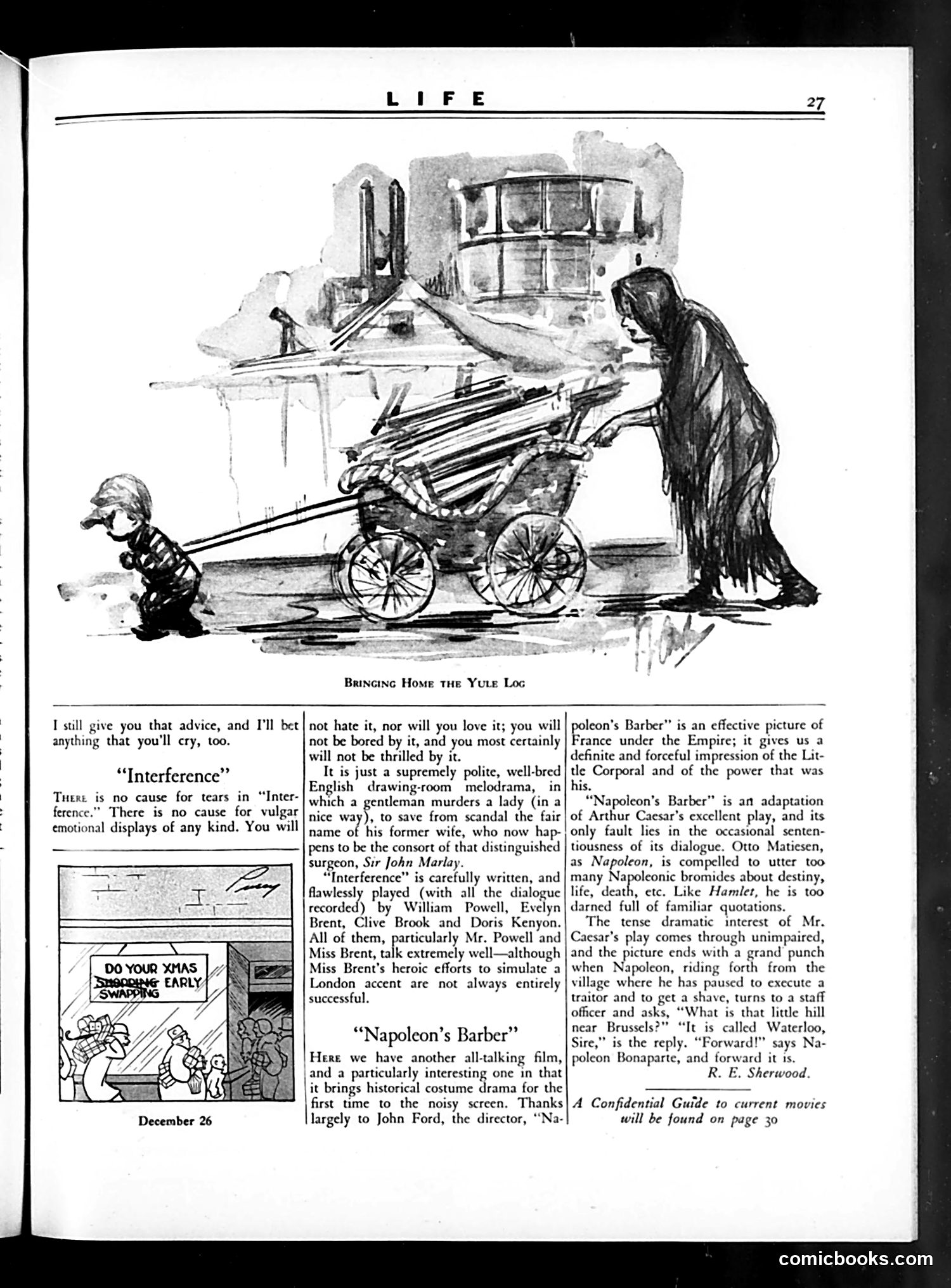
This page from Life magazine contains film reviews and a cartoon. The top illustration, "Bringing Home the Yule Log," depicts Death (a skeletal figure in dark robes) pushing a baby carriage containing a Yule log toward a house—a darkly humorous Christmas image playing on the season's associations with mortality and the "death" of the old year. Below are reviews of two early "talking pictures" (newly popular sound films). "Interference" is criticized as emotionally bland—polite but uninspiring drawing-room melodrama. "Napoleon's Barber," adapted from Arthur Caesar's play and directed by John Ford, is praised as an effective historical drama bringing costume drama to sound film, though faulted for overwrought dialogue about destiny. The review notes the dramatic irony: Napoleon asks about "that little hill near Brussels"—Waterloo, the site of his eventual defeat. The small comic strip dated "December 26" appears to advertise early Christmas shopping.
📄 Transcribed text from this page (OCR, searchable)
Machine-transcribed from the original scan — historical spelling and the odd misread are preserved.
I still give you that advice, and I'll bet anything that you'll cry, too. “Interference” There is no cause for tears in “Inter- ference.” There is no cause for vulgar emotional displays of any kind. You will December 26 Brincinc Home tHe Yue Loc not hate it, nor will you love it; you will not be bored by it, and you most certainly will not be thrilled by it. It is just a supremely polite, well-bred English drawing-room melodrama, in which a gentleman murders a lady (in a nice way), to save from scandal the fair name of his former wife, who now hap- pens to be the consort of that distinguished surgeon, Sir John Marlay. “Interference” is carefully written, and flawlessly played (with all the dialogue recorded) by William Powell, Evelyn Brent, Clive Brook and Doris Kenyon. All of them, particularly Mr. Powell and Miss Brent, ‘alk extremely well—although Miss Brent's heroic efforts to simulate a London accent are not always entirely successful. | “Napoleon’s Barber” Here we have another all-talking film, and a particularly interesting one in that it brings historical costume drama for the first time to the noisy screen. Thanks I largely to John Ford, the director, ‘‘Na- leon’s Barber" is an effective picture of rance under the Empire; it gives us a definite and forceful impression of the Lit- tle Corporal and of the power that was his. “Napoleon’s Barber” is an adaptation of Arthur Caesar's excellent play, and its only fault lies in the occasional senten- tiousness of its dialogue, Otto Matiesen, as Napoleon, is compelled to utter too many Napoleonic bromides about destiny, life, death, etc. Like Hamlet, he is too darned full of familiar quotations. The tense dramatic interest of Mr. Caesar's play comes through unimpaired, and the picture ends with a grand punch when Napoleon, riding forth from the village where he has paused to execute a traitor and to get a shave, turns to a staff officer and asks, “What is that little hill near Brussels?” “It is called Waterloo, Sire,” is the reply. “Forward!” says Na- poleon Bonaparte, and forward it 1s, R. E. Sherwood. A Confidential Guide to current movies will be found on page 30 comicbooks.com