
A complete issue · 36 pages · 1927
Life — December 22, 1927
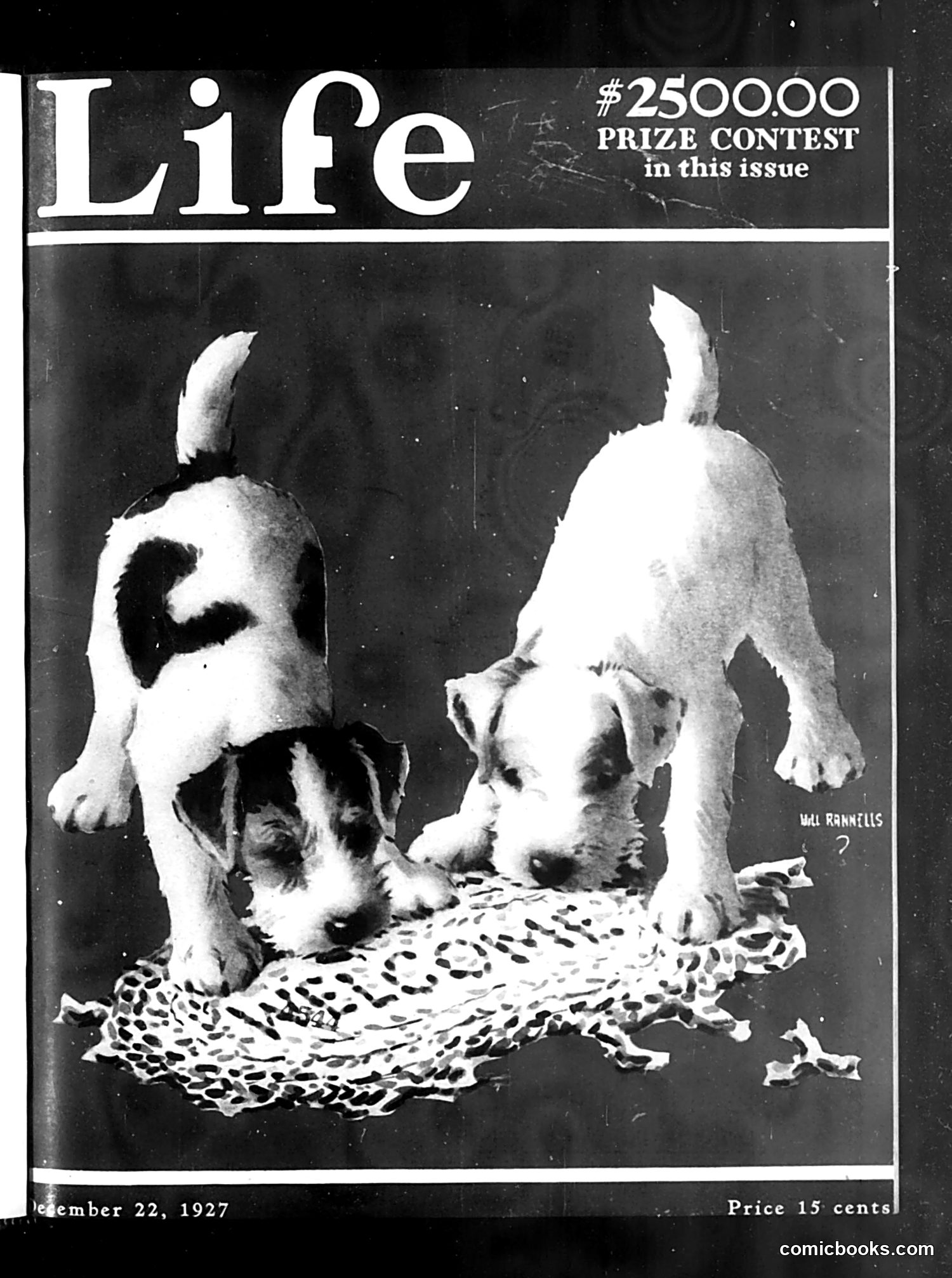
This cover features two dogs examining a patterned fish or net. The image appears to be a straightforward humorous illustration rather than political satire—simply depicting dogs investigating their catch, likely meant to amuse readers with the animals' curious behavior. The cover advertises a $250,000 prize contest within the issue, suggesting Life magazine was using substantial prizes to boost circulation during this period. At 15 cents, this represents typical magazine pricing of the late 1920s. The photographer credit reads "Will Rannells." Without additional context about that week's content, the specific topical reference—if any exists beyond simple animal humor—remains unclear from this cover alone.
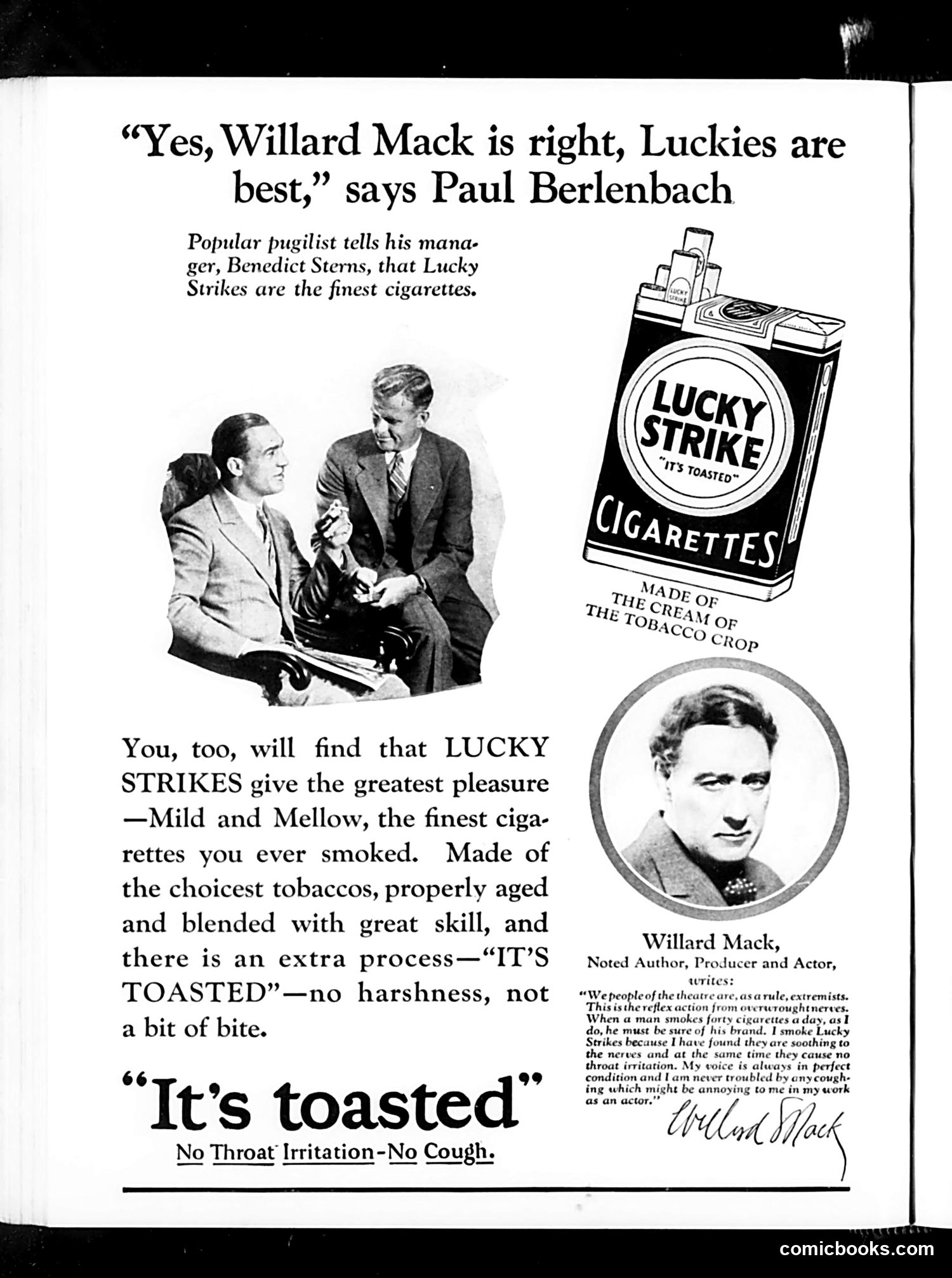
This is primarily a **Lucky Strike cigarette advertisement**, not political satire. The page endorses the brand by featuring: 1. **Willard Mack** (identified in the circular portrait) — a noted author, producer, and actor of the early 20th century — providing a celebrity testimonial claiming Lucky Strikes cause "No Throat Irritation—No Cough." 2. **The "It's Toasted" claim** — Lucky Strike's distinctive marketing slogan, emphasizing a special tobacco-processing method supposedly reducing harshness. 3. **A conversation scene** showing Mack discussing cigarettes with his manager, Benedict Sterns, presented as a casual endorsement. The advertisement exploits Mack's theatrical credibility to market cigarettes as throat-safe, a now-ironic health claim given modern tobacco science. This represents early-20th-century advertising's use of celebrity endorsements for tobacco products — practices now prohibited.
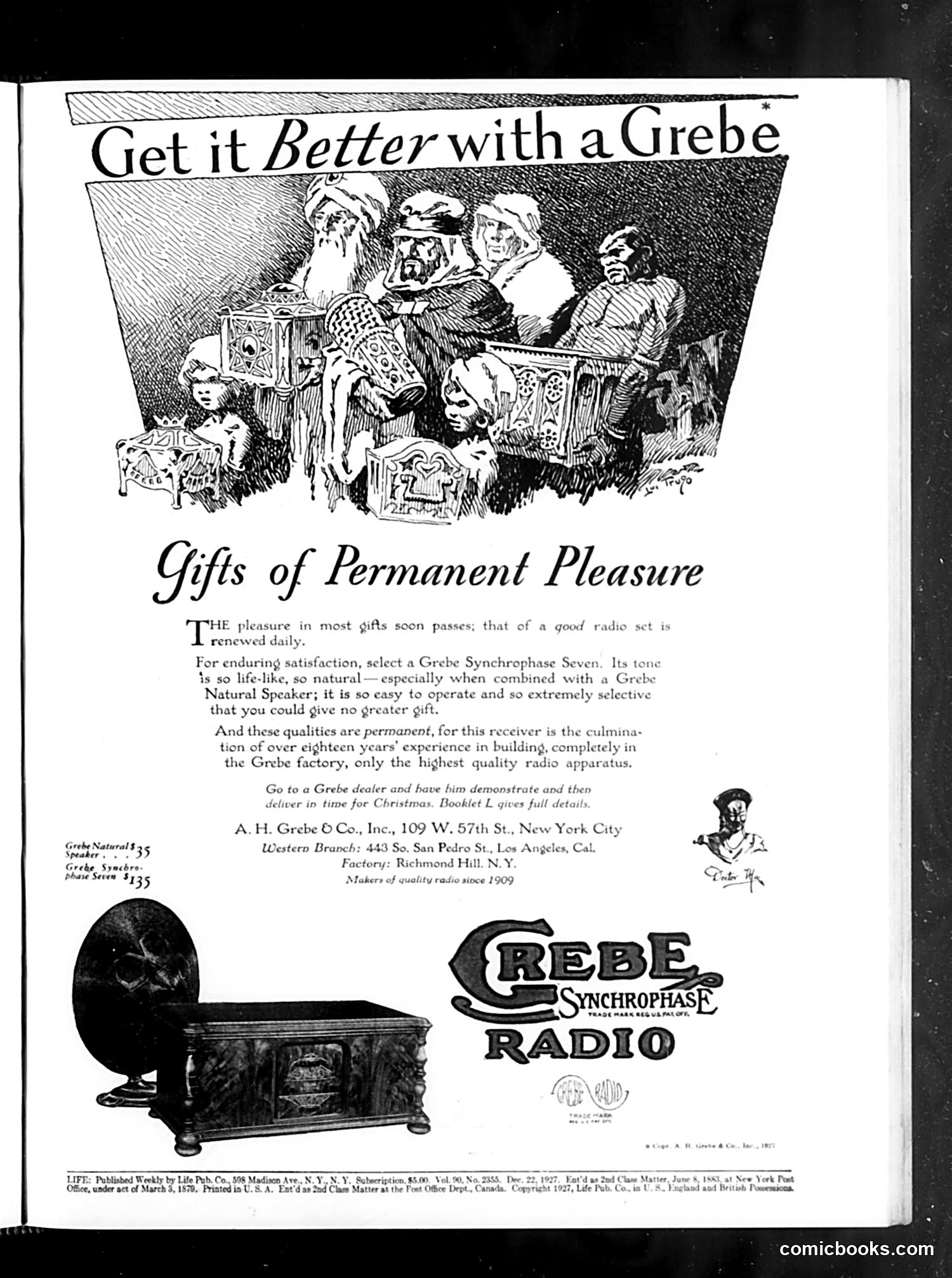
This page is primarily **advertising, not satire**. The headline "Get it Better with a Grebe" promotes the Grebe Synchrophase Seven radio receiver as a Christmas gift. The illustration at top depicts what appears to be **caricatured figures from various nationalities or stereotypes** gathered around ornate furniture—possibly suggesting the radio's universal appeal or international sophistication. However, the specific identities of these caricatures are **unclear without additional context**. The ad emphasizes the radio's superior tone quality and ease of operation, positioning it as a "gift of permanent pleasure" (unlike gifts whose appeal fades). The accompanying product photo shows an ornate wooden radio console with a large external speaker. This is a straightforward vintage product advertisement typical of 1920s Life magazine, not a political or social satire piece.
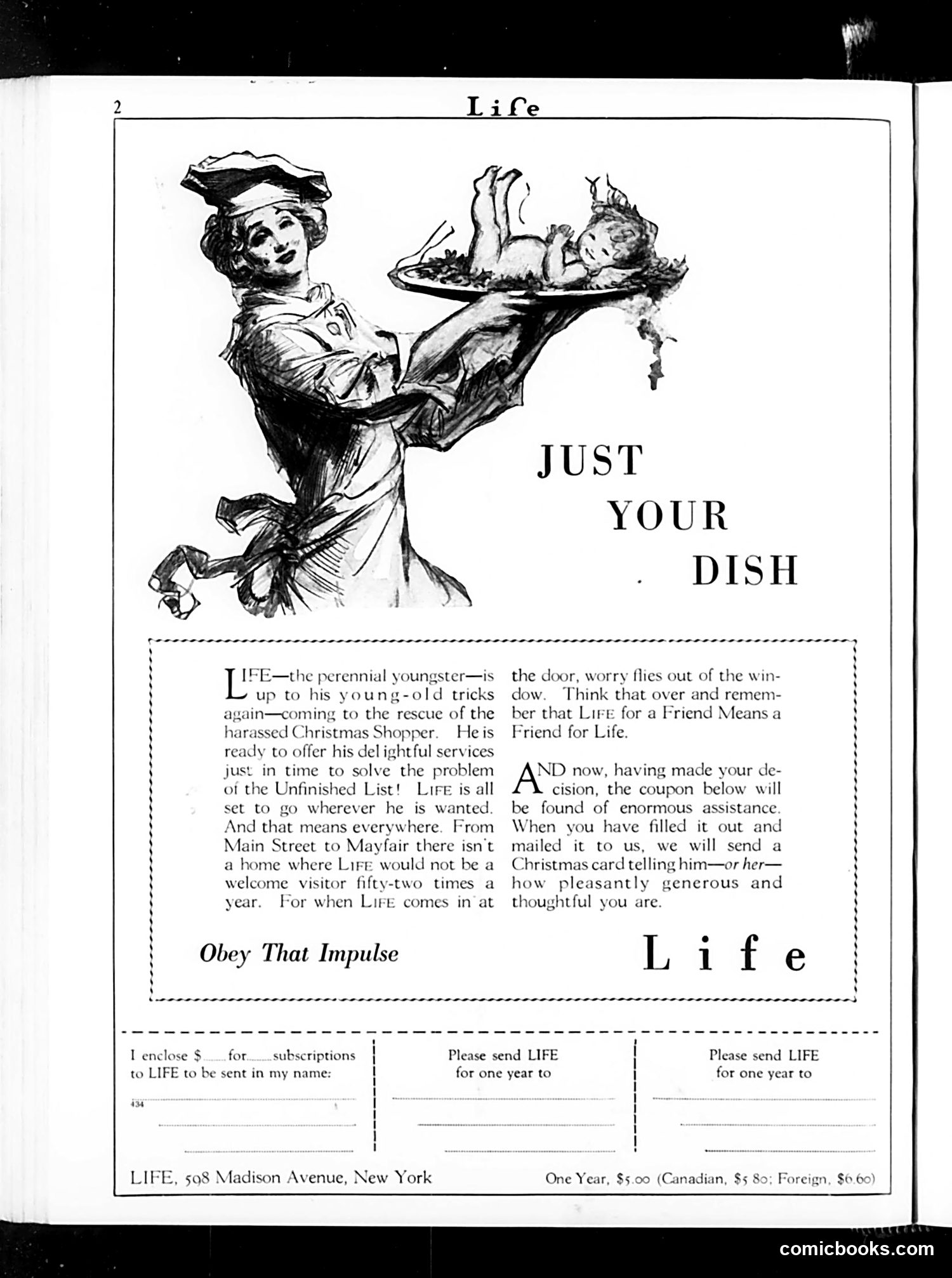
This is a **subscription advertisement** for *Life* magazine, not political commentary. The illustration shows a cheerful waiter or server character carrying a dish, with the tagline "Just Your Dish." The ad uses playful language comparing *Life* magazine to a helpful service. It describes *Life* as "the perennial youngster" ready to solve Christmas shopping problems and assist year-round. The copy suggests subscribing to *Life* as a thoughtful gift. The visual pun equates reading the magazine with being "served" entertainment—matching the server imagery. This is straightforward early 20th-century advertising humor, using a familiar service-industry figure to make magazine subscriptions seem appealing and accessible. The coupon at bottom allowed readers to purchase annual subscriptions ($5.00 domestically).
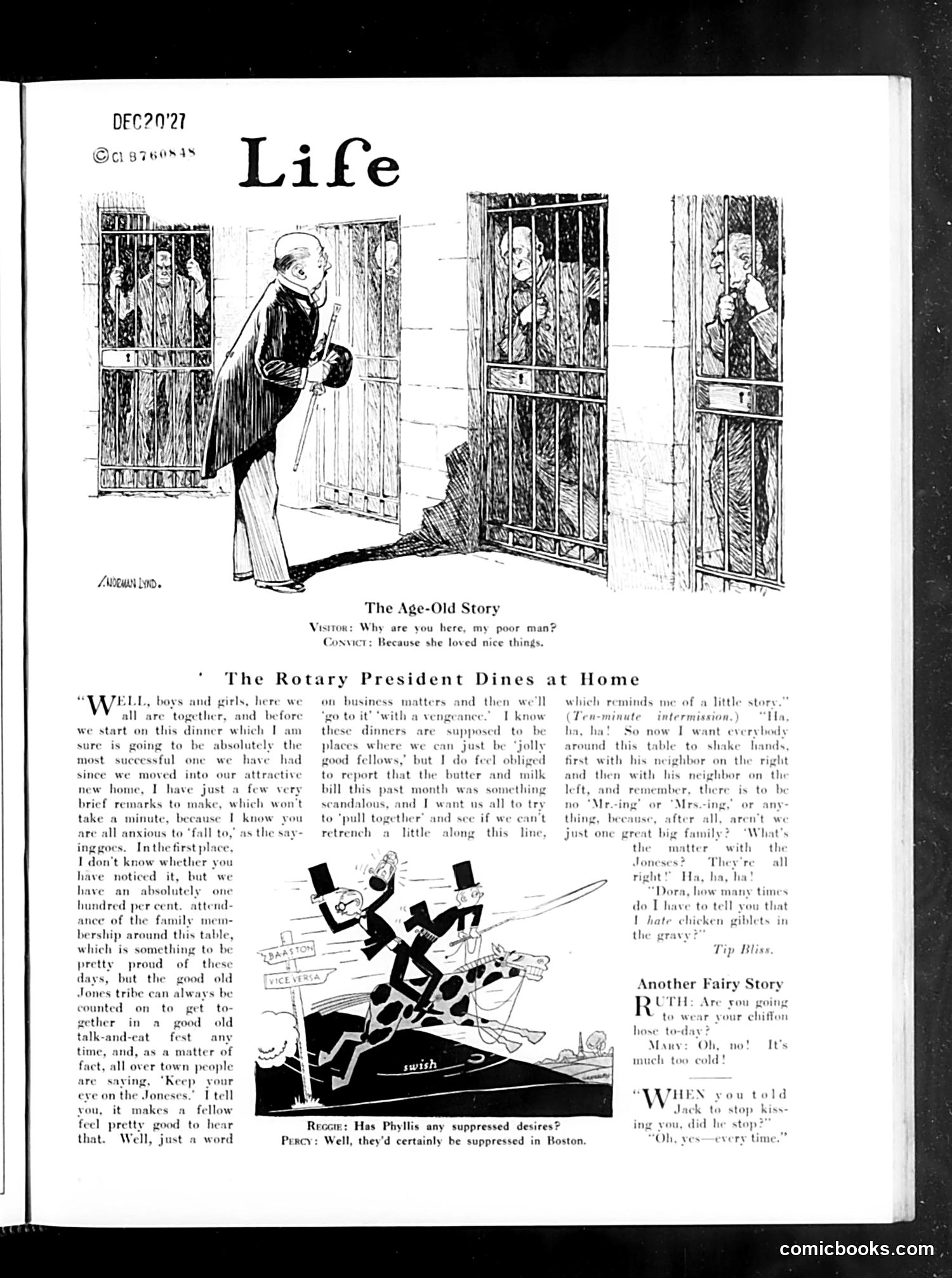
This page contains three separate humorous pieces typical of Life's satirical approach: 1. **"The Age-Old Story"**: A visual joke about a man visiting a prison, with the caption explaining he's there "Because she loved nice things"—satirizing women's materialism and consumerism as a cause of male criminality. 2. **"The Rotary President Dines at Home"**: A longer satirical article mocking civic organizations like Rotary Club, portraying their members as self-important while neglecting family duties. The illustration shows men in formal wear in chaotic disorder, suggesting the pretension versus reality gap. 3. **"Another Fairy Story"**: Brief humorous exchanges about a woman's chiffon hose and a man named Jack, playing on period romance tropes. The overall tone reflects 1920s social satire targeting class pretension, consumer culture, and gender stereotypes.
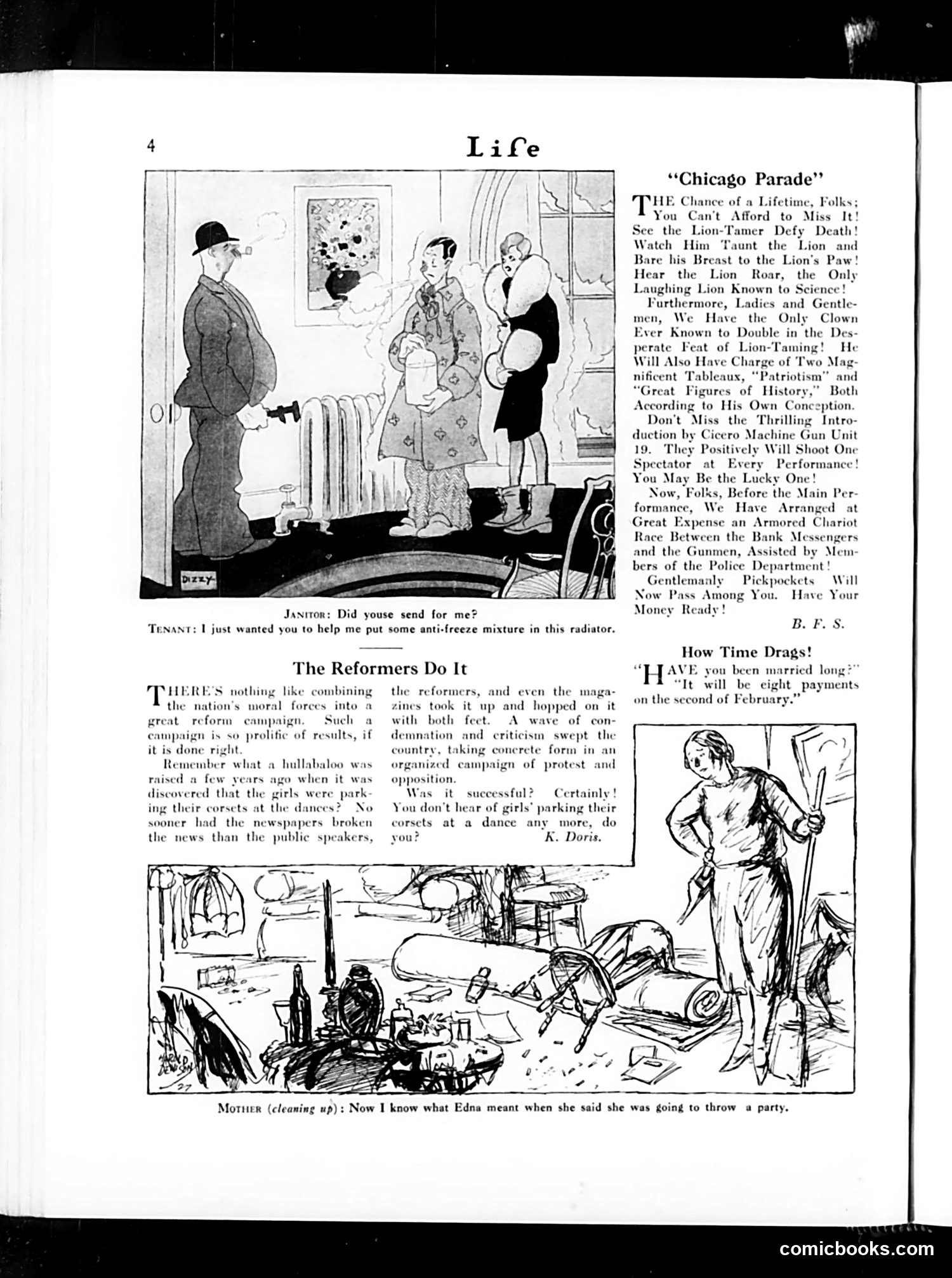
**Top Cartoon ("Chicago Parade"):** This appears to be a satirical advertisement for a circus-style spectacle featuring a lion-tamer. The text mocks the sensationalism by listing increasingly absurd attractions (clown, machine-gun demonstrations, chariot races, pickpockets). The joke critiques how "reformers" and moral crusaders promote their campaigns through spectacular public displays rather than substantive change. **Middle Section ("The Reformers Do It"):** Commentary on a past moral reform campaign (likely anti-corset activism), noting that reformers successfully generated public outrage through newspapers and public speakers, changing social behavior—in this case, eliminating corsets at dances. **Bottom Cartoon ("How Time Drags!"):** A domestic humor joke about a newlywed wife whose marriage contract requires eight payments, with a messy home scene implying marital discord.
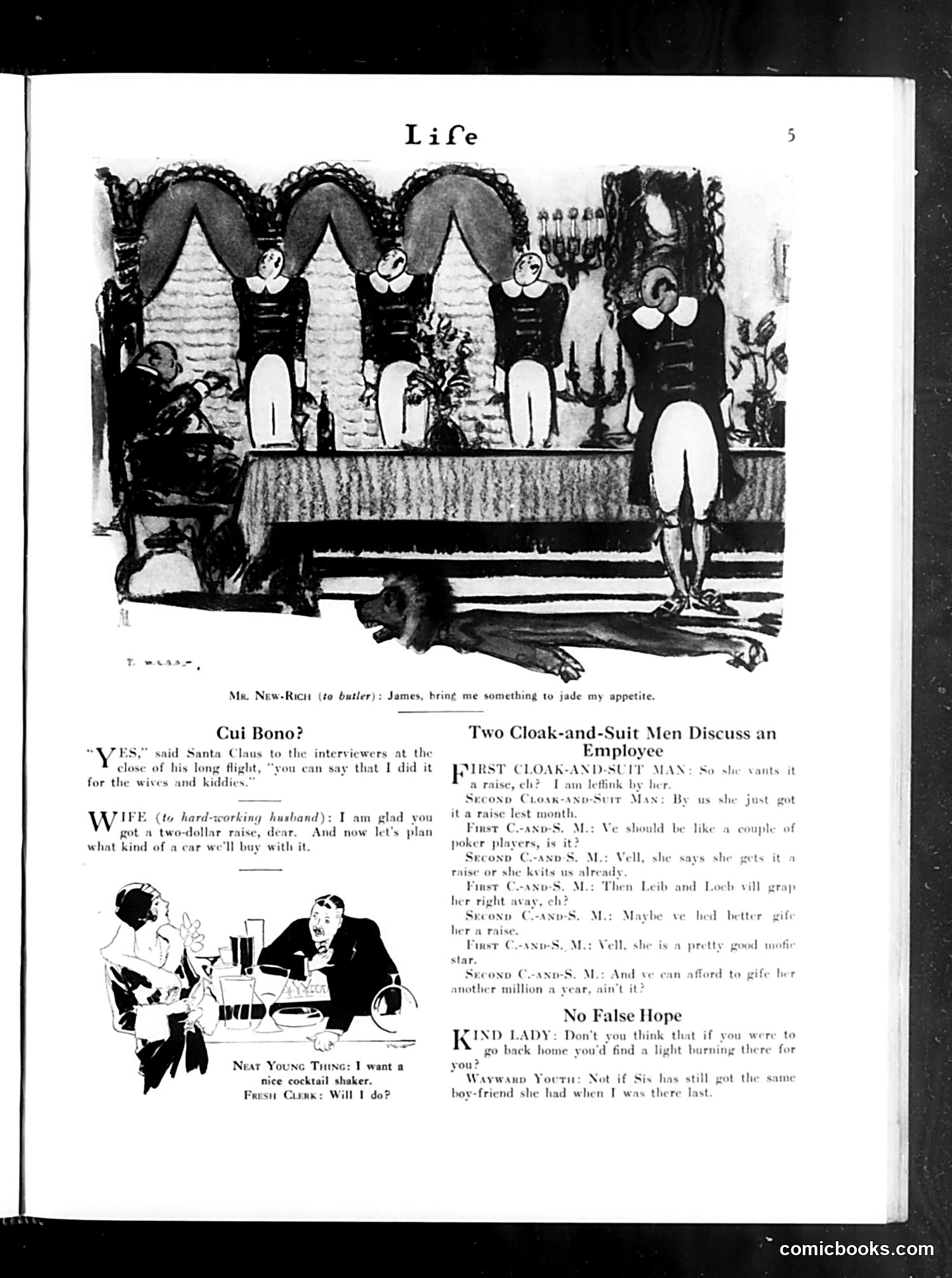
This page contains three separate satirical pieces mocking gender relations and economic inequality in the early 20th century. The top cartoon depicts what appears to be a wealthy man at an entertainment venue (possibly a cabaret or theater) requesting food while surrounded by showgirls, captioned "Cui Bono?" ("Who benefits?")—suggesting wealthy men enjoyed luxuries while others struggled. Below, "Two Cloak-and-Suit Men Discuss an Employee" satirizes wealthy businessmen debating whether to give their female employee a raise, with one suggesting they already pay her enough. "No False Hope" shows a dialogue between a young woman and an older man, where he discourages her romantic expectations, implying her previous boyfriend has moved on. All three pieces critique class disparities and romantic/economic inequality between genders during this era.
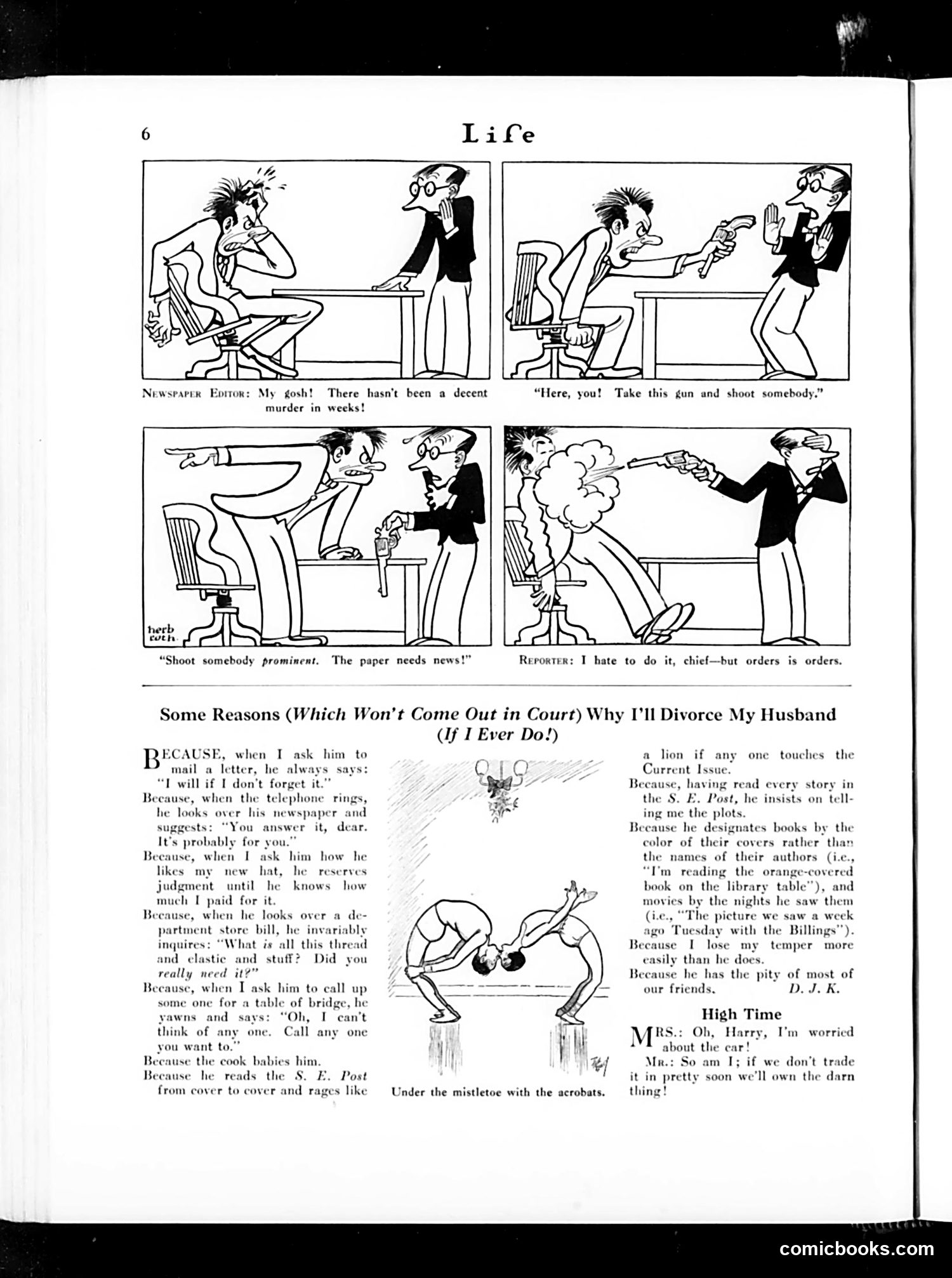
The top section is a four-panel comic about a newspaper editor pressuring a reporter to commit violence for sensational news. The editor orders the reporter to "shoot somebody" to generate headlines, saying "the paper needs news." When the reporter reluctantly obeys (shown by the explosion), the editor criticizes him for not shooting someone "prominent" enough. This satirizes the ruthless sensationalism of early 20th-century newspaper competition—editors' desperate pursuit of shocking stories regardless of ethics. The lower section humorously lists reasons a wife might divorce her husband, including his newspaper obsession, poor taste in clothing, and controlling behavior. The final item, "High Time," depicts marital discord over trading in their car. The overall page mocks both journalistic excess and domestic frustrations of the era.
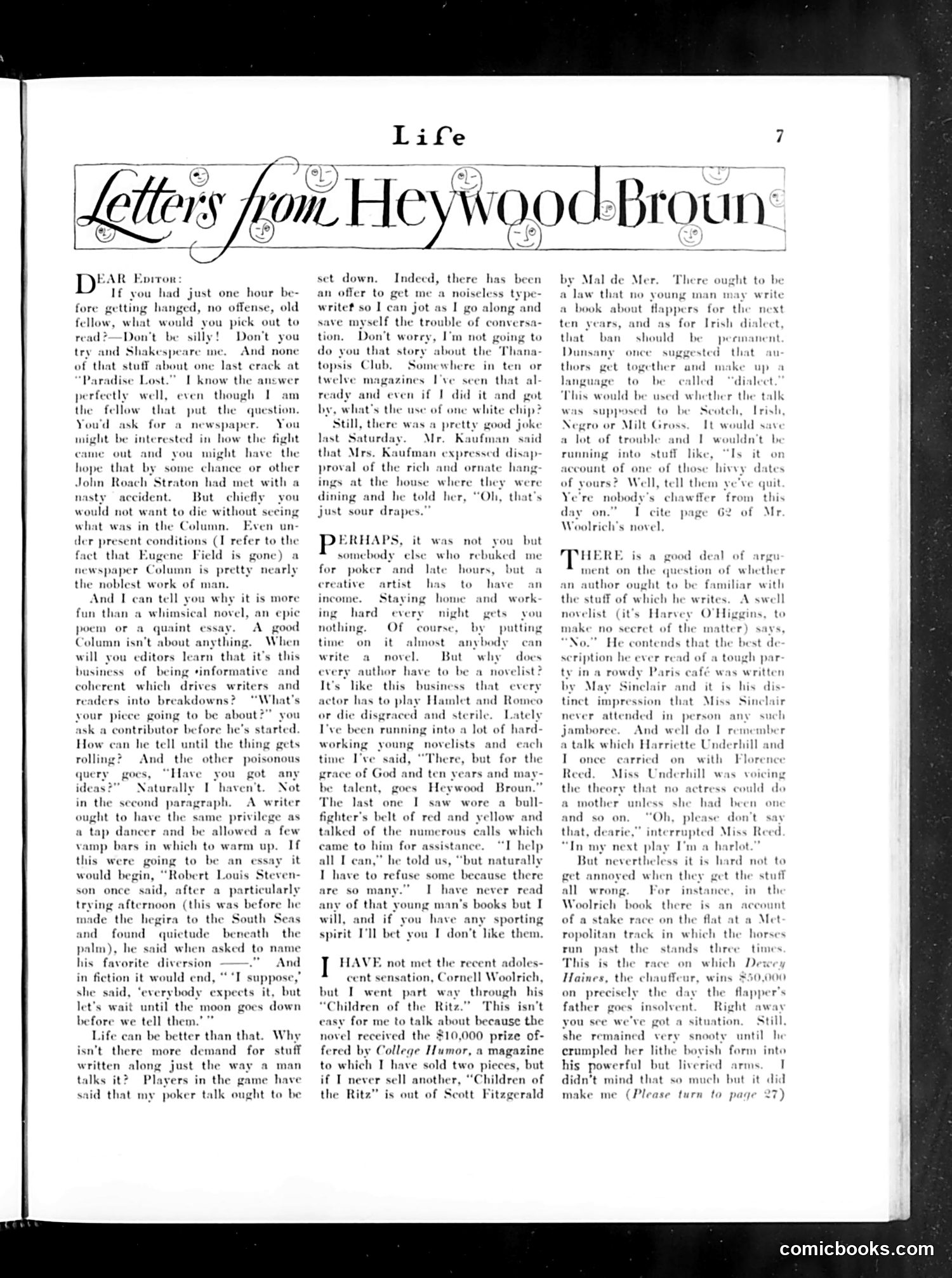
This page contains **"Letters from Heywood Broun,"** a satirical column rather than a political cartoon. Broun was a prominent American journalist and humorist. The column discusses: - Writing for newspapers versus novels - The absurdity of author expectations (referencing actors playing Hamlet) - A anecdote about a boxer's red/yellow belt and a fight - Cornell Woolrich's "Children of the Ritz" (a magazine story Broun sold) - A racehorse named **Dervey Haines** that won $50,000 The humor is literary and observational rather than overtly political—Broun critiques writing conventions, pokes fun at novelists' pretensions, and shares amusing anecdotes. The page demonstrates Life's focus on witty social commentary targeting educated readers familiar with contemporary authors and entertainment figures.
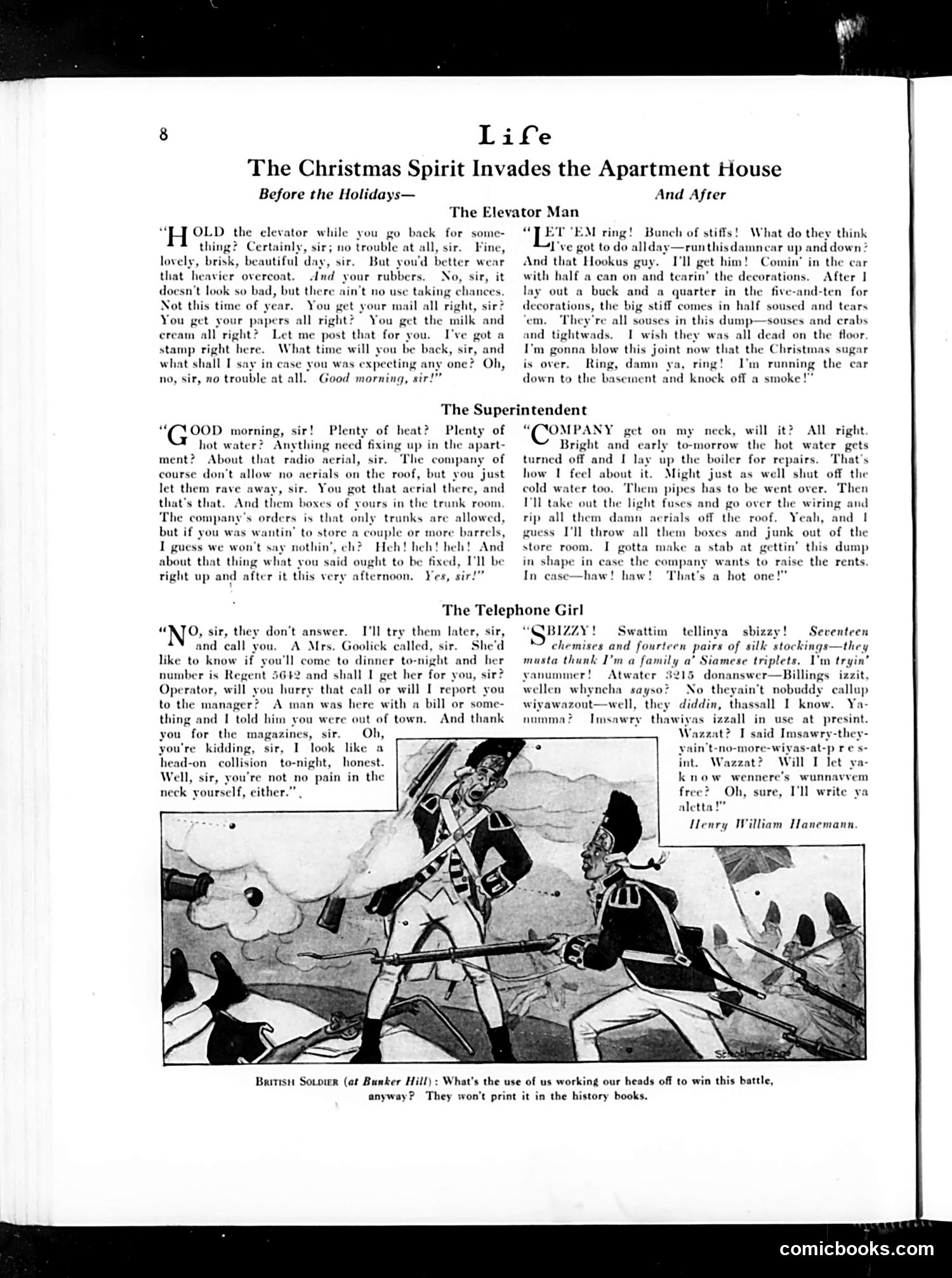
This page satirizes apartment-building staff during the Christmas season. Three workplace monologues appear: **The Elevator Man** complains about holiday decorations cluttering the building and residents' demands. **The Superintendent** grumbles about tenants storing items and general maintenance chaos. **The Telephone Girl** speaks in exaggerated, rapid-fire gibberish—a comedic stereotype of switchboard operators handling holiday call volume. The illustration shows soldiers in what appears to be WWI combat, with a caption joking that their battlefield efforts won't be recorded in history books. The humor targets working-class apartment workers' frustrations during the hectic Christmas period, using their vernacular speech and complaints as comedy. The page contrasts domestic holiday chaos with wartime struggles.
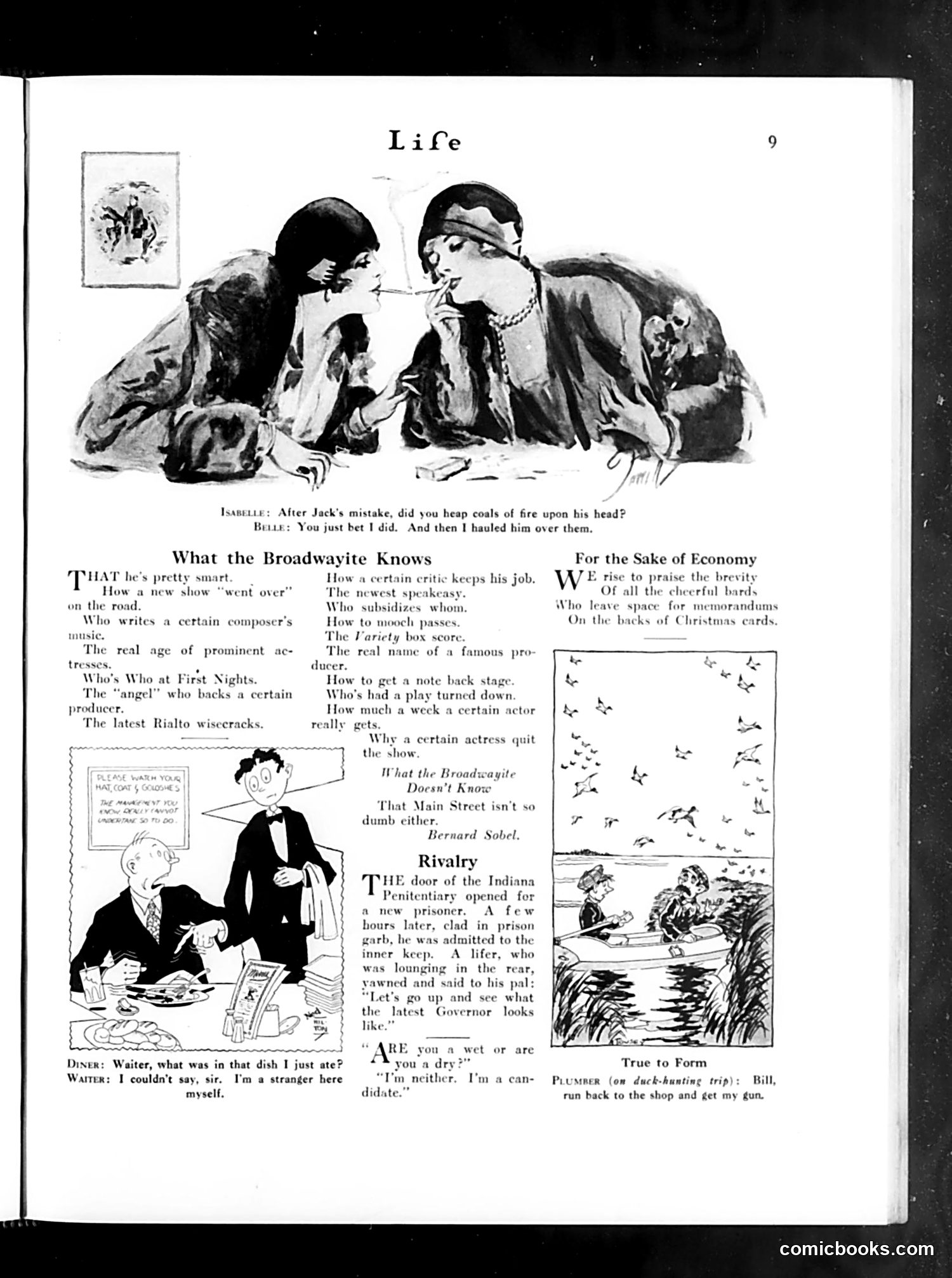
This page contains several satirical pieces targeting early 20th-century American society: **Top cartoon**: Shows two women gossiping. "Isabelle" brags about pouring "coals of fire" on someone named Jack's head after he made a mistake—violent retaliation presented as casual female behavior. **"What the Broadwayite Knows"**: A satirical list mocking theater world insiders' pretentious knowledge—critics, flops, backstage gossip, and actress scandals—suggesting Broadway society is superficial and focused on trivial scandals rather than genuine theater. **Diner cartoon**: A waiter cannot identify a mystery dish he's served, admitting ignorance to a stranger—satirizing restaurant quality or worker incompetence. **"Rivalry" section**: Features an anecdote about prison inmates, likely political satire about gubernatorial elections or prison conditions, though context is unclear. The overall tone mocks urban sophistication, theatrical pretension, and institutional failures.
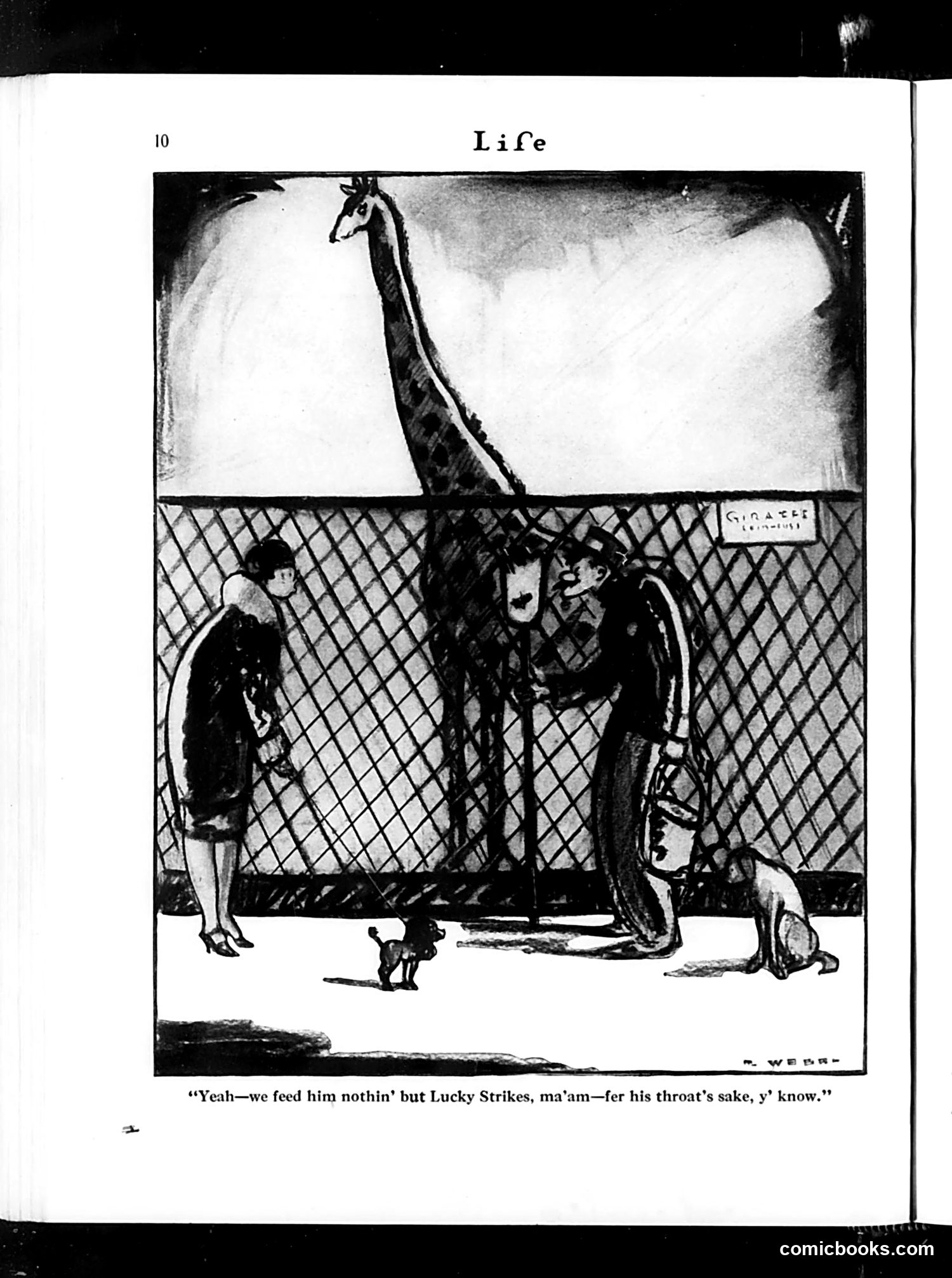
This single-panel cartoon by Webb depicts two elegantly dressed women viewing a giraffe behind a mesh enclosure, likely at a zoo. One woman explains they feed the animal "nothin' but Lucky Strikes" for "his throat's sake." This is an advertisement disguised as humor, promoting Lucky Strike cigarettes. The joke relies on the period's widespread cigarette marketing claims about throat health—a common advertising pitch before tobacco's dangers were widely acknowledged. The giraffe's notably long neck is the visual punchline, suggesting the product extends or benefits the throat. The cartoon satirizes both extravagant wealth (keeping exotic animals) and the absurdity of health claims made by tobacco companies in the early-to-mid 20th century.
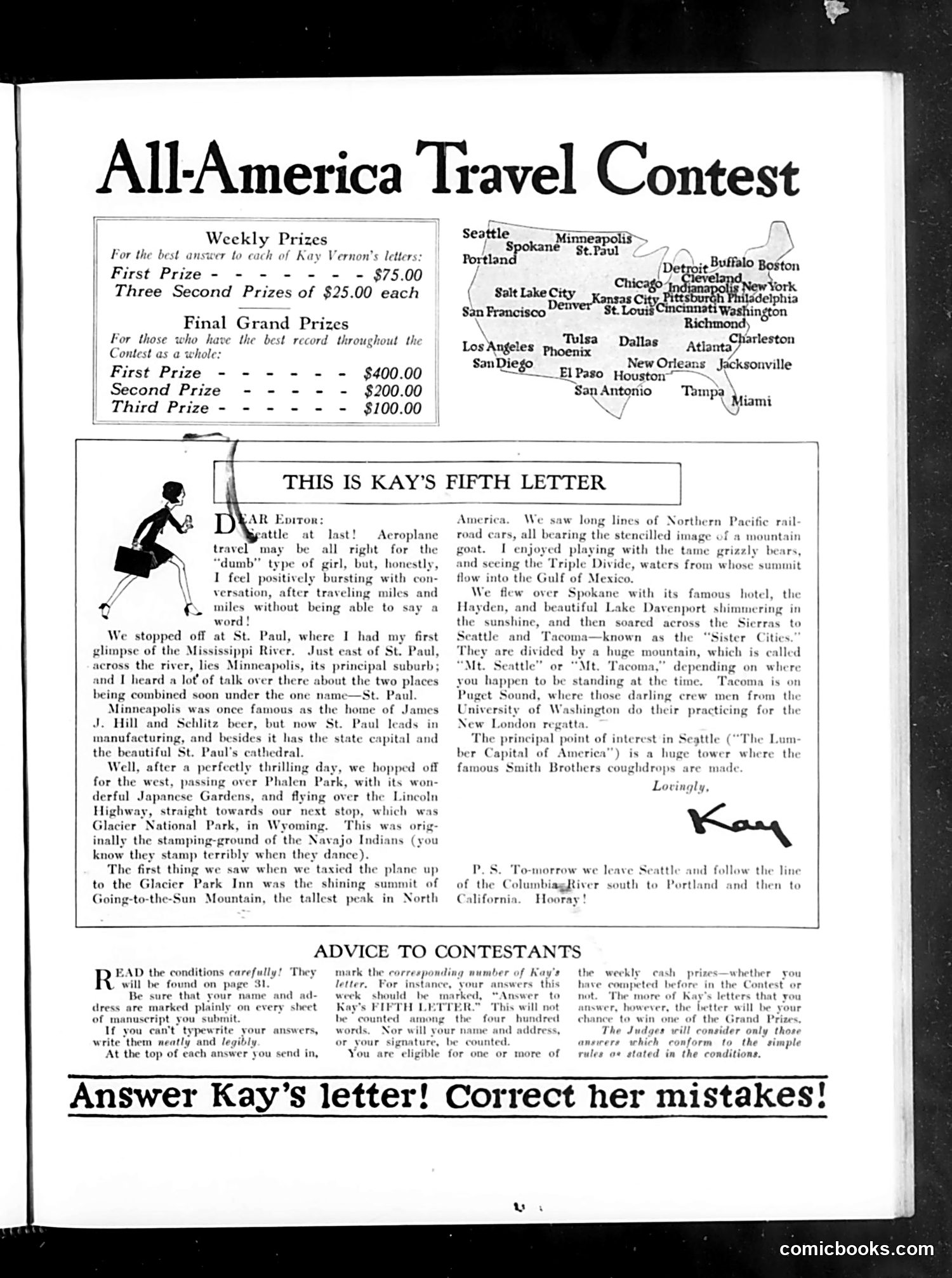
This page presents a reader-participation contest, not a political cartoon. The content consists of: **Contest Structure:** Readers answer questions based on letters from "Kay," who describes traveling across America. Weekly prizes ($75 for first place, $25 for second) and grand prizes ($400, $200, $100) are offered. **Kay's Fifth Letter:** Shows a young woman (illustrated on the left) describing travel experiences through the Pacific Northwest—Seattle, Tacoma, Spokane, and mentions of Glacier National Park and the Columbia River. She discusses local landmarks like the Smith Tower and observations about the region. **Purpose:** This is an educational geography game disguised as entertainment, encouraging readers to learn about American geography and cities while competing for cash prizes—a common magazine engagement tactic of the era.
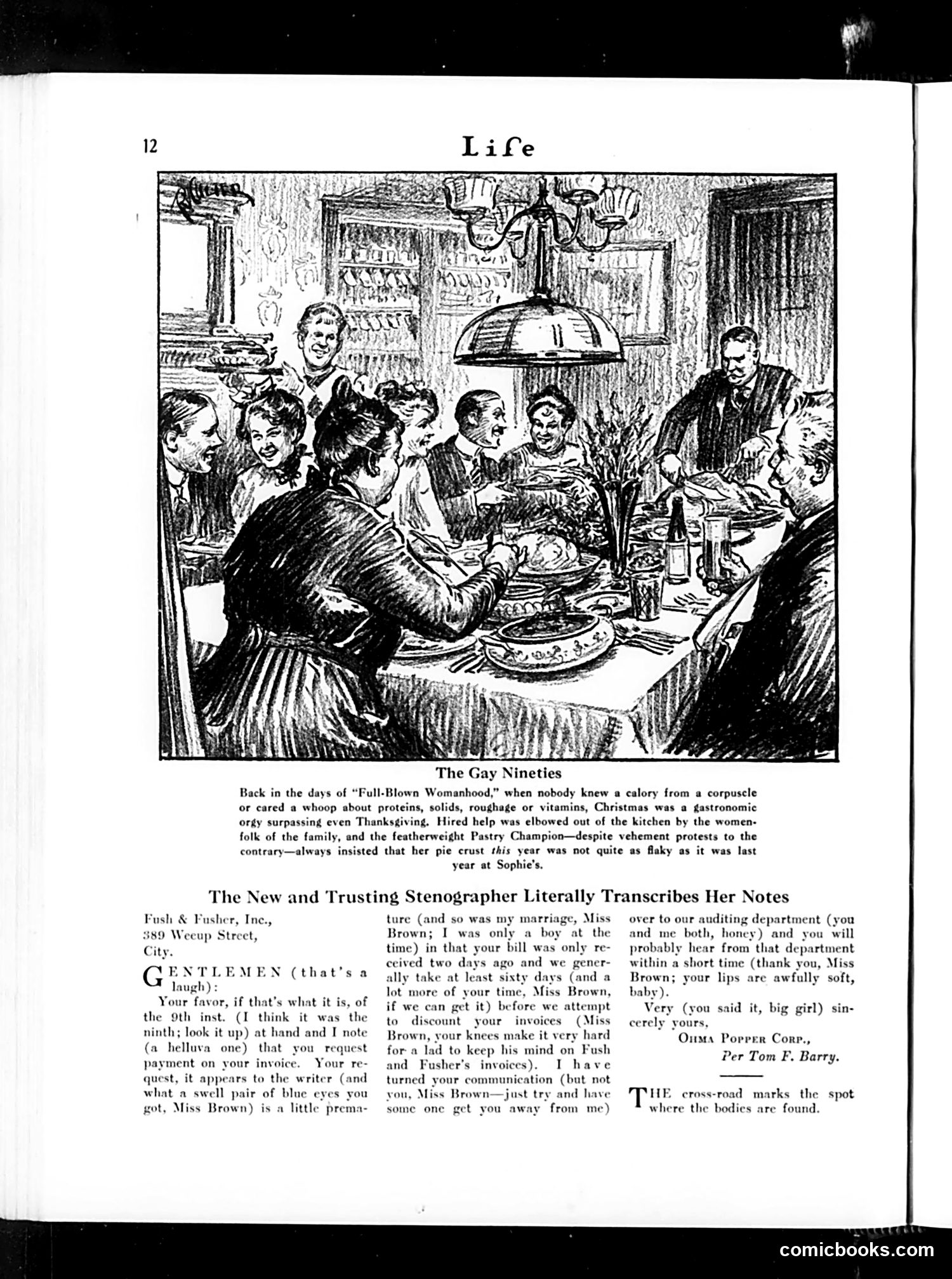
The main illustration titled "The Gay Nineties" is nostalgic satire. It depicts an elegant 1890s dinner party with well-dressed guests, accompanied by text mocking that era's ignorance about nutrition. The caption explains that people then knew nothing about "calories," "proteins, solids, roughage or vitamins"—concepts that had become common knowledge by Life's publication date (unclear when, but post-1920s). The page's secondary content features a humorous stenographer's letter transcribing her boss's dictation, with romantic banter and workplace flirtation. It satirizes both office dynamics and the stenographer's literal, sometimes confused transcription of his words. The advertisements below target middle-class readers with business services and products.
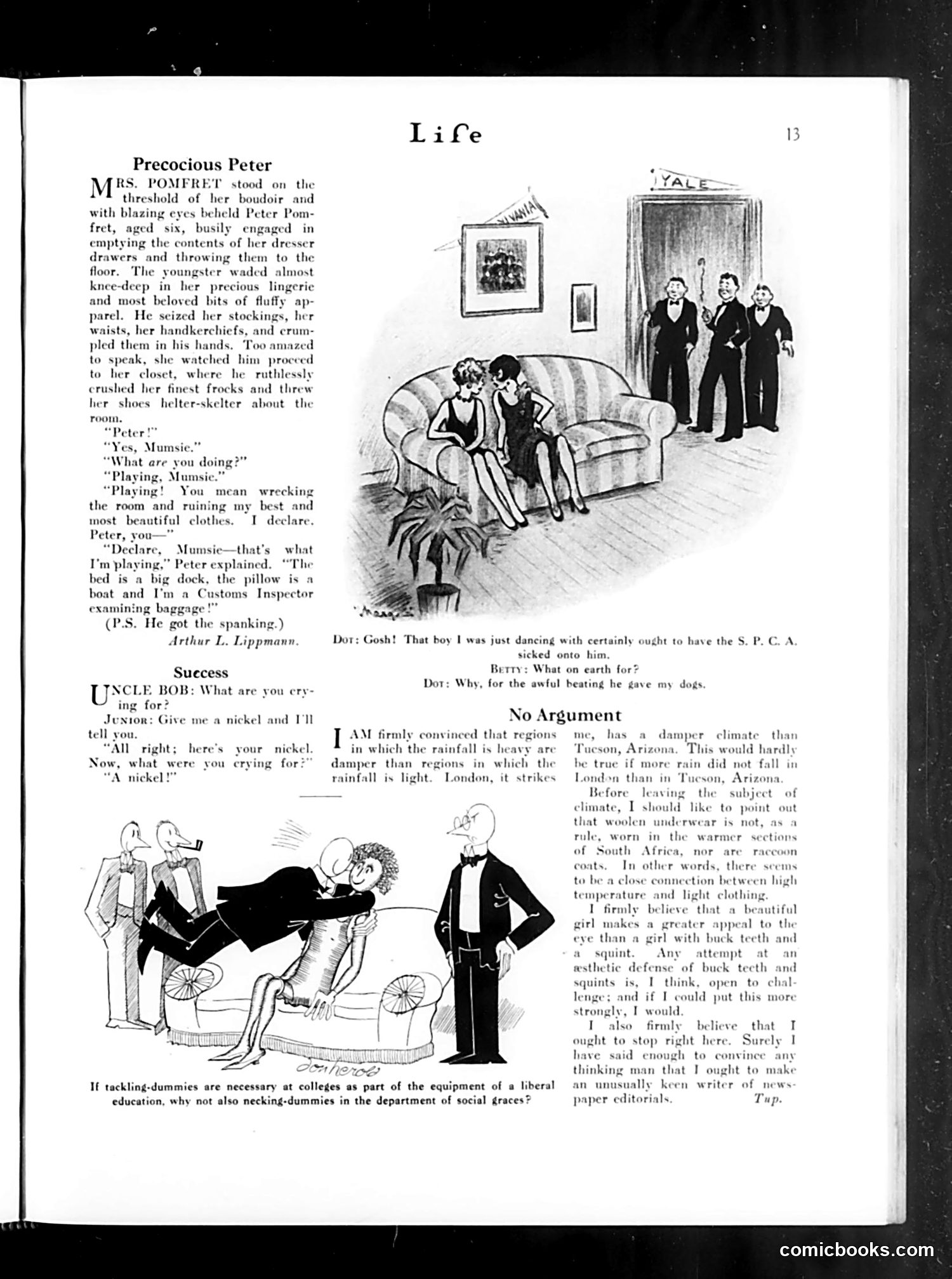
This page contains three humor pieces satirizing early 20th-century social norms: **"Precocious Peter"** mocks a young boy who destroys his mother's belongings while playing "Customs Inspector"—satirizing both childish destructiveness and perhaps the era's bureaucratic attitudes. **"Success"** shows a child crying over losing a nickel, mocking juvenile sentimentality about money. **"No Argument"** is an essay defending buck teeth and light clothing as aesthetically preferable—likely ironic commentary on beauty standards and regional climate debates of the period. The author argues against conventional preferences for specific fashion and dental aesthetics. The cartoons employ exaggerated situations and contrarian arguments typical of Life's satirical style, targeting middle-class manners, parental indulgence, and arbitrary social conventions.
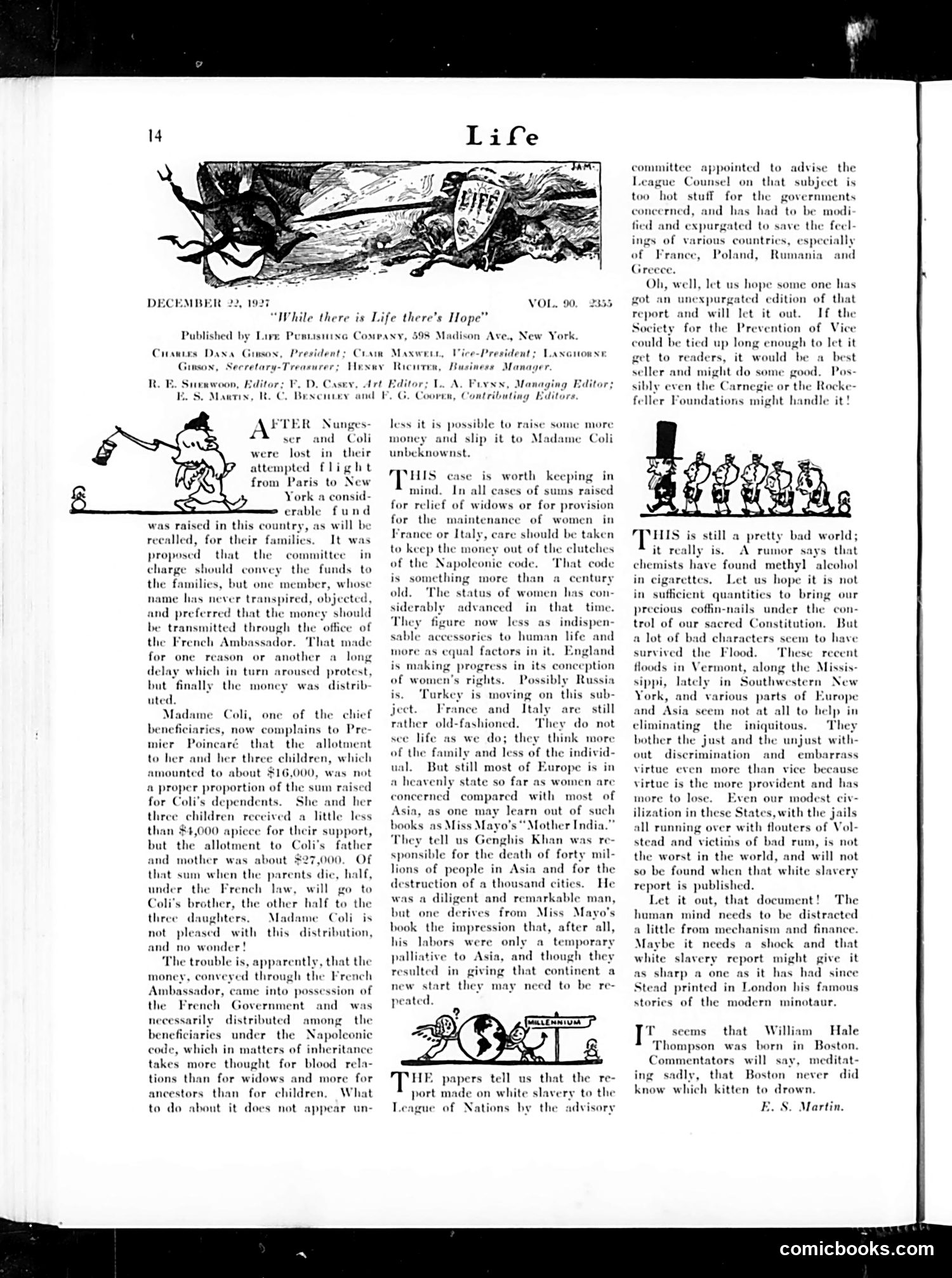
The page contains editorial commentary about post-WWI relief efforts, particularly regarding displaced persons from Paris to New York. The cartoons appear satirical about charity distribution and government bureaucracy. One illustration shows figures in top hats (representing wealthy donors or government officials) seemingly dismissing or ignoring pleas for aid—a common motif critiquing the wealthy's indifference to suffering. The text discusses how relief funds for war widows and displaced persons were being mishandled, with money potentially diverted or remaining stuck in bureaucratic channels rather than reaching intended beneficiaries. The author criticizes the inefficiency of charitable administration and calls for more transparent fund distribution. The satire targets both governmental incompetence and the moral failings of wealthy nations to properly aid those devastated by World War I.
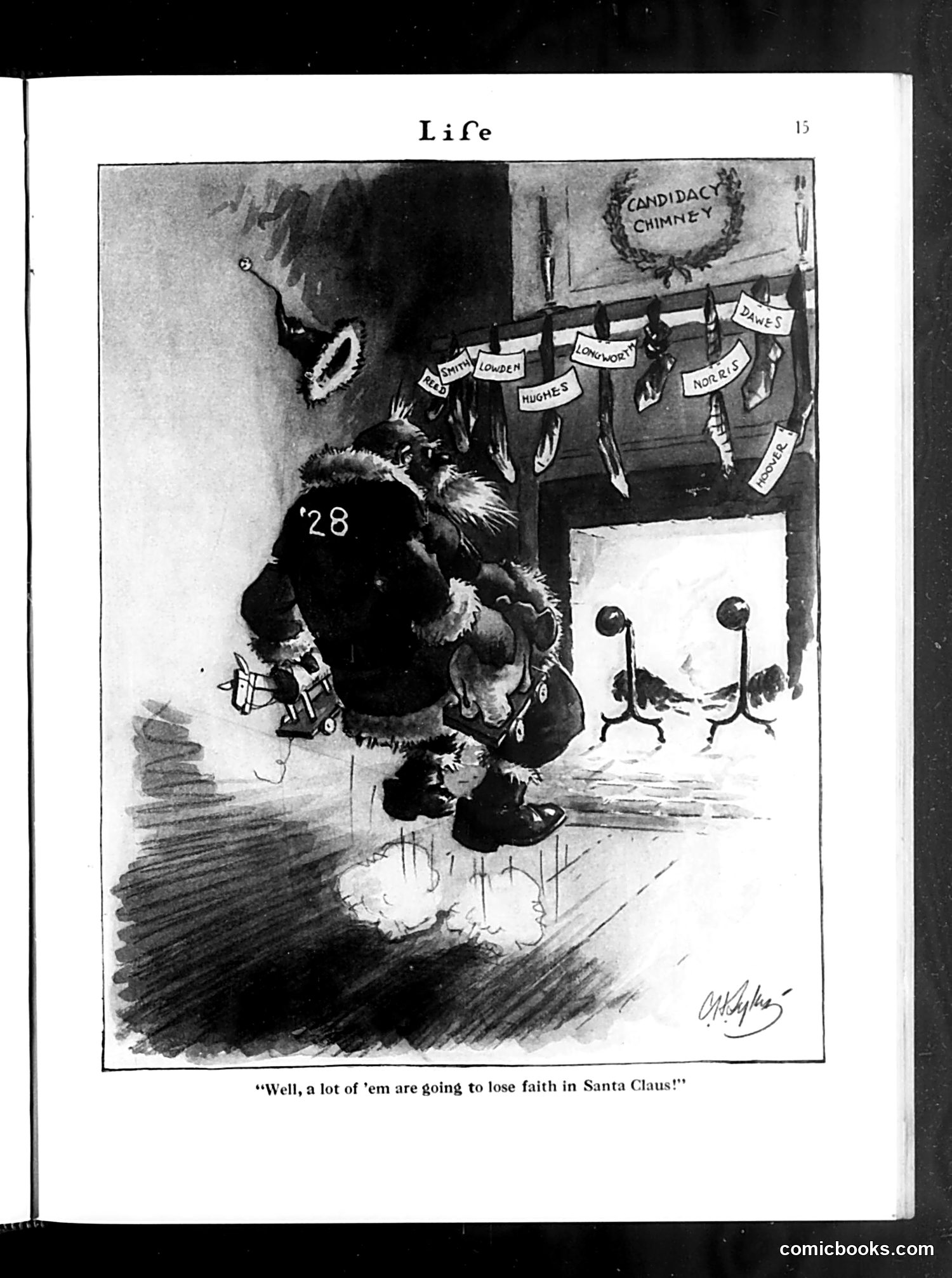
This is a satirical cartoon from Life magazine (page 15) depicting a dog examining stockings hung above a fireplace labeled "Candidacy Chimney." The stockings bear names of what appear to be political candidates or public figures: Smith, Lowden, Hughes, Daugherty, Dawes, Norris, and others. The caption reads: "Well, a lot of 'em are going to lose faith in Santa Claus!" The cartoon satirizes American politics, likely from the 1920s era (note the "'28" marking). It uses Christmas imagery to mock presidential or political aspirants—suggesting numerous candidates are hoping to be "chosen" (like Santa choosing worthy children), but many will be disappointed. The joke criticizes the false hopes and inevitable disappointments inherent in competitive electoral politics.
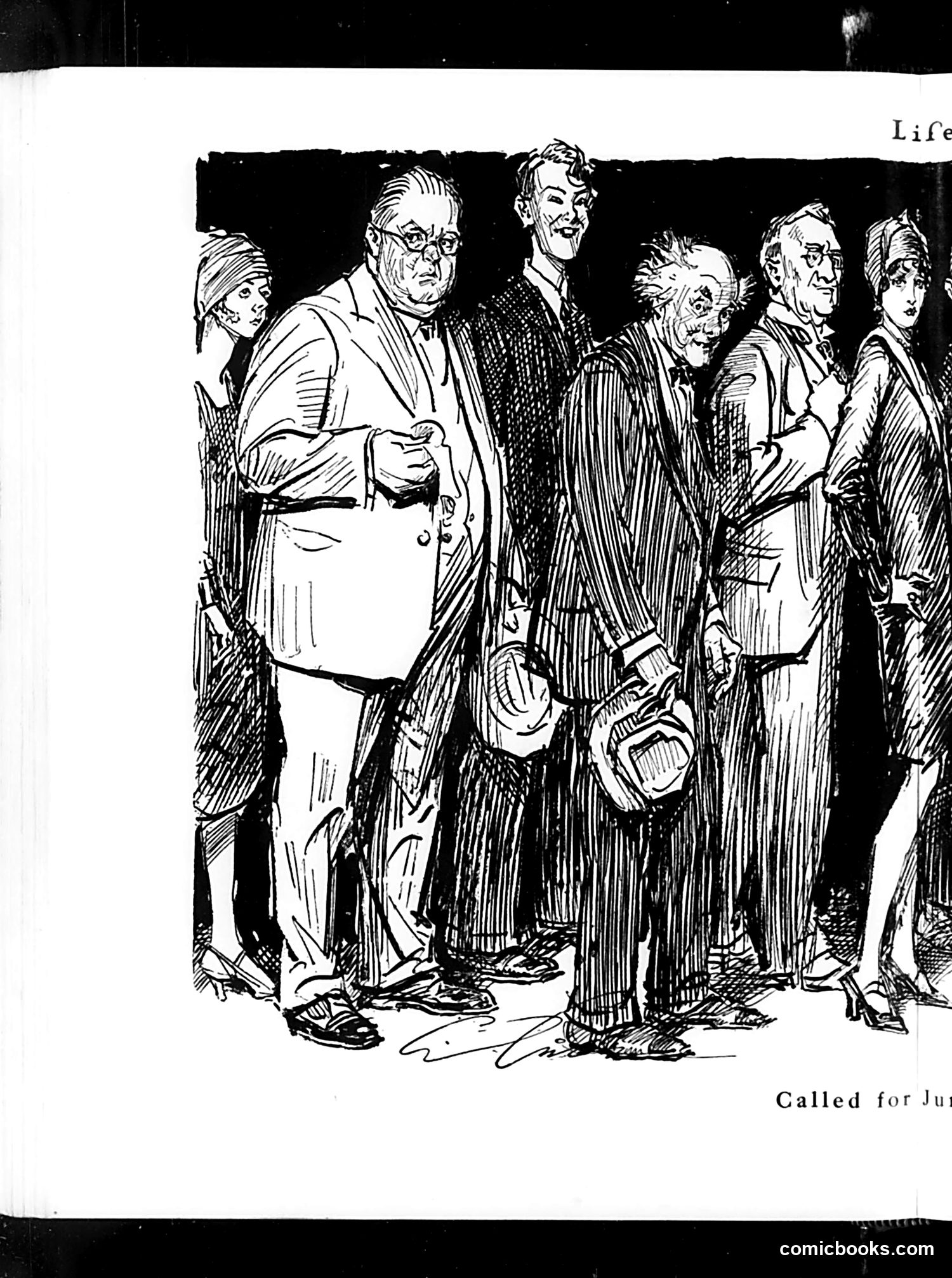
This appears to be a political cartoon from *Life* magazine depicting a group of people "Called for Ju[ry]" (text cut off at bottom). The sketch shows approximately eight figures in early 20th-century dress standing together, rendered in distinctive pen-and-ink crosshatching style. The satire likely concerns jury selection or jury duty—a civic obligation that was often satirized in American humor of the era. The diverse group of figures, with varying expressions and physical types, suggests commentary on who comprises juries or perhaps the reluctance/reactions of ordinary citizens summoned for jury service. Without the complete caption or additional context, the specific target of the satire—whether it mocks jurors themselves, the legal system, or social attitudes toward civic duty—remains unclear from the visible text alone.
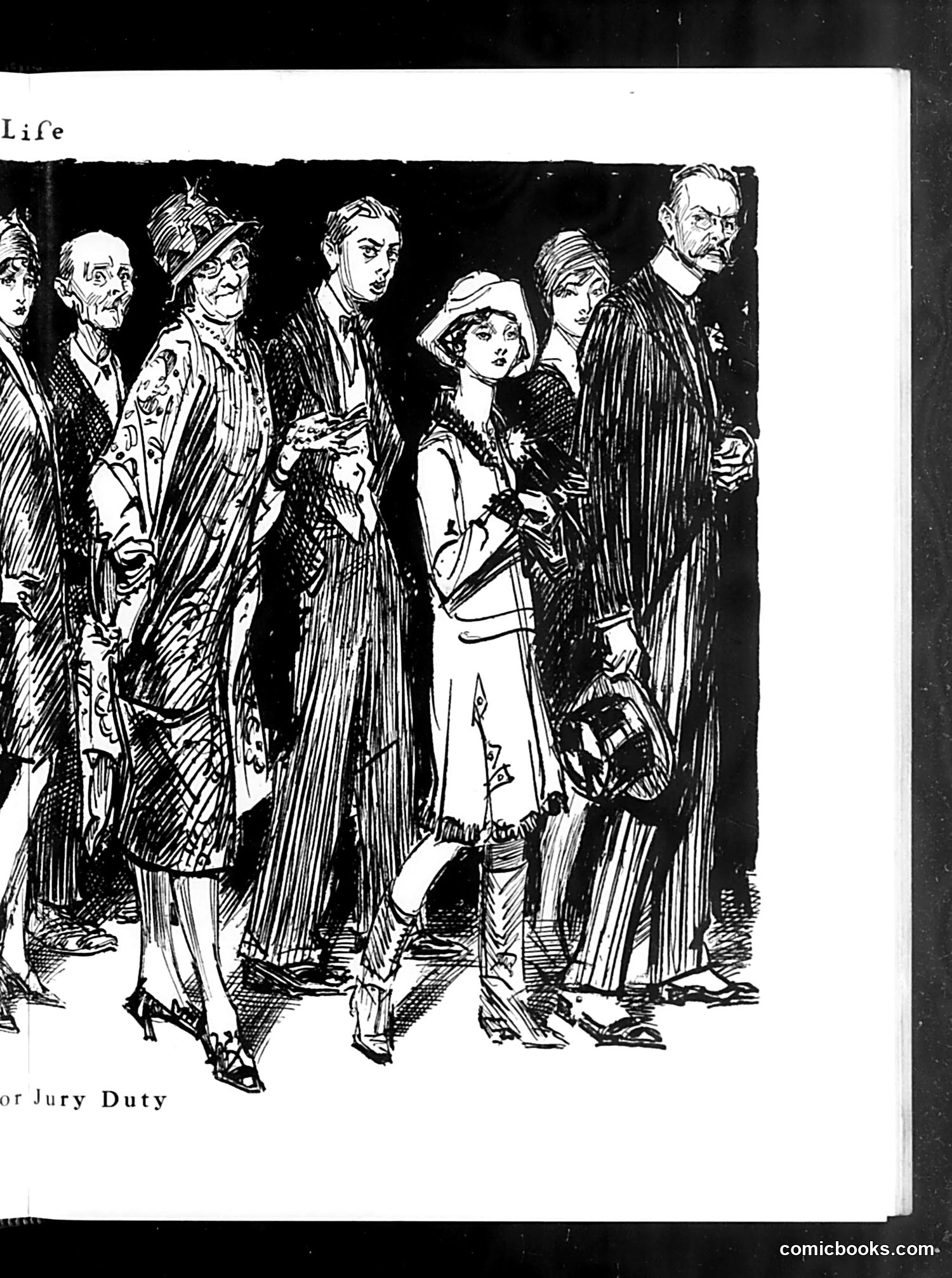
This satirical illustration depicts a diverse group of potential jurors being assembled for court duty. The cartoon uses exaggerated facial expressions and clothing styles typical of Life magazine's social commentary. The figures represent various social types and stereotypes of the era—elderly men, fashionably dressed women, and working-class individuals—all crowded together in apparent discomfort. The title "Jury Duty" suggests satire about the jury selection process itself. The cartoon likely mocks either the randomness of jury composition, the reluctance of citizens to serve, or broader questions about whether such diverse, ordinary people were truly capable of delivering fair justice. The crowded, somewhat chaotic arrangement emphasizes the absurdity of gathering strangers for judicial responsibility.
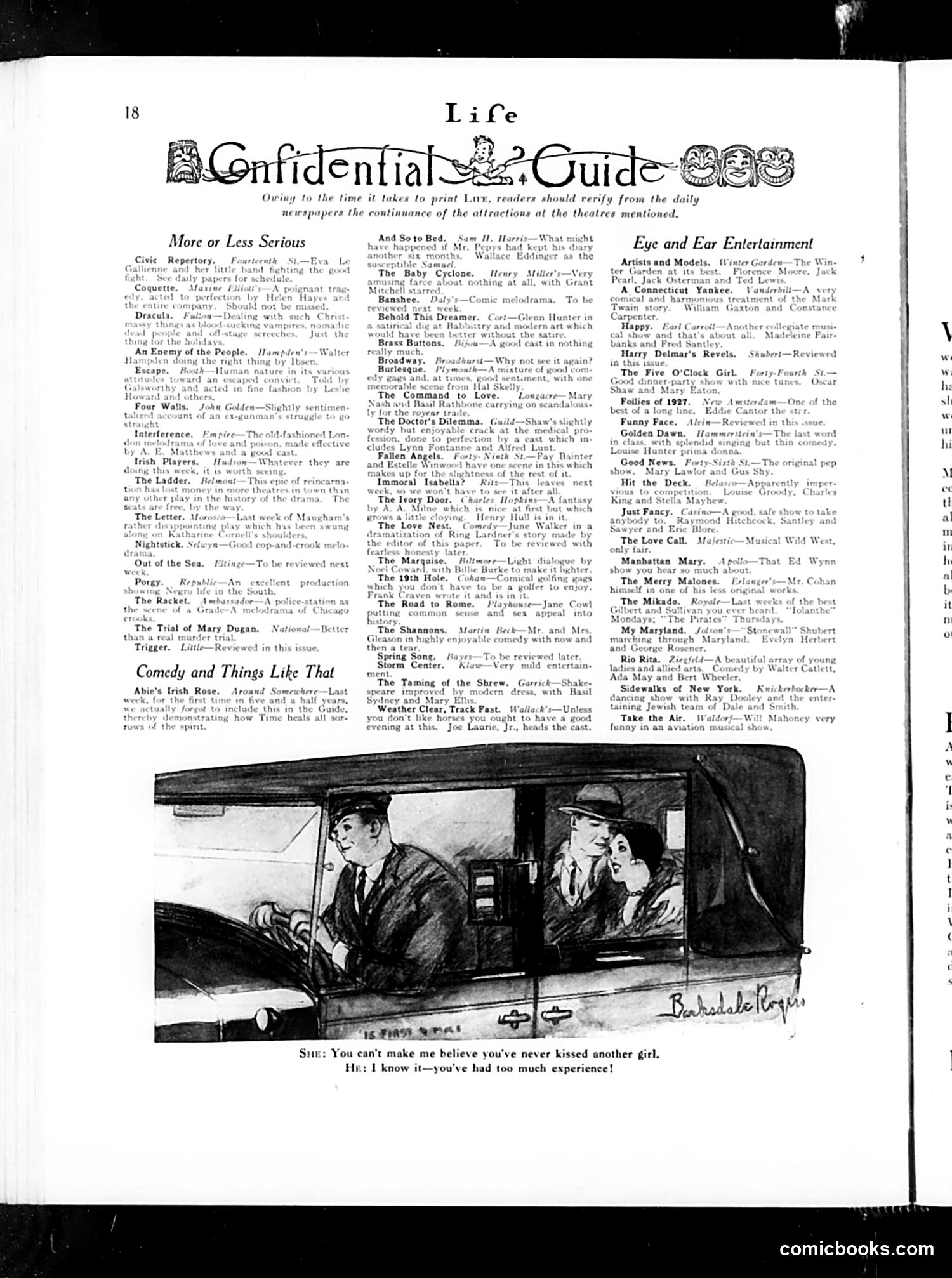
This page from Life magazine presents theater reviews alongside a single cartoon. The cartoon depicts two men in a car—one driving, one passenger—in what appears to be a flirtation scene. The dialogue reveals a gendered joke about experience and reputation: the woman claims the man must have kissed others (implying his inexperience), while he counters that *she* has "had too much experience"—a double standard critique of how society judges women's romantic history more harshly than men's. The cartoon satirizes 1920s dating culture and the hypocrisy of sexual morality standards. The automobile setting is significant—cars represented modern freedom and private spaces for courtship, a source of social anxiety for the era. The page itself is mostly a theater guide listing Broadway shows and reviews, with the cartoon serving as light comedic relief rather than serious social commentary.
This is a theater column reviewing Broadway shows, primarily the musical "Funny Face." The author humorously recounts how Life magazine failed to write comedy material for the show weeks earlier, then—ironically—the show became a hit anyway. The review praises Fred Astaire's tap dancing to George Gershwin's "What Am I Going to Do?" as the show's highlight, calling it "one of the most thrilling dramatic events in town." The Astaire siblings (Fred and Adele) and supporting performers like Victor Moore receive praise for their comedic timing. The column also reviews "Harry Delmar's Revels," noting performers like Frank Fay and Winnie Lightner, while gently mocking Bert Lehr's underutilization. The satire is gentle—the author jokes about their financial loss on the show while repeatedly returning to watch it, and self-deprecatingly admits the production succeeded without their involvement. It's characteristic of Life's theater criticism: witty, gossipy, and focused on star performances rather than plot.
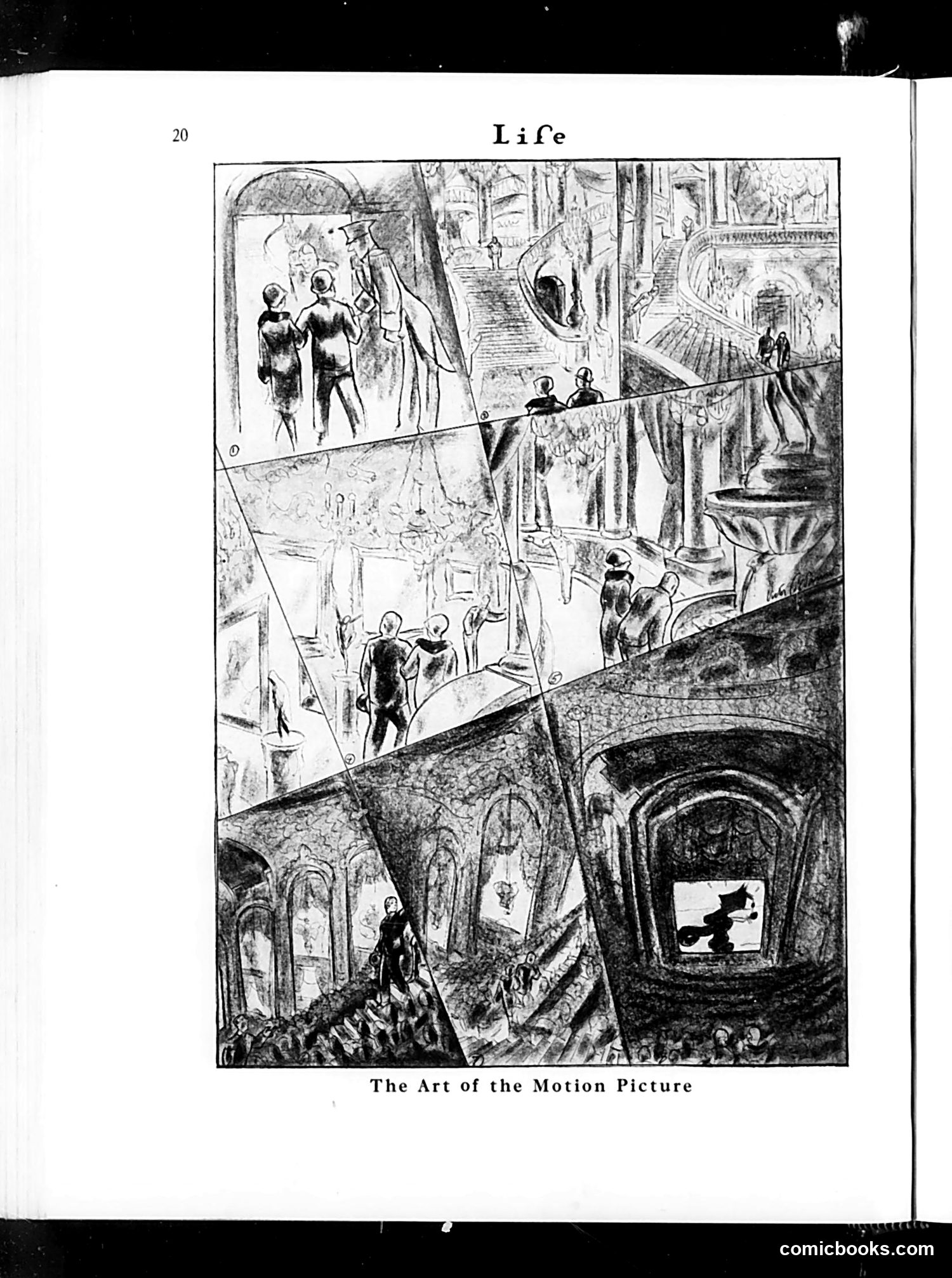
This satirical illustration depicts a multi-level architectural structure filled with figures, contrasting refined upper levels with darker, more chaotic lower levels. The caption suggests this is commentary on early cinema as an art form. The image appears to satirize the hierarchy of motion picture culture—upper sections show well-dressed audiences and elegant venues, while lower basement levels show cramped, darker conditions, possibly referencing cheap movie theaters or working-class cinema venues. The architectural layering likely critiques cinema's position within society: elevated as "art" above while serving mass audiences below in less dignified circumstances. This reflects early-20th-century debates about whether movies constituted legitimate art or merely popular entertainment for the masses.
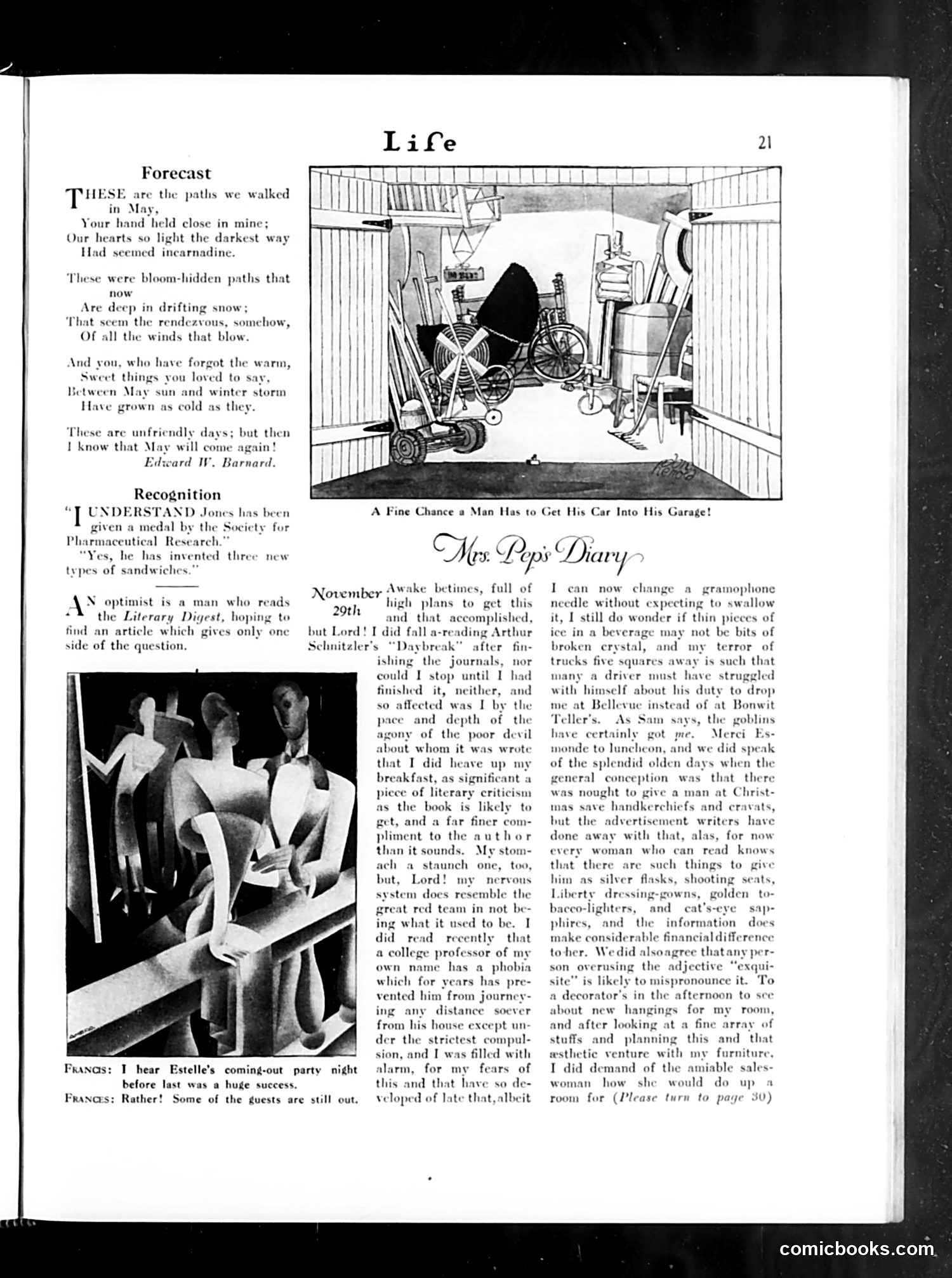
This page contains three distinct pieces of satire typical of Life's format: **"Forecast" (poem):** A romantic poem about lost love—paths walked together in May that are now frozen in winter snow. The beloved has grown "as cold as they," suggesting emotional distance. It's sentimental verse, common to the era's literary magazines. **"Recognition" section:** Two brief jokes. The first mocks pharmaceutical research by suggesting a scientist earned a medal for inventing three sandwich types—satirizing inflated corporate recognition. The second jokes about optimists reading the *Literary Digest* and hoping for one-sided arguments, likely referencing the magazine's reputation for bias or incomplete coverage. **"Mrs. Peps' Diary":** A gossipy society column where the narrator discusses reading Schnitzler's *Daybreak*, shopping for room furnishings, and discussing Christmas gift-giving trends. It satirizes upper-class anxieties and the shift from traditional gifts (handkerchiefs, cravats) to luxury goods advertised by "advertisement writers." **The garage cartoon** illustrates the practical joke: a cluttered garage makes parking difficult—relatable domestic humor. The page reflects 1920s concerns: literary criticism, consumer culture, and social anxiety among the wealthy.
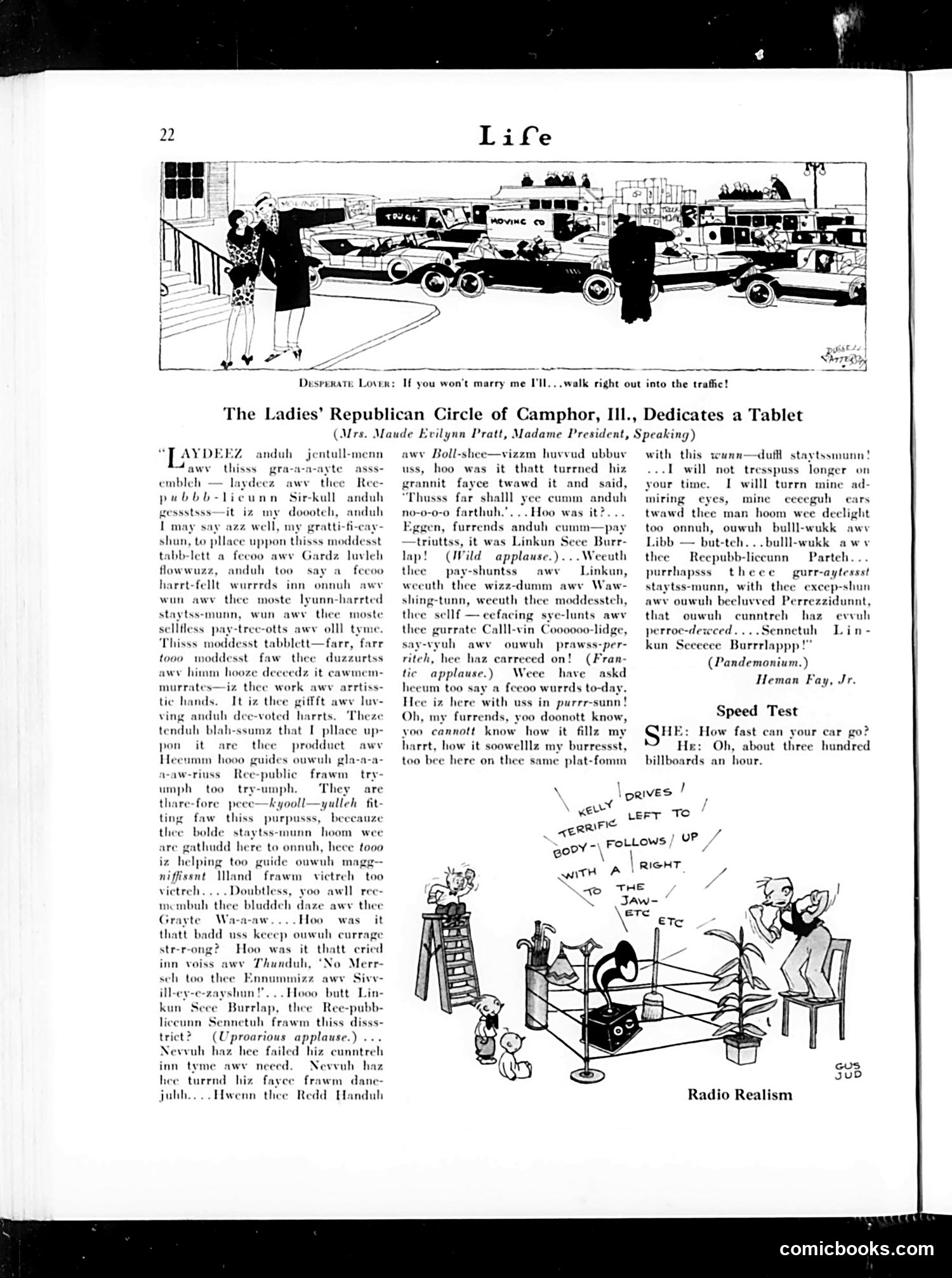
**Top Cartoon:** A desperate romantic threatens suicide-by-traffic if rejected—a common melodramatic trope of early 20th-century romance, satirized here as absurdly overwrought. **Main Article:** A parody of a political speech by a small-town Republican women's club, mocking overwrought, affected oratory. The garbled phonetic spelling ("TAYDEERZ anduh jentull-menn") ridicules an affected, exaggerated speaking style. The speech praises Lincoln Seeburrlap, apparently a local politician, for patriotic service. This satirizes provincial political theater and self-important local figures who invoke Civil War heroes to justify contemporary positions. The humor targets both the pretentious delivery and the generic patriotic flattery of small-town Republican gatherings. **"Speed Test" Cartoon:** A husband claims his car travels "three hundred billboards an hour"—joking that the car is so slow, one can read all the roadside advertisements passing by. This satirizes both slow driving and the proliferation of highway billboards in early automobile-era America.
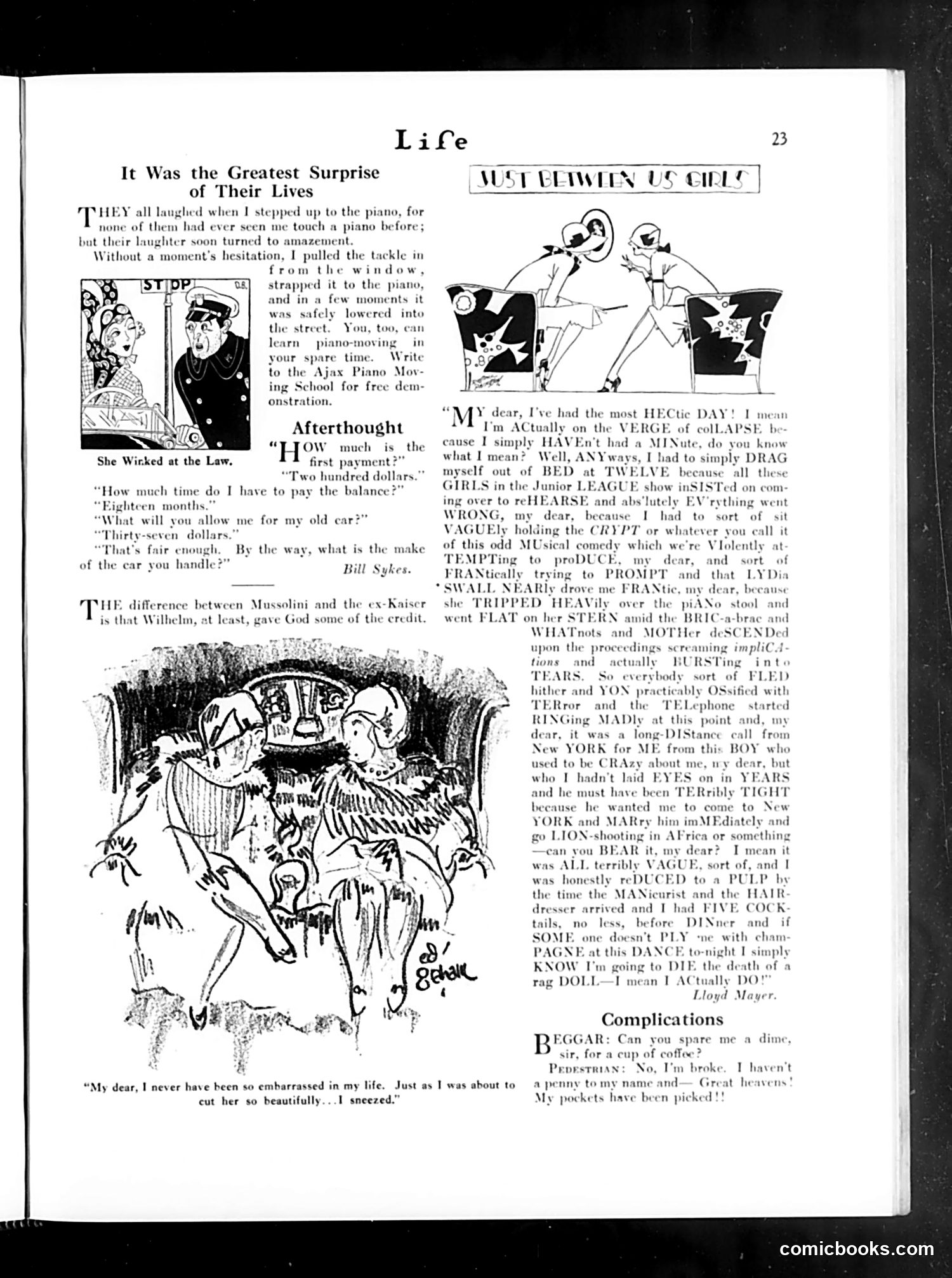
This page contains several satirical pieces typical of 1920s-era Life magazine humor: **Top cartoon** ("It Was the Greatest Surprise"): A deadpan joke about a piano-moving school advertisement. The humor lies in the absurd contrast—the narrator builds suspense as if about to demonstrate piano-playing skill, then reveals he simply used a pulley system to lower a piano out a window. It mocks both overly elaborate advertising copy and the gap between expectations and reality. **Middle section** ("Afterthought"): A jab at wealthy society women's frivolousness. The unnamed female speaker breathlessly recounts her chaotic day in exaggerated capitalization and run-on sentences, mixing trivial social drama (Junior League rehearsals) with absurd situations (a woman falling on a piano stool, a drunken long-distance marriage proposal). The satire targets their self-absorption and performative dramatics. **Bottom cartoons**: Brief joke exchanges—one comparing political leaders unfavorably, another playing on ironic timing (a beggar asking for money from a pickpocketed man). The satire reflects 1920s class anxieties and mockery of upper-class pretension.
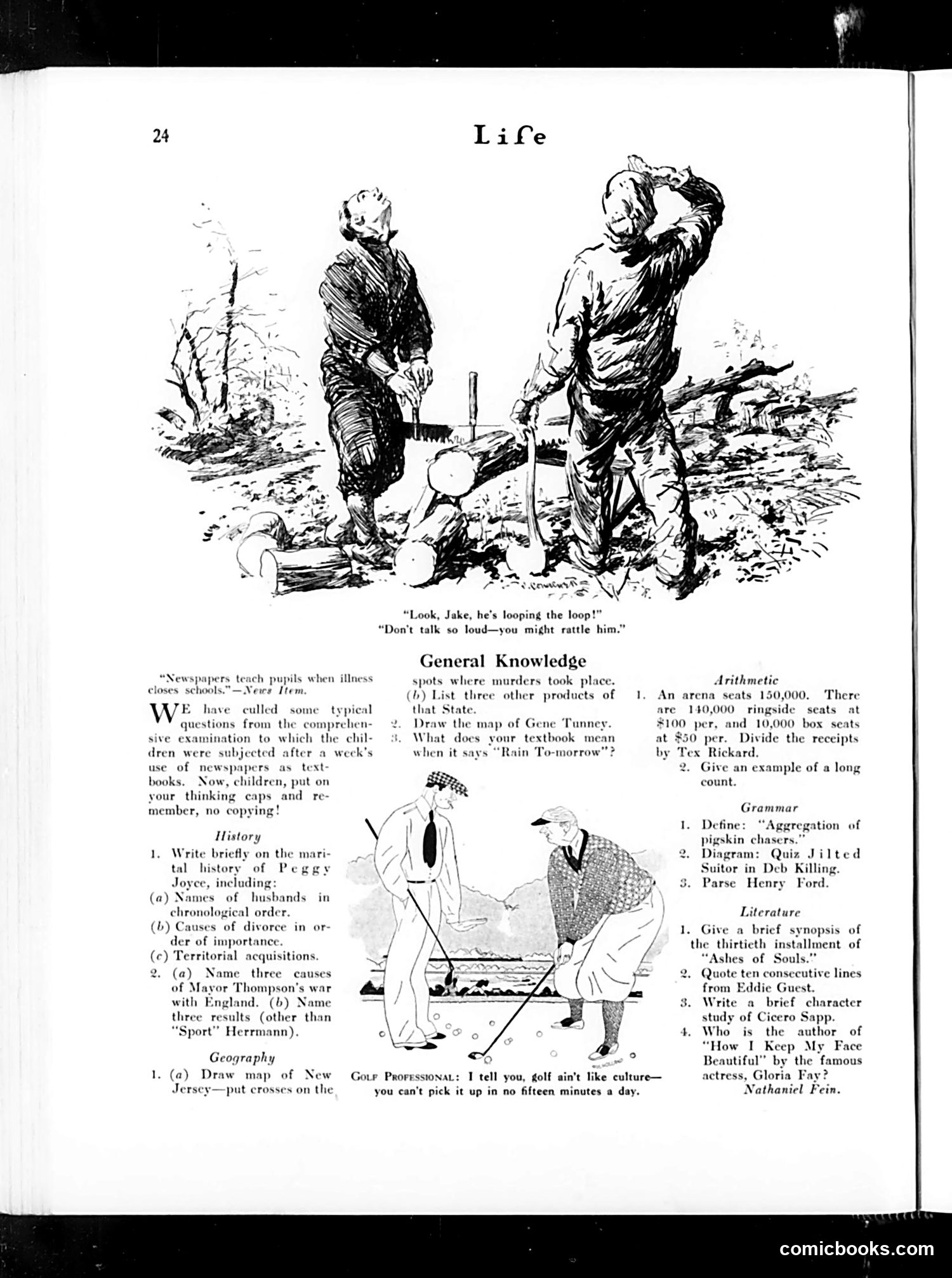
The top cartoon depicts two men watching an aviator perform a dangerous aerial stunt—a "loop-the-loop," where a plane flies in a vertical circle. One observer warns his companion not to talk loudly for fear of startling the pilot, treating the situation as precarious and requiring absolute concentration. This references the early aviation era when such aerial stunts were novel, dangerous public spectacles. The humor lies in the absurdity: a pilot performing a controlled aeronautical maneuver wouldn't actually be distracted by ground-level conversation, yet the cartoon treats it as genuinely risky. The "General Knowledge" section below parodies contemporary newspaper-based education, with absurdly trivial or frivolous quiz questions about scandals (Peggy Joyce's marriages), celebrities (Gene Tunney, Gloria Fay), and current sensations, mocking how newspapers had become primary educational tools and their focus on sensationalism rather than substantive content.
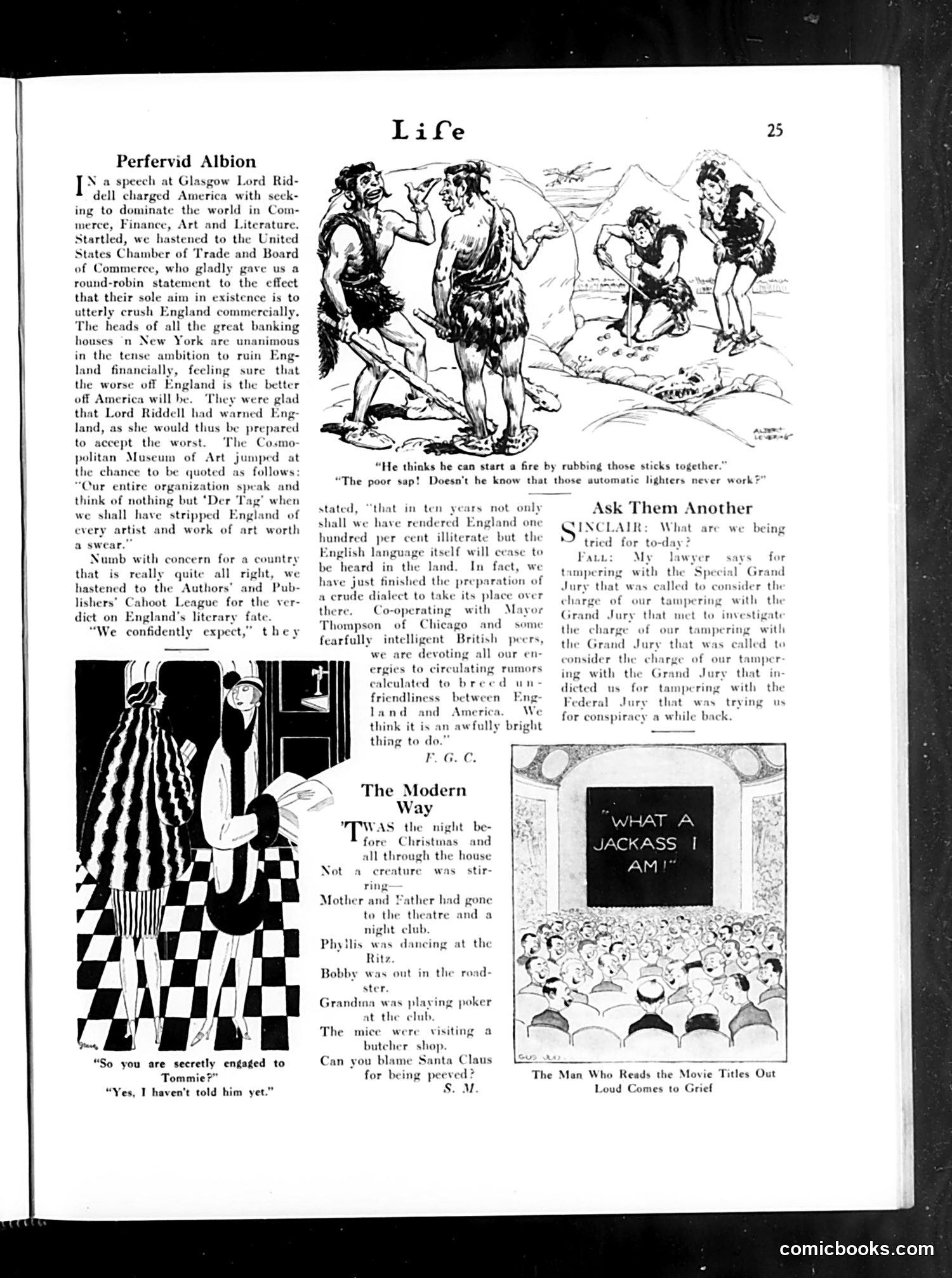
This *Life* magazine page contains three satirical pieces: **"Perfervid Albion"** mocks British anxiety about American dominance. Lord Riddell (a real British newspaper magnate) accused America of seeking global commercial supremacy. The satire responds by having American institutions gleefully confirm this paranoia—banking houses, museums, and publishers all claim their sole purpose is crushing Britain. The joke: Britain's fear is absurdly exaggerated; America isn't actually conspiring against it. **"The Modern Way"** satirizes 1920s parental neglect among the wealthy. While parents attend theaters and nightclubs, children unsupervised engage in frivolous activities (dancing at the Ritz, playing poker). The punch line blames Santa Claus for children's misbehavior—a backhanded critique of modern parenting abdication. **"Ask Them Another"** appears to reference a legal case involving "tampering"—likely Upton Sinclair (the muckraking author) and jury interference, though details are unclear from this excerpt alone. The cartoons exemplify *Life*'s satirical approach: exaggerating social anxieties and generational concerns for comedic effect.
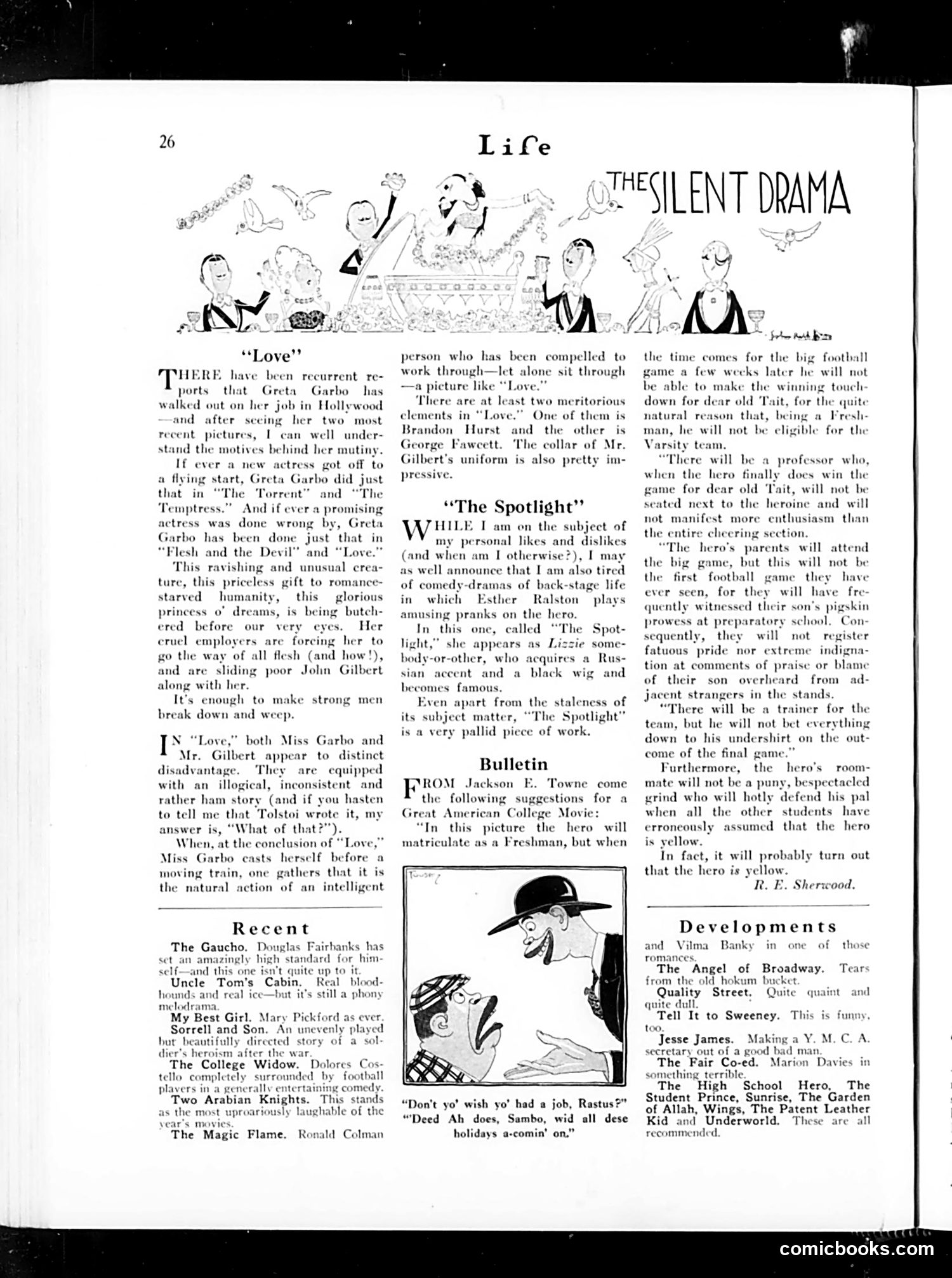
This page critiques Greta Garbo's film career circa mid-1920s. The author sarcastically defends Garbo's reported walkout from Hollywood, claiming her recent pictures (particularly "Love") have squandered her talent through poor scripts and direction. The complaint centers on *Tolstoi's* adaptation forcing Garbo into illogical, "ham" storytelling—the critic mockingly asks why adapting Tolstoi should excuse bad writing. The cartoon (showing two men in hats) illustrates a separate satirical piece mocking Hollywood's "Great American College Movie" formula. The proposal ridicules predictable narratives: heroes who mysteriously gain eligibility for big games despite being freshmen, and parents who conveniently attend championship matches without having witnessed earlier games. The broader joke targets silent cinema's hackneyed plotting and the studio system's inability to utilize genuine talent effectively.
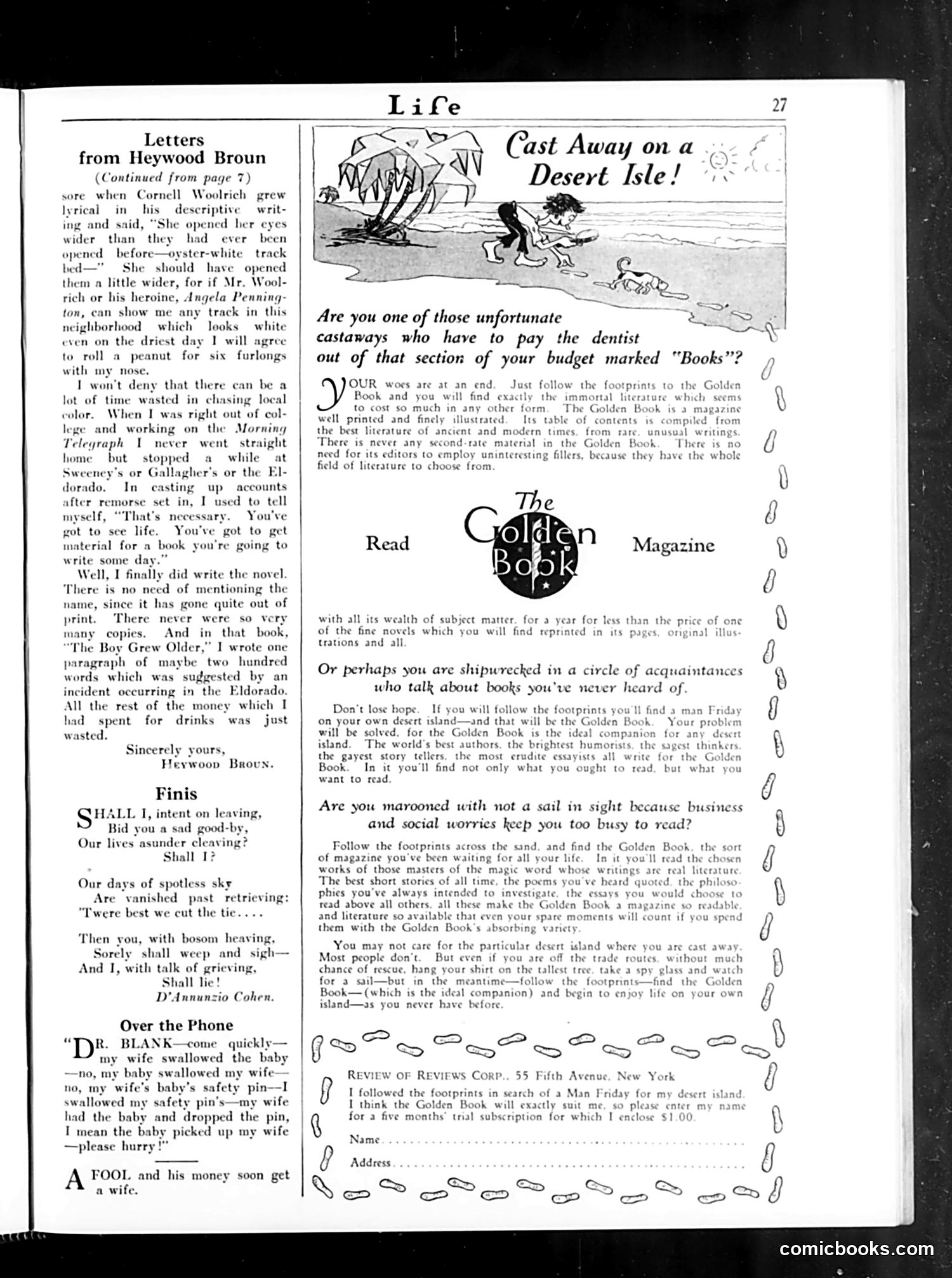
This page combines literary commentary with advertising, featuring minimal political content. **Left Column - "Letters from Heywood Broun"**: A respected newspaper columnist discusses the temptation to chase "local color" for literary authenticity. Broun recounts wasting money on drinks at various establishments while supposedly gathering material for a novel, only to use virtually none of it. The piece satirizes writers' self-deception about "necessary research." **"Finis" Poem**: A brief, sentimental poem attributed to "D'Annunzio Cohen"—likely a humorous parody combining famous Italian poet Gabriele D'Annunzio with a common Jewish surname, mocking overly dramatic romantic verse. **"Over the Phone"**: A short comedy sketch about confused telephone communication (a husband frantically reporting what his wife/baby/safety pin swallowed), followed by the aphorism "A FOOL and his money soon get a wife." **Right Side**: The Golden Book Magazine advertisement, using castaway/desert island metaphors to appeal to busy readers seeking accessible literature. The page is primarily lighthearted social satire rather than political commentary.
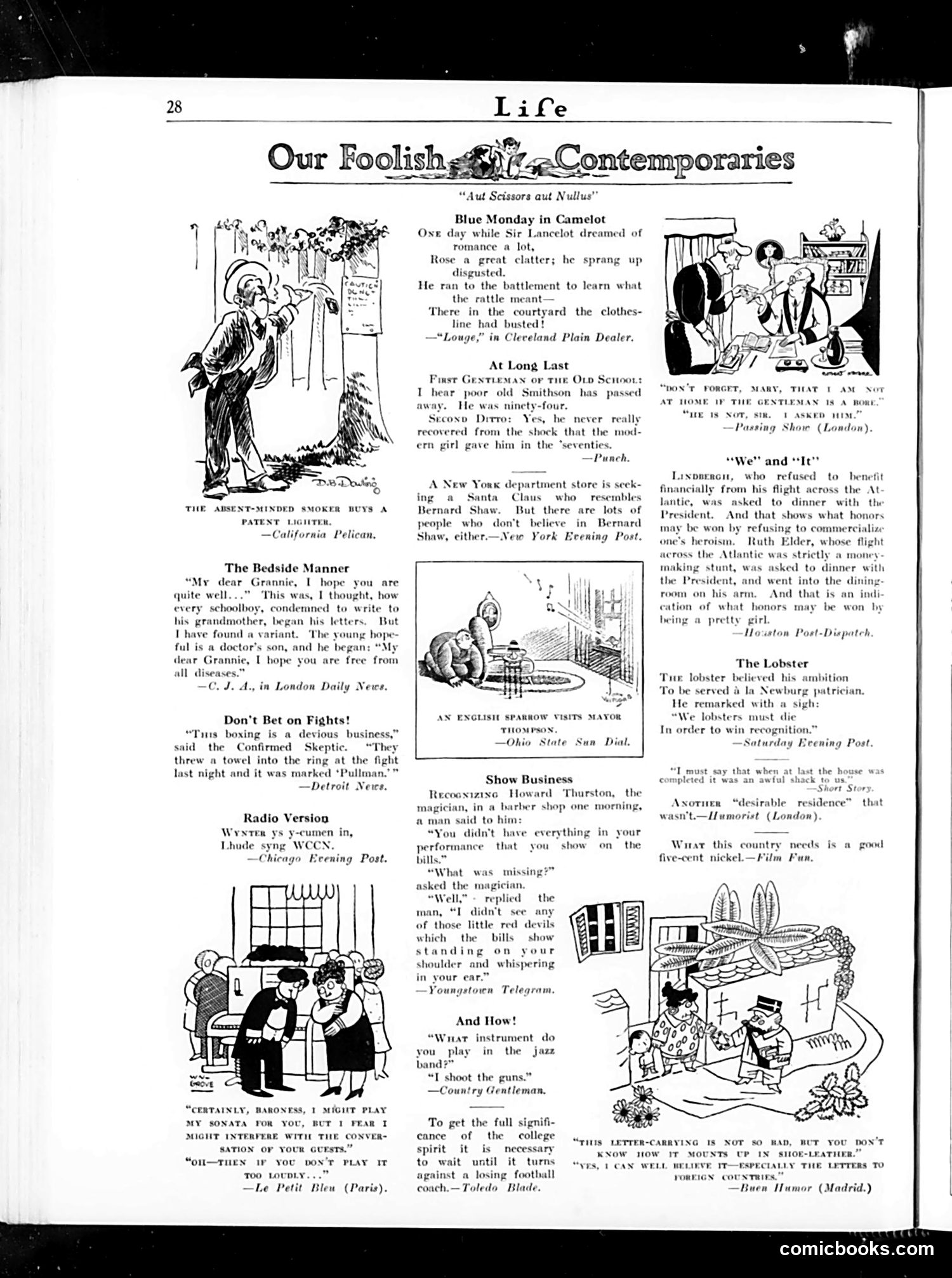
This page collects brief humorous anecdotes and cartoons mocking contemporary absurdities. Key items include: **"Blue Monday in Camelot"**: Sir Lancelot's romantic daydream is interrupted by clotheslines breaking in the castle courtyard—deflating medieval romance with modern domestic mundanity. **"Show Business"**: A magician is criticized for not displaying the "little red devils" advertised on his bills—satirizing false advertising and audience gullibility. **"The Lobster"**: A lobster aspires to patrician status ("à la Newburg") but must die for recognition—dark humor about social climbing through consumption. **"Radio Version"**: A pianist refuses to perform, claiming guests' conversation is more important—mocking pretentious social etiquette. The page ridicules absent-mindedness, boxing fraud, poor letter-writing, commercialism (Ruth Elder's transatlantic flight), and various contemporary social pretensions. The humor relies on incongruity and deflating expectations—typical of *Life* magazine's satirical approach to 1920s American society.
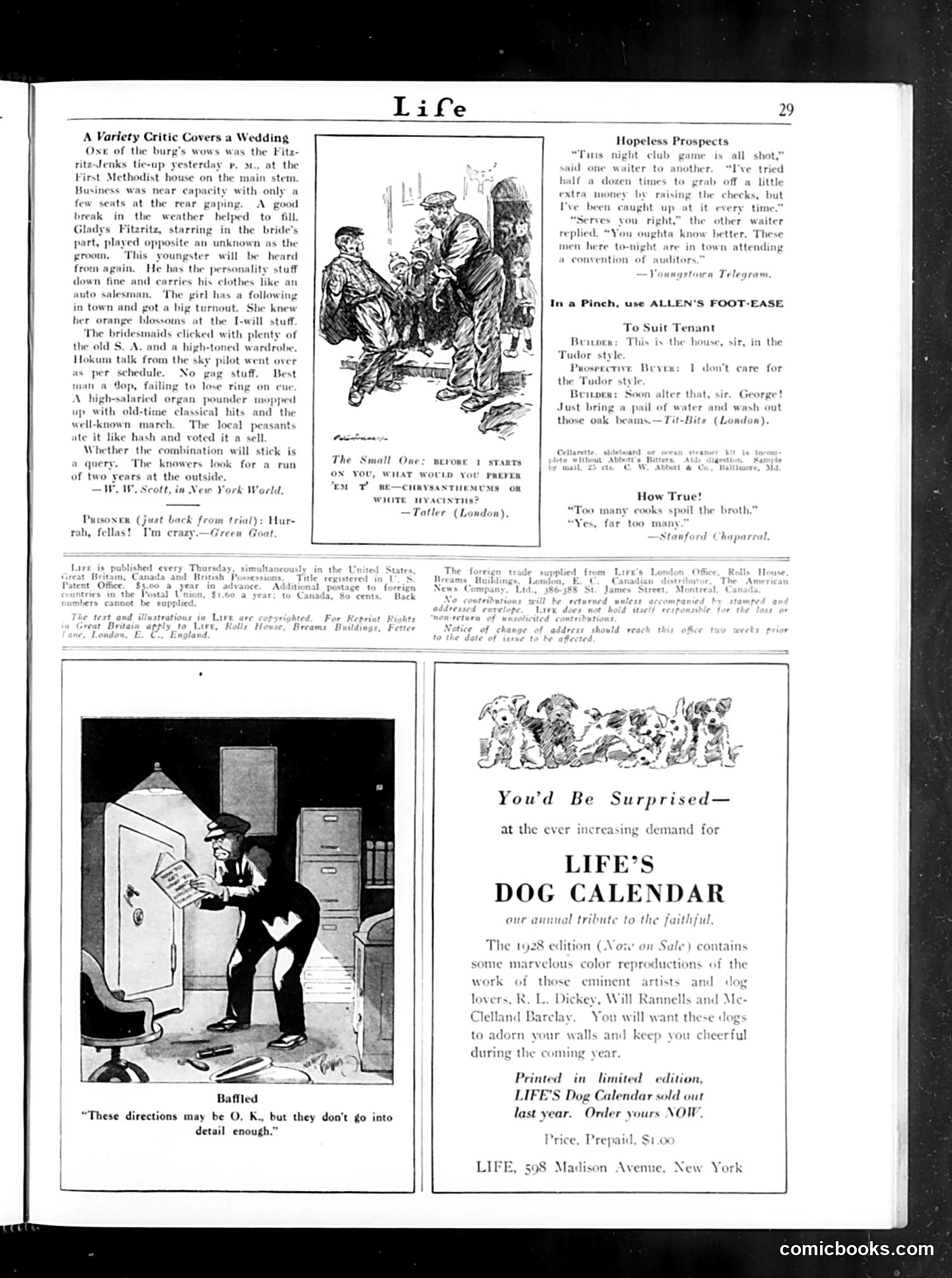
This page contains several brief satirical pieces typical of Life's humor: **"A Variety Critic Covers a Wedding"** (top left): A theater critic reviews a wedding as if it were a Broadway show—treating the bride and groom as "performers," noting the "business" (attendance), the groom's "personality," the organ music's "well-known march," and predicting the marriage will have "a run of two years." The satire mocks how critics reduce human experience to entertainment value, and was likely aimed at the pretentious theater criticism of the 1920s. **Other brief jokes** include: - A prisoner celebrating his insanity verdict - Waiters discussing failed schemes to inflate restaurant bills at a convention - A tenant rejecting "Tudor style" housing until shown cheaper materials - A small child choosing between flowers (unclear reference) **Lower half**: Advertisements for Allen's Foot-Ease remedy and Life's Dog Calendar (featuring work by cartoonists like R.L. Dickey), a commercial product rather than editorial content. The page exemplifies Life's format: densely packed short humor pieces mixing social satire with advertising.
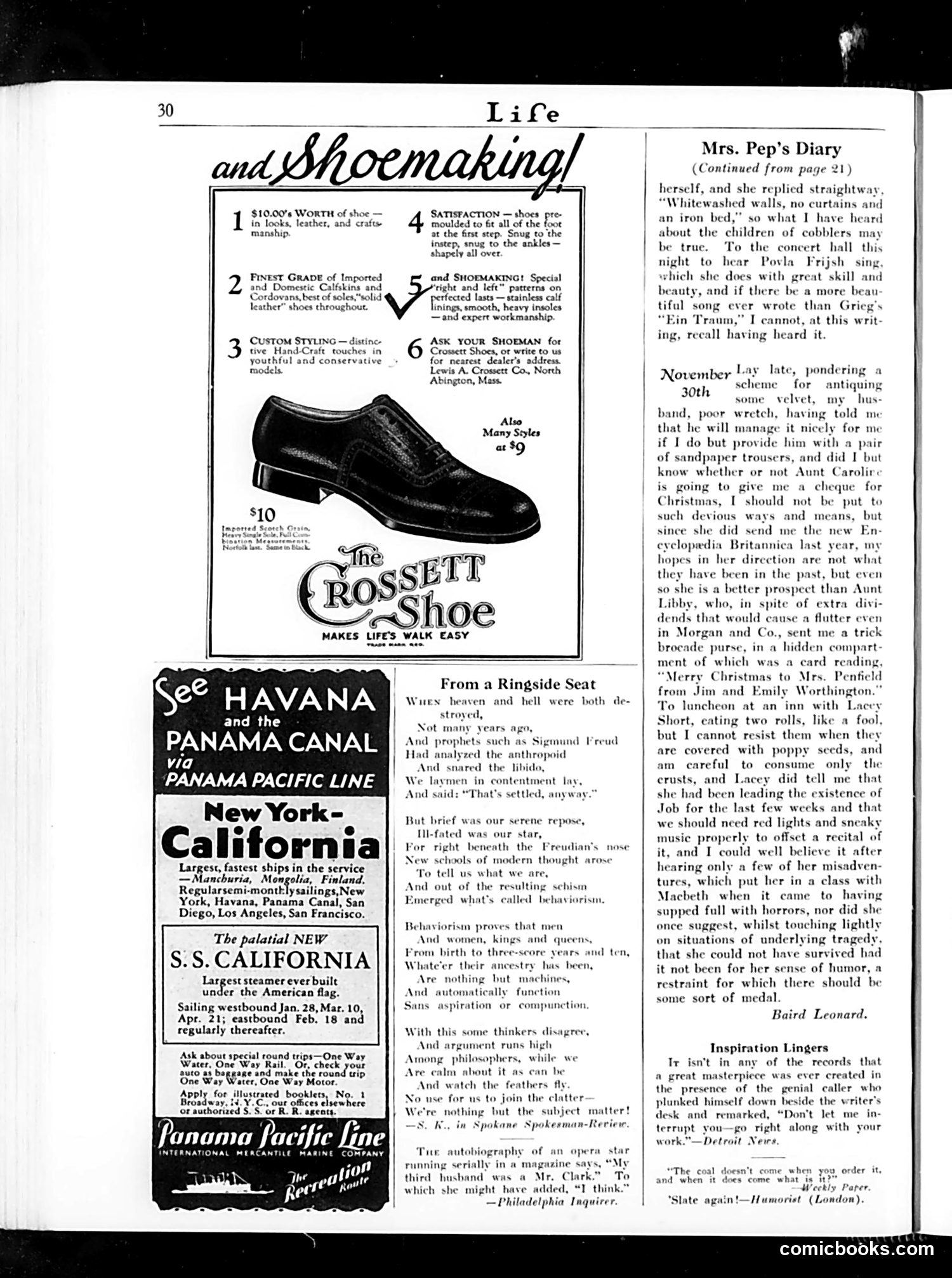
This page is primarily **advertising with some literary content**, not political satire. The dominant feature is a **Crossett Shoe advertisement** showcasing a men's loafer, emphasizing quality materials, custom styling, and comfort—typical early 20th-century shoe marketing. Below are travel advertisements for the **Panama Pacific Line** promoting luxury steamship service to California via the Panama Canal, then a recently completed modern marvel (opened 1914). The literary content includes: - **"From a Ringside Seat"**: A poem satirizing the contemporary intellectual trend of **Behaviorism**—the psychological school claiming humans are merely machines without consciousness or aspiration. The poem mocks this reductive philosophy as overly deterministic. - **"Mrs. Pep's Diary"**: A humorous domestic column recounting trivial household matters and social observations, common in magazines of this era. No political cartoons appear. The page reflects early 1920s consumer culture and contemporary intellectual debates about human nature.
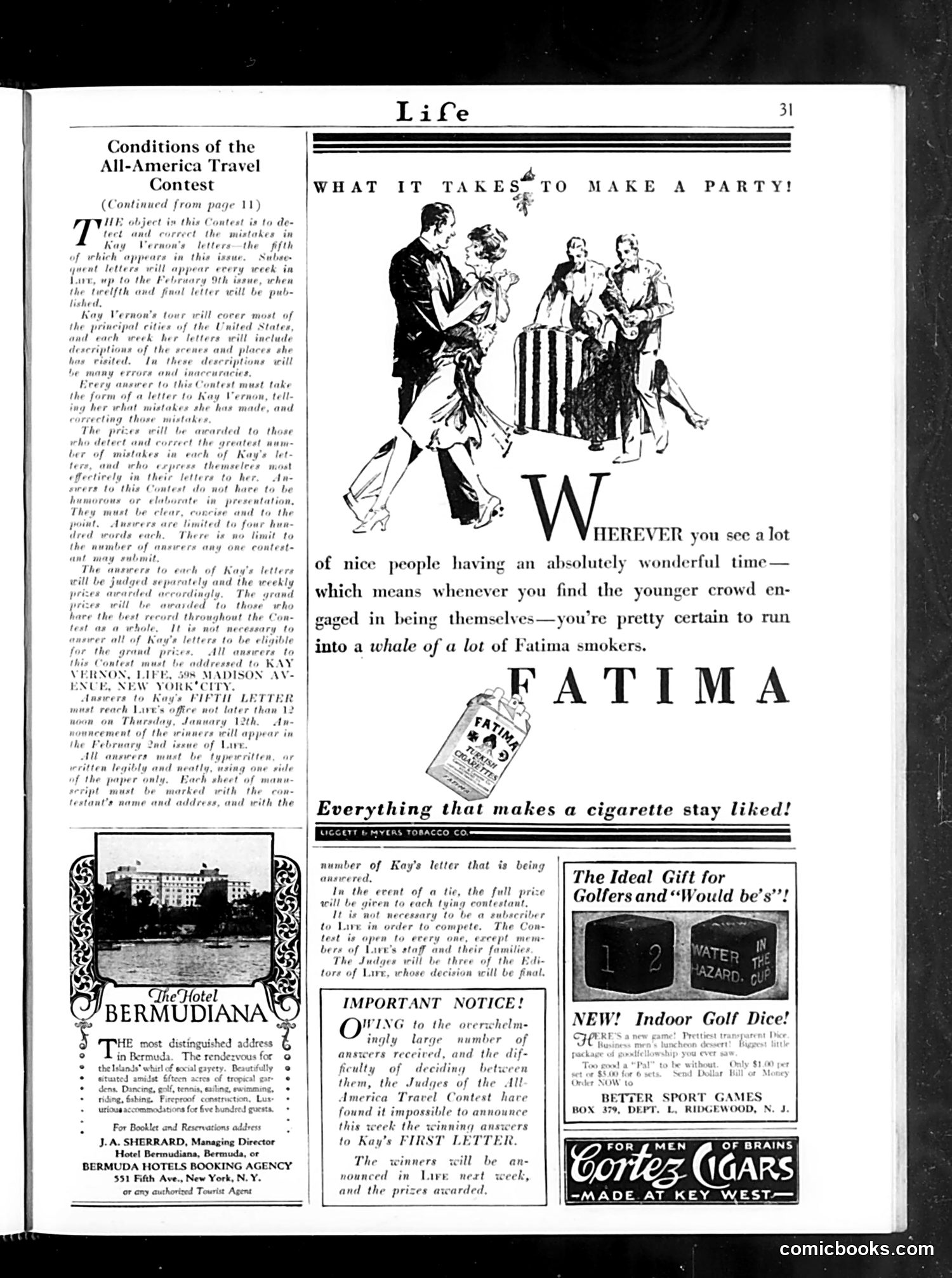
This page is primarily **advertising and contest information**, not political satire. The main content includes: 1. **Contest Rules** (top left): Details for Life's "All-America Travel Contest," where readers submit letters identifying mistakes in Kay Vernon's travel columns for prizes. 2. **Fatima Cigarette Advertisement** (center): The large illustration shows well-dressed young people at a social gathering. The ad's joke is that wherever young people have fun, they're smoking Fatima cigarettes—positioning the brand as associated with youth, sociability, and good times. This reflects 1920s advertising that normalized smoking. 3. **Hotel Bermudiana Advertisement** (left): Promotes the hotel as Bermuda's premier address. 4. **Miscellaneous Ads** (right): Indoor Golf Dice game and Cortes Cigars. The page reflects early 20th-century consumer culture and advertising norms. The Fatima ad is notable today for its casual promotion of cigarettes to young social crowds—something now considered irresponsible but then standard marketing practice.
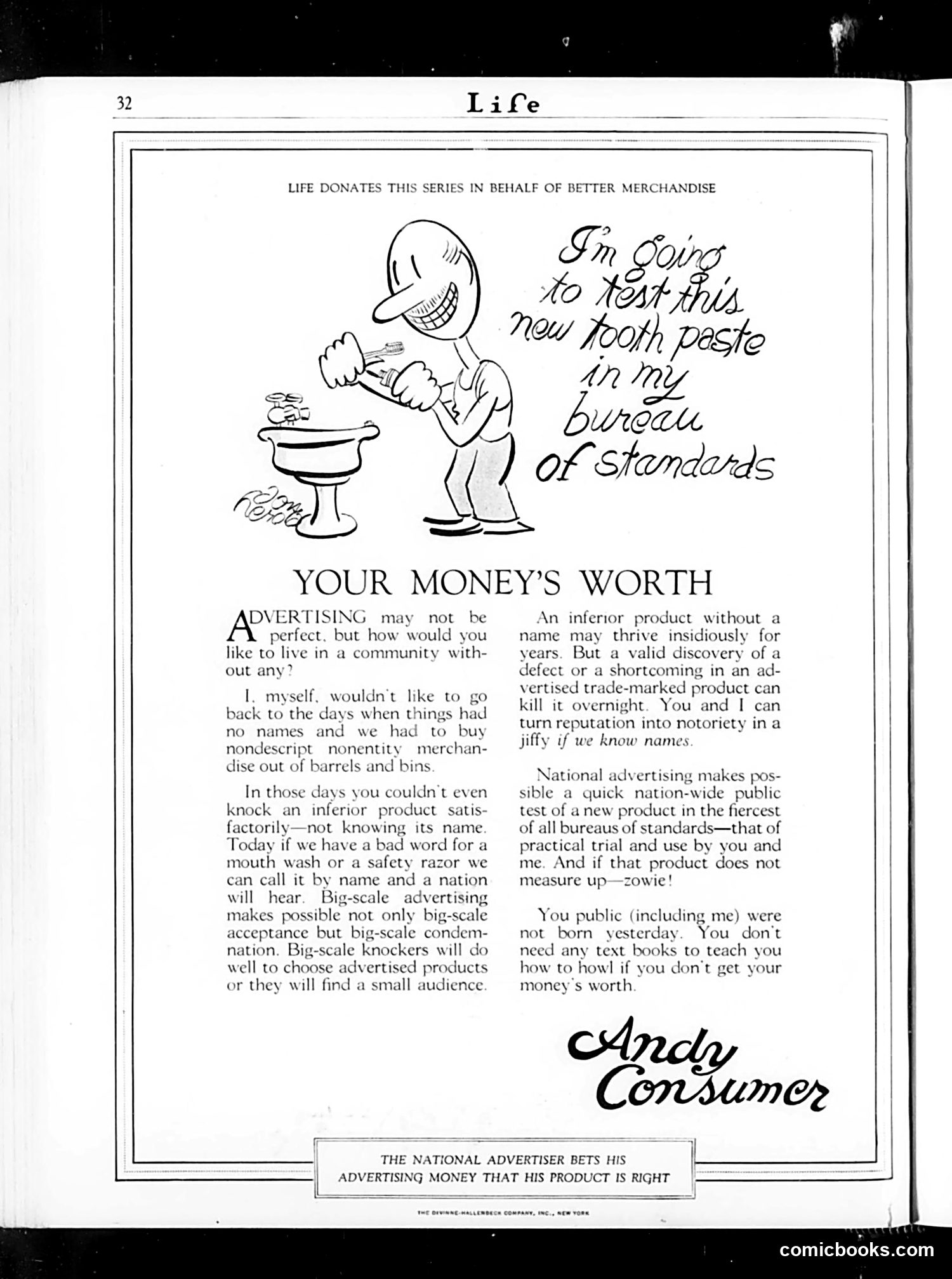
This is an opinion piece (not satire) by "Andy Consumer" arguing that national advertising benefits the public. The cartoon shows a cheerful figure testing toothpaste against a "bureau of standards"—illustrating the article's central claim. The argument: advertising creates accountability. Named, branded products can be publicly criticized and boycotted if defective, whereas unnamed merchandise sold "out of barrels and bins" (pre-modern commerce) allowed inferior goods to persist undetected. National advertising, the author contends, subjects products to "the fiercest of all bureaus of standards"—consumer use itself. The subtext reflects early-20th-century debates about consumer protection and advertising's role. Rather than cynically mocking ads, this piece defends them as a form of market transparency and quality control, trusting consumers to recognize and punish poor products through reputation damage.
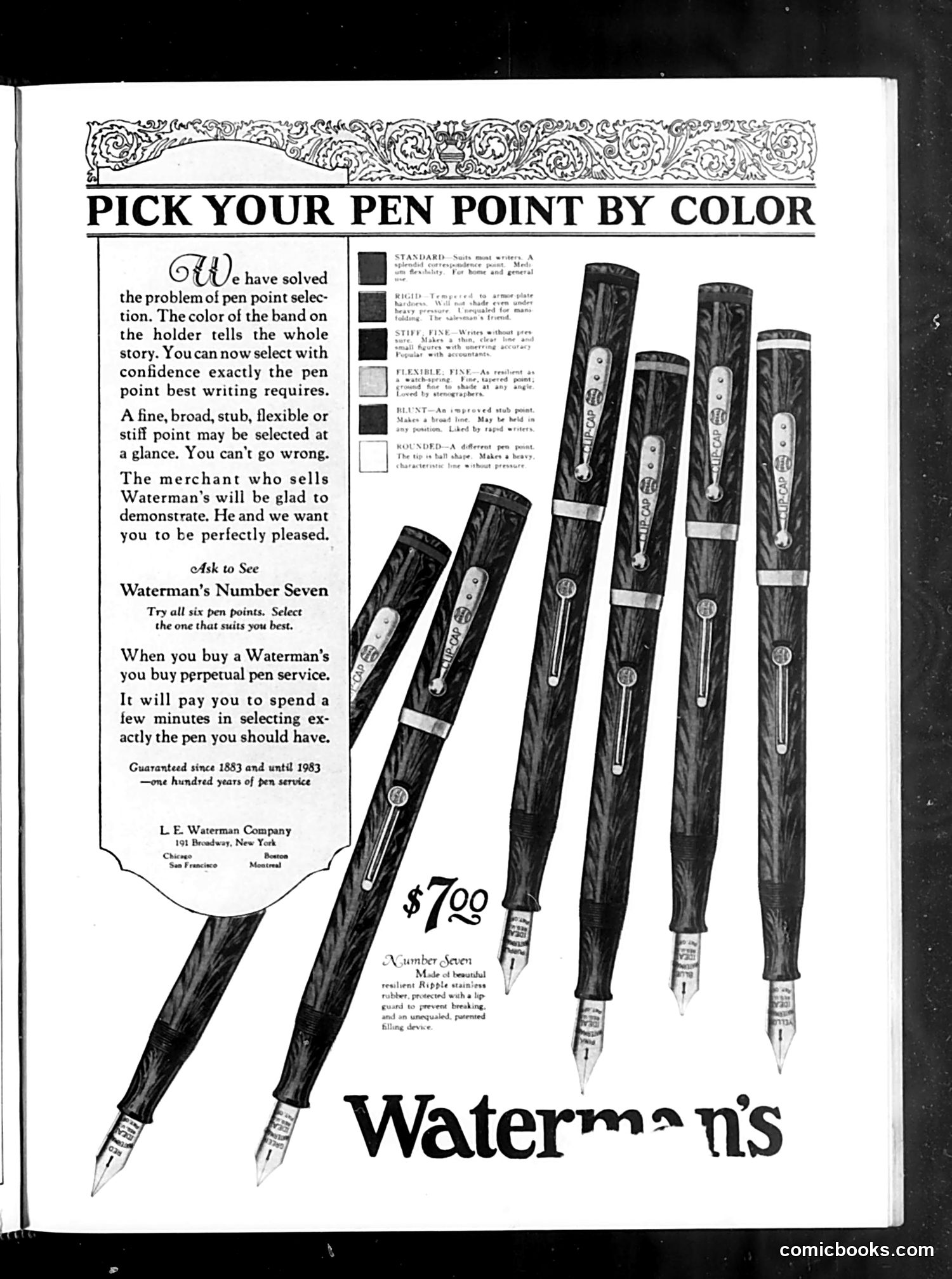
This is **not a cartoon or satire** — it's a straightforward **advertisement for Waterman's fountain pens**, priced at $7.00. The page promotes the "Number Seven" model by explaining how colored bands on pen holders indicate different nib types (fine, broad, stub, flexible, stiff). The ad's pitch: selecting the right pen point requires only a glance at the color-coded band, making the choice foolproof. Six pens are displayed to showcase the variety. The messaging emphasizes quality ("perpetual pen service") and encourages potential buyers to visit merchants for demonstration, backed by Waterman's century-old reputation (guaranteed "since 1883 and until 1983"). This is typical early-20th-century advertising copy — informative, reassuring, and emphasizing consumer convenience through simple visual systems. No political or satirical content is present.
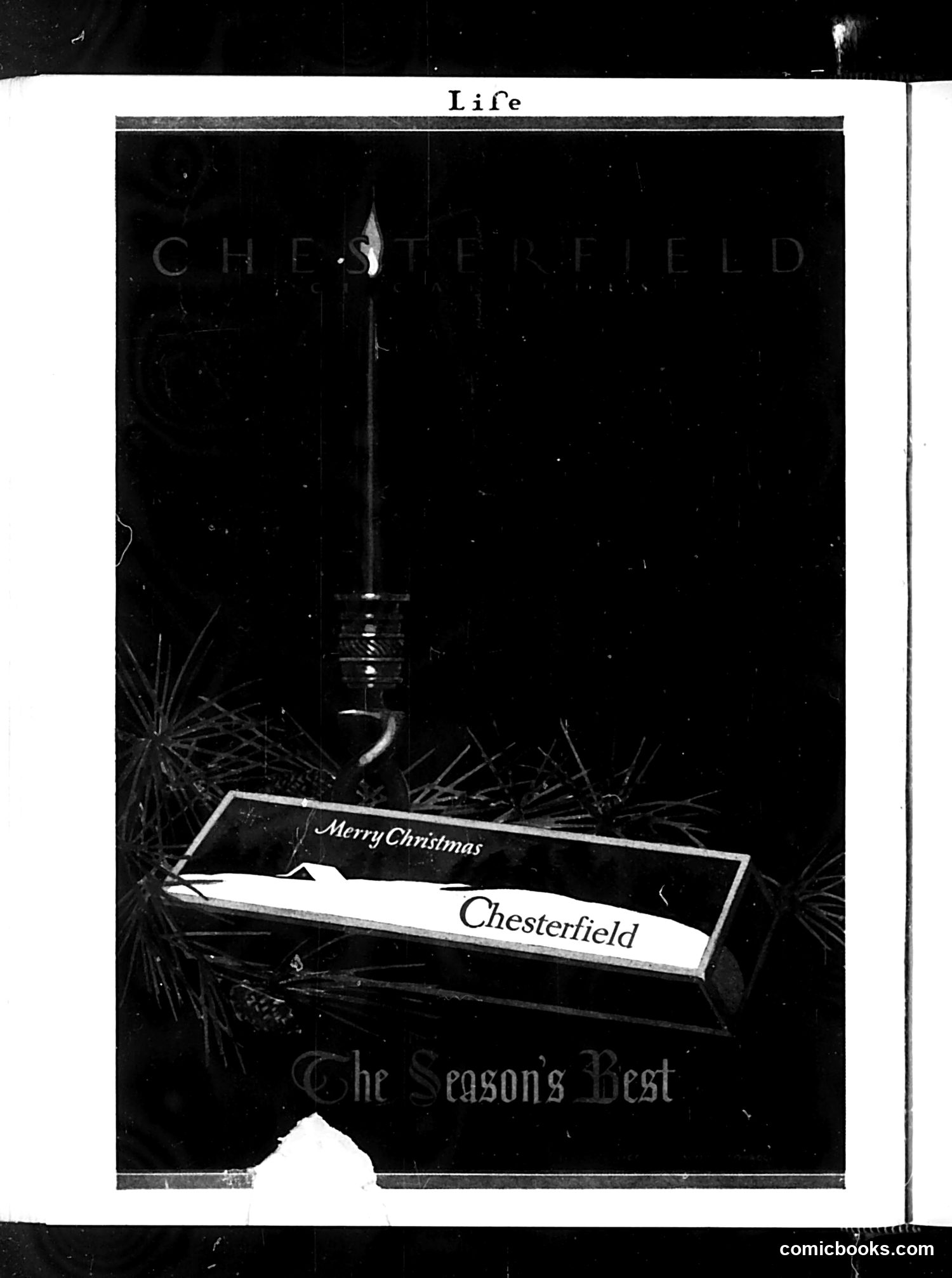
This is a **Christmas advertisement for Chesterfield cigarettes** from *Life* magazine. The image shows a lit cigarette standing upright like a candle, surrounded by evergreen branches, with a package of Chesterfield cigarettes beneath it. The text reads "Merry Christmas" and "The Season's Best." This is **not political satire** but rather a vintage commercial using holiday imagery to market cigarettes. The clever visual conceit equates the cigarette with a festive candle, associating the product with warmth, celebration, and gift-giving. This type of cigarette advertising was common and unregulated in early-to-mid 20th century America, before health warnings became mandatory. The ad exploits seasonal sentiment to encourage tobacco consumption.