
Life, 1927-12-22 · page 21 of 36
Life — December 22, 1927 — page 21: what you’re looking at
What you’re looking at
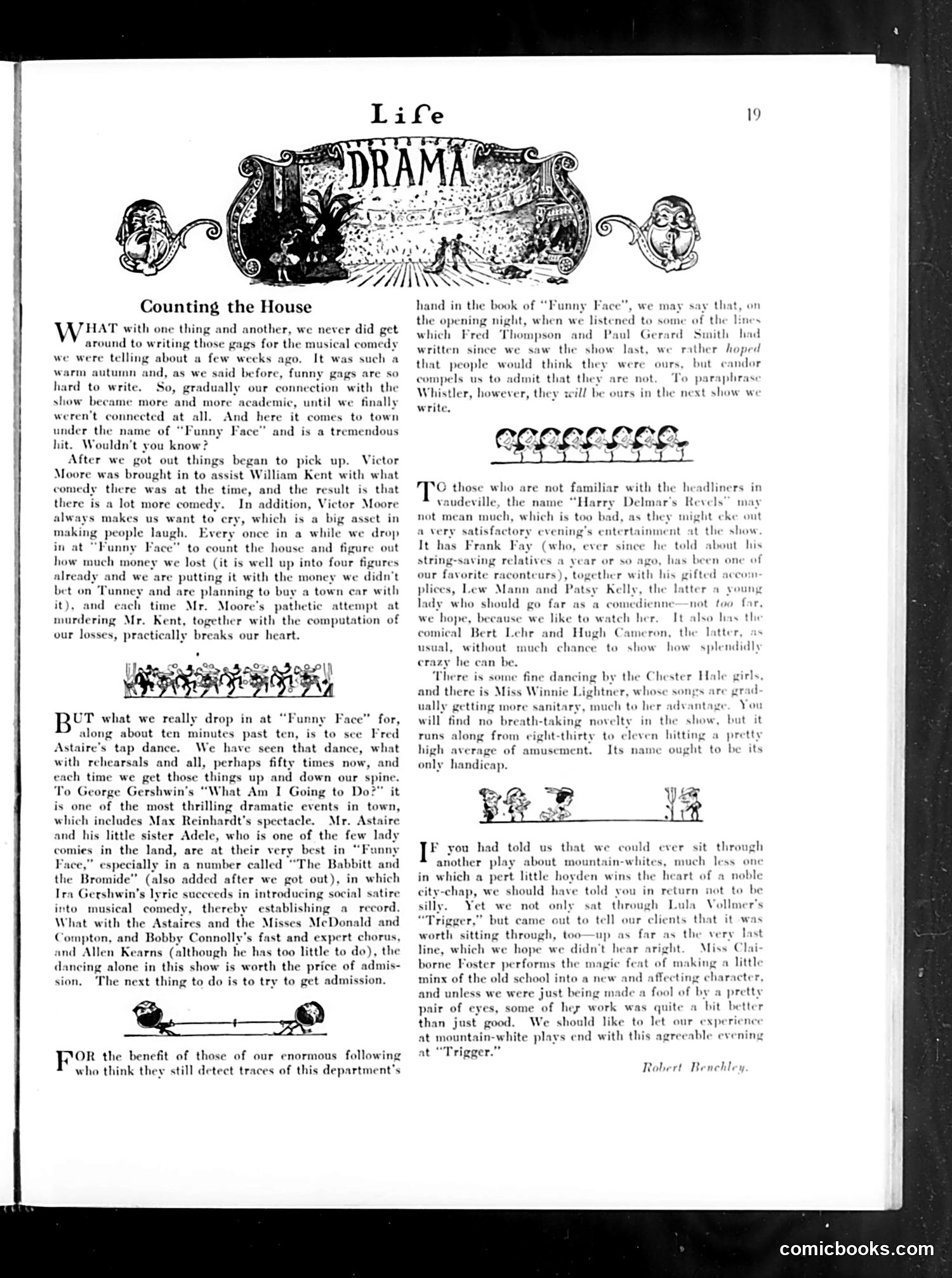
This is a theater column reviewing Broadway shows, primarily the musical "Funny Face." The author humorously recounts how Life magazine failed to write comedy material for the show weeks earlier, then—ironically—the show became a hit anyway. The review praises Fred Astaire's tap dancing to George Gershwin's "What Am I Going to Do?" as the show's highlight, calling it "one of the most thrilling dramatic events in town." The Astaire siblings (Fred and Adele) and supporting performers like Victor Moore receive praise for their comedic timing. The column also reviews "Harry Delmar's Revels," noting performers like Frank Fay and Winnie Lightner, while gently mocking Bert Lehr's underutilization. The satire is gentle—the author jokes about their financial loss on the show while repeatedly returning to watch it, and self-deprecatingly admits the production succeeded without their involvement. It's characteristic of Life's theater criticism: witty, gossipy, and focused on star performances rather than plot.
📄 Transcribed text from this page (OCR, searchable)
Machine-transcribed from the original scan — historical spelling and the odd misread are preserved.
Counting the House WHAT with one thing and another, we never did get around to writing those gags for the musical comedy we were telling about a few weeks ago. It was such a warm autumn and, funny gags are so hard to write. So, gradually our connection with the show became more and more academic, until we finally weren't connected at all. And here it comes to town under the name of “Funny Face” and is a tremendous hit. Wouldn't you know? After we got out things began to pick up. Victor Moore was brought in to assist William Kent with what comedy there was at the time, and the result is that there is a lot more comedy. In addition, Victor Moore always makes us want to ery, which is a big asset in making people laugh. Every once in a while we drop in at “Funny F. to count the house and figure out how much money we lost (it is well up into four figures already and we are putting it with the money we didn’t bet on Tunney and are planning to buy a town car with it), and time Mr. Moore's pathetic attempt at murdering Mr. Kent, together with the computation of our losses, practically breaks our heart. as we said before, UT what we really drop in at “Funny Face” for, along about ten minutes past ten, is to see Fred Astaire’s tap dance. We have seen that dance, what with rehearsals and all, perhaps fifty times now, « each time we get those things up and down our s} To George Gershwin's “What Am I Going to De is one of the most thrilling dramatic events in town, which includes Max Reinhardt's spectacle. Mr. and his little sister Adele, who is one of the few lad) comies in the land, are at their very best in “Fanny Face,” especially in a number called “The Babbitt and the Bromide” (also added after we got out), in which Ira Gershwin’s lyric succeeds in introducing soc into musical comedy, thereby establishing a What with the Astaires and the Misses McDonald : Compton, and Bobby Connolly's fast and expert chorus, and Alle on Kearns (although he has too little to do), the dancing alone in this show is worth the price of admis- sion. The next thing to do is to try to get admission. OR the benefit of those of our enormous following who think they still detect traces of this department's hand in the book of “ the opening n which Fred written since we saw the show that think they compels us to admit that they are not To paraphrase Whistler, however, they will be ours in the next show we T° those who are vaudeville, the not me Funny Face”, we t, when we listened to Paul may say tha’ me of the Smith Thompson and Gerard had last, we rather hoped people would were ours, but candor not familiar with the headliners in name “Harry Delmar’s Revels” may which is too bad, as they might cke out a very satisfactory evening's entertainment at the It has Frank Fay (who rbout his string-saving relatives a much, show ever since he told ar or so » has been one of our favorite raconteurs plices, Lew Mann , together with his gifted and Patsy Kelly, the lady who should go far as a comedienne—not we hope, beca we like to watch her, It also has the comical Bert Lehr and Hugh Cameron, the latter, usual, without chance to latter a yo too far, splendidly I i much show how crazy he can be. There is some fine dancing by the Chester Hale girl and there is Miss Winnie Lightner, whose songs are gra ually getting more sanitary, much to her advantage. You will find no breath-taking novelty in the show, but it runs along from cight-thirty to eleven hitting a pretty high Its name ought to be its average of amusement. only handicap. through much less one > you had told us that we could ever sit nother play about mountain-whites, in which a pert little hoyden wins the heart of a noble city-chap, we should have told you in return not to be silly Yet we not only sat through Lula “Trigger,” but came out to tell our clients that it was worth sitting through, as the very last line, which we hope we didn’t hear aright. Miss Clai borne Foster performs the magic feat of making a little minx of the old school into a new and affecting character, and unless we were just being made a fool of by a pretty pair of eyes, some of hey work was quite a bit better than just good. We should like to let our experien: at mountain-white plays end with this agreeable evening t “Trigger.” Vollmer's too—up as far bert Benchl. comicbooks.com