
Life, 1927-12-22 · page 16 of 36
Life — December 22, 1927 — page 16: what you’re looking at
What you’re looking at
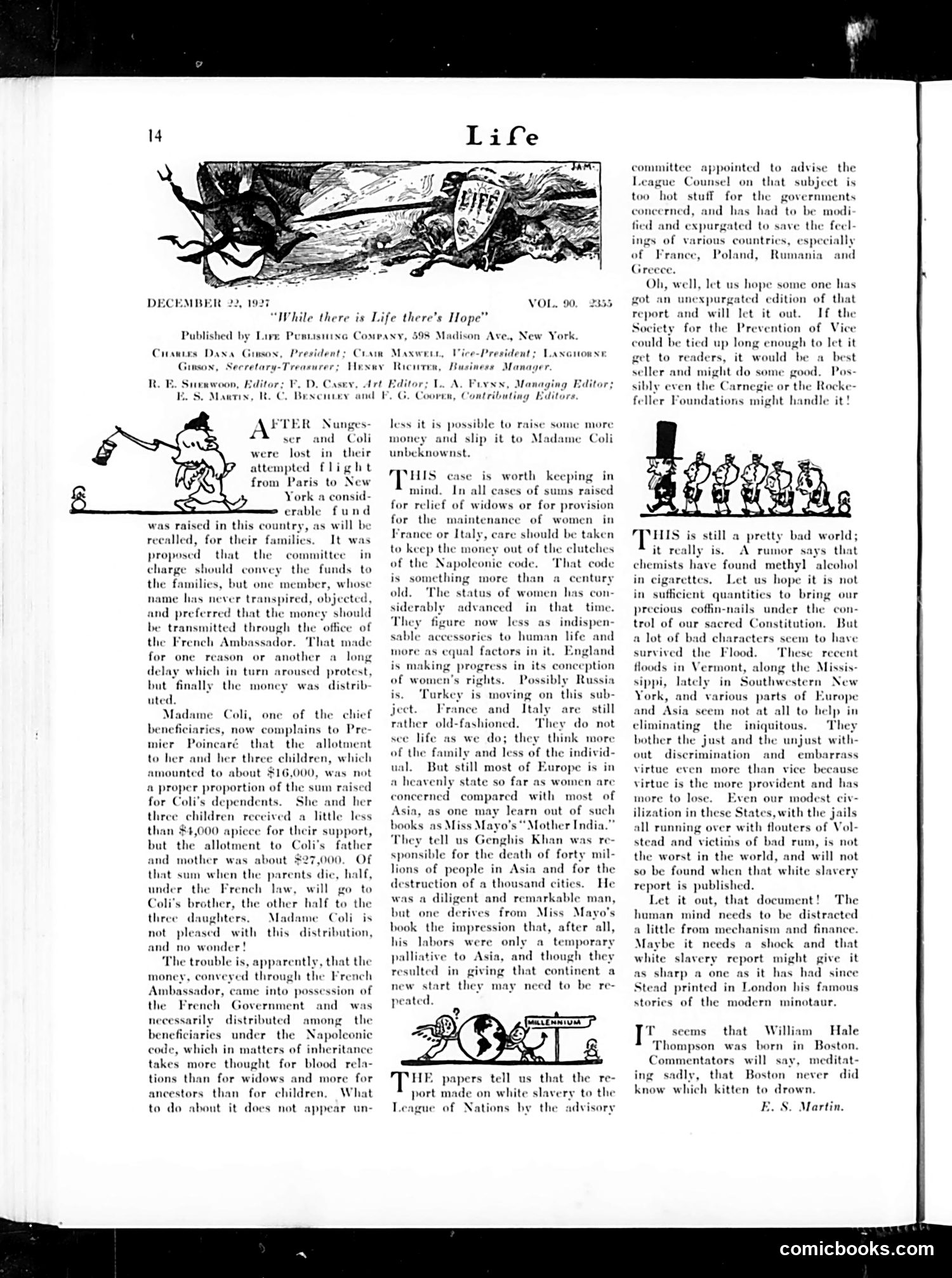
The page contains editorial commentary about post-WWI relief efforts, particularly regarding displaced persons from Paris to New York. The cartoons appear satirical about charity distribution and government bureaucracy. One illustration shows figures in top hats (representing wealthy donors or government officials) seemingly dismissing or ignoring pleas for aid—a common motif critiquing the wealthy's indifference to suffering. The text discusses how relief funds for war widows and displaced persons were being mishandled, with money potentially diverted or remaining stuck in bureaucratic channels rather than reaching intended beneficiaries. The author criticizes the inefficiency of charitable administration and calls for more transparent fund distribution. The satire targets both governmental incompetence and the moral failings of wealthy nations to properly aid those devastated by World War I.
📄 Transcribed text from this page (OCR, searchable)
Machine-transcribed from the original scan — historical spelling and the odd misread are preserved.
DECEMBER 22, 1927 “While there is Life there's Hope” Published by Lire Pesusiixe © Crtantes Dana Girsox, President: Cram iinson, Seeretary-Treasurer; Wesny Stieawoon, Edi S. Mantis, RL C. AFTER Nunges- ser and Coli were lost in their attempted flight from Paris to New York a consid- erable fund was raised in this country, as will be recalled, for their famil It was proposed that the committee in charge should convey the funds to the families, but one member, whose name has never transpired, objectec and preferred that the money should be transmitted through the office of the French Ambassador. That made for one reason or delay which in turns but finally. the uted. Madame Coli, one of the chief beneficiaries, now complains to Pri mier Poincaré that the allotment to her and her three children, which amounted to about $16,000, was not a proper proportion of the sum raised for Coli's dependents. She and her three children received a little less than $4,000 apiece for their support, but the allotment to Coli’s father and mother was about $27,000, Of that sum when the parents die, half, under the French law, will to Coli’s brother, the other half to the three daughters. Madame Coli is not pleased with this distribution, vother a long ‘oused protest, money was distrib and no wonder! The trouble is, apparently, that the money, conveyed through the French Ambassador, came into possession of the French Government and was ly distributed among the under the Napoleoni code, which in matters of inheritance takes more thought for blood rela- tions than for widows and more for What to do about it does not appear un- neces bene ancestors than for children, pany, 598 Me 2 PLD. Casey, Art Edit Besentey and t lison Ave., New York. Maxwett, Vice-President; Laxcuoasr Riciter, Business Manager. I. A. Fives, Managii Cooven, Contributing 9 Editor; G less it is possible to raise some more money and slip it to Madame Coli unbeknownst. TT MUS case is worth keeping in mind. In all cases of sums raised for relief of widows or for provision for the maintenance of women in France or Italy, care should be taken to keep the money out of the clutches of the Napoleonic e That code is something more than a century old. The status of women has con- siderably advanced in that time. They figure now less as_ indispen- sable accessories to human life and 1 equal factors in it. England is making progress in its conception of women's rights. Possibly Russia is. Turkey is moving on this sub- ject. France and Italy are. still rather old-fashioned. They do not see life as we do; they think more of the family and less of the individ- ual. But still most of Europe is in a heavenly state so far as women are concerned compared with most of Asia, as one may learn out of such books as Miss Mayo’s“ Mother India.” They tell us is Khan was re- sponsible for the death of forty mil- lions of people in Asia and for the destruction of a thousand cities. He was a diligent and remarkable man, but one derives from Miss Mayo's book the impression that, after all, his labors were only a temporary palliative to Asia, and though they resulted in giving that continent a new start they may need to be re- peated. HE. papers tell us that the re- port made on white slavery to the mic of Nations by the advisory committee appointed to advise. the League Counsel on that subject is too hot stuff for the ‘ governments acerned, and has had to be modi fied and expurgated to save the feel- ings of various countries, especially of France, Poland, Rumania and Greece. Oh, well, let us hope some one has got an unexpurgated edition of that report and will let it out. If the Society for the Prevention of Vice could be tied up long enough to let it get to readers, it would be a best seller and might do some good. Pos- sibly even the Carnegie or the Rocke- feller Foundations might handle it! TUS is still a pretty bad world; it really is. A rumor says that chemists have found methyl ‘alcohol in cigarettes. Let us hope it is not in sufficient quantities to bring our precious coffin-nails under the con- trol of our sacred Constitution, But a lot of bad characters seem to have survived the Flood. These recent floods in Vermont, along the Missis- sippi, lately in Southwestern New York, and Various parts of Europe and Asia seem not at all to help in eliminating the iniquitous. They bother the just and the unjust with- out discrimination and embarrass virtue even more than vice because virtue is the more provident and has more to lose. Even our modest civ- ilization in these States, with the jails ill running over with flouters of Vol- stead and victims of bad rum, is not the worst in the world, and will not so be found when that white slavery report is published. Let it out, that documen human mind needs to be distrac' a little from mechanism and finance. Maybe it needs a shock and that white slavery report might give it as sharp a one as it has had since Stead printed in London his famous stories of the modern minotaur. [T seems that William Hale Thompson was born in Boston. Commentators will say, medi er did ing sadly, that Boston ne know which kitten to drown. E. S. Martin. comicbooks.com