
A complete issue · 35 pages · 1927
Life — January 27, 1927
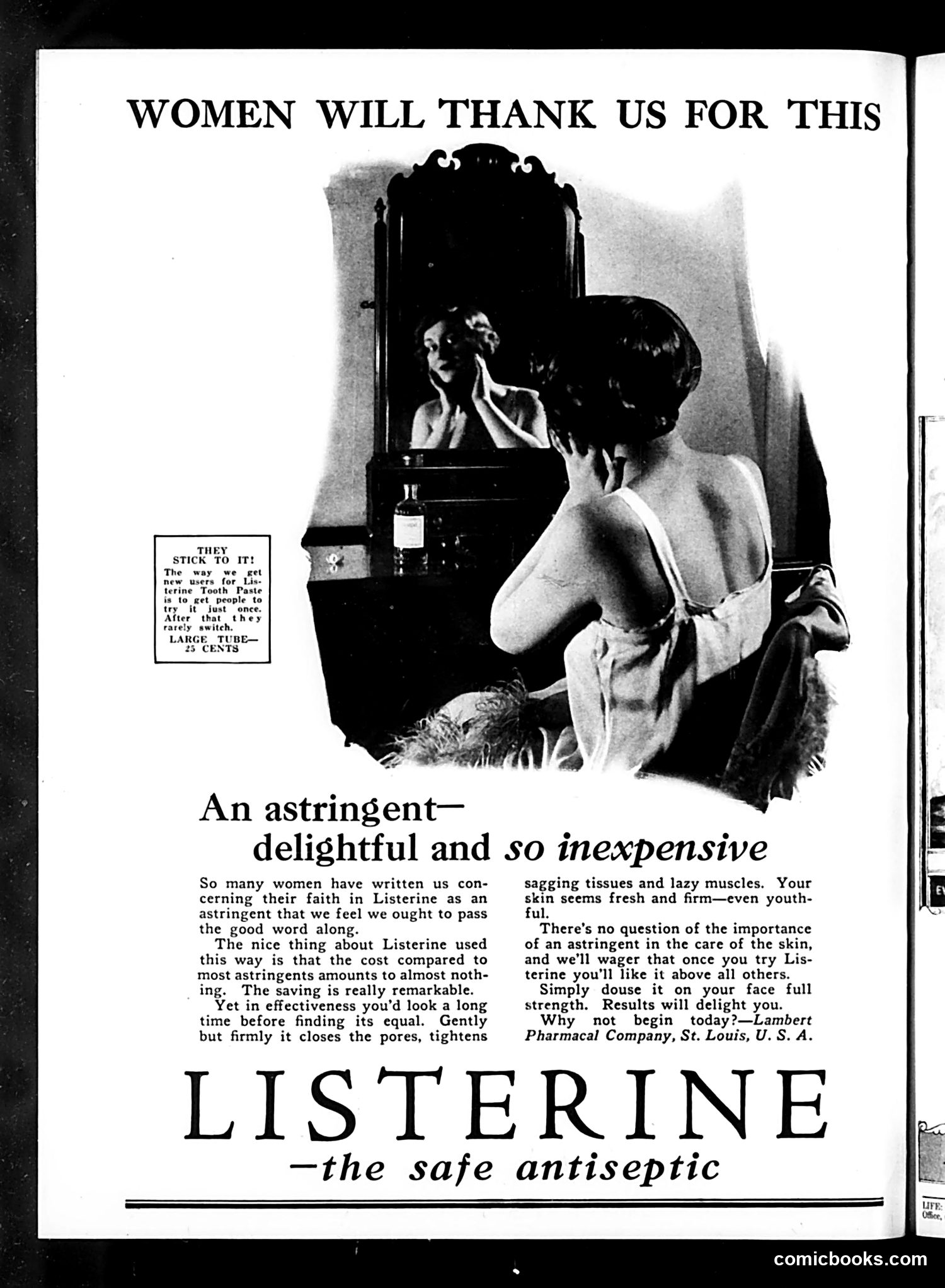
This is a **Listerine advertisement**, not political satire. The page promotes Listerine antiseptic as an inexpensive facial astringent for women. The image shows a woman at a mirror examining her face, with text emphasizing Listerine's low cost compared to other astringents. The ad claims it tightens pores, firms skin, and produces a "youthful" appearance. A small insert mentions Listerine's original use: helping dentists market toothpaste by creating the concept of "halitosis" (bad breath) as a social problem requiring their product. This reflects early 20th-century advertising targeting female insecurities about appearance and social acceptability—a common marketing strategy of that era that modern readers would recognize as manipulative.
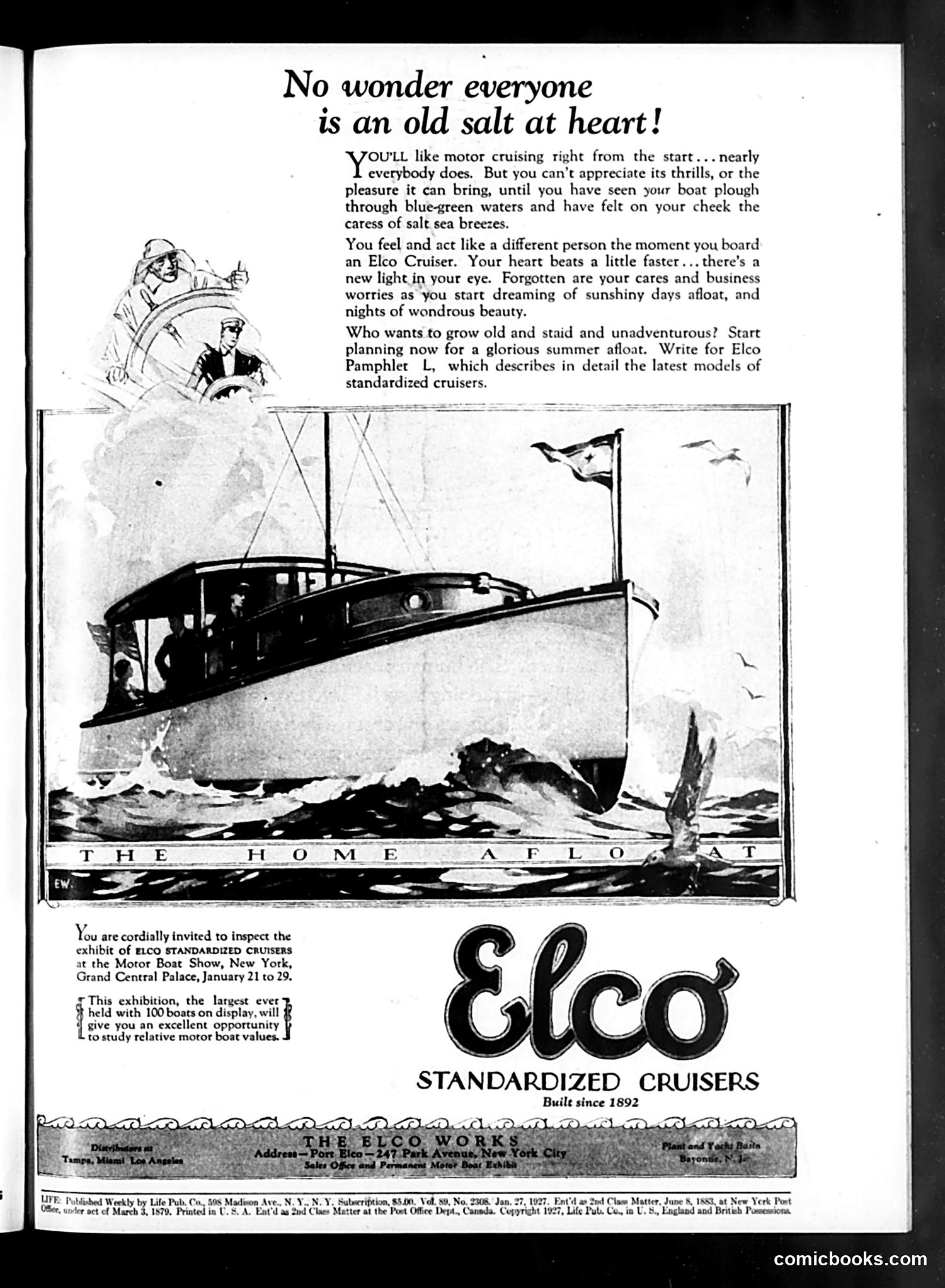
This is primarily an **advertisement for Elco Standardized Cruisers** (motorboats), not political satire. The page headline "No wonder everyone is an old salt at heart!" uses figurative language to appeal to readers' romantic desires for seafaring adventure. The text promises that owning an Elco Cruiser will transform you into an adventurous person, helping you escape everyday "cares and business worries" through boating. The illustration shows a pleasure boat underway, emphasizing leisure and elegance. The ad invites readers to visit the Motor Boat Show in New York (January 21-29) and request Pamphlet L for details on "standardized cruisers" — mass-produced boats available since 1892. This was targeted at middle-class aspirants seeking accessible luxury during the prosperous 1920s era.
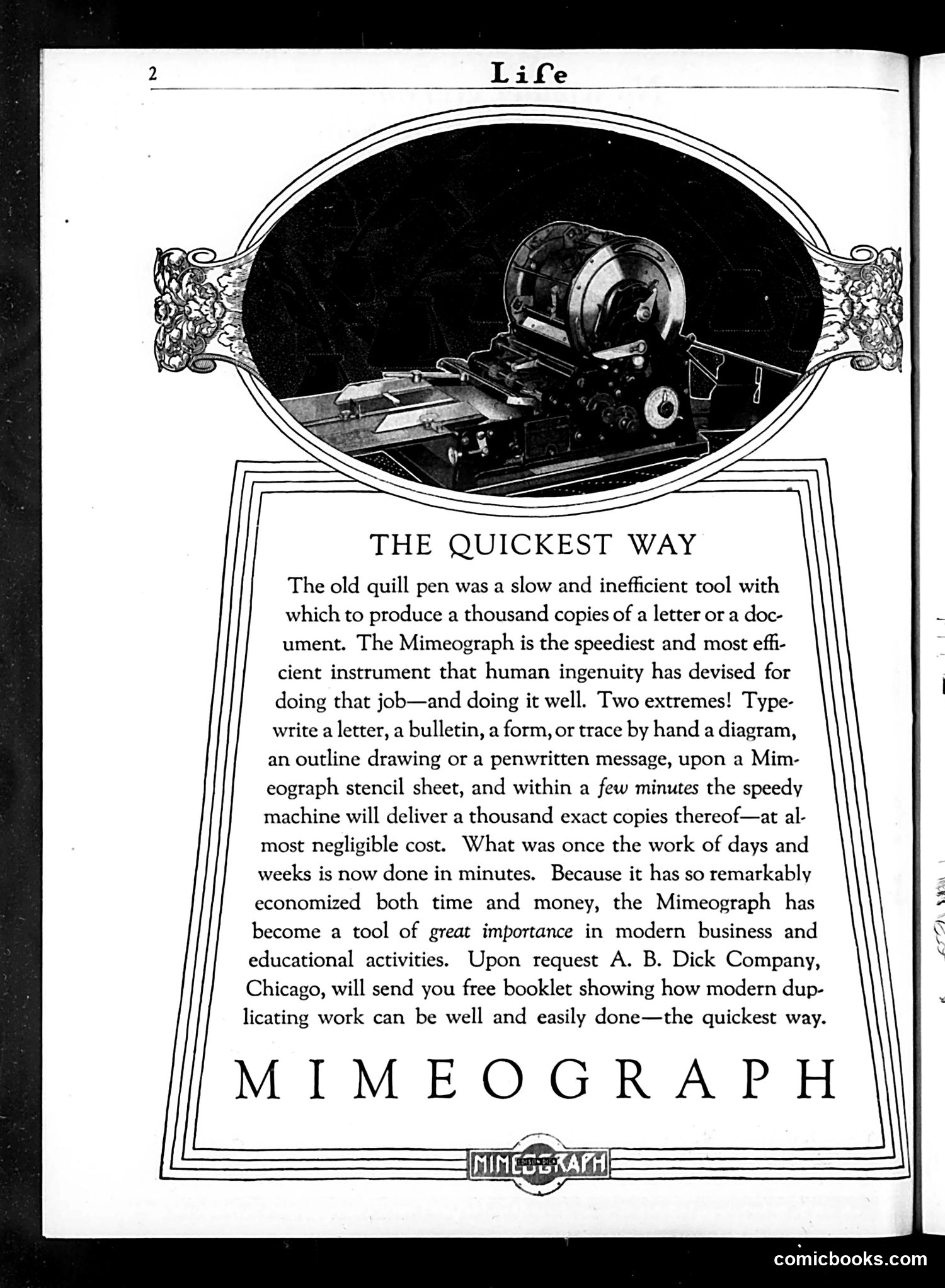
This is **not a political cartoon or satire**, but rather a straightforward advertisement for the Mimeograph machine, published in *Life* magazine (page 2). The ad promotes the Mimeograph as a revolutionary duplicating technology that replaced slow manual methods like quill pens. It claims the machine can produce 1,000 exact copies of documents "within a few minutes" at minimal cost, transforming work that previously took "days and weeks." The oval image shows the actual mimeograph device. The text emphasizes its importance for "modern business and educational activities" and invites readers to request a free booklet from A.B. Dick Company in Chicago. This reflects early-20th-century business enthusiasm for mechanization and office efficiency.
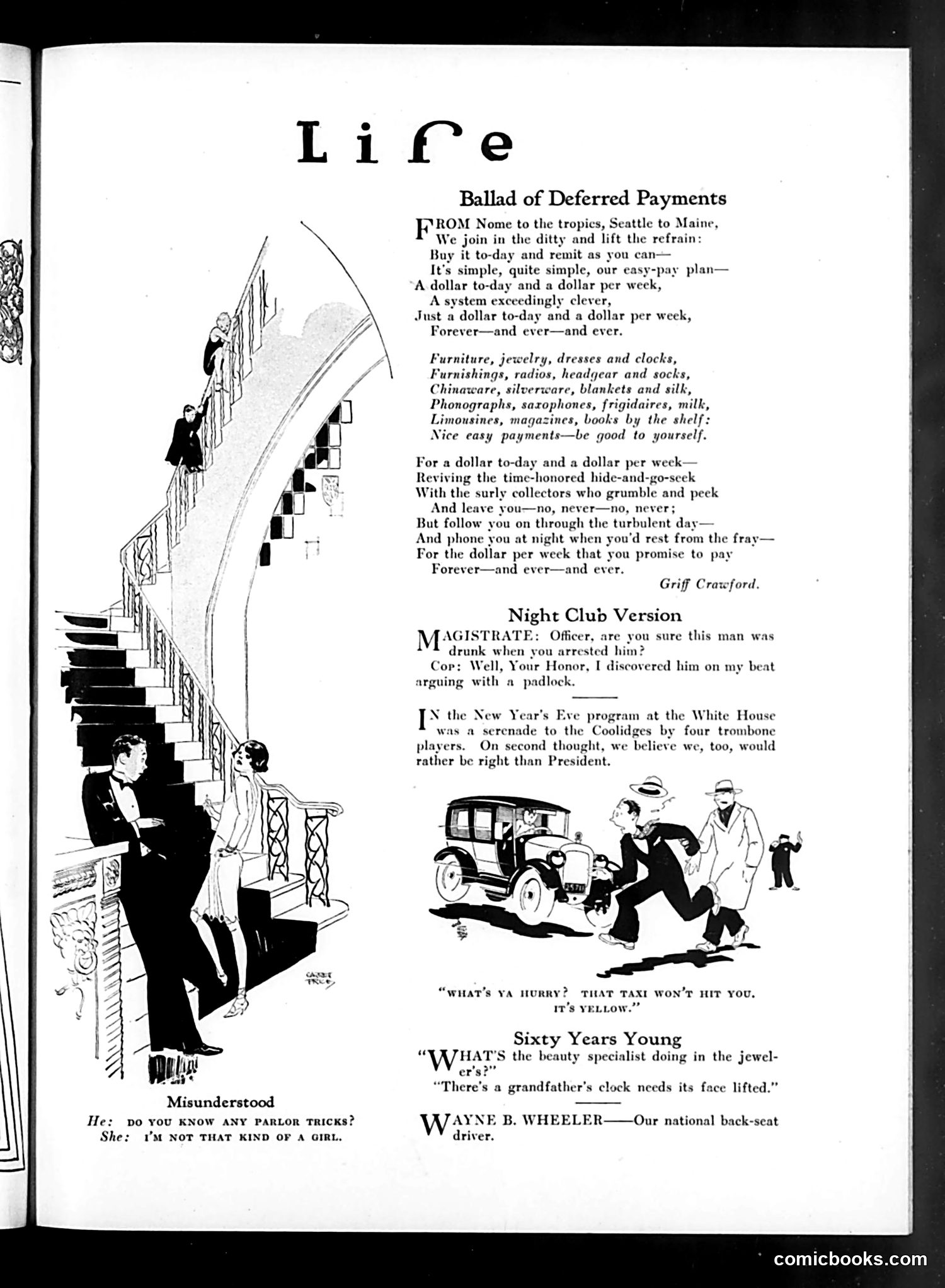
This page contains several satirical pieces from what appears to be the 1920s era: **"Ballad of Deferred Payments"** mocks the then-popular installment-buying system ("a dollar today and a dollar per week"), suggesting it keeps consumers perpetually indebted while collectors pursue them relentlessly. **"Night Club Version"** appears to reference Prohibition-era excess and lawlessness, with a dialogue about arrest and drunkenness, plus a joke about a White House New Year's Eve serenade by trombonists—possibly alluding to political figures or events of that period. **"Misunderstood"** is a visual joke about miscommunication between a man and woman regarding "parlor tricks." **"Sixty Years Young"** and the Wayne B. Wheeler reference suggest commentary on aging and contemporary figures, though the specific references are unclear without additional context. The page reflects 1920s consumer culture and social commentary.
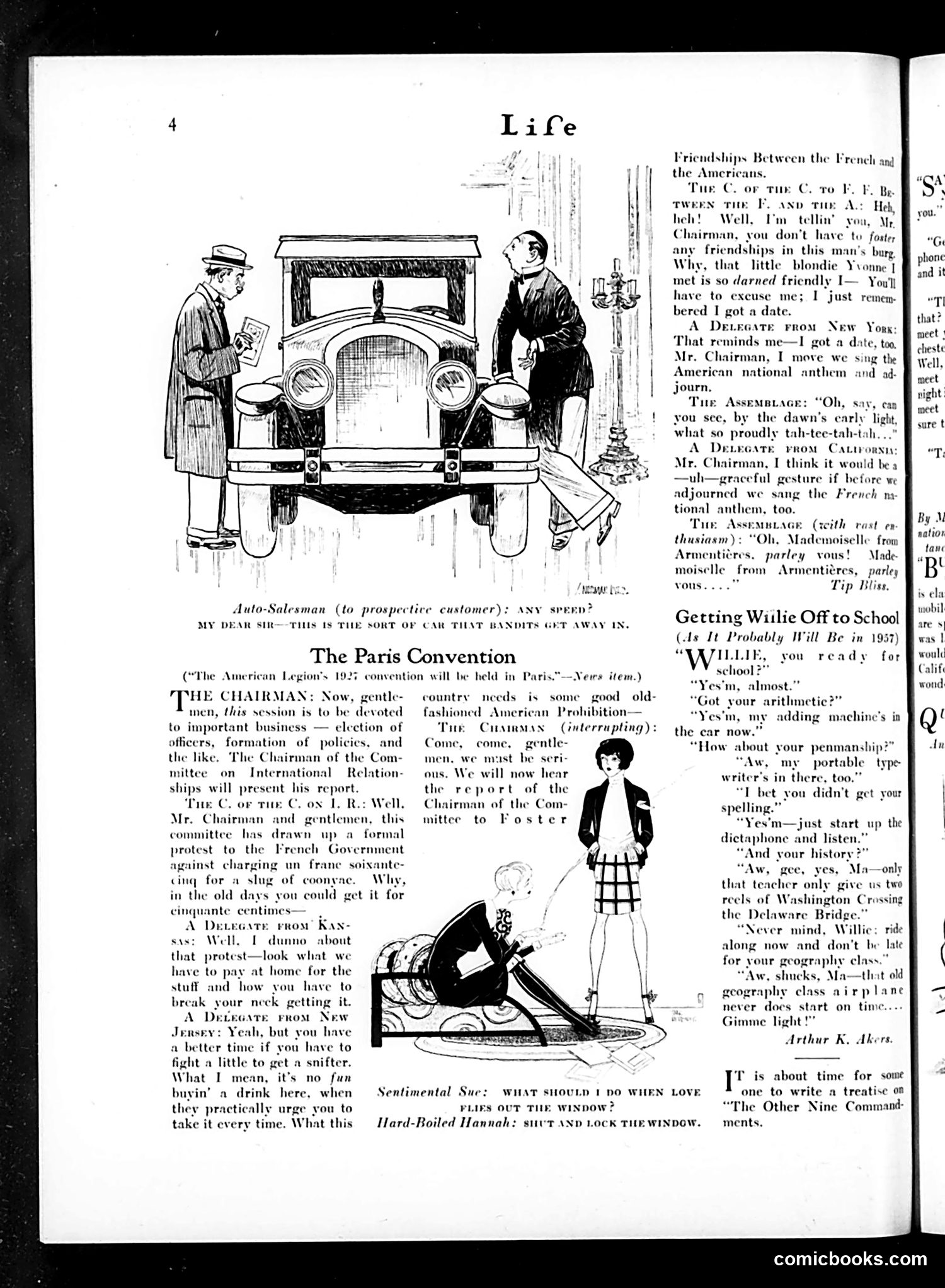
**"The Paris Convention"** cartoon depicts an American Legion convention discussion about international relations and Prohibition enforcement. The joke concerns delegates debating whether France should pay war debts while America smuggles alcohol—highlighting the hypocrisy of the era. One delegate protests that "in the old days you could get it for cinematic centuries," sarcastically commenting on how Prohibition made obtaining liquor difficult and expensive compared to pre-1920. **"Getting Willie Off to School"** is a humorous domestic sketch about a child's reluctance and excuses before school—mundane family comedy requiring no historical context. Both pieces reflect 1920s concerns: international post-WWI relations, Prohibition's unpopularity, and ordinary American life.
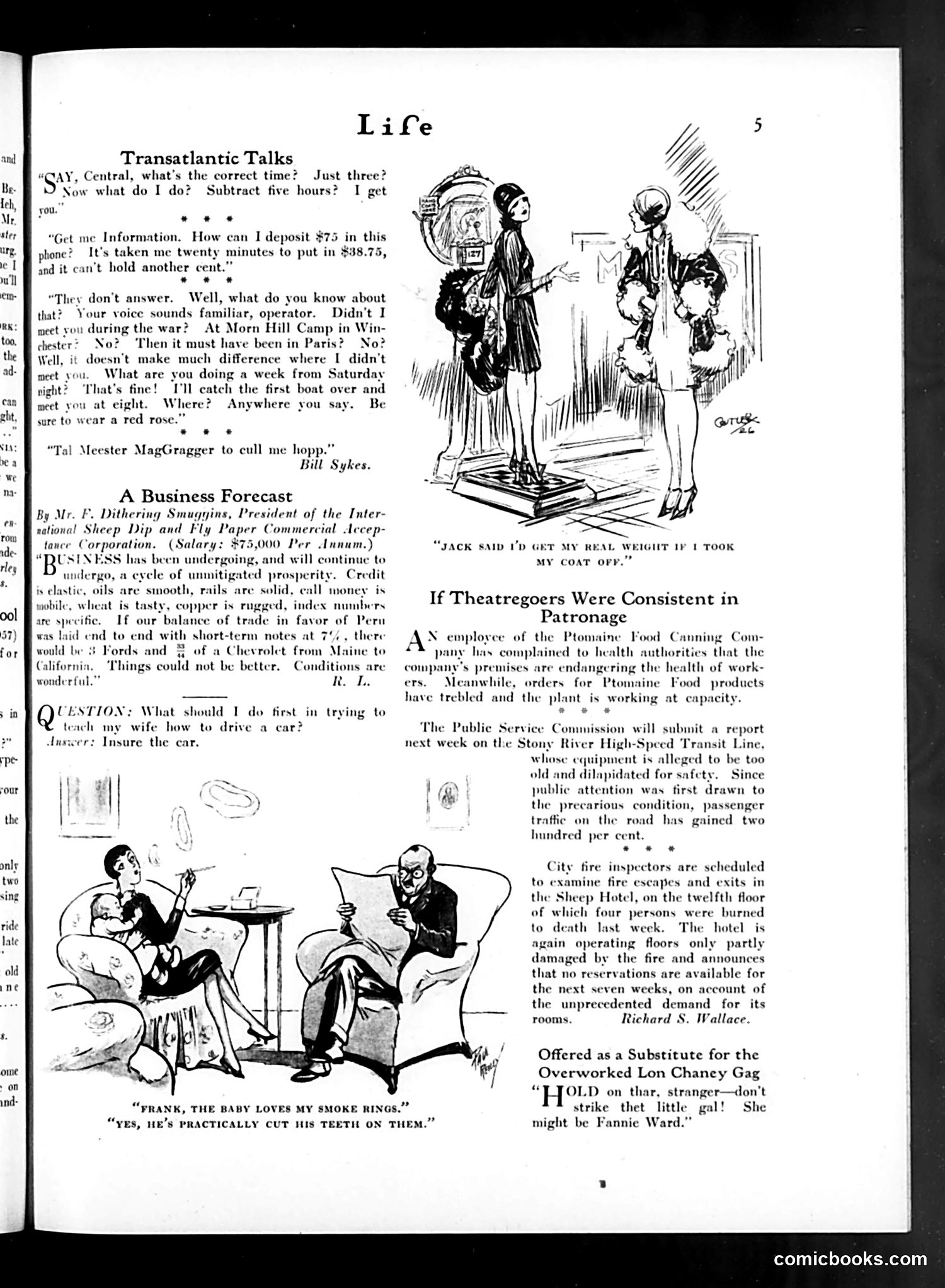
This page contains three separate satirical pieces: 1. **"Transatlantic Talks"** mocks the complications of international long-distance telephone calls—a relatively new technology. The humor centers on time zone confusion, operator misunderstandings, and the difficulty of conducting business across the Atlantic. 2. **"A Business Forecast"** presents an optimistic economic outlook from a sheep-dip company president, satirizing corporate boosterism and overly rosy financial predictions. 3. **"If Theatregoers Were Consistent in Patronage"** and the bottom cartoon mock inconsistent consumer behavior—patrons complaining about theater conditions while continuing to attend, and a domestic scene where a baby chews on smoke rings (absurd humor typical of the era). The page reflects 1920s concerns about modern technology, business speculation, and social contradictions.
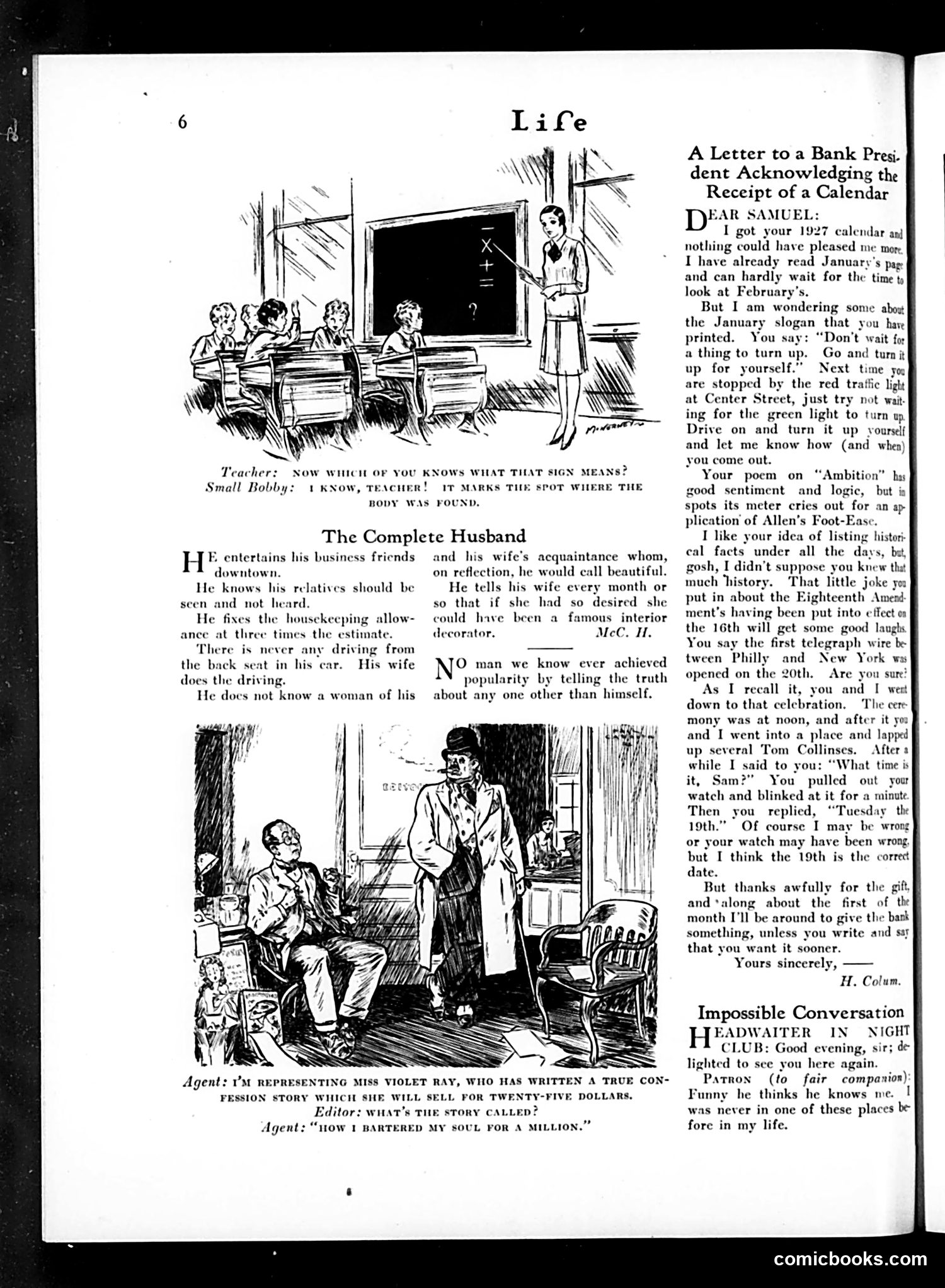
This page contains three satirical pieces from Life magazine (a 1920s humor publication): 1. **"Teacher, will you knows what that sign means?"** - A classroom cartoon mocking a student's ignorance about traffic signs, likely social commentary on poor education or reckless driving habits. 2. **"The Complete Husband"** - A humorous poem listing qualities of an ideal husband who entertains business friends, manages household finances, and avoids criticisms. The accompanying illustration shows a domestic scene, satirizing traditional gender roles and marriage expectations of the era. 3. **"A Letter to a Bank President"** - A reader's complaint about a 1927 calendar's unclear January slogan ("Don't wait for a thing to turn up. Go and turn it up yourself"), with amusing anecdotes about misunderstandings regarding the first telegraph line between Philadelphia and New York. These pieces represent typical 1920s humor targeting everyday life frustrations and social conventions.
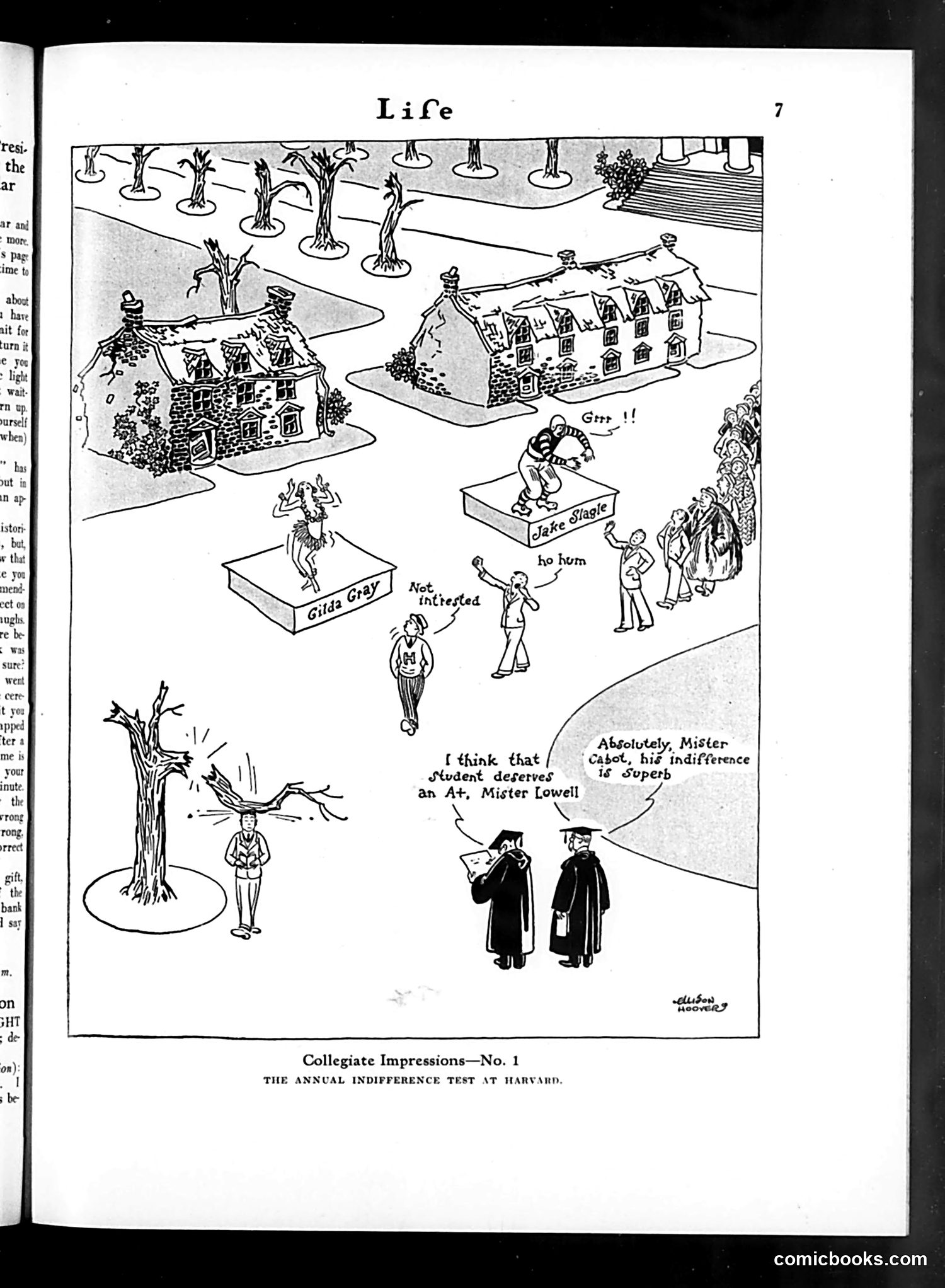
This satirical cartoon depicts Harvard student life, showing various campus scenes labeled with student types: "Gilda Gray" (likely referencing the popular 1920s dancer), "Jake Slagle" (unclear reference), and "Not intrigued" figures. The central joke involves two academics in robes at the bottom discussing a student's indifference, with one remarking "I think that student deserves an A+, Mister Lowell" to which another responds "Absolutely, Mister Cabot, his indifference is Superb." The satire mocks Harvard's reputation for cultivating aristocratic detachment and apathy among wealthy students—suggesting that indifference itself becomes an academic virtue worthy of top grades. This reflects early 20th-century critiques of elite universities prioritizing social standing over intellectual engagement.
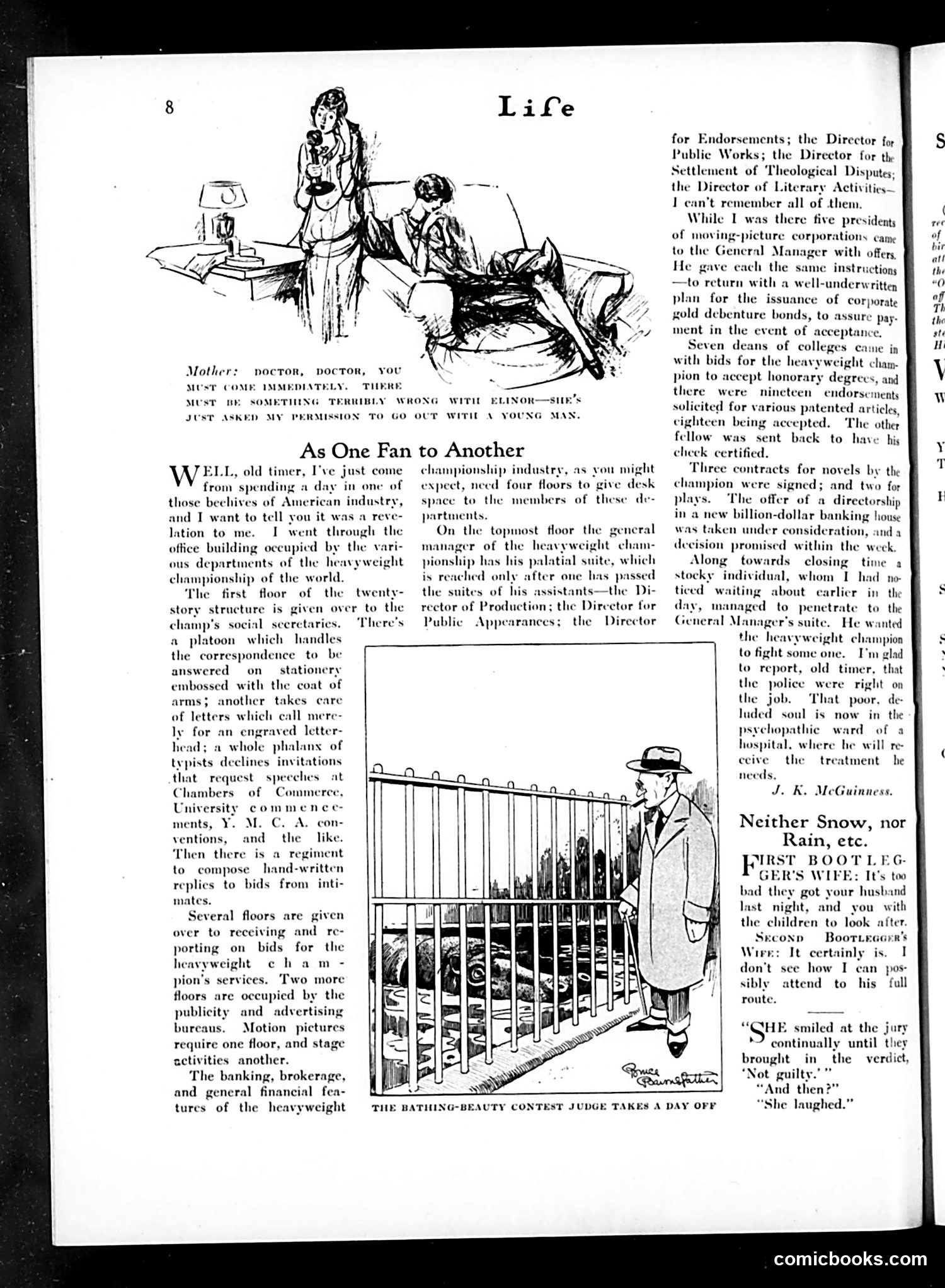
This page contains an article titled "As One Fan to Another" discussing the administrative bureaucracy of a major industrial corporation—likely a heavyweight boxing or sports championship organization. The text describes the proliferation of departments, directors, and paperwork required to manage even simple tasks. The central cartoon, captioned "THE BATHING-BEAUTY CONTEST JUDGE TAKES A DAY OFF," depicts a judge observing contestants through prison-cell bars, satirizing how beauty pageants objectify women by literally caging them for evaluation. Below the main article is a humorous dialogue between a bootlegger's wife and another woman about managing household duties, likely referencing Prohibition-era concerns. The satire targets corporate inefficiency, beauty industry exploitation, and domestic life during Prohibition.
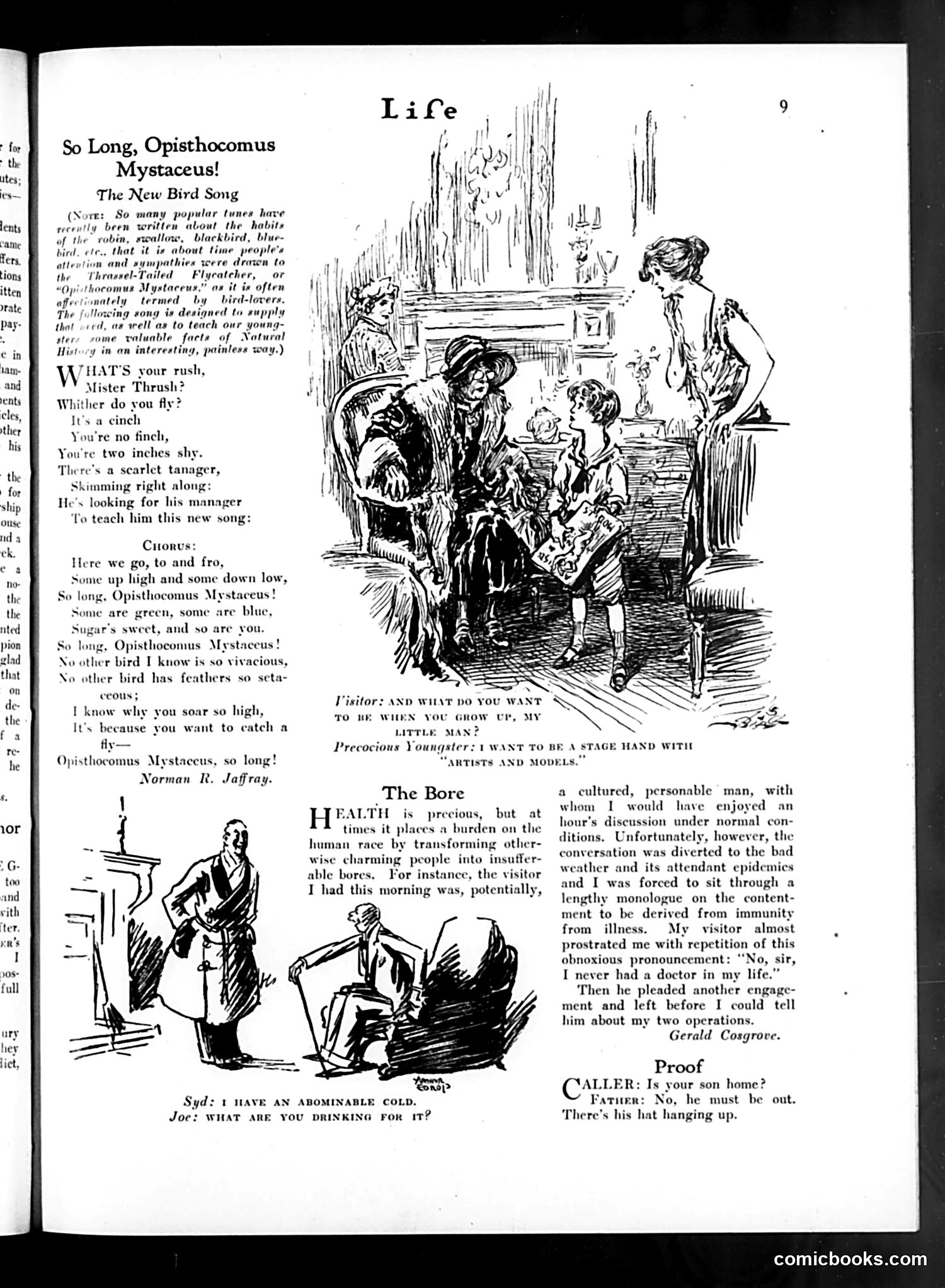
This page contains three separate humor pieces: 1. **"So Long, Opisthocomus Mystaceus!"** — A musical parody about an obscure bird species, with verses and chorus. The joke appears to be the absurdity of writing an elaborate "New Bird Song" about such an unpronounceable, insignificant creature. 2. **"The Bore"** — A sketch satirizing tedious social visitors. A man monopolizes conversation with lengthy, unwelcome discussion about his health problems and medical operations, exemplifying the type of bore who makes social calls unbearable. 3. **"Proof"** — A brief dialogue joke where a caller asks if someone's son is home; the father replies the son must be out because "his hat hanging up" — implying the son is there but hiding from visitors. All are gentle, domestic satire typical of early 20th-century American humor magazines.
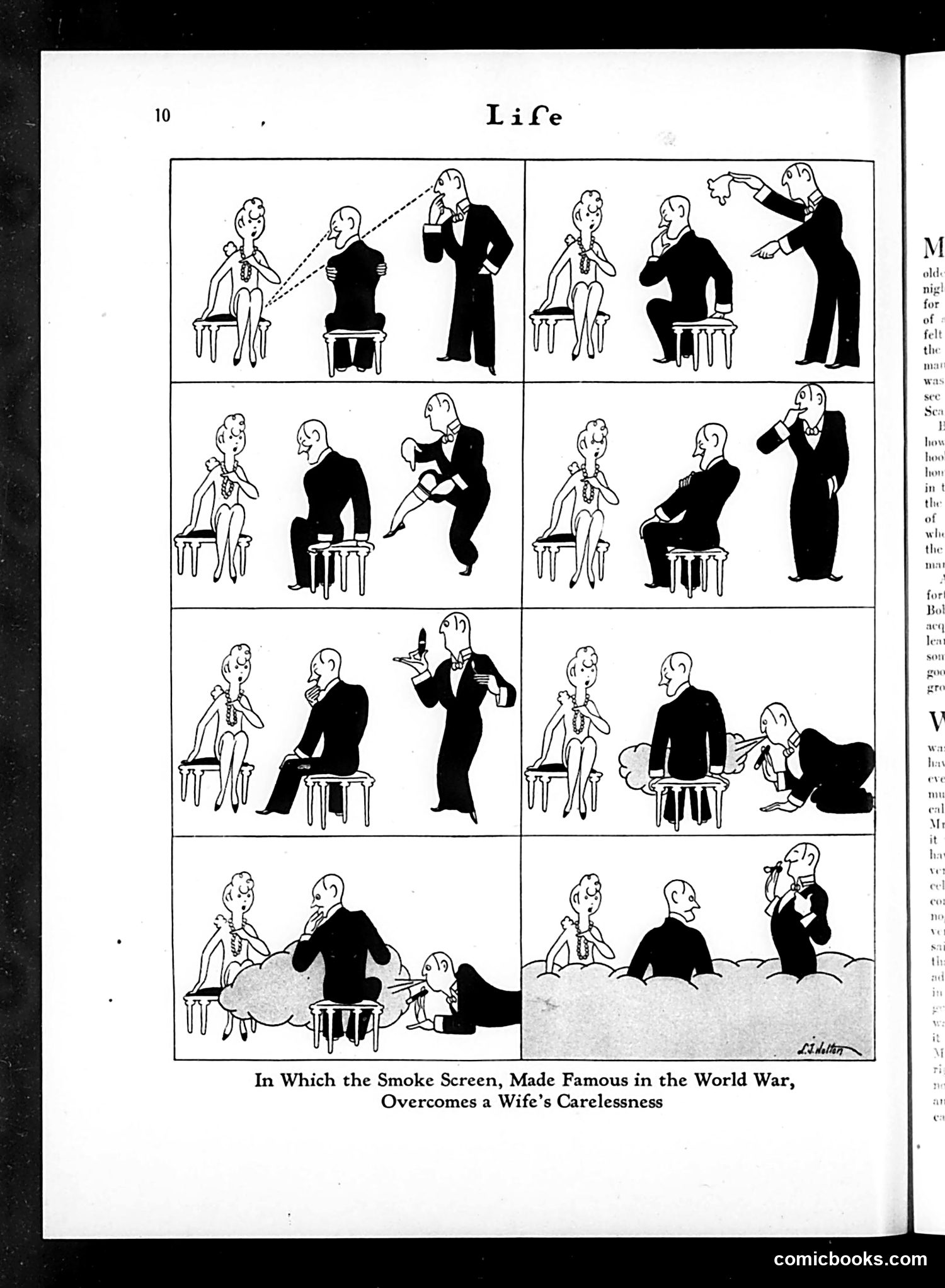
This satirical comic from *Life* magazine depicts a husband using military smoke screens—a famous World War I defensive tactic—to hide his infidelity from his wife. The sequence shows: the wife notices her husband's suspicious behavior; he deflects her concerns; she continues questioning him; finally, he creates an actual smoke screen (referencing the war technology) that obscures her view, allowing him to escape with another woman unseen. The satire mocks both marital deception and how men might exploit contemporary wartime references to evade accountability. It's a domestic humor piece that assumes readers would find the absurdist application of military innovation to marital problems funny, while commenting on gender dynamics and male infidelity in the era.
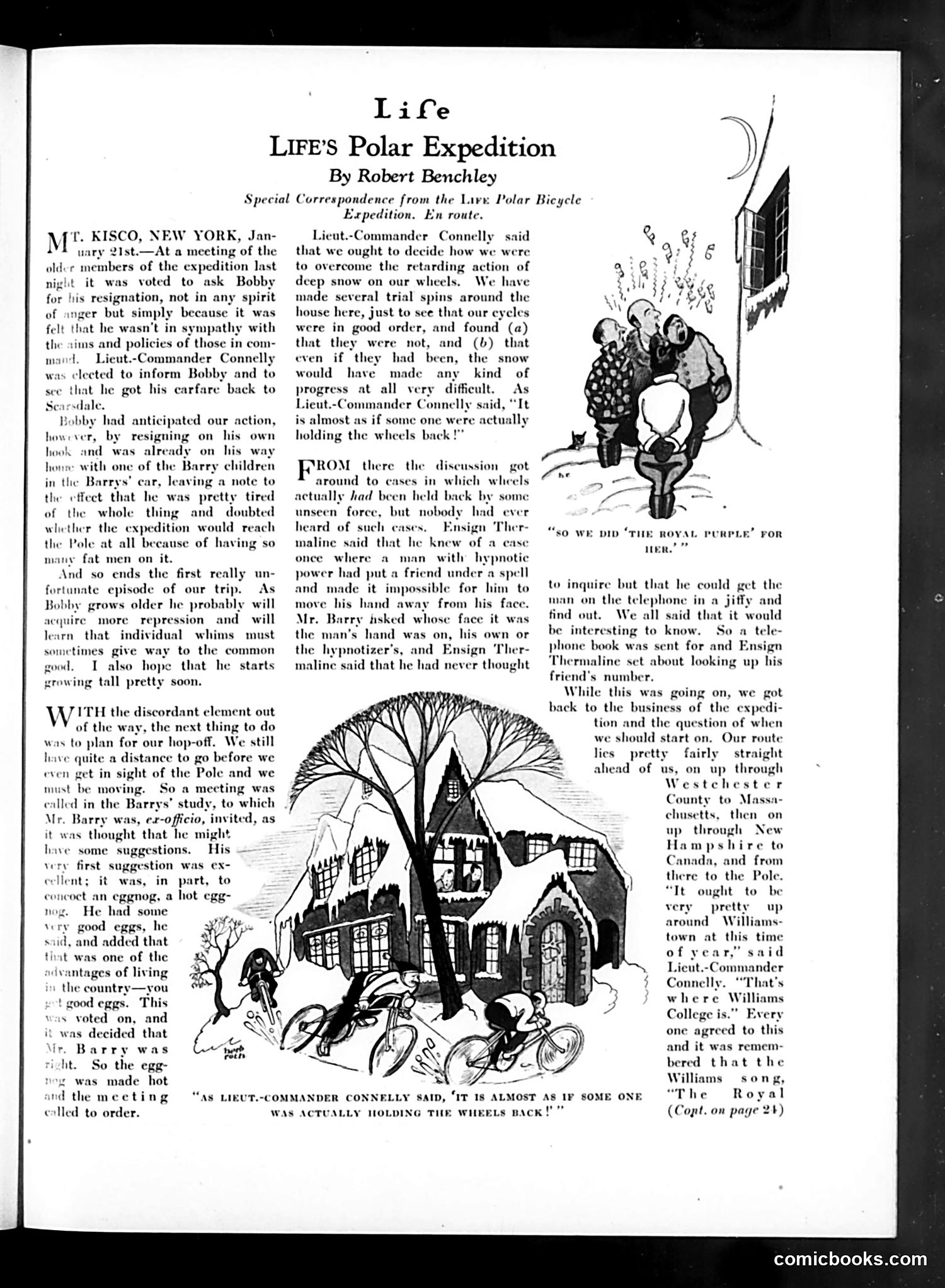
This is a humorous travelogue by Robert Benchley about "Life's Polar Bicycle Expedition." The article mocks an ill-conceived arctic journey by bicycle, poking fun at the expedition's poor planning and the friction between participants. The two illustrations show winter scenes: cyclists attempting to navigate snowy terrain, and a large mansion in a winter landscape. The satire centers on absurd problems—frozen wheels, contradictory advice from commanders, and discussion of whether wheels were actually being "held back" by mysterious forces. The piece ridicules both the expedition's incompetence and Benchley's character "Hobby," who resigned due to the fiasco. The humor derives from applying serious expedition language to a fundamentally ridiculous endeavor: attempting polar travel by bicycle. This reflects Life magazine's tradition of sophisticated comedic commentary on contemporary trends.
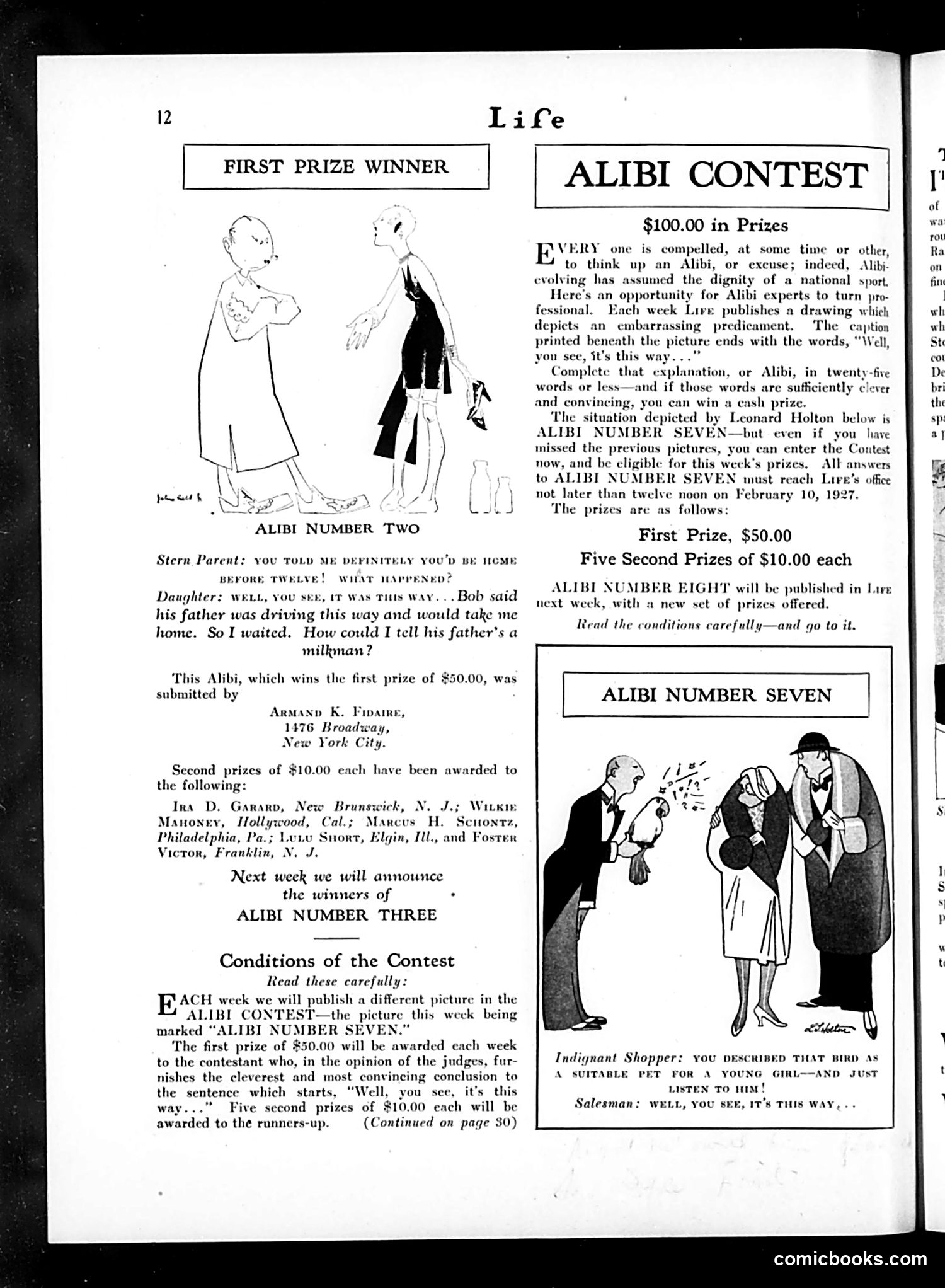
This page announces an ongoing "Alibi Contest" where readers submit humorous explanations for embarrassing situations depicted in cartoons. The first prize winner (Alibi Number Two) shows a stern parent confronting their daughter about coming home late. The daughter's explanation: her boyfriend's father was driving them and would bring her home, but she waited—"How could I tell his father's a milkman?" The humor relies on class prejudice: the embarrassment of being associated with working-class occupations. The second cartoon (Alibi Number Seven) shows a shopkeeper and salesman discussing a bird as a pet for a young girl, with the salesman providing his own alibi for why it's unsuitable. The contest invites readers to complete sentences starting "Well, you see, it's this way..." with $100 in total prizes offered.
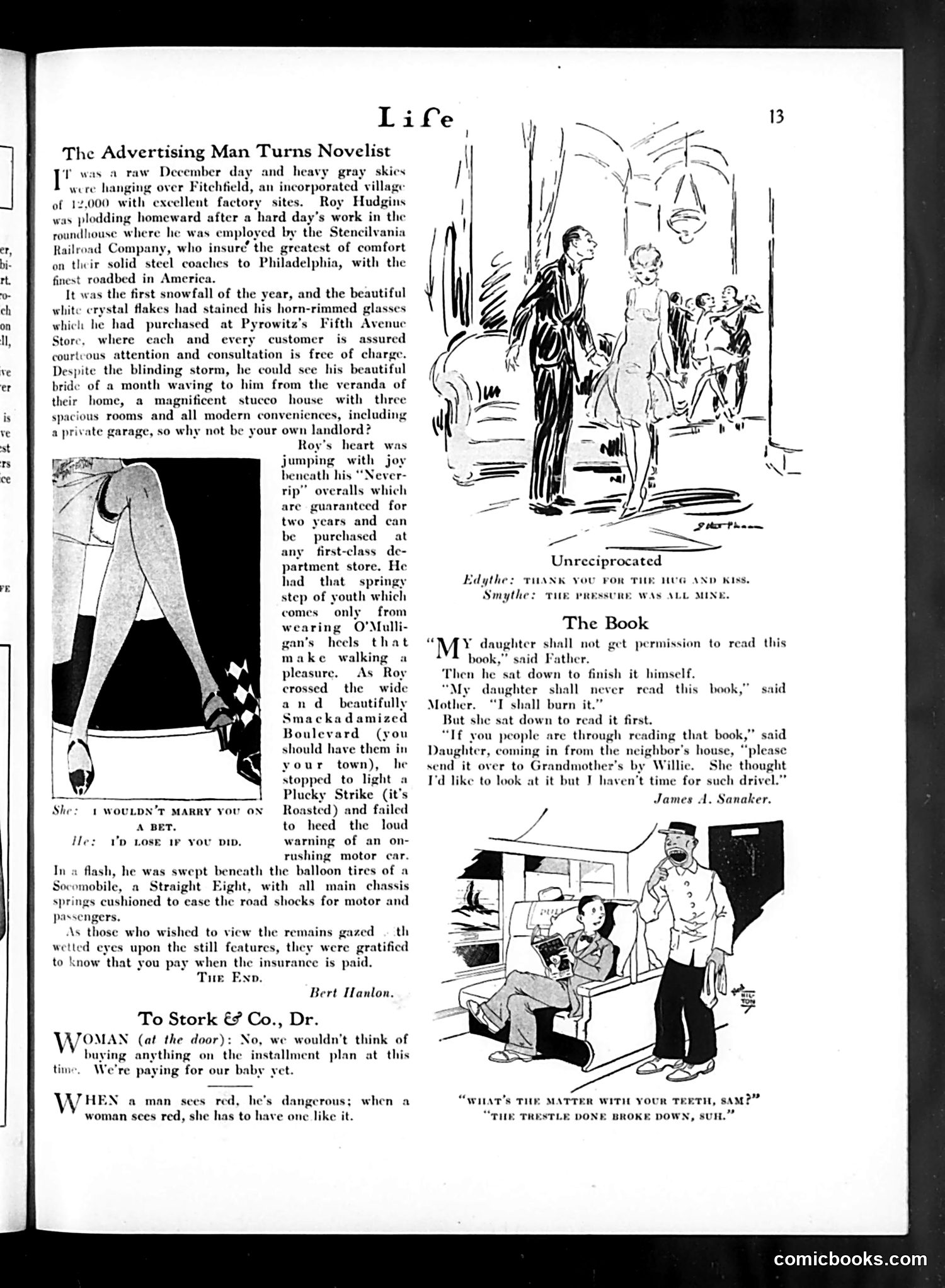
This page contains three separate humorous pieces typical of early 20th-century satire: **"The Advertising Man Turns Novelist"** (by Bert Hanlon): Satirizes advertising copywriting by presenting Roy Hudgins, an ad man who applies high-pressure sales techniques to romantic scenarios. The joke mocks how advertisers used exaggerated claims and manipulative language to sell products—here applied absurdly to seduction. **"Unreciprocated"**: A brief cartoon about romantic rejection, with the caption playing on courtship pressure. **"The Book"**: Depicts family conflict over reading restrictions, where parents attempt to censor their daughter's literature—a common anxiety about literature's moral influence in this era. **"To Stork & Co."**: A joke about installment purchasing for baby expenses. These pieces collectively satirize consumerism, advertising excess, and social conventions of the period.
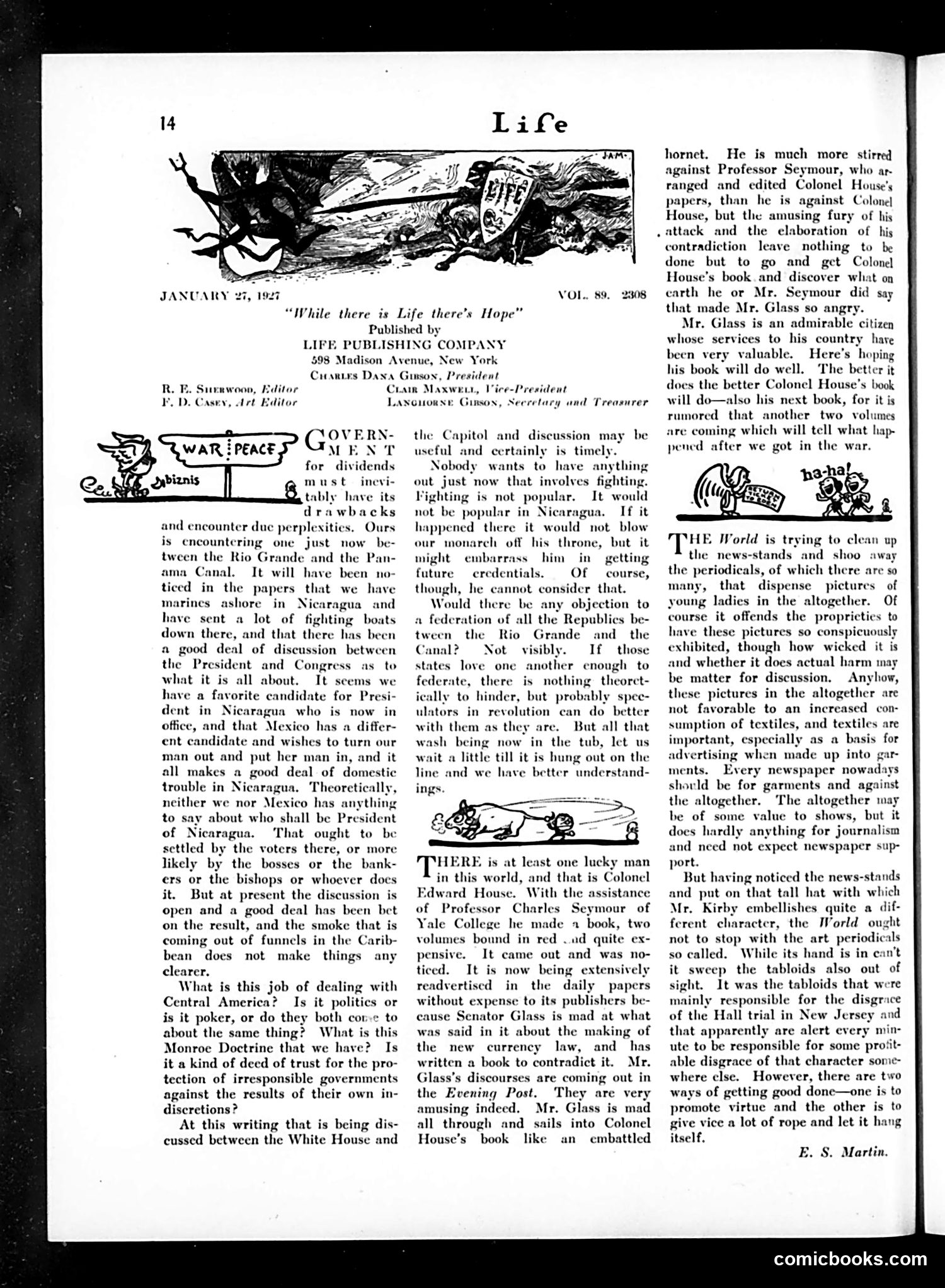
This page contains editorial commentary rather than political cartoons. The article discusses Central American politics, particularly instability in Nicaragua and Mexico, framed around whether the U.S. should intervene militarily. The text also addresses a controversy involving Senator Glass, who is angry about Colonel Edward House's book (published with Yale College professor Charles Seymour's assistance). Glass apparently views the book as contradicting his own account of events, particularly regarding currency law and post-war diplomacy. The author argues both Glass and House deserve consideration, and that newspapers should exercise restraint in covering such disputes to avoid damaging public figures' reputations. The piece criticizes sensationalist newsstand displays while defending editorial discretion.
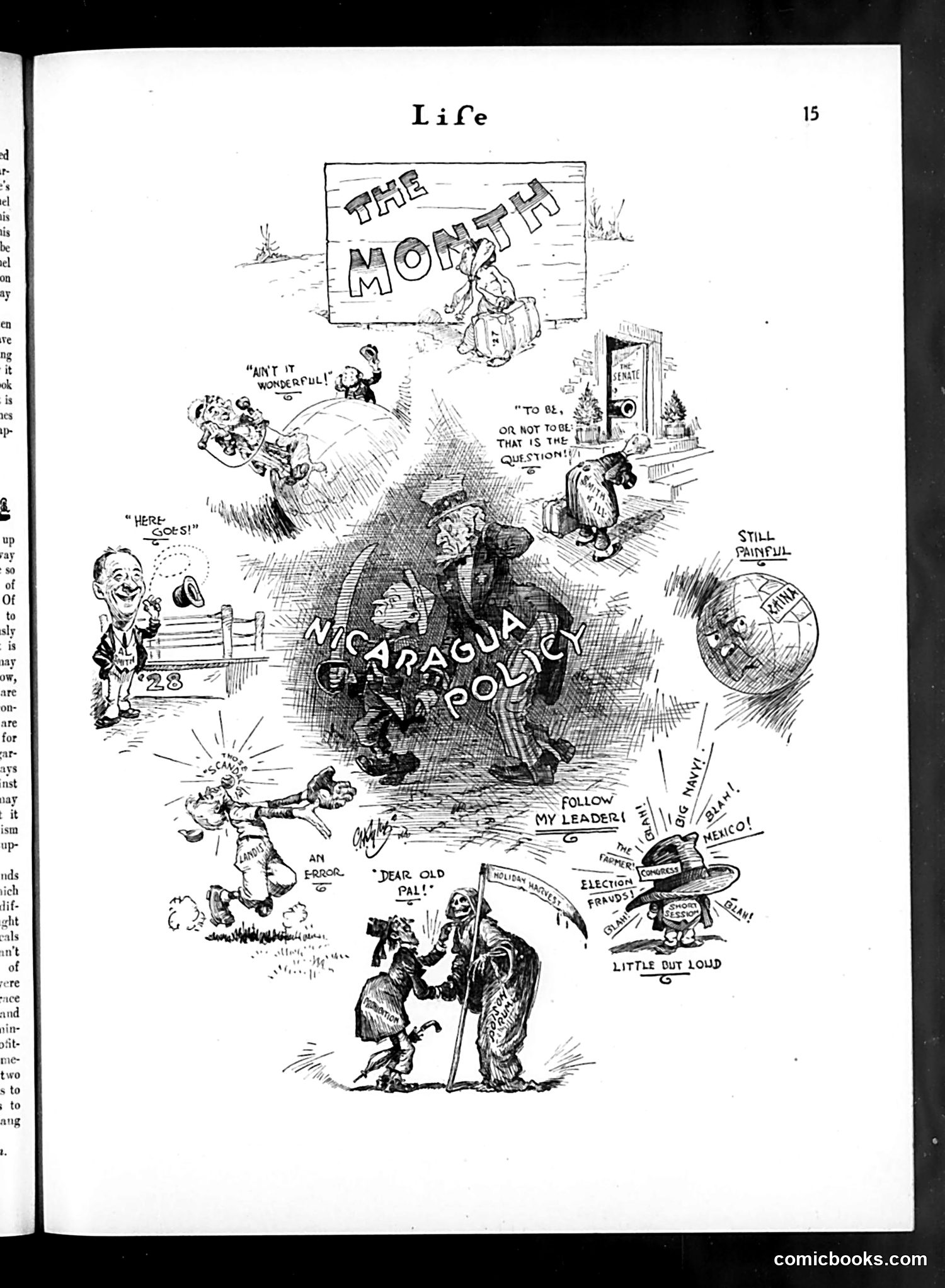
This Life magazine cartoon satirizes American intervention in Nicaragua's political chaos. "The Month" presents Nicaragua as a whirling mess of competing factions and instability. The central figure labeled "Nicaragua Policy" shows the country in turmoil, with various characters representing different political actors or outcomes. Text fragments reference "Follow my leader," "Dear old pal," and references to "election frauds" and political manipulation. The caricatures suggest competing U.S.-backed interests struggling for control. The bottom panel shows an elderly American figure ("Dear Old Pal") seemingly advising or directing a smaller figure, likely depicting U.S. interference in Nicaraguan affairs. The overall message critiques American political meddling in Central American countries and the resulting instability and corruption that such interference creates. The chaos reflects early 20th-century American interventionist foreign policy.
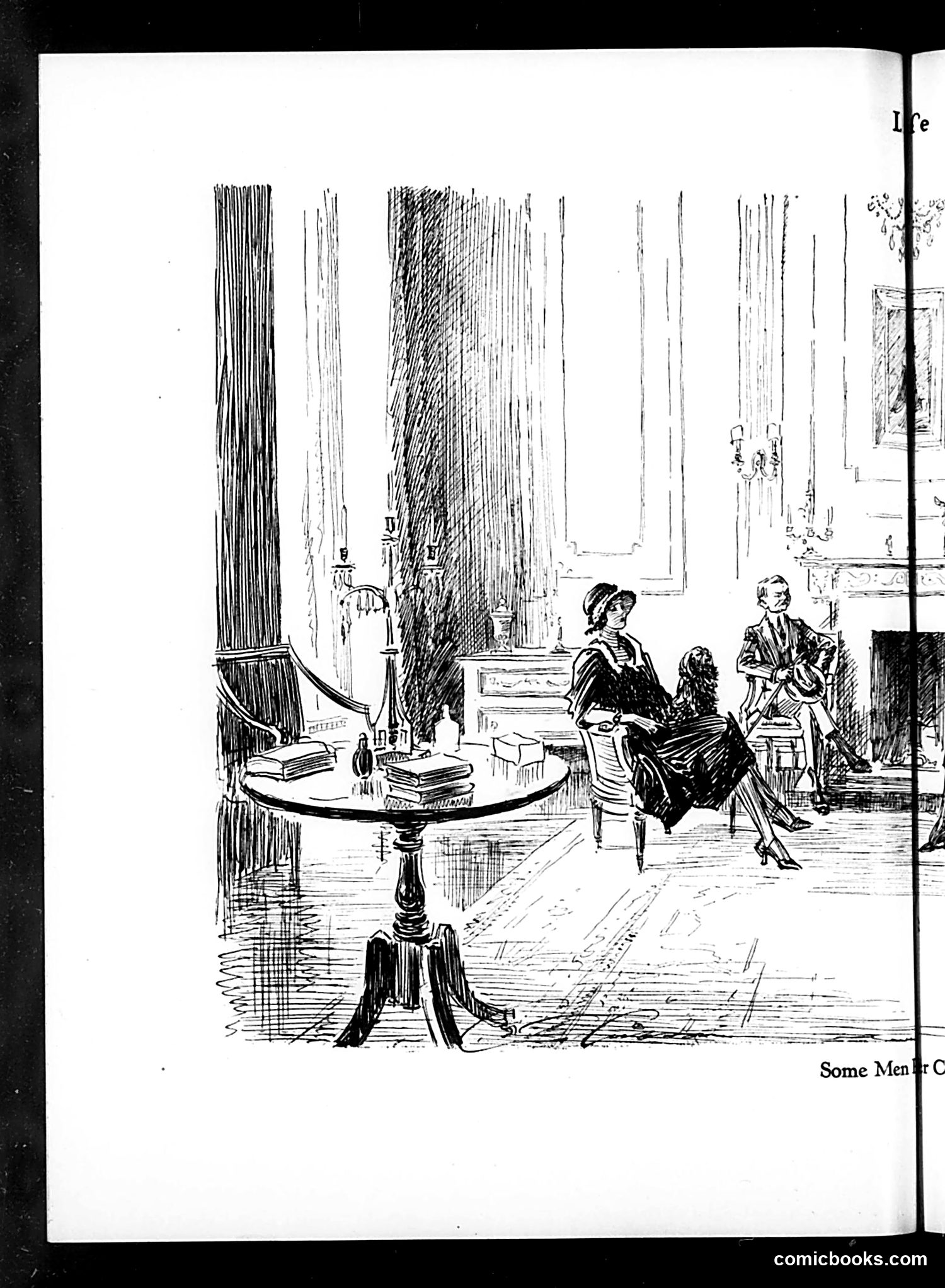
This is an illustration (not a political cartoon) depicting an interior scene, likely from a wealthy home or institution. The image shows several figures in early 20th-century dress in what appears to be a formal parlor or drawing room. A round pedestal table with books sits in the foreground, while four figures are positioned in the background—a woman standing, two seated figures, and a man in a suit. The partial text visible reads "Some Men" at the bottom, suggesting this illustration accompanies a story or article. Without the complete text, the specific satirical point remains unclear, though the formal setting and composition suggest social commentary on upper-class behavior or relationships. The artistic style is typical of Life magazine's editorial illustrations from the early 1900s.
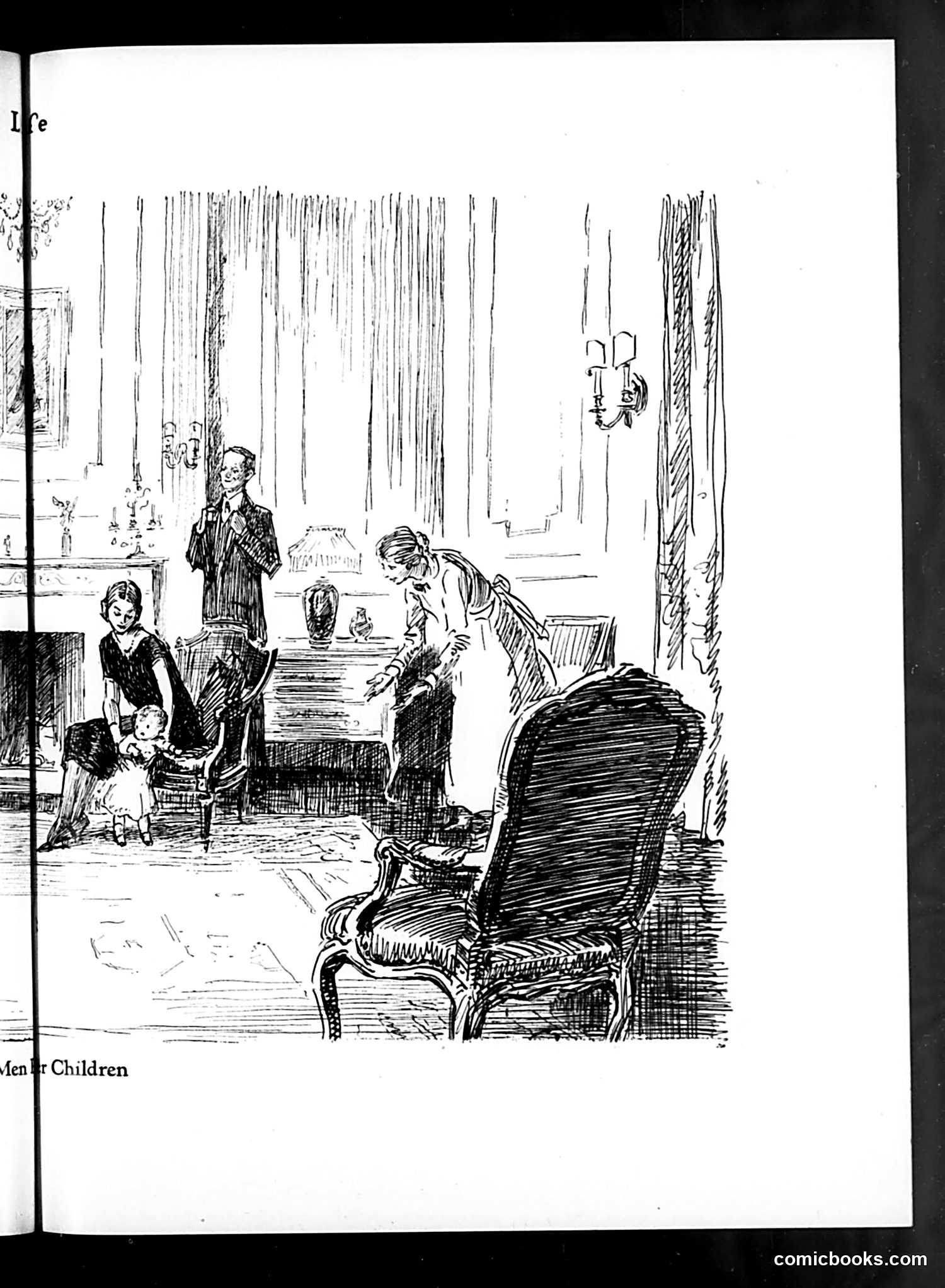
This illustration depicts a domestic interior scene titled "Men & Children" (visible at bottom left). The sketch shows what appears to be a family gathering or social visit in an upper-class home, with several figures: a seated man in the foreground (back to viewer), a woman standing near a small table, another woman with a child, and additional figures in the background. The style and dress suggest early 20th-century setting. Without additional context from the accompanying text or article, the specific satirical point remains unclear. The title's juxtaposition of "Men & Children" might suggest commentary on adult male behavior or family dynamics, but the exact social or political critique—if present—cannot be definitively determined from the image alone.
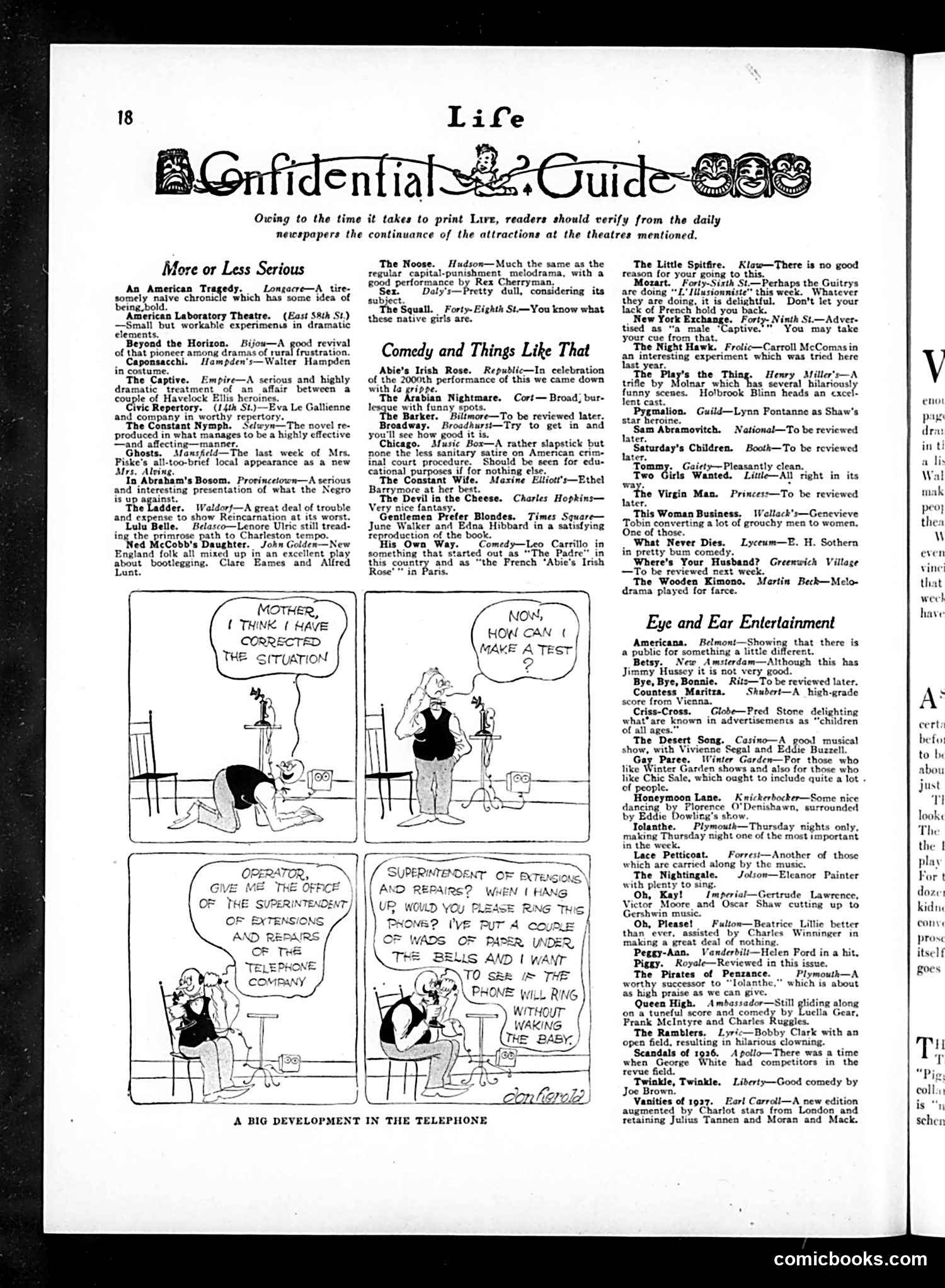
This four-panel comic satirizes phone company bureaucracy and incompetence. A mother tells the operator she's "corrected the situation," but the operator responds he cannot "make a test" without proper procedures. The superintendent of extensions then complains to the operator about repairing extensions, demanding he ring the office to test the phone—but refuses to hang up, so the bells won't ring and the baby will wake. The satire targets the absurd red tape of telephone company officials: they're so bound by rules and jurisdictional boundaries that simple problems become impossible to solve. The joke hinges on the ridiculous contradiction—the superintendent needs the phone tested but his very demands prevent the test from occurring. For modern readers, it evokes frustrations with corporate bureaucracy that remain relatable today, though attitudes toward telephone operators have shifted entirely.
This page is a **theater review column**, not primarily a political cartoon. The decorative "Drama" header contains theatrical masks but serves as a section divider rather than satire. The author critiques Broadway's theater industry and architecture, complaining that: 1. **Short-lived shows** make reviewing difficult—plays close so quickly the critic jokes about inventing titles to appear busy 2. **New theater design is ugly**—despite earlier beautiful theaters (Morosco, Music Box, Booth, Cort, Plymouth), recent buildings revert to garish "golden-kidney school of decoration" with excessive gilt and red curtaining 3. **The Royale Theatre specifically** is ridiculed as "modern Spanish in character" (cardinal red, orange, gold) looking like a mechanical piano; its ventilation system malfunctioned on opening night (January 11), and its narrow aisles force audiences into "hand-to-hand combat" 4. **Inexperienced ushers** trained at the Chanin School contributed to poor service This is **snobbish cultural criticism** aimed at theatrical producers' poor taste and incompetence—humor through exasperation rather than visual satire.
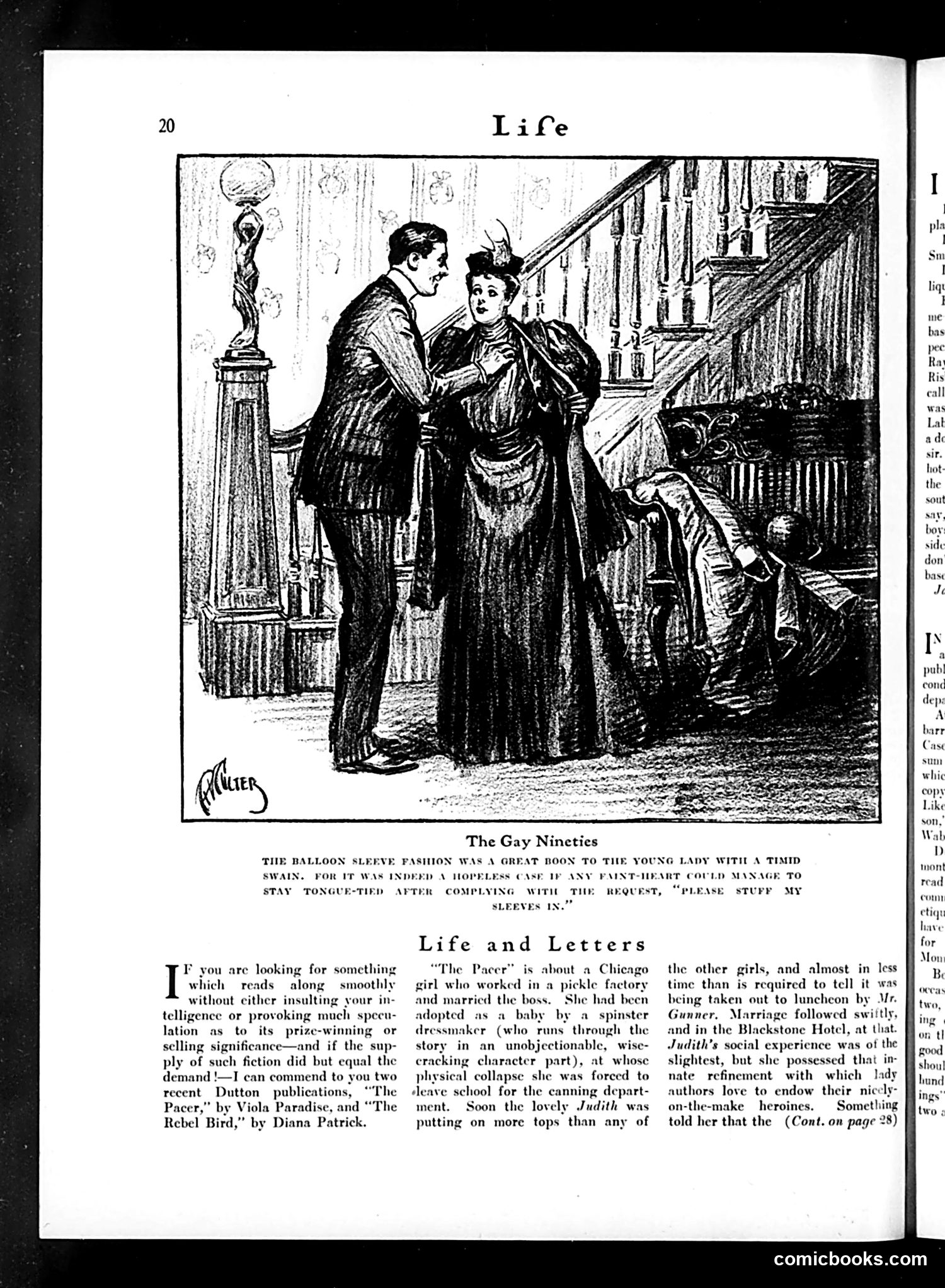
This satirical cartoon mocks the "balloon sleeve" fashion trend of the 1890s. The joke depicts a shy young man ("timid swain") attempting to compliment or court a woman wearing the exaggerated puffy sleeves popular in that era. The humor lies in the practical problem these enormous sleeves created: they were so voluminous that when the couple stood close together, the woman's sleeves literally prevented the man from reaching her or expressing affection—he must "stuff" the sleeves to get near her. The cartoon satirizes both the impracticality of extreme fashion trends and the awkwardness of courtship etiquette in the 1890s, where physical contact was heavily restricted by social convention. The balloon sleeve, intended as fashionable, ironically became a physical barrier to romance.
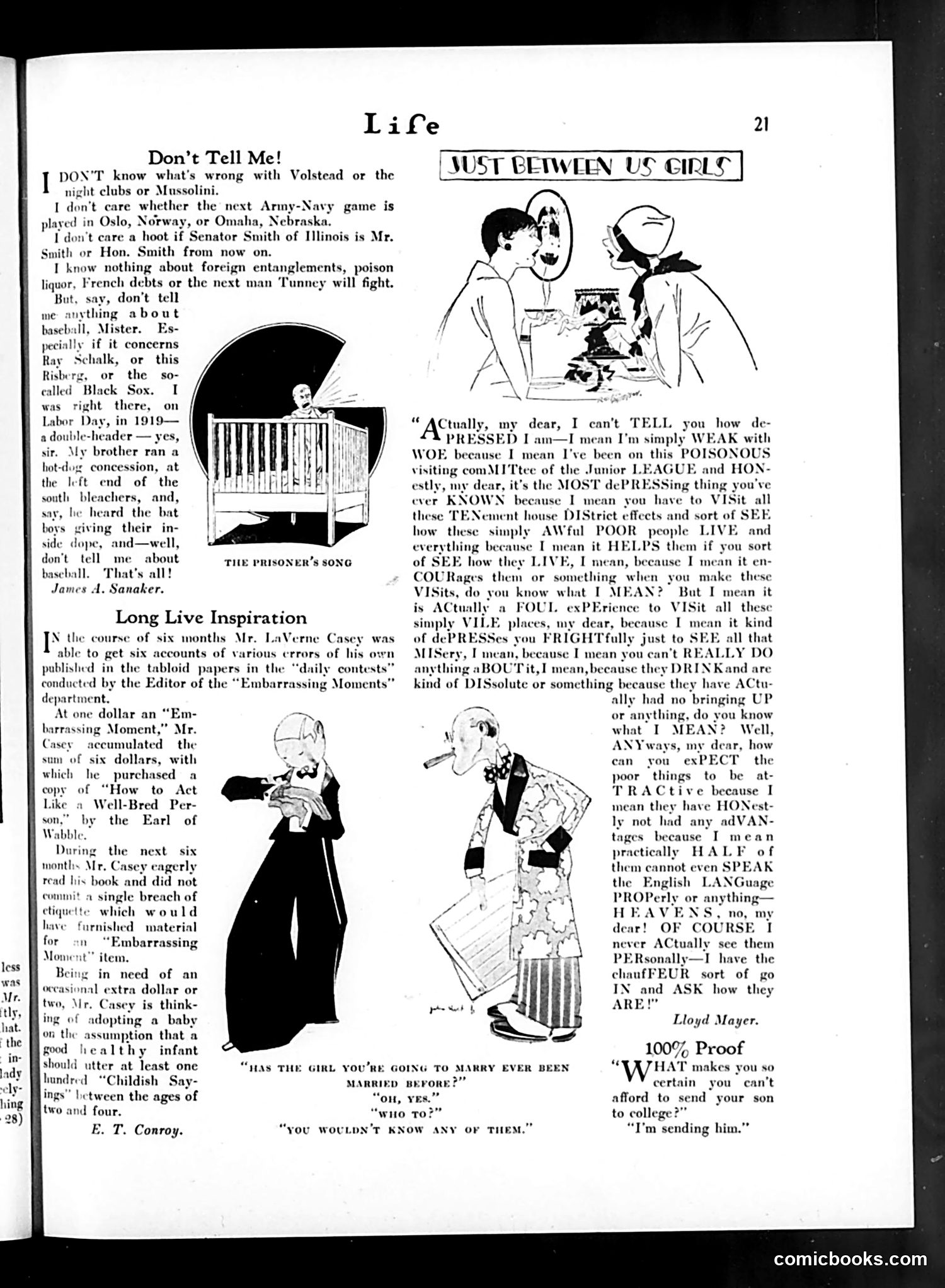
This page contains satirical commentary on 1920s American society: **"Don't Tell Me!"** - A humorous piece where a reader claims indifference to major contemporary issues (Volstead Act/Prohibition, Mussolini, Army-Navy games, Senator Smith) while passionately insisting he knows nothing about baseball—then immediately contradicting himself with detailed memories of the 1919 Black Sox scandal, a major sports corruption event. **"Long Live Inspiration"** - Mocks a man who earned money by submitting "embarrassing moment" anecdotes to tabloid papers, then spent it on an etiquette book. The joke: he's now considering adopting a baby to manufacture more "childish sayings" for profit. **"Just Between Us Girls"** - A wealthy woman's breathless monologue about charity visits to poor tenement districts. The satire targets her performative charity, condescension toward the poor, and inability to actually help while maintaining social distance. **"100% Proof"** - A brief joke implying the father couldn't afford college, so claimed he was "sending" his son (likely to work, not school). All pieces satirize American attitudes about wealth, class, and pretense.
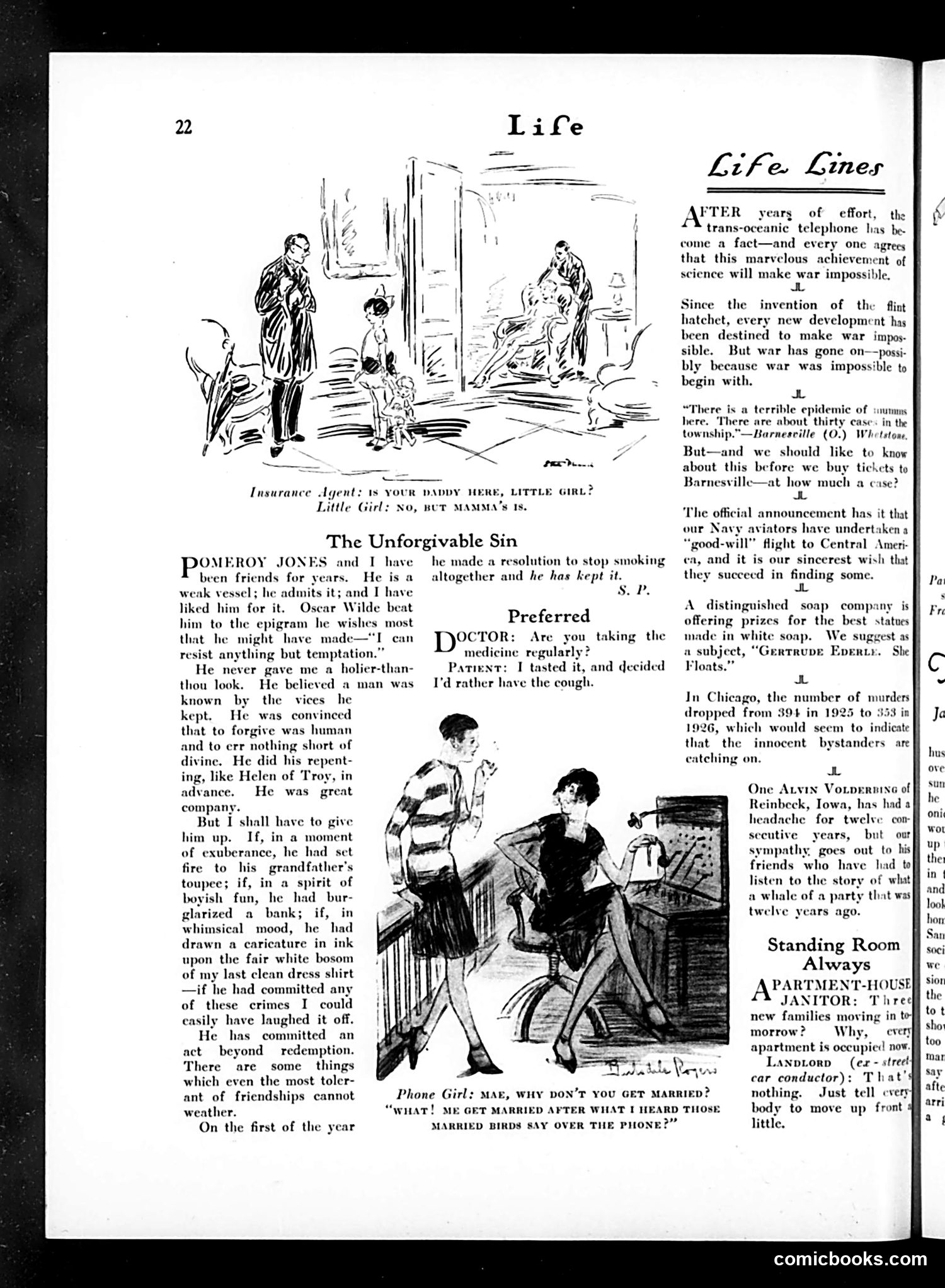
This page contains several satirical pieces typical of Life's humor: **Top cartoon**: An insurance agent asks a child if her "daddy" is home; she replies her "mamma's" there instead. The joke is a double entendre—suggesting the child's mother is entertaining a man who isn't her father, implying infidelity or loose morality. **"The Unforgivable Sin"**: A humorous short story about a friend who commits the ultimate betrayal—he *kept* his New Year's resolution to quit smoking. The satire mocks both the difficulty of maintaining resolutions and social judgment of reformed behaviors. **"Preferred"**: A patient refuses medicine because he tasted it; he'd rather keep his cough. Standard medical humor about unpalatable treatments. **"Phone Girl" cartoon**: A telephone operator won't marry because she's overheard married couples' conversations—implying marital arguments and disappointment. **"Life Lines"**: A column of brief satirical observations about trans-oceanic telephones, epidemics, crime statistics, and apartment housing shortages—poking fun at contemporary issues and human nature. The overall tone reflects 1920s-era American satire mocking social conventions, human foibles, and modern anxieties.
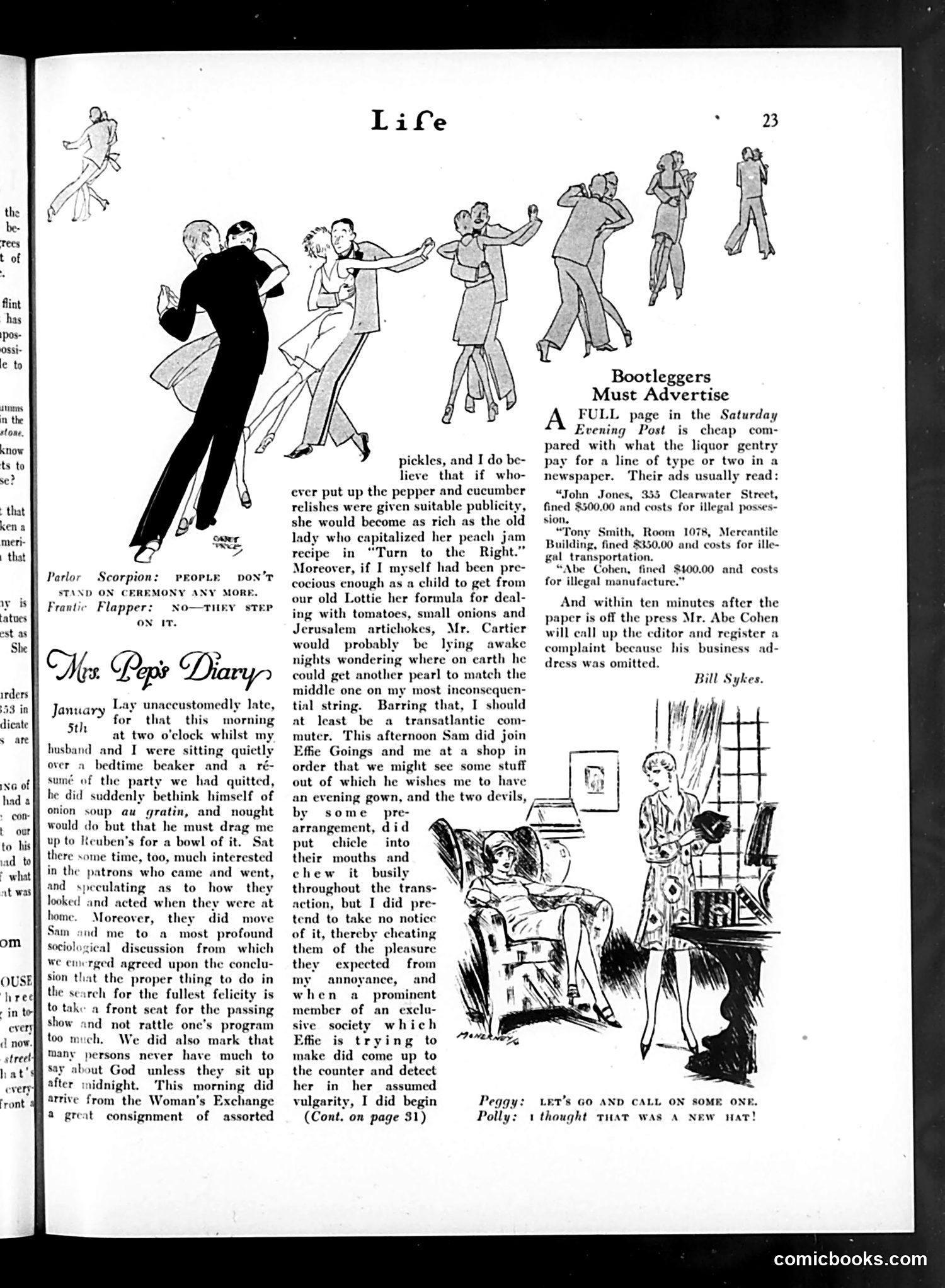
This page contains two satirical pieces from the 1920s Jazz Age: **"Parlor Scorpion" cartoon**: A brief joke mocking the decline of formal social etiquette. A man in formal dress appears startled as a flapper tells him people no longer "stand on ceremony"—they literally step on it. The satire targets the generational clash between Victorian propriety and the more casual, irreverent behavior of younger women. **"Mrs. Pep's Diary"**: A society woman's humorous account of Manhattan nightlife, featuring observations about late-night dining, homemade pickles, and encounters with fashionable people. The tone is lighthearted social commentary on urban leisure culture. **"Bootleggers Must Advertise"**: A brief satirical piece on Prohibition-era ironies. It notes that illegal liquor dealers paradoxically advertise their arrests in newspapers as publicity—when someone is fined for bootlegging, they appear in print, which actually benefits their business by making their name known. The overall content reflects 1920s American anxieties about changing social customs, urban modernity, and Prohibition's unintended consequences.
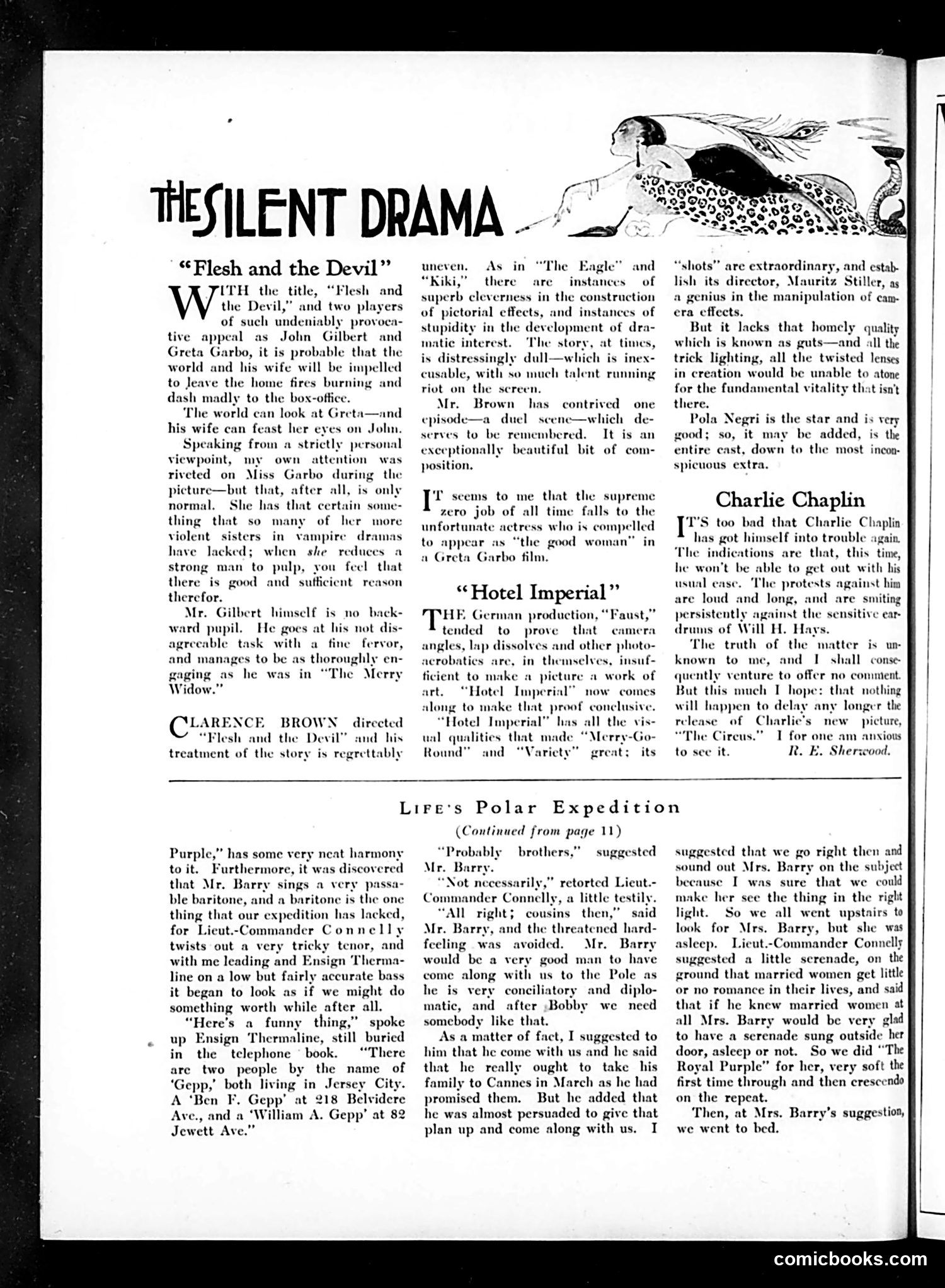
This page reviews three silent films, likely from the mid-1920s. The main illustrated article discusses "Flesh and the Devil," starring Greta Garbo and John Gilbert. The reviewer praises Garbo's compelling screen presence, particularly her ability to convincingly portray a femme fatale character ("vampire dramas"). Gilbert receives credit for solid performance. Director Clarence Brown is criticized for uneven direction—praised for a beautiful duel sequence but faulted for dull storytelling. A secondary review of "Hotel Imperial" dismisses it as technically accomplished but artistically hollow, lacking what the critic calls "guts" (fundamental vitality). A brief note expresses concern that Charlie Chaplin faces mounting protests from Will H. Hays (head of film industry censorship), hoping his new picture "The Circus" releases without further delay. The page reflects 1920s film criticism and era anxieties about cinema's moral content, particularly regarding sexuality and propriety in silent film entertainment.
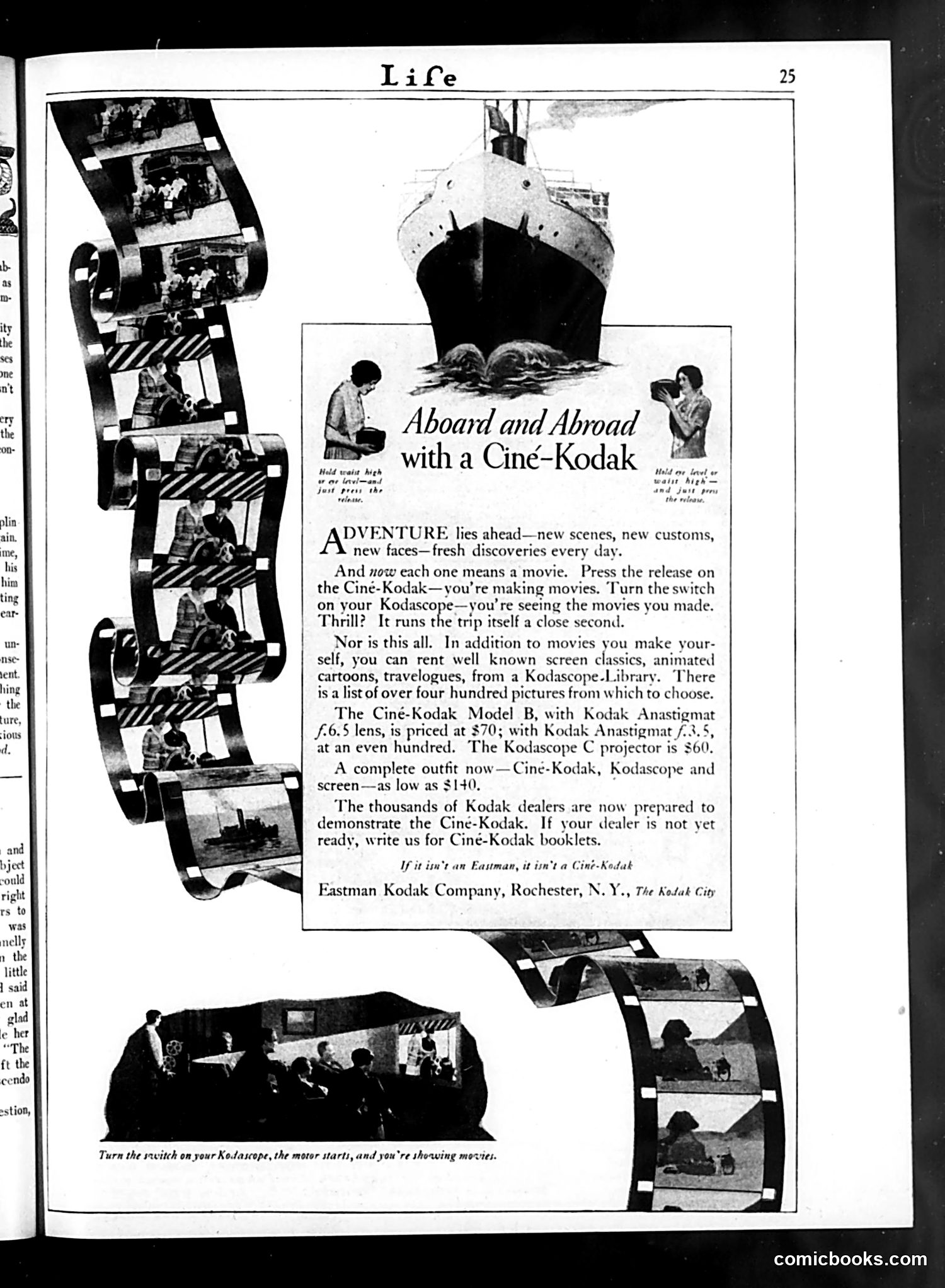
This is primarily a **Kodak advertisement**, not political satire. The page promotes the Ciné-Kodak, an early home movie camera system for consumers. The imagery shows a ship and film strips to emphasize the product's appeal: enabling ordinary people to record their own travel adventures and then project them at home. The tagline "Aboard and Abroad" suggests capturing vacation experiences. Key points for modern readers: - This represents an early consumer technology moment—when movie-making shifted from professional studios to home users - Prices ($70-$140) were substantial in this era, positioning it as a luxury good - The "Kodascope" was a projector; users could also rent pre-made content (cartoons, travelogues) - The tagline "If it isn't an Eastman, it isn't a Ciné-Kodak" emphasizes brand authenticity There is no political cartoon or satire present—this is straightforward commercial promotion targeting affluent consumers interested in documenting leisure travel.
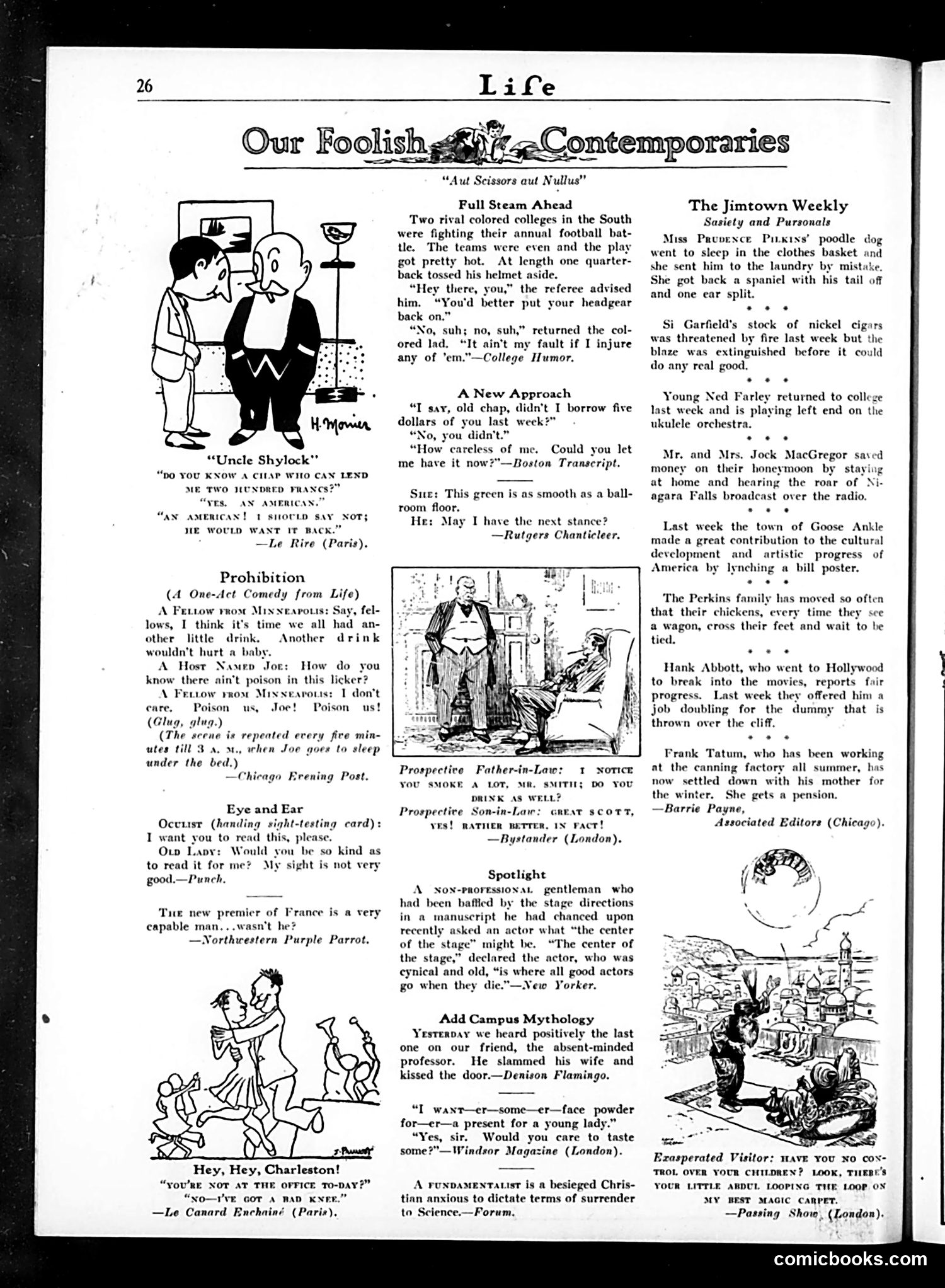
**"Uncle Shylock"** (top left): This cartoon satirizes American lending practices by contrasting them with European attitudes. A Parisian quips that while he knows a French lender, an American lender is worse—because Americans actually expect repayment. The ethnic slur in the title reflects antisemitic stereotypes about Jewish moneylenders prevalent in the 1920s, suggesting Americans are aggressively capitalistic. **"Prohibition" section**: This mocks Prohibition-era drinking culture. Despite the alcohol ban, Americans continued drinking anything available—even poisoned liquor—demonstrating the law's ineffectiveness and public disregard for it. **Other jokes** target contemporary absurdities: a man claiming a "mad knee" as an excuse, optical incompetence, and absent-minded professors. The humor relies on wordplay and situational comedy typical of 1920s satirical magazines.
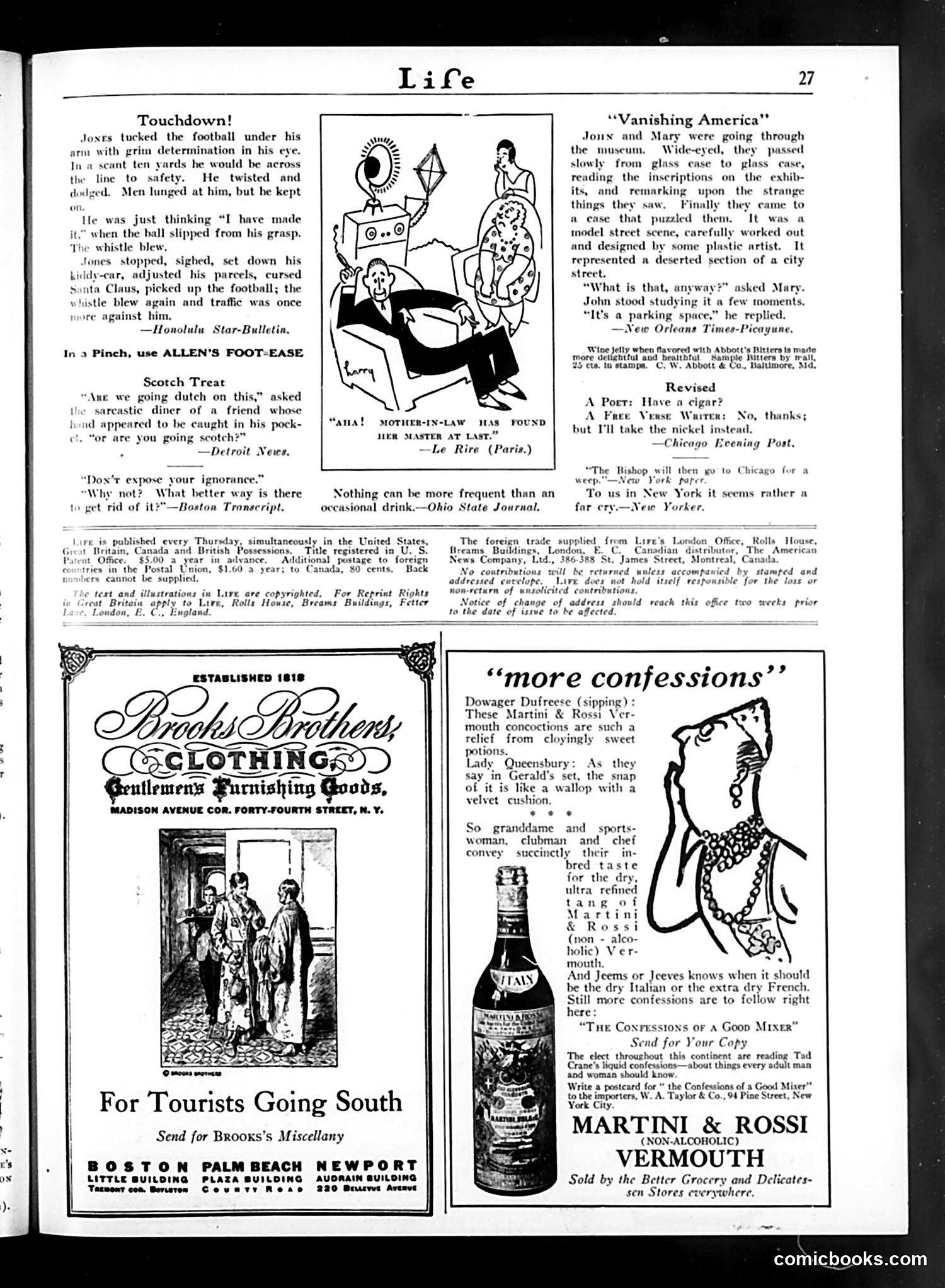
This page from *Life* magazine contains several brief satirical vignettes: **"Touchdown!"** depicts a man carrying a football through city traffic, treating a busy street like a football field. The joke is that modern urban life has become so chaotic that even mundane activities feel like dangerous athletic competitions—he "scores" by safely crossing the street. **"Vanishing America"** shows a museum exhibit of a "deserted section of a city street"—identified as a "parking space." This satirizes how automobiles and parking lots were rapidly replacing pedestrian urban landscapes, effectively erasing traditional American streetscapes from view while they were still being created. The remaining items are brief one-liner jokes about Dutch treats, ignorance, and vermouth preferences—typical *Life* filler content. The advertisements for Brooks Brothers clothing and Martini & Rossi vermouth occupy the lower half, reflecting the magazine's target readership of affluent, leisure-class Americans.
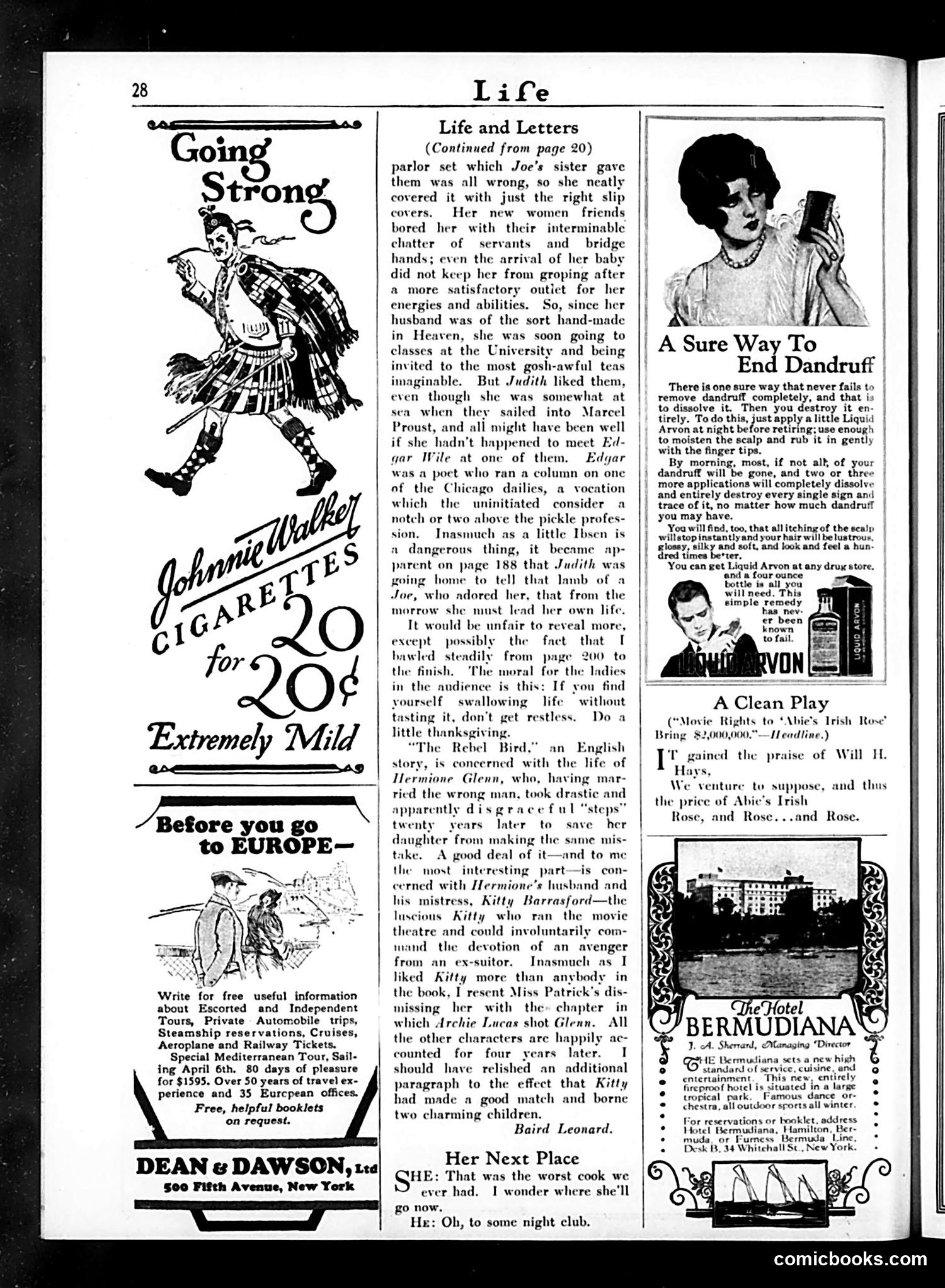
This page mixes literary criticism with period advertising and a brief humorous dialogue. **Main Content:** Book reviews by "Baird Leonard" discuss novels featuring marital discord—"Judith" involves a woman tempted by an intellectual poet to abandon her devoted husband, while "The Rebel Bird" concerns a woman who took drastic steps after marrying wrongly. The reviewer critiques character treatment and moral lessons for female readers about restlessness in marriage. **The Joke:** A short dialogue at bottom: A cook, fired for poor performance, will "go to some night club"—implying domestic servants were abandoning household work for nightlife employment, reflecting 1920s social mobility and the decline of traditional servant culture. **Advertising:** Includes cigarette ads ("Going Strong"), European travel services (Dean & Dawson), dandruff remedy (Liquid Arvon), and The Hotel Bermudiana resort. The page reflects Jazz Age concerns: changing gender roles, women's education, marital infidelity, and shifts in working-class employment patterns.
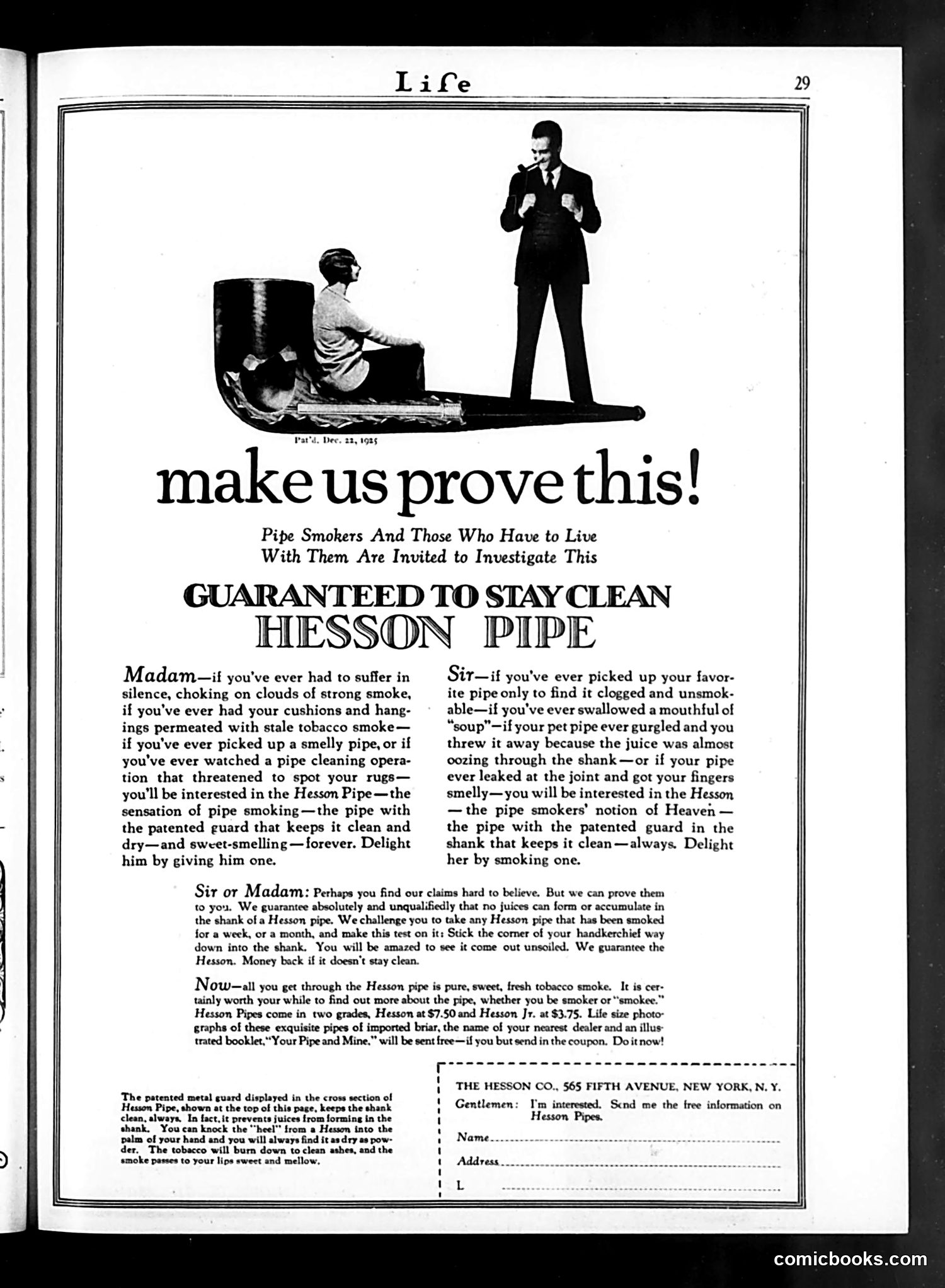
This is a **product advertisement**, not satire or political commentary. It promotes the Hesson Pipe, a smoking device with a patented guard designed to prevent tobacco juice accumulation in the pipe's shank. The ad addresses two audiences: smokers annoyed by messy, clogged pipes, and non-smokers (spouses, family) suffering from stale smoke and odor permeating furniture. The illustration shows a woman holding her nose near a pipe while a man stands nearby—depicting the domestic complaint the product claims to solve. The marketing strategy uses humor and challenge: the company dares customers to test the pipe after a week or month of use by inserting a handkerchief into the shank to prove it stays clean. Prices listed are $7.50 and $3.75 for the junior model. A coupon invites interested readers to request more information and a dealer locator. This reflects early 20th-century indoor pipe smoking culture and the marital friction it could create.
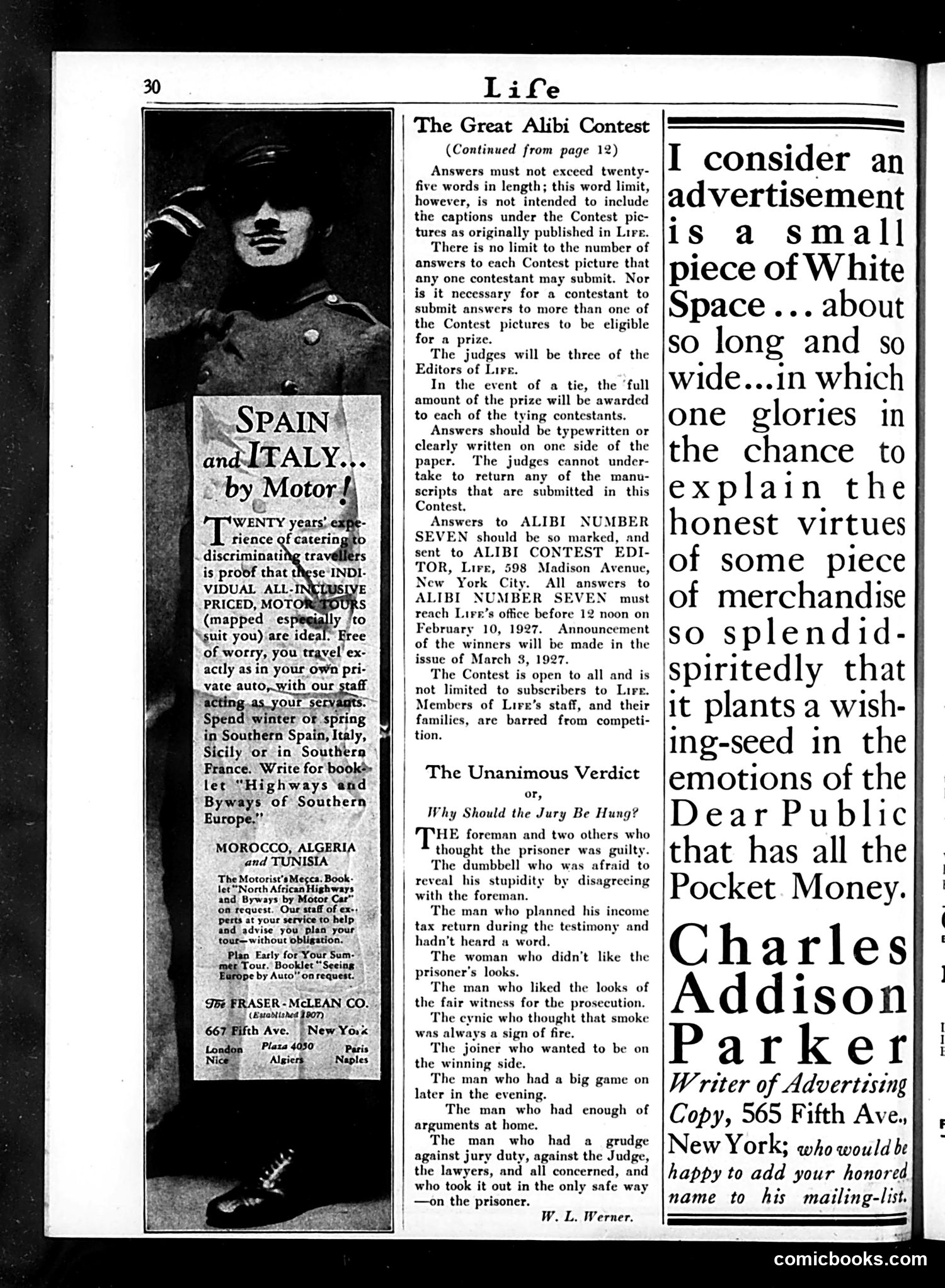
This page contains two distinct pieces: **Left side:** A travel advertisement for motor tours through Southern Europe (Spain, Italy, France, North Africa), emphasizing luxury and convenience—a marketing pitch for affluent 1920s travelers. **Right side:** Two items— 1. **"The Great Alibi Contest"**: Life magazine's ongoing reader contest asking people to caption a courtroom cartoon (not fully visible here). The rules and deadline are listed. 2. **"The Unanimous Verdict"**: A satirical piece by W.L. Werner listing the twelve jurors' actual motivations—none based on evidence. It mocks jury deliberation by suggesting jurors are distracted (tax returns), biased (looks), self-interested (evening plans), or grudge-driven rather than impartial. This is cynical social commentary on the American justice system. **Below:** Charles Addison Parker's self-promotional advertisement defining "good advertising" as persuasive white space that appeals to consumers' emotions and wallets—itself an example of the confident, somewhat tongue-in-cheek copywriting style of 1920s advertising.
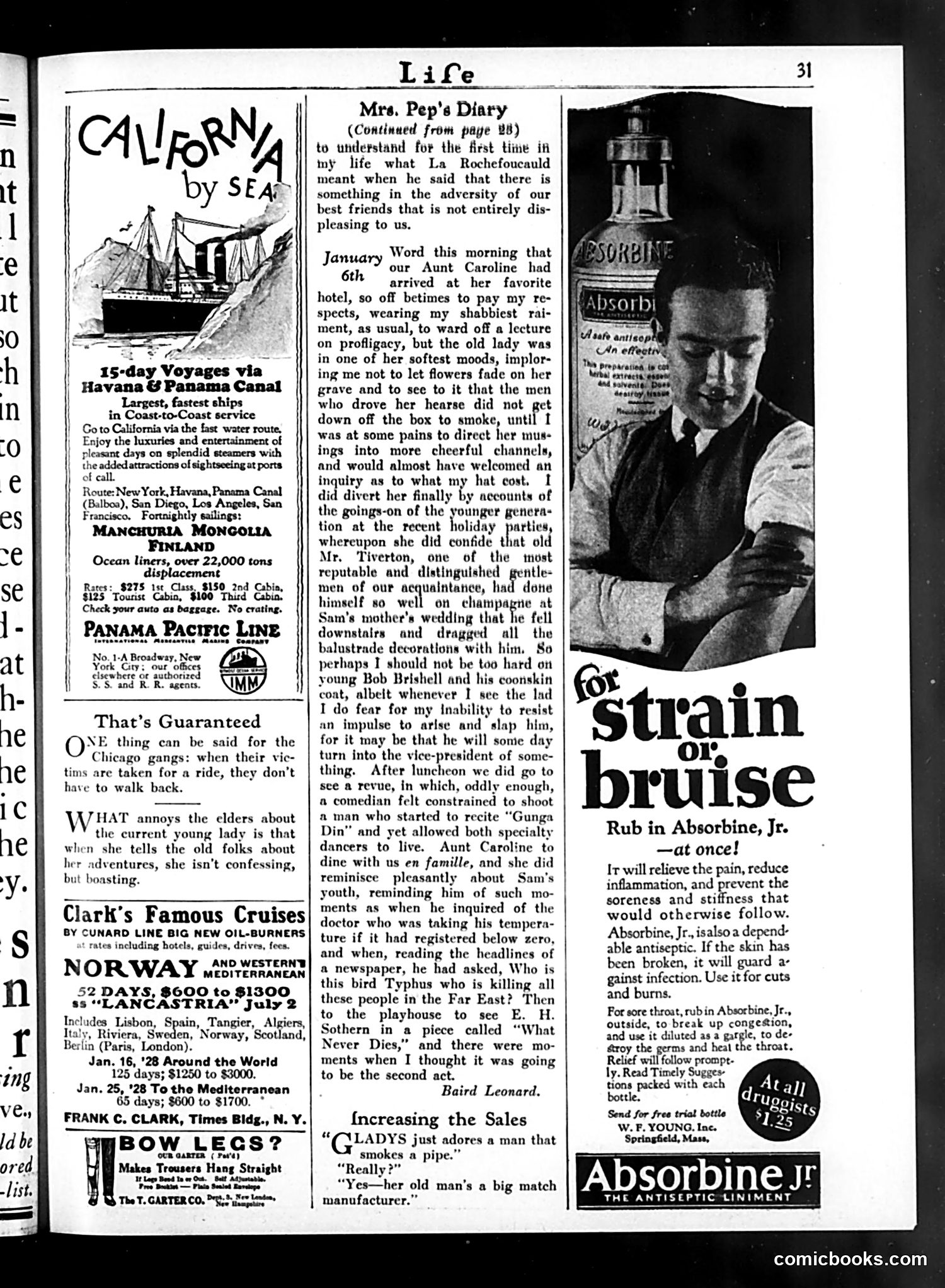
This page is primarily **advertising and serialized diary content**, not political cartoons. The main text is "Mrs. Pep's Diary," a humorous domestic column describing a visit from Aunt Caroline. The humor relies on **generational contrast**: the elderly aunt obsesses over propriety and mortality (flowers on her grave, men smoking), while the younger generation parties freely. The diary mocks both—the aunt's prudishness and the youth's excess (notably young Bob Brishell's "coonskin coat"). A subtle social criticism emerges: even respectable men like Mr. Tiverton get drunk and misbehave, yet face no real consequences, whereas the diarist fears her own nephew's future for similar conduct. The revue anecdote (shooting a man reciting poetry but allowing dancers to live) satirizes contemporary entertainment's arbitrary morality. The surrounding advertisements promote luxury cruises and steamship travel—reflecting 1920s affluence—alongside a product for "bow legs," suggesting body-image anxieties of the era. Overall, this is **light satirical social commentary** on class, age, and propriety rather than political satire.
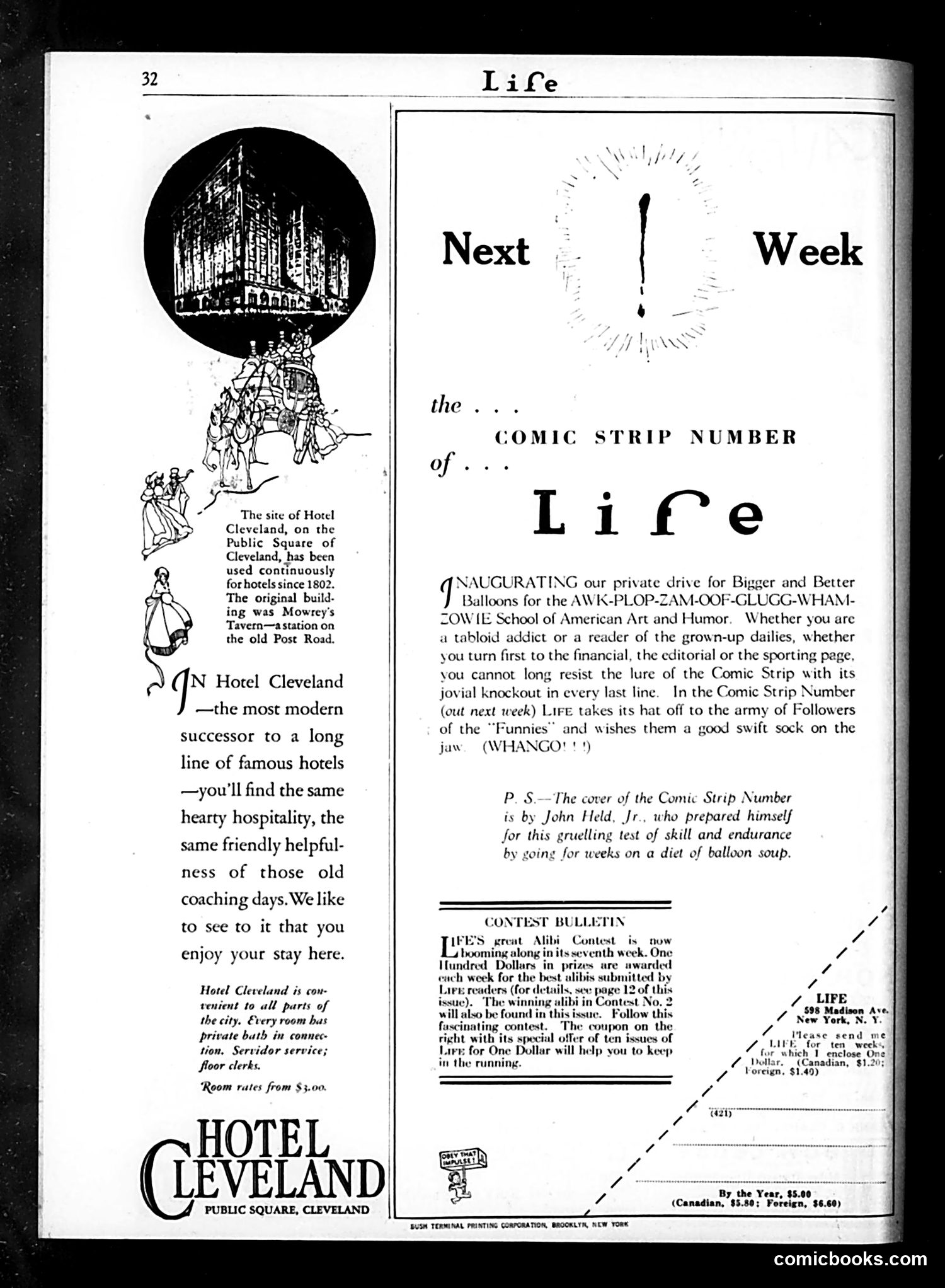
This page primarily advertises an upcoming comic strip issue of *Life* magazine while featuring a Hotel Cleveland advertisement. The text celebrates comic strips as popular entertainment, referencing the growing cultural phenomenon of newspaper "Funnies." The humorous tone (mock names like "AWIK-PLOP-ZAM-OOF-GLUGG-WHAM-ZOWIE School") satirizes both the absurdist sound effects typical of comics and the earnest promotion of American humor. A notable detail: illustrator John Held Jr. created the cover after supposedly enduring "weeks on a diet of balloon soup"—a joke about the exaggerated, weightless quality of comic strip humor. The page also promotes *Life's* "Alibi Contest," a reader participation feature offering weekly prize money, reflecting the magazine's interactive relationship with audiences. The Hotel Cleveland ad uses period advertising conventions, emphasizing historical continuity and modern amenities to appeal to travelers.

I can see this is a very dark, low-contrast image from what appears to be a historical publication (Life magazine). The page is almost entirely black with minimal visible detail—I can make out a white margin/border on the left side and the "comicbooks.com" watermark at the bottom, but I cannot discern any cartoon illustrations, text content, or figures clearly enough to identify them with confidence. Without being able to read the OCR text provided or see the actual content, I cannot accurately explain what political or social commentary this page contains. I would need a clearer, higher-contrast image to fulfill your request properly.