
Life, 1927-01-27 · page 26 of 35
Life — January 27, 1927 — page 26: what you’re looking at
What you’re looking at
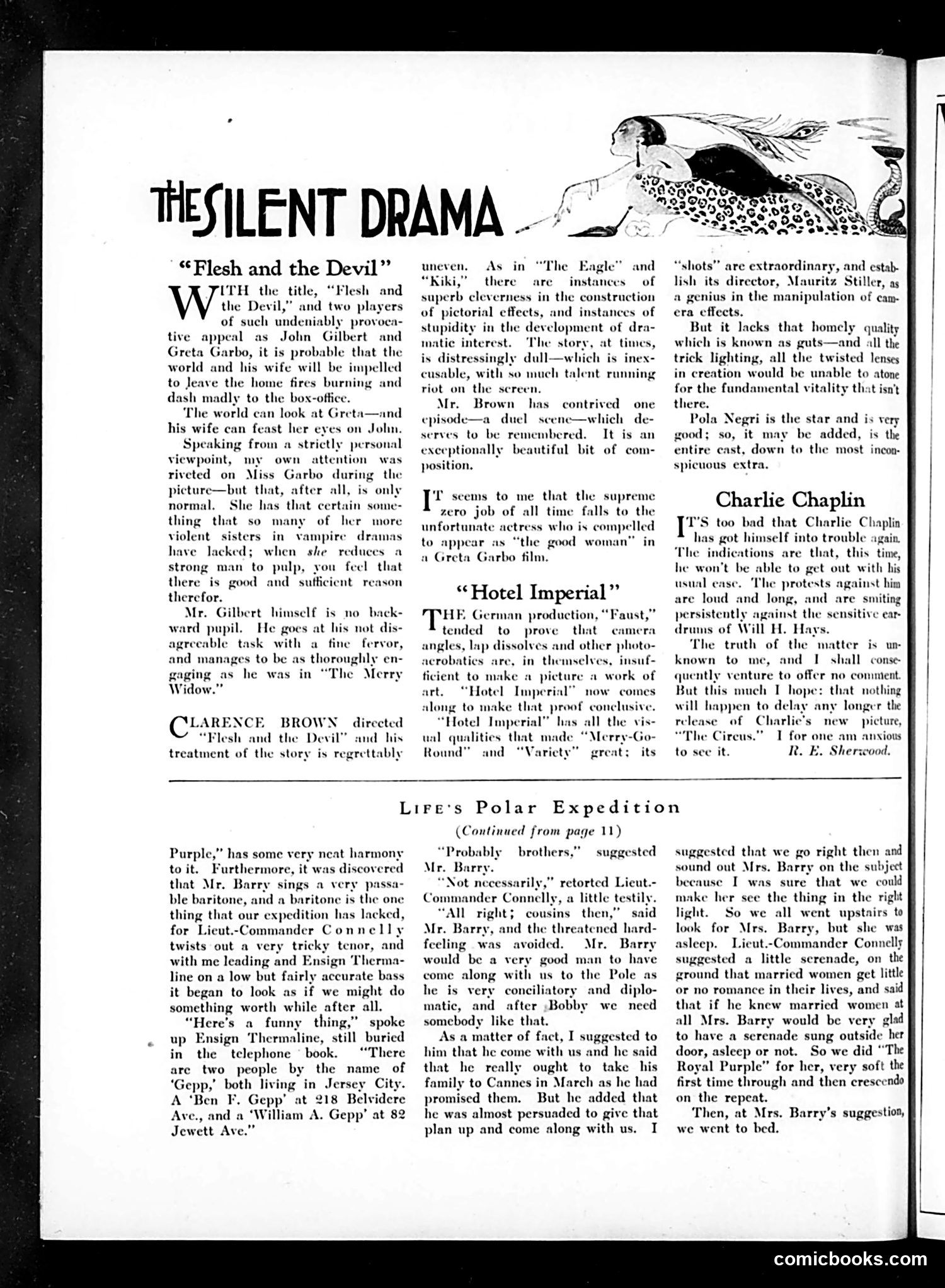
This page reviews three silent films, likely from the mid-1920s. The main illustrated article discusses "Flesh and the Devil," starring Greta Garbo and John Gilbert. The reviewer praises Garbo's compelling screen presence, particularly her ability to convincingly portray a femme fatale character ("vampire dramas"). Gilbert receives credit for solid performance. Director Clarence Brown is criticized for uneven direction—praised for a beautiful duel sequence but faulted for dull storytelling. A secondary review of "Hotel Imperial" dismisses it as technically accomplished but artistically hollow, lacking what the critic calls "guts" (fundamental vitality). A brief note expresses concern that Charlie Chaplin faces mounting protests from Will H. Hays (head of film industry censorship), hoping his new picture "The Circus" releases without further delay. The page reflects 1920s film criticism and era anxieties about cinema's moral content, particularly regarding sexuality and propriety in silent film entertainment.
📄 Transcribed text from this page (OCR, searchable)
Machine-transcribed from the original scan — historical spelling and the odd misread are preserved.
THESILENT DRAMA -- “Flesh and the Devil” ITH the title, “Flesh and \ V the Devil,” and two players of such undeniably provoca- tive appeal as John Gilbert and Greta Garbo, it is probable that the world and his wife will be impelled to Jeave the home fires burning and dash madly to the box-office. The world can look at Greta—and his wife can feast her eyes on John. Speaking from a strictly personal viewpoint, my own attention riveted on Miss Garbo during the picture—but that, after all, is on normal. She has that certain some- thing that so many of her violent. sisters in) vampire dramas have lacked; when she reduces a strong man to pulp, you feel that there is good and. sufficient reason therefor. Mr. Gilbert himself is no bac ward pupil. He goes at his not dis- agreeable task with a fine fervor, and manages to be as thoroughly en- gaging as he was in “The Merry Widow.” was more LARENCE. BROWN directed “Flesh and the Devil” and his treatment of the story is regrettably wy uneven, As in “The Eagle” and “Kiki,” there are instances of superb cleverness in the construction of pictorial effects, and instances of stupidity in the development of dra- matic interest. The story, at times, is distressingly dull—which is inex- cusable, with so much talent running riot on the sere Mr. Brown has contrived one episode—a duel scene—which de- serves to be remembered. It is an exceptionally beautiful bit of com- position, T scems to me that the supreme zero job of all time falls to the unfortunate actress who iy compelled to appear as “the good woman" in a Greta Garbo films ‘Hotel Imperial” HE German production, “Faust,” tended to prove that) camera angles, lap dissolves and other phot crobatics are, in themselves, insuf- ficient to make a picture a work of art. “Hotel Imperial” now comes along to make that proof conclusive. “Hotel Imperial” has all the v ual qualities that Round” and “Variety” “shots” are extraordinary, and estab- director, Mauritz Stiller, as a genius in the manipulation of cam- era effects. But it lacks that homely quality which is known as guts—and all the trick lighting, all the twisted lenses in creation would be unable to atone for the fundamental vitality that isn’t there. Pola Negri is the star and is very good; so, it may be added, is the entire cast, down to the most incon- spicuous extra, Charlie Chaplin too bad that Charlie Chaplin ais got hi T’S ha The he we elf into trouble again, ns are that, this time, le to get out with his usttal ease, ‘The protests against him are loud and long, and are smiting persistent] tinst the sensitive ear drums of Will H. Hays. The truth of the matter is un known to me, and IT shall conse- quently venture to offer no comment But this much T hope: that nothing will happen to delay any longer the release of Charlie’s new picture, “The Circus.” 1 for one am ansious to see it. R. EB, Sherwood. Li Purple,” has some very neat harmony to it. Furthermore, it was discovered that Mr. Barry sings a very passa- ble baritone, and a baritone is the one thing that our expedition has lacked, for Licut.-Commander Connelly twists out a very tricky tenor, and with me leading and Ensign Therma- line on a low but fairly accurate bass it began to look as if we might do something worth while after all. “Here's a funny thing,” spoke up Ensign Thermaline, still buried in the telephone ‘book. “There are two people by the name of ‘Gepp,’ both living in Jersey City. A ‘Ben F, Gepp’ at 218 Belvidere Ave., and a ‘William A. Gepp’ at 82 Jewett Ave.” Fe's Polar Expedition (Continued from page 11) “Probably Mr. Barry. “Not necessarily,” retorted Licut.- Commander Connelly, a little testily. “ALL right; cousins then,” said Mr. Barry, and the threatened hard- feeling was avoided. Mr. Barry would be a very good man to have come along with us to the Pole as he is very conciliatory and diplo- we need brothers,” suggested As a matter of fact, I suggested to him that he come with us and he said that he really ought to take his family to Cannes in March as he had promised them. But he added that he was almost persuaded to give that plan up and come along with us. I suggested that we go right then and sound out Mrs. Barry on the subject because I sure that we could make her see the thing in the right light. So we all went upstairs to look for Mrs. Barry, but she was asleep. Lieut.-Commander Connells suggested a little serenade, on the ground that married women get little or no romance in their lives, and said that if he knew married women at all Mrs. Barry would be very glad to have a serenade sung outside her door, asleep or not. So we did “The Royal Purple” for her, very soft the first time through and then crescendo on the repeat. Then, at Mrs. Barry’s suggestion, we went to bed. comicbooks.com