
A complete issue · 37 pages · 1926
Life — July 29, 1926
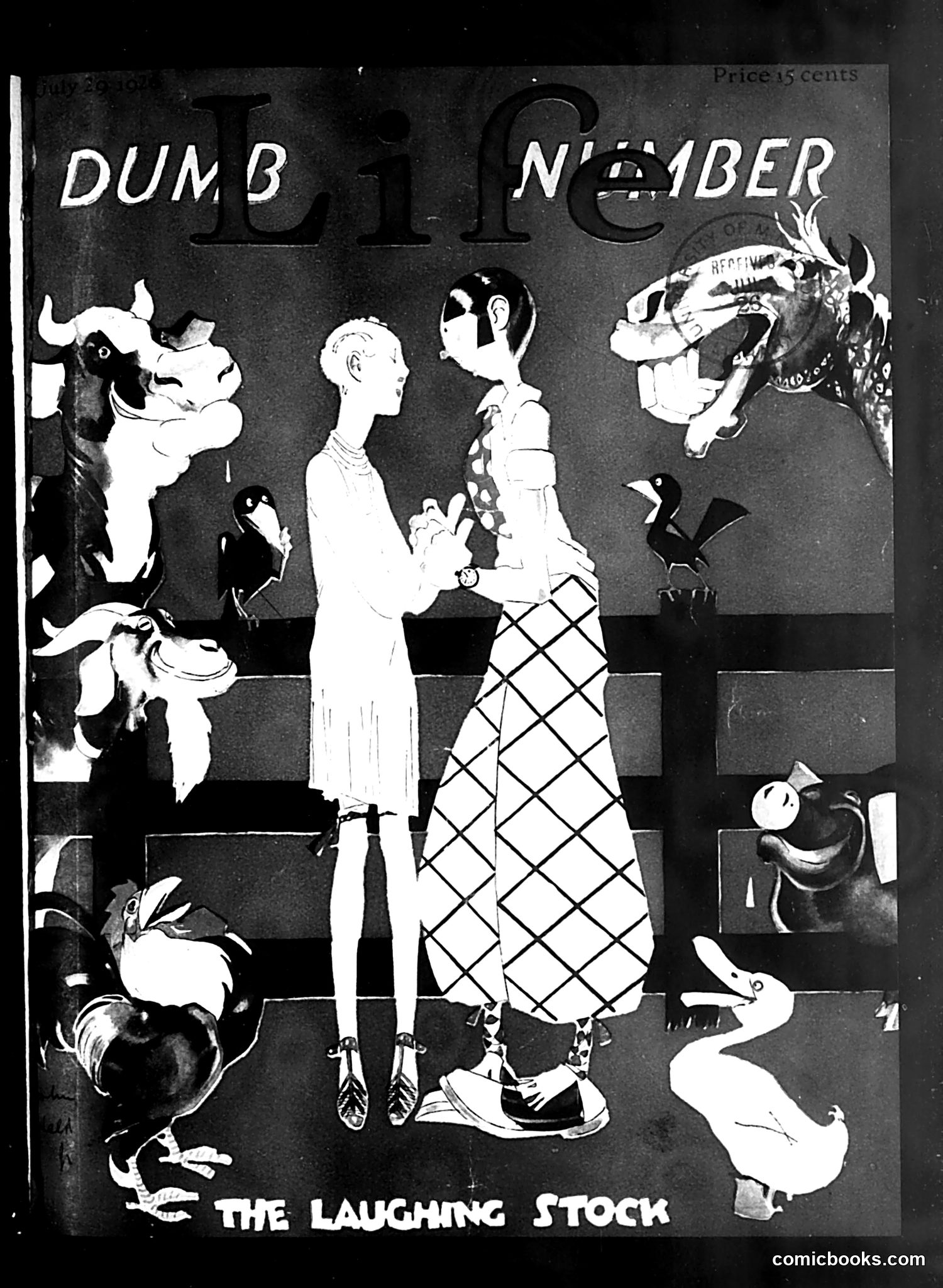
This cover satirizes the absurdity of public figures through "The Laughing Stock"—a visual pun featuring literal farm animals (cow, rooster, duck, pelican) surrounding two elegantly dressed women in 1920s fashion. The title plays on the phrase "laughing stock," meaning someone ridiculed or mocked. The cartoon appears to mock high society or political figures of the era by placing them among livestock, suggesting they deserve ridicule comparable to being barnyard animals. The formal dress contrasts sharply with the crude animal companions, emphasizing the satire. Without additional context, the specific figures remain unclear, but the crude caricatures and animal imagery were typical Life magazine tactics for lampooning contemporary celebrities or politicians deemed foolish or worthy of public scorn.
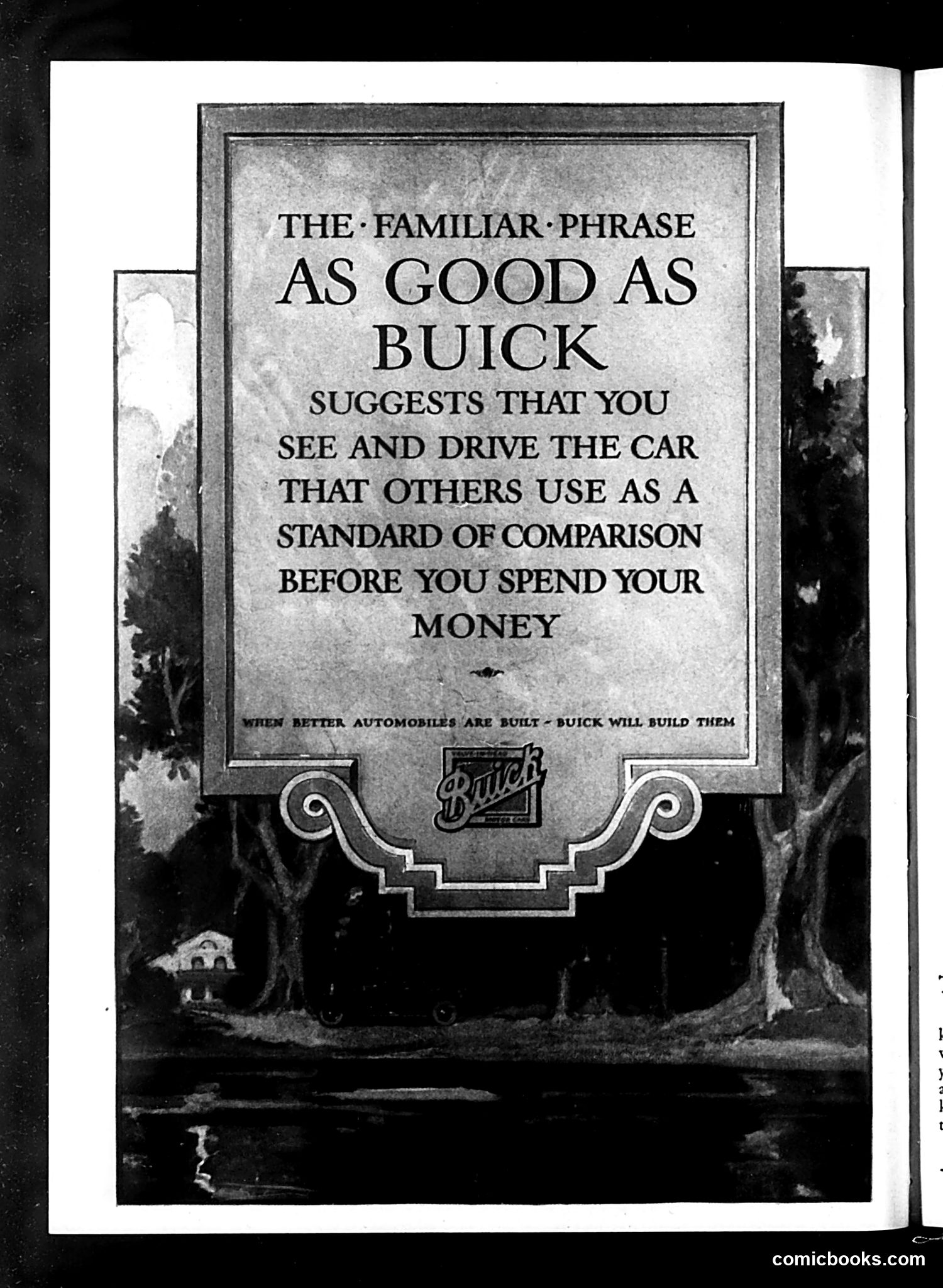
This is a **Buick automobile advertisement**, not political satire or editorial content. The ad uses the common phrase "as good as Buick" to establish Buick cars as a quality standard consumers should compare other vehicles against before purchasing. The visual framing—with the text centered in a formal panel surrounded by a nighttime landscape with trees—creates an elegant, aspirational tone typical of early 20th-century advertising design. The tagline "When Better Automobiles Are Built—Buick Will Build Them" emphasizes brand confidence and superiority. This is straightforward commercial messaging designed to influence consumer purchasing decisions by positioning Buick as the benchmark for automotive quality and value.
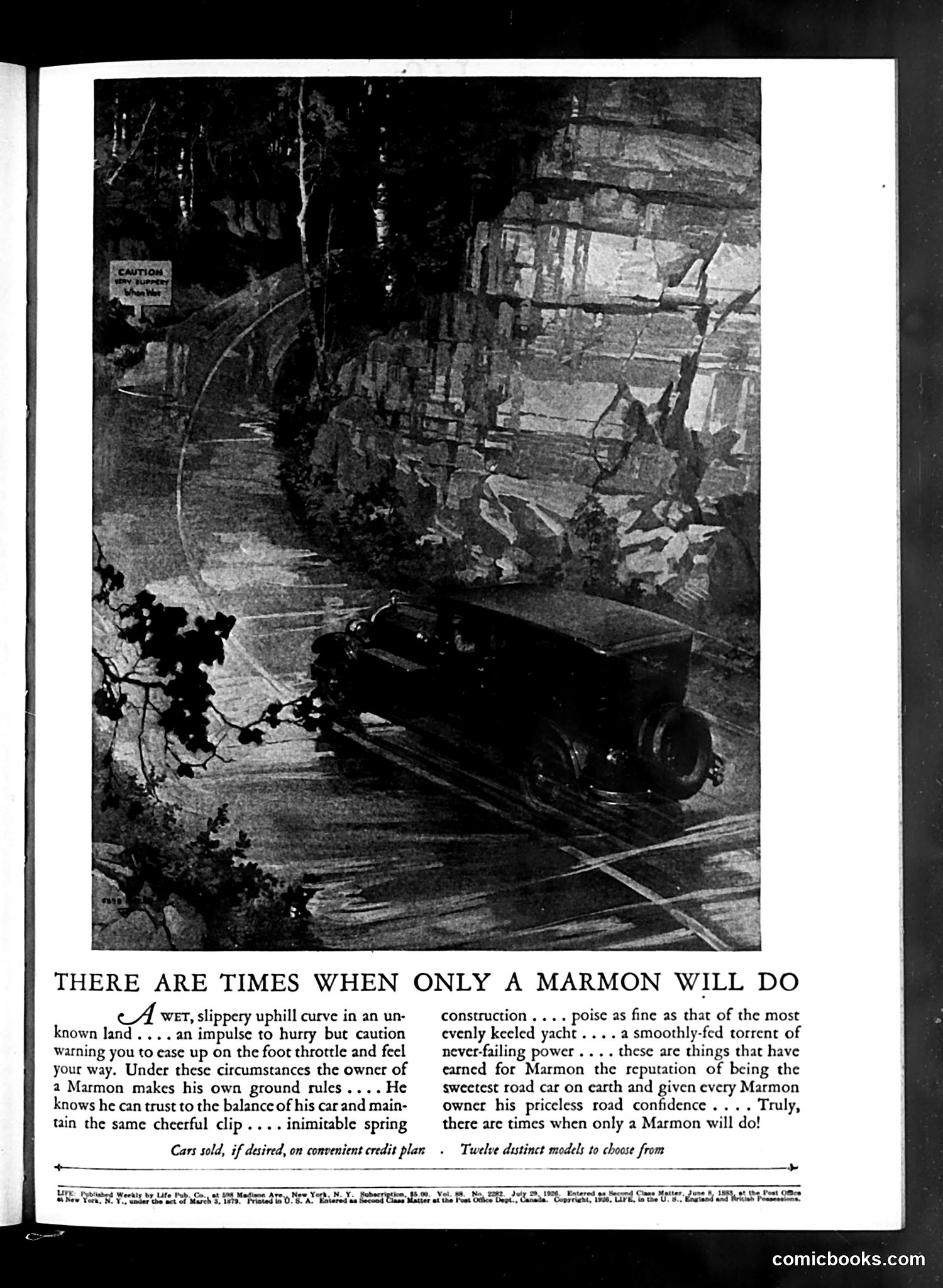
This page is **primarily an advertisement** for Marmon automobiles, not political satire. The text describes Marmon as the ideal vehicle for challenging driving conditions—specifically "a wet, slippery uphill curve in an unknown land." The advertisement uses aspirational language common to 1920s car marketing, emphasizing the vehicle's reliability, smooth handling, and superior engineering ("sweetest road car on earth"). The phrase "only a Marmon will do" suggests exclusivity and dependability. The black-and-white photograph shows a Marmon navigating what appears to be a difficult terrain or road condition, visually supporting the advertisement's claims about the car's capability and trustworthiness for discerning owners seeking "priceless road confidence." This reflects typical early automotive advertising strategy: selling not just transportation but confidence and status.
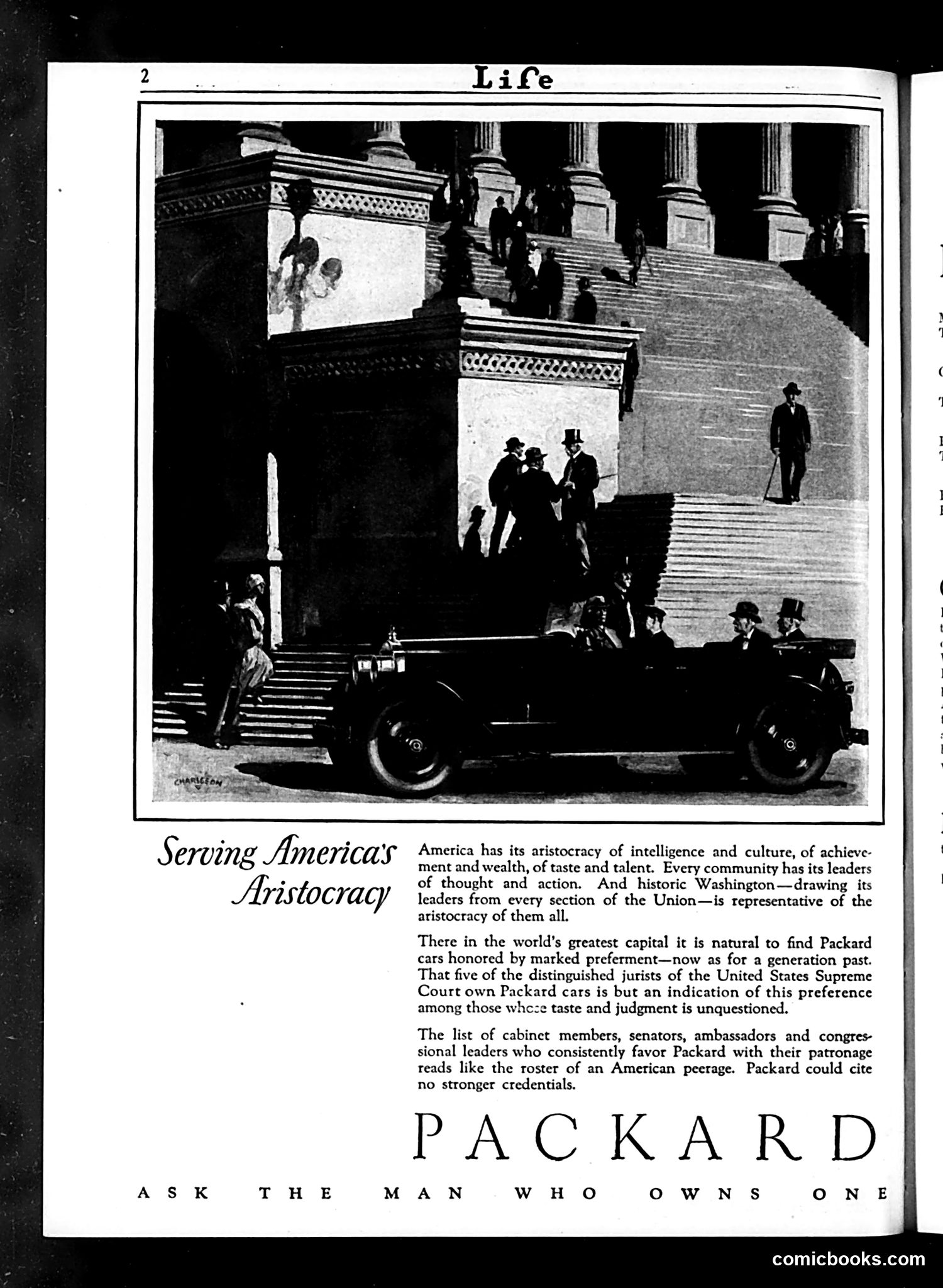
This page is primarily **Packard automobile advertising**, not satire or political cartoon. The image depicts an elegant early 20th-century scene at what appears to be the U.S. Capitol or similar neoclassical government building, with a Packard automobile prominently displayed in the foreground. Well-dressed figures in top hats and formal wear occupy the grand steps. The advertisement's text claims that Packard automobiles are favored by America's political and cultural elite—cabinet members, senators, ambassadors, and congressional leaders—positioning the car as a symbol of refined taste and social status. This represents **aspirational luxury marketing**: by associating Packard with Washington's aristocracy and "unquestioned judgment," the ad appeals to wealthy consumers' desires for prestige and social legitimacy rather than practical automotive features.
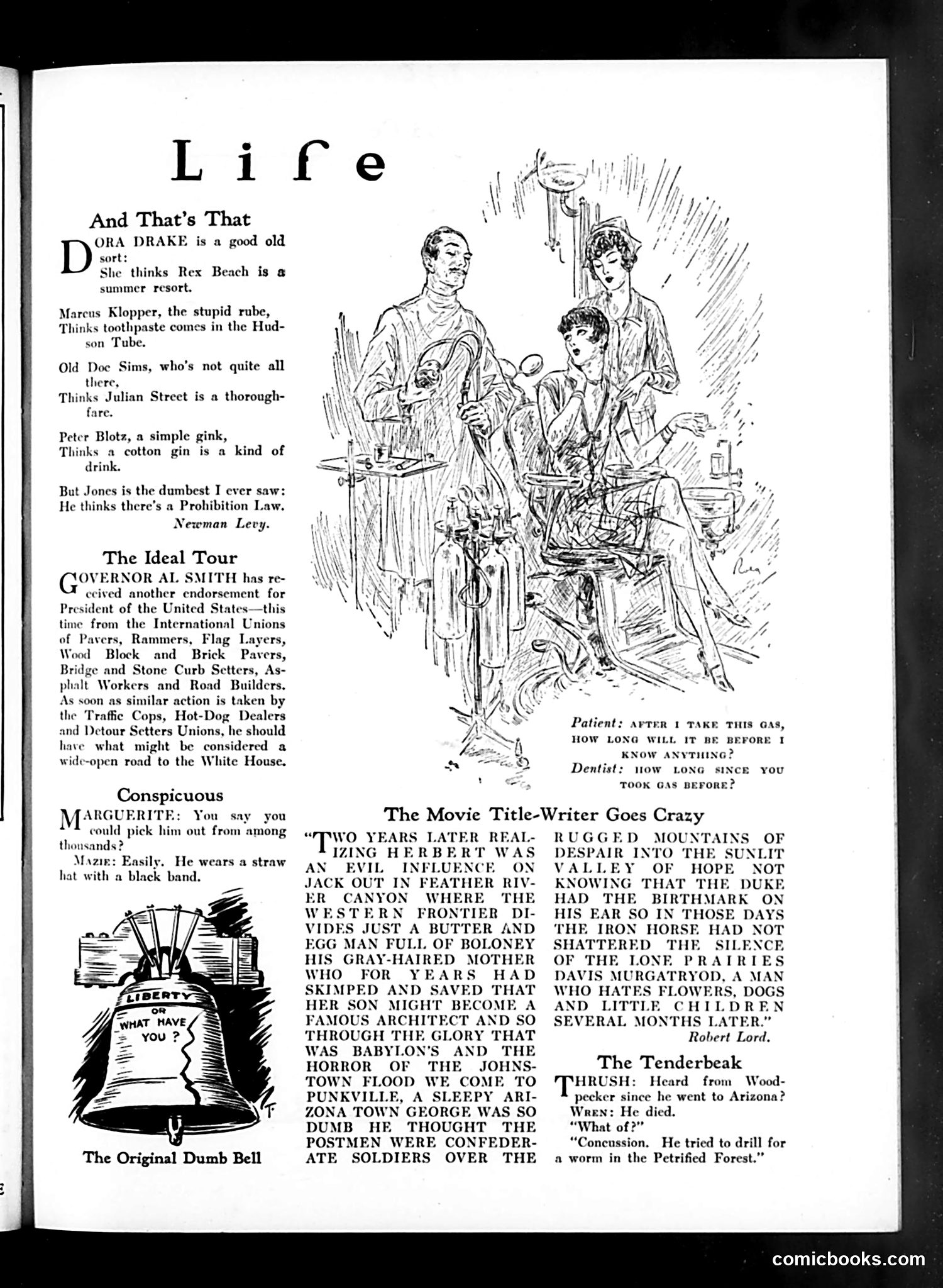
This page contains several satirical sections mocking contemporary attitudes and ideas: **"And That's That"** ridicules various people's misconceptions—Marcus Klopper's foolish beliefs, Peter Blotz's ignorance about cotton gin, and notably "Jones" for not understanding Prohibition exists (suggesting some people denied or ignored this law). **"The Ideal Tour"** advocates Governor Al Smith's presidential endorsement by labor unions, proposing he'd support workers' interests better than current policy. **"The Movie Title-Writer Goes Crazy"** parodies absurdly overwrought silent film titles with melodramatic plot descriptions, satirizing Hollywood's tendency toward excessive, nonsensical storytelling. The illustrations support these written jokes through caricature and visual humor, typical of Life's satirical approach during this era.
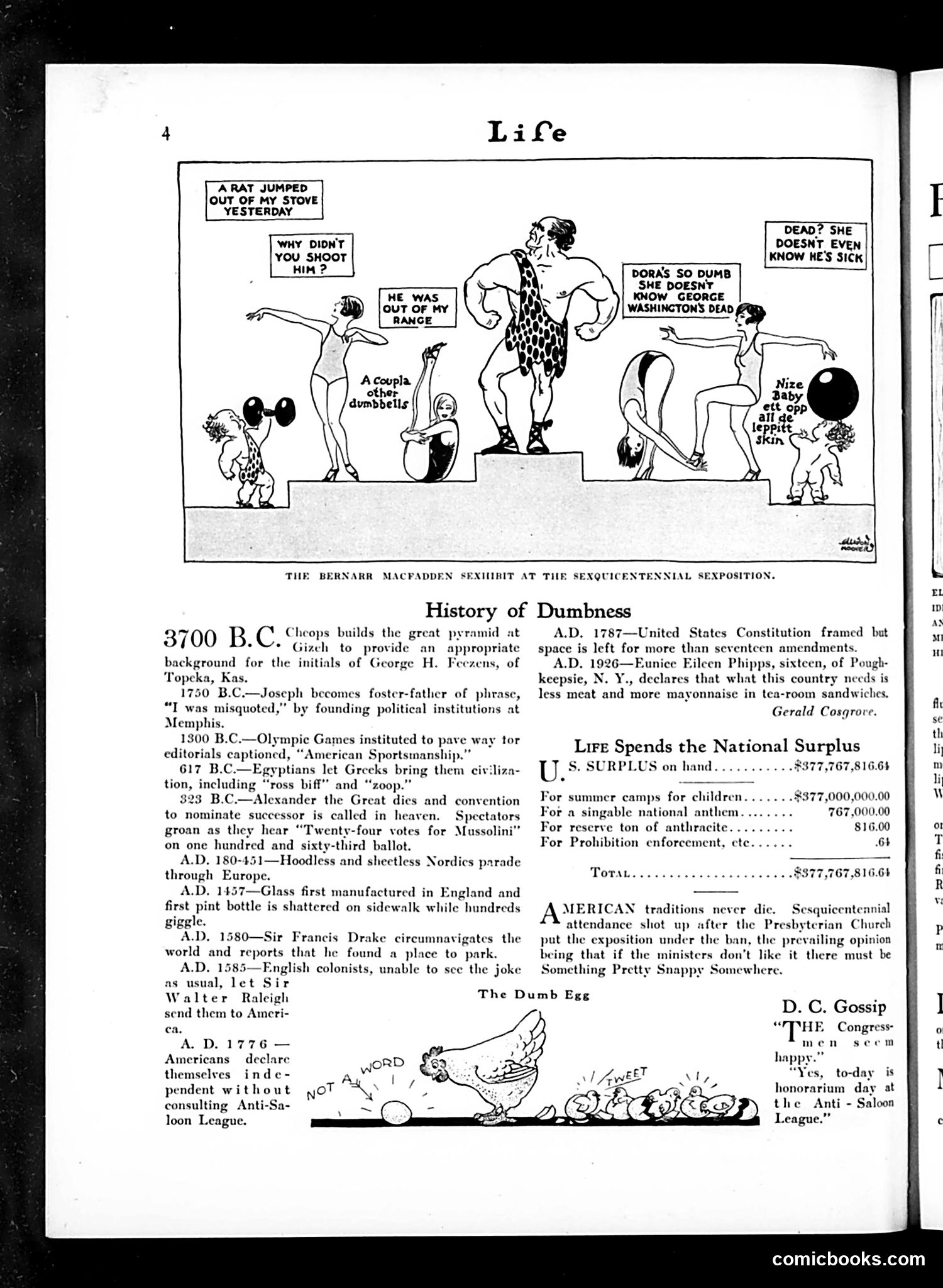
This cartoon satirizes Bernard Macfadden, a prominent 1920s physical culture promoter and magazine publisher. The title mockingly combines "Sesquicentennial Exposition" (Philadelphia's 1926 centennial celebration) with "sexposition"—suggesting Macfadden's exhibits exploited sexuality under the guise of health and fitness. The cartoon depicts various scantily-clad figures on a podium with absurd captions mocking different types of people (dumb women, etc.), likely criticizing Macfadden's tendency to display human "specimens" and promote controversial ideas about physical perfection and eugenics. The accompanying "History of Dumbness" timeline below appears to extend this satirical critique, using historical examples to mock public foolishness and gullibility.
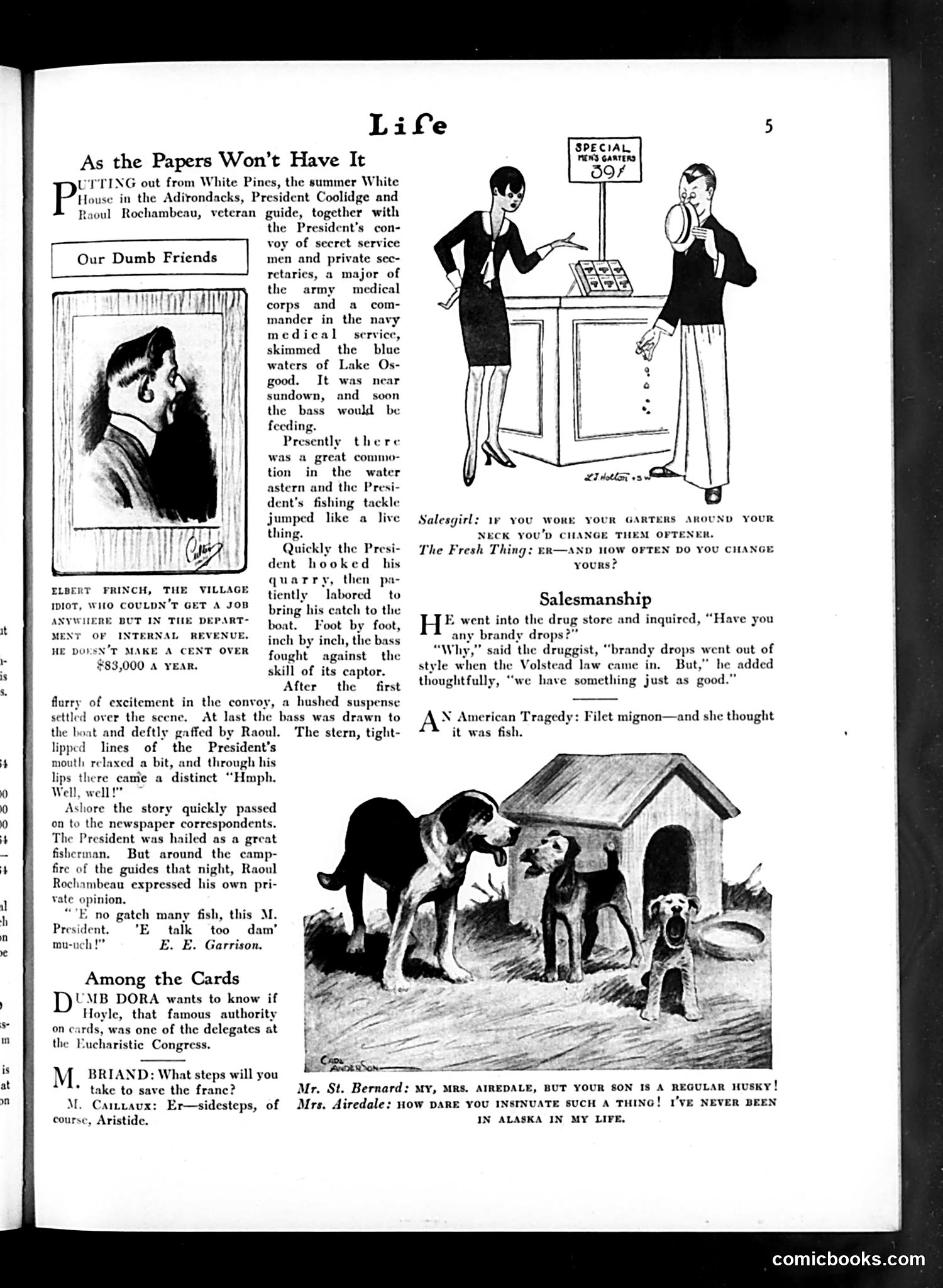
**"As the Papers Won't Have It"** depicts President Coolidge fishing at Lake Oswegod. The cartoon satirizes media coverage: after Coolidge successfully catches fish, newspapers hail him as a "great fisherman," but his guide Raoul privately expresses skepticism ("no catch many fish, this M. President"). The satire targets how newspapers spin favorable narratives around political figures regardless of reality. **"Our Dumb Friends"** shows Elbert French, described as a village idiot who doesn't earn money, suggesting contemporary attitudes toward people with intellectual disabilities. The remaining items—**"Salesmanship,"** **"An American Tragedy,"** and **"Among the Cards"**—are short humorous anecdotes satirizing commercial culture and social pretension typical of Life's satirical format.
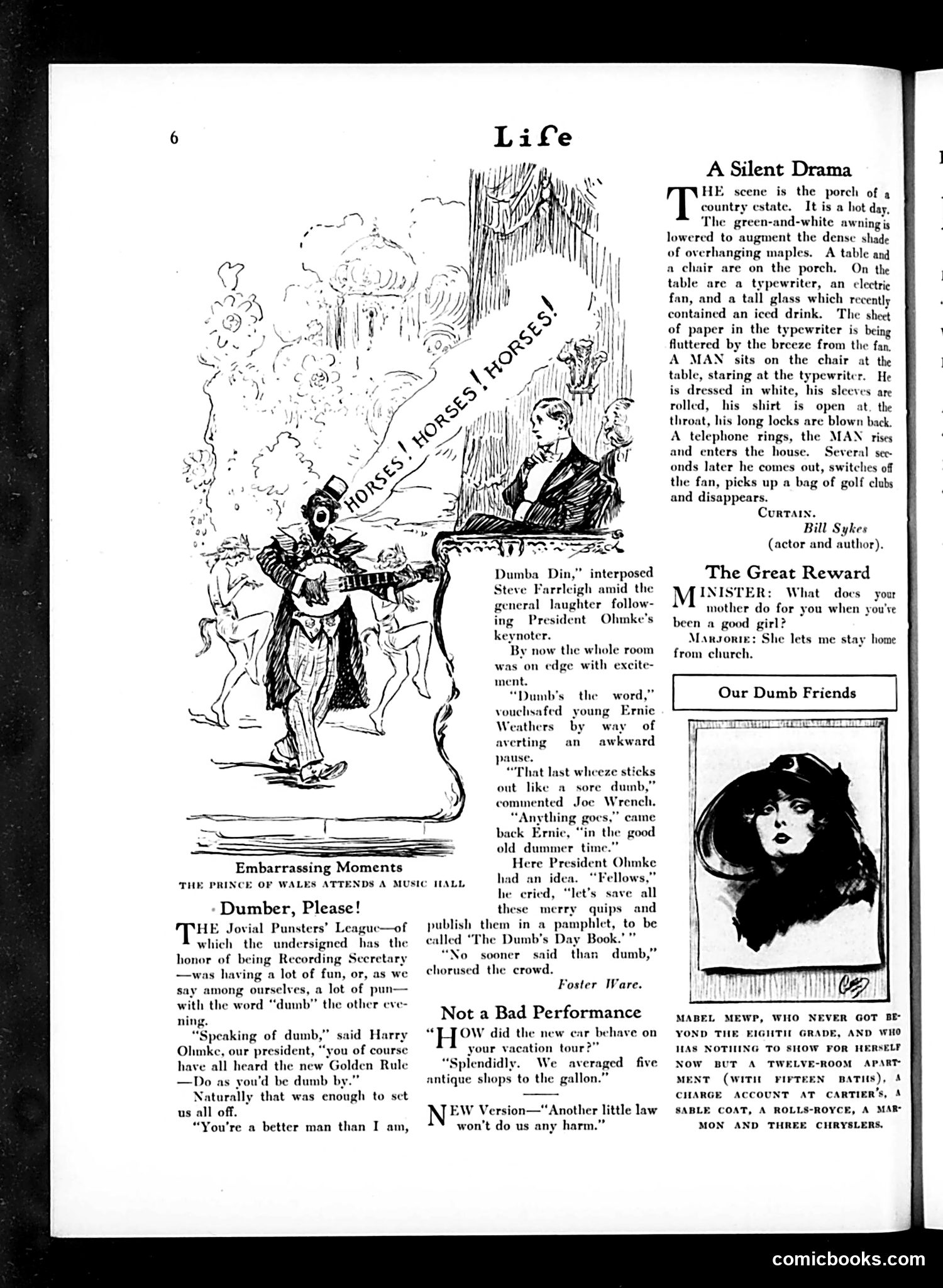
This page contains short satirical pieces and illustrations typical of Life magazine's humor. The main cartoon, "Embarrassing Moments," depicts President Ohmke attending a music hall where someone shouts "HORSES! HORSES! HORSES!" — apparently a crude heckle. The surrounding text describes the awkward scene with comedic commentary from onlookers. Below are brief humorous anecdotes about "dumbness," including a joke about the "Golden Rule" and wordplay on the term "dumb." The "Our Dumb Friends" section features a portrait illustration (credited to artist signature), likely a regular feature. Without clearer historical context, the specific President Ohmke reference and the exact satirical target remain unclear, though the overall tone mocks both public figures and social pretension.
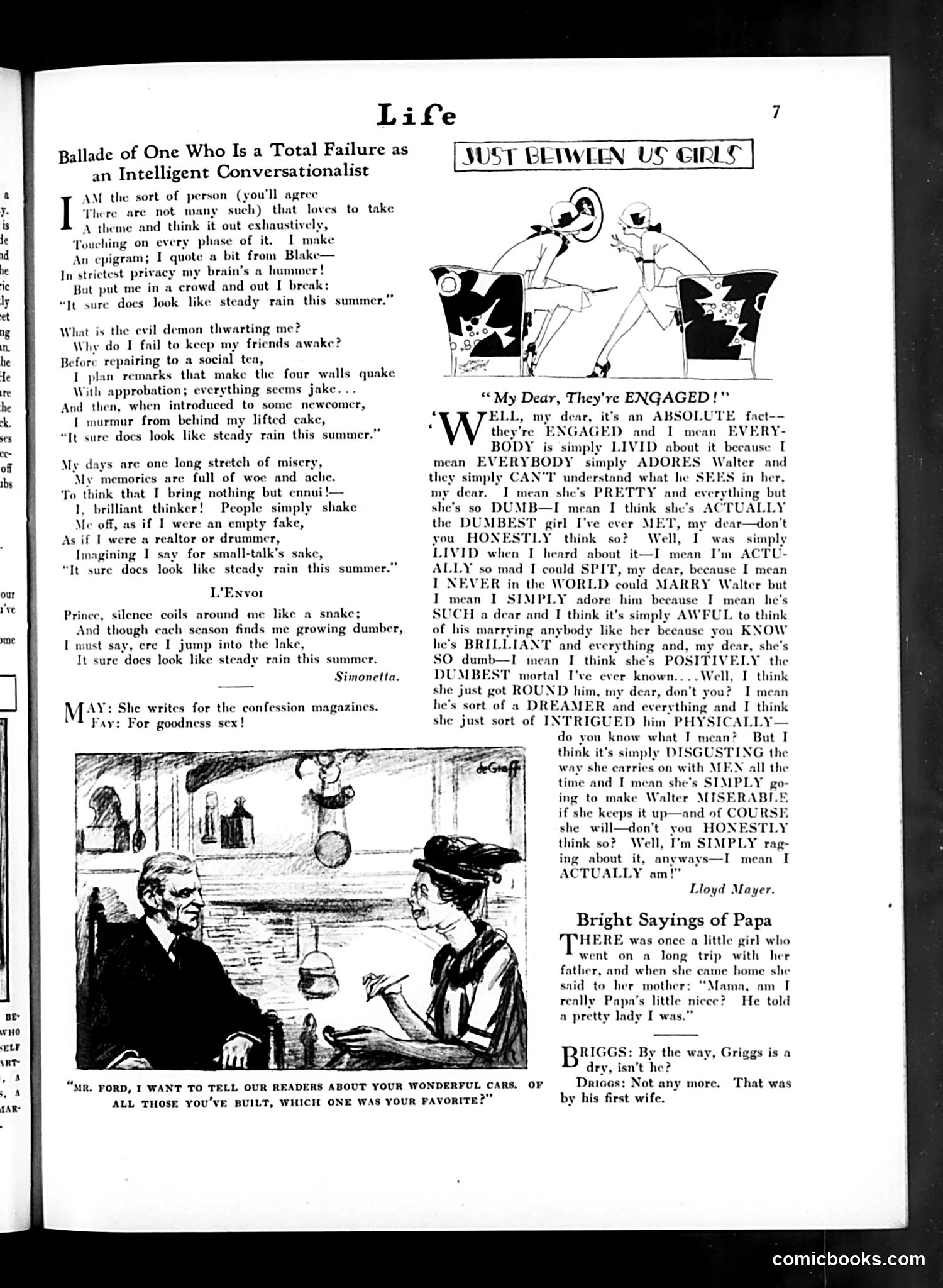
This cartoon satirizes a woman's breathless, run-on complaints about her fiancé Walter. The humor relies on the exaggerated feminine stereotype of gossiping and over-sharing emotional grievances—the title "Just Between Us Girls" frames this as intimate female conversation. The woman describes Walter in contradictory terms (calling him both "dumb" and "brilliant," "dull" and a "dreamer"), suggesting her complaints are irrational or overwrought rather than grounded. The satire targets both the stereotype of women's conversation as superficial gossip and the absurdity of finding fault with someone you claim to adore. The accompanying illustration shows two women in domestic setting, one speaking animatedly to the other. The joke assumes readers will recognize this as typical female social behavior worthy of mockery.
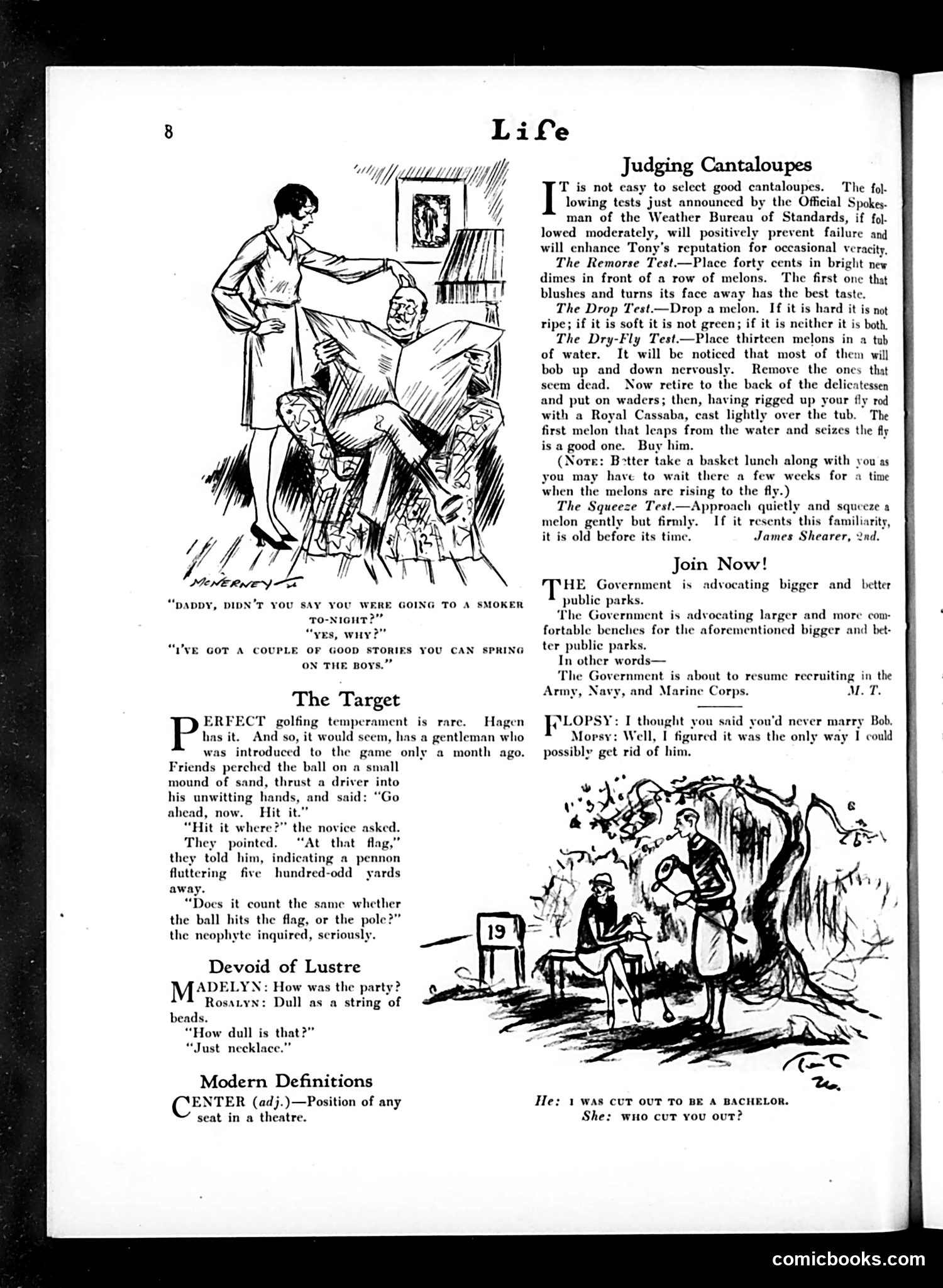
This page contains humorous articles and illustrations typical of Life's satirical content. The main features include: **"Judging Cantaloupes"** - Tests for selecting quality melons, presented as mock-scientific procedures (the "Remorse Test," "Drop Test," "Dry-Fly Test," "Squeeze Test"). This satirizes both the earnestness of consumer advice and the absurdity of overly elaborate selection methods. **"The Target"** - A brief anecdote about a gentleman's poor golfing temperament, illustrating upper-class leisure activities and the stereotype of competitive male behavior. **"Devoid of Lustre"** and **"Modern Definitions"** - Short comic exchanges mocking social pretension and theatrical terminology respectively. The page reflects 1920s-era American humor targeting middle and upper-class readers, with emphasis on domestic life, sport, and fashionable society.
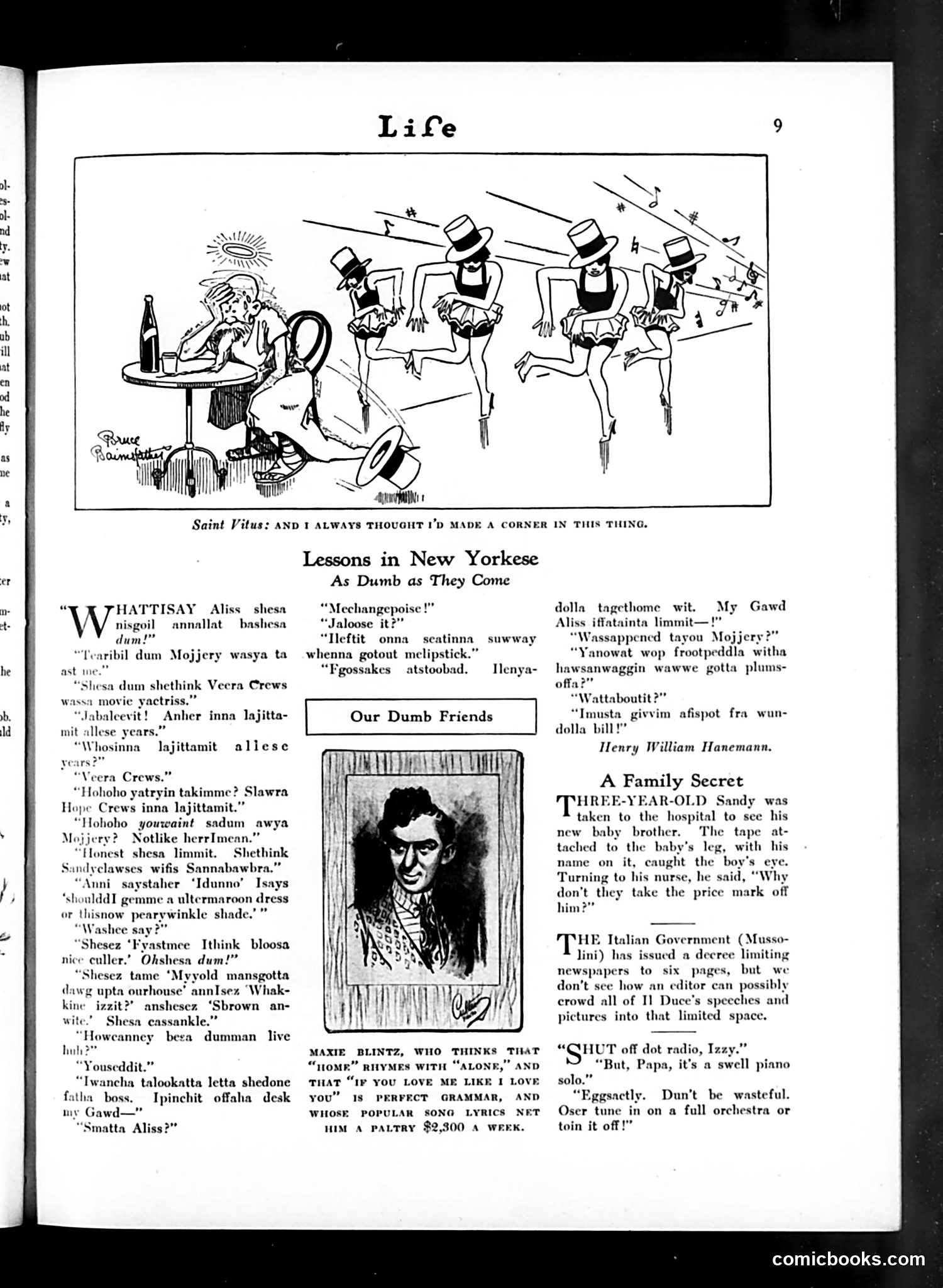
**Top Cartoon:** Bruce Bairnsfather's drawing depicts "Saint Vitus" observing performers doing the Charleston dance. The caption reads: "AND I ALWAYS THOUGHT I'D MADE A CORNER IN THIS THING." This satirizes the 1920s dance craze. Saint Vitus's Dance (a neurological disorder causing involuntary movements) is joked as the patron saint of the jerky Charleston—the wildly popular new dance style. Bairnsfather suggests the frenzied, uncontrolled movements resemble a genuine medical condition, poking fun at both the dance's vigorous nature and society's obsession with it. **Lower content:** "Lessons in New Yorkese" and humor pieces appear, plus a brief item about Maxie Blintz, a singer with a $2,300 weekly salary, contrasting entertainment wealth during the Jazz Age.
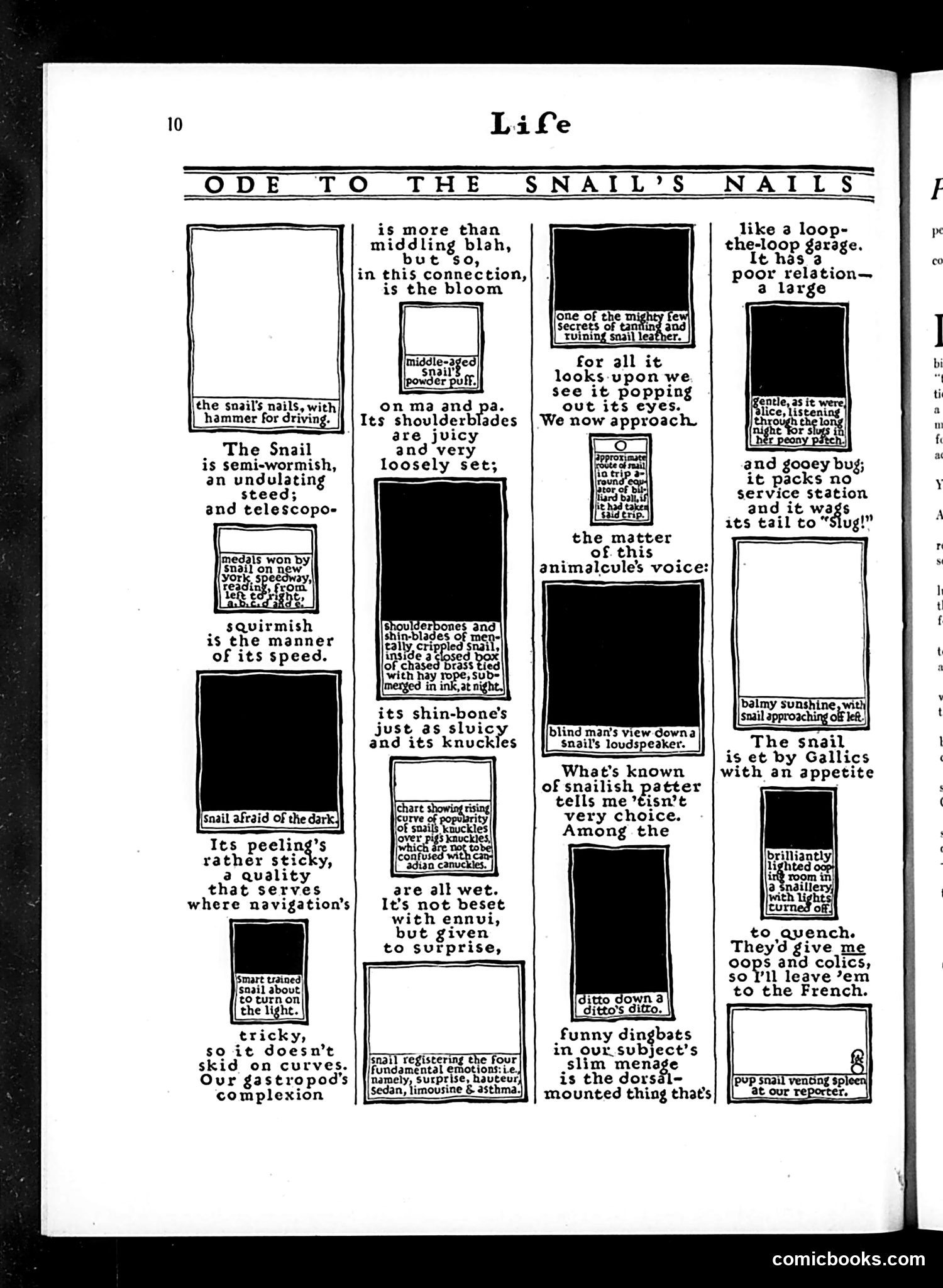
This is a humorous poem celebrating the snail as a subject, laid out in a modernist magazine format with bordered text boxes containing observations about snail anatomy and behavior. The "satire" here is gentle and absurdist rather than political. The poem mocks the pretension of serious nature writing by treating trivial snail characteristics with grandiose poetic language—describing the snail's nails as worthy of an "ode," discussing its "shin-bone's" sluggishness, and noting that Gallics eat snails with "appetite." The humor derives from the incongruity between elevated literary form (the classical ode) and mundane subject matter (snail locomotion, edibility). It's primarily a stylistic parody of overwrought naturalist or romantic poetry rather than social or political commentary.
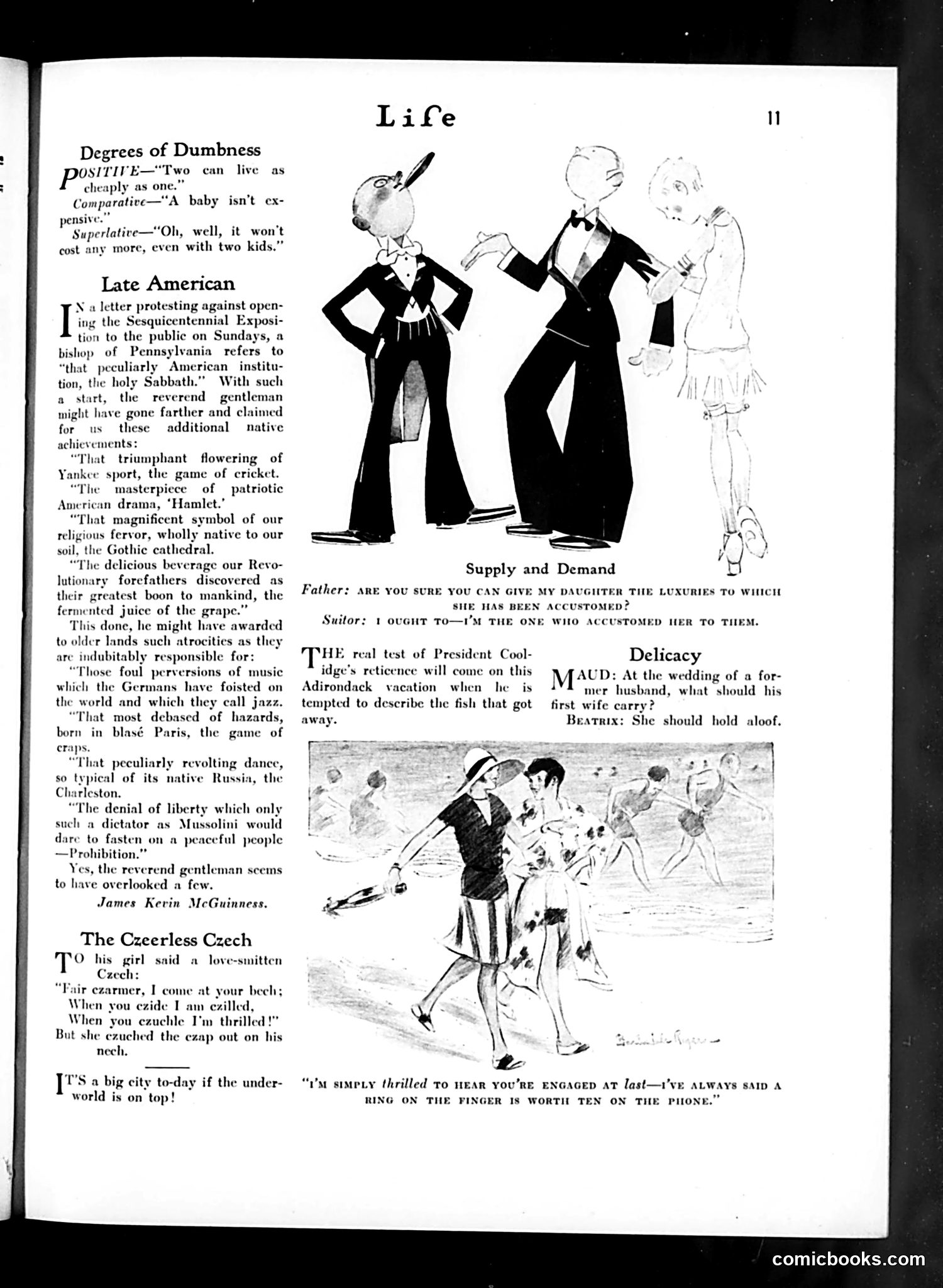
This page contains several satirical pieces typical of early 20th-century Life magazine humor: **"Late American"** mocks a Pennsylvania bishop's protest against Sunday Exposition at the Sesquicentennial Exhibition, sarcastically listing "native American achievements" (jazz, cricket, Hamlet, etc.) that contradict the bishop's claim of American moral superiority. **"Supply and Demand"** shows a sailor and father negotiating over a daughter's luxuries—typical gender-role satire about courtship expenses. **"Delicacy"** depicts a beach scene where a woman asks about holding a aloof fiancé, reflecting period anxieties about propriety and romance. **"The Czarless Czech"** presents a folk-tale style joke about a Czech lover's cruelty. The page exemplifies Life's blend of social commentary and domestic humor targeting middle-class American conventions and gender dynamics.
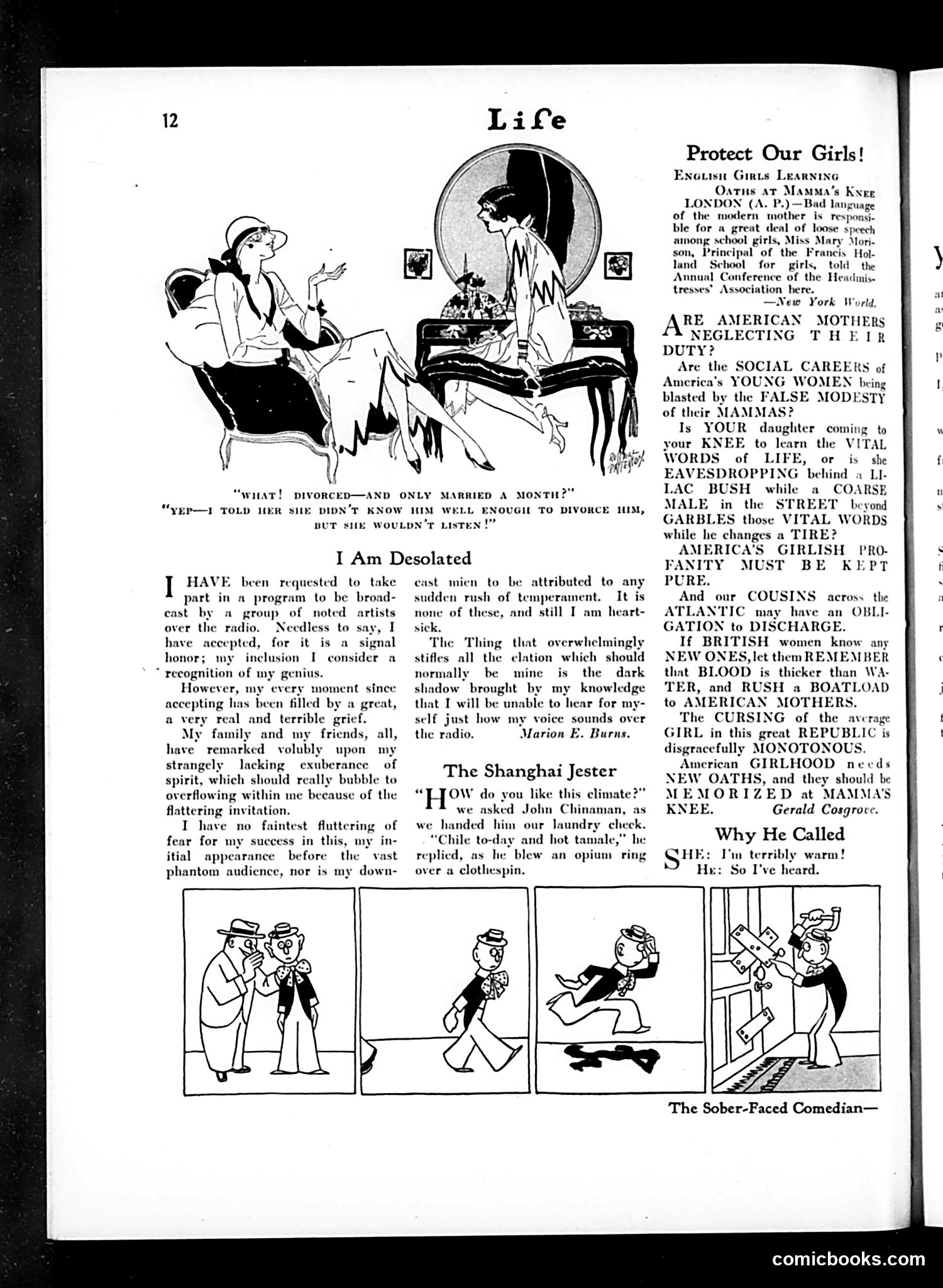
This page contains social commentary on 1920s American culture, particularly targeting women's behavior and propriety. **"I Am Desolated"** is a personal essay by someone (possibly Marion E. Burns, based on attribution) defending their reputation after public criticism, explaining their exuberance stems from nervousness rather than arrogance. **"The Shanghai Jester"** is a brief humor piece about someone commenting on hot weather while smoking opium. **"Why He Called"** is a four-panel comic strip showing a man courting a woman. The joke's punchline—"I'm terribly warm! / So I've heard"—suggests the woman has a reputation for promiscuity, implying the man's flattery about her warmth references her loose morals rather than the temperature. The adjacent "Protect Our Girls!" advertisement warns mothers about daughters adopting "false modesty" and inappropriate behavior, reflecting period anxieties about changing women's social roles.
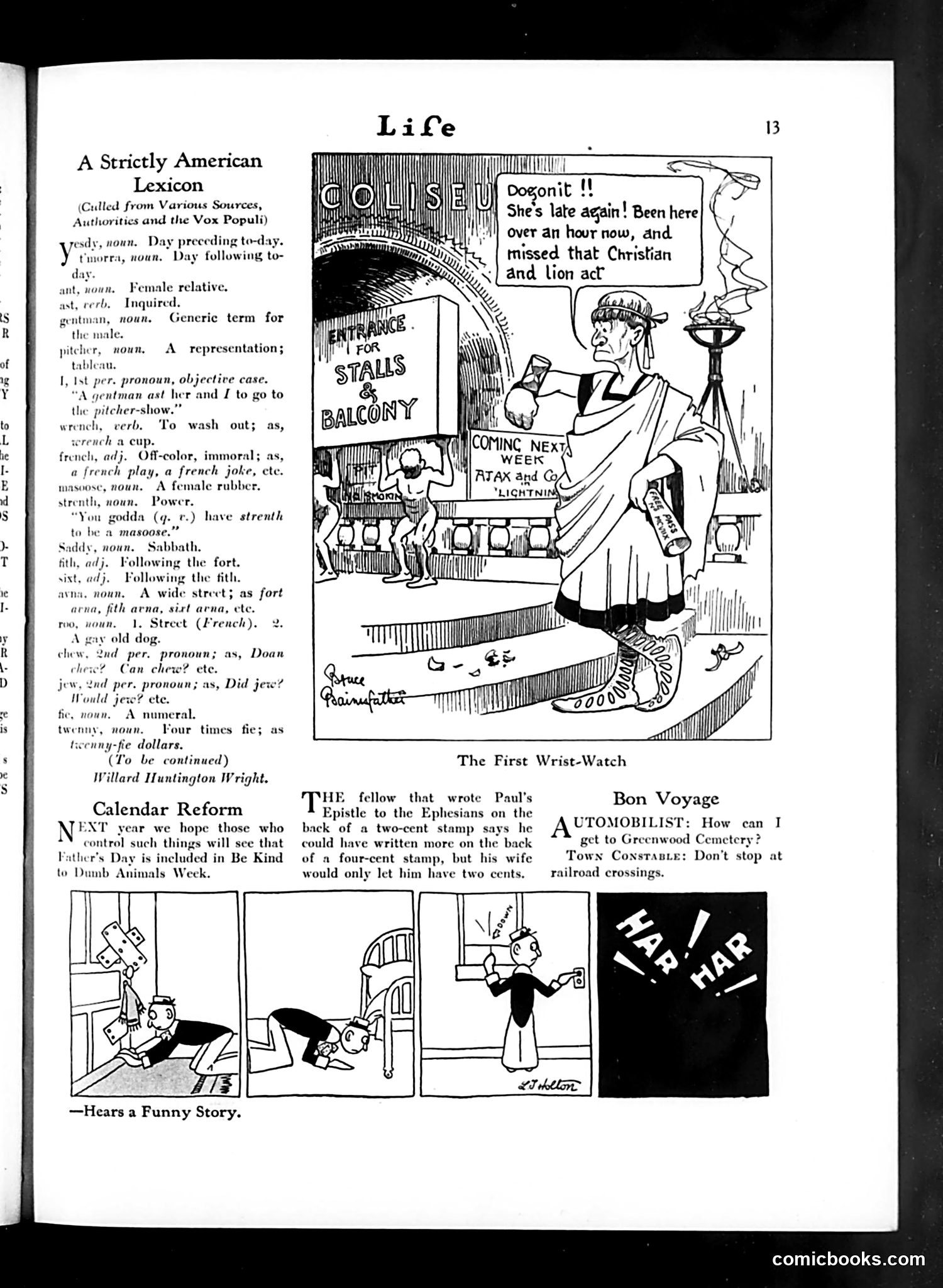
This cartoon depicts a Roman gladiator or centurion figure checking what appears to be an early wrist-watch. The humor stems from anachronism—the joke is that wrist-watches are presented as a modern invention, yet shown worn by an ancient Roman, suggesting the concept is absurdly old or timeless. The accompanying text about Paul's Epistle to the Ephesians reinforces the historical joke: someone writing on a two-cent stamp wishes they had more space, mirroring how constrained early communication methods were compared to modern convenience. The page also includes "Calendar Reform" comics and a "Bon Voyage" section with automobile humor. These appear to be typical satirical vignettes from Life magazine's comedic commentary on contemporary American life and technology.
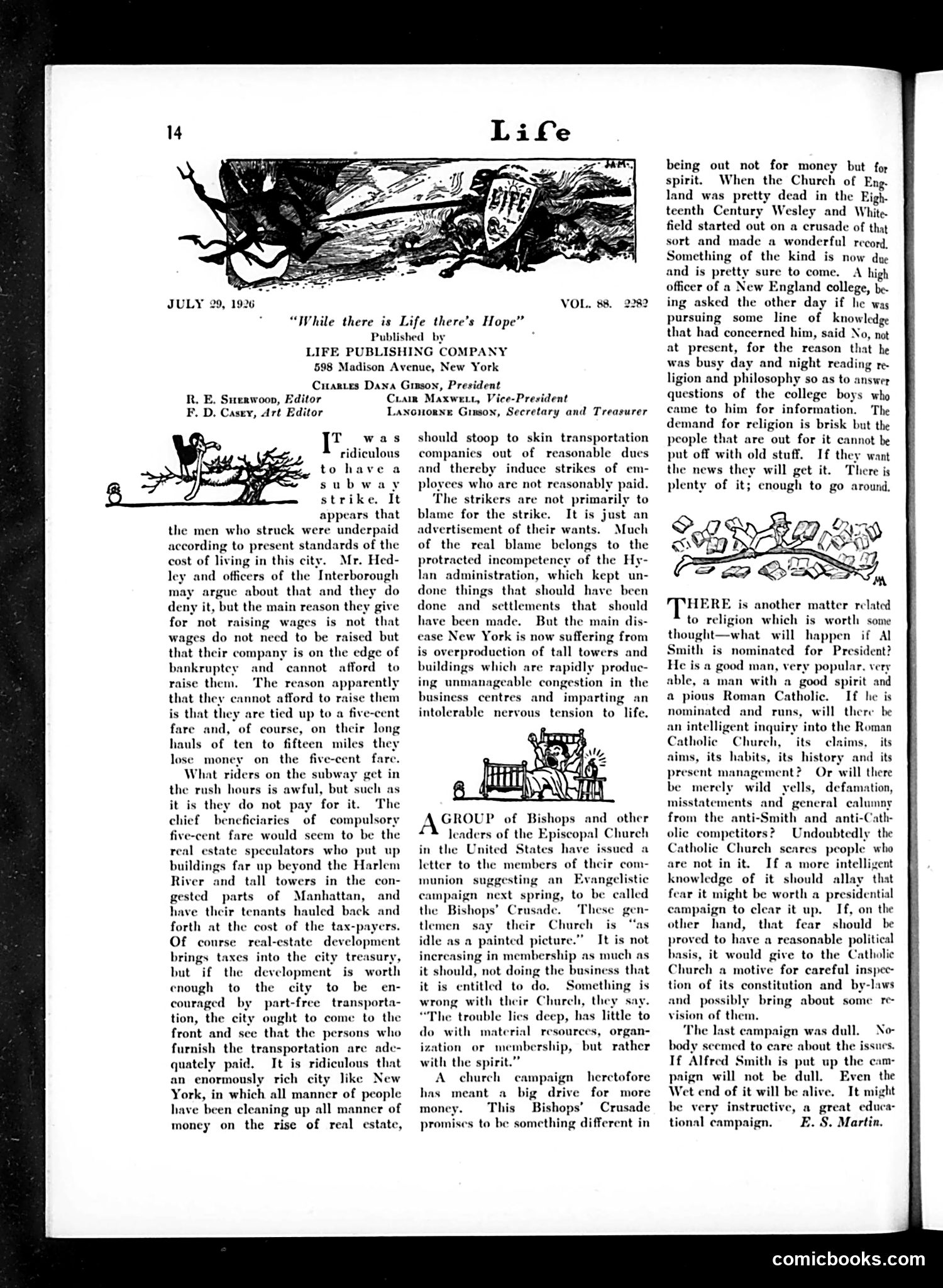
The main cartoon depicts a figure labeled "PIPE" wielding a large wrench or pipe, striking at what appears to be a subway structure. This illustrates the subway strike mentioned in the accompanying editorial text. The editorial discusses the underpaid transit workers' strike and argues that while their grievances are valid, the real blame lies with city mismanagement and real estate speculation that created unsustainable congestion. The author criticizes the "Hylan administration" for incompetence in addressing root causes. A second editorial discusses a potential presidential nomination of Al Smith and the "Bishops' Crusade"—an Episcopal Church campaign. The author advocates for intelligent examination of Smith's character and qualifications rather than sectarian attacks, suggesting anti-Catholic opposition to his candidacy exists.
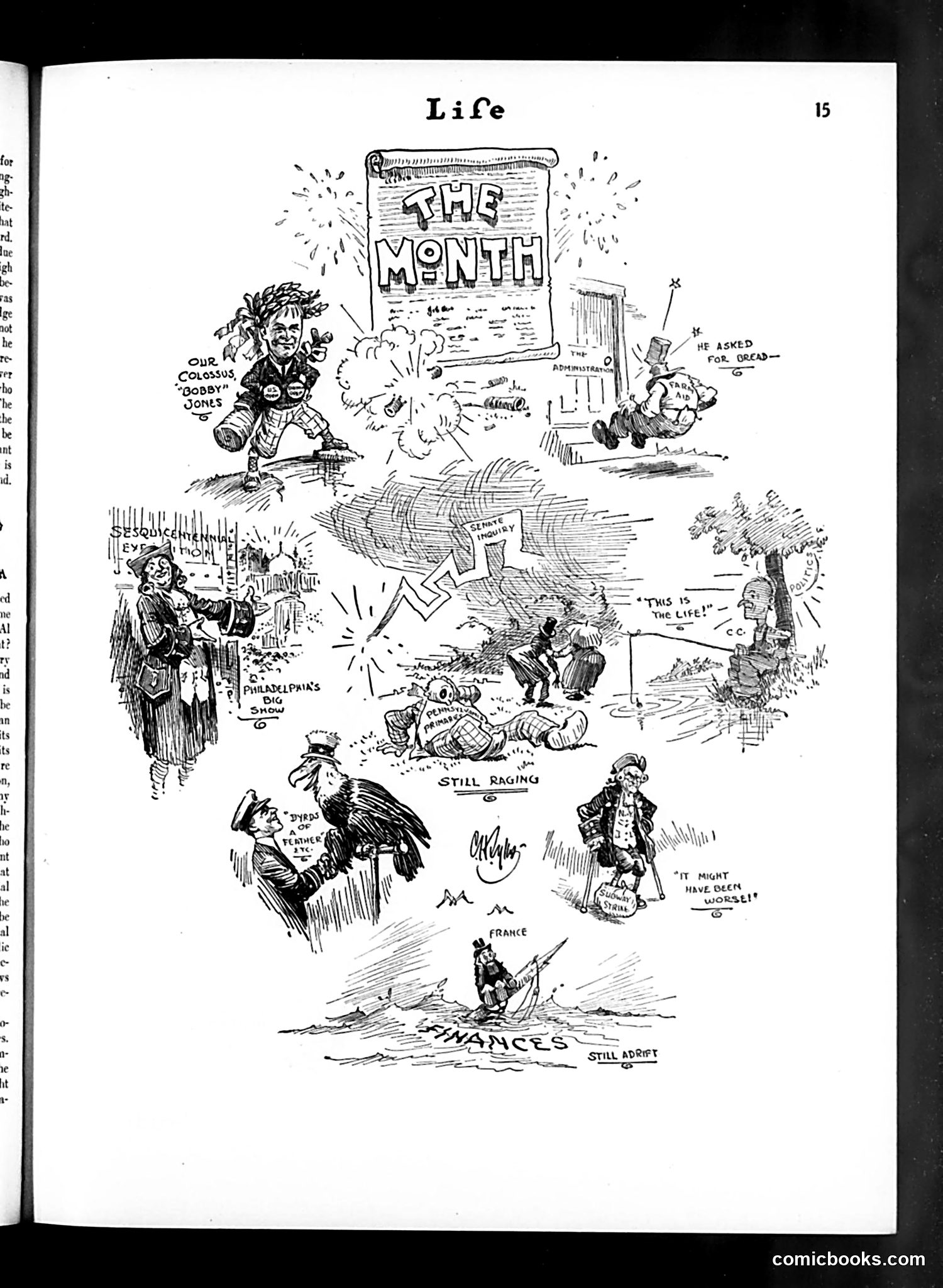
This satirical collage depicts various contemporary crises and absurdities, likely from the post-WWI era. Key panels include: - **"The Month" (top center)**: Suggests monthly news recaps - **"Colossos Donny Jones"**: An inflated figure, possibly mocking celebrity excess - **"Philadelphia's Greatest Show"**: References local scandal or spectacle - **"Still Raging"**: Depicts ongoing conflict or social turmoil - **"France - Finances - Still Adrift"**: Commentary on France's post-war economic instability - Various figures showing political and social disorder The overall message satirizes multiple failures: governmental incompetence, financial instability (especially in France), sensationalist media, and general societal chaos. The crowded, chaotic composition reinforces the sense of mounting problems. Without precise dates or clearer labels for all figures, specific identifications remain uncertain, but the satire targets institutional failure broadly.
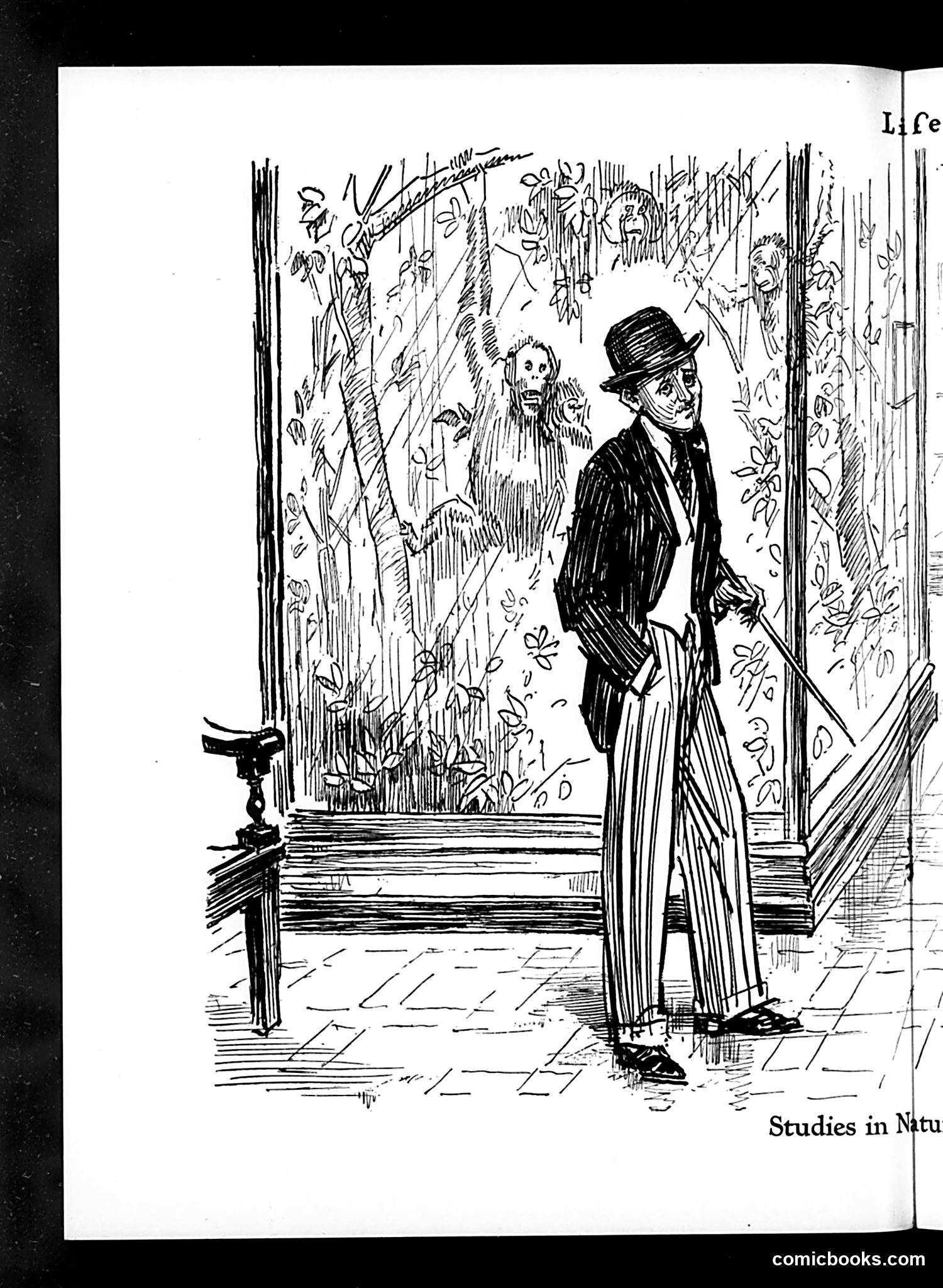
This illustration appears to be from "Studies in Nature," a section of Life magazine. It depicts a well-dressed man in a suit and fedora hat standing in what appears to be a greenhouse or conservatory, observing climbing vines and foliage on the walls. The cartoon likely satirizes urban society's relationship with nature—specifically, how wealthy or cultured city dwellers engage with the natural world in artificial, controlled settings rather than outdoors. The man's formal attire and composed posture contrasts with the wild, untended growth surrounding him, suggesting irony about "studying nature" while remaining fundamentally removed from it through civilization and artifice. The greenhouse setting emphasizes this separation between genuine nature and its domesticated representation.
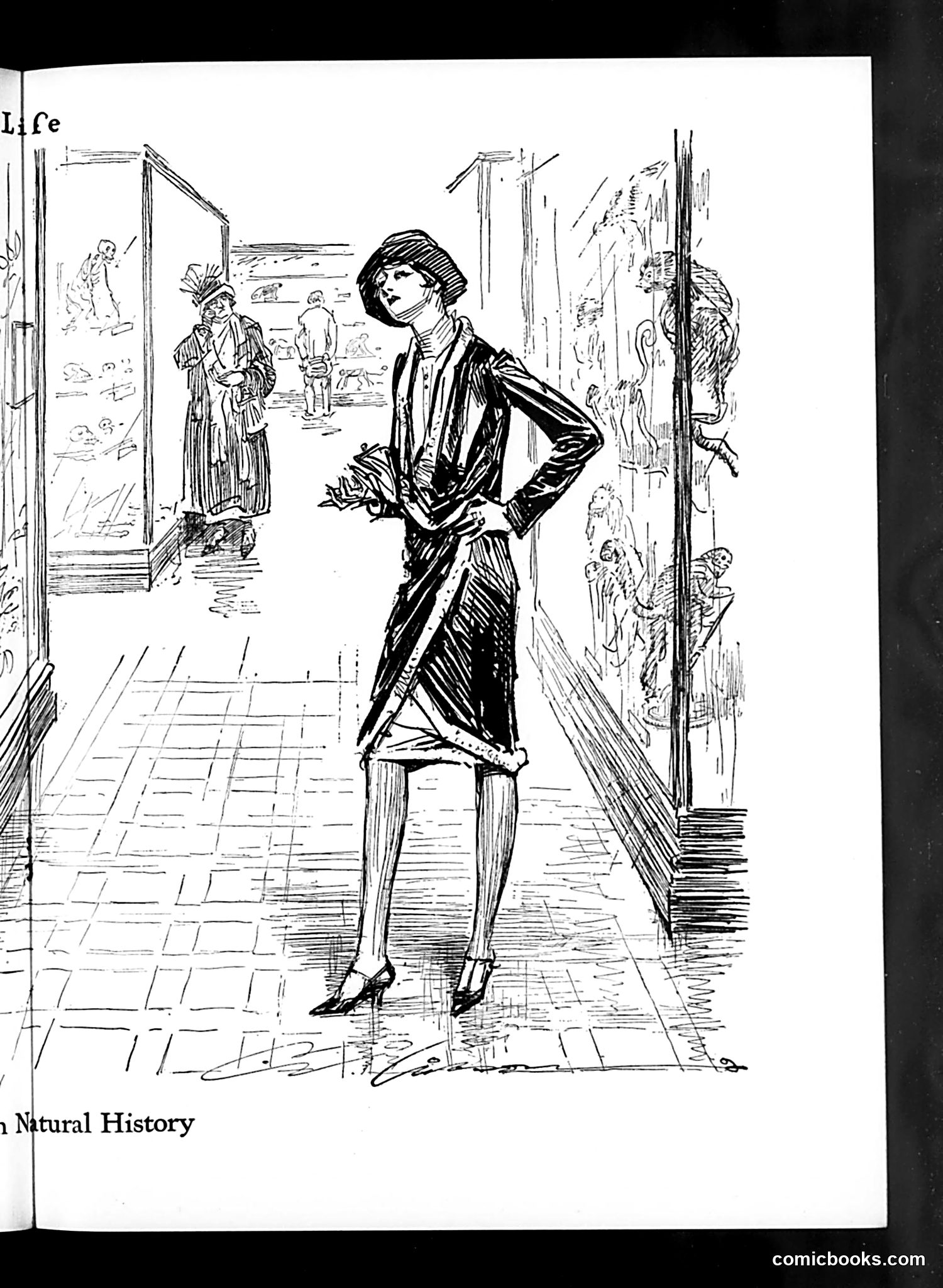
This illustration appears to be a satirical commentary on women's fashion and social behavior, likely from the early 20th century based on the style. The central figure is a woman in a dark coat and short skirt, striking a confident pose with hands on hips. The sketch emphasizes her leg exposure—notable because shorter skirts were considered scandalous at the time. The title "Natural History" suggests the cartoon is treating modern women's changing fashion choices as if they were specimens being observed scientifically. The background figures and architectural framing reinforce this observational angle. The satire likely mocks either the "new woman" of the era adopting more revealing clothing, or conservative disapproval of such fashion changes. The exaggerated proportions and bold linework are typical of Life magazine's irreverent humor.
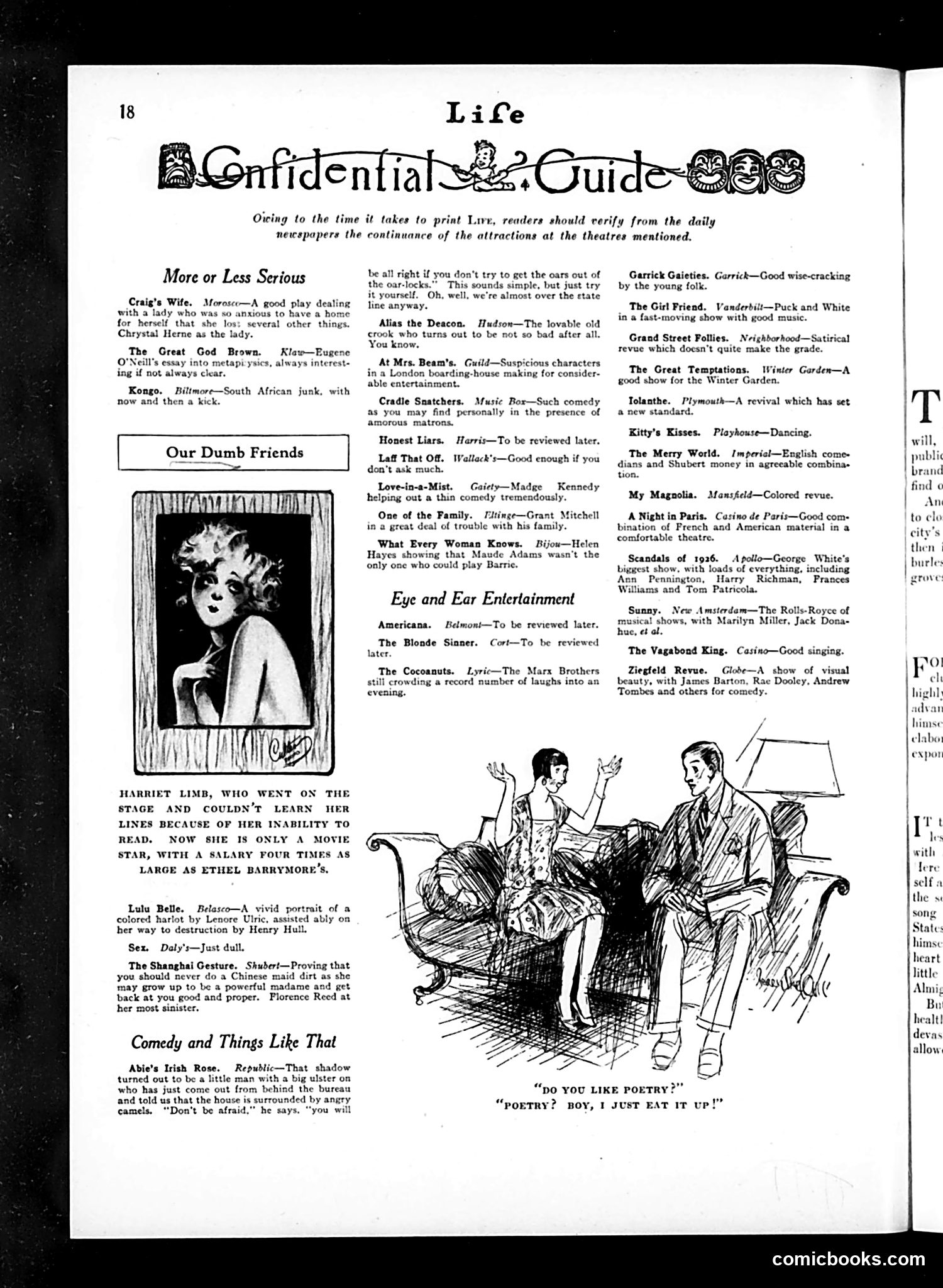
This page from *Life* magazine contains theater reviews and a satirical cartoon mocking theatrical pretension. **The Main Cartoon:** Shows two men in conversation, with one asking "Do you like poetry?" The other responds "Poetry? Boy, I just eat it up!"—a joke about philistine audiences who consume culture uncritically or performatively, treating serious art like casual entertainment. The caption's crude grammar emphasizes the speaker's lack of sophistication. **"Our Dumb Friends" Section:** Mocks Harriet Limb, an actress who couldn't learn lines due to illiteracy but became a successful movie star earning four times Ethel Barrymore's salary. The satire critiques how cinema rewards mediocrity while stage acting requires genuine skill—a common *Life* complaint about the new film industry. **Theater Reviews:** Brief, snarky assessments of current Broadway shows, many emphasizing lowbrow comedy (Marx Brothers, crude plots) over serious drama—reflecting *Life*'s somewhat elitist perspective on entertainment. The overall tone mocks both mass audiences and the entertainment industry catering to them.
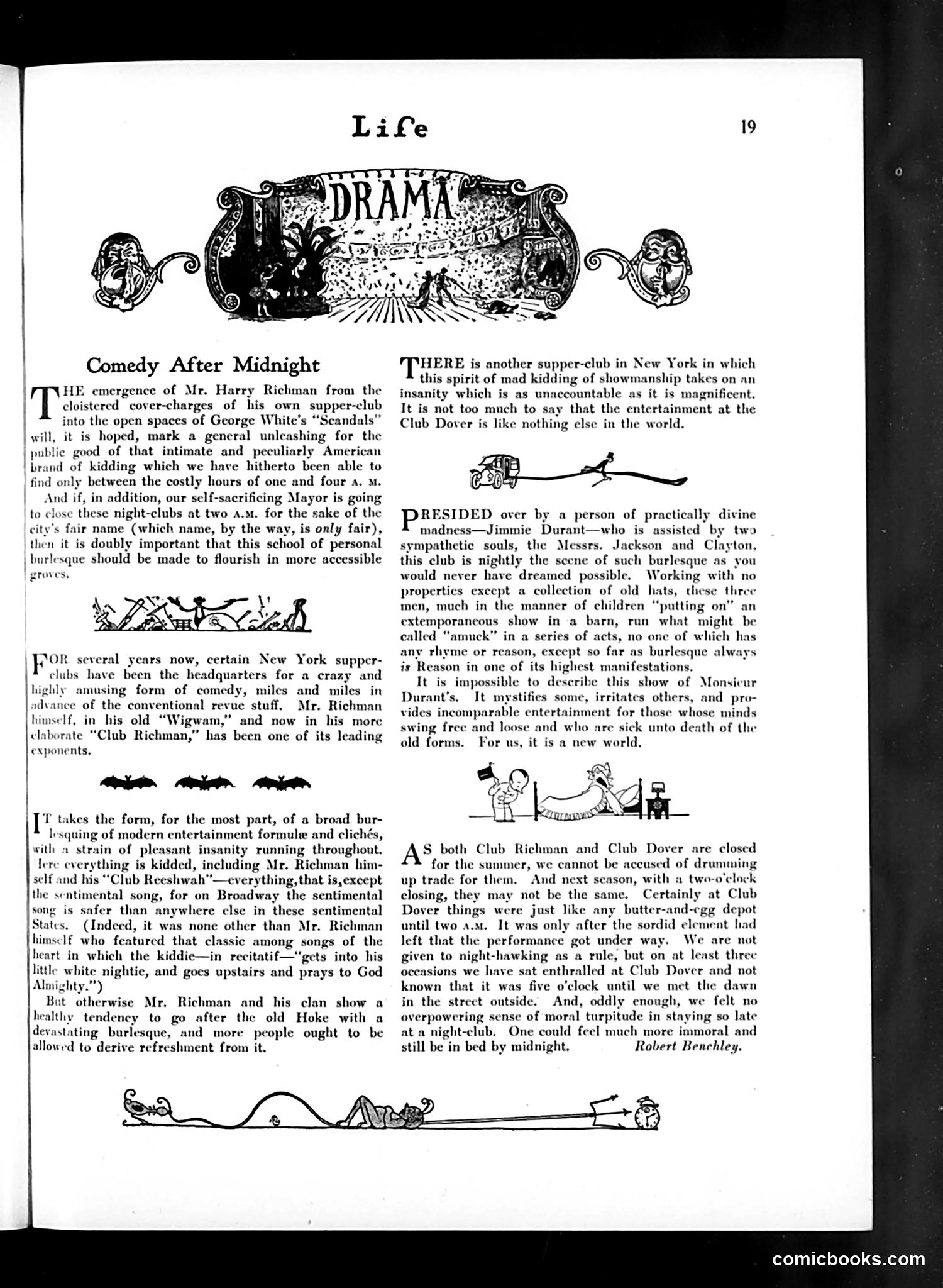
This article praises two avant-garde supper clubs—Club Richman (run by Harry Richman) and Club Dover (presided over by Jimmie Durante)—as venues for innovative American comedy and burlesque. The writer celebrates their irreverent, absurdist humor that mocks conventional entertainment formulas, contrasting it with Broadway's safer, sentiment-focused productions. The piece advocates for preserving this comedic tradition as the Mayor threatens to close night-clubs at 2 a.m. for the city's reputation. The author argues these clubs represent a distinctly American form of "personal burlesque" that deserves wider public access beyond the wealthy clientele who can afford late-night supper clubs. Club Dover is portrayed as particularly anarchic—three performers (Durant and two others) improvise nonsensical acts using only old hats, creating entertainment "like nothing else in the world." The satire targets both the sentimental pretension of Broadway and municipal prudishness about nightlife.
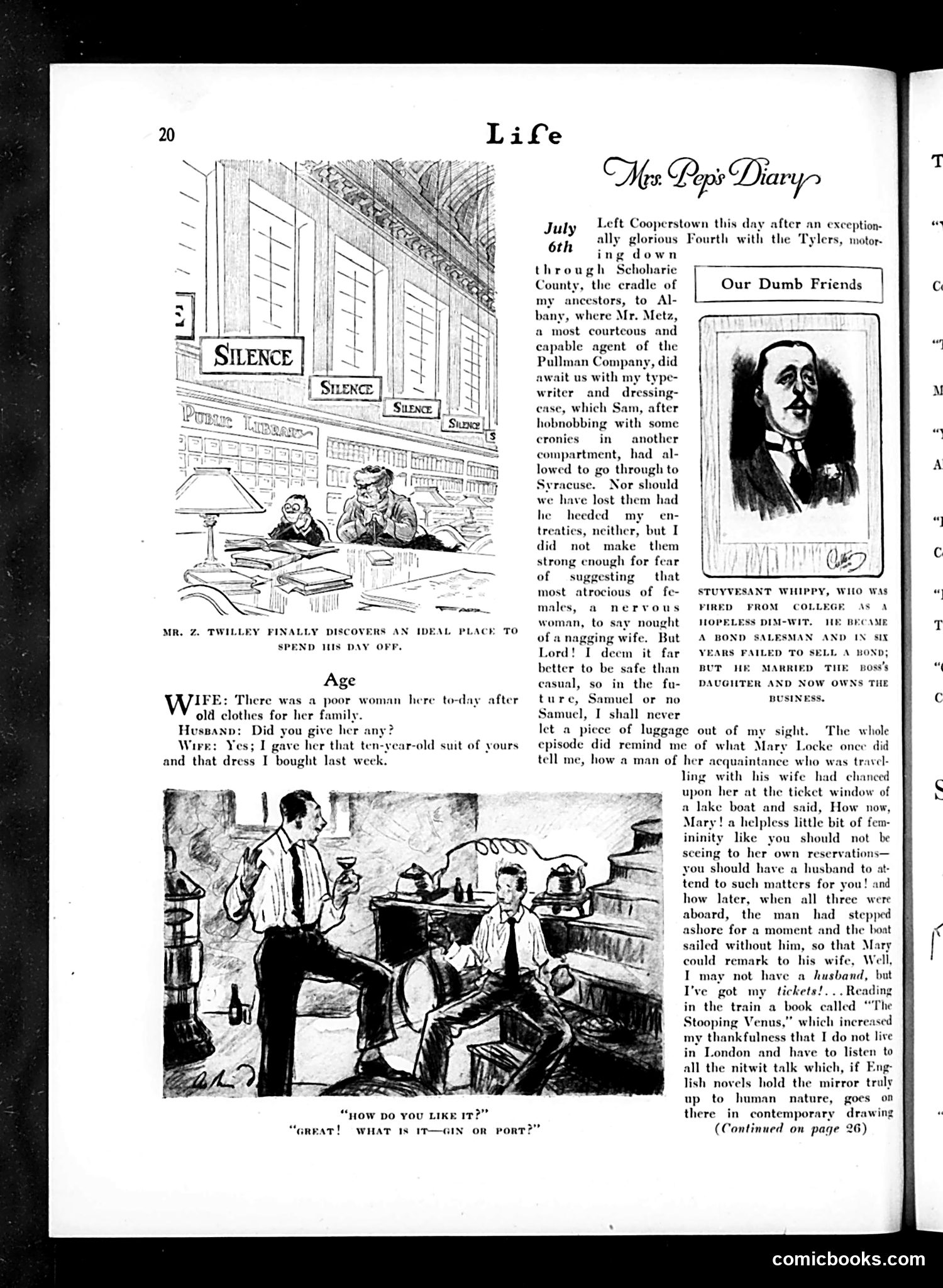
**Top Cartoon**: Mr. Z. Twilley discovers the public library as an ideal refuge from domestic life. The "Silence" signs emphasize this as an escape from the noise and demands of home—likely a wife. This satirizes the tension between married men seeking peace and the nagging demands of domestic responsibilities. **Bottom Cartoon**: A domestic dispute over household goods. A husband questions what his wife has given away—her old dress and his old suit to a poor woman. His response ("Great! What is it—gin or port?") suggests he's indifferent or sarcastic, implying marital discord over financial decisions and charity. **"Our Dumb Friends" Section**: Features Stuyvesant Whippy, a cautionary tale about an incompetent college graduate who failed at sales but married the boss's daughter, gaining business ownership through matrimony rather than merit. The satire mocks both his incompetence and the era's nepotism. **Mrs. Peps' Diary**: A woman's travel anecdote satirizing gender relations, including a joke about a woman abandoned at the dock—implying women's helplessness while she ironically proves more competent than her absent husband.
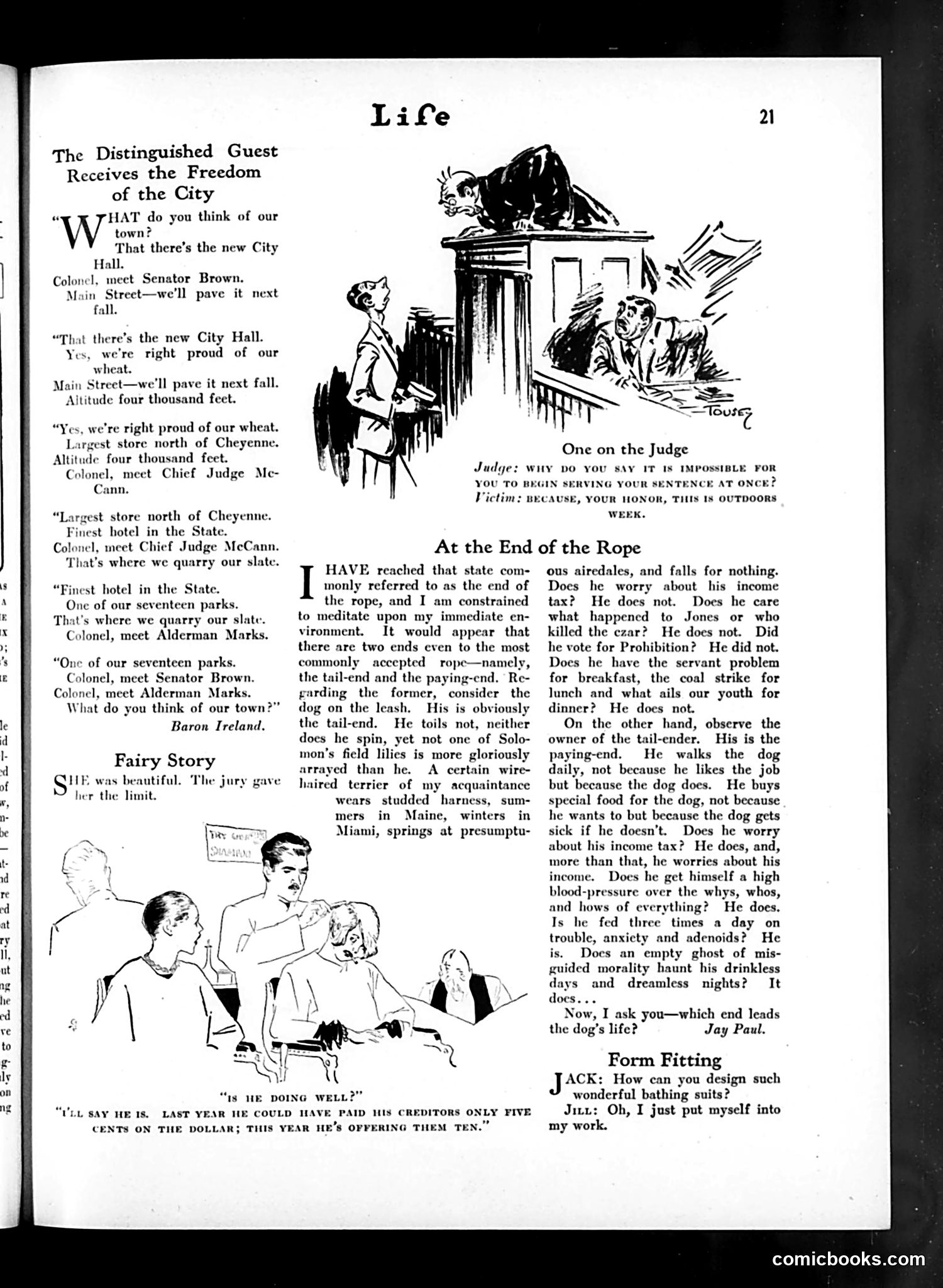
**"The Distinguished Guest Receives the Freedom of the City"** satirizes small-town boosterism. A visiting colonel is paraded through town while locals repetitively tout the same handful of achievements—the new City Hall, paving Main Street, wheat production, altitude—cycling through identical talking points with different officials (Senator Brown, Judge McCann, Alderman Marks). The satire mocks how provincial towns recycle the same limited accomplishments to impress visitors, suggesting shallow civic pride and lack of genuine progress. **"One on the Judge"** presents a prisoner requesting to delay sentencing because "this is outdoors week"—dark humor about prioritizing leisure over legal consequences. **"At the End of the Rope"** philosophically contrasts a carefree dog (the "tail-end") with its anxious owner (the "paying-end"), who worries about taxes, income, and social problems. The piece questions which actually lives better despite their reversed fortunes. **"Fairy Story"** and **"Form Fitting"** are brief joke segments unrelated to the other content.
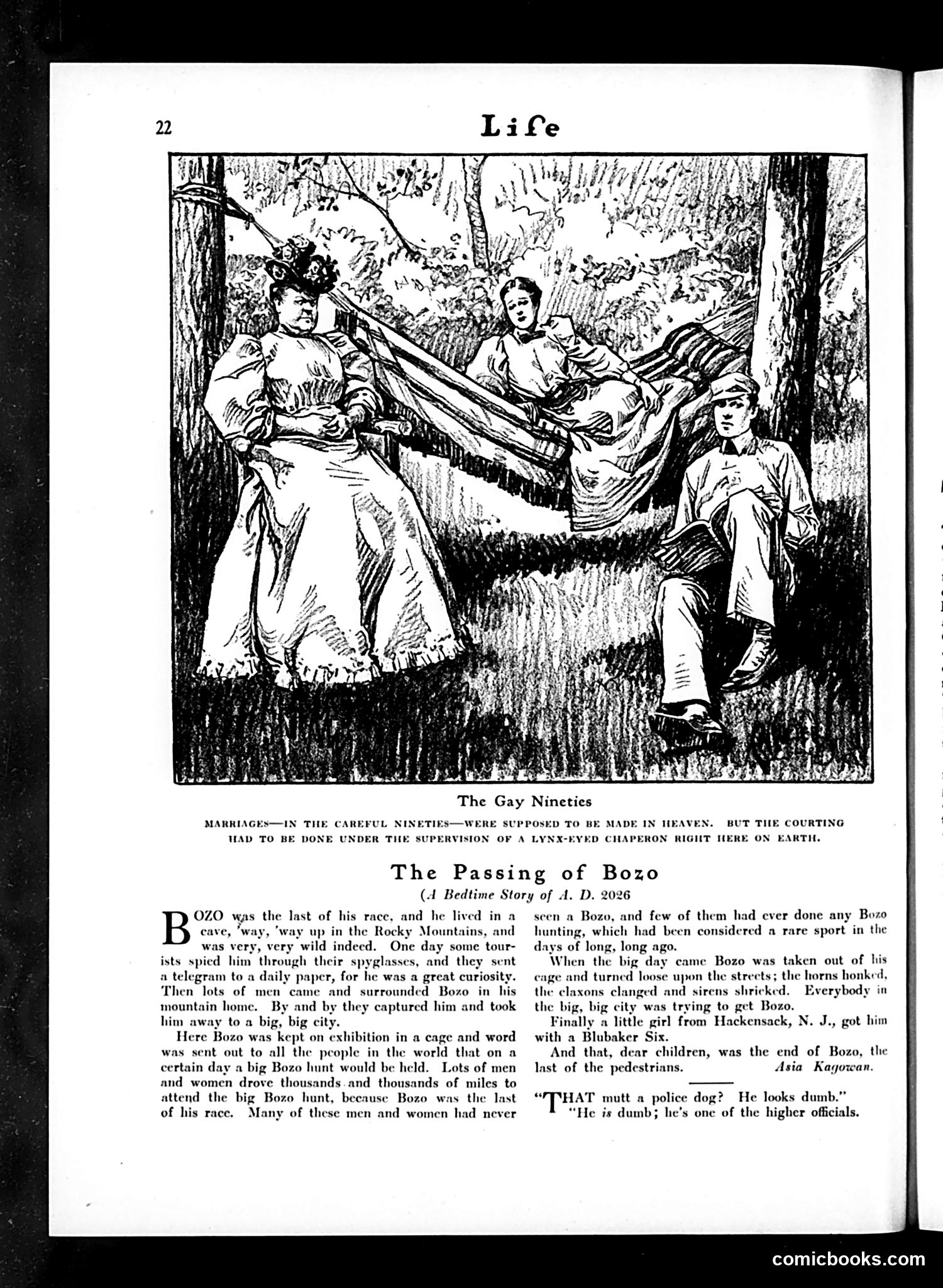
**"The Gay Nineties" (top cartoon):** This satirizes 1890s courtship customs. The caption jokes that while marriages were "made in heaven," actual courtship required strict chaperonage—an older woman (the "lynx-eyed chaperon") supervising young couples to prevent impropriety. The illustration shows a woman chaperoning a couple in a hammock, emphasizing the invasive oversight Victorian society imposed on romance. **"The Passing of Bozo" (bottom story):** This is science fiction satire set in 2026. "Bozo" is the last pedestrian—a human who walks. In this future, automobiles have become so dominant that pedestrians are extinct curiosities. The story ridicules car culture by presenting the final pedestrian as a hunted animal, captured and displayed, eventually killed by a girl in a "Blubaker Six" (a fictional car). It's dark humor warning about automotive culture's dehumanizing effects. **The closing joke** mocks bureaucratic incompetence—a "dumb" police dog represents high officials.
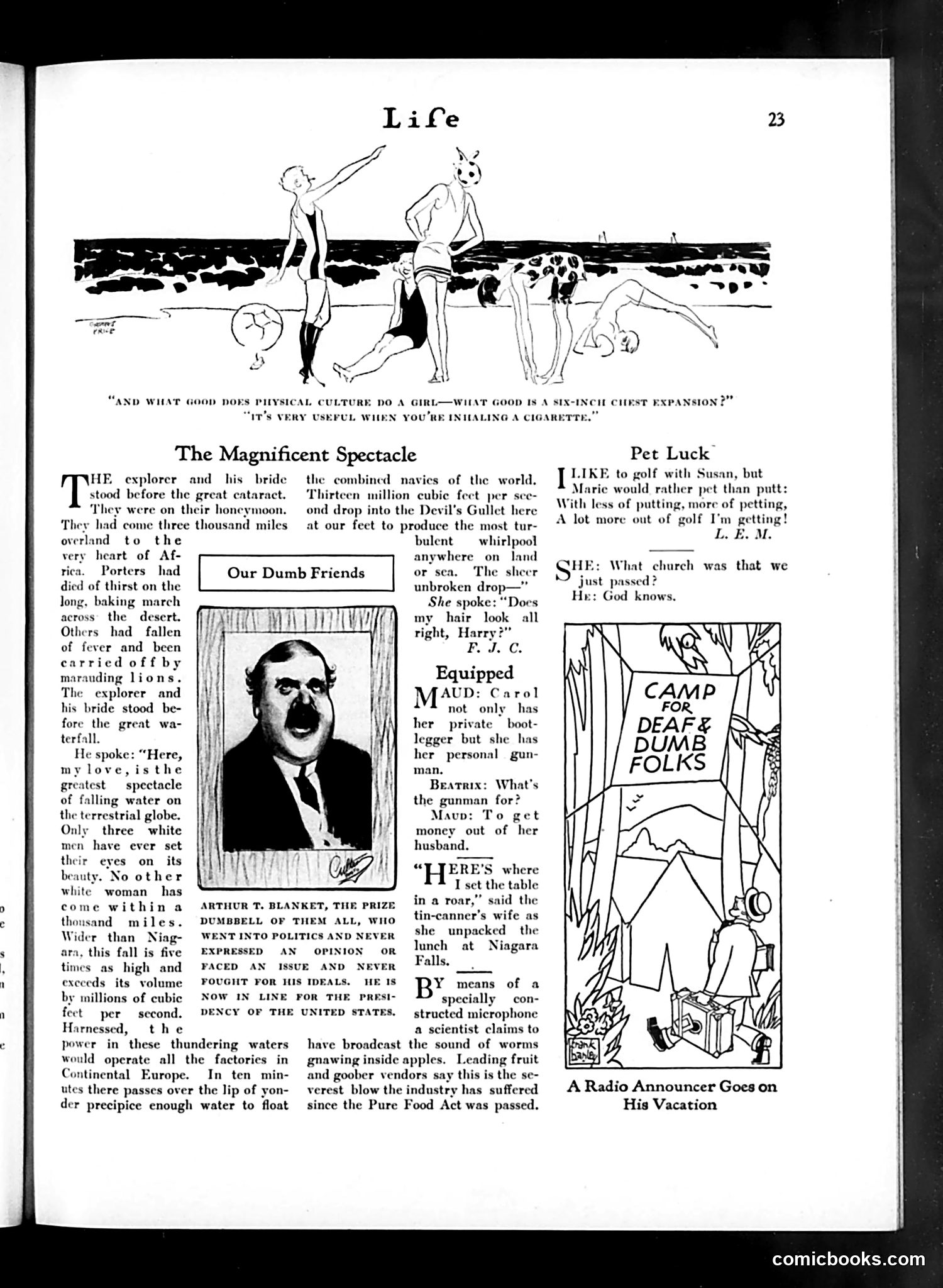
This page contains several satirical pieces targeting 1920s social attitudes: **"The Magnificent Spectacle"** mocks newlywed women's superficiality. A husband describes an African waterfall's geological grandeur in elaborate detail, only for his bride to interrupt asking if her hair looks good. The joke: women are portrayed as vain and indifferent to masculine intellectual interests. **"Our Dumb Friends"** features a caricatured photograph of "Arthur T. Blanket," a political figure described as a clueless "dumbbell" who holds no opinions or ideals yet rises toward the presidency—satire of incompetent politicians gaining power. **"Equipped"** jokes about wealthy women's infidelity and financial control: Carol keeps both a bootlegger (Prohibition-era) and a gunman to extort money from her husband. **"Pet Luck"** presents a male golfer preferring flirtation ("petting") with women over actual golf. The top cartoon depicts beach-goers; the caption jokes that physical fitness for women is "useful when inhaling a cigarette." Overall, the page reflects 1920s gender stereotypes and political cynicism characteristic of Life's satirical humor.
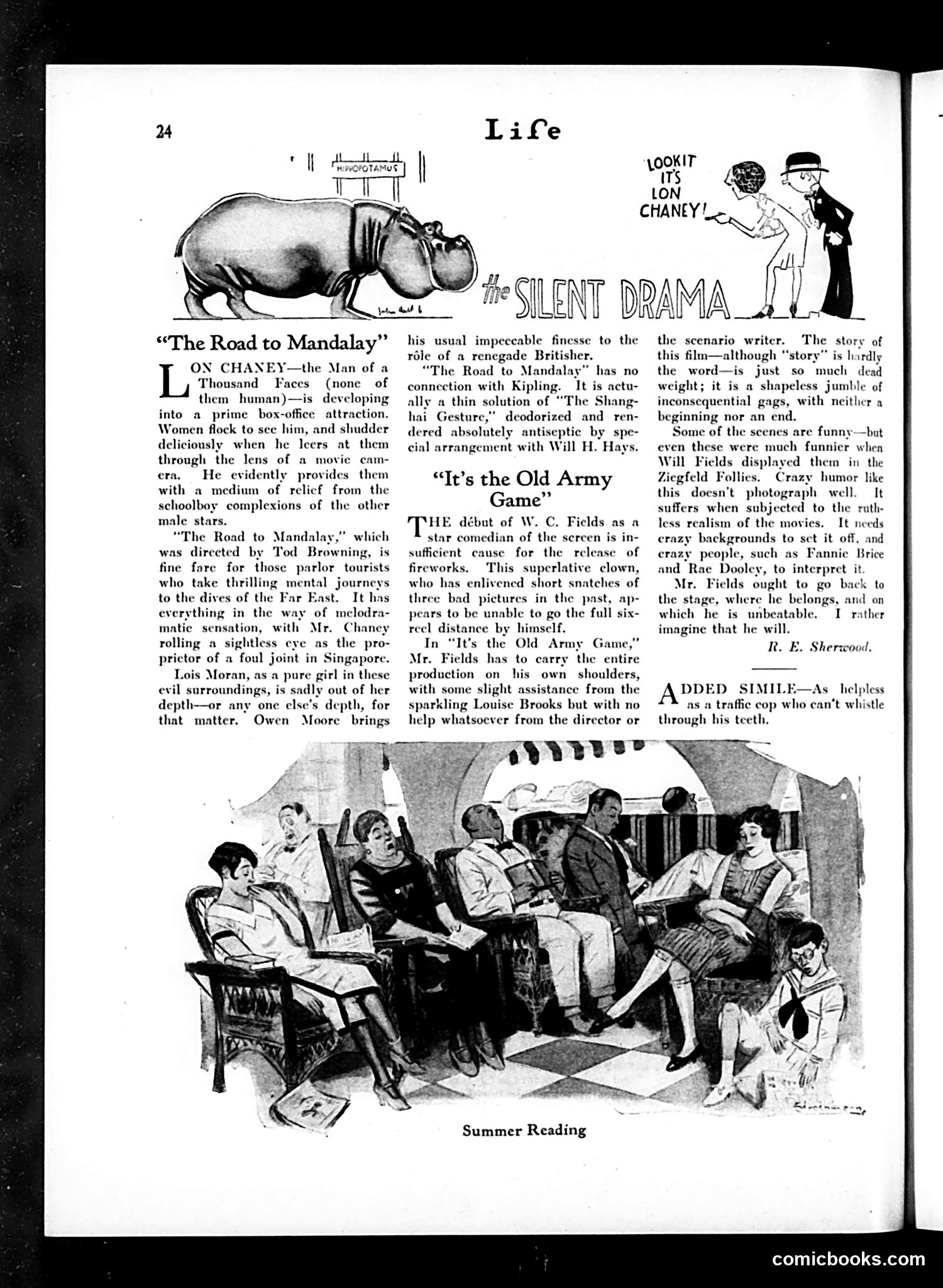
This page contains three film reviews from Life's "Silent Drama" section, critiquing contemporary movies: **"The Road to Mandalay"** reviews Lon Chaney's latest role. Chaney, known for grotesque character work ("Man of a Thousand Faces"), plays a blind proprietor in a Singapore dive. The review notes the film has been sanitized by Will H. Hays (the film industry's censor), removing any genuine edge from its source material. **"It's the Old Army Game"** reviews W.C. Fields's screen debut as a lead. The critic finds Fields unable to carry a full feature—his physical comedy works in short sketches but needs "crazy backgrounds" and supporting comedians (Fannie Brice, Rae Dooley) to succeed. The review suggests Fields belongs on stage, not film. **"Summer Reading"** (bottom illustration) shows a domestic scene of people leisurely reading during summer—likely advertising Life itself as vacation entertainment. The reviews reflect 1920s attitudes about silent film comedy and the nascent censorship apparatus.
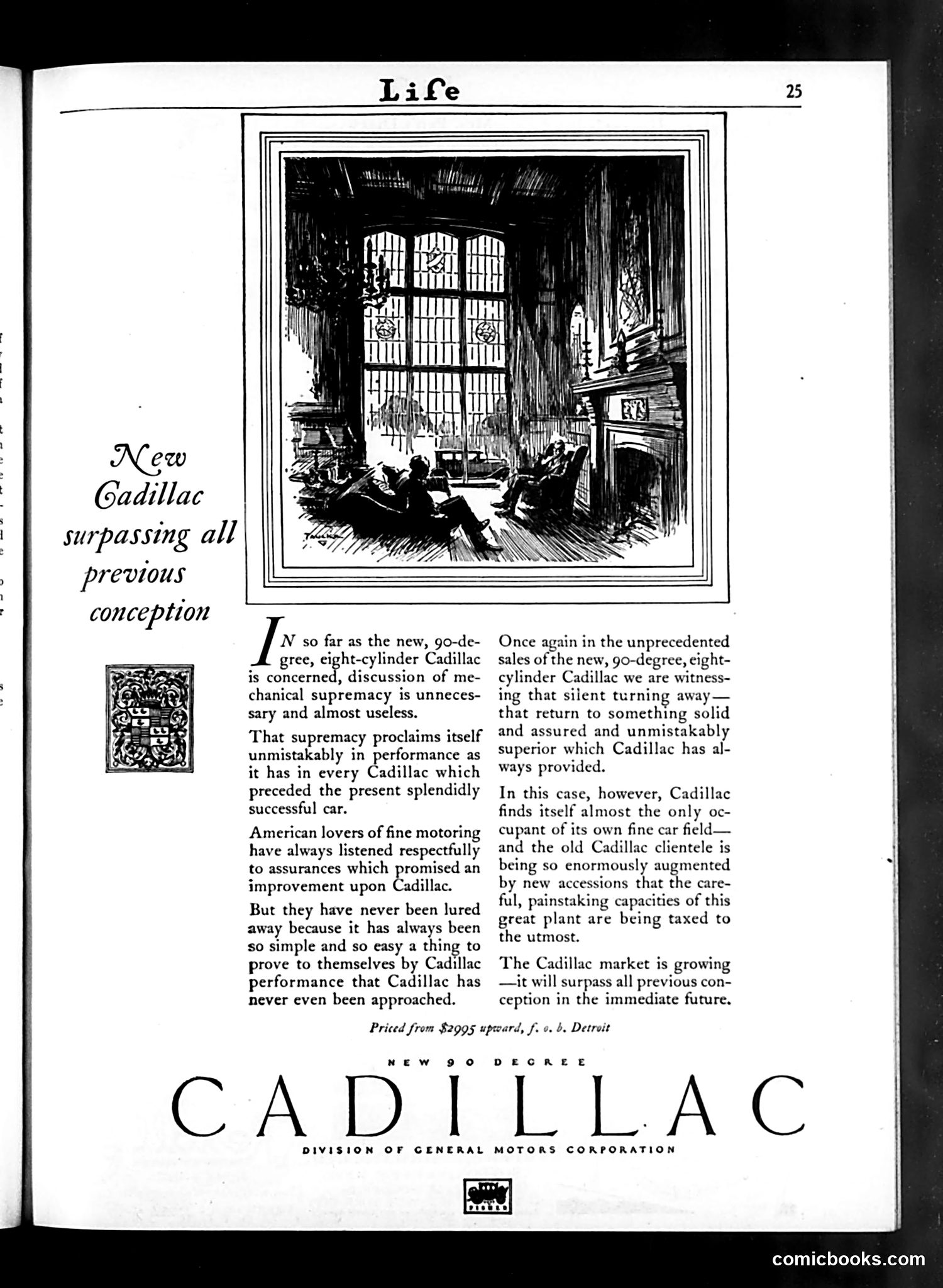
This is primarily a **luxury automobile advertisement**, not satire or political commentary. The page features a sketch of what appears to be an affluent interior (possibly a showroom or wealthy home) with well-dressed figures examining or discussing the new Cadillac. The advertisement claims the new 90-degree, eight-cylinder Cadillac represents unprecedented mechanical superiority and market dominance. The text argues that Cadillac's established reputation means customers naturally return to it rather than competitors, and that demand is so high the factory is "taxed to the utmost." The key pitch: Cadillac occupies an unrivaled market position and is experiencing explosive growth, with pricing starting at $2,995 f.o.b. Detroit. This represents **aspirational marketing** aimed at affluent readers—positioning Cadillac as the obvious choice for discerning motorists. There is no satirical element; it's straightforward brand promotion emphasizing exclusivity and performance.
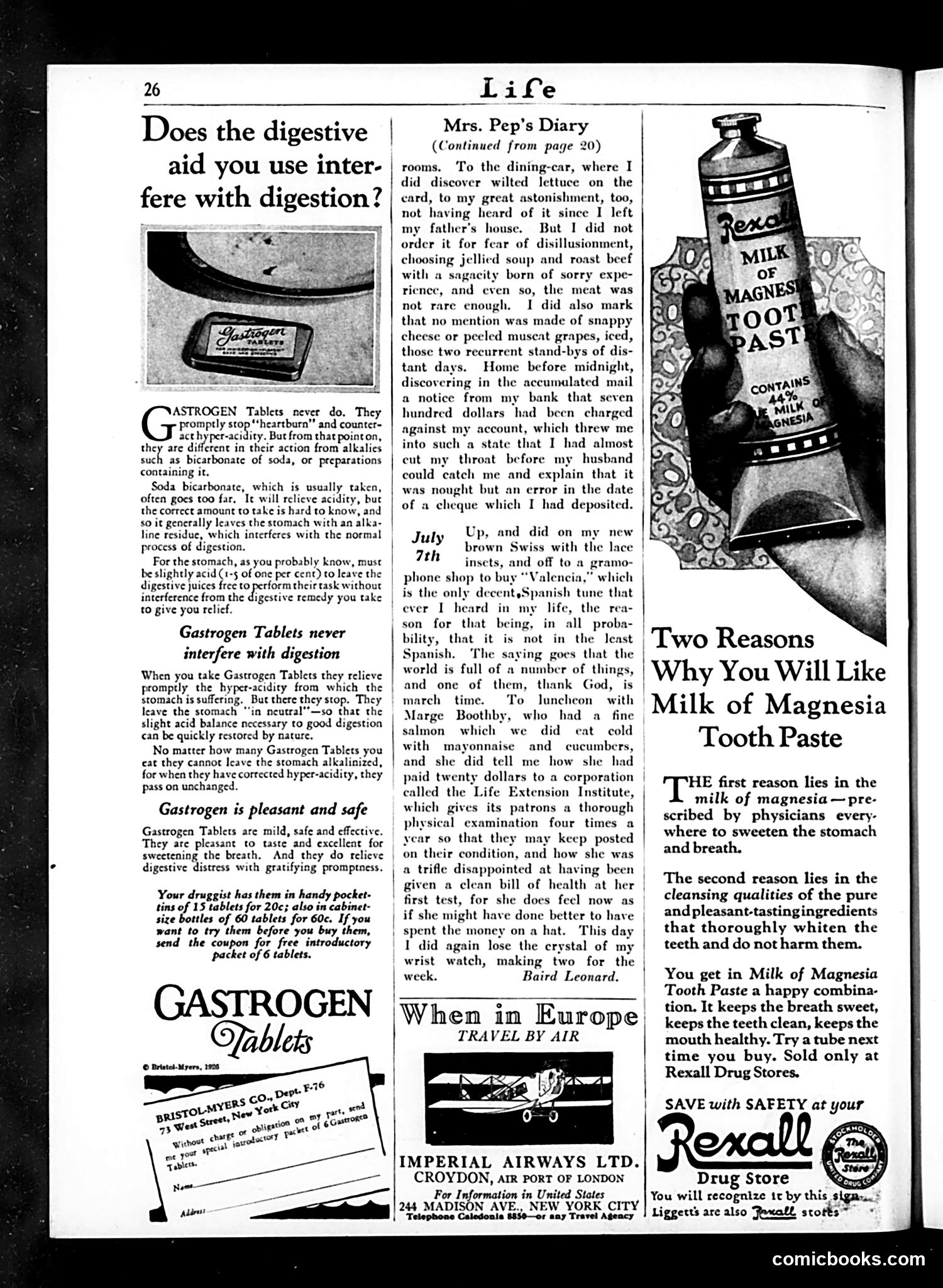
This page contains **advertisements and a serialized humor column** rather than political cartoons. The main content is "Mrs. Pep's Diary," a satirical domestic humor column typical of Life magazine's style, describing mundane upper-middle-class anxieties: wilted lettuce on trains, banking errors, purchasing Spanish records, and losing watch crystals. The advertisements—Gastrogen Tablets and Milk of Magnesia Toothpaste—represent the era's patent medicine industry. Gastrogen's ad cleverly positions itself as superior to baking soda by claiming not to over-alkalinize the stomach, using pseudo-scientific language about digestive acidity that would appeal to health-conscious readers. For modern readers: this reflects 1920s-30s consumer culture where digestive complaints were treated as serious social concerns, and advertising employed technical-sounding claims to sell remedies. The diary's tone—witty complaints about travel inconveniences and minor domestic crises—shows Life's satirical target: affluent readers' preoccupations.
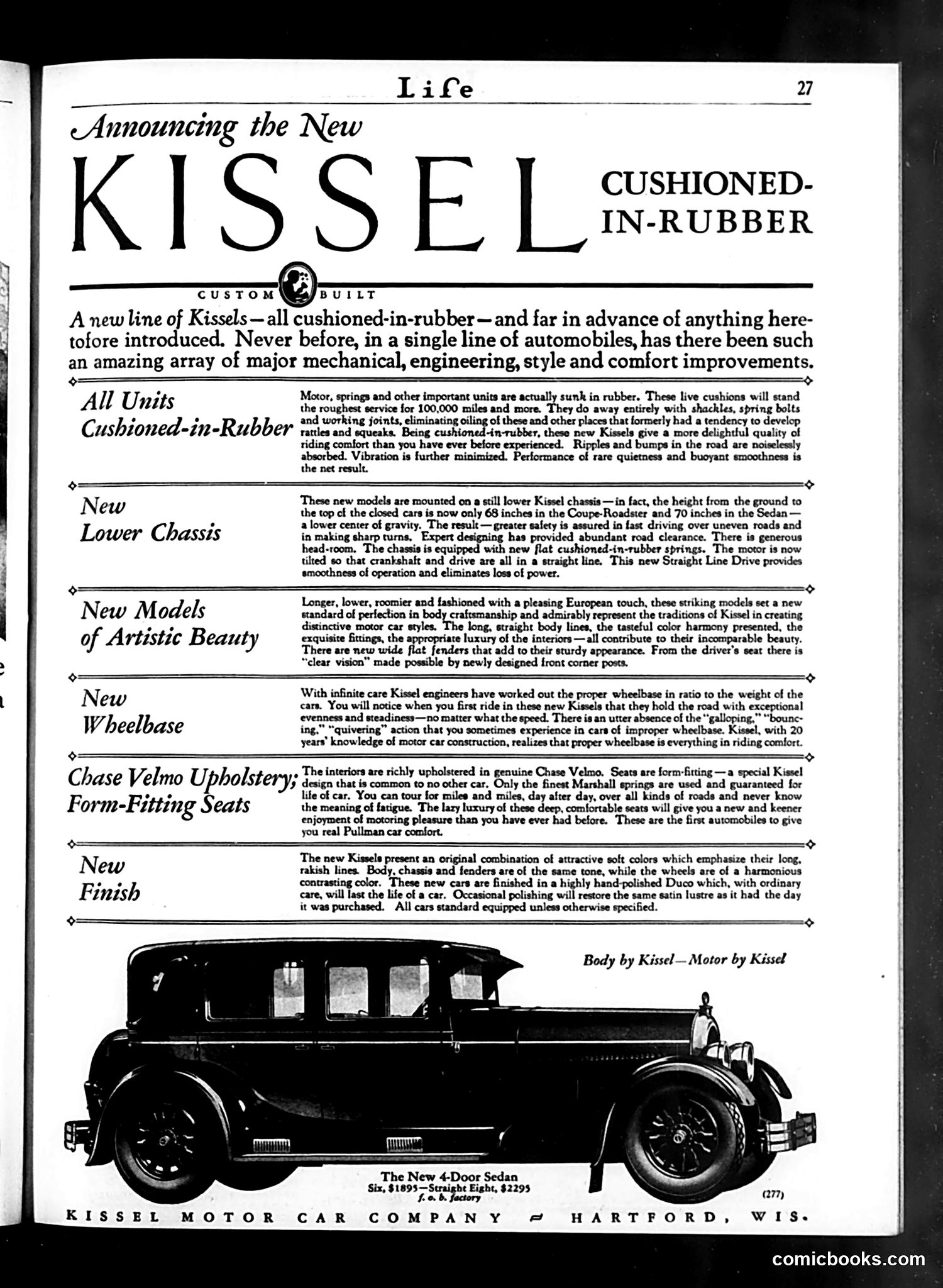
This is a full-page advertisement for Kissel automobiles, not a political cartoon or satire. The page announces a new line of Kissel "Cushioned-in-Rubber" cars, highlighting technical and comfort innovations: rubber-mounted motors and springs to absorb vibrations, a lower chassis for improved safety and handling, European-influenced styling, properly-proportioned wheelbase, genuine Chase Velmo upholstery, and coordinated color schemes. The image shows a black 4-door sedan with the caption "Body by Kissel—Motor by Kissel." This is straightforward automotive marketing from the 1920s, emphasizing engineering advances and luxury features to appeal to middle-to-upper-class buyers. There is no satire or political content present—it's a legitimate manufacturer's promotional material.
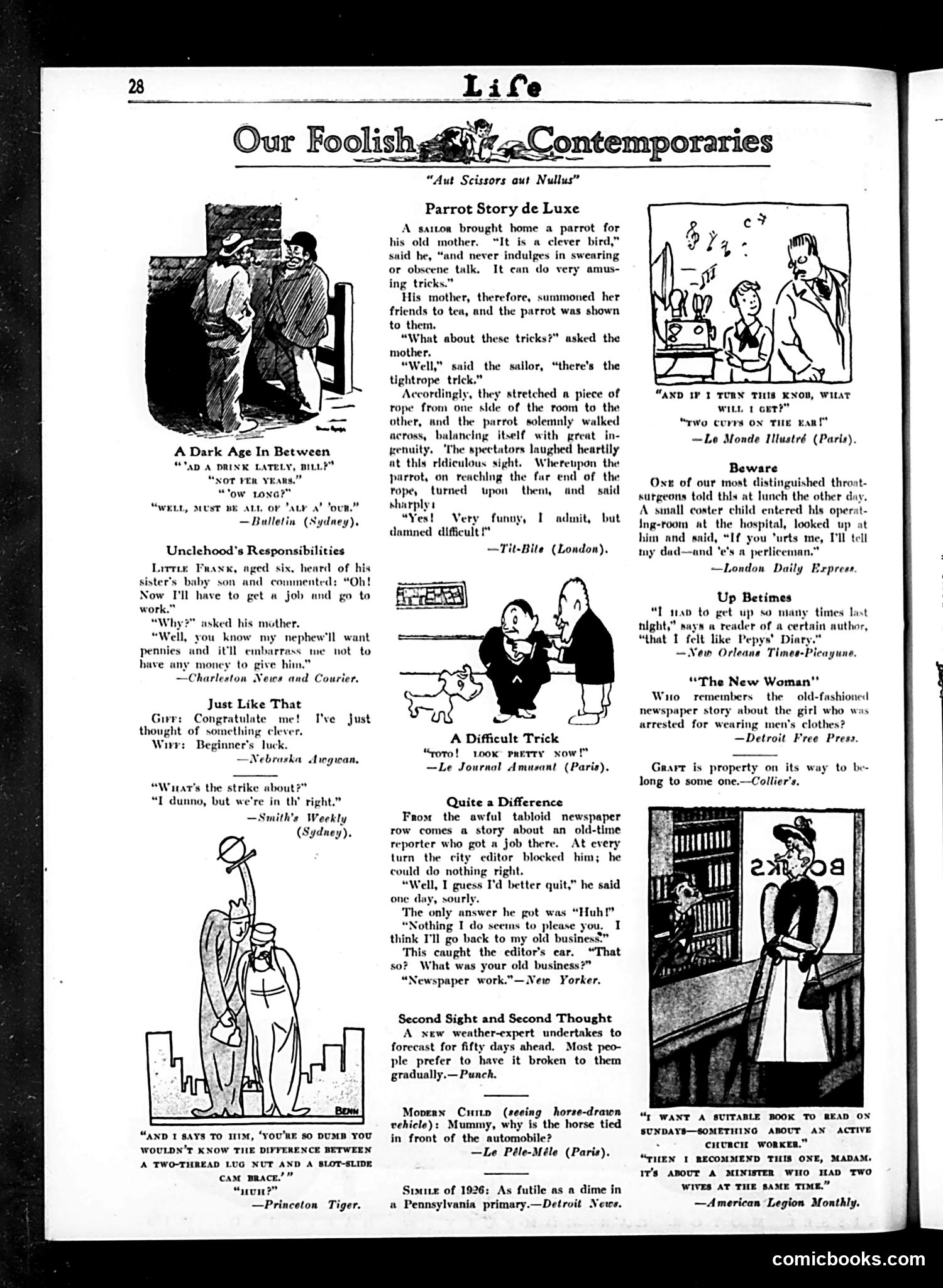
This page collects brief satirical anecdotes and cartoons lampooning social absurdities of the 1920s era. The humor targets: **Social pretension and awkwardness**: A child worries about affording pennies for his nephew; a parrot's "tightrope trick" impresses until the bird complains it's "damned difficult"—deflating false sophistication. **Workplace frustrations**: A reporter quits a tabloid job, only to reveal his "old business" was also newspaper work—suggesting the industry offers no escape. **Modern confusion**: A child asks why a horse is "tied in front of the automobile," satirizing society's rapid adjustment to cars replacing horses. **Generational shifts**: References to "The New Woman" and arrests for wearing men's clothes reflect 1920s debates over changing gender norms. The cartoons use simple illustrations and working-class dialogue to mock pretension across class lines—from sailors to reporters to society matrons. The humor is gentle rather than biting, typical of *Life*'s satirical style targeting everyday foolishness.
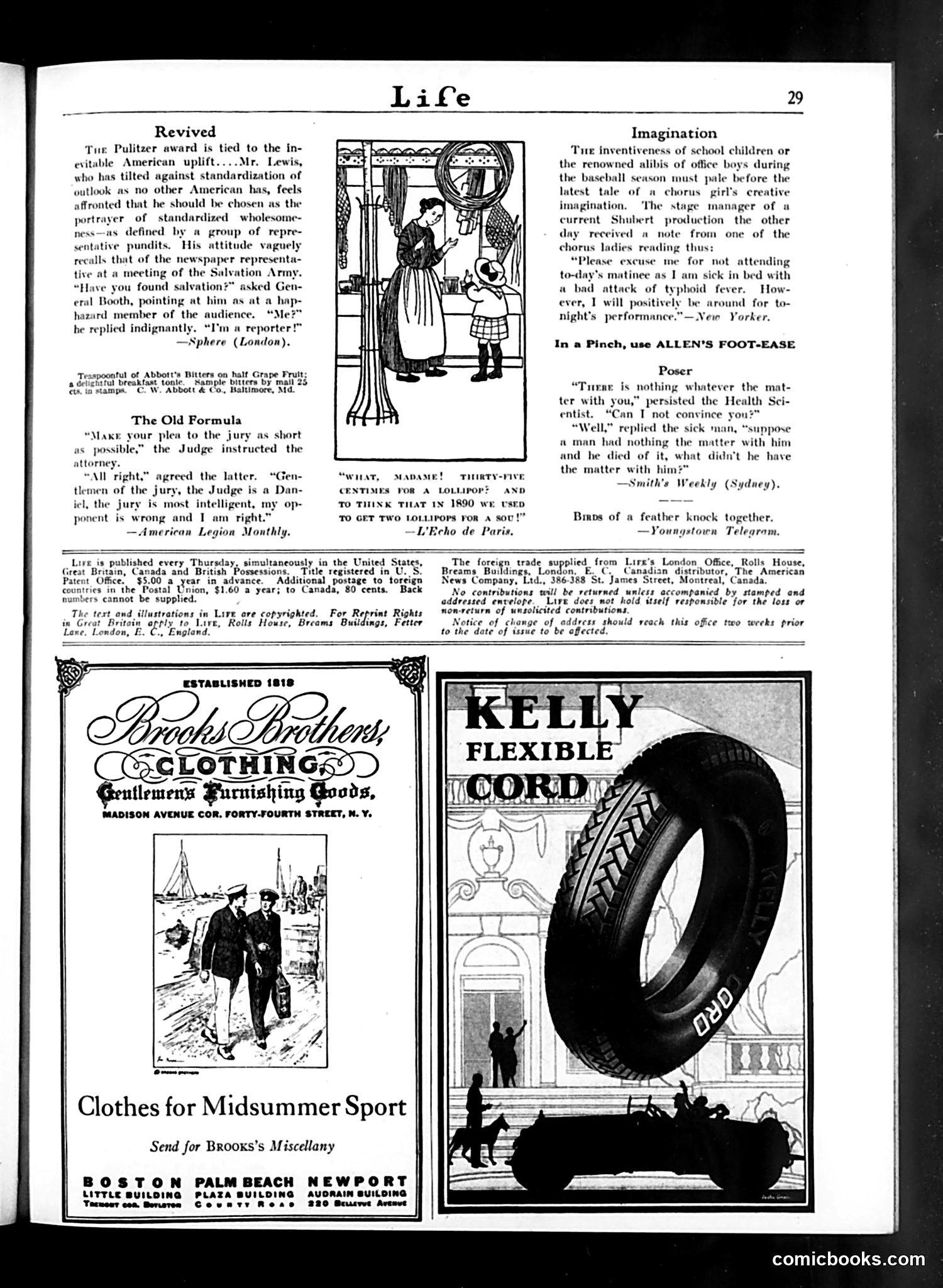
This page from *Life* magazine contains several brief satirical items and advertisements typical of the publication's format. **"Revived"** discusses the Pulitzer Prize going to Sinclair Lewis, noting the irony that Lewis, who critiques American standardization, receives an award defined by "representative pundits"—embodying the conformity he opposes. **"The Old Formula"** is a lawyer's joke: instructed to keep his jury address brief, the attorney delivers an absurdly short statement calling the judge a "Daniel" (wise), the jury intelligent, and himself right. **"Imagination"** mocks a chorus girl's excuse note claiming typhoid fever but promising to perform that night—satirizing implausible alibis. **"Poser"** presents a health scientist unable to convince a patient that nothing is wrong with him—a philosophical joke about the power of belief over medical fact. The page also contains period advertisements for Brooks Brothers clothing and Kelly tires. The overall tone reflects *Life*'s satirical approach to American social behavior, workplace absurdities, and contemporary attitudes.
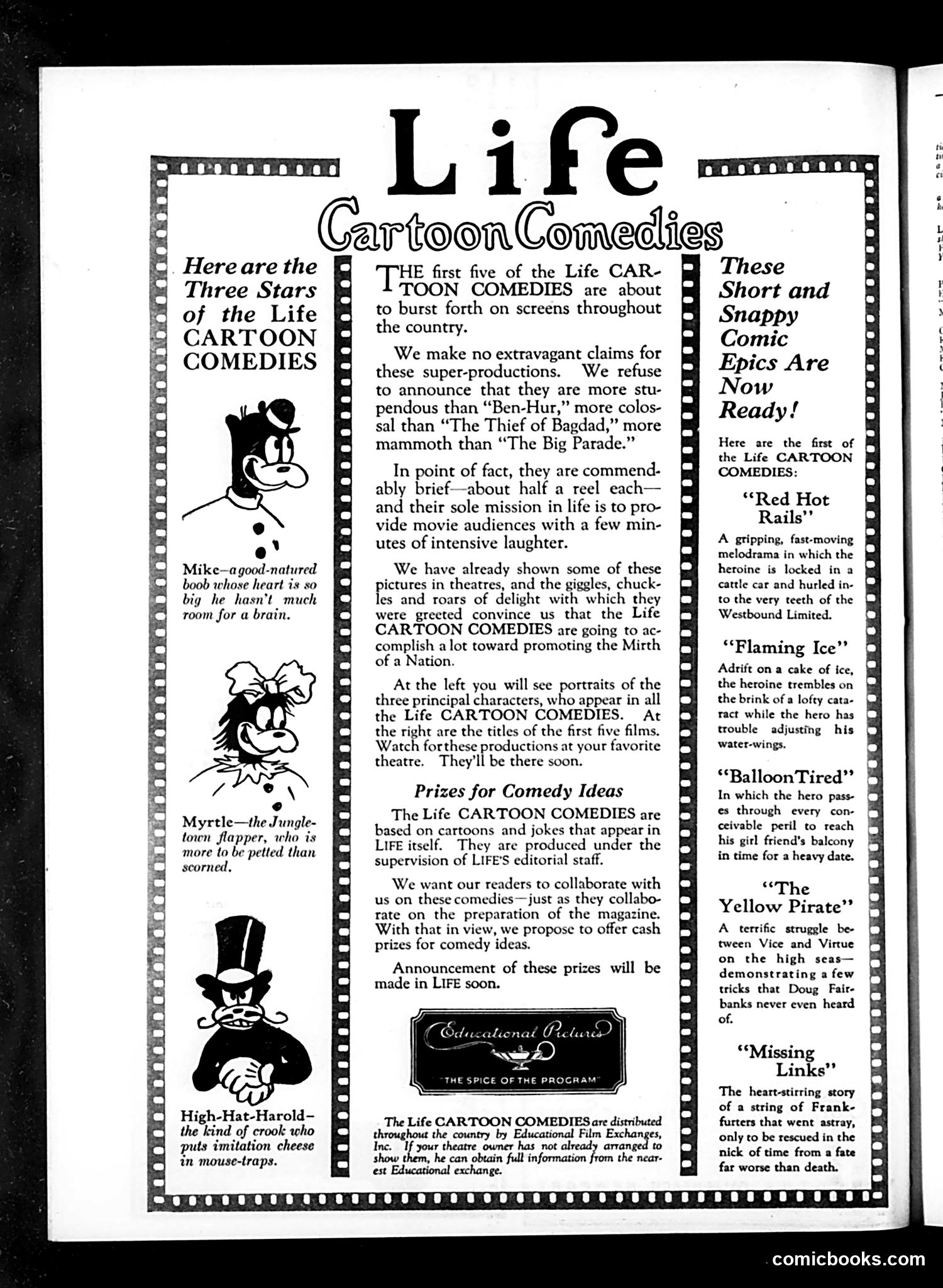
This page promotes Life magazine's new animated short film series, featuring three stock cartoon characters: Mike (a dim-witted but kind-hearted everyman), Myrtle (a flapper—a modern young woman of the Jazz Age), and High-Hat Harold (a petty con artist). The five films advertised parody popular Hollywood epics of the silent era (references to "Ben-Hur" and "The Thief of Bagdad" suggest early 1920s dating). The comedy titles mock melodramatic film conventions through absurd scenarios: heroines in peril on railway cars and icebergs, a hero using ridiculous methods to reach his girlfriend, and even a slapstick sequence about wayward hot dogs. The page solicits reader submissions for comedy ideas, positioning Life as collaborating with its audience. The satire targets both overblown Hollywood spectacle and contemporary popular culture anxieties about modernity, represented by the Jazz Age flapper character.
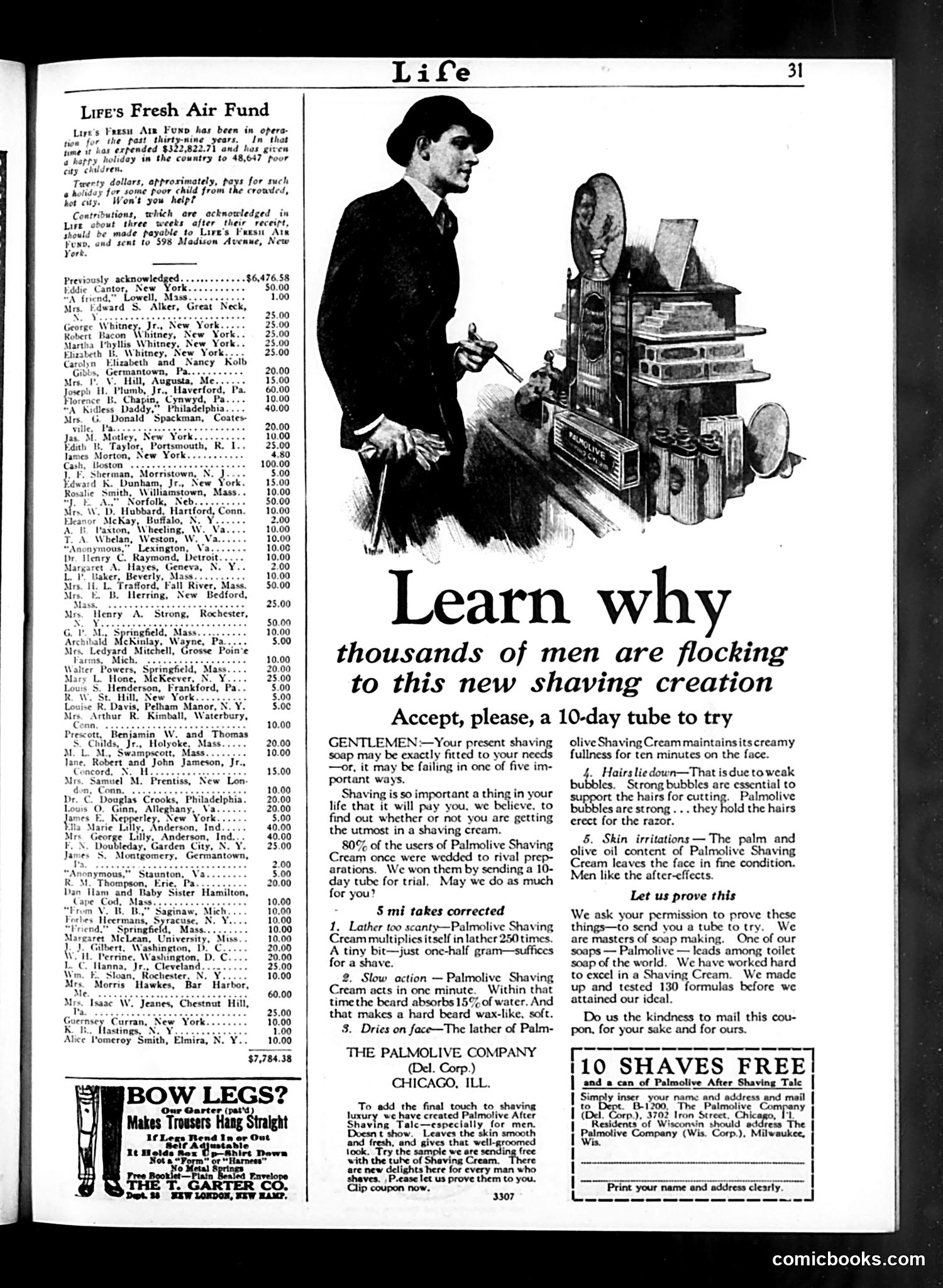
This page is primarily **advertising and fundraising content**, not satire or political commentary. The main content consists of: 1. **Life's Fresh Air Fund** (left column): A legitimate charitable appeal listing donors who contributed to send poor city children to the countryside. This was a real, long-running Life magazine initiative (39 years old at publication). 2. **Palmolive Shaving Cream advertisement** (center/right): A large promotional ad claiming the product outperforms competitors. It emphasizes five claimed advantages: rich lather, quick action, moisture retention, hair support, and aftershave benefits. The ad offers free samples to encourage trial. 3. **Minor ad** (bottom left): A "Bow Legs" corrective garment advertisement from the T. Carter Company. There is **no visible political cartoon or satire** on this page. It represents typical Life magazine content from the early 20th century: philanthropic appeals mixed with commercial advertising, reflecting both the magazine's social mission and its revenue model.
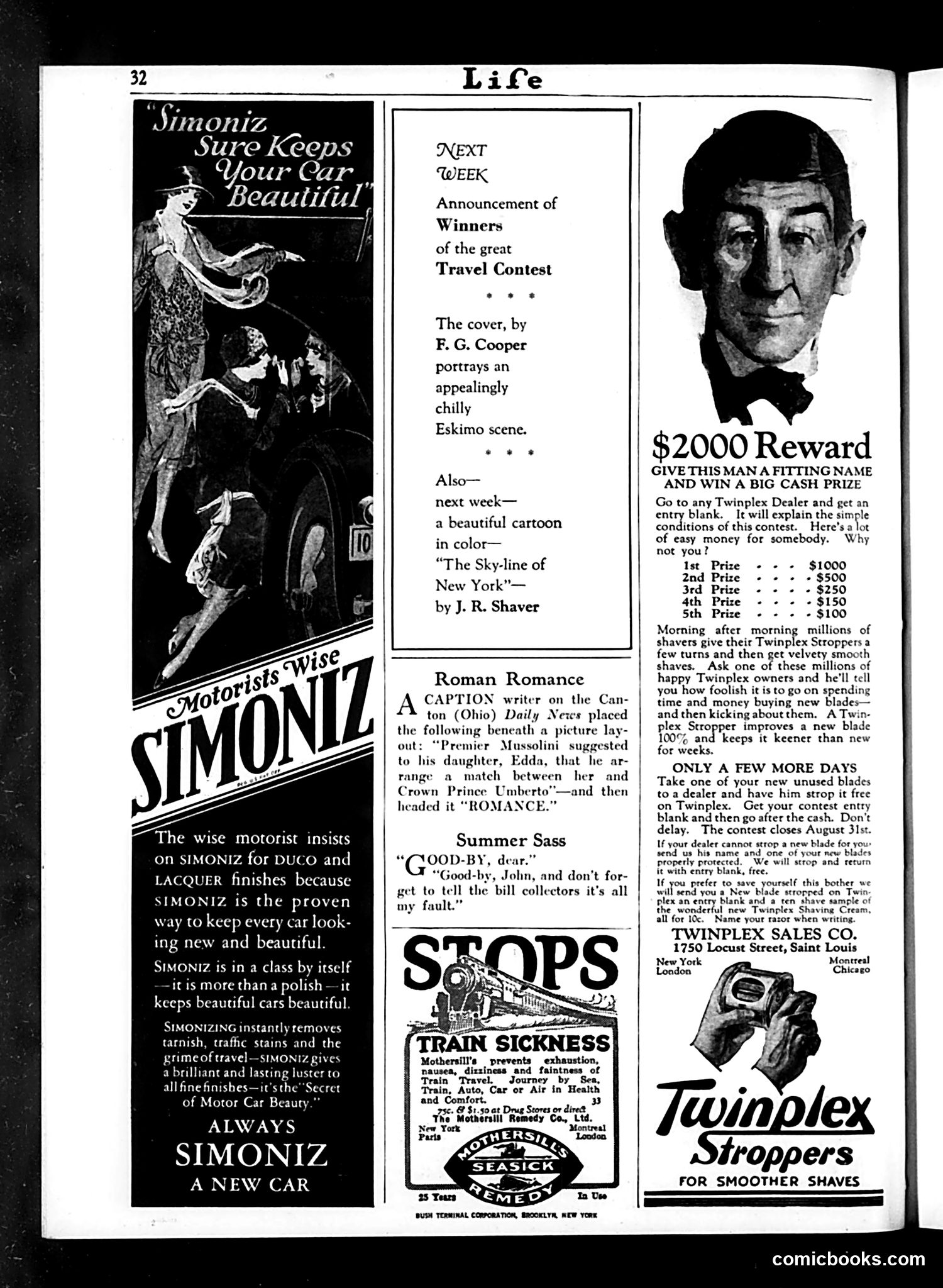
This is primarily an **advertising page** with minimal editorial content. The page features four major advertisements: 1. **Simoniz car polish** — promoting its superiority for keeping automobile finishes beautiful 2. **Twinplex razor stropper** — a $2,000 naming contest to identify a man's photograph, with prize money for correct entries 3. **Mothersill's remedy** — a motion sickness preventative for travel 4. **Seasick remedy** — another travel-related product The only satirical content is brief: a small section titled "Roman Romance" mocking a newspaper's melodramatic headline pairing Mussolini's daughter Edda with Crown Prince Umberto, and "Summer Sass"—a domestic joke about a wife telling her husband to blame her for unpaid bills. The page reflects 1920s-30s consumer culture, emphasizing automobiles, travel, and personal grooming products. No political cartoons appear.
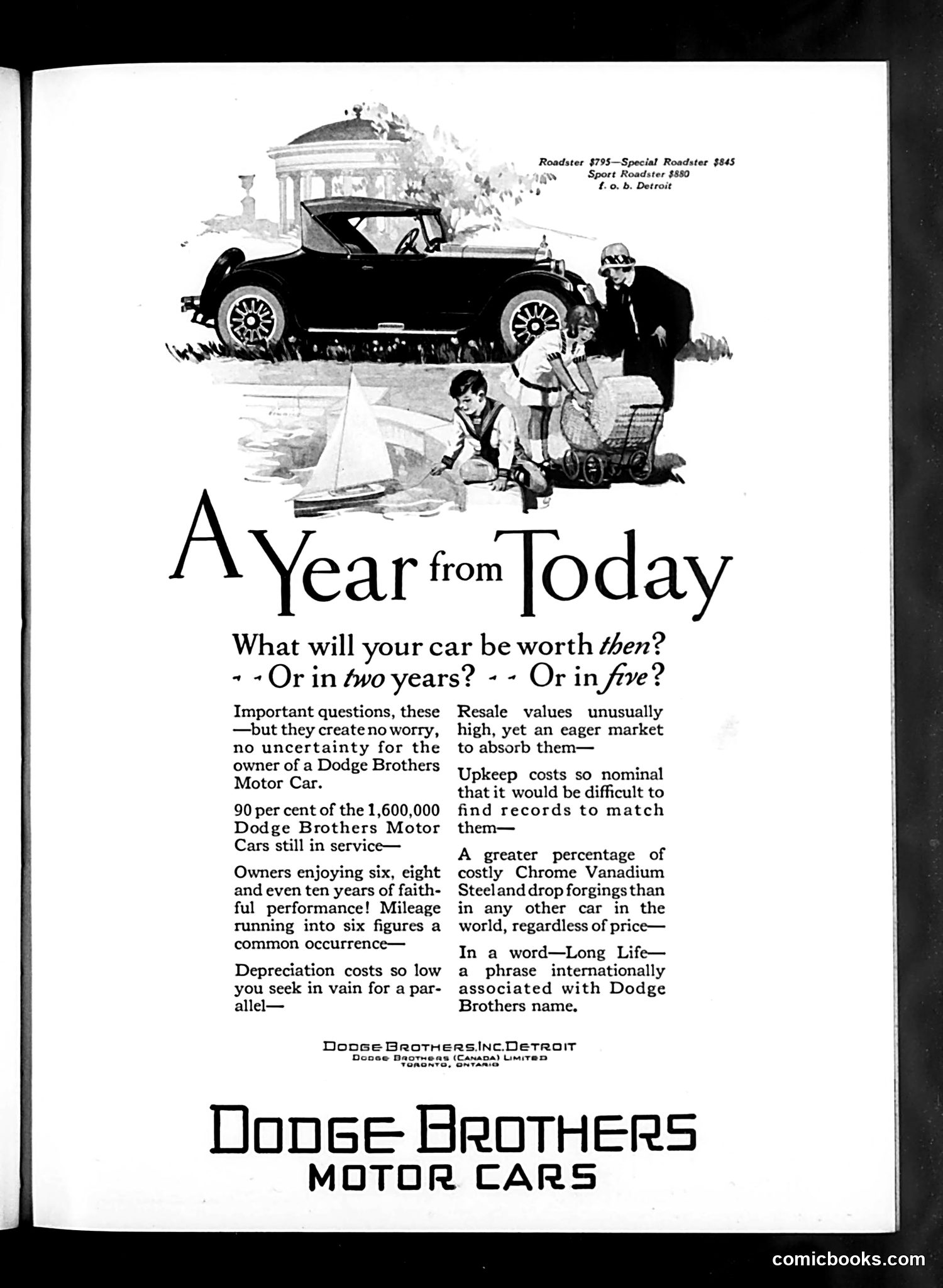
This is primarily a **Dodge Brothers Motor Car advertisement**, not political satire. The page appears from an early 1920s *Life* magazine (based on pricing and design). The central image shows a roadster automobile with affluent figures—a man in formal dress and a woman with a child—positioned near classical architecture, suggesting luxury and stability. This visual associates the car with wealth and permanence. The advertisement's pitch addresses a practical concern: **vehicle depreciation**. It claims Dodge Brothers cars hold resale value unusually well, require minimal upkeep, and often remain in service 6-10 years with "six figures" mileage. The headline "A Year from Today" emphasizes long-term reliability and low ownership costs. The text highlights the car's durable materials (Chrome Vanadium Steel) and boasts that 90% of 1.6 million Dodge cars remain operational—a longevity claim meant to reassure buyers of their investment's durability. **No political content or satire is present**—this is straightforward commercial advertising targeting middle-to-upper-class car buyers concerned about long-term value.
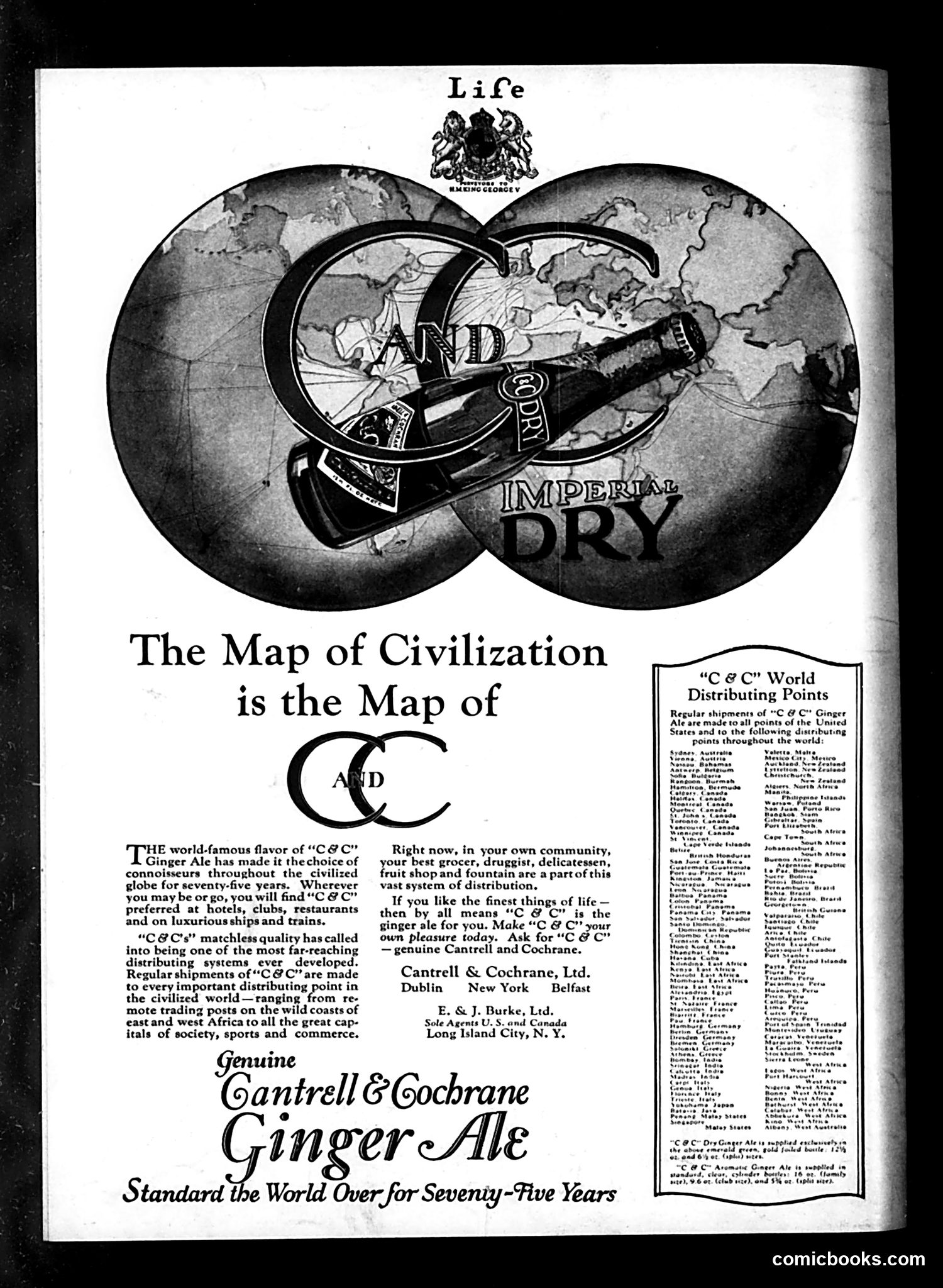
This is primarily **advertising, not satire or political commentary**. The page promotes Cantrell & Cochrane's "C&C" Ginger Ale using imperialist rhetoric common in early 20th-century marketing. The centerpiece shows a globe overlaid with a compass and telescope, paired with the slogan "The Map of Civilization is the Map of C&C." The advertisement equates the product's global distribution network with "civilization" itself—a revealing conflation typical of the era's colonial attitudes. The text boasts that C&C shipments reach "every important distributing point in the civilized world," explicitly contrasting "civilized" regions with "remote trading posts on the wild coasts of east and west Africa." This language reflects period-appropriate assumptions about Western commercial dominance and cultural superiority. The right panel lists worldwide distribution points, emphasizing the brand's international reach as a mark of prestige. For modern readers, the advertisement's casual linking of a commercial product to the concept of "civilization" itself exemplifies how corporate marketing and imperial ideology intertwined in this era.

I can see this is a black and white image from Life magazine, but the image quality is too poor for me to make out clear details of any cartoon figures, caricatures, or text content beyond the watermark. The page appears to show some kind of illustrated content on the right side with what might be circular or spiral design elements, but I cannot reliably identify specific figures, political references, or the satirical point being made. To provide an accurate historical analysis as requested, I would need a clearer, higher-contrast version of this page. Without being able to read the text or see the illustrations distinctly, I cannot responsibly identify who is depicted or what social/political commentary is intended.