
Life, 1926-07-29 · page 21 of 37
Life — July 29, 1926 — page 21: what you’re looking at
What you’re looking at
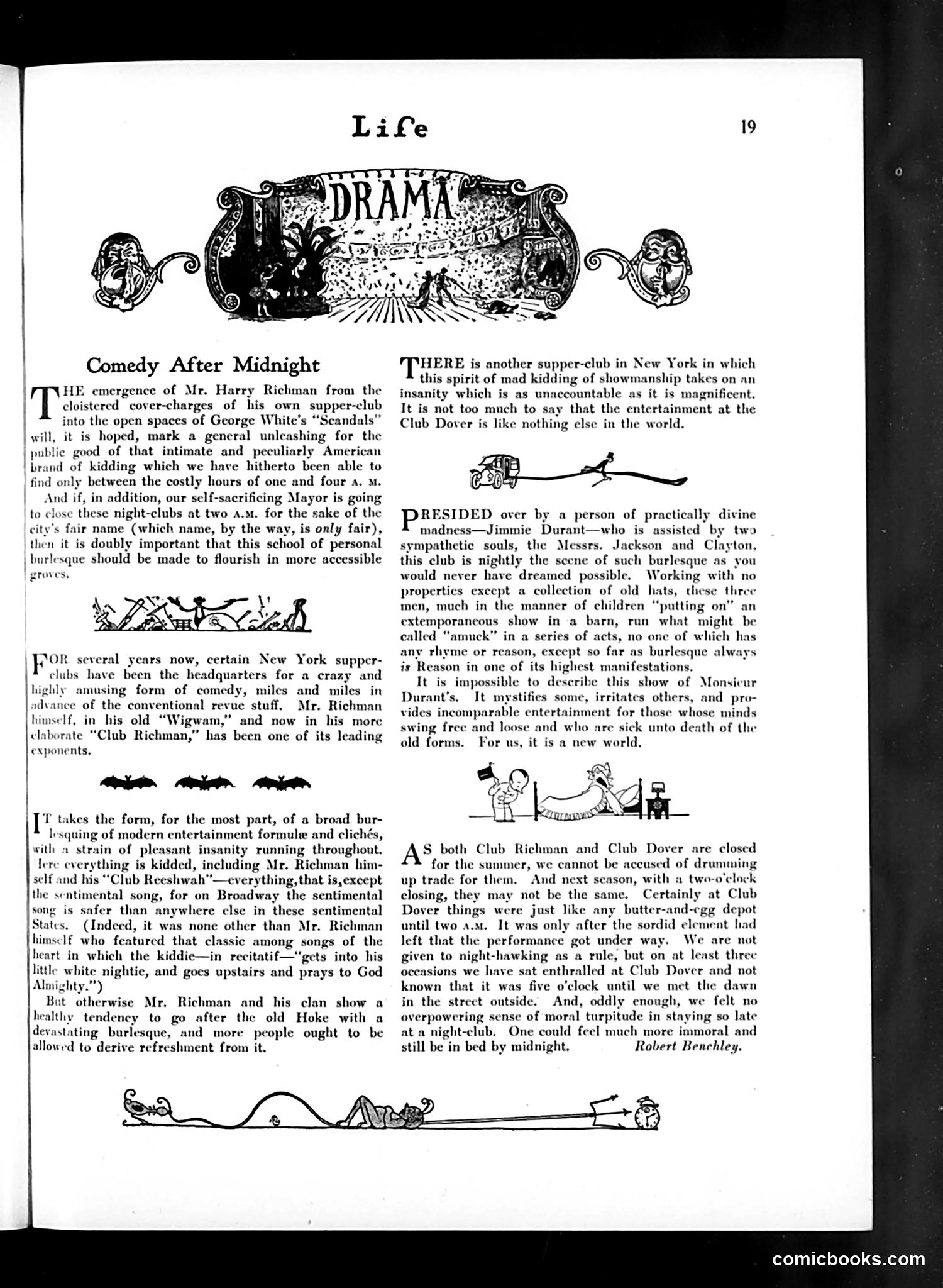
This article praises two avant-garde supper clubs—Club Richman (run by Harry Richman) and Club Dover (presided over by Jimmie Durante)—as venues for innovative American comedy and burlesque. The writer celebrates their irreverent, absurdist humor that mocks conventional entertainment formulas, contrasting it with Broadway's safer, sentiment-focused productions. The piece advocates for preserving this comedic tradition as the Mayor threatens to close night-clubs at 2 a.m. for the city's reputation. The author argues these clubs represent a distinctly American form of "personal burlesque" that deserves wider public access beyond the wealthy clientele who can afford late-night supper clubs. Club Dover is portrayed as particularly anarchic—three performers (Durant and two others) improvise nonsensical acts using only old hats, creating entertainment "like nothing else in the world." The satire targets both the sentimental pretension of Broadway and municipal prudishness about nightlife.
📄 Transcribed text from this page (OCR, searchable)
Machine-transcribed from the original scan — historical spelling and the odd misread are preserved.
Comedy After Midnight HE emergence of Mr. Harry Richman from the loistered cover-charges of his own supper-club into the open spaces of George White’s “Scandals” will, it is hoped, mark a gencral unleashing for the public good of that intimate and peculiarly American brand of kidding which we have hitherto been able to find only between the costly hours of one and four a. M. And if, in addition, our self-sacrificing Mayor is going to close these night-clubs at two a.m. for the sake of the city’s fair name (which name, by the way, is only fair), then it is doubly important that this school of personal burlesque should be made to flourish in more accessible groves. | Jeor several years now, certain New York supper- clubs have been the headquarters for a crazy and highly amusing form of comedy, miles and miles in idvance of the conventional revue stuff. Mr. Richman himself, in his old “Wigwam,” and now in his more elaborate “Club Richman,” has been one of its leading exponents, ee et wie | | [° takes the form, for the most part, of a broad bur- lesquing of modern entertainment formule and clichés, with a strain of pleasant insanity running throughout. flere everything is kidded, including Mr. Richman him- self and his “Club Reeshwah”—everything, that is,except the sentimental song, for on Broadway the sentimental song is safer than anywhere clse in these sentimental States. (Indeed, it was none other than Mr. Richman himself who featured that classic among songs of the heart in which the kiddie—in recitatif—“gets into his little white nightie, and goes upstairs and prays to God Almighty But otherwise Mr. Richman and his clan show a healthy tendency to go after the old Hoke with a devastating burlesque, and more people ought to be allowed to derive refreshment from it. HERE is another supper-club in New York in which this spirit of mad kidding of showmanship takes on an insanity which is as unaccountable as it is magnificent. It is not too much to say that the entertainment at the Club Dover is like nothing else in the world. e_—*—_. RESIDED over by a person of practically divine madness—Jimmie Durant—who is assisted by two mpathetic souls, the } s. Jackson and ‘on, this club is nightly the scene of such burlesque as you would never have dreamed possible. Working with no properties except a collection of old hats, these three men, much in the manner of children “putting on” an extemporancous show a barn, run what might be called “amuck” in a series of acts, no one of which has any rhyme or reason, except so far as burlesque always is Reason in one of its highest manifestations. It is impossible to describe this show of Monsicur stifies some, irritates others, and pro- mparable entertainment for those whose minds swing free and loose and who are sick unto death of the For us, it is a new world. old forms. S both Club Richman and Club Dover are closed for the summer, we cannot be accused of drumming up trade for them, And next season, with a tw lock closing, they may not be the same. Certainly at Club Dover things were just like any butter-and-cgg depot until two a.m. It was only after the sordid element had left that the performance got under way. We are not given to night-hawking as a rule, but on at least three occasions we have sat enthralled at Club Dover and not known that it was five o'clock until we met the dawn in the street outside. And, oddly enough, we felt no overpowering sense of moral turpitude in staying so late at a night-club. One could feel much more immoral and still be in bed by midnight. Robert Benchley. comicbooks.com