
Life, 1926-07-29 · page 20 of 37
Life — July 29, 1926 — page 20: what you’re looking at
What you’re looking at
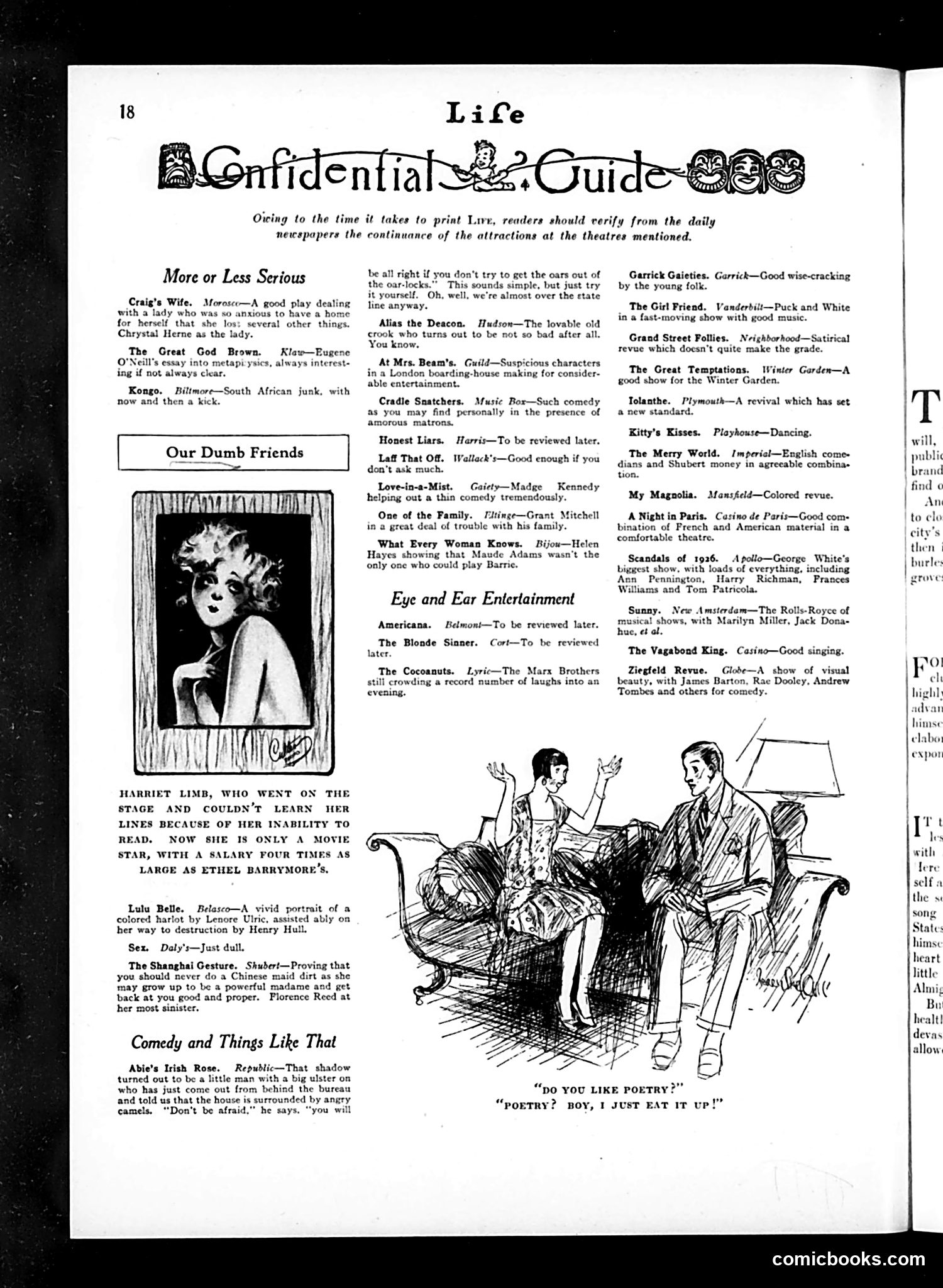
This page from *Life* magazine contains theater reviews and a satirical cartoon mocking theatrical pretension. **The Main Cartoon:** Shows two men in conversation, with one asking "Do you like poetry?" The other responds "Poetry? Boy, I just eat it up!"—a joke about philistine audiences who consume culture uncritically or performatively, treating serious art like casual entertainment. The caption's crude grammar emphasizes the speaker's lack of sophistication. **"Our Dumb Friends" Section:** Mocks Harriet Limb, an actress who couldn't learn lines due to illiteracy but became a successful movie star earning four times Ethel Barrymore's salary. The satire critiques how cinema rewards mediocrity while stage acting requires genuine skill—a common *Life* complaint about the new film industry. **Theater Reviews:** Brief, snarky assessments of current Broadway shows, many emphasizing lowbrow comedy (Marx Brothers, crude plots) over serious drama—reflecting *Life*'s somewhat elitist perspective on entertainment. The overall tone mocks both mass audiences and the entertainment industry catering to them.
📄 Transcribed text from this page (OCR, searchable)
Machine-transcribed from the original scan — historical spelling and the odd misread are preserved.
More or Less Serious Craig’s Wife. Morosec—A good play dealing with a lady who was so anxious to have a hor for herself that she los: several other thing Chrystal Herne as the lady. The Great God Brown. Klow—Eugene O'Neill's essay into metapi-ysics, always interest ing if not always clear. Kongo. Biltmore—South African junk, with now and then a kick. Our Dumb Friends HARRIET LIMB, WHO WENT ON THE STAGE AND COULDN’T LEARN HER LINES BECAUSE OF HER INABILITY TO READ. NOW SHE IS ONLY A MOVIE STAR, WITH A SALARY FOUR TIMES AS LARGE AS ETHEL BARRYMORE’S, Lulu Belle. Belasco—A_ vivid portrait of a colored harlot by Lenore Ulric, assisted ably on her way to destruction by Henry Hull. Sex. Daly's—Just dull. The Shanghai Gesture. Shuber!—Proving that you should never do a Chinese maid dirt as she may grow up to be a powerful madame and get back at you good and proper. Florence Reed at her most sinister. Comedy and Things Like That Abie's Irish Rose. Republic—That shadow turned out to be a little man with a big ulster on who has just come out from behind the bureau and told us that the house is surrounded by ang? camels, “Don't be afraid,” he says. “ Oicing to the time it takes to print Live, readers should verify from the daily newspapers the continuance of the attractions at the theatres mentioned. be all right if you don’t try to get the oars out of the oar-lock: This sounds simple, but just try it yourself. Oh, well, we're almost over the etate line anyway. Alias the Deacon. Hudson—The lovable old crook who turns out to be not so bad after all. You know, At Mrs. Beam’s. Guild—Suspicious characters in a London boarding-house making for consider- able entertainment. Cradle Snatchers. Music Box—Such comedy as you may find personally in the presence of amorous matrons. Honest Liars. Harris—To be reviewed later. Laff That Off. IWallack’s—Good enough if you don't ask much. Love-in-a-Mist. Gaiety—Madge Kennedy helping out a thin comedy tremendously. One of the Family. [itinge—Grant Mitchell in a great deal of trouble with his family. ‘What Every Woman Knows. Bijou—Helen Hayes showing that Maude Adams wasn't the only one who could play Barrie. Eye and Ear Entertainment Americana. Belmoni—To be reviewed later. The Blonde Sinner. Cort—To be reviewed later. The Cocoanuts. Lyric—The Marx Brothers still crowding a record number of laughs into an evening. “Do YoU LIKE POETRY?” “poetry? poy, 1 Just EAT IT uP!” Garrick Gaieties. Garrick—Good wise-cracking by the young folk. The Girl Friend. Vanderbilt—Puck and White in a fast-moving show with good music. Grand Street Follies. Nrighborhood—Satirical revue which doesn’t quite make the grade. The Great Temptations. Winter Garden—A good show for the Winter Garden. Tolanthe. Plymouth—A revival which has set a new standard. Kitty’s Kisses. Playhouse—Dancing. The Merry World. Imperial—English come- dians and Shubert money in agreeable combina- tion. My Magnolia. Afansfeld—Colored revue. A Night in Paris. Casino de Paris—Good com- bination of French and American material in a comfortable theatre. Scandals of 1926. A pollo—George White's biggest show, with loads of everything, including Aen Pennington, Harry Richman, Prances Williams and Tom Patricola. New Amsterdam—The Rolls-Royce of hows, with Marilyn Miller, Jack Dona- hue, ef al. The Vagabond King. Casino—Good singing. Ziegfeld Revue. Globe—A show of visual beauty, with James Barton, Rae Dooley, Andrew ‘Tombes and others for comedy. iT comicbooks.com | will, | publ ! brand find | An to clo city’s then | | bueles ko ch hight, advar himse clabo expor | I’, with Lere self a