
A complete issue · 42 pages · 1926
Life — April 29, 1926
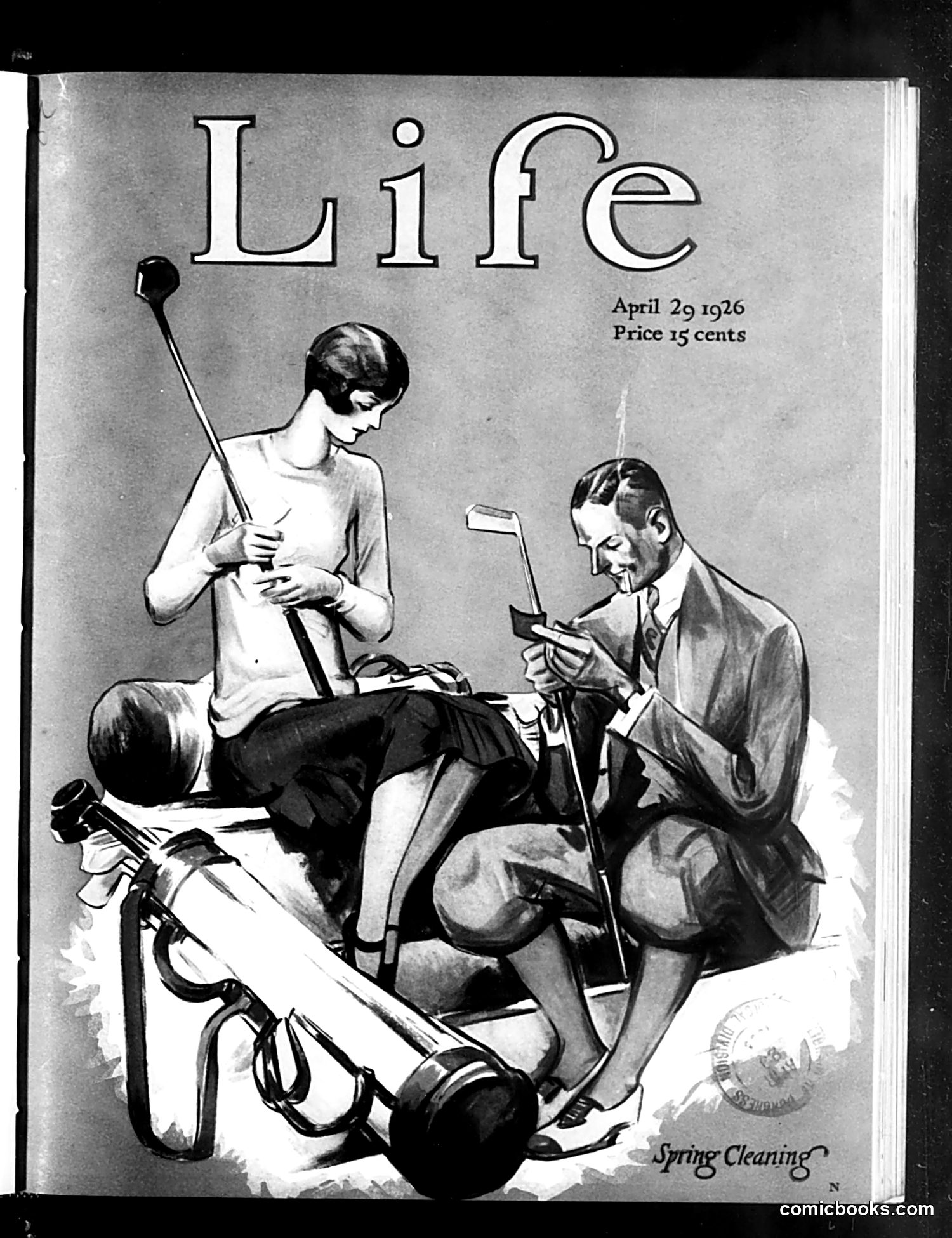
This cover satirizes spring cleaning through a gender-role reversal. A woman sits in a baby carriage wielding a golf club while a man (likely her husband) does household cleaning work with a mop and bucket beside them. The joke targets 1920s social anxieties about changing gender roles during the "flapper" era. Women were gaining more independence and freedoms—including golfing, a leisure activity traditionally male-dominated. The satire suggests men have been relegated to domestic duties while women enjoy leisure. The title "Spring Cleaning" plays on both literal housecleaning and the period's broader social "cleaning house" of traditional gender expectations. It's comedic commentary on the era's gender upheaval during the progressive 1920s.
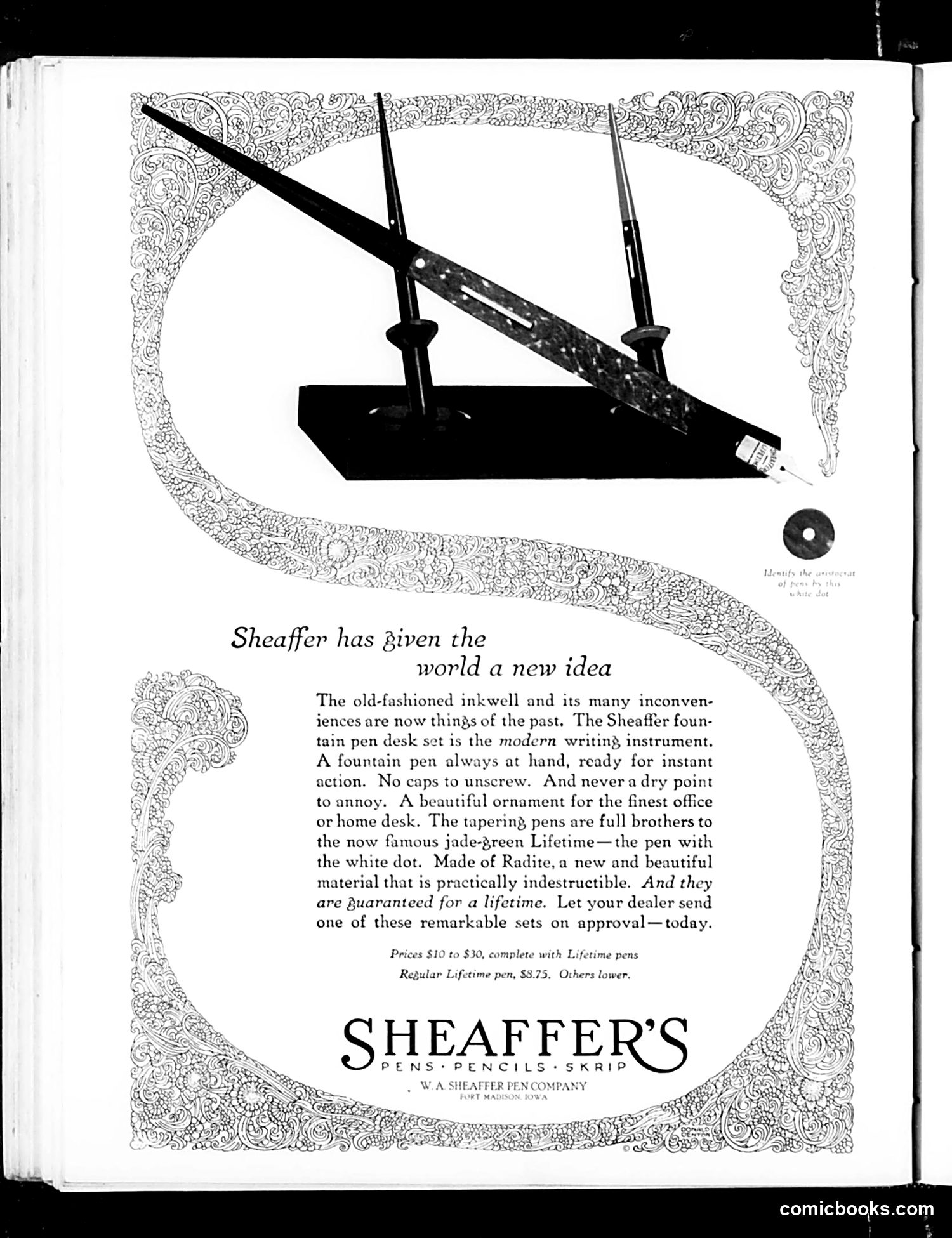
This page is **primarily a Sheaffer fountain pen advertisement**, not political satire. The decorative border and ship imagery serve as marketing elements rather than commentary. The ad promotes Sheaffer's "modern writing instrument"—a fountain pen desk set—positioning it as superior to "old-fashioned inkwells." The ship illustration appears purely decorative, emphasizing elegance and prestige associated with the product. Key selling points highlighted: lifetime guarantee, no dry points, ready-to-use design, and jade-green "Lifetime" pen models made from Radite (described as "practically indestructible"). The ornamental border styling suggests this targets affluent office and home users seeking status symbols. There is **no apparent political or social satire** on this page—it's straightforward commercial advertising from Life magazine's revenue model.
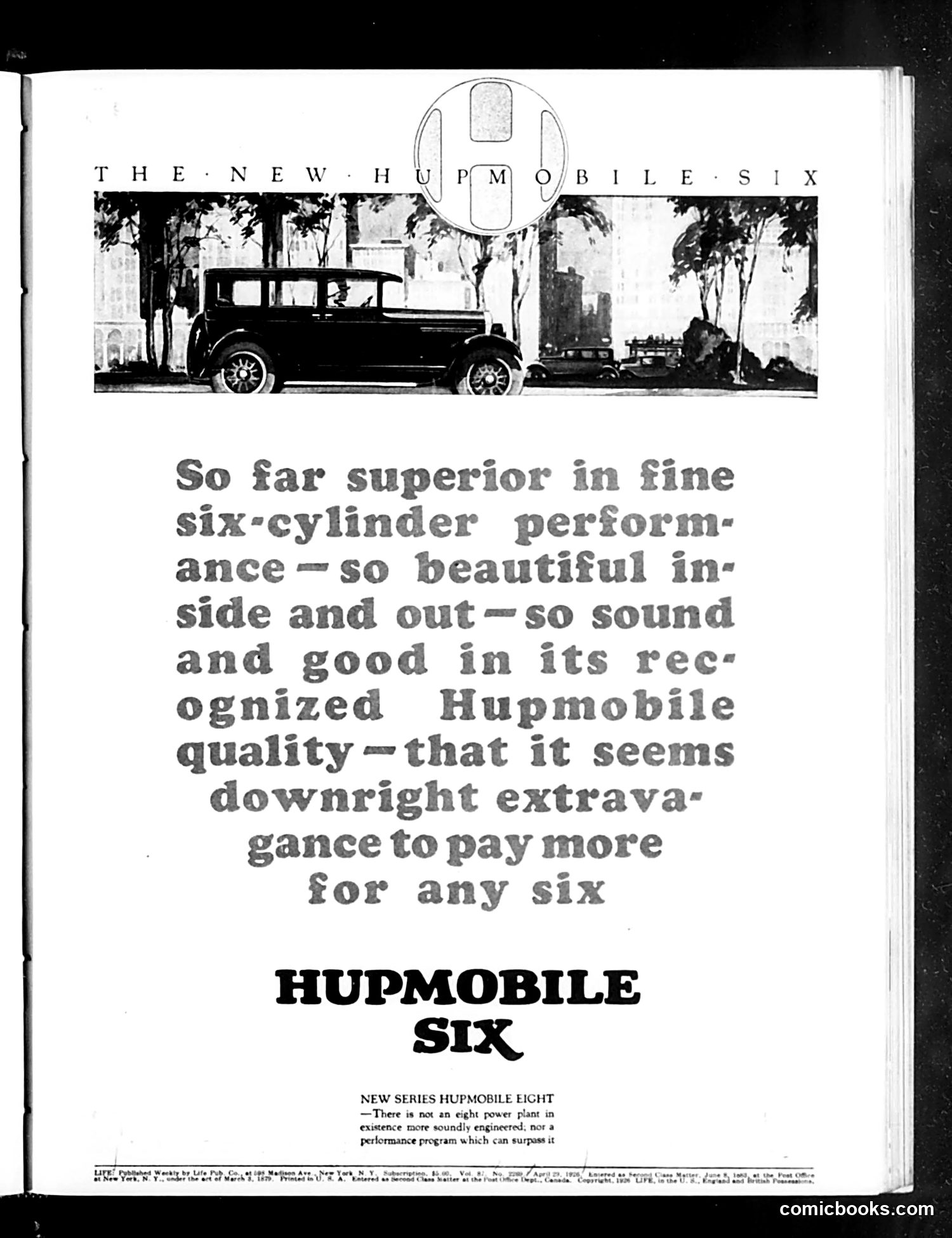
This is primarily a **automobile advertisement**, not a political cartoon. The page promotes the Hupmobile Six, a luxury car manufactured in the early 20th century. The advertisement uses a stylized illustration of the vehicle alongside text claiming superior six-cylinder performance, beautiful interior and exterior design, and recognized quality. The central argument is that despite these advantages, the Hupmobile Six remains competitively priced—making it "extravagance" to pay more for competing six-cylinder vehicles. There is no political satire or social commentary here. The decorative header "THE NEW HUPMOBILE SIX" and the urban street scene setting are purely aesthetic marketing choices typical of period automobile advertising in *Life* magazine.
This is a **Chrysler automobile advertisement**, not a political cartoon. The page promotes the Chrysler Imperial "80" model. The ad uses a rhetorical strategy common to early 20th-century marketing: it invokes the company's engineering history and the vision of Walter P. Chrysler himself to establish credibility. The text argues that understanding the Imperial "80"'s superiority requires remembering the earlier Chrysler "70" and the cumulative effort behind the brand's reputation. The advertisement emphasizes technical specifications (80 mph, 92 horsepower) and positions the car as the product of decades of automotive expertise. This is straightforward product promotion rather than satire—typical of *Life* magazine's advertising content during this era.
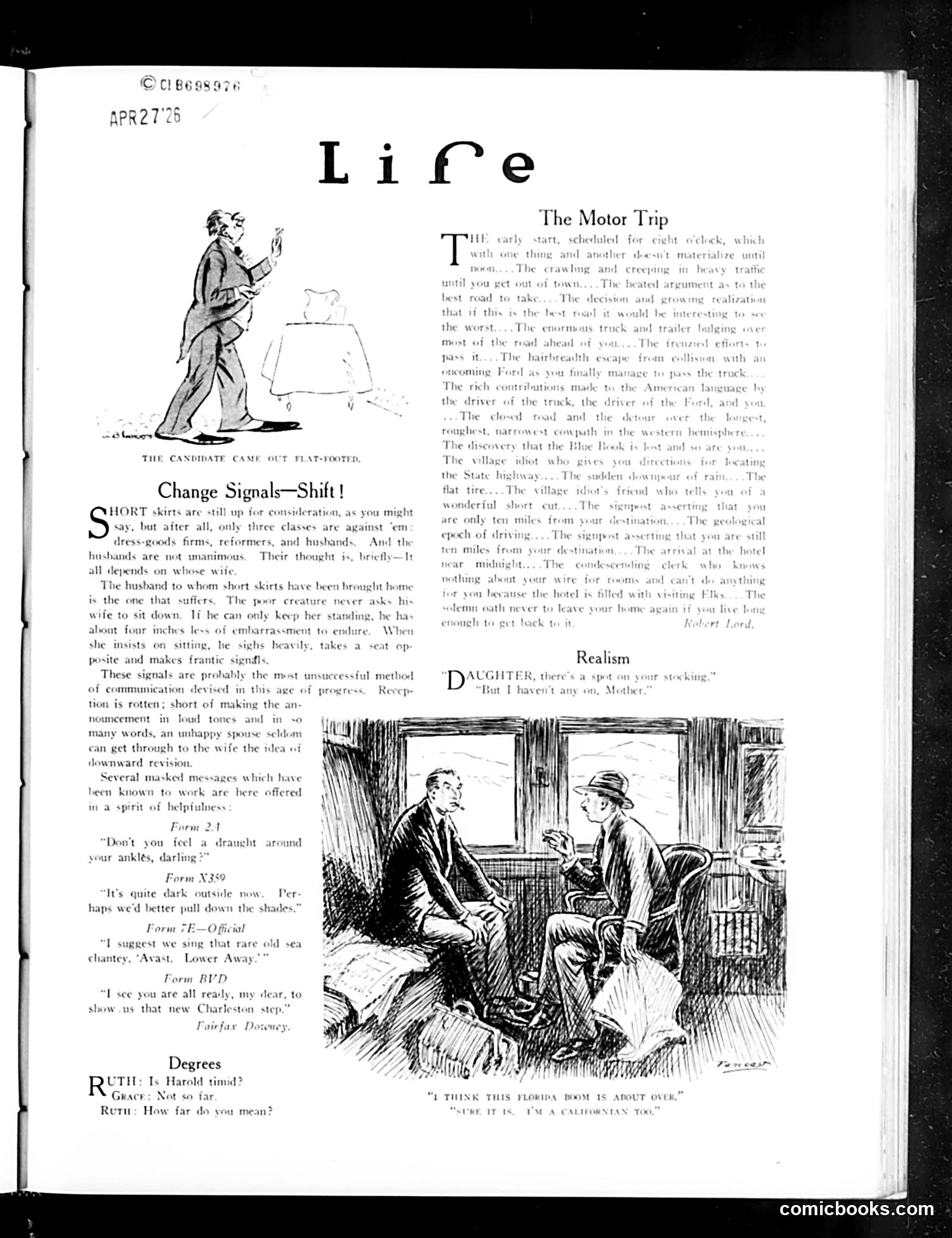
This page contains three separate humor pieces: 1. **"The Motor Trip"** - A satirical article mocking early automobile travel experiences, focusing on the tedious decision-making about route choice and encounters with trucks on poor roads. 2. **"Change Signals—Shift!"** - Commentary on wives signaling husbands to change driving behavior using exaggerated gestures instead of verbal communication. The satire targets marital dynamics and the awkwardness of backseat driving. 3. **"Realism"** - A cartoon showing two men in what appears to be a train or ship cabin, with one mentioning "a spot on your stocking" while the other insists they have no socks. The caption references Florida and a Californian taxi, suggesting commentary on regional travel or tourist experiences during the 1920s leisure travel boom. These pieces humorously reflect anxieties about modern transportation and changing social customs of the era.
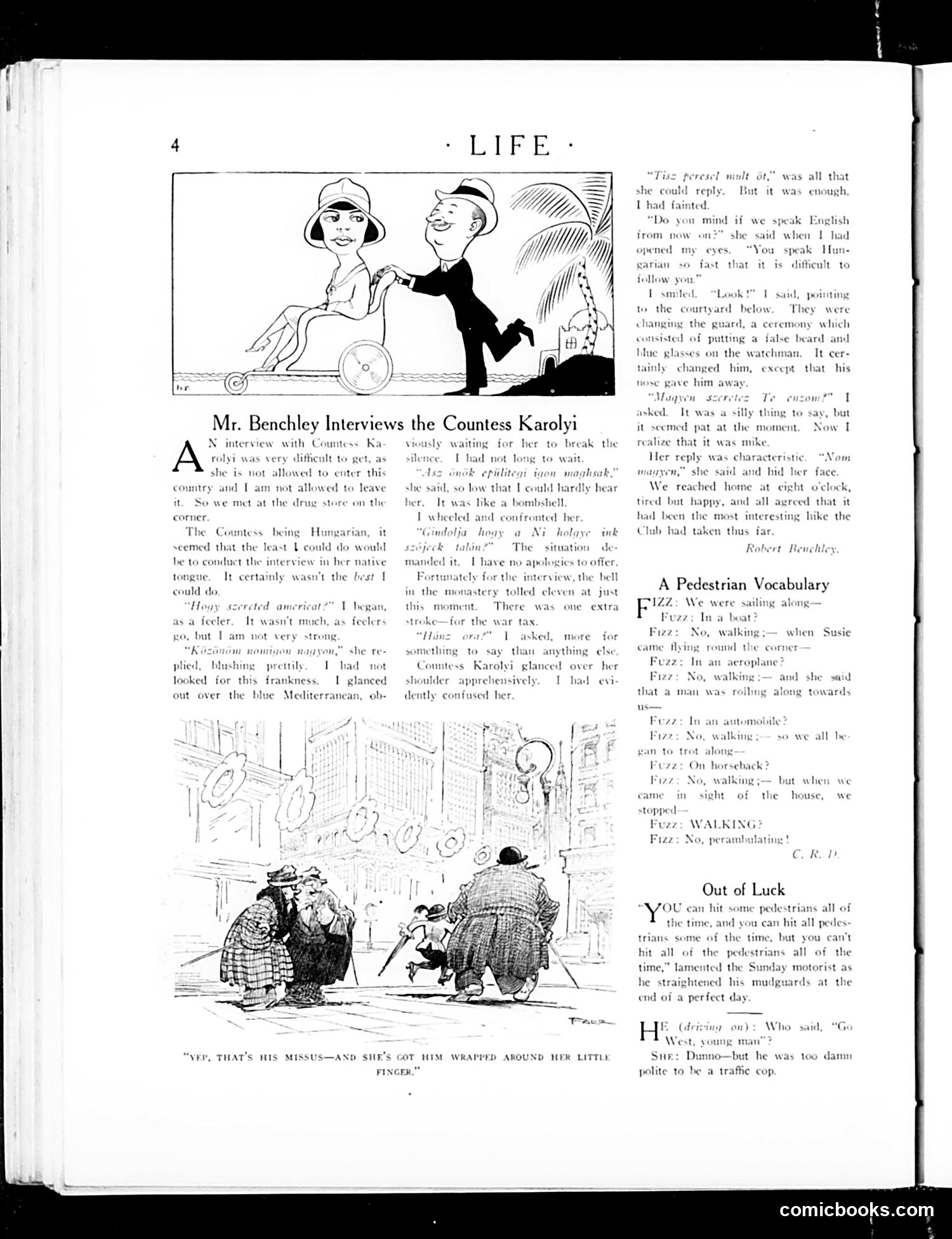
**Main Cartoon: "Mr. Benchley Interviews the Countess Karolyi"** This depicts Robert Benchley (a well-known humorist) interviewing a Hungarian countess. The text reveals Benchley's difficulty obtaining the interview and the countess's reluctance to speak English, insisting on Hungarian. The cartoon satirizes the awkwardness of cross-cultural communication and Benchley's persistence as a journalist. The countess appears evasive about discussing details, suggesting political sensitivity—likely related to post-WWI Hungarian politics and the war tax mentioned in the text. **Lower Section: "A Pedestrian Vocabulary"** and **"Out of Luck"** These are humorous short pieces about pedestrians and traffic, playing on wordplay and the emerging automobile culture's impact on city life. The page represents LIFE's characteristic blend of social satire and celebrity humor.
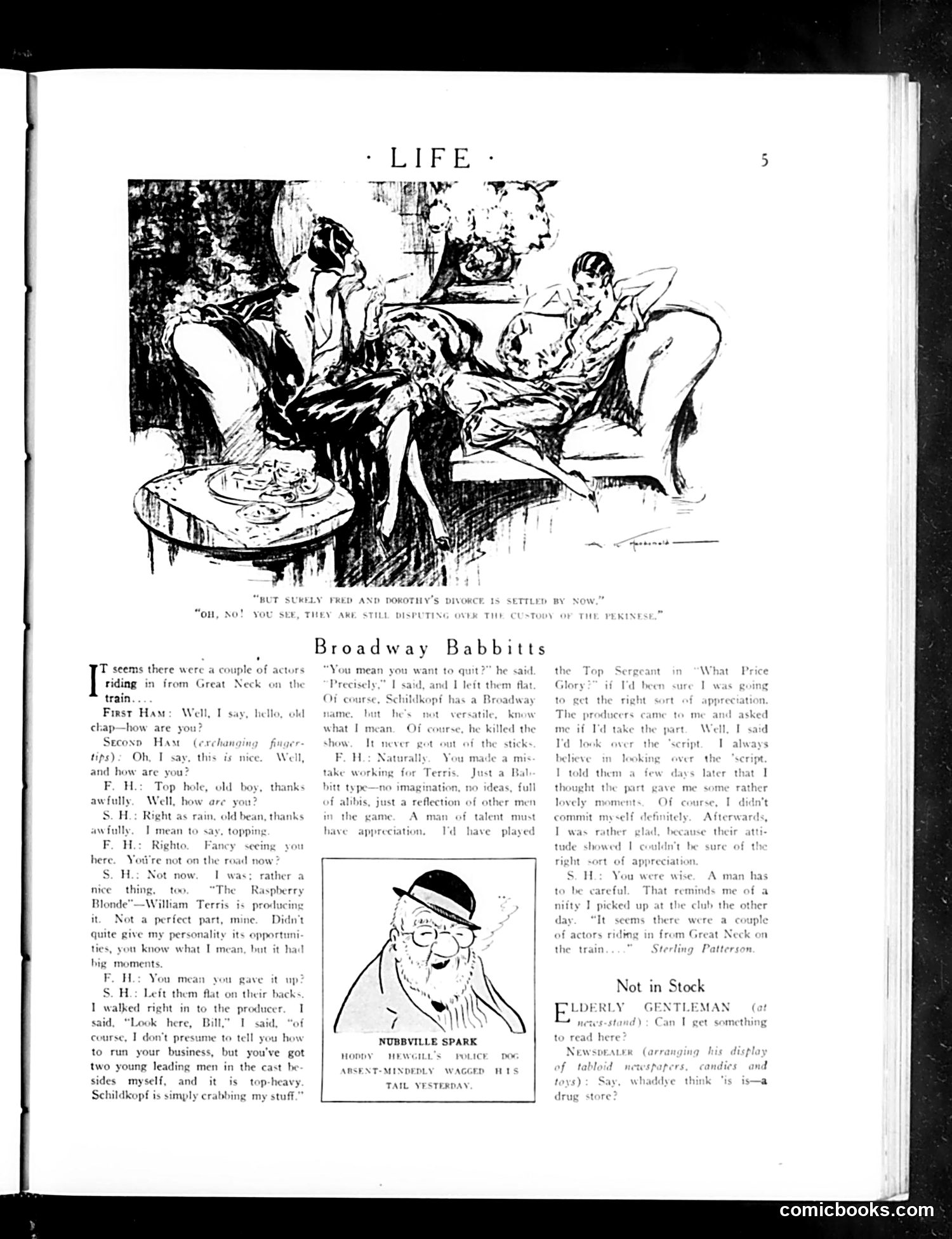
This page satirizes theatrical actors and Broadway culture. The main sketch depicts socialites gossiping about an actor named Schildkopf who's leaving show business. The dialogue mocks the pretensions of Broadway performers—one character notes Schildkopf lacks versatility and has "no imagination, no ideas," just mimics other actors. The smaller cartoon features "Hubbville Spark," captioned as "Hobby: Heckler's Police Dog. Absent-Mindedly Wagged His Tail Yesterday." The satire targets both struggling actors seeking undeserved respect and the superficial Broadway social scene. The term "Babbitt" refers to Sinclair Lewis's 1922 novel character—a conformist businessman—here applied mockingly to theatre people who affect sophistication while lacking genuine talent or originality.
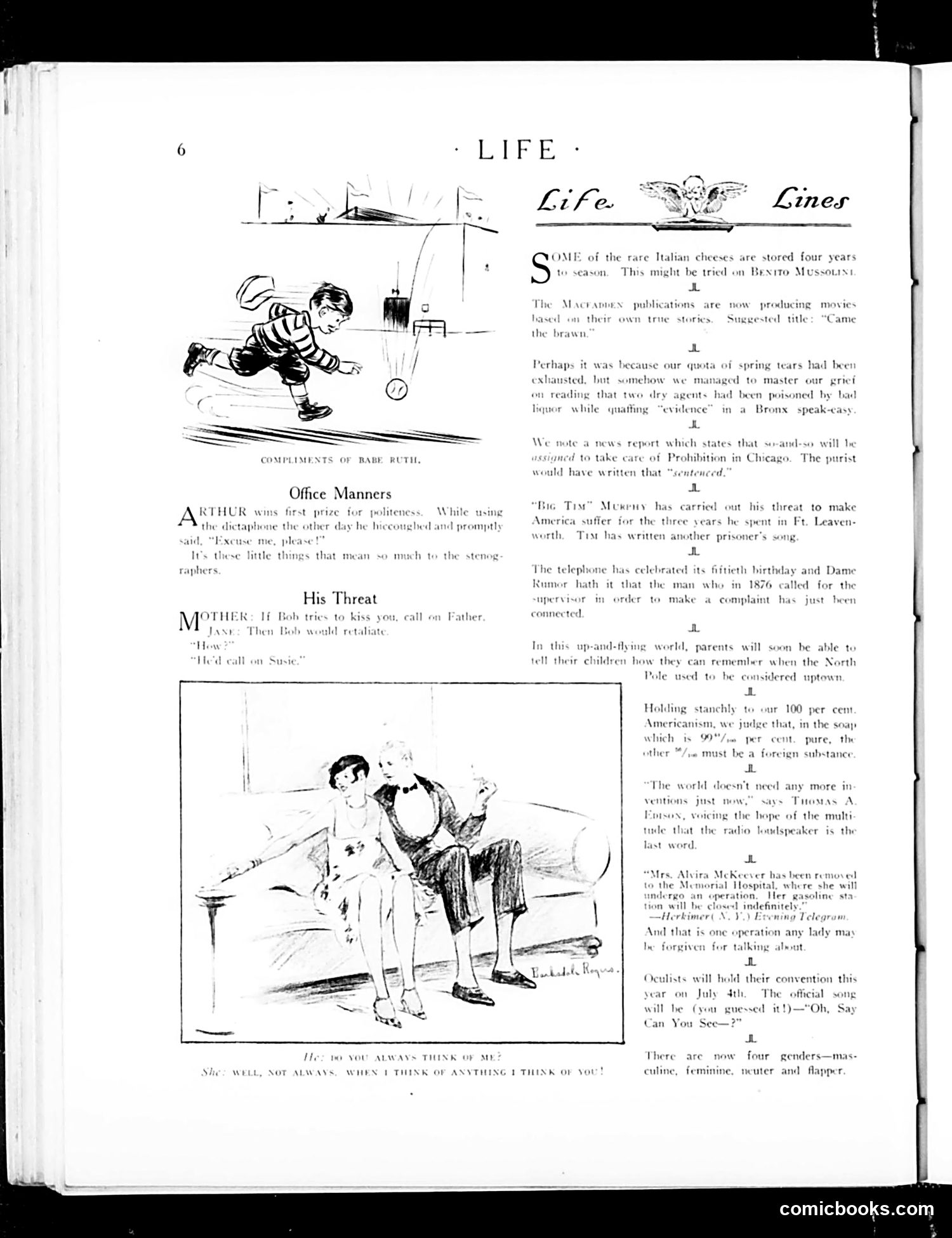
This page contains three satirical pieces: 1. **"Compliments of Babe Ruth"** - A sketch of a baseball player sliding, likely referencing the famous athlete's aggressive playing style. 2. **"Office Manners"** - A brief anecdote about Arthur winning a politeness prize for using a dictaphone, mocking workplace etiquette and emerging office technology. 3. **"His Threat"** - A cartoon showing a domestic dispute where a mother threatens to call the father if Bob misbehaves, and Bob counters he'll "call on Susie" instead. The accompanying illustration depicts a young couple in an intimate moment, satirizing how children's threats about romantic involvement were considered scandalous or humorous in this era. The humor relies on period-specific social anxieties about romance, technology in offices, and parent-child dynamics.
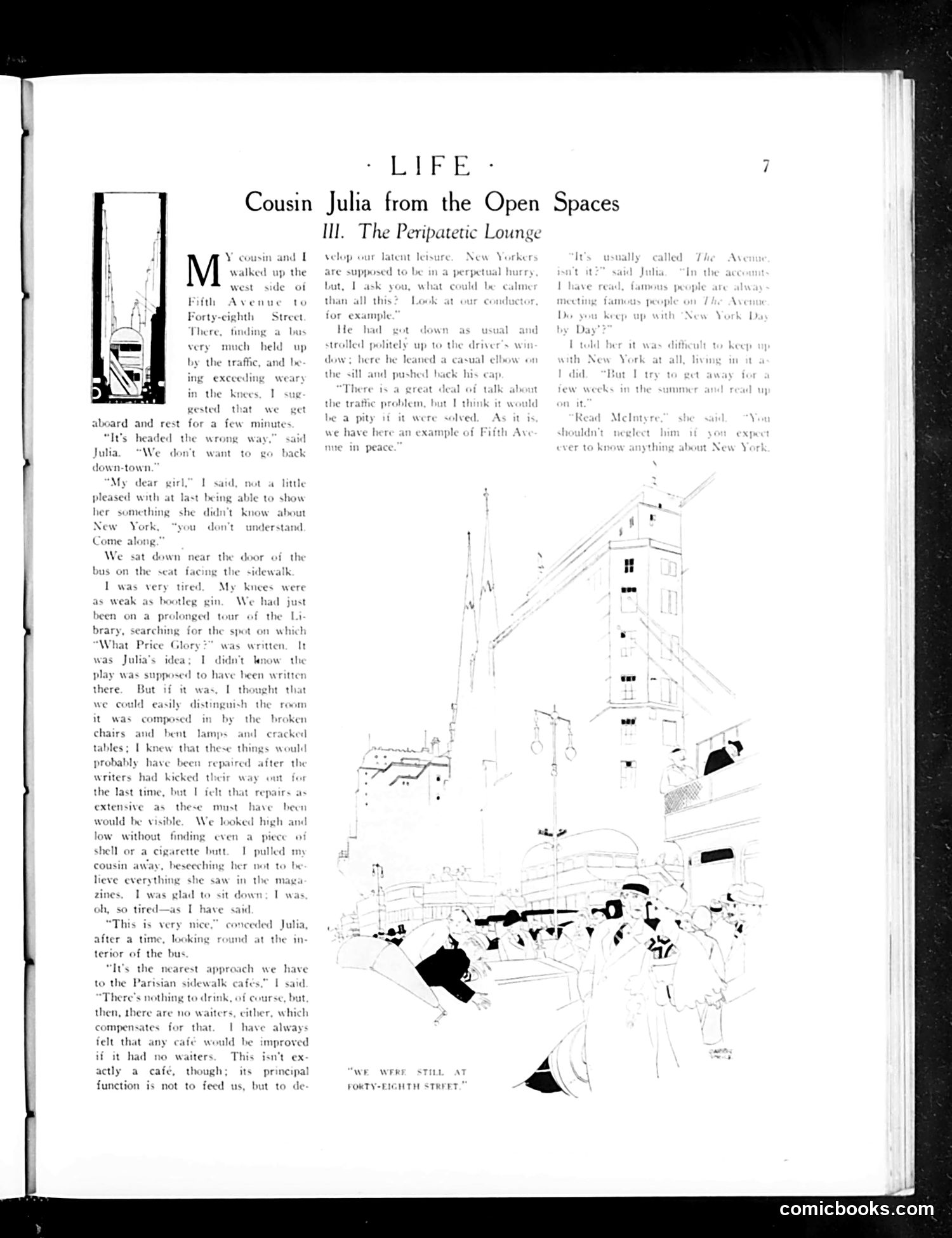
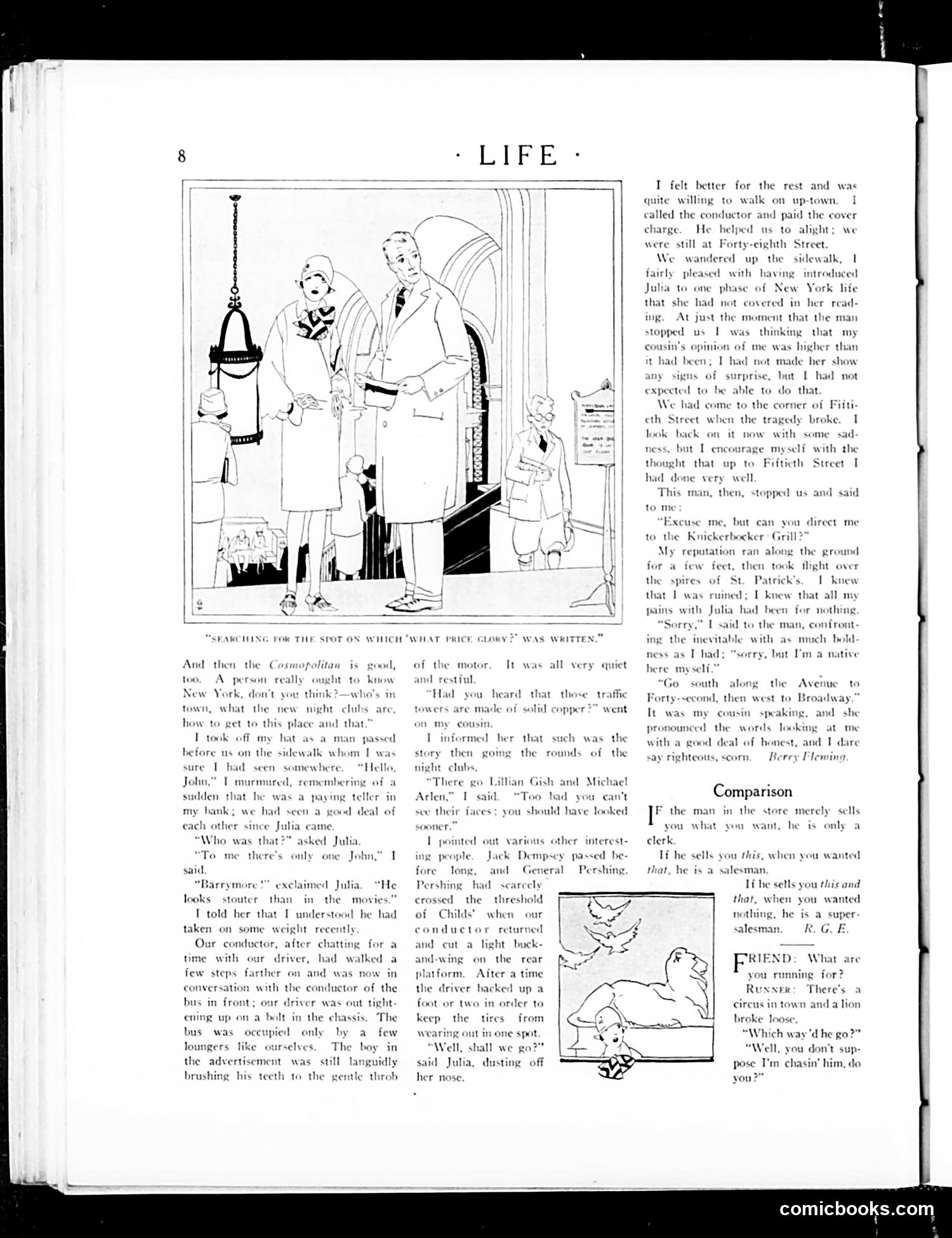
This page contains a narrative story with illustrations about New York City social life. The main cartoon shows elegantly dressed figures in what appears to be an upscale hotel or club entrance, with a uniformed doorman. The story references "the Knickerbocker Grill" and mentions nightclubs, suggesting 1920s Manhattan leisure culture. References to "Lillian Gish and Michael Arlen" (a fashionable novelist) and discussions of traffic towers made of "solid copper" indicate contemporary concerns with modernity and wealth. The "Comparison" section on the right page appears to be a humorous guide distinguishing between a clerk, salesman, and super-salesman—likely satirizing commercial social hierarchies of the era. The overall tone mocks sophisticated urban society's pretensions while documenting its actual preoccupations and geography.
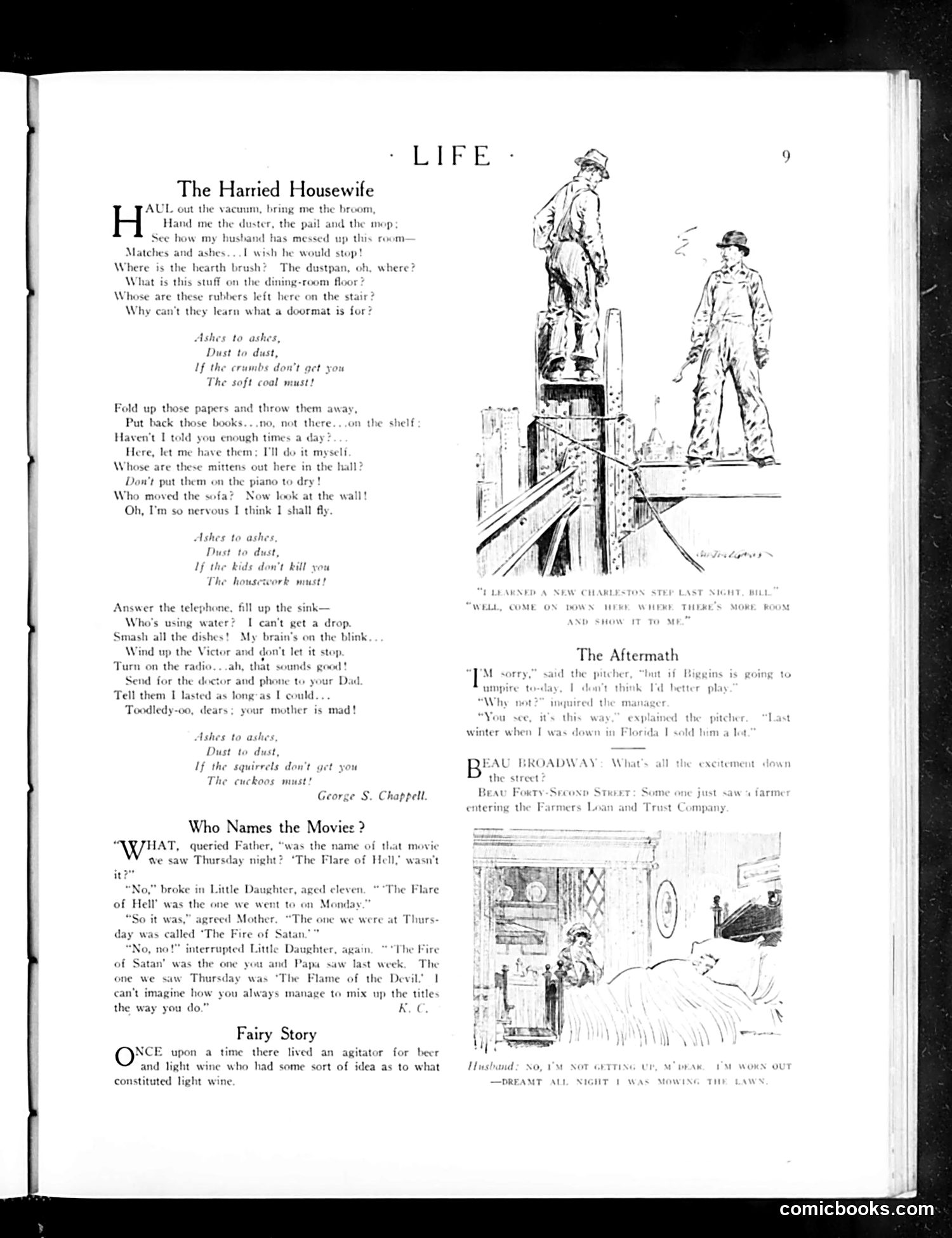
This page contains three satirical pieces about domestic life and entertainment: **"The Harried Housewife"** (top left) uses verse to mock the overwhelming demands placed on wives—vacuum cleaning, dusting, childcare, household repairs—presented as an endless, exhausting list. The satire critiques both the impossible expectations and the wife's frustration. **"Who Names the Movies?"** mocks the confusion over movie titles, suggesting families constantly mix up similar-sounding titles like "The Flare of Hell" vs. "The Fire of Satan," satirizing either poor movie naming or audience confusion. **"The Aftermath"** and **"Fairy Story"** (bottom sections) contain brief anecdotes with accompanying illustrations—typical Life magazine filler humor targeting everyday domestic scenarios and absurdities. The overall page reflects 1920s-30s middle-class anxieties about household management and popular entertainment.
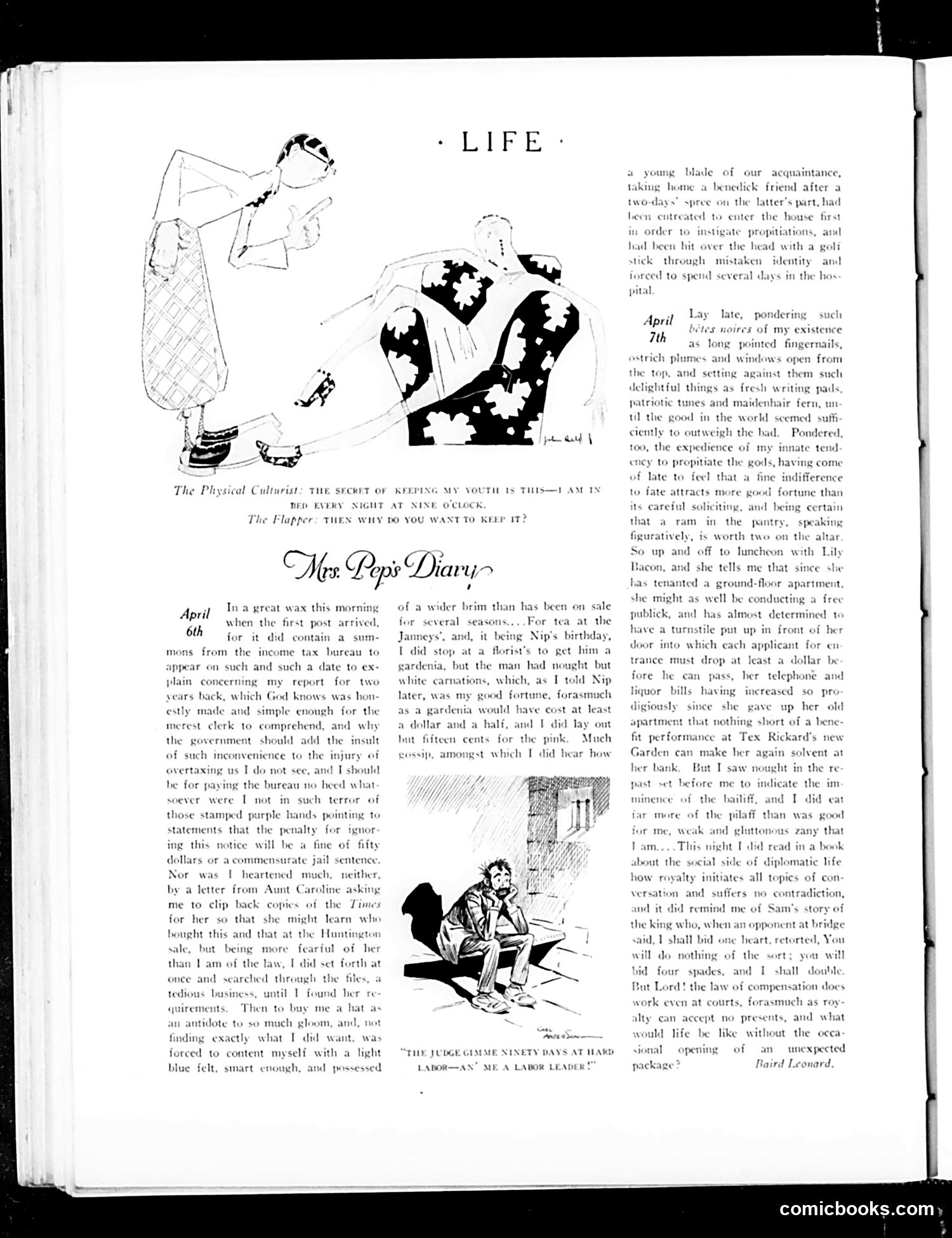
This page features "Mr. Pops Diary," a satirical column about everyday life and social observations. The two illustrations accompany diary entries dated April 7th and show typical middle-class experiences being gently mocked. The top cartoon depicts "The Physical Culturist" - a person obsessed with fitness routines, satirizing the era's health-conscious fad movements. The lower illustration shows "The Judge Gimme Ninety Days at Hard Labor" - apparently mocking someone (possibly a judge or authority figure) facing consequences, likely referencing actual legal proceedings or social embarrassment of the period. The diary text discusses mundane concerns: tax returns, florist costs, a friend's visit, and romantic philosophizing. The satire targets pretentiousness and the gap between social aspirations and reality among the urban middle class. The humor relies on recognizing these universal human foibles rather than specific political references.
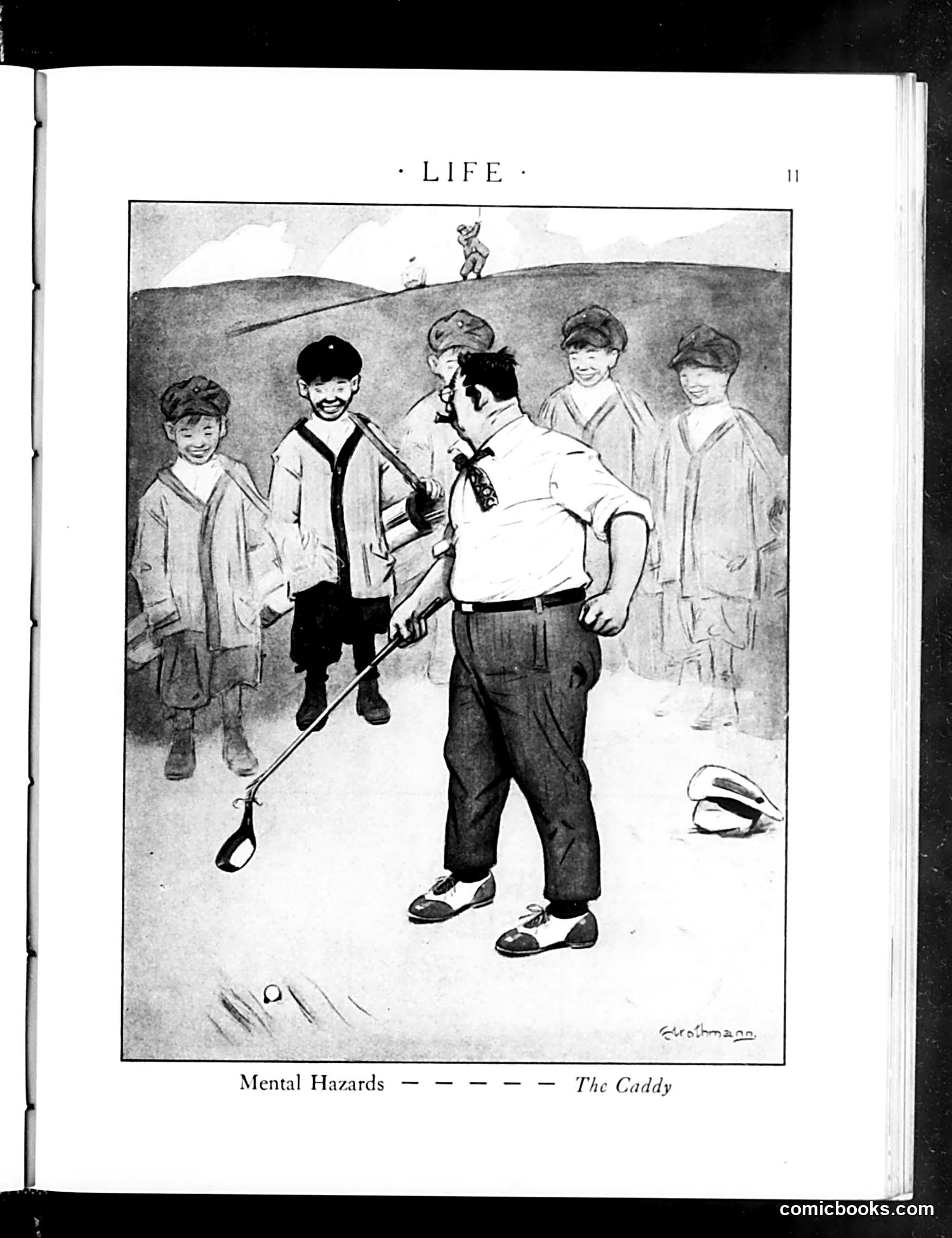
This is a satirical illustration about golf caddies as a social concern. The image shows an adult golfer surrounded by young boys, with the caption identifying the caddy as a "mental hazard." The satire appears to criticize the influence of caddies on young players' psychology and behavior during golf. The gathering of attentive boys around the golfer suggests caddies were viewed as potentially corrupting influences—perhaps through gambling, crude language, or other vices associated with the profession. This reflects early 20th-century anxieties about working-class youth and their moral development. The "mental hazard" framing treats the caddy's presence as a psychological threat comparable to physical obstacles on a golf course, satirizing contemporary concerns about social contamination and youth corruption.
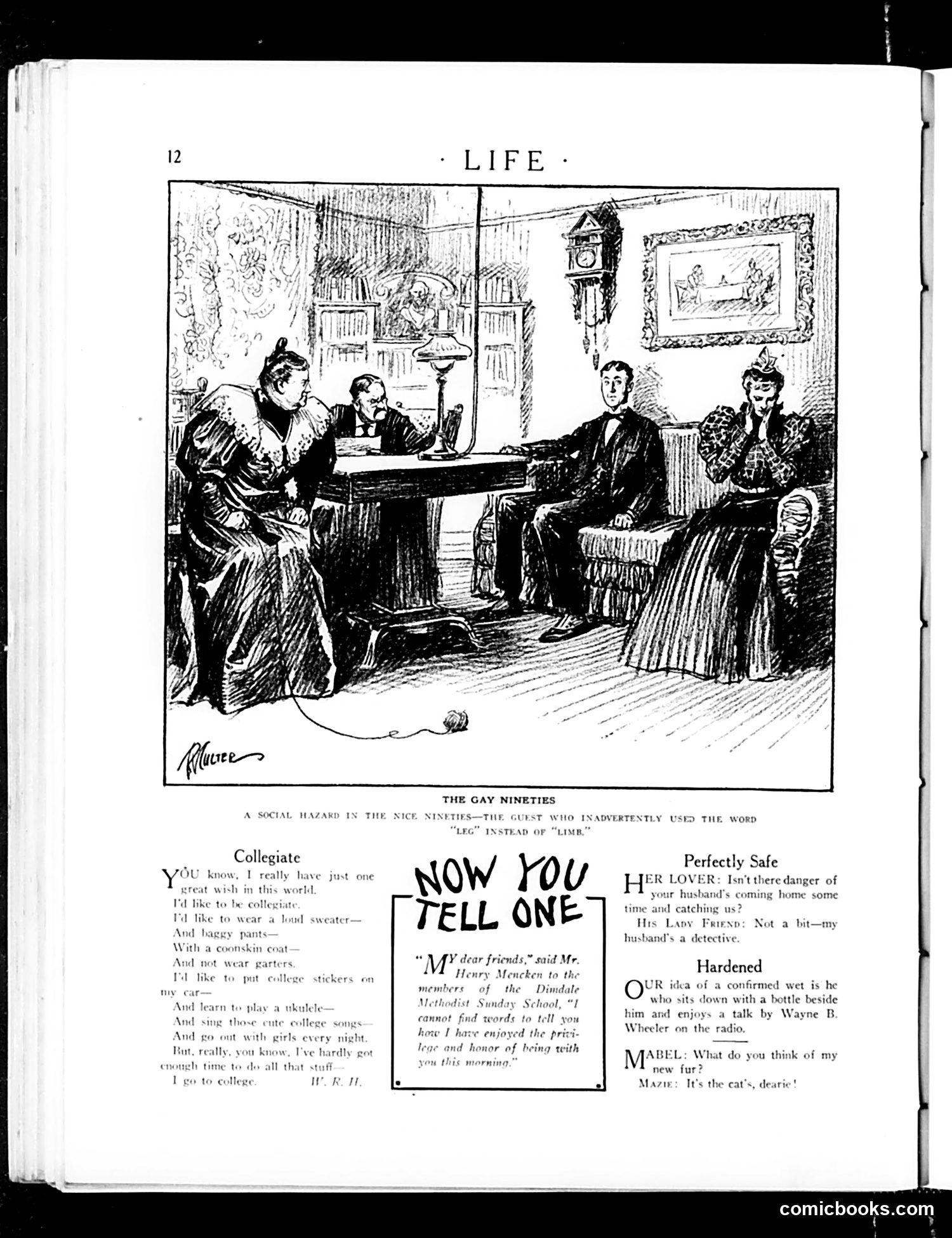
This Life magazine page satirizes 1890s social conventions through three separate humorous pieces. The main cartoon depicts a parlor scene where a guest has committed a social faux pas by using the word "leg" instead of the euphemistic "limb"—a violation of Victorian propriety. The shocked reactions of the assembled women illustrate how prudish and restrictive language norms were among the upper classes. Below are three brief humor columns: "Collegiate" mocks young men eager to join fraternities and pursue college social life; "Now You Tell One" presents an anecdote about proper etiquette; and "Perfectly Safe" and "Hardened" offer short joke exchanges about romantic situations and fur coats. Together, these pieces gently mock the rigid social codes and artificial propriety of the 1890s era.
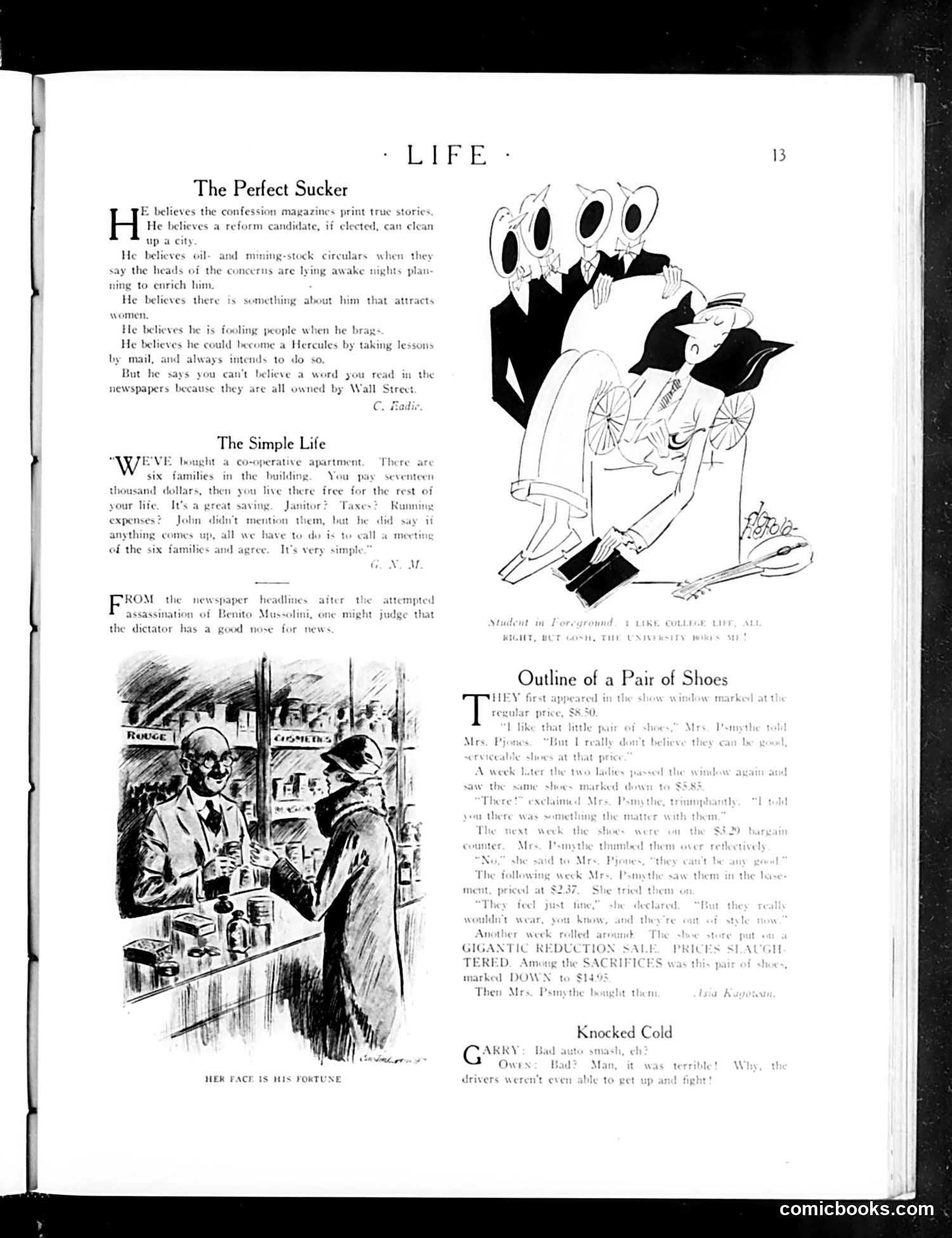
This page contains three separate satirical pieces mocking American credulity and consumer behavior: **"The Perfect Sucker"** attacks a naive man who believes false promises—confession magazines, reform candidates, oil stock schemes, and Wall Street investments. The satire targets gullible Americans susceptible to manipulation. **"The Simple Life"** humorously describes a cooperative apartment building arrangement, suggesting the impracticality of shared living through bureaucratic meetings. **"Outline of a Pair of Shoes"** (right side cartoon) satirizes women's shopping habits, depicting two women obsessing over marked-down shoes in store windows, repeatedly purchasing the same pair as prices fluctuate. The illustration shows their financial irrationality and consumerism. **"Her Face Is His Fortune"** (lower left) depicts a street vendor or con artist, suggesting exploitation through appearance-based commerce. These pieces collectively mock consumer culture and false belief systems prevalent in early 20th-century America.
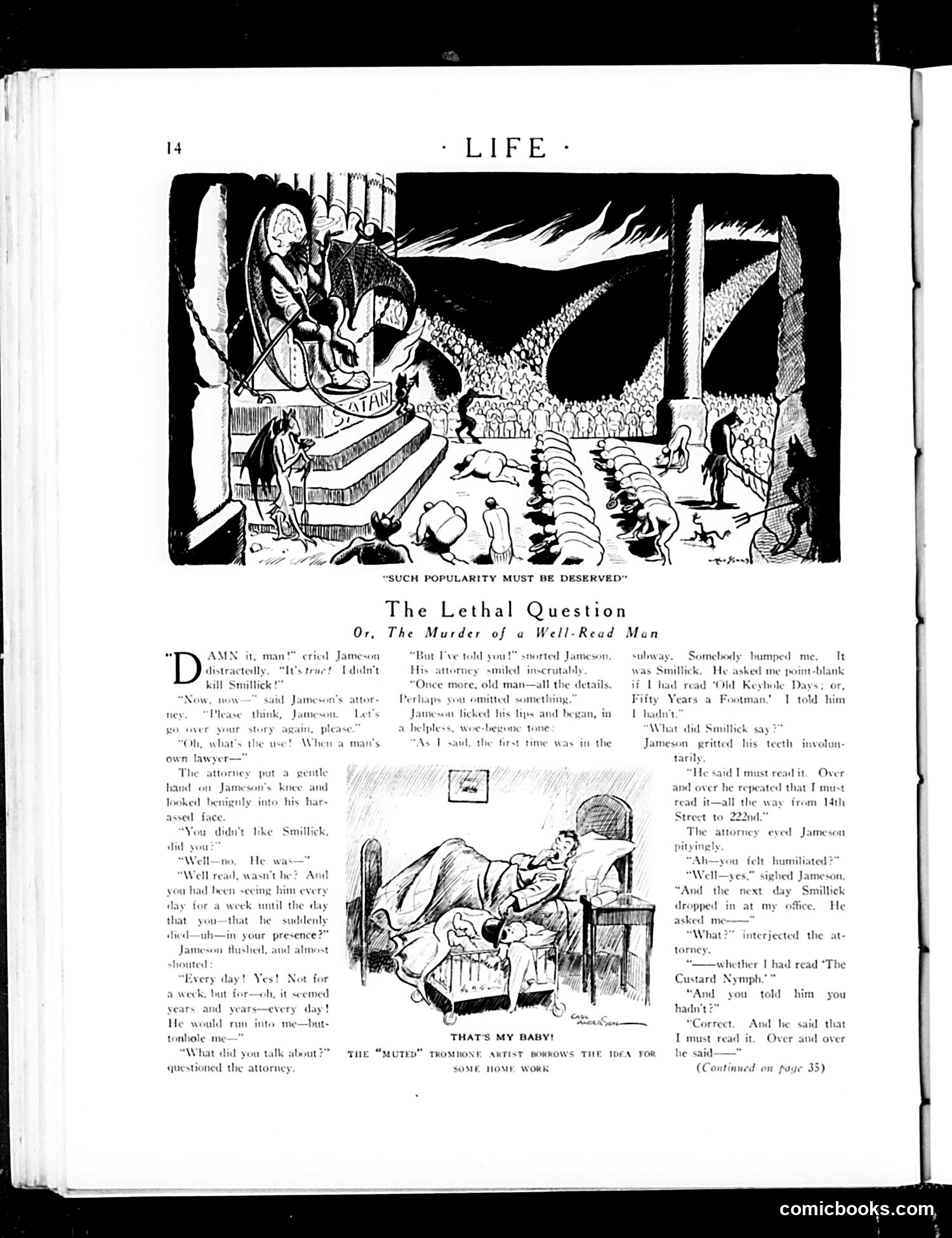
This satirical story concerns a man named Jameson whose attorney repeatedly insists he read "The Custard Nymph"—a book the attorney finds so tedious that he believes reading it constitutes torture. The top cartoon depicts what appears to be a theatrical or gladiatorial scene, with "Such Popularity Must Be Deserved" as its caption, likely mocking overhyped literary works. The satire targets the gap between critical acclaim and actual readability: a book can be popular yet unendurable. The attorney's obsessive demand that Jameson read this specific work—repeatedly, cover-to-cover—represents how literary pretension and social pressure force people to consume mediocre books. The joke is that "well-read" culture itself can be lethal.
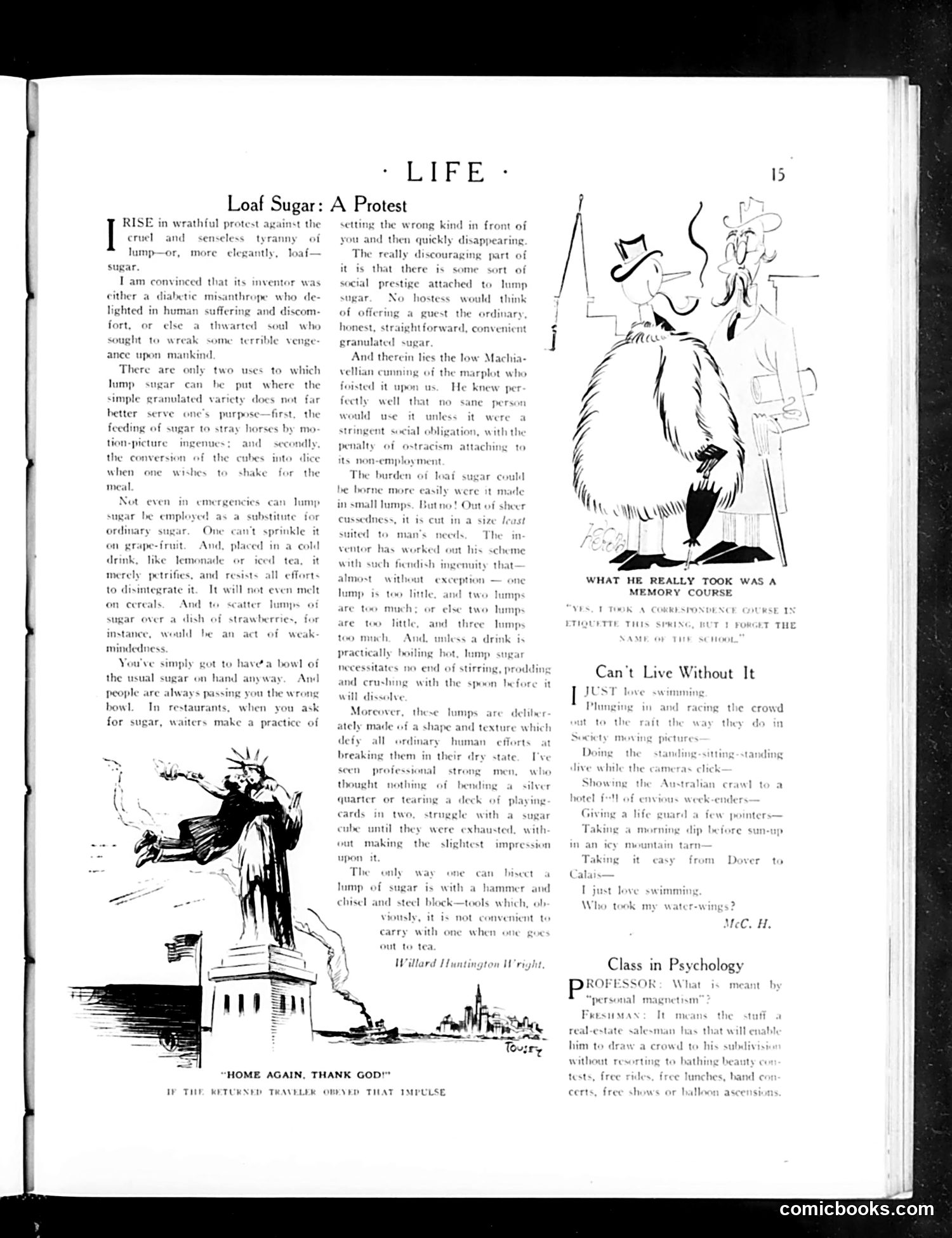
This page contains three separate humor pieces: 1. **"Loaf Sugar: A Protest"** - A satirical article about loaf sugar's social pretensions. The text complains that loaf sugar is unnecessarily fancy and difficult to use compared to granulated sugar, mocking the social status some attach to it. 2. **"Home Again, Thank God"** (bottom cartoon) - Depicts a returning traveler thanking God for the impulse that brought him home. The cartoon suggests relief at escaping foreign travel complications. 3. **"Can't Live Without It"** and **"Class in Psychology"** - Lighter humor pieces about everyday life and a professor's definition of "personal magnetism." The overall tone is genteel American satire mocking social pretensions and travel misadventures, typical of early 20th-century Life magazine's humor.
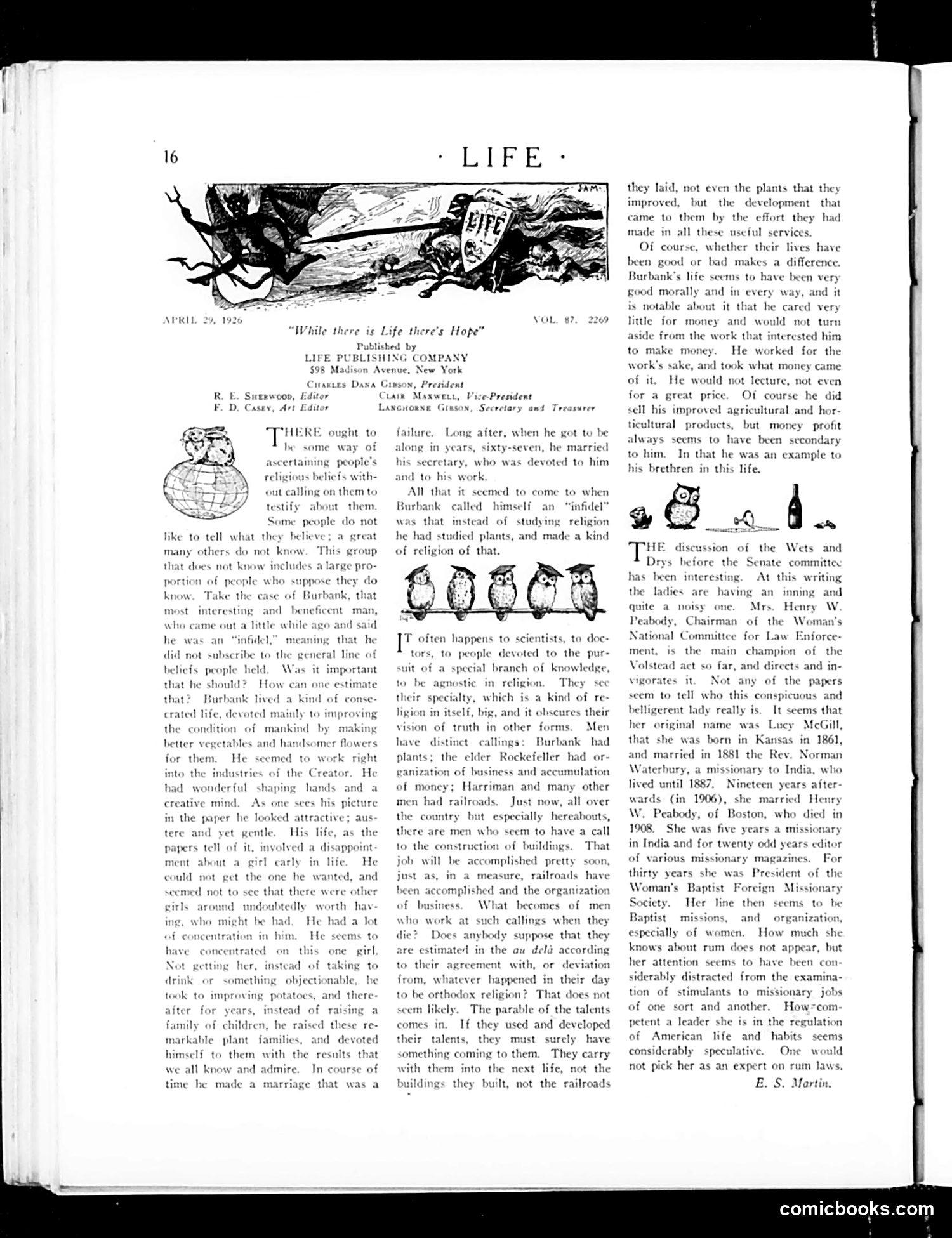
The page features an illustration titled **"While there is Life there's Hope"** depicting a figure emerging from or sitting atop a globe—suggesting optimism or resilience amid global circumstances. The article discusses **Luther Burbank**, the famous botanist and plant breeder. The text notes Burbank's unconventional religious views, describing how he "did not subscribe to the general line of beliefs people held" and instead focused on practical plant improvement work rather than religious doctrine. The piece uses Burbank as an example of someone whose life contributions—developing improved plants and agricultural products—represent secular accomplishment. This reflects early 20th-century American debates between scientific progress and traditional religious belief systems, positioning practical achievement as spiritually meaningful work.
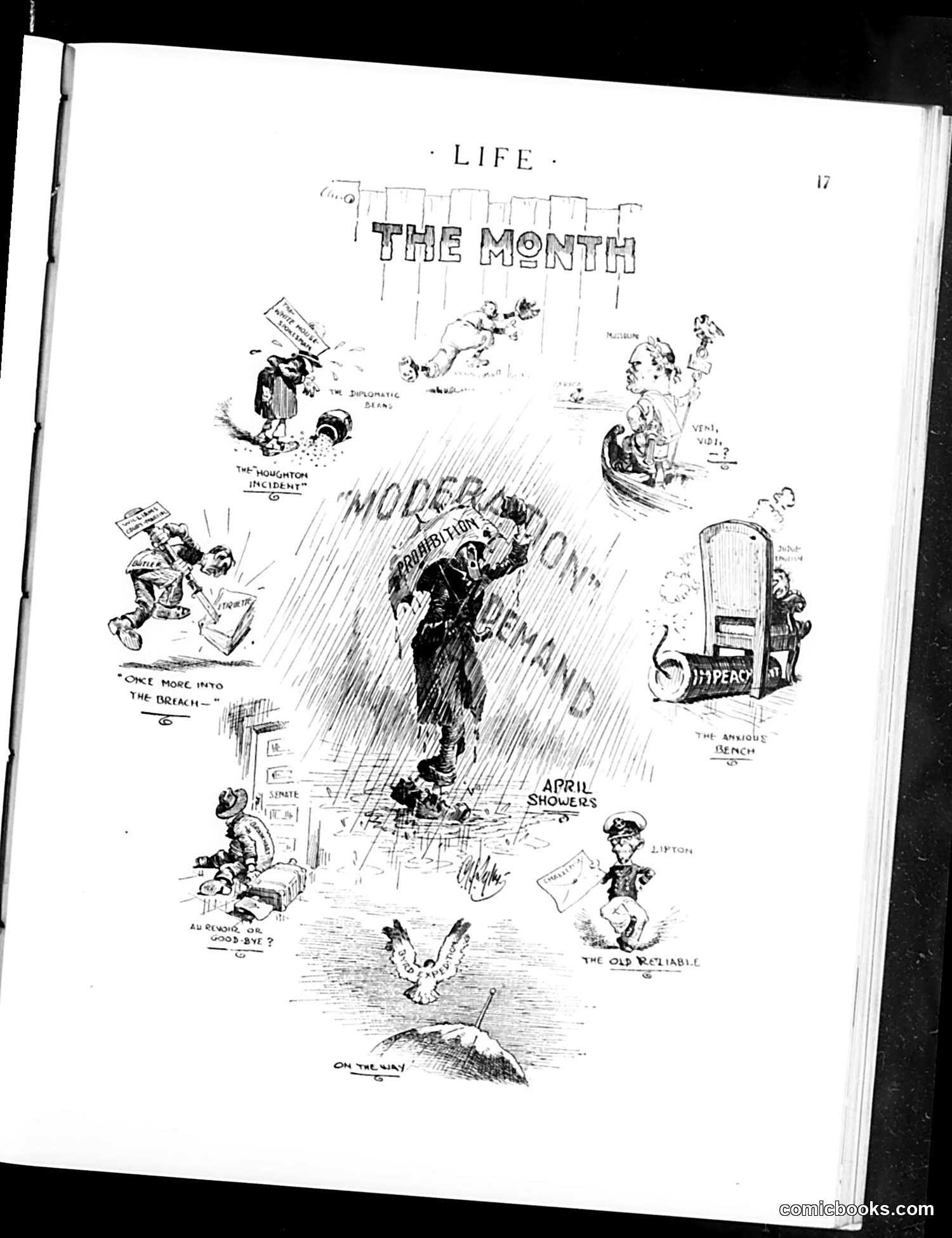
This satirical page depicts April's events as a stormy month ("April Showers") with a central figure struggling against "Prohibition" enforcement. Various vignettes surround the main scene: - **"One More Into the Breach"** references military duty or political resolve - **"The Houghton Incident"** appears upper left (unclear reference without more context) - **"The Anxious Heroin"** and **"The Old Reliable"** label other scenes - **"Good-Bye"** suggests departures or failures - References to Senate activities and voting ("Good-Bye?") The overall theme satirizes Prohibition enforcement struggles during April, with the drenched central figure embodying the difficulties politicians faced. The surrounding scenes mock various political players and their responses to prohibition-related controversies. The cartoonist uses exaggeration and humor to critique government overreach and enforcement chaos.
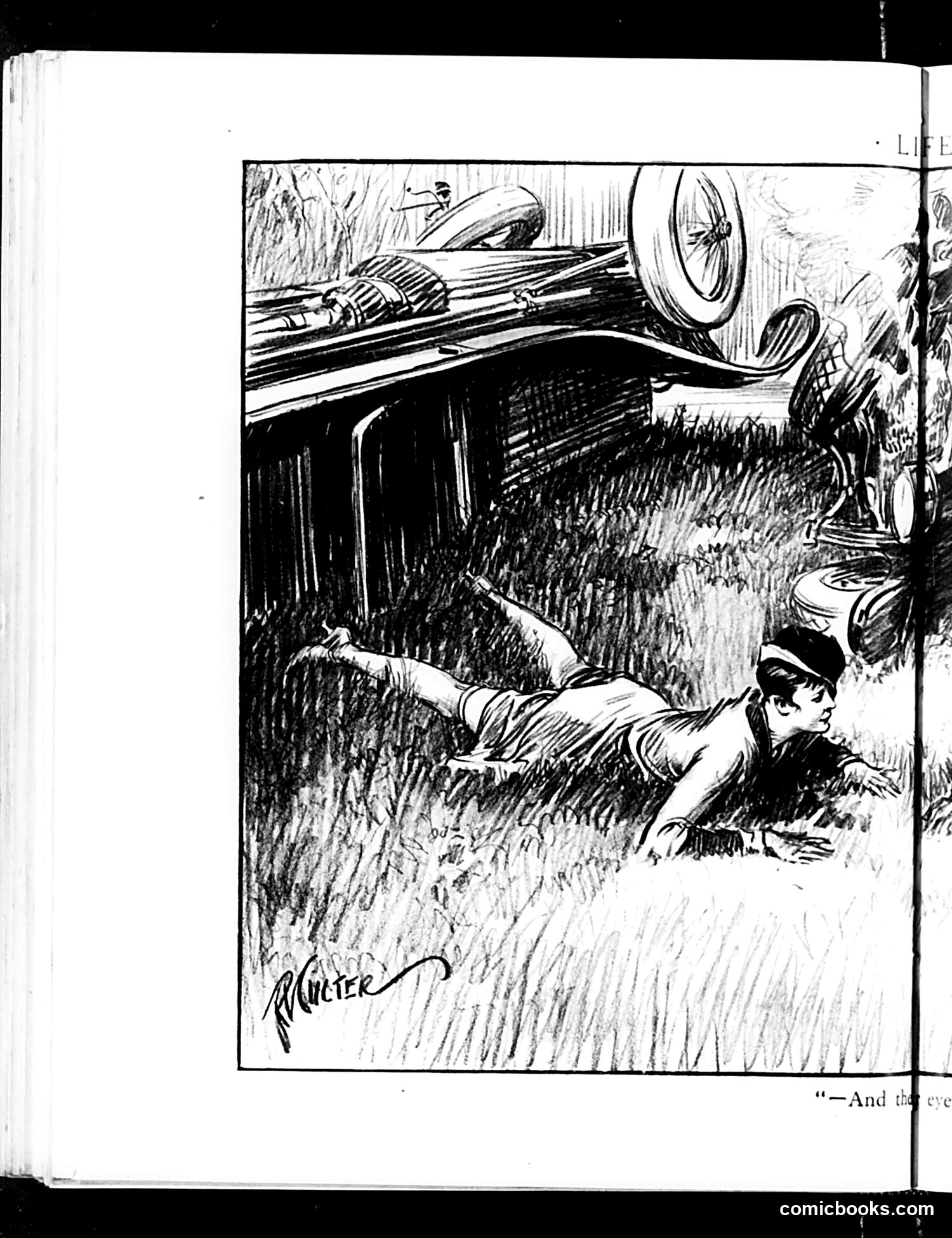
This is a single illustration by artist Miller (signed lower left) depicting a dramatic automotive accident scene. A child lies prone in tall grass after apparently being struck by or falling from a vehicle visible at the top of the frame. The composition emphasizes the vulnerability of the child and the danger posed by automobiles. Given *Life* magazine's satirical tradition, this likely comments on a contemporary public safety concern—specifically child pedestrian safety during the early automotive era when cars were becoming common but traffic safety awareness remained low. The stark, dramatic rendering underscores the serious consequences of negligent driving around children. The incomplete caption ("And the eye...") suggests this accompanied a larger article or commentary on automobile safety hazards.
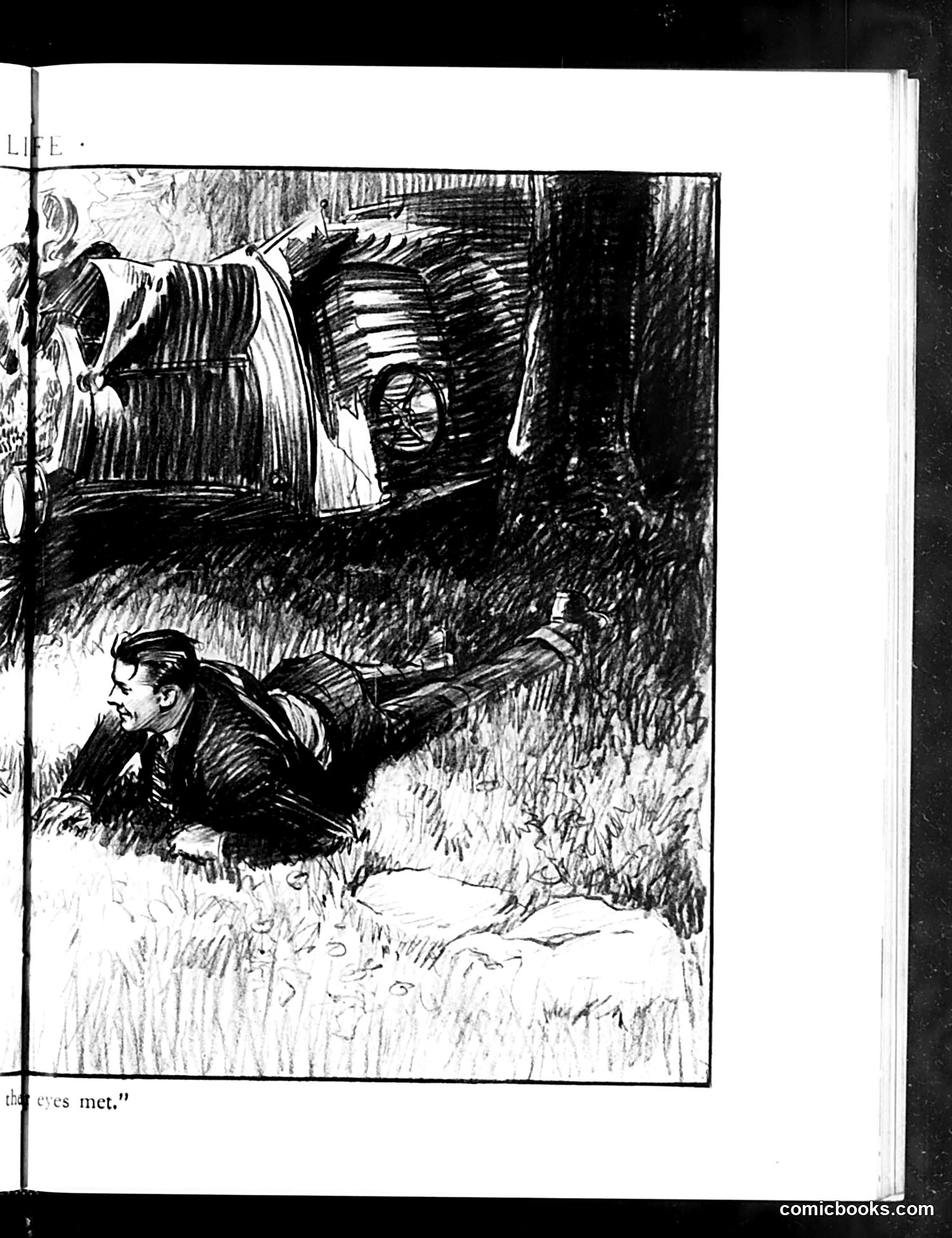
This is a satirical illustration from *Life* magazine showing a man lying prone in grass, apparently hiding or fleeing, while a vehicle passes nearby. The partial text "the eyes met" suggests a narrative moment of recognition or confrontation. The cartoon likely depicts a social or political commentary about evasion or escape, though **without full context or caption text, the specific reference remains unclear**. The man's posture and the vehicle's presence suggest tension or danger. The style and printing suggest **early-to-mid 20th century**, consistent with *Life*'s satirical tradition. However, **the identity of the figure(s) and the precise political or social situation being mocked cannot be determined from the visible image and incomplete text alone**. More contextual information would be needed for accurate interpretation.
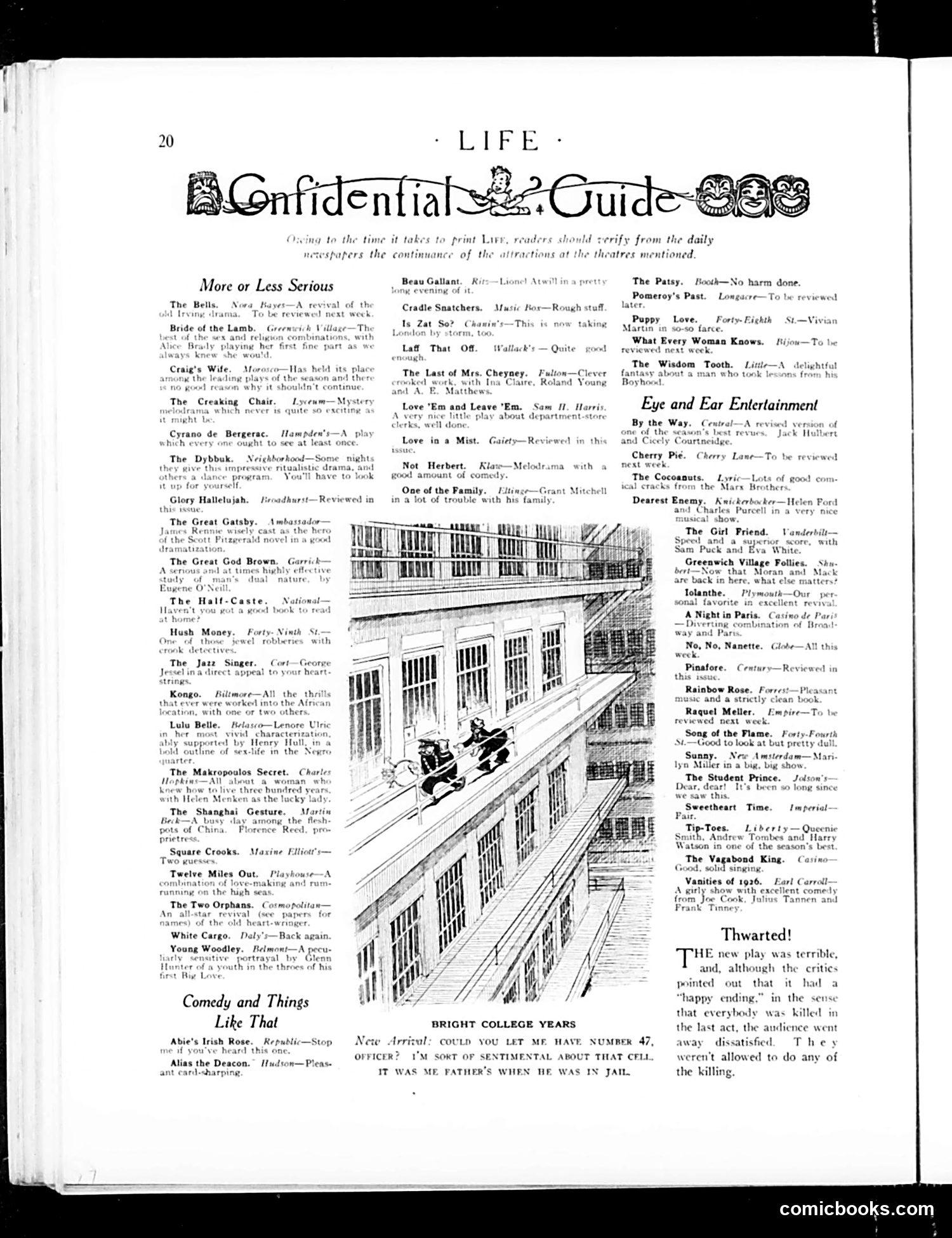
This page is primarily a **theater review guide** listing Broadway shows with brief critical assessments, a standard Life feature. The main satirical content appears in two sections: ## "Bright College Years" Cartoon The small illustrated cartoon shows a college student asking a police officer for a prison cell number—specifically his father's former jail cell number—claiming sentimental attachment. The joke mocks sentimentality and suggests a humorous family legacy of criminality. ## "Thwarted!" Short Humor Piece This brief satirical commentary ridicules a poorly-received new play with a "happy ending" where everyone dies in the final act. The satire targets both the play's illogical construction and the audience's frustration at being denied the cathartic experience of grief or dramatic response—they "weren't allowed to do any of the killing" (emotional release). It's a gentle jab at absurd theatrical conventions and theatrical pretension. Both items exemplify Life's characteristic light satirical humor about American social foibles and entertainment culture.
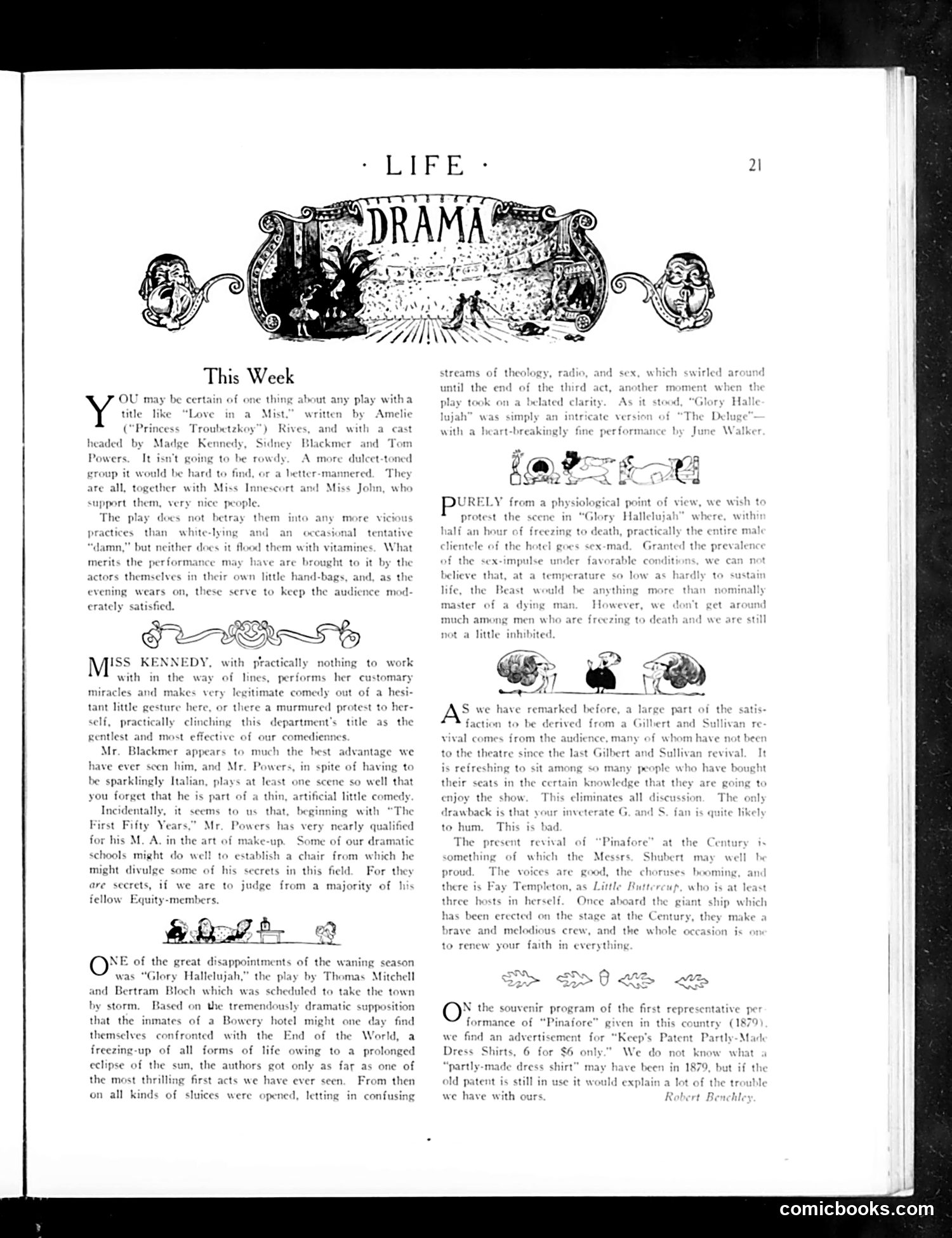
This page reviews contemporary theatrical productions for a general audience. The main text discusses several plays: **"Love in a Mist"** — praised for its refined cast (Madge Kennedy, Sidney Blackmer, Tom Powers) and gentle comedy, though acknowledged as somewhat artificial. **"Glory Hallelujah"** — a disappointment. Despite a promising premise (Bowery hotel residents confronting the world's end via solar eclipse), the play falters after its strong first act, devolving into confused plotting about "sex-impulse" and religious themes. **"Pinafore"** revival at the Century Theatre — praised for good voices and choruses, featuring Fay Templeton. A sidebar notes an 1829 patent for "partly-made dress shirts" that predates modern ready-made clothing. The reviews employ theatrical insider humor and gentle mockery typical of Life's drama criticism—appreciating competent performances while critiquing lazy or overly ambitious writing. The cartoonistic elements appear decorative rather than satirical.
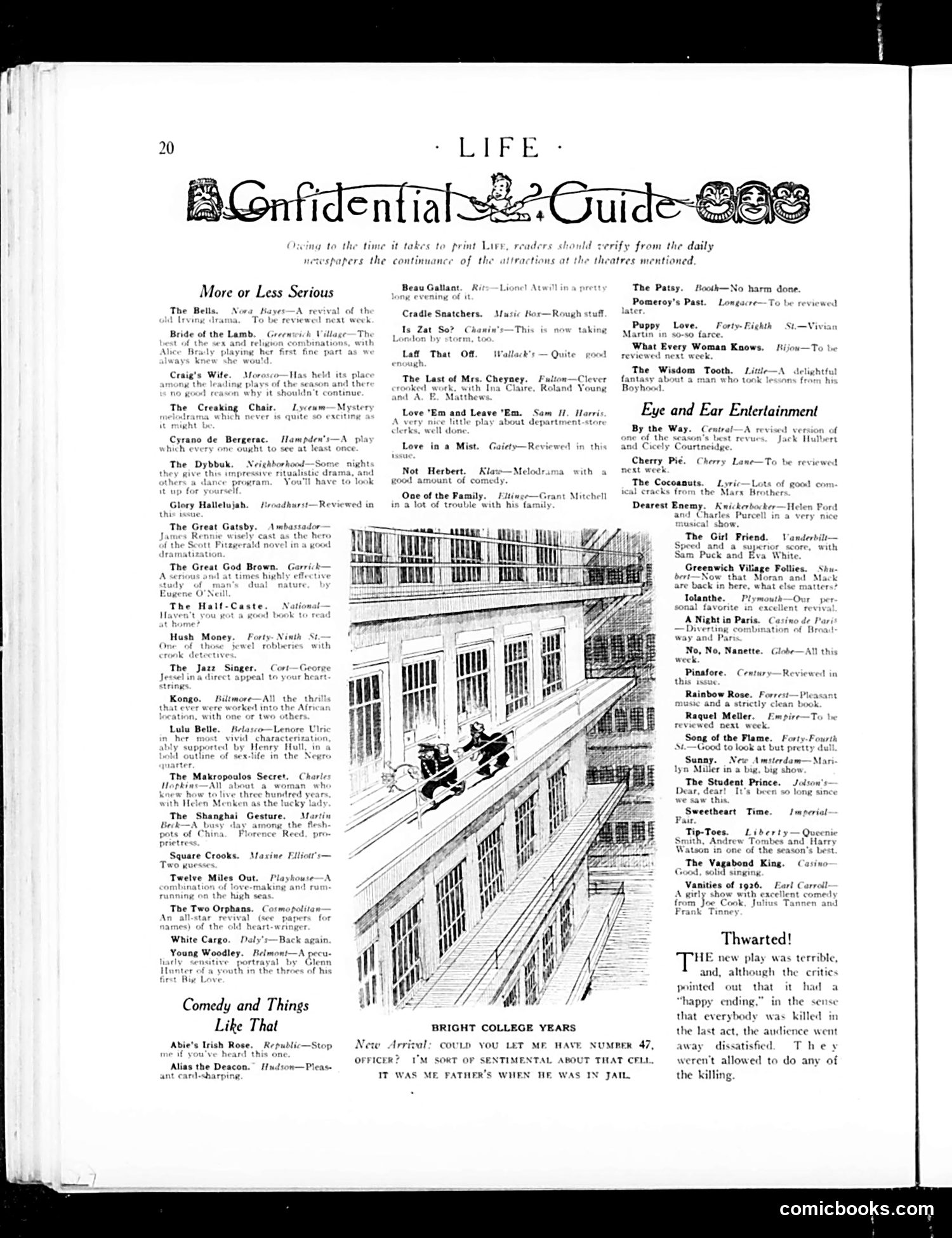
This page from Life magazine is primarily a **theatre listings and reviews section**, not a political cartoon. It catalogs Broadway shows currently running, with brief critical assessments of plays like "Abie's Irish Rose," "The Great God Brown," and "The Cocoanuts." The central illustration shows a **"Bright College Years"** scene depicting two young men in what appears to be a jail cell. One asks the other for a cell number "47," explaining sentimentally that it belonged to his father when he was imprisoned. This is a humorous reference to **generational continuity of petty crime or vice**—suggesting the younger generation is following in their father's criminal footsteps, framed as nostalgic family tradition. The brief article at page bottom, "Thwarted!," critiques a terrible new play with an unsatisfying ending that left audiences disappointed despite its supposedly "happy" conclusion. The page reflects Life's typical blend of **entertainment criticism and light satirical humor** about American social life, targeting theatrical audiences of the Roaring Twenties era.
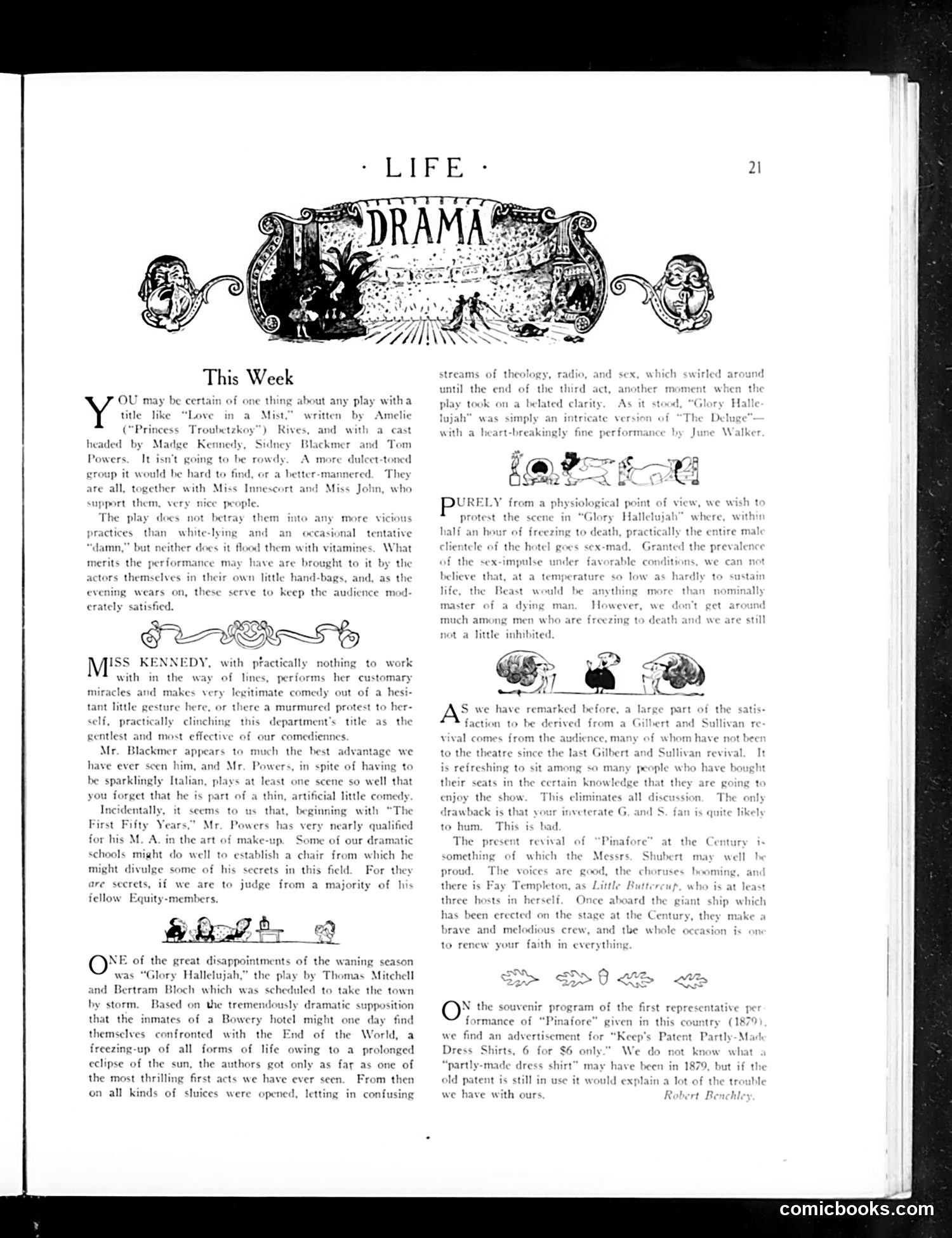
This page reviews theatrical productions from what appears to be the early 20th century. The main criticism concerns "Glory Hallelujah," a play by Thomas Mitchell and Bertram Bloch set in a Bowery hotel confronting "the End of the World." The reviewer praises its opening act as "thrilling" but notes the plot collapses afterward—once the apocalyptic premise is introduced, the narrative loses coherence and "all kinds of slices were opened, letting in confusing" content about theology, radio, and sex. The piece praises supporting actors like Mae Kennedy and Sidney Blackmer in another production ("Love in a Mist"), particularly commending Kennedy's physical comedy and Blackmer's performance. The reviewer also protests a scene in "Glory Hallelujah" where freezing actors must portray dying characters, questioning its physiological realism. The page concludes with a humorous advertisement note about an 1879 patent for "partly-made dress shirts"—satirizing outdated commercial claims still in use.
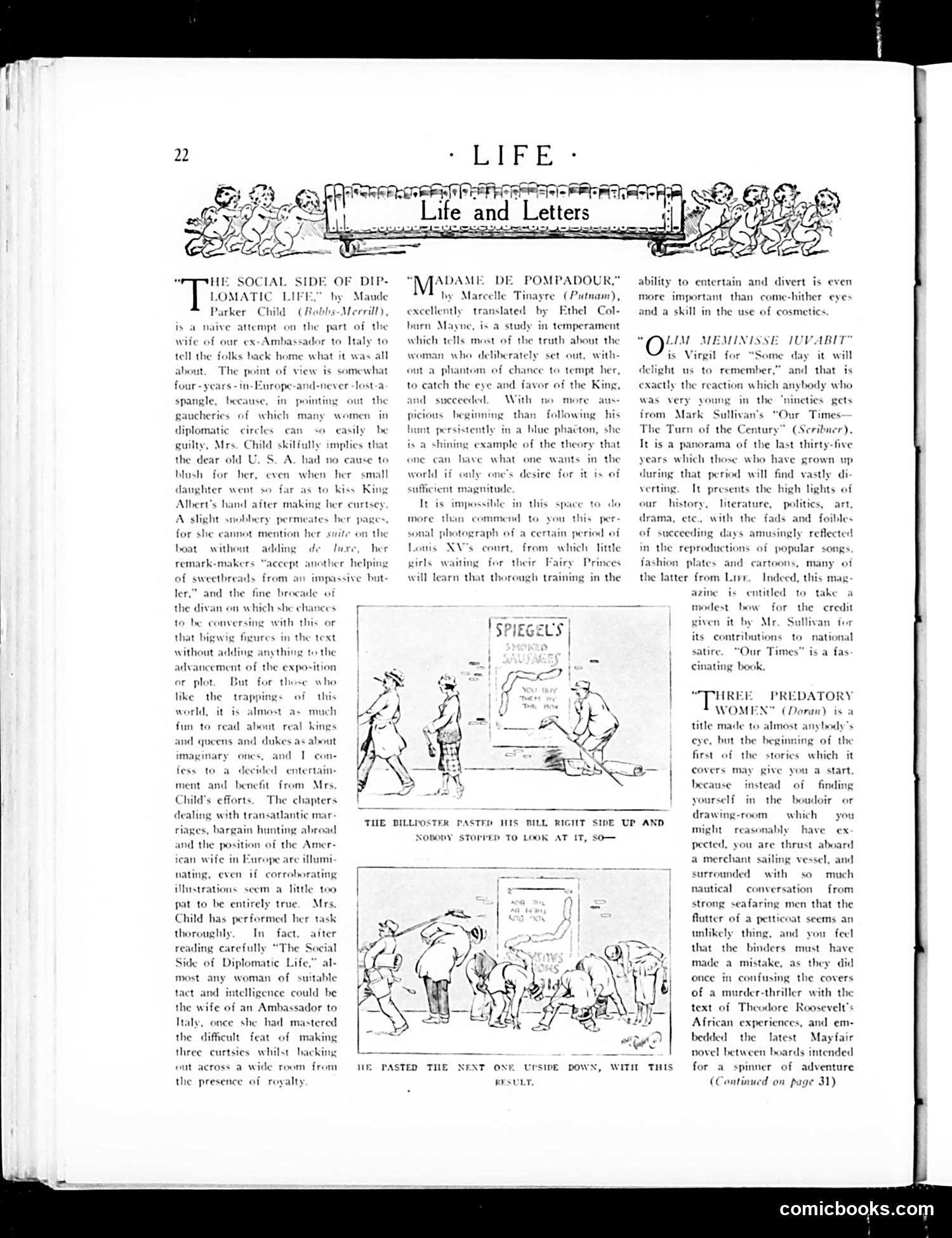
This page from *Life* magazine reviews three books. The cartoons illustrate a satirical piece about diplomatic etiquette. **The cartoons** show a hapless diplomat repeatedly failing at basic social protocol—first "pasting his bill right side up" when "nobody stopped to look," then attempting the reverse "upside down" with comical results. The humor mocks the absurdity of diplomatic formalities and the pretension surrounding ambassadorial conduct. **The book reviews** discuss: 1. "The Social Side of Diplomatic Life" by Maude Parker Child—a naive guide to being an ambassador's wife in Italy, where even small social missteps (like kissing the King's hand) could cause scandal 2. "Madame de Pompadour"—analyzing how the famous mistress of Louis XV deliberately seduced the king through charm and temperament 3. "Our Times" by Mark Sullivan—a nostalgic panorama of 1890s American culture through reproductions of period cartoons and songs The satire targets both the pretentiousness of diplomatic society and the earnest, often contradictory advice-literature aimed at women navigating elite social worlds.
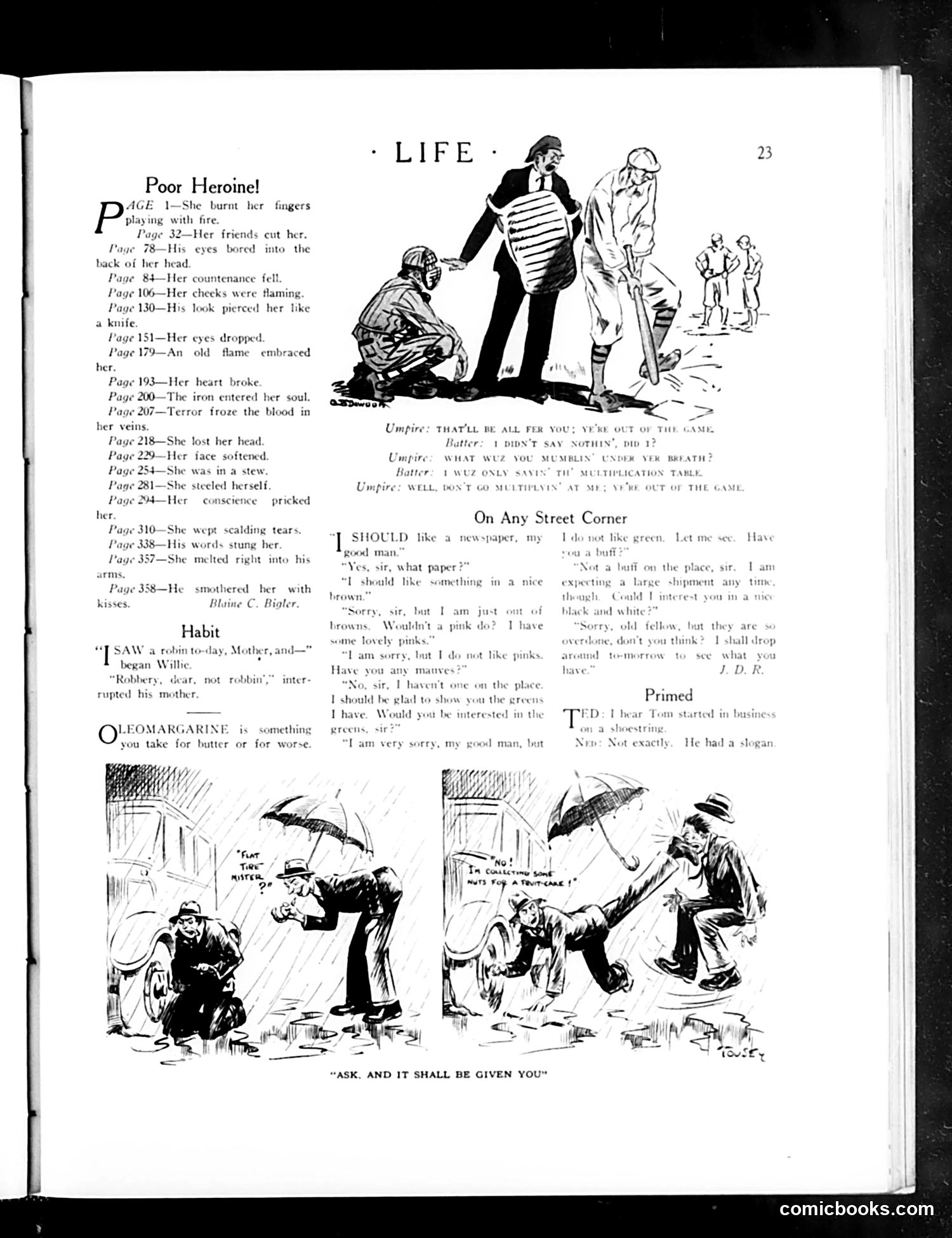
This page contains three distinct satirical pieces: **"Poor Heroine!"** parodies melodramatic Victorian/early-20th-century novels by cataloging absurdly literal interpretations of common literary clichés—"Her heart broke," "The iron entered her soul," "Terror froze the blood." The satire mocks overwrought romantic fiction's purple prose. **"Habit"** features a brief joke about a child mispronouncing "robin" as "robbin'" (theft), playing on how children mishear words—a common domestic humor format. **"On Any Street Corner"** satirizes newspaper vendors' inability to satisfy customers' increasingly specific demands (brown paper, pink, mauve, greens). The bottom cartoon, captioned "Ask, and it shall be given you," shows the vendor eventually losing patience with the demanding customer—mocking both consumerism and the gap between idealistic promises and reality. The baseball umpire dialogue at top appears unrelated, possibly spillover from another article.
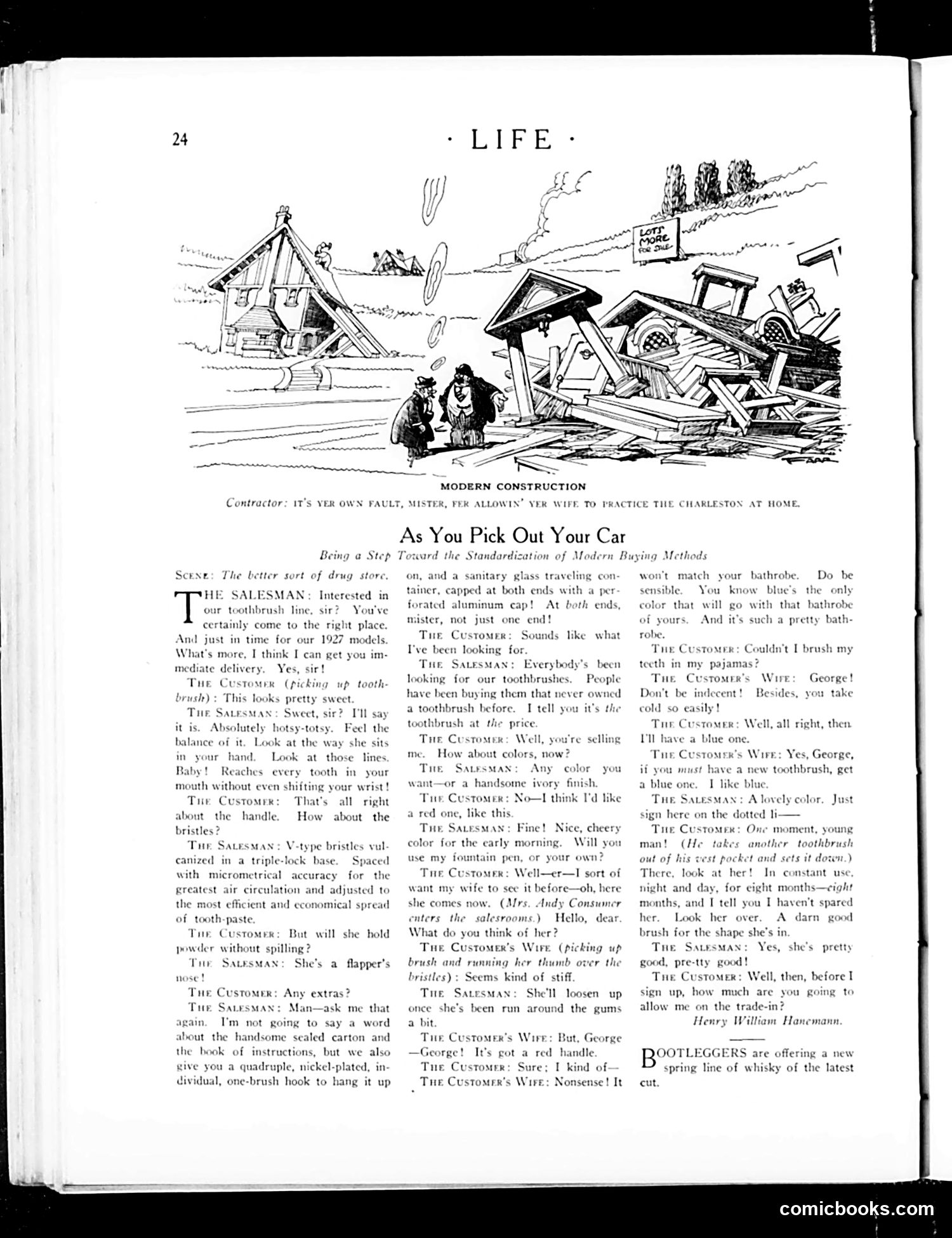
This page satirizes the **aggressive, pseudo-scientific sales tactics** of 1920s salesmen—specifically applied to toothbrushes as an absurd parallel to automobiles. The salesman uses grandiose language ("V-type bristles vulcanized in a triple-lock base," "micrometrical accuracy") to sell what is fundamentally a simple product, mimicking how car dealers marketed new models with jargon-heavy features. The humor targets **consumerism and advertising excess** of the era. A customer's wife appears concerned about propriety (refusing to brush teeth in pajamas, worried about the color matching the bathrobe), reflecting anxieties about modern behavior and respectability. The final joke about trading in an old toothbrush mirrors the car-buying process itself. The top cartoon ("Modern Construction") depicts a chaotic building site, mocking shoddy workmanship alongside the consumer-obsession theme. This reflects the post-WWI economic boom when advertising became manipulative and Americans embraced consumption as lifestyle.
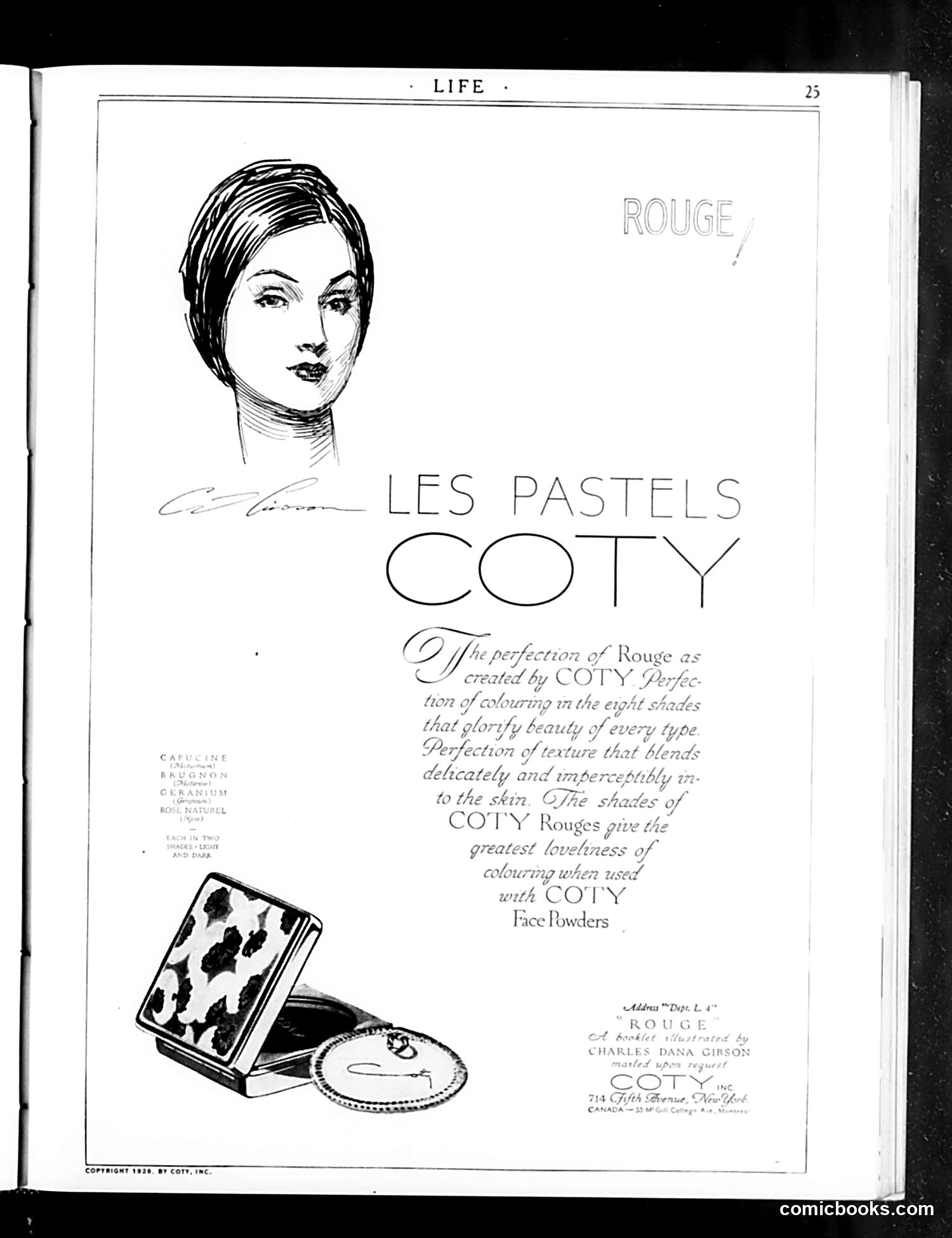
This is primarily an **advertisement**, not a cartoon or satire. The page promotes "Les Pastels Coty," a rouge (cheek cosmetic) product by the Coty cosmetics company. The ad features a stylized illustration of a woman's face in profile, representing the idealized beauty standard of the 1920s era—with defined features and fashionable short hair typical of the "flapper" period. The accompanying text emphasizes that Coty's rouge comes in eight shades designed to flatter "every type" of complexion, and that it blends seamlessly with Coty face powders. The decorative product packaging is shown at bottom left. This is a straightforward cosmetics advertisement from 1926, not political or satirical content. It reflects 1920s beauty marketing and women's cosmetics consumption during that era.
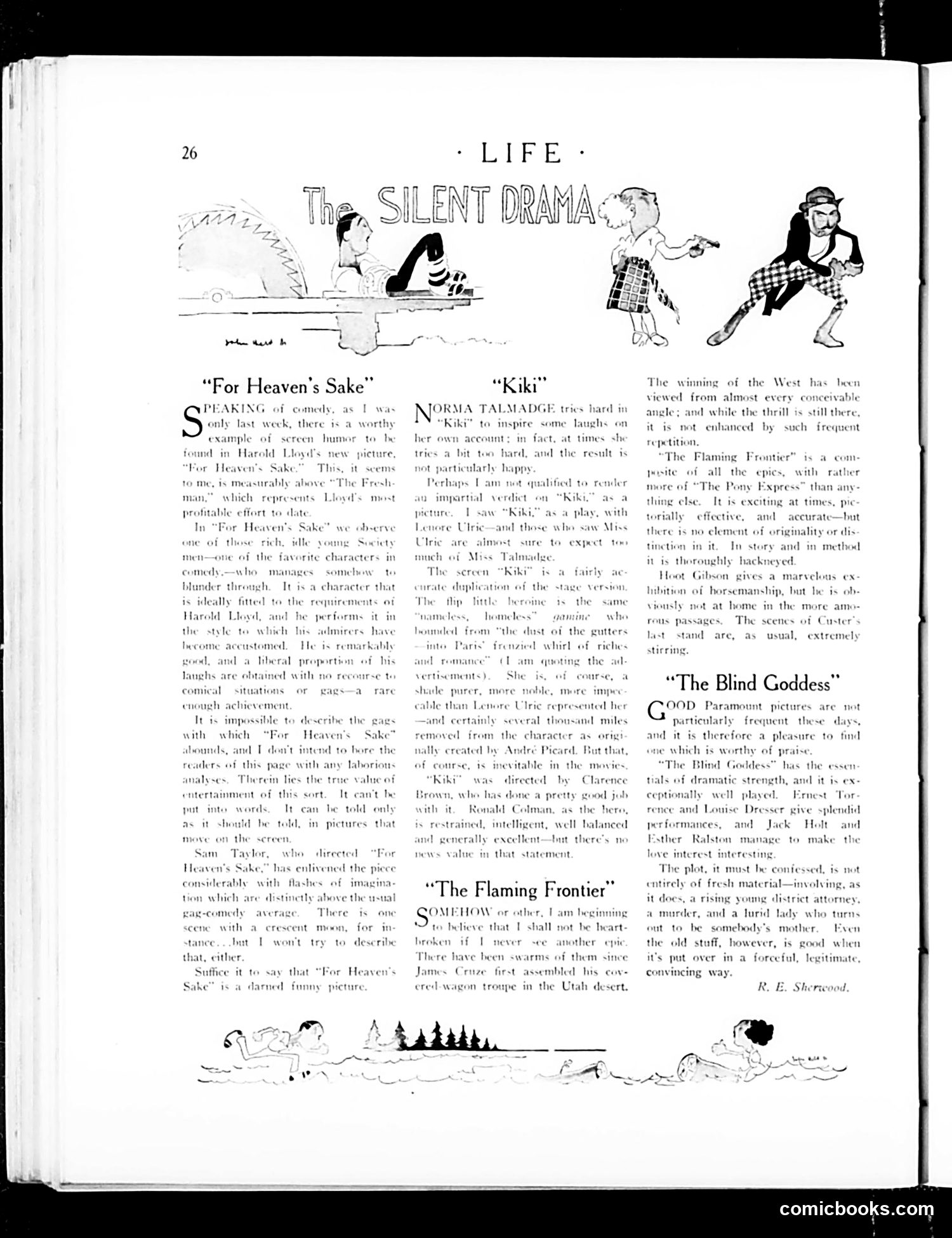
This page reviews three silent films, reflecting early 1920s cinema criticism. The cartoons at top illustrate comedic physical humor typical of silent movies. **"For Heaven's Sake"** stars Harold Lloyd in a slapstick comedy. The reviewer praises its humor, noting that silent films' strength lies in visual gags that can't be adequately described in words. **"Kiki"** features Norma Talmadge as a Parisian character. The critic acknowledges the film differs substantially from the stage play, as movie adaptations inevitably do, but finds it entertainingly performed. **"The Flaming Frontier"** is criticized as derivative—another Western following countless similar stories. While praising the lead actor's horsemanship and exciting cavalry scenes, the reviewer finds the plot thoroughly predictable. **"The Blind Goddess"** receives praise as a rare quality Paramount picture with good performances. However, the reviewer admits the plot relies on familiar melodramatic elements (murder, mistaken parentage) but concedes it's executed competently. The tone reflects how critics evaluated silent cinema: emphasizing visual spectacle while lamenting recycled stories.
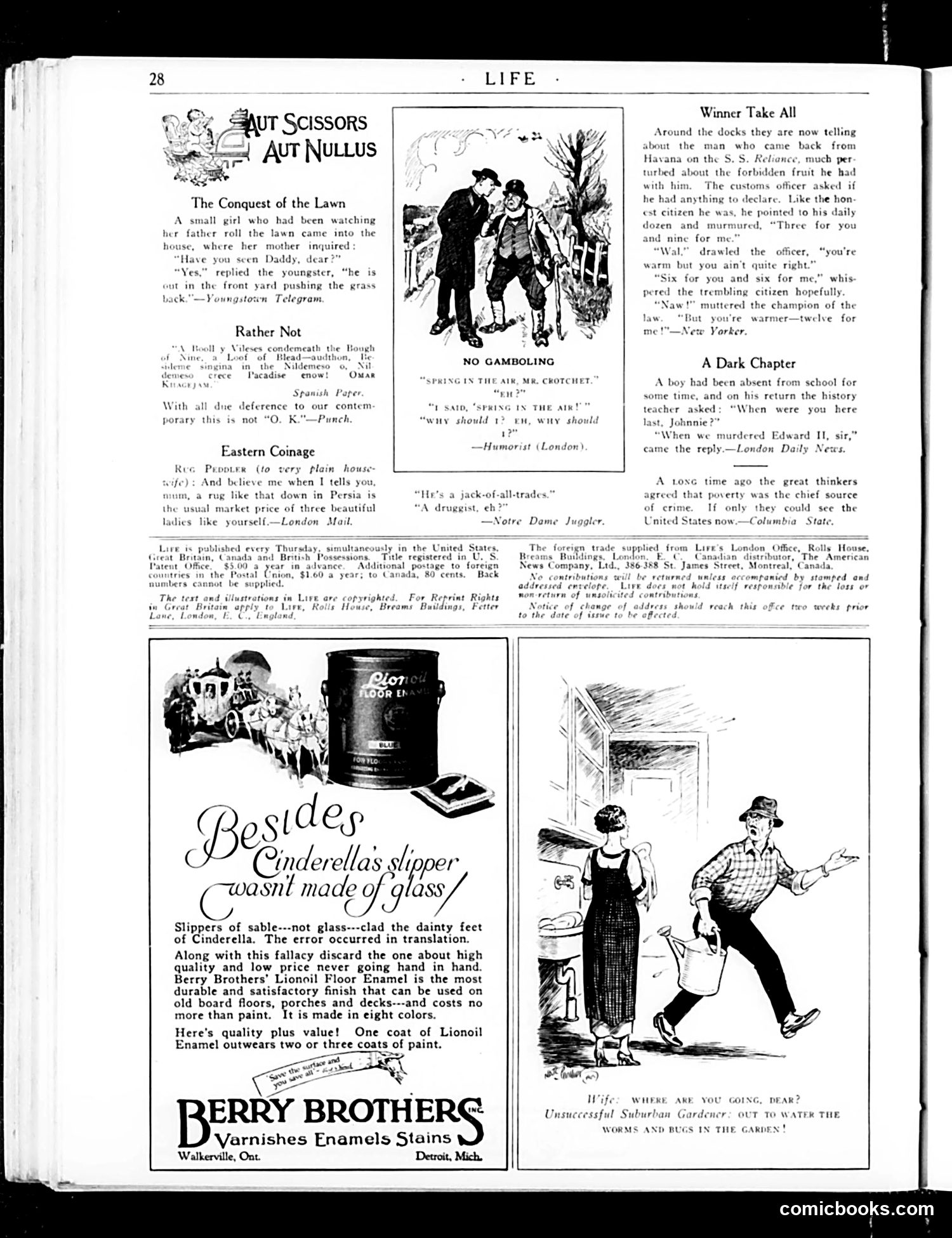
This page from Life magazine contains several brief satirical items typical of the publication's format: **"Winner Take All"** jokes about a man returning from Havana with contraband fruit (likely rum or cigars, given Prohibition-era context). He attempts bribing a customs officer with increasingly generous splits, misunderstanding the officer's hints—a commentary on corruption and the absurdity of Prohibition enforcement. **"The Conquest of the Lawn"** depicts a child watching father mow the lawn, a gentle domestic humor piece about suburban life. **"A Dark Chapter"** presents a schoolboy's dark reply about "when we murdered Edward II"—historically accurate but darkly humorous as casual classroom response. **"Eastern Coinage"** references Persian rugs, a wealth/commerce joke. The page also includes period advertisements (Berry Brothers varnish, Lionoil enamel) and a cartoon of a wife asking her husband about going outside to water the garden—where he encounters worms and bugs, suggesting domestic marital humor about yard work avoidance. Overall, this represents typical 1920s-era American humor: Prohibition satire, domestic life observations, and advertising.
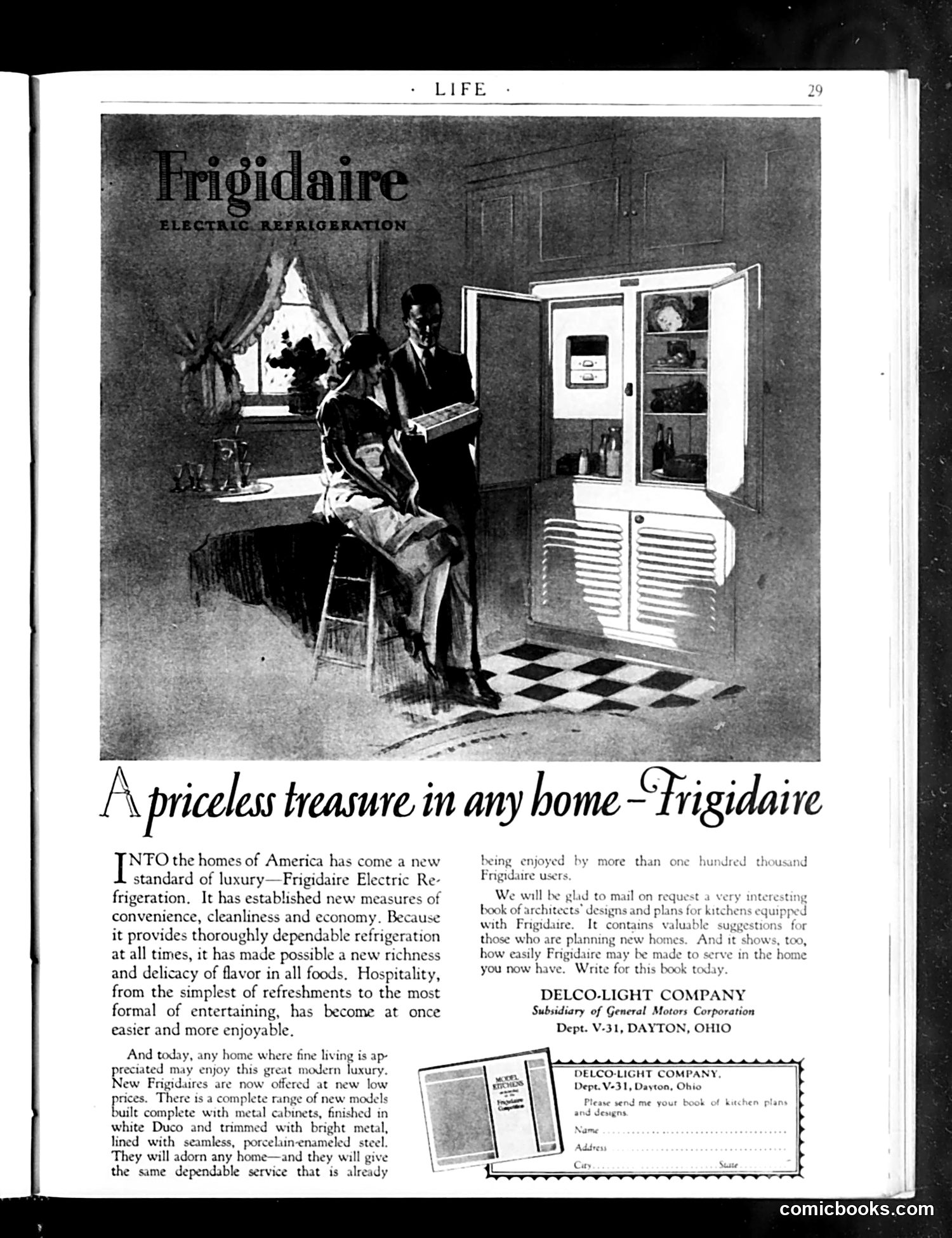
This is a **full-page advertisement**, not satire or political commentary. It promotes Frigidaire electric refrigeration as a new luxury product for American homes. The illustration depicts an idealized domestic scene: a well-dressed woman sits at a kitchen table while a man (likely her husband) opens a large Frigidaire refrigerator. The setting emphasizes modernity and elegance—checkered flooring, fashionable clothing, refined furnishings. The ad's messaging targets middle-to-upper-class Americans by positioning electric refrigeration as enabling sophisticated entertaining and fine living. The tagline "A priceless treasure in any home" reflects 1920s-30s consumer culture, when electric appliances represented progress and status. The copy emphasizes reliability, new affordable pricing, and aesthetic appeal ("will adorn any home"). This reflects the era when refrigeration was still a luxury good being marketed to aspirational consumers, before it became standard in American kitchens.
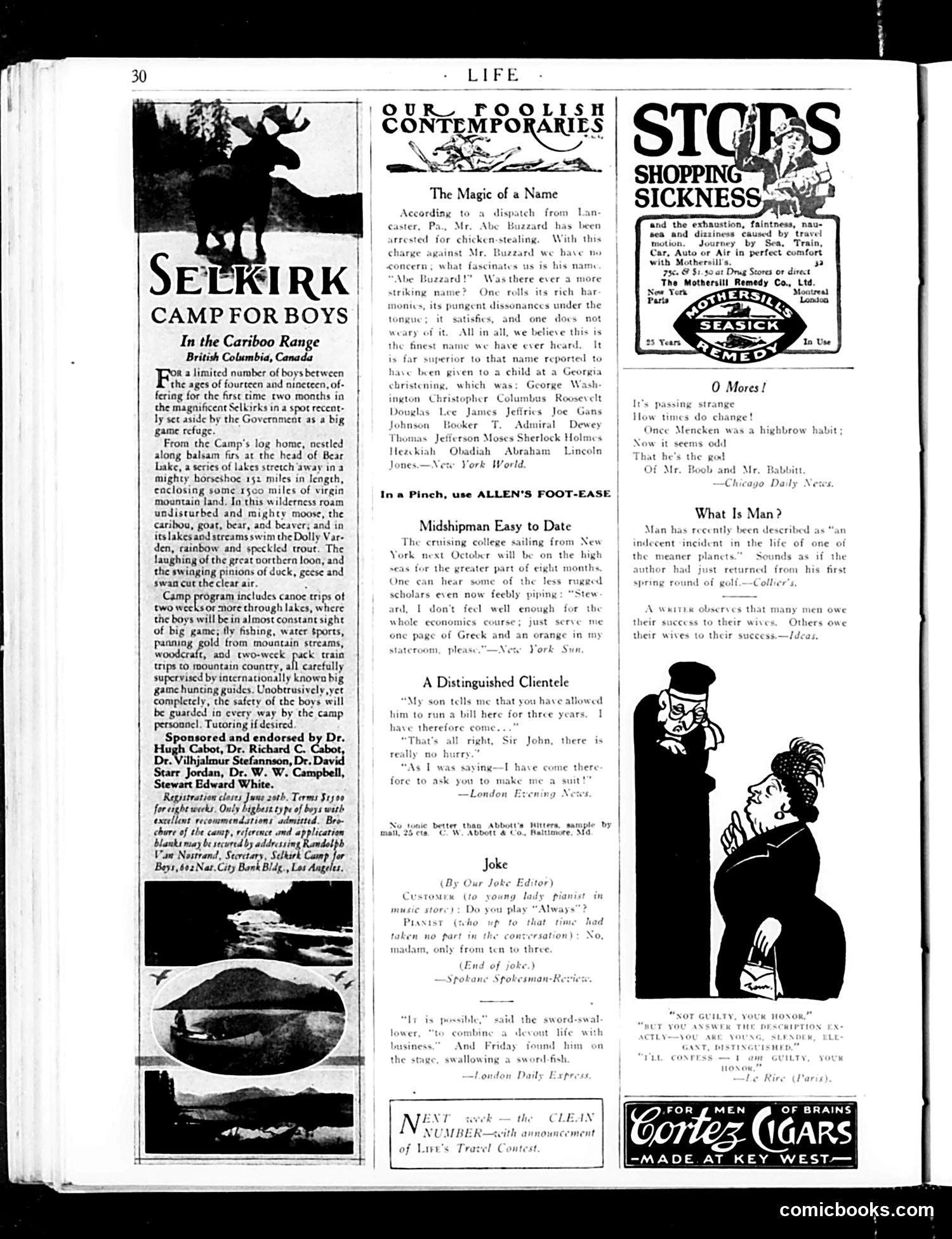
This page from *Life* magazine (a satirical publication, not the modern photo magazine) contains multiple sections of humor and advertising typical of the era. **Main Content:** The left side features an advertisement for **Selkirk Camp for Boys** in British Columbia—a wilderness experience offering canoeing, hunting, and outdoor activities for teenagers aged 14-19. **"Our Foolish Contemporaries"** section satirizes newspaper absurdities: - A humorous piece about an arrested man named "Abe Buzzard," mocking how this surname—though ridiculous—sounds more distinguished than famous names like Roosevelt or Jeffries - Jokes about college sailors and financial transactions - Miscellaneous short quips about everyday life **The Cartoon:** The right side shows a small cartoon captioned *"Not Guilty, Your Honor"*—depicting a well-dressed man claiming innocence while being arrested. The humor appears to target social hypocrisy or false respectability. The page is primarily **filler content and advertisements** rather than focused political satire. It reflects early 20th-century *Life*'s style: light social commentary mixed with product promotions.
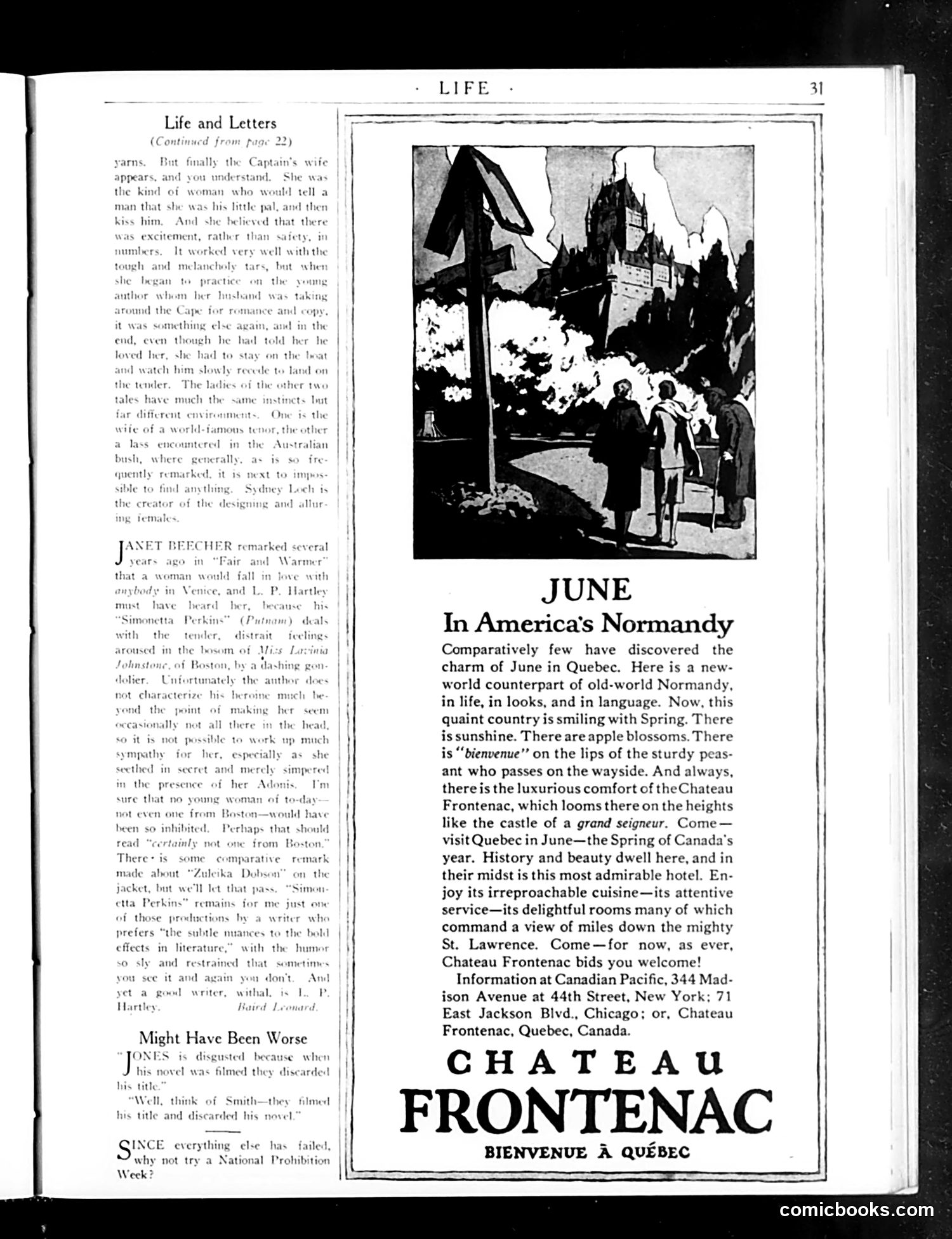
This page combines literary commentary with advertising. The left column discusses writers like Janet Beecher and L.P. Hartley, including a satirical quip about Prohibition: "Since everything else has failed, why not try a National Prohibition Week?" This references the ongoing debate about alcohol bans during the Prohibition era (1920-1933), sarcastically suggesting that if other social reforms have flopped, perhaps restricting drinking might work. The right side is a full-page advertisement for Chateau Frontenac hotel in Quebec City, framed as travel editorial. It markets Quebec as "America's Normandy"—positioning French-Canadian culture as analogous to European sophistication—and emphasizes the hotel's luxury, cuisine, and scenic St. Lawrence views. The ad appears designed to appeal to wealthy American travelers seeking Old World charm without leaving North America.
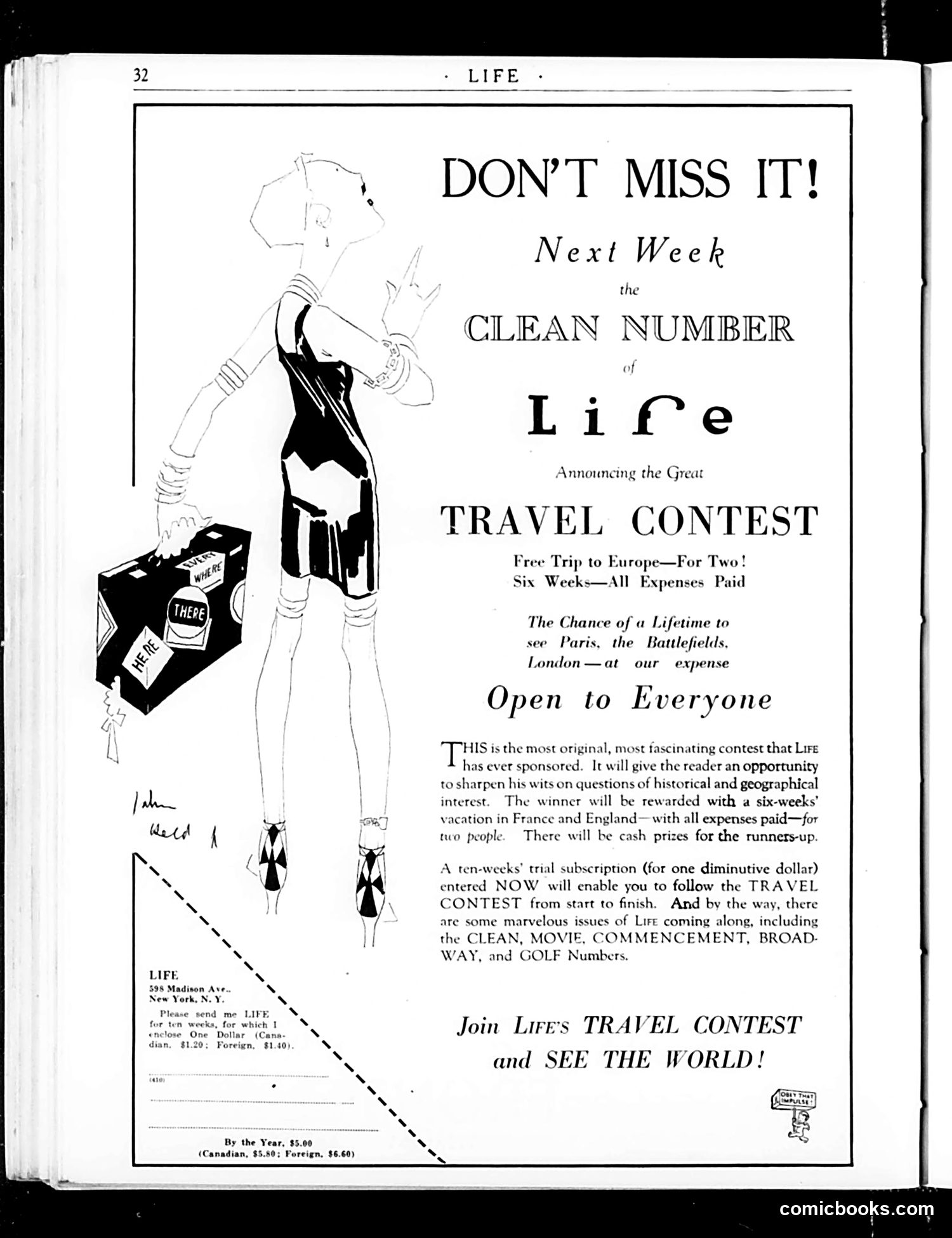
This is primarily **advertising content**, not political satire. Life magazine is promoting an upcoming travel contest and subscription offer. The illustration shows a stylized woman in 1920s flapper fashion (short skirt, headband, long strands) juggling luggage and travel accessories—visualizing the promised European adventure. **The appeal:** Life is offering readers a chance to win an all-expenses-paid six-week trip to France and England for two people by entering a trivia contest about "historical and geographical interest." The copy emphasizes this as "the most original, most fascinating contest" Life has sponsored. **The business model:** A one-dollar ten-week trial subscription would let readers follow the contest from start to finish, with cash prizes for runners-up. Life also highlights upcoming special themed issues (Clean, Movie, Broadway, Golf numbers) to encourage subscription. The "CLEAN NUMBER" reference suggests Life had humor issues with adult content, making the "clean" edition a marketable variant.
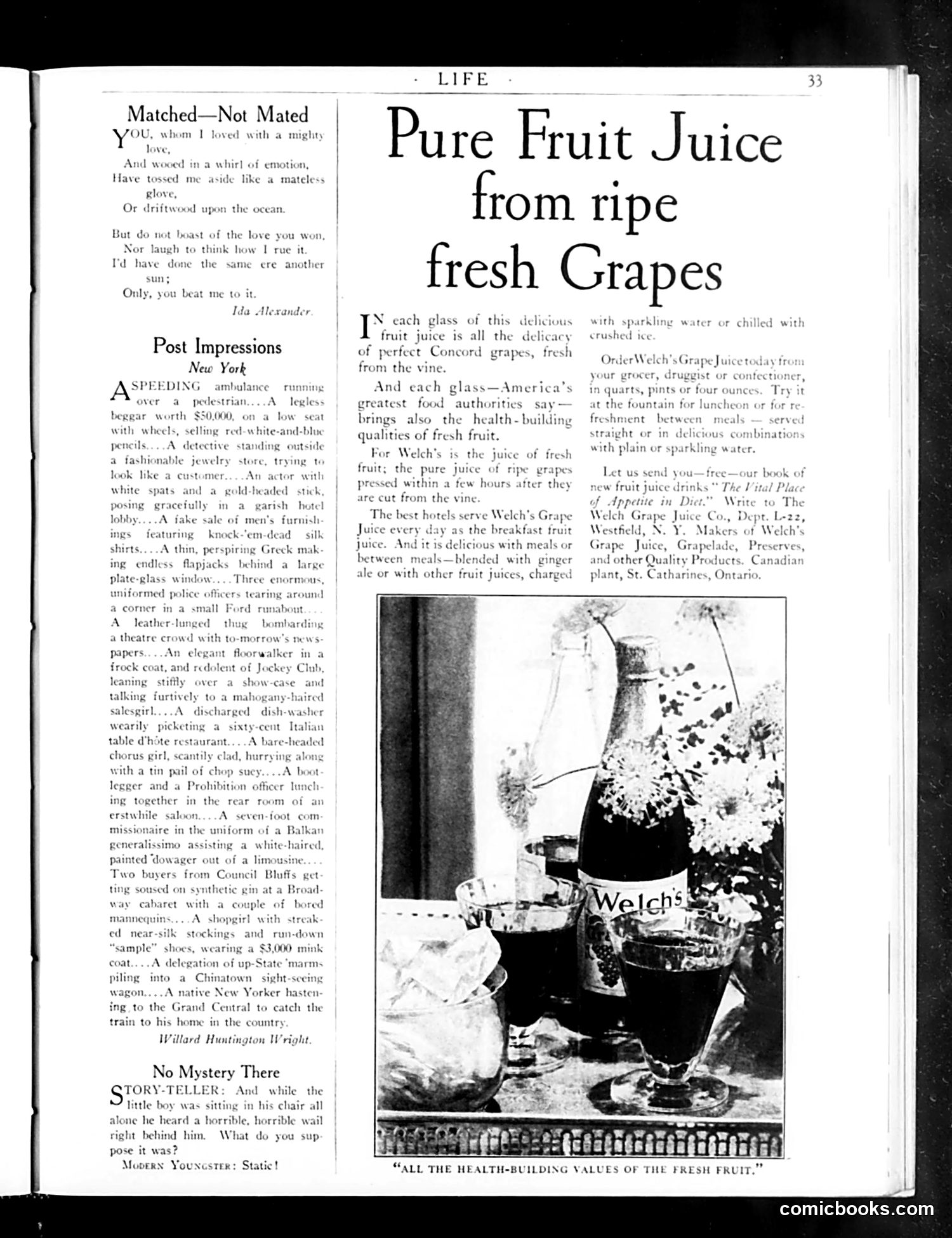
This page mixes poetry, social satire, and advertising with no coherent political cartoon. **"Matched—Not Mated"** is a romantic poem by Ida Alexander about unrequited love—a heartbroken speaker addressing someone who toyed with their affections. **"Post Impressions: New York"** by Willard Huntington Wright is satirical social commentary sketching various New York characters and types: disabled veterans, actors, flapper chorus girls, Prohibition-era bootleggers and police, wealthy dowagers, and rural visitors. The humor targets urban society's contrasts and moral hypocrisy (noting Prohibition officers alongside illegal alcohol dealers). **"No Mystery There"** is a brief joke: a storyteller asks children what caused a mysterious wail—the modern child answers "Static!" (radio interference)—mocking contemporary technology replacing imagination. The page's **dominant content is a Welch's Grape Juice advertisement** featuring grapes and a glass, emphasizing health benefits and availability at hotels and stores. There is no unified political cartoon or satirical image—the page assembles unrelated literary and commercial content typical of Life's miscellaneous format.
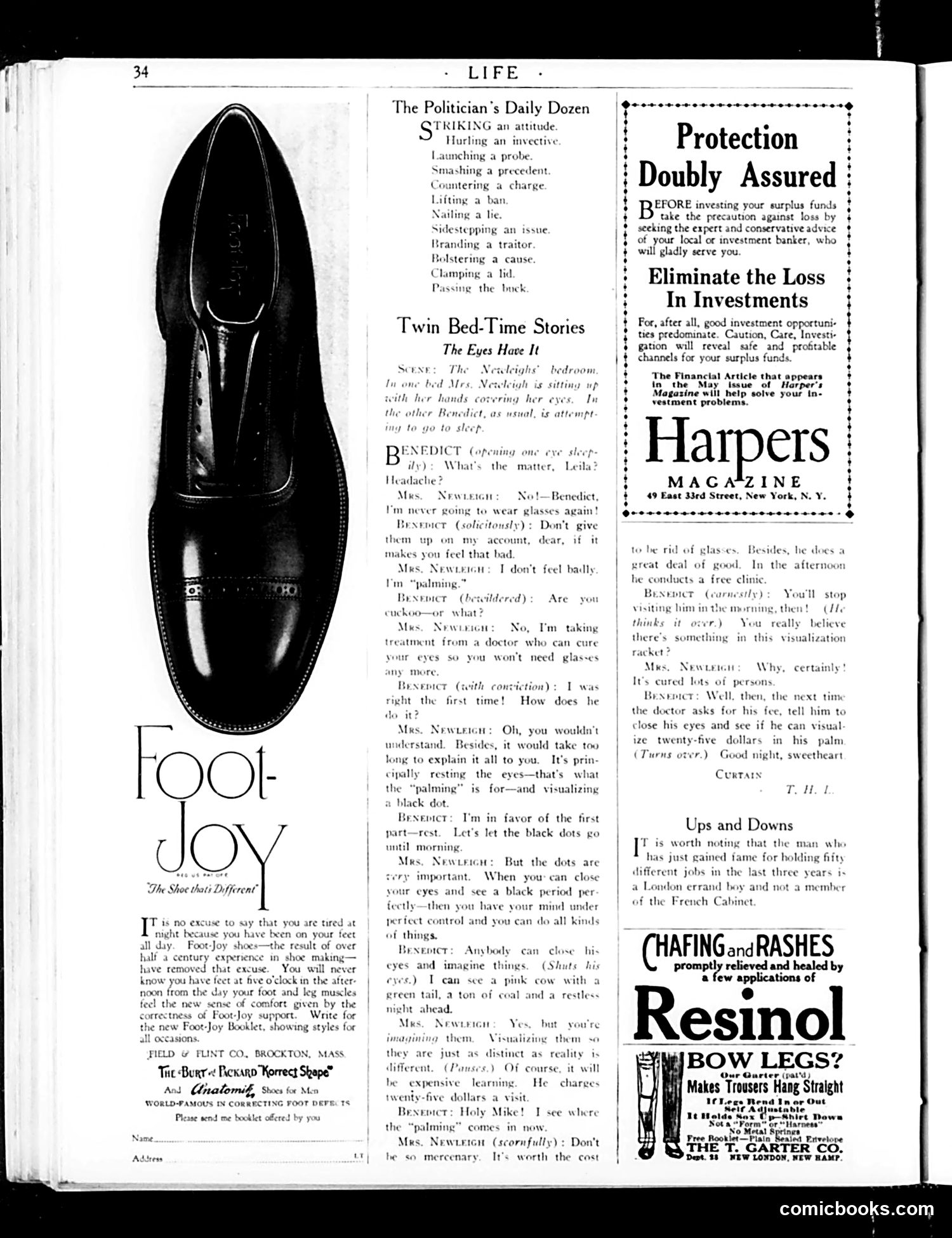
This page primarily showcases **advertising** for shoes and investment services, alongside two pieces of satirical content: **"The Politician's Daily Dozen"** is a brief checklist-style satire listing twelve routine political maneuvers: "striking an attitude," "hurling invective," "smashing a precedent," "lifting a ban," "nailing a lie," "sidestepping an issue," "branding a traitor," "bolstering a cause," and "passing the buck." The joke critiques politicians as engaging in predictable, performative theater rather than substantive governance—a timeless jab at political phoniness. **"Twin Bed-Time Stories: The Eyes Have It"** is a marital comedy dialogue where Mrs. Newleigh refuses glasses but visits a doctor who charges $25 per visit to teach "visualization"—imagining black dots to rest eyes. Her husband finds the expensive treatment absurd, though she insists it works. The satire mocks both pseudoscientific medical fads and gullible patients willing to pay handsomely for dubious treatments. Both pieces reflect early 20th-century skepticism toward political rhetoric and unproven wellness trends.
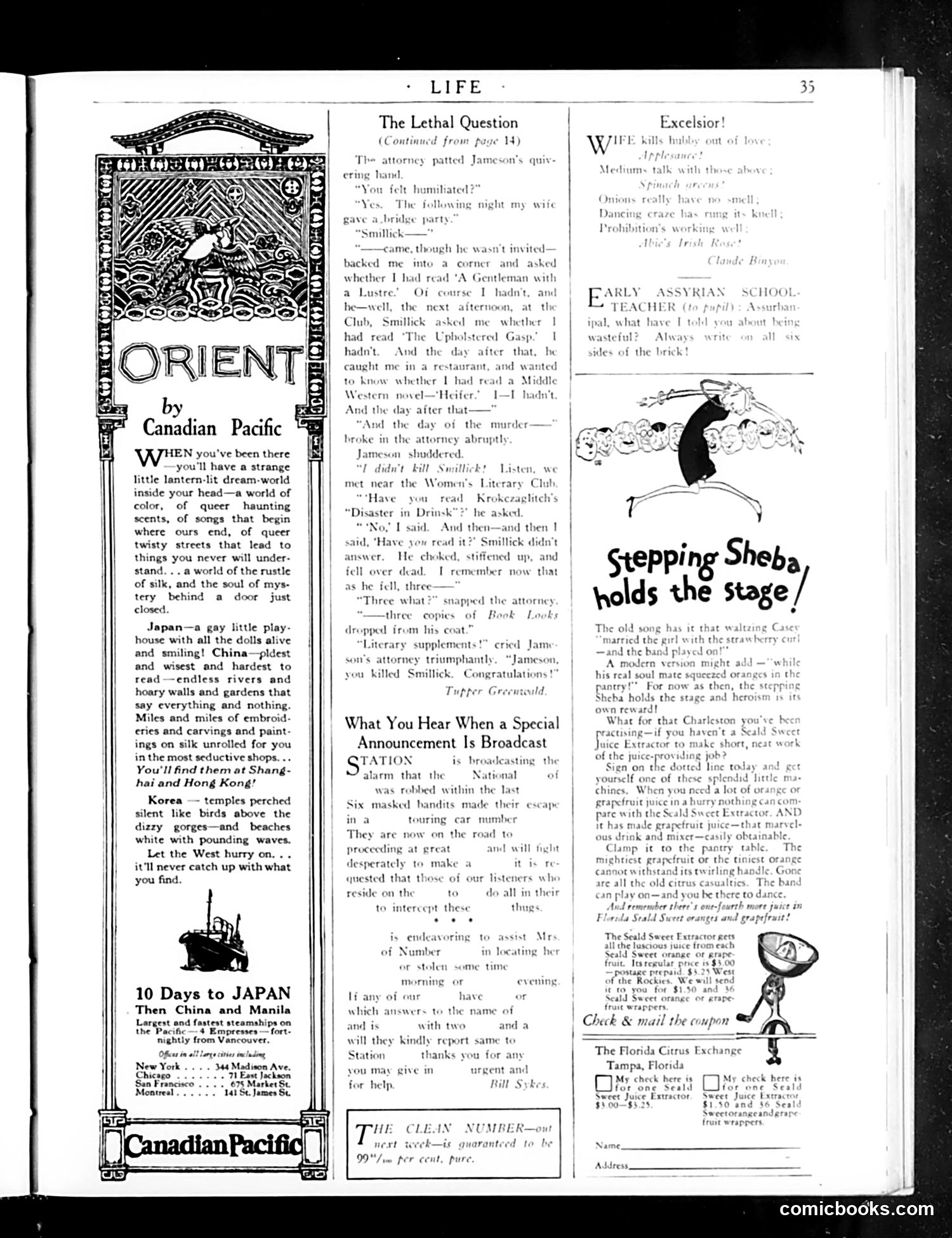
This page contains **primarily advertisements** with two satirical pieces interspersed. The main content includes: 1. **"Orient by Canadian Pacific"** — A travel advertisement romanticizing Asia (Japan, China, Korea, Shanghai, Hong Kong) with flowery language about exotic mystery and beauty. This reflects early 20th-century Western orientalism. 2. **"The Lethal Question"** — A humorous short story about a man (Smillick) who dies after repeatedly pestering an attorney about whether he's read various literary works. The joke: when Smillick collapses dead, "three copies of Book Looks dropped from his coat" — satirizing pretentious literary culture and social one-upmanship through reading. 3. **"What You Hear When a Special Announcement Is Broadcast"** — A satirical piece mimicking radio emergency bulletins about a robbery, poking fun at the dramatic, overwrought language of radio broadcasts. 4. Various product advertisements (Scald Sweet Juice Extractor, etc.) and travel promotions round out the page. The overall tone reflects *Life* magazine's satirical approach to American culture and contemporary social pretensions.
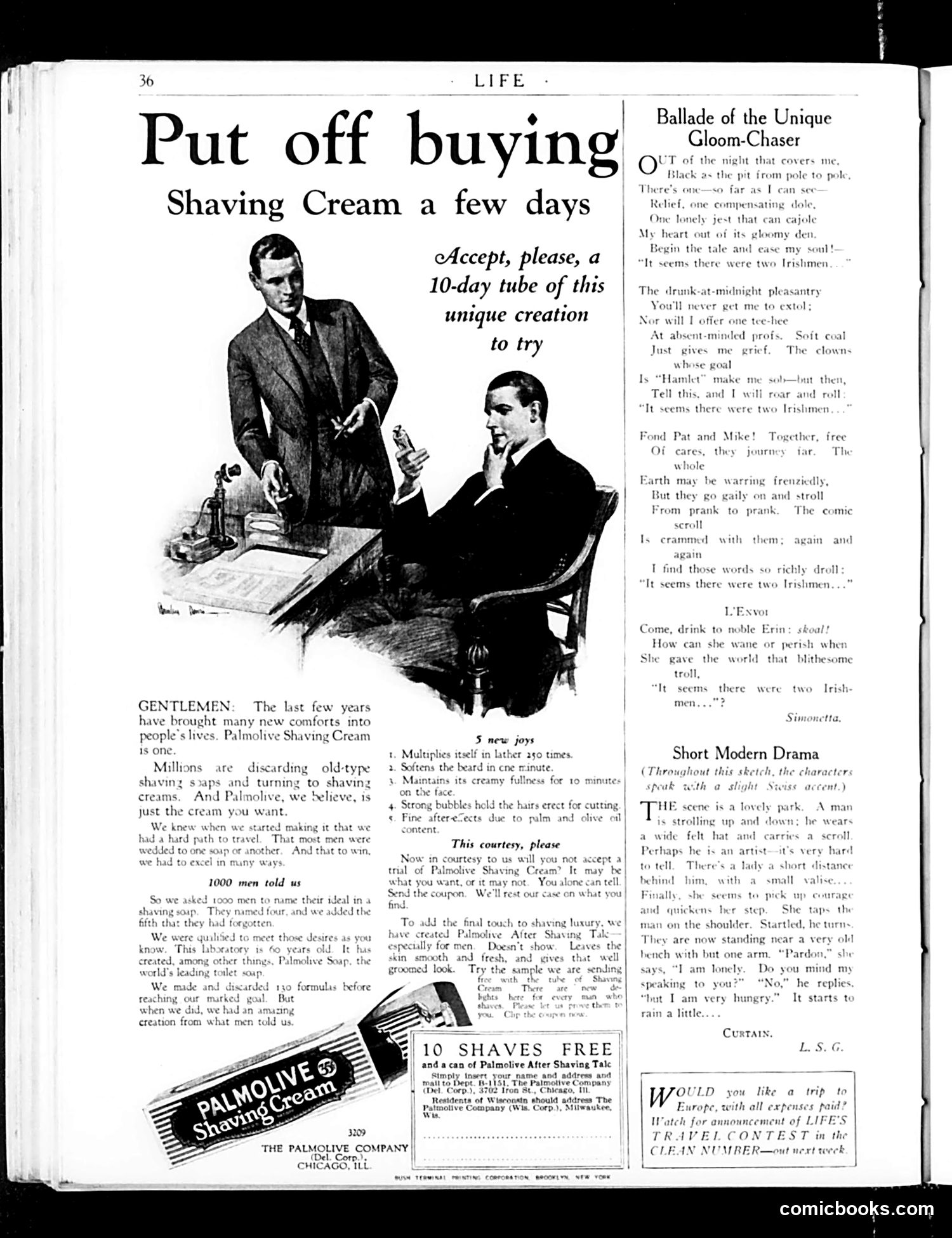
This page is primarily a **Palmolive Shaving Cream advertisement** with supporting literary content, not political satire. The main ad features two businessmen in an office setting, with the standing figure presenting a tube of shaving cream to the seated man. The advertisement's appeal centers on **convenience and modernity**: it urges readers to postpone purchasing their regular shaving soap and try this new product instead, offering "10 shaves free" as an incentive. The copy emphasizes that "millions are discarding old-type shaving soaps" for modern shaving creams—positioning Palmolive as aligned with contemporary progress. The surrounding content includes humorous poetry ("Ballad of the Unique Gloom-Chaser") and a short dramatic sketch, typical of Life's satirical magazine format. **For modern readers**: This represents early 20th-century consumer marketing emphasizing novelty and lifestyle improvement, before such advertising techniques became ubiquitous.
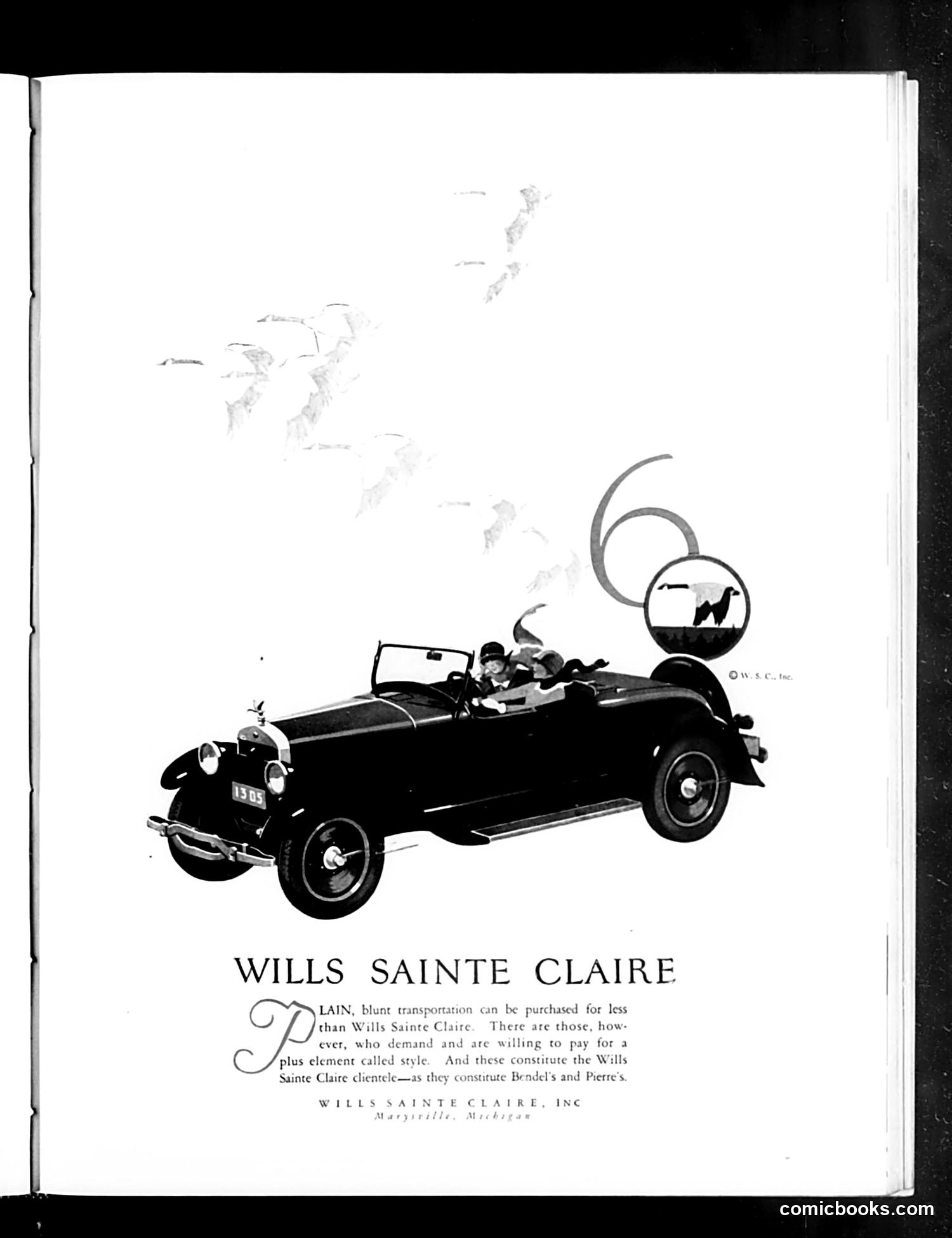
This is a **car advertisement**, not political satire. It promotes the Wills Sainte Claire automobile, manufactured in Marysville, Michigan. The ad uses humor to position the car as aspirational. The copy argues that while basic transportation is cheap, those with discerning taste willing to pay more choose the Wills Sainte Claire for its "style." The illustrated car—shown as a luxury convertible with well-dressed occupants—represents this premium positioning. The decorative art deco graphics (the curved spheres above the vehicle) emphasize modernist elegance. This is a straightforward **luxury goods pitch** from the automotive era (1920s), suggesting that owning this brand signals sophistication and refinement to potential buyers.
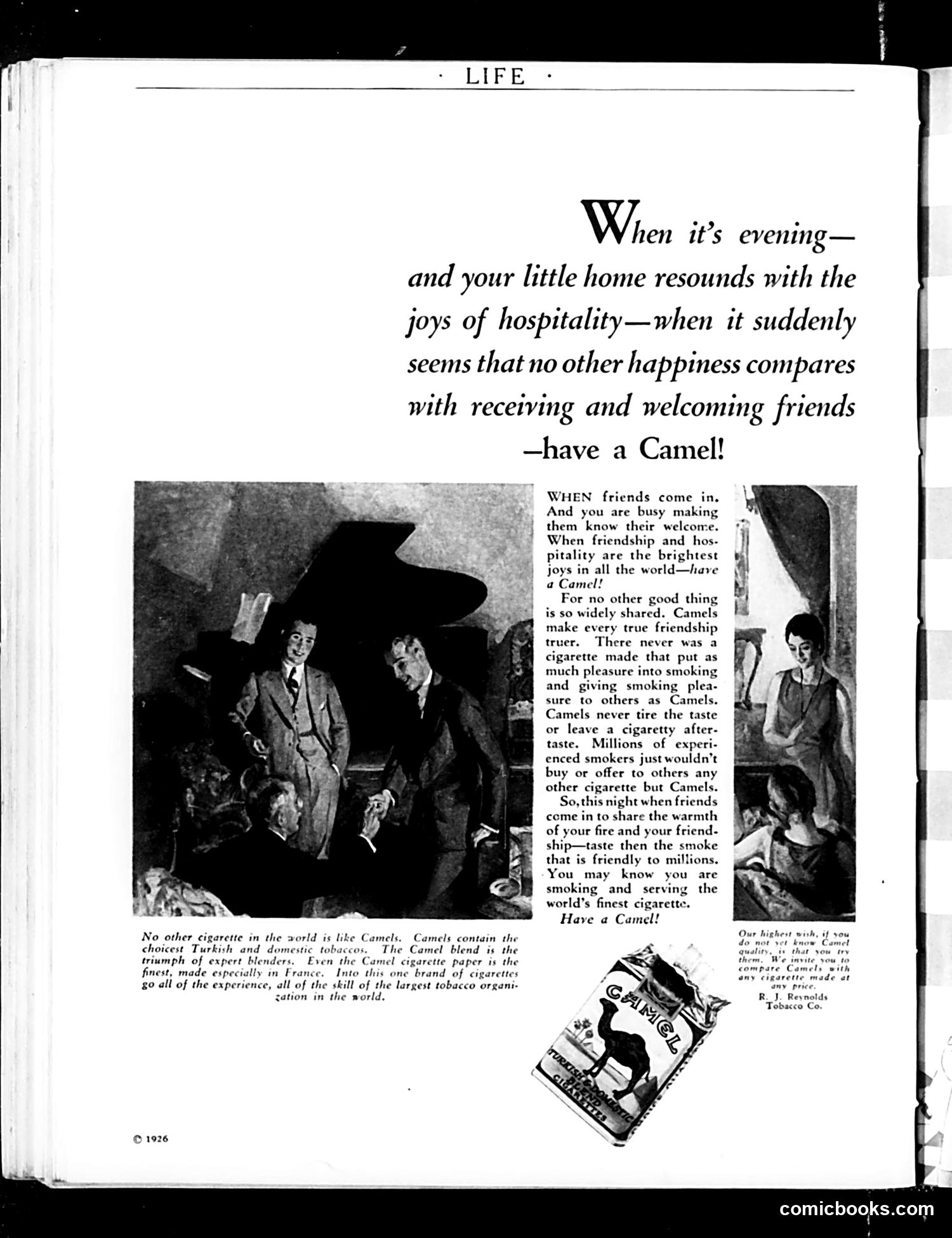
This is a **Camel cigarette advertisement** from 1926, not satire or political commentary. It appears in *Life* magazine's advertising section. The page depicts a domestic social scene: well-dressed men and women gathered in a home during evening, sharing cigarettes while entertaining guests. The central image shows figures by a fireplace in an intimate, hospitable setting. The ad's appeal is entirely about **social status and hospitality**: smoking Camels signals good taste, refinement, and generosity toward guests. The text emphasizes that offering Camels demonstrates friendship and that no other cigarette brand is superior. **For modern readers**: This reflects pre-1960s advertising when cigarettes were marketed as wholesome social accessories associated with elegance and hospitality—before health risks were widely acknowledged or regulated. The ad makes no health claims, only lifestyle and taste appeals, which would be illegal in contemporary cigarette advertising.