
Life, 1926-04-29 · page 18 of 42
Life — April 29, 1926 — page 18: what you’re looking at
What you’re looking at
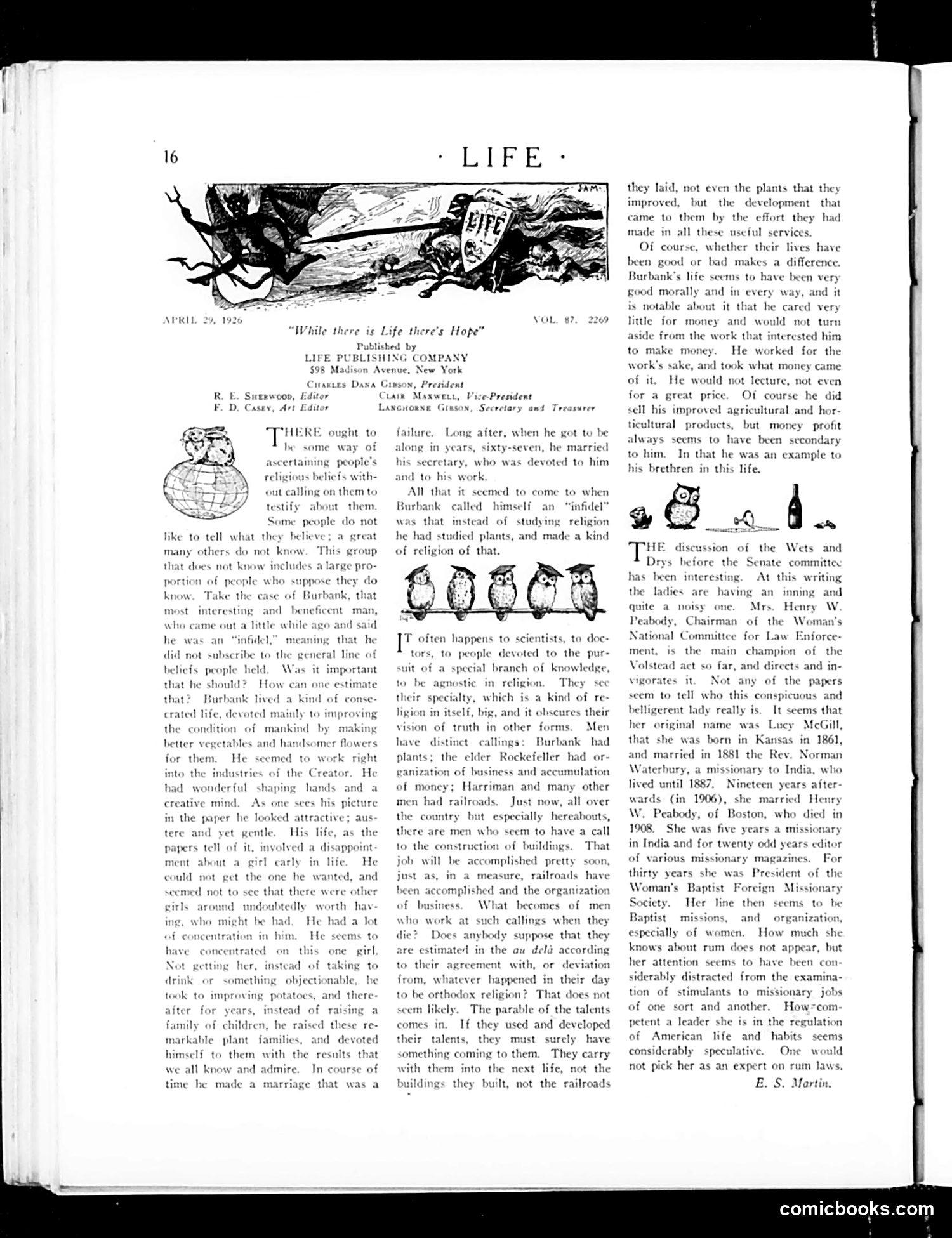
The page features an illustration titled **"While there is Life there's Hope"** depicting a figure emerging from or sitting atop a globe—suggesting optimism or resilience amid global circumstances. The article discusses **Luther Burbank**, the famous botanist and plant breeder. The text notes Burbank's unconventional religious views, describing how he "did not subscribe to the general line of beliefs people held" and instead focused on practical plant improvement work rather than religious doctrine. The piece uses Burbank as an example of someone whose life contributions—developing improved plants and agricultural products—represent secular accomplishment. This reflects early 20th-century American debates between scientific progress and traditional religious belief systems, positioning practical achievement as spiritually meaningful work.
📄 Transcribed text from this page (OCR, searchable)
Machine-transcribed from the original scan — historical spelling and the odd misread are preserved.
LIFE PUBLISH Cuantrs Dawa Giasox, Pre Suexwoor, Editor Casey, Art Editor Cae Lancuorse G RE ought te s beliefs with- out calling on them to Some people do not many others ¢ that does nm yw includes a large general line crated life, devoted mainly to improving better vegetables and handsomer flowers r he looked attractive; seemed not to took to impre to them with the ed by NG COMPANY ue, New York nt Maxwent, Vice-President sox, Secretary and Treasurer re. Long aiter, when he got to be long married 1 years, sixty-seven, his secretary, who was devoted to him ud to his work All that it seemed to come to when nk called himself an “infidel” was that instead of studying re he had studied plants, and made a kind of religion of that. l often happens to scientists, to doc- tors, to people devoted to the pur- suit of a special branch of knowledge, io be agnostic in. reli ion, They sec their specialty, which is a kind of re- ligion in itself, big, and it ol vision of truth in oth er forms. ings: Burbank had Rockefeller had or- distinet ca elder of business and accumulation have plants; the ganizati of money; Harriman and many other men had railroads. Just now, all over the country but especially hereabouts, there are men who seem to have a call That pretty so to the construction of buildings. job will be accomplished just as, in a measure, railroads have en accomplished and the organization What who work at such callings when they of business. becomes of men ie? ~=Does anybody suppose that the; are estimated in the au dela according to their agreement with, or deviation from, whatever happened in their day to be orthodox religion? That does not seem likely. The parable of the talents If they used and developed they: ‘rast have to them. They carry with them into the next life, not the builc built, not the railroads comes in their taler surely something coming they they laid, not even the plants that they improved, but that came to them by the effort they had in all these the development made useful services. Of course, whether their lives have been good or bad makes a difference. Burbank’s life seems to have been very good morally and in every way, and it able little for aside from the work that to make mc work's sak of it. He for a great price. Of is ne out it that he cared very money and would not turn rested him cy. He worked for the «| took what money came would not lecture, not even he did sell his improved agricultural and hor- ticultural products, course me ey profit always seems to have been secondary to him. In that he was an example to his brethren in this life. Wets and Senate committe HE discussion of the Drys has been before the teresting. At this writing ladies are aving an inning and quite a noisy one. Mrs. Henry W Peabody, Chairman of the Woman’ National Committee for Law Enforce- ment, is the main champion of the Volstead act so far, and directs nd in- apers seem to tell who this conspicuous and Vigorates it any of the It seems that Lucy belligerent lady really is. her original name that was McGill, in 1861, Norman she was born in 1881 the Rev and married in Watert lived until 1887, Nineteen years after wards (in 1906), she married Henry W. Peabody, of Boston, who died in 1908, She was five years a missionary in India and for twenty odd years ed of various missionary magazines. For the thirty years she was President « Woman's Baptist Her line ist miss Society. then seems to be and org: zation, How much she knows about rum does not appear, but especially of women her attention seems to have been con siderably distracted from the examina- tion of stimulants to missionary jobs How com. petent a leader she is in the regulation of American life and_ hal considerab of one sort and another. seems. speculative. One would not pick her as an expert on rum laws. E. S. Martin, comicbooks.com