
A complete issue · 36 pages · 1926
Life — February 25, 1926
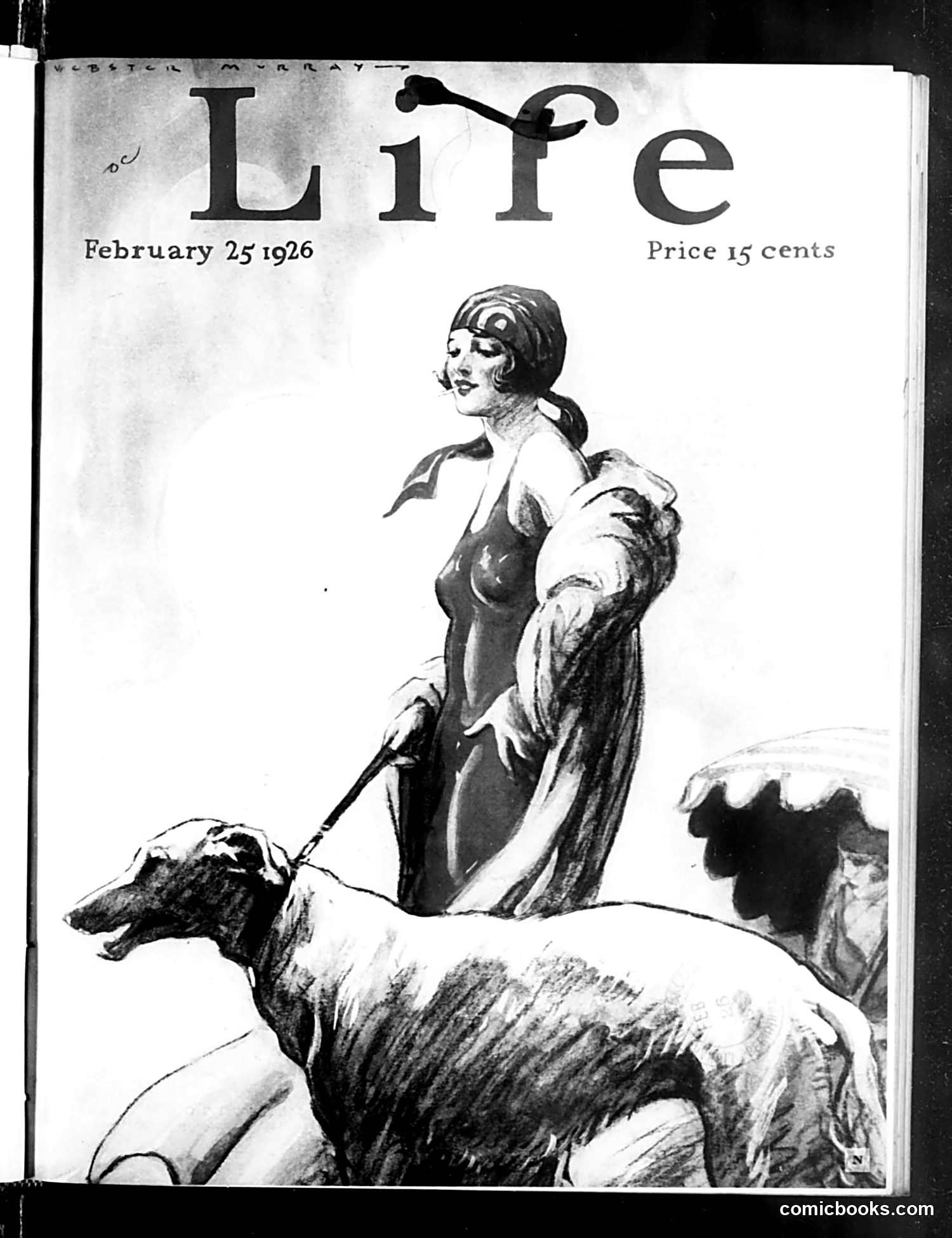
This appears to be a **Life magazine cover featuring an illustration of a fashionable woman with a dog**. The woman wears 1920s attire—a short-sleeved dress and coat—reflecting the era's modern fashion. Her hairstyle and makeup are characteristic of the "flapper" aesthetic that dominated the period. The illustration likely satirizes **contemporary upper-class leisure culture** and women's fashion trends of the Jazz Age. The inclusion of a well-groomed dog suggests themes of wealth, refinement, or perhaps vanity. Without additional text visible on the cover, the specific satirical point remains unclear, though Life magazine typically used covers to comment on social trends, fashion excess, or cultural shifts of the 1920s.
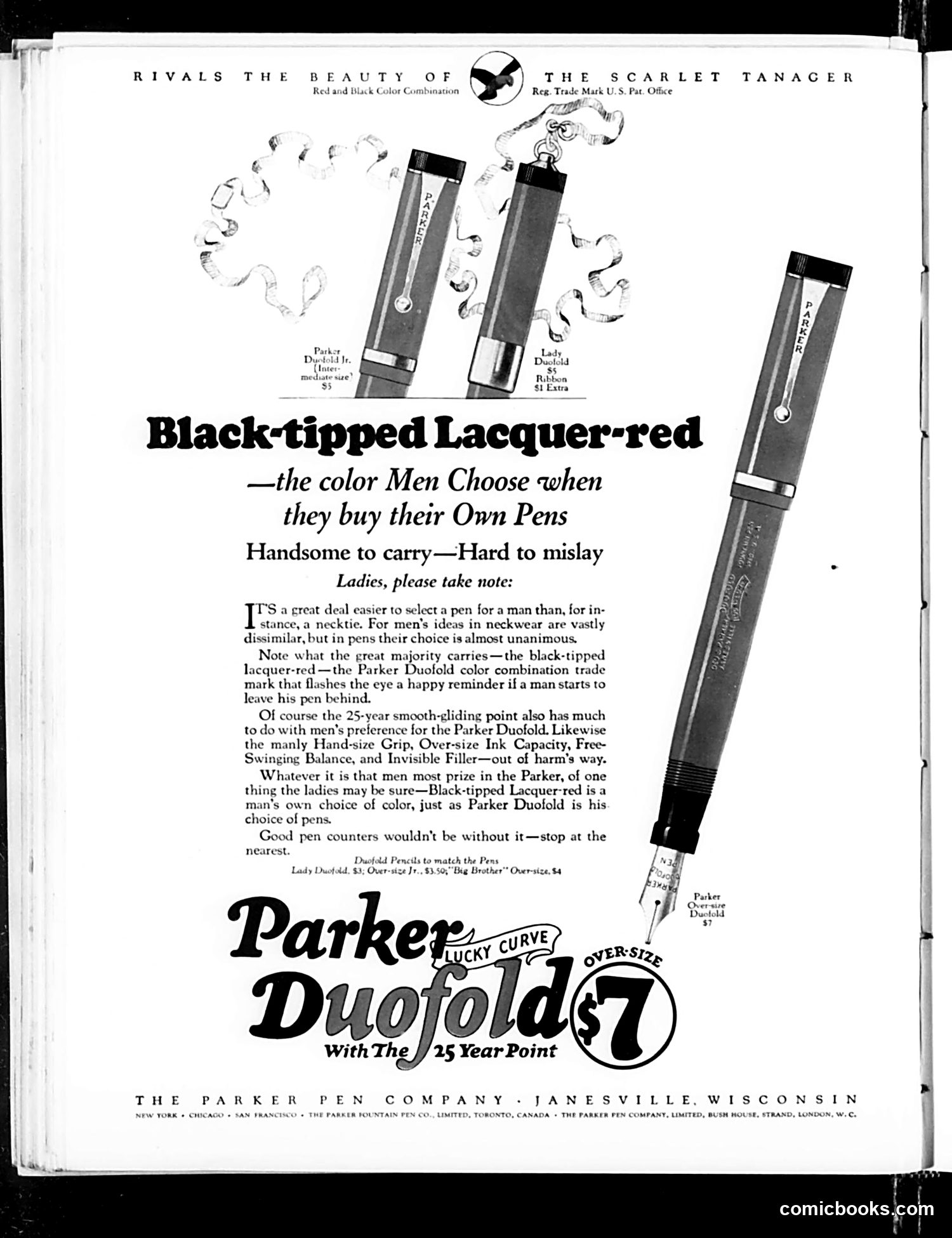
This is **not a cartoon or satire page**—it's a straightforward **advertisement for Parker Duofold fountain pens** from the early 20th century. The ad targets gift-giving, particularly aimed at women shopping for men. It argues that selecting a pen for a man is easier than choosing neckties, since men have "almost unanimous" preference for the Parker Duofold in black-tipped lacquer-red (the brand's signature color combination). The copy emphasizes masculine qualities—the pen is "hard to mislay" and appeals to men's practical preferences for smooth writing and large ink capacity. The ad presents this color choice as definitively masculine, reassuring female gift-buyers that they cannot go wrong with this selection. This reflects period advertising that assigned colors and products rigid gender associations.
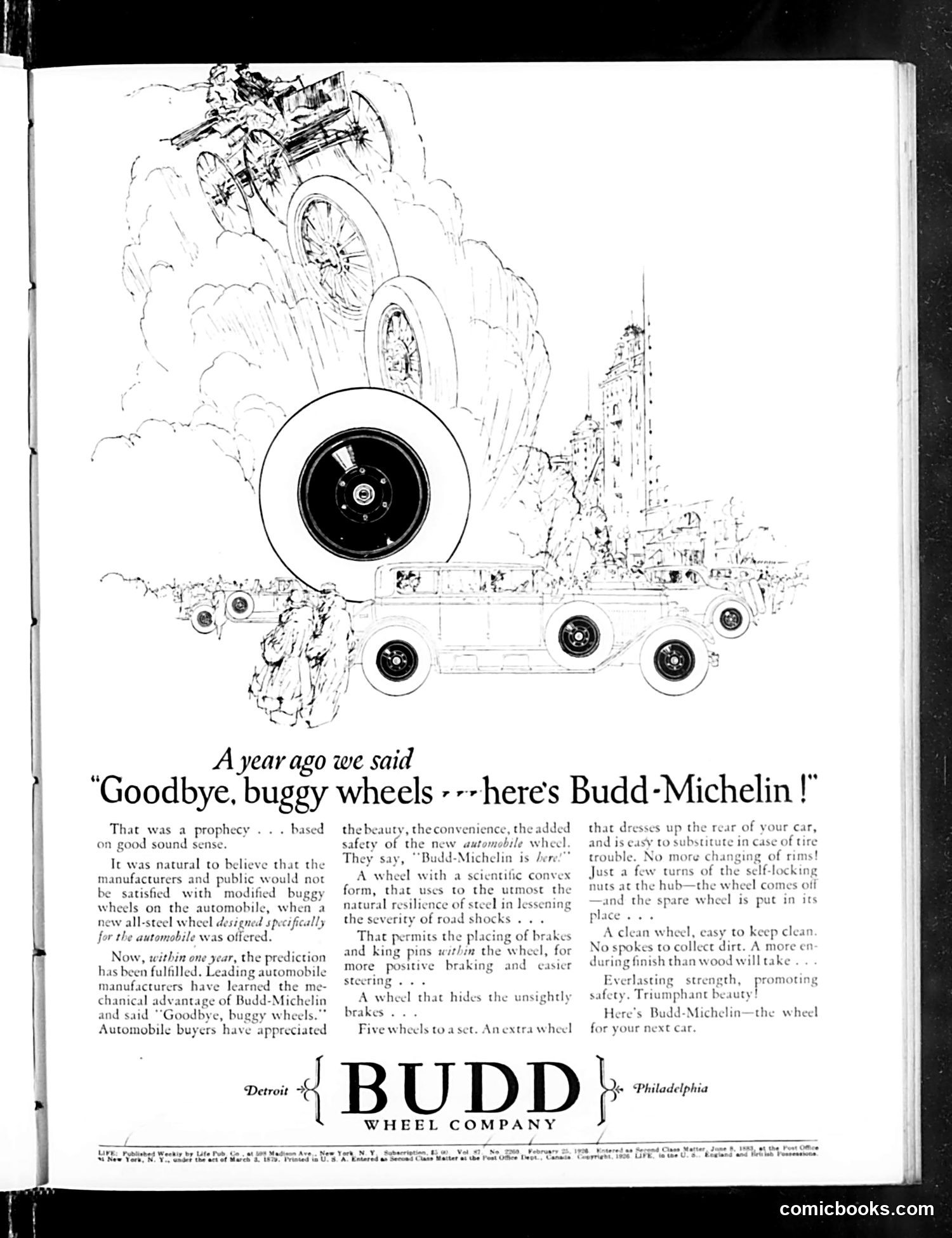
This is primarily a **Budd Wheel Company advertisement**, not political satire. The ad celebrates the superiority of modern automobile wheels over older "buggy wheels." The visual humor compares transportation eras: a horse-drawn buggy appears above a modern automobile, with wheels prominently displayed. The headline "Goodbye, buggy wheels...here's Budd-Michelin!" marks the obsolescence of horse-drawn vehicles. The ad emphasizes practical advantages of the new automobile wheel: scientific design, durability, easier braking, simpler steering, and easier cleaning. It positions Budd-Michelin wheels as representing progress and modernity. This reflects early 20th-century American optimism about automobiles replacing horse-drawn transportation—a genuine technological shift occurring during this period.
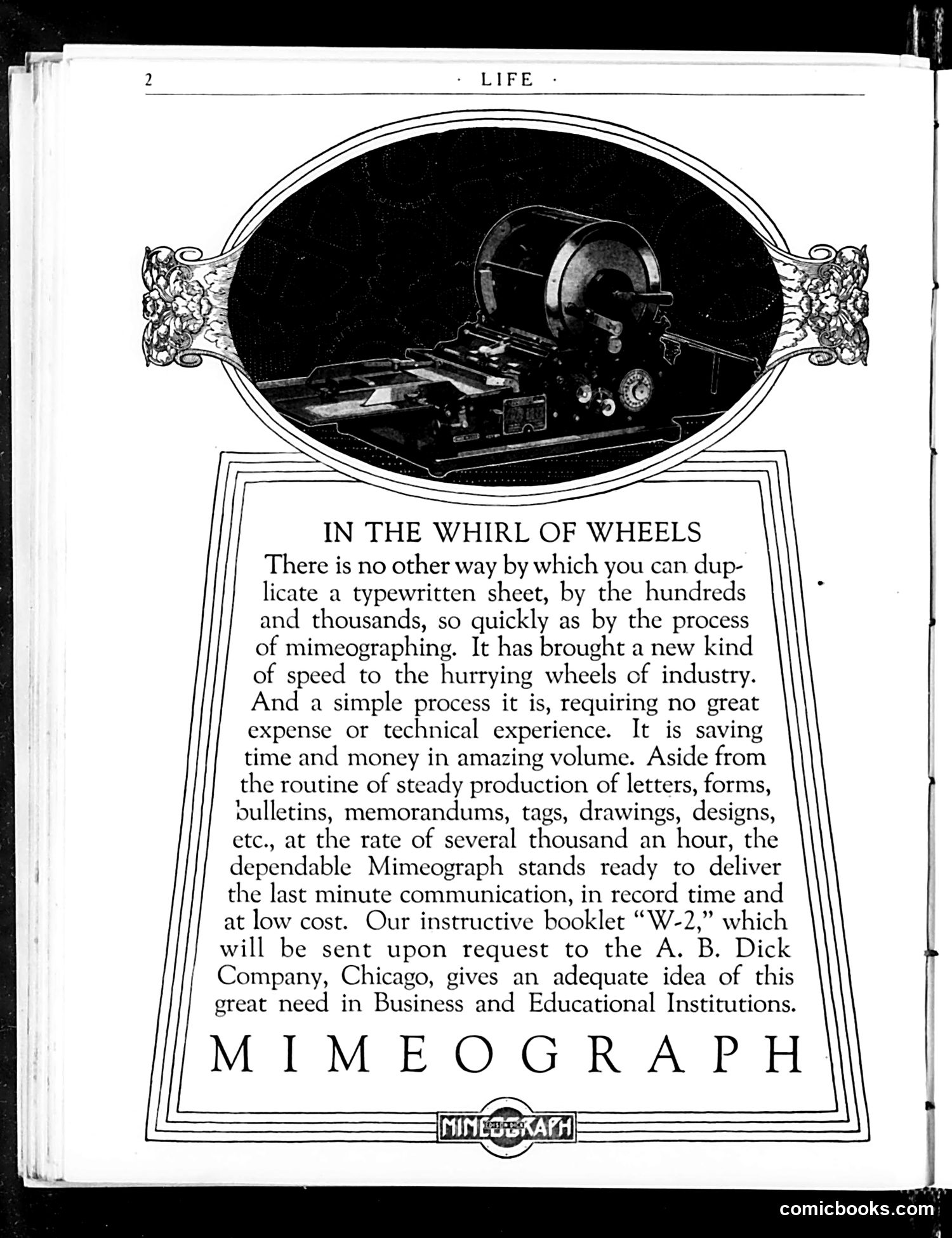
This is primarily **advertising content**, not satirical editorial material. The page promotes the Mimeograph machine, manufactured by the A. B. Dick Company of Chicago. The advertisement emphasizes the mimeograph's speed and efficiency for duplicating documents—letters, forms, bulletins, memoranda, designs—at "several thousand an hour." The headline "In the Whirl of Wheels" uses industrial imagery to suggest modernity and progress. The circular photograph shows the mechanical device itself. The copy targets business and educational institutions, promising cost savings and quick communication capabilities. This represents early 20th-century business technology marketing, positioning the mimeograph as essential office equipment for the modern industrial era.
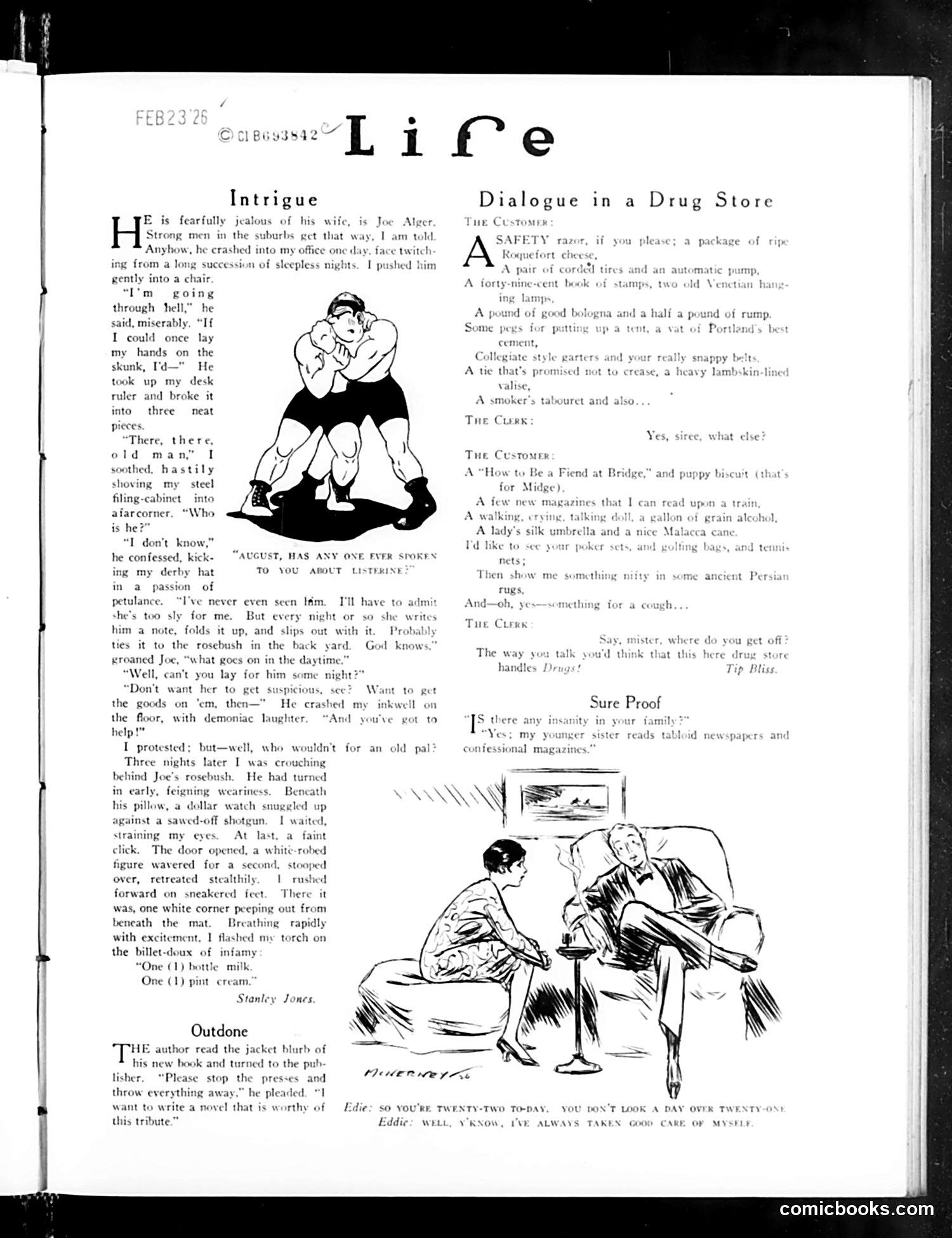
This page contains three separate pieces of satirical content: 1. **"Intrigue"** — A short story about a man who crashes into an office and is subsequently beaten. The narrative appears to be social satire about workplace violence or class conflict. 2. **"Dialogue in a Drug Store"** — A humorous sketch depicting a customer rattling off an absurdly long shopping list to a clerk, satirizing American consumer culture and the increasingly commercialized general store that stocks everything from food to magazines to clothing. 3. **"Sure Proof"** — A cartoon showing two men discussing tabloid newspapers and confession magazines, with one character noting his younger sister reads such publications. This satirizes the popularity of sensationalist media and gossip publications among the general public. The overall theme critiques consumer culture, media consumption, and workplace dynamics of the era.
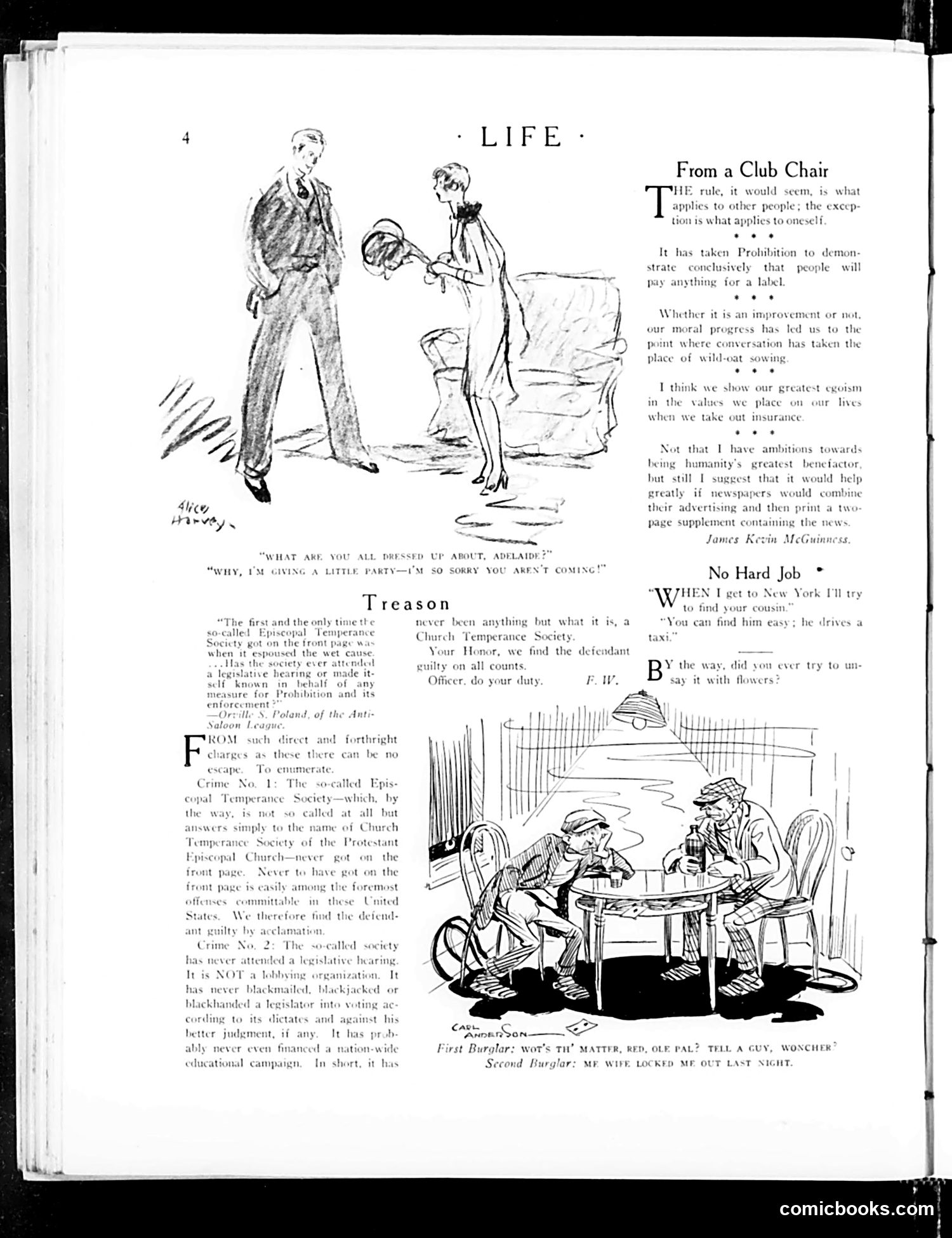
**Top Cartoon ("From a Club Chair"):** This appears to be social commentary on Prohibition-era hypocrisy. The sketch shows a man confronting a woman about her dressed-up appearance at a party he wasn't invited to—likely satirizing the selective morality and social pretense of the Prohibition period. **Middle Section ("Treason"):** A lengthy text piece critiquing temperance enforcement, specifically attacking the "Episcopal Temperance Society" and church-based prohibition efforts. It argues these organizations lack legal authority and questions their methods. **Bottom Cartoon ("No Hard Job"):** A humorous exchange between taxi drivers about finding someone in New York City, with a punchline about using flowers as a pickup method—light social satire unrelated to Prohibition. The page overall reflects 1920s debates about Prohibition enforcement and moral regulation.
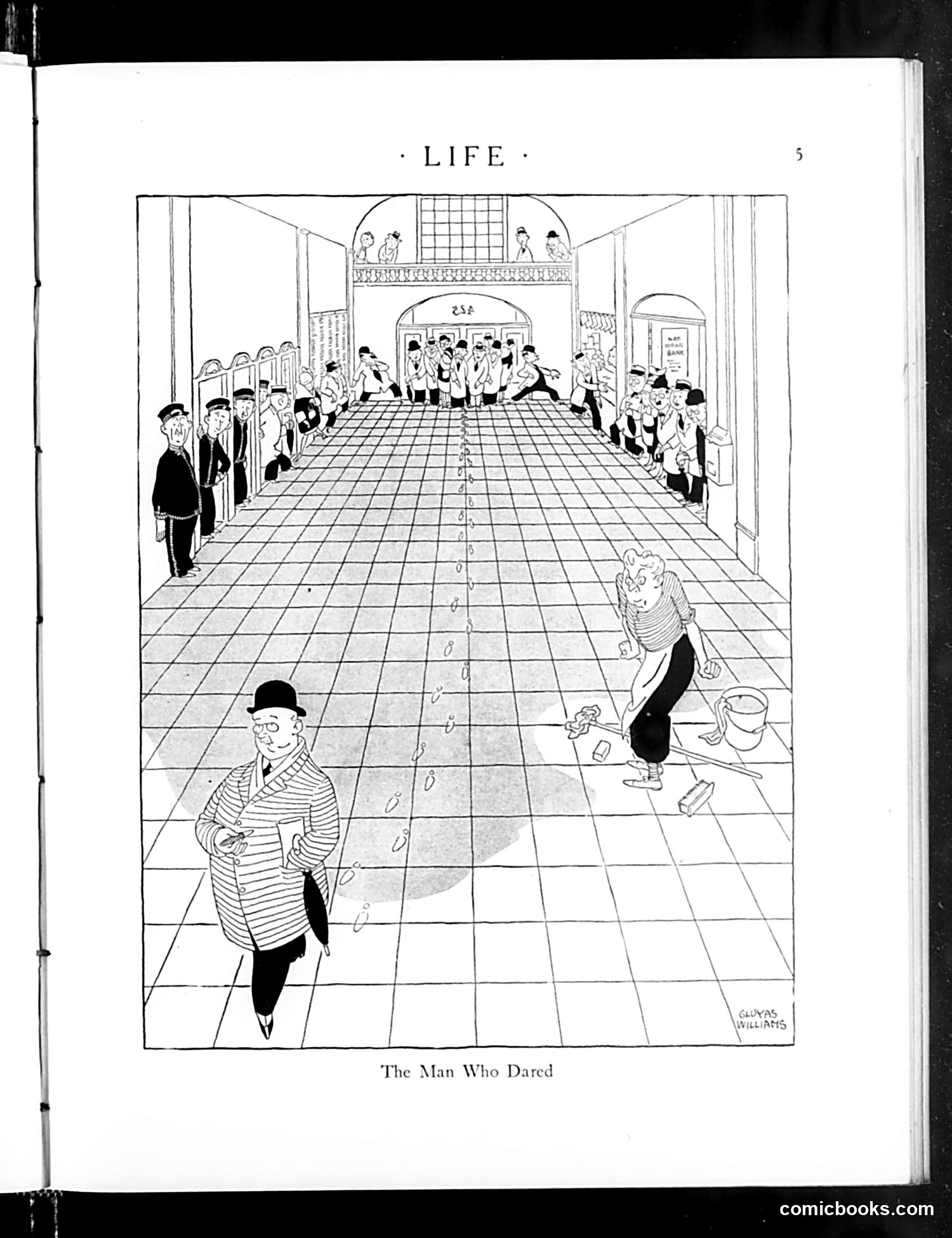
This cartoon depicts a lone man in a striped suit and bowler hat walking through a crowded, institutional corridor—appearing to be a subway station or government building. He walks confidently down the center while crowds of formally-dressed observers line both sides, watching from behind barriers and at upper levels. The title "The Man Who Dared" suggests this figure is doing something transgressive or courageous in a conformist society. The cartoon satirizes social pressure and conformity—the lone individual defying expected behavior while an anxious crowd observes. The specific nature of his "daring" act isn't explicit, but the composition emphasizes the tension between individual nonconformity and mass social surveillance or disapproval. This reflects early 20th-century concerns about individuality versus societal pressure.
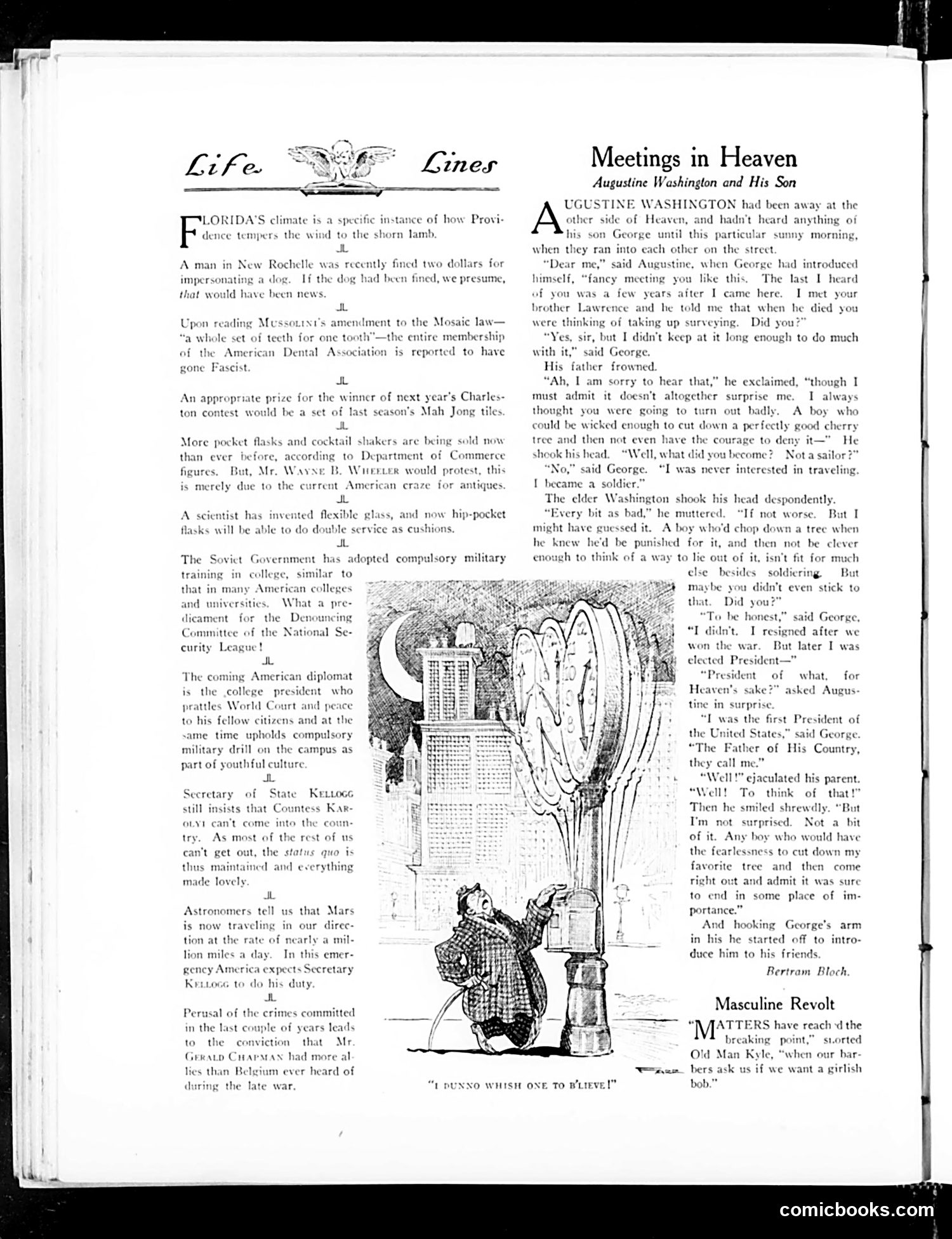
This page contains two distinct pieces: **"Meetings in Heaven"** (right): A dialogue between Augustine Washington (George Washington's father) and his son George, who has recently died. The satire mocks how George Washington's legacy has been mythologized—Augustine expresses surprise that his son became President, implying the real George Washington's actual accomplishments seem inflated by American cultural memory. The joke hinges on contrasting the idealized historical figure with the ordinary man. **Left column "Life Lines"**: Brief satirical news items commenting on contemporary American politics and culture, including references to Secretary Kellogg and various social observations. **The cartoon** (center): Depicts a large tree being felled, illustrating the opening anecdote about young George Washington and the cherry tree—a famous apocryphal story about Washington's honesty that Life treats as absurd mythology.
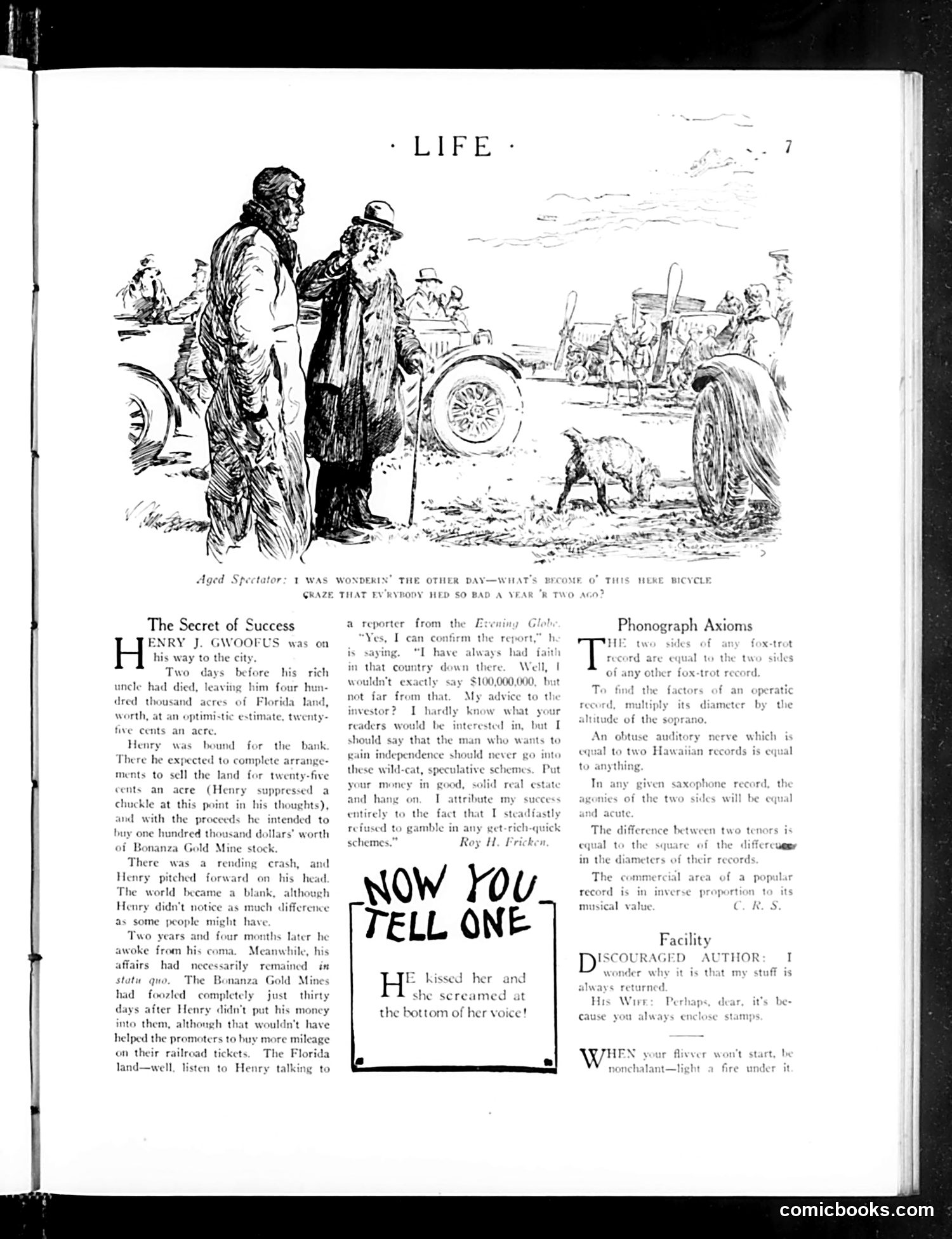
This page contains three separate articles/features rather than a unified cartoon: 1. **"The Secret of Success"** - A narrative about Henry J. Gwoods, a wealthy Floridian who made money in land speculation and gold mining. The accompanying sketch shows an "Aged Spectator" questioning another man about a bicycle craze from two years prior—apparently satirizing how quickly financial fads come and go. 2. **"Now You Tell One"** - A joke feature with a risqué punchline about kissing. 3. **"Phonograph Axioms"** and **"Facility"** - Brief humorous tips about records and writing. The page represents typical early 20th-century Life magazine content: a mix of short humor pieces, practical advice, and satirical commentary on contemporary manias (here, speculation and get-rich-quick schemes).
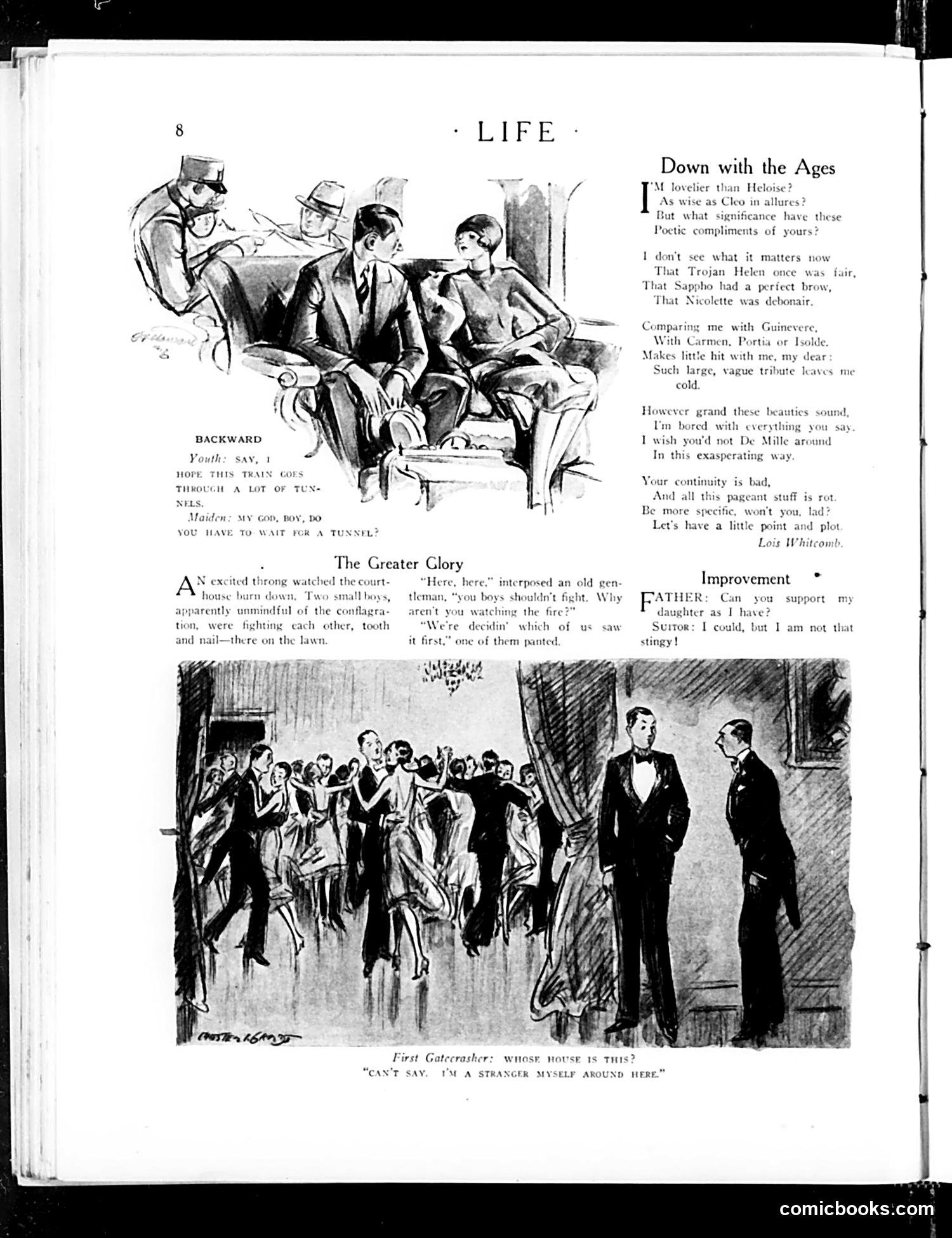
This page contains three distinct pieces of satirical humor typical of early 20th-century Life magazine: **"Backward"** (top sketch): A brief comic exchange mocking impatient youth on trains, with no specific political reference—just observational humor about social behavior. **"Down with the Ages"** (right column): A poem by Lois Whitcomb complaining that comparisons to classical beauties (Helen of Troy, Sappho, Nicolette) are tedious clichés. She demands "specific" compliments instead. This satirizes overworn romantic flattery and flowery poetic conventions. **"The Greater Glory"** (bottom): Two illustrations depicting excited boys watching a house fire, then a formal party scene. The humor contrasts childhood enthusiasm for spectacle with adult social pretense and awkwardness. None reference specific political events or identifiable figures—they're purely social satire targeting universal human behaviors and dated romantic conventions.
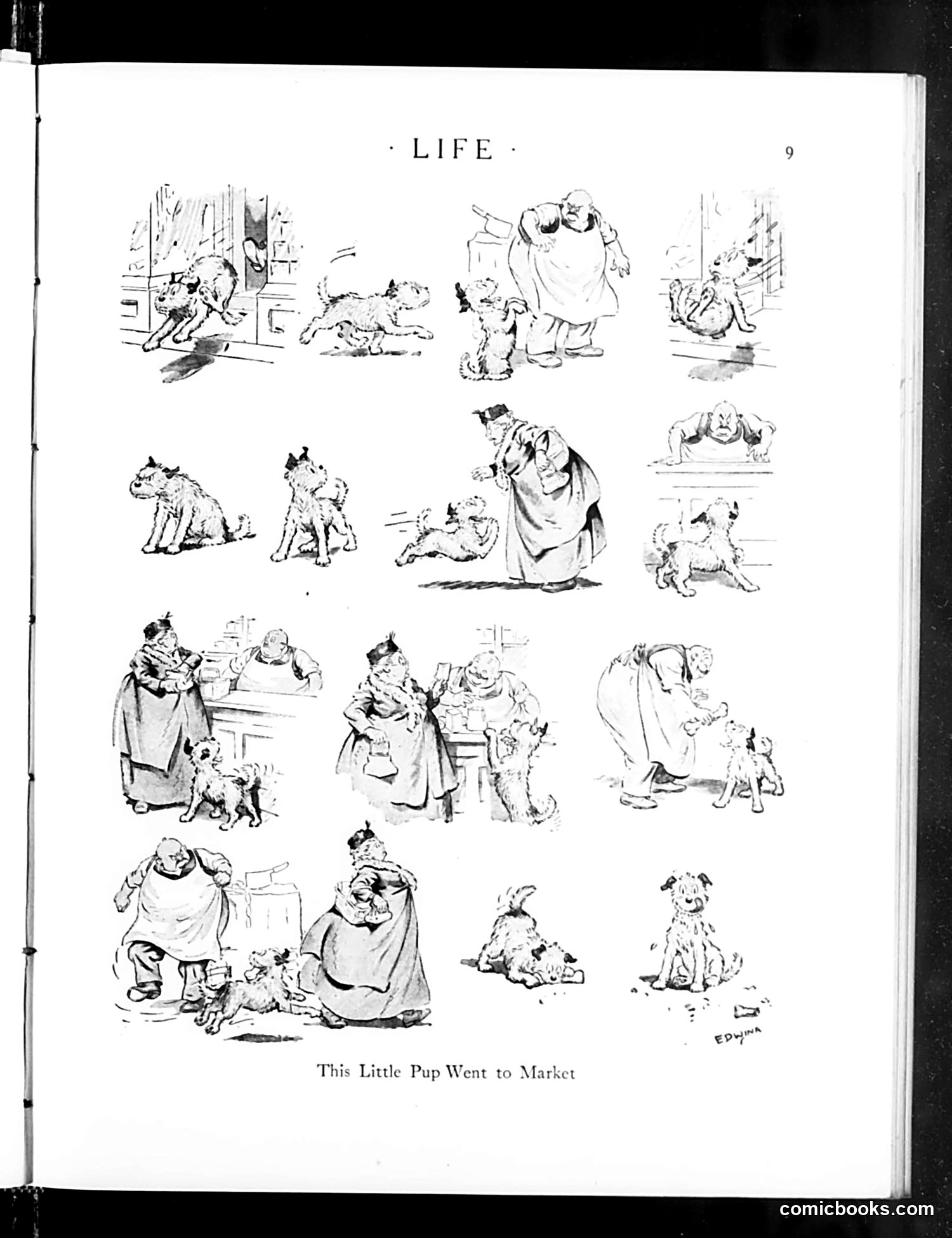
This is a humorous illustrated story told entirely in sketches, with no dialogue. It depicts a small dog's journey through various domestic scenes with human figures—primarily women and children of different sizes and social stations. The narrative appears to show the dog encountering different households and situations: being chased, playing, being cared for, and interacting with adults and children. The title references the nursery rhyme "This Little Pig Went to Market," but substitutes a puppy as protagonist. This is gentle domestic humor rather than political satire—typical of *Life* magazine's lighter content. The appeal lies in following the dog's misadventures through Victorian-era family life, rendered in expressive pen-and-ink style with careful attention to period clothing and interior details.
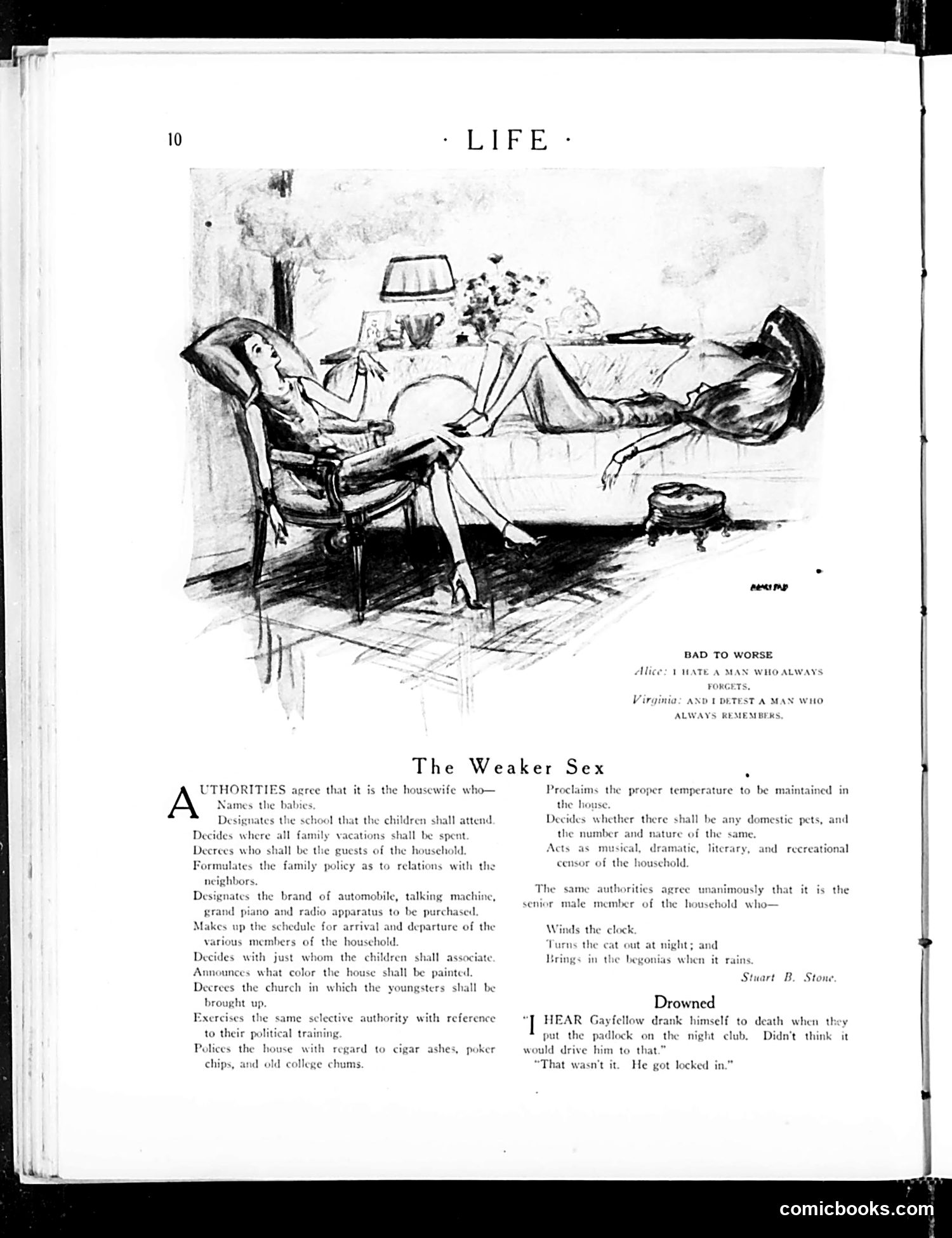
This page satirizes gender roles through ironic reversal. The illustration shows a woman lounging leisurely while a man attends to household tasks, contradicting the caption "The Weaker Sex." The text lists what "authorities agree" — in reality, describing the housewife's extensive domestic responsibilities: managing children's education, household temperature, pets, decorating, scheduling, financial decisions, and moral instruction. The satire exposes how women performed invisible labor while society deemed them "weaker." The second section humorously inverts this, attributing trivial male duties (winding clocks, letting cats out) to the "senior male member," further mocking the notion of male household authority. The brief "Drowned" anecdote reinforces themes of male incompetence through a darkly comic mishap.
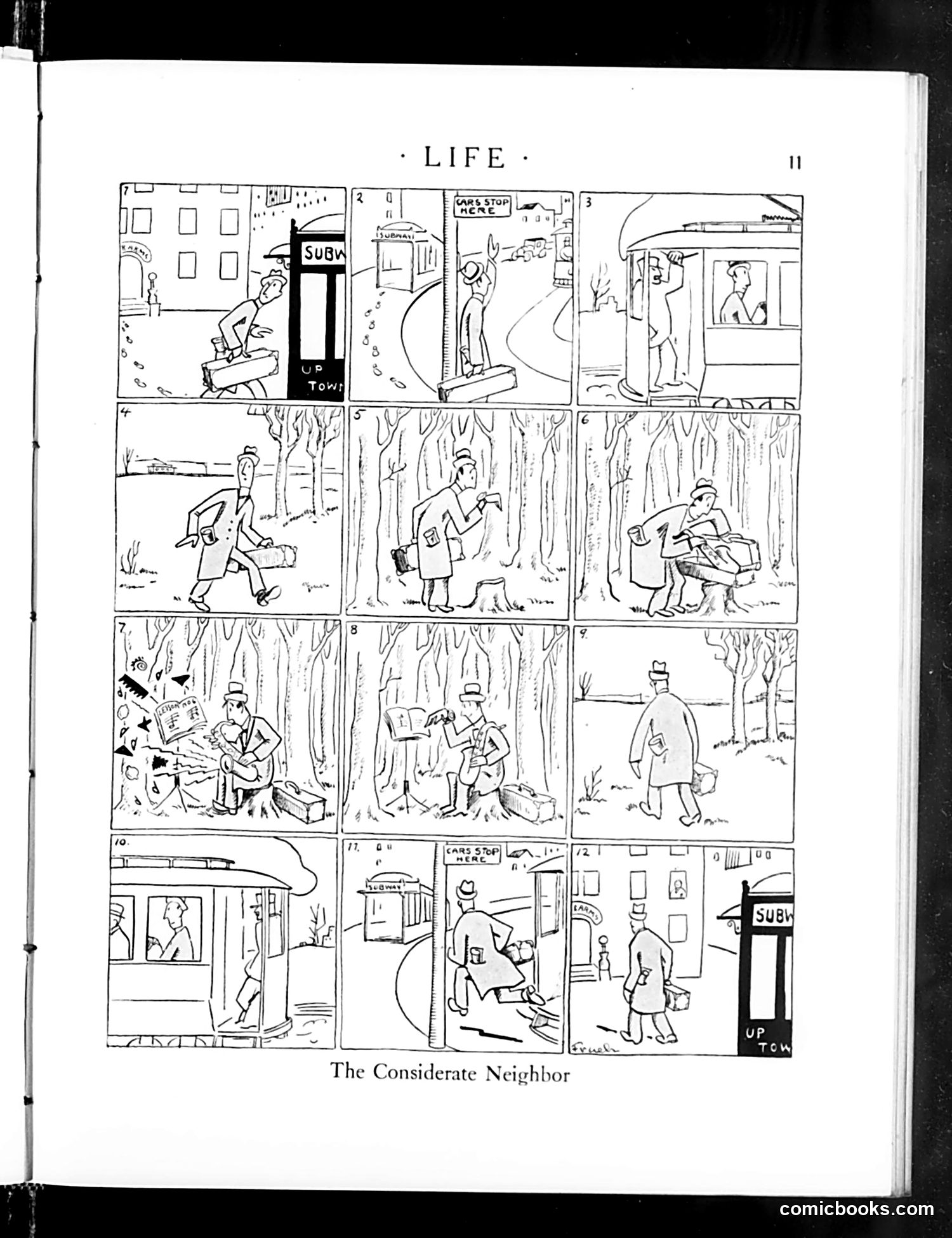
This is a satirical comic strip about urban neighborly behavior. The narrative follows a man who encounters his neighbor in various settings—a subway station, forest/park area, and apartment building—across twelve panels. The humor appears to center on the concept of being a "considerate neighbor." The strip shows the protagonist repeatedly encountering the same person in different contexts, with the punchline suggesting ironic commentary on what "consideration" actually means in city life. The repeated appearance of the subway sign and apartment building establishes an urban setting typical of 1920s-30s Life magazine humor, which often satirized modern city living and social etiquette. Without clearer dialogue, the exact satirical point is unclear, but it likely mocks either hypocrisy in neighborly behavior or the awkwardness of repeated urban encounters.
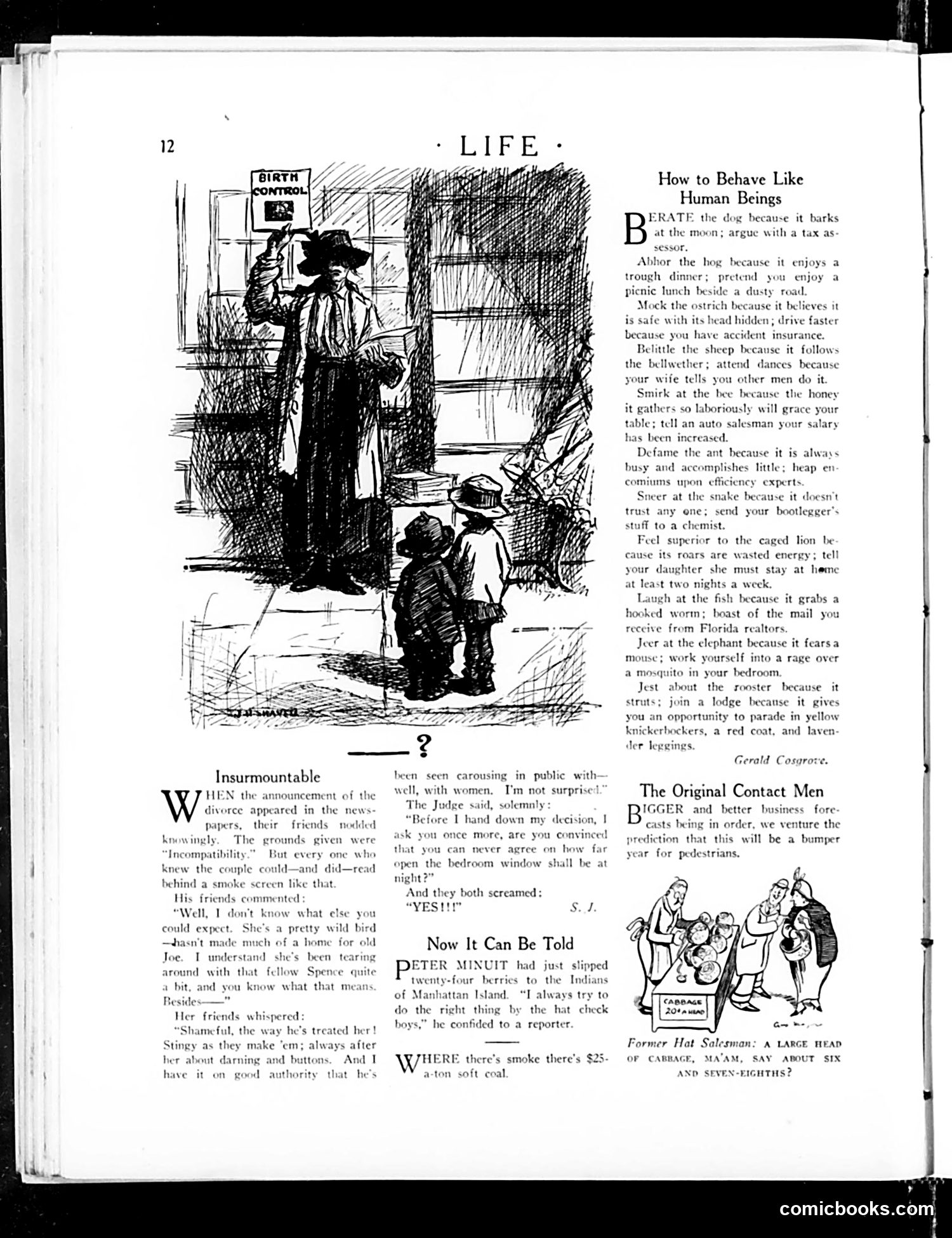
This page contains three satirical pieces reflecting early 20th-century American humor: **"How to Behave Like Human Beings"** offers mock advice by Gerald Gould, humorously suggesting humans mimic animals—berate dogs, mock ostriches, sneer at snakes. It's social satire mocking human pretension through absurdist inversion. **"Insurmountable"** depicts a divorce announcement. The joke centers on a couple's irreconcilable disagreement about bedroom window position at night—treated seriously as grounds for separation. It satirizes how petty domestic disputes can become catastrophic marriage failures. **"The Original Contact Men"** shows businessmen in hats, with caption referencing a "large head of cabbage" allegedly "six and seven-eights" tall—likely absurdist humor about commercial exaggeration or tall tales in business culture. The overall tone is gentle domestic and social satire typical of Life magazine's era.
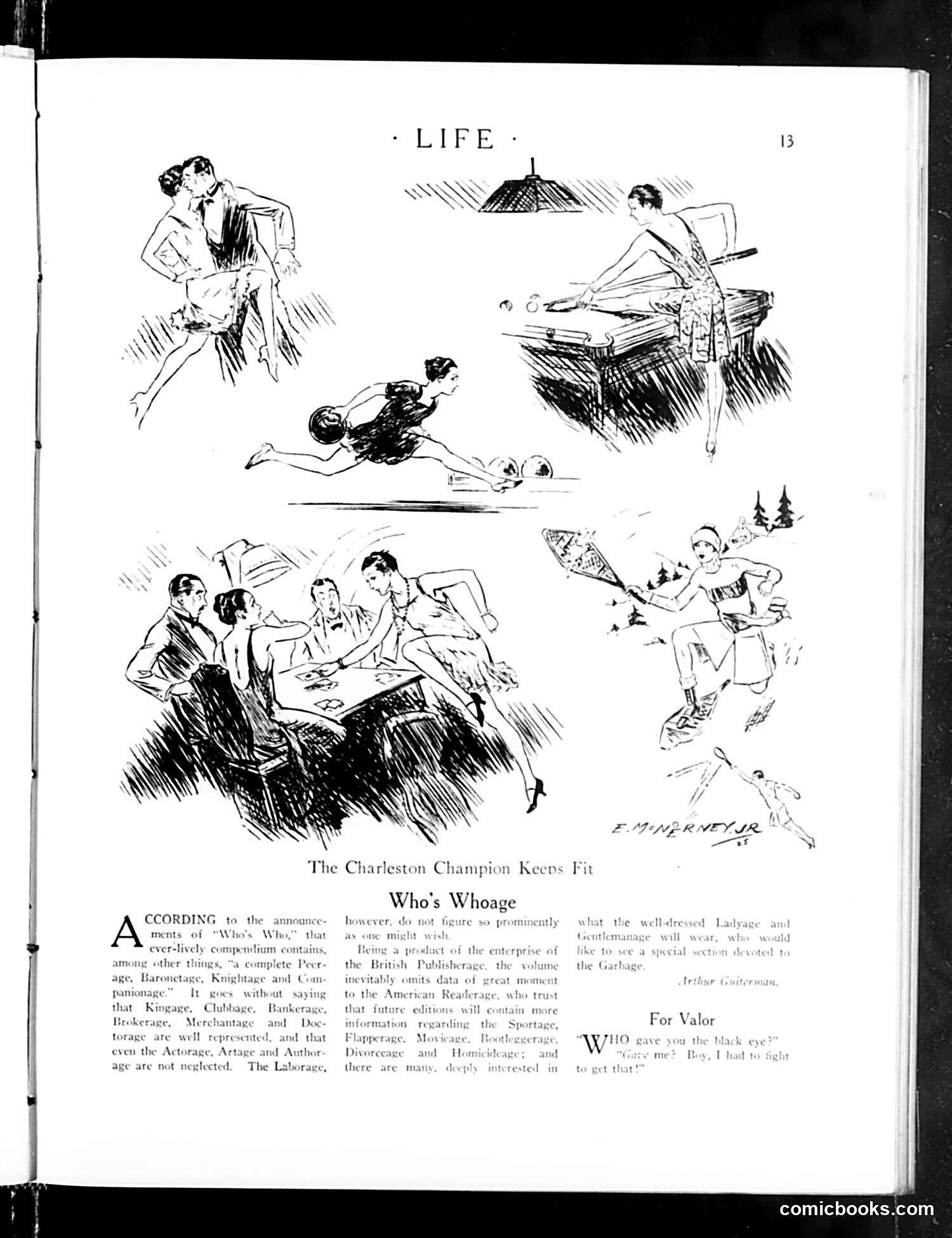
This page contains satirical illustrations about social dancing and leisure activities of the era. **"The Charleston Champion Keeps Fit"** shows various scenes of 1920s social life: people dancing the Charleston, playing cards, and flying a kite. The Charleston was a wildly popular jazz-age dance that scandalized conservative society. **"Who's Whoage"** is a humorous section about "Who's Who" reference books, poking fun at how such volumes omit various disreputable professions and social types—suggesting that while "respectable" occupations are documented, certain classes of people (dancers, entertainers, and other "undesirable" figures) are conspicuously absent from official records. **"For Valor"** appears to be a brief anecdote about fighting, likely illustrating masculine behavior or courtship rituals of the period. The overall tone mocks both upper-class pretension and changing social norms.
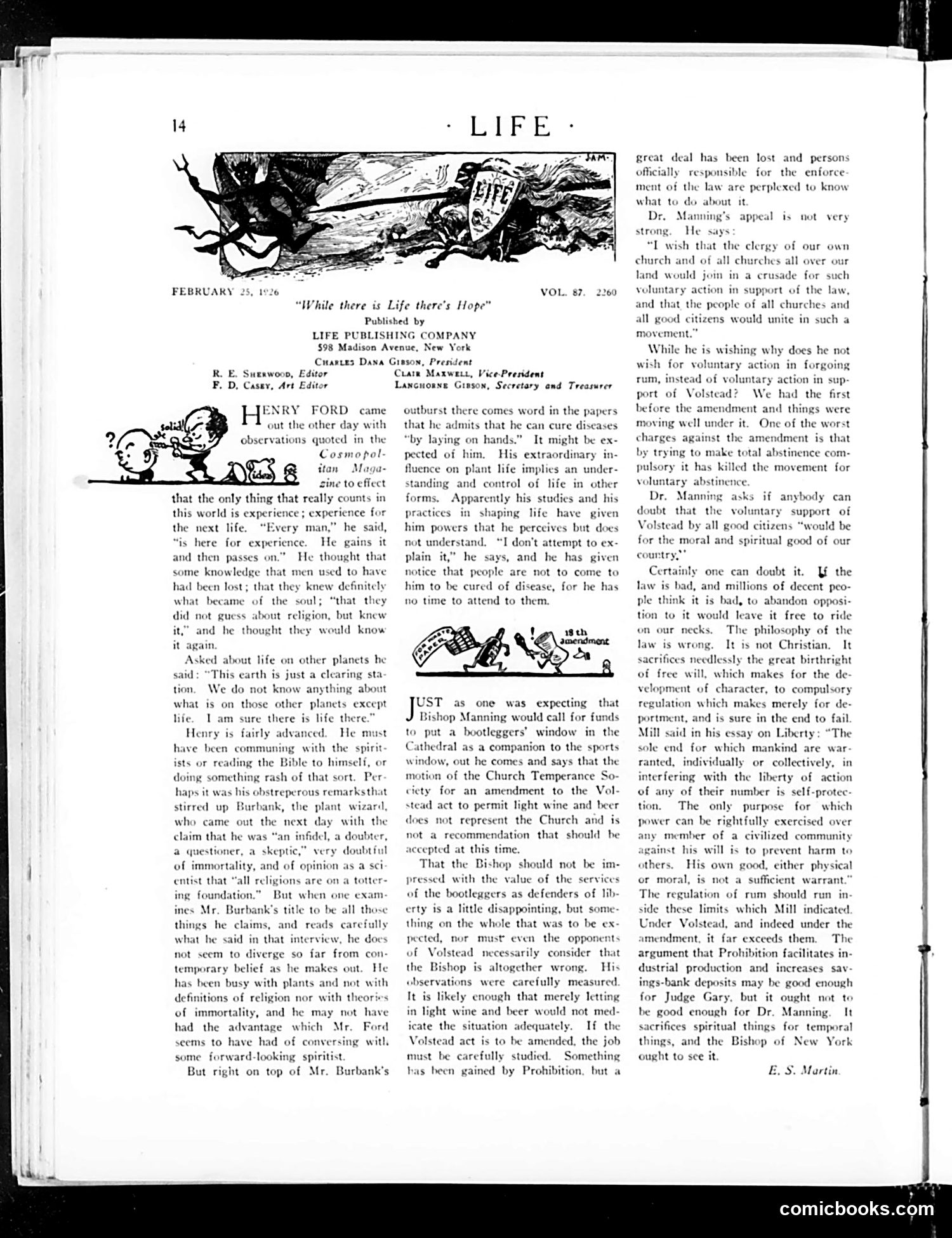
This page features editorial commentary on Prohibition enforcement and religious authority. The main cartoon (top left) depicts a skeletal or death-like figure labeled "Life," illustrating the magazine's satirical stance. The article discusses Henry Ford's influence on life and morality, then pivots to criticizing Bishop Manning's call for church support of Prohibition enforcement. The text argues that while Manning claims voluntary action, he's actually promoting legal coercion—a contradiction the author finds troubling. The satire targets the hypocrisy of religious leaders invoking "voluntary" cooperation while demanding legal prohibition. The author (signed E.S. Martin) questions whether spiritual concerns should be sacrificed for enforcement of temporal laws, suggesting Manning's position lacks philosophical consistency.
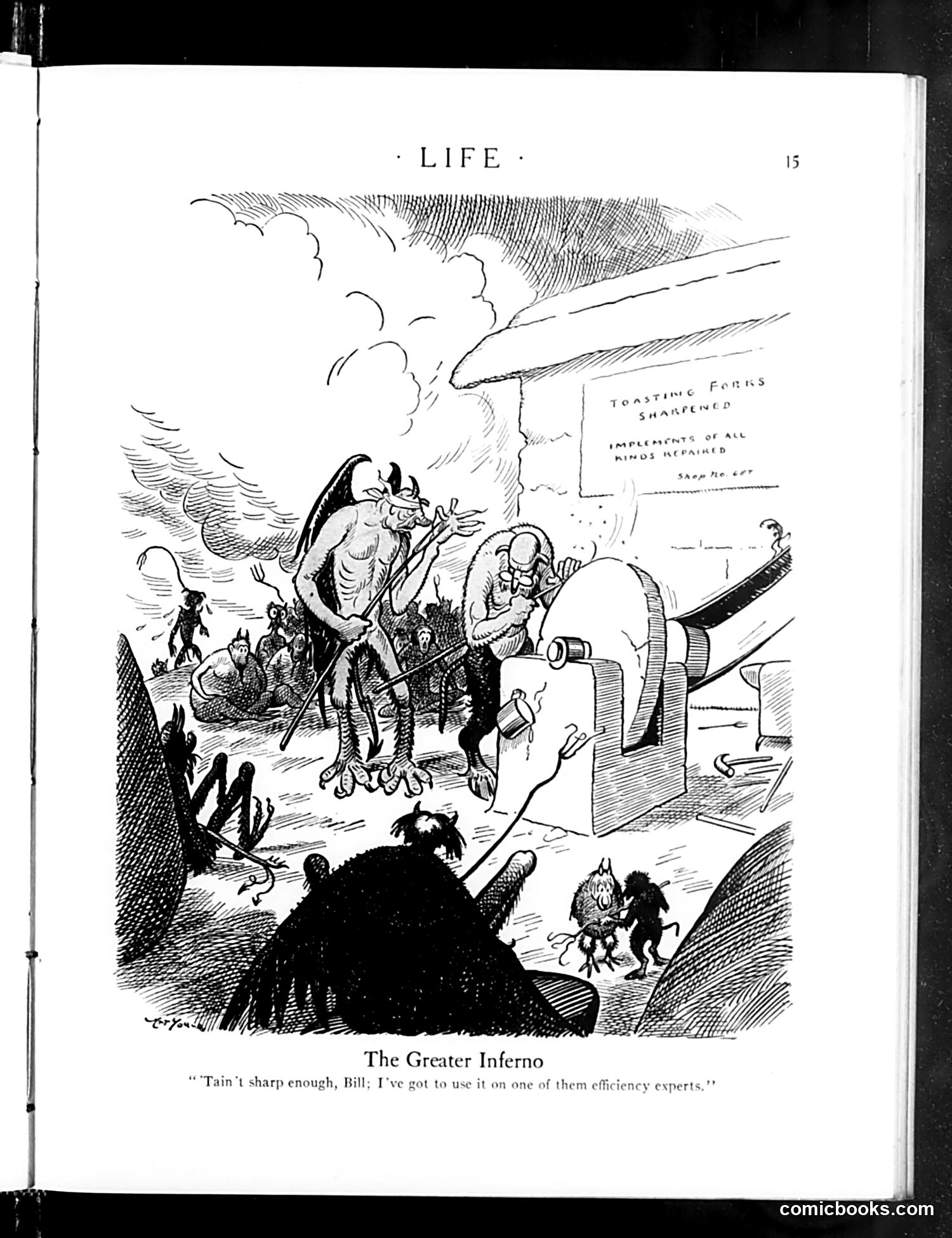
This political cartoon satirizes industrial inefficiency during what appears to be the early 20th century. The scene depicts a hellish factory setting where demonic figures oversee chaotic operations. The caption reads: "'Tain't sharp enough, Bill; I've got to use it on one of them efficiency experts." The satire targets the "efficiency expert" movement—consultants who were hired to streamline industrial operations. The cartoon suggests these experts were themselves ineffectual or problematic, depicted as so dull they require sharpening. The infernal imagery implies that factories and industrial labor were already hellish environments, and adding efficiency consultants only made matters worse. The cartoon mocks both industrial management practices and the contemporary obsession with workplace "efficiency" through mock-scientific methods.
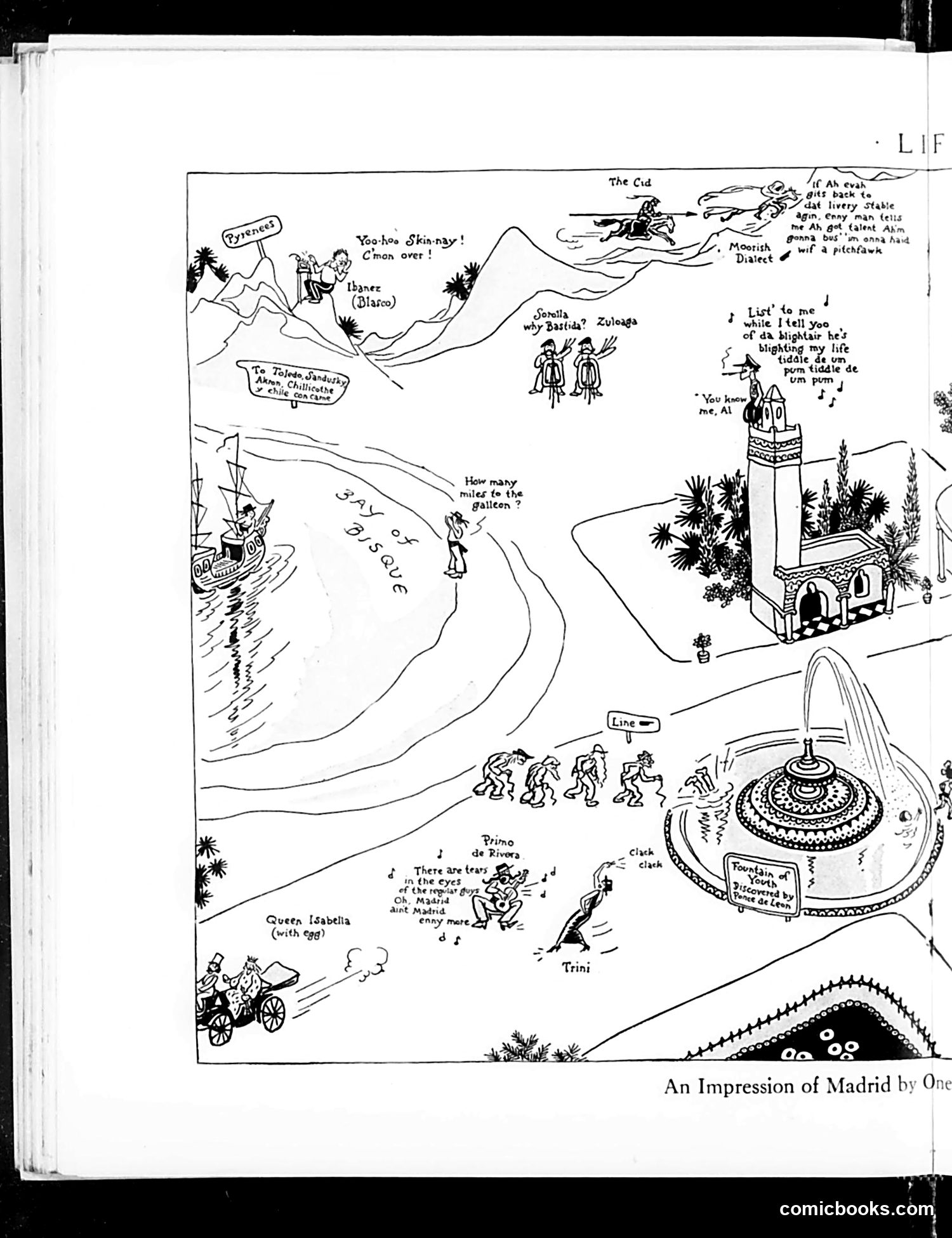
This is a whimsical satirical map of Madrid, presented as a surreal tourist landscape. The cartoon depicts various Spanish stereotypes and cultural references scattered across an exaggerated terrain: - **"The Cid"** appears at the top, referencing the legendary Spanish military hero - **"Voo-hoo Shinny"** and musical references suggest flamenco culture - **"Queen Isabella (with egg)"** references the historical monarch - References to **"Primo de Rivera"** (appears to be political commentary on Spanish leadership) - Various musical notations and dancers emphasize stereotypical Spanish entertainment - The overall effect satirizes American perceptions of Madrid as an exotic, music-filled tourist destination The humor relies on condensing Spanish cultural identity into simplified, recognizable symbols for Life magazine's American readership, while gently mocking both Spanish stereotypes and foreign tourist expectations.
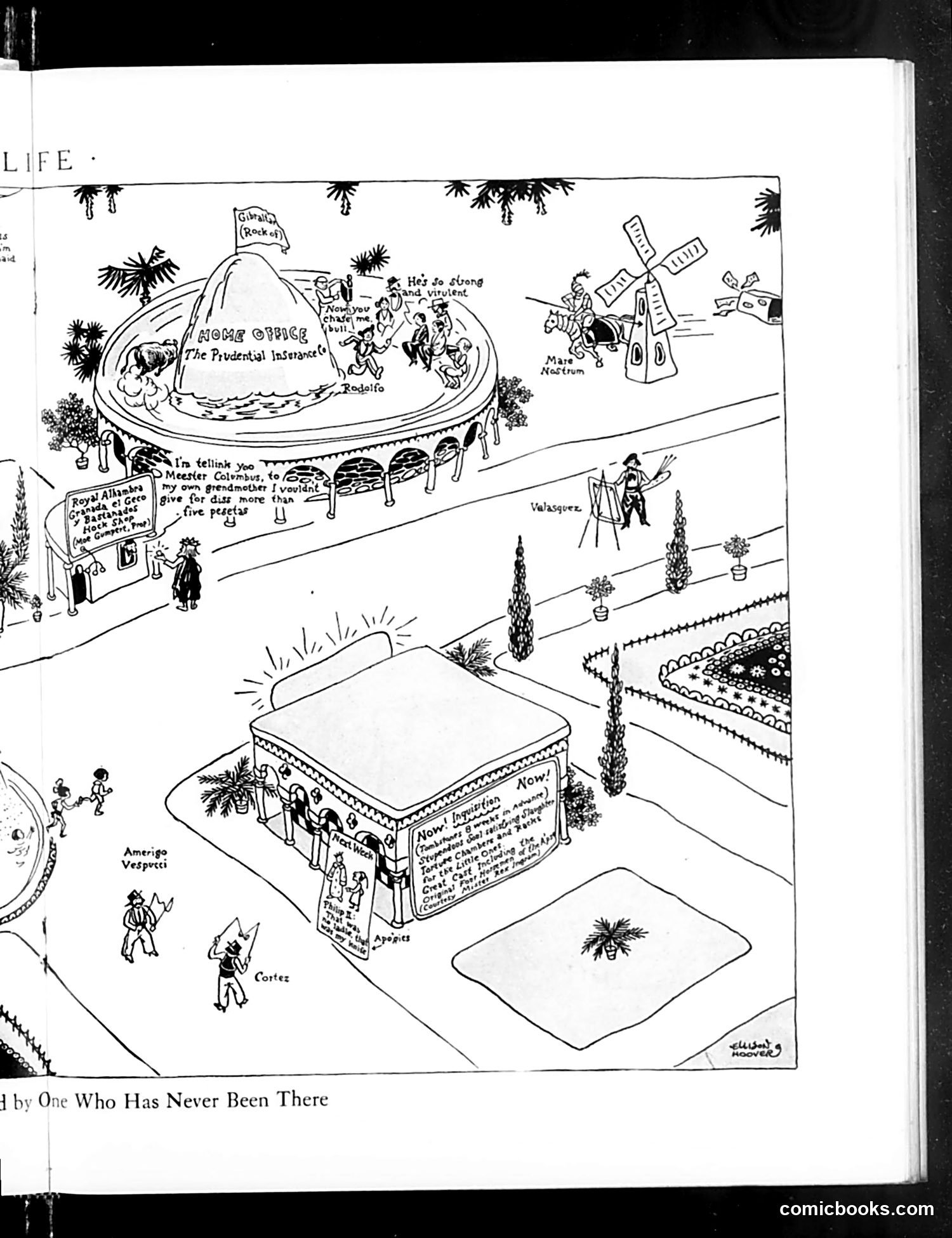
This is a satirical map of an imaginary "Nome Office" landscape, apparently mocking The Prudential Insurance Company's operations or culture. The cartoon depicts various labeled locations and figures in an isometric view, including references to "Amerigo Vespucci" and "Cortez" at the bottom left. The satire appears to target corporate bureaucracy and insurance industry practices, presenting the workplace as an elaborate, absurd territory to be explored. Various labeled structures and activities suggest critiques of insurance operations, though specific references are difficult to identify without clearer OCR text or additional context about Life magazine's contemporary issues. The subtitle indicates this is "A Map...by One Who Has Never Been There"—suggesting the cartoon humorously imagines an unfamiliar corporate world from an outsider's perspective.
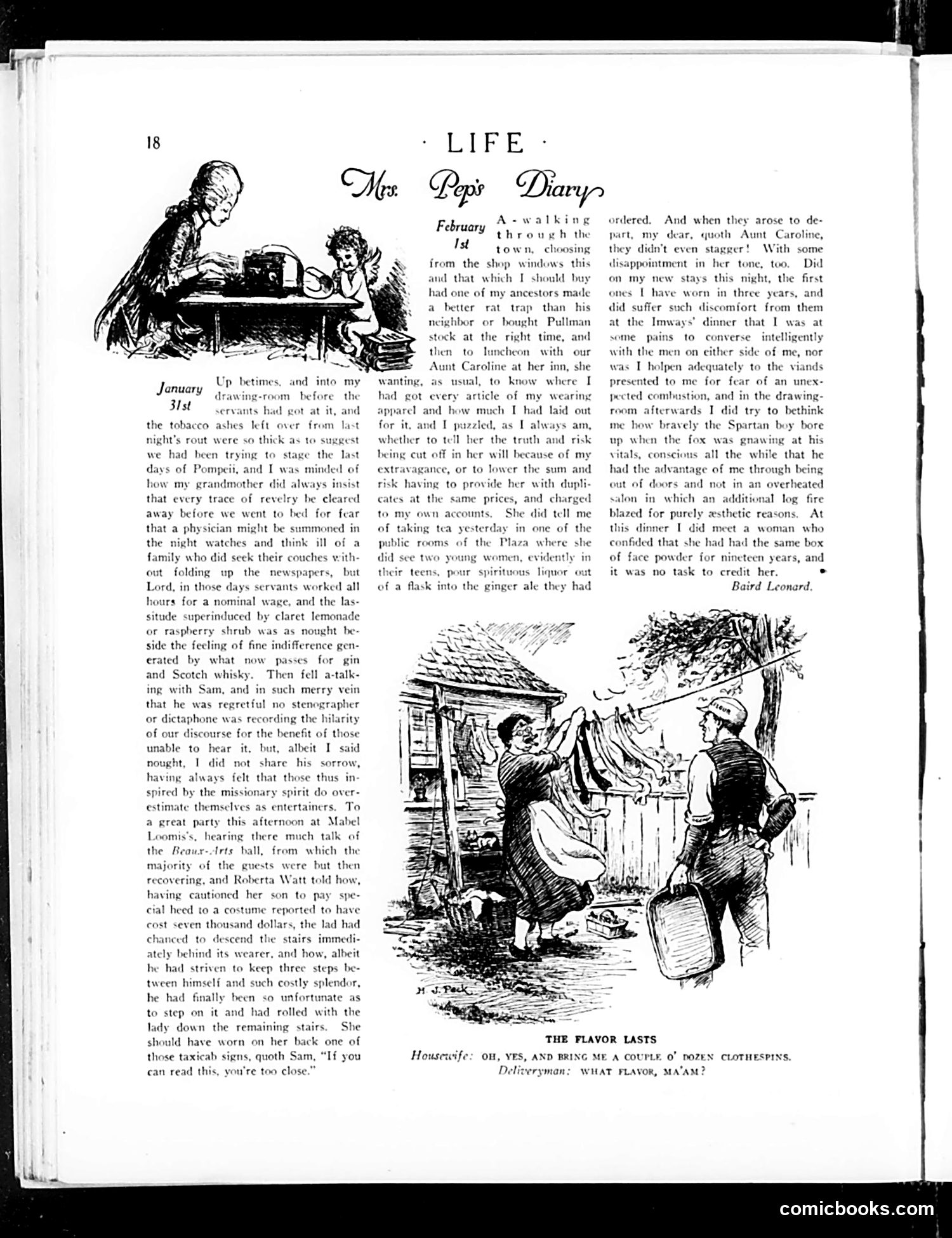
This page from *Life* magazine features a fictional diary entry mocking upper-class social pretensions and concerns. The narrator obsesses over trivial matters: whether to lie to her wealthy Aunt Caroline about expenses, fashionable discomfort from new corsets, and embarrassment over a housewife's "costume malfunction" at a society ball (rolling down stairs in an expensive dress). The accompanying illustration shows a domestic servant scene, likely depicting the contrast between the narrator's anxieties and working-class reality. The satire targets several things: women's vanity, obsession with appearance and fashion, the artificial constraints of high society, and financial anxiety masked by social climbing. The diary format allows *Life* to gently ridicule how absurd these concerns seem—a woman suffering physically at dinner while worried about her respectability, or fretting over deceiving relatives about spending. The humor lies in the disconnect between the trivial nature of these worries and the diary-writer's self-importance in recording them.
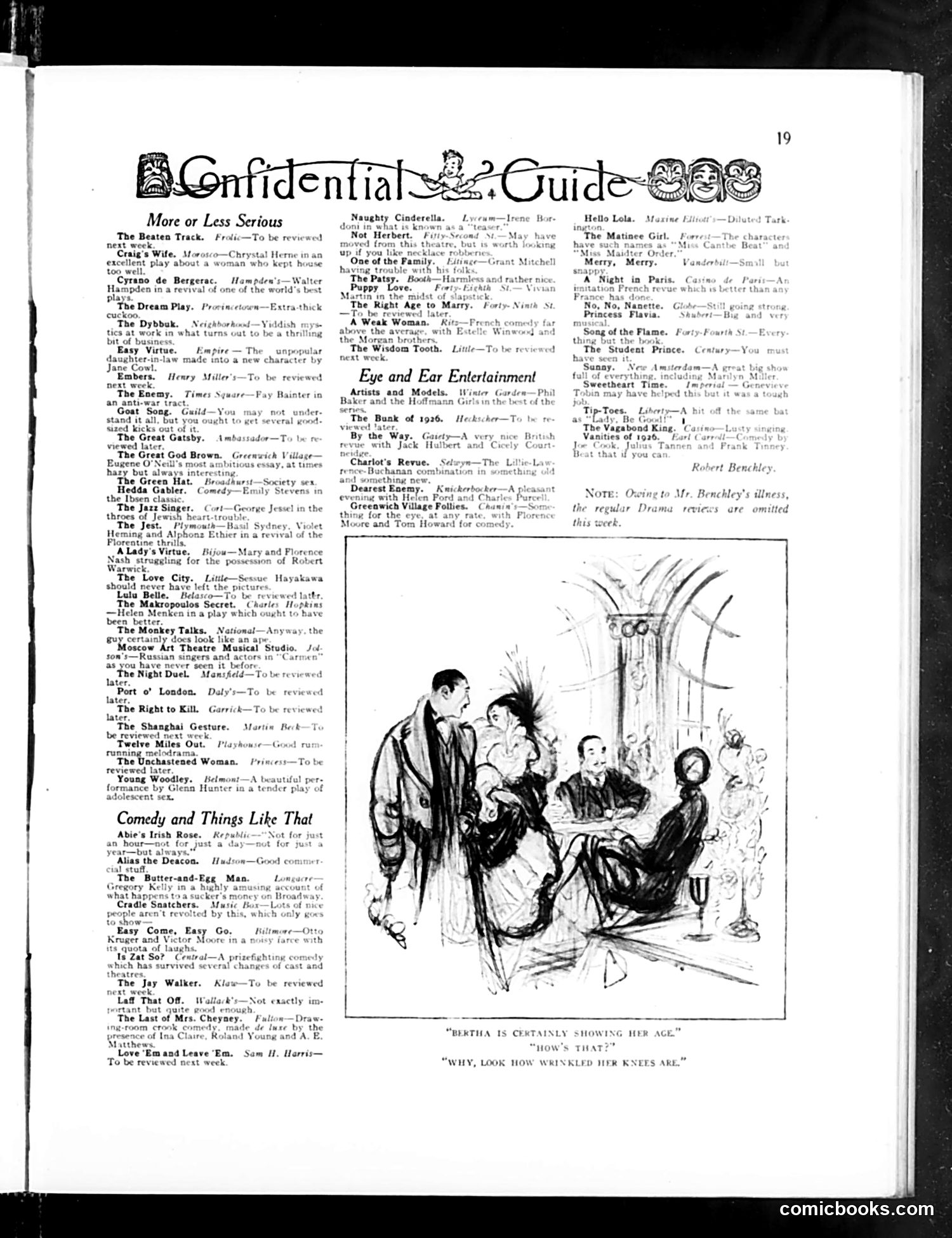
This page is primarily a **theater review guide** for Broadway productions, with a small satirical cartoon at the bottom. ## The Cartoon The illustration depicts a social scene where a man and woman examine an older woman (presumably "Bertha"), with one observer commenting on her appearance: "Bertha is certainly showing her age—How's that?—Why, look how wrinkled her knees are." **The satire**: This is a humorous jab at **aging and vanity in the 1920s**. The joke relies on the era's obsession with youthful appearance and the lengths people went to maintain it. By focusing on "wrinkled knees"—an unusual and somewhat absurd detail—the cartoon mocks both the superficiality of judging women's age by their skin and the desperation some felt to fight visible signs of aging. The exaggerated attention to this minor body part reflects 1920s beauty standards and perhaps anticipates the rise of anti-aging cosmetic products being heavily marketed during this period. The cartoon reflects broader Jazz Age attitudes about youth, beauty, and the social pressures on women to maintain appearance.
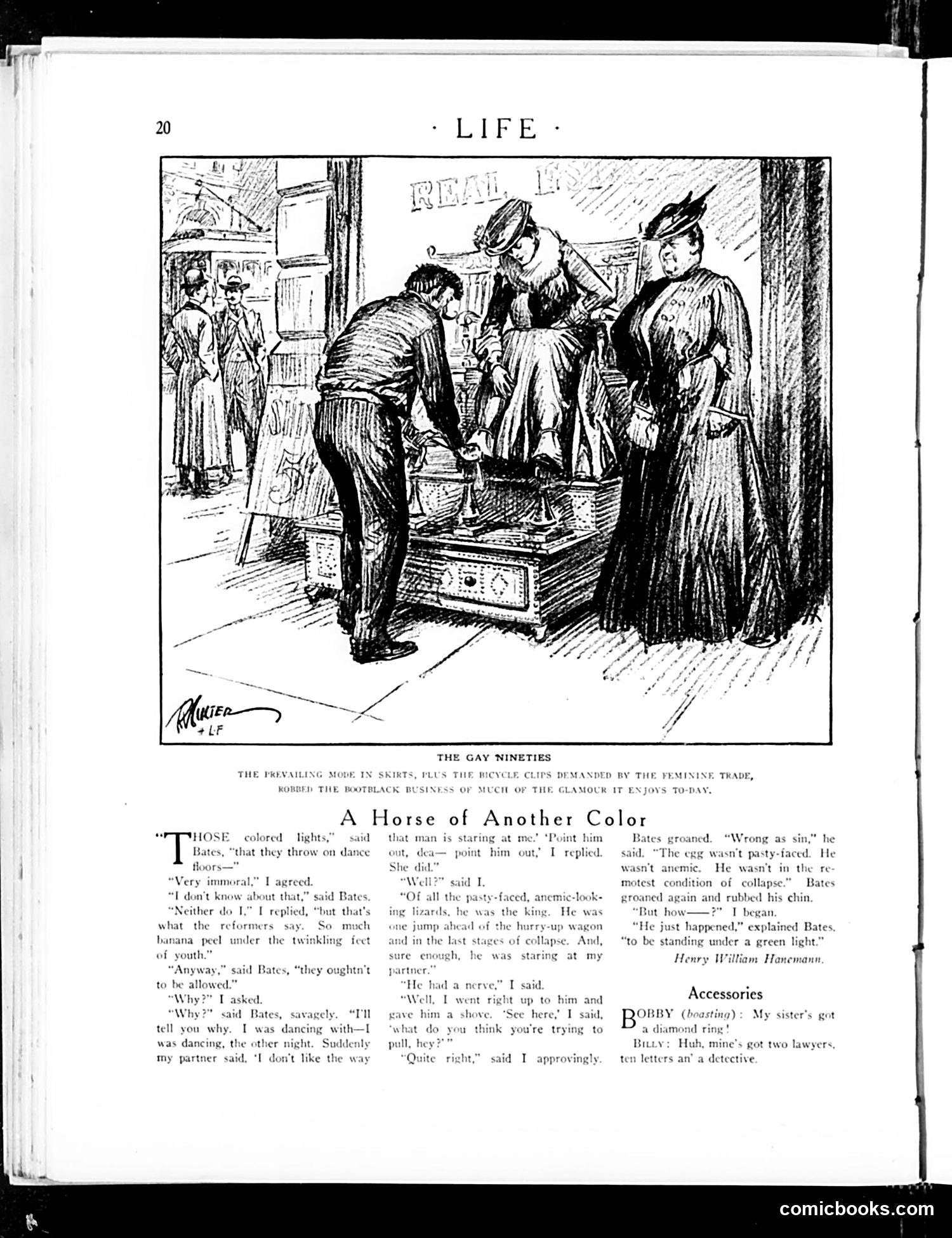
This page contains two distinct pieces of satirical content: **"The Gay Nineties" Illustration (top):** A cartoon depicting a retail scene labeled "REPAIR" where customers examine clothing. The caption critiques how 1890s women's fashion—specifically long skirts combined with bicycle clips (necessary for riding bicycles)—undermined the glamorous appeal that formerly attracted business to clothing repair shops. The satire targets how practical cycling attire stripped away the "glamour" merchants previously enjoyed. **"A Horse of Another Color" (bottom):** A short story dialogue between characters named Bates and another man. The narrative humorously explores misunderstandings about colored stage lighting at dances and an encounter where Bates shoves a man under a green light. The story plays with ambiguous motivations and social awkwardness at social events. **"Accessories" (sidebar):** Brief comic definitions mocking social pretension—"Bobby" brags about his sister's diamond ring; "Billy" counters that his mother has "two lawyers" and "a detective," sarcastically equating legal troubles with status symbols. The page satirizes 1890s social conventions, fashion, and class pretension.
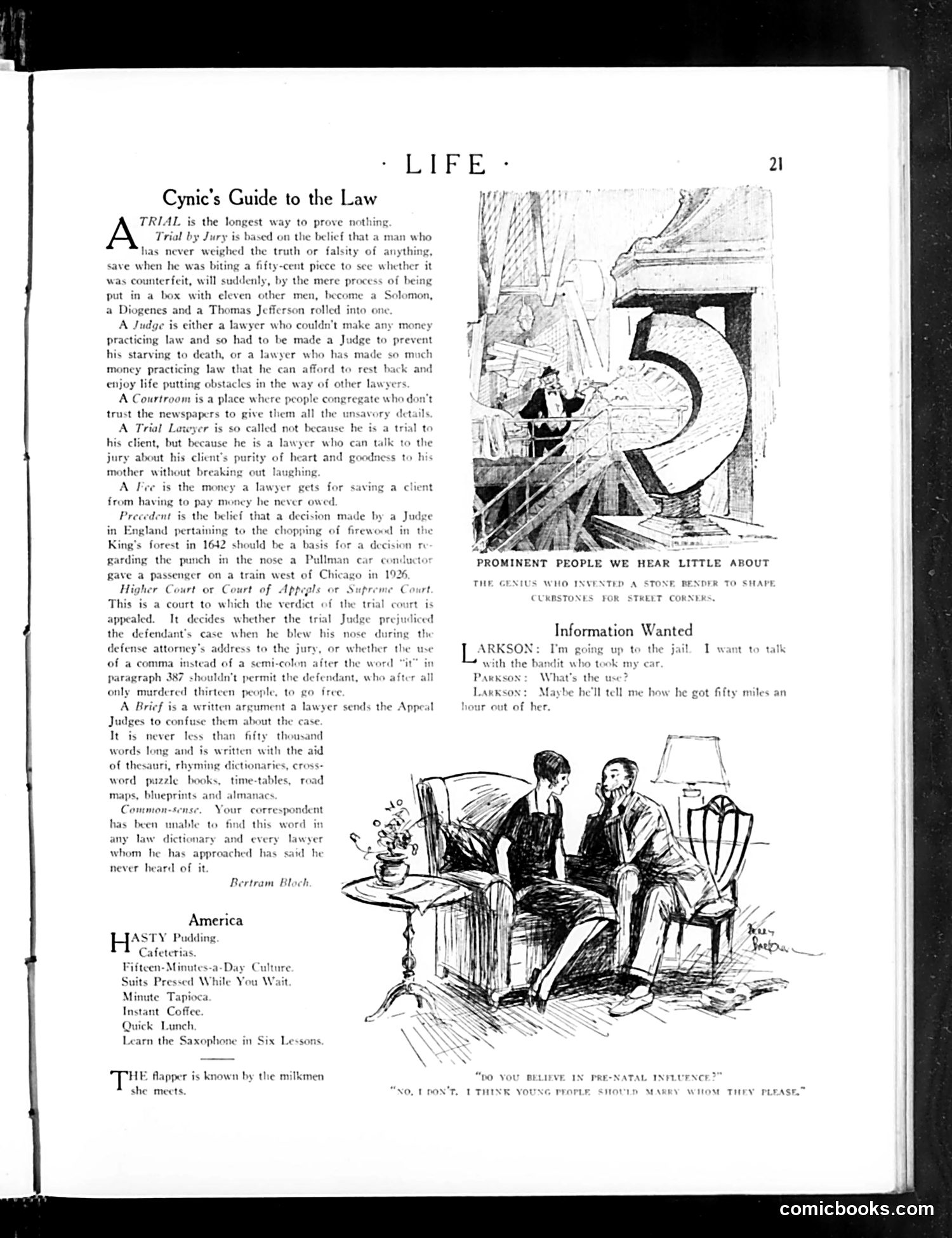
This page satirizes American legal system absurdities through cynical definitions. The "Cynic's Guide" mocks judges as either failed lawyers or wealthy ones forced into service; juries as ordinary people unqualified to judge truth; courtrooms as places where newspapers mislead; and legal fees as extortion. The satire suggests trials are lengthy, incomprehensible exercises in obfuscation rather than justice-seeking. The cartoon below shows a woman visiting a man in jail, captioned "Information Wanted." She wants details about how her car was stolen—darkly humorous given she's visiting a bandit. The page also includes period advertisements (cafeterias, instant coffee, saxophone lessons) satirizing "Hasty America" and its quick-fix culture. The bottom joke about "flappers" being identified by milkmen references 1920s young women's social visibility and dating practices, joking about premarital relationships.
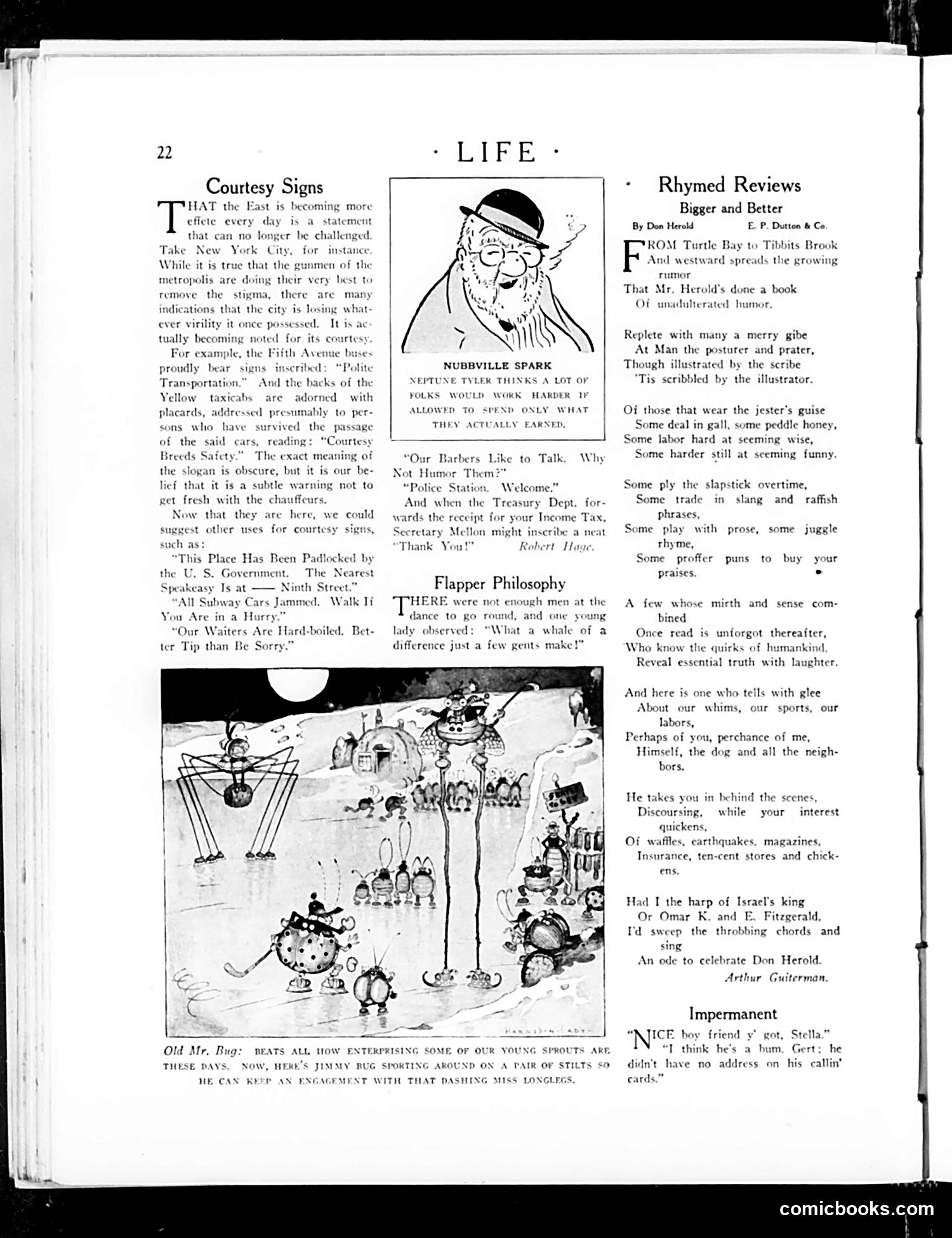
This page from *Life* magazine contains three distinct sections mocking American urban life and social behavior: **"Courtesy Signs"** critiques the decline of New York City's vitality. The author notes that despite efforts to promote "courtesy" through signs like "Courtesy Breeds Safety," the city is losing its edge. The satire suggests New York's toughness is being eroded by excessive politeness campaigns. **"Flapper Philosophy"** features a cartoon of futuristic characters on stilts observing that "a whale of a difference just a few gents make"—mocking the superficiality of 1920s youth culture and their casual observations about gender. **"Rhymed Reviews"** is a verse review of Don Herold's humor book, praising his ability to reveal "essential truth with laughter" through observations of everyday life. The smaller jokes ("Impermanent," "Our Barbers Like to Talk") are brief comedic quips typical of *Life*'s format. The "Old Mr. Bug" caption references young people's enterprising nature during the era.
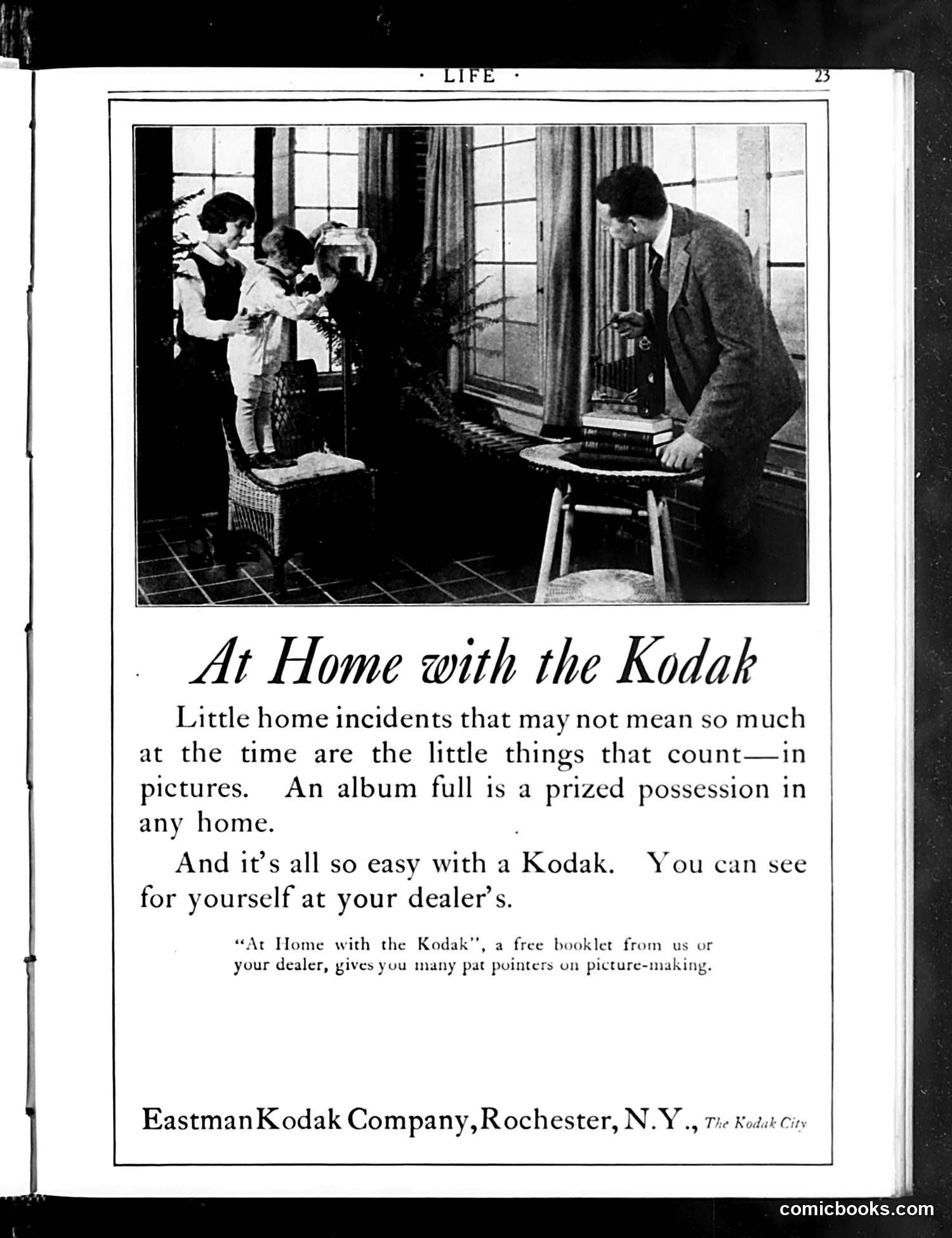
This is a Kodak advertisement, not political satire. The page shows a domestic scene of a family with children and adults in an early 20th-century home, with large windows and period furnishings. The ad's message is straightforward: Kodak cameras make it easy to capture "little home incidents" that become treasured memories preserved in photograph albums. The text emphasizes that photography is simple and accessible to ordinary homeowners ("easy with a Kodak"). The advertisement promotes both the camera itself and a free instructional booklet titled "At Home with the Kodak" available from dealers. This represents early consumer marketing positioning photography as an essential domestic activity for preserving family life—a common advertising strategy of the era.
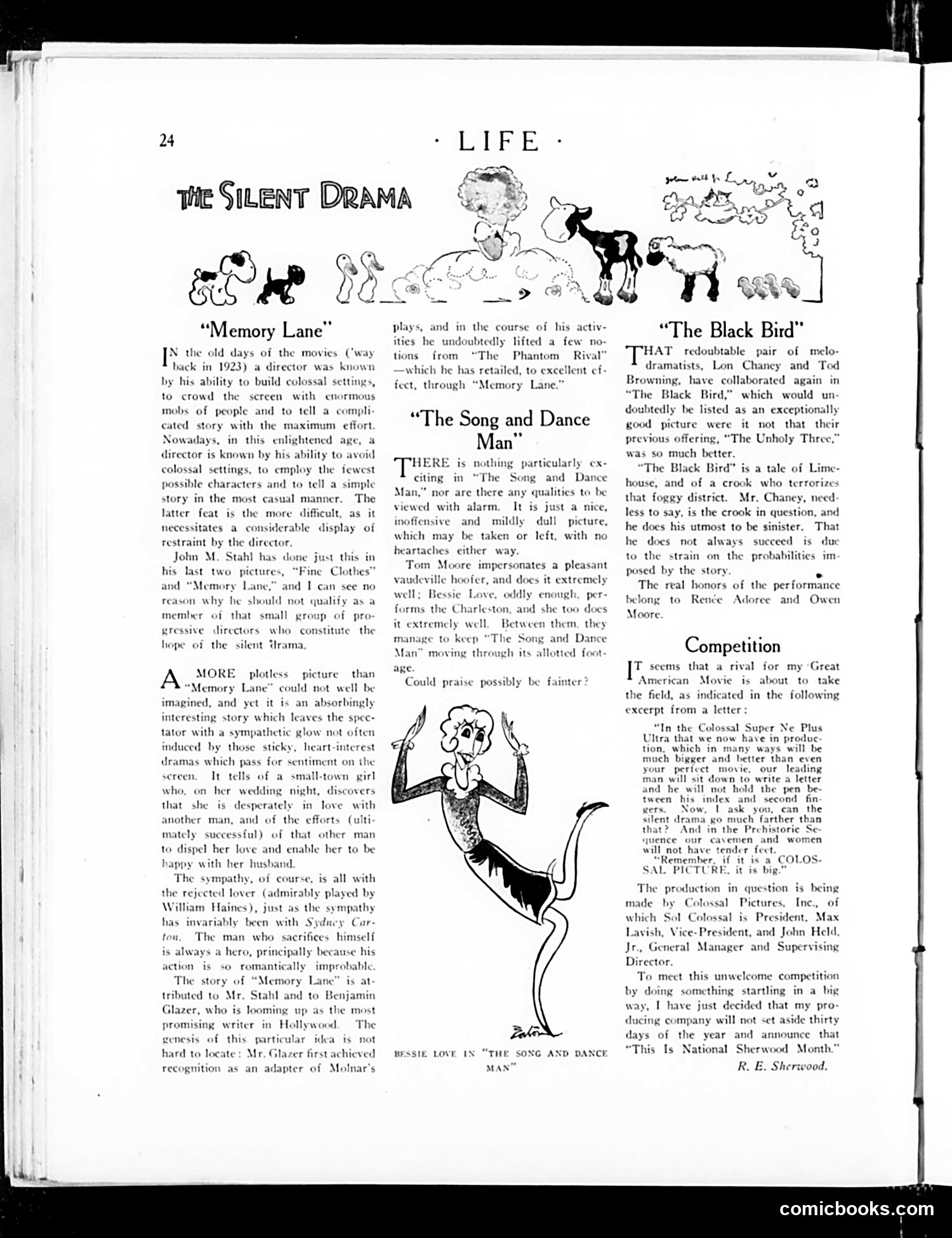
This page contains three film reviews from the silent cinema era (circa 1923-1924). The text discusses three movies: **"Memory Lane"** - Praised as a plotless but engaging story about a small-town girl who marries one man while loving another. Director John M. Stahl is commended for restraint and simplicity rather than elaborate sets—a shift from 1920s filmmaking excess. **"The Song and Dance Man"** - A mildly dismissive review of a vanilla entertainment featuring Tom Moore as a vaudeville performer and Bessie Love performing the Charleston. The critic's faint praise ("Could praise possibly be fainter?") is satirical. **"The Black Bird"** - Reviews the collaboration between horror-filmmaker Tod Browning and star Lon Chaney, noting it's good but inferior to their previous hit "The Unholy Three." The crude cartoon of a dancer illustrates the second review's vaudeville theme. A sidebar **"Competition"** mentions a rival studio's "Colossal Super Ne Plus Ultra" production, expressing competitive boasting about bigger, better films.
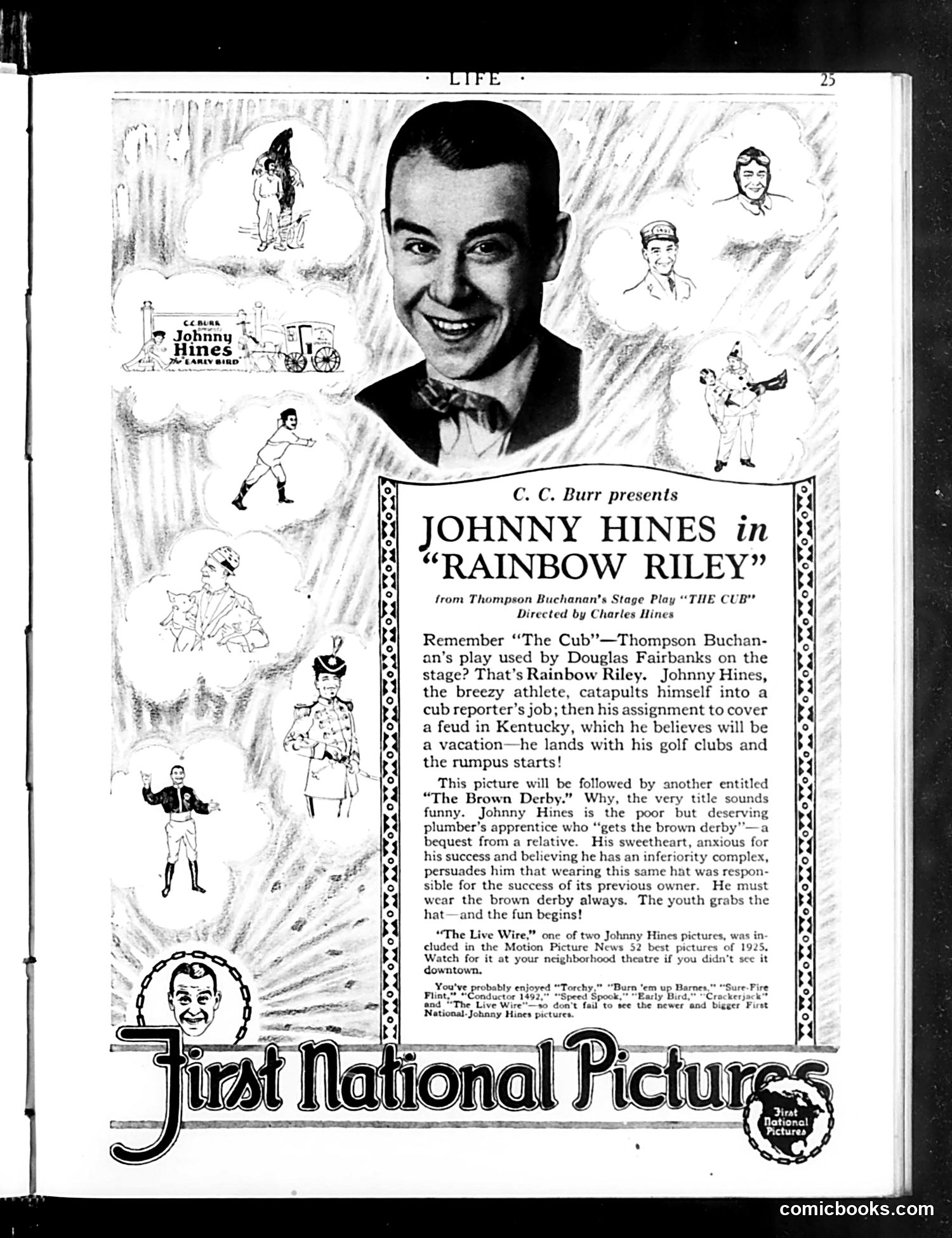
This is a **First National Pictures advertisement** promoting actor Johnny Hines and two upcoming films: "Rainbow Riley" and "The Brown Derby." **The Films' Plots:** - "Rainbow Riley" adapts a stage play, following a young cub newspaper reporter assigned to cover a Kentucky feud—which he mistakenly treats as a vacation, bringing golf clubs instead. - "The Brown Derby" features Hines as a plumber's apprentice who inherits a lucky hat, convinced its previous owner's success came from wearing it. **Context for Modern Readers:** This represents 1920s silent film marketing, when movies were heavily promoted through magazine advertisements. Johnny Hines was apparently a popular comedy actor of the era. The plots rely on physical comedy and situational humor typical of silent comedies. The ad's mention of "The Live Wire" being among 1925's best 52 pictures suggests the studio is building Hines' reputation through critical acclaim. The decorative vignettes around the central portrait show various comedic scenarios from the films.
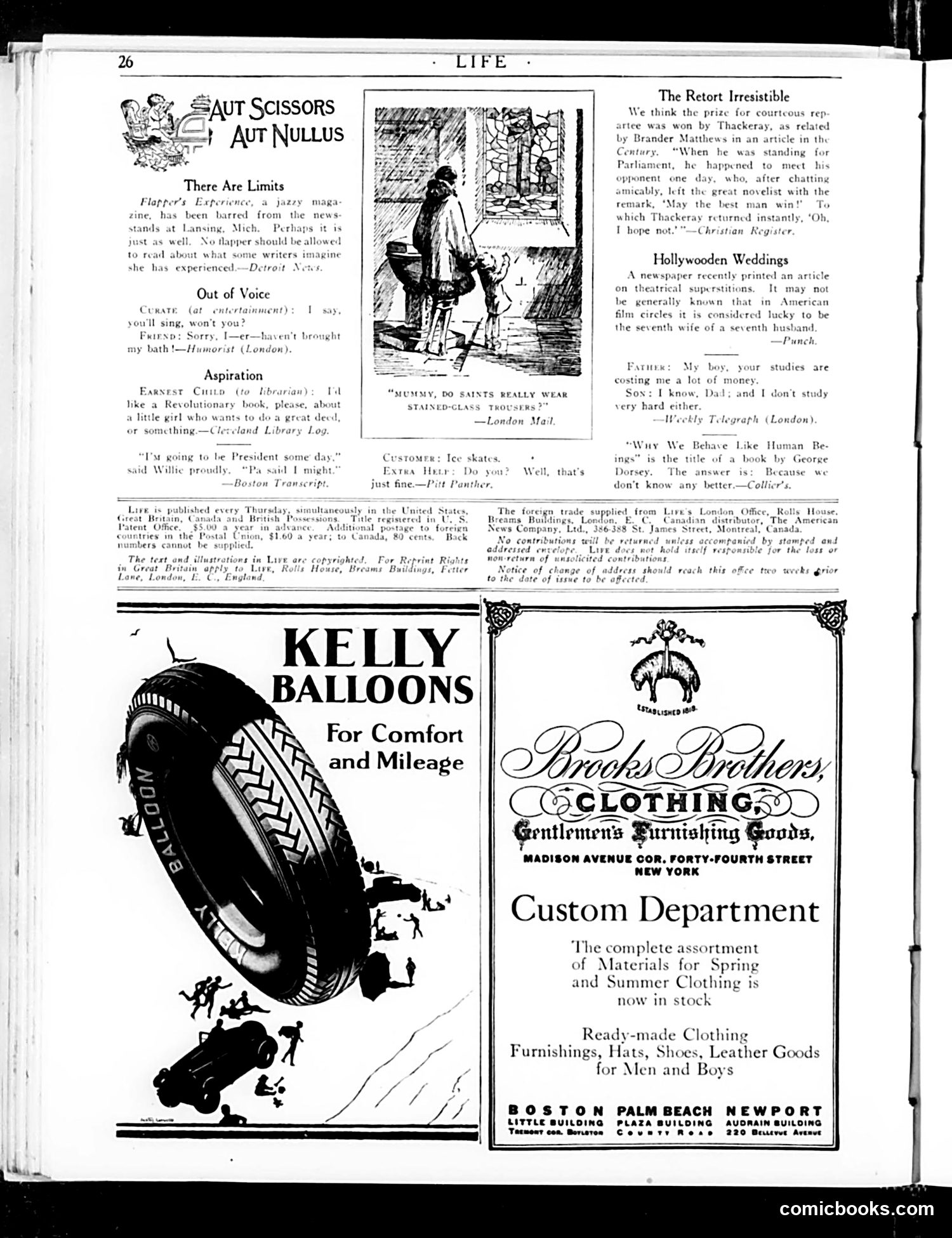
This page contains **satirical humor columns and advertisements** rather than political cartoons. The "Saut Scissors Aut Nullus" section presents brief comedic anecdotes mocking social pretensions and human behavior: - **"There Are Limits"**: Jokes about a "jazzy magazine" being banned from libraries—satirizing both pulp publications and censorious authorities. - **"Out of Voice"**: A curate complains his singing voice is ruined; the joke plays on religious propriety. - **"Aspiration"**: A child declares he'll become President; the punchline (likely cut off) suggests youthful naïveté. The right column includes **witty social commentary**: a Thackeray anecdote about courteous repartee, observations on Hollywood superstitions around marriage, and a book review noting humans behave irrationally because "we don't know any better." The page is primarily **advertisements** (Kelly Balloons, Brooks Brothers clothing) typical of Life's business model. The overall tone is **gentle mockery of American social foibles**, class anxieties, and modern absurdities—characteristic of Life's satirical brand.
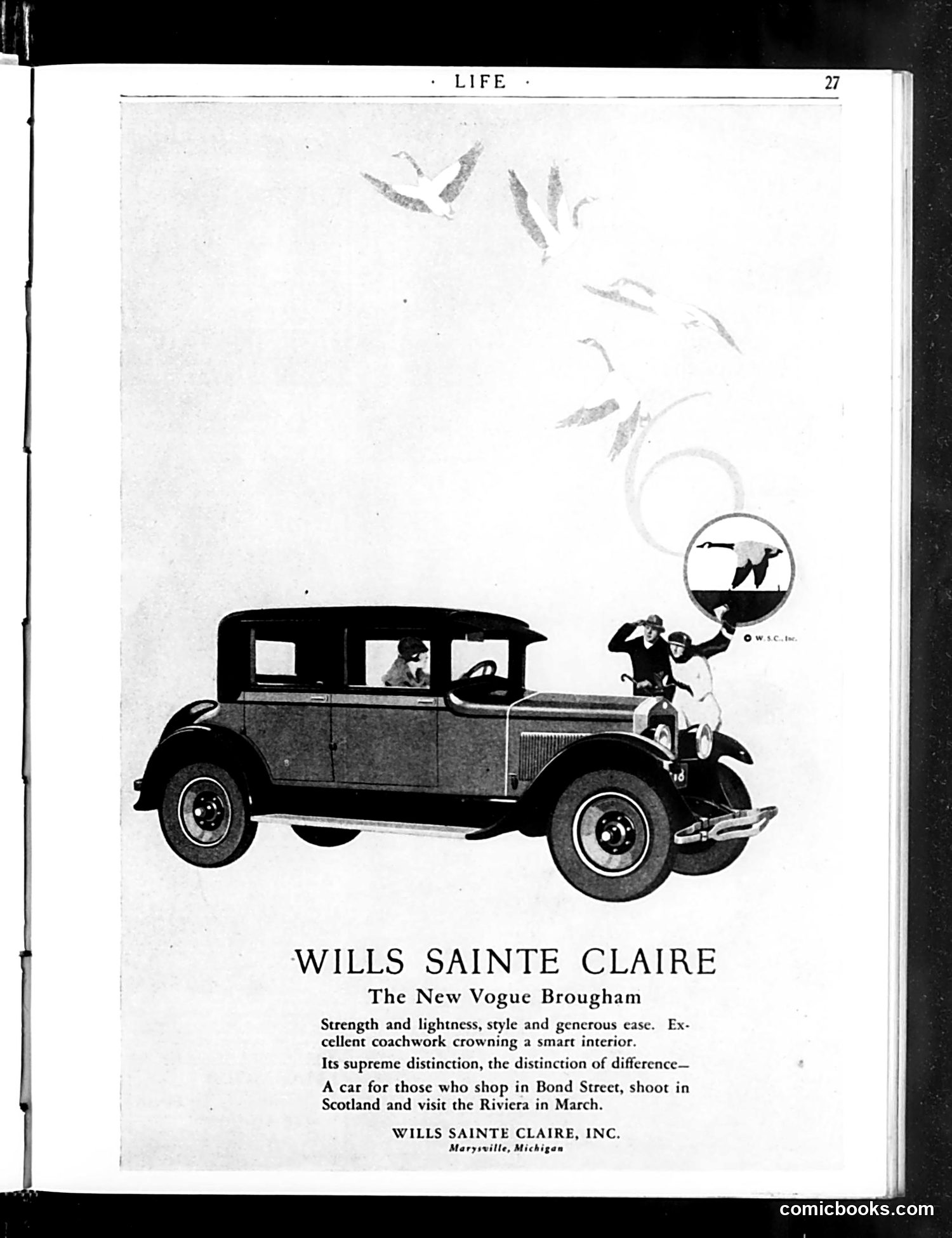
This is a straightforward automobile advertisement, not a political cartoon or satire. It promotes the Wills Sainte Claire brougham, a luxury car manufactured in Michigan. The ad uses social aspiration as its marketing strategy, targeting wealthy consumers by listing exclusive leisure activities: shopping on London's prestigious Bond Street, hunting in Scotland, and vacationing on the French Riviera in winter. The illustration shows the vehicle with elegantly dressed figures, and birds in flight above suggest freedom and elegance. The humor (if present) is subtle and lies in the advertisement's pretentiousness—marketing a Michigan-made automobile by associating it exclusively with European luxury travel and high society. This appears designed to appeal to affluent American readers of *Life* magazine during the automotive boom era.
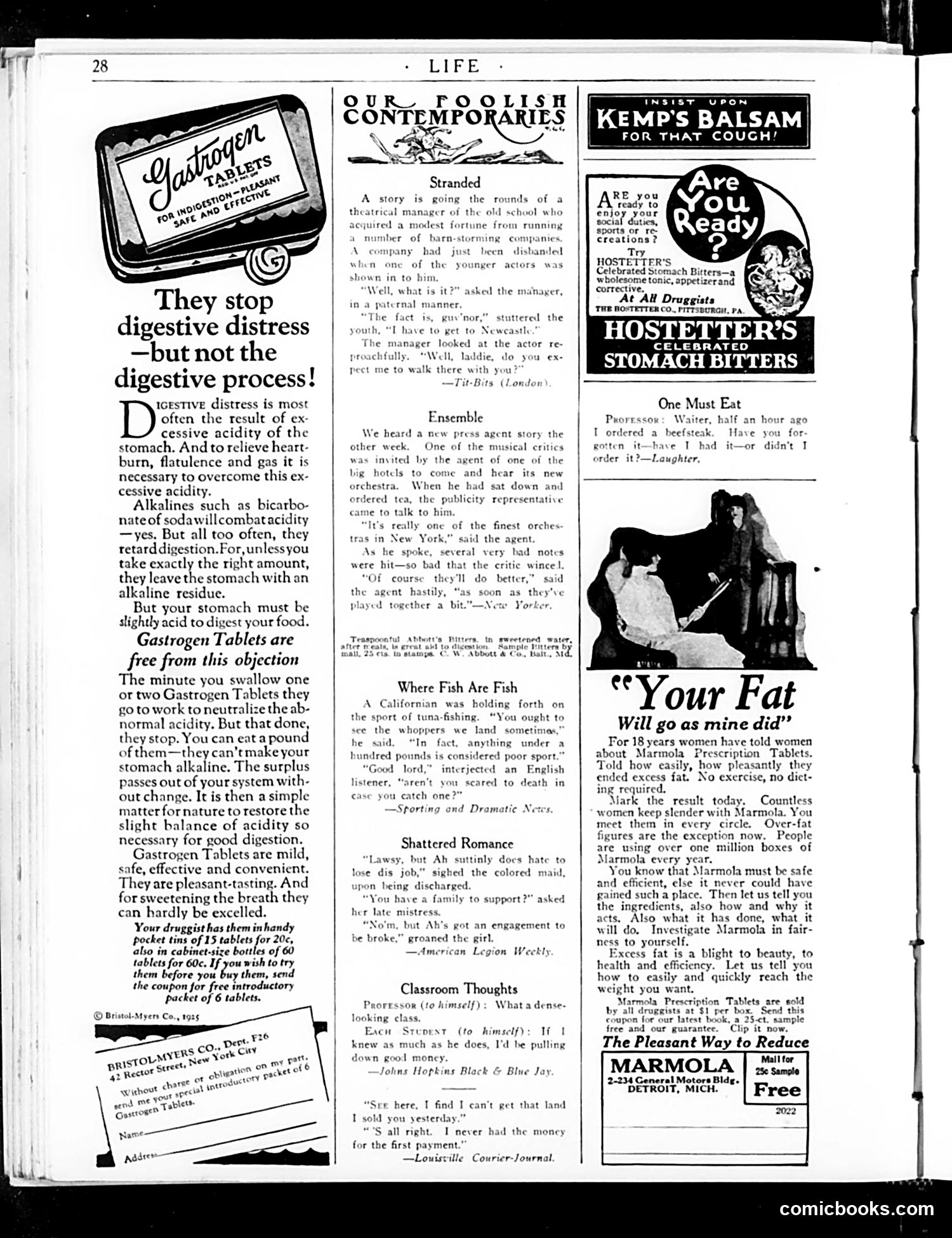
This page is primarily **product advertising** from 1935, not political satire. The dominant content features three commercial advertisements: Gastrogen Tablets (digestive aids), Hostetter's Stomach Bitters, and Marmola (weight-loss tablets). The editorial humor content consists of brief anecdotes under "Our Foolish Contemporaries"—including a theatrical manager tale, an orchestra story, and classroom jokes—typical *Life* magazine filler meant as light social commentary rather than pointed satire. The ads reveal period attitudes: Gastrogen pitches the ideal of precise stomach chemistry; Marmola's copy assumes women readers are preoccupied with weight and appearance ("Excess fat is a blight to beauty"); and Hostetter's positions bitters as essential for social function. The page reflects 1930s consumer culture and gender assumptions, but contains no identifiable political figures or specific satirical targets.
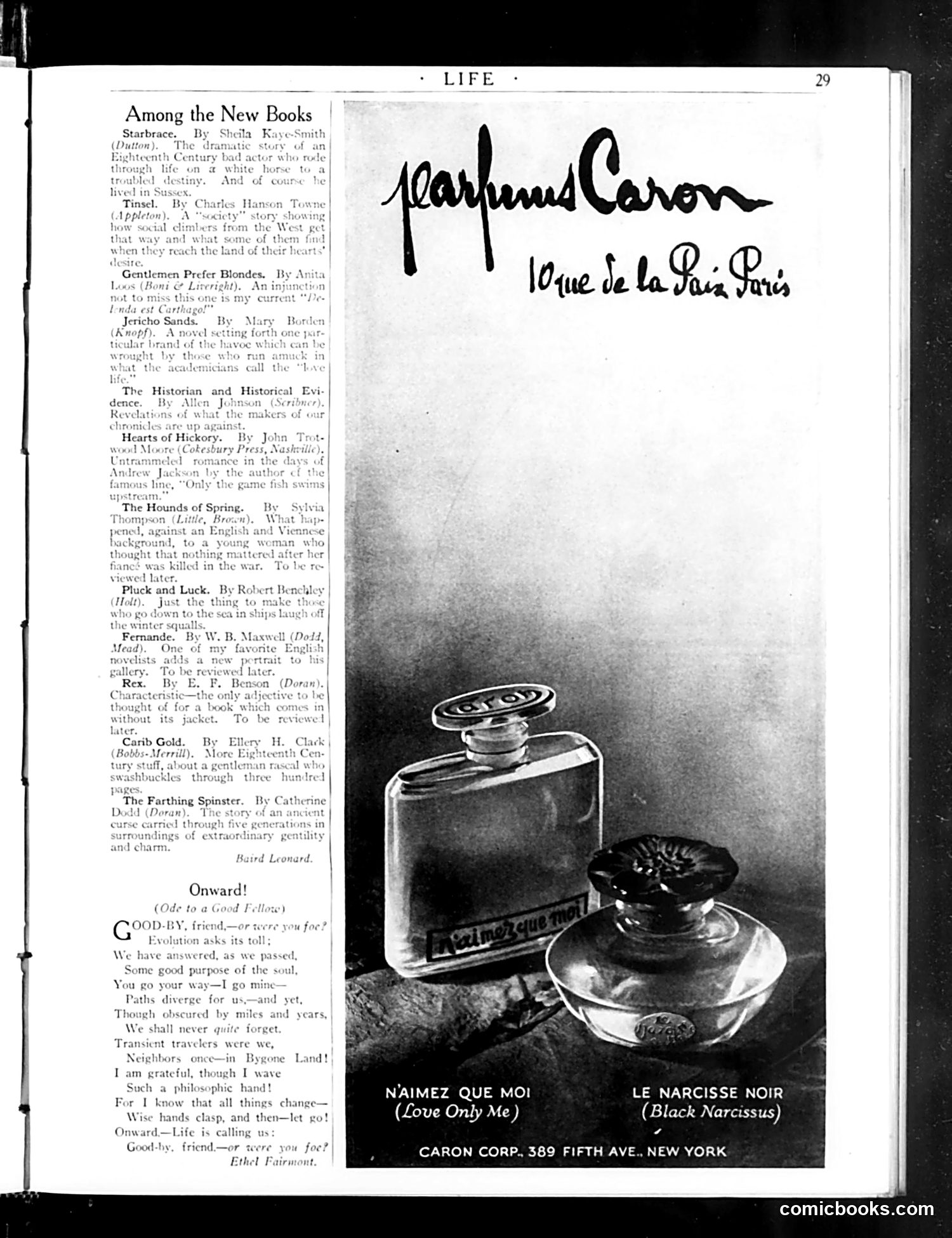
This page is primarily a **book review section** ("Among the New Books"), not a political cartoon. The left column lists contemporary novels with brief descriptions—titles like *Starbrace*, *Gentlemen Prefer Blondes*, and *Hearts of Hickory*. The right side contains a **perfume advertisement** for Caron fragrances, featuring two bottle designs with French names: *Naimez Que Moi* ("Love Only Me") and *Le Narcisse Noir* ("Black Narcissus"). The ad shows elegant Art Deco-style perfume bottles, a common luxury product advertisement in 1920s *Life* magazine. There is no political satire or social commentary visible here—this is a standard magazine page mixing literary coverage with high-end consumer advertising, typical of *Life*'s format during the Jazz Age era.
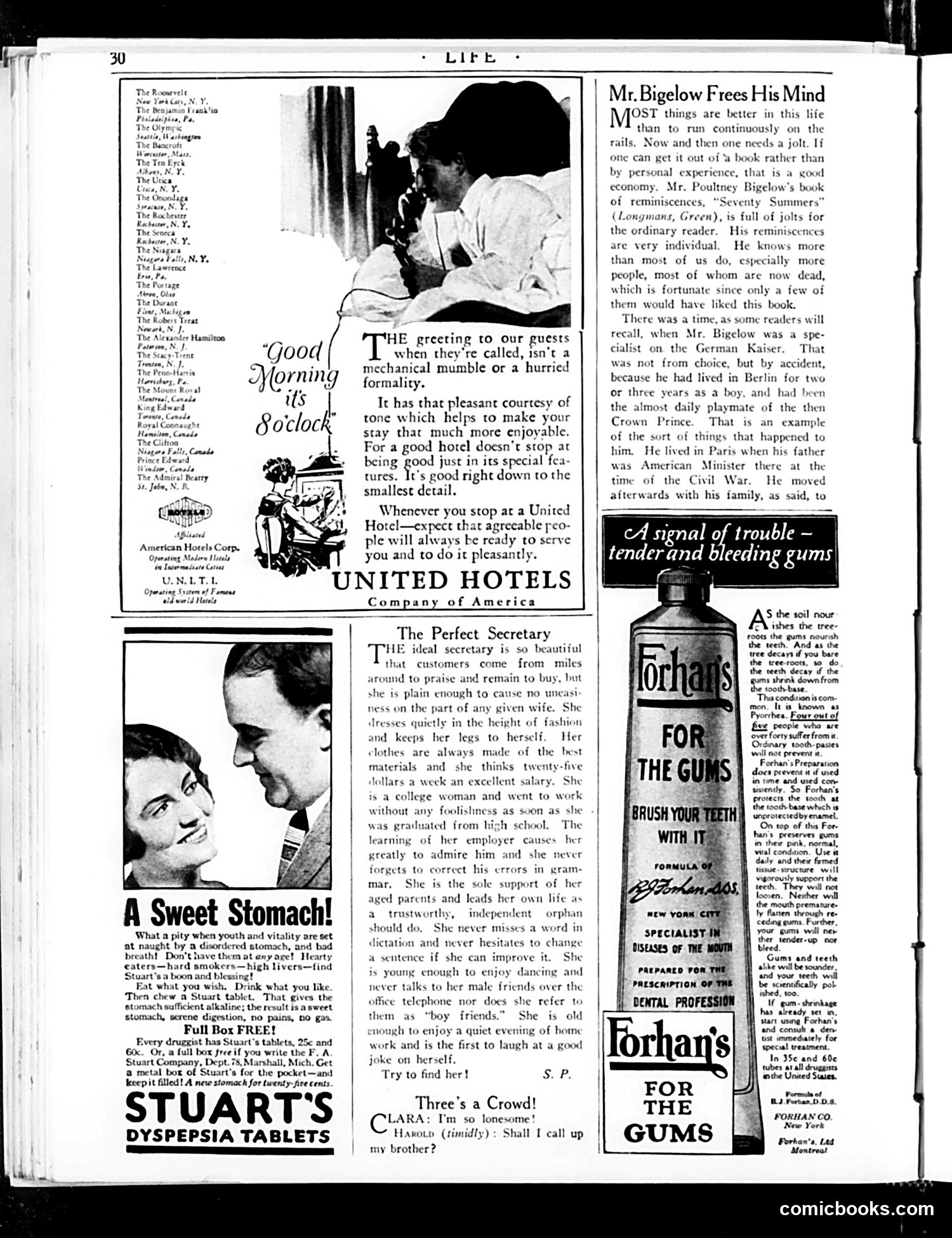
This page is primarily **advertising with some light satirical content**. The main elements: **Advertisements:** - United Hotels Company promotes courteous service - Stuart's Dyspepsia Tablets (digestive aid) uses humor about indulgent eating - Forhan's "For the Gums" dental product **Satirical Content:** "*The Perfect Secretary*" is a tongue-in-cheek description of an impossible ideal—a woman who is beautiful enough to attract customers but plain enough not to threaten wives; educated but subservient; fashionable yet modest; well-paid yet content with $25/week; devoted to work yet socially restrained. The satire critiques both unrealistic employer expectations and the constrained roles available to working women of the era. "*Three's a Crowd*" is a brief domestic joke playing on loneliness and awkward social dynamics. The book review of Poultney Bigelow's "*Seventy Summers*" discusses his memoir of unusual personal connections (including proximity to the German Crown Prince), presented as light reading for general audiences. The page reflects 1920s attitudes toward gender roles, consumption, and leisure.
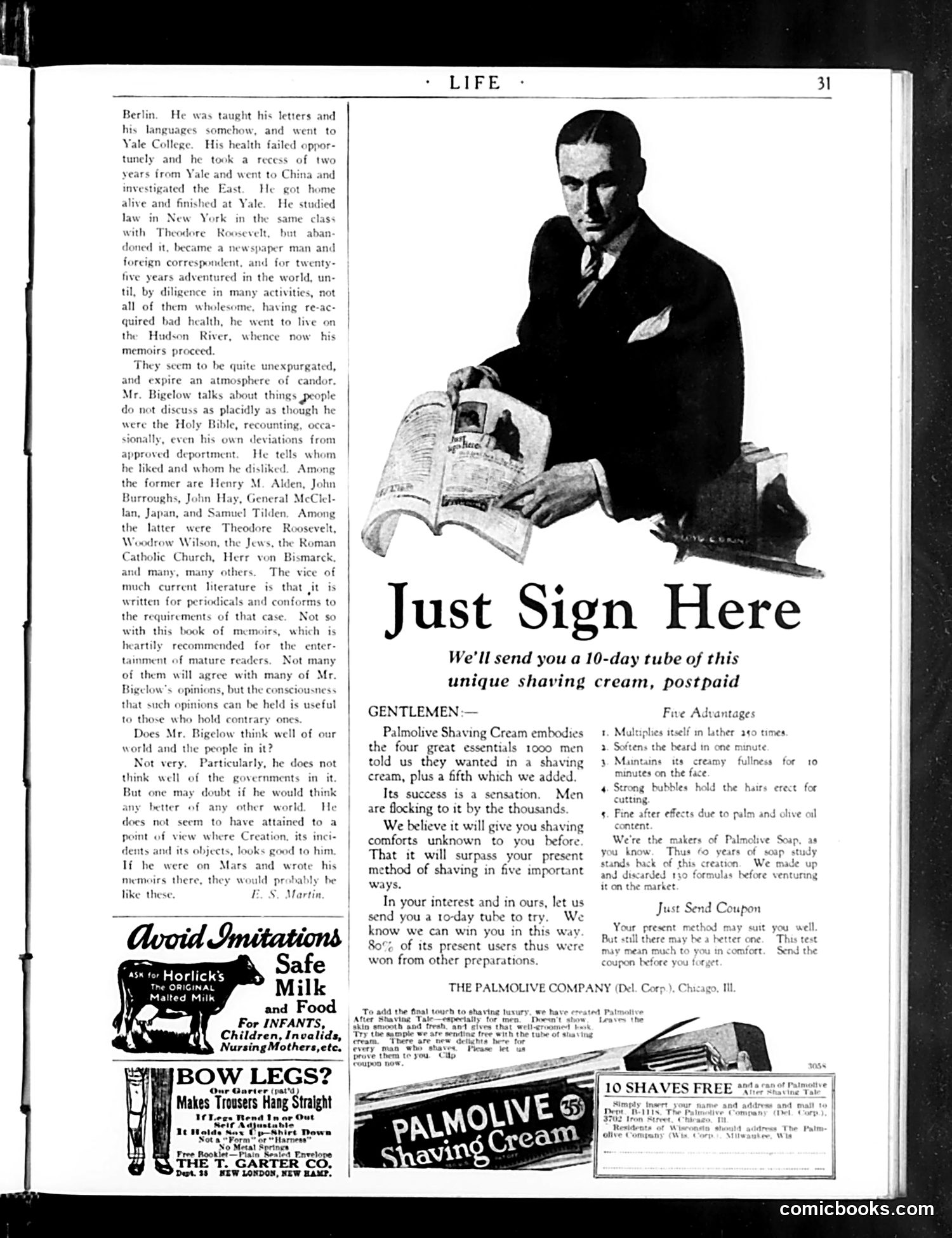
This page is primarily **advertising**, not political satire. The main content is a biographical article about someone named Bigelow (likely John Bigelow, a 19th-century diplomat and writer), discussing his travels to China, work as a newspaper correspondent, and friendships with figures like Theodore Roosevelt. The advertisements are era-typical (early 20th century): - **Palmolive Shaving Cream** dominates with a large appeal to "gentlemen" - **Horlick's Malted Milk** (nutritional product) - **T. Garter Company** (bow-leg corrective device) None of these ads contain political commentary. The page reflects period consumer culture: personal grooming products, health supplements, and corrective devices marketed with earnest sales pitches rather than humor. The "Just Sign Here" coupon structure was standard direct-response advertising technique of the era.
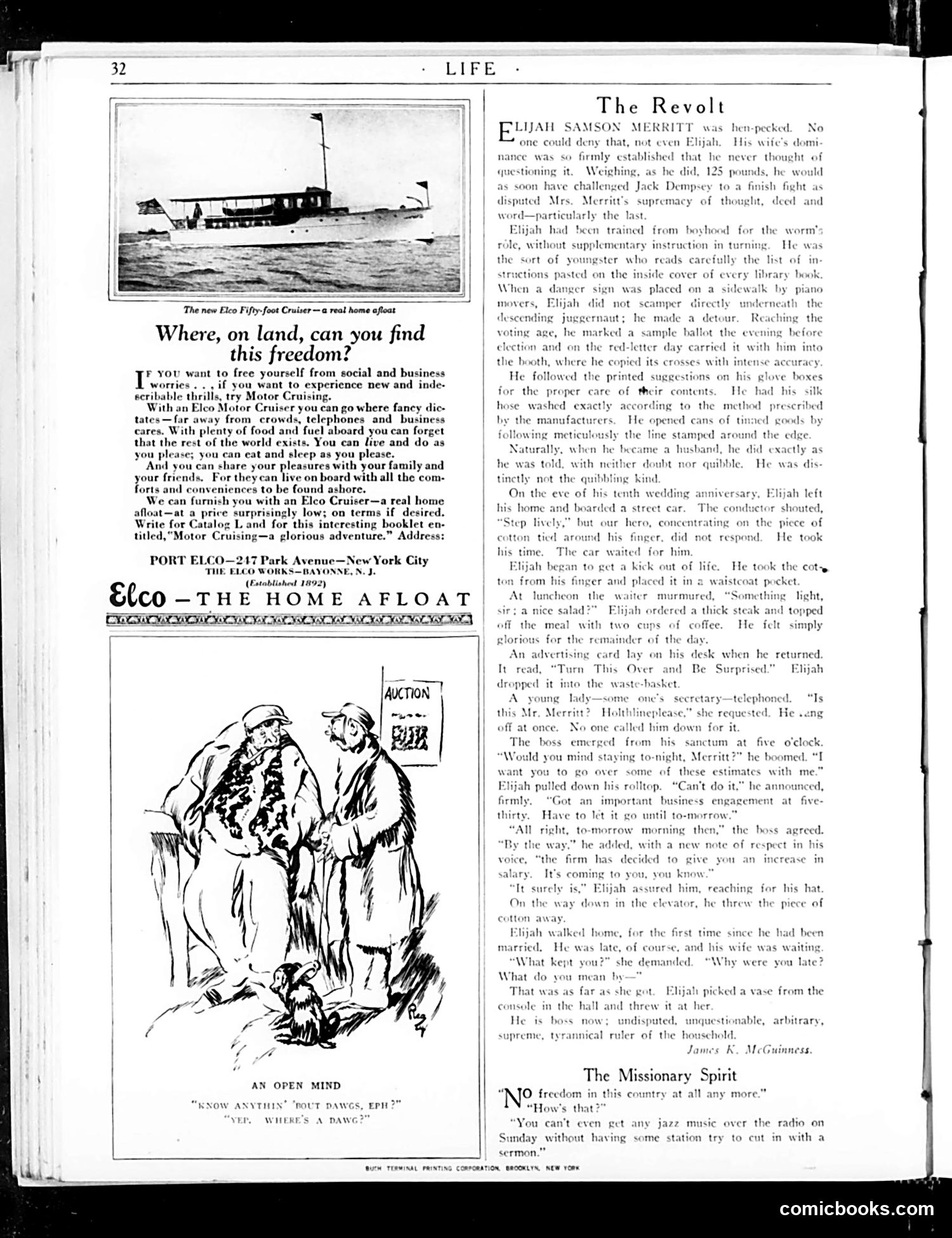
This page contains a serialized story about **Elijah Samson Merritt**, a henpecked husband dominated by his wife. The narrative satirizes rigid adherence to rules and instructions—Elijah obsessively follows printed directions on everything from canned goods to library books, never questioning authority. The turning point comes when his boss demands he stay late for a business engagement, but Elijah refuses, citing a prior commitment. This small act of defiance emboldens him. When he arrives home late that evening, his wife confronts him ("Why were you late?"), and instead of submitting as usual, **Elijah throws a vase at her**—a dramatic rebellion against decades of marital subjugation. The accompanying cartoon labeled "An Open Mind" shows two men discussing "dawgs" (dogs), illustrating the theme of unquestioning obedience. The satire targets early-20th-century gender dynamics and the emasculation of men in marriage, while also mocking blind rule-following. The accompanying **Elco motorboat advertisement** ironically promotes "freedom" on the opposite page.
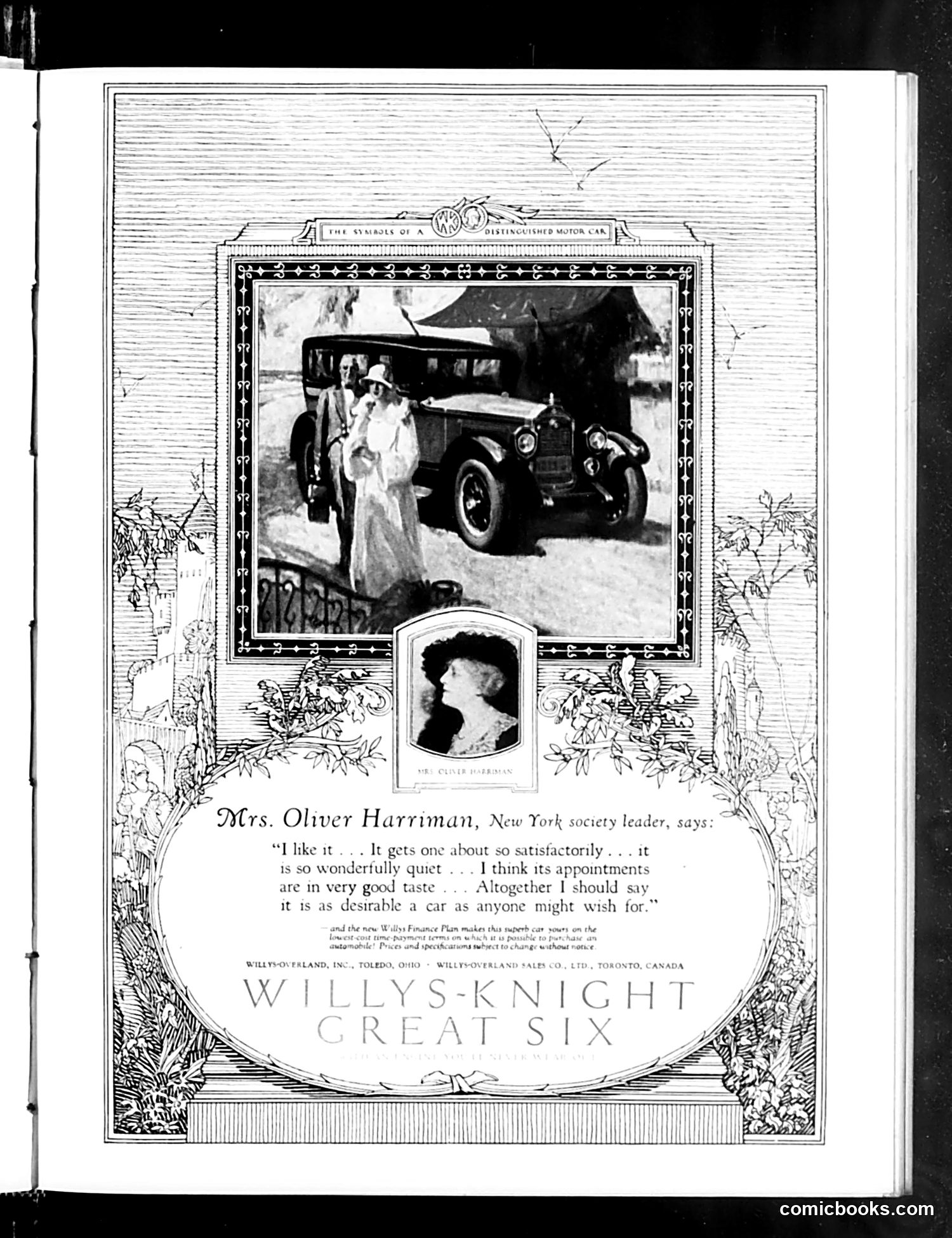
This is a car advertisement, not political satire. It features Mrs. Oliver Harriman, a New York society leader, endorsing the Willys-Knight Great Six automobile. The ad uses her social status as a testimonial—implying that if a wealthy, taste-conscious society woman approves of the car's quiet operation and refined appointments, it must be desirable. The humor is subtle: the ad gently mocks wealthy elites by suggesting their primary concerns are discretion ("wonderfully quiet") and decorative "appointments" rather than performance. For modern readers, it demonstrates early 20th-century advertising's reliance on celebrity endorsements and the assumption that aspirational consumers would trust the opinions of the wealthy and fashionable.
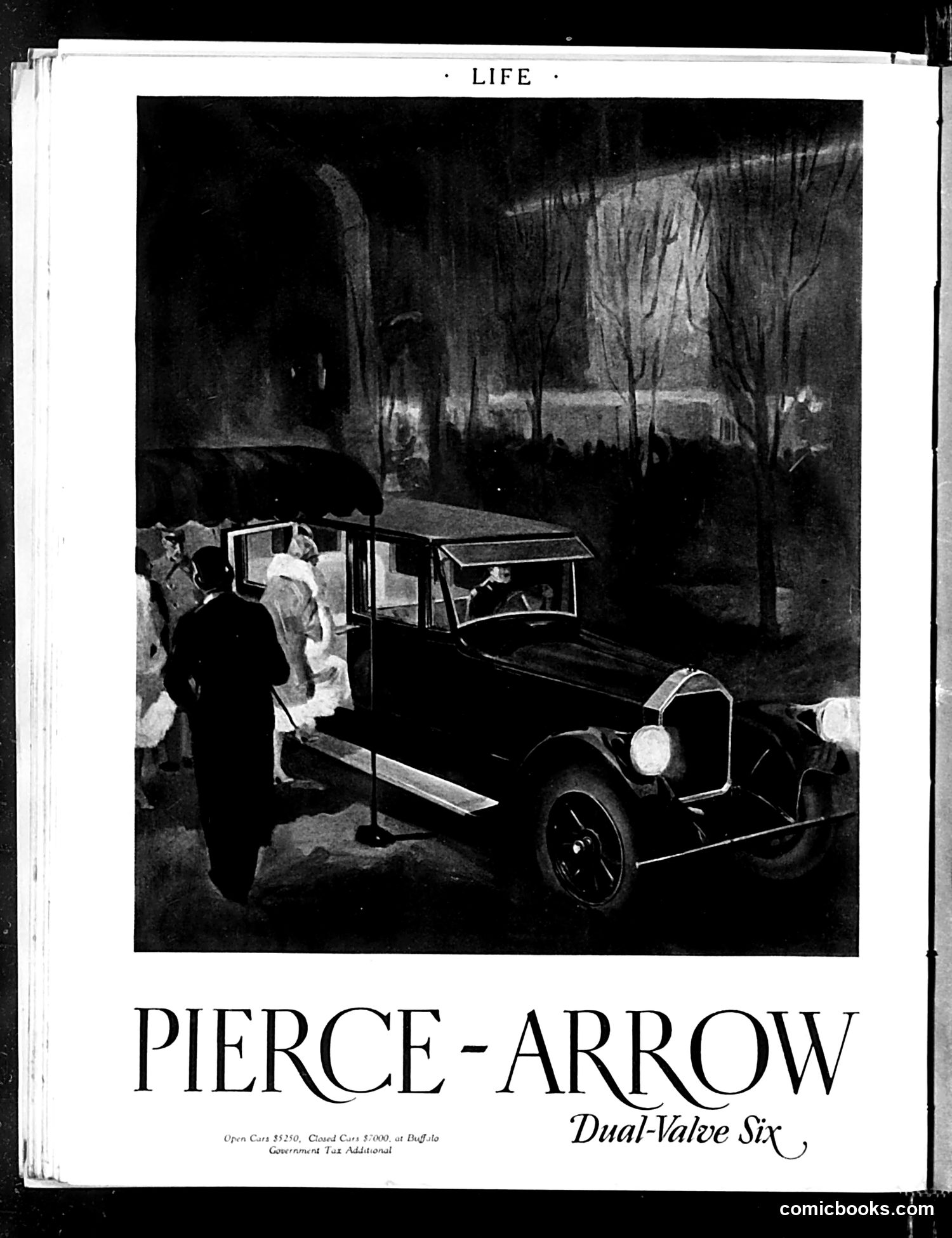
This is a full-page advertisement for the Pierce-Arrow automobile, specifically their "Dual-Valve Six" model. The image depicts a nighttime social scene—an elegantly dressed couple arriving at what appears to be a formal event or gathering, with the dark Pierce-Arrow automobile prominently featured as the focal point. This is not political satire or a cartoon; it's a luxury car advertisement from *Life* magazine. The ad emphasizes the automobile's prestige by associating it with sophisticated nightlife and formal social occasions. The dramatic nighttime setting and well-dressed figures suggest the car appeals to affluent, socially prominent consumers. Small text indicates pricing and tax information. This represents typical 1920s-era automotive advertising targeting wealthy buyers.