
Life, 1926-02-25 · page 26 of 36
Life — February 25, 1926 — page 26: what you’re looking at
What you’re looking at
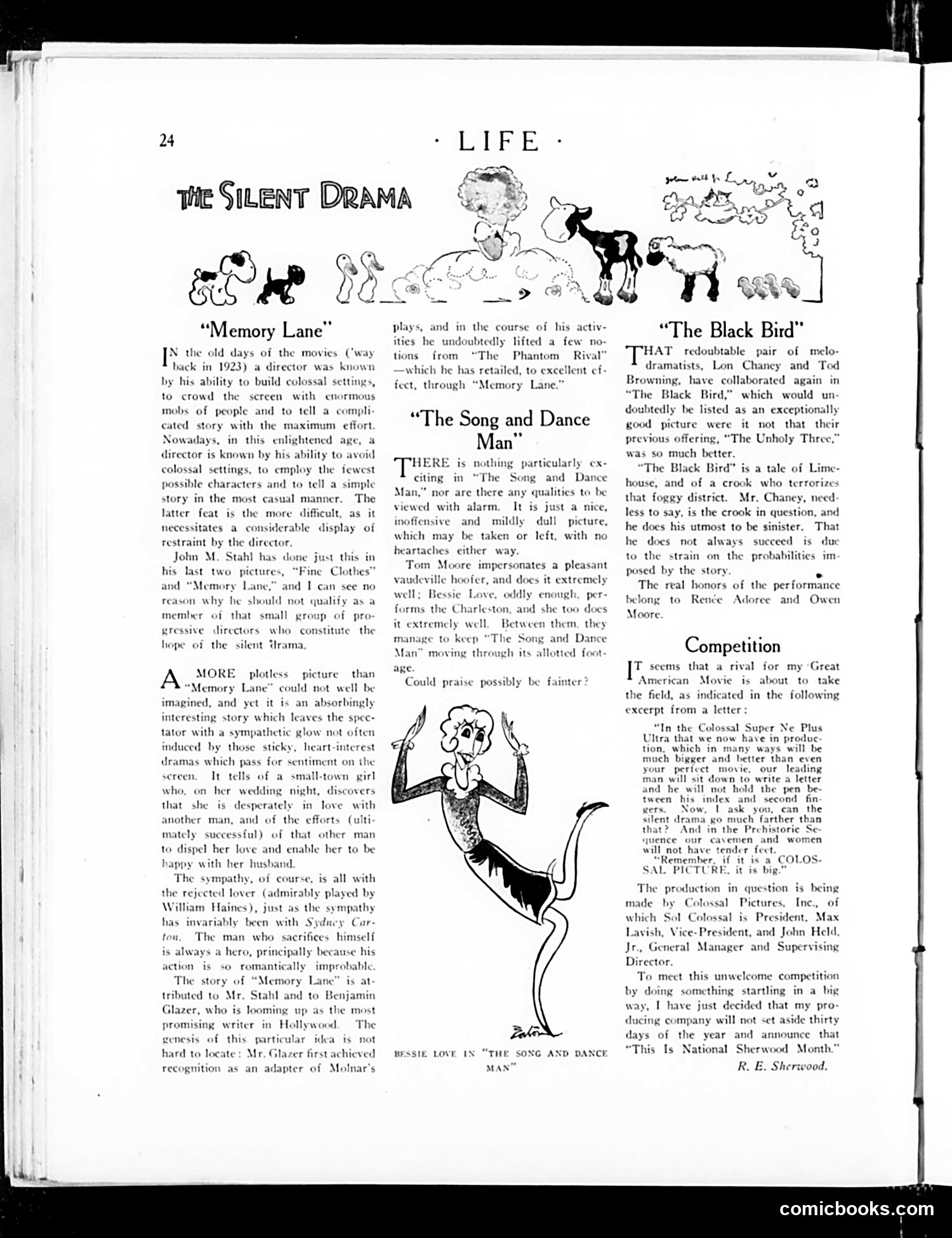
This page contains three film reviews from the silent cinema era (circa 1923-1924). The text discusses three movies: **"Memory Lane"** - Praised as a plotless but engaging story about a small-town girl who marries one man while loving another. Director John M. Stahl is commended for restraint and simplicity rather than elaborate sets—a shift from 1920s filmmaking excess. **"The Song and Dance Man"** - A mildly dismissive review of a vanilla entertainment featuring Tom Moore as a vaudeville performer and Bessie Love performing the Charleston. The critic's faint praise ("Could praise possibly be fainter?") is satirical. **"The Black Bird"** - Reviews the collaboration between horror-filmmaker Tod Browning and star Lon Chaney, noting it's good but inferior to their previous hit "The Unholy Three." The crude cartoon of a dancer illustrates the second review's vaudeville theme. A sidebar **"Competition"** mentions a rival studio's "Colossal Super Ne Plus Ultra" production, expressing competitive boasting about bigger, better films.
📄 Transcribed text from this page (OCR, searchable)
Machine-transcribed from the original scan — historical spelling and the odd misread are preserved.
24 Te Sitenyr DRAMA Bom 12 “Memory Lane” N the old days of the movies (way back in 1923) a direc by his ability to build colossal settings, the with mobs of people and to tell a compli with the maximum effort Nowadays, in this enlightened age, a re was known to crowd screen enormous cated story director is known by his ability to avoid colossal settings, to employ the fewest possible characters and to tell a simple The as it story in the most casual man latter feat necessitates ner. difficult a considerable display of is the more restraint by the director John M. Stahl has dk last two and “Memory Lane, © just this in ine Clothes” and I can see no his picture reason why he should not qualify as a that member of small group of pro gressive directors who constitute the hope of the silent Urama. MORE plotless picture than A imagined, and yet it is an absorbingly “Memory Lane” could not well be interesting story which leaves the spec- M often those sticky, heart-interest tator with a sympathetic glow 1 induced by dramas which pass for sentiment on the tells of on her screen. It U-town girl who, wedd that another man, ar the efforts mately that other man to dispel her love and enable her to be ig night, discovers is desperately she ove with i successful) of happy with her hushand The sympathy, of course, is all with rejected lover (admirably played by William Haines), just as the sympathy has invariably been with Sydney ( The is always a hero, principally because his romantically able The story of “Memory Lane” is at- tributed to Mr. Stahl Glazer, who is looming ton. man who sacrifices himself action is so impro to Benjamin pas the most Hollywood. The particular is not Mr. Gla promising writer in genesis of this idea hard to locate er first achieved recognition as an adapter of Molnar’s 0G plays, and in the course of his activ- ities he undoubtedly lifted a few no- ti from “The Phantom Rival” —which he has retailed, to excellent cf fect, through “Memory Lane “The Song and Dance Man” THERE is nothing particularly ex- citing in “The So and Dance Man,” nor are there any qualities to be viewed with alarm. It is ta nice, mildly dull picture, taken or left, with no artaches either way. Tom Moore impersonates a pleasant vaudeville hoofer, and does it extremely inoffensive and which may be he well; Bessie Love, oddly forms the Charleston, it extremely well enough, per- and she too does Between them, they to keep “The Song and Dance hits allotted foot mani Man age Could praise possibly be fainter moving thro “THE MAN” BESSIE LOVE IN SONG AND DANCE “The Black Bird” HAT redoubtable pair of m dramatists, Lon Chaney and Browning, have collaborated agai “The Black Bird,” which would un doubtedly be listed as an exceptionally good picture were it not that their previous offering, “The Unholy Three,” was so much better. “The Black Bird’ house, and of a crook who terrorizes that foggy district. Mr. Chaney is the crook in question, and That due is a tale of Lime- need. less to s. he does his utmost to be sinister. not strain on the he does succeed is to the posed by the story i The real honors of the performance always probabilities im belong to Renée Adorce and Owen Moore Competition T seems that a rival for my ‘Great take Mowing American Movie is about to t excerpt from a letter: e field, as indicated in the “In the Colossal Super Ne Plus Ultra that we now have in produc tion, which in many ways will be much bigger and better than even your perfect movie, our leading man will sit down to write a letter and he will not hold the pen be tween his index and second fin you, can the in the Prehi cavemen and women tender fect if it is a COLOS- it is big.” uence our will not have “Remember. SAL PICTURE The production in question is being made by Colossal Pictures, Inc. of which Sol Colossal is President, Max Lavish, Vice-President, and John Held Jr, General Manager and Supervising Director. To mect this unwelcome competition by doing something startling in a hig way, I have just decided that my pro- ducing company will not set aside thirty the year and announce that National Sherwood Month.” R. days of “This Is herwood. comicbooks.com