
A complete issue · 36 pages · 1926
Life — January 28, 1926
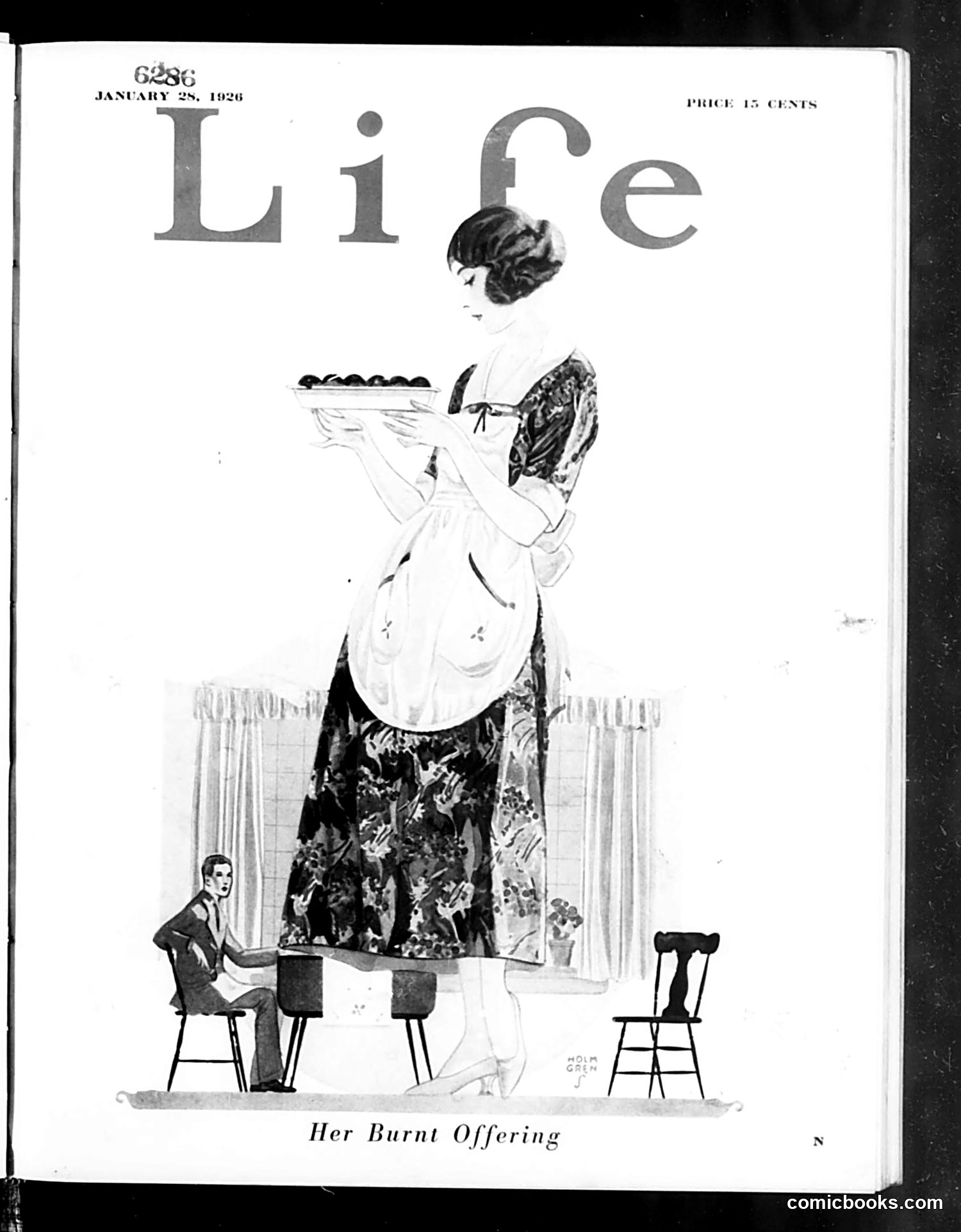
This satirical cover depicts a domestic scene playing on the double meaning of "burnt offering." A woman, drawn in an exaggerated classical style, presents a burnt (overcooked) pie or baked good to a small man seated below her. The title "Her Burnt Offering" is a pun—simultaneously referencing a religious sacrifice and the common domestic joke about a wife's failed cooking attempt. This reflects 1920s gender humor where women's cooking incompetence was a standard comedic trope. The classical artistic treatment (enlarging the woman monumentally while miniaturizing the man) adds ironic grandeur to the mundane domestic failure, satirizing how women presented their domestic efforts as worthy of appreciation, even when unsuccessful.
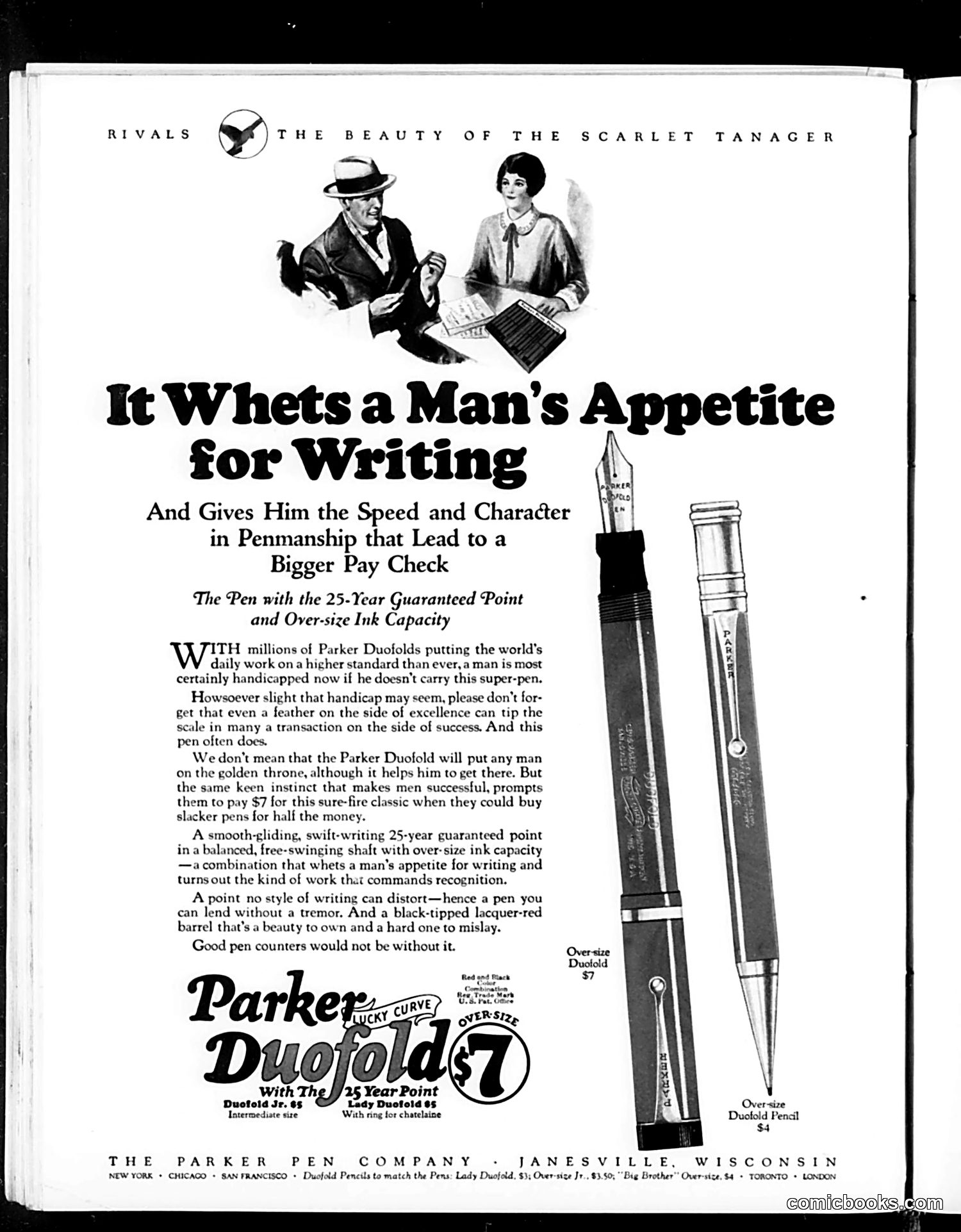
This is primarily a **Parker Pen advertisement**, not satirical content. The page promotes the Parker Duofold fountain pen, priced at $7, featuring a 25-year guaranteed point and oversized ink capacity. The illustration shows two figures—a man in a hat and suit alongside a woman—apparently discussing business or writing matters. The ad's messaging plays on 1920s-era aspirational capitalism: suggesting that owning this superior pen will enhance a businessman's professional success and earning potential ("Bigger Pay Check"). The satire is subtle and self-aware—the ad somewhat humorously acknowledges that a pen alone won't guarantee success, yet argues that quality tools matter for serious professionals. This reflects period advertising's blend of practical claims with lifestyle aspiration.
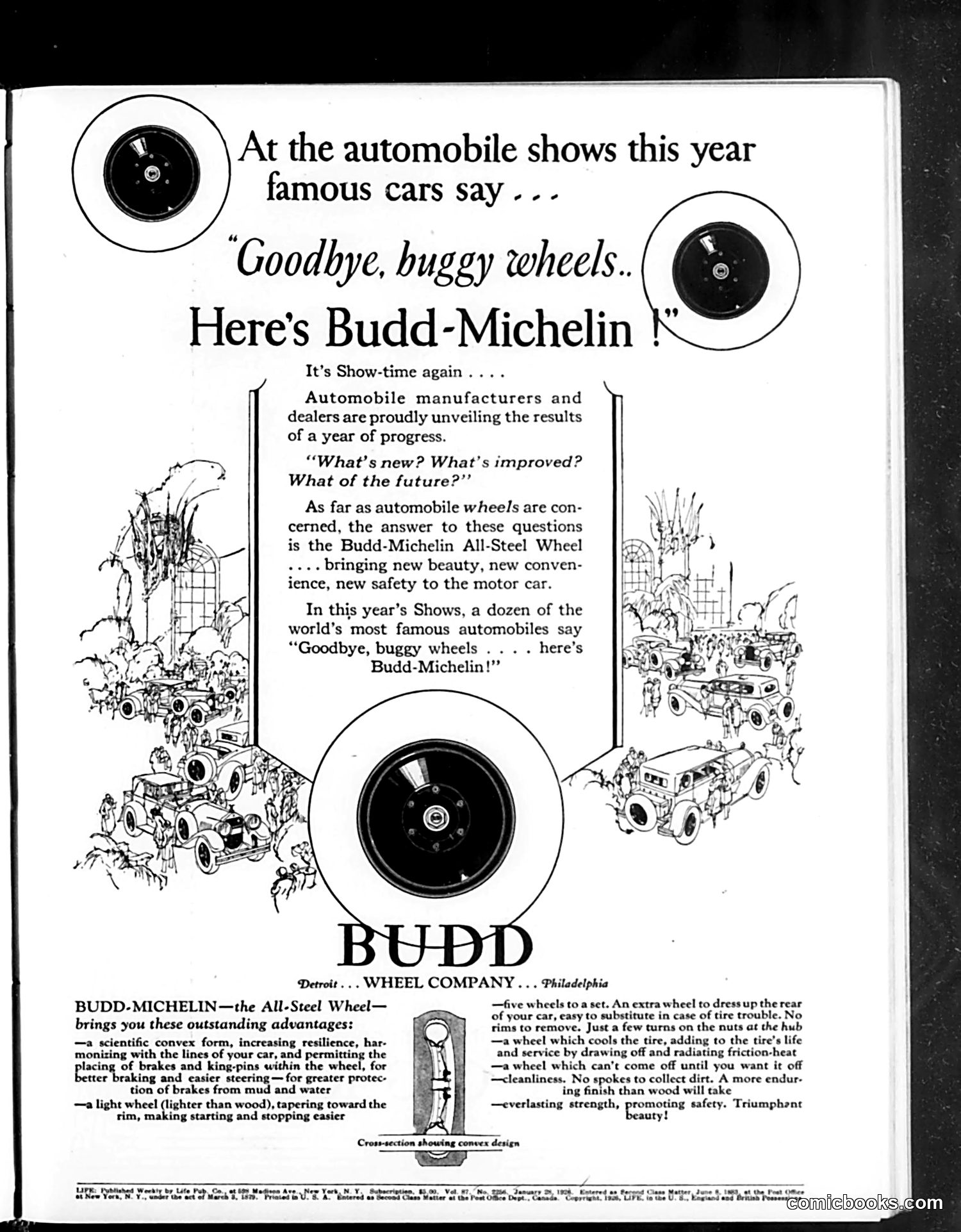
This is primarily an **advertisement for Budd-Michelin All-Steel Wheels**, not satire or political commentary. The "famous cars say goodbye, buggy wheels" framing uses humor as a sales technique rather than social critique. The page depicts the automotive industry's transition from wooden-spoked buggy wheels to modern all-steel wheels—a genuine technological advancement of the era. The illustration shows cars triumphantly replacing horse-drawn carriages, emphasizing industrial progress and modernization. The cartoon elements (anthropomorphized cars, exuberant scenes) are lighthearted marketing language highlighting the Budd-Michelin wheel's benefits: durability, safety, easier tire replacement, and aesthetic appeal. This reflects early 20th-century confidence in automotive technology as superior to horse-drawn transportation. There is no political satire present—this is straightforward product advertising dressed in humorous visual language.
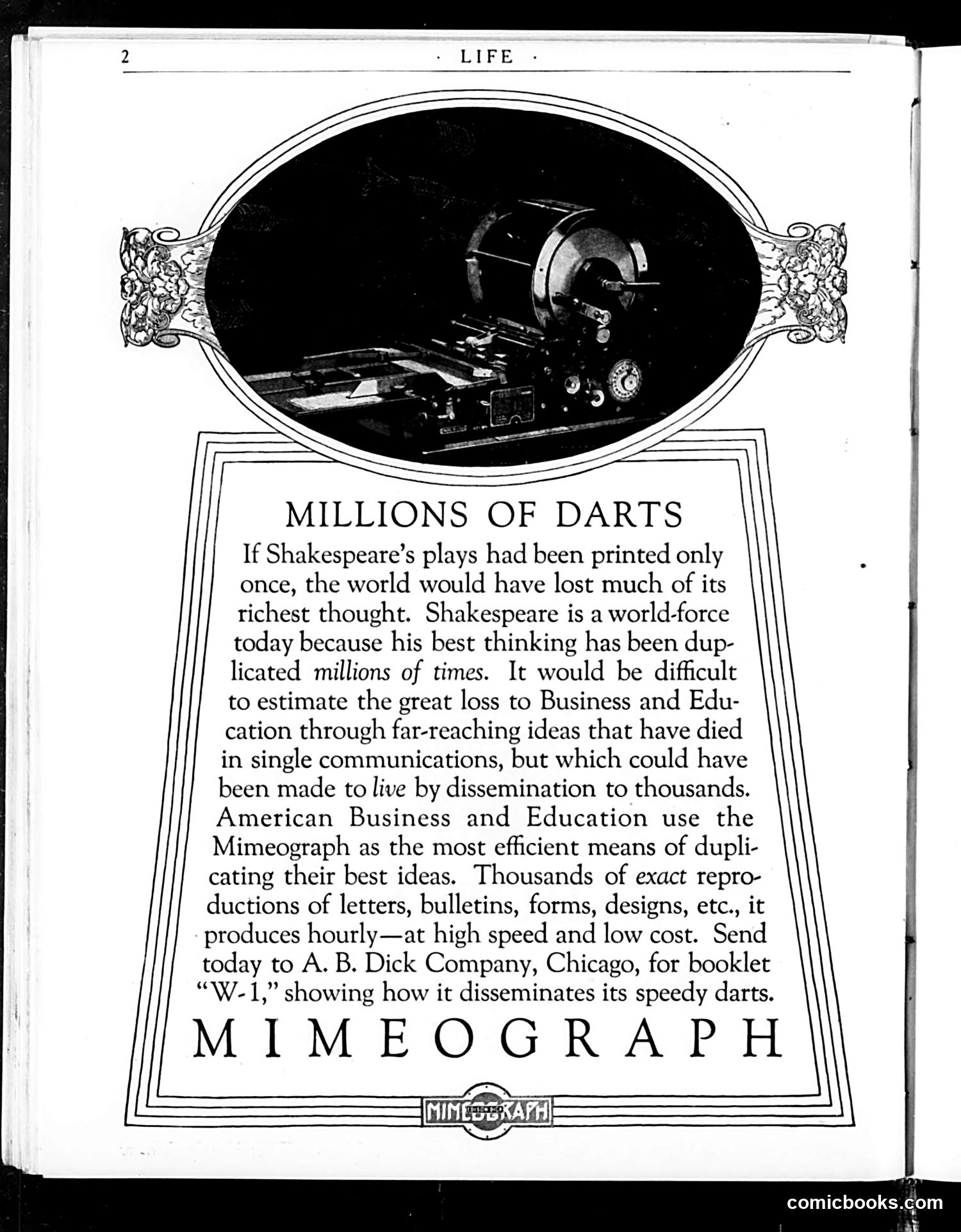
This is primarily a **Mimeograph advertisement**, not a political cartoon. The page features a product image at the top showing a mimeograph machine—a now-obsolete document reproduction device. The advertisement uses Shakespeare as a rhetorical device: it argues that Shakespeare's enduring influence came from *repeated dissemination* of his works. The ad then makes an analogy—just as multiple printings made Shakespeare influential, businesses should use mimeographs to mass-produce and distribute their own "best ideas" widely and efficiently. The satirical angle (typical of Life magazine) appears subtle: the comparison between Shakespeare's timeless genius and business efficiency documents is somewhat absurd and humorous. The ad promises "high speed and low cost" reproduction, targeting American businesses and educational institutions.
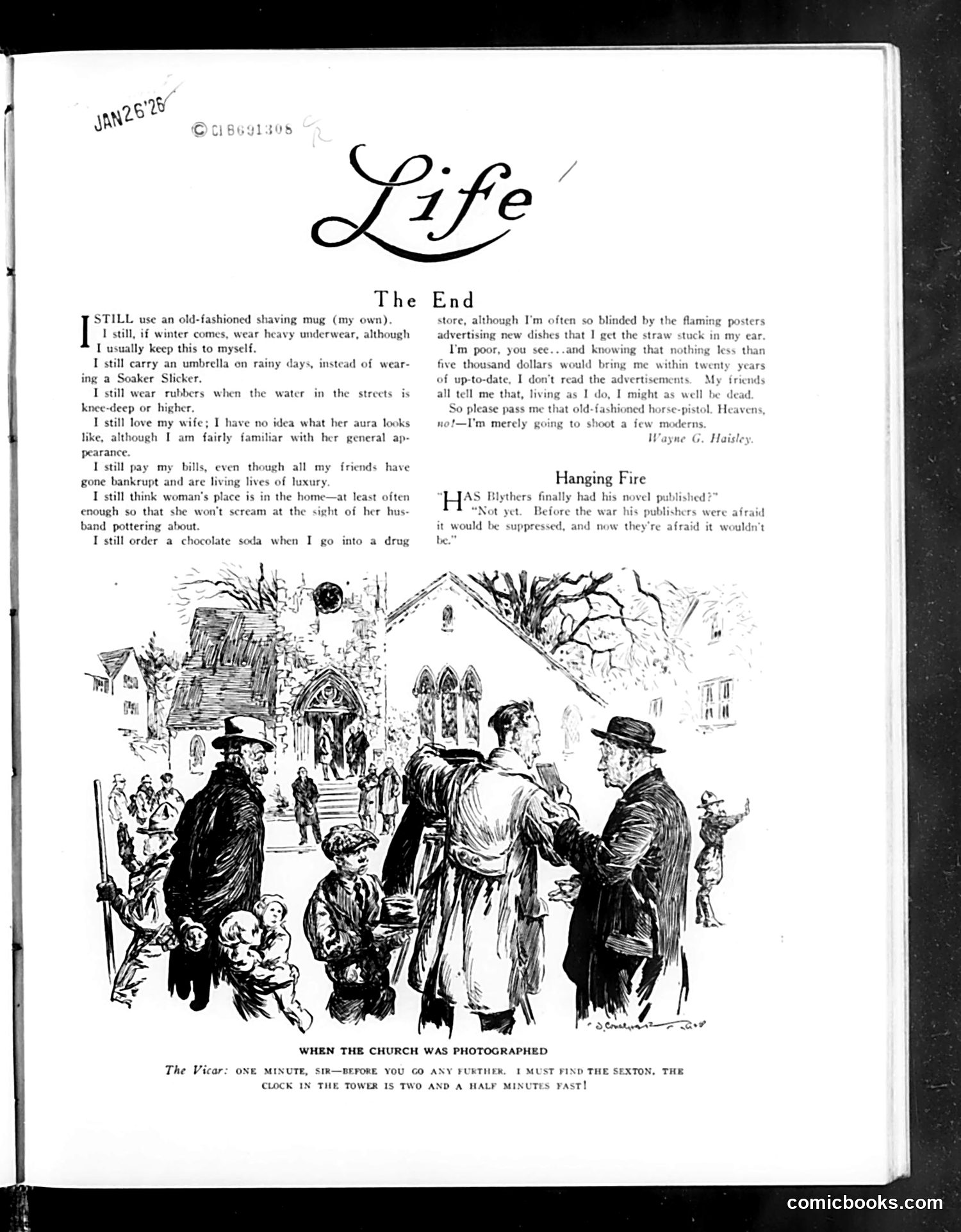
This page contains two separate pieces: **"The End"** (top) is a humorous essay by Wayne G. Hailey about maintaining old-fashioned habits despite modern changes—using traditional shaving mugs, carrying umbrellas, paying bills, and ordering chocolate sodas while friends have gone bankrupt. **"Hanging Fire"** (bottom) is a short satirical piece about Has Blyther's unpublished novel. His publishers feared suppressing it before WWI, but now worry it won't be suppressed because they fear publication won't matter anymore—a joke about how wartime has made even controversial content seem irrelevant. The accompanying illustration shows a church photograph scene with urgently dressed figures, illustrating the Vicar's panicked dialogue about finding the sexton before the clock strikes 2:30—a simple comedic vignette about timing and bureaucratic fuss.
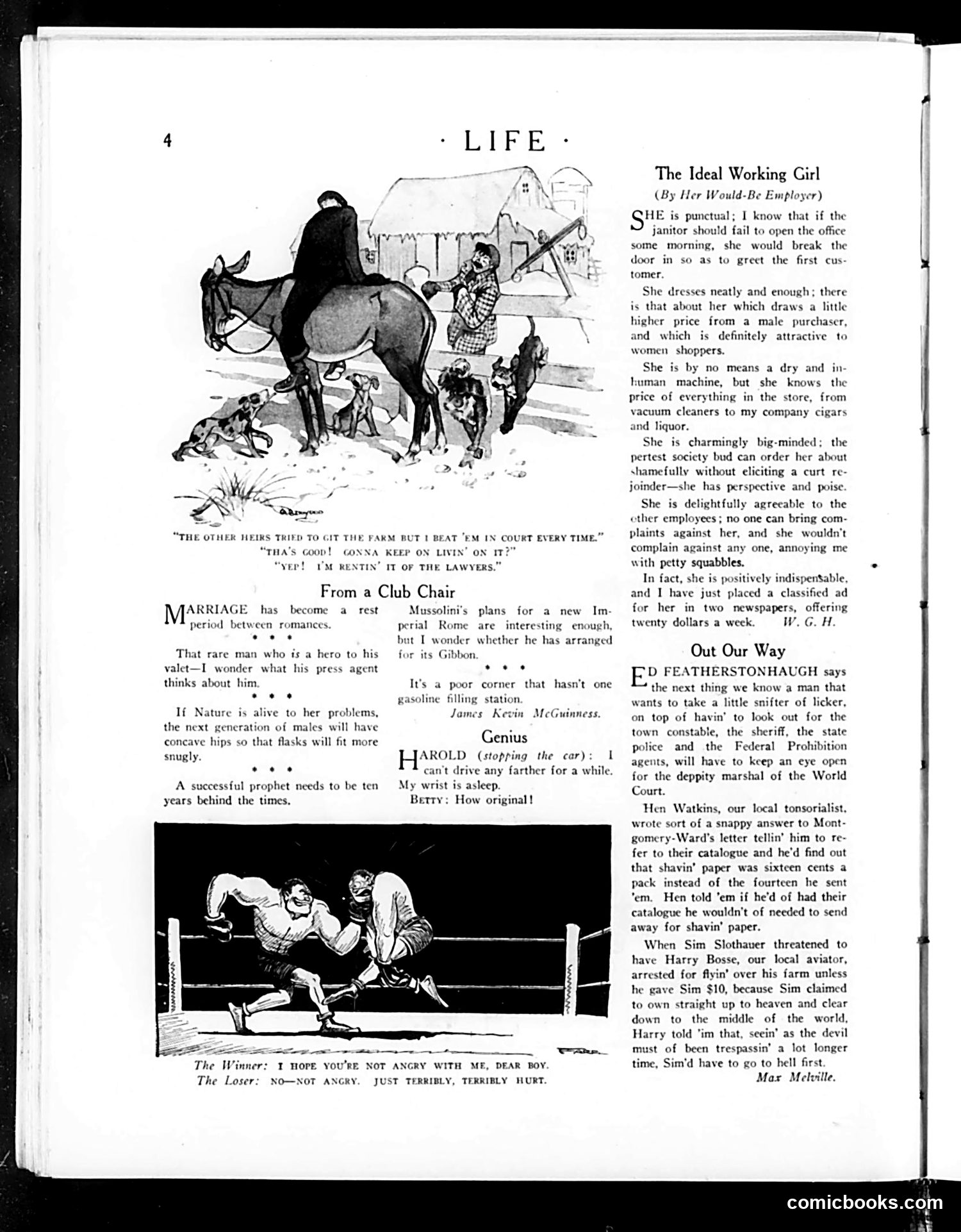
This page contains several satirical pieces about gender relations and workplace dynamics in early 20th-century America. **"The Ideal Working Girl"** mocks employer expectations, portraying an impossibly perfect female employee who is punctual, neat, knowledgeable about inventory, well-mannered, and indispensable—yet affordable at twenty dollars per week. The satire critiques how employers exploited women workers by expecting exceptional qualities at minimal pay. **"From a Club Chair"** contains brief social commentary about marriage, prophecy, and male-female relations. **"Genius"** is a short joke about a man claiming his wrist is "asleep"—a pun on laziness. The boxing cartoon depicts two fighters, illustrating physical comedy rather than political content. Overall, the page satirizes gender stereotypes and labor exploitation of the era.
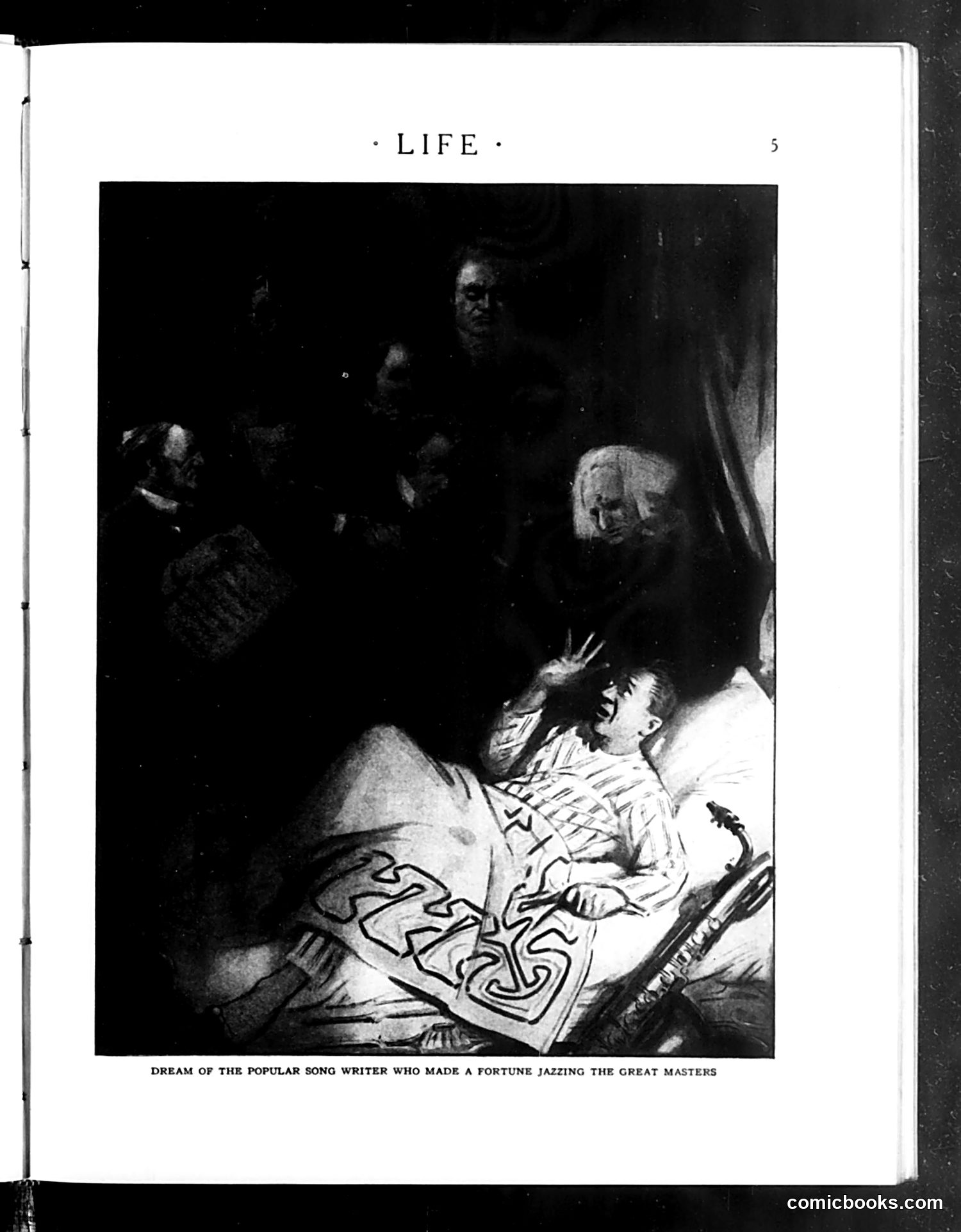
This is a satirical illustration from *Life* magazine (page 5) depicting "Dream of the Popular Song Writer Who Made a Fortune Jazzing the Great Masters." The image shows a sleeping figure (the song writer) dreaming of classical composers or "great masters" (appearing as ghostly figures in the background) observing his work with apparent disapproval. The dreamer is shown clutching what appears to be sheet music with jazz-style notations. The satire targets the early 20th-century practice of composers adapting or "jazzing up" classical music for popular commercial success. The joke is that while these song writers profited enormously from modernizing the masters' works, the composers themselves (depicted as stern observers) would be dismayed by such vulgar appropriation of their serious art.
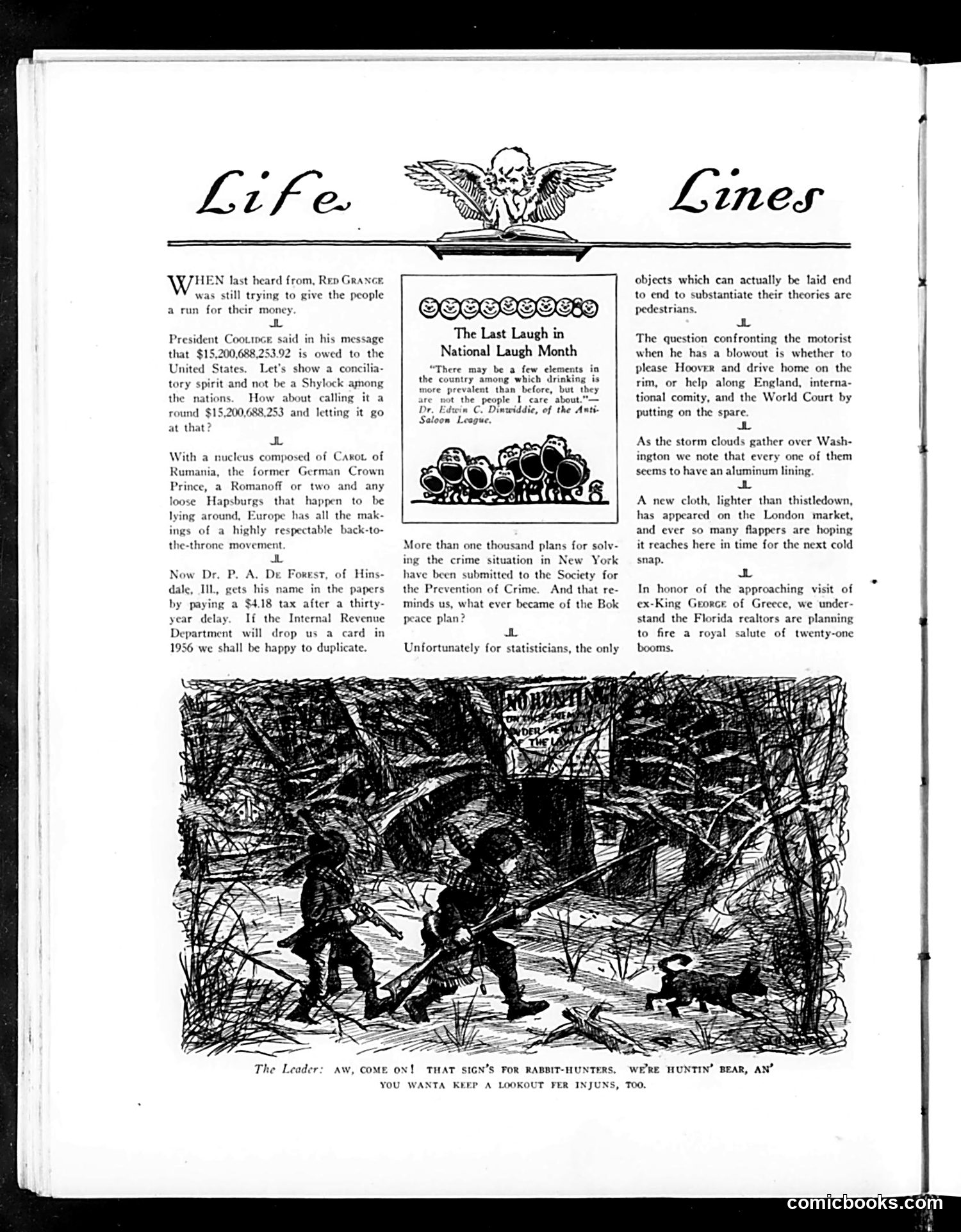
This page from *Life* magazine's humor section contains several brief satirical items: **Main cartoon** (bottom): Shows figures in a swampy setting with a sign reading "RABBIT HUNTERS." The leader's speech bubble reads: "AW, COME ON! THAT SIGN'S FOR RABBIT-HUNTERS. WE'RE HUNTIN' BEAR, AIN'T YOU WANTA KEEP A LOOKOUT FER INJUNS, TOO." The joke appears to satirize careless or overconfident hunters ignoring warning signs and underestimating dangers. **Text items** above discuss: President Coolidge's message about national debt; plans to solve New York crime; a new cloth ("lither than thistledown"); and Florida's planned twenty-one-boom salute honoring Greece's ex-king. The overall tone is lighthearted social and political commentary typical of 1920s satirical journalism.
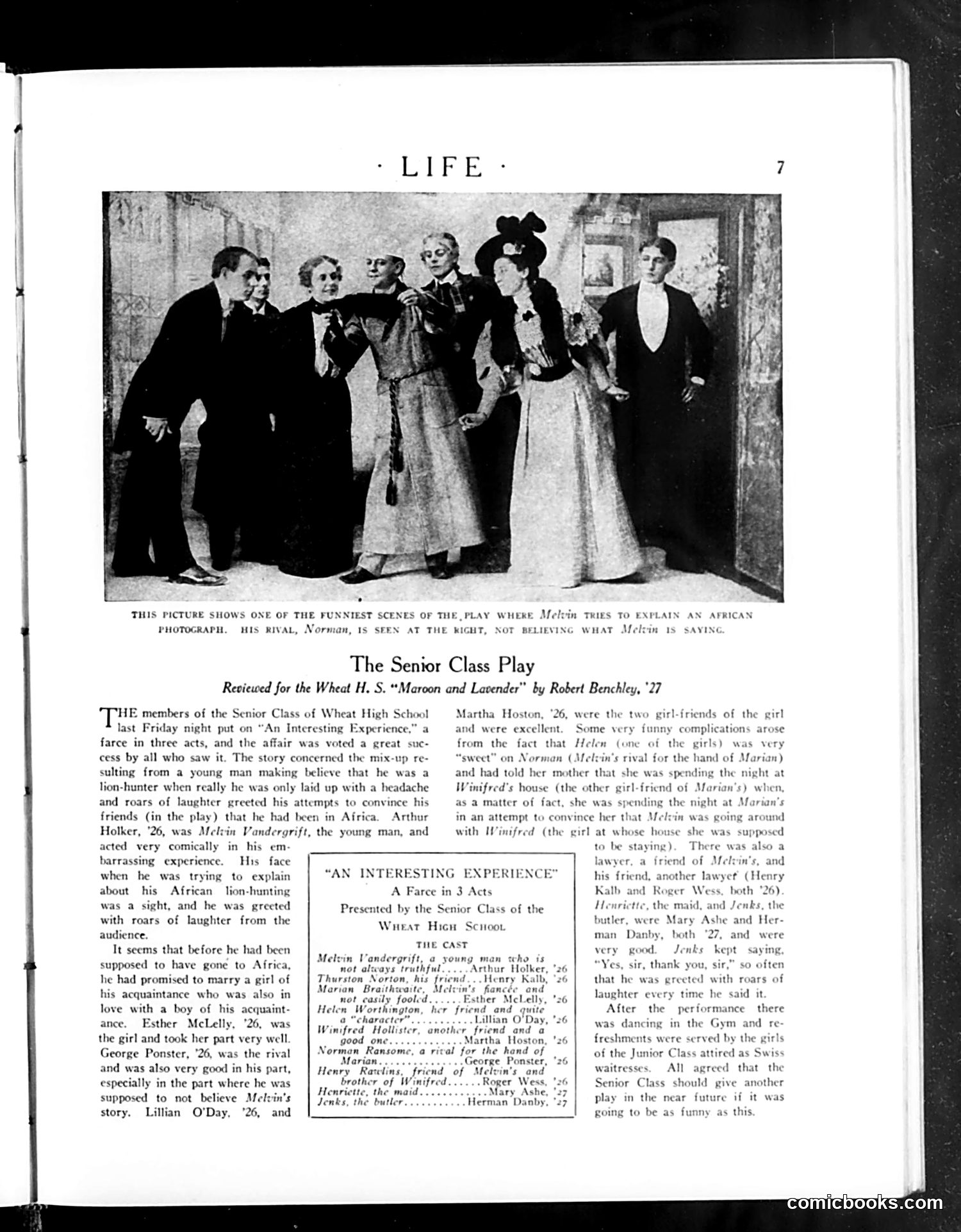
This page documents a high school theatrical production called "An Interesting Experience," performed by Wheat High School's Senior Class. The photograph shows the cast in what appears to be a comedic scene involving characters named Melvin and Norman, with the caption explaining that Melvin is attempting to convince his friends of an African hunting story—a setup for the play's humor. The page is not political satire. Rather, it's a lighthearted review of a student production, typical of Life magazine's coverage of American social life. The joke appears to center on Melvin's implausible tall tale about Africa and his friends' skeptical reactions. The cast list and detailed character descriptions suggest this was a popular local entertainment event worthy of magazine coverage.
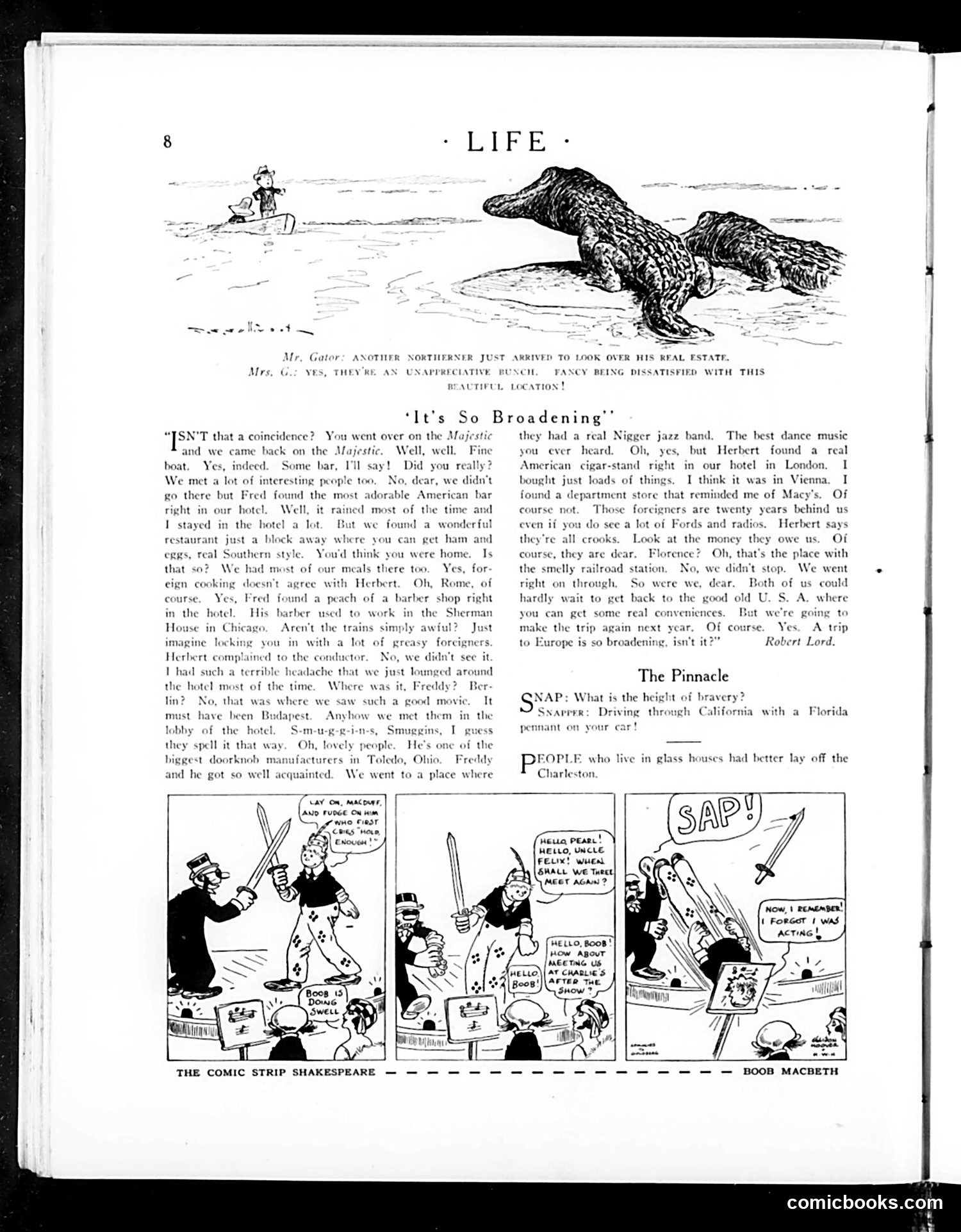
This page contains humorous prose and comic strips satirizing upper-class travel experiences. The opening illustration shows a wealthy man examining his "real estate"—alligators—suggesting absurd property ownership. The prose section "It's So Broadening" mocks tourists who travel to Europe and return with pretentious stories about discovering "authentic" experiences—jazz in London, cigar stands in Vienna—while missing genuine American culture. The satire targets wealthy Americans who view continental travel as a marker of sophistication. "The Comic Strip Shakespeare" at bottom parodies Shakespeare's *Macbeth* by reducing it to crude sword-fighting slapstick ("Boob Macbeth"), ridiculing both melodramatic stage combat and popular entertainment's dumbed-down versions of classics. Overall, the page satirizes class pretension and cultural snobbery in 1920s American society.
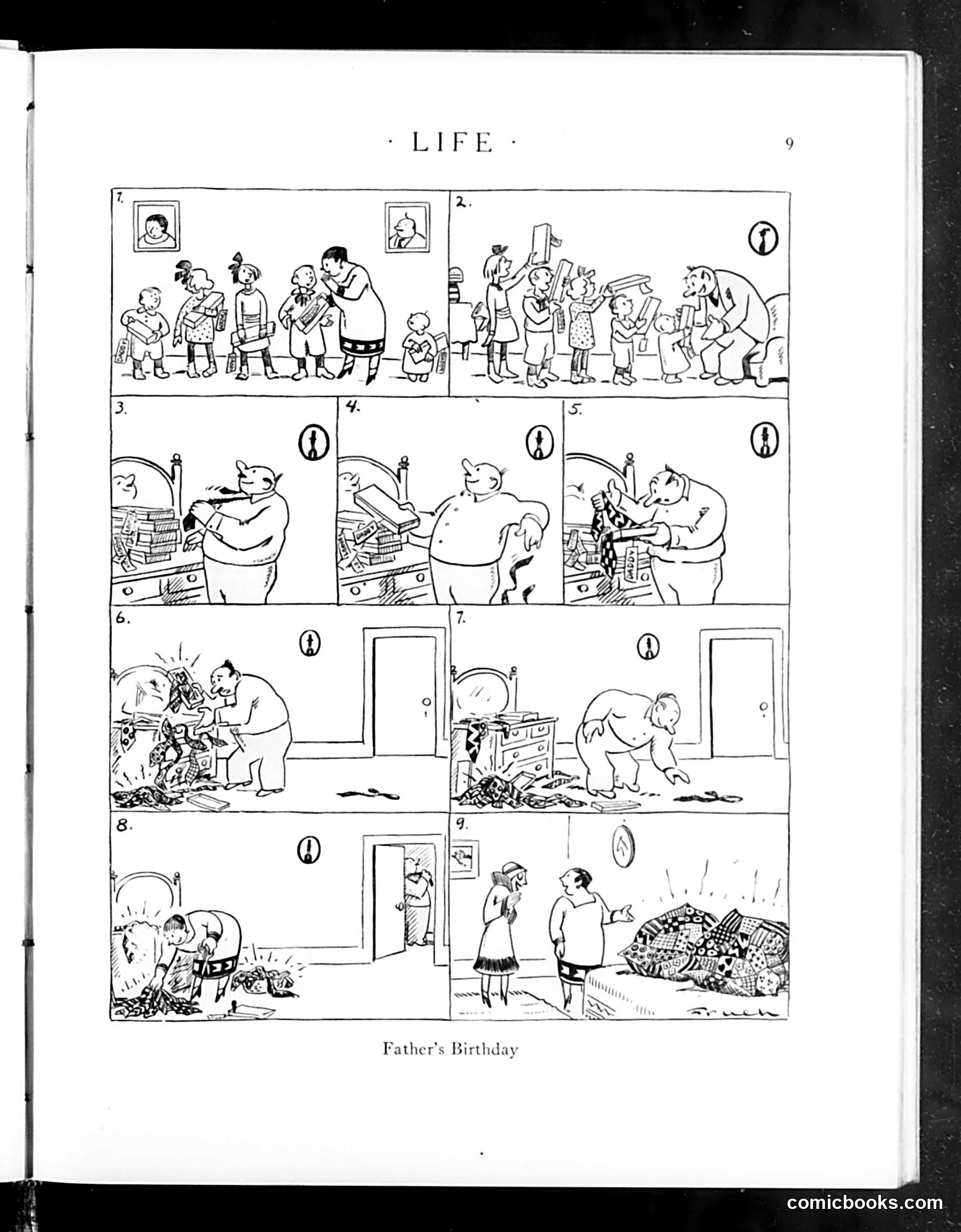
This is a humorous domestic comic strip titled "Father's Birthday" showing a father's birthday celebration going progressively wrong. The narrative follows a simple arc: Panel 1 shows a family gathering to celebrate. Panels 3-5 depict the father discovering and unwrapping gifts, appearing increasingly dismayed. Panels 6-8 show escalating chaos—the gifts appear to be malfunctioning or breaking, creating mess and disorder in the home. Panel 9 concludes with the family standing amid the wreckage of destroyed presents. The satire targets the contrast between birthday gift-giving expectations and reality: well-intentioned presents cause destruction and frustration rather than joy. It's a commentary on consumer goods quality or the impracticality of typical gifts—a relatable domestic humor common to early 20th-century Life magazine satire.
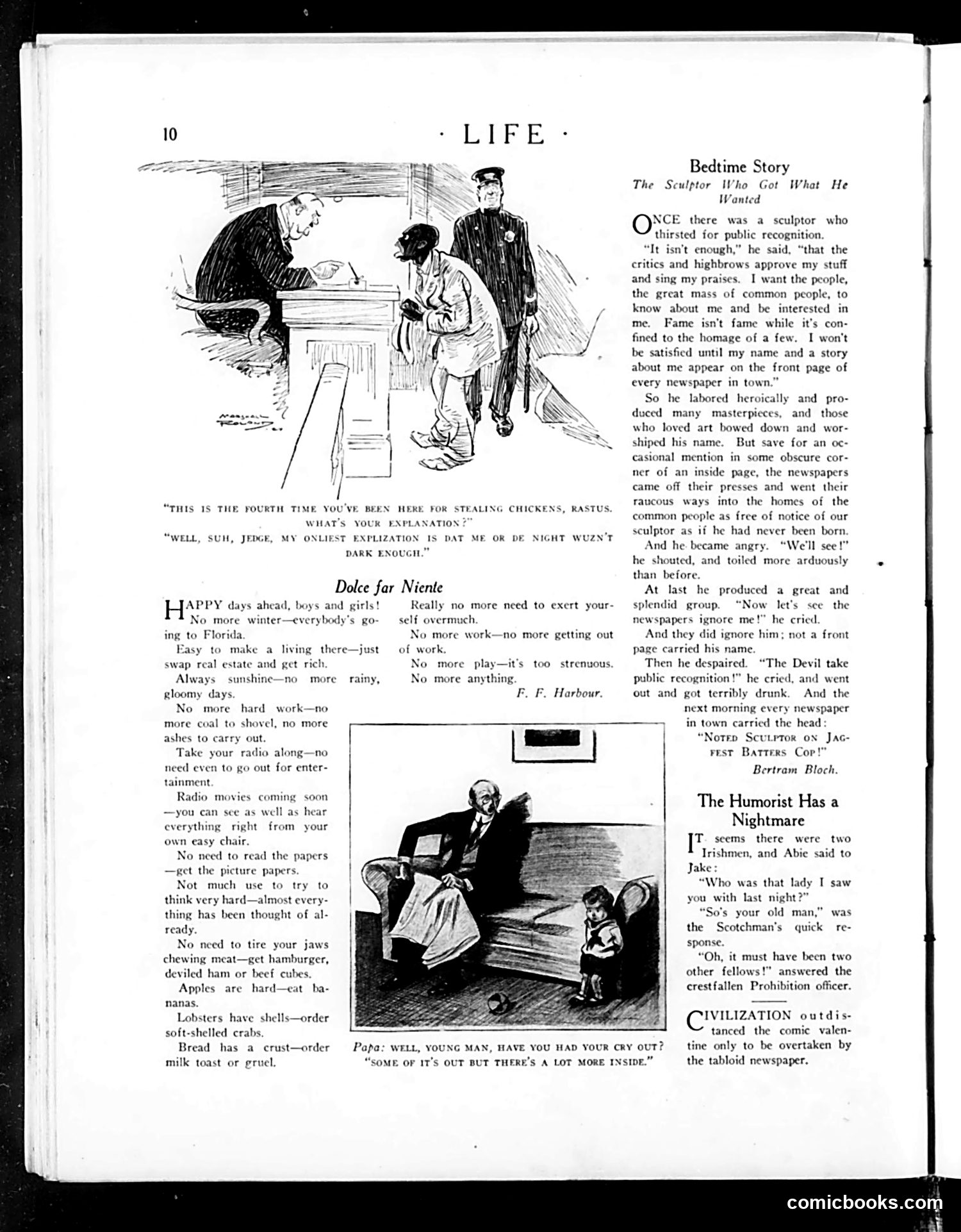
This page contains three distinct pieces: 1. **"Bedtime Story: The Sculptor Who Got What He Wanted"** — A cautionary tale about an ambitious artist desperate for public recognition. He eventually achieves notoriety when newspapers report he's stolen chickens, but it's the wrong kind of fame. The satire mocks both the artist's misguided ambitions and sensationalist media that elevates criminals. 2. **"Dolce far Niente"** — A humorous poem by F.F. Harbour listing easy Florida living perks (no winter, no work, no coal shoveling). It's gentle social satire about leisure-seeking escapism. 3. **"The Humorist Has a Nightmare"** — A joke about Prohibition-era drunk confusion, likely referencing contemporary alcohol policies. The cartoons use ink illustrations typical of early 20th-century American humor magazines.
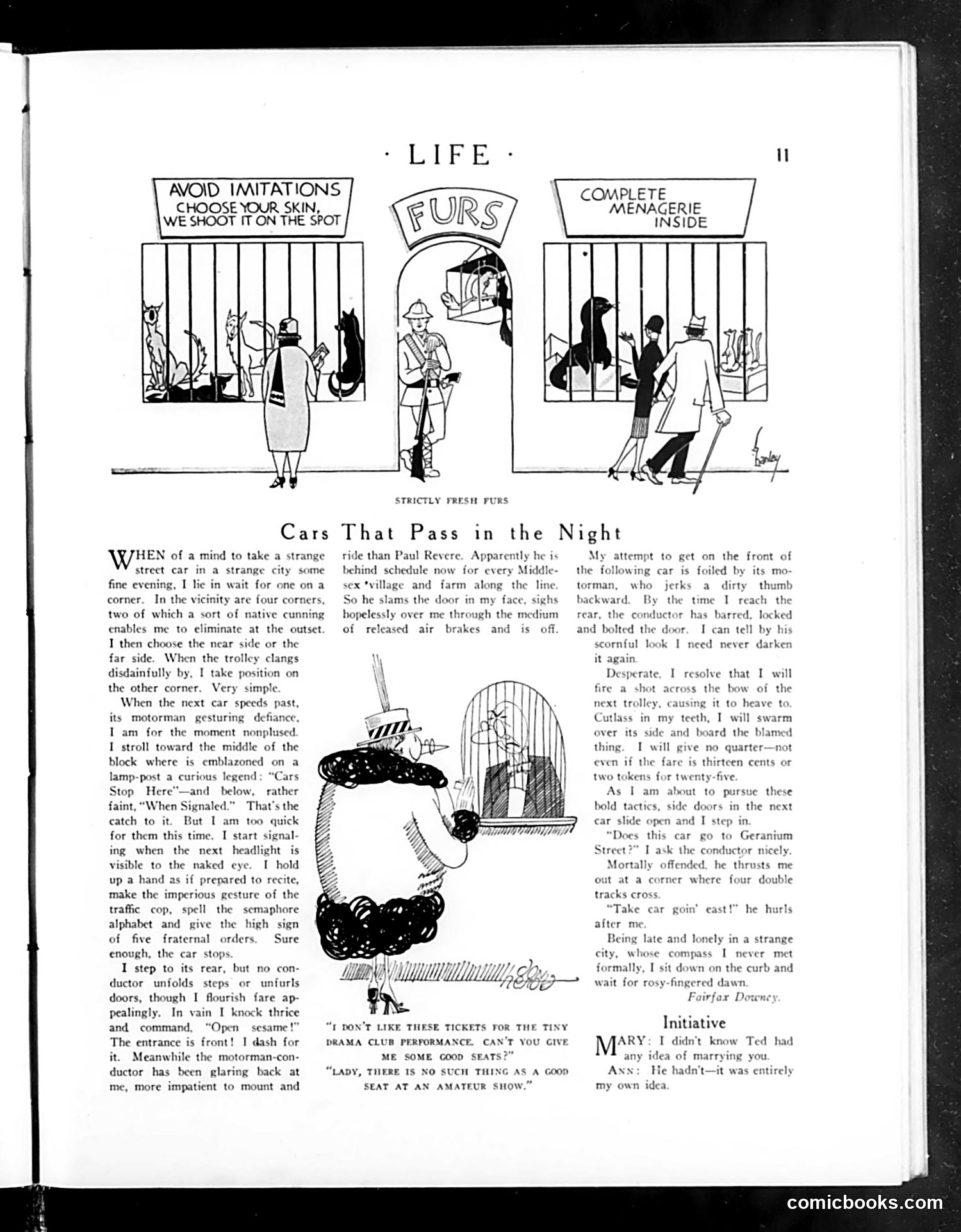
This page contains two satirical cartoons about 1920s urban life. The top cartoons mock the fur trade: the left depicts a furrier advertising "avoid imitations" while displaying furs behind bars (suggesting they're caged animals), and the right shows a "complete menagerie inside" a fur shop—visual satire on treating animal pelts as commodities. The main story, "Cars That Pass in the Night," describes a passenger's petty revenge fantasies against streetcar conductors—deliberately blocking doors, attempting to derail trolleys, and demanding transfers to unlikely locations. It's satirizing urban frustrations and the class tension between working-class transit employees and demanding passengers. The bottom section appears to begin a short story titled "Initiative" about a character named Mary discussing Ted's marriage proposal. The satire targets consumer culture, animal exploitation, and everyday urban irritations.
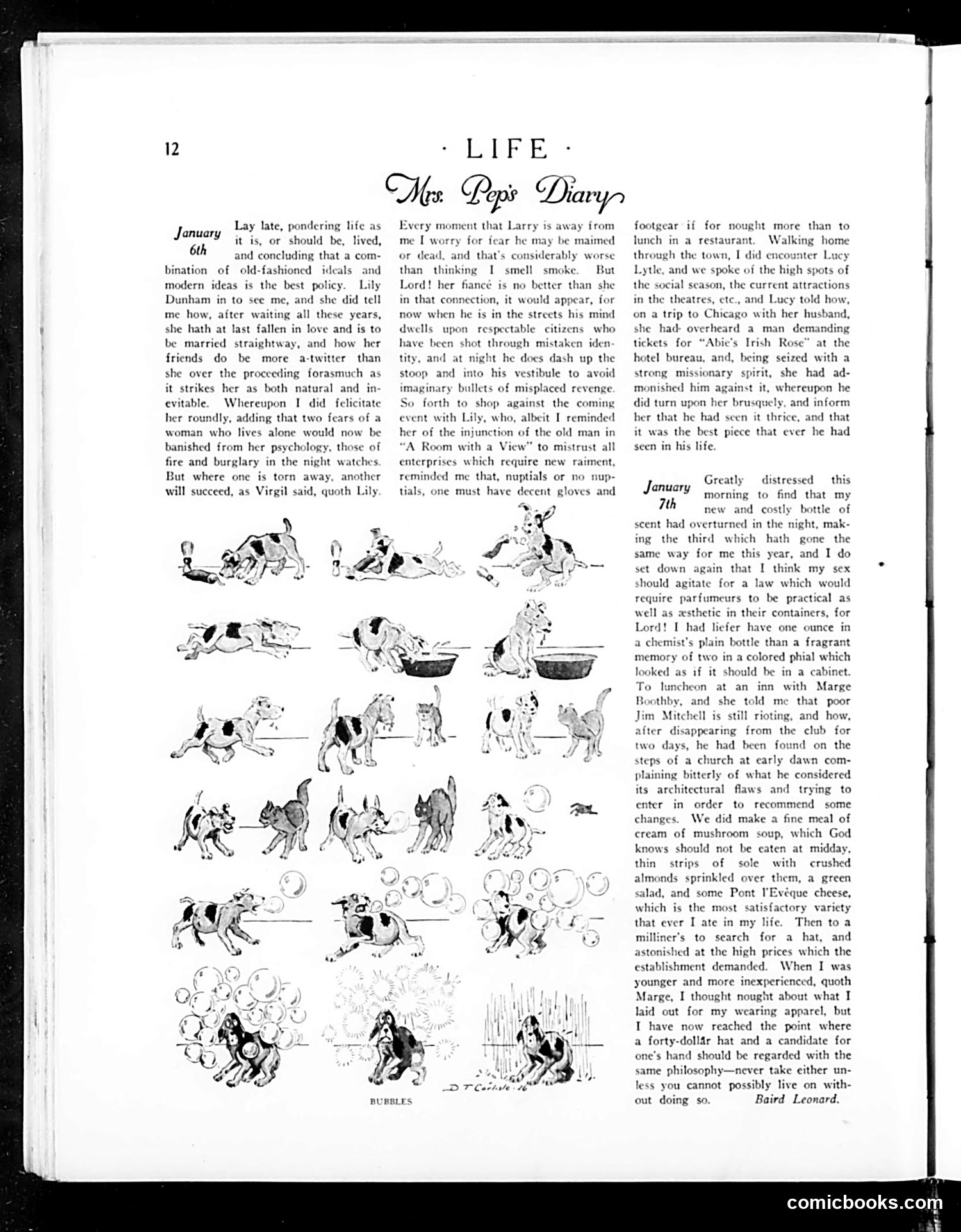
This page features **Mrs. Pep's Diary**, a humorous diary column dated January 6th and 7th. The left side contains a series of cartoon illustrations labeled "BUBBLES" depicting a dog (apparently "Pep") in various comedic situations—playing, bathing, chasing bubbles, and getting into mischief. The diary entries, written by a woman reflecting on domestic life, discuss her husband Larry's concerns about his reputation, anxiety about smell/smoke, and her own social activities and shopping. The accompanying dog cartoons provide visual comedy illustrating the chaos and mess that pets create in household life. The satire gently mocks both anxious husbands and the everyday frustrations of managing a home with an energetic pet.
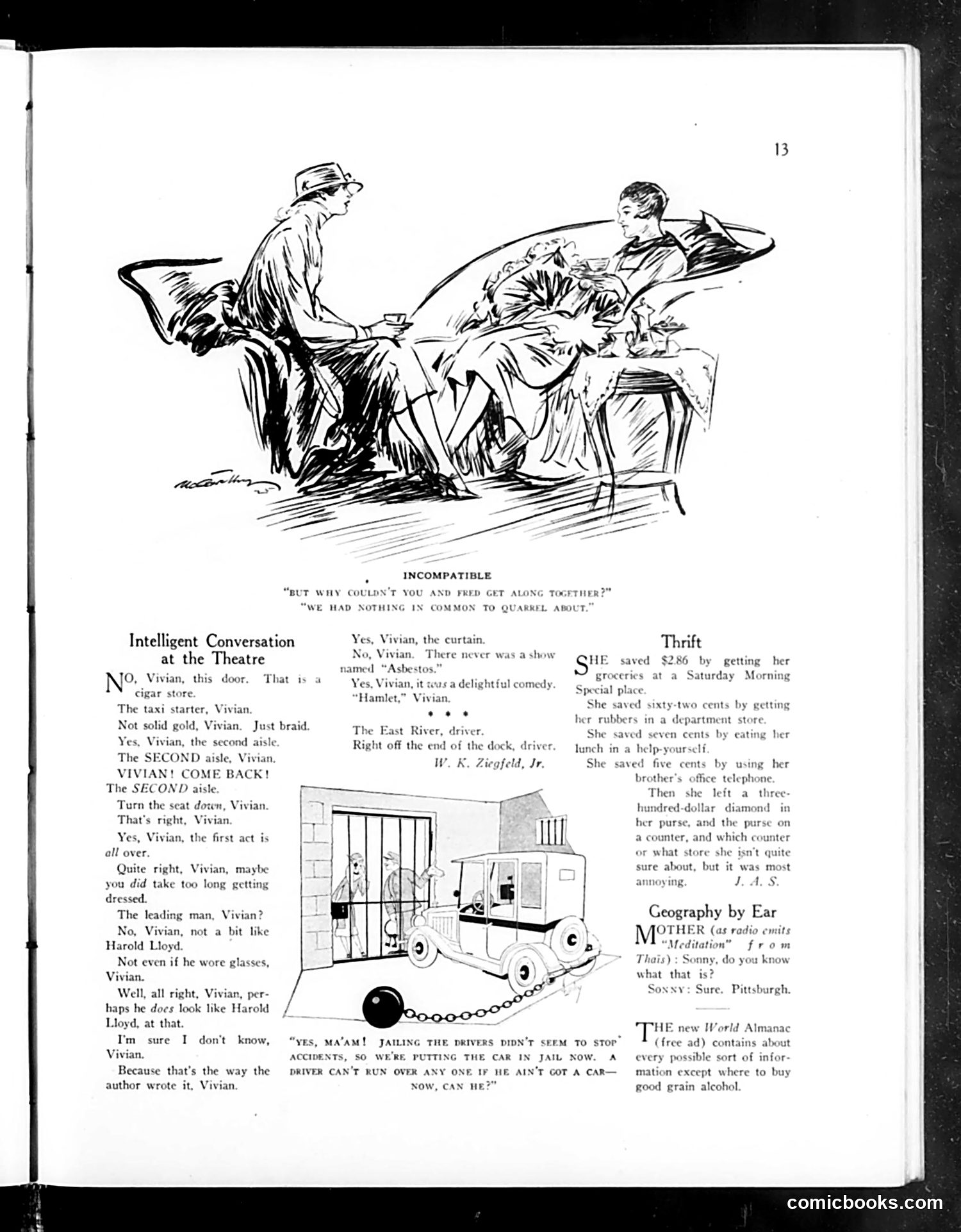
**Top Cartoon ("Incompatible"):** A man and woman sit awkwardly while a third man stands between them. The caption quotes their incompatibility: he wanted to quarrel about "nothing in common." The satire mocks couples who claim irreconcilable differences over trivial matters—a commentary on marriage discord in the Jazz Age when divorce became more socially acceptable. **"Intelligent Conversation":** A dialogue between two characters about theater, likely mocking pretentious cultural discourse about Broadway shows like "Hamlet." **Other sections include:** A humorous short story about a woman saving money through various minor economies; a "Geography by Ear" radio segment joke; and an advertisement note about the World Almanac. The page reflects 1920s-30s era American humor focusing on marriage, consumerism, and popular entertainment.
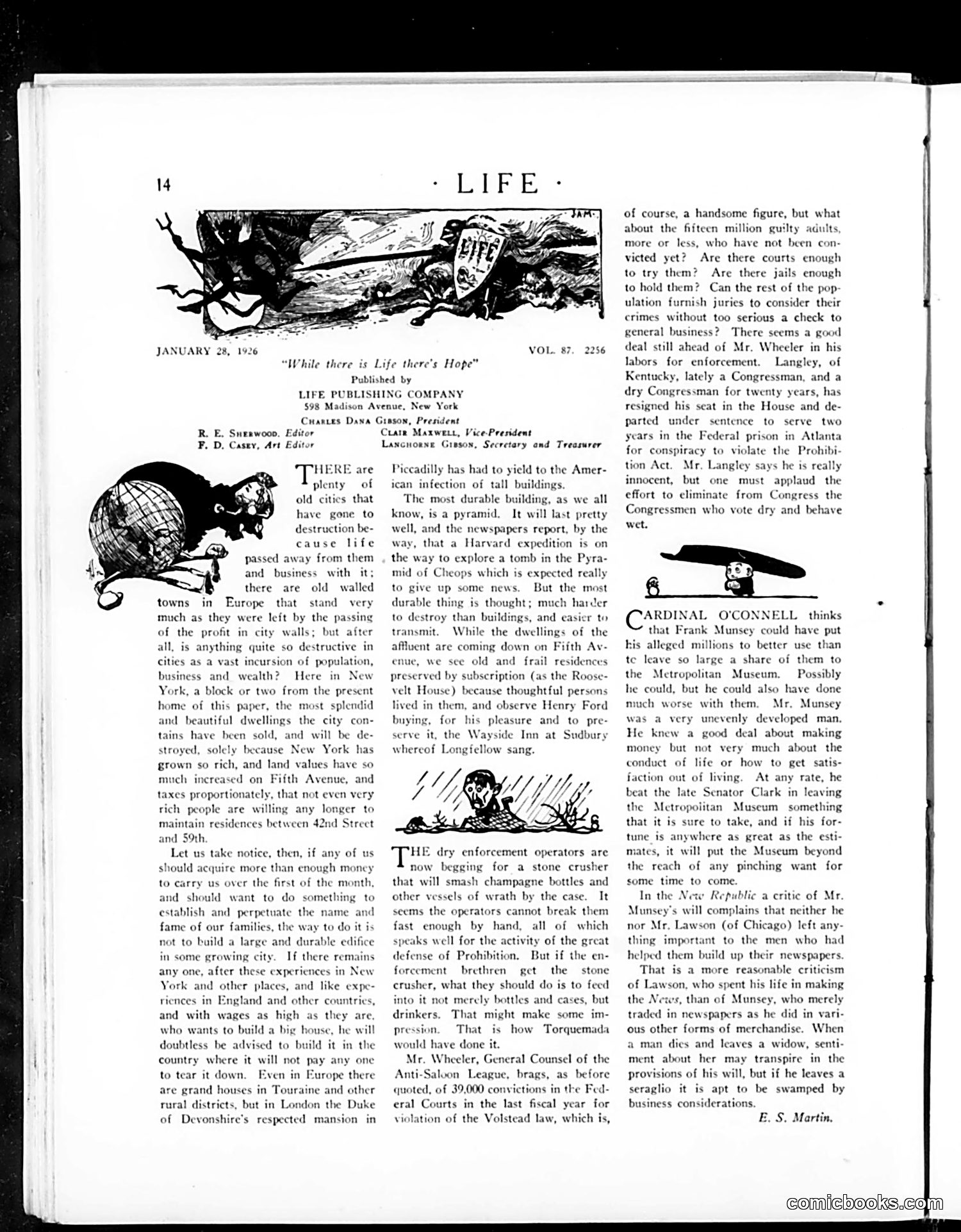
This page contains editorial commentary on Prohibition enforcement and criminal justice rather than political cartoons. The main illustration shows a skeleton or death figure amid rubble, captioned "While there is Life there's Hope." The text critiques the enforcement of Prohibition, discussing the paradox that while enforcement operations (like stone crushers destroying bottles) continue, roughly 15 million Americans remain unconvicted of violations. The author questions whether sufficient courts and jails exist to prosecute such widespread lawbreaking. The second section discusses Frank Munsey's donation of his millions to the Metropolitan Museum, suggesting such philanthropy is insufficient compensation for questionable business practices during his lifetime. The satire targets both government ineffectiveness in enforcing unpopular laws and wealthy industrialists' attempts at redemption through late-life charitable donations.
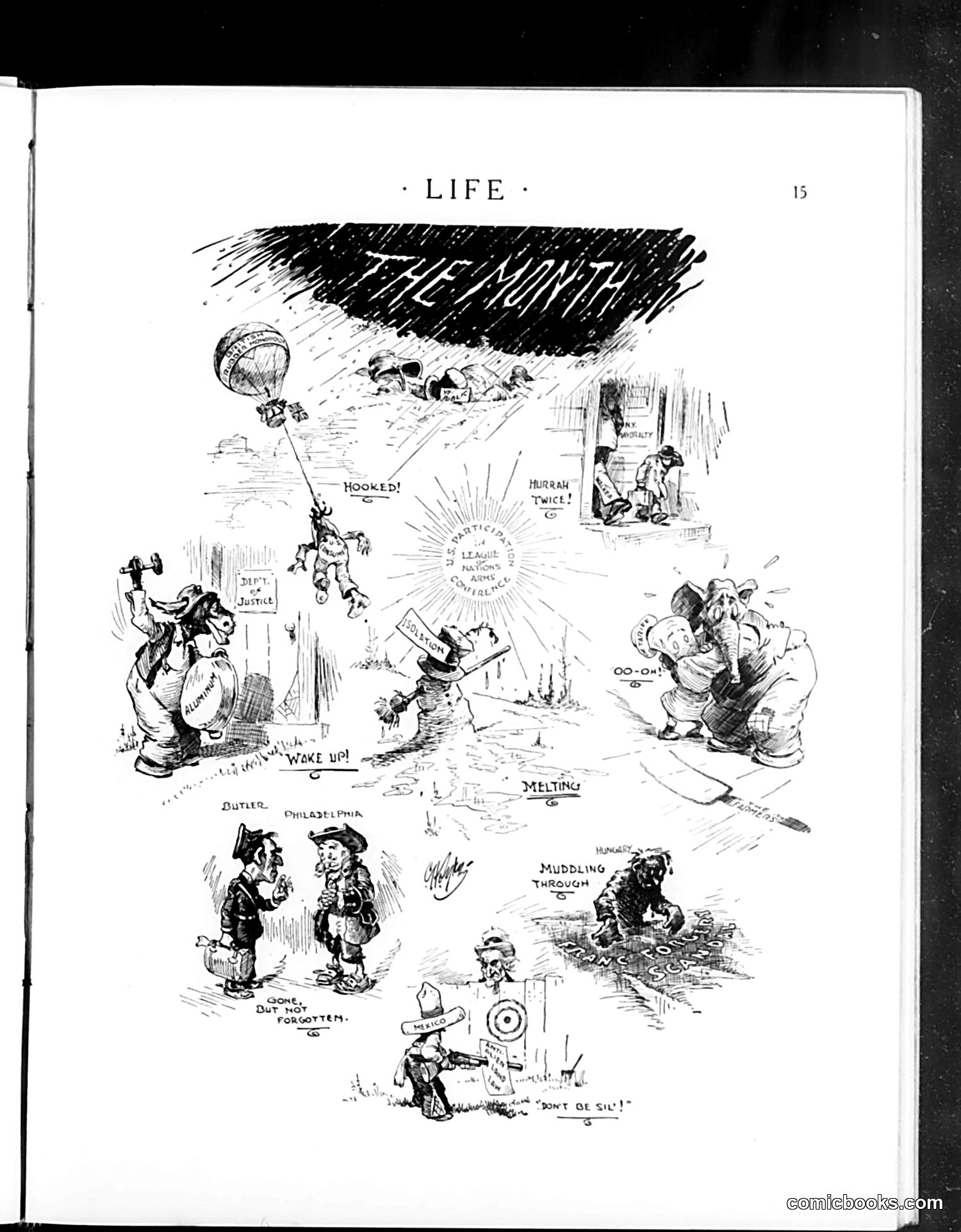
This is a satirical cartoon depicting American life during what appears to be the early 20th century. The central sun radiates labels like "League of Nations" and "Humanity's Hopes," suggesting idealistic aspirations. Around this center are vignettes showing various figures and scenarios: "Hooked!" (parachutist), "Wake Up!" (Justice figure), "Butler Philadelphia," "Gone But Not Forgotten," "Hurrah Twice!," "Melting" (pot reference), and "Muddling Through." The cartoon satirizes the gap between lofty humanitarian ideals and messy political reality. References to the League of Nations suggest post-WWI optimism being undermined by corruption, apathy, and incompetence. The various labeled scenes appear to mock different aspects of American society—justice, immigration, politics, and public consciousness—as falling short of noble aspirations.
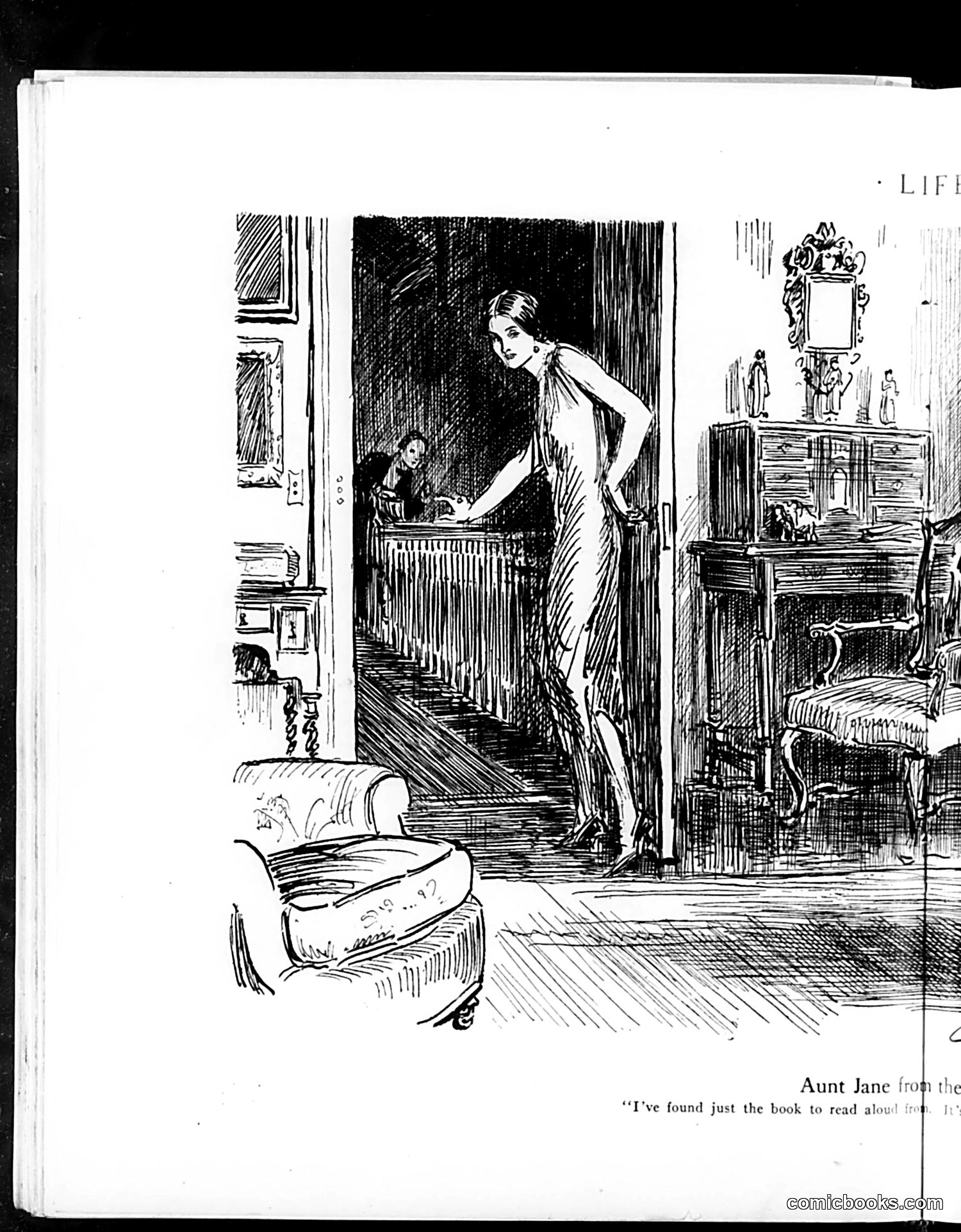
This appears to be an illustration from Life magazine featuring a domestic scene titled "Aunt Jane." The image shows a woman in a negligee entering a bedroom where a child sits reading in bed. The partial caption reads: "I've found just the book to read aloud from; it's—" The satire likely targets middle-class domestic propriety and children's education of the era. The humor derives from the risqué visual contrast—an adult woman in revealing sleepwear entering a child's bedroom to read aloud—which would have been considered improper or suggestive to early 20th-century readers. The cartoon mocks either overly permissive parenting, the blurring of bedroom boundaries, or the awkwardness of selecting "appropriate" children's literature. The specific book title is cut off, leaving the joke's punchline incomplete in this page excerpt.
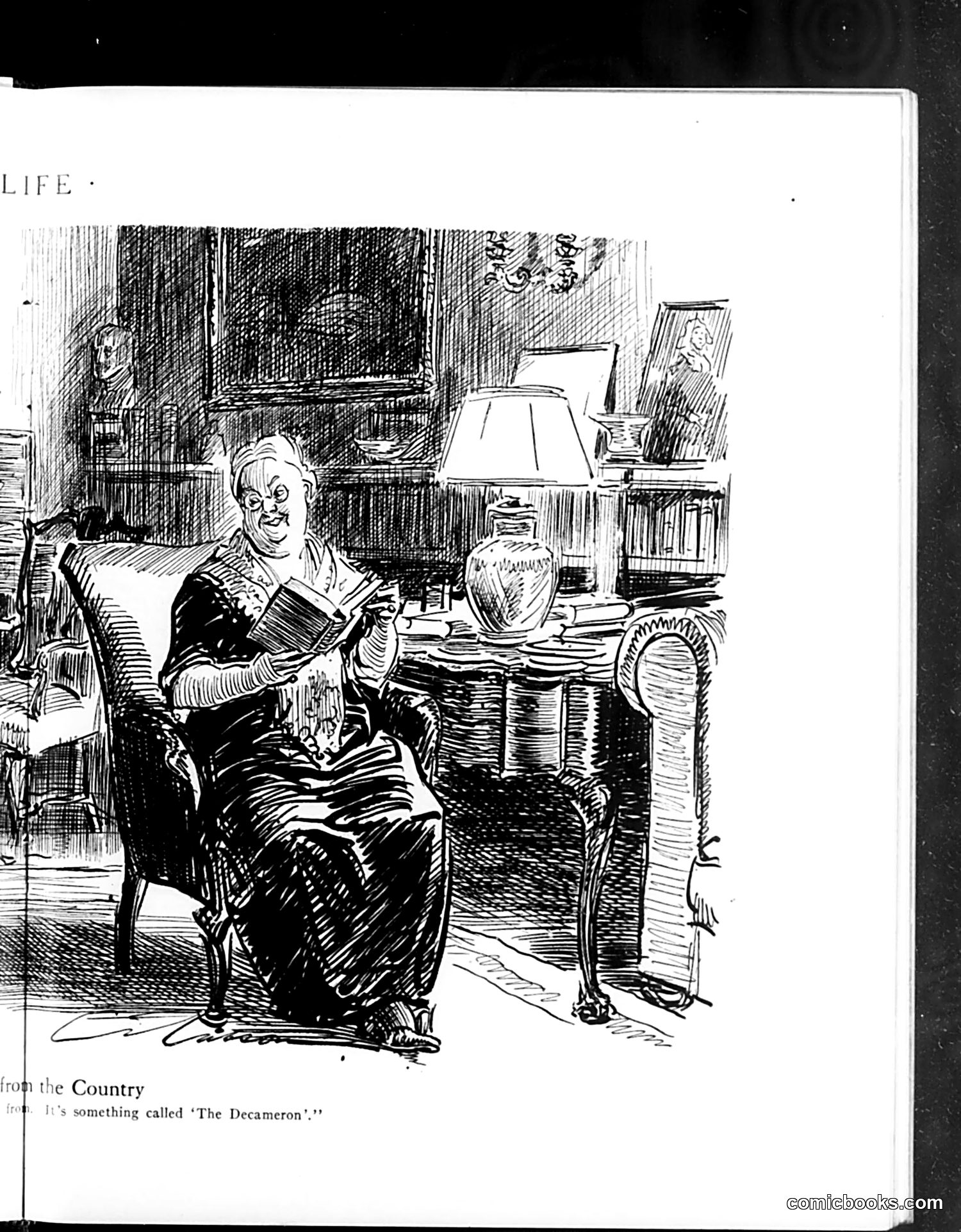
This page features a satirical illustration titled "From the Country" with a caption referencing "The Decameron." The image shows a woman seated in a comfortable, well-appointed parlor, reading a book. She appears to be a visitor from the countryside, based on the caption's framing. The satire likely mocks rural visitors encountering sophisticated urban literary culture. The reference to *The Decameron* (Boccaccio's 14th-century collection of novellas) suggests she's attempting to engage with highbrow literature—perhaps pretentiously or incongruously. Her earnest reading posture contrasts with the implication that a "country" person would find such refined material amusing or pretentious. The cartoon gently ridicules social pretensions and the gap between urban and rural sophistication during this period.
This page satirizes Broadway revue productions—elaborate musical-comedy shows popular in the 1920s. The critic humorously claims Life received a $3 million bequest (from deceased publisher Frank Munsey) specifically to review revues, yet somehow has $114.50 left over, implying these shows are cheap entertainment. The piece critiques several productions: praising Jack Hulbert's "By the Way" for elegant simplicity; approving Charlot's show featuring stars Beatrice Lillie and Gertrude Lawrence but complaining it's become over-dressed; and faulting the "Greenwich Village Follies" for burying their best sketch ("The Spy," starring Tom Howard) early in the bill without crediting the author. The final paragraph praises Earl Carroll's "Vanities" for featuring three excellent comedians—Joe Cook, Julius Tannen, and Frank Tinney—who provide the bulk of theatrical laughs. The satire targets producers' tendency toward spectacle over comedy and their failure to recognize or promote quality sketches.
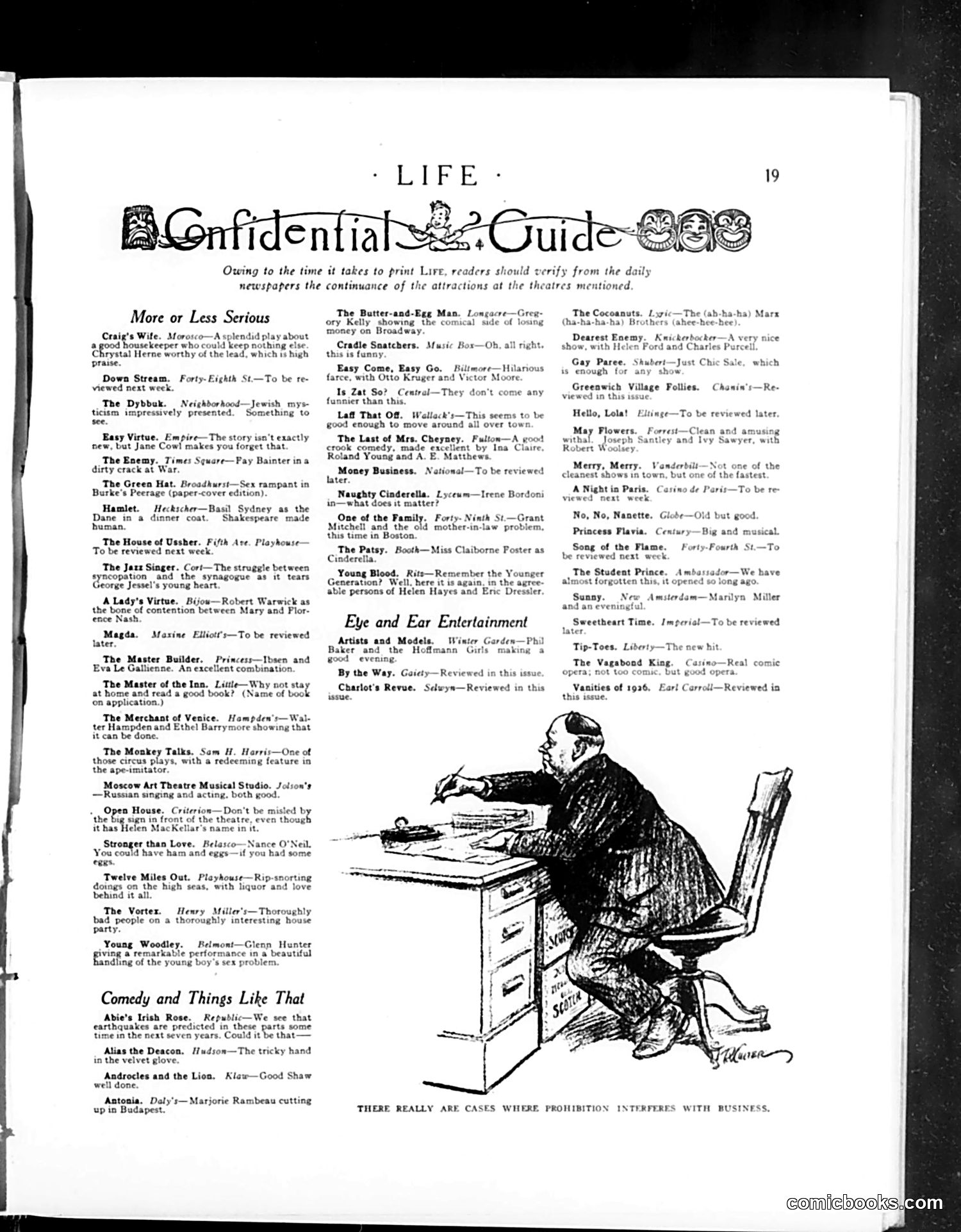
This is a **theater guide and review page** from Life magazine, not primarily a political cartoon. The main visual element is a cartoon illustration of a businessman at a desk, captioned: "THERE REALLY ARE CASES WHERE PROHIBITION INTERFERES WITH BUSINESS." **What the cartoon means:** During Prohibition (1920-1933), alcohol was illegal. The cartoon satirizes a businessman whose work is disrupted—he cannot entertain clients or conduct business deals over drinks, a standard social lubricant of the era. The joke suggests Prohibition creates genuine business hardship, not just moral inconvenience. The page itself lists Broadway theater productions with brief reviews. Notable titles include *Abie's Irish Rose* and *The Jazz Singer* (about Jewish-American life), *Craig's Wife* (domestic drama), and *Young Woodley* (about youth sexuality). The reviews are sardonic and terse, typical of Life's satirical voice toward contemporary entertainment.
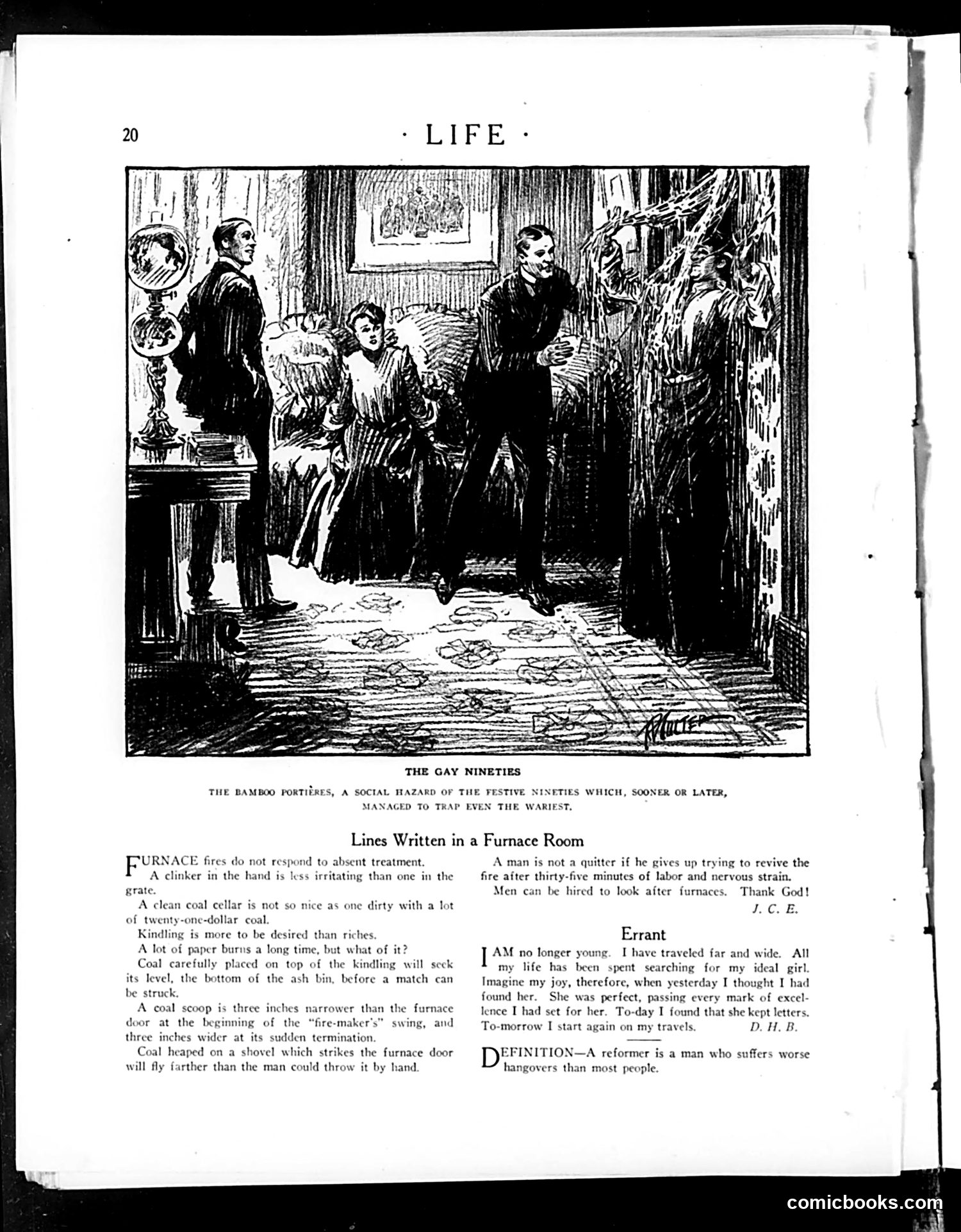
The top illustration depicts a social scene from the 1890s featuring "bamboo portieres" (decorative curtains made of bamboo strips that were fashionable then). The cartoon's joke is that these trendy interior decorations were a "social hazard"—the bamboo strips would trap unwary guests, presumably catching clothing or causing embarrassing entanglements at parties. Below are three humorous pieces: a mock-philosophical poem about the frustrations of maintaining a coal furnace (poking fun at domestic life's tedious realities), a brief romantic anecdote about a man who finds his "ideal girl" only to discover she keeps letters from another man (suggesting women's romantic autonomy), and a one-line joke defining "reformer" as someone with worse hangovers than average (satirizing temperance or social reform advocates). The page satirizes both 1890s fashion hazards and domestic/social pretensions.
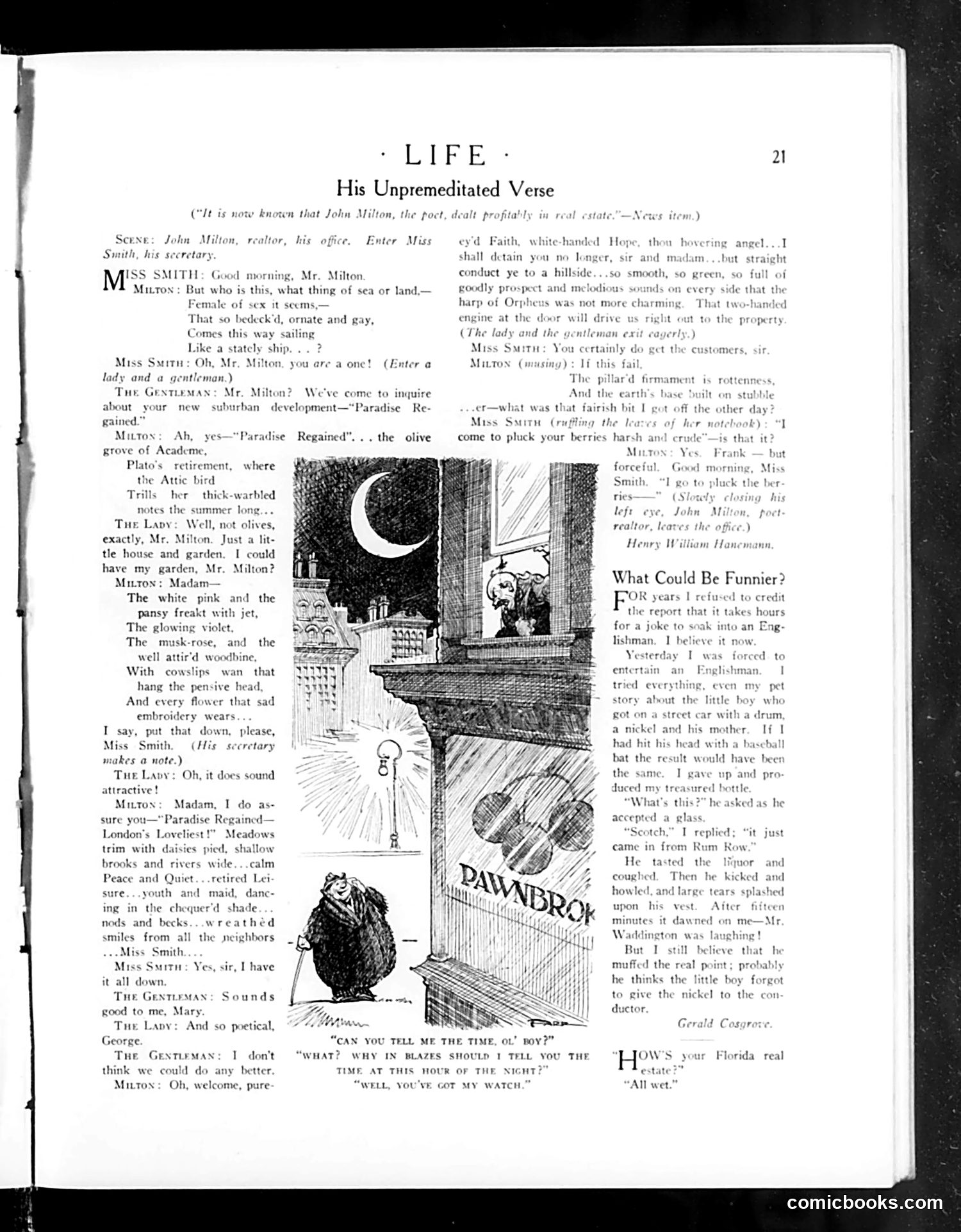
This satire mocks the incongruity of poet John Milton—author of the epic *Paradise Lost*—working as a modern real estate agent. The humor depends on knowing Milton's grand literary legacy. The setup parodies Milton's own verse. When a couple inquires about a suburban development called "Paradise Regained" (echoing his actual work), Milton responds in flowery, poetic language describing gardens and flowers—passages that sound Miltonic but are absurdly applied to selling property. The joke: Milton's elevated, archaic poetic diction clashes hilariously with mundane real estate patter. Miss Smith's reactions ("you are a one!") underscore the absurdity of this serious poet reduced to hawking modest suburban lots with pseudo-Miltonic flourishes. The accompanying cartoon shows Milton as a realtor with clients—visualizing this ridiculous scenario. The satire gently mocks both the pretension of real estate marketing and the notion of treating Milton as mere commercial material rather than a timeless poet.
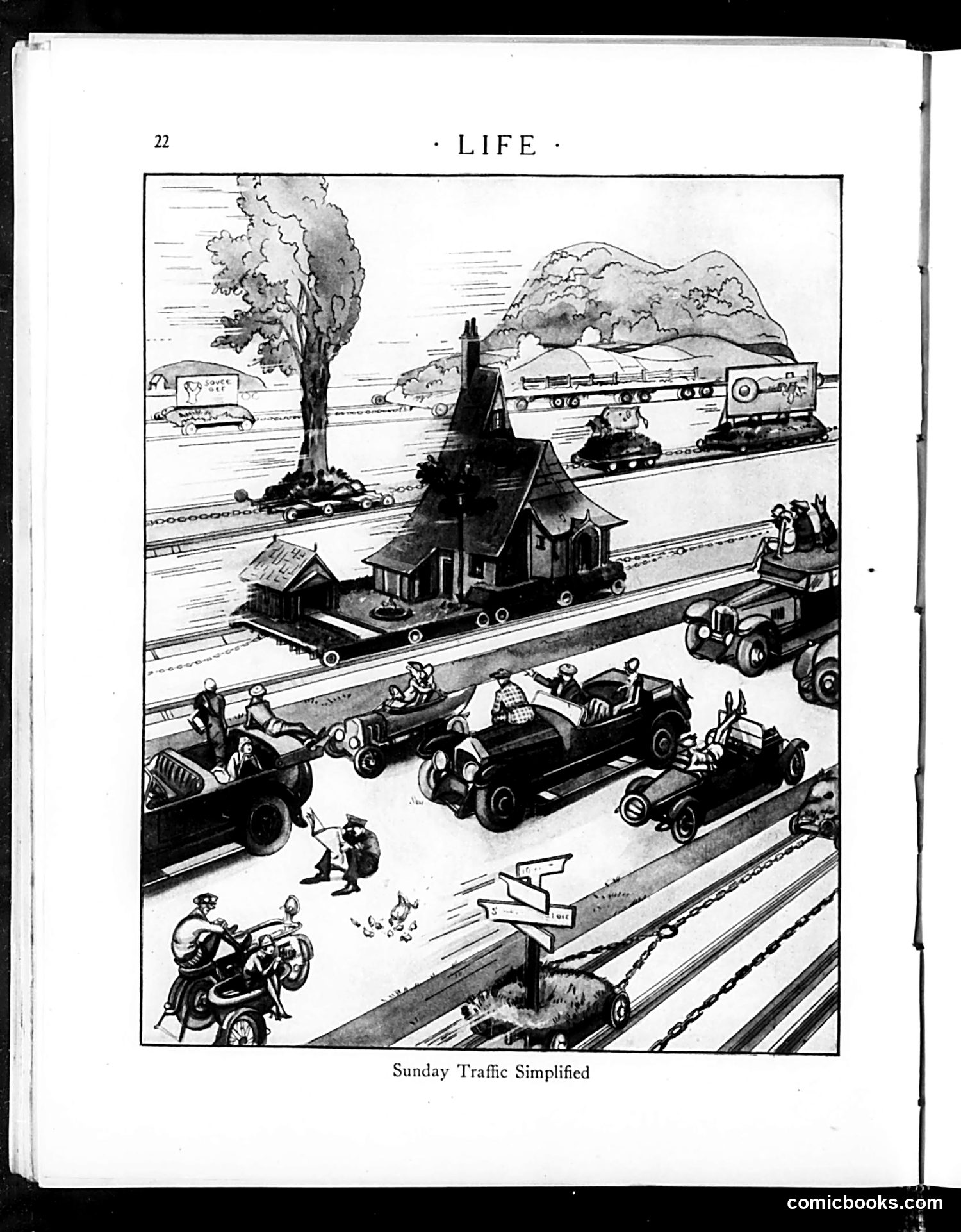
This is a satirical cartoon from *Life* magazine depicting an imagined future solution to Sunday traffic congestion. The illustration shows a humorous reorganization of transportation: vehicles are sorted onto separate parallel tracks by type—motorcycles, cars, trucks, and trains—each confined to their own lane. A church sits centrally, and heavy trucks/tractors occupy dedicated routes above. The satire mocks the period's growing traffic problems and suggests an absurdly extreme "solution": total segregation and regimentation of vehicles. The cartoon likely comments on both increasing automobile congestion in early-to-mid 20th century America and the era's faith in technological/organizational fixes to modern problems. The image implies such rigid control would be necessary (and ridiculous) to manage Sunday traffic.
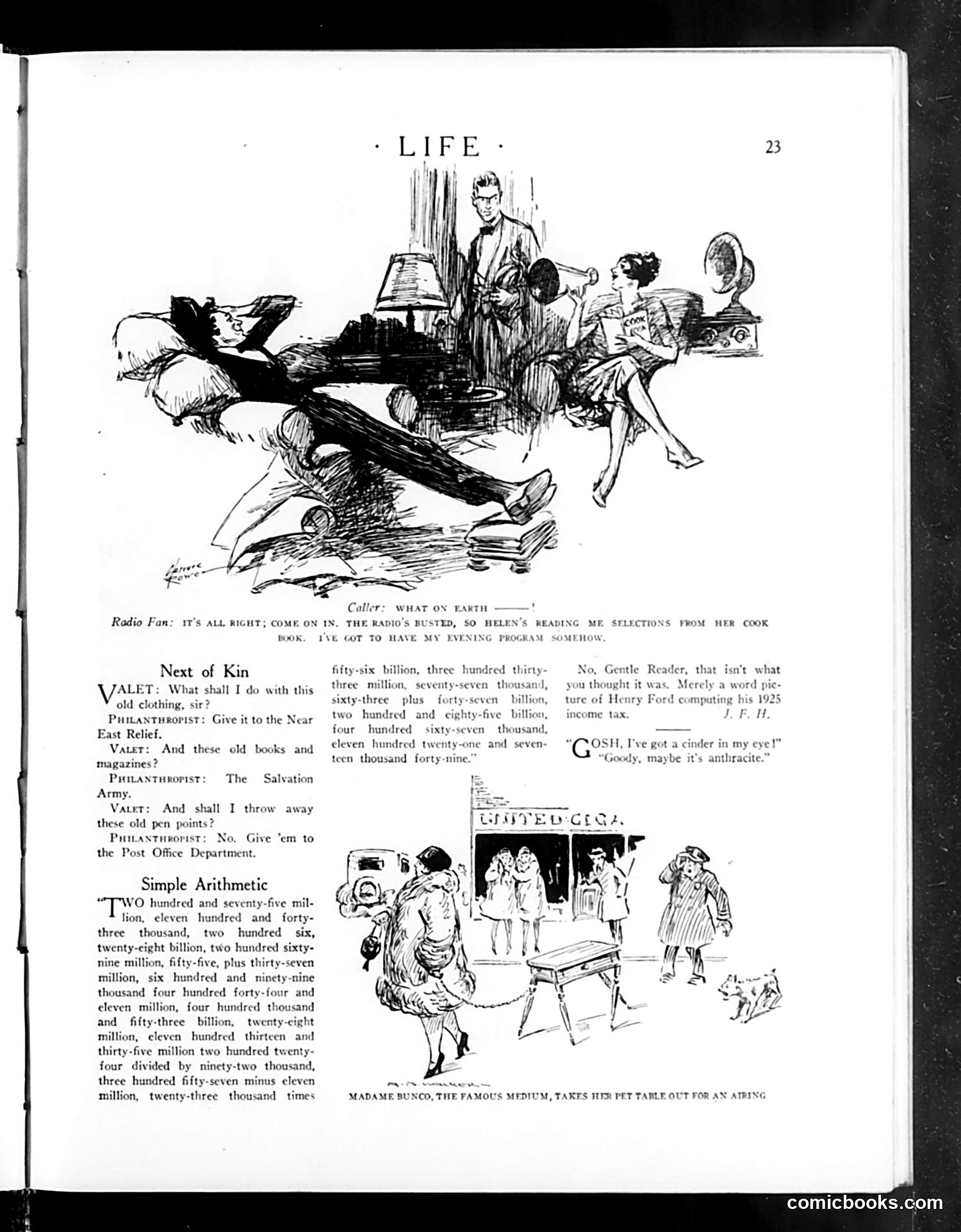
This page from *Life* magazine contains three satirical pieces circa 1925: **Top cartoon**: A radio malfunction forces a family to endure someone reading extremely complex arithmetic problems aloud as entertainment—mocking both the tedium of early radio programming and people's desperation for any content. **Left column**: A dialogue satirizing well-meaning charity. A philanthropist redirects donations: old clothes to Near East Relief, books/magazines to the Salvation Army, old pen points to the Post Office. The joke is the absurd specificity and the implication that charitable organizations will accept anything, no matter how useless. **Bottom cartoon**: "Madame Bunco" (a transparent fake-spiritualist name) takes her pet table outside for "an airing." This mocks spiritualist mediums of the 1920s—Madame Bunco relies on a trick table (likely rigged for séance fraud) so obviously it needs literal maintenance like a pet. All three pieces target 1920s social follies: gullible consumers, dubious charities, and fraudulent spiritualism.
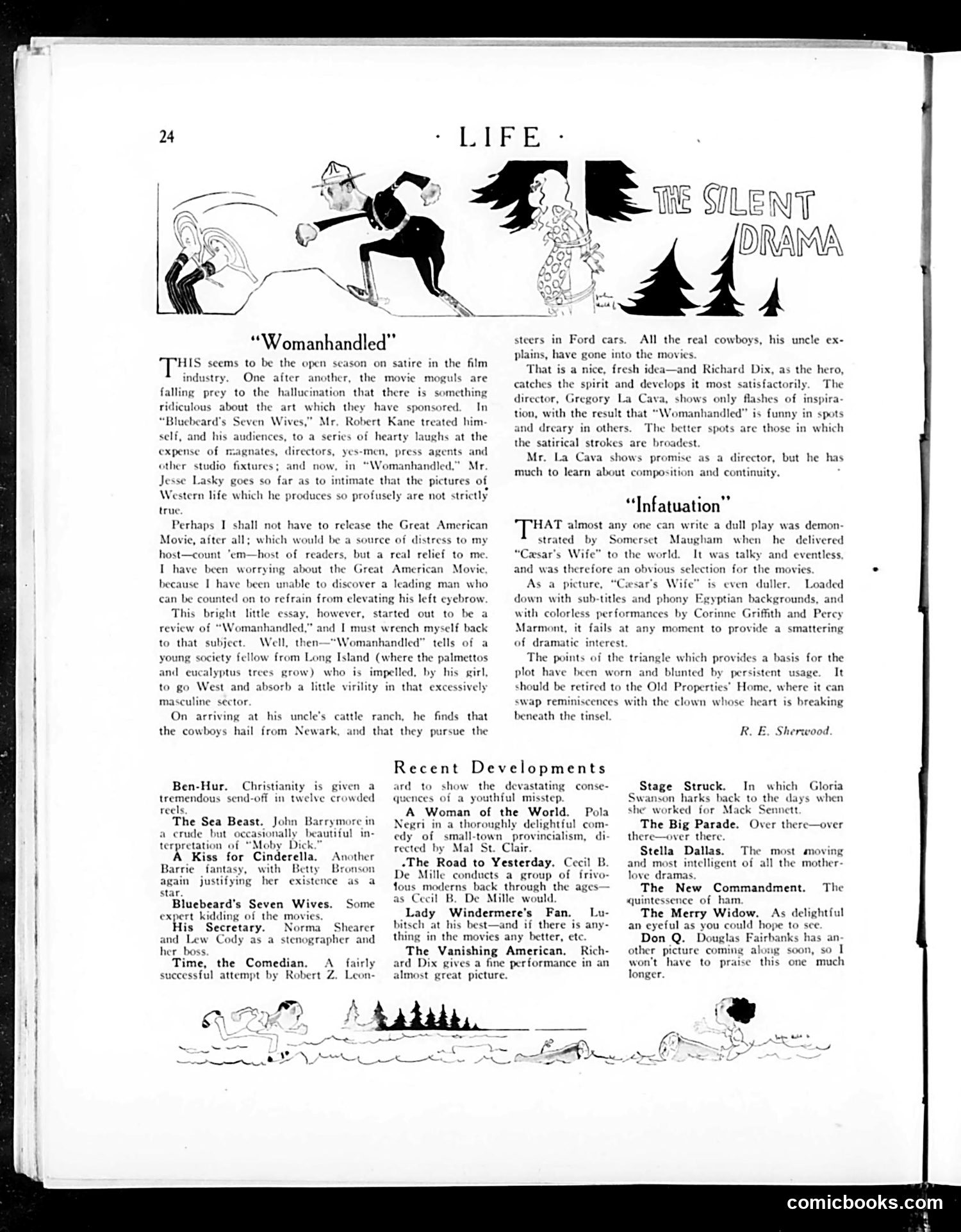
This page reviews films that mock the movie industry itself—a trend the critic finds refreshing. "Womanhandled" satirizes Western films by revealing that real cowboys have abandoned ranching for movies, while fake ones from Newark drive Ford cars. The joke exposes Hollywood's manufactured authenticity: the industry producing ersatz "Western life" pictures while actual cowboys work in cinema. The critic praises this self-aware humor, contrasting it with "Infatuation" (adapted from Somerset Maugham's "Caesar's Wife"), which he finds genuinely dull—overstuffed with subtitles, fake Egyptian sets, and colorless performances. He sardonically suggests retiring the love-triangle plot to a metaphorical "Old Properties' Home." The page reflects 1920s Hollywood's emerging willingness to mock itself and expose its own fabrications—a sophisticated stance for an industry dependent on illusion.
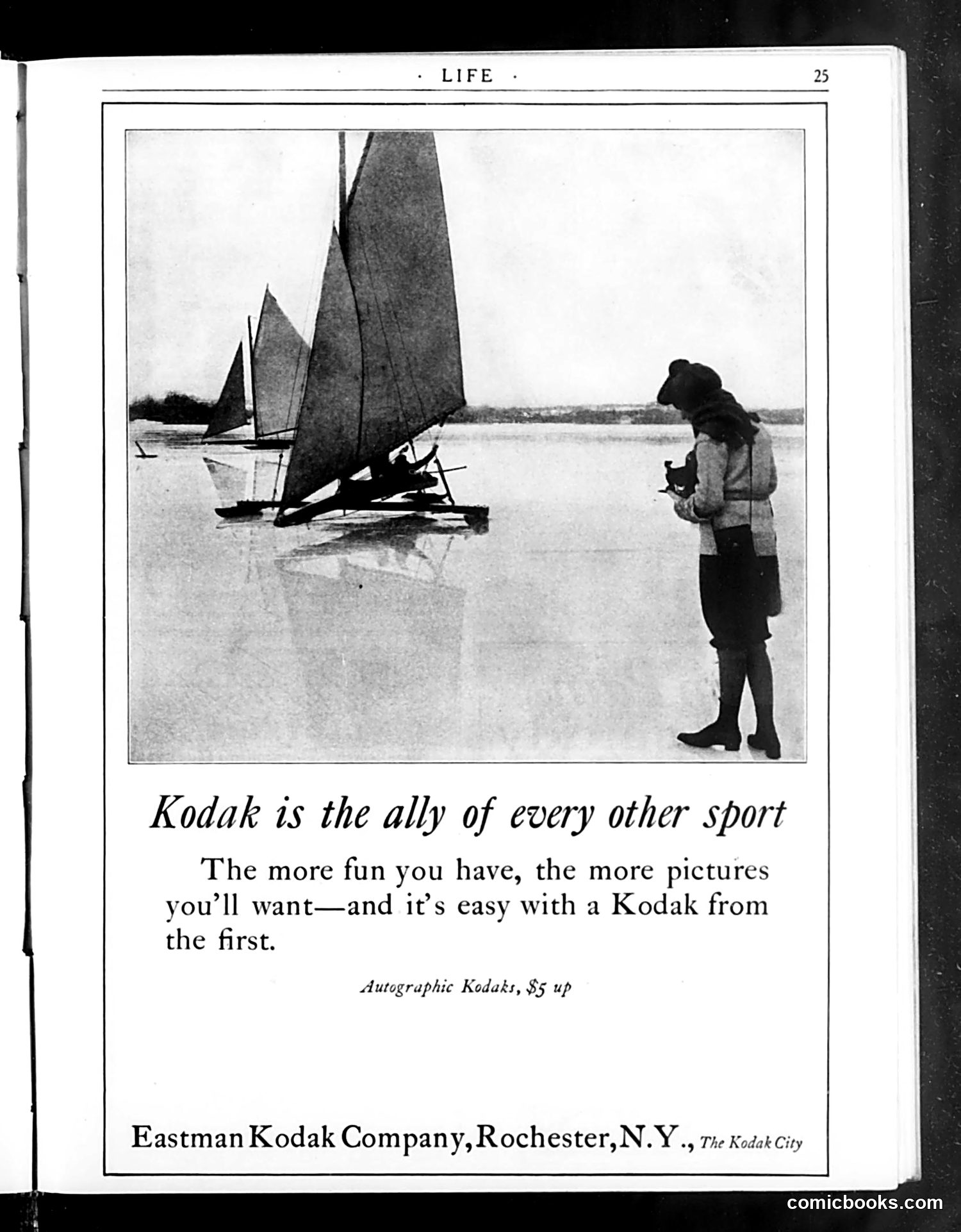
This is a straightforward **Kodak advertisement**, not political satire. The page shows a woman standing on what appears to be a frozen or shallow body of water, holding a camera and photographing sailing boats in the background. The ad's message is commercial: that cameras enhance recreational activities by letting people capture memories. The tagline "Kodak is the ally of every other sport" positions photography itself as a complementary leisure pursuit—the more fun you have doing things, the more you'll want to photograph them. The "Autographic Kodaks, $5 up" indicates the camera model and price point. This represents early 20th-century marketing strategy: associating a consumer product with outdoor leisure and modern lifestyle.
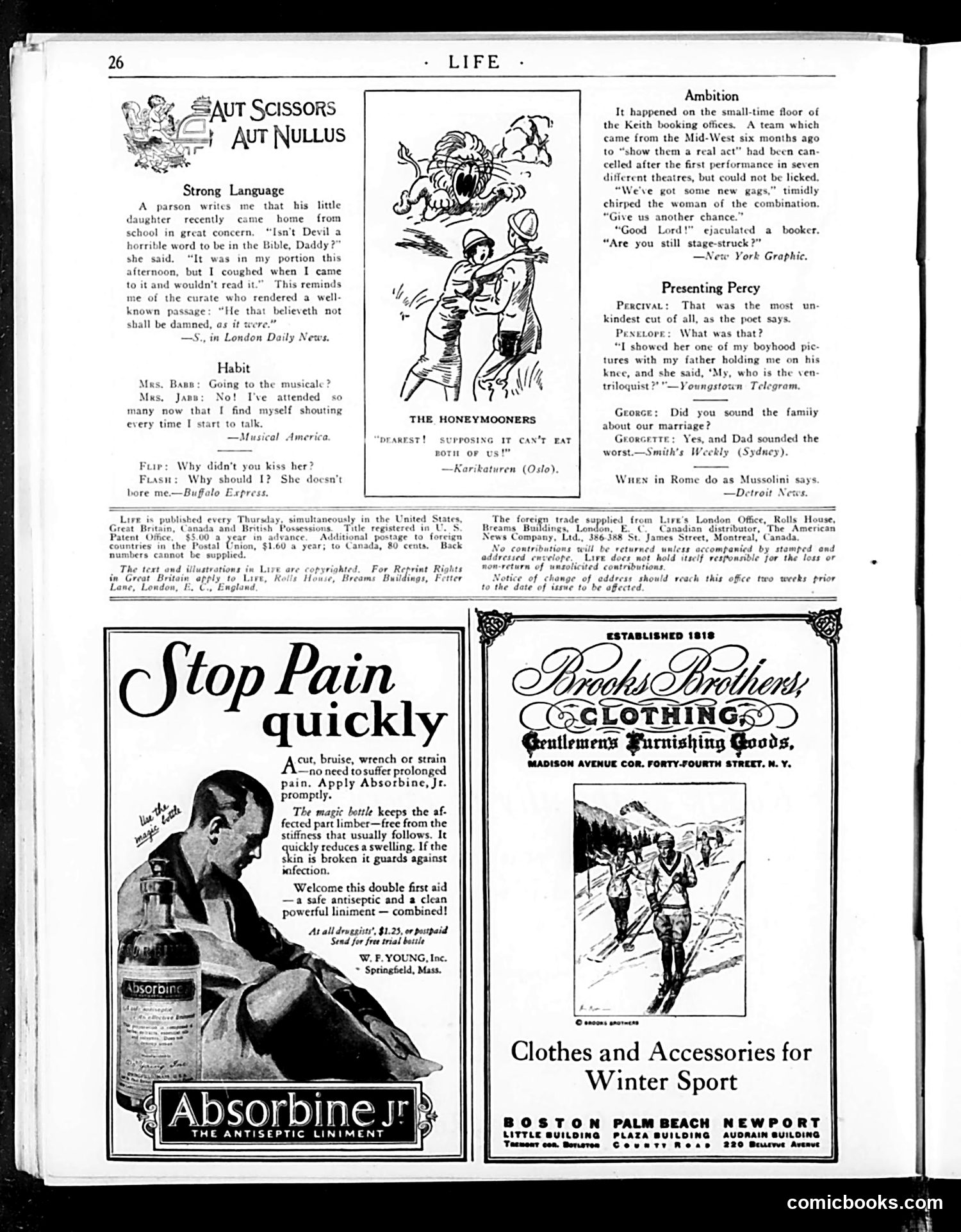
This page consists primarily of **humorous anecdotes and advertisements** rather than political cartoons. The satirical content targets social behaviors and attitudes of the era: **"Strong Language"** mocks prudishness—a child objects to the word "Devil" appearing in the Bible, reflecting early 20th-century concerns about propriety. **"Ambition"** satirizes show business persistence: a vaudeville team, repeatedly rejected at different theaters, still pitches new material to booking agents, highlighting both theatrical desperation and stubborn optimism. **"Habit"** jokes about concert-goers becoming so conditioned to applauding that they shout in normal conversation. **"The Honeymooners"** cartoon (center) depicts a couple discussing whether food can eat them, revealing newlyweds' disconnection from reality. The remaining anecdotes cover similar domestic and social quirks. The page is rounded out by **period advertisements** for pain relief liniment and clothing, typical of Life's revenue model. No specific political figures or events are referenced.
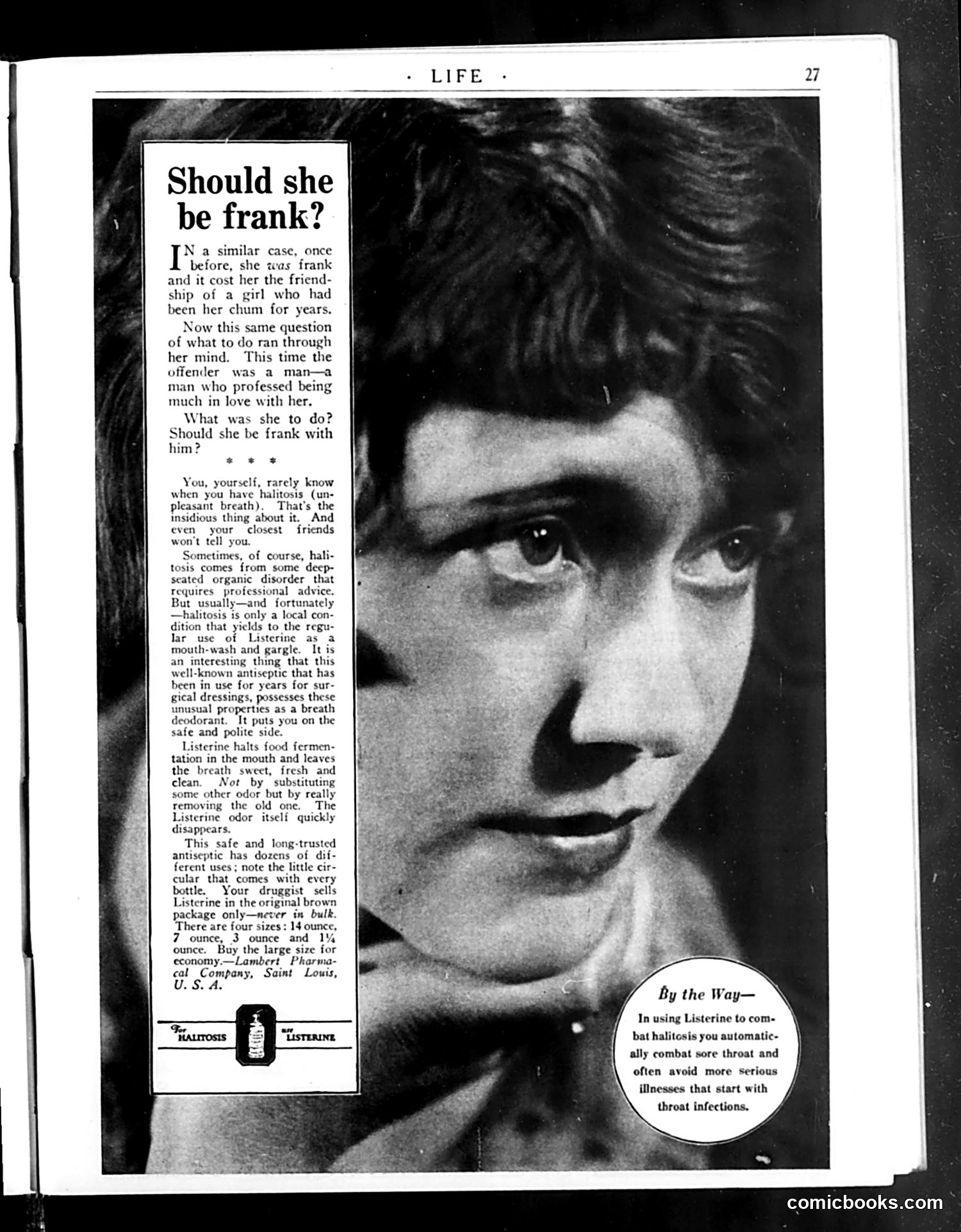
This is primarily a **Listerine mouthwash advertisement** disguised as relationship advice content, a common advertising technique of the era. The "cartoon" frames a social dilemma: A woman must decide whether to frankly tell her male suitor that he has **halitosis (bad breath)**—a situation made awkward because a previous honest conversation about this with a female friend cost her that friendship. The ad uses this relatable social anxiety to introduce Listerine as the solution: rather than risk the uncomfortable conversation, the woman (or any reader) can simply use Listerine to prevent halitosis entirely. The product copy emphasizes that bad breath is "insidious"—people don't know they have it, and friends won't tell them—making Listerine a socially necessary product. This represents **1920s-30s advertising psychology**: creating manufactured social shame or anxiety, then positioning a product as the solution. The image of the woman's concerned face reinforces the emotional stakes of the dilemma being sold.
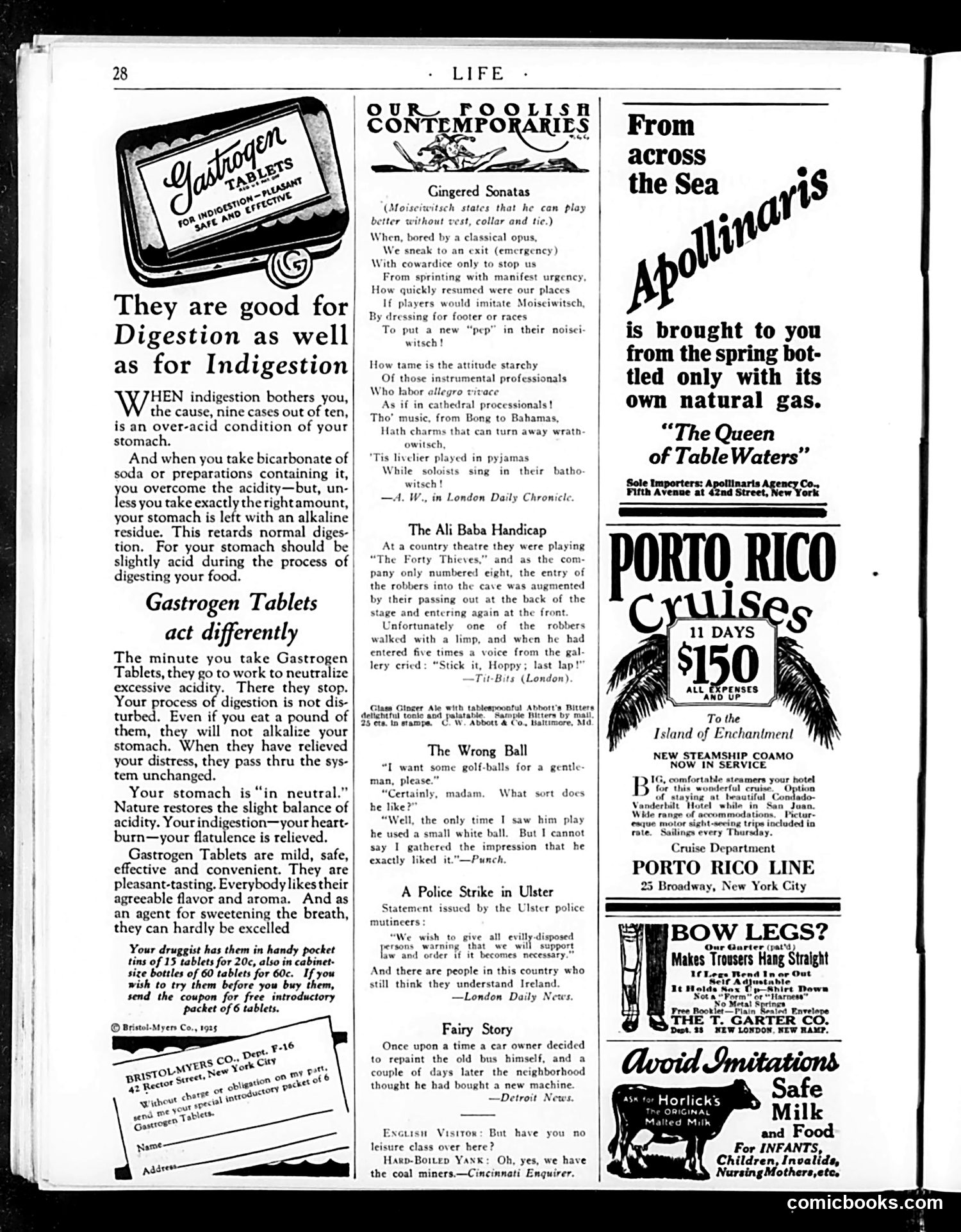
This page from Life magazine (1935) combines advertisements with satirical commentary in the "Our Foolish Contemporaries" section. **Main Content:** The satire targets pretentious classical musicians. The piece mocks concert performers who maintain rigid formality while playing—suggesting they'd perform better in casual athletic wear (pajamas, racing outfits) to add "pep." The jokes reference a musician named Moiseiwitsch, implying classical music performance has become stiff and joyless. Supporting anecdotes ridicule theatrical incompetence (actors limping through repeated entrances) and absurd situations (mistaking golf preferences). **Advertisements:** The page heavily features Gastrogen Tablets (antacids), Apollinaris bottled water, and Porto Rico cruise packages—typical 1930s consumer products. **Context:** This reflects Depression-era Life's irreverent humor attacking cultural pretension while promoting consumption. The satire assumes readers find stuffiness in high culture inherently funny—a common magazine stance of the period.
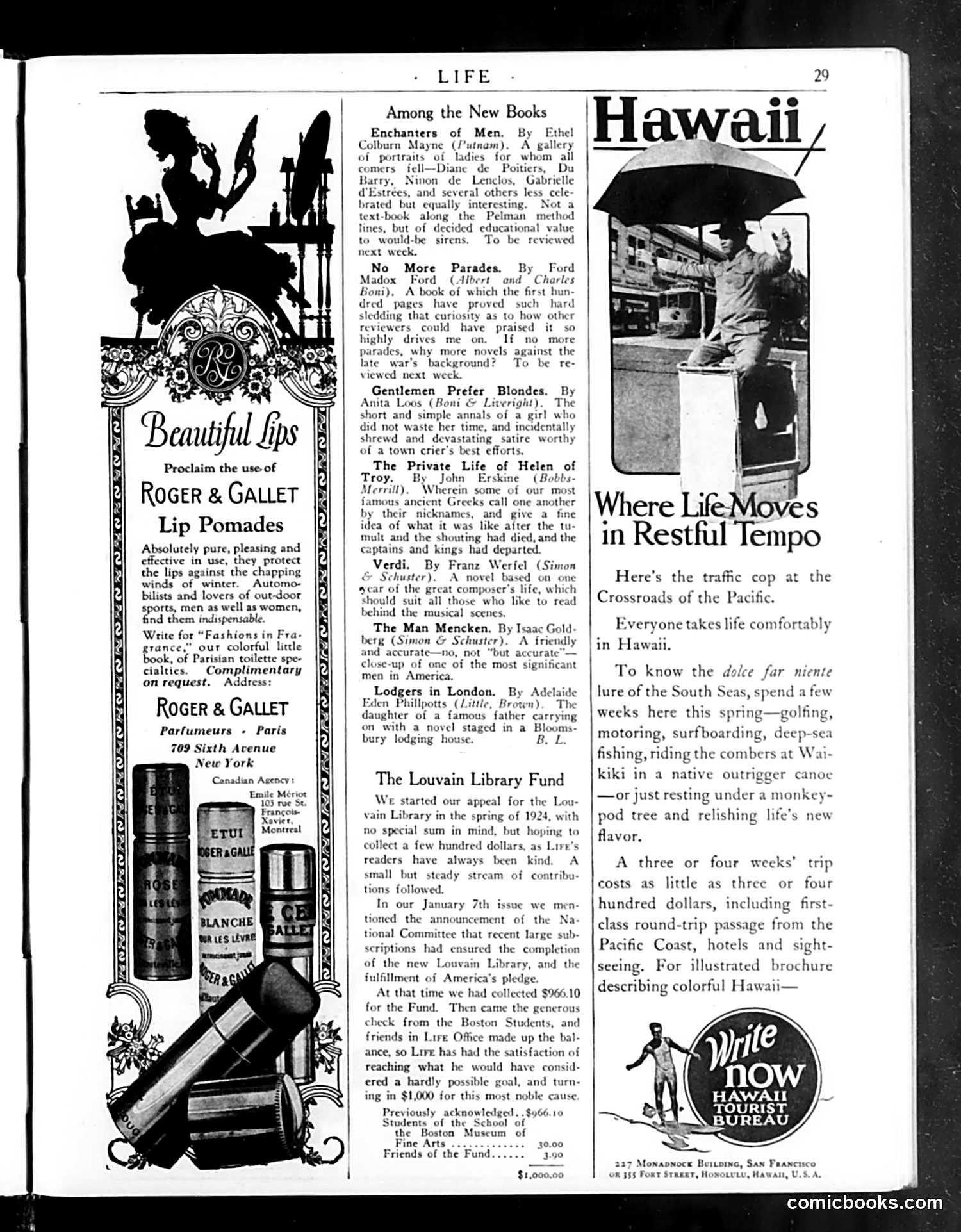
This page combines book reviews, advertising, and travel promotion typical of Life magazine's format. **Left side:** A decorative advertisement for Roger & Gallet lip pomades, a French beauty product, emphasizing their appeal to outdoor enthusiasts and motorists. **Center:** Book reviews of contemporary 1920s works, including Anita Loos's *Gentlemen Prefer Blondes* (satirizing materialism in young women), Ford Madox Ford's war novel, and John Erskine's *The Private Life of Helen of Troy* (a modernizing retelling of classical myth). **Right side:** A travel advertisement for Hawaii, featuring a traffic policeman at "Crossroads of the Pacific." The text promotes Hawaii as a relaxing destination for golf, surfboarding, and leisure—positioning it as an exotic but accessible vacation spot for affluent American readers. The page reflects 1920s consumer culture: sophistication, modern leisure travel, and literary interest in debunking Victorian propriety (reflected in the book selections).
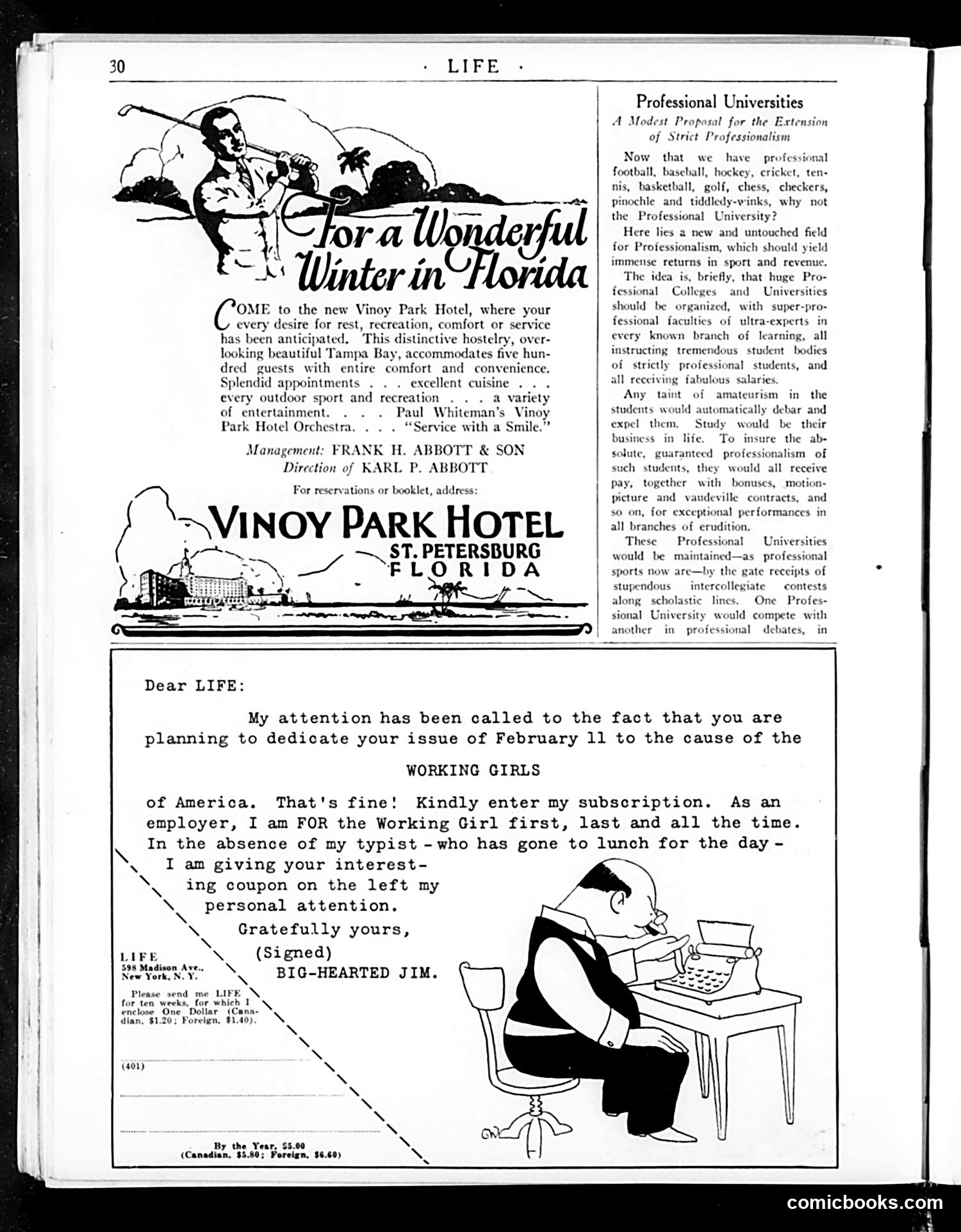
**Top Section:** A mock-serious proposal for "Professional Universities"—satirizing American culture's obsession with professionalism and commercialization. The piece sarcastically suggests that since sports have gone professional, why not education itself? Students would be paid employees, receive bonuses and vaudeville contracts, and compete in "professional debates." The satire mocks the reduction of learning to profit-driven enterprise. **Bottom Section:** A letter from "Big-Hearted Jim," an employer, applauding Life's upcoming issue dedicated to working girls. The joke's irony: Jim claims to support working women "first, last and all the time," yet his *actual* support consists of signing a subscription coupon while his typist is away at lunch—suggesting he's using her absence to avoid real work, undermining his stated commitment. The cartoon of the seated female office worker reinforces this contradiction between professed support and actual workplace behavior.
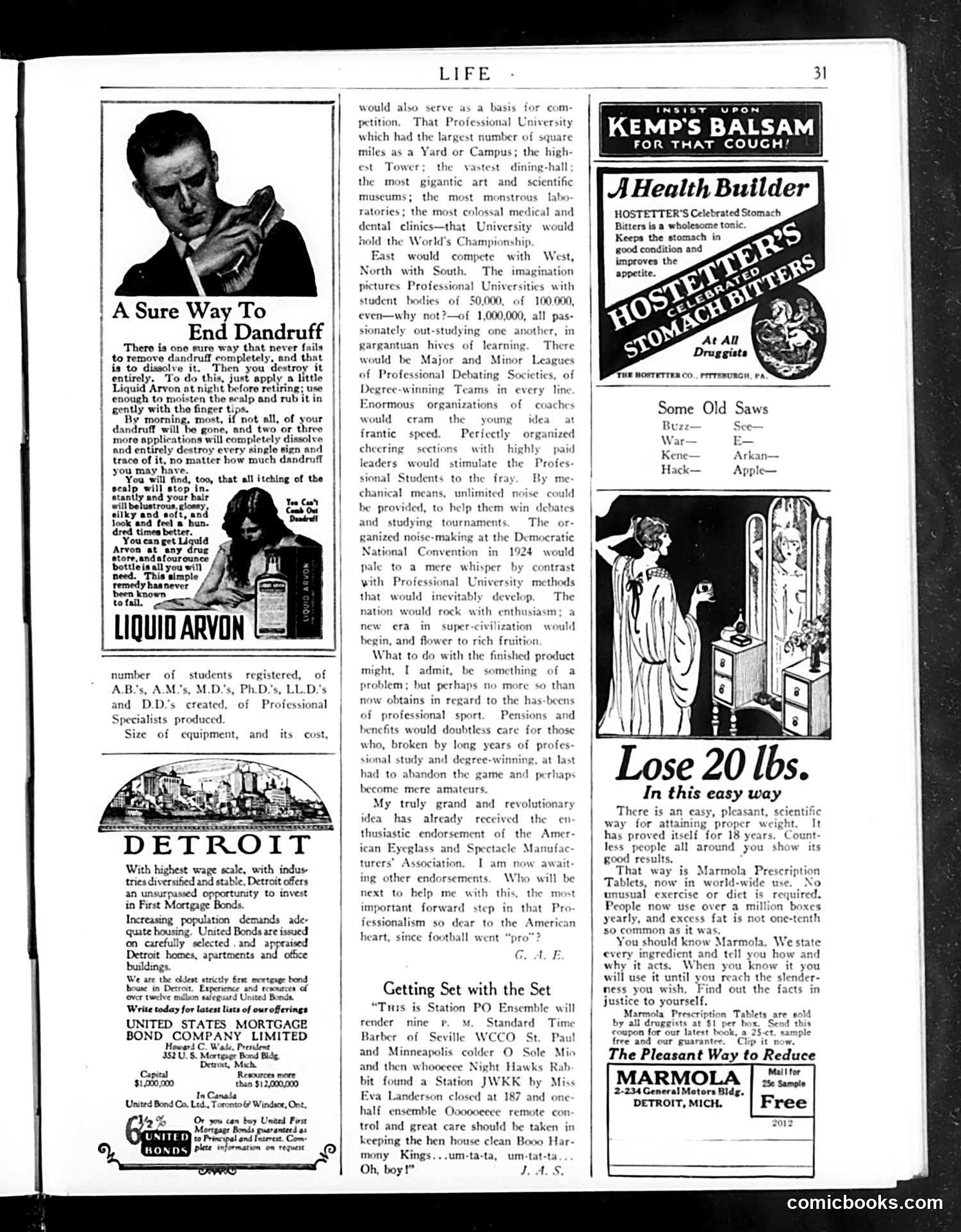
This page is primarily **advertising**, not political satire. The main content includes: **Left side:** Ads for Liquid Arvon (a dandruff treatment) and United States Mortgage Bond Company promoting Detroit real estate investment. **Center:** An article titled "Getting Set with the Set" about a radio broadcast (Station PQ Ensemble performing standard time signals and music). **Right side:** More product ads—Kemp's Balsam cough remedy, Hostetter's Stomach Bitters, and Marmola weight-loss tablets. The only satirical content is a brief article (partially visible) mocking the concept of "Professional Universities"—institutions competing by sheer size and noise rather than educational quality, with students numbering in the millions. The author suggests this absurd expansion reflects actual problems in professional education. This reflects 1920s concerns about commercialization and size-obsession in American universities, though the satire is gentle and overshadowed by commercial messaging.
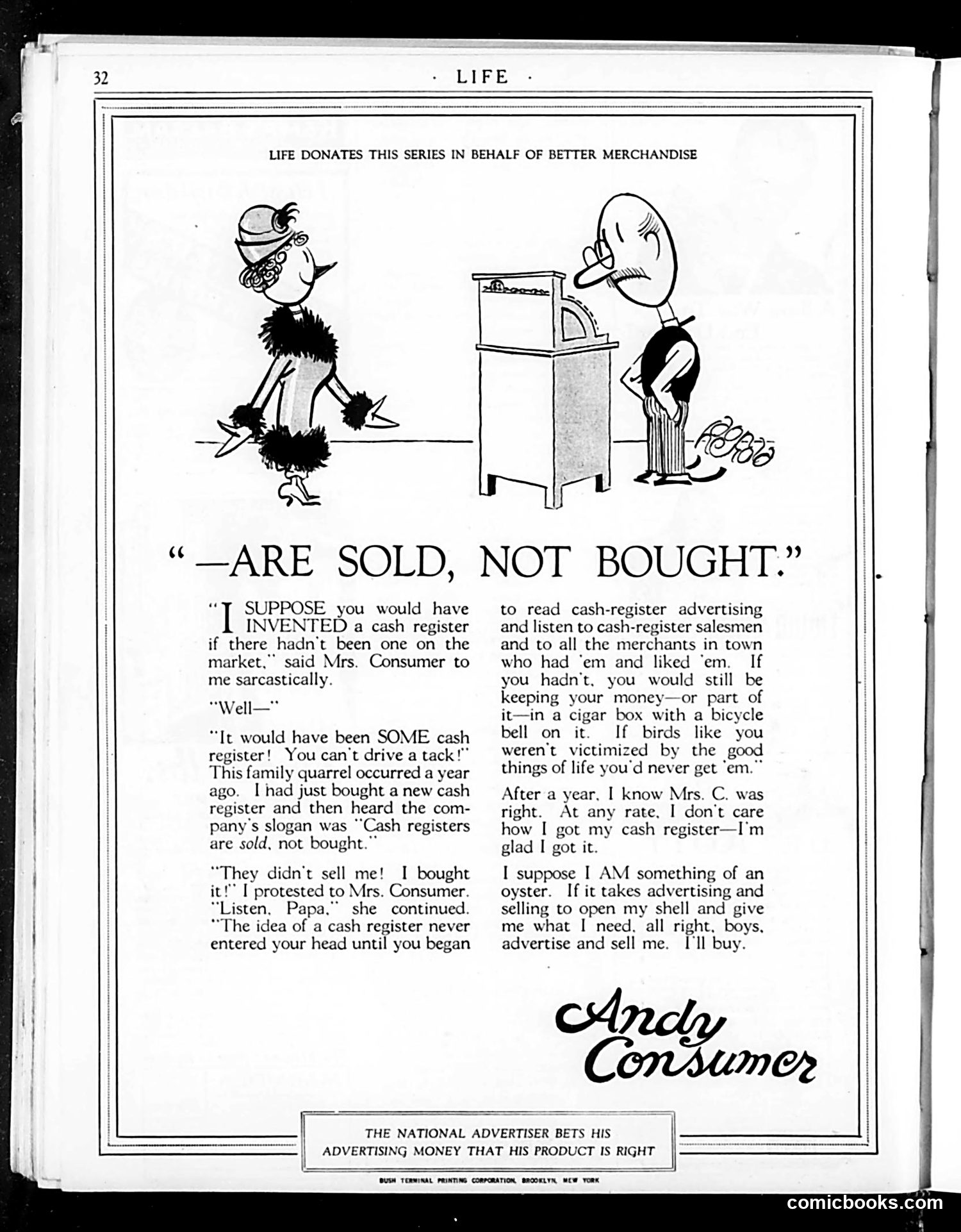
This satirical piece features a domestic argument between a husband and wife (labeled "Andy Consumer") about whether he *chose* to buy a cash register or was manipulated into wanting one through advertising and salesmen. The wife's argument: he never thought of cash registers until bombarded by marketing. He was a passive "oyster" needing to be pried open by persuasive selling tactics—not a rational consumer making independent choices. The husband eventually concedes she's right, accepting that advertising "victimizes" people into buying things they didn't know they needed, but concluding he's happy with the purchase anyway. The satire critiques early 20th-century consumer culture and advertising's power to *create* desire rather than fulfill existing wants. The tagline—"The National Advertiser Bets His Advertising Money That His Product Is Right"—suggests that aggressive marketing, not product merit, drives sales. It's a commentary on how consumers are shaped by commercial forces, not independent agents.
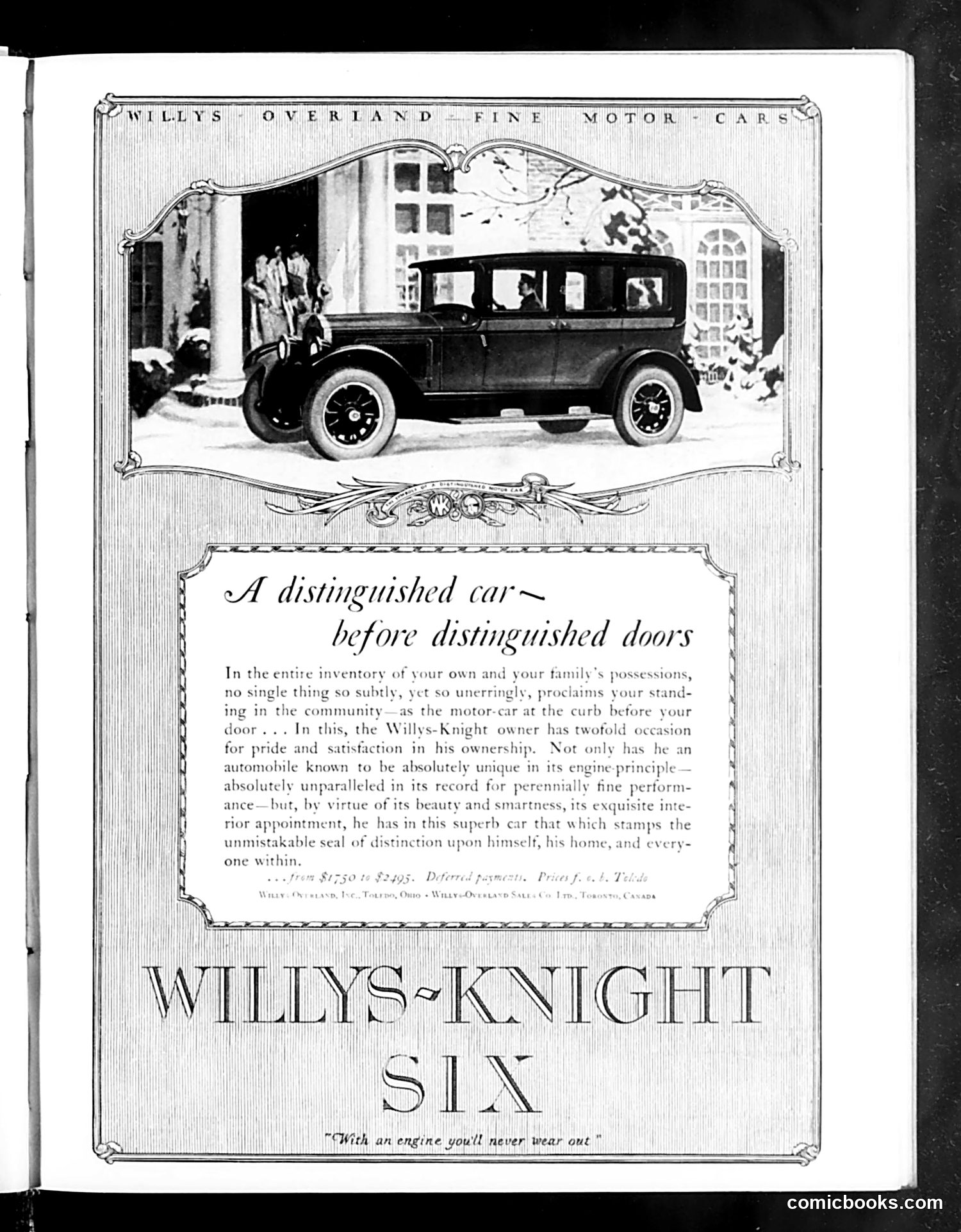
This is **not a cartoon or satire**, but rather a **luxury automobile advertisement** for the Willys-Knight Six, appearing in *Life* magazine. The ad employs early 20th-century aspirational marketing: it argues that a car parked at one's curb signals social status and distinction to the community. The copy emphasizes the vehicle's exclusivity—its unique engine principle and superior performance—as a way to advertise personal refinement and taste. The tagline "With an engine you'll never wear one" suggests reliability and longevity, positioning the purchase as a marker of wealth and good judgment. The depicted scene shows the car before an elegant home with formally dressed figures, reinforcing the association between car ownership and upper-class respectability. This reflects the 1920s-era belief that consumer goods—especially automobiles—functioned as public declarations of social standing, a concept that would resonate with *Life's* affluent readership.
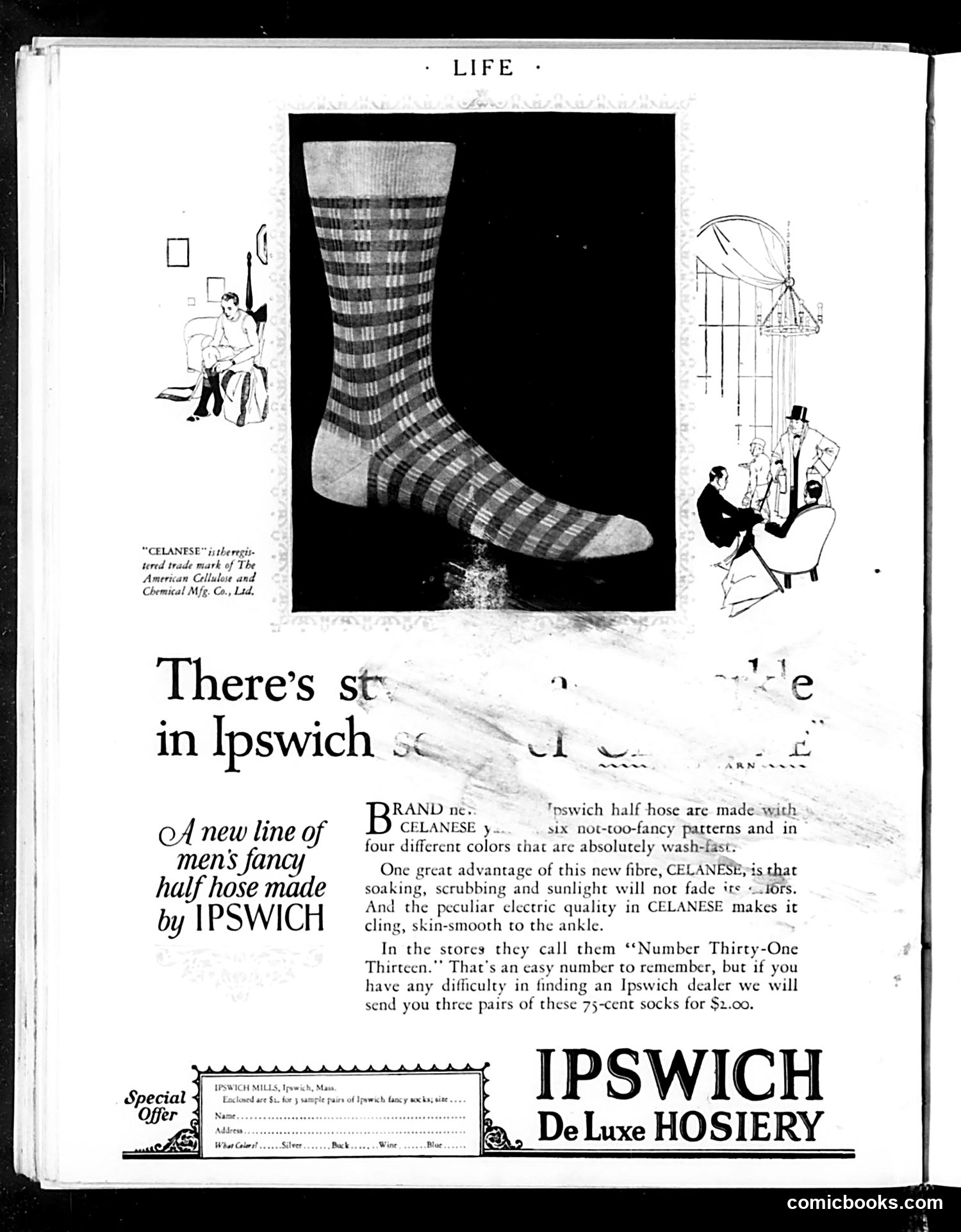
This page is primarily **advertising, not political satire**. It promotes Ipswich De Luxe Hosiery—specifically men's fancy half-socks made with Celanese synthetic fiber. The decorative illustrations are generic period humor rather than topical commentary: a man in a chair (likely representing comfort/relaxation), fashionable people at what appears to be a social gathering, and a window scene. These establish a lifestyle context for the product rather than satirizing specific figures or events. The actual "joke" or selling point is the product itself: Celanese fiber's claimed advantages—it won't fade, clings smoothly to the ankle, and has an "electric quality." The copy uses light humor (the store name "Number Thirty-One Thirteen" is "an easy number to remember") and a promotional offer (three pairs for $2.00) typical of 1920s-30s advertising. No political references, caricatures of real people, or satirical commentary appear on this page.