
Life, 1926-01-28 · page 26 of 36
Life — January 28, 1926 — page 26: what you’re looking at
What you’re looking at
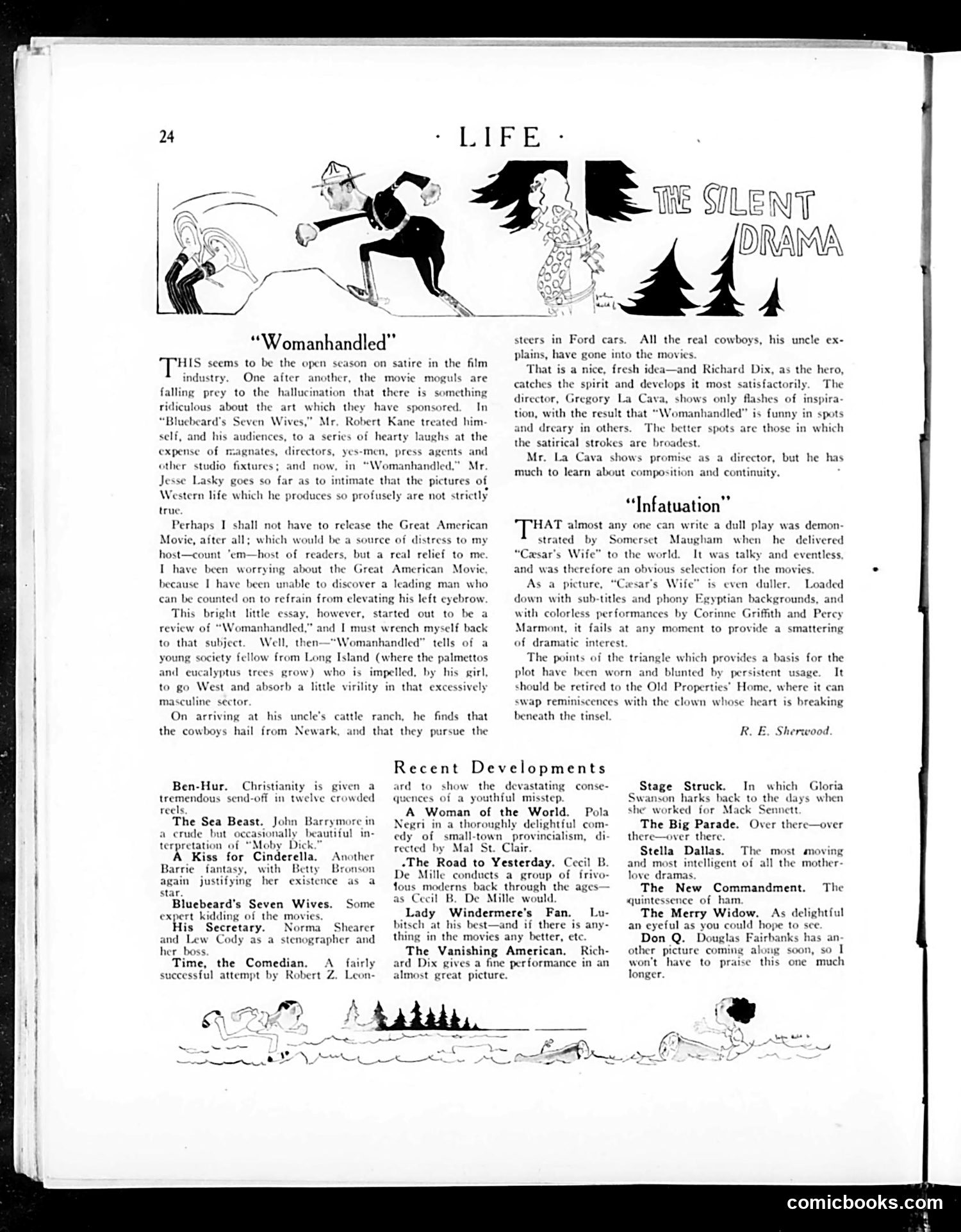
This page reviews films that mock the movie industry itself—a trend the critic finds refreshing. "Womanhandled" satirizes Western films by revealing that real cowboys have abandoned ranching for movies, while fake ones from Newark drive Ford cars. The joke exposes Hollywood's manufactured authenticity: the industry producing ersatz "Western life" pictures while actual cowboys work in cinema. The critic praises this self-aware humor, contrasting it with "Infatuation" (adapted from Somerset Maugham's "Caesar's Wife"), which he finds genuinely dull—overstuffed with subtitles, fake Egyptian sets, and colorless performances. He sardonically suggests retiring the love-triangle plot to a metaphorical "Old Properties' Home." The page reflects 1920s Hollywood's emerging willingness to mock itself and expose its own fabrications—a sophisticated stance for an industry dependent on illusion.
📄 Transcribed text from this page (OCR, searchable)
Machine-transcribed from the original scan — historical spelling and the odd misread are preserved.
a “Womanhandled” HIS seems to be the open season on satire in the film industry. One after another, the movie moguls are falling prey to the hallucination that there is something ridiculous about the art which they have sponsored. In “Bluebeard’s Seven Wives,” Mr, Robert Kane treated him- self, and his audiences, to a series of hearty laughs at the expense of magnates, directors, yes-men, press agents and other studio fixtures; and now, in “Womanhandled.” Mr Jesse Lasky goes so far as to intimate that the pictures of Western life which he produces so profusely are not strictly truc Perhaps I shall not ha to release the Gr American Movie, after all; which would be a source of distress to my host—count ‘em—host of readers, but a real relief to me. I have been worrying about the Great American Movie. because I have been unable to discover a leading man who can be counted on to refrain from elevating his left eyebrow This bright little essay, however, started out to be a review of “Womanhandled,” and I must wrench myself back to that subject. Well, then—“Womanhandled” tells of a young society fellow from Long Island (where the palmettos and eucalyptus trees grow) who is impelled, by his. girl, to go West and absorb a little virility in that excessively masculine sector. On arriving at his uncle's cattle ranch, he finds that the cowboys hail from Newark, and that they pursue the steers in Ford cars. All the real cowboys, his uncle ex- plains, have gone into the movies. That is a nice, fresh idea—and Richard Dix, as the hero, catches the spirit and develops it most satisfactorily. The director, Gregory La Cava, shows only flashes of inspira- tion, with the result that “Womanhandled” is funny in spots and dreary in others. The better spots are those in which the satirical strokes are broadest Mr. La Cava shows promise as a director, but he has much to learn about composition and continuity, “Infatuation” HAT almost any n write a dull play was demon- strated by Somerset Maugham when he delivered “Czxsar's Wife” to the world. It was talky and eventless. and was therefore an obvious selection for the movies. As a picture, “Cwsar’s Wife” is even duller. Loaded down with sub-titles and phony Egyptian backgrounds, and with colorless performances by Corinne Griffith and Percy Marmont, it fails at any moment to provide a smattering of dramatic interest The points of the triangle which provides a basis for the plot have been worn and blunted by persistent usage. It should be retired to the Old Properties’ Home, where it can swap reminiscences with the clown whose heart is breaking beneath the tinsel. R. E, Sherwood. Recent Developments Ben-Hur. Christian is given a ‘d to show the tremendous send-off in twelve crowded nees of a y devastating conse- h{ul misstep. Stage Struck. In which Gloria Swanson harks back to the days when reels A Woman of the World. Pola she worked for Mack Sennett The Sea Beast. John Barrymore in Negri in a thoroughly delightful com- a crude but occasionally beautiful in- dy’ of small-town terpretation of “Moby Dick rected by Mal St. Clair. A Kiss for Cinderella. A Barrie fantasy, with Betty Bi again justifying her existence as star. Bluebeard’s Seven Wives. expert kidding of the movies. s His Secretary. Norma Shearer _ bitsch at his best and Lew Cody as a stenographer and — thing in the mov The Big Parade. Over there—over provincialism, di- there—over there. Stella Dallas. The most moving -The Road to Yesterday. Cecil B. and most intelligent of all the mother- De Mille conducts a group of irivo- love dramas fous moderns back through the ages— as Cecil B. De Mille would. Lady Windermere’s Fan. Lu- and if there is any- an eyeful as you could hope to sce es any better, ete. Don Q. Douglas Fairbanks has an The New Commandment. The quintessence of ham. The Merry Widow. As delightful her_ boss The Vanishing American. Rich- other picture coming along soon, so I Time, the Comedian. A fairly ard Dix gives a fine performance in an won't have to praise this one much successful attempt by Robert Z. Leon- almost great picture. longer. comicbooks.com ‘4