
Life, 1926-01-28 · page 20 of 36
Life — January 28, 1926 — page 20: what you’re looking at
What you’re looking at
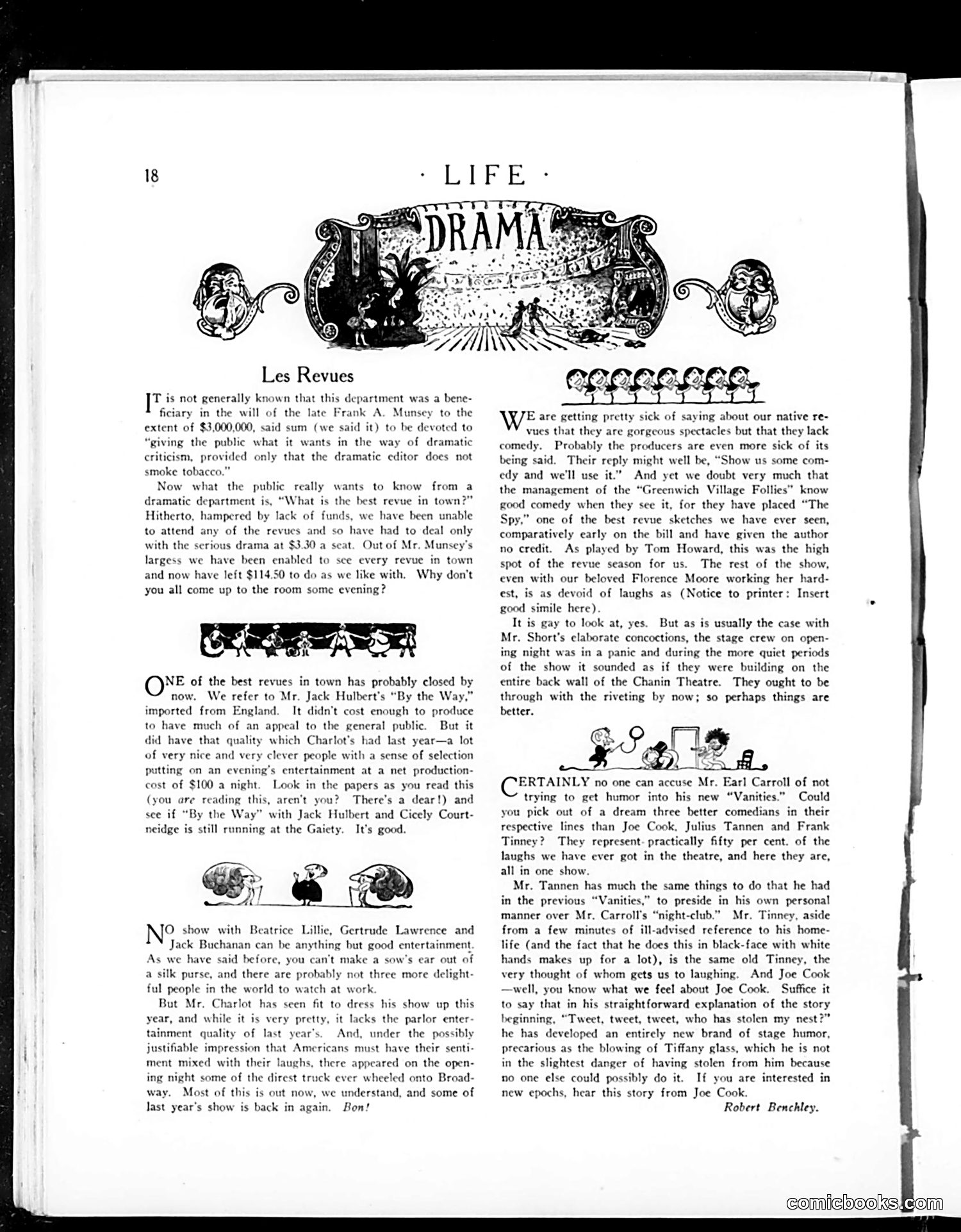
This page satirizes Broadway revue productions—elaborate musical-comedy shows popular in the 1920s. The critic humorously claims Life received a $3 million bequest (from deceased publisher Frank Munsey) specifically to review revues, yet somehow has $114.50 left over, implying these shows are cheap entertainment. The piece critiques several productions: praising Jack Hulbert's "By the Way" for elegant simplicity; approving Charlot's show featuring stars Beatrice Lillie and Gertrude Lawrence but complaining it's become over-dressed; and faulting the "Greenwich Village Follies" for burying their best sketch ("The Spy," starring Tom Howard) early in the bill without crediting the author. The final paragraph praises Earl Carroll's "Vanities" for featuring three excellent comedians—Joe Cook, Julius Tannen, and Frank Tinney—who provide the bulk of theatrical laughs. The satire targets producers' tendency toward spectacle over comedy and their failure to recognize or promote quality sketches.
📄 Transcribed text from this page (OCR, searchable)
Machine-transcribed from the original scan — historical spelling and the odd misread are preserved.
Les Revues T is not generally known that this department was a bene- ficiary in the will of the late Frank A. Munsey to the extent of $3,000,000, said sum (we said it) to be devoted to “giving the public what it wants in the way of dramatic criticism, provided only that the dramatic editor does not smoke tobacco.” Now what the public really wants to know from a dramatic department is, “Wh: Hitherto, hampered by lac funds, we have been unable to attend any of the revues and so have had to deal only with the serious drama at $3.30 a seat. Out of Mr, Munsey’s largess we have been enabled to sce every revue in town and now have left $114.50 to do as we like with, Why don't you all come up to the room some evening? is the best revue in town E of the best revues in town has probably closed by now. We refer to Mr. Jack Hulbert's “By the Wa imported from England. It didn’t cost enough to produce to have much of an appeal to the general public. But it did have that quality which Charlot's had last year—a lot of very nice and very clever people with a sense of selection putting on an evening's entertainment at a net production- cost of $100 a night. Look in the papers as you read this (you are reading this, aren't you? There’s a dear!) and see if “By the Way” with Jack Hulbert and Cicely Court- neidge is still running at the Gaiety. It's good. Ne show with Beatrice Lillie, Gertrude Lawrence and Jack Buchanan can be anything but good entertainment As we have said before, you can't make a sow’s ear out of a silk purse, and there are probably not three more delight- ful people in the world to watch at work, But Mr. Charlot has seen fit to dress his show up this year, and while it is very pretty, it lacks the parlor enter- tainment quality of last year's. And, under the possibly justifiable impression that Americans must have their senti- ment mixed with their laughs, there appeared on the open- ing night some of the direst truck ever wheeled onto Broad- way. Most of this is out now, we understand, and some of last year’s show is back in again. Bon! WE are getting pretty sick of saying about our native re- vues that they are gorgeous spectacles but that they lack . Probably the producers are even more sick of its being said. Their reply might well be, “Show us some com- edy and we'll use it.’ And yet we doubt very much that the management of the “Greenwich Village Follies” know good comedy when they see it, for they have placed “The Spy.” one of the best revue sketches we have ever seen, comparatively early on the bill and have given the author no credit. As played by Tom Howard, this was the high spot of the revue season for us. The rest of the show, even with our beloved Florence Moore working her hard- est, is as devoid of laughs as (Notice to printer: Insert good simile here). It is gay to look at, yes. But as is usually the case with Mr. Short’s elaborate concoctions, the stage crew on open- ing night was in a panic and during the more quict periods of the show it sounded as if they were building on the entire back wall of the Chanin Theatre. They ought to be through with the riveting by now; so perhaps things are better. ERTAINLY no one can accuse Mr. Earl Carroll of not trying to get humor into his new “Vanities.” Could you pick out of a dream three better comedians in their respective lines than Joe Cook, Julius Tannen and Frank Tinney? They represent: practically fifty per cent. of the laughs we have ever got in the theatre, and here they are, all in one show. Mr. Tannen has much the same things to do that he had in the previous “Vanities,” to preside in his own personal manner over Mr. Carroll's “night-club.”| Mr. Tinney, aside from a few minutes of ill-advised reference to his home- life (and the fact that he does this in black-face with white hands makes up for a lot), is the same old Tinney, the very thought of whom gets us to laughing. And Joe Cook —well, you know what we feel about Joe Cook. Suffice i to say that in his straightforward explanation of the story beginning, “Tweet, tweet, tweet, who has stolen my nest?” he has developed an entirely new brand of stage humor, precarious as the blowing of Tiffany glass, which he is not in the slightest danger of having stolen from him because no one else could possibly do it. If you are interested in new epochs, hear this story from Joe Cook. Robert Benchley.