
Life, 1926-01-28 · page 16 of 36
Life — January 28, 1926 — page 16: what you’re looking at
What you’re looking at
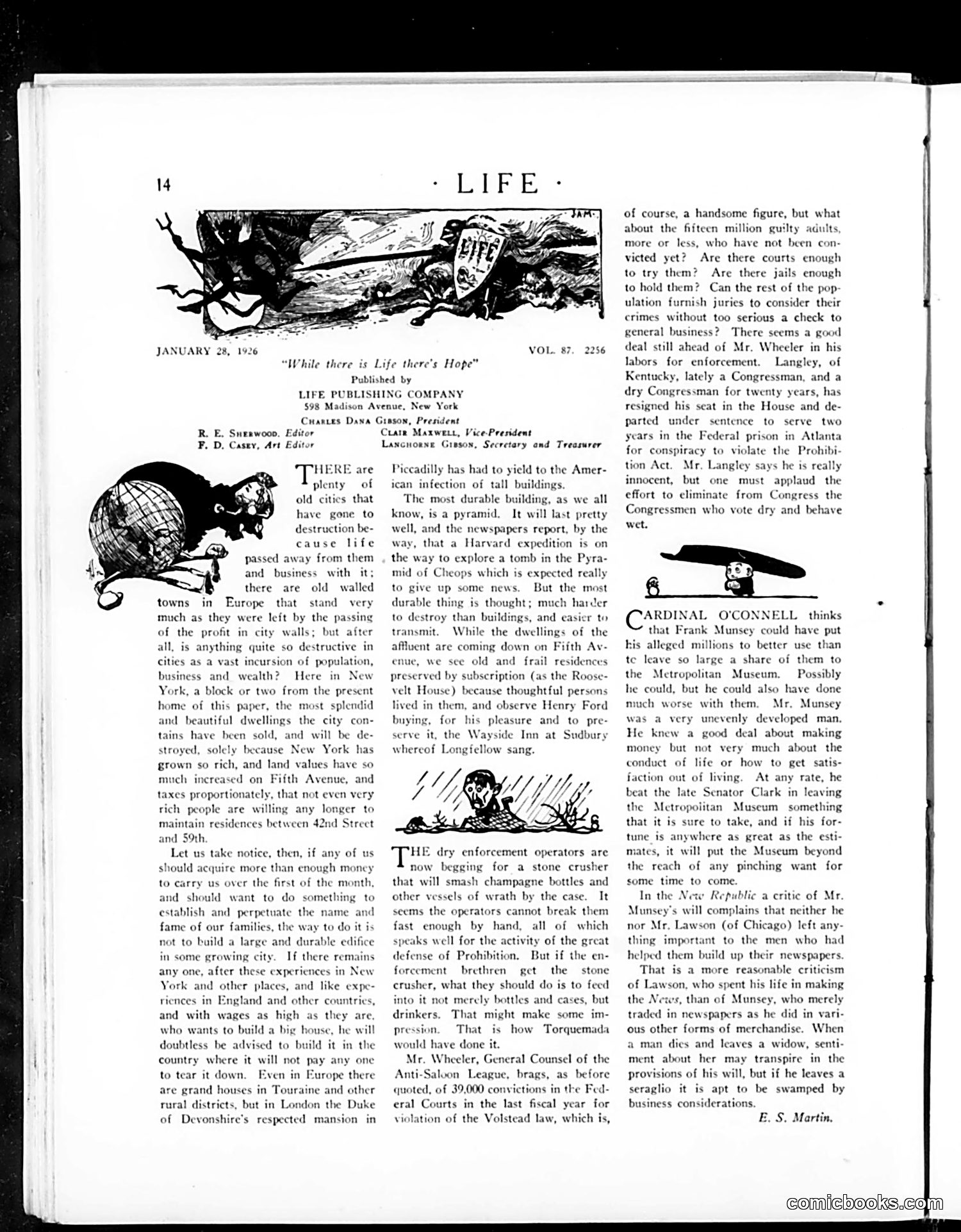
This page contains editorial commentary on Prohibition enforcement and criminal justice rather than political cartoons. The main illustration shows a skeleton or death figure amid rubble, captioned "While there is Life there's Hope." The text critiques the enforcement of Prohibition, discussing the paradox that while enforcement operations (like stone crushers destroying bottles) continue, roughly 15 million Americans remain unconvicted of violations. The author questions whether sufficient courts and jails exist to prosecute such widespread lawbreaking. The second section discusses Frank Munsey's donation of his millions to the Metropolitan Museum, suggesting such philanthropy is insufficient compensation for questionable business practices during his lifetime. The satire targets both government ineffectiveness in enforcing unpopular laws and wealthy industrialists' attempts at redemption through late-life charitable donations.
📄 Transcribed text from this page (OCR, searchable)
Machine-transcribed from the original scan — historical spelling and the odd misread are preserved.
JANUARY 28, 1926 “While there is L Life there's Hope” Published by LIFE PUBLISH $98 Madison Av Cuantes Dana C R. E. Sneawooo, Editor F. D. Casey, Art E HERE are plenty of old cities that have to destruction be- cause life passed away from them and business with it; there a old walled towns in Europe that stand very much as they were left by the passing but after all, is anything quite so destructive in gone of the profit in city walls; cities as a vast incursion of population, wealth? Here in New York, a block or two from the present home of this paper and beautiful dwel tains have business and the most splendid ngs the city con- been sold, and will be de- stroyed, solely because New York has grown so rich, and land values have so sed on Fifth Avenue, and taxes proportionately, that not even very rich people are willing any longer to maintain residences between 42nd Street and 59th. Let us take notice, then, if any of us should ac much inerea wire more than enough money to carry us over the first of the mon: should want ing ish and perpetuate the name ani fame of our families, the way to do it is not to build a larg: in some growing city any one, after these experiences in New York and other places, and like expe- riences in England and other countries, and with wages as high as they are. who wants to build a big house and to do somet est and durable edifice If there remains he will doubtless be advised to build it in the country where it will not pay any one to tea Even in Europe there are grand houses in Touraine and other rural districts, but in London the L of Devonshire’s respected mansion in rit down. uke 3 COMPANY enue, New York jimsom, President Ctare Maxwert, Vice-President Laxcnoane Gieson, Secretary and Treasurer Piccadilly has had to yield to th ican infection of tall buildings. Amer- The most durable building, as we all know, is a pyramid, It will last pretty well, and the newspapers report, by the way, that a Harvard expedition is on the way to explore a tomb in the Pyra mid of Cheops which is expected reall But the most durable thing is thought; much harder to destroy than buildings, and e transmit. to give up some news. sier to While the dwellings of the affluent are coming down on Fifth Av- old and frail residences preserved by subscription (as the Roose- velt House) because thoughtful persons lived in them, and observe Henry Ford buying, for his pleasure and to pre- serve it, the Wa whereof Longfellow sang. enue, we see side Inn at Sudbury enforcement operators are for a stone crusher that will smash champagne bottles and other vessels of wrath by the case. It seems the operators cannot break them fast enough by hand, all of which ks well for the activity of the great defense of Prohib But forcement brethren get the stone crusher, what they should do is to feed into it not merely bottles and cases, but drinkers. That might make some im- pression. That is how Torquemada would have done it. Mr. Wheeler, General Counsel of the Anti-Saloon League, brags, as before quoted, of 39,000 convictions in the Fed- eral Courts in the last fiscal year for violation of the Volstead law, which is, mn. the en- of course, a handsome figure, but what about the fifteen million guilty adults. more or less, who have not been con- victed yet? Are there courts enough to try them? Are there jails enough to hold them? Can the rest of the pop: ulation furnish juries to consider their crimes without too serious a check to general business? There seems a good deal still ahead of Mr. Wheeler in his labors for enforcement. Langley, of Kentucky, lately a Congressman, and a dry Congressman for twenty years, has resigned his seat in the House and de- parted under sentence to serve two years in the Federal prison in Atlanta for conspiracy to violate the Prohibi tion Act. Mr, Langley says he is really innocent, but must applaud the effort to eliminate from Congress the Congressmen who vote dry and behave wet. one ARDINAL O'CONNELL thinks that Frank Munsey could have put his alleged millions to better use than te leave so large a share of them to the Metropolitan Museum. Possibly he could, but he could also have done with them. Mr. Munsey was a very unevenly developed man. He knew a good deal about making money but not very much about the of life or how to get satis- At any rate, he or Clark in leaving Museum something nd if his for- tune is anywhere as great as the esti- mates, it will put the Museum beyond the reach of any pinching want for some time to come. In the Republic a critic of Mr. Munsey’s will complains that neither he nor Mr, Lawson (of Chicago) left any- thing important to the men who had helped them build up their newspapers That is a more reasonable criticism of Lawson, who spent his life in making the News, than of Munsey, who merely traded in newspapers as he did in vari- ous other forms of merchandise. When a man dies and leaves a widow, senti- ment about her may transpire in the provisions of his will, but if he leaves a seraglio it is apt to be swamped by business considerations. much worse conduct faction out of living beat the late Se the Metropolitan that it is sure to take, E. S. Martin, comichooks.