
A complete issue · 36 pages · 1926
Life — January 21, 1926
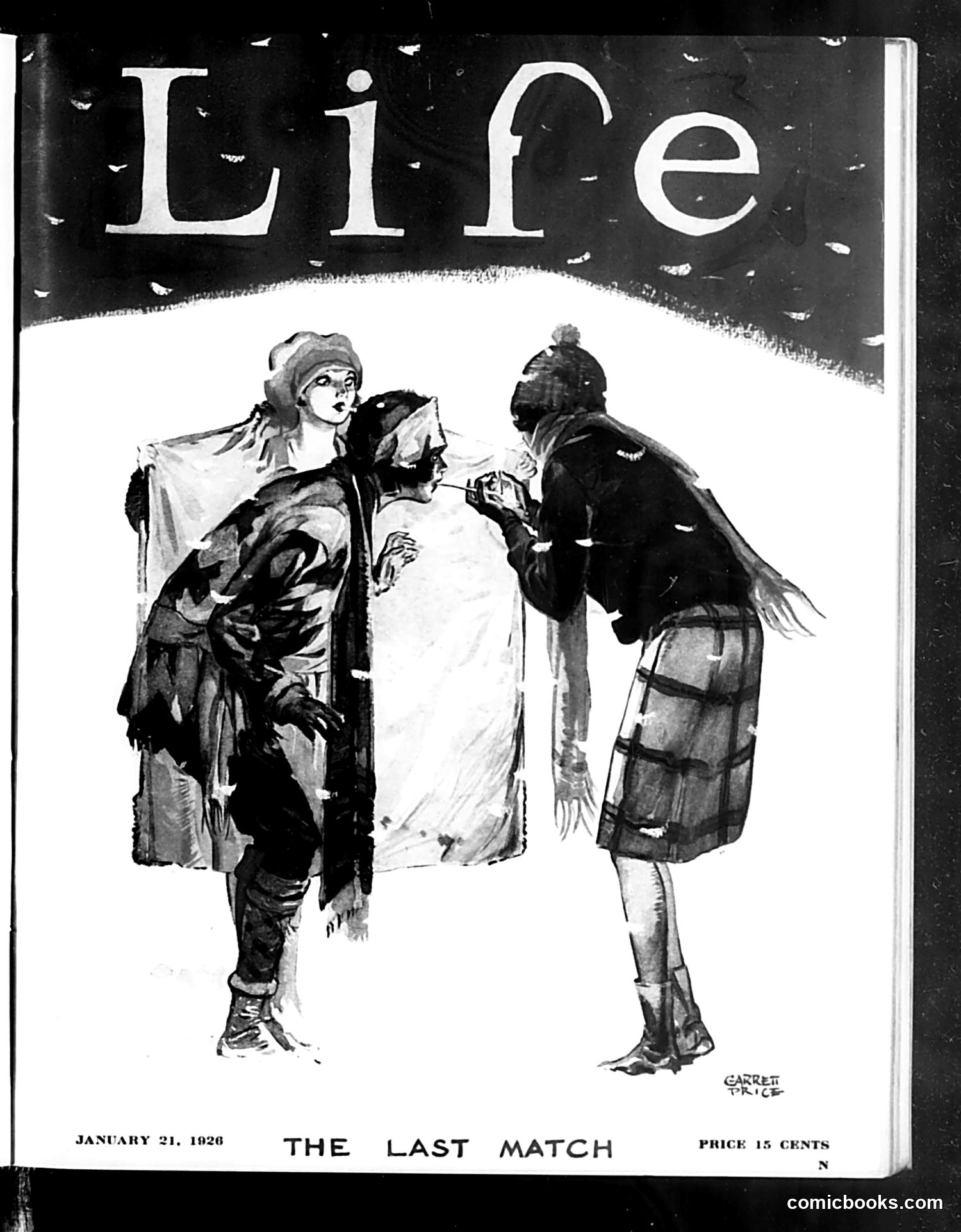
This cover illustration by Garrett Price depicts "The Last Match"—a scene of two women examining what appears to be a matchbox or similar item. The satirical title suggests commentary on scarcity or depletion of resources. Given the 1926 date and the magazine's tradition of social satire, this likely references Prohibition-era concerns, possibly about alcohol supplies becoming scarce as enforcement intensified. The figures' winter clothing and the dramatic lighting suggest urgency or concern about obtaining something in short supply. The phrase "last match" could metaphorically represent dwindling resources during this period of strict alcohol restrictions that defined American life from 1920-1933. Without additional context, the specific social commentary remains somewhat unclear.
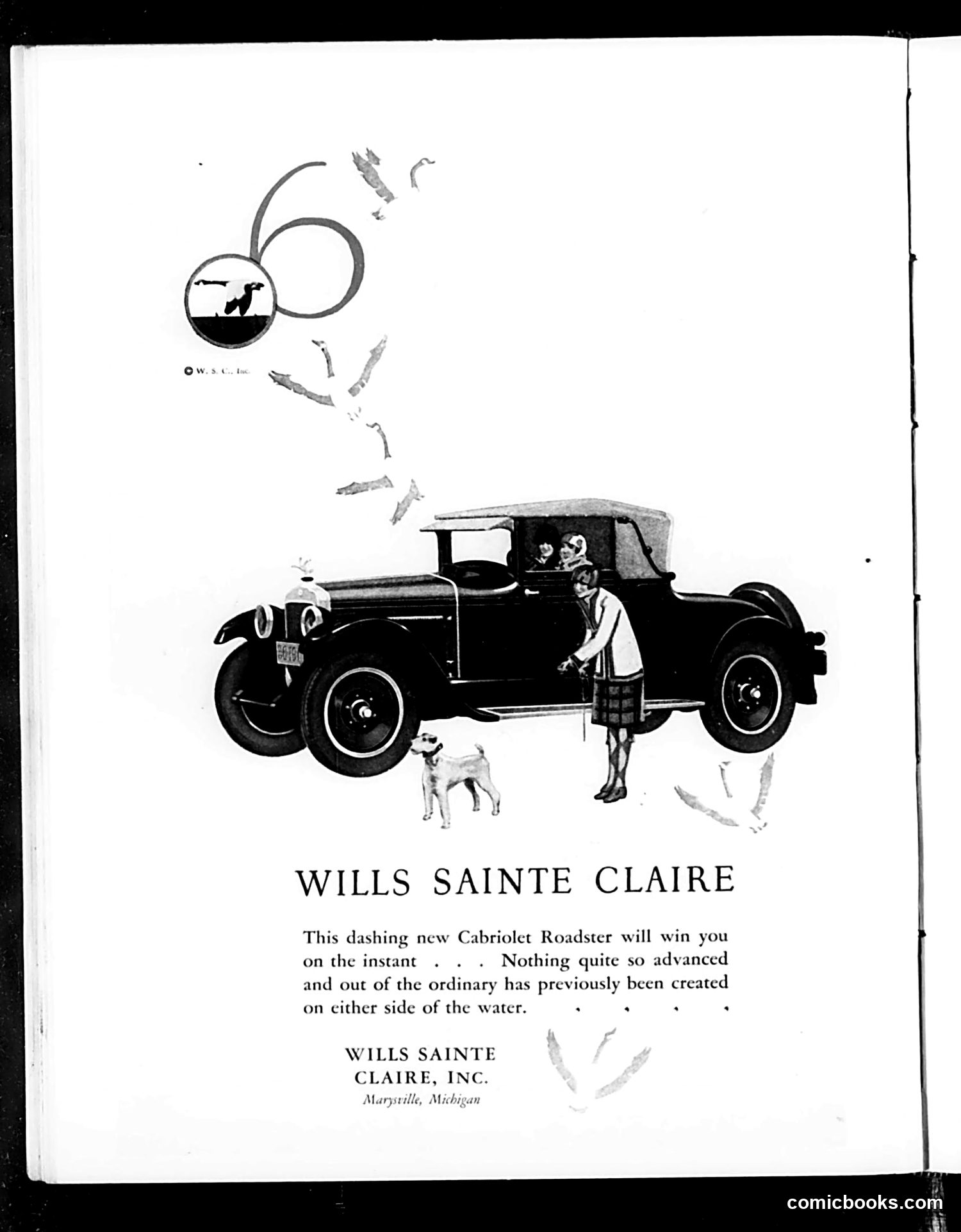
This is primarily an **advertisement**, not satire or political cartoon. It promotes the Wills Sainte Claire automobile, a Cabriolet Roadster manufactured by Wills Sainte Claire, Inc. in Marysville, Michigan. The ad uses humor to appeal to potential buyers. The illustration shows a man with a dog beside the car, while another figure appears in the vehicle above (possibly representing aspiration or the car's appeal). The accompanying text claims the car is "dashing" and "advanced," featuring innovations "out of the ordinary." The whimsical imagery—with the dreamy figure floating above—suggests the car represents modern luxury and status. This is typical automotive advertising of the era, emphasizing technological progress and lifestyle appeal rather than practical transportation.
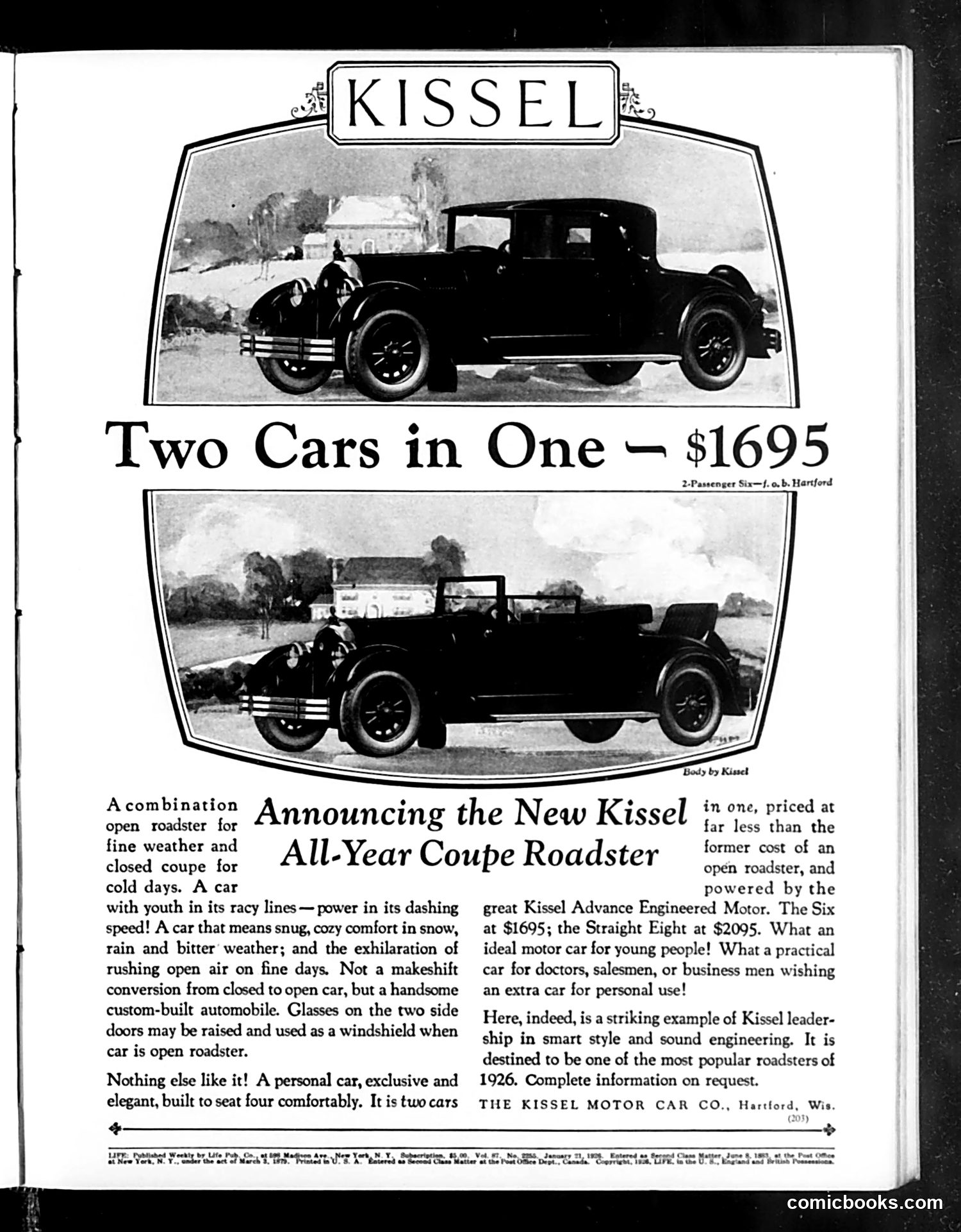
This is **not a political cartoon or satire**—it's a straightforward automobile advertisement from Life magazine. The page advertises the Kissel All-Year Coupe Roadster, priced at $1,695. The "Two Cars in One" concept refers to the vehicle's convertible design: it functions as an open roadster for pleasant weather and converts to a closed coupe for winter conditions. Two photographs show the same car in both configurations. The marketing pitch emphasizes practicality and versatility—combining "youth," "power," "comfort," and "exhilaration" in a single vehicle. The ad positions this as ideal for "young people," doctors, salesmen, and businessmen wanting extra personal transportation. The Kissel Motor Car Company (Hartford, Wisconsin) positions this as an economical alternative to owning multiple vehicles. This reflects 1920s consumer marketing rather than satire or political commentary.
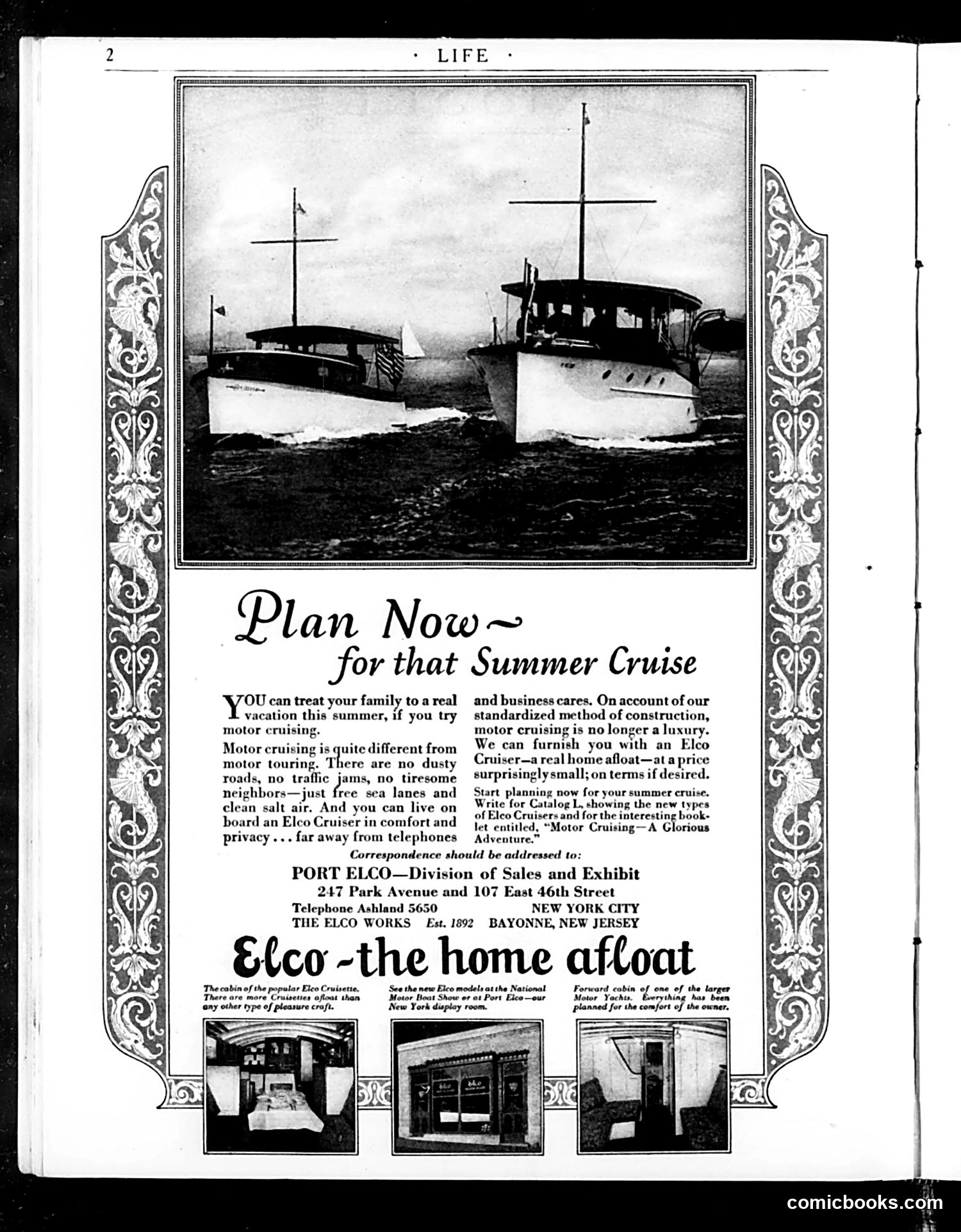
This is **not a political cartoon or satire page** — it's a **commercial advertisement** for Elco motor cruisers. The page promotes leisure boating as an affordable vacation option for families. The ad's main argument: motor cruising was once a luxury, but Elco standardized production has made it accessible. The text emphasizes comfort and escape ("far away from telephones and business cares"). The image shows two Elco cruiser boats at anchor. Below are three smaller photographs displaying the boat's interior amenities — cabin, galley, and forward cabin — emphasizing comfort and livability. This represents 1920s-era marketing positioning recreational boating as a democratized leisure activity for middle-class Americans, not just the wealthy.
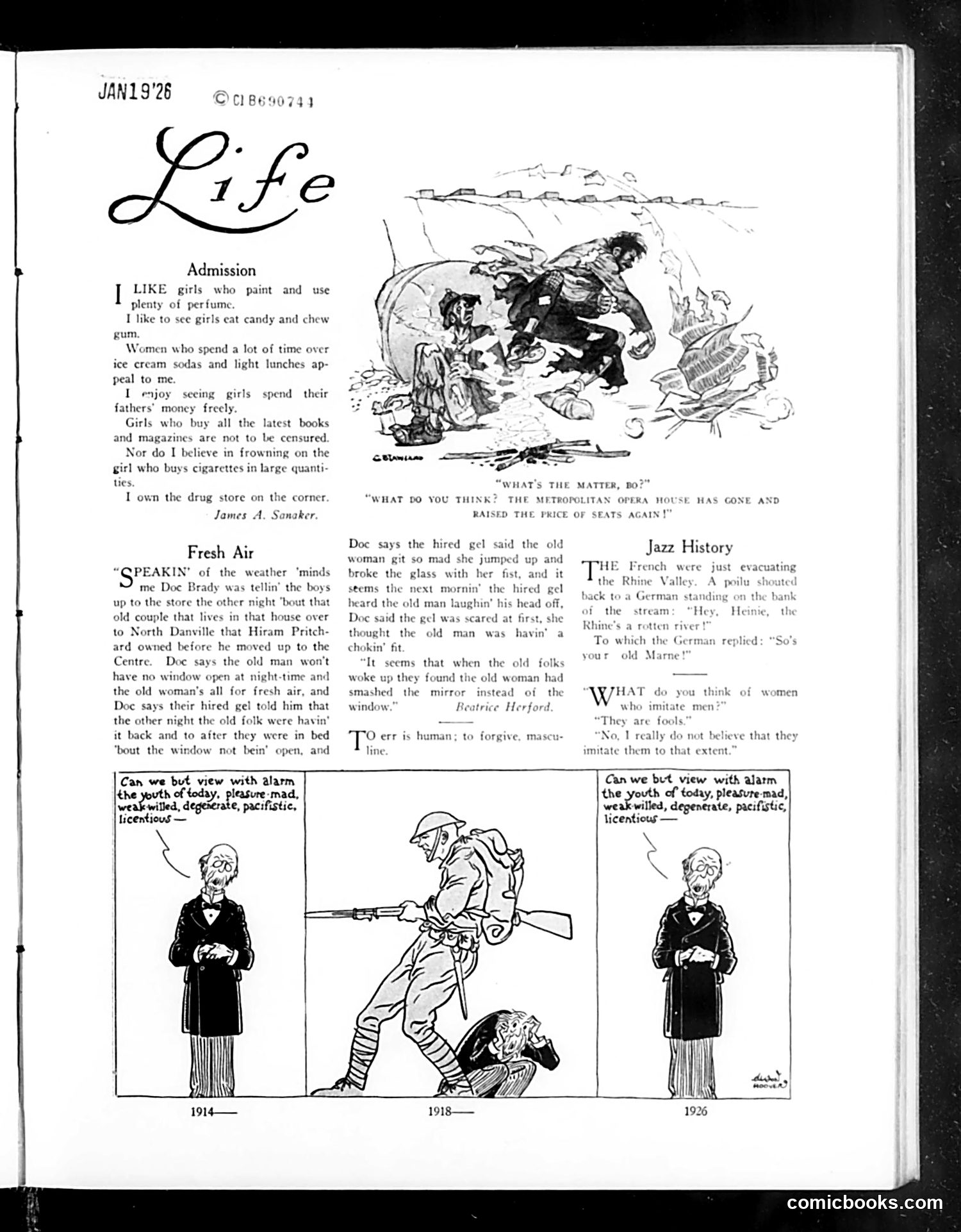
This page contains social commentary and humor typical of 1920s Life magazine. The three-panel cartoon at bottom tracks attitudes toward youth across three periods (1914, 1918, 1926), showing an elderly woman's consistent disapproval. In 1914 and 1926, she expresses concern about "pleasure mad, weak willed, degenerate, pacifistic, licentious" youth. The middle panel (1918) depicts a soldier, suggesting that wartime duty temporarily redeemed youth in public perception. The articles above discuss contemporary social observations: women's behavior, a hiring manager's anecdote about a broken mirror, and jazz's French origins during WWI. The satirical point appears to be generational anxiety—elders consistently criticized young people regardless of era or circumstances, implying such criticism was a perpetual, perhaps unfounded, tradition.
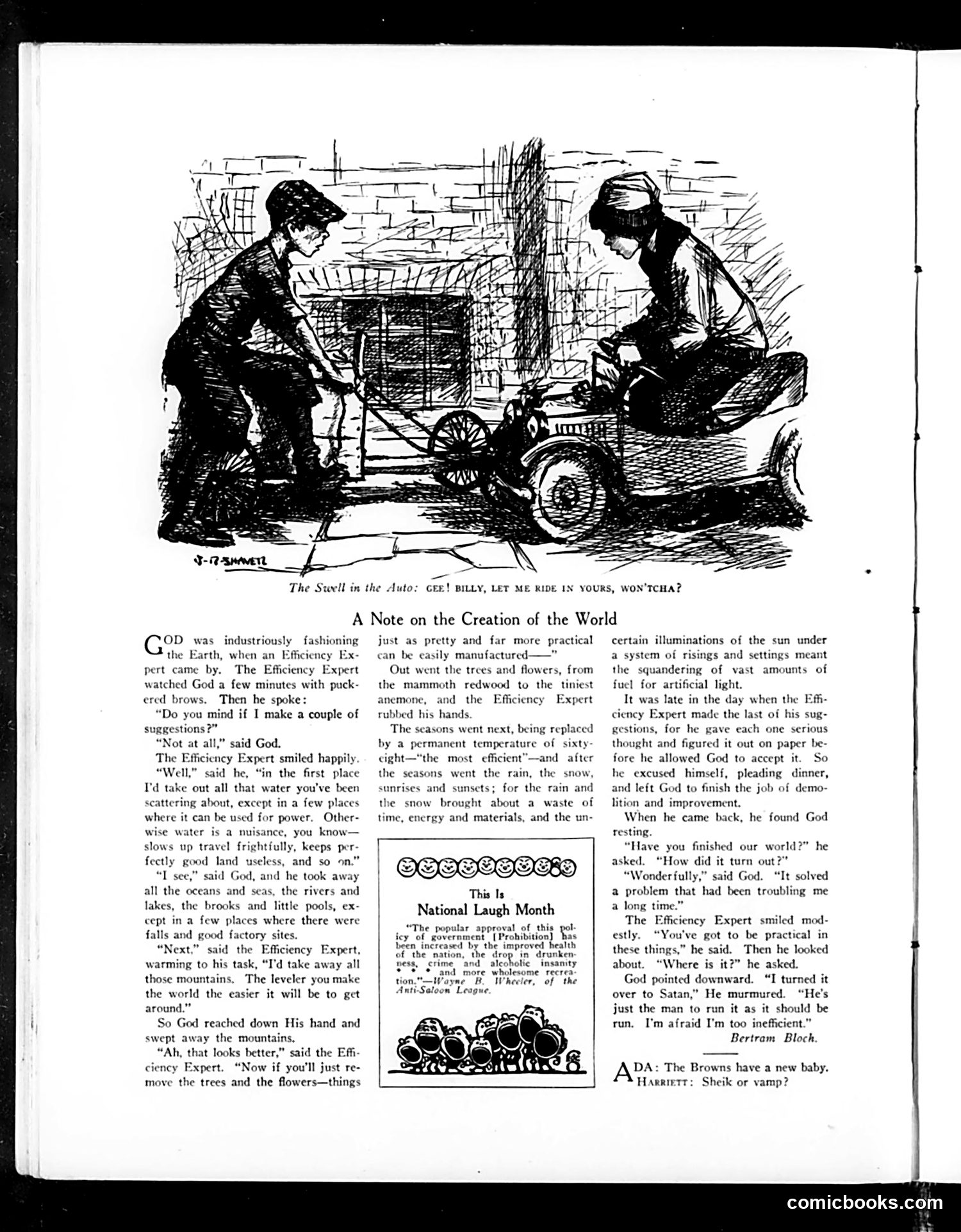
**Top Cartoon:** "The Swell in the Auto" depicts two boys with a toy automobile. One asks to ride in the other's vehicle, using the slang phrase "won'tcha?" The humor targets wealthy children mimicking adult "swell" (upper-class) culture and their possessive attitudes toward automobiles—then still relatively novel luxury items. The satire mocks how quickly the wealthy adopt and display status symbols. **Main Story:** "A Note on the Creation of the World" is a humorous allegory where God hires an "Efficiency Expert" to improve creation. The satire critiques the early-20th-century obsession with industrial efficiency and optimization applied to everything, even divine work. The expert removes "waste" (nature, beauty) for practicality—a commentary on how modernization threatened traditional values.
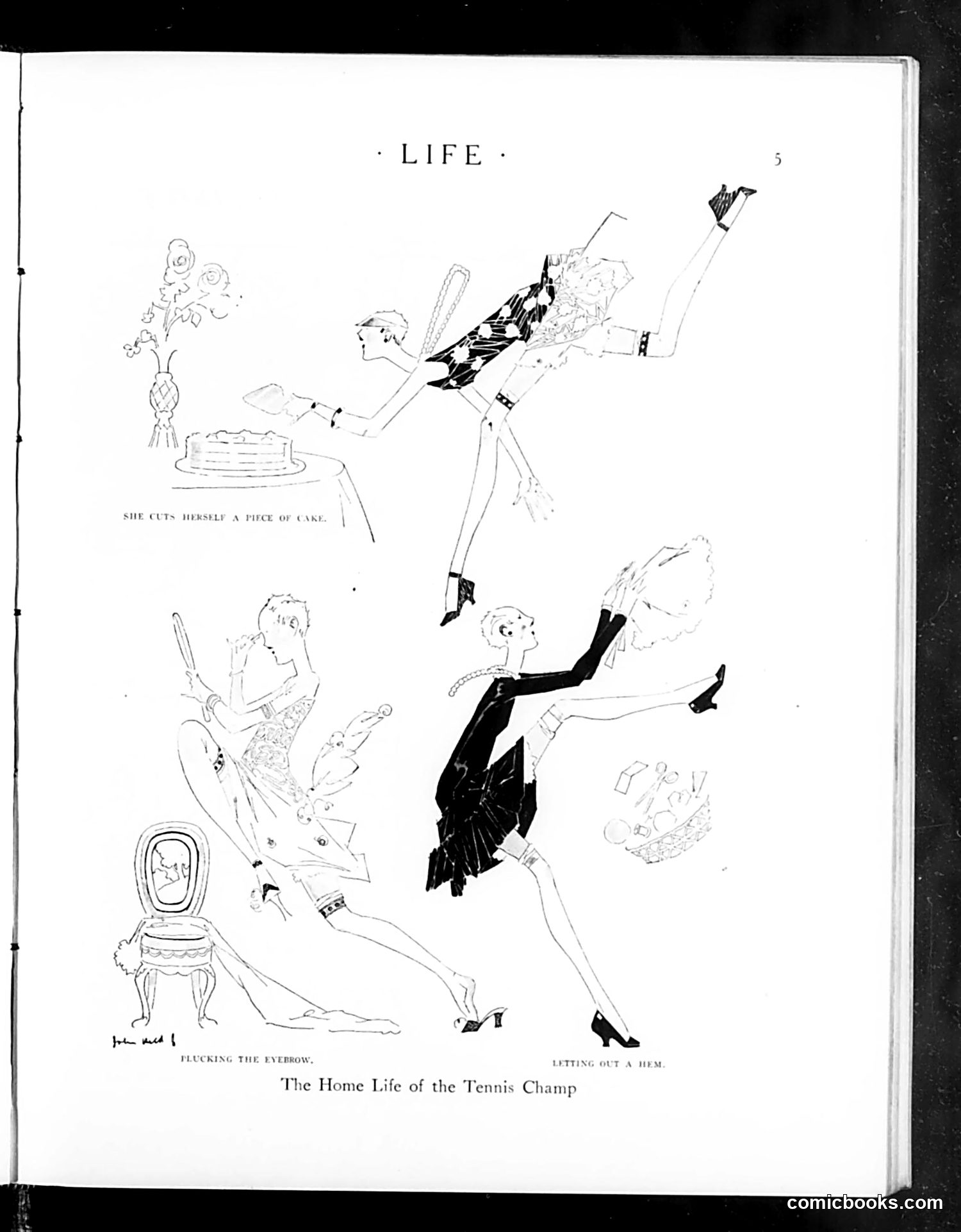
This satirical page depicts a woman's domestic activities styled as athletic tennis moves. The central figure performs exaggerated, dynamic poses while doing ordinary household tasks: "plucking the eyebrow," "letting out a hem," and cutting cake. A small decorative chair appears below. The satire mocks the emerging "New Woman" of the 1920s—one who plays competitive sports (tennis was fashionable among women) while still managing domestic duties. By presenting housework as athletic performance, the cartoonist playfully critiques the expectation that modern women balance both spheres simultaneously. The exaggerated poses suggest the physical comedy and absurdity of performing these contradictory social roles with equal vigor.
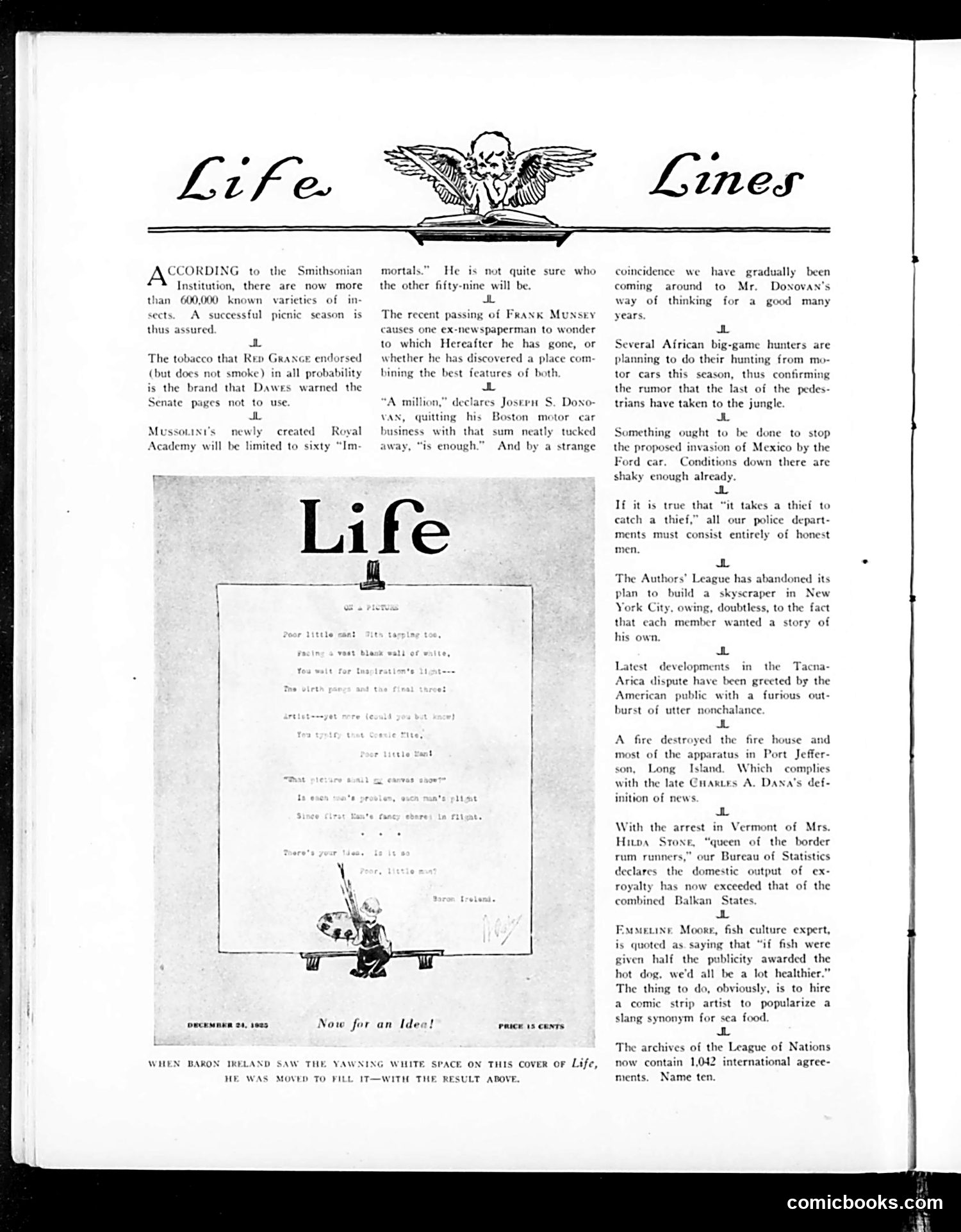
This page from *Life* magazine (dated December 24, 1925, per the footer) contains a cartoon titled "Now for an Idea!" The illustration shows a figure sitting on a bench labeled "Baron Ireland," contemplating how to fill white space on a magazine cover. The cartoon satirizes the creative process—specifically Baron Ireland's struggle to generate original editorial ideas. The accompanying "Life Lines" column discusses various contemporary topics: the Smithsonian Institution's plant varieties, Frank Munsey's passing, Joseph Donovan's business ventures, African hunters, Mexican invasion concerns via Ford cars, police integrity, the Authors' League's skyscraper project, and statistics on the League of Nations. The cartoon's humor derives from depicting creative block as a literal, physical struggle.
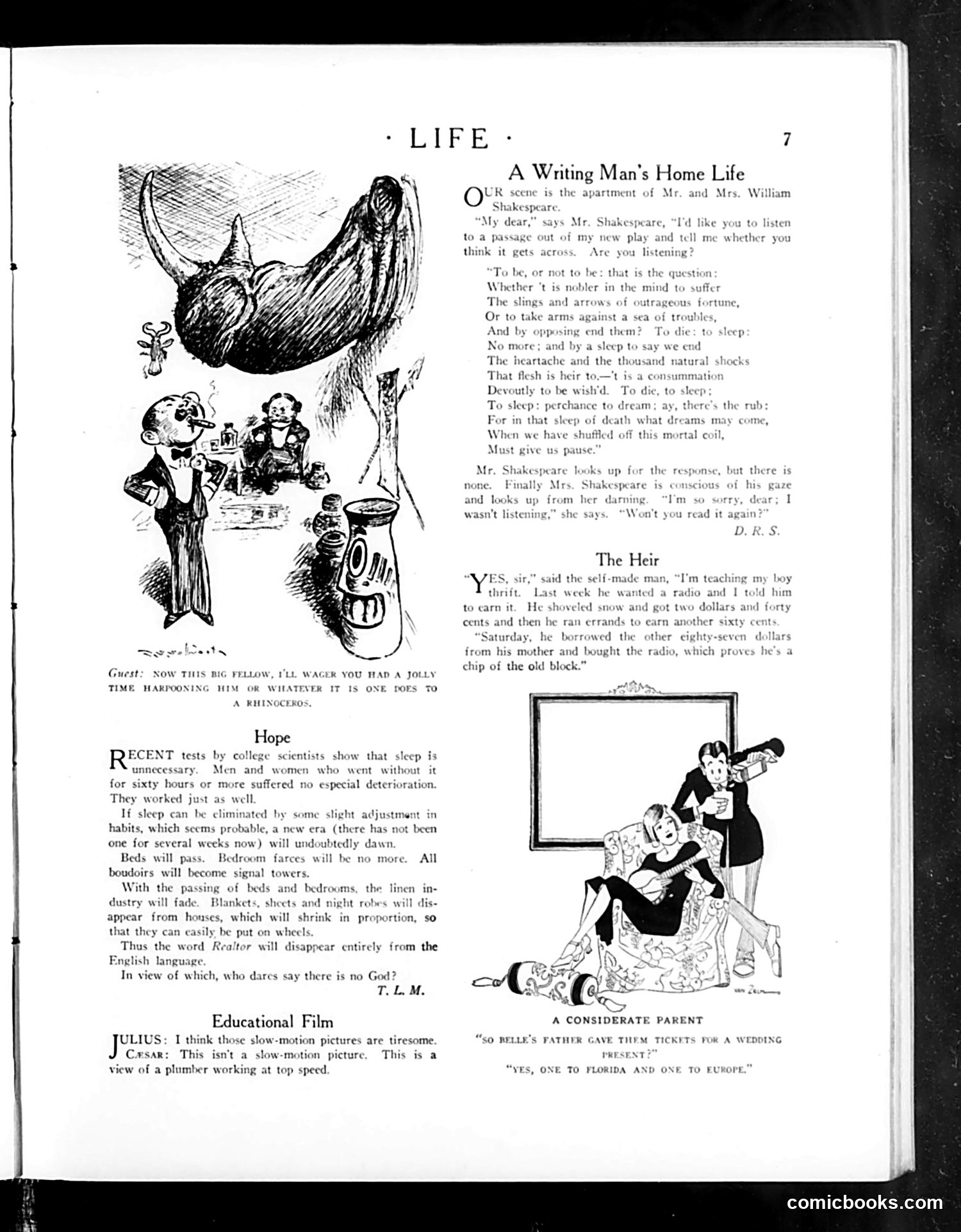
The top cartoon depicts William Shakespeare at home with his wife, who interrupts his creative process. He's reciting lines from *Hamlet* (the "To be or not to be" soliloquy), but Mrs. Shakespeare is unimpressed and distracted by her needlework, eventually asking "Won't you read it again?" The satire mocks the creative genius unappreciated by his own household—a relatable domestic scenario where the writer's grand artistic ambitions clash with ordinary home life and spousal indifference. The lower cartoon, "A Considerate Parent," shows a father giving wedding tickets as gifts—one to Florida, one to Europe—rather than attending himself. The joke satirizes parental abdication of responsibility disguised as generosity.
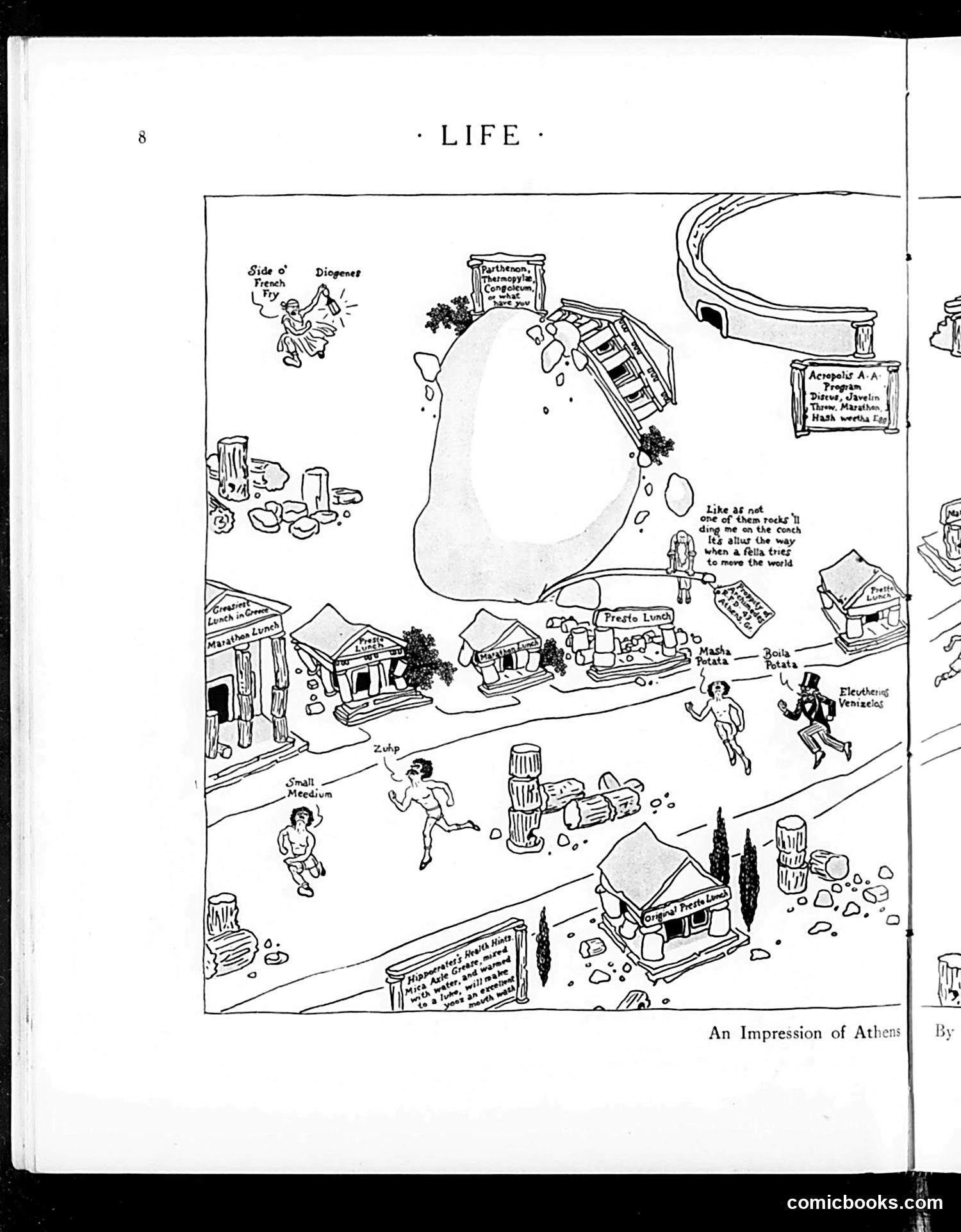
This is a satirical cartoon depicting ancient Athens as a chaotic marketplace teeming with commercial activity and petty commerce. The illustration shows various street vendors, lunch stands (labeled "Fiesta Lunch," "Mashed Lunch," etc.), and small shops surrounding what appears to be the Parthenon or similar classical structure. The satire critiques the romanticized ideal of ancient Athens as a center of philosophy and democracy by instead portraying it as dominated by mundane commercial concerns—food vendors, street hustlers, and everyday mercenary activity. References to "Side o' French," "Zoup," and various lunch establishments emphasize this mercenary, commercialized vision rather than the classical ideals typically associated with Athens. The cartoon appears to mock both nostalgia for classical antiquity and contemporary commercial excess.
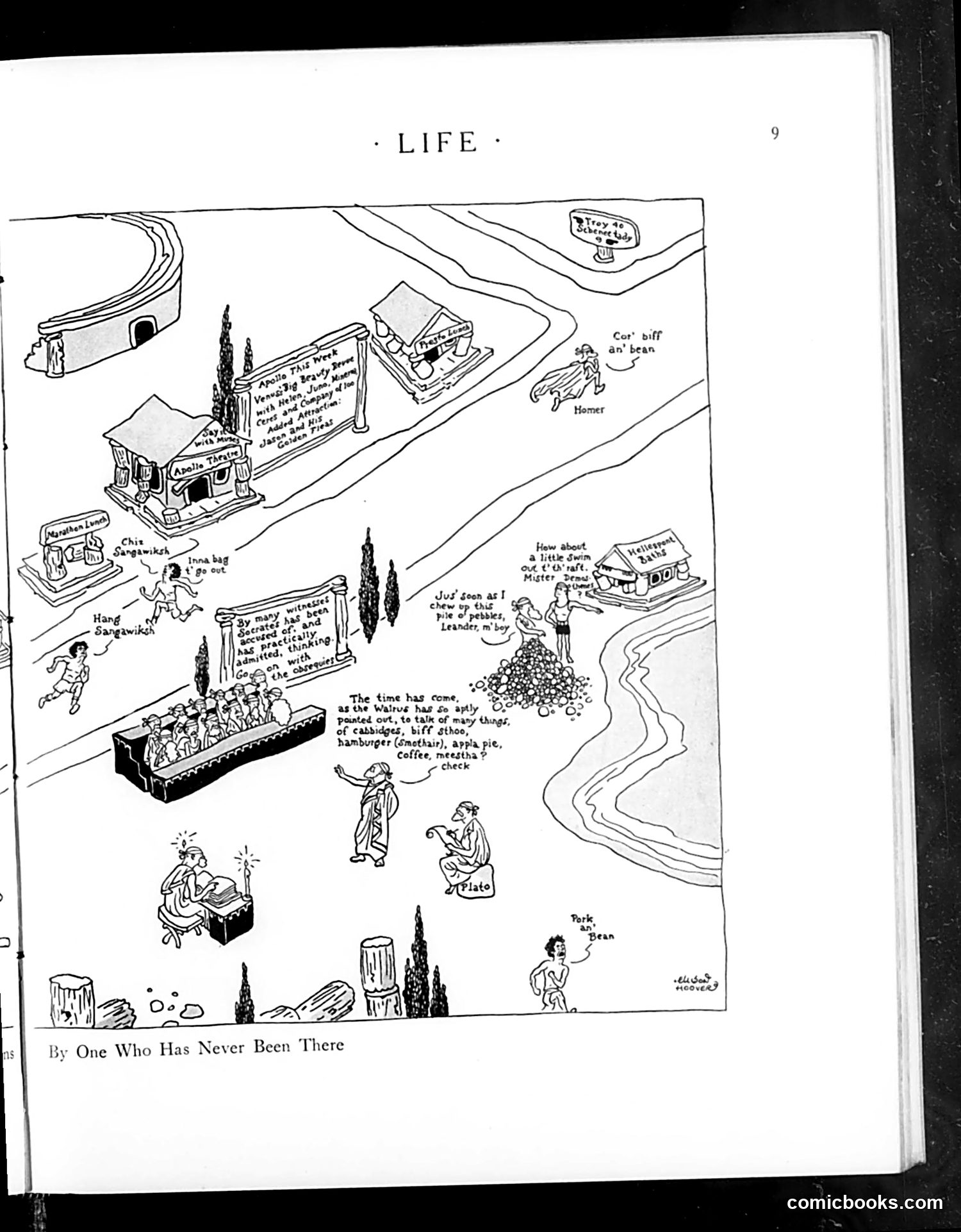
This is a humorous map-style illustration satirizing life in what appears to be California or the American West. The cartoon mocks stereotypical regional characteristics through exaggerated labels and scenes: oversized produce, references to food items ("cabbage, biff stew, hamburger, apple pie, coffee, needles"), tourist attractions, and casual lifestyle elements. The title's self-aware disclaimer—"By One Who Has Never Been There"—is the joke itself. The cartoonist is openly admitting to depicting the region based on secondhand stereotypes and popular imagination rather than actual experience. This satirizes both unreliable travel writing and Americans' tendency to hold exaggerated regional prejudices based on hearsay rather than firsthand knowledge.
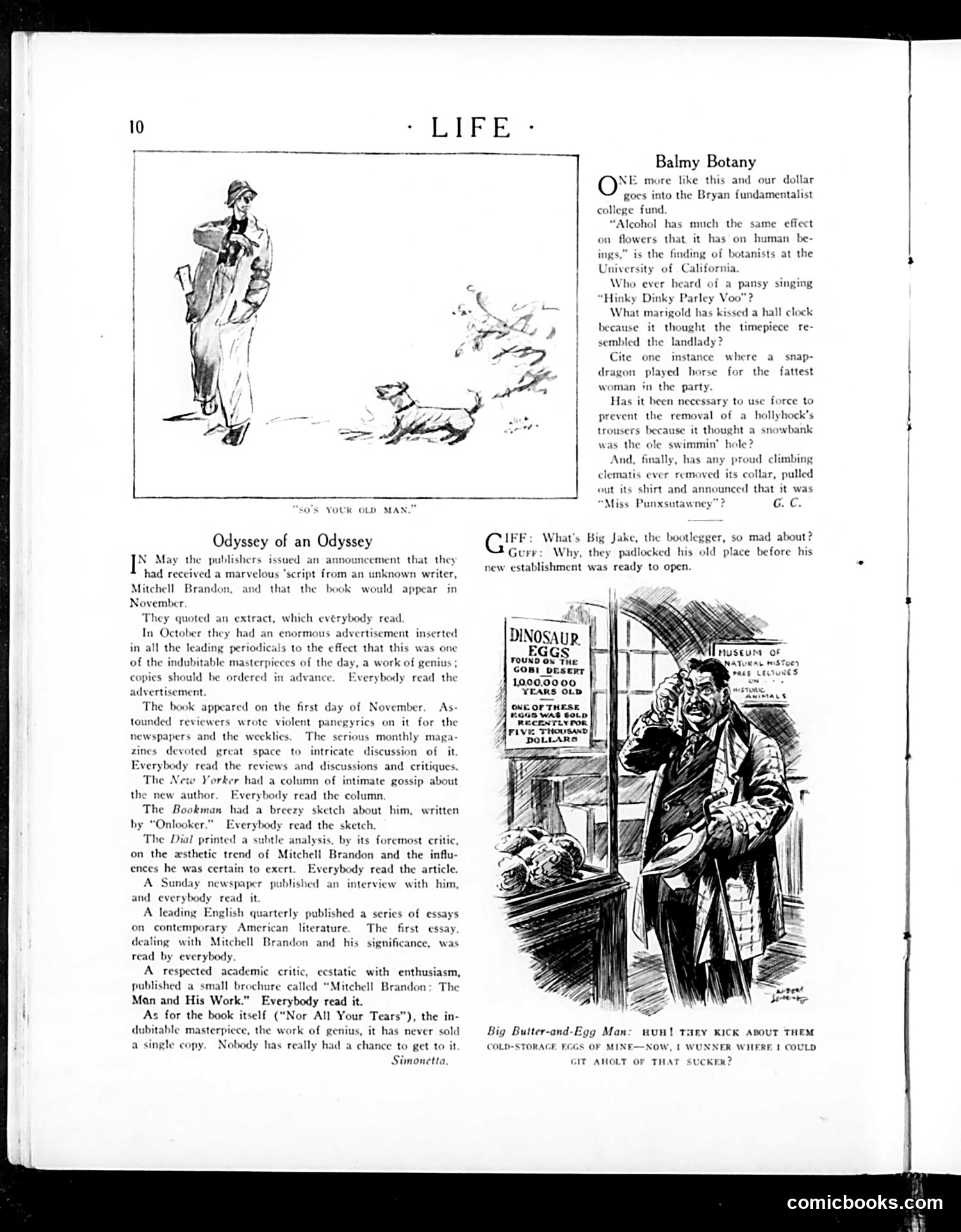
This page contains two separate humor pieces from *Life* magazine: **Upper cartoon** ("So's Your Old Man"): A sketch of a man in a coat confronting what appears to be a small animal or creature. The humor is unclear without additional context. **Lower section** ("Odyssey of an Odyssey"): A satirical piece about the publishing frenzy surrounding a novel by "Mitchell Brandon" (likely a fictional author). The text mocks how publishers, newspapers, magazines, and critics all obsessively covered and hyped an unknown writer's debut book called "Nor All Your Tears." The satire targets herd mentality in literary promotion—everyone reads reviews, advertisements, and critical essays about the book, yet "not a single copy" was actually sold to the public. **Right cartoon** ("Big Butter-and-Egg Man"): A man in a coat stands before shop windows advertising dinosaur eggs. The humor concerns cold-storage eggs and appears to reference someone nicknamed "Big Butter-and-Egg Man," though the specific reference is unclear.
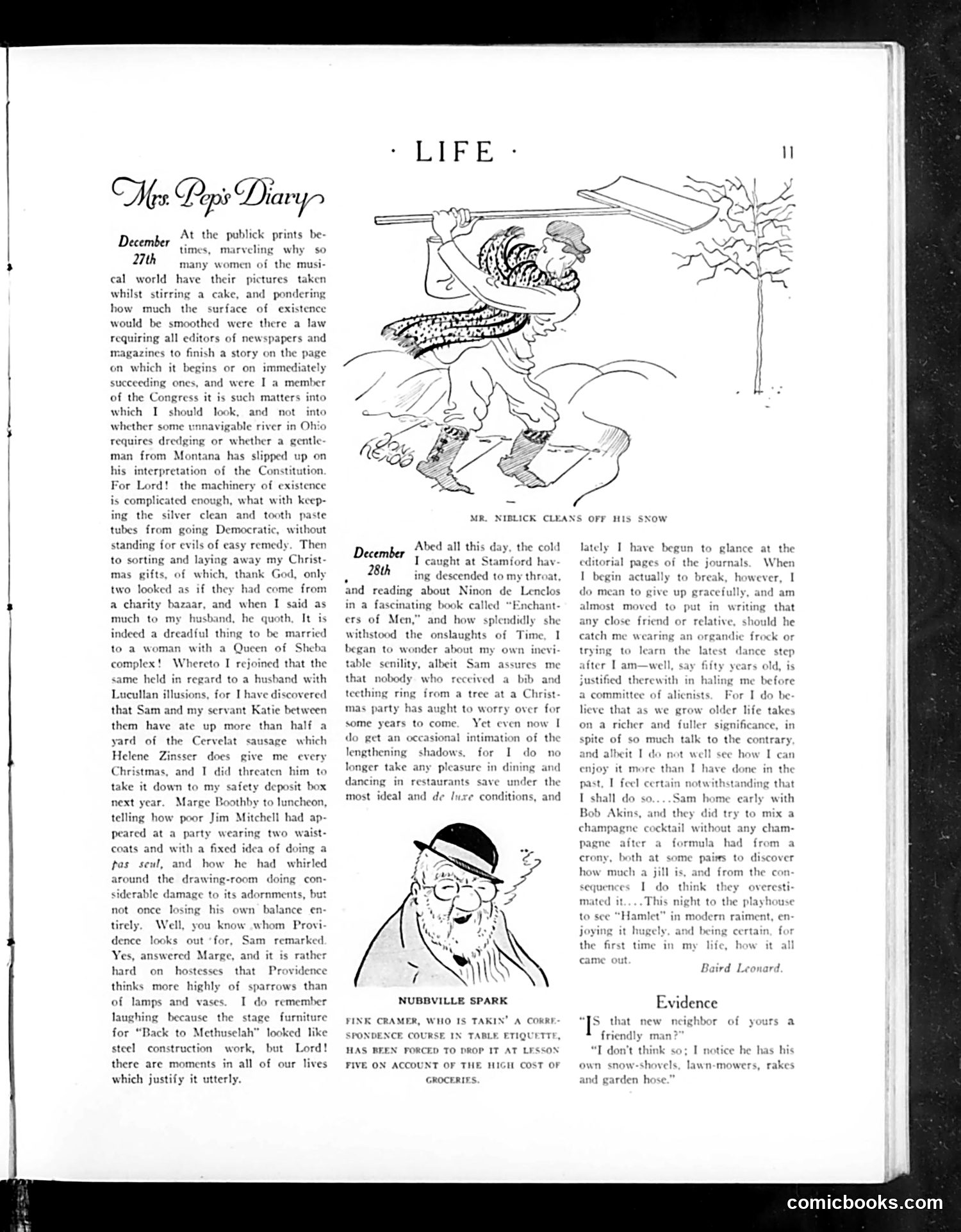
This page contains two satirical pieces from early 20th-century *Life* magazine: **"Mr. Nirlick Cleans Off His Snow"** (top cartoon): Shows a rotund, overdressed figure brushing snow off elaborate winter clothing while holding a rifle. The caption suggests this is a wealthy man (presumably named Nirlick) performing an absurdly fussy grooming ritual. The satire likely mocks the pretentious habits of the wealthy or newly rich class who obsess over maintaining appearances. **"Nubbville Spark"** (bottom cartoon): Depicts an elderly bearded man. The caption indicates he's a "fine crammer" being forced to take correspondence courses in table etiquette due to high grocery costs—satirizing economic hardship affecting even older, established community members. Both pieces employ period-typical caricature and social commentary about class, wealth, and economic struggle.
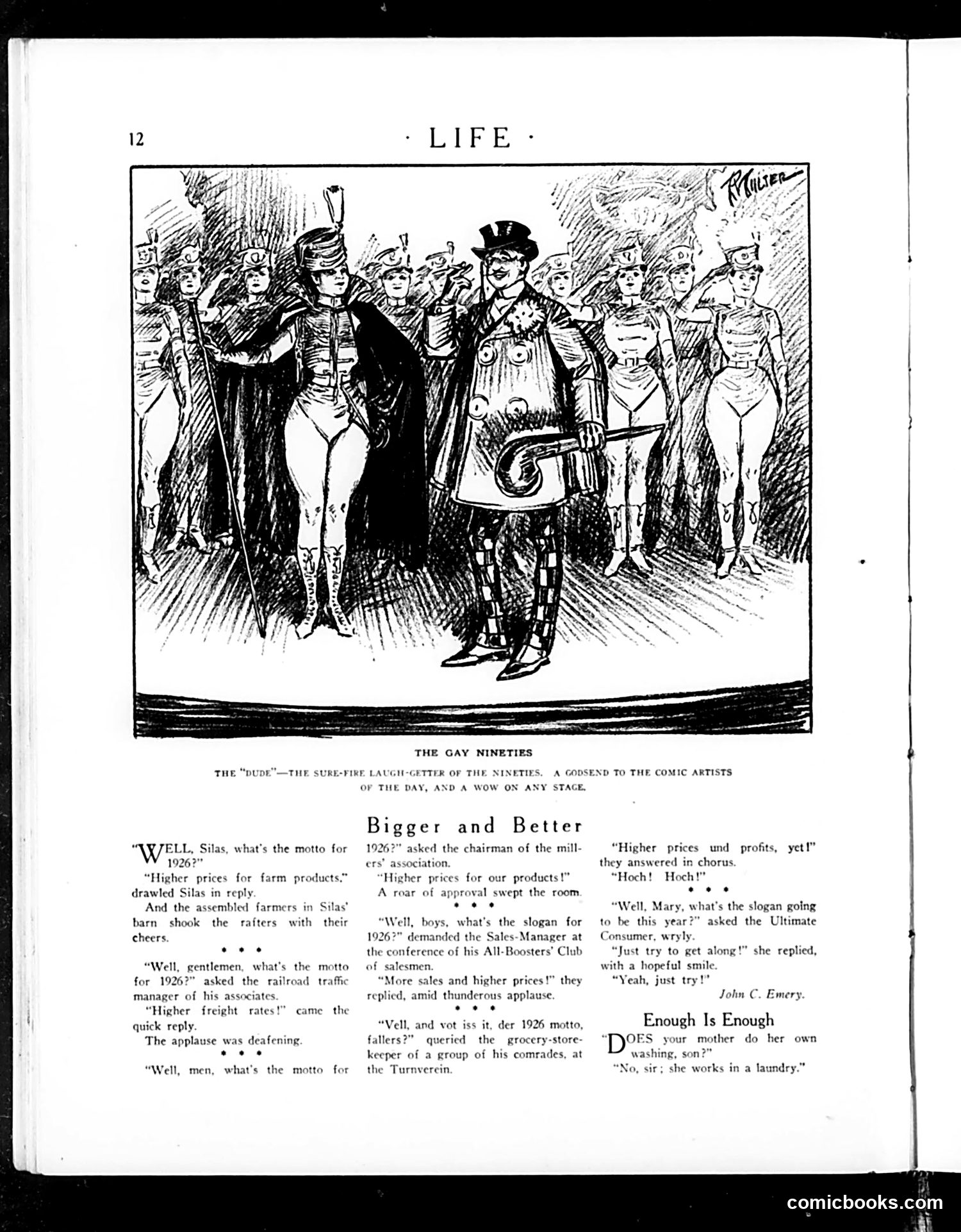
This cartoon satirizes the 1920s economic boom by mocking the era's obsession with rising prices and profits. The illustration shows elaborately costumed figures labeled "The Gay Nineties," but the caption clarifies this is actually about **1926** — a joke about how enthusiastically people were repeating the phrase "higher prices and higher profits" as the motto for that year. The accompanying text presents a series of comedic exchanges where various professionals (farmers, railroad managers, grocers) all cite "higher prices" as their answer when asked for their year's motto, creating satirical commentary on widespread inflation and commercial self-interest during the Roaring Twenties economic bubble.
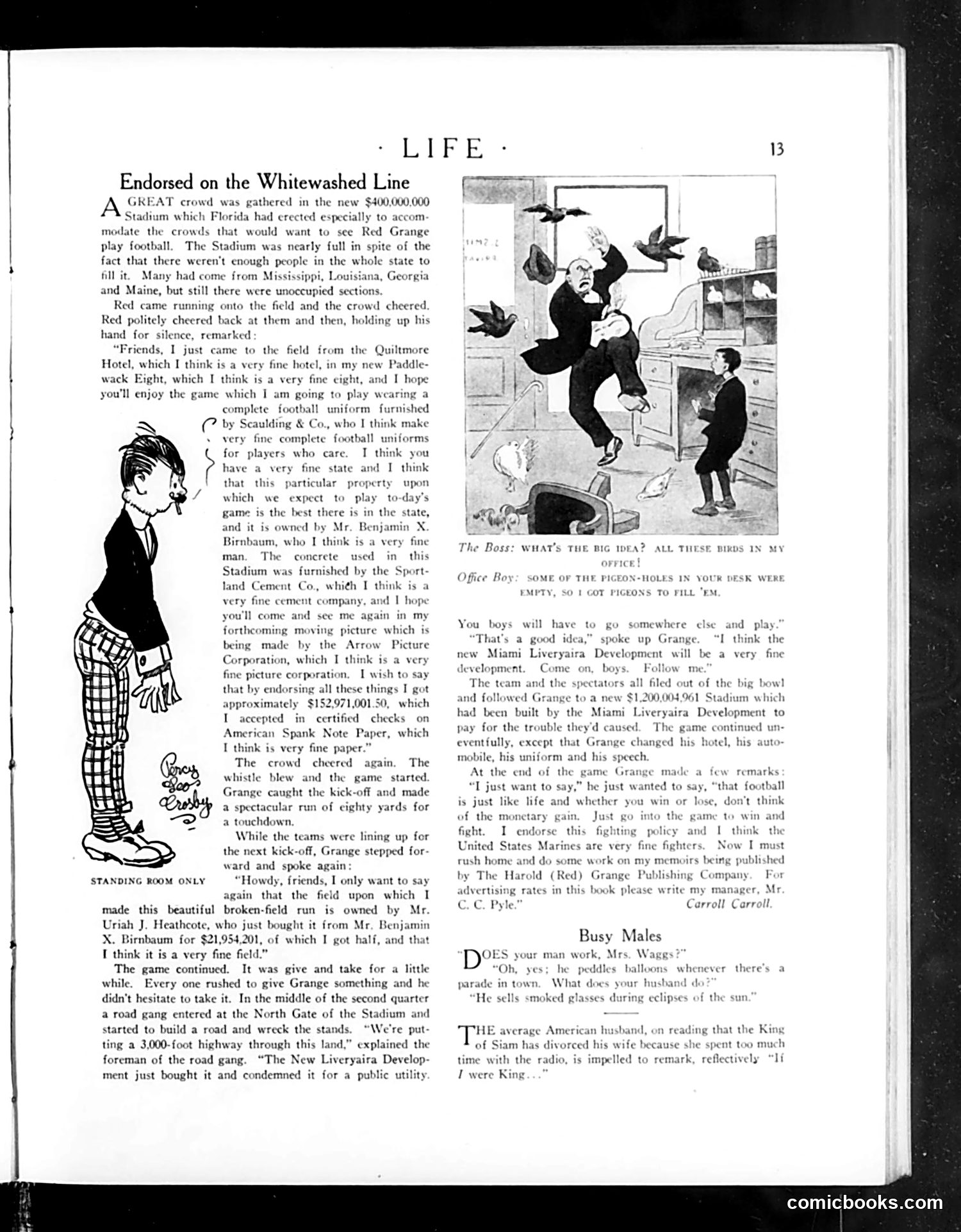
This page contains two distinct pieces: **Main Article/Cartoon (left):** A humorous account of a football game at a new $400,000 stadium in Florida. Red Grange, a famous football player, is the central figure. The text describes the stadium's construction and endorsements by various companies (Scaulding & Co. for uniforms, Sportland Cement Co., Arrow Picture Corporation). The accompanying cartoon shows a young man in football attire labeled "Standing Room Only." **"The Boss" Cartoon (right):** Depicts a chaotic office scene where a boss discovers pigeons have filled desk holes, leading to a situation requiring employees to find elsewhere to play. **"Busy Males" Section (bottom right):** A brief satirical piece about husbands and domestic life, including a quip about the King of Siam divorcing his wife for spending too much time with radio. The page exemplifies 1920s-30s satirical humor targeting commercialism, sports celebrity culture, and gender dynamics.
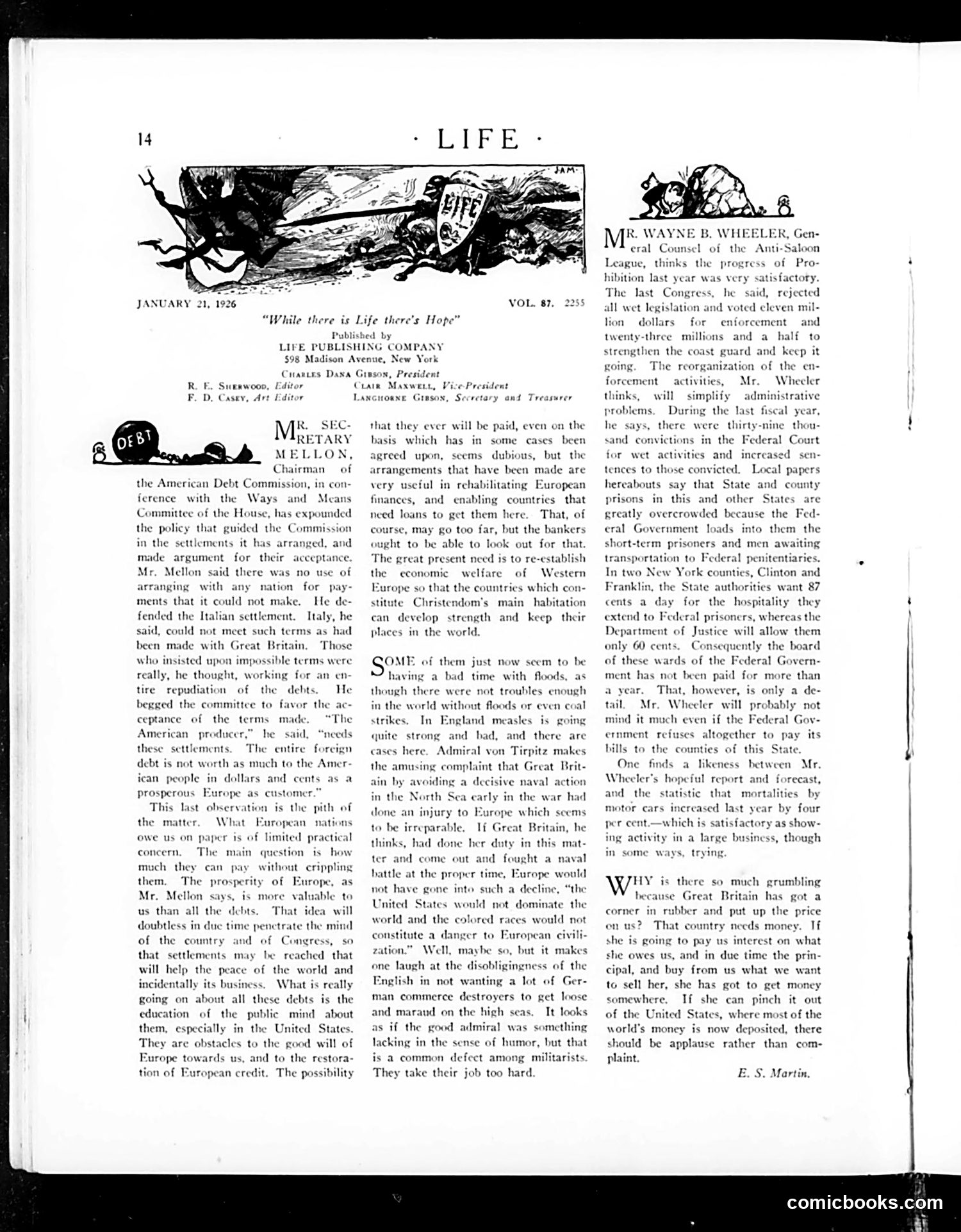
The masthead cartoon depicts a skeletal "DEBT" figure crushing beneath a log labeled "LIFE"—a visual metaphor for how national debt burdens the nation's welfare. The articles discuss European war debt repayment to America and domestic issues. Mr. Secretary Mellon (Treasury Secretary) argues European nations should pay their debts, while Mr. Wheeler counters that enforcement is impractical and damages European recovery. The debate reflects post-WWI tensions: America wanted repayment for loans, but European nations struggled economically. The right-side commentary by E.S. Marin critiques Britain's financial complaints, noting Britain should repay what it owes rather than grumble about interest rates. The satire targets political disagreement over debt policy during the economically turbulent 1920s.
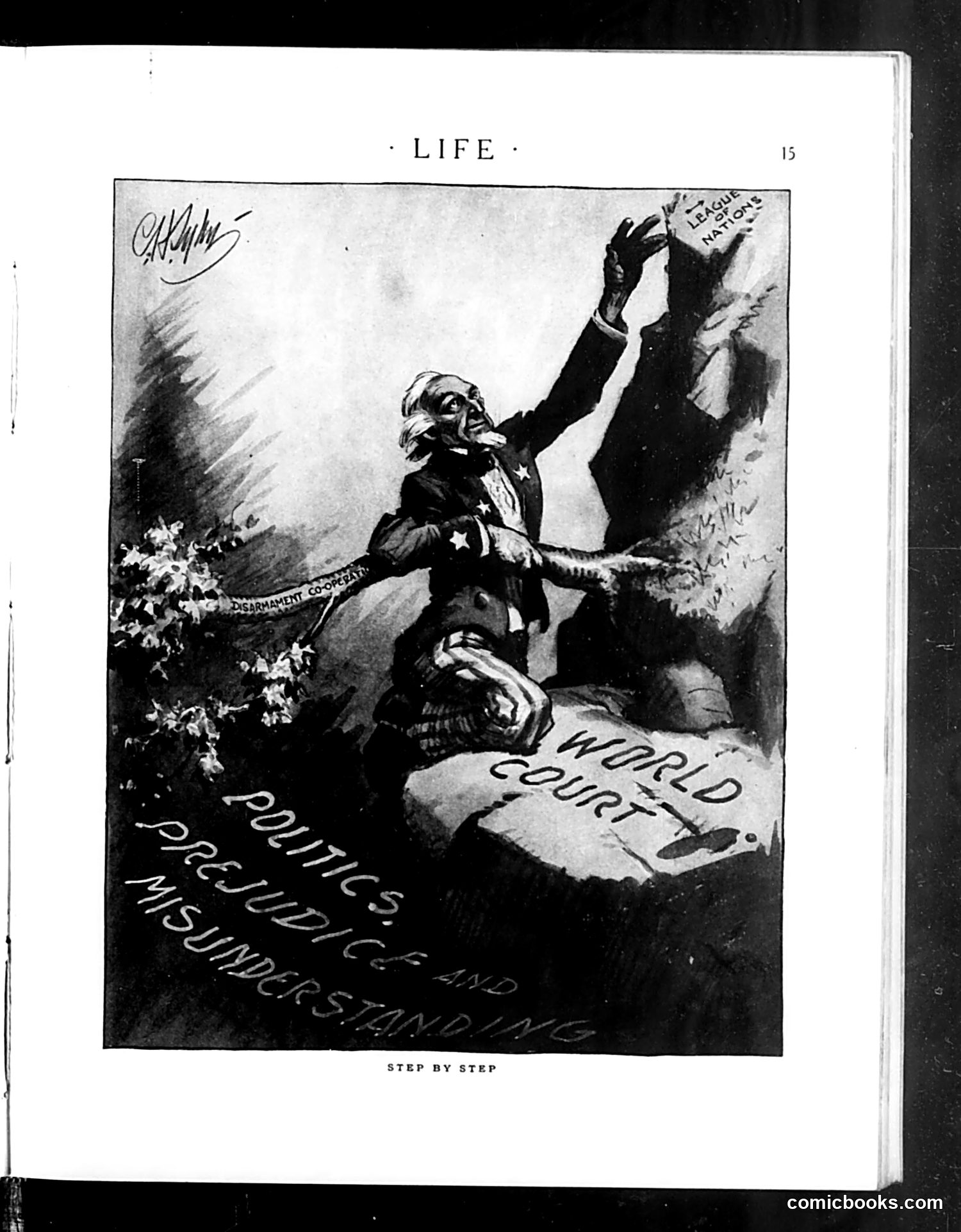
This Life magazine cartoon depicts Uncle Sam (identifiable by his starred jacket and top hat) struggling to climb out of a deep pit labeled "World Court." He's weighed down by a chain marked "Disarmament Conference" and reaching upward toward light labeled "League Membership." The satire critiques American isolationism in the interwar period. Uncle Sam appears trapped by international obligations—specifically disarmament negotiations and League of Nations membership—unable to escape despite his efforts. The cartoon suggests these international commitments are burdensome constraints rather than solutions, reflecting American reluctance to fully engage with post-WWI global governance structures. The title "Step by Step" implies slow, difficult progress toward international involvement.
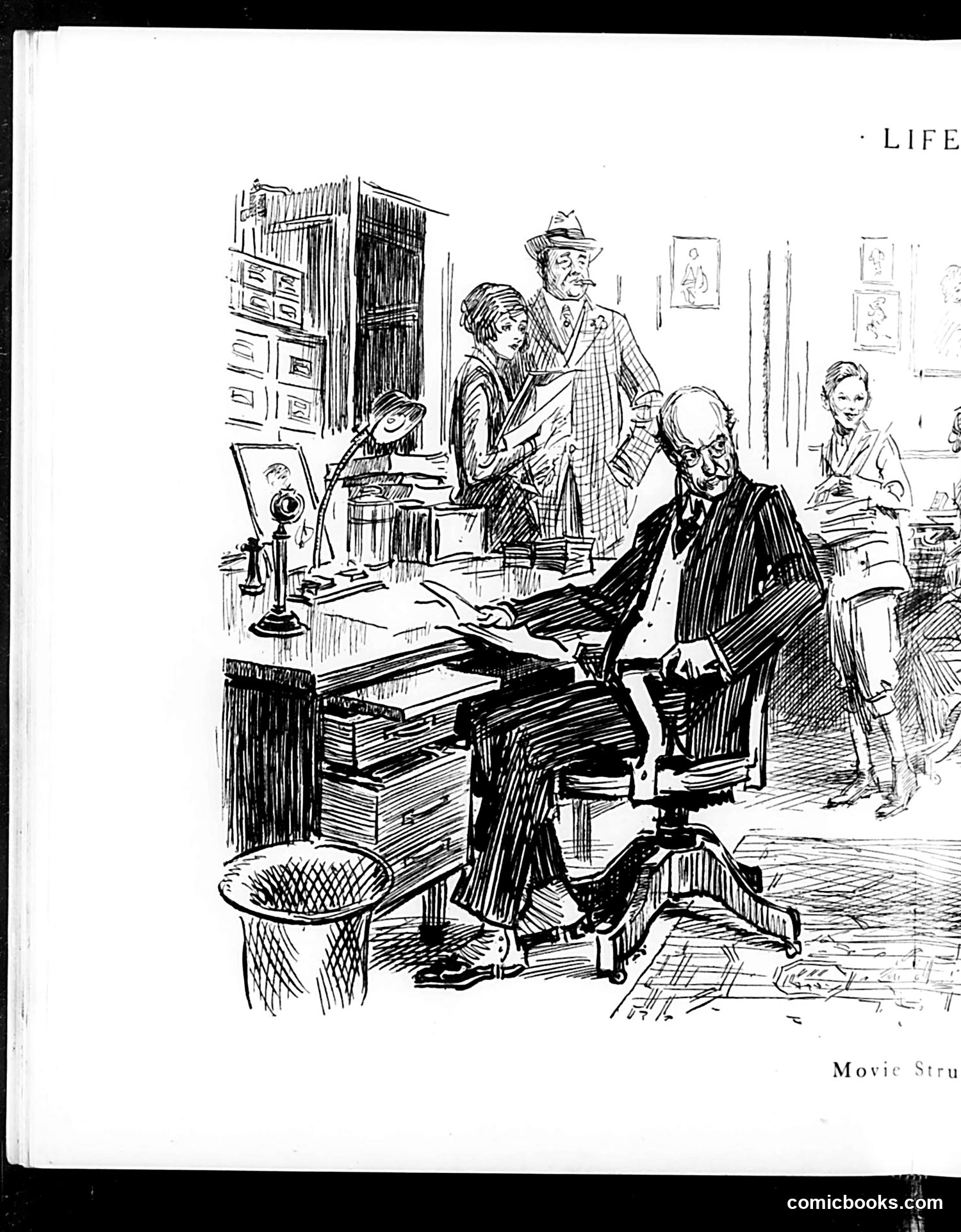
This appears to be a satirical cartoon from *Life* magazine depicting a movie studio office scene. The illustration shows a bald executive seated at a desk reviewing documents, while several staff members stand nearby—including a man in a hat and checkered suit, a woman, and others. A waste basket sits prominently in the foreground. The partial caption reads "Movie Stru[dio]" (likely "Movie Studio Structure" or similar). The satire likely mocks the hierarchical, bureaucratic nature of early Hollywood studios—the executive's dominant central position, the deferential postures of staff members, and the wastepaper basket suggest commentary on inefficiency, waste, or the disposable treatment of creative talent. The specific critique remains unclear without the full caption.
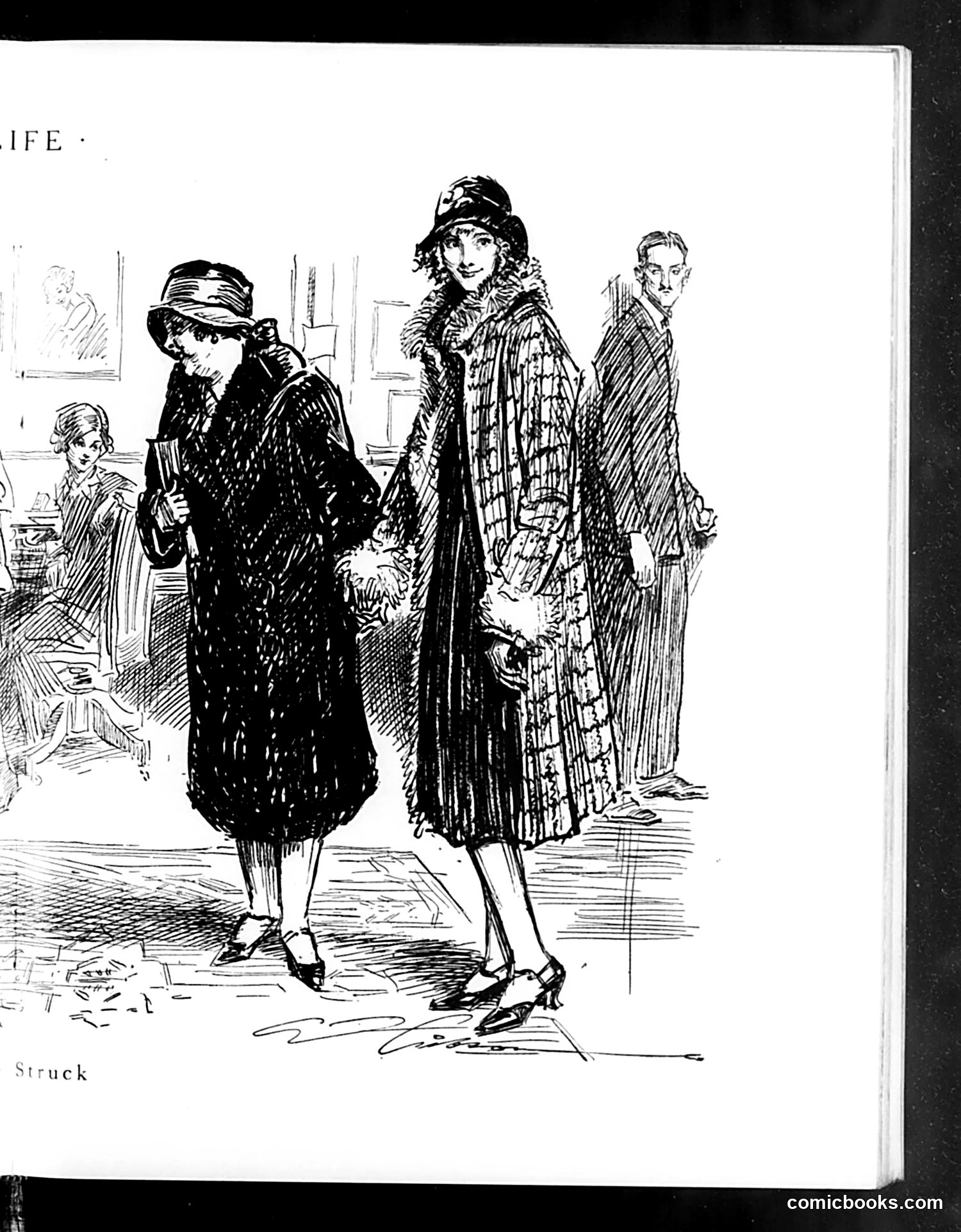
This pen-and-ink illustration titled "Struck" depicts what appears to be fashionable women and men in early 20th-century dress, likely from a department store or public venue. The cartoon satirizes contemporary fashion and social behavior, though the specific satire remains unclear from the limited text provided. The figures display exaggerated period clothing—elaborate coats with fur collars, cloche hats, and formal attire typical of the 1920s. The word "Struck" could reference labor strikes, social upheaval, or perhaps a humorous comment on how fashionable people are "struck" (impressed/affected) by style trends. Without additional context or caption text, the precise social or political commentary cannot be definitively identified. The illustration appears to be a fashion or society-focused satirical drawing rather than explicitly political commentary.
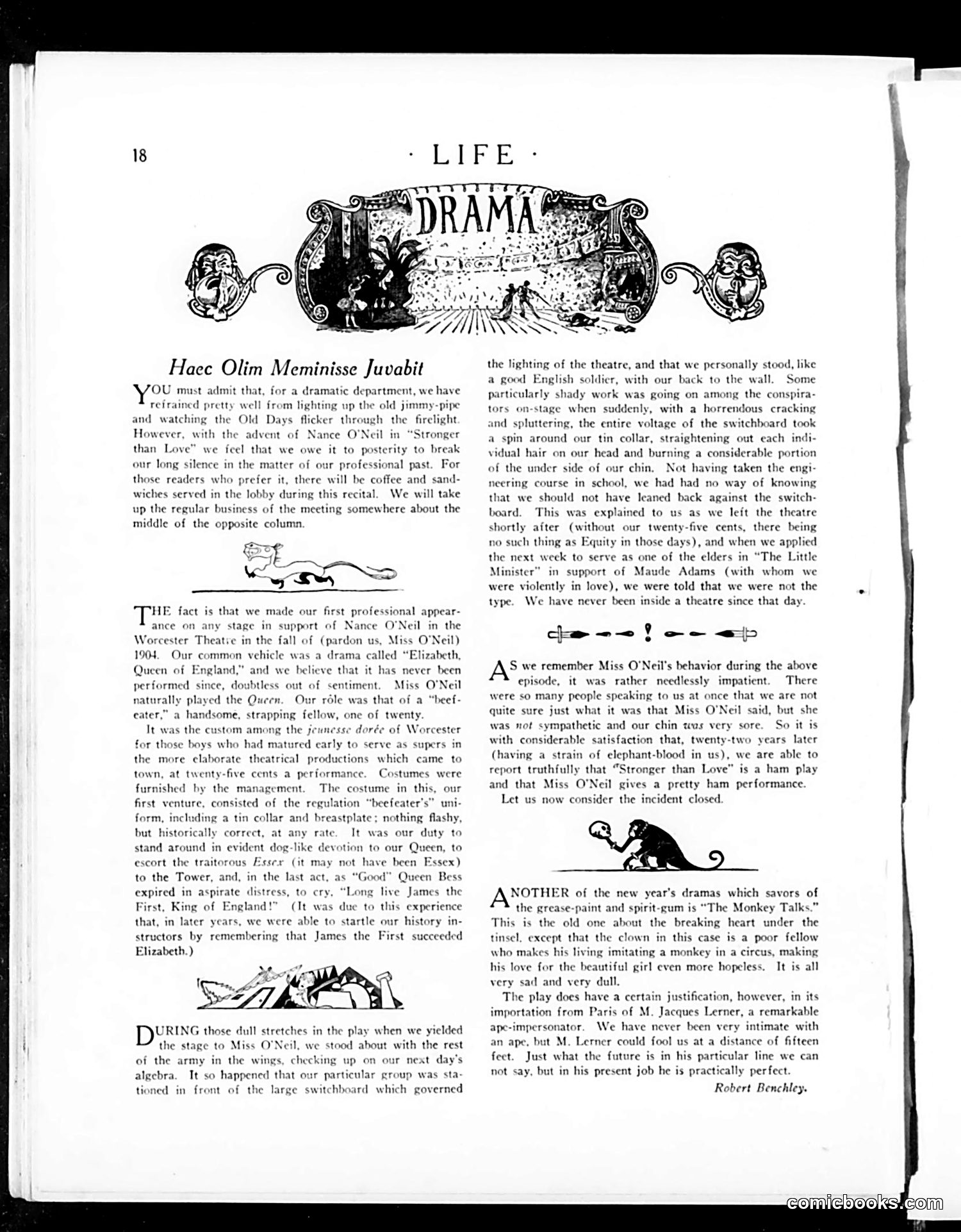
This is a humorous personal essay by Robert Benchley (bylined at bottom) recounting his theatrical career mishap. The piece mocks amateur theater and his own youthful naïveté. **The Setup:** Benchley describes his 1904 debut as a "Beefeater" (guard) in a production of "Elizabeth, Queen of England" starring actress Nance O'Neil at Worcester Theatre. **The Joke:** While standing dutifully near the lighting switchboard, the young Benchley leans against it and receives an electrical shock that burns his chin and singes his hair. He's ejected from the theater without pay (no labor protections existed then—"no such thing as Equity"). **The Satire:** Benchley ridicules both his youthful ignorance and the pretentious theatrical world. The Latin title means "it will be pleasant to remember these things"—a grandiose claim for such a humiliating experience. He never returned to theater after this incident. The ornamental "DRAMA" header and theatrical framing emphasize the mock-serious tone of this self-deprecating anecdote about early 20th-century theater life.
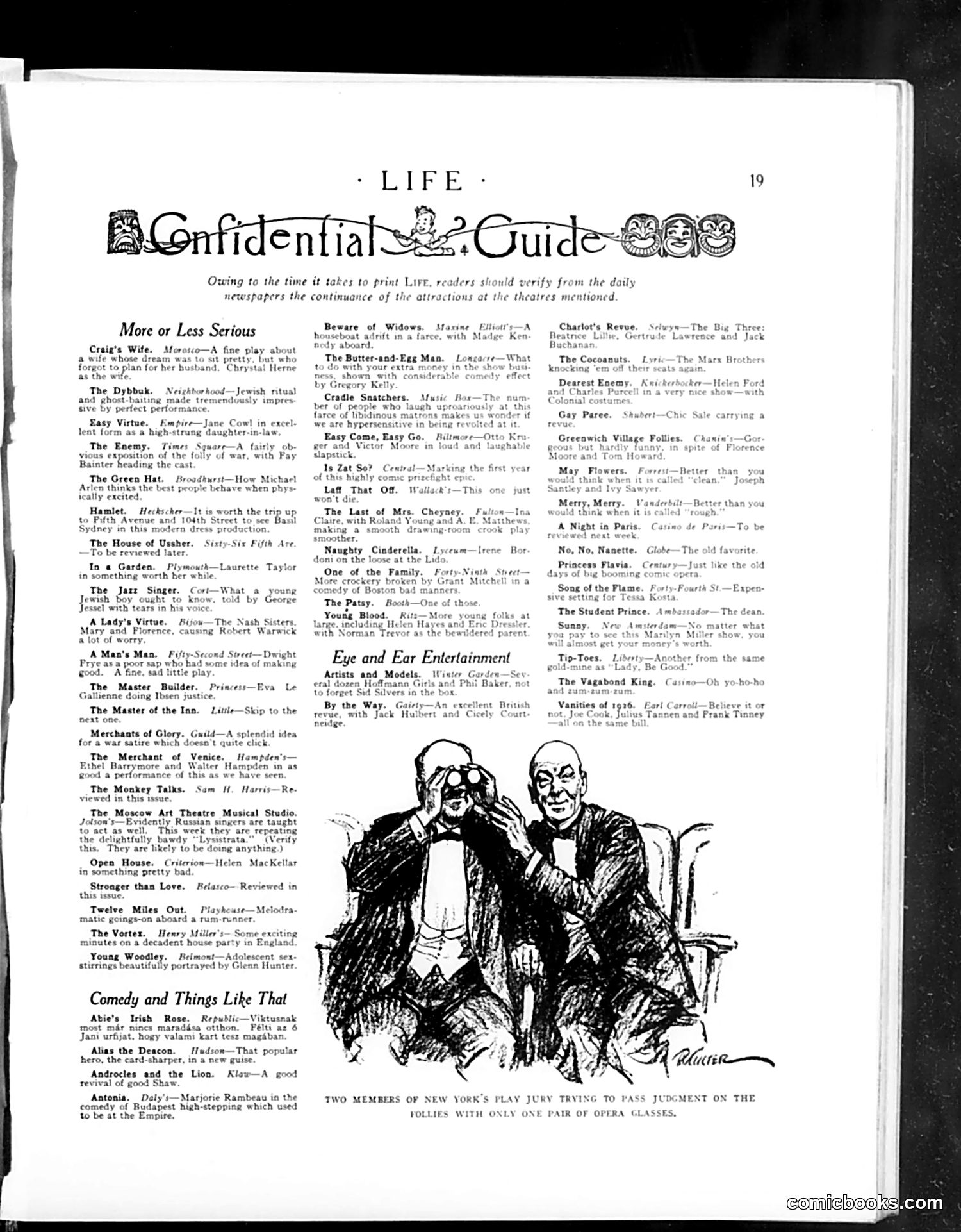
This single-panel cartoon depicts two exaggerated male faces in profile, examining something closely through what appears to be opera glasses or similar viewing devices. The caption reads: "TWO MEMBERS OF NEW YORK'S PLAY JURY TRYING TO PASS JUDGMENT ON THE FOLLIES WITH ONLY ONE PAIR OF OPERA GLASSES." The satire mocks theater critics or jury members evaluating Broadway productions (specifically the "Follies," a famous revue). The joke is that they share a single pair of opera glasses—suggesting either incompetence, laziness, or insufficient resources to properly view and judge the performance. This implies the reviewers cannot adequately see or evaluate what they're critiquing, making their judgments worthless. It's a commentary on the absurdity of theatrical criticism or the unqualified nature of those tasked with judging entertainment.
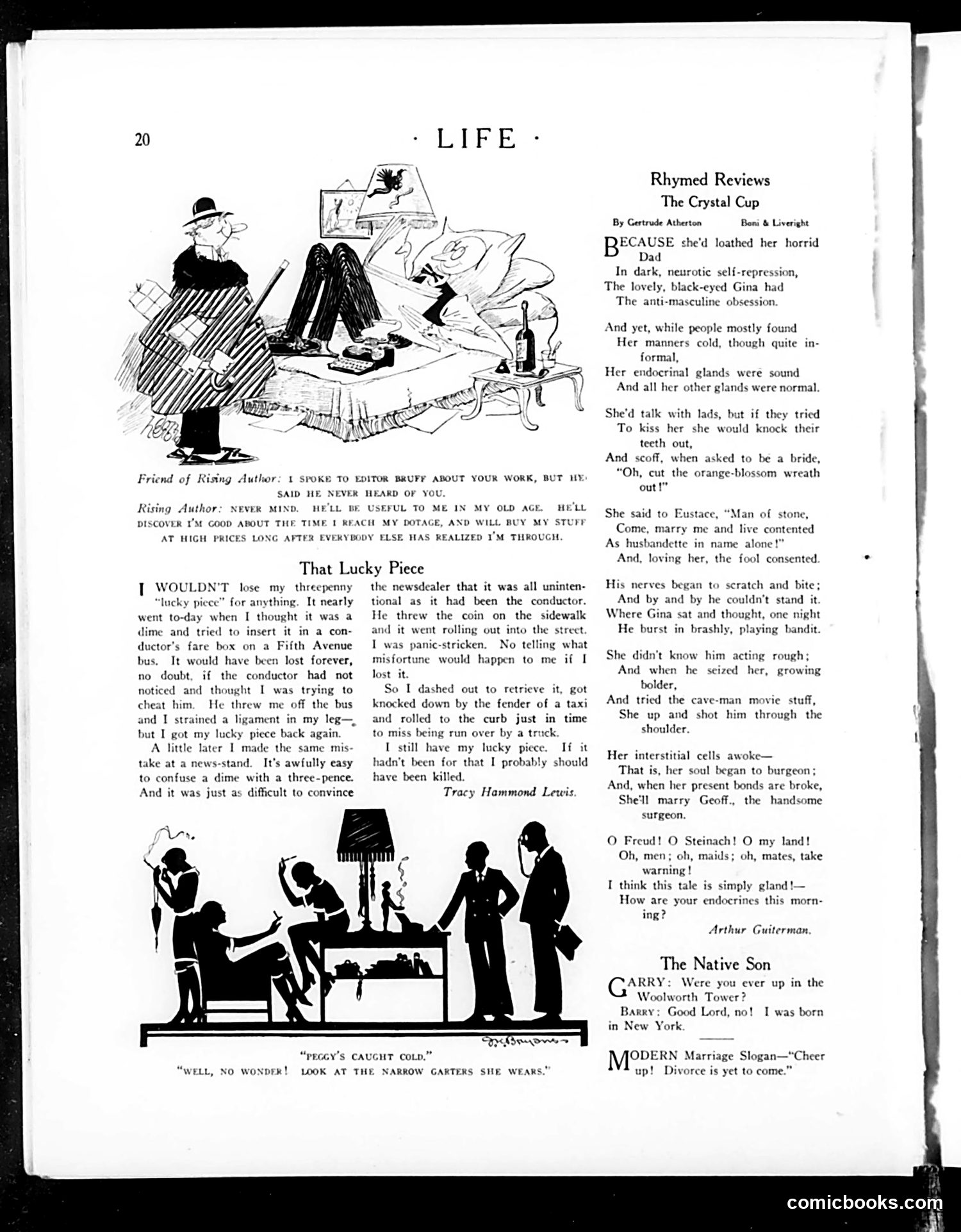
This page contains three satirical pieces typical of 1920s American humor: **"That Lucky Piece"** mocks superstition. A man confuses a British threepenny coin for an American dime, nearly losing it twice—once on a bus, once at a newsstand. Each near-loss results in physical injury (getting thrown off a bus, knocked by a taxi), yet he celebrates keeping his "lucky piece." The satire: the coin brings nothing but misfortune, yet he credits it with saving his life. **"The Crystal Cup"** is a book review in verse, satirizing Freudian psychology's popularity in the 1920s. It mocks a woman whose sexual coldness toward men is attributed to "endocrinal glands" and unresolved father issues—a parody of how pseudo-scientific psychology was applied to explain women's behavior. **"The Native Son"** is a brief joke about geographic ignorance, where "Barry" admits he's never visited the Woolworth Tower despite being a New Yorker—likely mocking Americans' unfamiliarity with their own landmarks. The page emphasizes satirizing contemporary trends: superstition, Freudian fads, and urban provincialism.
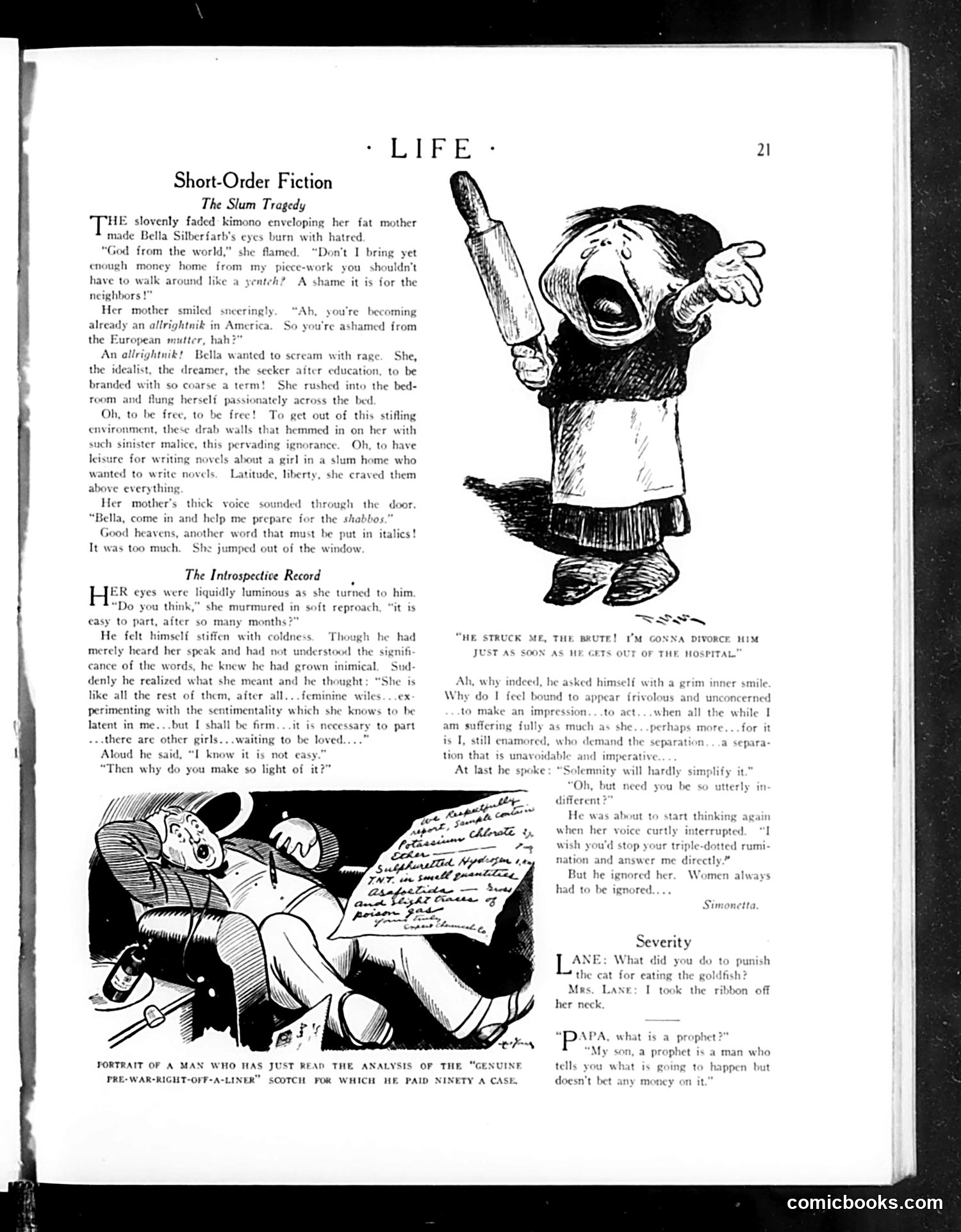
This page satirizes pretentious literary and intellectual affectation among early 20th-century Americans, particularly immigrants and the newly upwardly mobile. **"The Slum Tragedy"** mocks earnest immigrant fiction about social struggle. Bella, a Jewish girl from a tenement (evidenced by Yiddish words like "yenteh" and "shabbos"), wants to escape poverty to write novels—ironically, about girls like herself wanting to write novels. The satire targets the self-serious melodrama and clichéd themes of contemporary "problem fiction." **"The Introspective Record"** parodies overwrought psychological realism and stream-of-consciousness narratives, where characters endlessly analyze their emotions through interior monologue rather than act. **The lower cartoon** ridicules men who pretend expertise in expensive goods (a "$90 case" of scotch) and then read analytical articles claiming authenticity—the "pre-war-right-off-a-liner" reference suggests fake sophistication about whisky origins. The page collectively mocks the pretentiousness of both immigrant aspiration and pseudo-intellectual culture among those seeking respectability through affected literary taste.
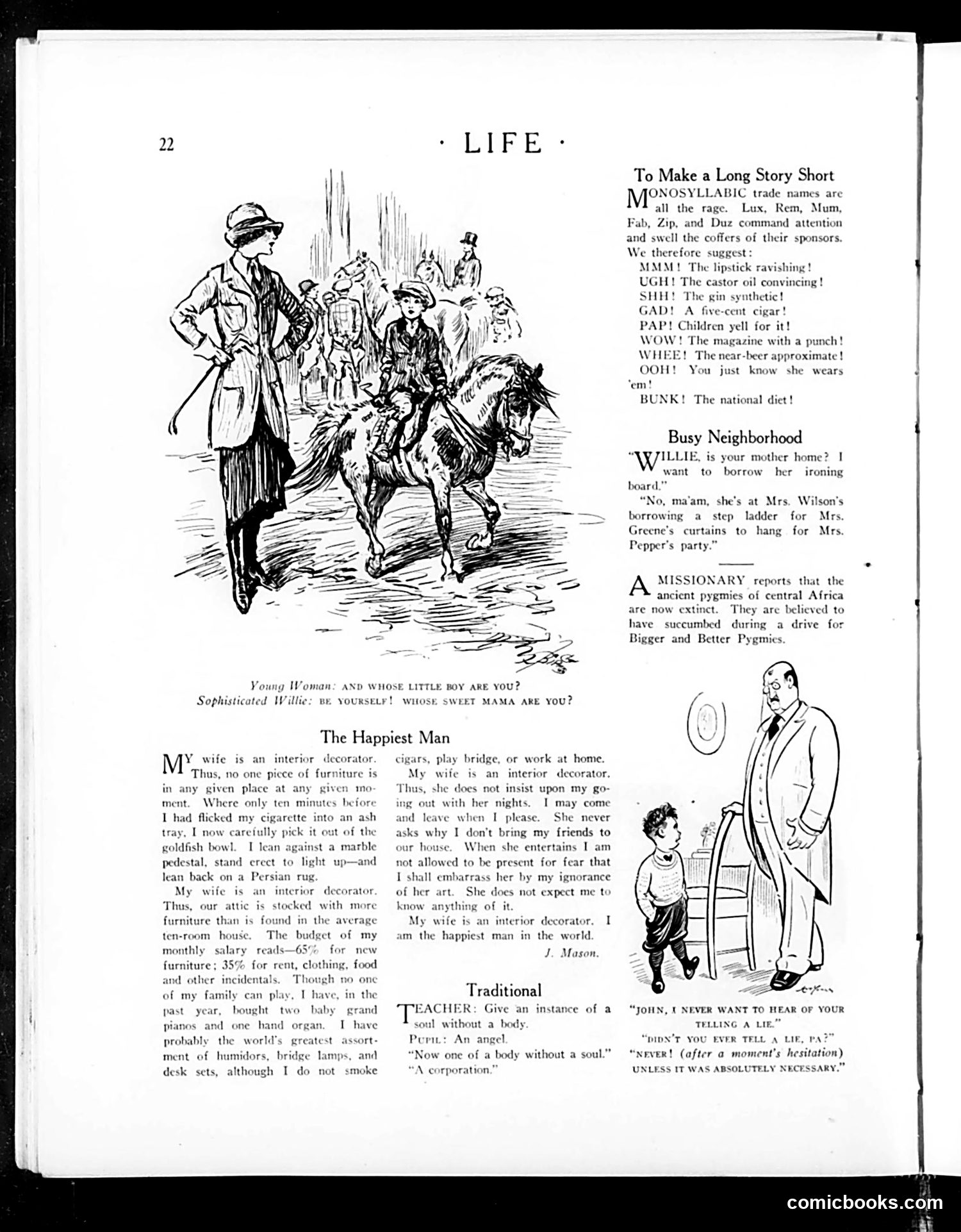
This page contains several satirical pieces targeting 1920s American consumer culture and social pretension: **"The Happiest Man"** mocks wives obsessed with interior decoration—a newly fashionable pursuit. The narrator claims happiness because his decorator wife demands nothing of him: he needn't entertain friends (she's embarrassed by his ignorance) or accompany her socially. The satire exposes how consumerism and status-seeking paradoxically isolate spouses, while the man's contentment reveals shallow self-interest. **"To Make a Long Story Short"** parodies the advertising trend of one-syllable brand names (Lux, Duz, Zip), mocking corporate marketing's cheapness and consumers' gullibility. **"Busy Neighborhood"** jokes about mothers constantly borrowing from each other—suggesting women's lives revolve around domestic labor and social obligations. **"Traditional"** is a mild joke about corporations having no soul, presented as dialogue between teacher and pupil. The overall tone satirizes American materialism, particularly how consumer goods and status symbols fragment family life and authentic human connection during the prosperous 1920s.
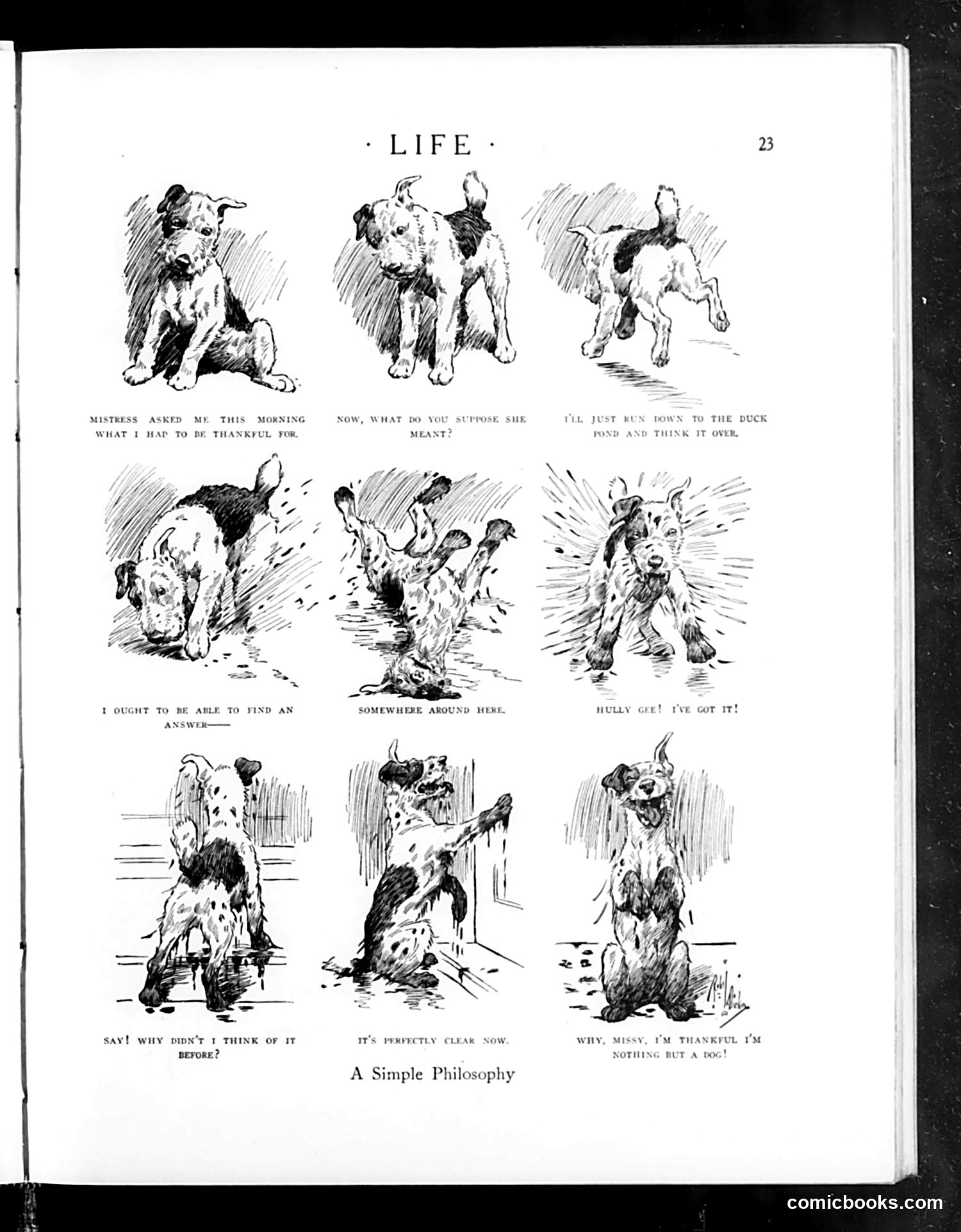
This is a nine-panel comic strip about a dog's practical approach to gratitude. The narrative follows a dog who is asked by his mistress what he's thankful for. Struggling initially ("I ought to be able to find an answer"), he eventually arrives at a simple conclusion: he's thankful to be "nothing but a dog." The humor relies on the dog's realization that being a dog—with uncomplicated needs and pleasures (running, fetching, playing in water)—is inherently satisfying. The title "A Simple Philosophy" suggests the satire is gently mocking human complexity and ingratitude by contrast. The dog requires no material wealth, social status, or philosophical sophistication to find contentment; he simply embraces his nature. This reflects early 20th-century sentimental humor about animals as models of simple happiness, contrasting with human anxieties and pretensions.
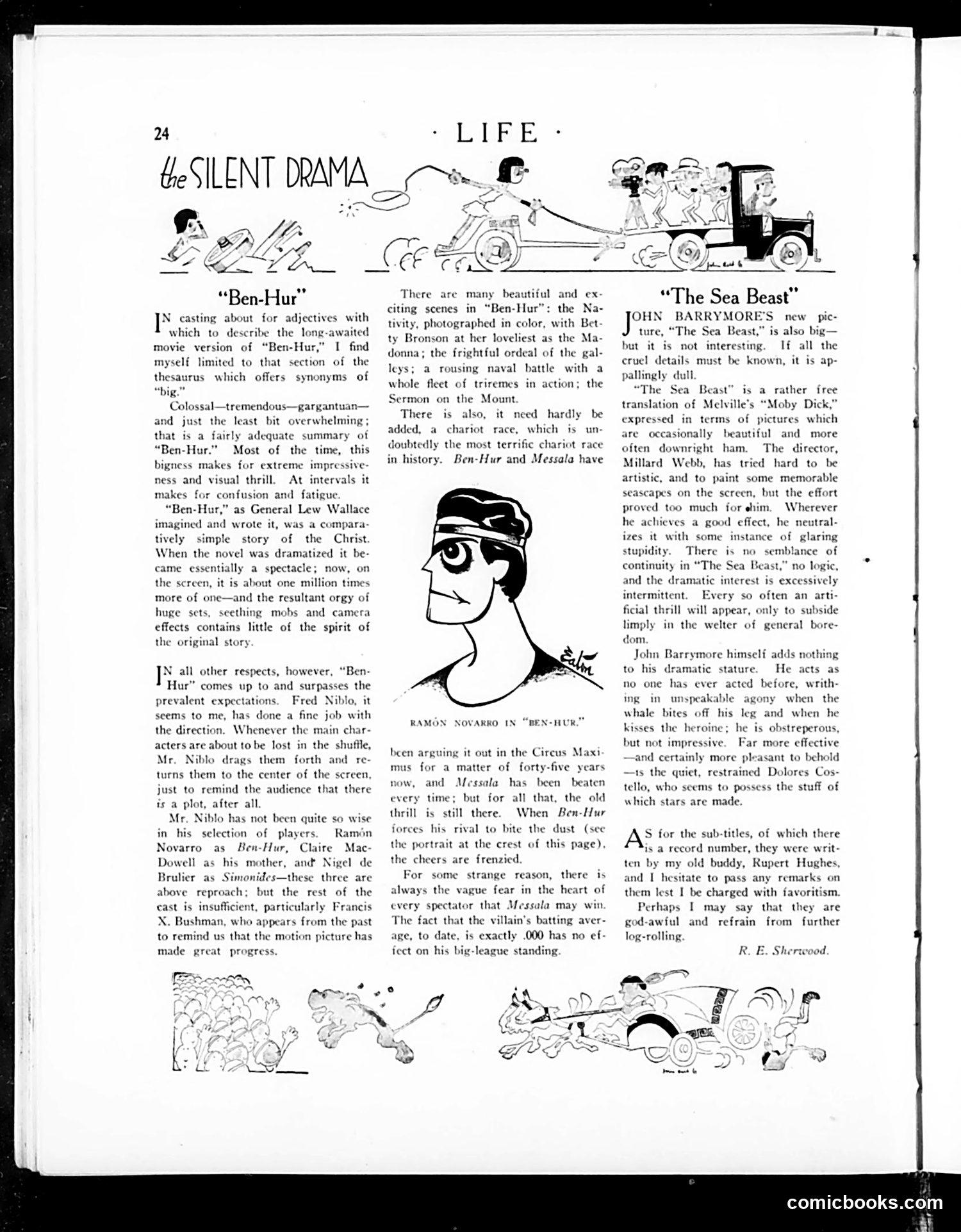
This page reviews two major silent films: *Ben-Hur* and *The Sea Beast*. **Ben-Hur** receives praise despite its massive scale. The reviewer notes the film's enormous spectacle—colossal sets, crowd scenes, and technical effects—which sometimes overwhelms the original story's spiritual essence. Director Fred Niblo is credited with maintaining focus on the plot. The cast is mostly praised (Ramon Novarro, Claire MacDowell), though Francis X. Bushman is criticized as dated. The chariot race between Ben-Hur and Messala is highlighted as thrilling, with a baseball metaphor joking that Messala's "batting average" remains .000 despite repeated losses. **The Sea Beast**, John Barrymore's adaptation of *Moby Dick*, receives harsh criticism. The reviewer calls it "appallingly dull" despite occasional beautiful seascapes. Director Millard Webb's attempts at artistry are undermined by "glaring stupidity" and lack of continuity. Barrymore's overwrought acting—"wrything" dramatically when the whale attacks—is mocked as excessive and unconvincing.
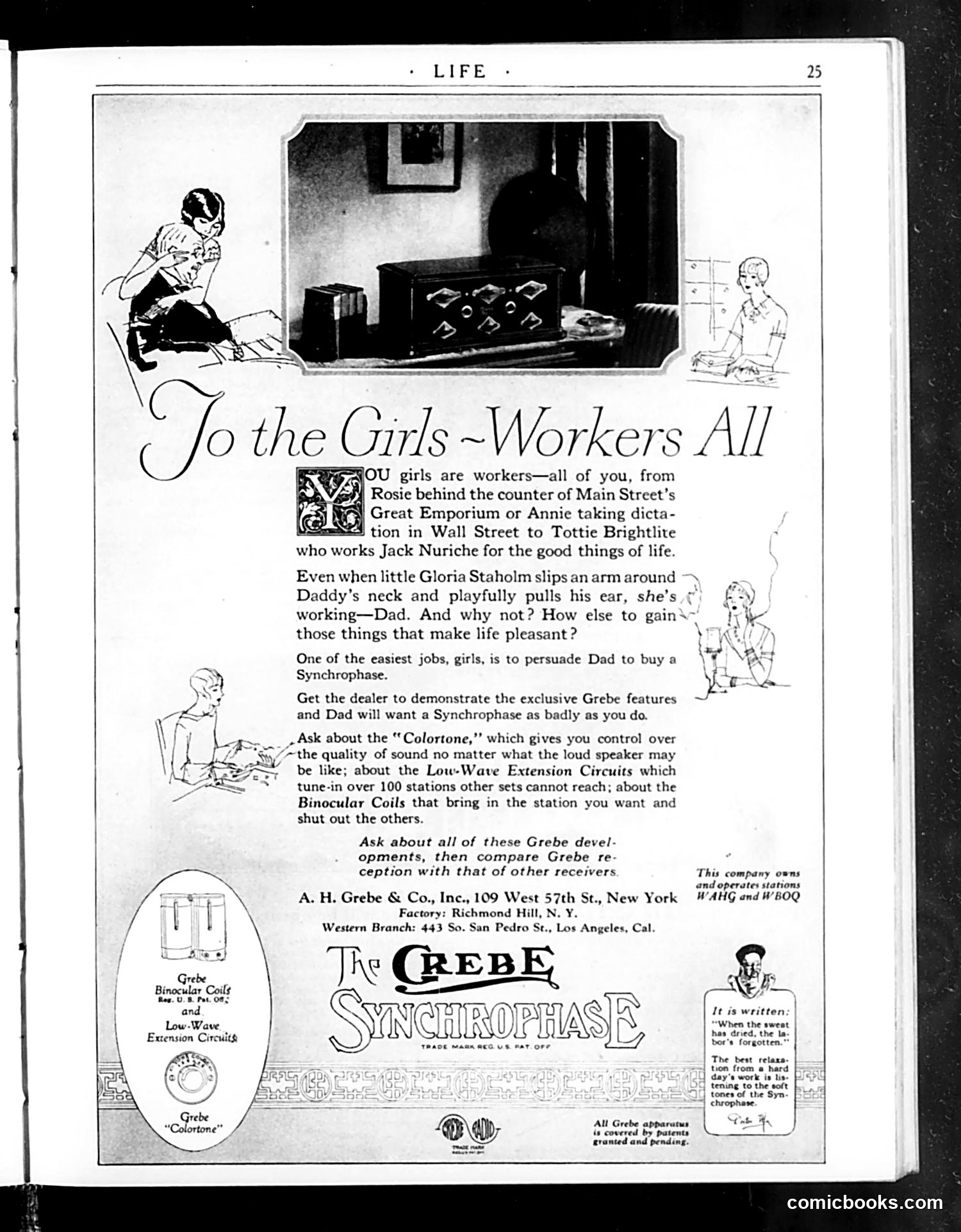
This is primarily a **radio receiver advertisement** disguised as satirical social commentary, appearing in *Life* magazine (likely 1920s, based on the Synchrophase radio model). The "satire" targets young women by redefining all their activities—from retail work to flirtation—as "work" designed to manipulate fathers into buying consumer goods. It names specific female archetypes: "Rosie" (shopgirl), "Annie" (secretary), "Tottie Brightlite" (social climber), and "little Gloria Staholm" (daddy's girl). The joke is that even innocent affection becomes instrumentalized—Gloria playfully pulling her father's ear is "working" him. The advertisement then explicitly instructs girls to use these manipulation tactics to persuade fathers to purchase the Grebe Synchrophase radio, touting its technical superiority (Colortone, Low-Wave Extension Circuits, Binocular Coils). Rather than genuine satire, this is **manipulative advertising** using humor to suggest that consumer persuasion is women's "natural work," reducing female agency to salesmanship for their fathers' benefit.
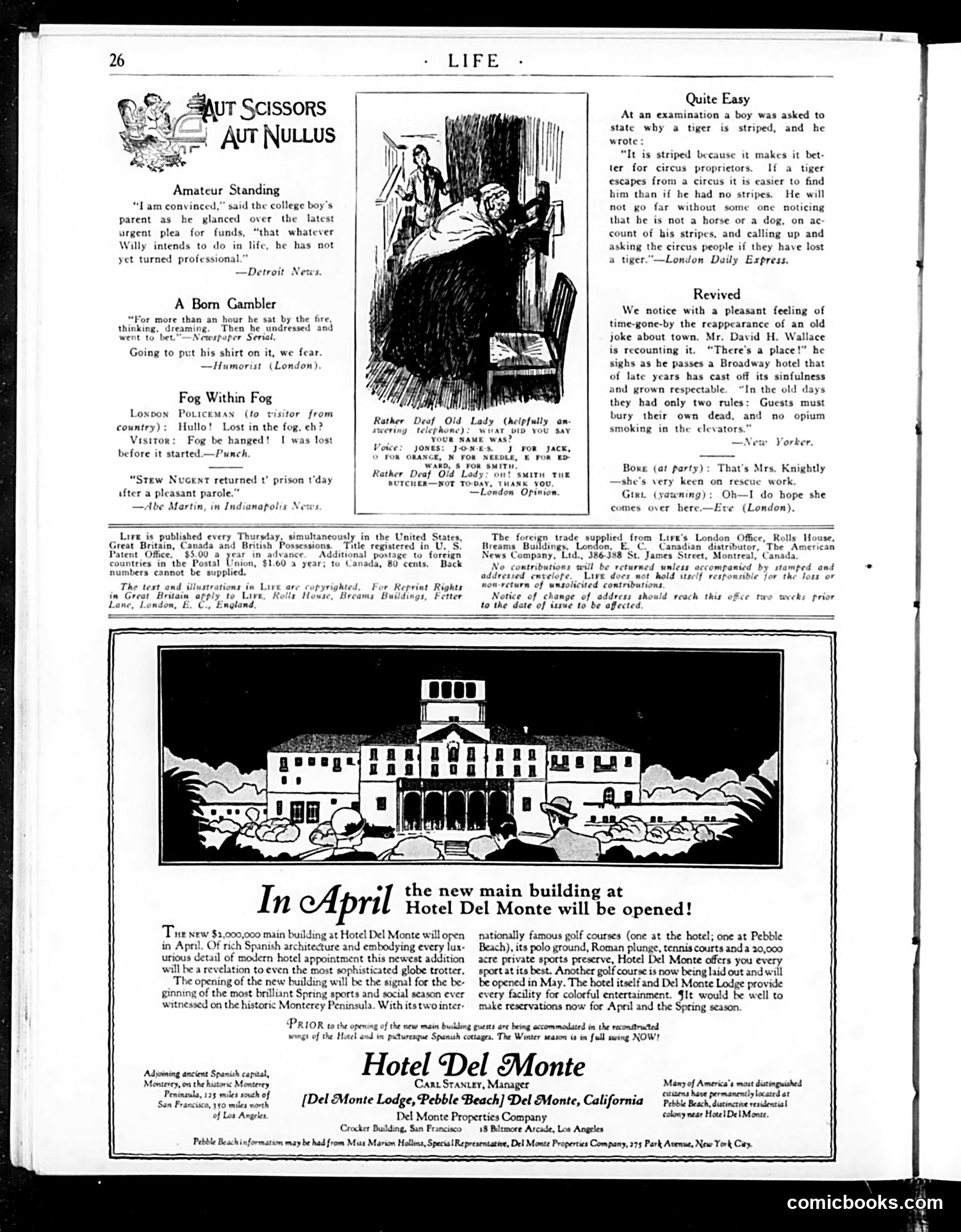
This page contains several short humorous anecdotes ("Aut Scissors Aut Nullus") typical of Life's satirical format, followed by a large Hotel Del Monte advertisement. The cartoons mock everyday absurdities: a boy's flawed logic about tiger stripes (confusing appearance with camouflage), a college patron's skepticism about his son's professional prospects, and a London policeman lost in fog despite claiming to guide a visitor through it. The "Revived" section notes the reappearance of an old joke about a now-respectable Broadway hotel that once had only two rules: guests must bury their own dead and no opium in elevators—satirizing the hotel's former disreputability. These are gentle, universal jokes requiring no specific historical knowledge beyond understanding early-20th-century urban life and hotel culture. The bulk of the page is advertising for Hotel Del Monte in California, promoting its Spanish architecture, golf courses, and recreational facilities opening in April.
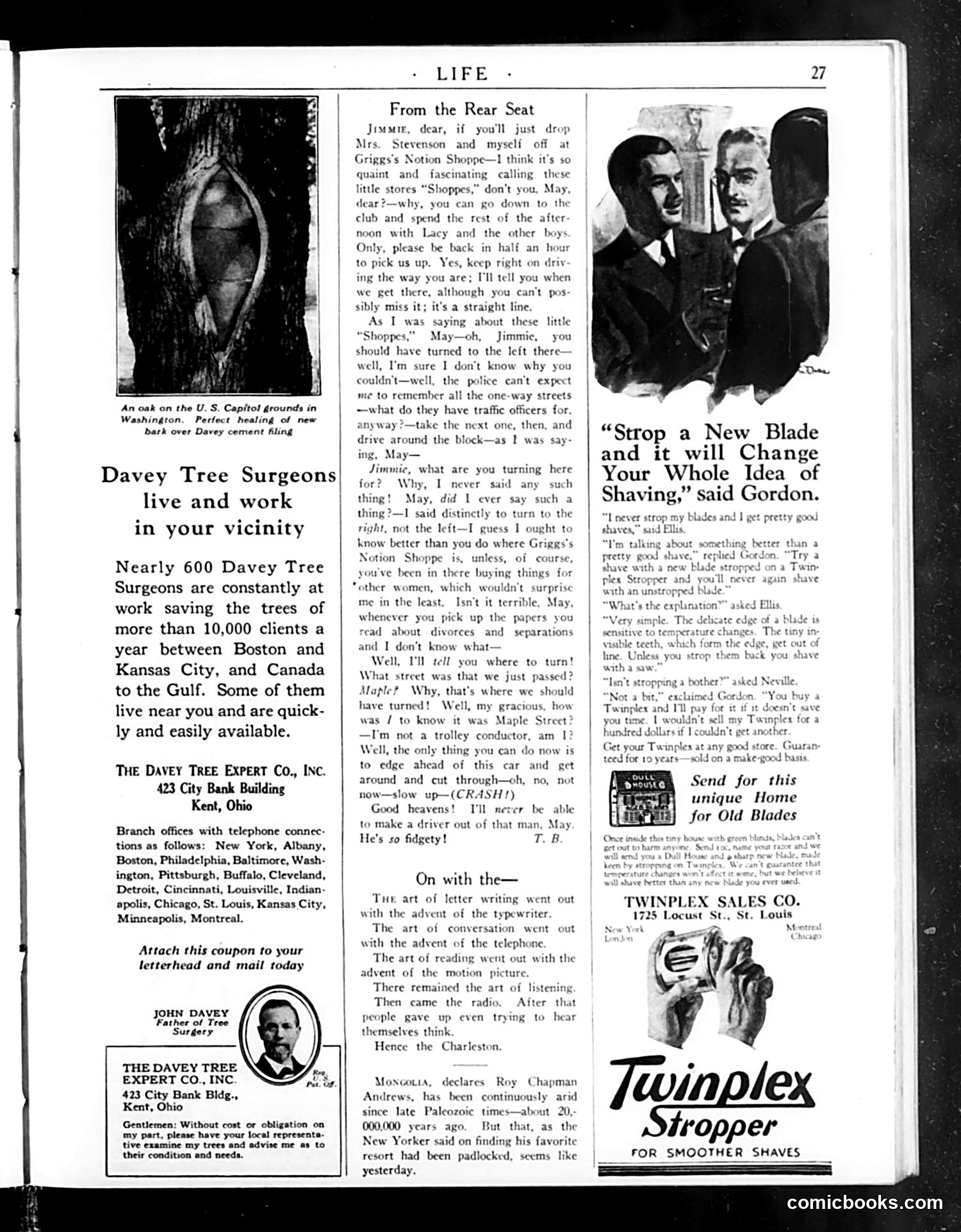
This page is primarily **advertisements** with one satirical piece. The main content is "From the Rear Seat," a satirical column mocking backseat drivers—specifically nagging wives. The piece depicts a woman (identified as "May" in dialogue) constantly criticizing her husband's driving with contradictory instructions ("turn left"/"turn right"), snide comments about his fidelity, and complaints about modern life (one-way streets, divorce scandals in newspapers). The humor culminates in a crash ("CRASH!"), after which she blames him for being "fidgety." The satire targets the stereotype of the overbearing, gossipy wife whose endless complaints and impossible demands drive her husband to distraction—a common trope in 1920s-30s humor. The column ends with a non-sequitur joke about how the loss of conversation arts led to the Charleston dance craze. The page also includes advertisements for tree surgery services and razor blade products, typical of Life magazine's mixed editorial-advertising format.
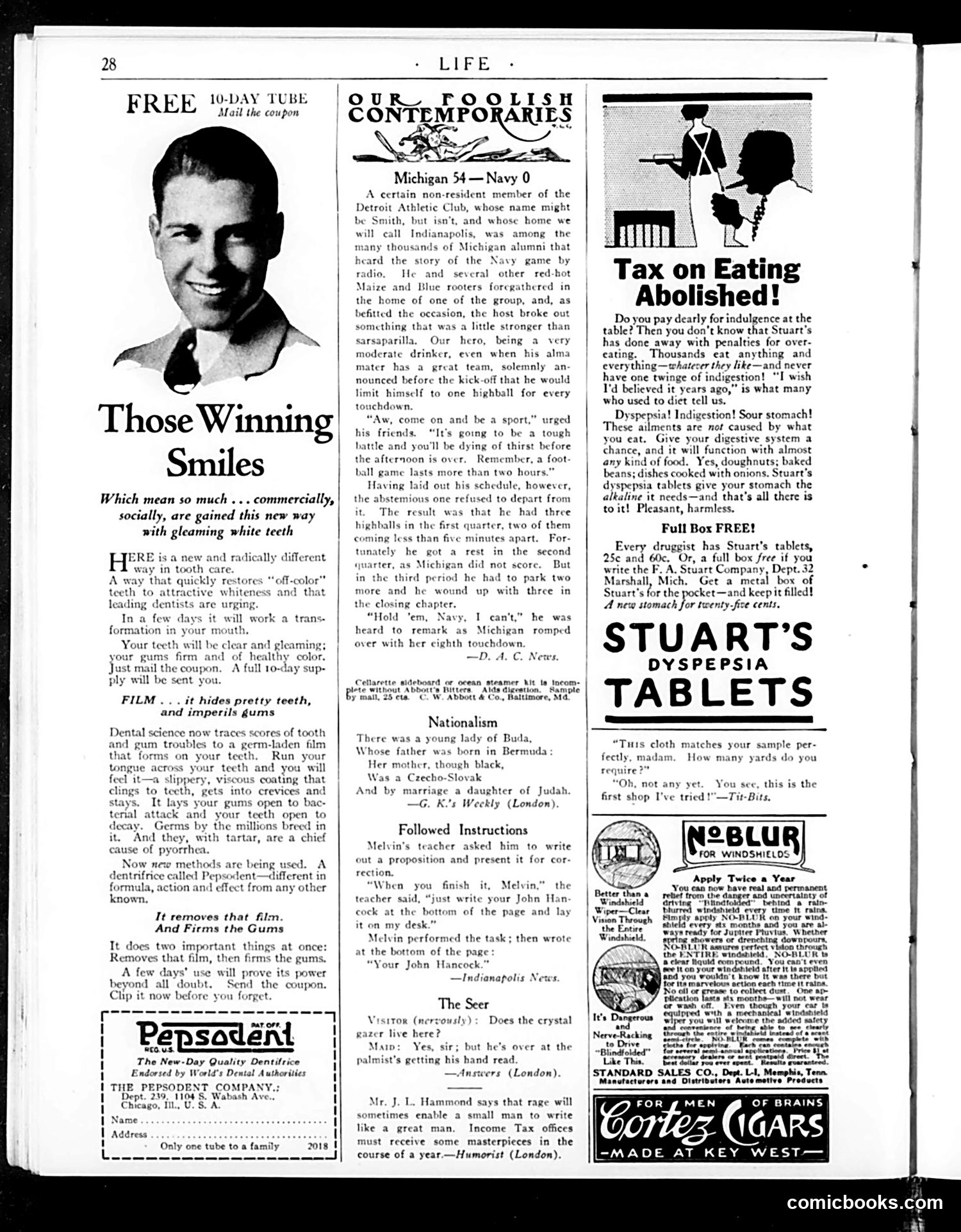
This page is primarily **advertising**, dominated by a large Pepsodent toothpaste advertisement featuring a smiling man and copy promising whitened teeth and healthier gums. The ad claims their product removes a "film" that causes dental problems—using then-current germ-theory marketing common in 1920s dentistry ads. The non-advertising content consists of brief humorous items: 1. **"Michigan 54—Navy 0"**: A satirical anecdote about an abstemious Michigan alumnus who pledges to limit himself to one highball per touchdown at a house party during the football game broadcast. His friends pressure him to drink more, and he ends up consuming three highballs as Michigan scores eight touchdowns. 2. **"Nationalism"**: A light verse joke about a cosmopolitan woman's mixed heritage (Bermuda, black, Czech-Slovak, Jewish). 3. **"Followed Instructions"** and **"The Seer"**: Mild comedic anecdotes about literal interpretation and fortune-telling. These items appear typical of Life magazine's satirical humor section—gentle, domestic comedy rather than political satire.
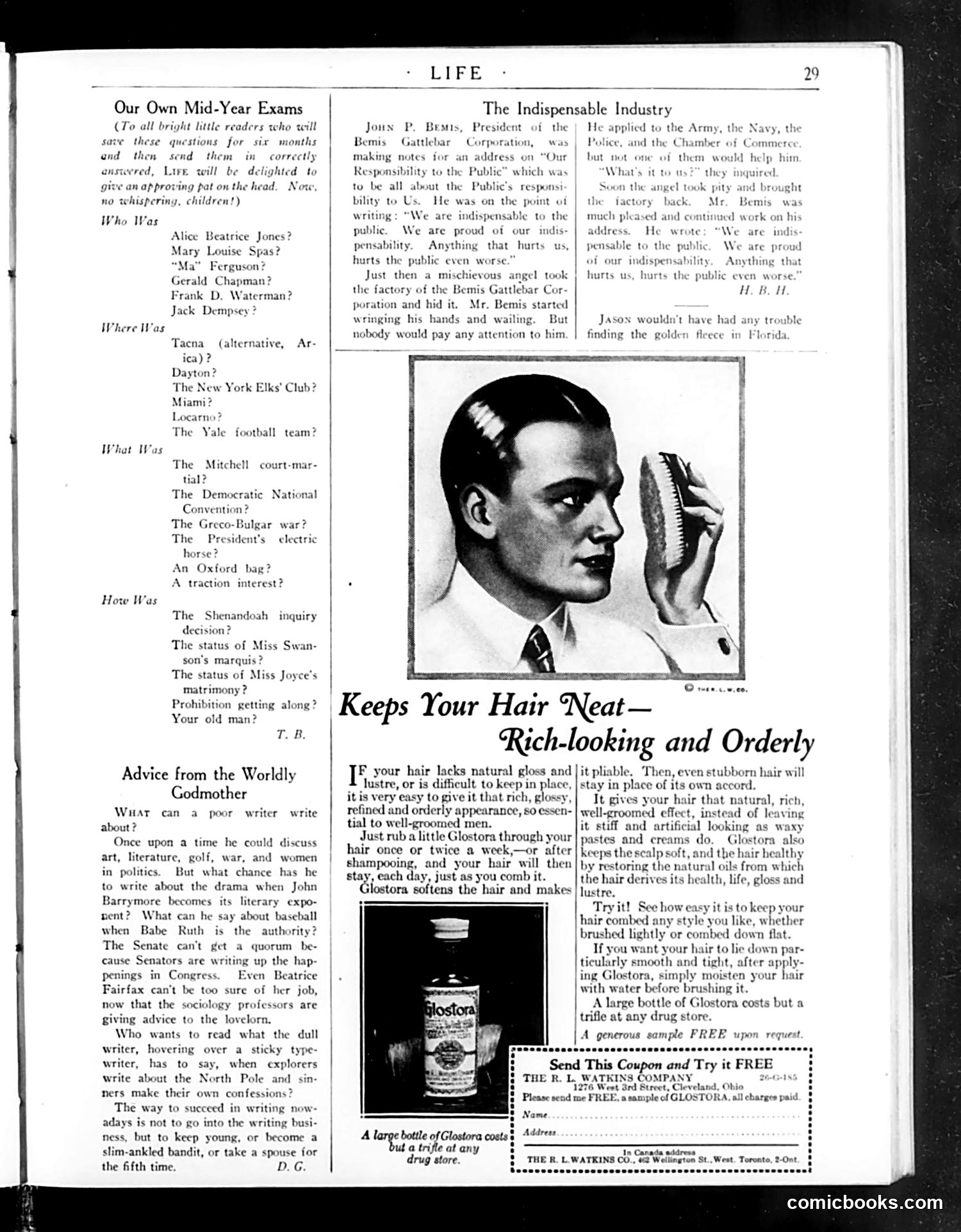
This page comprises three distinct sections: **"Our Own Mid-Year Exams"** presents a trivia quiz for readers about contemporary 1920s figures and events—celebrities like Jack Dempsey (boxer) and Babe Ruth, political figures like "Ma" Ferguson, and current events (the Greco-Bulgarian war, Prohibition). The satire mocks the era's obsession with celebrity gossip and headline trivia. **"Advice from the Worldly Godmother"** satirizes how celebrities and public figures have monopolized expertise across all fields. The piece complains that writers can no longer comment on drama (Barrymore dominates), baseball (Ruth dominates), or advice columns, because famous personalities now control discourse in every domain. The joke: ordinary people are being displaced by celebrity commentary. **The remaining content is advertising** for Glostora hair product, featuring a man grooming himself and a coupon offer. This is unrelated to the satirical content above. The page's humor reflects 1920s anxieties about celebrity culture's expanding influence over public discourse.
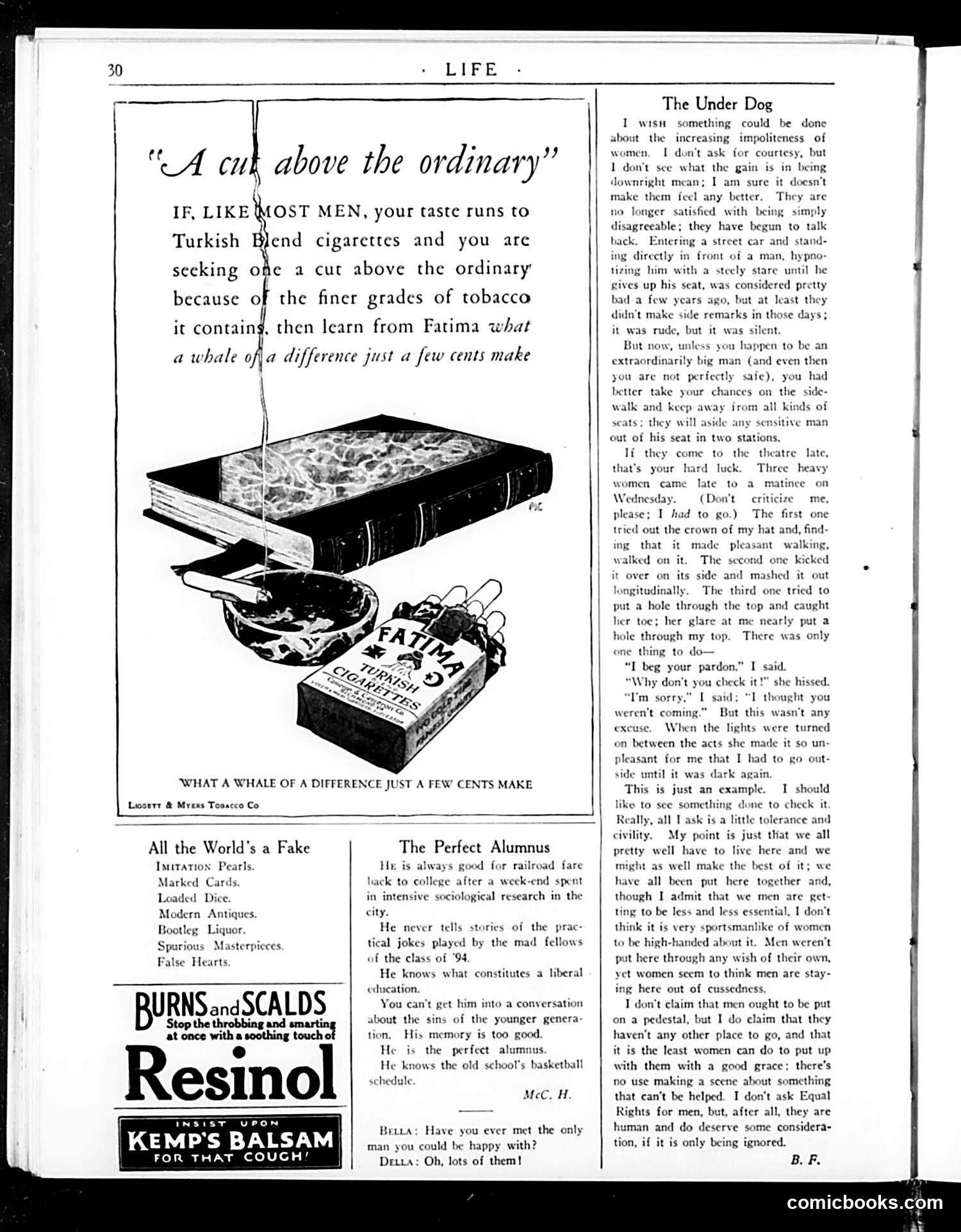
This page combines advertising with satirical social commentary typical of early 20th-century *Life* magazine. **The Main Cartoon** (top left) advertises Fatima Turkish cigarettes, using a visual pun: a whale emerging from a tobacco box, illustrating the slogan "a whale of a difference just a few cents make." It's straightforward product advertising. **Social Commentary** dominates the right side. "The Under Dog" complains about women's increasing rudeness in public spaces—particularly on streetcars and at theaters. The author describes women blocking seats, stepping on hats, and making hostile remarks, contrasting this with past "silent" rudeness. He argues women should tolerate men's presence with "good grace" since men didn't choose to exist. **Context**: This reflects tension over women's changing social roles, possibly post-suffrage. The complaint about women's assertiveness reveals anxiety about shifting gender dynamics. The author frames male passivity as involuntary while expecting female accommodation—a distinctly period perspective on gender relations. The page also includes miscellaneous satirical items ("All the World's a Fake") and patent medicine ads typical of *Life*'s mixed content.
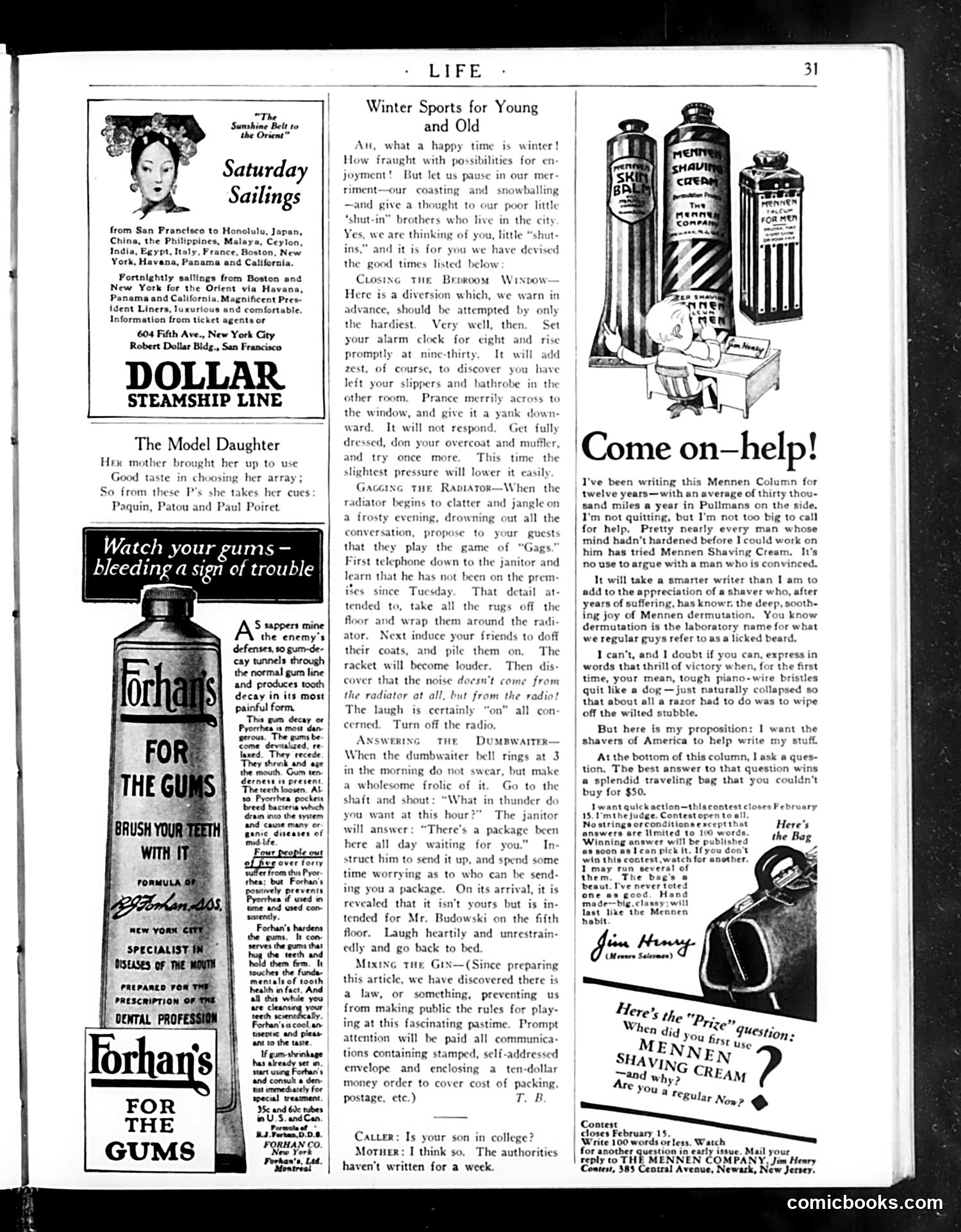
This page contains mostly **advertising and humor columns**, not political cartoons. The main content is "Winter Sports for Young and Old," a satirical piece mocking city dwellers trapped indoors. It describes absurd "entertainments" for "shut-in" children: struggling with frozen windows, dealing with noisy radiators, playing pranks with dumbwaiters, and receiving misdirected packages. The humor lies in the contrast between romanticized "winter sports" and the tedious, frustrating realities of urban apartment living—stuck indoors fighting malfunctioning heating and plumbing. The advertisements promote luxury steamships, high fashion (Paquin, Patou, Poiret), and **Forhan's toothpaste**, which claims to prevent pyorrhea (gum disease). The toothpaste ad uses fear-based marketing typical of the 1920s-30s, treating a dental condition as a serious health threat requiring immediate treatment. The page reflects period concerns: class aspirations (luxury travel, designer fashion), dental anxiety, and urban living frustrations.
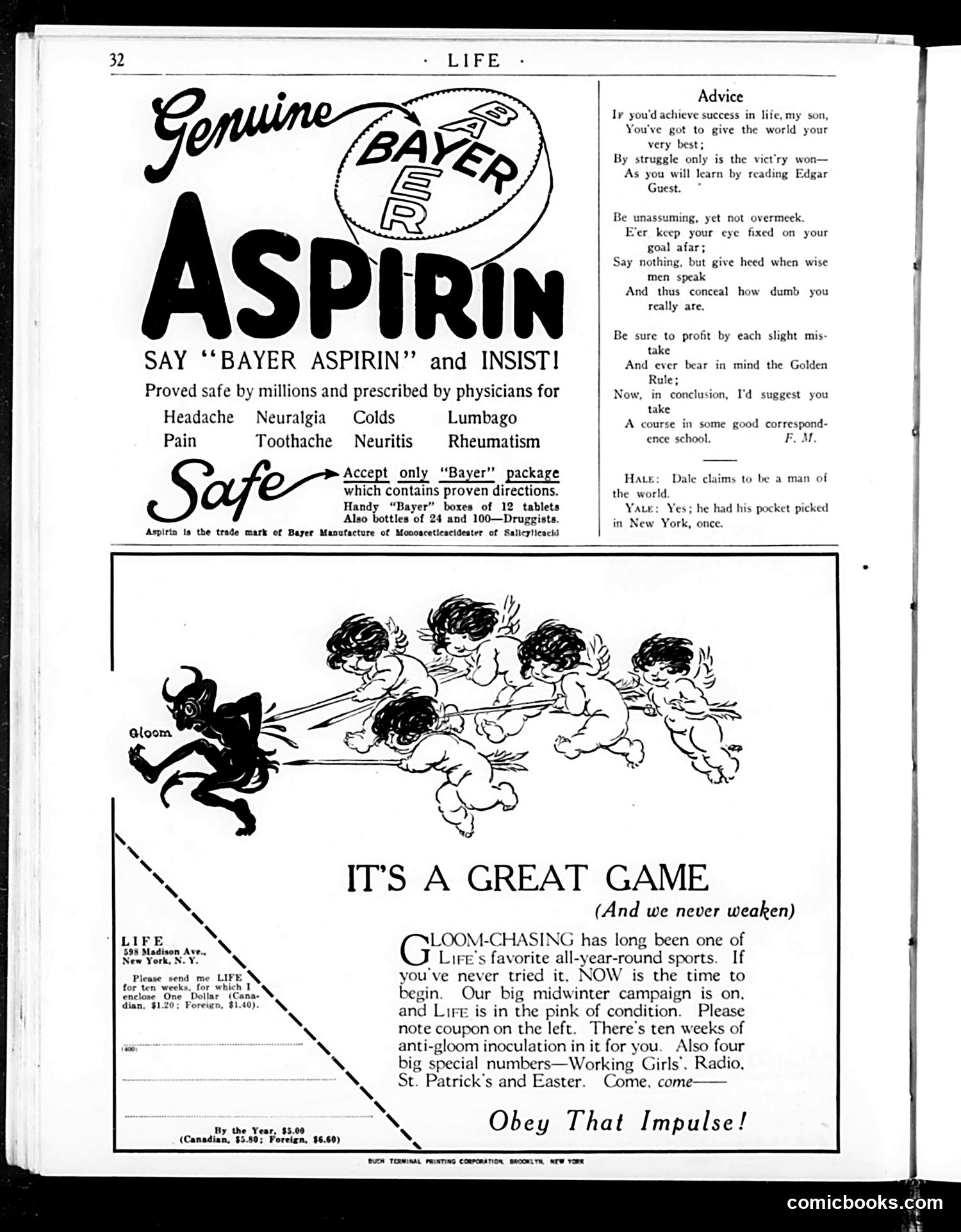
This page mixes commercial advertising with satirical humor typical of Life magazine's format. The **Bayer Aspirin ad** (top left) is straightforward product marketing, listing medical uses and emphasizing the branded "Bayer" package. The **"Advice" column** (top right) is satirical verse mocking self-help platitudes of the era. It parodies the inspirational poetry popular in magazines, with lines like "conceal how dumb you really are"—a cynical jab at the gap between motivational rhetoric and reality. The signature "F. M." and reference to Edgar Guest (a famous inspirational poet) ground this in period literary culture. The **"Gloom-Chasing" section** (bottom) humorously pitches Life magazine itself as a recreational product—a "sport" or antidote to winter depression. The cartoon shows cupid-like figures battling a demon labeled "Gloom," presenting magazine reading as an uplifting activity. The closing line "Obey That Impulse!" encourages subscription impulse-buying. Overall, the page blends earnest advertising with self-aware mockery of both consumer culture and inspirational messaging.
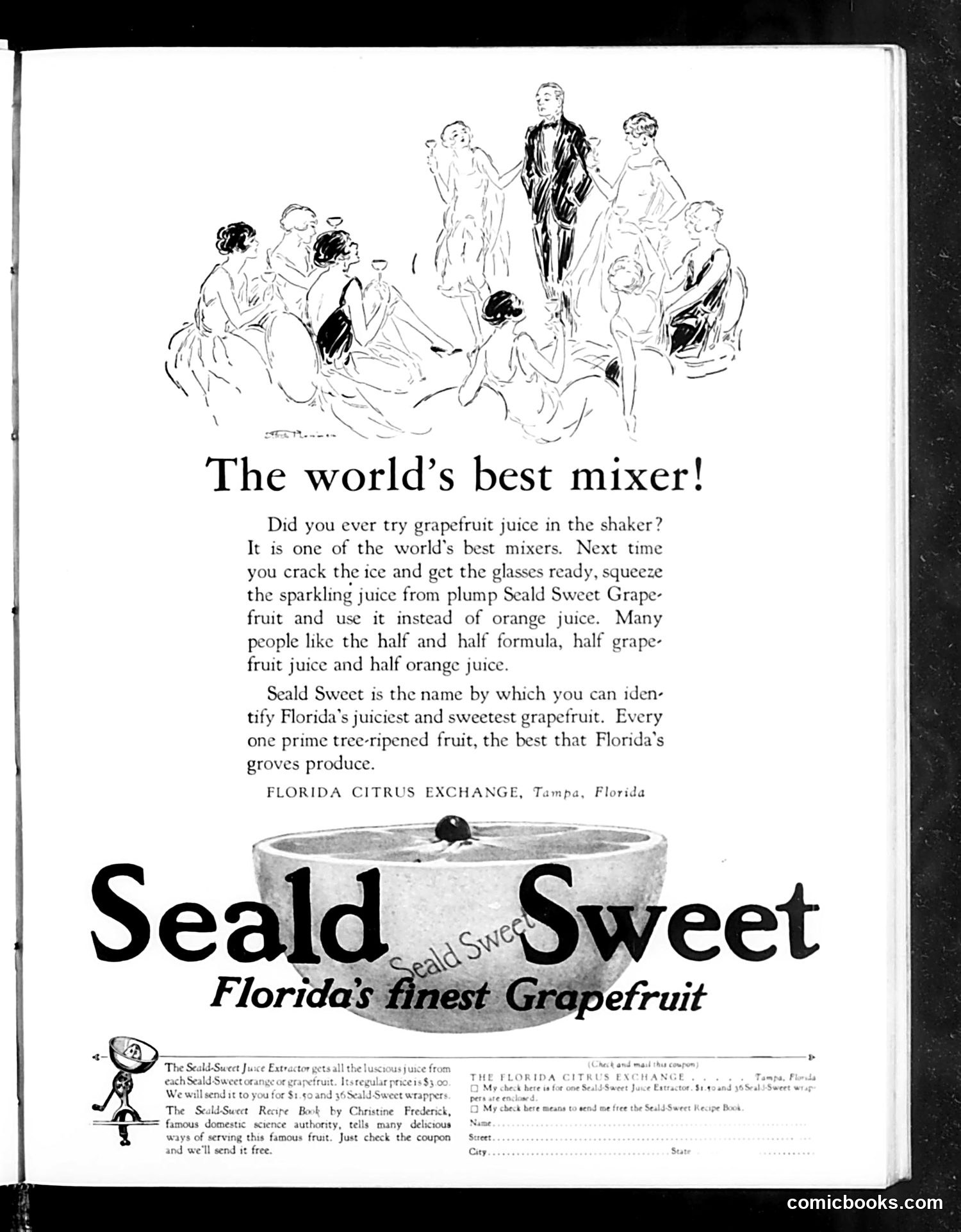
This is a **fruit juice advertisement**, not political satire. The page promotes Seald Sweet grapefruit juice from Florida's Citrus Exchange. The illustration depicts a social gathering—likely a cocktail party—where well-dressed people hold drinks. The "mixer" pun is deliberate: the ad suggests using grapefruit juice in alcoholic cocktails ("shake"), while also using "mixer" colloquially to mean a social event where people gather. The text encourages readers to substitute grapefruit juice for orange juice in mixed drinks, recommending even a 50/50 blend of both citrus juices. A coupon at bottom offers recipe information. This reflects early-to-mid 20th-century advertising targeting middle-class leisure and entertaining culture, positioning Florida citrus as a premium, sophisticated ingredient for home cocktail-making.
This is a cigarette advertisement for Pall Mall brand, not a political cartoon. The image shows a luxury cigarette package displayed prominently against an ornate, decorative background suggesting wealth and sophistication. A cigarette is positioned beside the pack. The ad's tagline reads "THEY ARE GOOD TASTE," positioning the product as a marker of refined social status. The elaborate decorative imagery behind the package reinforces aspirational messaging—linking cigarette consumption to elegance and cultural refinement. This represents mid-20th-century advertising strategies that associated tobacco products with desirability and social class. Such advertisements were common in magazines before cigarette health warnings became mandatory.