
Life, 1926-01-21 · page 16 of 36
Life — January 21, 1926 — page 16: what you’re looking at
What you’re looking at
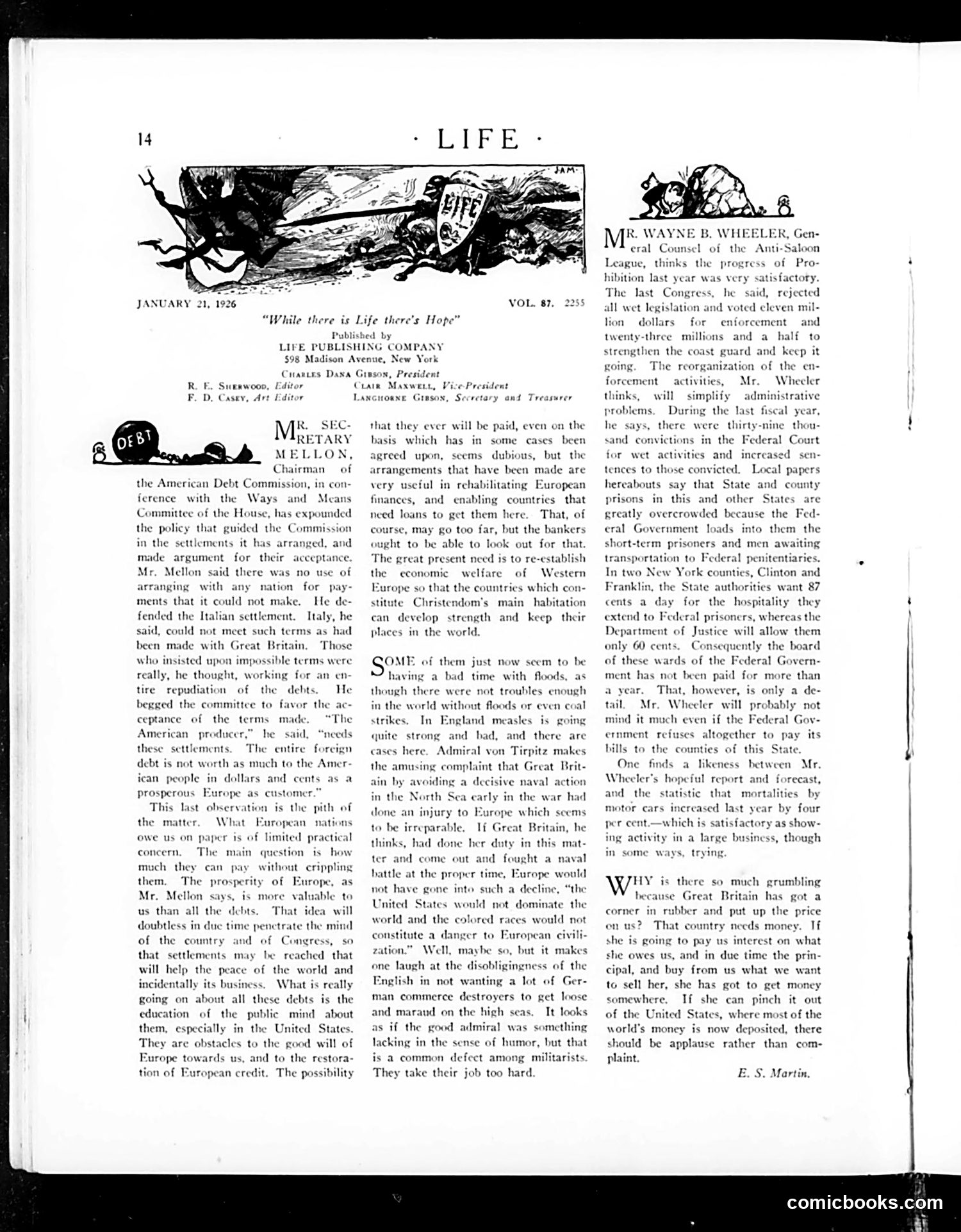
The masthead cartoon depicts a skeletal "DEBT" figure crushing beneath a log labeled "LIFE"—a visual metaphor for how national debt burdens the nation's welfare. The articles discuss European war debt repayment to America and domestic issues. Mr. Secretary Mellon (Treasury Secretary) argues European nations should pay their debts, while Mr. Wheeler counters that enforcement is impractical and damages European recovery. The debate reflects post-WWI tensions: America wanted repayment for loans, but European nations struggled economically. The right-side commentary by E.S. Marin critiques Britain's financial complaints, noting Britain should repay what it owes rather than grumble about interest rates. The satire targets political disagreement over debt policy during the economically turbulent 1920s.
📄 Transcribed text from this page (OCR, searchable)
Machine-transcribed from the original scan — historical spelling and the odd misread are preserved.
“While there is Life the LIFE P' VOL. 87. by BLISHING COMPANY $98 Madison Avenue, New York Cuantes Dasa Gre: R. F. Suewooo, Editor F. D, Casey, Art Editor R. SEC- RETARY MELLON, Chairman of the American Debt Commission, in ¢ ference with the Ways and Means Committee of the House, has expounded Commiss ed, and made argument for their acceptar Mr. Mellon said there was no use of the policy that guided t , in the settlements it has arra e. arranging with any nation for pay- ments that it could not make. He de- fended the Italian settlement. Italy, he said, could not meet such terms as had been made with Great Britain. Those who insisted upon impossible terms were really, he thought, working for an en- tire repudiation of the debts. He begged the committee to favor the ac- The eds ceptance of the terms made. American producer,” he sai these settlements. The entire foreign debt is not worth as much to the Amer ican people in dollars and cents as a prosperous E rope as customer.” This last observation is the pith of the matter. What European nations owe us on paper is of limited practical concern, The main question is how much they can pay without crippling them. The prosperity of Mr. Mellon says, is more us than all the debts. That ide doubtless i curope, as able to will duc time penetrate the mind of the country and of Congress, so that settlements may be reached that will help the peace of the world and incidentally its business. What is really going on about all these debts is the education of the public mind about them, especially in the United States. They are obstacles to the good will of Europe towards us, and to the restora- tion of European credit. The possibility Crate Maxwenn, Vi Laxcioaxe Gresox, Secretary and Treasurer i", Presiden Preside that they ever will be paid, even on the basis which has in some cases been greed upon, seems dub arrangements that have been made are Zuropean finances, and enabling countrics that need loans to get them here. That, of course, may go too far, but the bankers ought to be able to look out for that. The great present need is to re-establish the economic welfare of Western us, but the very useful in rehabilitating Europe so that the countries which con- stitute Christendom's main habitation can develop strength and keep. their places in the world. OME of them just now seem to be having a bad time with floods, as though there were not troubles enough in the world without floods or even coal strikes. In England measles is going nd bad, and. there are cases here. Admiral von Tirpitz makes quite strong the amusing complaint that Great Brit- ain by avoiding a decisive naval action rth Sea early in the war had in the } done an injury to Europe which scems to be irreparable. If Great Britain, he thinks, had done her duty in this mat- ter 1 foug hattle at the proper time, Europe would J come out ht a naval not have gone inte such a decline, “the United $ world and the colored races would not ates would not dominate the constitute a danger to European civi zation.” Well, maybe so, but it makes one laugh at the disobligingness of the English in not wanting a lot of Ger- man commerce destroyers to get loose and maraud on the high seas. It looks as if the good admiral was something lacking in the sense of humor, but that is a common defect among mil They take their job too hard. R. WAYNE B, WHEELER, Gen- eral Counsel of the Anti-Saloon League, thinks the 1 gress of Pro- hibition last year was very satisfactory. The last Congress, he said, rejected all wet legislation and voted eleven mil- lion dollars for enforcement and twenty-three millions and a half to strengthen the coast guard and keep it ing. The reorganization of the en- forcement activities, Mr. Wheeler thinks, will simplify administrative problems. During the last fiscal year, he says, there were thirty-nine thou- ederal Court for wet activities and increased sen- sand convictions in the tences to those convicted. Local papers hereabouts say that State and county prisons in this and other States are greatly overcrowded because the Fed- o them the short-term prisoners and men aw transportation to Federal penitentiaries. In two New York counties, Clinton and Franklin, the State authorities want 87 cents a day for the hospitality they eral Government loads in iting extend to Federal prisoners, whereas the Department of Justice will allow them only 60 cents. nsequently the board of these wards of the Federal Govern- ment has not been paid for more than a year. That, however, is « tail, Mr. Wheeler will pre mind it much even if the ernment refuses altogether to pay its hills to the coun One finds a likeness between Mr. Wheeler's hopeful report and forecast, ly a de- ably not “ederal Gov- ies of this State. nd the statistic that mortalities by r by four per cent.—which is satisfactory as show- motor cars increased last ing activity in a large business, though in some ways, trying HY is there so much grumbling because Great Britain has got a corner in rubber and put up the price en us? That she is going to pay us interest on what intry needs money. If she owes us, and in due time the prin- cipal, and buy from us what we want to sell her, she has got to get money somewhere. If she can pinch it out of the United States, where most of the world’s money is now deposited, there should be applause rather than com- plaint. E. S. Martin.