
Life, 1926-01-21 · page 20 of 36
Life — January 21, 1926 — page 20: what you’re looking at
What you’re looking at
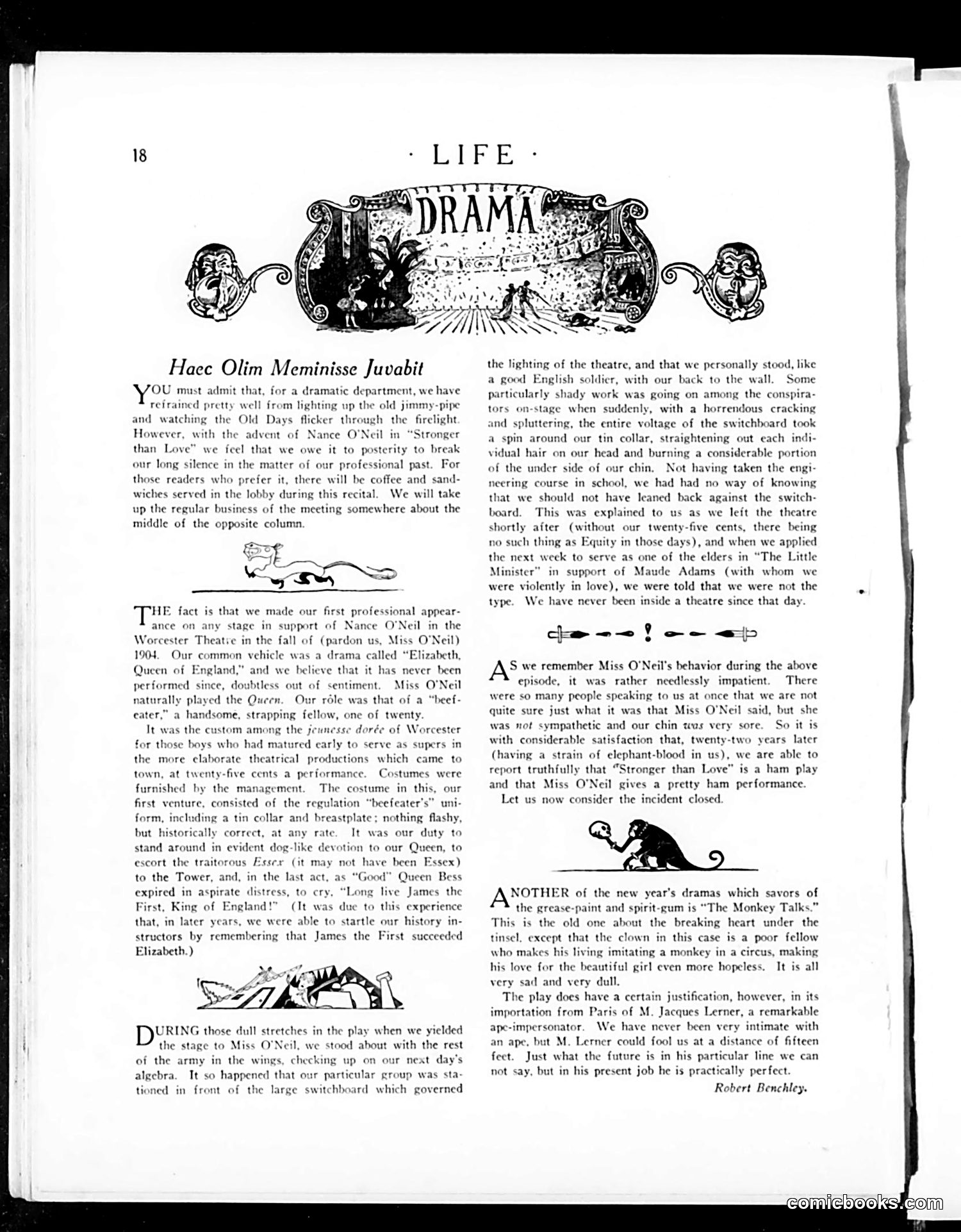
This is a humorous personal essay by Robert Benchley (bylined at bottom) recounting his theatrical career mishap. The piece mocks amateur theater and his own youthful naïveté. **The Setup:** Benchley describes his 1904 debut as a "Beefeater" (guard) in a production of "Elizabeth, Queen of England" starring actress Nance O'Neil at Worcester Theatre. **The Joke:** While standing dutifully near the lighting switchboard, the young Benchley leans against it and receives an electrical shock that burns his chin and singes his hair. He's ejected from the theater without pay (no labor protections existed then—"no such thing as Equity"). **The Satire:** Benchley ridicules both his youthful ignorance and the pretentious theatrical world. The Latin title means "it will be pleasant to remember these things"—a grandiose claim for such a humiliating experience. He never returned to theater after this incident. The ornamental "DRAMA" header and theatrical framing emphasize the mock-serious tone of this self-deprecating anecdote about early 20th-century theater life.
📄 Transcribed text from this page (OCR, searchable)
Machine-transcribed from the original scan — historical spelling and the odd misread are preserved.
Haec Olim Meminisse Juvabit OU must admit that, for a dramatic department, we have refrained pretty well from lighting up the old jimmy-pipe and watching the Old Days flicker through the firelight However, with the advent of Nance O'Neil in than Love” we feel that we owe it to posterity to break our long silence in the matter of our professional past. For those readers who prefer it, there will be coffee and sand- wiches served in the lobby during this recital. We will take up the regular business of the meeting somewhere about the middle of the opposite column. Stronger nal appear- nee on any stage in support of Nance O'Neil in the Worcester Theatve in the fall of (pardon us, Miss O'Neil) 1904. Our common vehicle was a drama called “Elizabeth, THE fact is that we made our first professi Queen of England,” and we believe that it has never been performed since, doubtless out of sentiment. Miss O'Neil naturally played the Queen. Our réle was that of a “beef- cater,” a handsome, strapping fellow, one of twenty. dorée of Worcester those boys who had matured early to serve as supers in ame to town, at twenty-five cents a performance. Costumes were It was the custom among the jennes the more claborate theatrical productions which furnished hy the management. The costume in this, ot first venture, consisted of the regulation “beefeater’s” ur form, ing a tin collar and breastplate; nothing flash but historically correct, at any rate. It was our duty to stand around in evident dog-like devotion to our Queen, to escort the traitorous Essex (it may not have been Essex) to the Tower, and, in the last act, as “Good” Queen Bess expired in aspirate distress, to cry, “Long live James the First, King of England!” this experience in later years, we were able to startle our history in- structors by remembering that (It was due t mes the First succeeded URING those dull stretches in the play when we yielded the stage to Miss O'Neil, we stood about with the rest of the army in the wings, checking up on our next day's algebra. It so happened that our particular grot tioned in front was sta- the large switchboard which governed the lighting of the theatre, and that we personally stood, like a good English soldier, with our back to the wall. particularly shady work was going on among the conspira- tors on-stage when suddenly, with a horrendous cracking and spluttering, the entire voltage of the switchboard took a spin around our tin collar, straightening out each indi- vidual hair on our head and burning a considerable portion of the under side of our chin, Not having taken the engi- Some ering course in school, we had had no way of knowing that we should not have leaned back against the switch- board. This was explained to us as we leit the theatre shortly after (without our twenty-five cents, there being no such thing as Equity in those days), and when we applied the next week to serve as one of the elders in “The Little Minister” in support of Maude Adams (with whom we were violently in love), we were told that we were not the type. We have never been inside a theatre since that day. S we remember Miss O'Neil’s behavior during the above episode, it was rather needlessly impatient. There were so many people speaking to us at once that we are not quite sure just what it was that Miss O'Neil said, but she was not sympathetic and our chin wes very sore. with considerable satisfaction that, twenty-two years later (having a strain of elephant-blood in us), we are able to report truthfully that “Stronger than Love” is a ham play and that Miss O'Neil gives a pretty ham performance. Let us now consider the incident closed. So it is NOTHER of the new year's dramas which savors of the grease-paint and spirit-gum is “The Monkey Talks.” This is the old one about the breaking heart under the tinsel, except that the clown in this case is a poor fellow who makes his living imitating a monkey in a circus, making his love for the beautiful girl even more hopeless. It is all very sad and very dull. The play does have a certain justification, however, in its importation from Paris of M. Jacques Lerner, a remarkable ape-impersonator. We have never been very intimate with an ape, but M. Lerner could fool us at a distance of fifteen feet. Just what the future is in his particular line we can not say, but in his present job he is practically perfect. Robert Benchley.