
A complete issue · 40 pages · 1926
Life — January 14, 1926
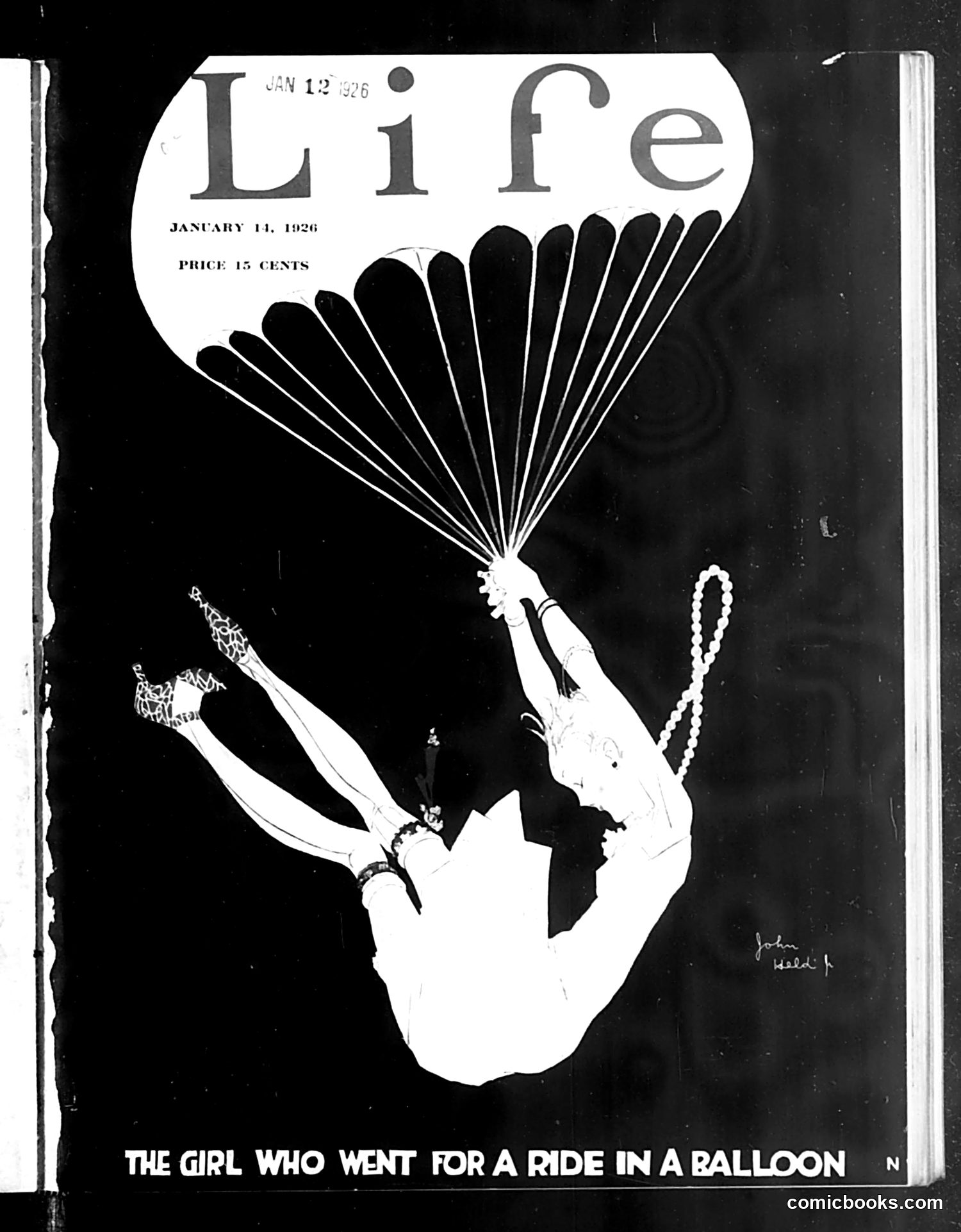
This January 1926 *Life* cover depicts a woman in elegant 1920s attire (headband, pearl necklace, bangles) ascending in a hot-air balloon. The illustration is credited to John Held Jr., *Life*'s premier cartoonist of the era. The satire likely references the Jazz Age's culture of thrill-seeking and reckless adventure among young women—the "flapper" lifestyle that scandalized conservative society. The balloon ride represents the dangerous escapism and daring behavior that defined 1920s youth culture. The woman's fashionable appearance emphasizes she's a modern "New Woman" rejecting Victorian propriety in favor of excitement and independence—a common satirical target in *Life* during this period.
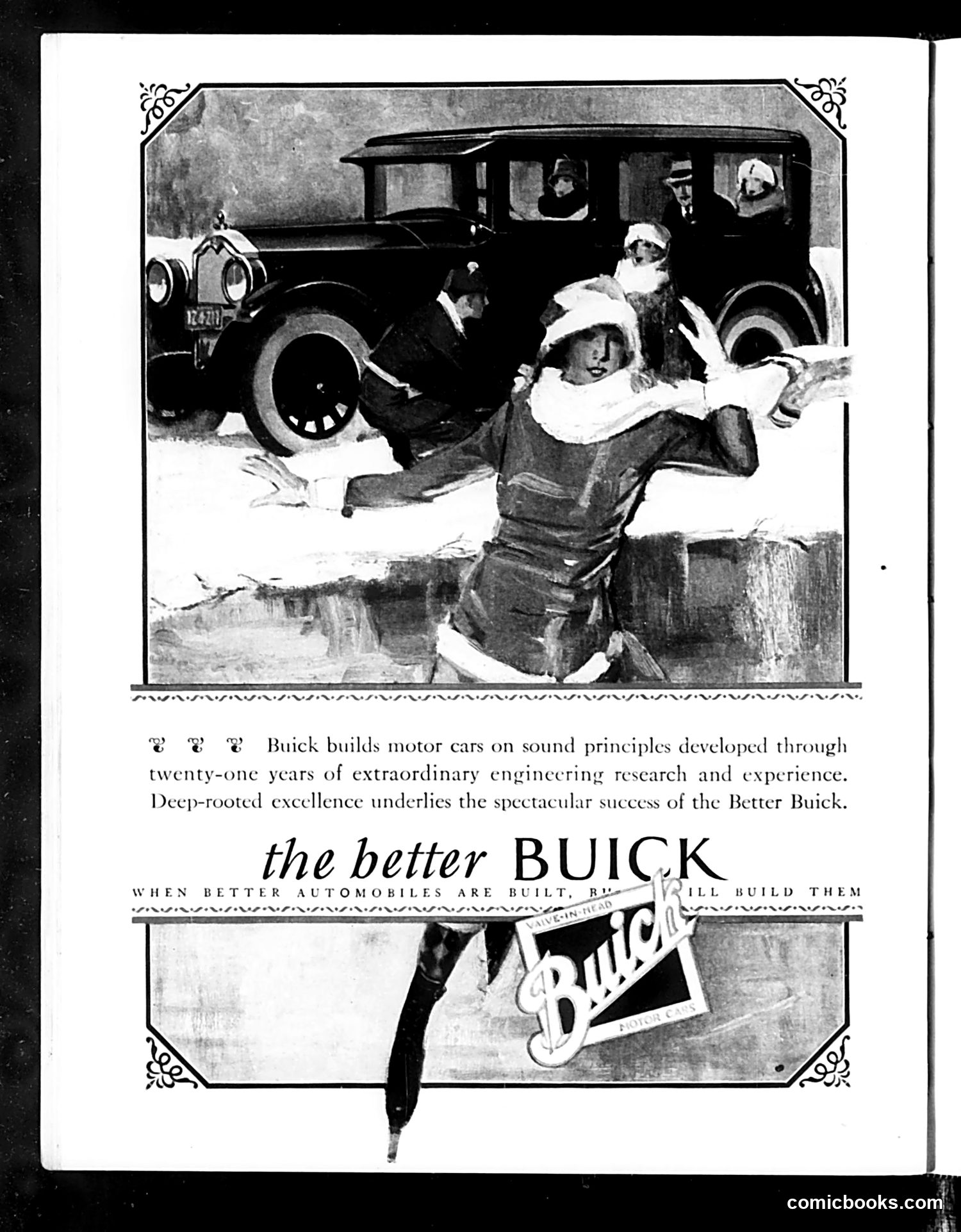
This is a **Buick automobile advertisement**, not political satire. The image shows a woman in winter clothing playfully posing beside a Buick car in snowy conditions, with passengers visible inside the vehicle. The ad's messaging emphasizes engineering reliability: "Buick builds motor cars on sound principles developed through twenty-one years of extraordinary engineering research and experience." The comedic element is mild and domestic—the woman's exaggerated, joyful pose suggests the car brings happiness and reliable winter performance. The slogan "When Better Automobiles Are Built, Buick Will Build Them" asserts market superiority through engineering excellence rather than style. This reflects early 1920s automotive advertising strategy: positioning cars as products of serious technical development rather than mere luxury goods.
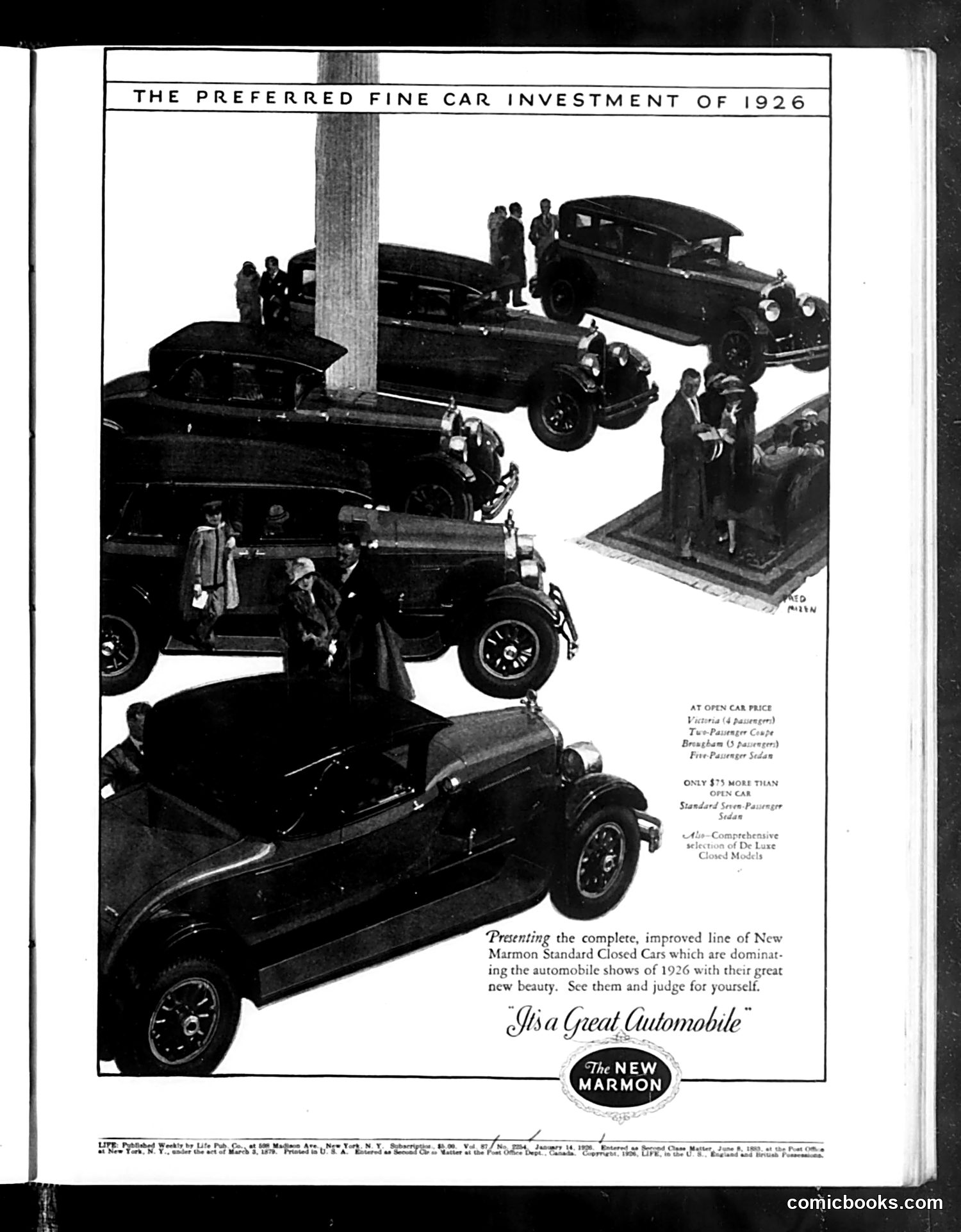
This is **not a political cartoon or satire**—it's a straightforward automobile advertisement for the "New Marmon" car line from 1926. The page showcases four different Marmon vehicle models arranged vertically, with well-dressed people examining them. The text emphasizes these are "closed cars" (fully enclosed vehicles, then a luxury feature) and presents the 1926 lineup as "the preferred fine car investment." The tagline "It's a Great Automobile" and pricing information at open-car level indicate this is premium marketing targeting affluent buyers. The formal presentation and emphasis on "great new beauty" reflects 1926 advertising conventions for luxury automobiles during the prosperous mid-1920s. There is no satire or political content here—simply period advertising.
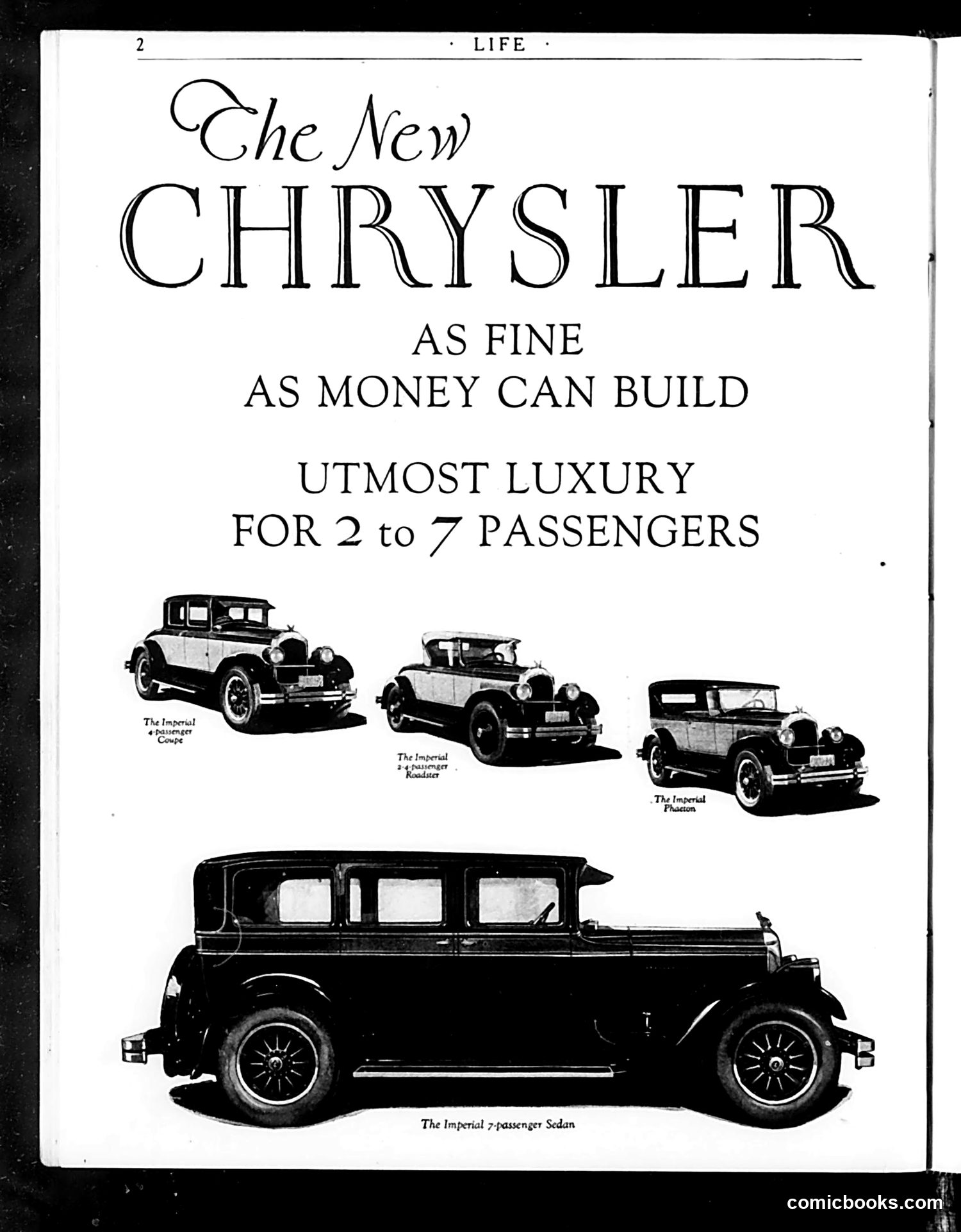
This is a **Chrysler automobile advertisement**, not political satire or a cartoon. The page promotes the "New Chrysler" as a luxury vehicle, emphasizing that it offers "utmost luxury for 2 to 7 passengers" at a price point competitive with what money can build. The ad displays four vehicle models: three smaller coupe/phaeton variants shown at top (the Imperial 4-passenger Coupe, Imperial 5-passenger Phaeton, and Imperial Phaeton), with the larger Imperial 7-passenger Sedan featured prominently below. This appears to be a 1920s-era advertisement targeting affluent buyers, positioning Chrysler as offering comparable luxury to competitors while accommodating various party sizes. The focus is purely commercial, not satirical or political.
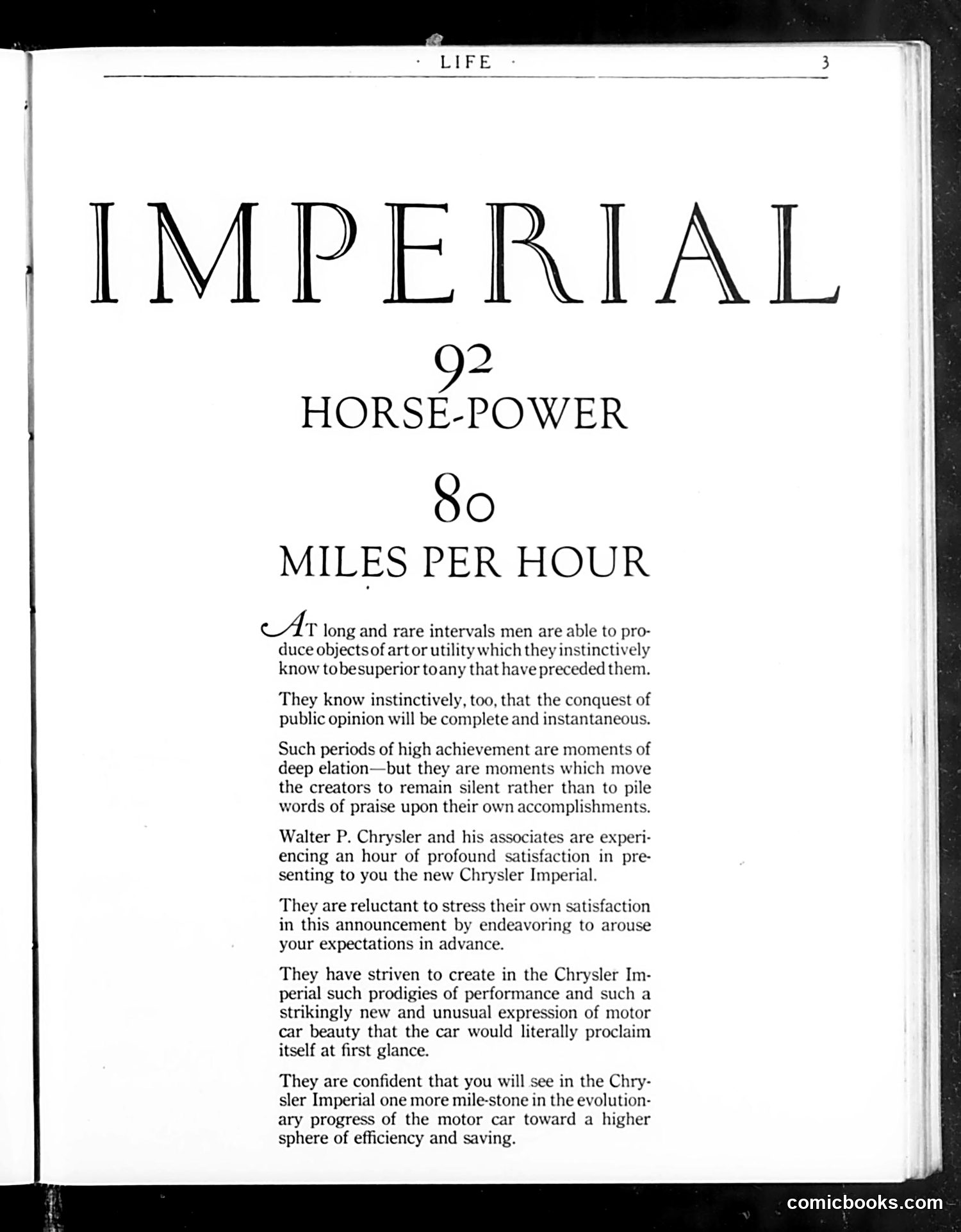
This page is **not a cartoon or satire**—it's a **straightforward advertisement** for the Chrysler Imperial automobile, published in *Life* magazine. The ad announces the Imperial's specifications (92 horsepower, 80 mph) and uses rhetorical flourish to position it as a milestone in automotive achievement. The text employs a common advertising strategy: praising the creators' humility and restraint while simultaneously making grand claims about the car's "prodigies of performance" and "strikingly new and unusual expression of motor car beauty." The lengthy prose attempts to elevate the product by framing its announcement as a moment of historic technological progress—appealing to readers' sense of modernity and efficiency during what appears to be the 1920s-30s era of automotive innovation.
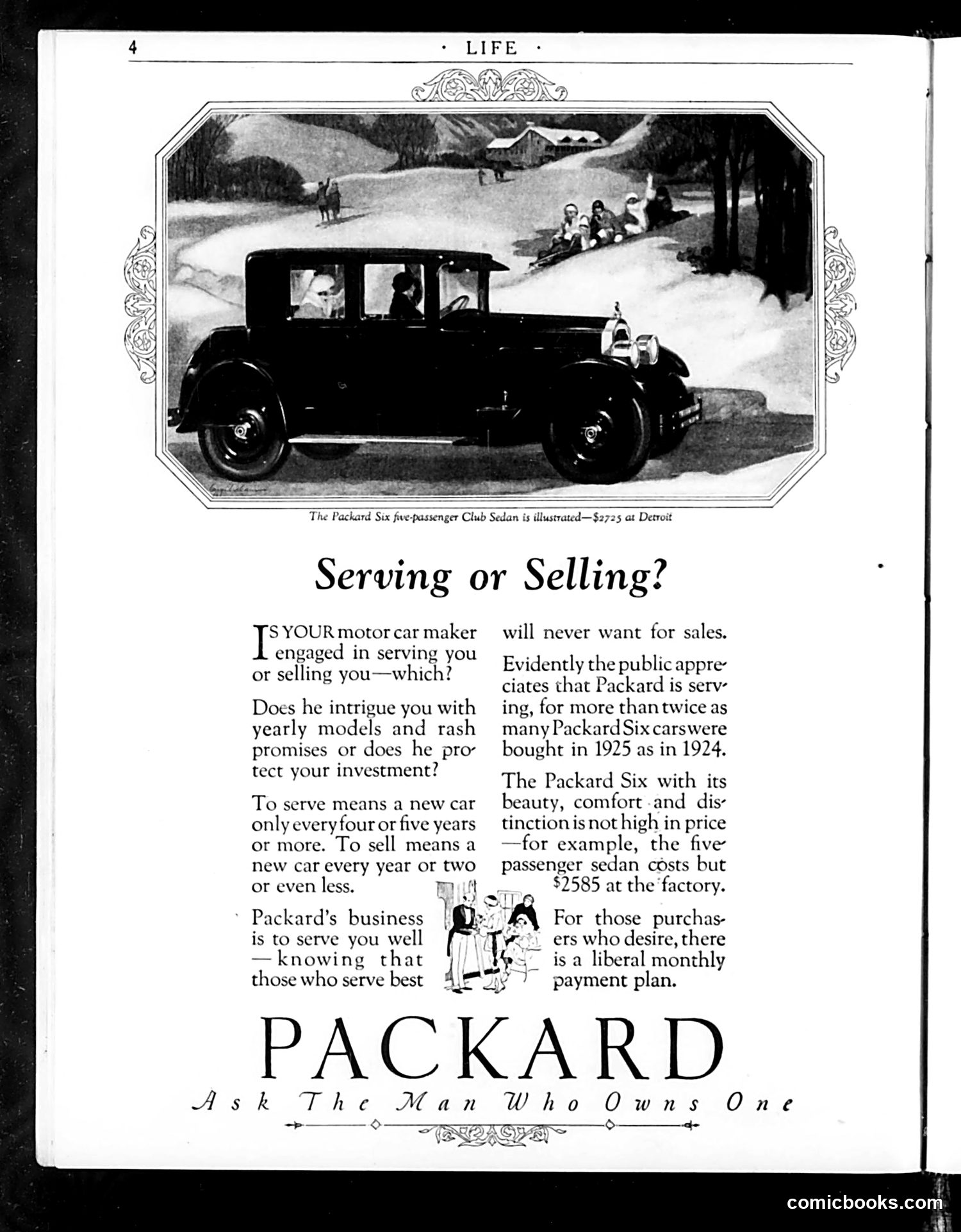
This is primarily a **Packard automobile advertisement**, not satire or political commentary. The ad argues that Packard's business model emphasizes *service* over aggressive sales tactics. It contrasts manufacturers who push yearly new models with Packard's approach of releasing new cars every four to five years, framing this as customer protection rather than constant pressure to upgrade. The headline "Serving or Selling?" poses this distinction. The ad notes that more Packard Six cars were purchased in 1925 than 1924, attributing this to the brand's reputation for reliability and service. It highlights the affordable price ($2585) and offers a flexible monthly payment plan. The winter scene photograph shows the car in family use, emphasizing practical, everyday reliability rather than luxury or status.
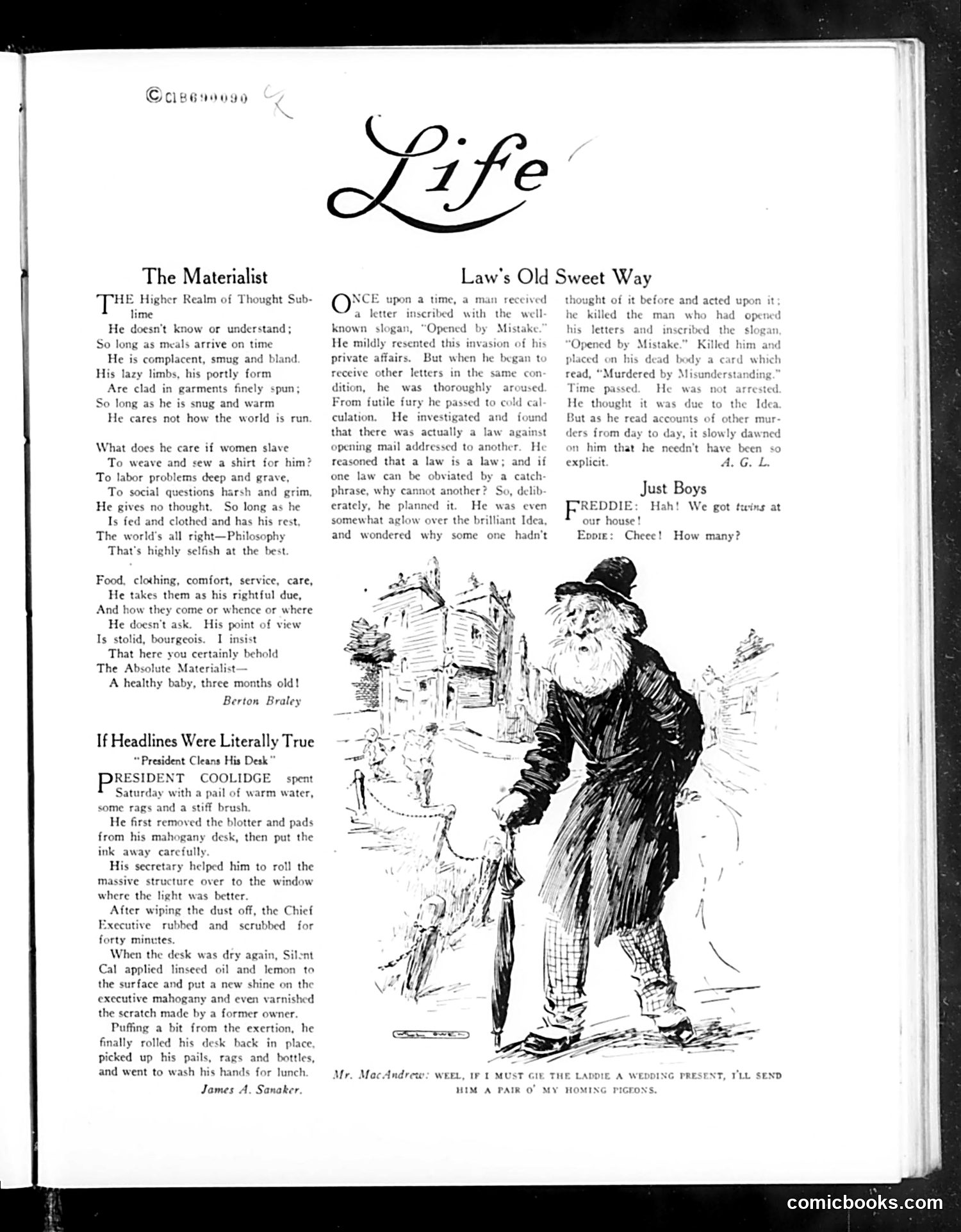
This page contains three separate satirical pieces: **"The Materialist"** (Berton Braley poem): Mocks a man focused solely on physical comforts—food, clothing, shelter—who ignores philosophical or social concerns. The satire targets materialism as shallow philosophy. **"Law's Old Sweet Way"**: A brief story about a man receiving letters marked "Opened by Mistake" that reveal a legal loophole. The satire critiques how laws can be technically circumvented through deliberate misinterpretation. **"Just Boys"** and **"If Headlines Were Literally True"**: Humorous vignettes using wordplay and absurdist logic. The cartoon illustrates a shabby old man offering homing pigeons as a wedding gift—visual humor accompanying satirical commentary on literal headline interpretations. The overall page exemplifies Life's editorial approach: combining poetry, short prose, and illustrations to satirize contemporary social attitudes and legal/administrative absurdities.
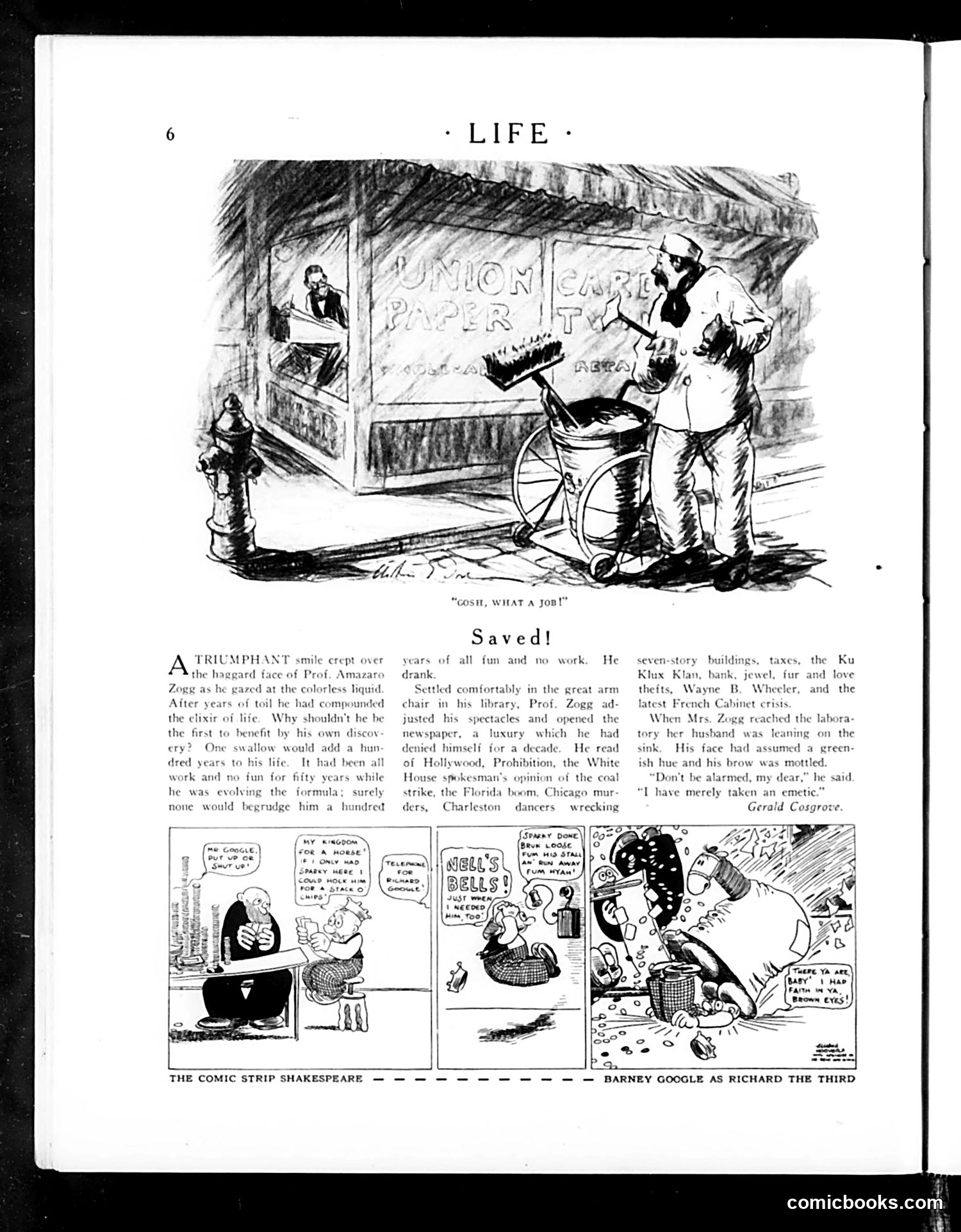
This Life magazine page satirizes Professor Amarzo Zogg, a character described as having enjoyed years of leisure before discovering "a formula" for something unspecified. The top cartoon mocks his triumphant expression upon finally accomplishing work after decades of idleness. The bottom section includes "The Comic Strip Shakespeare" and "Barney Google as Richard the Third"—references to a popular contemporary comic strip character. The satire appears to target both the professorial class's pretensions and popular entertainment culture. The main joke seems to be about idle intellectuals finally producing results, while the Shakespeare parody suggests mockery of adapting classical literature for mass-market comics. The specific formula and its relevance remain unclear from visible text, though context suggests social commentary on work, leisure, and cultural democratization during the Prohibition era referenced in the article.
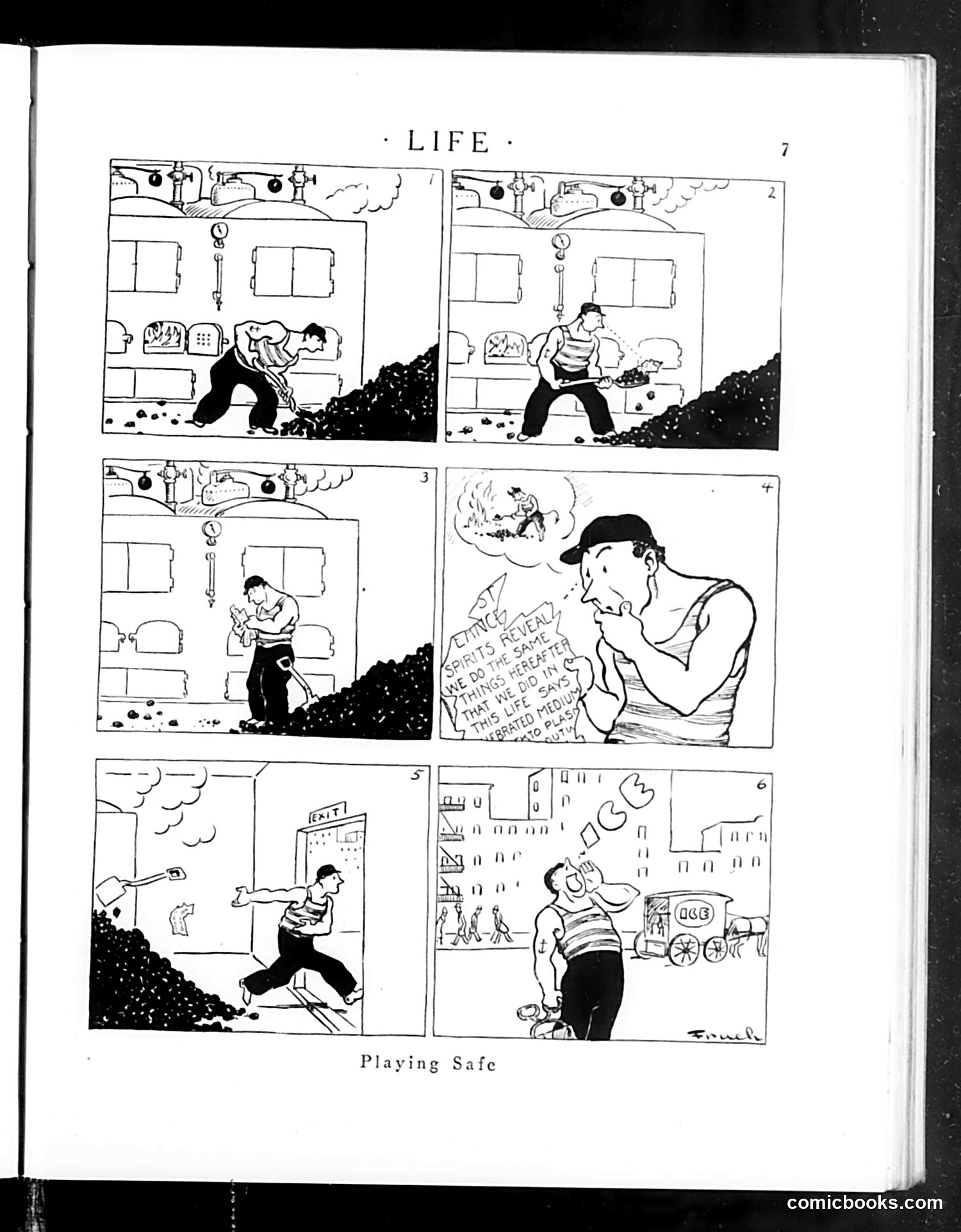
This six-panel comic depicts a man repeatedly encountering danger—collapsing buildings, falling debris, traffic hazards—yet always escaping unscathed through cautious behavior. Panel 4 shows him contemplating life's risks, with a thought bubble listing dangers: "ACCIDENT," "SICKNESS," "POVERTY," "OLD AGE," etc. The satire critiques excessive caution and risk-aversion. The protagonist survives physical dangers by being careful, but the comic suggests that obsessive avoidance of life's inherent risks leads to paralysis or missed experiences. The final panels show him successfully navigating urban chaos through vigilance. The joke appears to be ironic commentary on Depression-era anxiety about economic and physical security—that while playing it safe from immediate hazards works tactically, it reflects a deeper cultural nervousness about life itself.
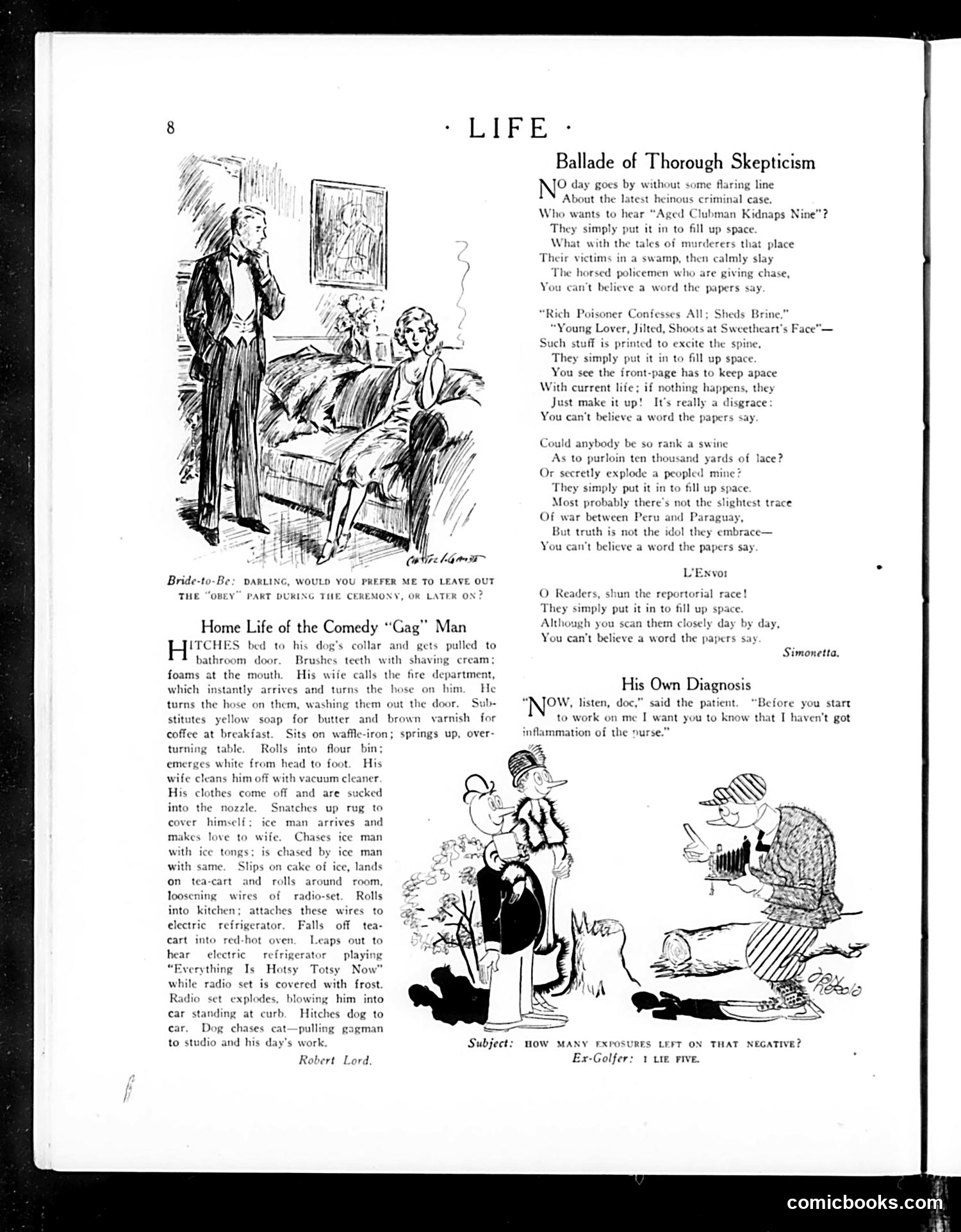
This page contains three satirical pieces: 1. **"Ballade of Thorough Skepticism"** (poem by Simonetta): Mocks sensationalist newspaper journalism—particularly crime reporting—that fabricates or exaggerates stories ("Aged Clubman Kidnaps Nine") to fill space. The refrain "You can't believe a word the papers say" is the central complaint about media unreliability. 2. **"Home Life of the Comedy 'Gag' Man"** (by Robert Lord): Humorous account of a slapstick comedy writer's chaotic domestic life, where his own home becomes a constant physical disaster (hoses, radio explosions, ice mishaps) mirroring the "gags" he writes. 3. **"His Own Diagnosis"** (cartoon): A doctor and patient discuss X-ray negatives, with the punchline suggesting the doctor has misidentified images or the patient's condition remains unclear—playing on medical uncertainty.
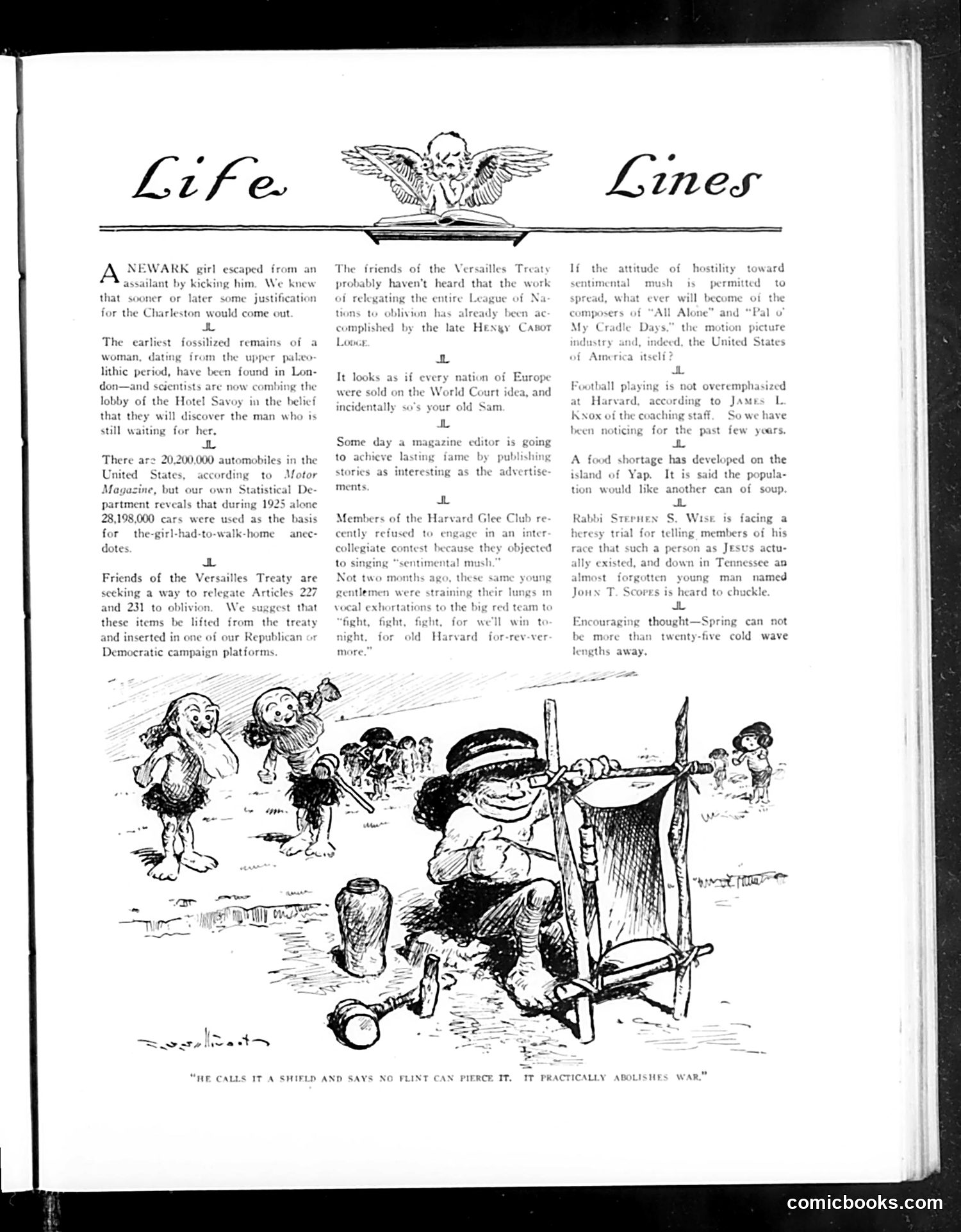
This page contains a satirical cartoon depicting a figure constructing what appears to be a shield or protective device, captioned: "He calls it a shield and says no flint can pierce it. It practically abolishes war." The cartoon mocks pacifist or disarmament rhetoric of the era—likely from the 1920s-30s based on the "Life" publication style. The central figure represents advocates claiming that some new policy, treaty, or invention can prevent war entirely. The absurd, crude construction shown suggests the satirist views such claims as naive or laughable oversimplifications. The surrounding text references the League of Nations and disarmament treaties, positioning this as commentary on overly optimistic peace initiatives of the interwar period. The joke: no simple shield can truly abolish warfare.
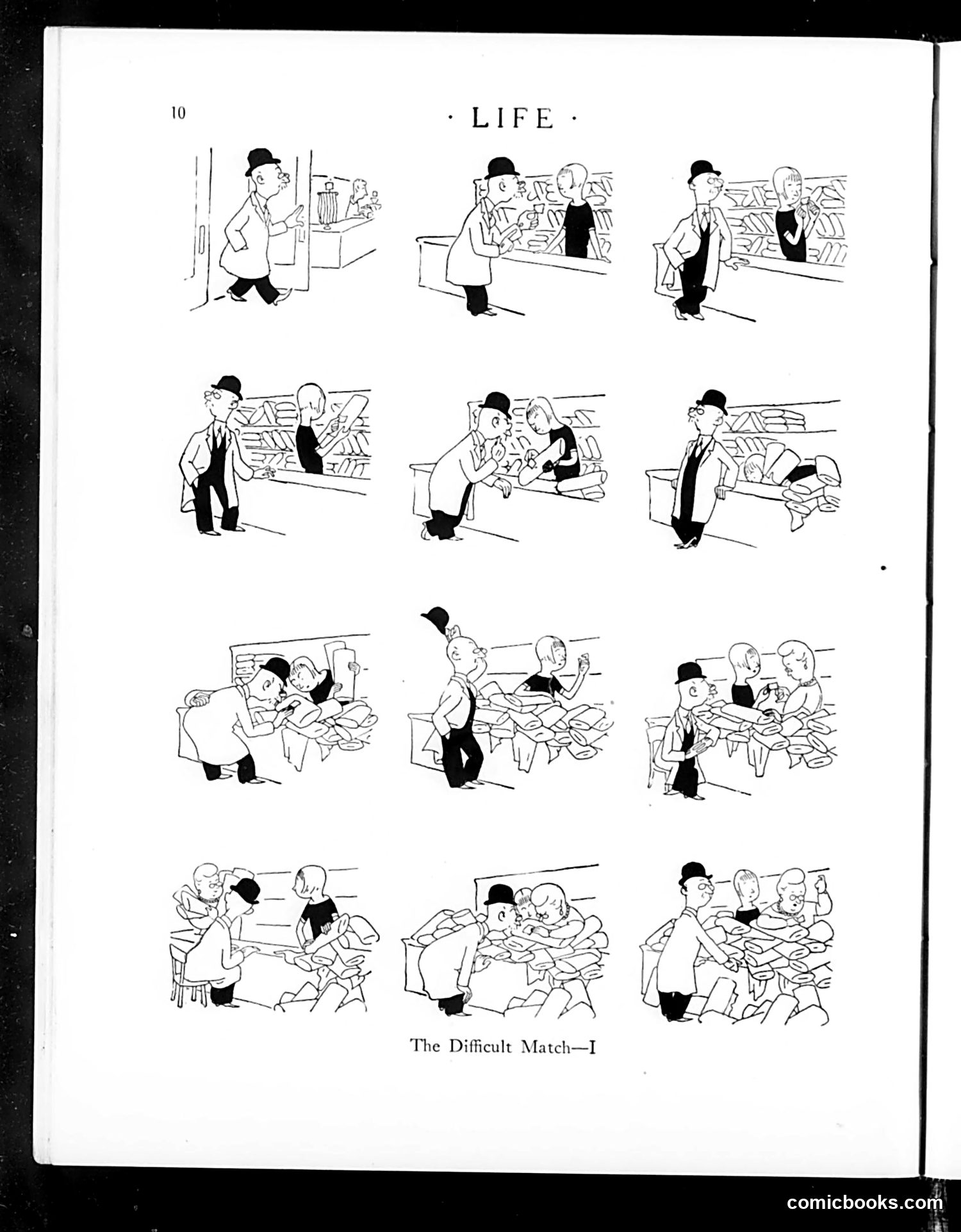
This comic strip depicts a businessman (in bowler hat and suit) attempting to arrange or manage some kind of social or romantic situation involving multiple children and what appears to be a woman in black. The sequential panels show escalating chaos—the man's attempts to orchestrate or control the scenario progressively fail, with children becoming increasingly unruly and disorderly. The title "The Difficult Match" suggests this is about matchmaking or arranging a difficult pairing. The humor derives from the contrast between the man's formal, controlled appearance and the growing pandemonium he cannot manage. This likely satirizes either marital arrangement difficulties or social pretension—the well-dressed businessman unable to control circumstances despite his apparent status and authority. The specific social context remains unclear without additional context.
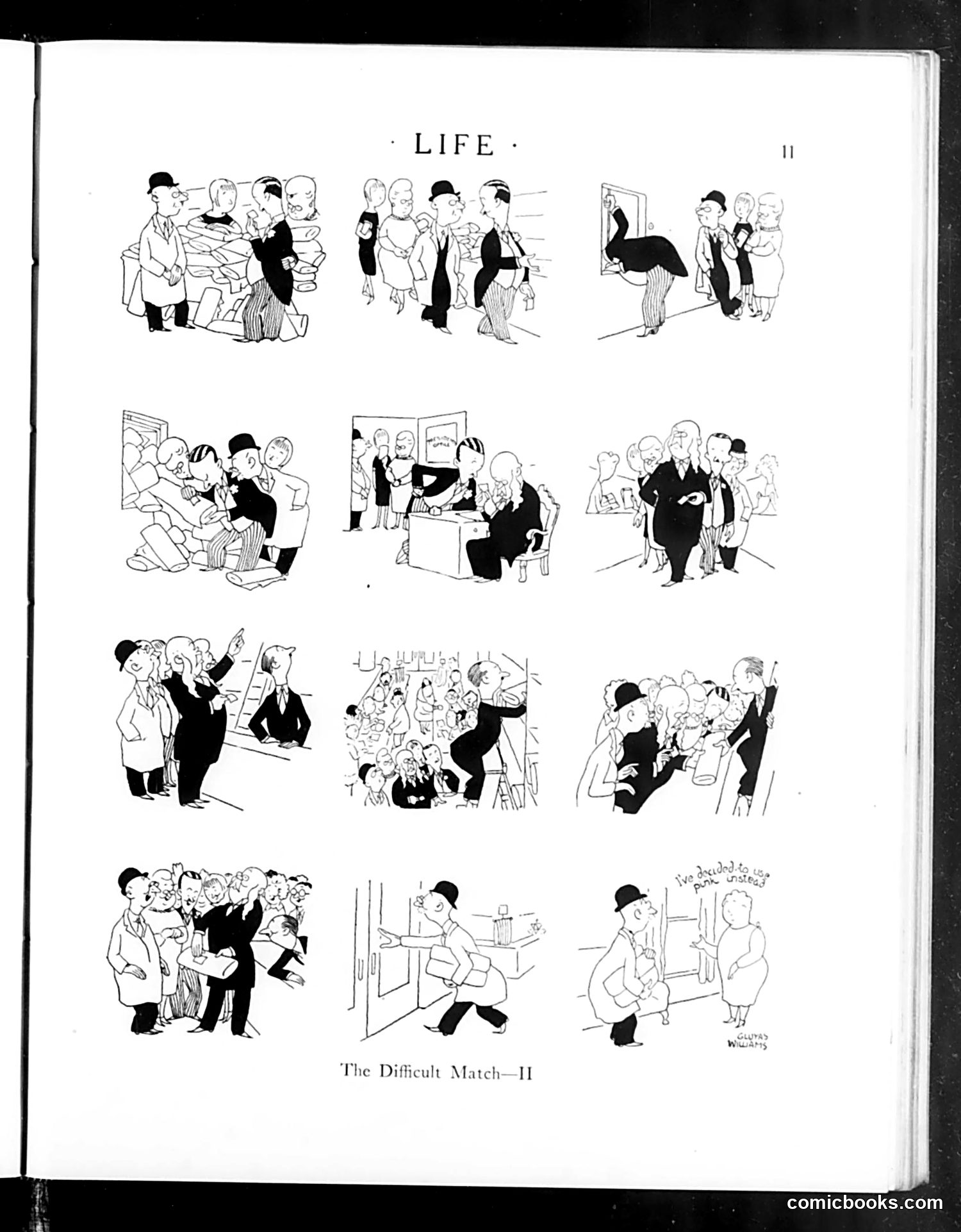
This page from *Life* magazine presents a series of comic vignettes titled "The Difficult Match—II," satirizing the challenges of matchmaking and courtship among upper-class society. The cartoons depict various scenarios where a well-dressed man (likely a matchmaker or social intermediary) attempts to facilitate romantic introductions between eligible parties. The humor derives from the awkwardness and social complications that arise: mismatched personalities, disapproving relatives, and the general difficulty of orchestrating successful romantic unions. The visual style—simple line drawings emphasizing facial expressions and body language—was characteristic of early 20th-century satirical illustration. The cartoon mocks the formality and social pretense surrounding marriage arrangements among the wealthy, presenting matchmaking as an inherently chaotic enterprise despite careful planning.
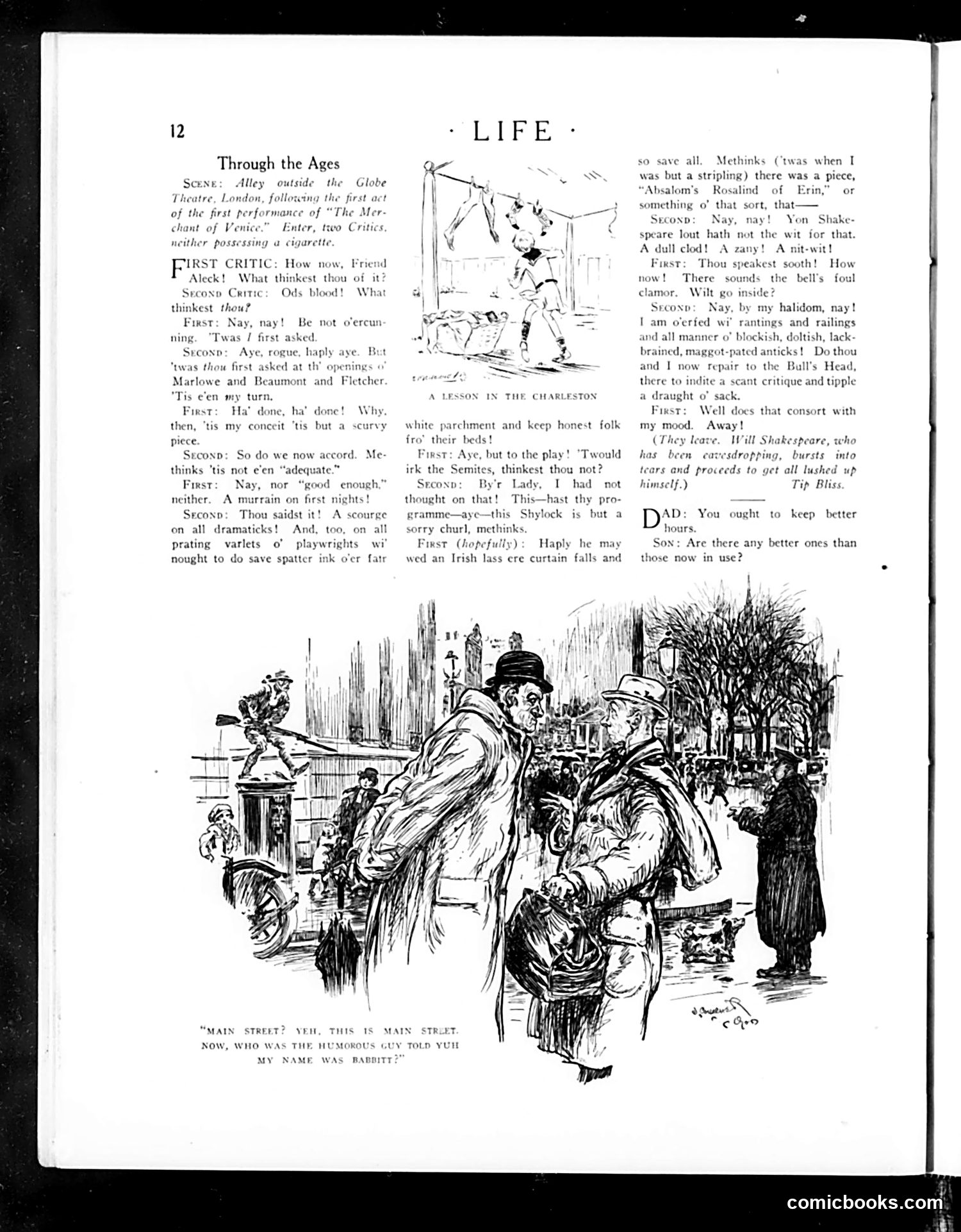
This page contains two distinct elements: **Top Section ("A Lesson in the Charleston"):** A theatrical sketch mocking drama critics and Shakespearean actors. The "First Critic" and "Second Critic" debate whether a production of Shakespeare is worthwhile, with one dismissing it as "not good enough." The satire targets pretentious theater criticism and the gap between critical standards and popular entertainment. References to the Charleston (a 1920s dance craze) suggest contemporary audiences preferred modern entertainment to classical theater. **Bottom Illustration:** Shows two well-dressed men on a city street with pedestrians and urban scenery. The caption reads: "Main Street? Yeh, this is Main Street. Now, who was the humorous guy told yuh my name was Babbitt?" This references Sinclair Lewis's 1922 novel *Babbitt*, satirizing American small-town conformity and materialism. The joke appears to play on mistaken identity or assumptions about "typical" Main Street characters.
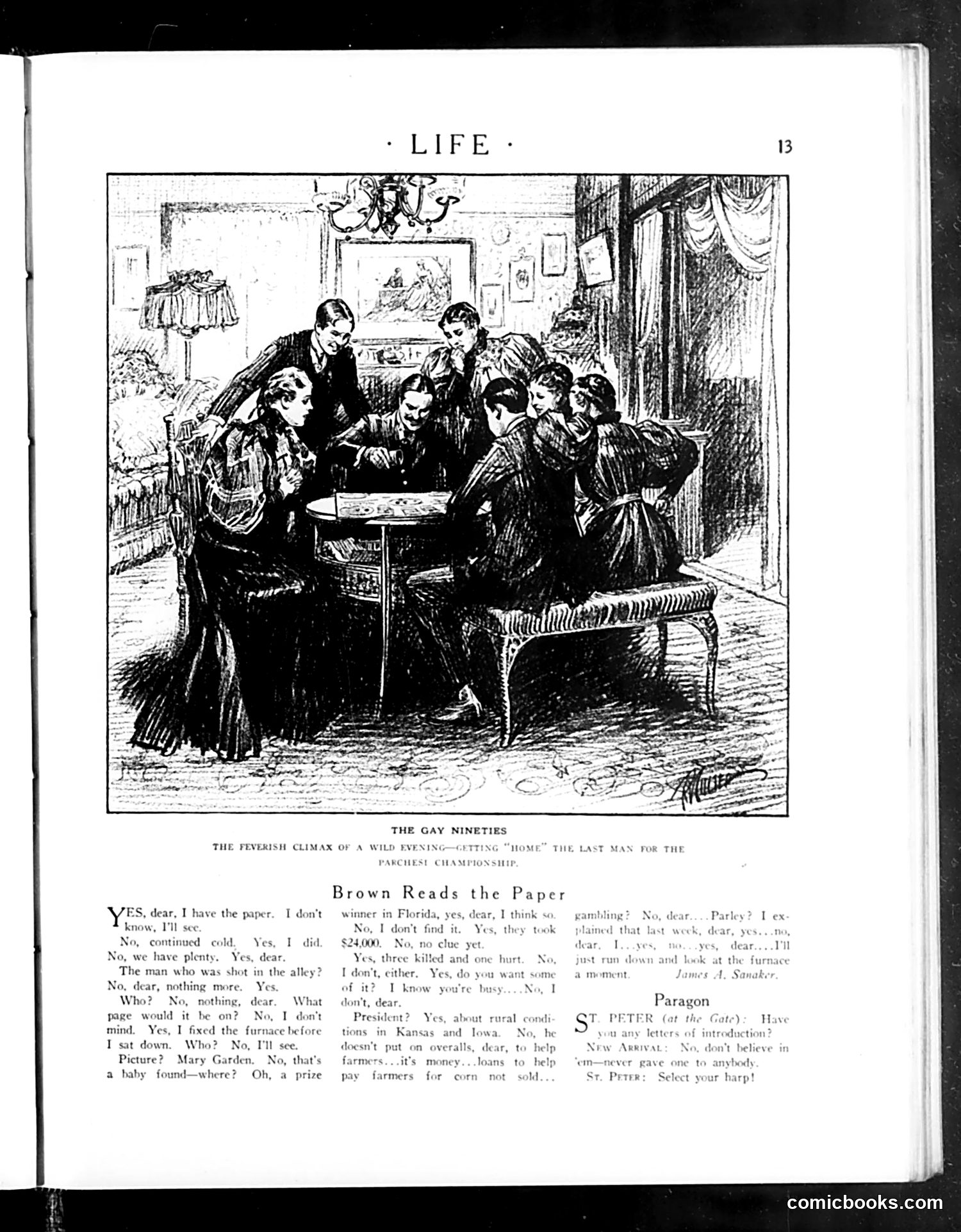
**Main Illustration: "The Gay Nineties"** The sketch depicts a fashionable indoor social gathering from the 1890s era. Well-dressed women and men in period clothing surround a small table, suggesting a parlor game or entertainment activity. The caption describes it as capturing "the feverish climax of a wild evening—getting 'home' the last man for the parcheesi championship," indicating the scene satirizes the intense competition over trivial parlor games among the leisure class. **Text Content: "Brown Reads the Paper" and "Paragon"** These appear to be humorous dialogue pieces—likely theatrical sketches or comic narratives. They depict domestic and social scenes with conversational humor typical of Life's satirical format, mocking everyday concerns of the period's middle and upper classes. The page presents nostalgic humor about 1890s social life and contemporary domestic comedy.
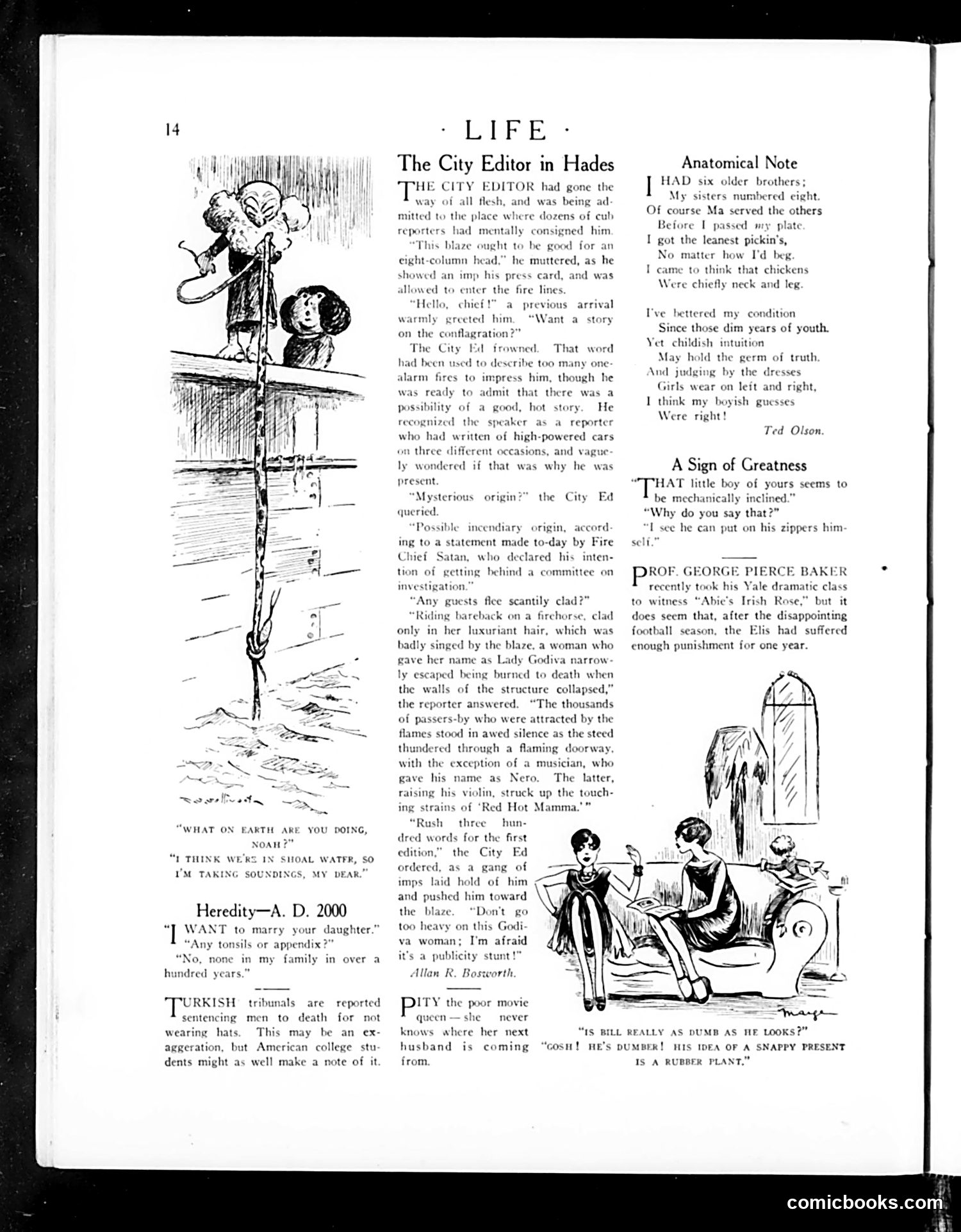
This page contains several brief humorous pieces typical of Life magazine's satirical style. The main story "The City Editor in Hades" mocks newspaper journalism—specifically the cliché of sensational "fire stories." A deceased city editor arrives in the afterlife and immediately seeks dramatic stories, showing that newspaper men obsess over spectacular incidents regardless of circumstance. The satire suggests journalists prioritize sensational narratives over substance. The cartoon below depicts a domestic scene where a husband presents his wife with what she considers a ridiculous gift ("a snappy present is a rubber plant"), mocking men's poor gift-giving judgment and wives' disappointment. The smaller items—"Heredity," Turkish hat laws, and movie-queen gossip—represent Life's typical short-form social commentary on contemporary absurdities in culture, fashion, and behavior.
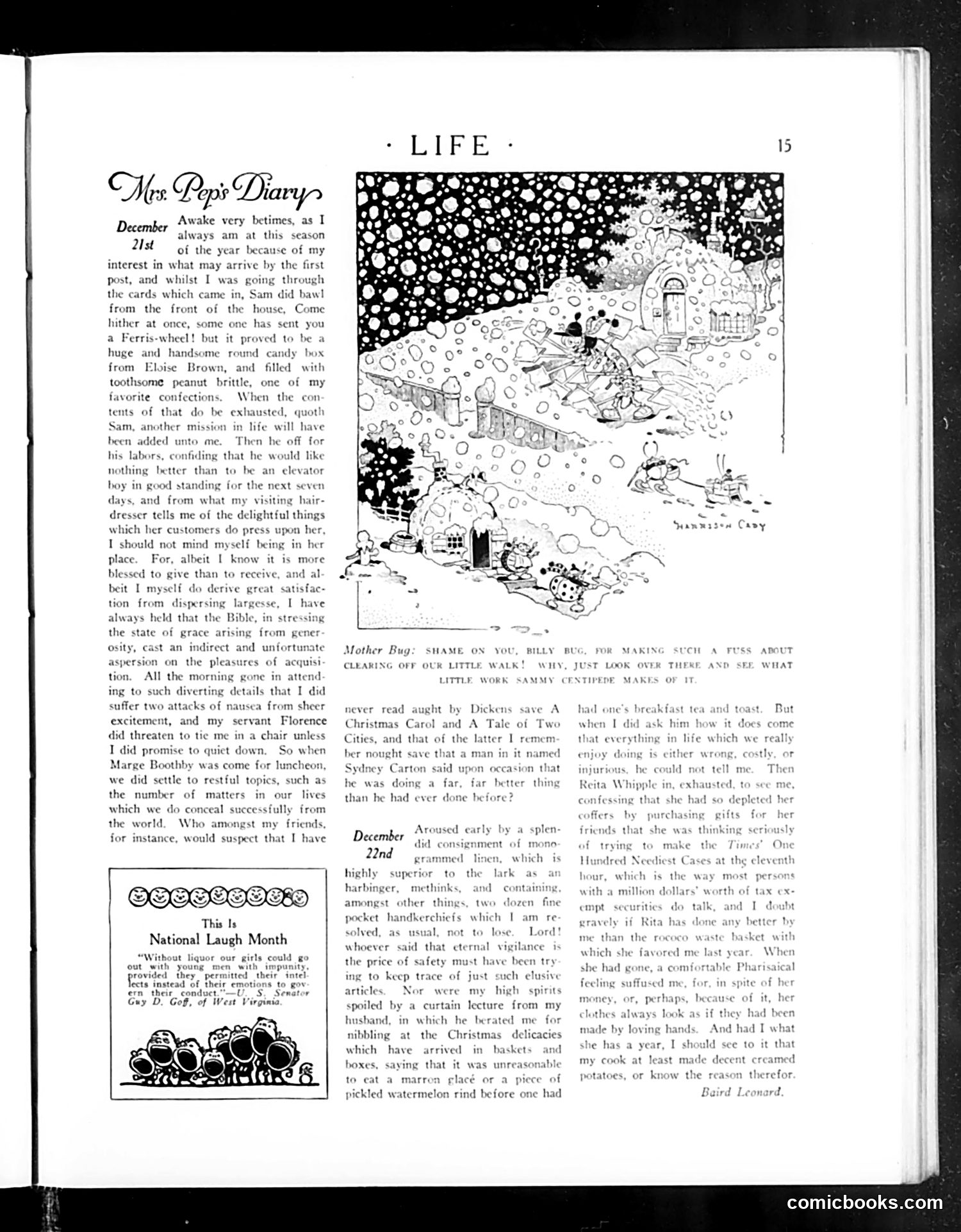
This page contains **Mrs. Pop's Diary**, a personal column, rather than political satire. The diary entry (dated December 21st-22nd) describes domestic life—receiving a Ferris-wheel candy box, managing household tasks, and dealing with servants' issues. The accompanying illustration depicts a whimsical winter scene with snow and various activities. Below that is a section titled **"This Is National Laugh Month"** featuring a humorous quote about liquor and conduct, illustrated with cartoon faces. The bottom section includes **"Mother Bug"**—a satirical piece mocking a character (Billy Bug) for complaining during household chores, suggesting it's minor domestic humor rather than political commentary. Overall, this page focuses on **social satire and domestic humor** rather than political cartooning.
This page discusses **Frank Munsey**, a prominent newspaper publisher who died recently. The cartoon at top depicts Death (skeletal figure with scythe) claiming Munsey, with "Life" magazine's banner present—a visual pun on the magazine's own name. The article, credited to **William Allen White** (a famous Kansas editor), praises Munsey's business acumen while criticizing his transformation of journalism into a profit-driven enterprise. White argues Munsey prioritized financial security over the profession's noble ideals, reducing newspapers to mere commercial ventures rather than civic institutions. The satire critiques how Munsey and similar publishers degraded American journalism's moral purpose in pursuit of wealth, a significant concern during the 1920s media landscape.
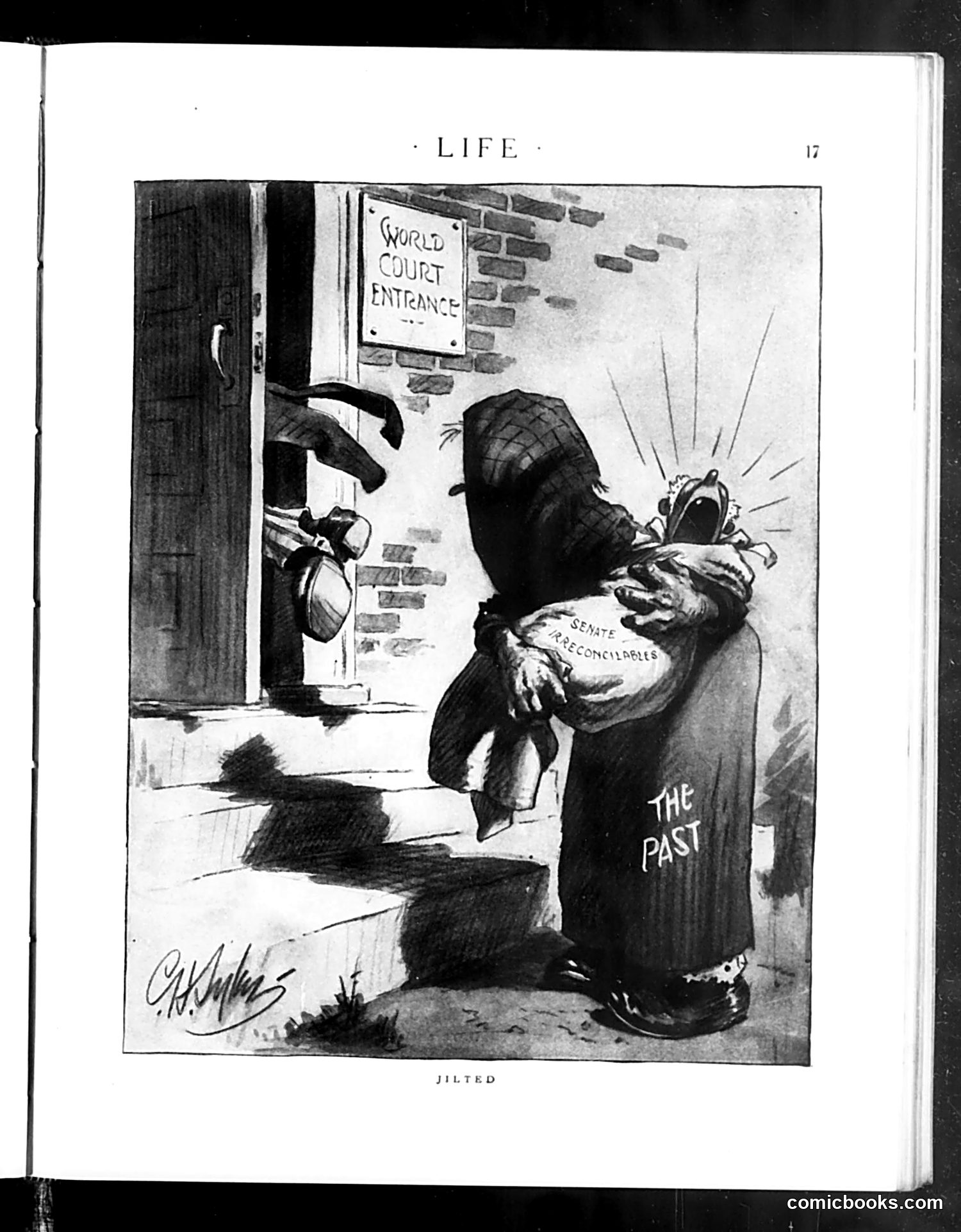
This cartoon satirizes the Senate's rejection of League of Nations membership. A figure labeled "The Past" (representing isolationist/historical American policy) blocks the "World Court Entrance," literally slamming the door on a figure carrying "Senate Reconcilables" (likely referring to senators willing to compromise on League membership). The cartoon criticizes how past attitudes prevented U.S. participation in international governance structures. "The Past" appears as an obstinate force preventing progress toward global cooperation. The "Jilted" title suggests the World Court or League was abandoned/rejected—presumably by the U.S. Senate's refusal to ratify membership. This reflects early 1920s debates over American isolationism versus international engagement.
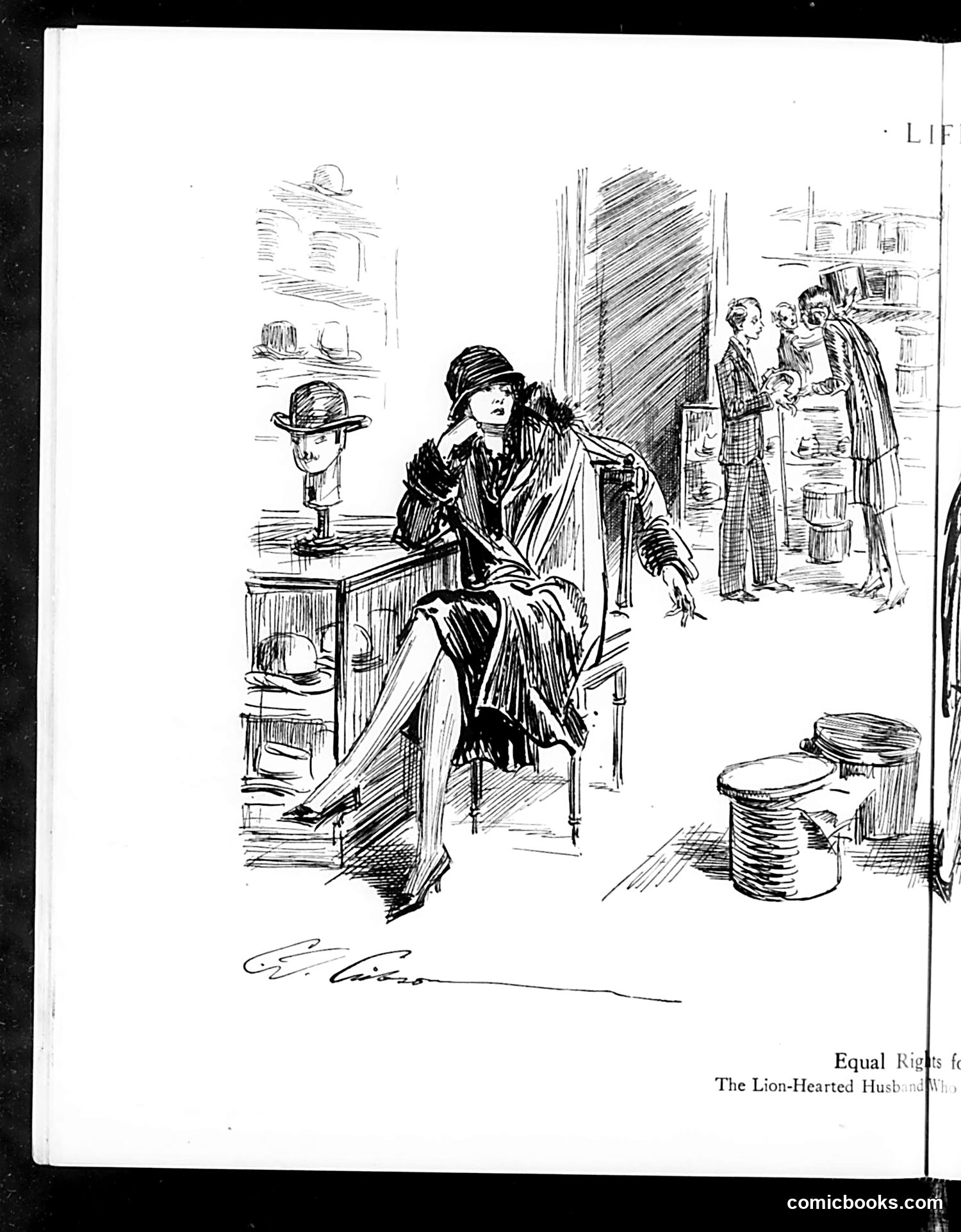
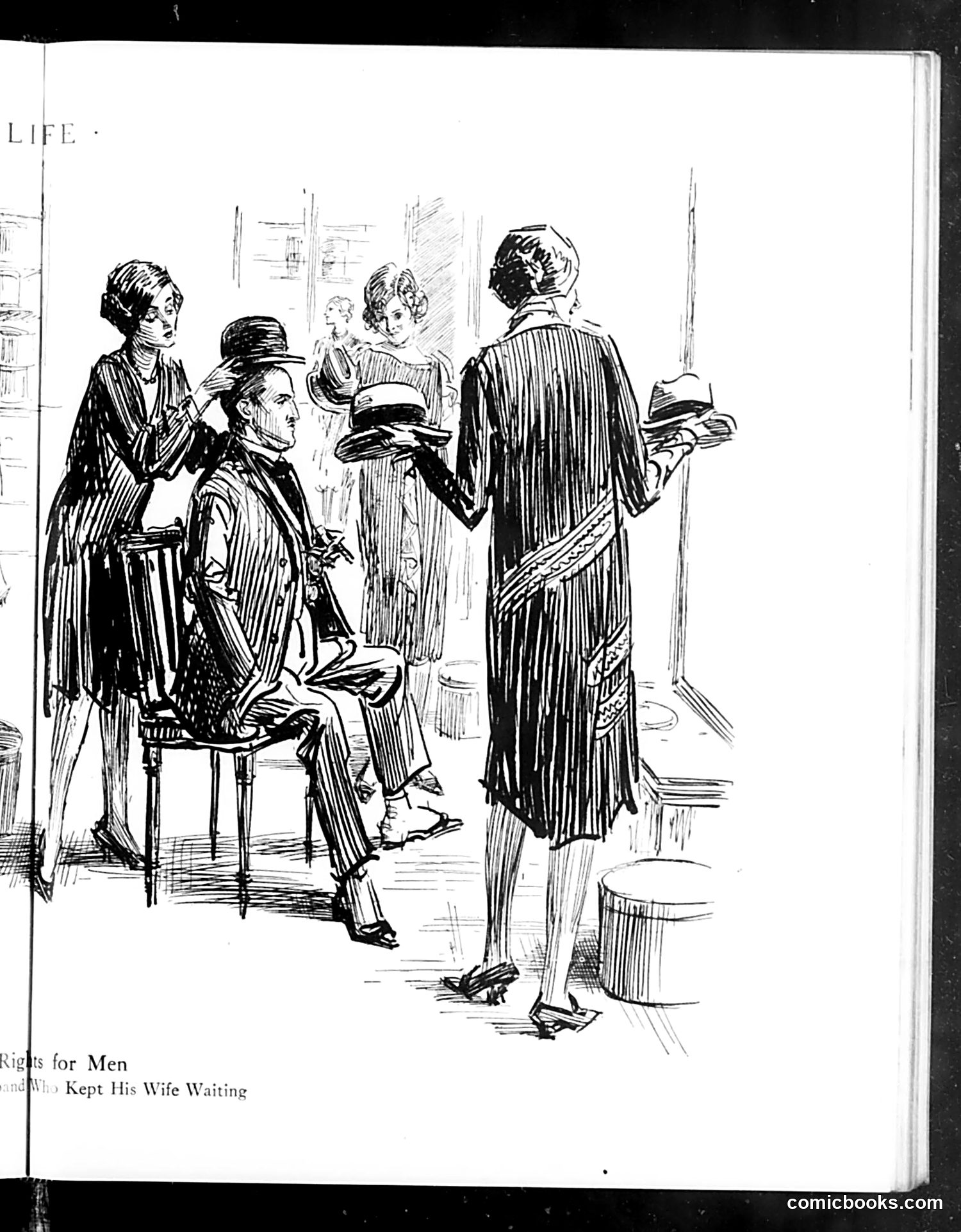
This is a satirical cartoon titled "Rights for Men—and He Kept His Wife Waiting." The sketch depicts a social scene where a well-dressed man (center, holding his hat) appears to be socializing or flirting with other women in what looks like an interior space, while his wife waits elsewhere—presumably at home or in another room, as the caption suggests. The satire targets the hypocrisy of men's rights rhetoric: while men advocated for expanding their own freedoms and "rights," they simultaneously maintained traditional expectations that women (especially wives) should remain patient and subordinate. The cartoon mocks this double standard, suggesting that "men's rights" conveniently excluded granting wives equal consideration or respect for their time.
This page reviews Broadway plays (Nos. 118-122), focusing on theatrical productions. The visible content discusses: **"One of the Family"** — a Boston-set play featuring actress Louise Closser Hale and Great Mitchell. The reviewer notes its appeal to New England audiences, praising the complete elimination of the letter "r" to authentically capture Boston dialect ("Bostonian" pronunciation). **"The Dybbuk"** — a play the Neighborhood Playhouse rehearsed for twelve weeks. The reviewer praises it as "practically perfect," describing how it explores spiritual possession (a dybbuk is a Jewish folklore concept of a wandering soul inhabiting another's body). The critic compares it favorably to other Jewish ritual dramas, noting its emotional intensity. The satirical illustrations are small and unclear in reproduction, but the text represents typical *Life* magazine drama criticism — witty, gossipy commentary on contemporary Broadway productions aimed at educated readers interested in theater and dialect humor.
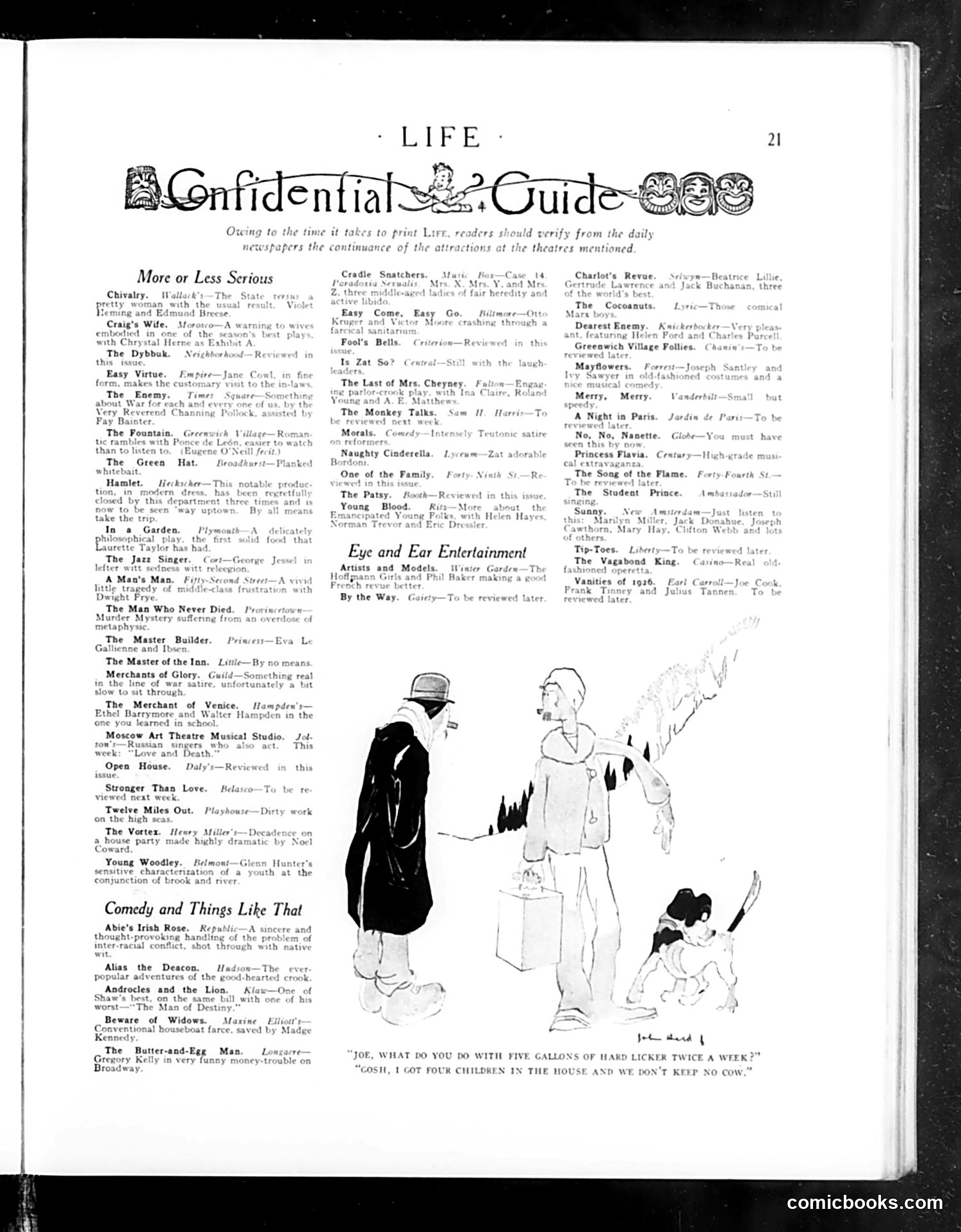
This is a single-panel cartoon satirizing Prohibition enforcement and domestic hardship. The illustration shows a man confronted by what appears to be a law enforcement officer or federal agent (identifiable by the hat and official appearance). The joke exploits the absurdity of Prohibition-era logic: the man defensively explains he possesses five gallons of hard liquor twice weekly not for illegal drinking, but because he has four children at home and no cow for milk. He's sarcastically suggesting the officer should understand his "necessity" for this large quantity of alcohol. The humor targets both Prohibition's impracticality—families genuinely struggled with limited milk sources—and the hypocrisy of enforcement. It implies ordinary people found creative justifications for breaking laws they didn't respect, while mocking the earnestness of prohibition agents who might actually believe such excuses. This reflects 1920s public skepticism about Prohibition's effectiveness and social impact.
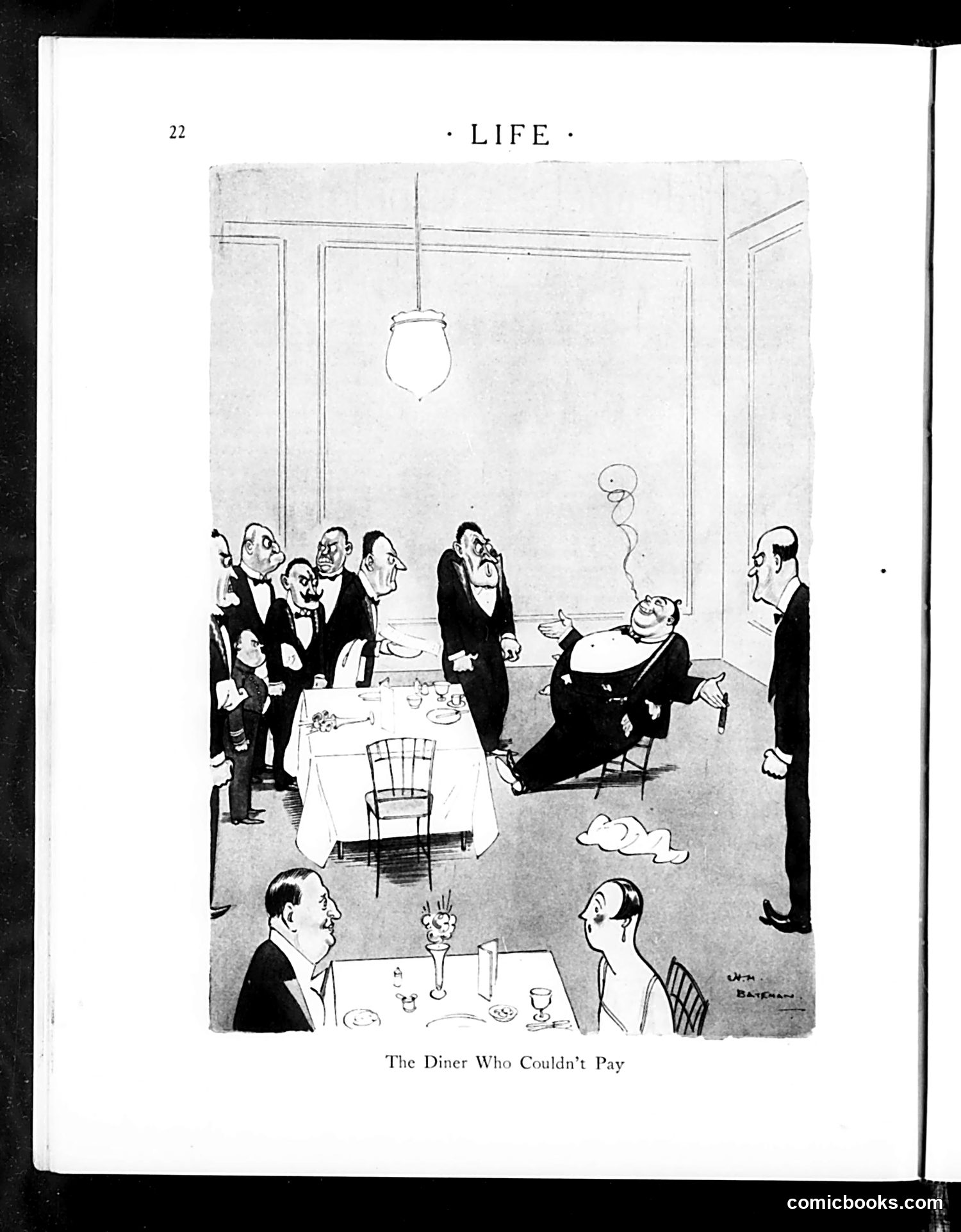
This cartoon satirizes social embarrassment in a formal dining setting. A well-dressed man sits at a restaurant table with a companion, appearing distressed or contemplative—likely realizing he cannot pay the bill. Meanwhile, other formally-dressed diners and waitstaff stand around the dining room observing the situation, their attention focused on the awkward scene. The humor targets the social shame of financial inability in genteel company. The stark contrast between the man's formal attire and his financial predicament suggests class anxiety—the pretense of respectability undermined by empty pockets. The onlookers' gazes emphasize public humiliation, a common theme in early 20th-century satirical humor about social pretension and economic vulnerability.
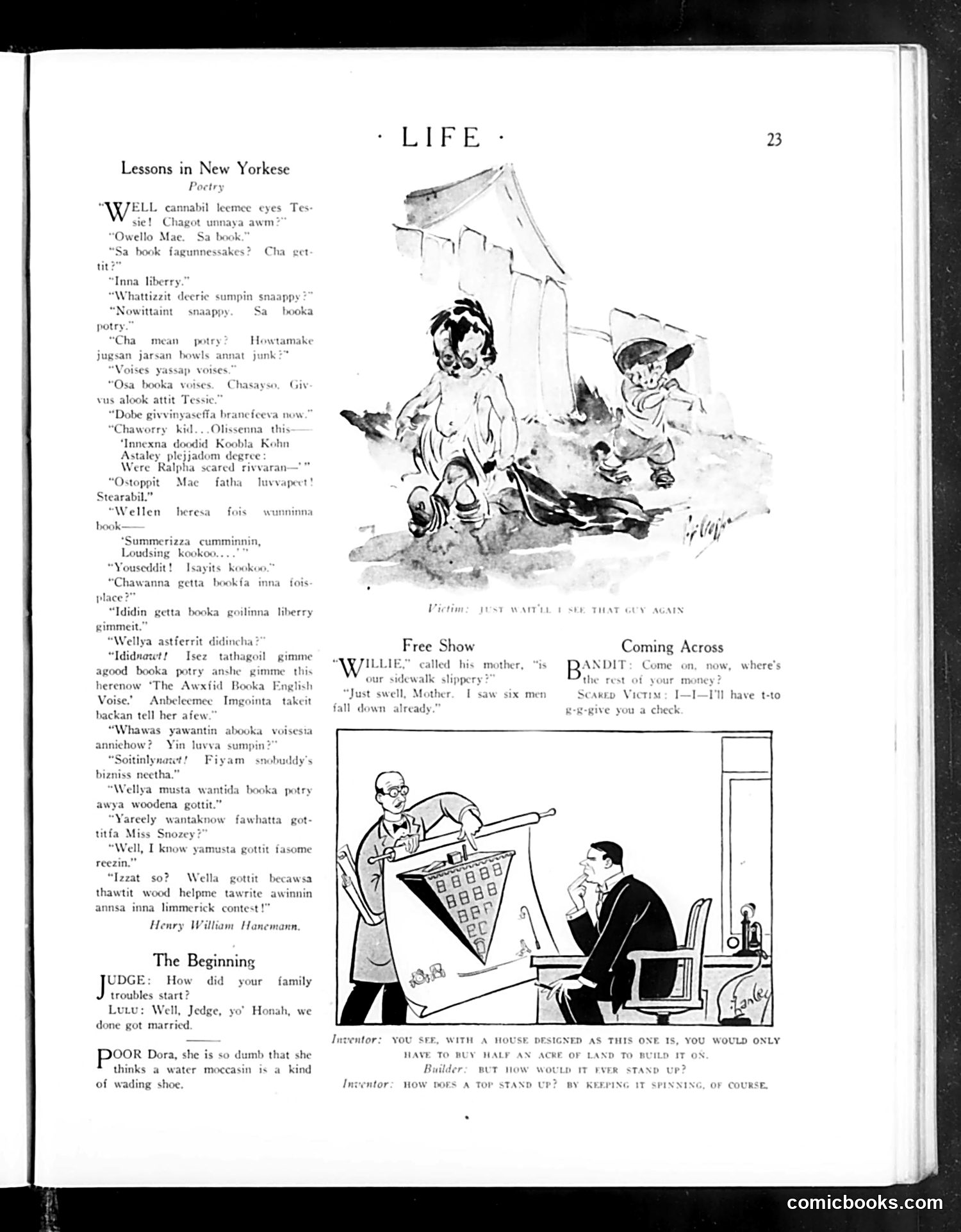
This page contains three separate comic pieces satirizing American life: **"Lessons in New Yorkese"** mocks working-class New York City immigrant dialect through a comedic dialogue about library visits. The exaggerated phonetic spelling ("cannabil leemee eyes," "Owello Mae") ridicules how non-native English speakers sound to native ears—typical of period humor that punched down at immigrants and the poor. **"Free Show"** depicts a con artist selling a dubious real estate scheme to a gullible buyer, pitching a house so tiny it requires only half an acre of land. The humor lies in the obvious absurdity the builder presents with a straight face. **"The Beginning"** shows a Black couple (indicated by dialect) explaining their marriage to a judge, with the punchline that poverty ("dumb" wife) caused their troubles—a crude stereotype playing on class and race. The page reflects Life's satirical approach: mocking immigrants, the poor, and racial minorities through exaggerated dialect and "fool" characters, representing attitudes common in early 20th-century American humor.
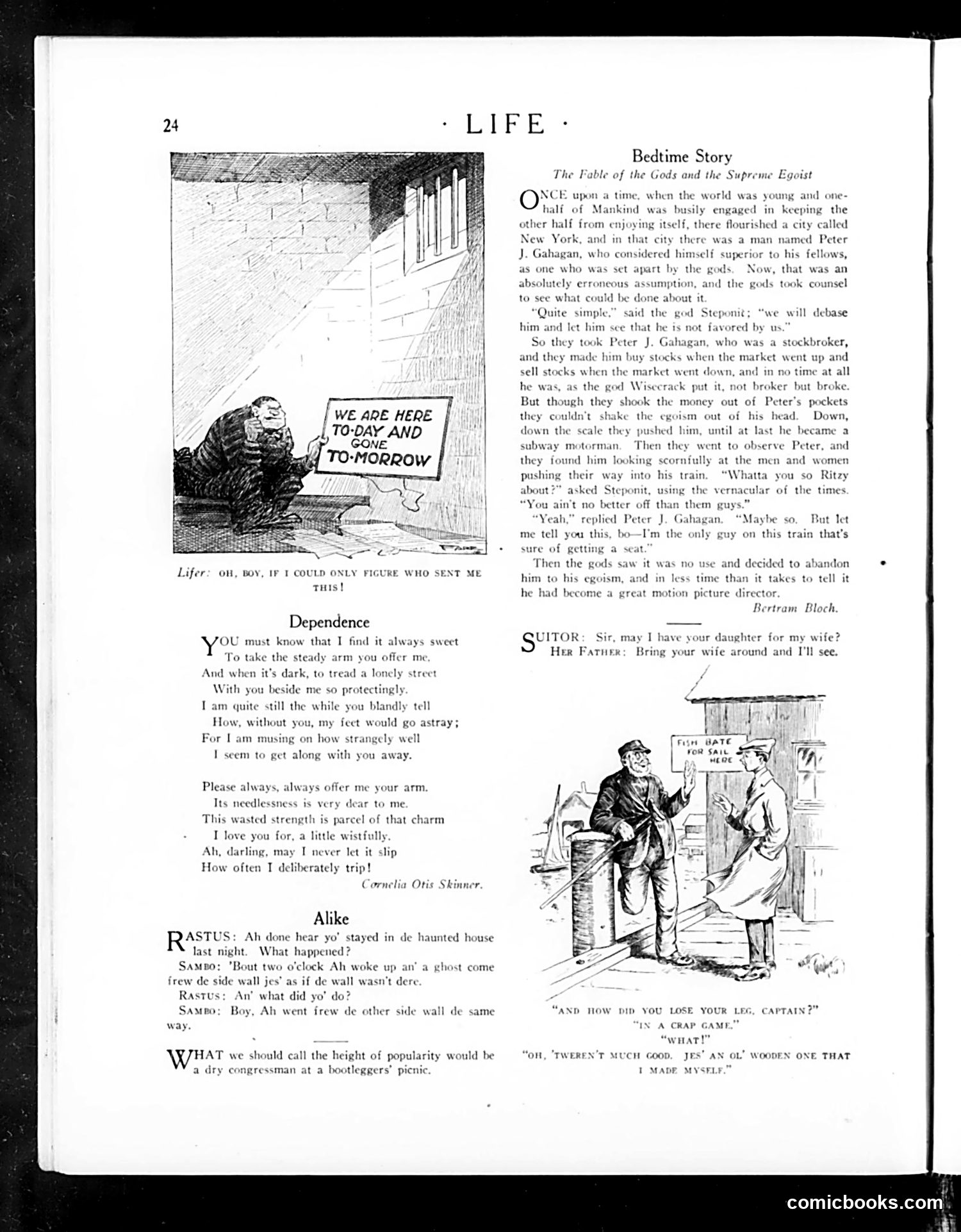
This page contains three satirical pieces from the early 20th century: **"The Fable of the Gods and the Supreme Egoist"** mocks a wealthy stockbroker named Peter J. Gahagan who considers himself superior to others. The gods punish his arrogance by bankrupting him through stock market manipulation, demoting him to subway motorman. The joke: his egotism survives intact—even as a transit worker, he smugly claims superiority because he'll get a seat. It concludes he becomes a film director (likely referencing silent-film industry figures of the era). **"Dependence"** is a poem by Cornelia Otis Skinner about a woman who enjoys appearing helpless to her male companion, deliberately tripping to maintain dependence. **"Alike"** and the captain cartoon are brief jokes: one features stereotyped dialect humor about a ghost passing through walls; the other plays on a prosthetic limb as a casualty joke. The page demonstrates Life's satirical approach to American society, wealth, ego, and gender dynamics of its era.
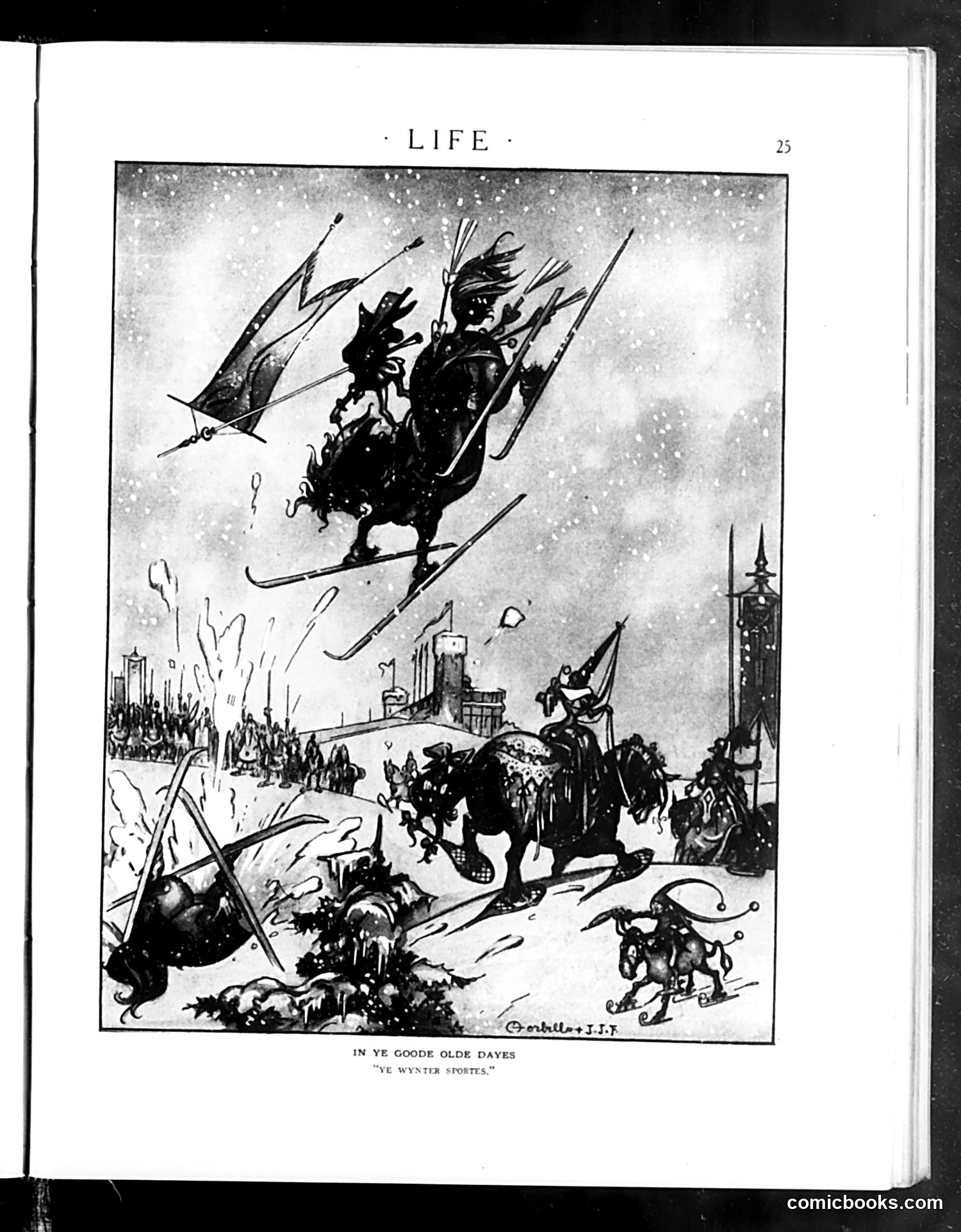
This satirical illustration depicts a fantastical winter scene titled in mock-archaic language. It shows elaborate, exaggerated "winter sports" involving costumed figures on skis engaged in what appears to be a chaotic, theatrical battle or pageant. The scene includes castles, towers, crowds, and airborne figures—suggesting an absurdist take on historical winter recreation. The satire likely mocks either: (1) romanticized notions of "the good old days" by showing them as ridiculous spectacles, or (2) contemporary winter sports fashions and pretensions as overly elaborate and performative. The mock-old-English spelling reinforces the nostalgic parody. Without the publication date visible, the exact historical reference remains unclear, but the cartoon uses exaggeration and theatrical staging to mock period aesthetics or sporting culture.
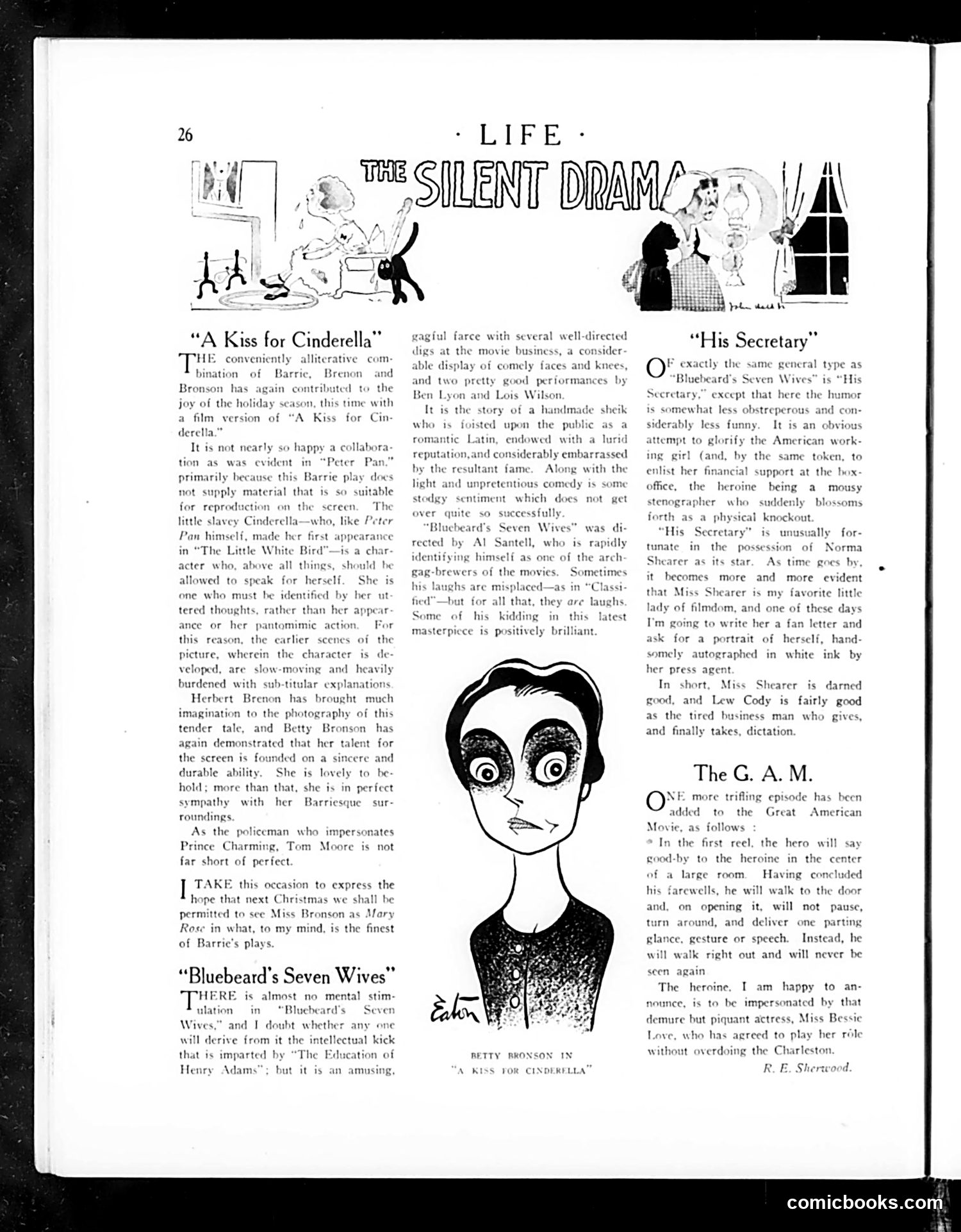
This page reviews four silent films. The central illustration shows Betty Bronson, star of "A Kiss for Cinderella," a J.M. Barrie adaptation. The reviewer praises Bronson's performance but criticizes the film itself, noting that Barrie's play didn't translate well to screen and that the character required excessive written explanations rather than relying on Bronson's natural acting ability. The other reviews are brief: "Bluebeard's Seven Wives" is called amusing but intellectually lightweight; "His Secretary" stars Norma Shearer and attempts to glorify working girls, with the reviewer expressing genuine admiration for Shearer's talent; and "The G.A.M." (Great American Movie) satirizes a clichéd plot device where the hero exits without looking back, never to be seen again. The writing reflects 1920s film criticism's concern with adapting literary works and evaluating actors' physical presence versus written exposition.
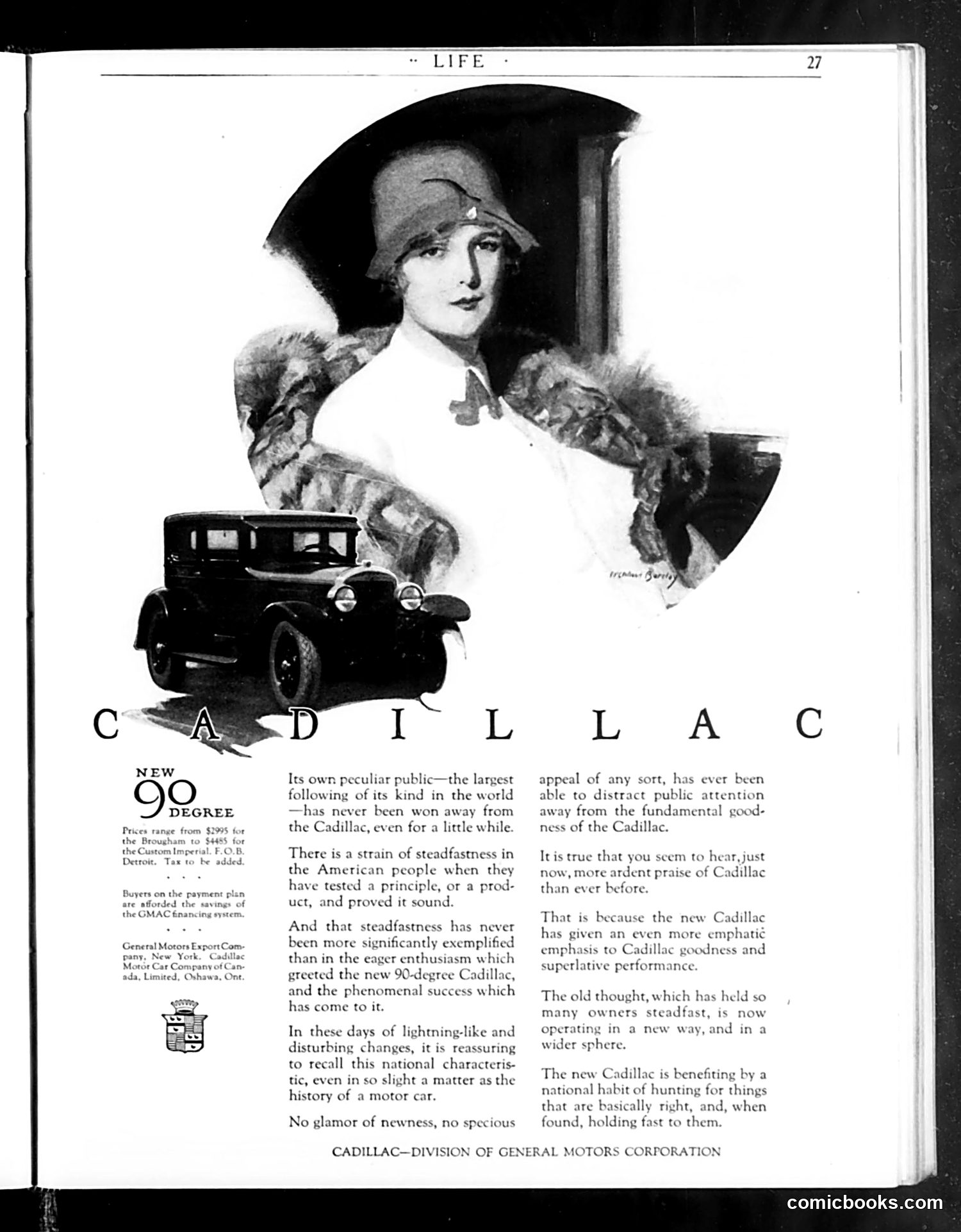
This is a **Cadillac automobile advertisement**, not satire or political commentary. The page features an elegant illustration of a stylishly dressed woman in 1920s fashion (cloche hat, fur stole) with a luxury car positioned below. The text praises Cadillac's reliability and American consumer loyalty, arguing that the "new 90-degree Cadillac" succeeds not through trendy novelty but through proven quality. The advertisement claims Americans demonstrate "steadfastness" when they've tested and approved a product—and Cadillac benefits from this national characteristic. The message positions Cadillac as a rational choice based on fundamental goodness rather than superficial appeal, while the glamorous female image targets affluent buyers of the era. This represents classic 1920s luxury marketing: combining aspirational imagery with appeals to sound judgment.
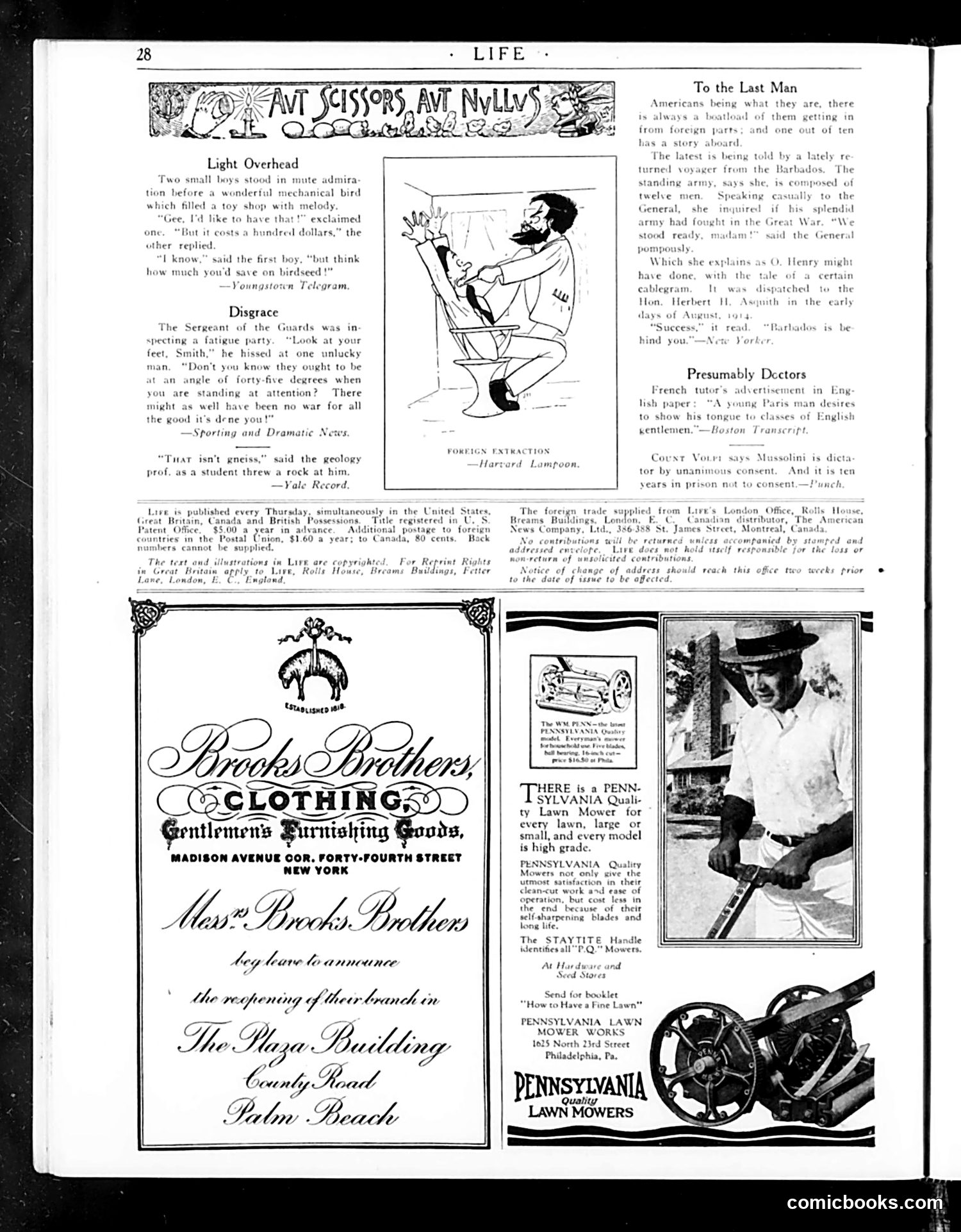
This page is primarily **advertising with minimal editorial content**. The main cartoon, "Foreign Extraction" (center), shows a man struggling to operate what appears to be a dentist's chair or medical equipment—likely satirizing incompetence or the difficulty of mastering complex machinery. The brief humor items ("Light Overhead," "Disgrace," "Presumably Doctors") are short anecdotes poking fun at: - Children's naive economics - Military discipline and soldier complaints post-WWI - Geology professors and miscommunication - Foreign language instruction The page is dominated by **period advertisements**: Brooks Brothers clothing, Pennsylvania Lawn Mowers, and real estate announcements for Palm Beach properties. The lawn mower ad features a photograph of a man demonstrating equipment. **For modern readers**: This reflects early 20th-century concerns (post-WWI soldier reintegration, immigrant education, technological complexity) alongside consumerism targeting affluent readers. The humor is genteel and domestic rather than sharp political satire.
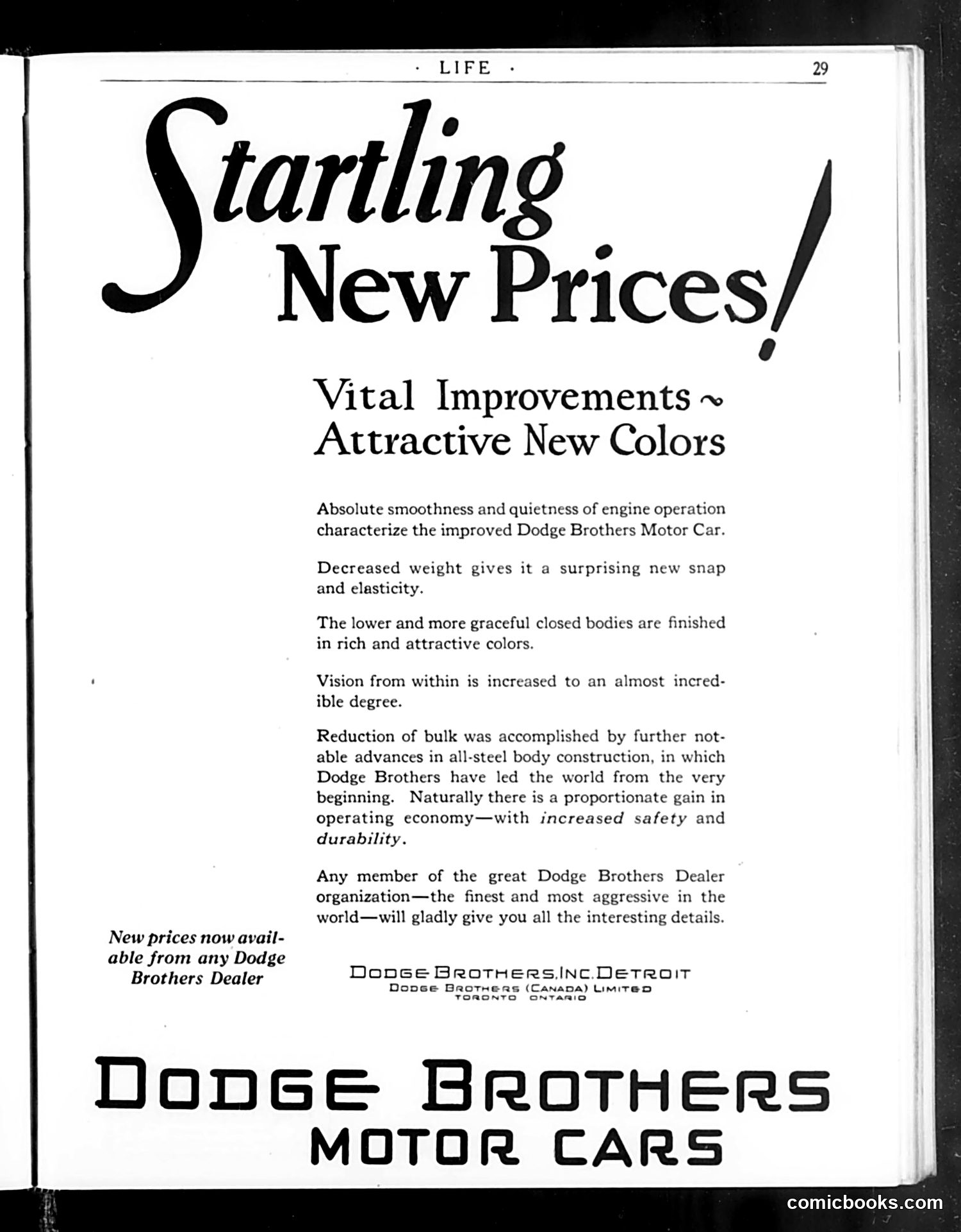
Page 29 of *Life* magazine contains a full-page advertisement for Dodge Brothers Motor Cars announcing new models with reduced prices. The ad highlights technical improvements: smoother engine operation, decreased weight, new color options, improved visibility, and all-steel body construction. It emphasizes cost savings and durability benefits. There is no political or social satire present. This is a genuine automotive advertisement from the early automotive era when Dodge Brothers was a major American manufacturer. The exclamatory tone ("Startling New Prices!") reflects period advertising style. The page directs readers to contact their local Dodge Brothers dealer for details.
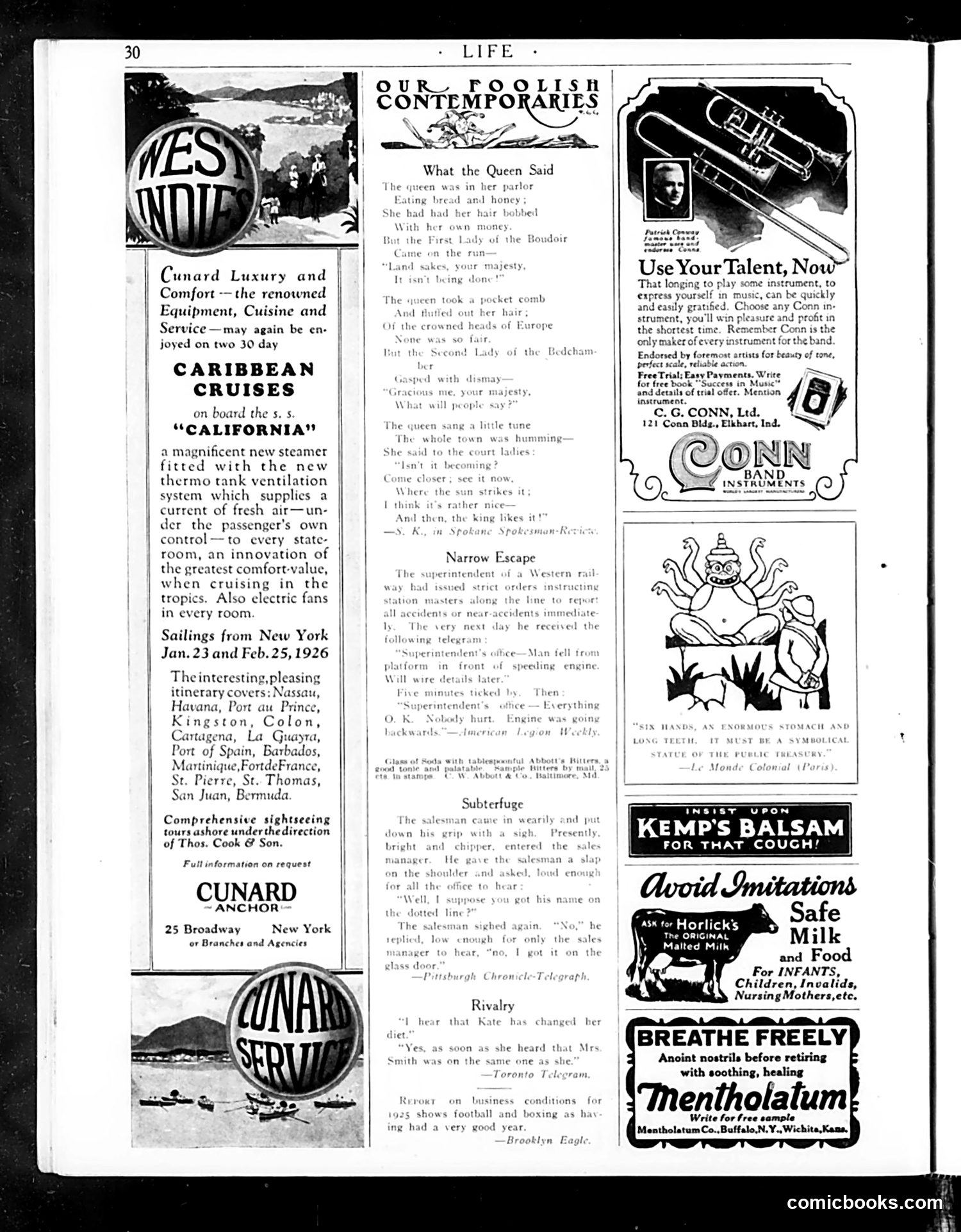
This page is primarily **advertising** with minimal satirical content. The dominant features are commercial ads for luxury cruises, musical instruments, and patent medicines—typical of 1920s magazines. The small text section titled "Our Foolish Contemporaries" contains brief humorous anecdotes: - **"What the Queen Said"**: A joke about a queen eating bread and honey, with her hair becoming disheveled—gentle, nonsensical humor. - **"Narrow Escape"** and **"Subterfuge"**: Brief workplace comedies about a railroad superintendent and a salesman, poking mild fun at bureaucratic miscommunication. - **"Rivalry"**: A gossip item about someone named Kate changing her diet after hearing about Mrs. Smith doing the same. These are light social observational jokes with no political content—typical filler humor for the era. The page's real purpose is selling Cunard steamship vacations, Conn band instruments, and various patent medicines to affluent readers.
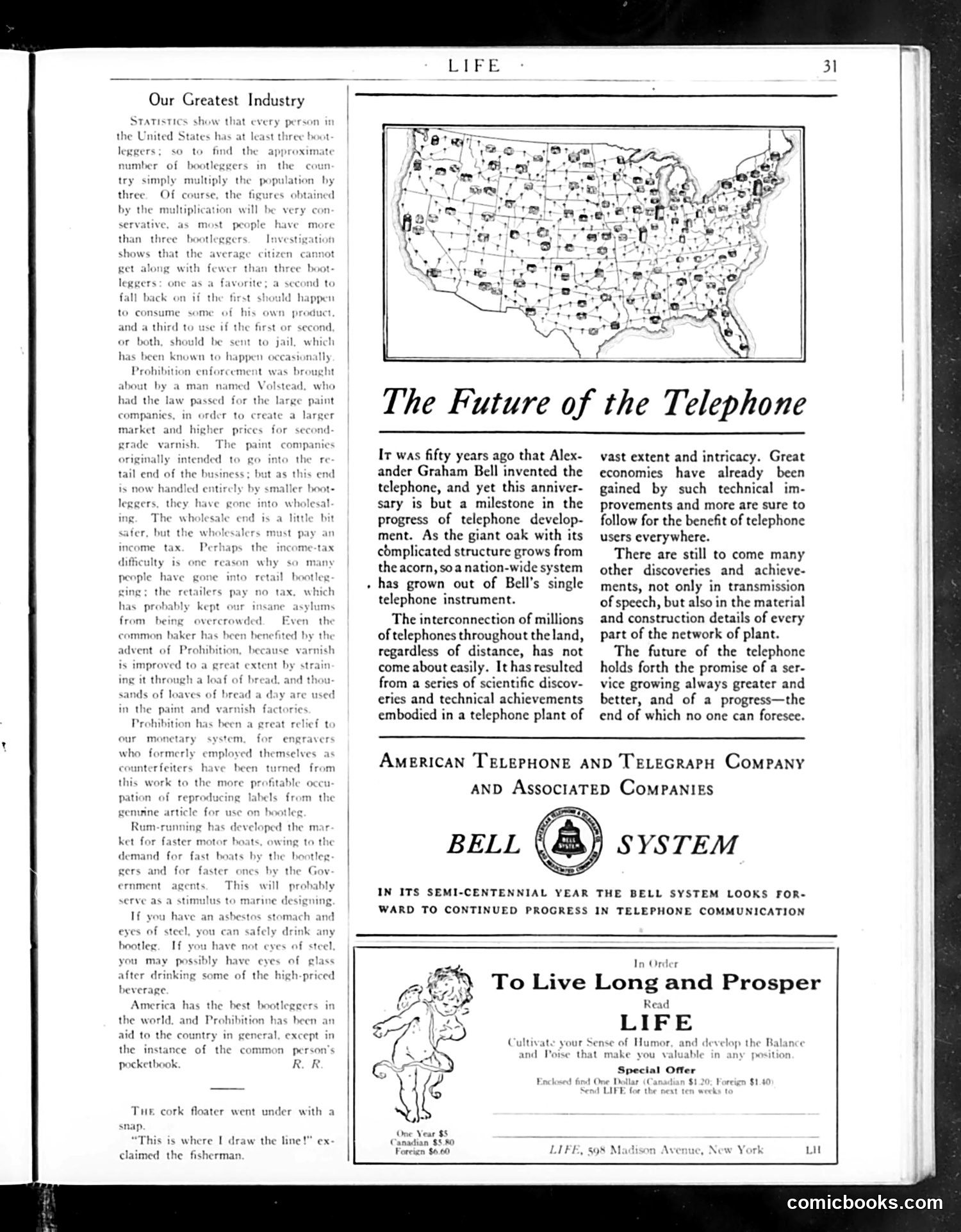
This page from Life magazine (likely 1920s) satirizes Prohibition through dark humor about bootlegging. The left column's article claims bootlegging is "our greatest industry," arguing that every American needs three bootleggers: one favorite, one backup, and one for emergency use. It mocks Prohibition's failure by suggesting the law (passed by Representative Volstead) actually *benefited* paint companies and created lucrative illegal markets for fast boats and contraband. The satire targets how Prohibition enforcement backfired economically—unemployed counterfeiters now work in bootlegging, bakers supply illegal distilleries, and the government loses tax revenue. The small cartoon at bottom shows a fisherman declaring "This is where I draw the line!" after a cork floater sinks—a pun suggesting even he has limits, contrasting the widespread moral compromise Prohibition created. The Bell System advertisement on the right provides sharp contextual contrast: respectable technological progress versus the criminal economy Prohibition inadvertently fostered.
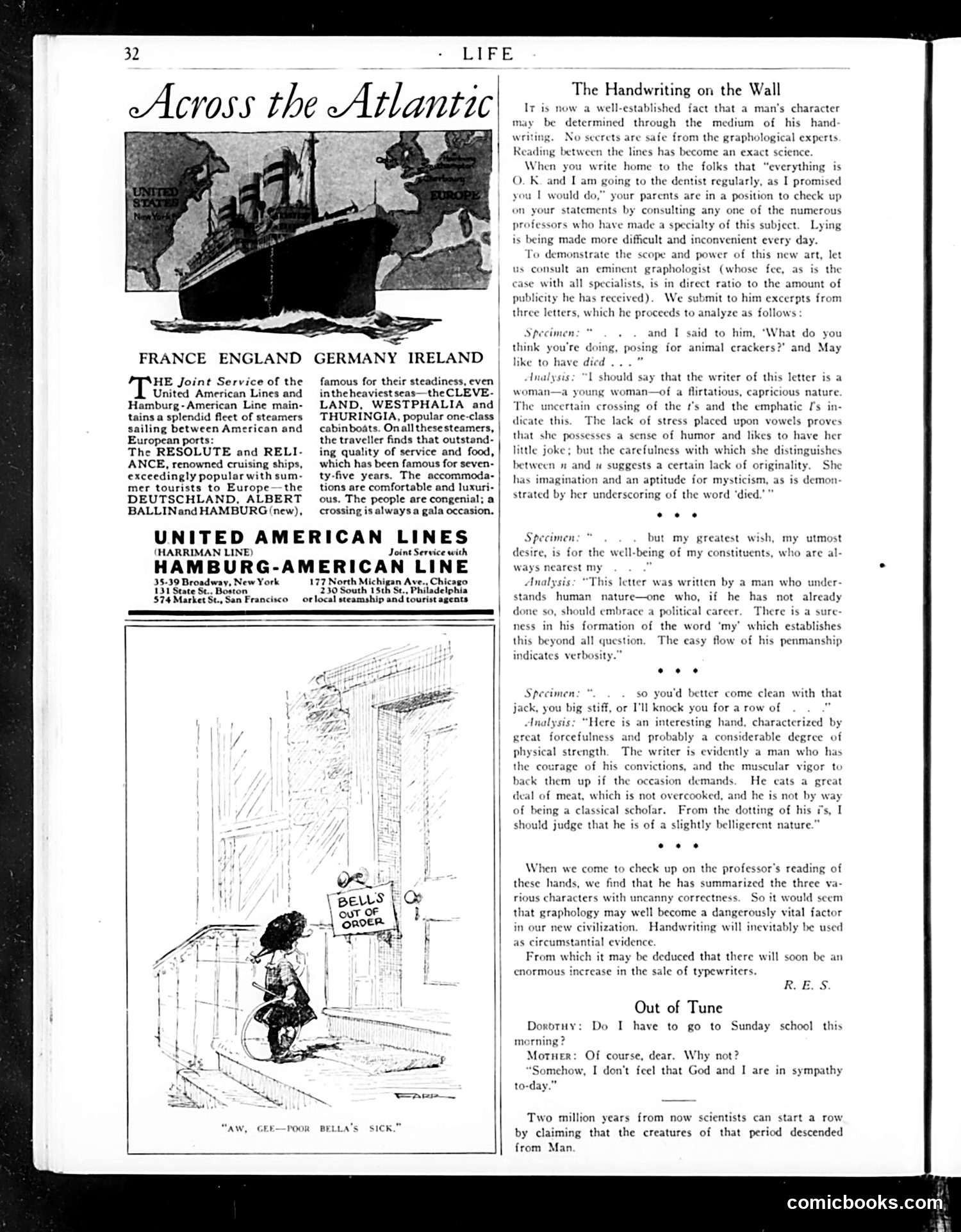
This page satirizes the early-20th-century fad of **graphology**—analyzing personality from handwriting. The text mocks how this pseudoscience claims to reveal character, lies, and even profession from penmanship alone. Three specimen letters are presented with hilariously reductive "analyses": a flirtatious young woman identified by her crossed t's; a politician recognized by his emphasis on "my"; and a physically strong, meat-eating man detected through his dotted i's. The satire targets the widespread gullibility about graphology as a legitimate science. By showing absurdly specific personality readings drawn from trivial handwriting features, the piece ridicules both the "expert" graphologists charging fees and the public's willingness to believe their interpretations. The ad section below shows steamship companies unrelated to the main humor, standard for Life magazine's mixed advertising-and-editorial format.
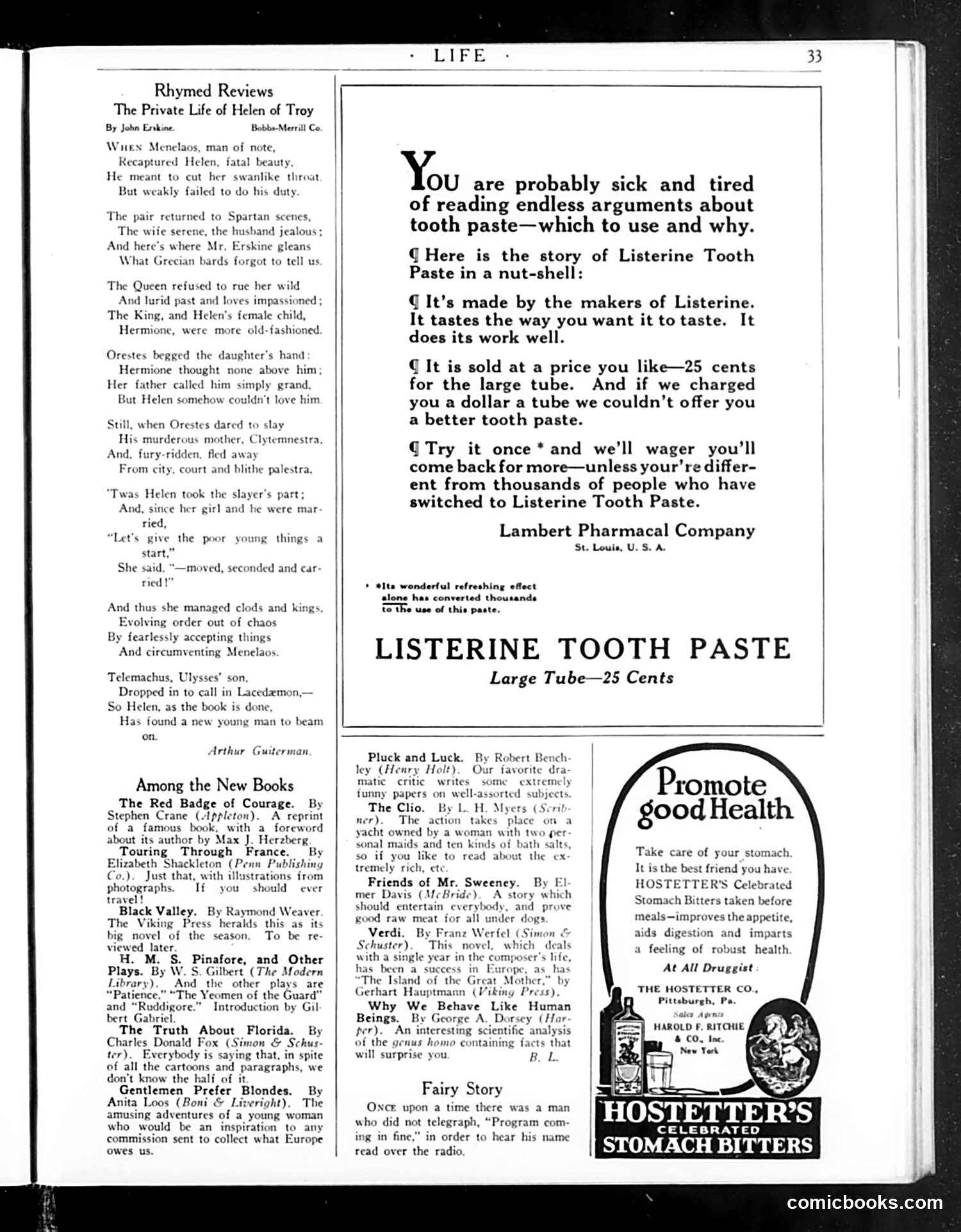
This page contains a **rhymed book review** (left column) and **advertisements** (right column and bottom). **The Review:** Arthur Guiterman offers a humorous verse critique of John Erskine's novel *The Private Life of Helen of Troy*. The satire mocks how the book reimagines the Greek mythological figure Helen not as tragic, but as a pragmatic woman who manages situations by accepting circumstances and working around her husband Menelaus. Guiterman's tone suggests mild amusement at this domestication of classical tragedy—Helen becomes a practical problem-solver rather than a doomed beauty. The review implicitly pokes fun at modern literary retellings that strip mythic figures of their gravitas. **The Advertisements:** Two full-page ads (Listerine Tooth Paste and Hostetter's Stomach Bitters) occupy significant space, typical of 1920s magazine revenue models. These reflect period consumer marketing: direct address, simple product claims, and appeals to health consciousness. The page illustrates *Life*'s dual purpose: literary satire for educated readers alongside commercial advertising.
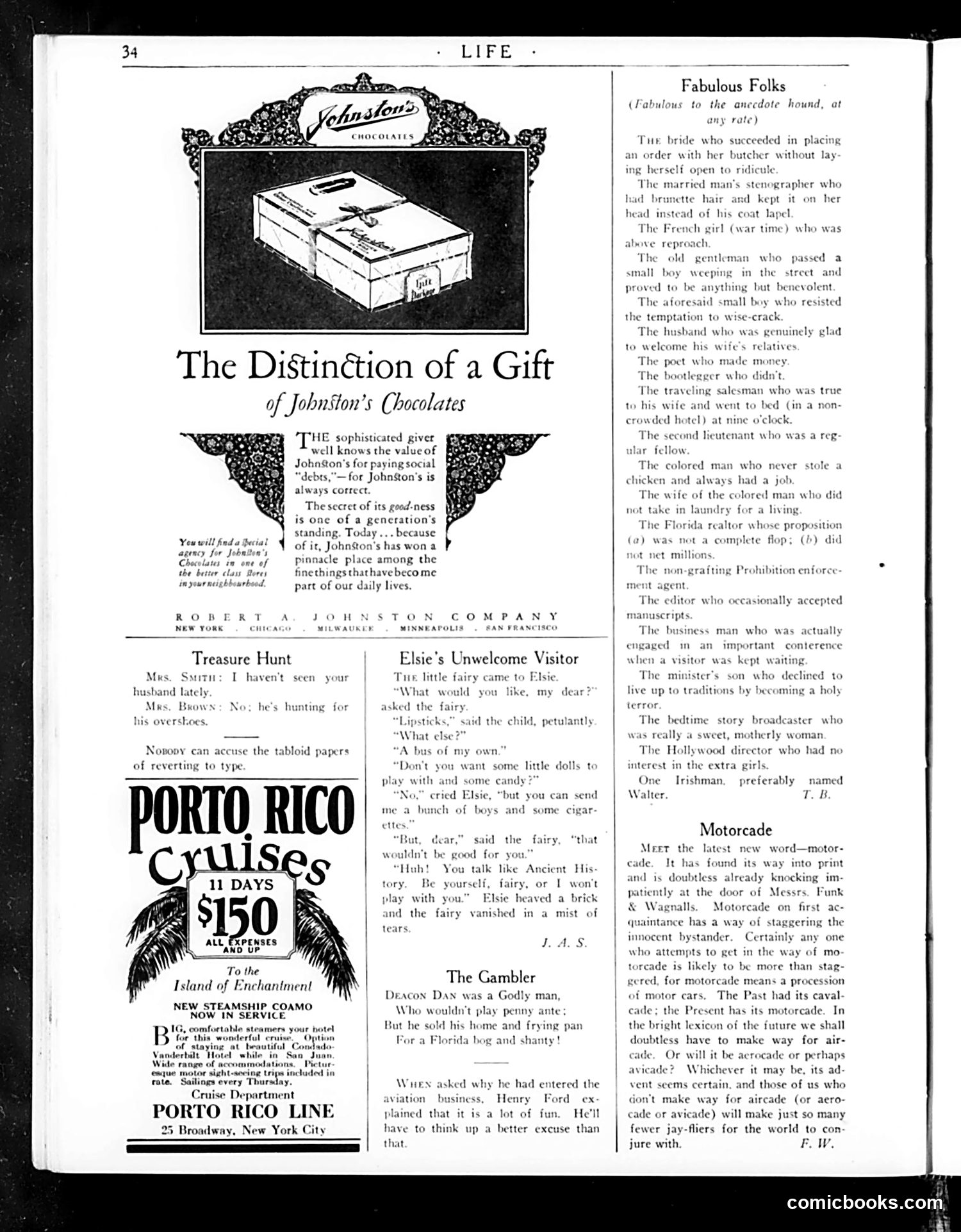
This page mixes advertising with humorous short pieces typical of 1920s satirical magazines. The main content includes: **"Fabulous Folks"** — A list of improbable, virtuous characters presented as satirical commentary on social types. Examples include "the traveling salesman who was true to his wife" and "the editor who occasionally accepted manuscripts"—implying these behaviors were so rare they were essentially fictional. The satire targets common stereotypes and human weaknesses of the era. **Short comic vignettes** like "Elsie's Unwelcome Visitor" (a child rejecting a fairy's gifts for boys and cigarettes), and "The Gambler" (mocking a deacon who abandons respectability for Florida real-estate speculation—likely referencing the 1920s Florida land boom). **"Motorcade"** — A playful note on new slang, suggesting the neologism follows the pattern of "cavalcade" but for motor cars. The ads (Johnston's Chocolates, Porto Rico cruises, Porto Rico Line shipping) reflect contemporary consumer culture. Overall, the page satirizes modern American social pretension, greed, and hypocrisy through gentle mockery rather than sharp political commentary.
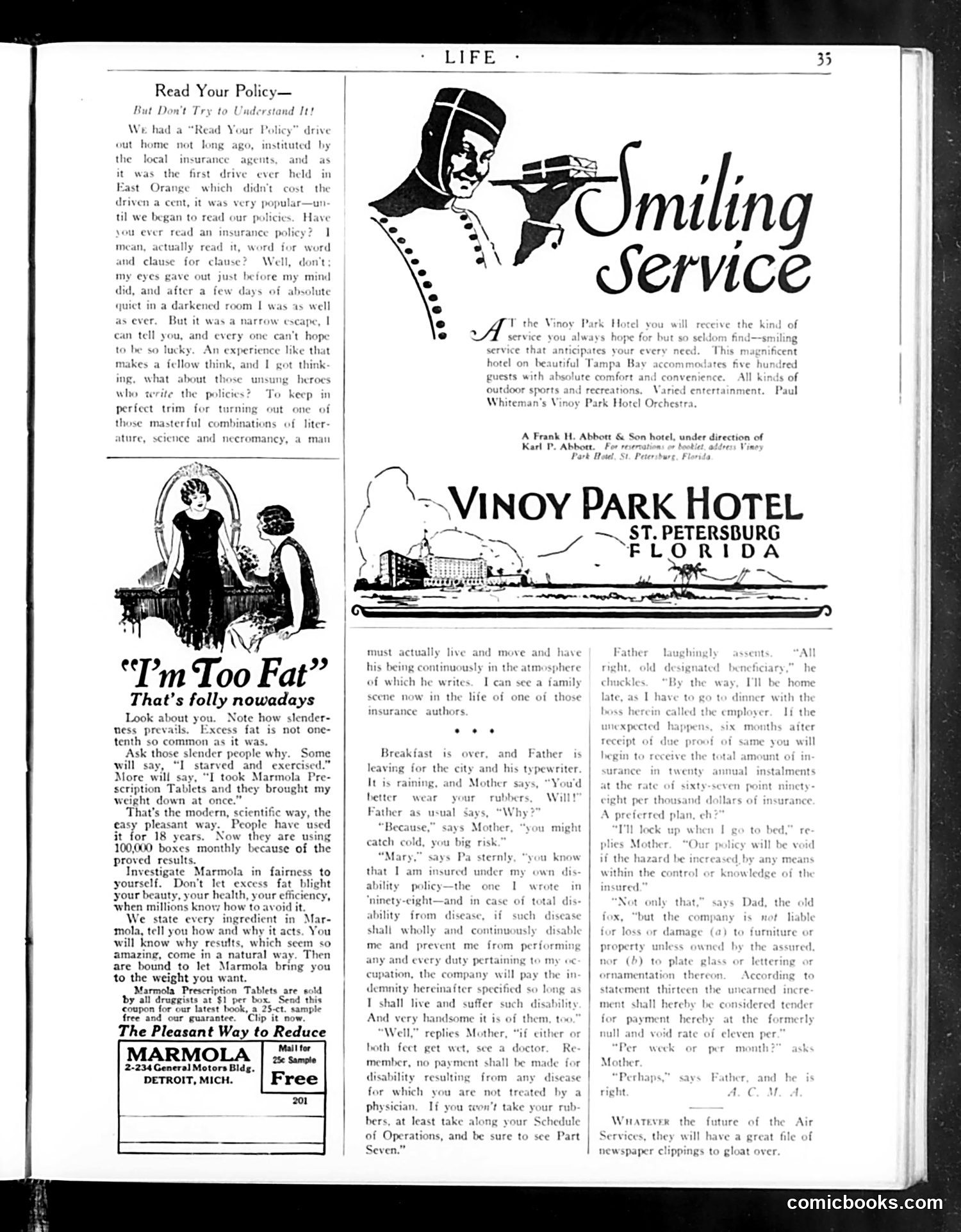
This page contains two distinct pieces: **Left side:** A humorous essay mocking insurance policies. The author describes a "Read Your Policy" campaign by local insurance agents. He admits that actually *reading* an insurance policy nearly drove him mad—after days of studying incomprehensible legal language and clauses in a darkened room, he emerged traumatized. The satire targets the deliberately obscure, unreadable nature of insurance contracts that ordinary people are expected to understand and sign. **Right side:** An advertisement for Vinoy Park Hotel in St. Petersburg, Florida, followed by a domestic comedy sketch where Father and Mother discuss his disability insurance policy. Mother worries he'll catch cold without rubbers; Father reassures her his insurance covers "total disability from disease." The joke plays on the gap between real-life risks (catching a cold) and what insurance actually covers—suggesting the policy's protections are largely theoretical. Together, these pieces satirize early 20th-century insurance as simultaneously impenetrable to consumers yet somehow reassuring to buyers who don't fully understand what they've purchased.
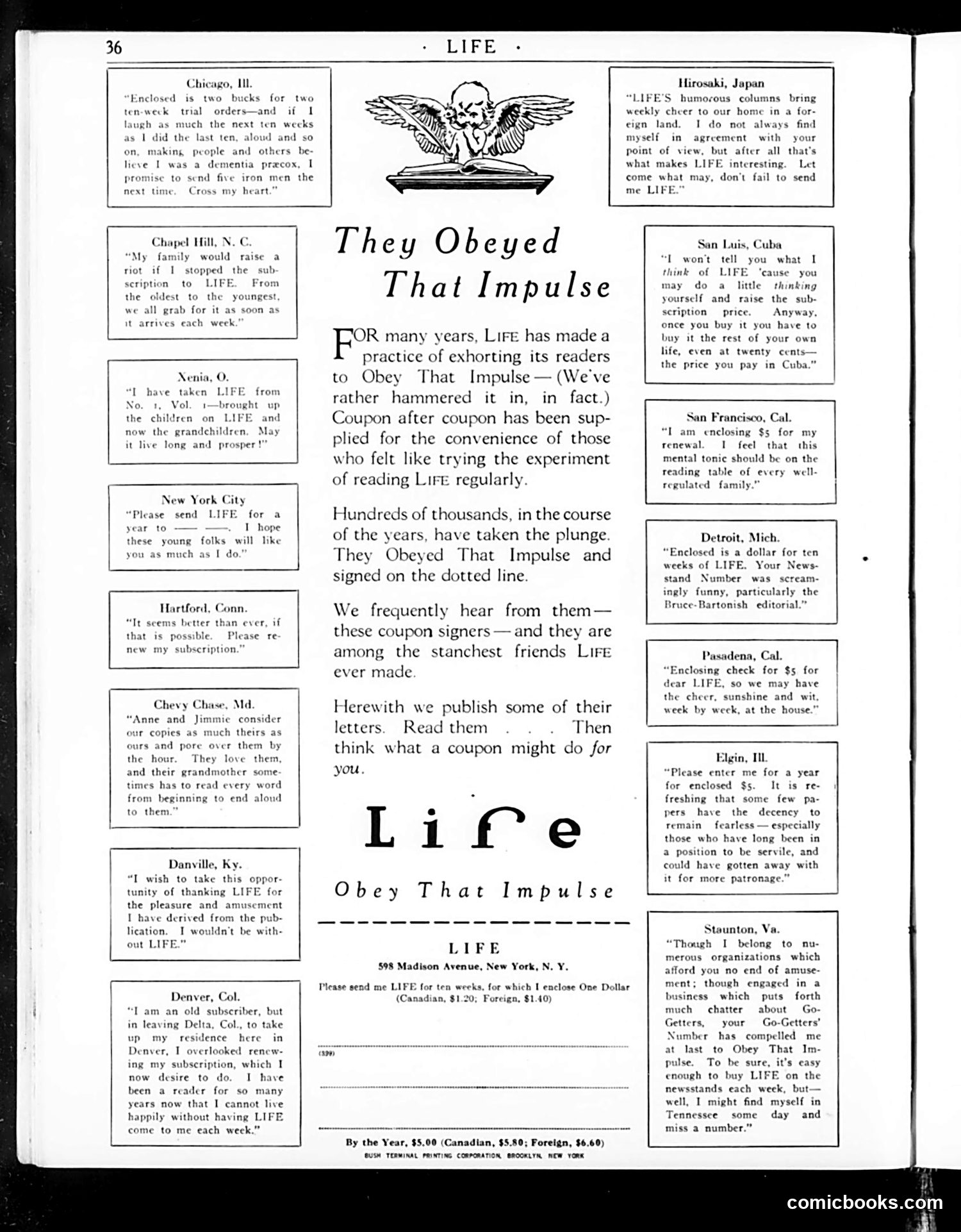
This is a **subscription promotion page**, not a political cartoon. The central image—a winged cherub sitting on an open book—is decorative branding for *Life* magazine itself. The page's purpose is to encourage subscription by reprinting **reader testimonials** from across America and abroad (Japan, Cuba). These letters praise *Life*'s humor and satirical content, with readers describing it as essential entertainment—one calls it a "mental tonic." The phrase "Obey That Impulse" is *Life*'s own marketing slogan, urging readers to act on the impulse to subscribe. The page notes that "hundreds of thousands" have done so and become loyal subscribers. The testimonials emphasize *Life*'s appeal as humorous, fearless commentary on contemporary issues (one reader mentions the "Bruce-Bartonish editorial"). Essentially, this is a **advertising page** leveraging customer satisfaction to sell subscriptions—a common early 20th-century magazine tactic.
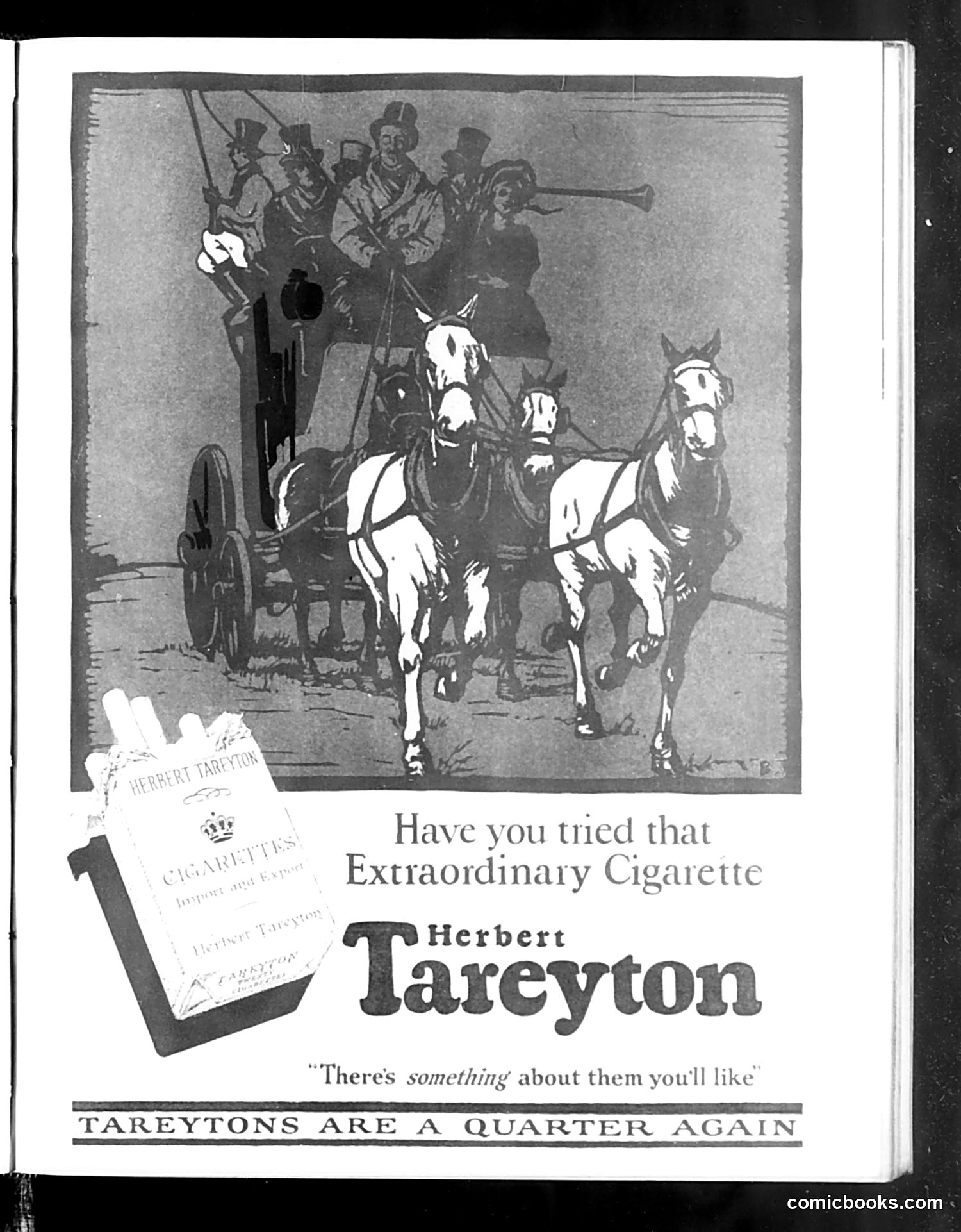
This is a cigarette advertisement for Herbert Tareyton brand, not political satire. The image shows a horse-drawn carriage carrying several well-dressed men in top hats, depicted in an exaggerated, comedic style typical of early 20th-century advertising illustration. The ad's humor relies on the phrase "Tareytons are a quarter again"—a pun playing on the double meaning of "quarter" (both a coin denomination and a quarter-turn or rotation). The chaotic, careening carriage scene visually reinforces this wordplay, suggesting the cigarettes are worth the extra cost ("a quarter again" = 25% more expensive). The tagline "There's something about them you'll like" was a common advertising appeal emphasizing product quality without specific claims.
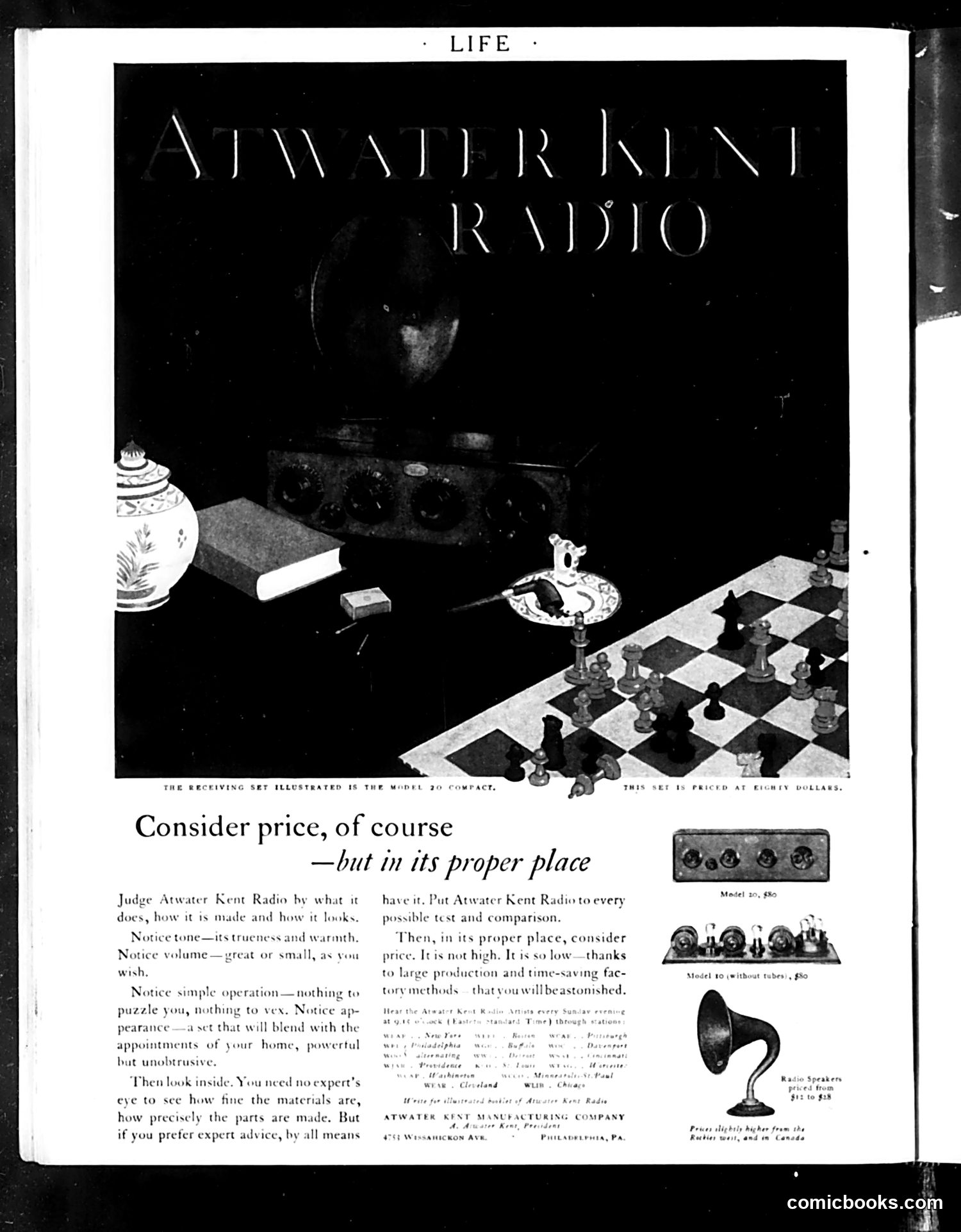
This is **not a cartoon or satire page**—it's a **product advertisement** for Atwater Kent radios, disguised within Life magazine's format. The large photograph at top shows a radio receiving set displayed among luxury goods (chess set, decorative plate, ornamental lamp), establishing the product as a refined home accessory. The "AMATEUR KIND RADIO" text appears to be either OCR error or decorative typography. The advertisement's rhetorical strategy argues that while the Atwater Kent radio is affordable ("price is not high"), buyers should first judge it by **quality metrics**: sound fidelity, volume control, aesthetic design, and internal precision engineering. Only *then* should price be considered—implying the low cost is a bonus given the superior craftsmanship. This was typical 1920s-30s radio advertising: positioning an emerging consumer technology as both luxury and practical. The chess and fine objects in the photograph suggest radio ownership as a mark of cultured domesticity. **No satire is present.** This is straightforward commercial promotion.