
Life, 1926-01-14 · page 18 of 40
Life — January 14, 1926 — page 18: what you’re looking at
What you’re looking at
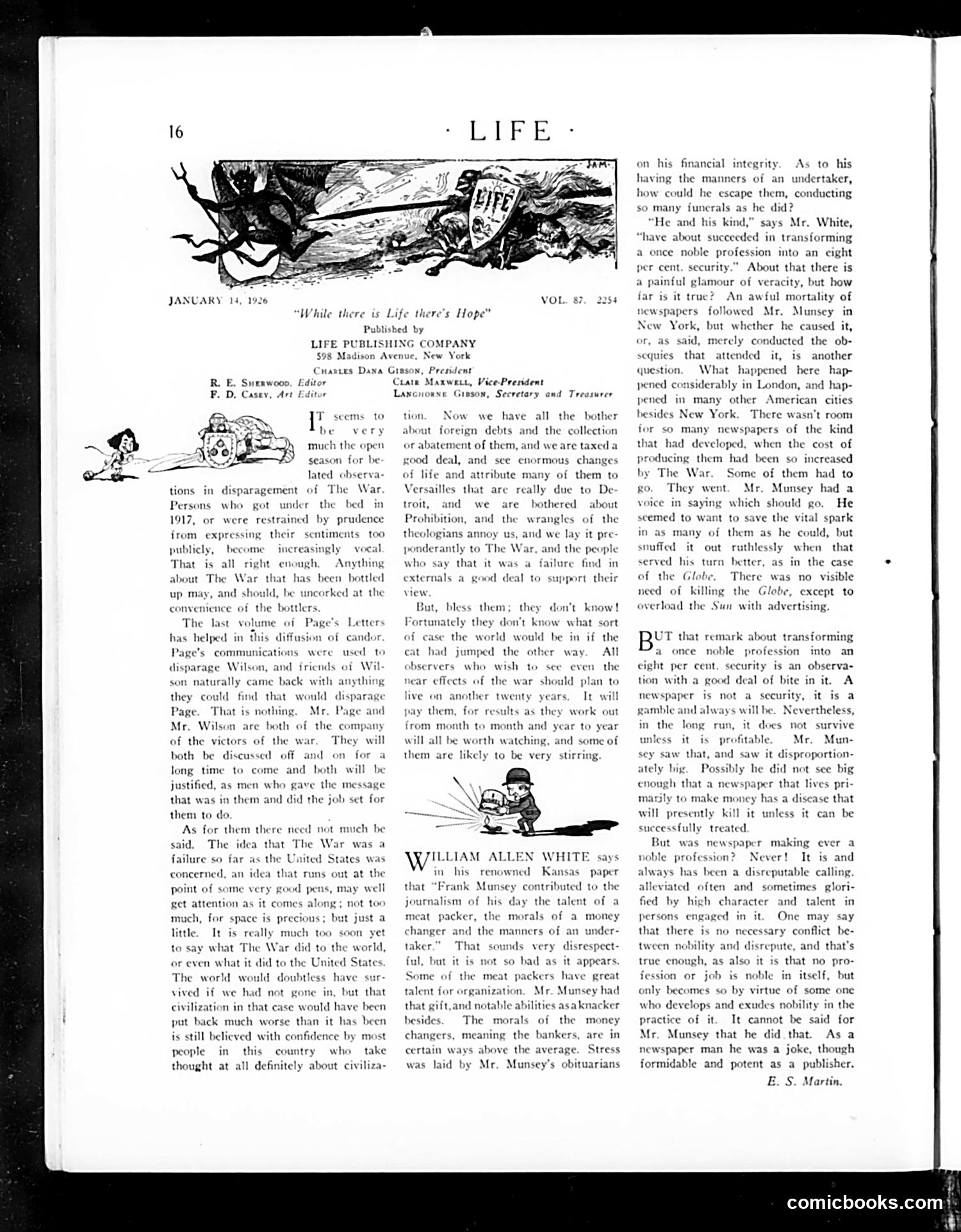
This page discusses **Frank Munsey**, a prominent newspaper publisher who died recently. The cartoon at top depicts Death (skeletal figure with scythe) claiming Munsey, with "Life" magazine's banner present—a visual pun on the magazine's own name. The article, credited to **William Allen White** (a famous Kansas editor), praises Munsey's business acumen while criticizing his transformation of journalism into a profit-driven enterprise. White argues Munsey prioritized financial security over the profession's noble ideals, reducing newspapers to mere commercial ventures rather than civic institutions. The satire critiques how Munsey and similar publishers degraded American journalism's moral purpose in pursuit of wealth, a significant concern during the 1920s media landscape.
📄 Transcribed text from this page (OCR, searchable)
Machine-transcribed from the original scan — historical spelling and the odd misread are preserved.
JANUARY “While there is Li there's Hope” Published by LIFE PUBLISH $98 Mad: COMPANY Avenue, New York Cuantes Dana Ginsox, President R. E. Sneawoon, Editor D. Casey, Art £ T seems to be very much the open season for be lated observa- tions in disparagement of The War. Persons who got under the bed in 1917, or were restrained by prudence from expressing their sentiments too publicly, become increasingly vocal That is all right enough, Anything about The War that has been bottled up may, and should, be uncorked at the avenience of the bottlers, The last volume of Page's Letters has helped in this diffusion of candor Page’s communications were used to disparage Wilson, and friends of Wil son naturally came back with anything they 1 find that would disparag Page. That is nothing. Mr. Page and Mr. Wilson are both of the company of the victors of the war. They will both be discussed off and on for a Jong time to come and both will be justified, as men who gave the message that was in them and did the job set for them to de As for them there need not much be said. The idea that The War was a failure so far as the United States was concerned, an idea that runs out at the point of some very good pens, may well get attention as it comes along; not too much, for space is precious; but just a little. It is really much too soon yet to say what The War did to the world, or even what it did to the United Sta: The world would doubtless have vived if we had not gone in, but that civilization in that case would have been put back much worse than it has been is still believed with confidence by most people in this country who take thought at all definitely about civiliza- Ctate Maxwett, Vice-President Laxcnorxe Grason, Secretary ond Treasurer »w we have all the bother bout foreign debts and the collection or abatement of them, and we are taxed a good deal, and see enormous changes of life and attribute many of them to Versailles that are really due to De troit, 1 we are bothered about Prohibi nd the wrangles of the and we lay it pre- derantly to The War, and the people who say that it was a failure find in externals a good deal to support their view But, bless them; they ‘t know! Fortunately they don’t know what sort of case the world would be in if the cat had jumped the hi All observers who wish to sec the near effects of the war should plan to live on another twenty years. It will pay them, for results as they work out from month to month and year to year will all be worth watching, and some of them are likely to be very. stirring V ILLIAM ALLEN WHITE says in his renowned Kansas paper that “Frank Munsey contributed to the journalism of his day the talent of a meat packer, the morals of a money changer and the manners of an under- taker.” That sounds very disrespect- ful, but it is not so bad as it appears Some of the meat packers have great talent for organization. Mr. Munsey had that gift,and notable abilities asaknacker besides. The morals of the money changers, meaning the bankers, are in certain ways above the average. Stress was laid by Mr. Munsey’s obituarians As to his having the manners of an undertaker, how could he escape them, conducting so many funerals as he did? “He and his kind,” says Mr. White, “have about succeeded in transforming a once noble profession into an eight per cent. security.” About that there is a painful glamour of veracity, but how far is it true? An awful mortality of vewspapers followed Mr. Munsey in New York, but whether he caused it, . as said, merely conducted the ob- sequies that attended it, is another What happened here hap- pened considerably in London, and hap- pened in many other American cities besides New York. There wasn't room for so many newspapers of the kind that had developed, when the cost of producing them had been so increased by The War. Some of them had to Mr. Munsey had a voice in saying which should go. He scemed to want to save the vital spark on his financial integrity question go. They went in as many of them as he could, but snuffed it out ruthlessly when that served his turn better, as in the case of the Glob There was no visible need of killing the Globe, except to overload the Sun with advertising. BY T that remark about transforming a once noble profession into an eight per cent. security is an observa- tion with a good deal of bite in it. A newspaper is not a security, it is a gamble ai ways willbe. Nevertheless, in the long run, does not survive unless it is. profitable. Mr. Mun- sey saw that, and saw it disproportion- ately big. Possibly he did not see big enough that a newspaper that lives pri- marily to make money has a disease that will presently kill it unless it can be successfully treated. But was newspaper making ever a noble profession? Never! It is and always has been a disreputable calling. alleviated often and sometimes glori- fied by high character and talent in persons engaged in it. One may say that there is no necessary conflict be- tween nobility and disrepute, and that's true enough, as also it is that no pro- fession or job is noble in itself, but only becomes so by virtue of some one who develops and exudes nobility in the practice of it. It cannot be said for Mr. Munsey that he did that. As a newspaper man he was a joke, though formidable and potent as a publisher. E. S. Martin, ¢ comicbooks.com}