
A complete issue · 36 pages · 1925
Life — December 10, 1925
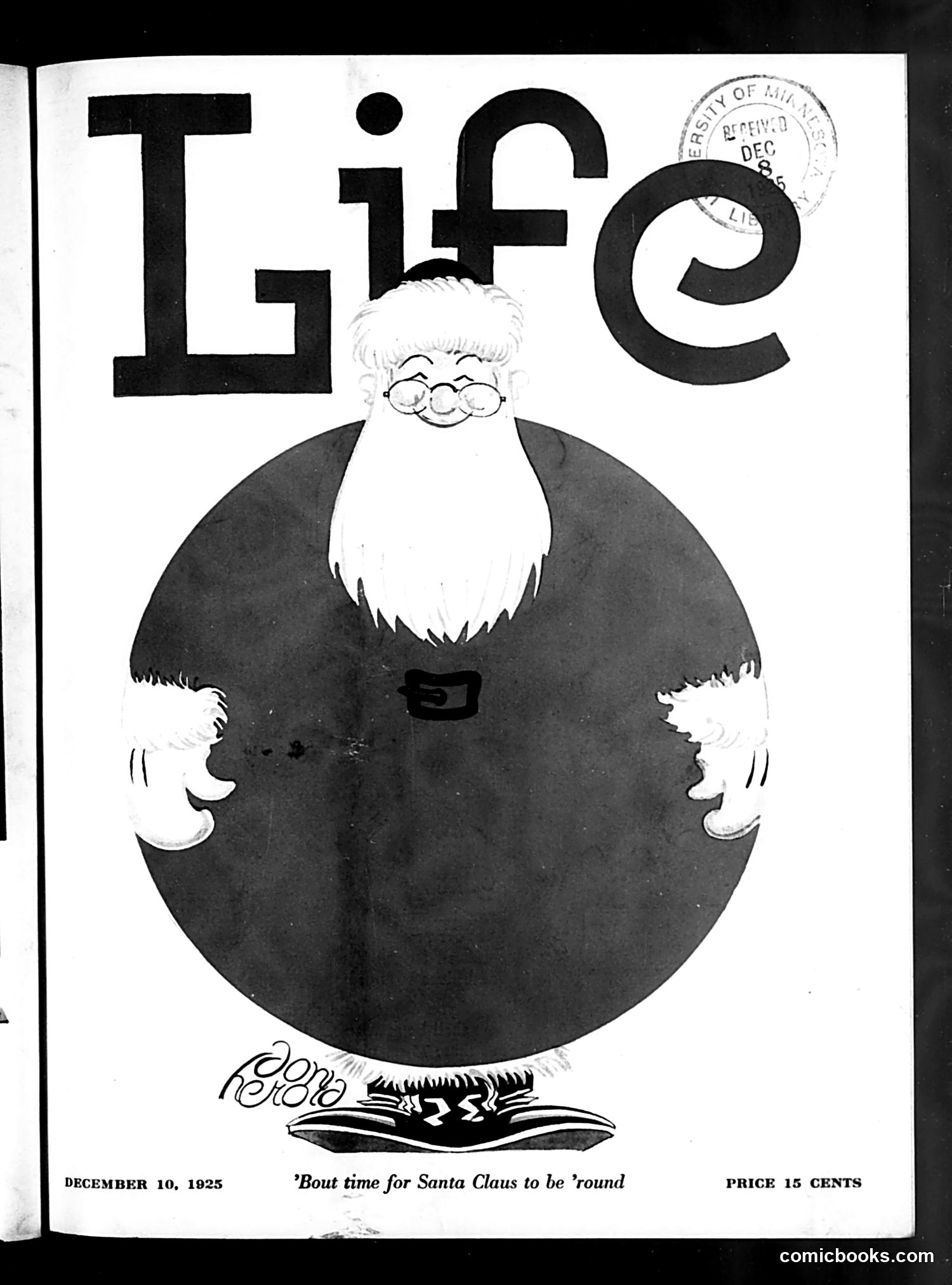
This cover features a large, rotund Santa Claus figure with the caption "'Bout time for Santa Claus to be 'round." The satirical point appears to be visual commentary on Santa's increasing girth or commercialization. The phrase "Life" at the top and the price of 15 cents date this to the 1920s holiday season. The cartoon likely satirizes either the commercialization of Christmas or makes a joke about Santa's weight/indulgence—a common humor topic during this era. The simple but effective design uses Santa's circular silhouette as the primary visual joke. Without additional context about specific 1925 events, the exact satirical target remains unclear, though it's clearly a humorous holiday-themed cover meant to amuse readers during the Christmas season.
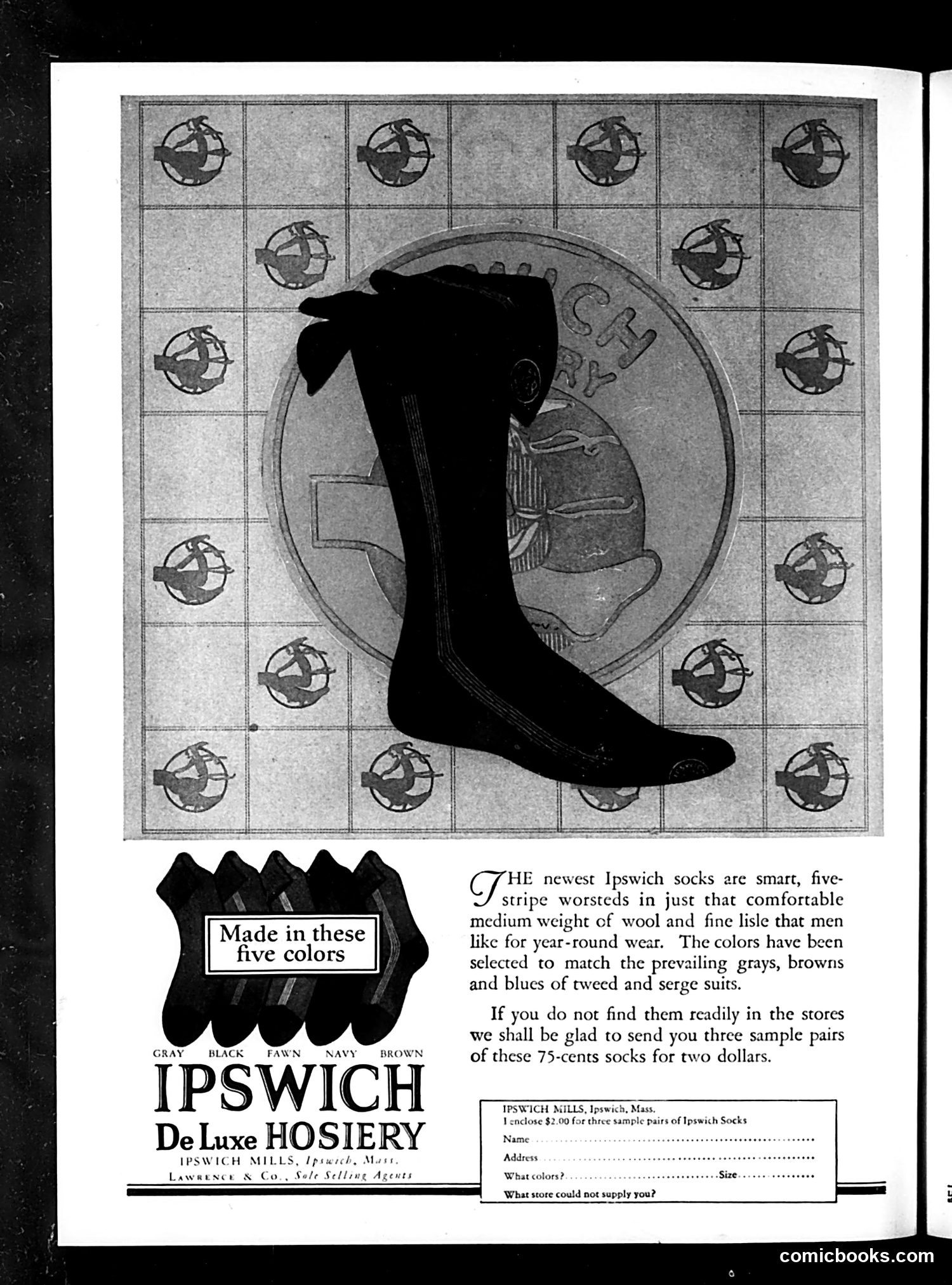
This page is primarily **advertising, not satire or political commentary**. It advertises Ipswich De Luxe Hosiery socks, made by Ipswich Mills in Massachusetts. The visual humor is straightforward product advertising: a large silhouetted sock dominates the composition, overlaid on a grid pattern with repeated globe/compass motifs. The design emphasizes the sock's quality and availability in five colors (gray, black, fawn, navy, brown) suitable for matching tweed business suits—typical menswear of the era. The advertisement includes a mail-order offer: three sample pairs for two dollars. There is no political satire or social commentary present. This appears to be standard early-20th-century commercial advertising using eye-catching graphic design to promote men's hosiery.
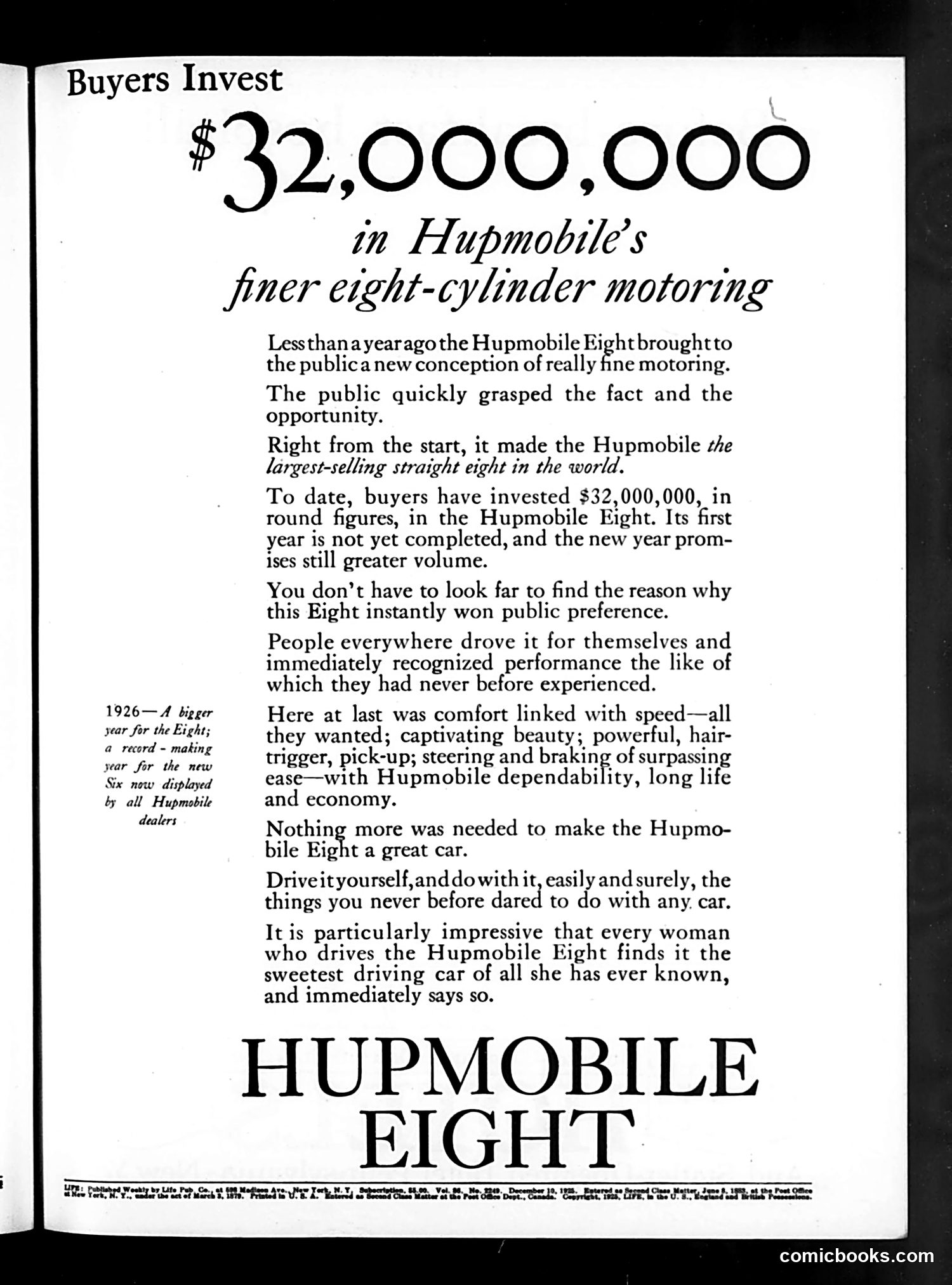
This is **not a cartoon or satire** — it's a straightforward **automobile advertisement** for the Hupmobile Eight, published in Life magazine around 1926. The ad celebrates that buyers have invested $32 million in this eight-cylinder car, making it "the largest-selling straight eight in the world." The text emphasizes the car's performance, comfort, beauty, and ease of handling, particularly noting that "every woman who drives the Hupmobile Eight finds it the sweetest driving car of all she has ever known." This represents early 20th-century marketing targeting both general buyers and women drivers specifically—a notable detail for 1926, when women's automotive independence was still relatively new. The ad uses sales figures as proof of quality rather than satire.
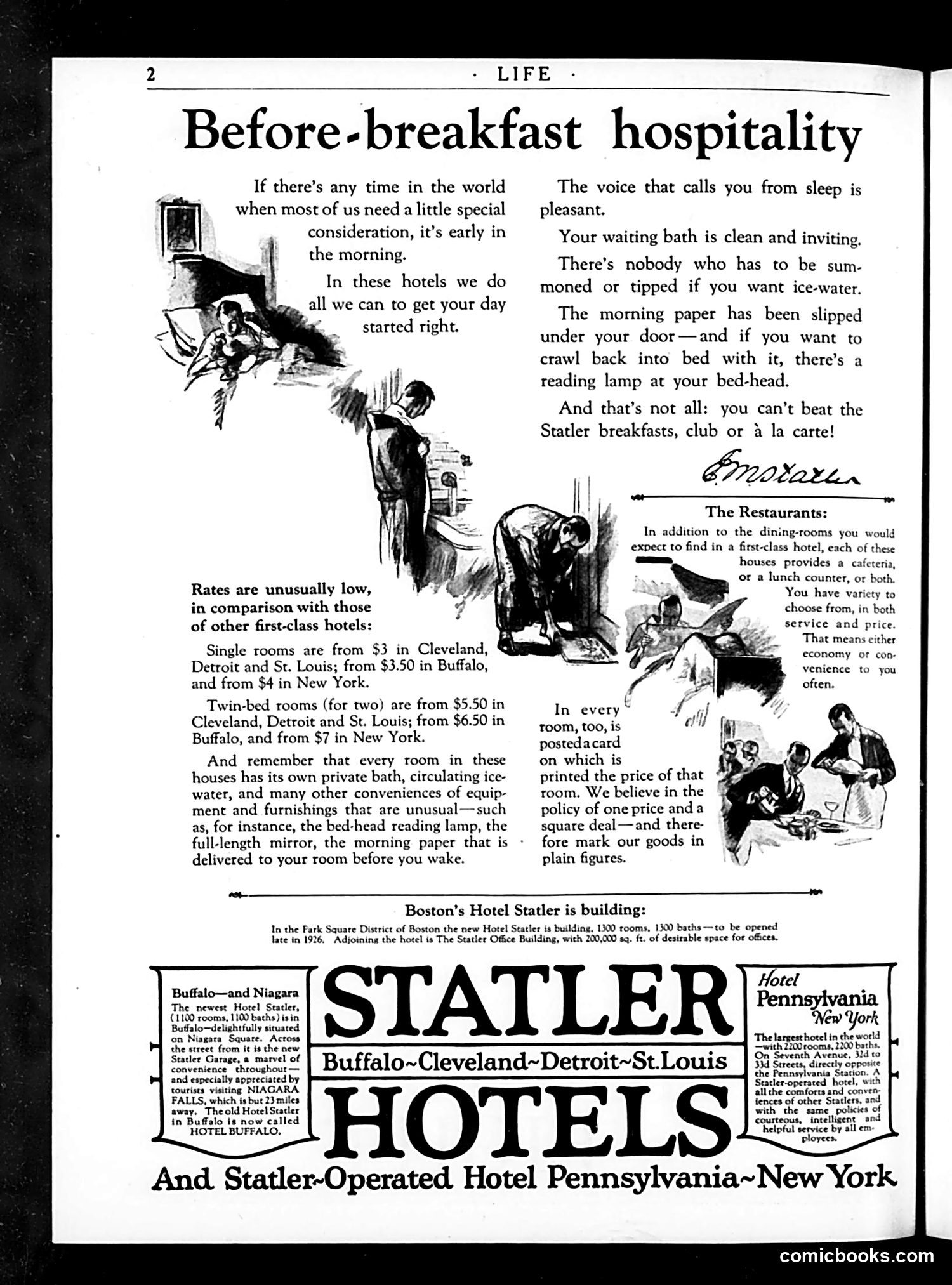
This page is primarily **advertising, not satire or political commentary**. It promotes Statler Hotels' "before-breakfast hospitality" — their early morning service offerings. The illustrations show hotel staff attending to guests' morning needs: delivering wake-up calls, providing clean bathrooms, delivering newspapers, and offering breakfast options. The accompanying text emphasizes convenience features like ice water service, reading lamps, and the Statler chain's transparent pricing policy. The only signature visible is "Emoransen" (likely the illustrator), accompanying sketches of bellhops and guests. The page concludes with promotional information about Statler Hotels in Buffalo, Cleveland, Detroit, and St. Louis, plus the Hotel Pennsylvania in New York. No political or social satire is present — this is straightforward early-20th-century hotel marketing targeting business travelers.
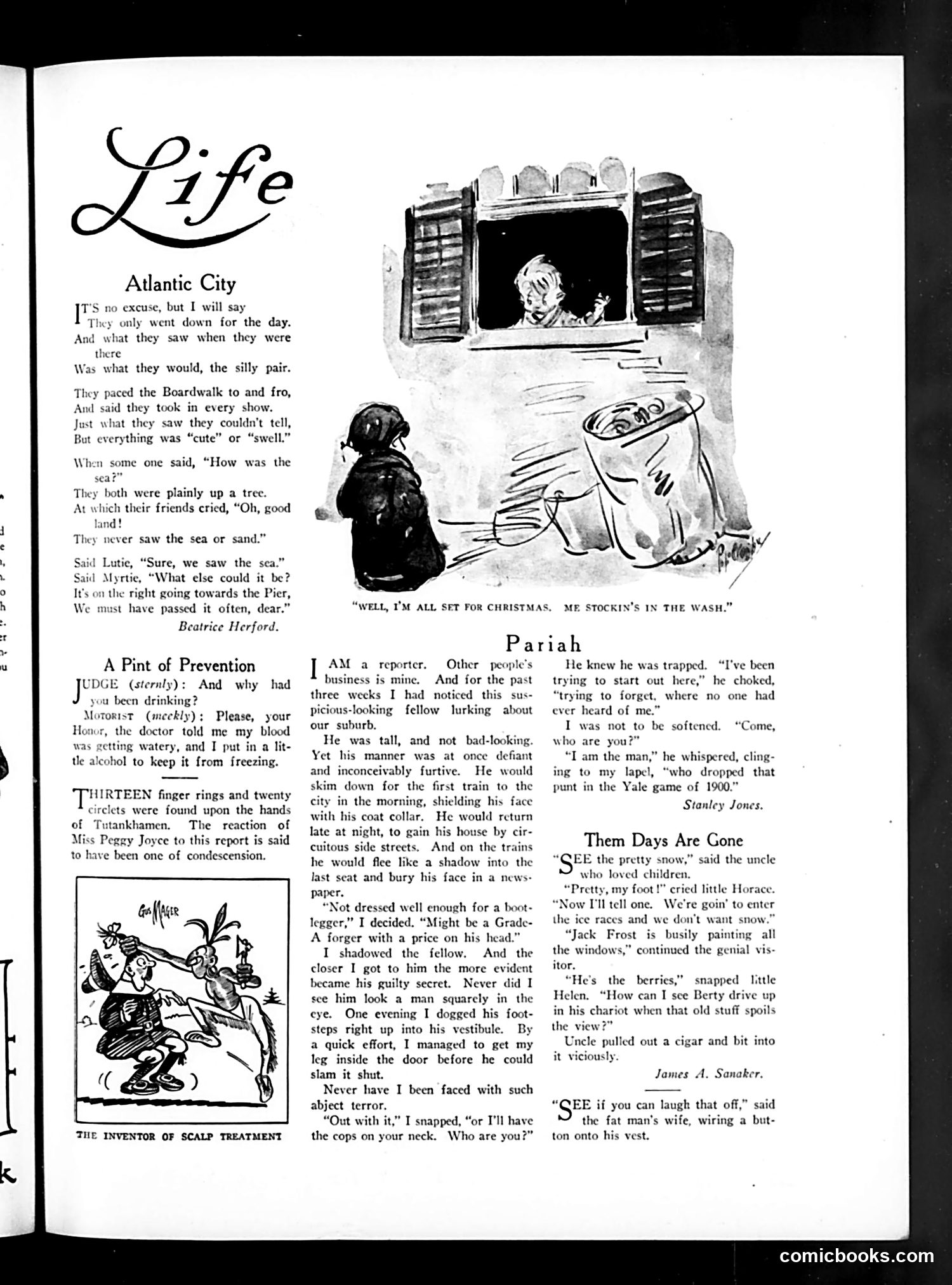
This page contains four separate pieces of satirical humor typical of early Life magazine: 1. **"Atlantic City"** (top): A poem by Beatrice Herford mocking tourists who visit Atlantic City boardwalk but never actually see the ocean or beach—they're too busy shopping and showing off. 2. **"A Pint of Prevention"** (left): A judge questions a drunk man about his drinking habits. The joke appears to reference contemporary medical beliefs about alcohol's preservative properties (keeping blood from freezing). 3. **"Pariah"** (center): A reporter describes pursuing a suspicious man around town. The humor involves mistaken identity and the man's growing paranoia about being followed. 4. **"Them Days Are Gone"** (right): Uncle describes how children's entertainment has changed—Jack Frost no longer paints windows; modern children prefer ice races and painted windows as novelties. The small illustration shows "The Inventor of Scalp Treatment," likely a medical quack.
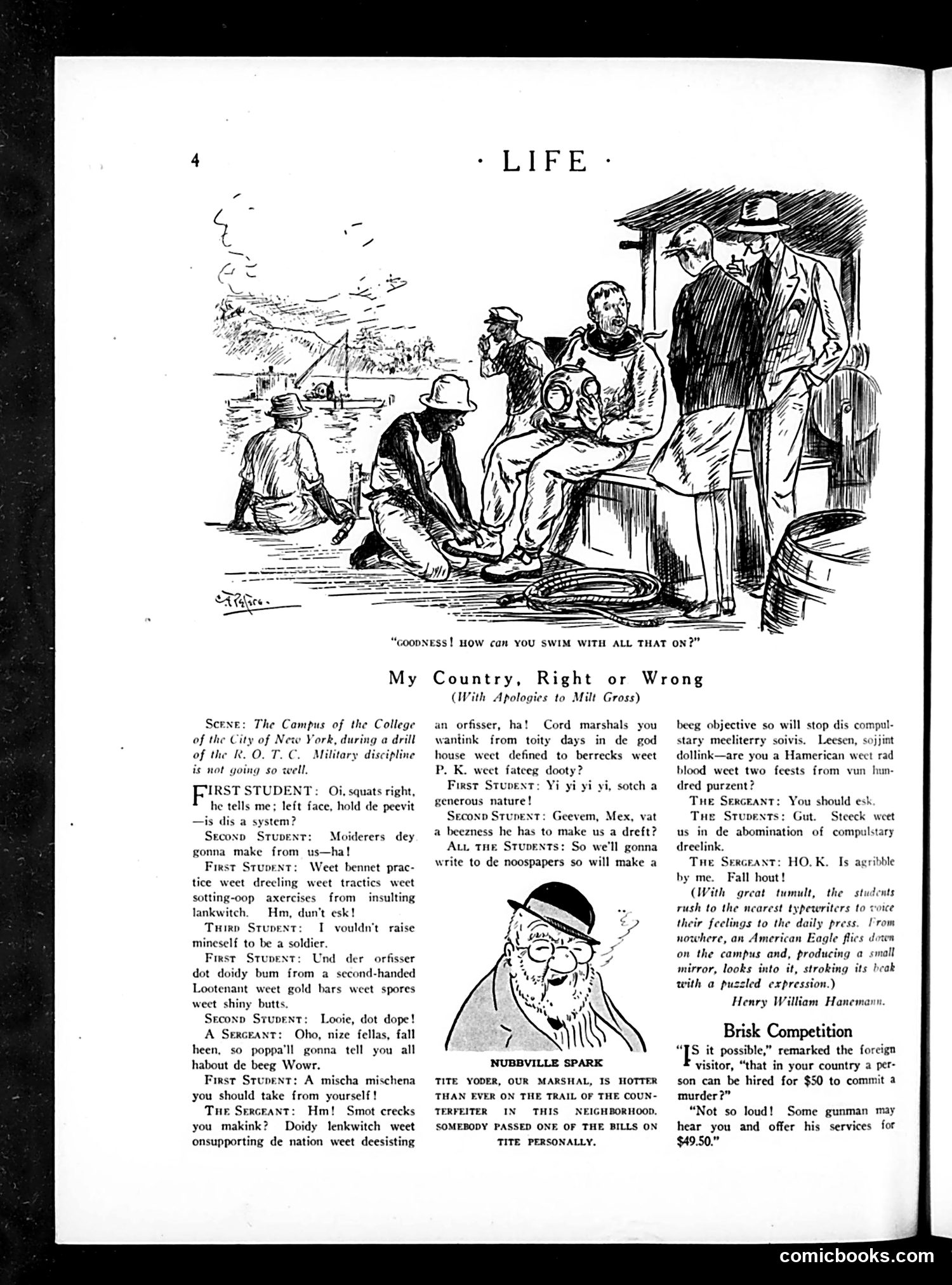
This page satirizes military discipline at a New York City college during R.O.T.C. (Reserve Officers' Training Corps) drills. The main cartoon depicts first-year students questioning absurd military regulations—specifically about swimming in full uniforms during exercises. The satire targets the disconnect between practical sense and military protocol: students must wear heavy, soaked clothing that impedes swimming, illustrating how rigid institutional rules often ignore common sense and human reality. The secondary item, "Brisk Competition," jokes about a foreign visitor shocked that murder can be hired cheaply in America ($50), darkly commenting on American violence and moral standards compared to other countries. Both pieces use humor to critique authority—institutional military rigidity and broader American social problems.
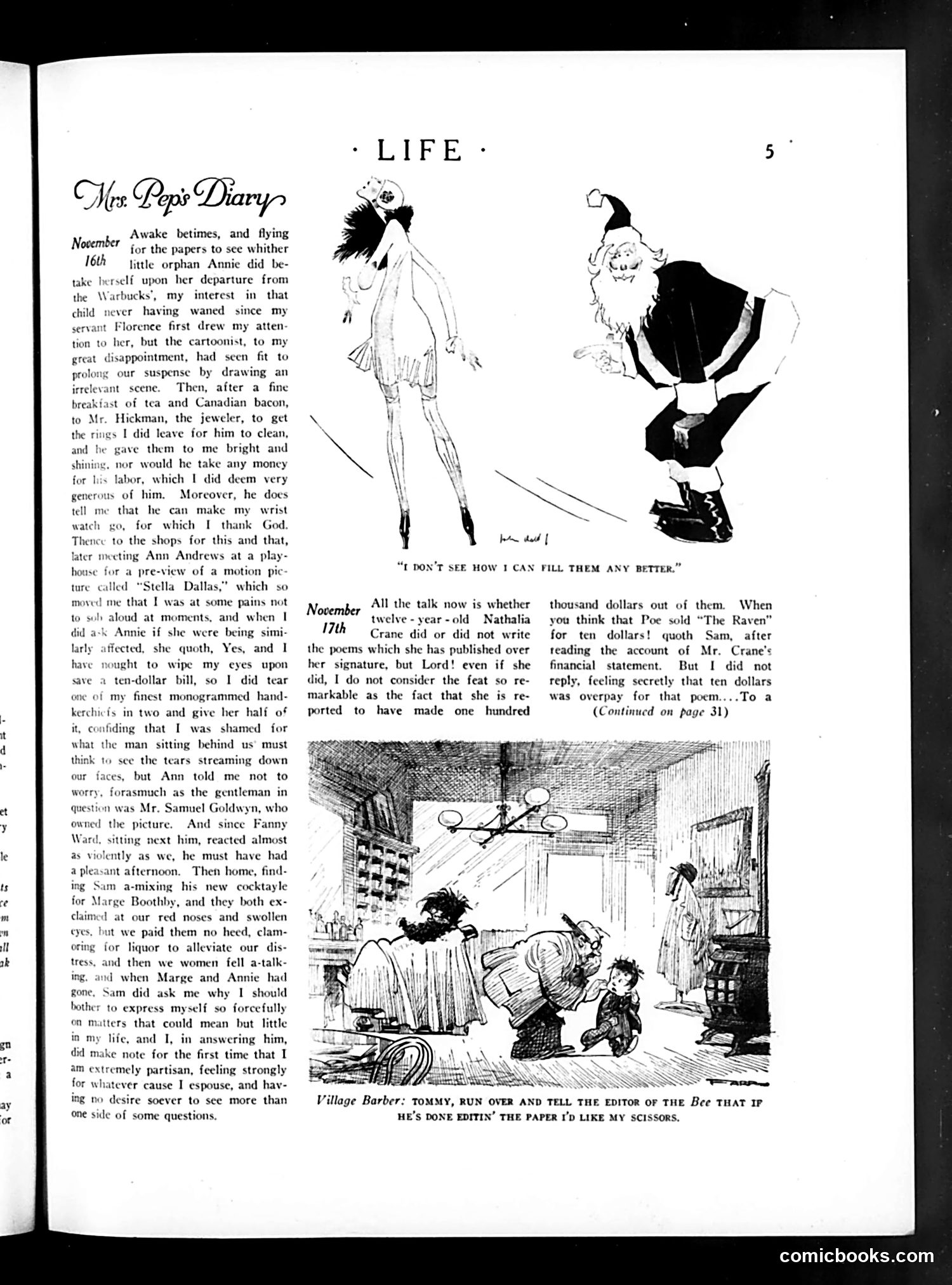
This page from *Life* magazine's "Mrs. Pepsi's Diary" column satirizes literary celebrity and publishing economics. The top sketches mock pretension: a tall, awkwardly-posed woman (likely representing affected literary figures) and a bearded gnome-like character illustrate the column's sardonic tone. The diary entry discusses twelve-year-old **Nathalia Crane**, a child poet whose work generated controversy about authorship—whether she genuinely wrote her published poems. The satirist expresses skepticism about her claimed financial success ("ten dollars out of them"), implying the public was gullible about purchasing verse from a child prodigy. The bottom illustration shows a barber scene, likely satirizing working-class perspectives on literary pretension—the "Village Barber" commentary contrasts ordinary life with highbrow publishing debates.
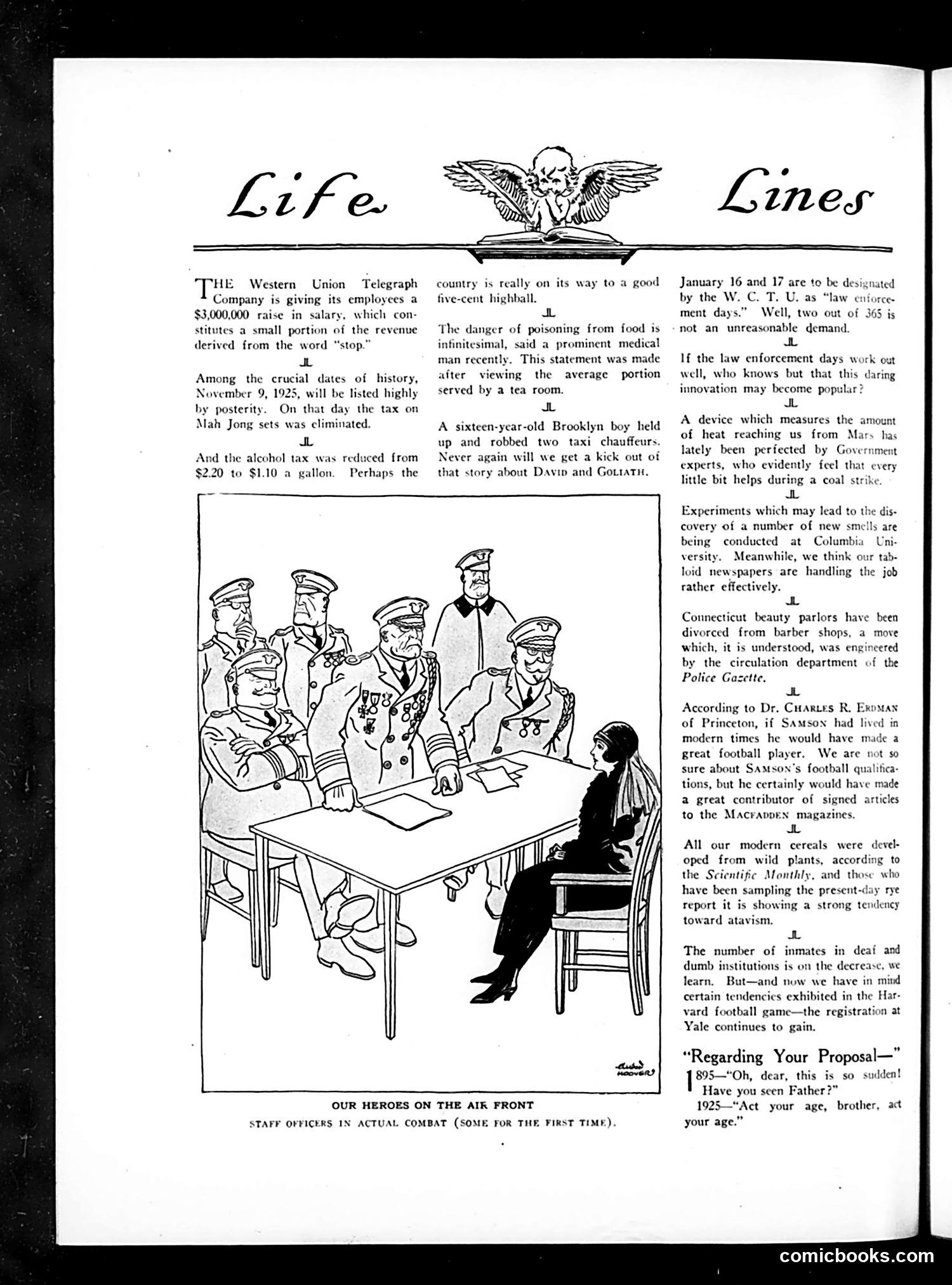
This cartoon satirizes military bureaucracy during what appears to be World War I. It depicts staff officers in actual combat—"some for the first time"—seated at a table conducting official business while a lone soldier sits across from them. The humor lies in the contrast between the officers' formal, desk-bound military procedures and the chaos of actual warfare happening around them. The satire suggests that career military administrators are disconnected from frontline realities, more concerned with paperwork and protocol than combat conditions. By showing these officers finally experiencing combat themselves, the cartoon mocks both their inexperience and the absurdity of conducting wartime operations through rigid bureaucratic channels rather than practical field knowledge.
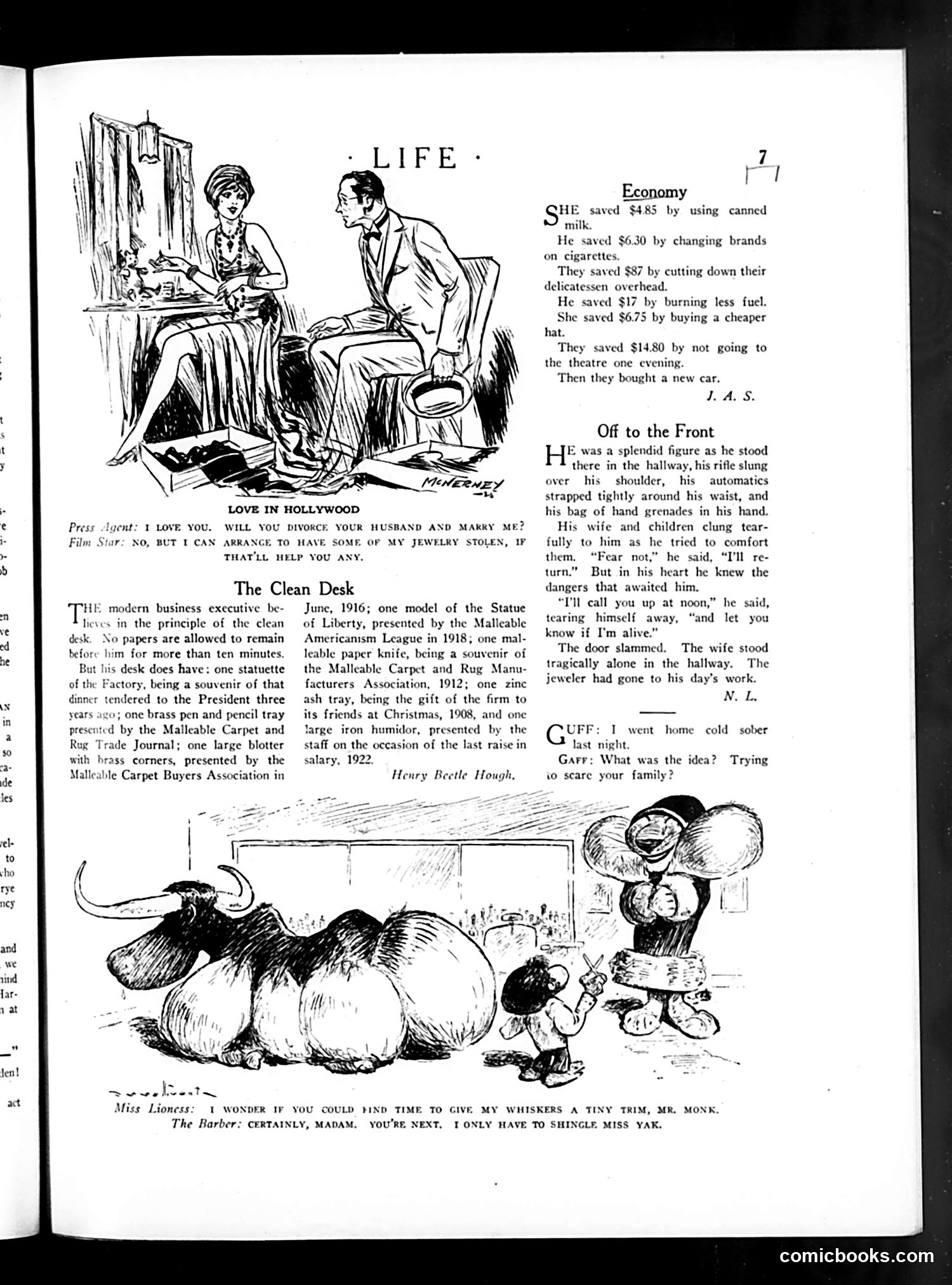
This page contains three separate humorous pieces typical of Life's satirical format: 1. **"Love in Hollywood"**: A sketch mocking marital infidelity among film industry figures, with a wife asking her husband about arranging jewelry theft to fund her lifestyle. 2. **"Economy"**: A list satirizing middle-class penny-pinching during what appears to be an economic period (likely 1920s, given references to "theatre" and car purchases), poking fun at couples obsessively tracking trivial savings. 3. **"Off to the Front"**: A wartime story about a soldier departing with his wife and children, emphasizing emotional sacrifice and duty. 4. **"The Clean Desk"**: A piece celebrating business efficiency principles, referencing Malleable manufacturers' gifts and awards. The bottom cartoon depicts a large cow and small figures, accompanying a joke about barber services and "Miss Yak."
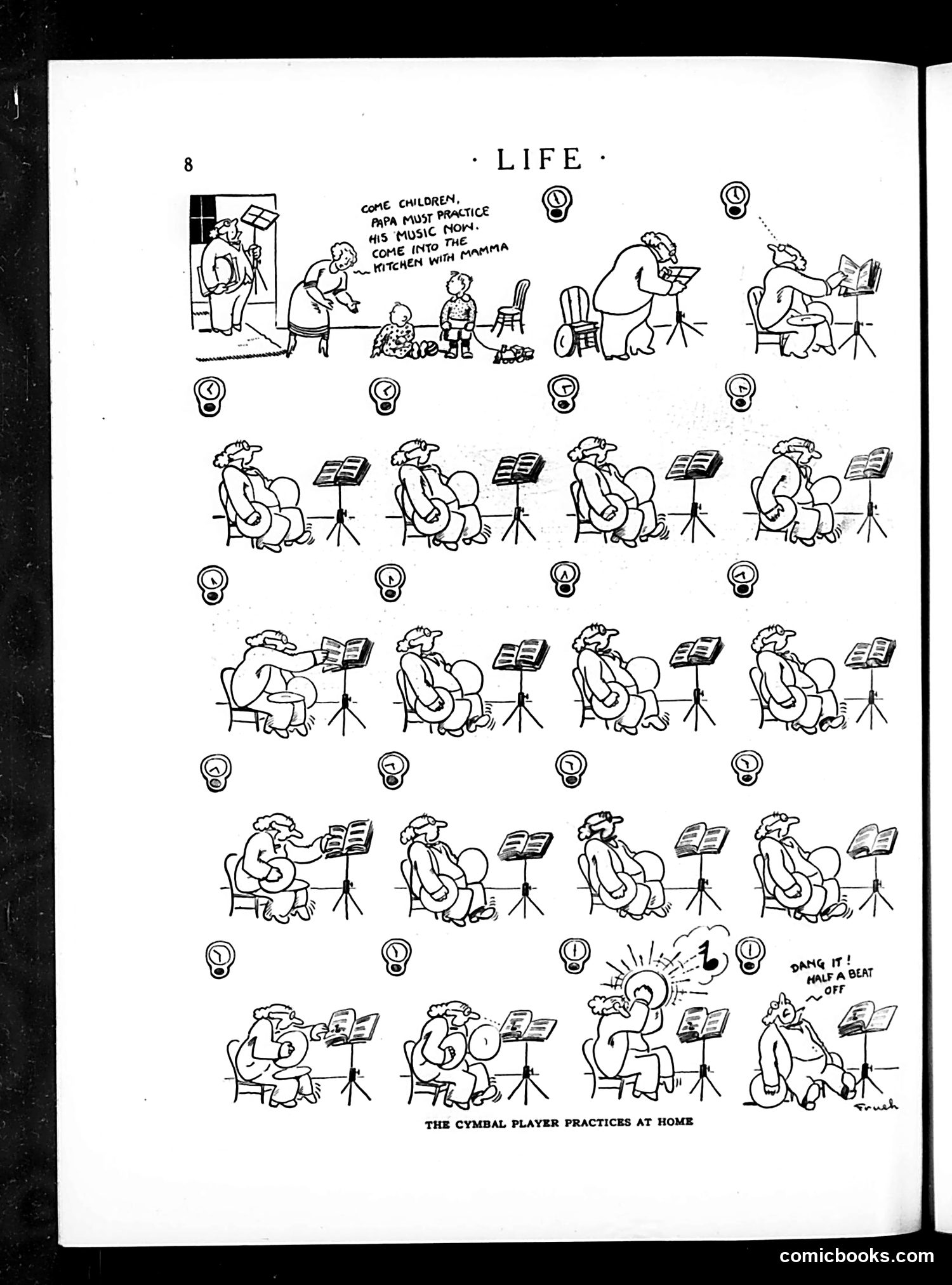
This humorous cartoon depicts a music lesson scenario where a father attempts to teach his children to play cymbals at home. The top panel shows the family gathering as the father announces the practice session. The remaining panels show the repetitive practice of cymbal-playing, with the children positioned at music stands, performing the same motions over and over. The satire targets the chaos and noise of home music practice—particularly the loud, clanging cymbals that would drive a household to distraction. The final panel, showing the father apparently losing patience ("Dang it! Make a beat off"), humorously suggests the father's own frustration with the endless, seemingly pointless repetition. The joke captures a relatable domestic frustration: ambitious musical instruction creating household pandemonium.
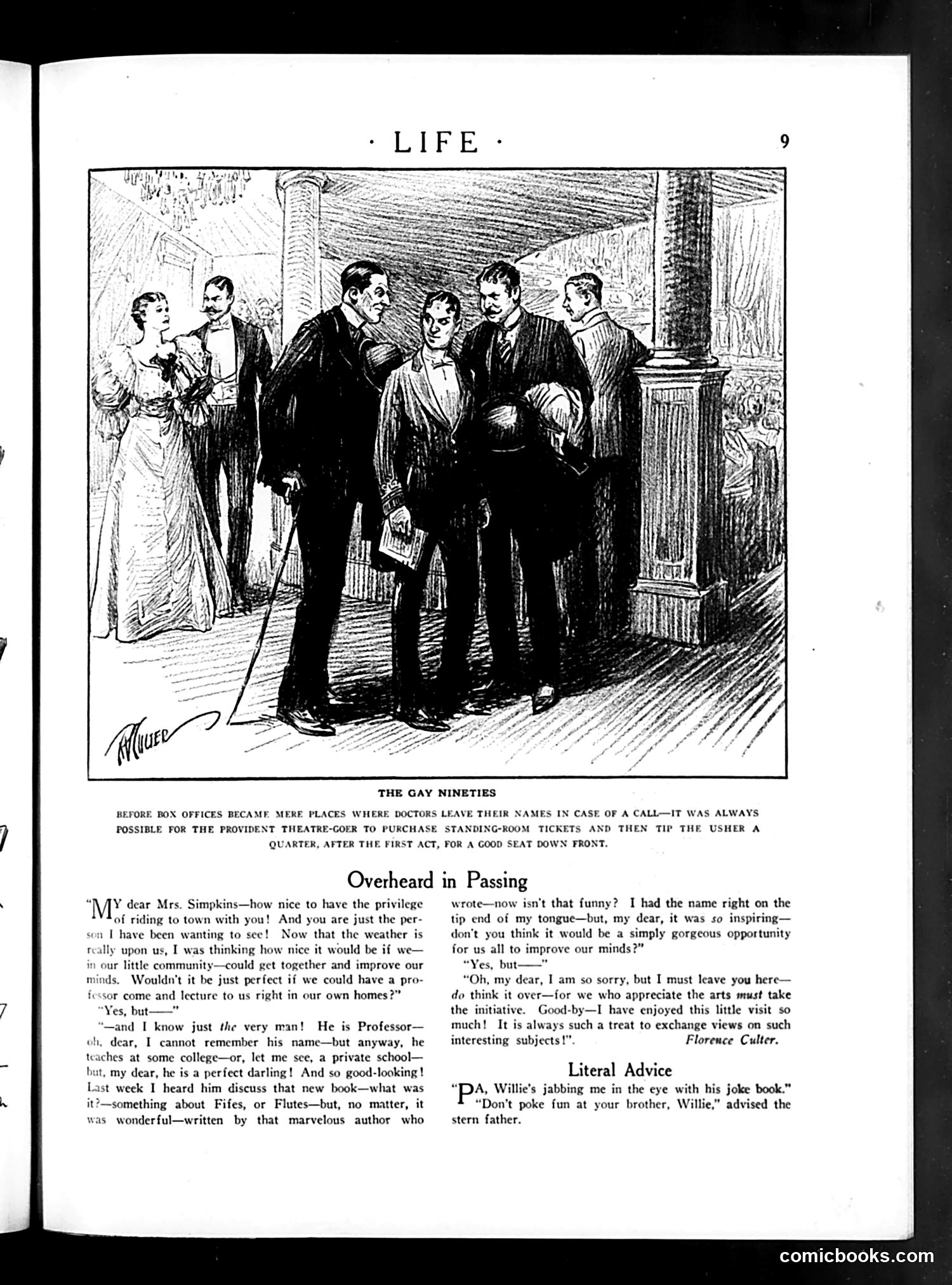
**The Main Cartoon ("The Gay Nineties"):** The illustration depicts men in formal attire at what appears to be a theater box office or similar venue. The caption explains that before box offices existed as standard establishments, doctors would leave their names "in case of a call," and theater-goers could tip ushers for good seats—a practice the caption presents as humorously outdated. **The Text Sections Below:** "Overheard in Passing" and "Literal Advice" are brief humorous anecdotes typical of Life's satirical format. They appear to mock pretentious social behavior and naïve advice-giving rather than target specific political figures. The humor relies on wordplay and social observation rather than current events. **Overall Context:** This page represents Life's trademark style of gentle social satire about American manners and customs.
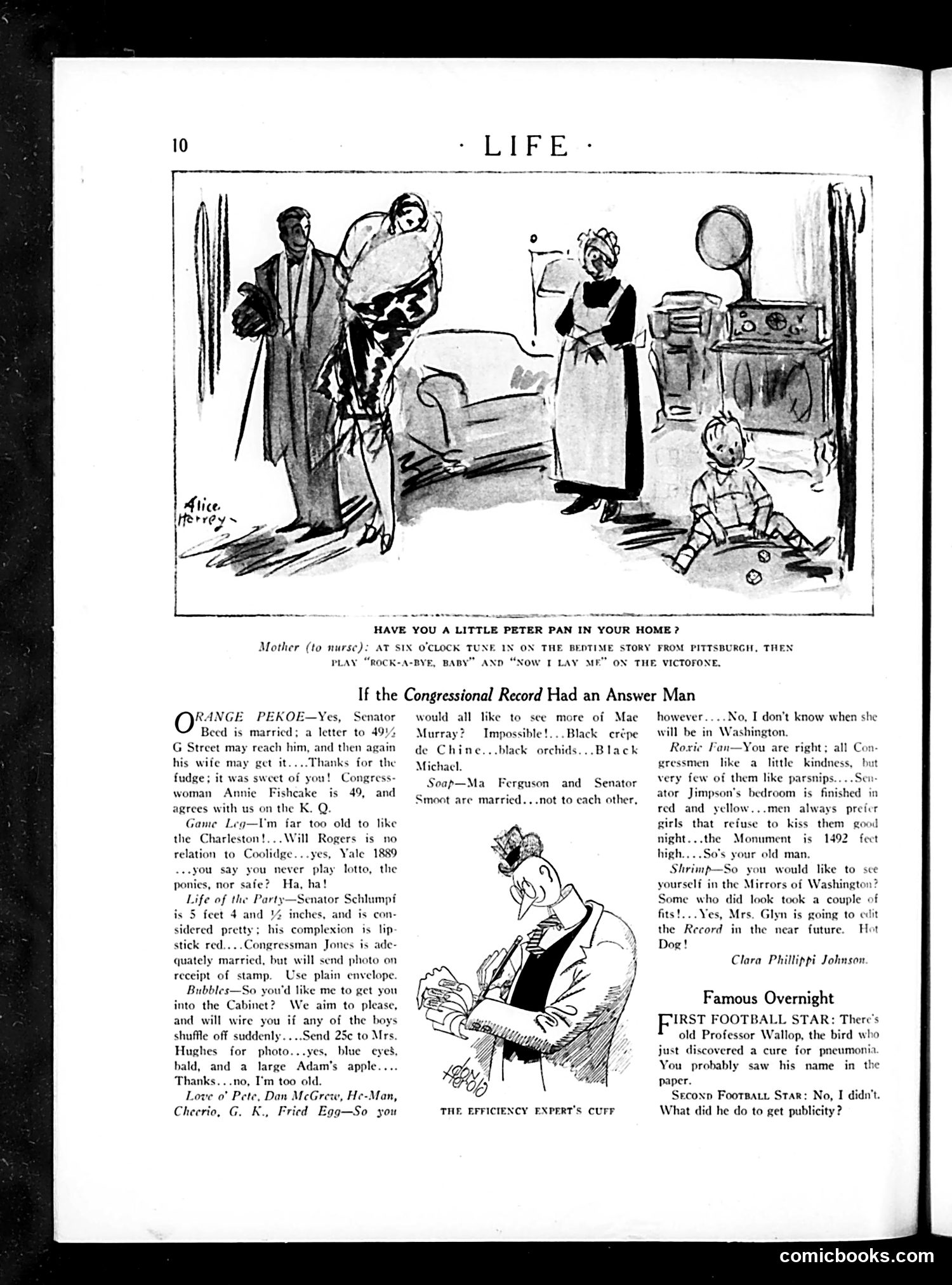
The top cartoon titled "Have You a Little Peter Pan in Your Home?" satirizes domestic life, showing a nurse tending to children while parents depart. The caption references the popular "Peter Pan" story—the joke appears to be about childish behavior persisting into adulthood. Below, the section "If the Congressional Record Had an Answer Man" mocks senators' personal gossip, featuring invented exchanges between politicians like Orange Pekoe and Rosie Pun. The humor comes from treating serious Congressional records as if they were a gossip advice column, satirizing senators' trivial concerns and marital entanglements. The "Efficiency Expert's Cutt" cartoon (lower right) appears unrelated—a brief illustrated joke. This reflects Life magazine's traditional format: social satire mixed with light humor about contemporary politics and manners.
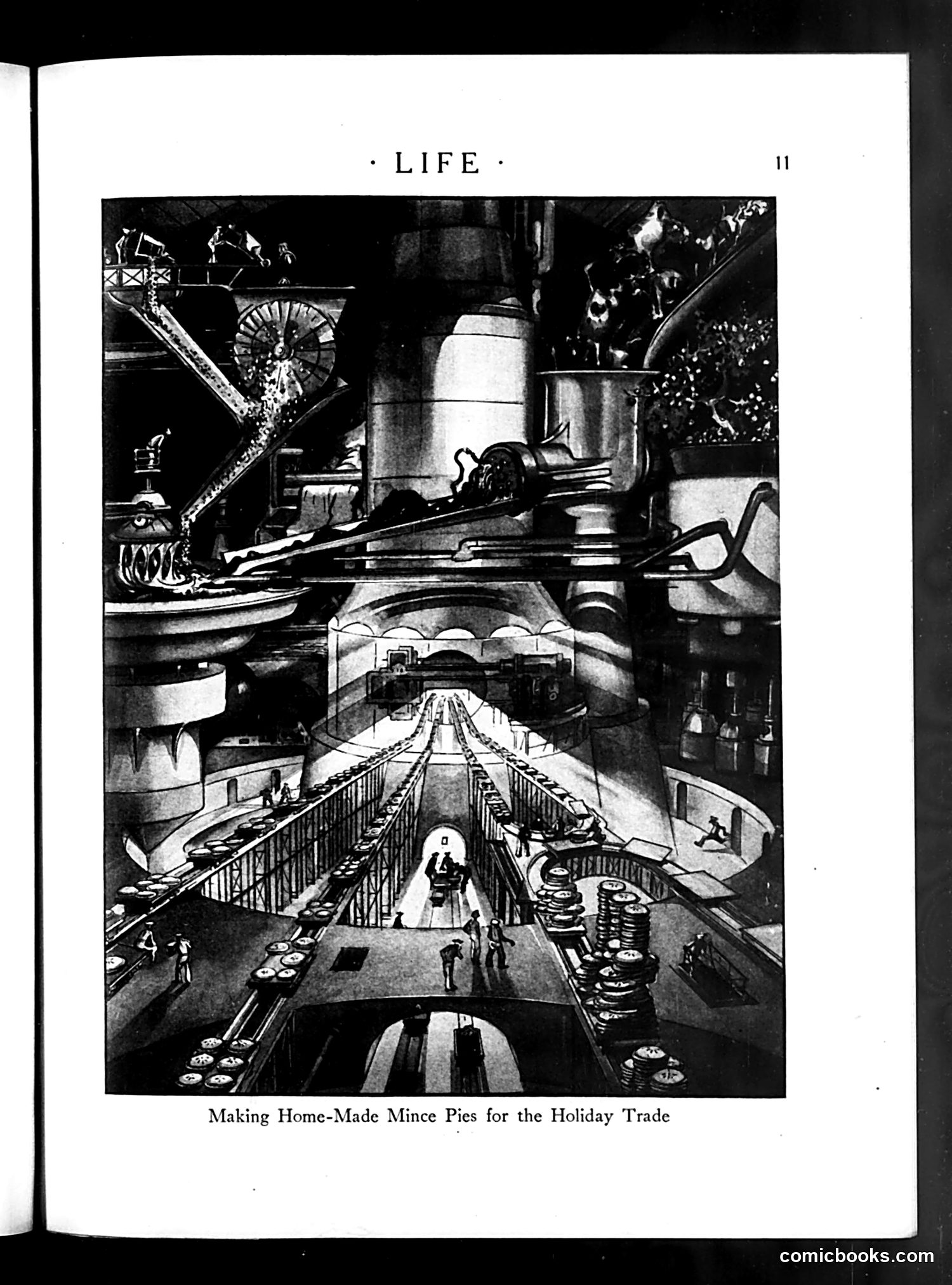
This is an illustrated article from *Life* magazine showing "Making Home-Made Mince Pies for the Holiday Trade." The image depicts an industrial factory setting with a surreal, exaggerated perspective—workers producing mince pies on an enormous assembly-line scale. The satirical point appears to be mocking the commercialization of holiday baking. Rather than pies being homemade in kitchens as tradition dictated, they're mass-produced in factories for retail sale during the Christmas season. The elaborate industrial machinery and the caption's emphasis on "home-made" (in quotation marks implicitly) creates ironic humor: these supposedly authentic homemade goods are actually factory products. This reflects early 20th-century concerns about industrialization replacing traditional domestic labor and authenticity.
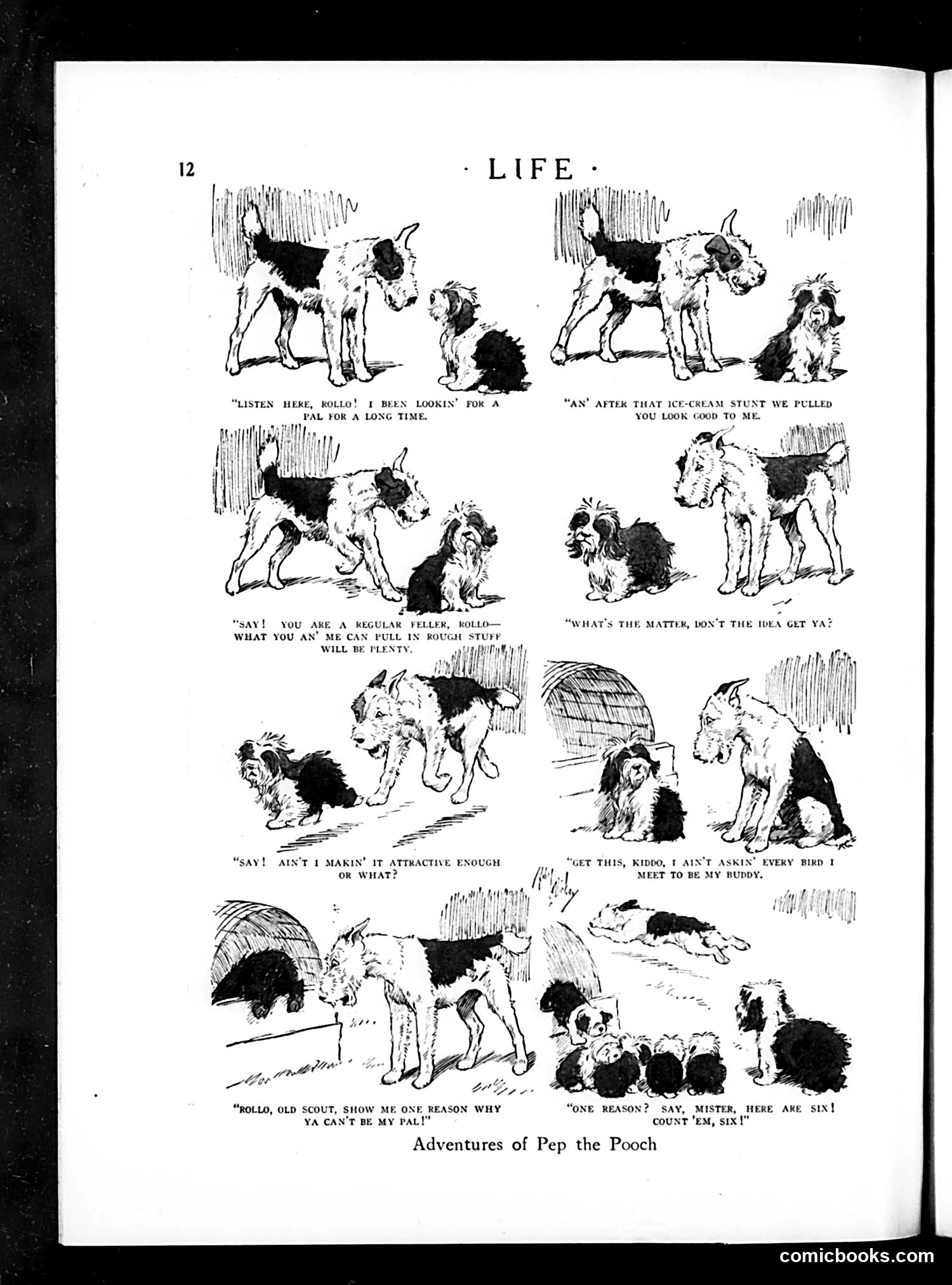
This is a humorous comic strip featuring dogs, not political satire. The narrative follows a larger dog named "Bollo" and a smaller dog named "Pep" through various social situations. The strip's humor derives from dogs mimicking human behavior and social anxieties: Bollo brags about his fighting prowess, seeks validation for his attractiveness, attempts to attract a female dog, and ultimately tries to recruit Pep as a "buddy." The final panel reveals Pep has found six other small dogs, subverting Bollo's exclusive friendship offer. The satire targets human vanity, social climbing, and the desire for companionship—expressed through anthropomorphized dogs. This was typical early-20th-century comic strip humor, using animals as vehicles for social commentary without targeting specific political figures or events.
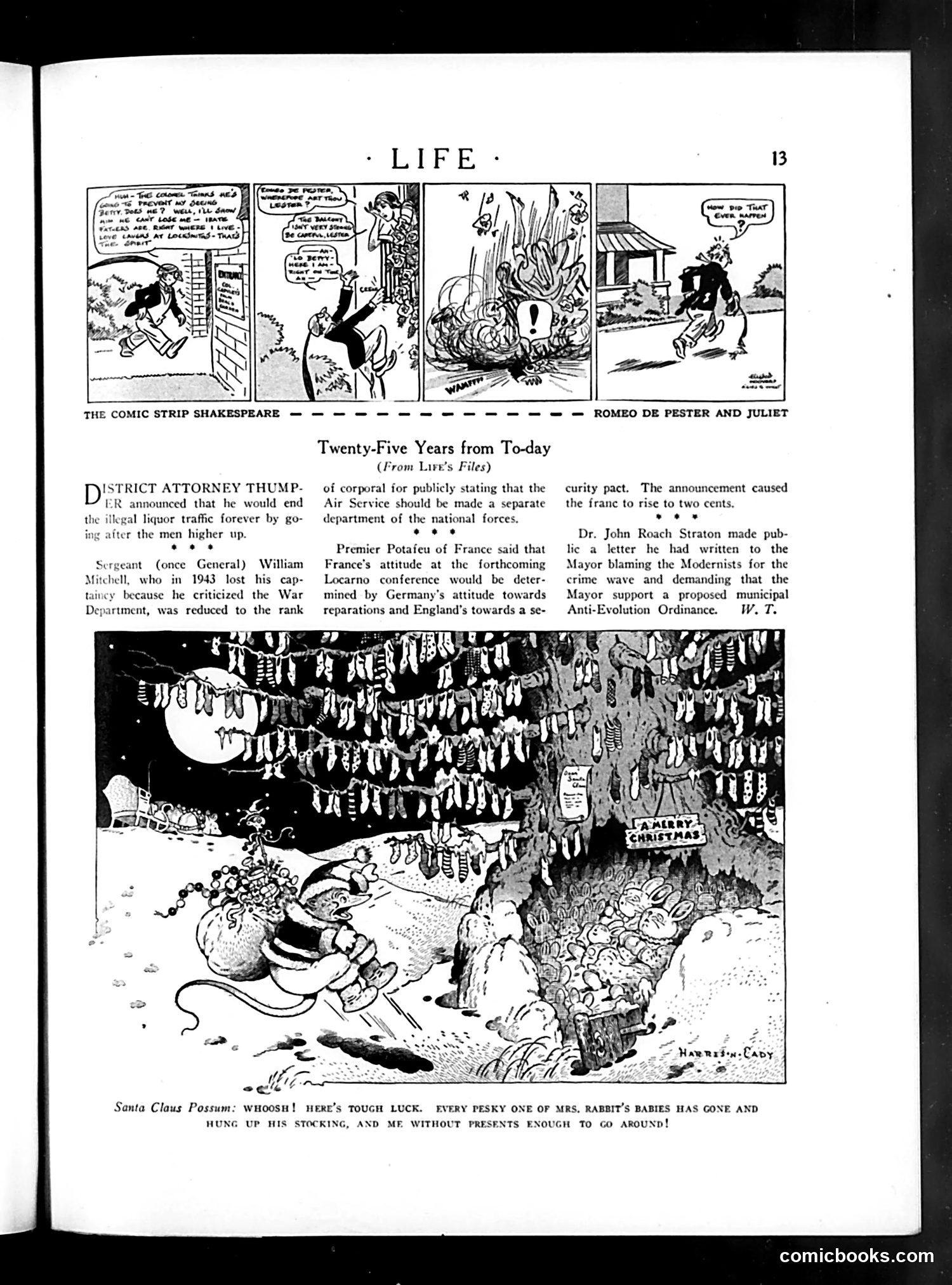
**Top Comic Strip:** "The Comic Strip Shakespeare — Romeo de Pester and Juliet" offers satirical retelling of Shakespeare using modern slapstick, poking fun at both classical literature and contemporary vaudeville-style humor. **Main Articles:** Brief political notes reference: - A District Attorney ending illegal liquor traffic - Military rank disputes (Sergeant William Mitchell's demotion for criticizing the War Department) - Premier Poincaré of France commenting on upcoming diplomatic conferences regarding Germany and reparations **Bottom Cartoon:** "Santa Claus Possum" depicts Santa struggling with empty stockings because "Mrs. Rabbit's babies" consumed all presents. This is holiday-themed humor about scarcity and competing demands for resources—likely reflecting post-WWI economic concerns about shortages and inflation affecting American households.
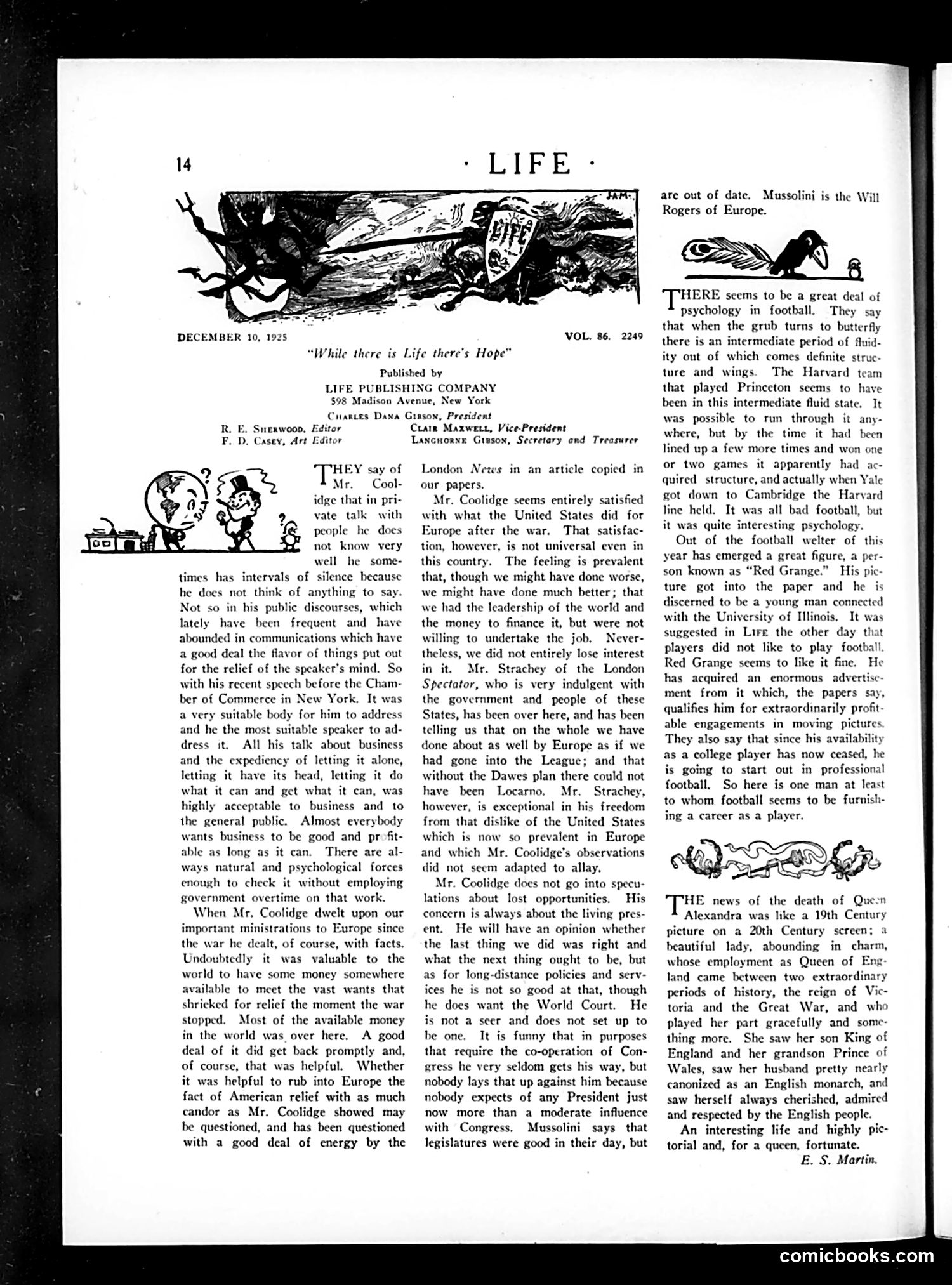
The top cartoon depicts two figures in conflict—one labeled "PIPE" (unclear full identification). The text discusses European politics post-WWI, referencing Mussolini as "the Will Rogers of Europe" (satirizing his populist appeal). The article critiques American isolationism and debates U.S. involvement in European affairs, particularly regarding war debt and the League of Nations. The right column discusses Queen Alexandra's death and her son King Edward, noting her dignity and respect among the English people. The football section uses the "Red Grange" phenomenon to discuss American sports psychology. Overall, the page reflects 1925 concerns: European political instability, American foreign policy debate, and emerging celebrity culture in sports.
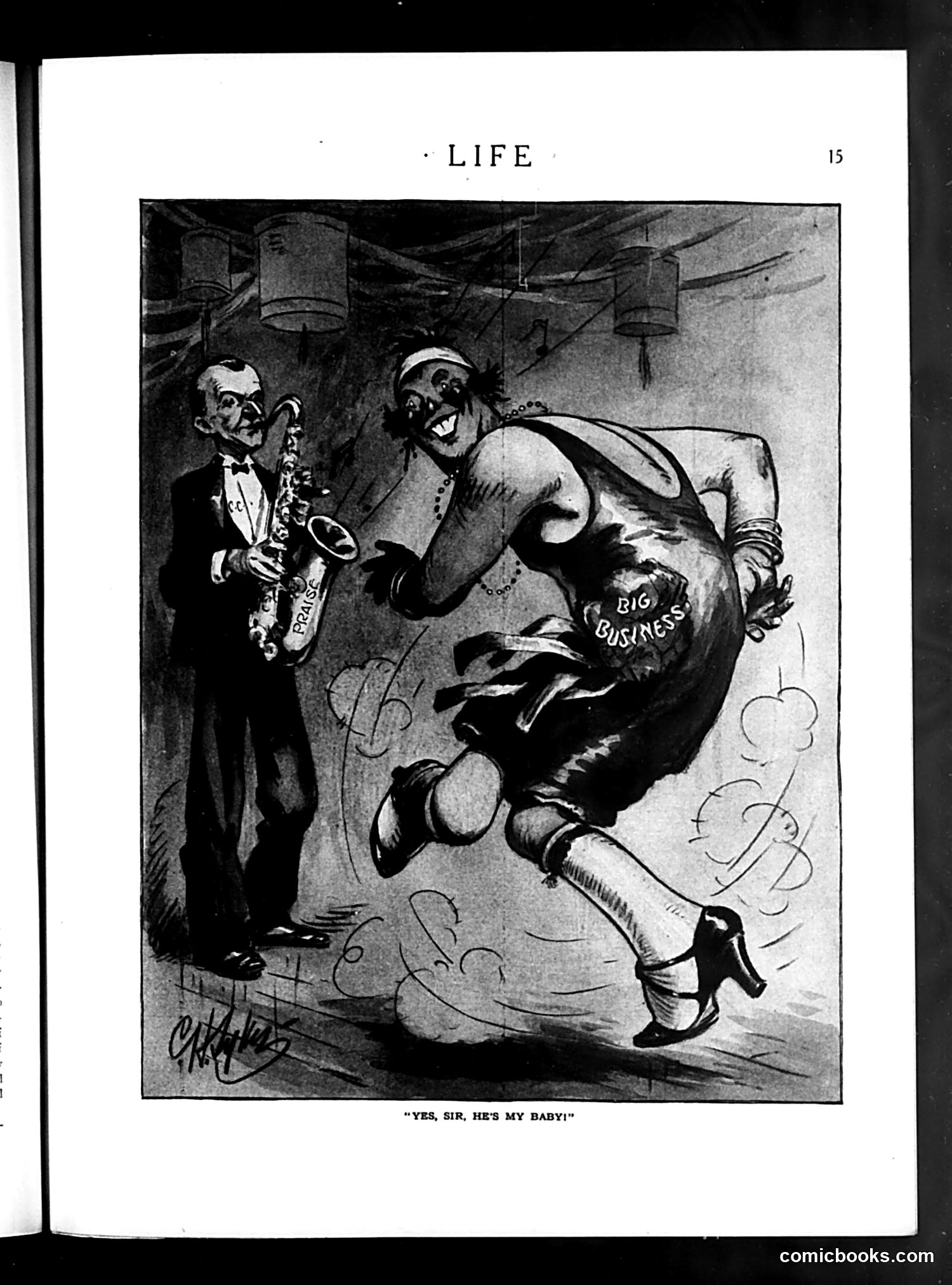
This satirical cartoon depicts a man in formal attire playing a saxophone, observing another figure labeled "BIG BUSINESS" dancing energetically. The caption reads "YES, SIR, HE'S MY BABY!" The cartoon appears to criticize the relationship between music/entertainment and commercial interests during the Jazz Age. The well-dressed musician represents the entertainment industry or perhaps a promoter, while "Big Business"—shown as an exuberant, caricatured dancer—represents corporate commercialization. The joke suggests that Big Business has become the "baby" or product of the entertainment world, implying that commercial interests now control or dominate what should be artistic expression. This reflects early 20th-century anxieties about commercialization corrupting artistic authenticity.
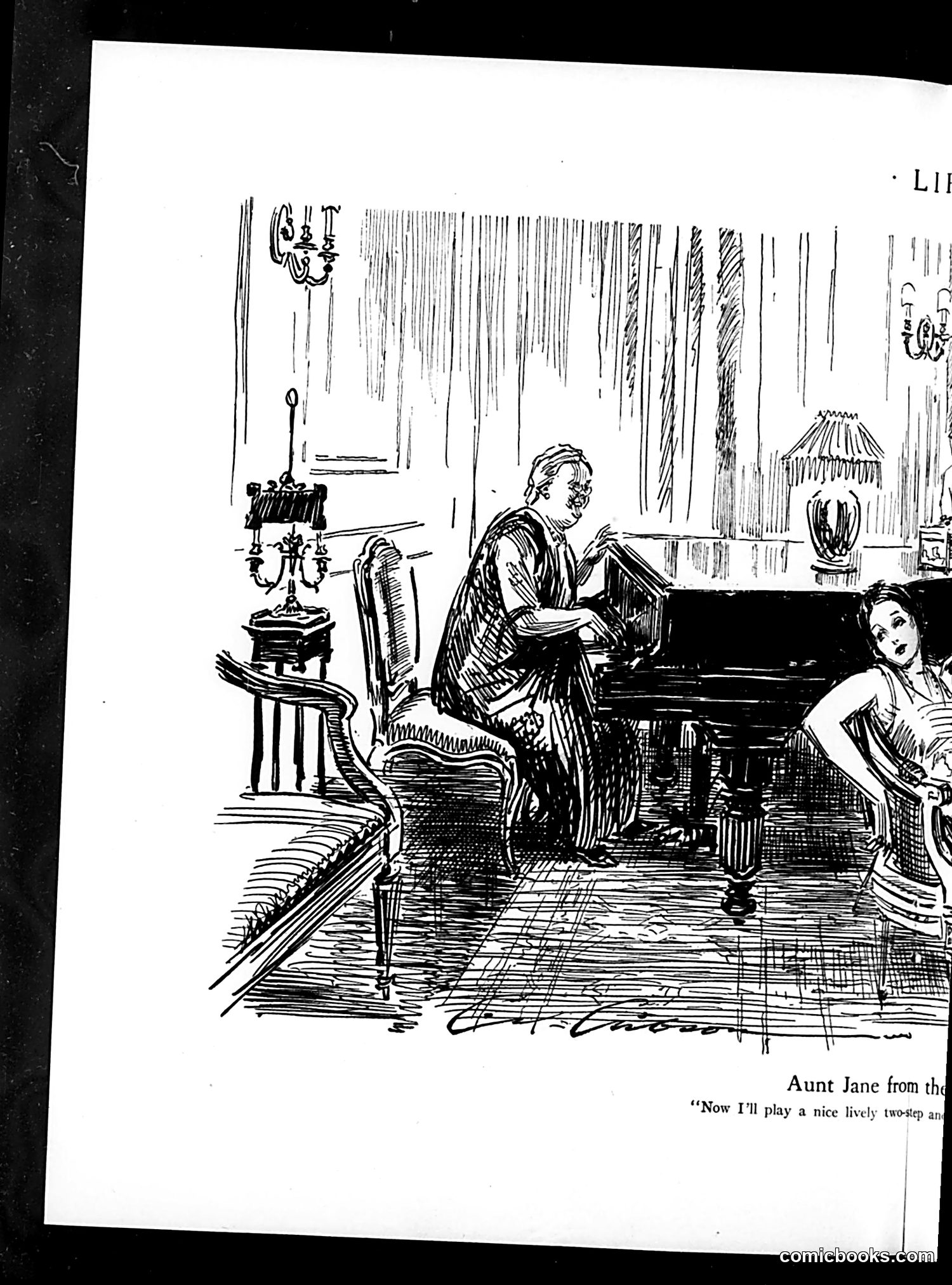
This illustration depicts a domestic scene in an elegant parlor, with a man seated at a piano and a woman watching. The caption references "Aunt Jane" and quotes: "Now I'll play a nice lively two-step and..." The cartoon appears to satirize Victorian-era social conventions around amateur musical performance. The joke likely centers on the tedious expectation that household members—particularly women—would provide piano entertainment for guests, and the predictable, uninspired nature of such performances (a "nice lively two-step" being generic popular music of the era). The furnishings and formal dress suggest upper-class domestic life, where musical accomplishment was a marker of refinement, though actual skill varied widely. The satire mocks the obligatory, repetitive nature of these social rituals rather than any specific political event.
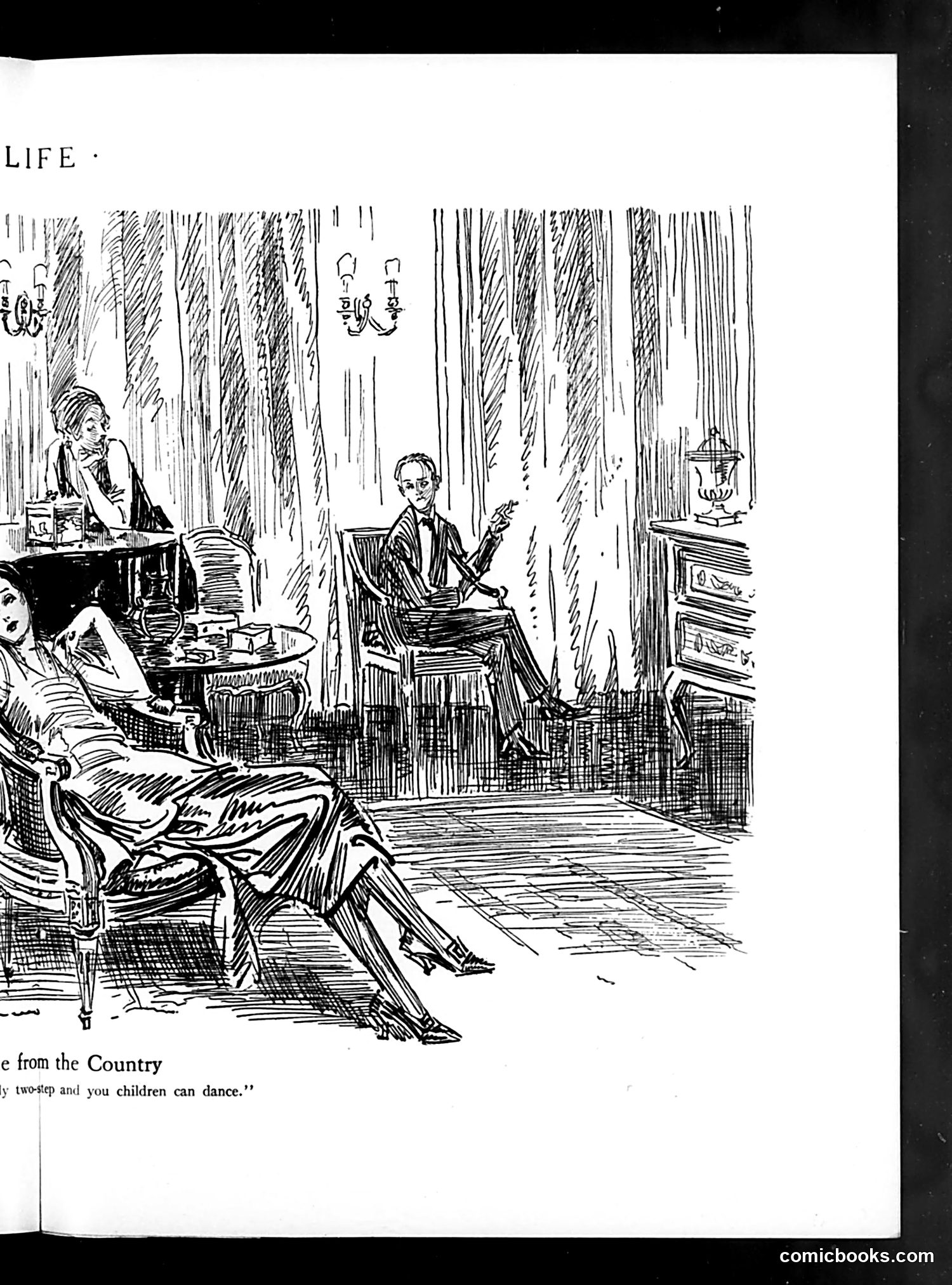
This appears to be a section titled "LIFE" featuring a social satire scene. The illustration shows an elegant interior with tall curtains where three figures are present: a woman reclining in a chair (foreground left), a man seated at a desk (background left), and another man sitting in a chair holding what appears to be a violin or musical instrument (center-right). The partially visible caption references "from the Country" and mentions a "two-step" dance, suggesting the humor involves someone from a rural background attempting or offering to teach fashionable city dwellers country dancing. This satirizes the contrast between rural and urban social customs—a common theme in early 20th-century American humor, mocking either rural naiveté or urban pretension. The specific figures and full context remain unclear from the visible portion.
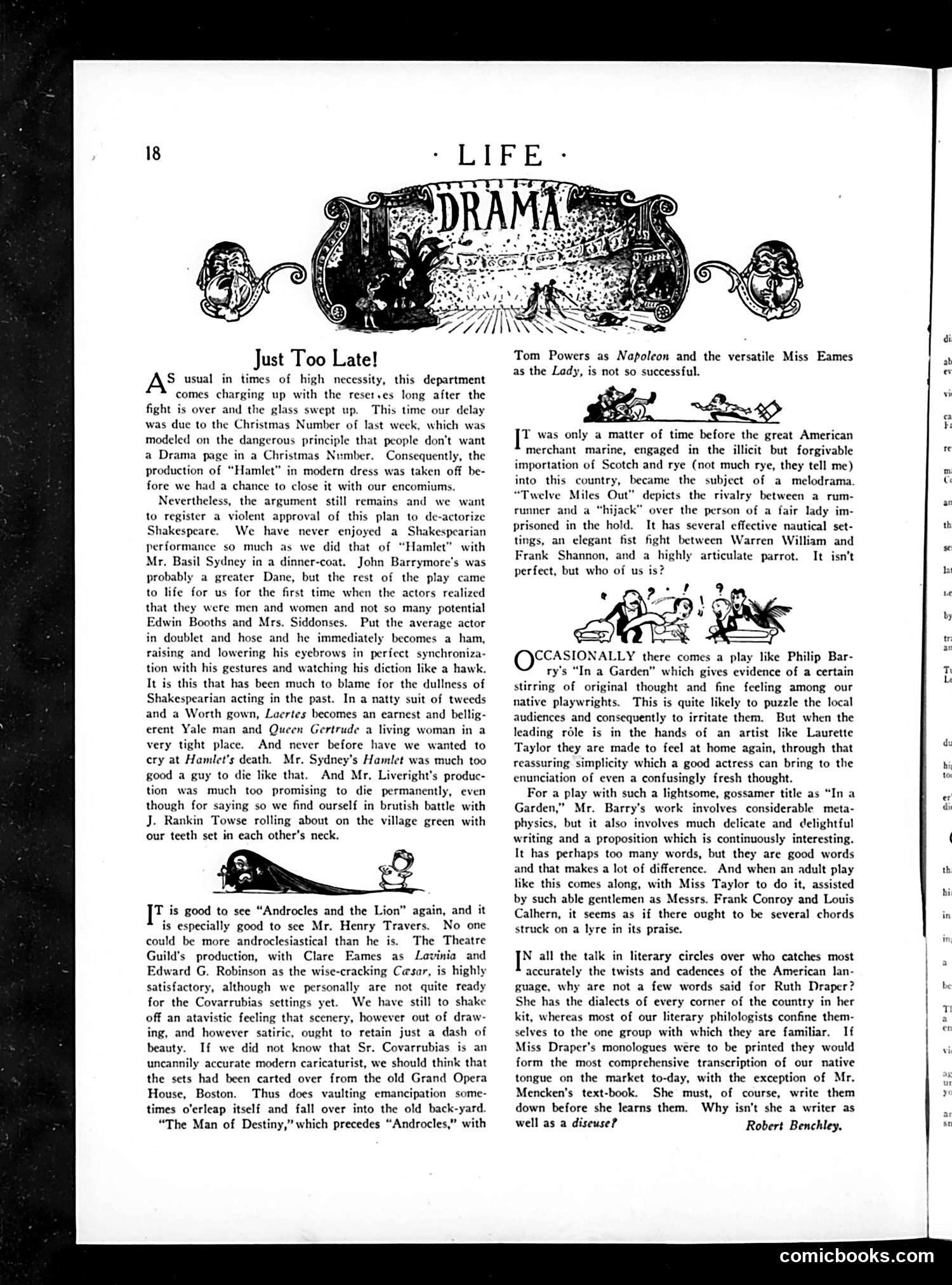
This is a theater review page from Life magazine's satirical "Drama" section. The main content critiques several Broadway productions: **"Hamlet" in Modern Dress**: Life *approves* of actor Basil Sydney performing Shakespeare in contemporary clothing (a dinner coat rather than Elizabethan costume). The satire targets traditional Shakespearean acting—the overwrought gestures and eyebrow-raising that made classical theater tedious. Modern dress allegedly made characters feel like real people rather than theatrical "hams." **Other Reviews**: The page also covers Shaw's "Androcles and the Lion," "Twelve Miles Out" (a Prohibition-era melodrama about rum-runners), and "In a Garden" by Philip Barry. The cartoons are small, generic theatrical illustrations rather than political commentary. The satire here is *theatrical*—mocking stuffy classical performance traditions and praising innovative staging that made Shakespeare accessible and emotionally resonant to modern audiences.
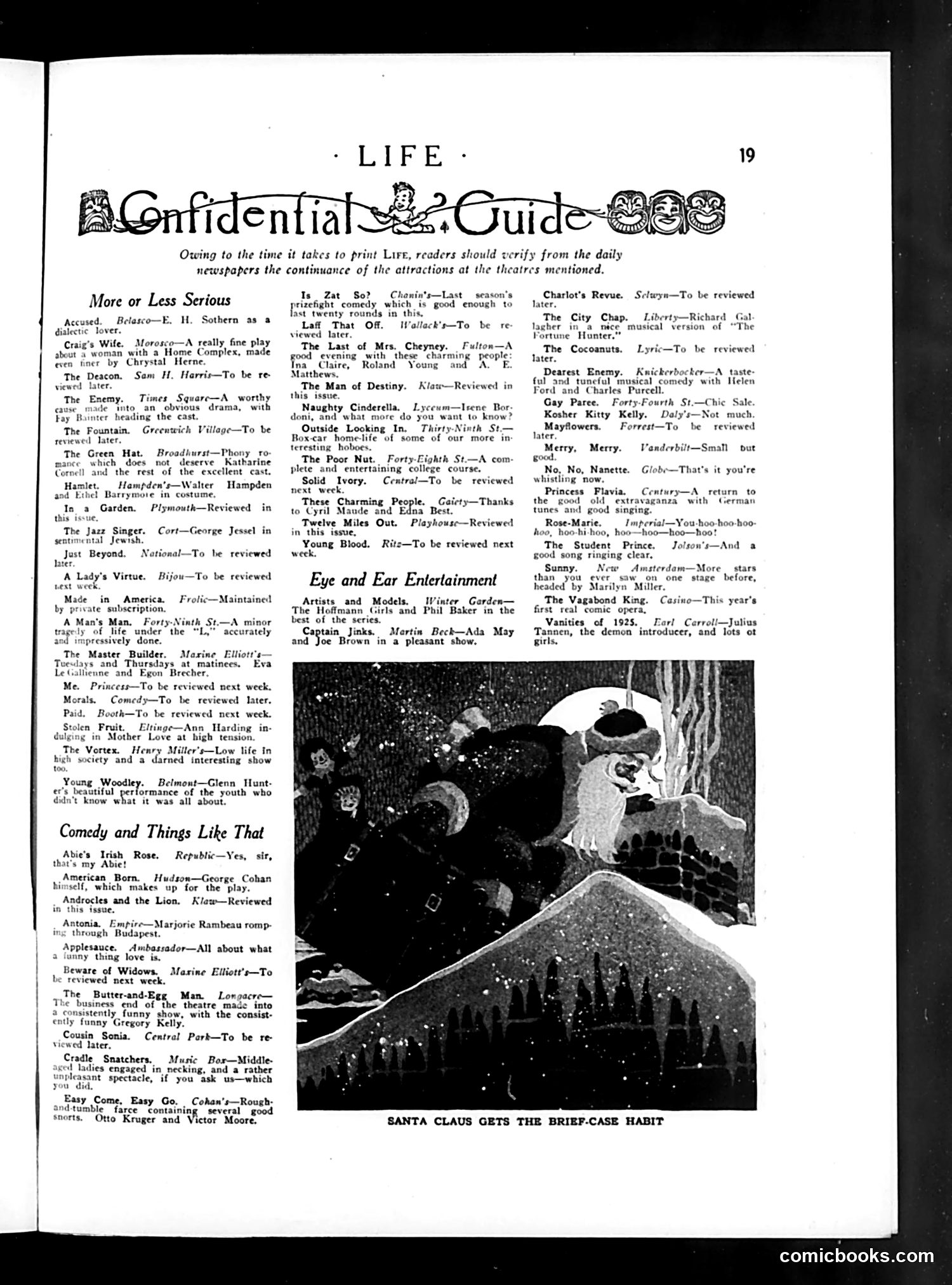
This page from *Life* magazine is primarily a theater guide listing Broadway shows with brief reviews. The single cartoon illustration at the bottom depicts Santa Claus carrying a briefcase while climbing down a chimney—a visual joke about the commercialization of Christmas during the 1920s. The satire suggests that even Santa Claus, traditionally a symbol of holiday generosity and magic, has been transformed into a businessman preoccupied with commerce and contracts (represented by the briefcase). This reflects *Life*'s recurring criticism of how American capitalism was infiltrating and corrupting traditional values and holiday sentiment. The cartoon likely resonated with readers concerned that the modern business world was overwhelming cultural institutions and sacred traditions, reducing everything—including Christmas—to commercial transactions and professional obligations rather than spiritual or familial meaning.
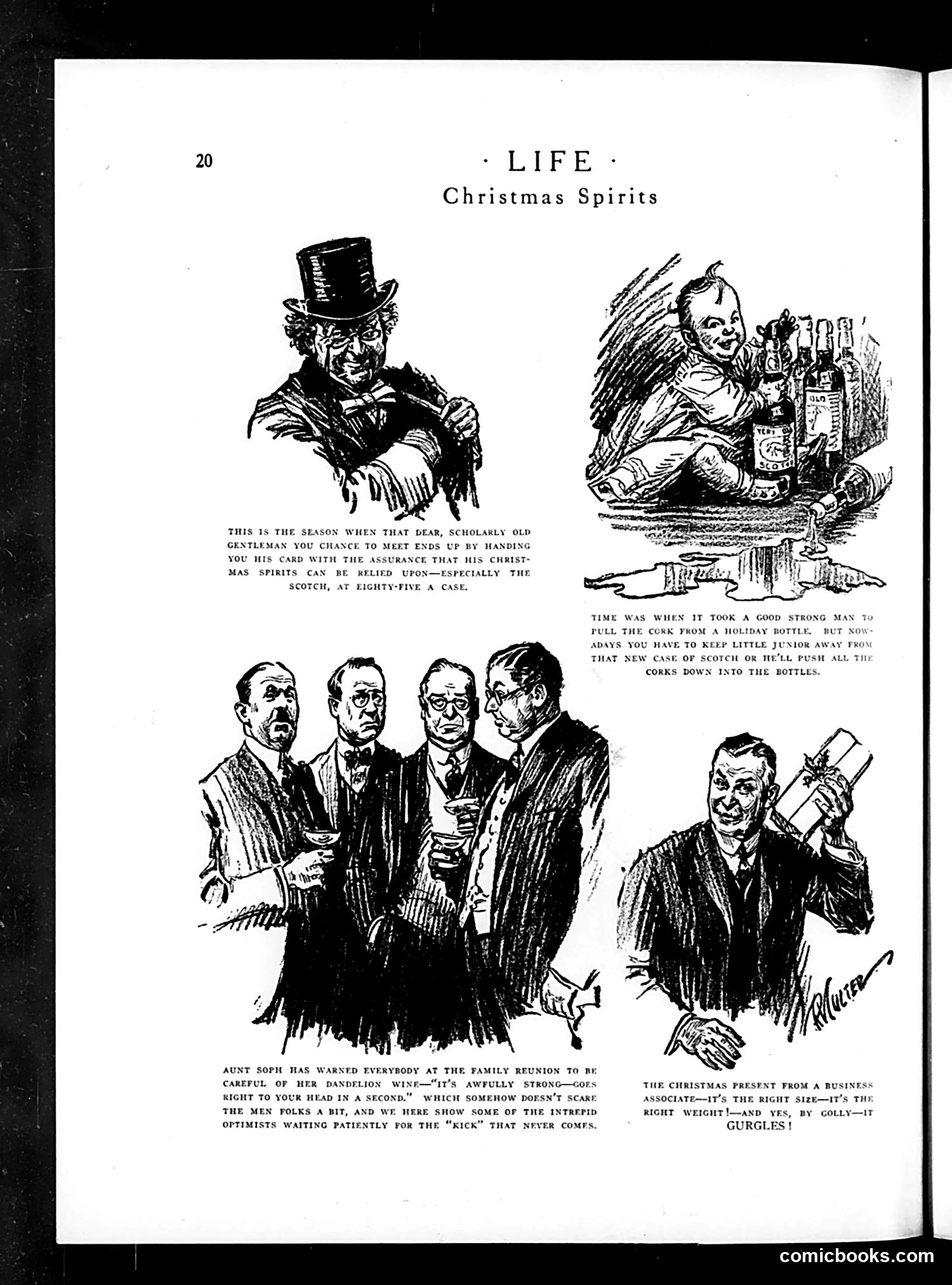
This satirical page mocks American drinking culture during the holiday season. The cartoons depict various Christmas scenarios centered on alcohol consumption: The top illustrations show wealthy gentlemen distributing expensive Scotch whisky (at "eighty-five a case"—a high price), and reference the challenge of keeping liquor away from children who might tamper with bottles. The largest cartoon shows men at a family gathering, warned by "Aunt Soph" about her potent dandelion wine. The caption humorously notes that despite warnings about its strength, the men eagerly await its effects. The final image shows a man proudly presenting a bottle as a Christmas gift, emphasizing its weight and the gurgling sound—implying its value lies purely in the alcohol itself. The satire targets the way alcohol dominates holiday celebrations and the social competition around serving impressive spirits, while also gently mocking masculine bravado about alcohol consumption.
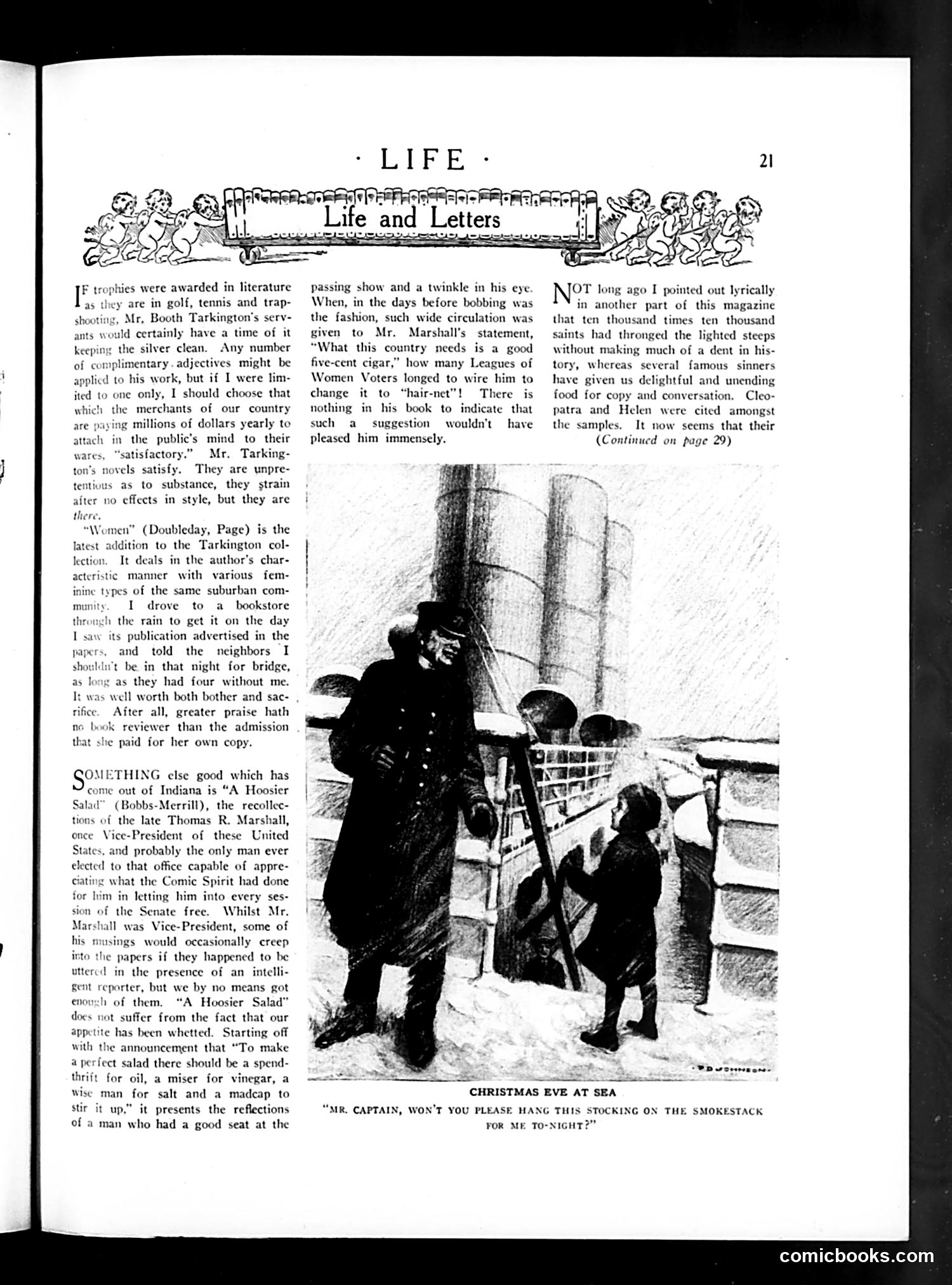
This page from *Life* magazine contains two distinct elements: **Main Text**: A book review column praising novelist Booth Tarkington's work "Women," and discussing Thomas R. Marshall's memoir "A Hoosier Salad." Marshall, former Vice-President, is noted for having made a famous quip about needing "a good five-cent cigar"—which the text humorously notes that women's groups (the "Leagues of Women Voters") wished he'd redirected toward more "respectable" concerns like hair-nets, reflecting 1920s gender politics and social reform movements. **Illustration**: A sentimental Christmas Eve scene showing what appears to be a young child asking a ship's captain to hang a stocking on the smokestack. The image's sentimentality—a child maintaining Christmas traditions at sea—contrasts with the page's sophisticated literary commentary, typical of *Life*'s mix of highbrow and genteel domestic humor.
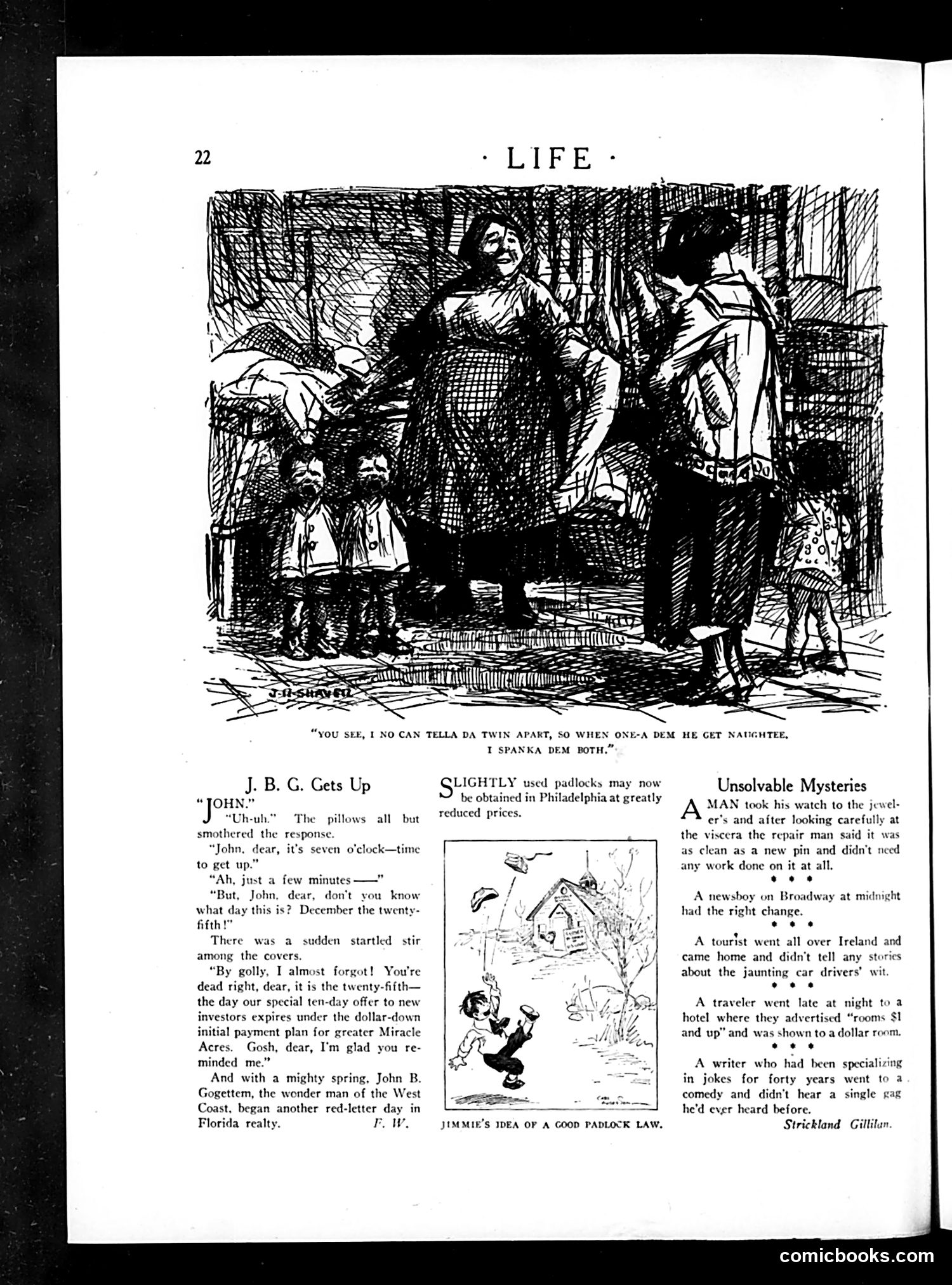
The main cartoon depicts a domestic scene where a husband, "John B. Gogettem," is reminded it's Christmas morning—but his immediate excitement isn't about the holiday. Instead, he springs from bed because December 25th is the deadline for a special investment offer in "Miracle Acres," a Florida real estate development with a dollar-down payment scheme. The satire targets the real estate speculation craze of the 1920s, likely the Florida land boom. Gogettem's name itself is a pun on get-rich-quick mentality. The joke is that commercial greed has entirely displaced the meaning of Christmas—a holiday's spiritual significance is eclipsed by financial opportunity. The smaller cartoons and text snippets below are brief humorous anecdotes about improbable situations (an honest newsboy, a clean watch needing no repair), serving as filler content typical of Life's satirical format. The top illustration shows what appears to be a comedic ethnic scene involving twins, with dialect humor common to the era's problematic conventions.
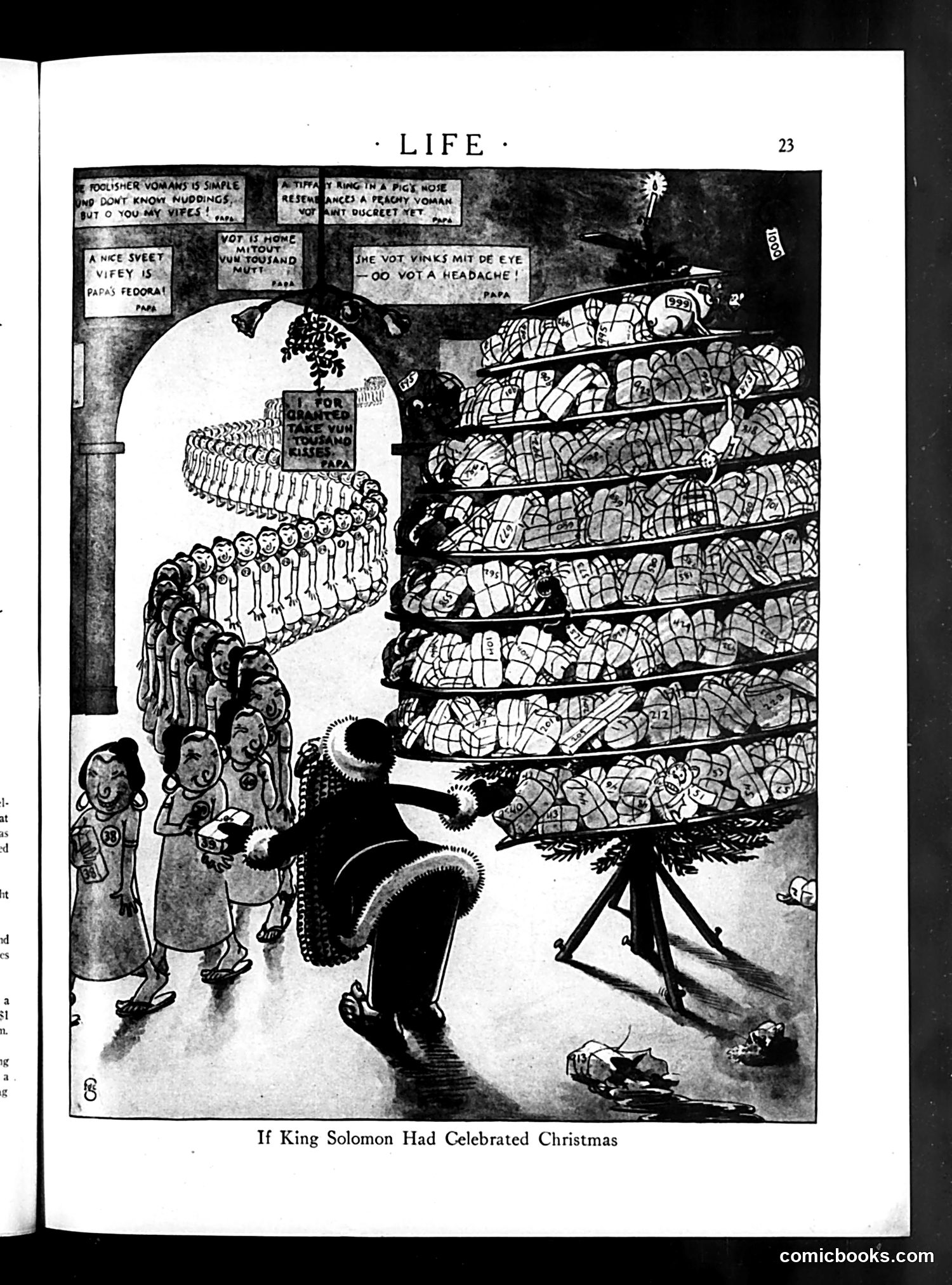
This satirical cartoon imagines King Solomon—biblical figure famous for his wisdom and numerous wives—hosting a Christmas dinner. The joke depicts the chaos of managing multiple households during the holidays. On the left, Solomon's many wives stand in a doorway. On the right, he struggles to carve an enormous Christmas turkey for the assembled crowd of family members stacked on tiered benches. The speech bubbles show wives complaining in various accents about domestic grievances—puddings, headaches, eye problems—suggesting the comedic impossibility of keeping multiple spouses happy during holiday festivities. The satire targets the logistical nightmare of managing plural marriage during a major holiday celebration, treating Solomon's biblical polygamy as a domestic farce. It's humor based on cultural assumptions about marital discord and holiday stress, rather than pointed political commentary.
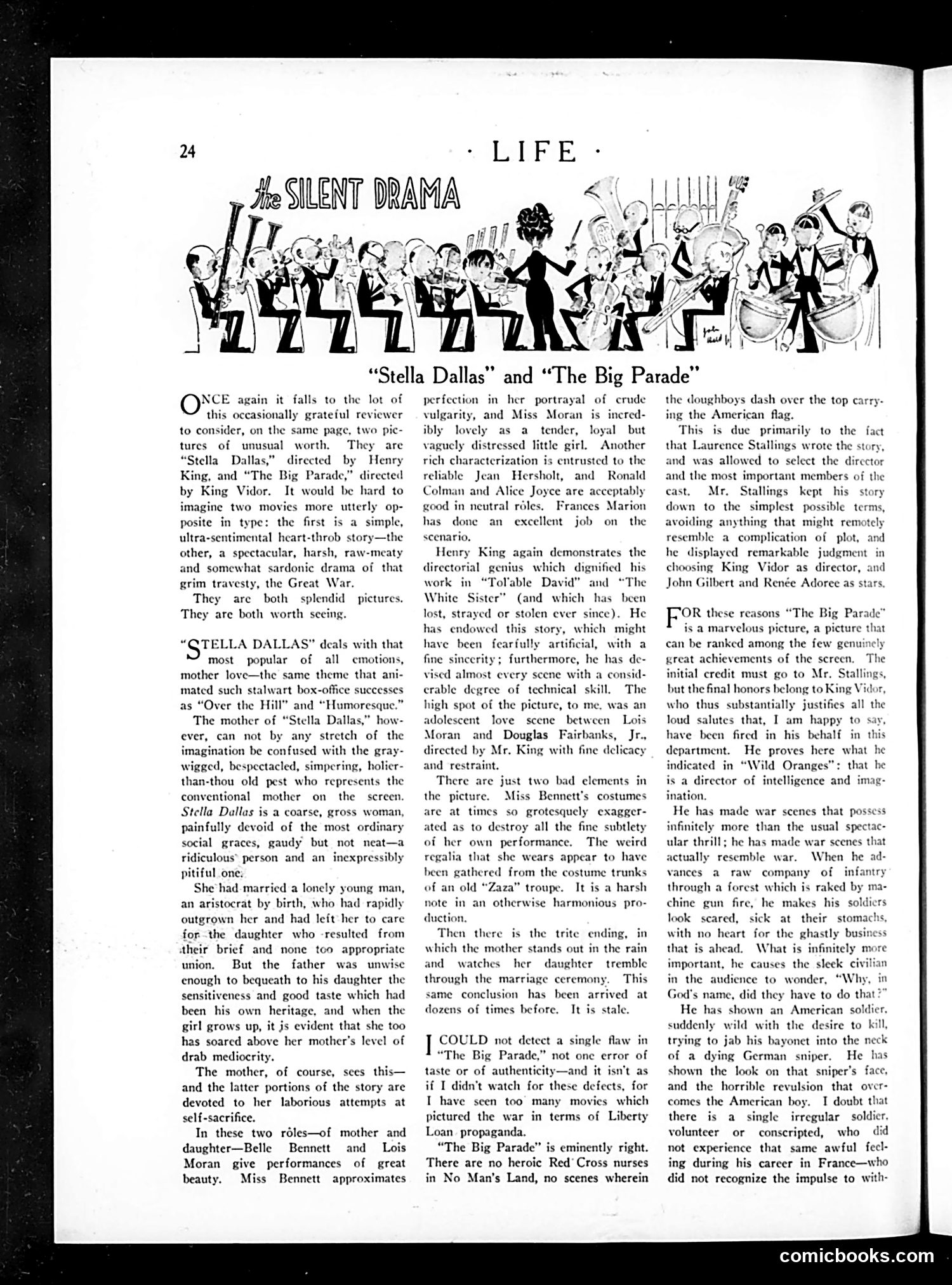
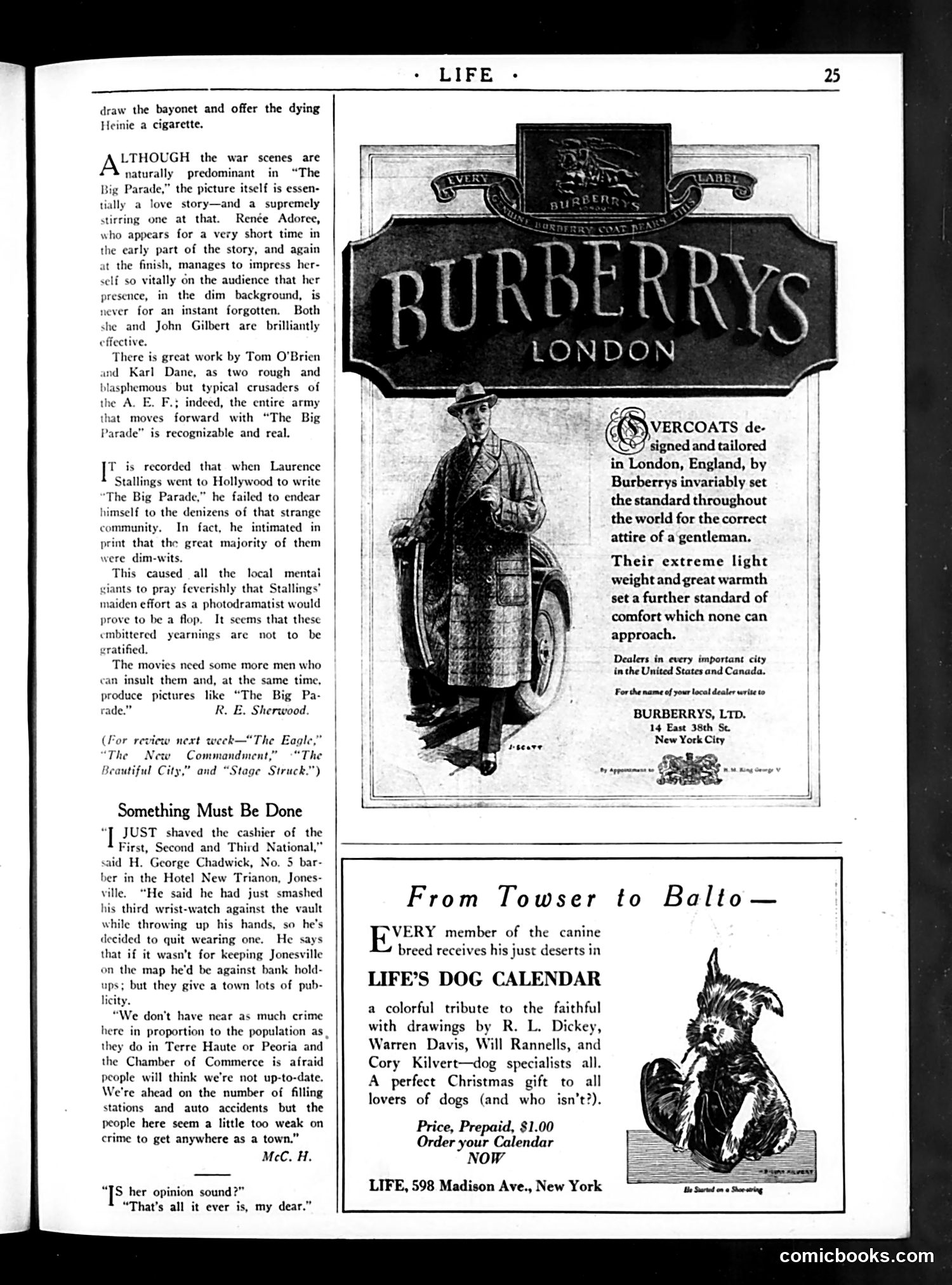
This page combines a film review with advertisements and humor pieces. The main content reviews "The Big Parade," a 1925 war film, praising its battle scenes and love story while noting the film's writer, Laurence Stallings, had insulted Hollywood's intelligence in print. The review humorously notes that despite local animosity toward Stallings, the film succeeded—and argues Hollywood needs more such critical voices. A short humor piece titled "Something Must Be Done" satirizes small-town boosterism: a barber reports a bank cashier won't wear watches because repeated robberies keep destroying them during hold-ups. The town's Chamber of Commerce reportedly welcomes the crime because it makes Jonesville seem "up-to-date," despite the actual danger. The advertisements include Burberrys overcoats and Life's dog calendar. These are straightforward period advertising with no satirical intent.
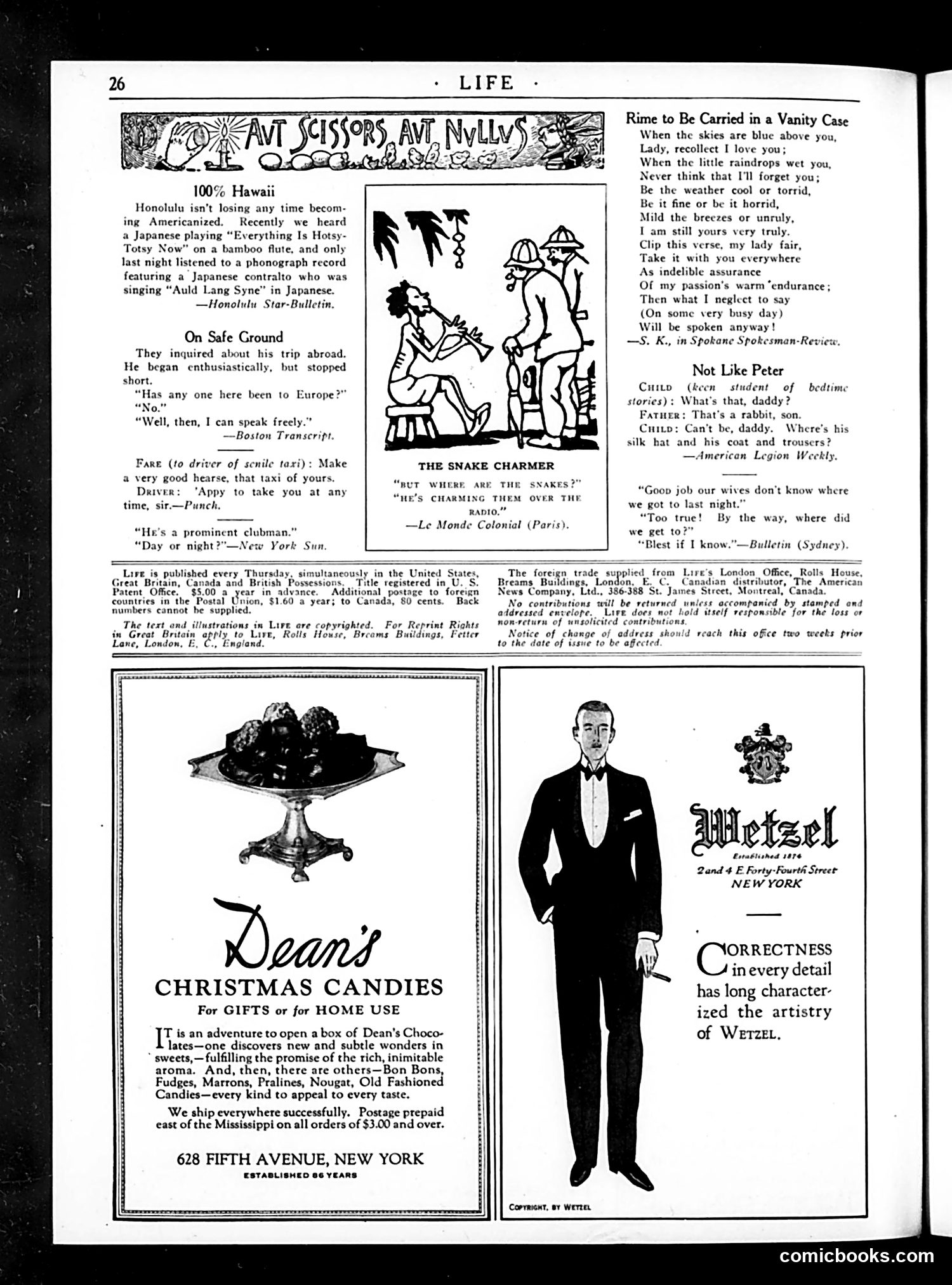
This page contains several short humorous items typical of Life's satirical format: **"100% Hawaii"** jokes about cultural Americanization—Japanese musicians now playing American popular songs, showing rapid Western influence in Hawaii. **"The Snake Charmer"** cartoon references radio as a modern phenomenon. The joke plays on "charming snakes over the radio"—likely satirizing radio's newfound power to influence or "charm" mass audiences, perhaps echoing concerns about propaganda or manipulation through this emerging technology. **Other brief humor pieces** include wordplay about taxi drivers, travel anecdotes, and domestic comedy—standard fare for the era's magazines. The page is primarily **advertising** (Dean's Christmas Candies, Wetzel formal wear), with these satirical items interspersed. The cartoon style and references suggest this is from the 1920s-1930s, when radio was still novel and Life maintained its tradition of mixing social commentary with commercial content.
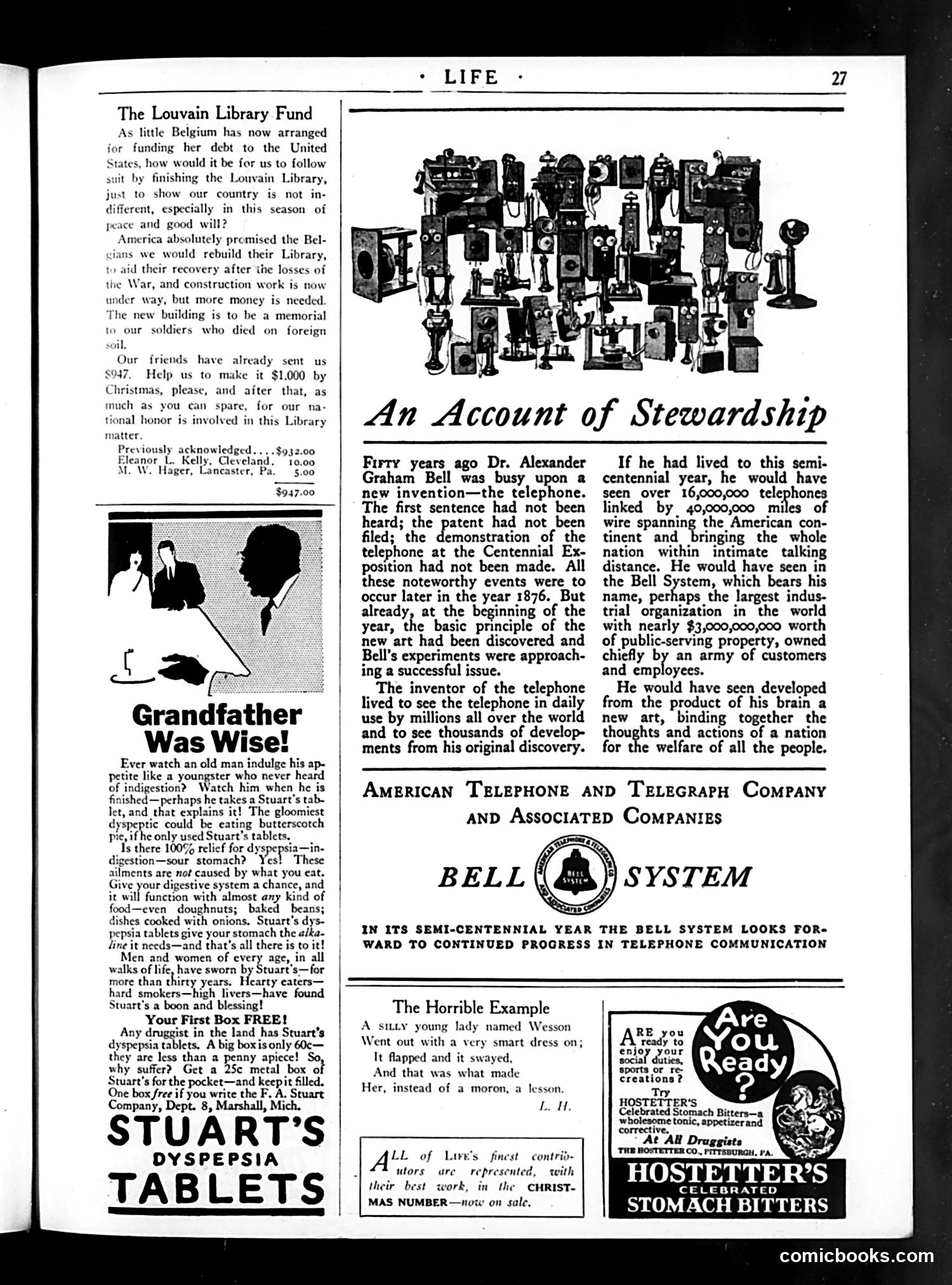
This page mixes charitable fundraising, product advertising, and corporate messaging typical of 1920s *Life* magazine. **The Louvain Library Fund** (top left): A post-WWI appeal seeking donations to rebuild Belgium's damaged Louvain Library as a memorial to American soldiers. This reflects 1920s philanthropic nationalism—America positioned itself as benevolent peacemaker. **"Grandfather Was Wise!"** (left): Advertisement for Stuart's Dyspepsia Tablets, a digestive remedy. The humor relies on stereotypes about elderly men's digestive troubles and the implied wisdom of using patent medicine rather than dietary changes. **"An Account of Stewardship"** (right): A Bell Telephone System advertisement marking the telephone's 50th anniversary (circa 1876). It praises Alexander Graham Bell's invention and celebrates the Bell System's massive growth—16 million phones, $3 billion in assets—framing telephone infrastructure as a public good binding the nation together. **"The Horrible Example"** (bottom): An incomplete humorous poem about a woman's fashion mishap, likely a moral cautionary tale about vanity. The page reflects 1920s corporate confidence and consumer culture alongside patriotic post-war sentiment.
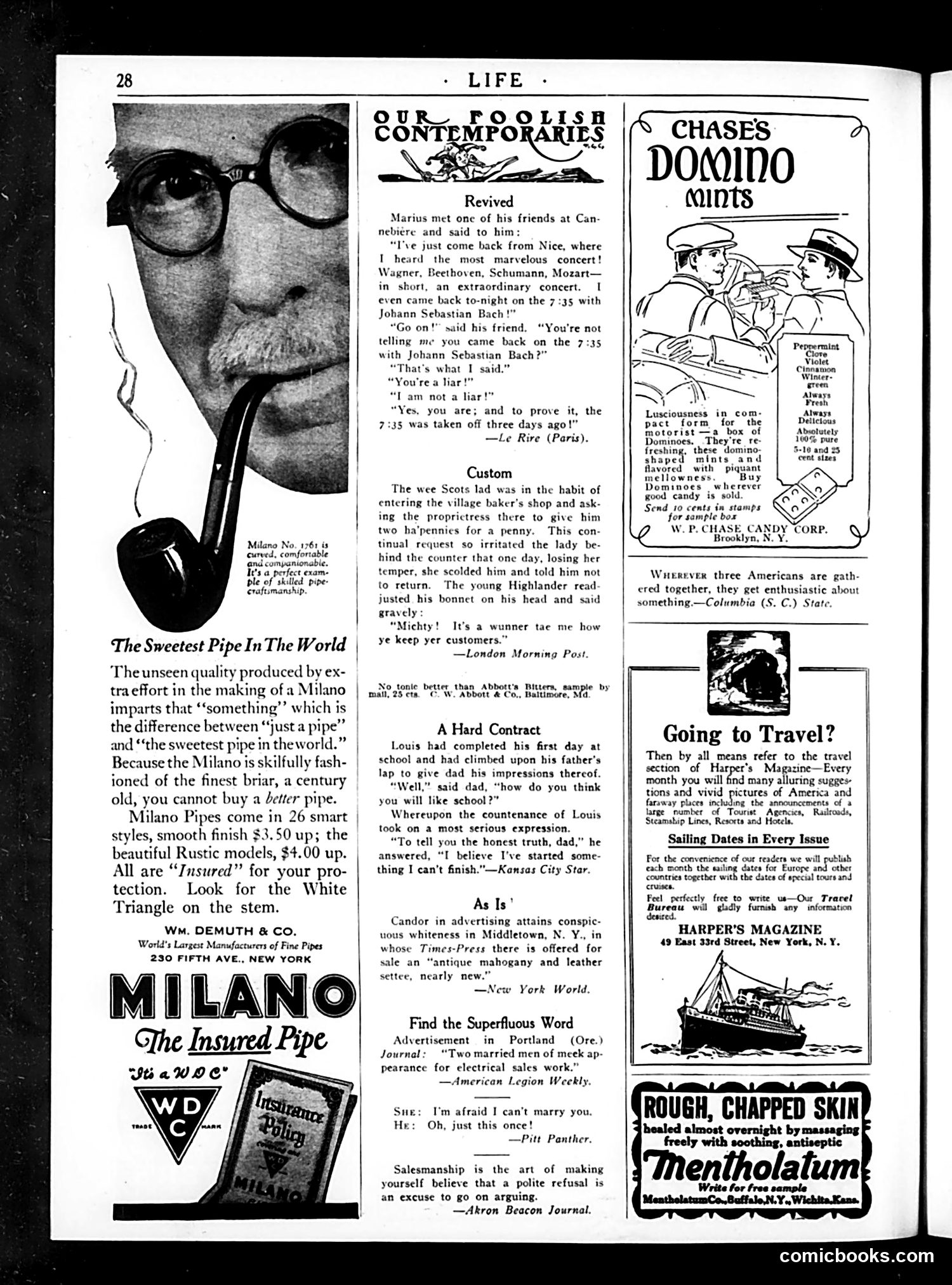
This page is primarily **advertising and humor columns**, not political cartoons. The main content includes: **"The Sweetest Pipe in the World"** — A large Milano pipe advertisement emphasizing handcrafted quality and durability as selling points. **Humor Sections** ("Our Foolish Contemporaries," "Revived," etc.) — Short anecdotes mocking human behavior: - A man's absurd claim about attending a concert with composer Johann Sebastian Bach on a train that wasn't running - A Scottish boy's logic trap with a baker - A child's honest admission that school is harder than expected - Advertisements with unintentionally revealing language (like "two married men" needed for sales) **Other Advertisements** — Chase Domino Mints, Mentholatum for skin, and Harper's Magazine travel section. The satire is light and observational rather than political—poking fun at everyday foolishness, exaggeration, and the gap between intention and reality. This reflects Life magazine's genteel, upper-middle-class humor typical of the early 20th century.
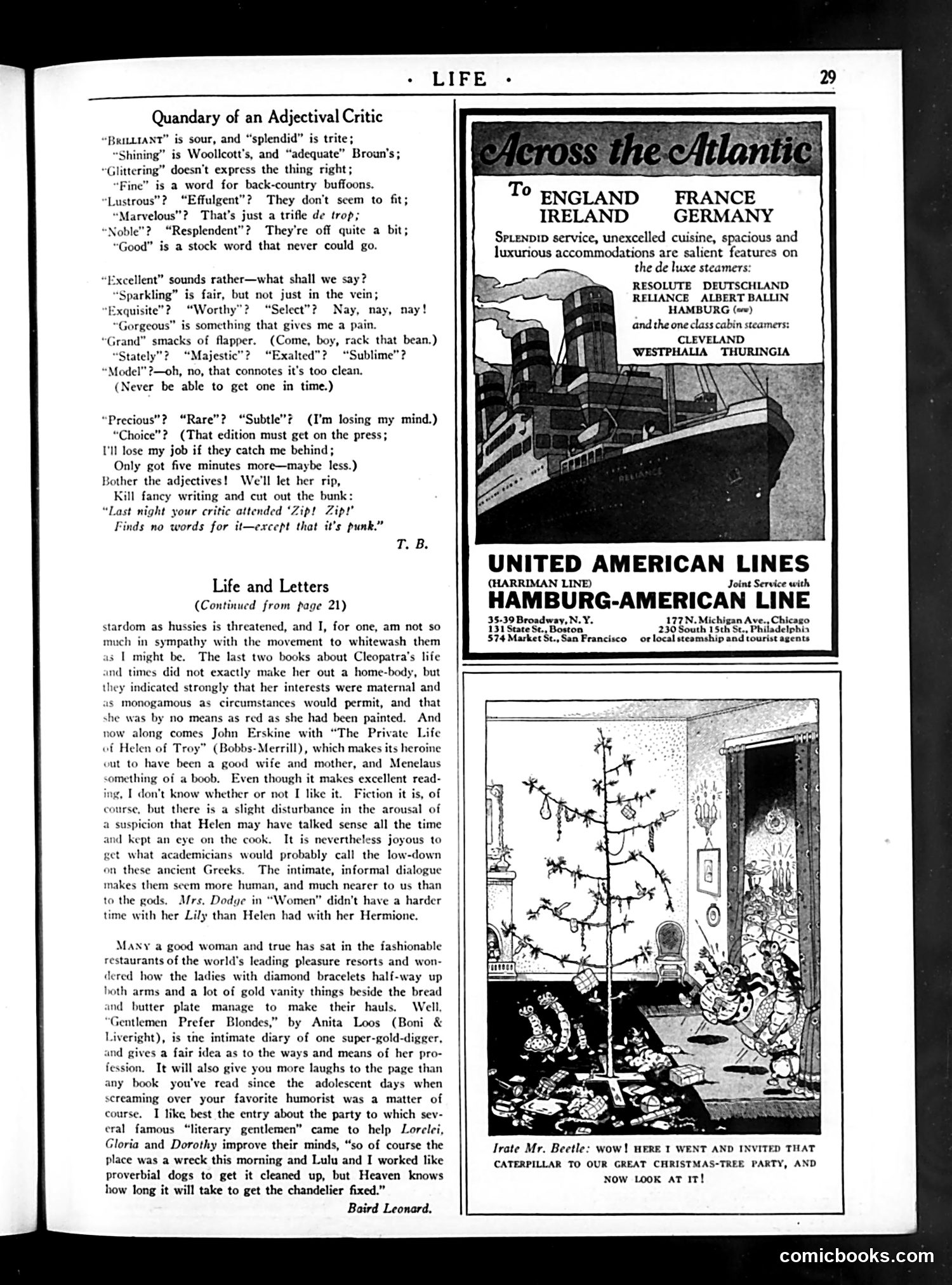
The left column contains a poem satirizing theatrical critics' struggle to find fresh adjectives. The poet (T.B.) catalogs worn-out praise words—"brilliant," "splendid," "excellent"—showing how critical vocabulary has been exhausted by overuse. The humor peaks when the critic, under deadline pressure ("I'll lose my job if they catch me behind"), abandons eloquence entirely and simply writes that a show called "Zip! Zip!" is "punk." This mocks both the pretensions of professional critics and the impossibility of finding original language in a glutted marketplace. The "Life and Letters" section below reviews recent books, including John Erskine's *The Private Life of Helen of Troy*, which reimagines classical figures as ordinary people with domestic concerns—a popular literary trend of the era that "humanizes" historical icons. The right side contains shipping advertisements for transatlantic ocean liners, standard magazine filler of the period.
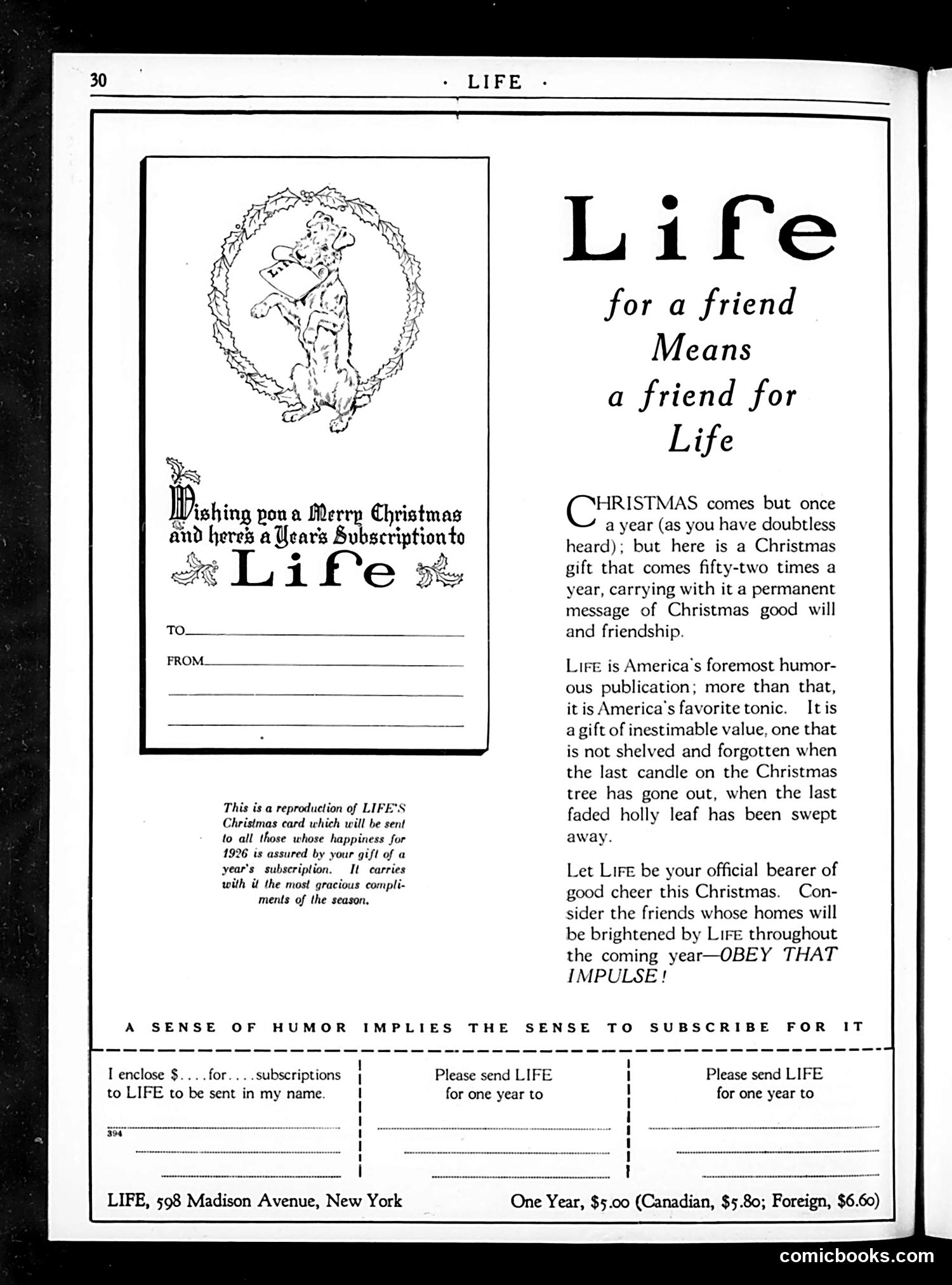
This is a **subscription advertisement**, not political satire. Life magazine—America's leading humor publication—marketed annual subscriptions as Christmas gifts. The page features a classical cherub or putto (child figure) in a wreath, symbolizing goodwill. The pitch emphasizes that unlike single Christmas gifts, a Life subscription provides year-round humor and friendship ("fifty-two times a year"). The copy positions Life as essential to good cheer and social connection, calling it "America's favorite tonic" and urging readers to "OBEY THAT IMPULSE"—a common advertising appeal of the era. **For modern readers**: This reveals how magazines sustained themselves through gift subscriptions and how humor publications marketed aspirational lifestyle value to middle-class readers during the 1920s prosperity.
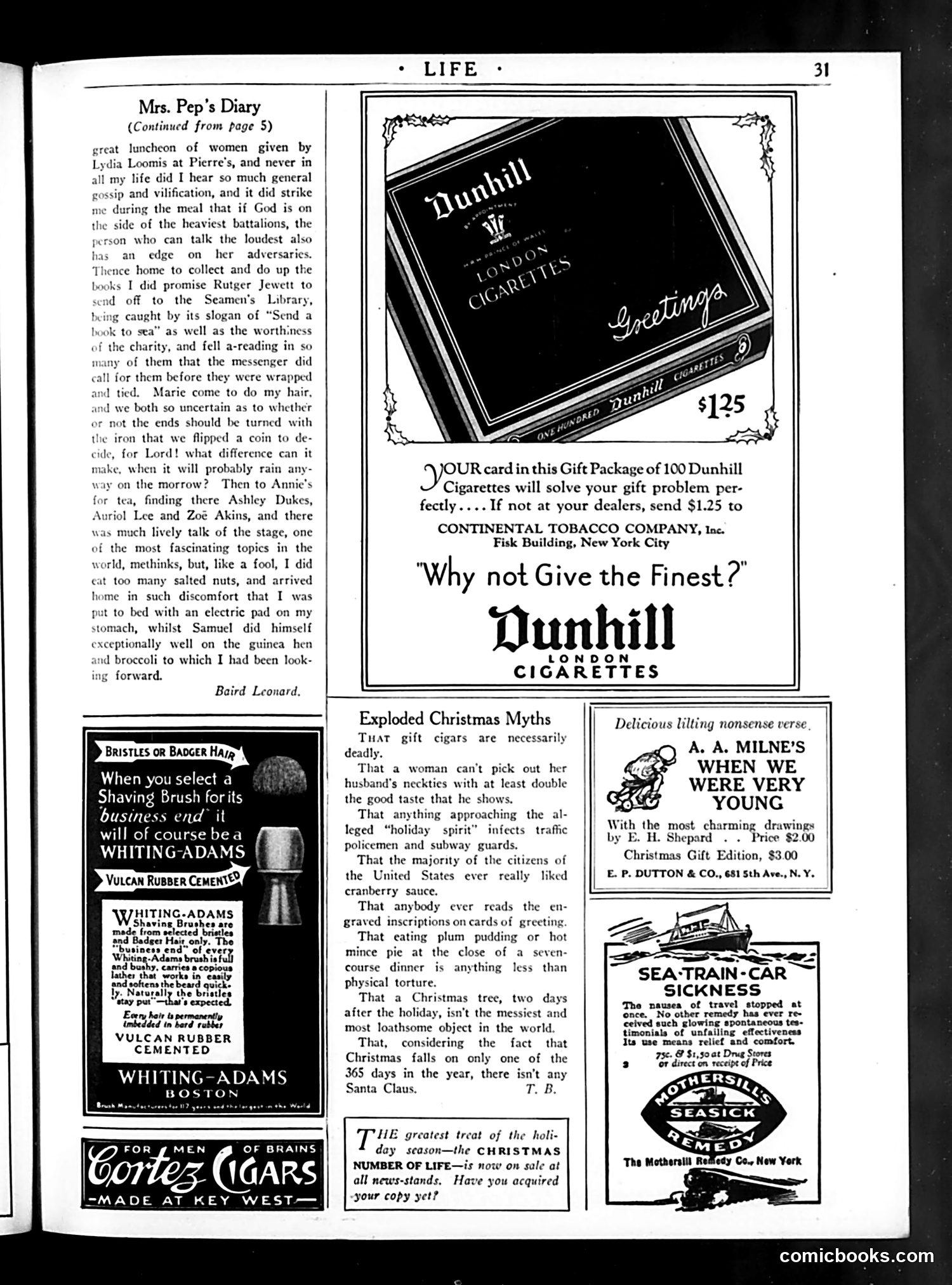
This page is primarily **advertising and light social commentary**, not political satire. The main content is "Mrs. Pep's Diary," a gossipy society column describing a woman's day attending a luncheon, visiting the Seamen's Library, getting her hair done, and having tea with theater people (Ashley Dukes, Auriol Lee, Zoé Akins—apparent theatrical figures of the era). The tone is satirical toward upper-class social rituals and vanities. The page features multiple advertisements for luxury goods: Dunhill cigarettes (framed as gift solutions), Whiting-Adams shaving brushes, and A.A. Milne's children's book "When We Were Very Young." "Exploded Christmas Myths" is a humorous list debunking holiday clichés—that gift cigars are necessary, that Christmas trees stay attractive, that cranberry sauce is actually enjoyed, etc. The satire targets commercialized holiday conventions. Overall, this reflects 1920s-era consumer culture and upper-class social life, with gentle mockery of materialism and holiday excess.
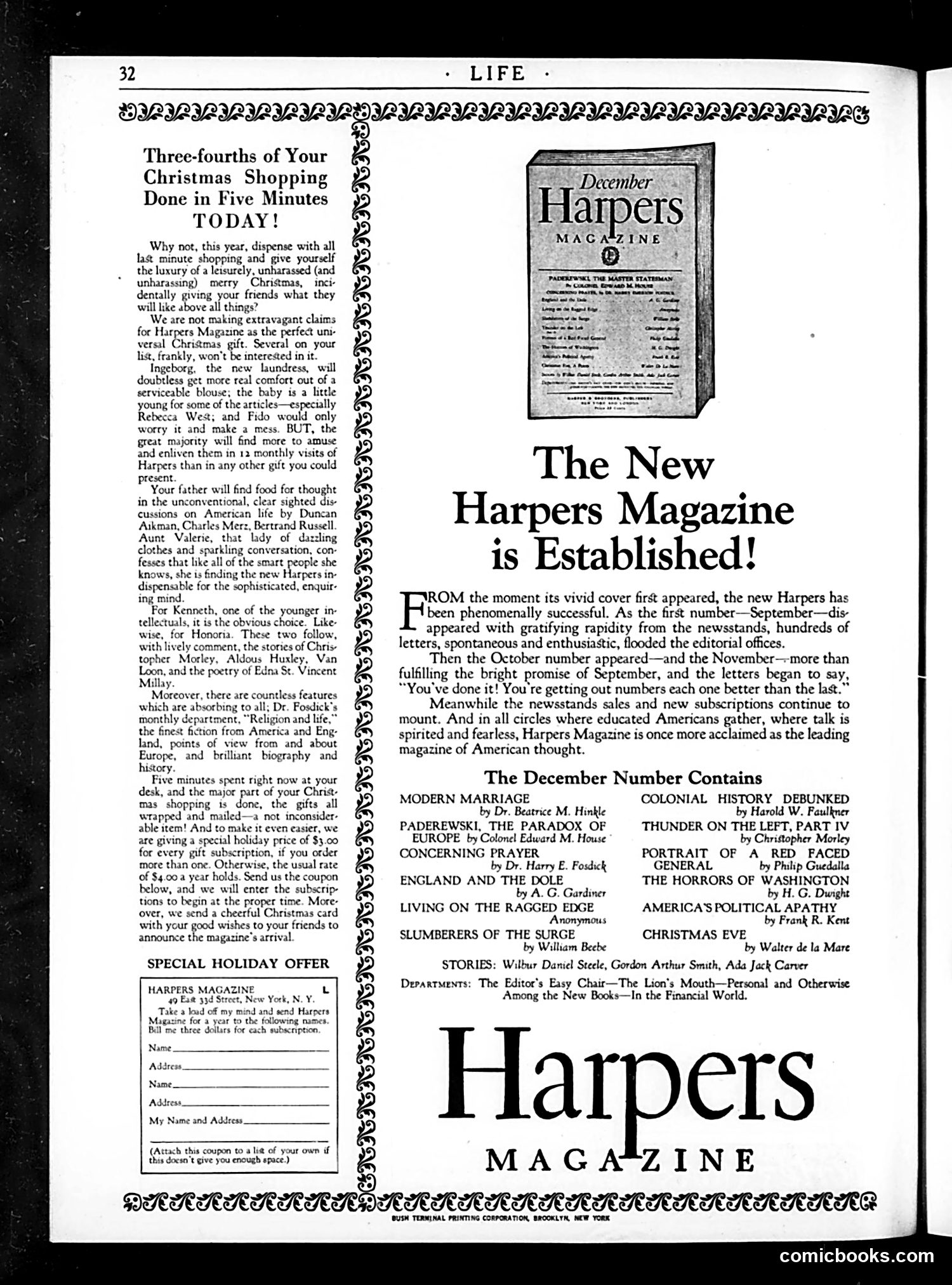
This page is primarily a **Christmas gift advertisement** for the newly established Harper's Magazine, rather than political satire. The ad promotes Harper's as an ideal holiday subscription gift by suggesting it appeals to diverse recipients—intellectuals, fathers seeking serious commentary on American life, sophisticated aunts, and younger intellectuals. It references real contemporary contributors like Bertrand Russell, Aldous Huxley, and Christopher Morley. The December issue's contents reveal the magazine's intellectual focus: articles on modern marriage, Paderewski, prayer, and British economic policy ("England and the Dole"). The humor is gentle rather than satirical—the ad acknowledges Harper's isn't suitable for everyone (notably joking that the laundress would prefer a blouse, the baby isn't ready for sophisticated essays, and the dog would just make a mess of it). The "three-fourths of your Christmas shopping done in five minutes" pitch emphasizes convenience and sophistication as marketing angles for this re-established publication.
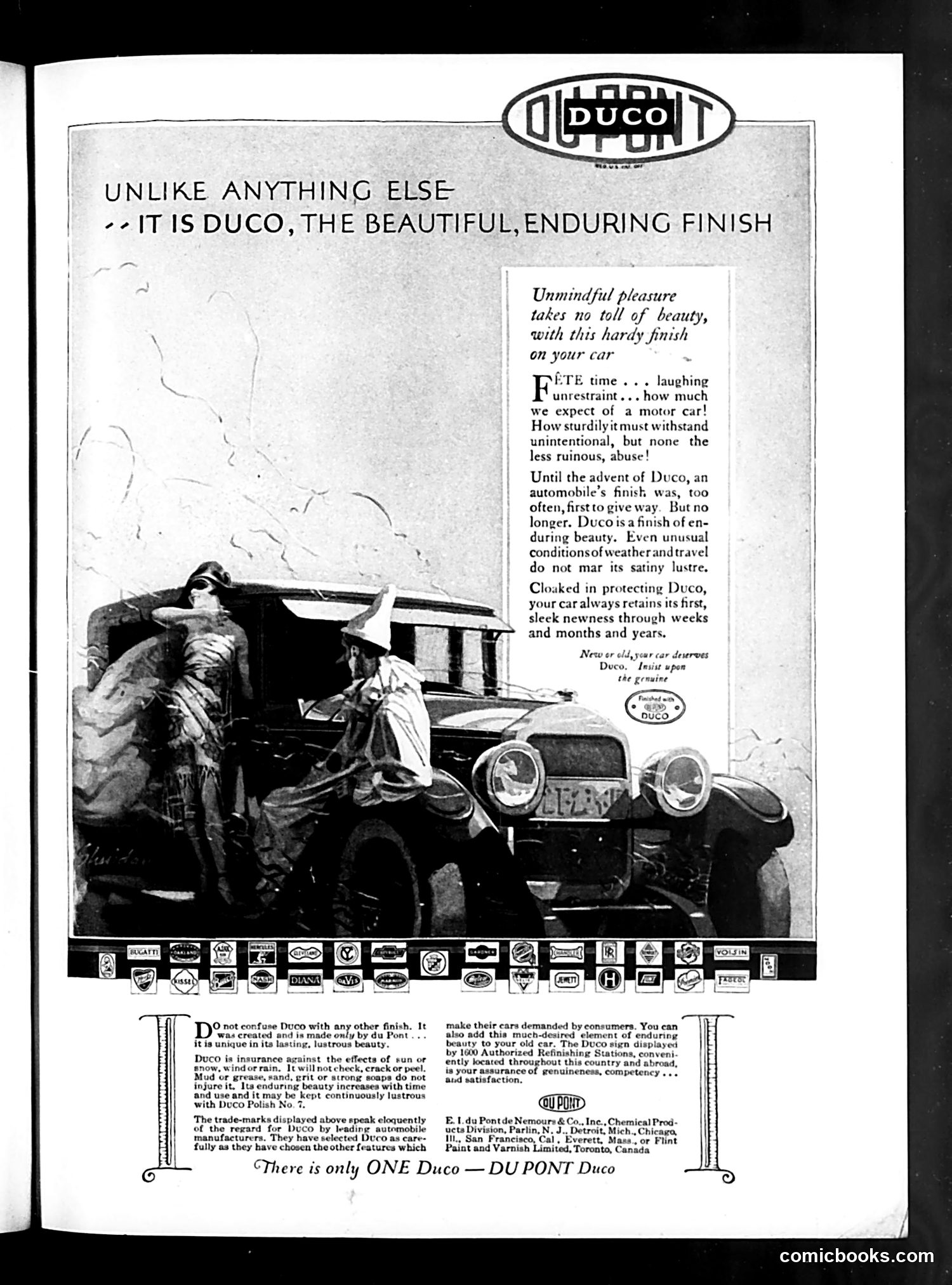
This is primarily a **DuPont automobile paint advertisement**, not political satire. The page promotes "Duco," a new automotive finish product. The image shows a vintage car being inspected by two figures in work clothes, illustrating the product's durability claims. The advertisement's humor is gentle and commercial rather than satirical: it jokes about how cars endure "unmindful pleasure" and "unintentional, but ruinous abuse" from owners who expect their vehicles to withstand rough treatment. The key selling point is that Duco's finish resists damage from weather, dirt, and wear—unlike previous automobile paints that would crack and fade. The page emphasizes that major car manufacturers have adopted Duco, positioning it as the industry standard. This represents early 20th-century advertising's shift toward lifestyle messaging, using aspirational imagery (carefree driving) alongside practical durability claims. There is no political content or satire intended.
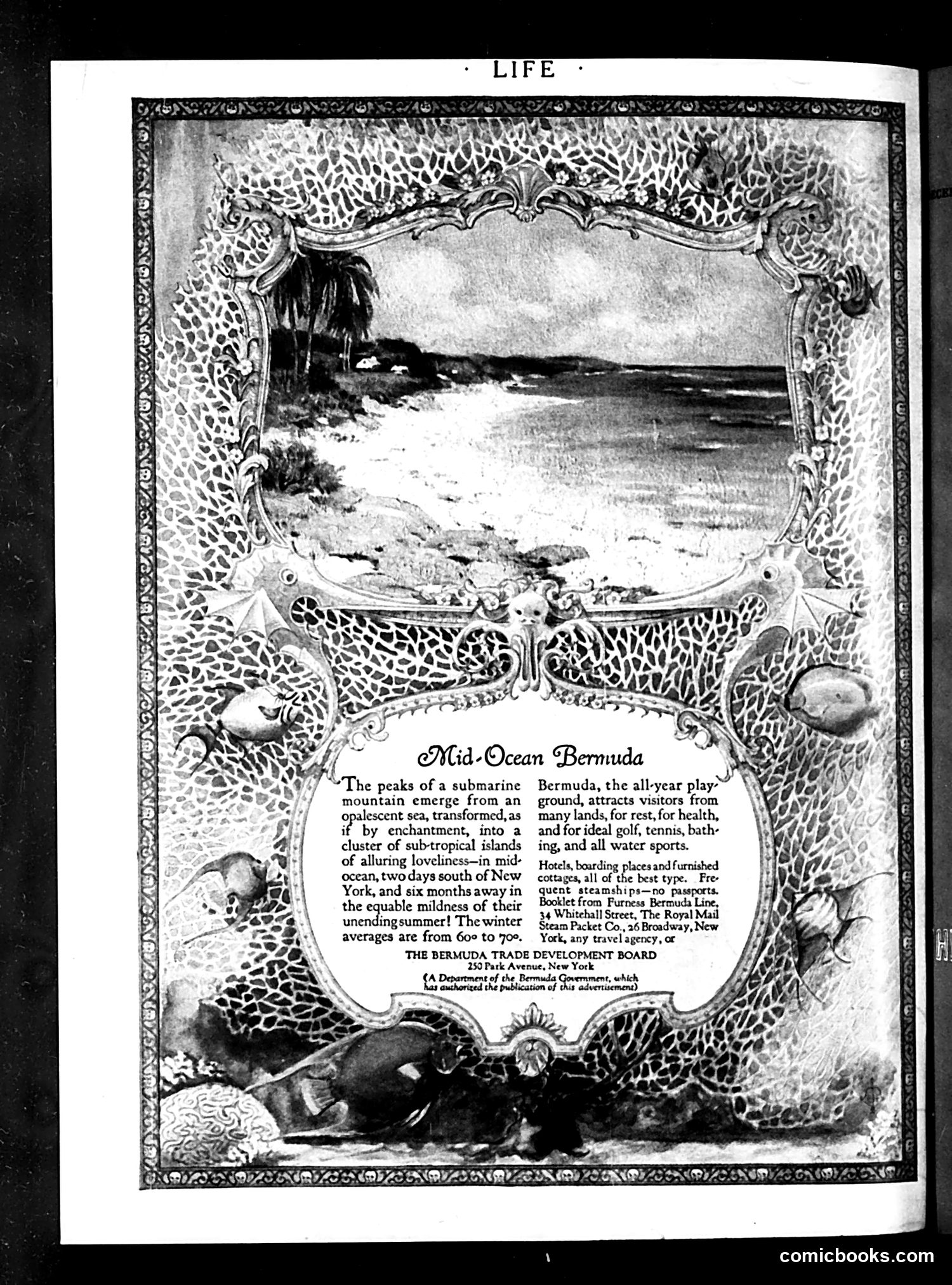
This is **not a cartoon or satire**—it's a travel advertisement for Bermuda disguised as editorial content in Life magazine. The ornate decorative border and romantic illustration (a beach scene with palm tree) frame promotional text describing Bermuda as an exotic vacation destination. The copy emphasizes year-round mild weather, luxury hotels, and recreational activities (golf, tennis, water sports) to attract wealthy American tourists. The fine print reveals the ad's true nature: it's sponsored by the Bermuda Trade Development Board, a government agency authorized to place this advertisement. This represents early 20th-century "native advertising"—promotional material presented in magazine editorial style rather than as obvious paid advertising. For modern readers, this illustrates how magazines once blended ads with content, and how island tourism marketing targeted affluent leisure travelers in an era when Bermuda was a prestigious destination two days by steamship from New York.