
Life, 1925-12-10 · page 26 of 36
Life — December 10, 1925 — page 26: what you’re looking at
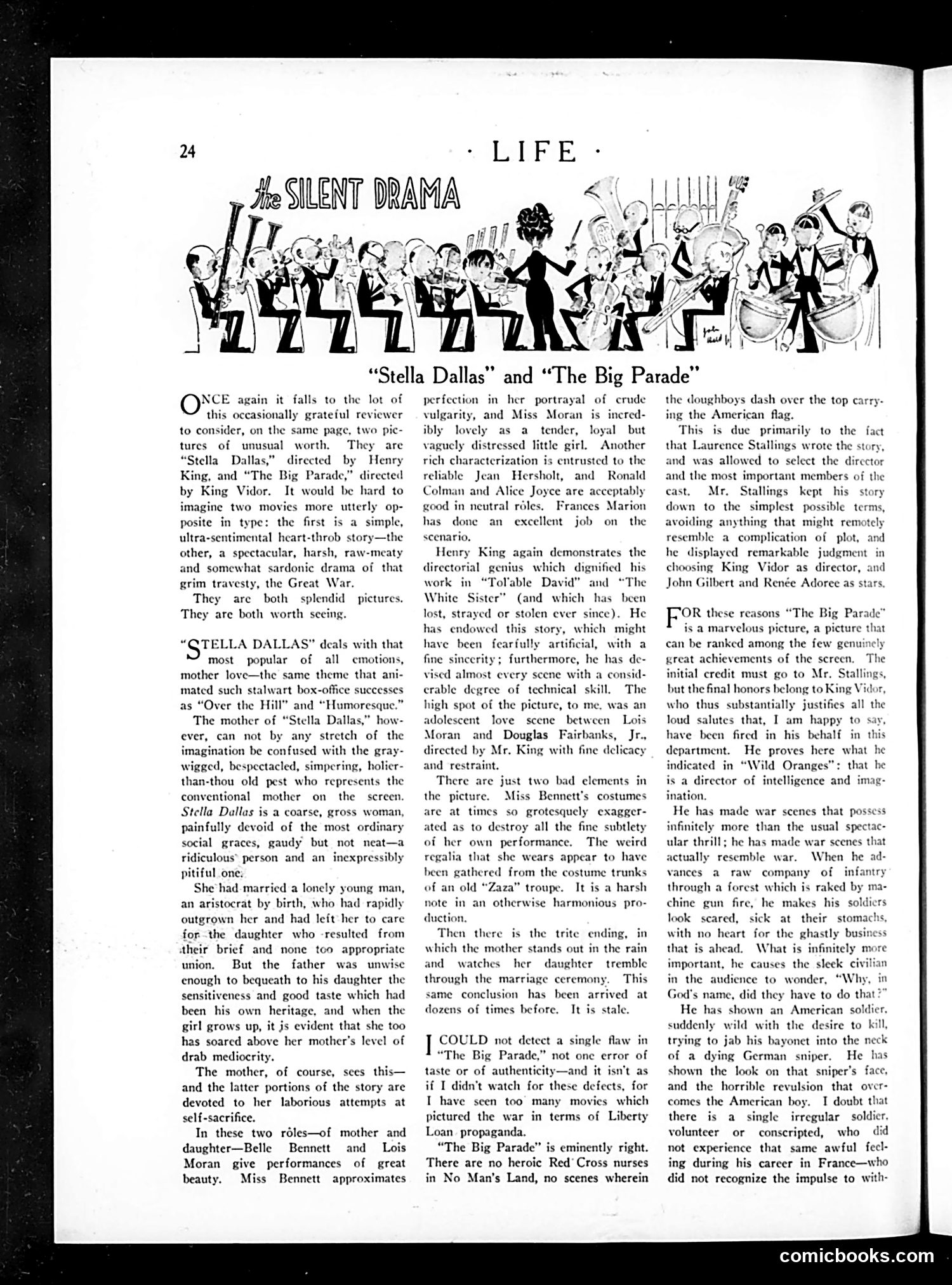
A restored page from Life, 1925-12-10. Page through the whole issue in the reader above.
📄 Transcribed text from this page (OCR, searchable)
Machine-transcribed from the original scan — historical spelling and the odd misread are preserved.
“Stella Dallas” and “The Big Parade” gain it falls to the lot of this occasionally grateful reviewer to consider, on the same page, two pic- tures of unusual worth, They are “Stella Dallas,” directed by Henry King, and “The Big Parade,” directed by King Vidor. It would be hard to imagine two movies more utterly op- posite in type: the first is a simple, ultra-sentimental heart-throb story—the other, a spectacular, harsh, raw-meaty and somewhat sardonic drama of that grim travesty, the Great War. They are both splendid pictures. They are both worth sccing. “QTELLA DALLAS” deals with that most popular of all cmotions, mother love—the same theme that ani- mated such stalwart box-office successes as “Over the Hill” and “Humoresque.” The mother of “Stella Dallas,” how- ever, can not by stretch of the imagination be confused with the gray- wigged, bespectacled, simpering, holier- than-thou old pest who represents the conventional mother on the screen. Stella Dallas is a coarse, gross woman, painfully devoid of the most ordinary social graces, gaudy but not neat—a ridiculous’ person and an inexpressibly pitiful one: She had married a lonely young man, an aristocrat by birth, who had rapidly outgrown her and had left her to care for the daughter who -resulted from their brief and none too appropriate union. But the father was unwise enough to bequeath to his daughter the sensitiveness and good taste which had been his own heritage, and when the girl grows up, it js evident that she too has soared above her mother’s level of drab mediocrity. The mother, of course, sees this— and the latter portions of the story are devoted to her laborious attempts at self-sacrifice. In these two rdles—of mother and daughter—Belle Bennett and Lois Moran give performances of great beauty. Miss Bennett approximates perfection in her portrayal of crude vulgarity, and Miss Moran is incred- ibly lovely as a tender, loyal but vaguely distressed little girl. Another rich characterization is entrusted to the reliable Jean Hersholt, and Ronald Colman and Alice Joyce are acceptably good in neutral roles. Frances Marion has done an excellent job on the scenario, Henry King again demonstrates the directorial genius which dignified his work in “Tolable David" and “The White Sister” (and which has been lost, strayed or stolen ever since). He has endowed this story, which might have been fearfully artificial, with a fine sincerity; furthermore, he has de- vised almost every scene with a consid- crable degree of technical skill. The high spot of the picture, to me, was an adolescent love scene between Lois Moran and Douglas Fairbanks, Jr., directed by Mr. King with fine delicacy and restraint. There are just two bad elements in the picture. Miss Bennett's costumes are at times so grotesquely exagger- ated as to destroy all the fine subtlety of her own performance. The weird regalia that she wears appear to have been gathered from the costume trunks of an old “Zaza” troupe. It is a harsh note in an otherwise harmonious pro- duction. Then there is the trite ending, in which the mother stands out in the rain and watches her tremble This arrived at It is stale. daughter through the marriage ceremony. same conclusion has dozens of times before. been COULD not detect a single flaw in “The Big Parade,” not one error of taste or of authenticity—and it isn’t as if I didn’t watch for these defects, for I have seen too many movies which pictured the war in terms of Liberty Loan propaganda. “The Big Parade” is eminently right. There are no heroic Red’ Cross nurses in No Man’s Land, no scenes wherein the doughboys dash over the top carry- ing the American flag. This is due primarily to the fact that Laurence Stallings wrote the story, and was allowed to select the director and the most important members of the Mr, allings kept his down to the simplest possible terms, avoiding anything tha cast, story t might remotely resemble a complication of plot, and he displayed remarkable judgment in choosing King Vidor as director, and John Gilbert and Renée Adoree as stars. 'OR these reasons “The Big Parade” is a marvelous picture, a picture that can be ranked among the few genuinely great achievements of the screen. The initial credit must go to Mr. Stallings, but the final honors belong to King Vi who thus substantially justifies all the loud salutes that, I am happy to say, have been fired in his behalf in this department. He proves here what he indicated in “Wild Oranges”: that i director of intelligence and imag- ination. He has made war scenes that possess infinitely more than the usual spectac- ular thrill; he has made war scenes that actually resemble When he ad- vances a raw company of infantry through a forest which is raked by ma- war. chine gun fire, he makes his soldiers look scared, sick at their stomac with no heart for the ghastly busin that is ahead. What is infinitely m important, he causes the sleek civ in the audience to wonder, “Why, in God's name, did they have to do that?” He has shown an American soldier. suddenly wild with the desire to kill, trying to jab his bayonet into the neck of a dying German sniper. He has shown the look on that sniper’s face, and the horrible revulsion that over- comes the American boy. I doubt t! there is a single irregular soldier. volunteer or conscripted, who did not experience that same awful fecl- ing during his career in France—who did not recognize the impulse to with- comicbooks.com