
Life, 1925-12-10 · page 16 of 36
Life — December 10, 1925 — page 16: what you’re looking at
What you’re looking at
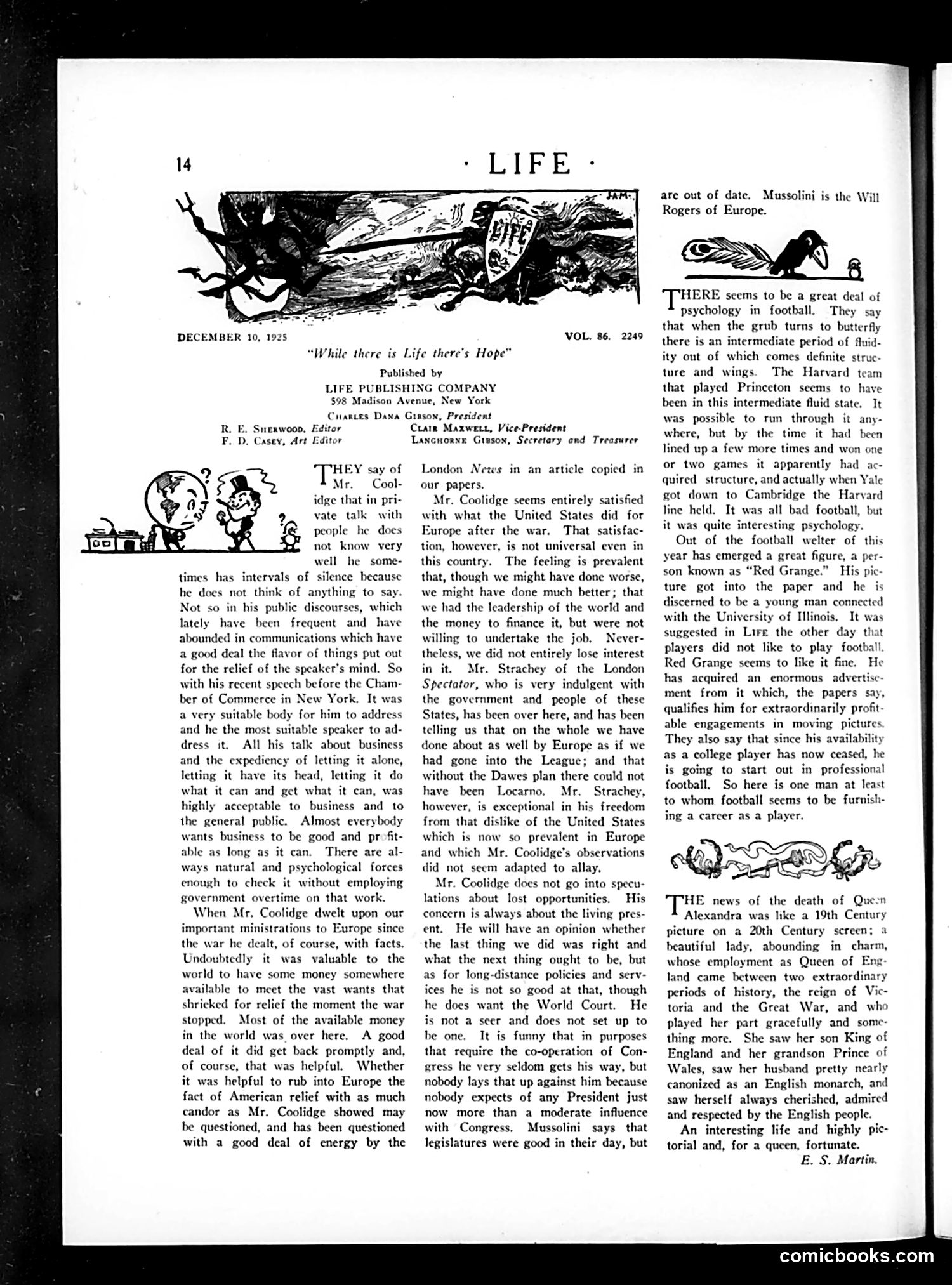
The top cartoon depicts two figures in conflict—one labeled "PIPE" (unclear full identification). The text discusses European politics post-WWI, referencing Mussolini as "the Will Rogers of Europe" (satirizing his populist appeal). The article critiques American isolationism and debates U.S. involvement in European affairs, particularly regarding war debt and the League of Nations. The right column discusses Queen Alexandra's death and her son King Edward, noting her dignity and respect among the English people. The football section uses the "Red Grange" phenomenon to discuss American sports psychology. Overall, the page reflects 1925 concerns: European political instability, American foreign policy debate, and emerging celebrity culture in sports.
📄 Transcribed text from this page (OCR, searchable)
Machine-transcribed from the original scan — historical spelling and the odd misread are preserved.
DECEMBER 10, 1925 VOL. 86. 2249 “While there is Life there's Hope” Published by LIFE PUBLIS HING IMPANY 598 Madison Avenue, New York Crartes Dana Grason, President R. E, Surewoon, Editor F. D, Casey, Art Editor HEY say of Mr. Cool- idge that in pri- vate talk with peaple he does not know very he some- times has intervals of silence because he docs not think of anything to say. Not so in his public discourses, which lately have been frequent and have abounded in communications which have a good deal the flavor of things put out for the relief of the speaker's mind. So with his recent speech before the Cham- ber of Commerce in New York. It was a very suitable body for him to address and he the most suitable speaker to ad- dress it. All his talk about business and the expediency of letting it alone, letting it have its head, letting it do what it can and get what it can, was highly acceptable to business and to the general public. Almost everybody wants business to be good and pr fit- able as long as it can. There are al- ways natural and psychological forces enough to check it without employing government overtime on that work. When Mr. Coolidge dwelt upon our important ministrations to Europe since the war he dealt, of course, with facts. Undoubtedly it was valuable to the world to have some money somewhere available to meet the vast wants that shricked for relief the moment the war stopped. Most of the available money in the world was over here. A good deal of it did get back promptly and, of course, that was helpful. Whether it was helpful to rub into Europe the fact of American relief with as much candor as Mr. Coolidge showed may be questioned, and has been questioned with a good deal of energy by the Crain Maxwett, Vice-President Lancnorng Grason, Secretary and Treasurer London Ne our papers. Mr. Coolidge seems entirely satisfied with what the United States did for Europe after the war. That satisfac- tion, however, is not universal even in this country. The feeling is prevalent that, though we might have done worse, we might have done much better; that we had the leadership of the world and the money to finance it, but were not willing to undertake the job. Never- theless, we did not entirely lose interest in it. Mr. Strachey of the London Spectator, who is very indulgent with the government and people of these States, has been over here, and has been telling us that on the whole we have done about as well by Europe as if we had gone into the League; and that without the Dawes plan there could not have been Locarno. Mr. Strachey, however, is exceptional in his freedom from that dislike of the United States which is now so prevalent in Europe and which Mr. Coolidge’s observations did not seem adapted to allay. Mr. Coolidge does not go into specu- lations about lost opportunities. His concern is always about the living pres- ent. He will have an opinion whether the last thing we did was right and what the next thing ought to be, but as for long-distance policies and serv- ices he is not so good at that, though he does want the World Court. He is not a seer and does not set up to be one, It is funny that in purposes that require the co-operation of Con- gress he very seldom gets his way, but nobody lays that up against him because nobody expects of any President just now more than a moderate influence with Congress. Mussolini says that legislatures were good in their day, but ‘s in an article copied in are out of date. Mussolini is the Will Rogers of Europe. cS “THERE seems to be a great deal of psychology in football. They say that when the grub turns to butterfly there is an intermediate period of fluid- ity out of which comes definite struc- ture and wings. The Harvard team that played Princeton seems to have been in this intermediate fluid state. It was possible to run through it any- where, but by the time it had been lined up a few more times and won one or two games it apparently had ac- quired structure, and actually when Yale got down to Cambridge the Harvard line held. It was all bad football, but it was quite interesting psychology. Out of the football welter of this year has emerged a great figure, a per- son known as “Red Grange.” His pic- ture got into the paper and he is discerned to be a young man connected with the University of Illinois. It was suggested in Lire the other day that players did not like to play football Red Grange seems to like it fine. He has acquired an enormous advertise- ment from it which, the papers say, qualifies him for extraordinarily profit- able engagements in moving pictures. They also say that since his availability as a college player has now ceased, he is going to start out in professional football. So here is one man at least to whom football seems to be furnish- ing a career as a player. HE news of the death of Queen Alexandra was like a 19th Century picture on a 20th Century screen; & beautiful lady, abounding in charm, whose employment as Queen of Eng- land came between two extraordinary periods of history, the reign of Vic- toria and the Great War, and who played her part gracefully and some- thing more. She saw her son King of England and her grandson Prince of Wales, saw her husband pretty nearly canonized as an English monarch, and saw herself always cherished, admired and respected by the English people. An interesting life and highly pic- torial and, for a queen, fortunate. E. S. Martin. comicbooks.com