
Life, 1925-12-10 · page 20 of 36
Life — December 10, 1925 — page 20: what you’re looking at
What you’re looking at
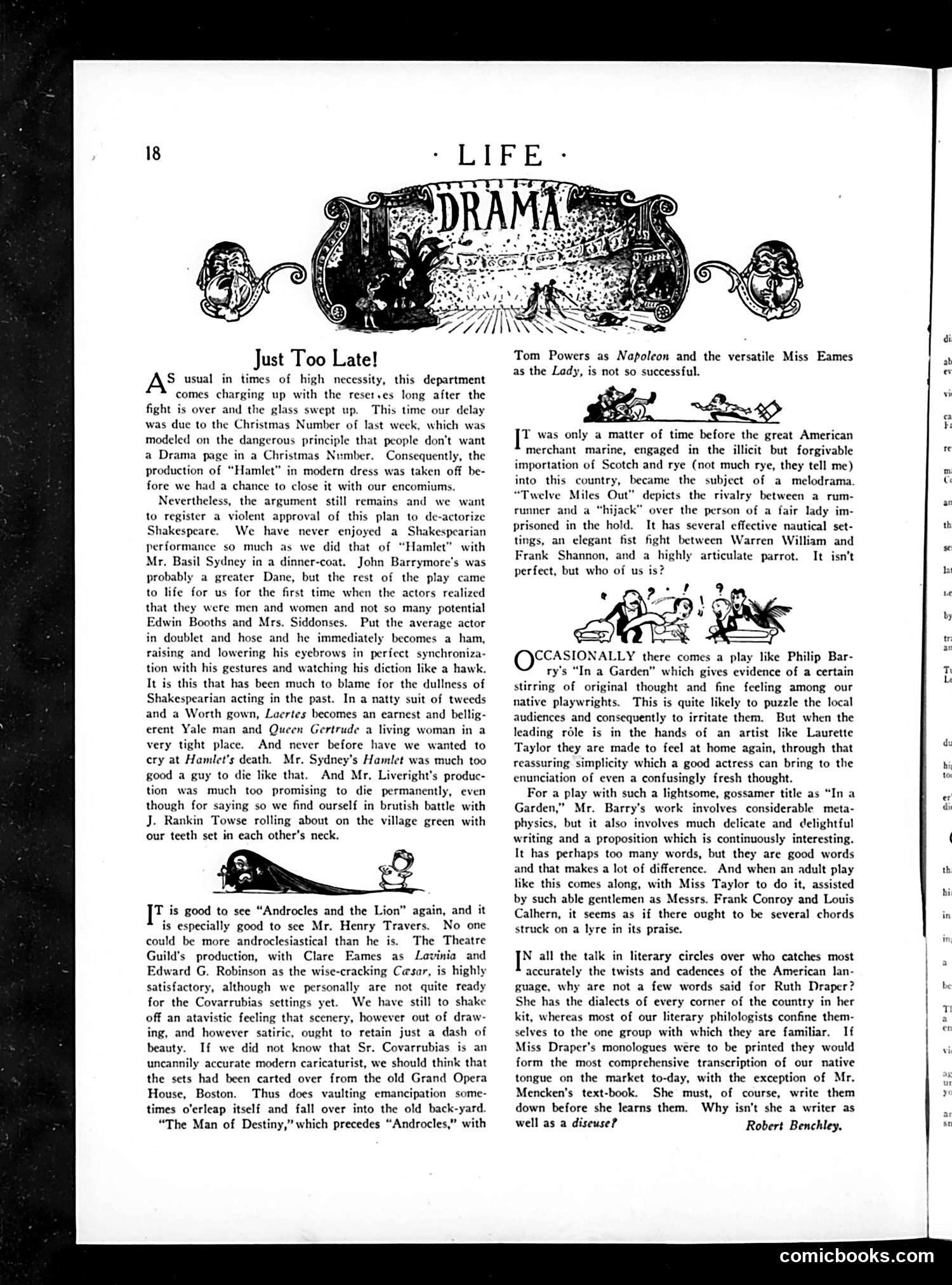
This is a theater review page from Life magazine's satirical "Drama" section. The main content critiques several Broadway productions: **"Hamlet" in Modern Dress**: Life *approves* of actor Basil Sydney performing Shakespeare in contemporary clothing (a dinner coat rather than Elizabethan costume). The satire targets traditional Shakespearean acting—the overwrought gestures and eyebrow-raising that made classical theater tedious. Modern dress allegedly made characters feel like real people rather than theatrical "hams." **Other Reviews**: The page also covers Shaw's "Androcles and the Lion," "Twelve Miles Out" (a Prohibition-era melodrama about rum-runners), and "In a Garden" by Philip Barry. The cartoons are small, generic theatrical illustrations rather than political commentary. The satire here is *theatrical*—mocking stuffy classical performance traditions and praising innovative staging that made Shakespeare accessible and emotionally resonant to modern audiences.
📄 Transcribed text from this page (OCR, searchable)
Machine-transcribed from the original scan — historical spelling and the odd misread are preserved.
Soins 7/1 Just Too Late! S usual in times of high necessity, this department comes charging up with the reset.es long after the fight is over and the glass swept up. This time our delay was due to the Christmas Number of last week, which was modeled on the dangerous principle that people don't want a Drama page in a Christmas Number. Consequently, the production of “Hamlet” in modern dress was taken off be- fore we had a chance to close it with our encomiums. Nevertheless, the argument still remains and we want to register a violent approval of this plan to de-actorize Shakespeare. We have never enjoyed a Shakespearian performance so much as we did that of “Hamlet” with Mr. Basil Sydney in a dinner-coat. John Barrymore's was probably a greater Dane, but the rest of the play came to life for us for the first time when the actors realized that they were men and women and not so many potential <dwin Booths and Mrs. Siddonses. Put the average actor in doublet and hose and he immediately becomes a ham, raising and lowering his eyebrows in perfect synchroniza- tion with his gestures and watching his diction like a hawk. It is this that has been much to blame for the dullness of Shakespearian acting in the past. In a natty suit of tweeds and a Worth gown, Laertes becomes an earnest and bellig- erent Yale man and Queen Gertrude a living woman in a very tight place. And never before have we wanted to cry at Hamilct’s death. Mr. Sydney’s Hamlet was much too good a guy to die like that. And Mr. Liveright’s produc- tion was much too promising to die permanently, even though for saying so we find ourself in brutish battle with J. Rankin Towse rolling about on the village green with our teeth set in each other's neck. ig is good to see “Androcles and the Lion” again, and it is especially good to see Mr. Henry Travers. No one could be more androclesiastical than he is. The Theatre Guild’s production, with Clare Eames as Lavinia and Edward G. Robinson as the wise-cracking Cesar, is highly satisfactory, although we personally are not quite ready for the Covarrubias settings yet. We have still to shake off an atavistic feeling that scenery, however out of draw- ing, and however satiric, ought to retain just a dash of beauty. If we did not know that Sr. Covarrubias is an uncannily accurate modern caricaturist, we should think that the sets had been carted over from the old Grand Opera House, Boston. Thus does vaulting emancipation some- times o'erleap itself and fall over into the old back-yard. “The Man of Destiny,” which precedes “Androcles,” with IWR Tom Powers as Napoleon and the versatile Miss Eames as the Lady, is not so successful. BG! ~Lm sg T was only a matter of time before the great American merchant marine, engaged in the illicit but forgivable importation of Scotch and rye (not much rye, they tell me) into this country, became the subject of a melodrama. “Twelve Miles Out” depicts the rivalry between a rum- runner and a “hijack” over the person of a fair lady im- prisoned in the hold. It has several effective nautical set- tings, an elegant fist fight between Warren William and Frank Shannon, and a highly articulate parrot. It isn’t perfect, but who of us is? \CCASIONALLY there comes a play like Philip Bar- ry's “In a Garden” which gives evidence of a certain stirring of original thought and fine feeling among our native playwrights. This is quite likely to puzzle the local audiences and consequently to irritate them. But when the leading rdle is in the hands of an artist like Laurette Taylor they are made to feel at home again, through that reassuring simplicity which a good actress can bring to the enunciation of even a confusingly fresh thought. For a play with such a lightsome, gossamer title as “In a Garden,” Mr. Barry's work involves considerable meta- physics, but it also involves much delicate and delightful writing and a proposition which is continuously interesting. It has perhaps too many words, but they are good words and that makes a lot of difference. And when an adult play like this comes along, with Miss Taylor to do it, assisted by such able gentlemen as Messrs. Frank Conroy and Louis Calhern, it seems as if there ought to be several chords struck on a lyre in its praise. N all the talk in literary circles over who catches most accurately the twists and cadences of the American lan- guage, why are not a few words said for Ruth Draper? She has the dialects of every corner of the country in her kit, whereas most of our literary philologists confine them- selves to the one group with which they are familiar. If Miss Draper's monologues were to be printed they would form the most comprehensive transcription of our native tongue on the market to-day, with the exception of Mr. Mencken's text-book. She must, of course, write them down before she learns them. Why isn’t she a writer as well as a diseuse? Robert Benchley. comicbooks.com