
A complete issue · 36 pages · 1925
Life — July 23, 1925
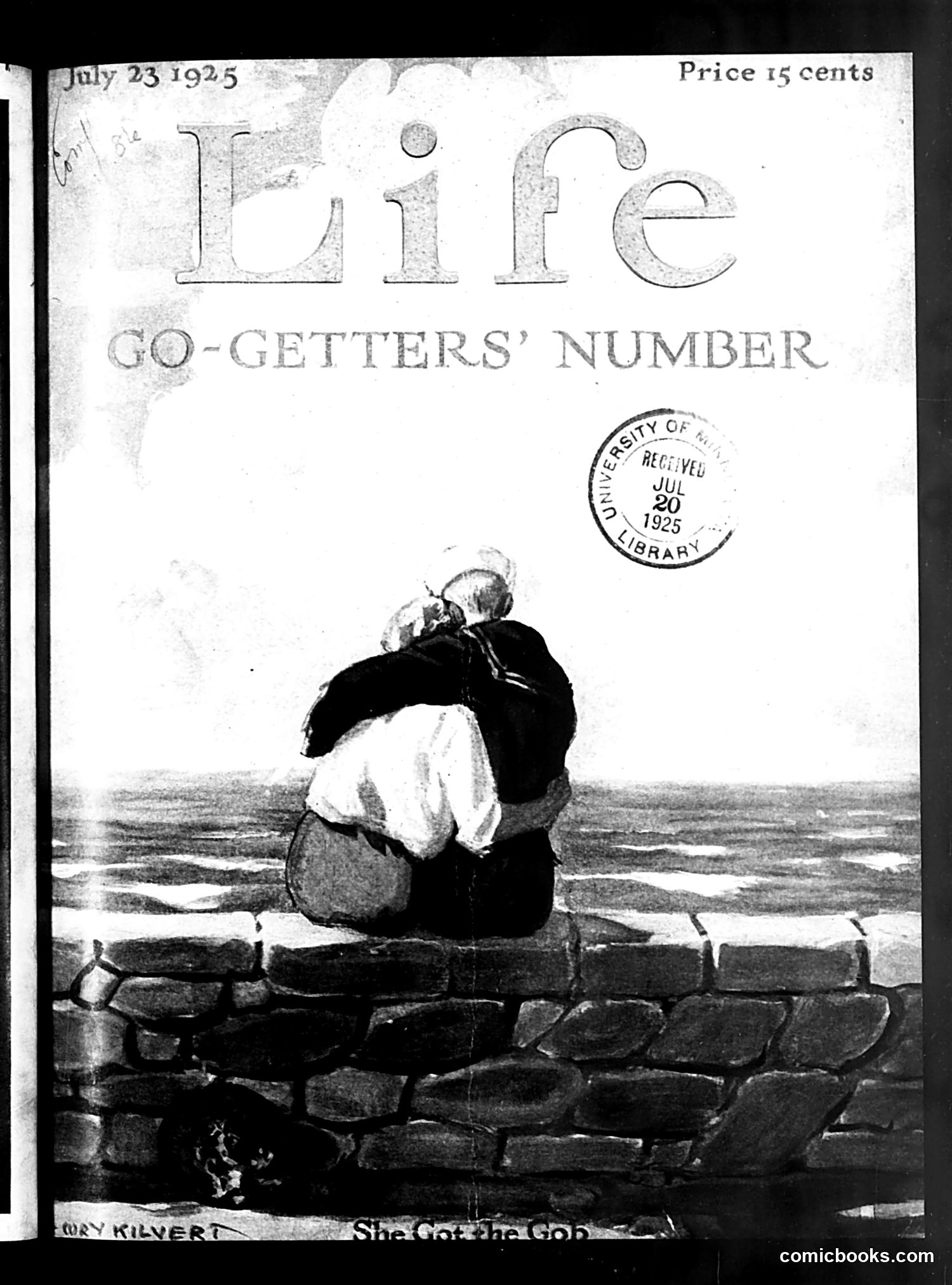
This cover depicts a solitary figure seated on a stone wall overlooking a vast, desolate seascape. The person wears dark clothing and appears to be gazing pensively outward. The image is titled "Go-Getters' Number," suggesting satire about American ambition and the "go-getter" ethos popular in 1920s business culture. The lonely, contemplative pose contrasts sharply with the energetic connotations of "go-getter." This likely satirizes the emptiness or spiritual cost of relentless American materialism and ambition during the prosperous but often spiritually hollow Jazz Age. The desolate landscape reinforces themes of isolation and disillusionment despite economic success.
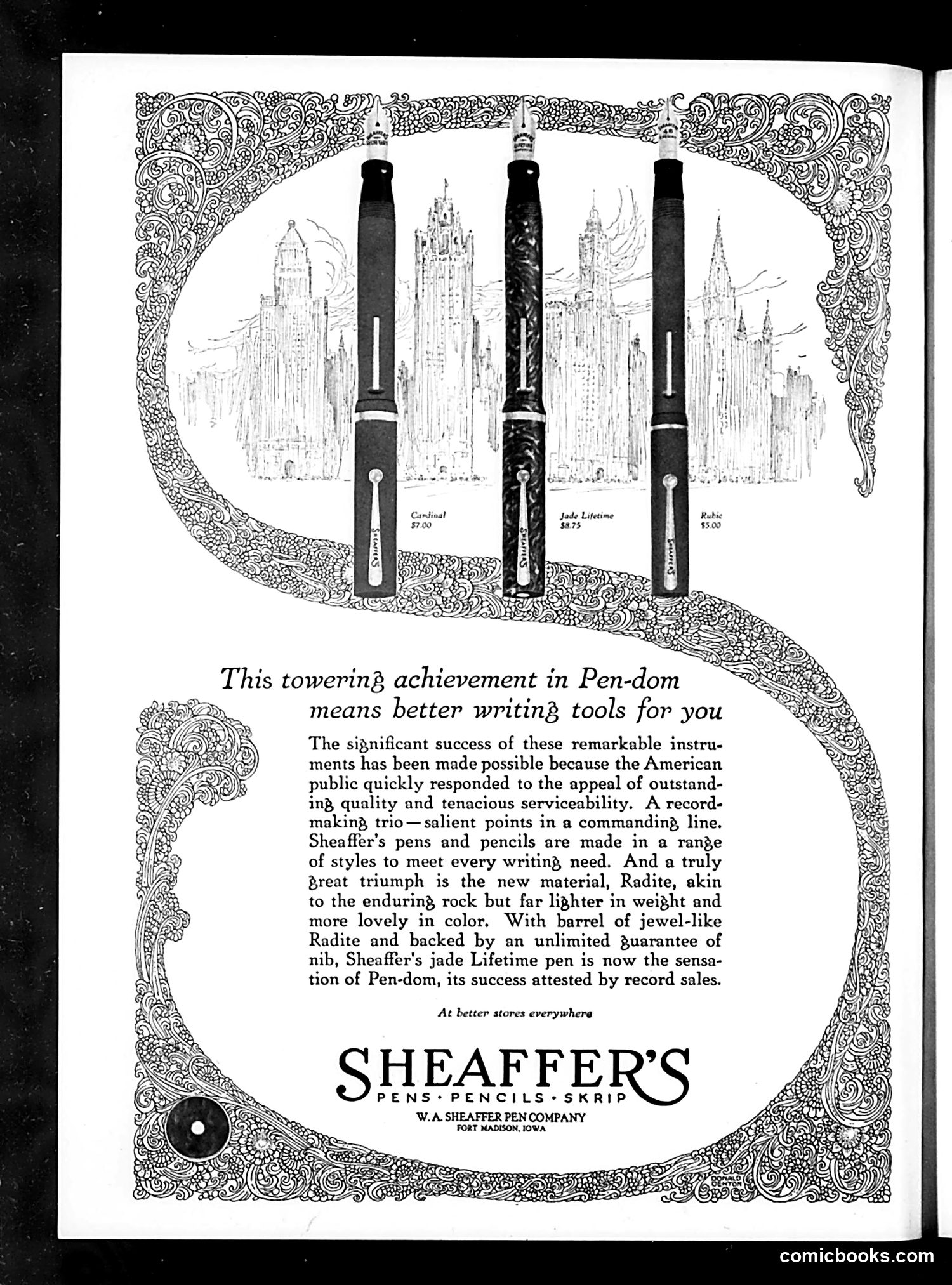
This is primarily a **Sheaffer pen advertisement**, not a political cartoon. The page promotes three fountain pen models (Cardinal, Jade Lifetime, and Robe) displayed against a stylized cityscape skyline. The ornamental border and elegant layout are characteristic of 1920s-1930s advertising design. The ad's central conceit is a pun: "This towering achievement in Pen-dom means better writing tools for you." The skyscraper imagery metaphorically elevates the pens as prestigious products. The text emphasizes Sheaffer's "outstanding quality and tenacious serviceability" and highlights Radite, a new material described as durable yet lighter than traditional materials. There is **no political satire** here—this is straightforward commercial advertising from Life magazine's business pages.
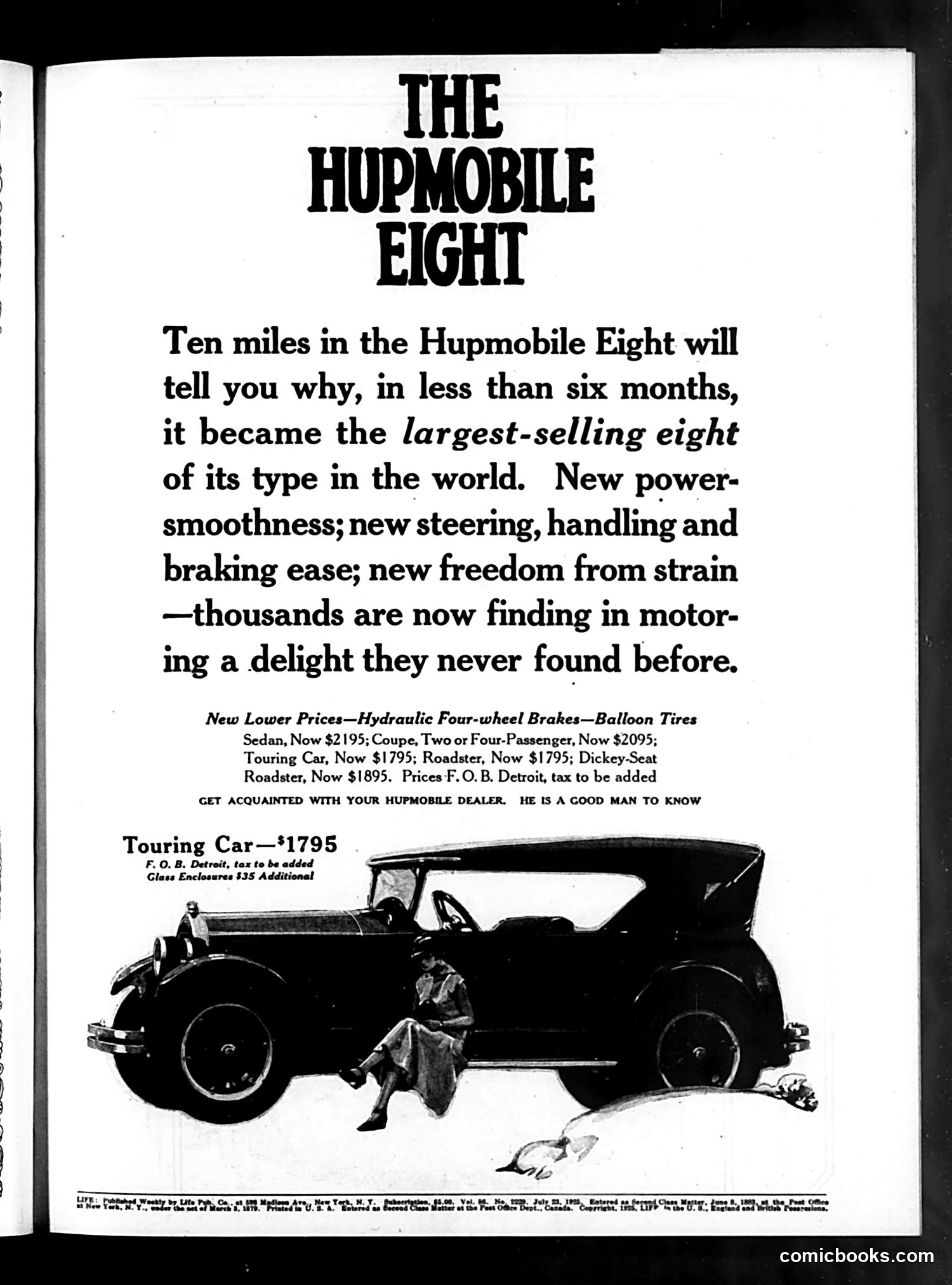
This page is primarily **advertising, not satire or political commentary**. It's a Hupmobile automobile advertisement from *Life* magazine promoting the Hupmobile Eight motor car. The ad highlights the car's commercial success—claiming it became "the largest-selling eight of its type in the world" within six months—and emphasizes new features: hydraulic four-wheel brakes, improved power and smoothness, and enhanced steering and handling. The illustration shows a well-dressed woman posing beside a touring car model priced at $1795, with glass enclosure available for an additional $35. Various sedan and roadster prices are listed. The tagline "GET ACQUAINTED WITH YOUR HUPMOBILE DEALER. HE IS A GOOD MAN TO KNOW" encourages readers to visit dealerships. This is straightforward commercial promotion rather than satirical commentary.
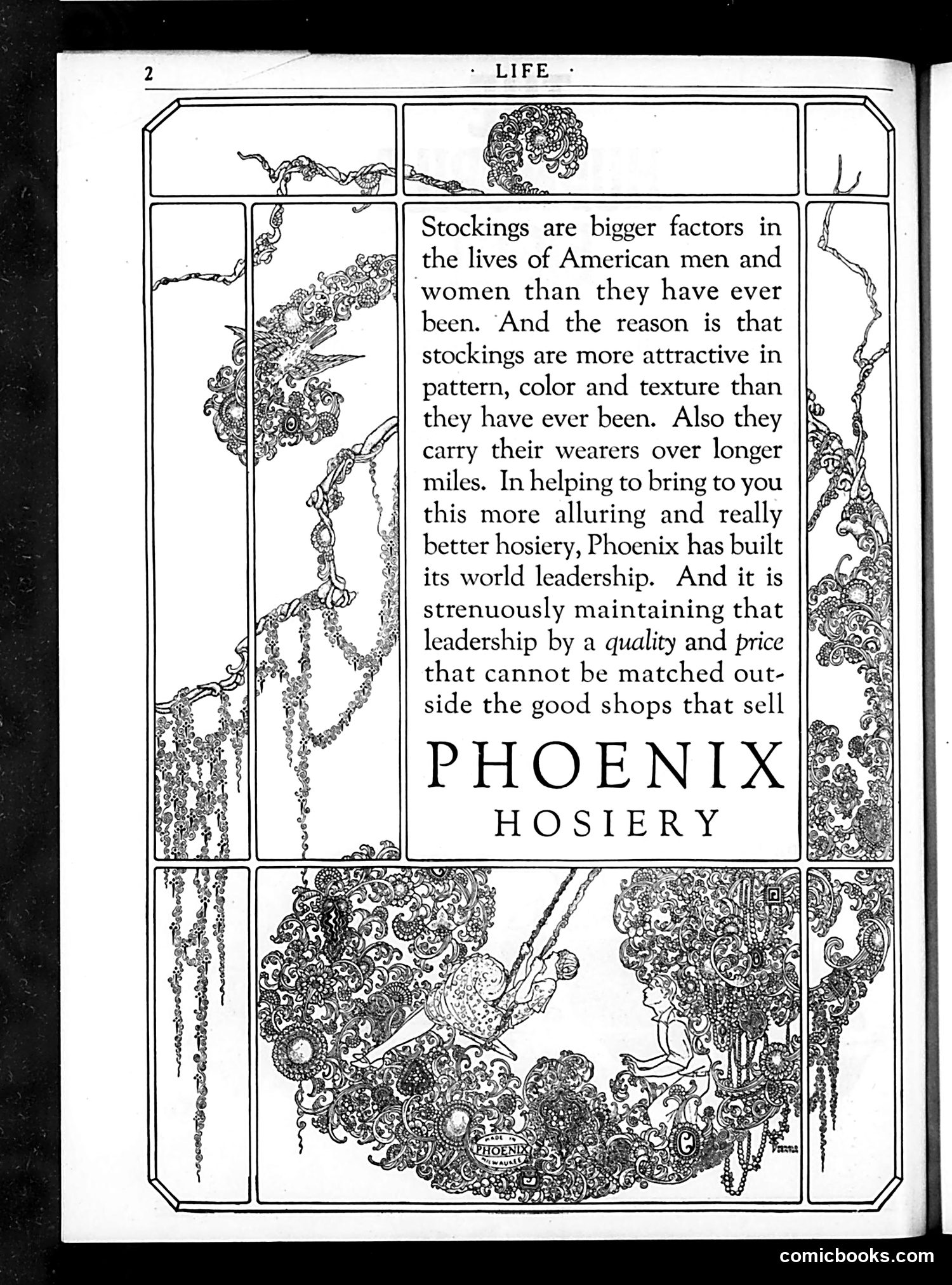
This page is primarily **advertising**, not satire or political commentary. It's a Phoenix Hosiery company advertisement from Life magazine. The ad argues that stockings have become more important to American life than ever before, featuring improved patterns, colors, and durability. Phoenix claims "world leadership" in hosiery quality while maintaining competitive pricing through "good shops." The decorative Art Nouveau-style illustrations with trees, foliage, and a fairy-tale figure are purely ornamental—typical of early 20th-century advertising design. They convey luxury and elegance rather than satirize anything. There is **no political cartoon or satire** on this page. It's straightforward commercial messaging aimed at consumers, using period-appropriate visual aesthetics to market stockings as both fashionable and practical goods.
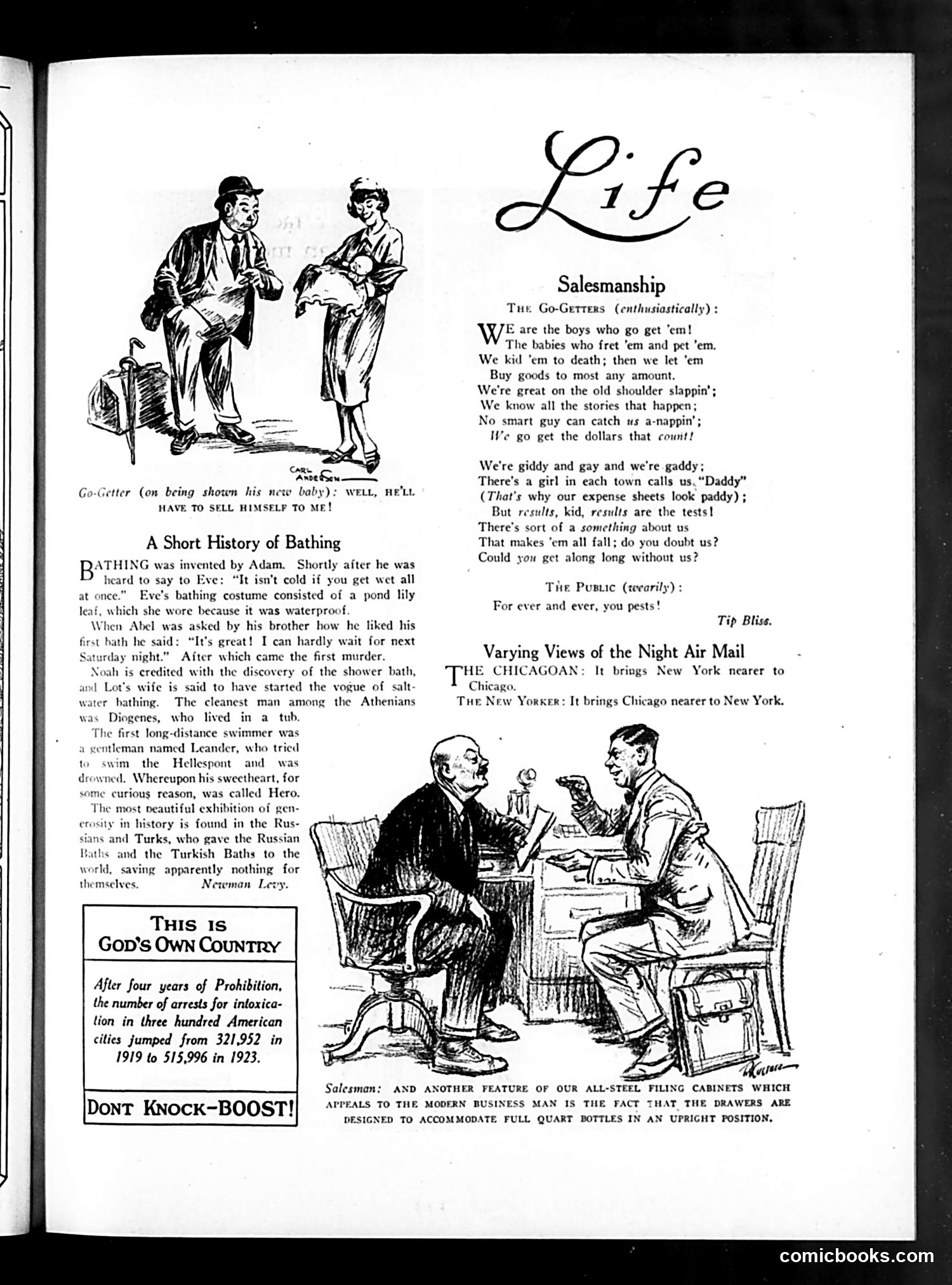
This page contains satirical commentary on salesmanship and Prohibition-era society. **"The Go-Getters" cartoon** depicts a salesman showing his new baby to colleagues, joking he must "sell himself" to support it—satirizing aggressive 1920s sales culture and the pressure on breadwinners. **"Salesmanship" poem** mocks overeager traveling salesmen who chase women ("a girl in each town calls us 'Daddy'"), buy anything on credit, and prioritize commission over results. **"Varying Views of the Night Air Mail"** is a political joke: Chicago and New York papers spin the same mail service differently based on self-interest—one claims it brings New York closer, the other claims it brings Chicago closer. It satirizes media bias. **"This Is God's Own Country"** celebrates Prohibition's success, noting arrests for liquor violations increased dramatically (321,952 to 515,996 in three years)—sarcastically suggesting this proves effectiveness.
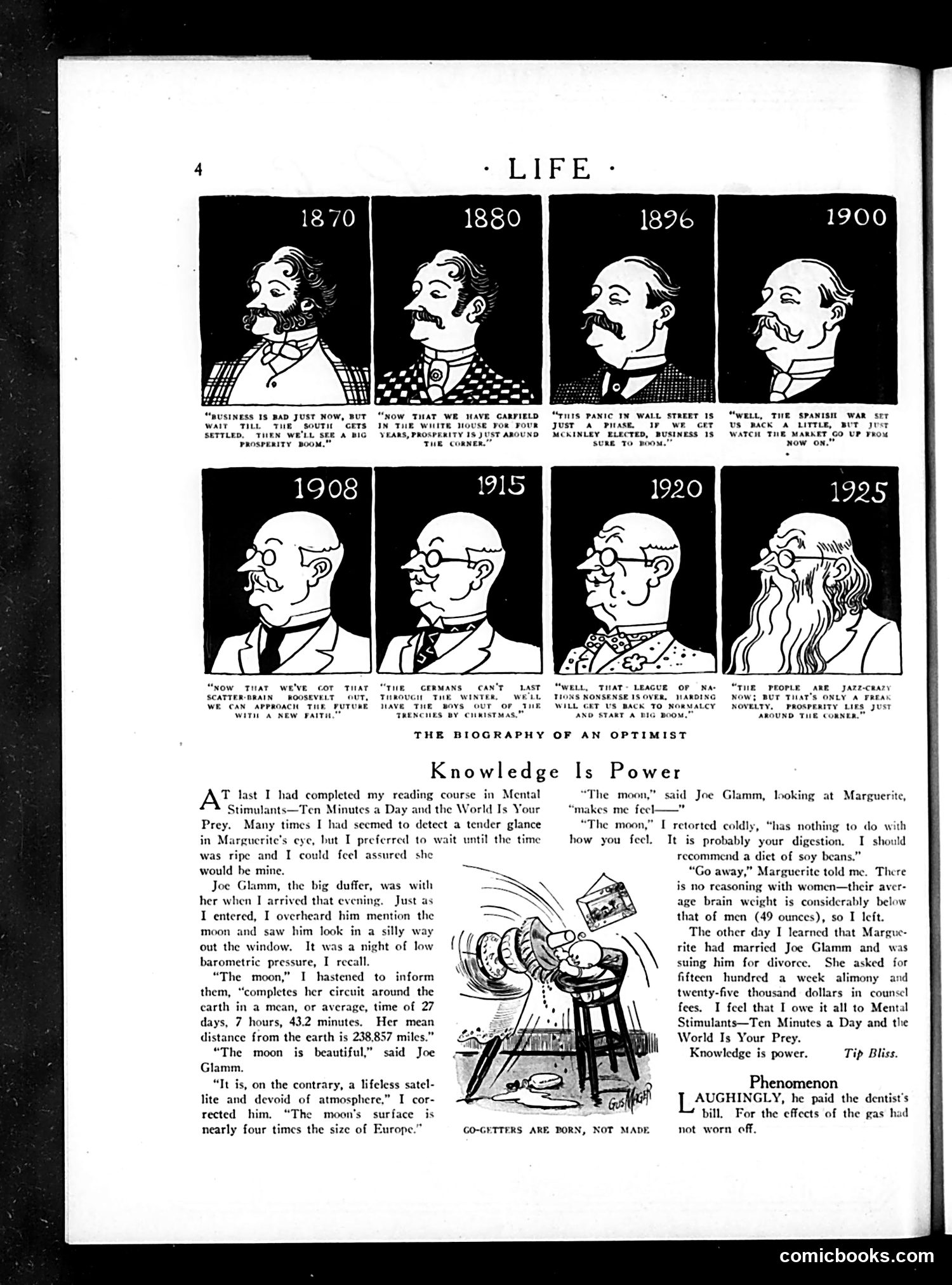
This satirical strip tracks an unnamed optimist's increasingly absurd pronouncements across 55 years (1870-1925). Each panel shows him making rosily confident predictions that historical events would prove wrong: - 1880: Claims the South will prosper - 1896: Dismisses economic panic as temporary - 1900: Predicts Spanish-American War will boost markets - 1908-1920: Makes claims about German military capability, League of Nations success, and post-WWI recovery The joke is that this character consistently misreads major political and economic crises as manageable or beneficial. By 1925, he's aged dramatically (depicted with long beard), suggesting decades of proven-wrong optimism. The satire mocks blind faith in positive outcomes despite mounting historical evidence to the contrary—a common target of *Life* magazine's editorial humor about American politics and business.
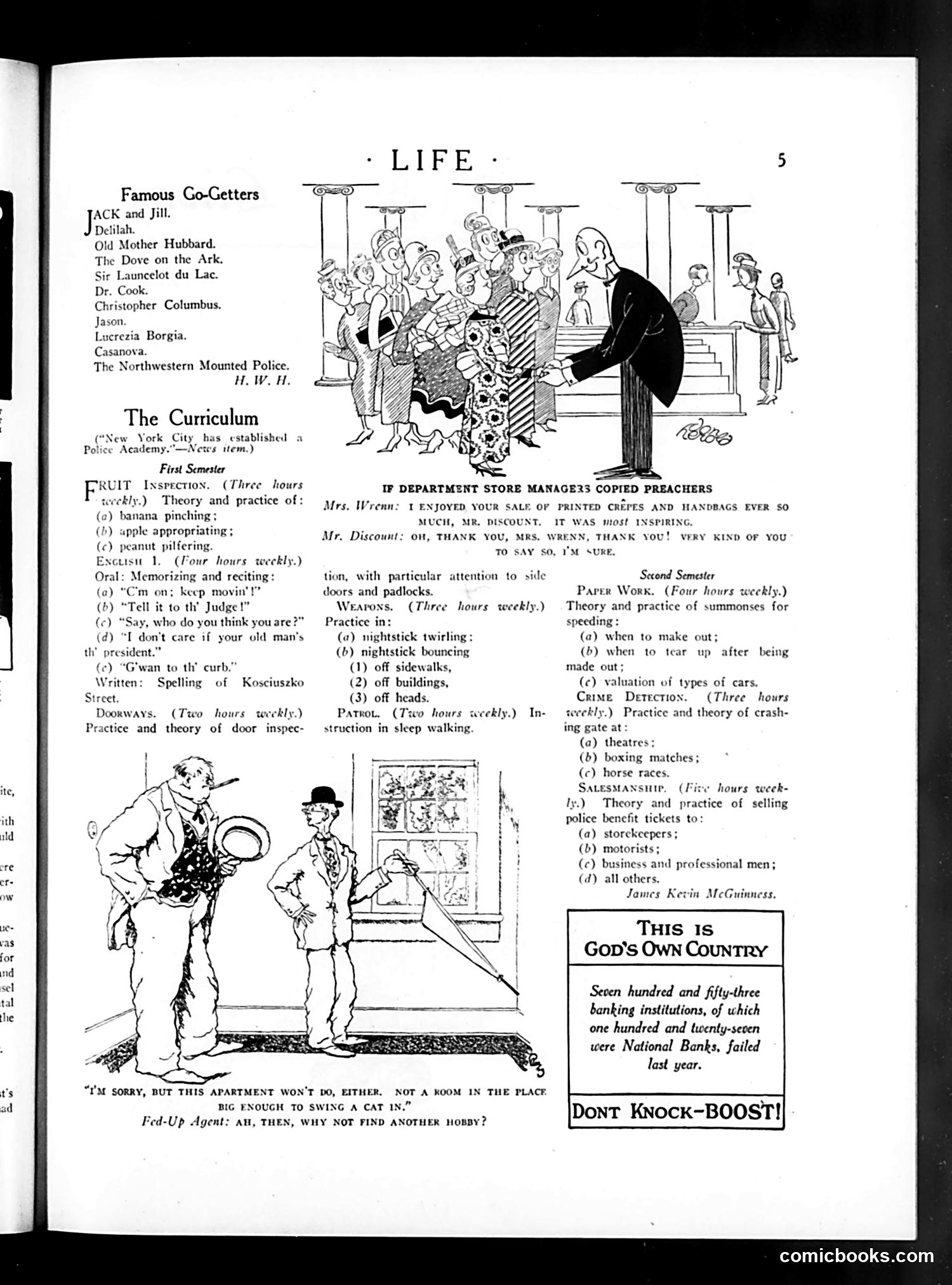
This page satirizes police department training curricula through a mock "Police Academy" curriculum listing absurd courses like "Fruit Inspection" (banana pinching, apple appropriating) and "Doorways" (door inspection practice). The main cartoon depicts a frustrated police officer telling a fed-up agent: "I'm sorry, but this department won't do, either. Not a room in the place big enough to swing a cat in." This references the idiom "room to swing a cat," mocking police departments' cramped, inadequate facilities or bureaucratic inefficiency. The satire targets police institutional incompetence and poor working conditions during what appears to be the early 20th century. The "Famous Go-Getters" list adds ironic contrast—listing historical figures alongside mundane or questionable "achievements." The page also includes unrelated period advertisements.
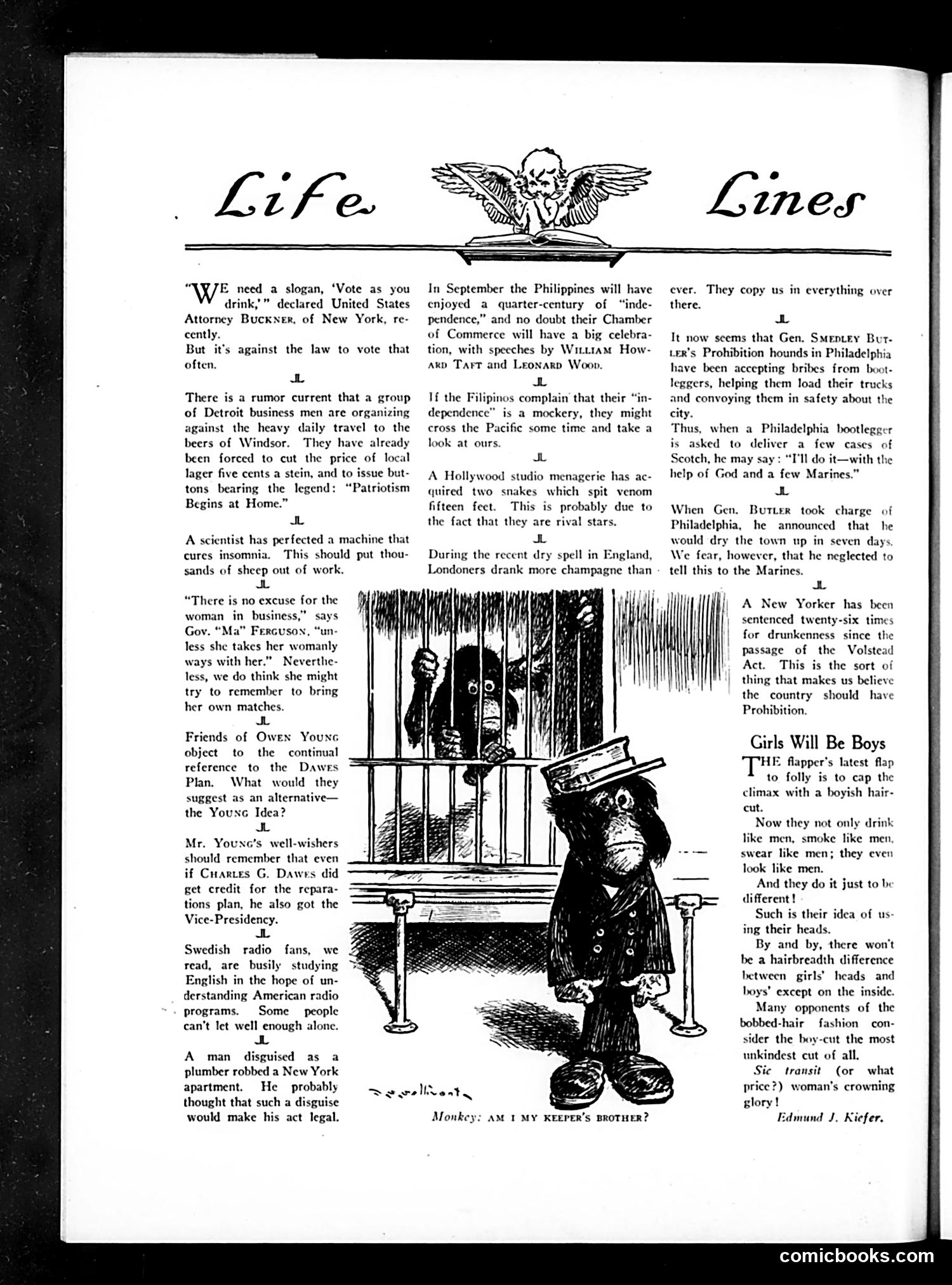
This satirical page combines brief social commentary with a cartoon about Prohibition-era bootlegging. The central illustration shows a monkey in a hat and coat at a window, captioned "Monkey: Am I my keeper's brother?" — likely satirizing how Prohibition drove ordinary people to criminality. The surrounding text snippets mock various 1920s topics: women in business, Detroit's bootlegging operations, British drinking habits during Prohibition, and the Volstead Act's enforcement (noting a New Yorker sentenced 26 times for drunkenness). The right column's "Girls Will Be Boys" section satirizes flappers adopting masculine behaviors—smoking, drinking, swearing, and getting bobbed haircuts—treating these as markers of gender confusion rather than feminist progress. The page reflects Jazz Age anxieties about social upheaval.
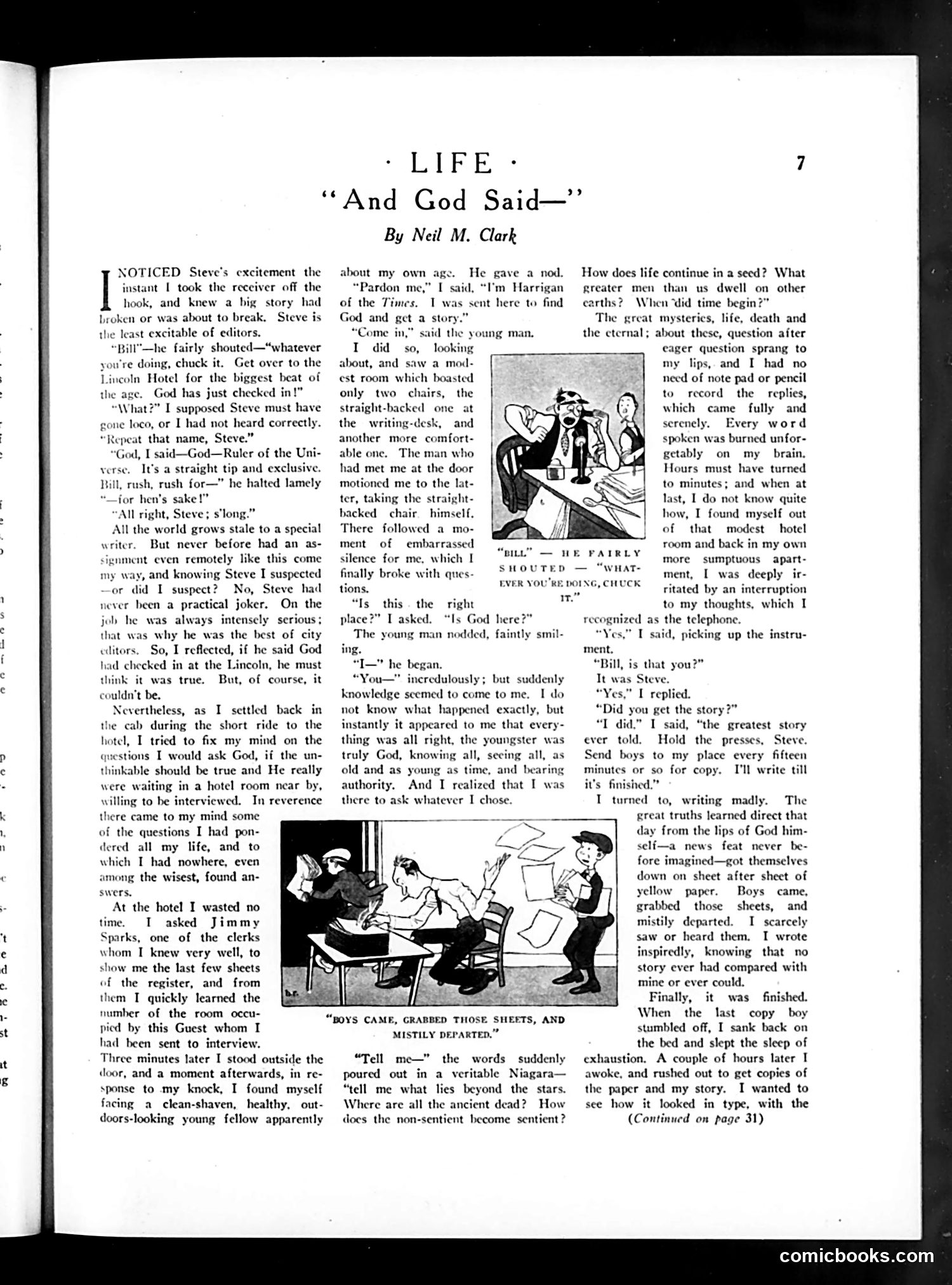
This page presents a short story about a journalist seeking "the greatest story ever told" from God himself. The two illustrations show: 1. **Top cartoon**: A man labeled "BILL" at a writing desk, with someone shouting "WHATEVER YOU'RE DOING, CHUCK IT." This depicts Bill interrupting his work with urgent news. 2. **Bottom cartoon**: Labeled "BOYS CAME, GRABBED THOSE SHEETS, AND MOSTLY DEPARTED," showing messengers collecting manuscript pages—illustrating the frantic dissemination of Bill's divine interview. The satirical point appears to be mocking both journalistic ambition and the commodification of religious truth. The story suggests that even direct communication from God becomes merely sensational copy—reduced to sheets of paper grabbed by boys and distributed as newspaper material. It's commentary on how media treats profound spiritual matters as trivial commercial product.
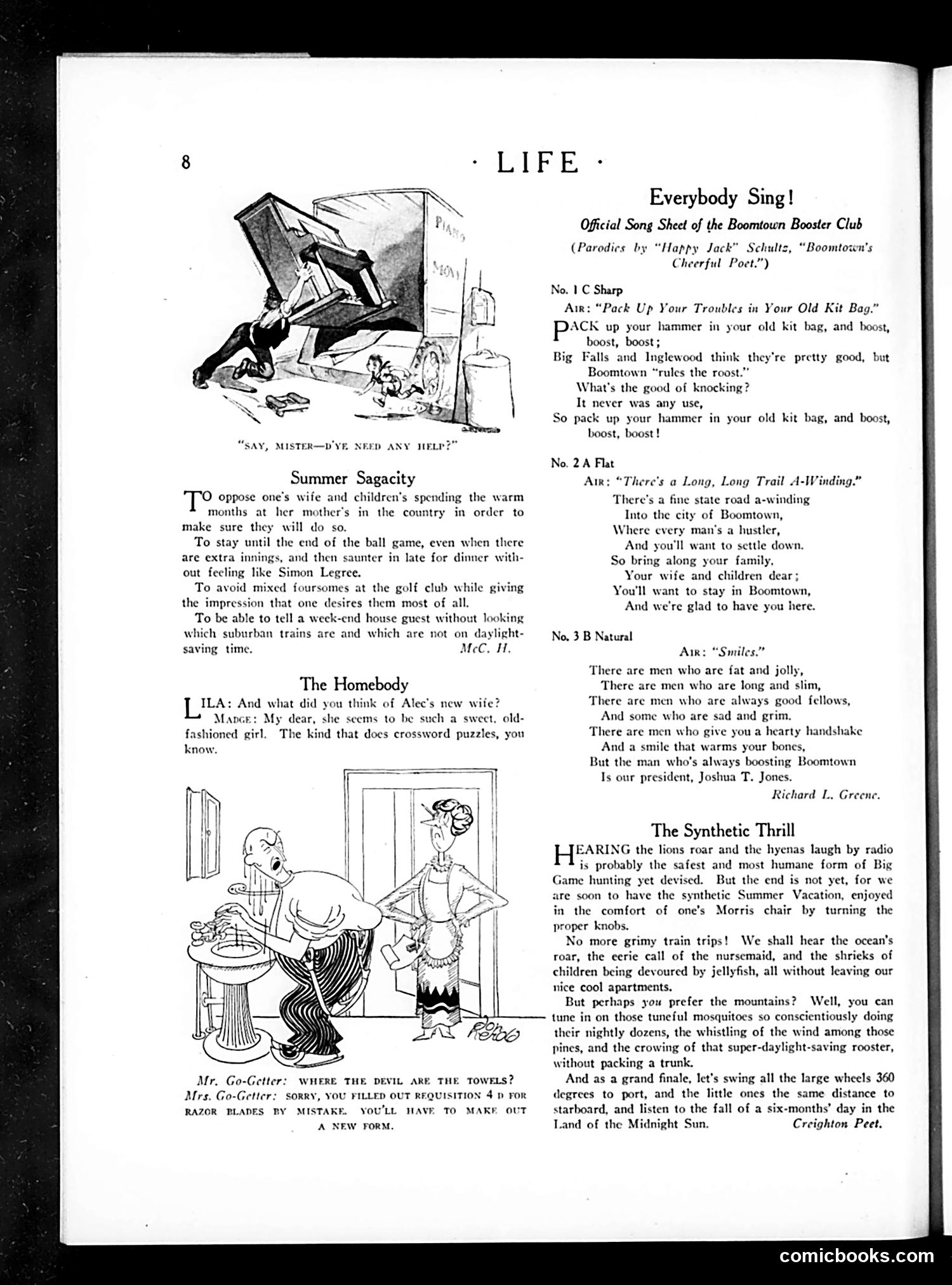
This page contains humor pieces and a cartoon about domestic life, likely from the 1920s-30s based on the styling. **"The Homebody" cartoon** shows a domestic dispute: Mr. Go-Getter asks "WHERE THE DEVIL ARE THE TOWELS?" while his wife responds that she had to repurpose them—she filled out a requisition to make a new form. The satire targets bureaucratic absurdity: the introduction of excessive paperwork and official procedures into everyday household management, suggesting that even simple domestic tasks now require tedious administrative processing. The accompanying text pieces mock "Summer Sagacity" (avoiding wife/children to stay at ball games) and promote "Boomtown"—suggesting this satirizes small-town boosterism and the conflict between domestic obligations and personal leisure.
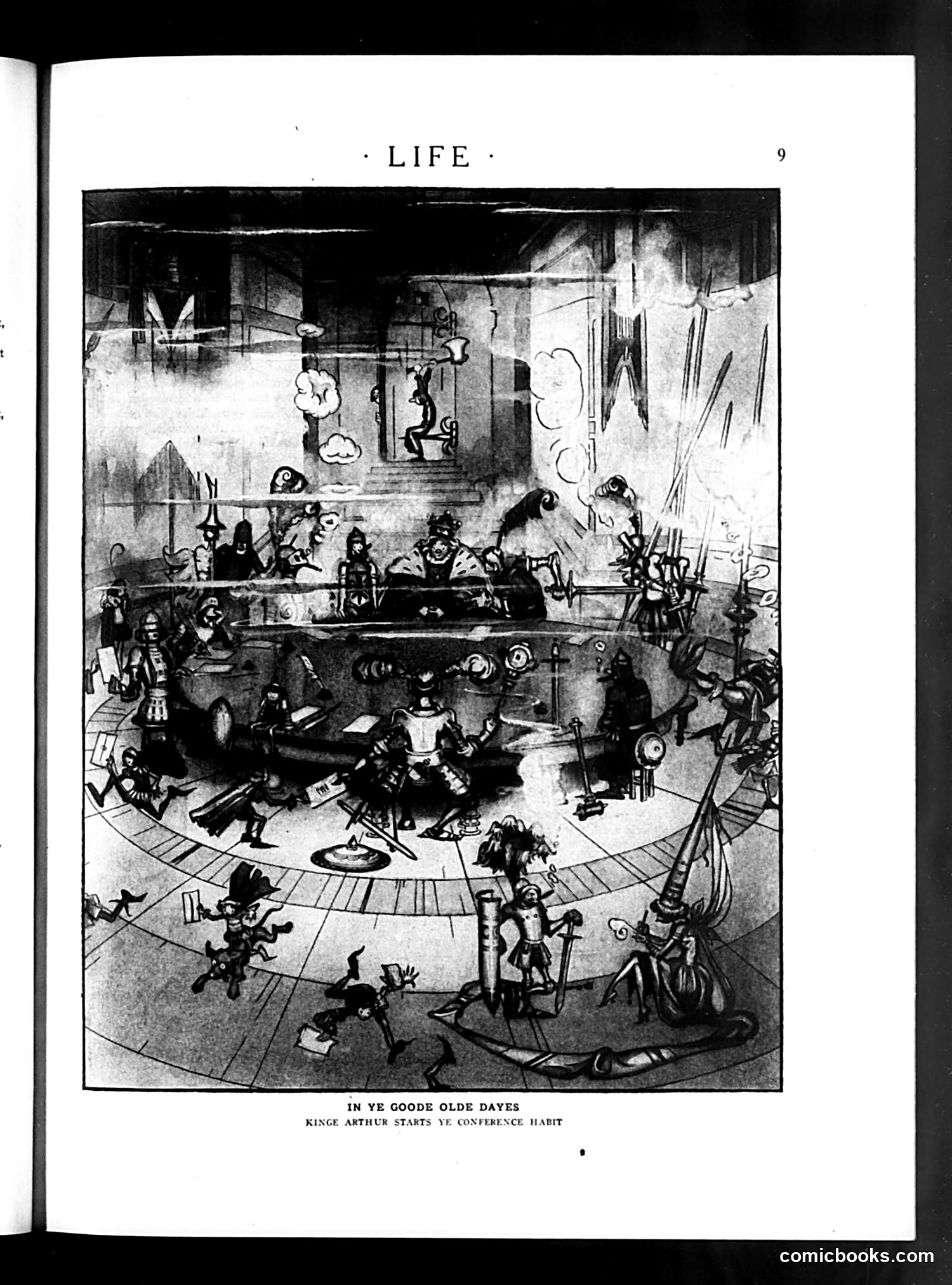
This satirical cartoon depicts King Arthur's legendary Round Table conference, but reimagines it as a chaotic medieval gathering rather than an orderly noble assembly. The illustration shows numerous figures in period costume engaged in animated discussion and argument around and within the table setting—some standing, gesturing wildly, others appearing to debate heatedly. The satire appears to mock the contemporary "conference habit"—likely referring to early 20th-century diplomatic conferences or corporate meetings. By attributing this modern practice to King Arthur, the cartoonist suggests that endless conferencing and discussion, presented as noble tradition, actually produces disorder and inefficiency. The joke implies that conferences, though dressed up as serious business, devolve into chaotic theatricality.
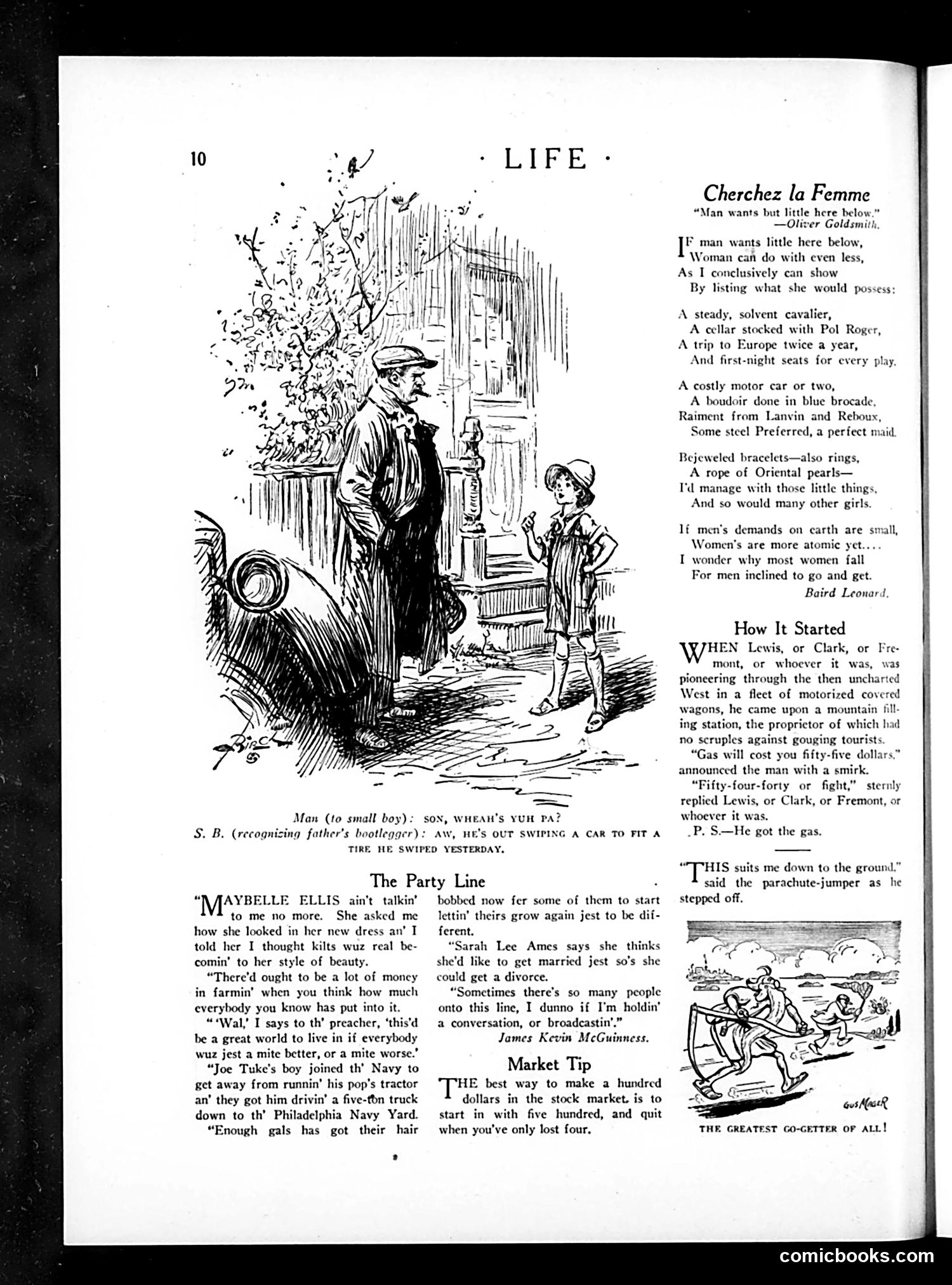
This page contains satirical commentary on gender relations and consumerism, circa early 20th century. **"Cherchez la Femme"** section quotes Oliver Goldsmith and Baird Leonard, ironically listing what women supposedly need: European trips, motor cars, jewelry, and servants. The satire critiques both male assumptions about female desires and women's actual material demands. **"How It Started"** humorously describes early automobile tourism—pioneers crossing the West in motorized wagons. The "$50 to $45" haggling joke parodies both frontier bargaining and the emerging car industry's pricing. **"The Party Line"** gossips about Maybelle Ellis's appearance and various acquaintances' romantic/financial misadventures, exemplifying the contemporary fascination with society scandal. The cartoons and quips collectively mock modern consumer culture, gender dynamics, and social pretensions of the era.
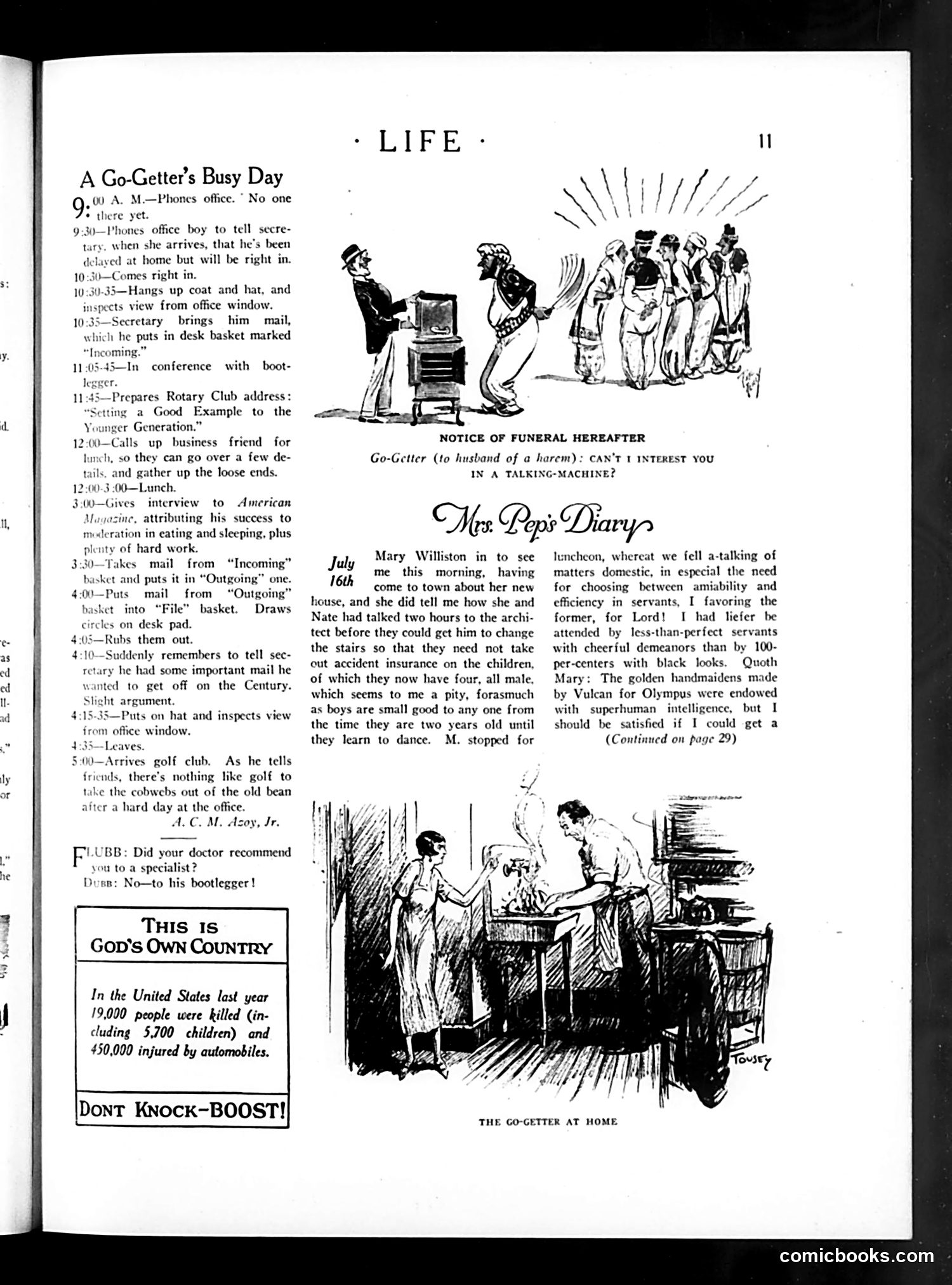
This page satirizes the busy urban lifestyle of the 1920s. "A Go-Getter's Busy Day" mocks a frantic office worker whose schedule spans 9 AM to 5 PM with back-to-back activities—phones, conferences, mail sorting, interviews, lunch meetings, and golf—suggesting constant, exhausting productivity. The "Notice of Funeral Hereafter" joke plays on this theme: a man is so busy he can't attend a funeral, proposing a talking machine (early recording device) as replacement—absurdist humor about how technology and modern life have made even death an inconvenience. "Mrs Pep's Diary" humorously contrasts domestic life, with a woman managing household chaos and children while her husband pursues leisurely pursuits. The bottom safety ad ("This Is God's Own Country") ironically juxtaposes cheerful "Go-Getter" imagery with automobile death statistics, critiquing reckless modern progress.
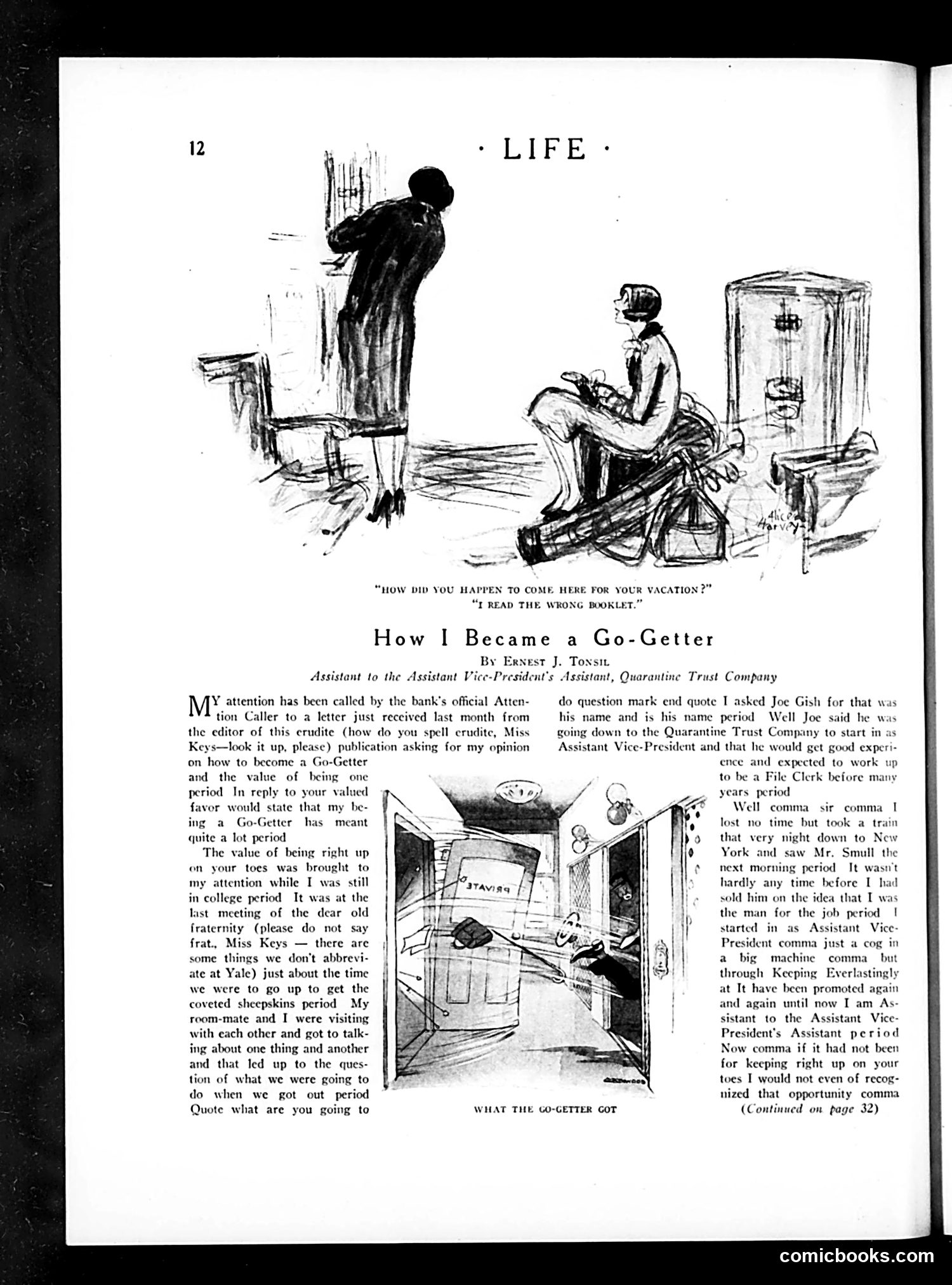
This article by Ernest J. Toxsil satirizes corporate ambition and workplace advancement in early 20th-century America. The top cartoon shows a woman standing on furniture while another reads a guidebook—presumably about becoming a "go-getter," a then-popular term for an aggressive, self-promoting employee. The article mocks the era's obsession with self-improvement advice and corporate climbing. The narrator describes starting at the Quarantine Trust Company as a lowly file clerk, then being repeatedly promoted to "Assistant to the Assistant Vice-President's Assistant"—a satirical commentary on meaningless middle-management positions and the performative nature of corporate advancement. The humor lies in how ambition and effort don't actually lead to real success, only inflated titles.
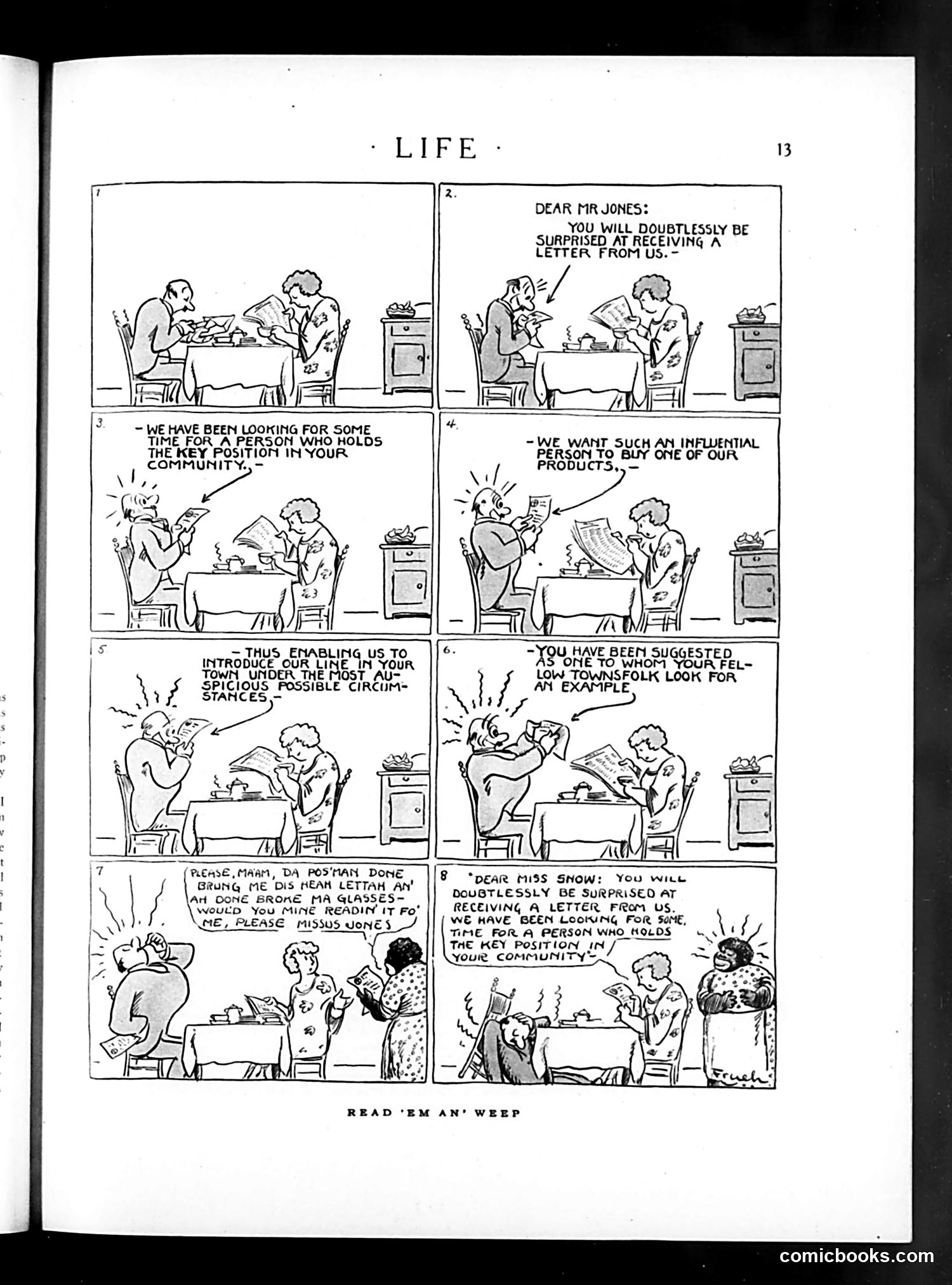
This is a humorous eight-panel comic depicting a domestic dinner conversation between a husband and wife (Mr. and Miss Jones). The husband reads letters aloud from companies seeking to recruit the wife as a local influencer to promote their products in town. The satire targets **early 20th-century marketing tactics** and the concept of leveraging social influence for product placement. Companies appeal to the wife by flattering her standing in the community, ultimately asking her to endorse their goods to friends and neighbors. The final panel shows the wife's exasperated reaction—implied by the husband's desperate plea "Please, Mamma, da postman done bring us dis heah lettah"—suggesting the absurdity and annoyance of constant solicitations exploiting the aspirational desire to be considered community leaders.
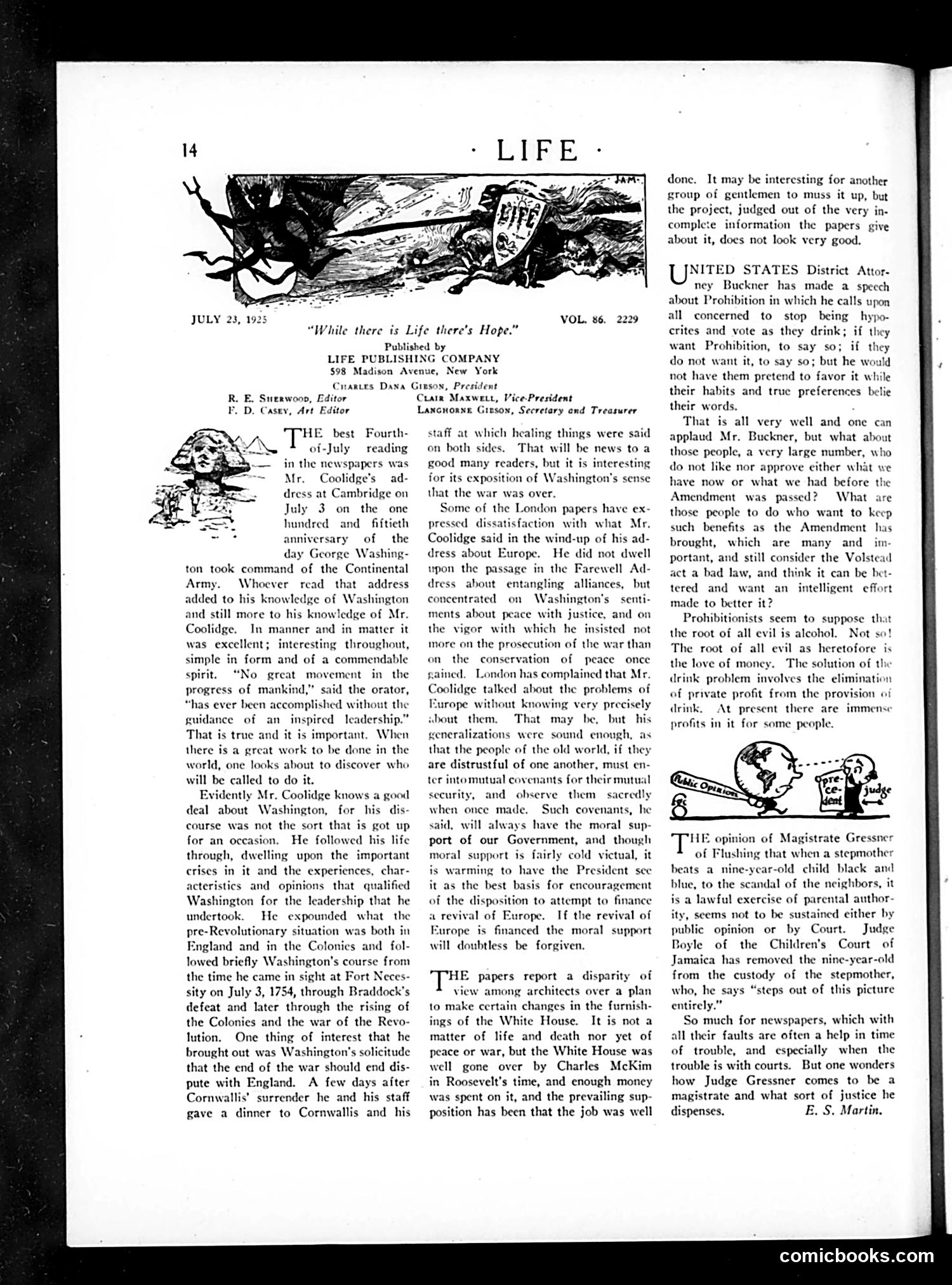
This page contains editorial commentary on Prohibition rather than a traditional political cartoon. The main illustration shows **a coffin labeled "RIP" with devil-like figures**, satirizing the consequences of Prohibition enforcement. The text criticizes **District Attorney Buckner's speech** demanding stricter Prohibition enforcement while acknowledging citizens won't voluntarily comply. The satire targets the contradiction: Buckner wants people to stop drinking while remaining hypocrites about their actual preferences. The commentary suggests Prohibition's "root of all evil" isn't alcohol itself but rather **the law's attempt to enforce private morality**. The piece argues this approach generates corruption and fails because it ignores what people actually want—a familiar anti-Prohibition argument from the 1920s.
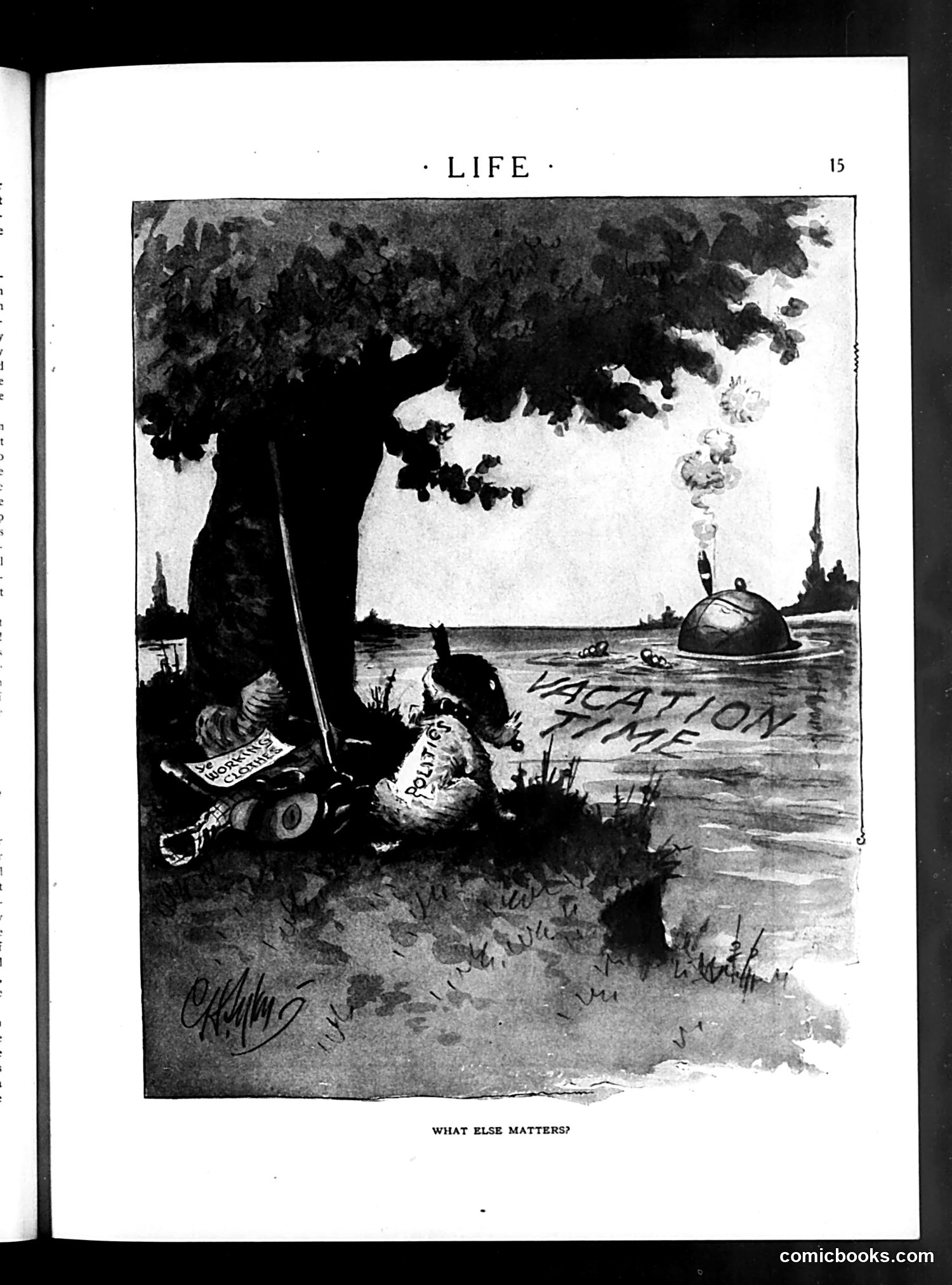
This appears to be a World War I-era satirical cartoon from *Life* magazine. The image depicts a figure lounging beneath a tree on a riverbank, surrounded by what appears to be propaganda or political materials, while in the background military installations and warships are visible across the water. The title "What Else Matters?" suggests ironic commentary on American isolationism or complacency during wartime. The figure seems to represent either American political leadership or the general public ignoring urgent military/political matters happening abroad. The contrast between peaceful leisure in the foreground and military activity in the background emphasizes the cartoon's critique of detachment from international crisis. The style and subject matter suggest this comments on pre-1917 or early American involvement debates.
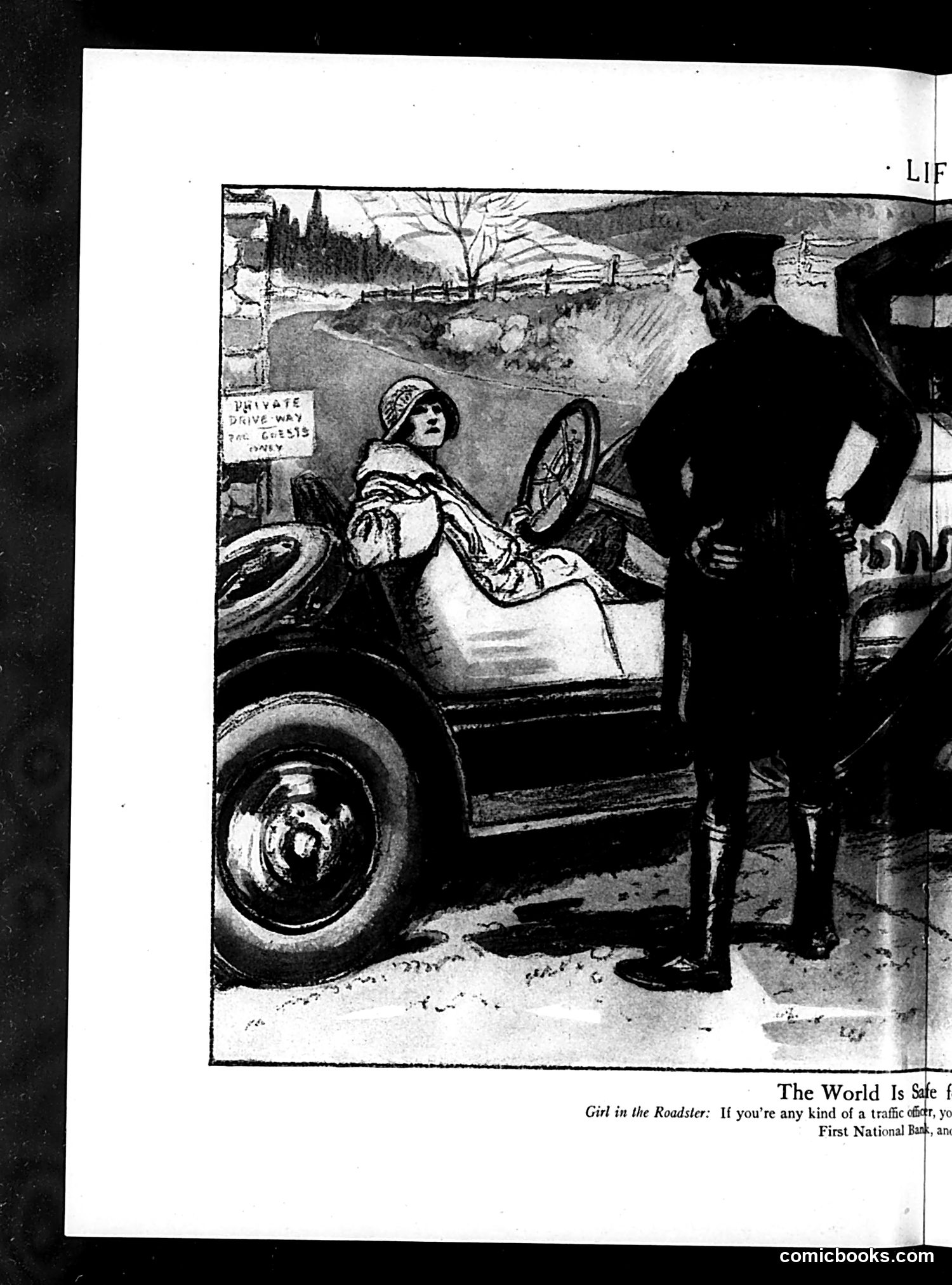
This appears to be a safety-themed cartoon from Life magazine satirizing traffic enforcement. The image shows a woman driving a roadster (open-top car) with a "Private Drive Way For Guests Only" sign visible, being approached by what appears to be a traffic officer or policeman. The incomplete caption suggests the woman is challenging the officer's authority or competence ("If you're any kind of a traffic officer..."), likely making a joke about traffic enforcement standards or suggesting the officer should be doing something else. The cartoon appears to be promoting road safety awareness—possibly connected to the "First National Bank" credit line visible in the OCR text, suggesting this was sponsored safety advertising rather than purely editorial satire. The humor likely lies in questioning whether traffic officials were actually effective at their jobs during this early automotive era.
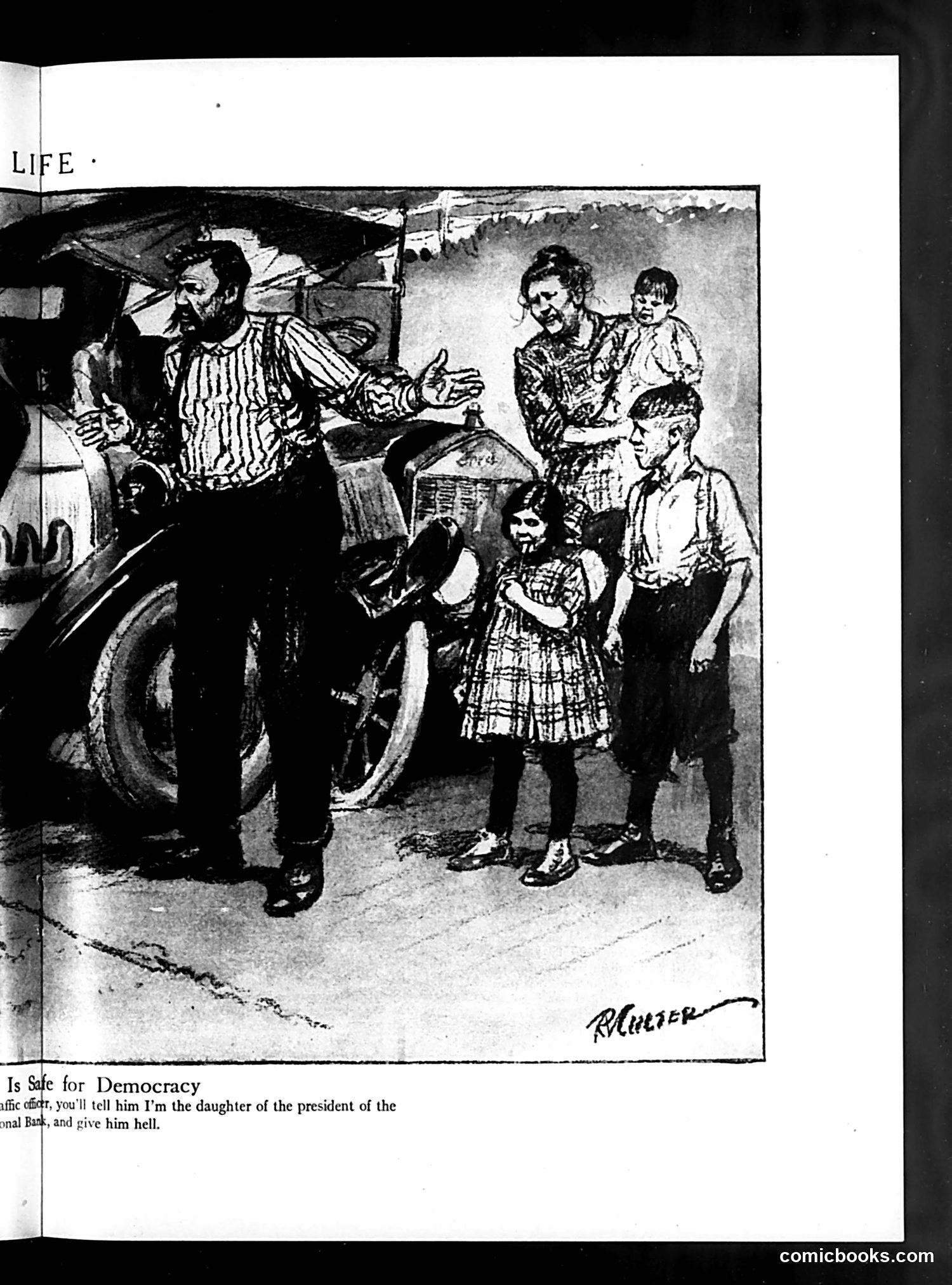
This political cartoon satirizes American intervention and power dynamics. An adult man (appearing to be a politician or official) gestures while speaking to children near a Ford automobile. The caption suggests he's instructing a child to invoke her father's position—claiming to be "the daughter of the president"—to intimidate or manipulate someone (likely a traffic officer or authority figure). The title "Is Safe for Democracy" appears ironic, critiquing how political privilege and nepotism undermine democratic principles. The cartoon suggests that in practice, democracy means using family connections and intimidation rather than equal treatment under law. Children learning such tactics reflects broader satirical commentary on American political corruption and the abuse of power by the elite.
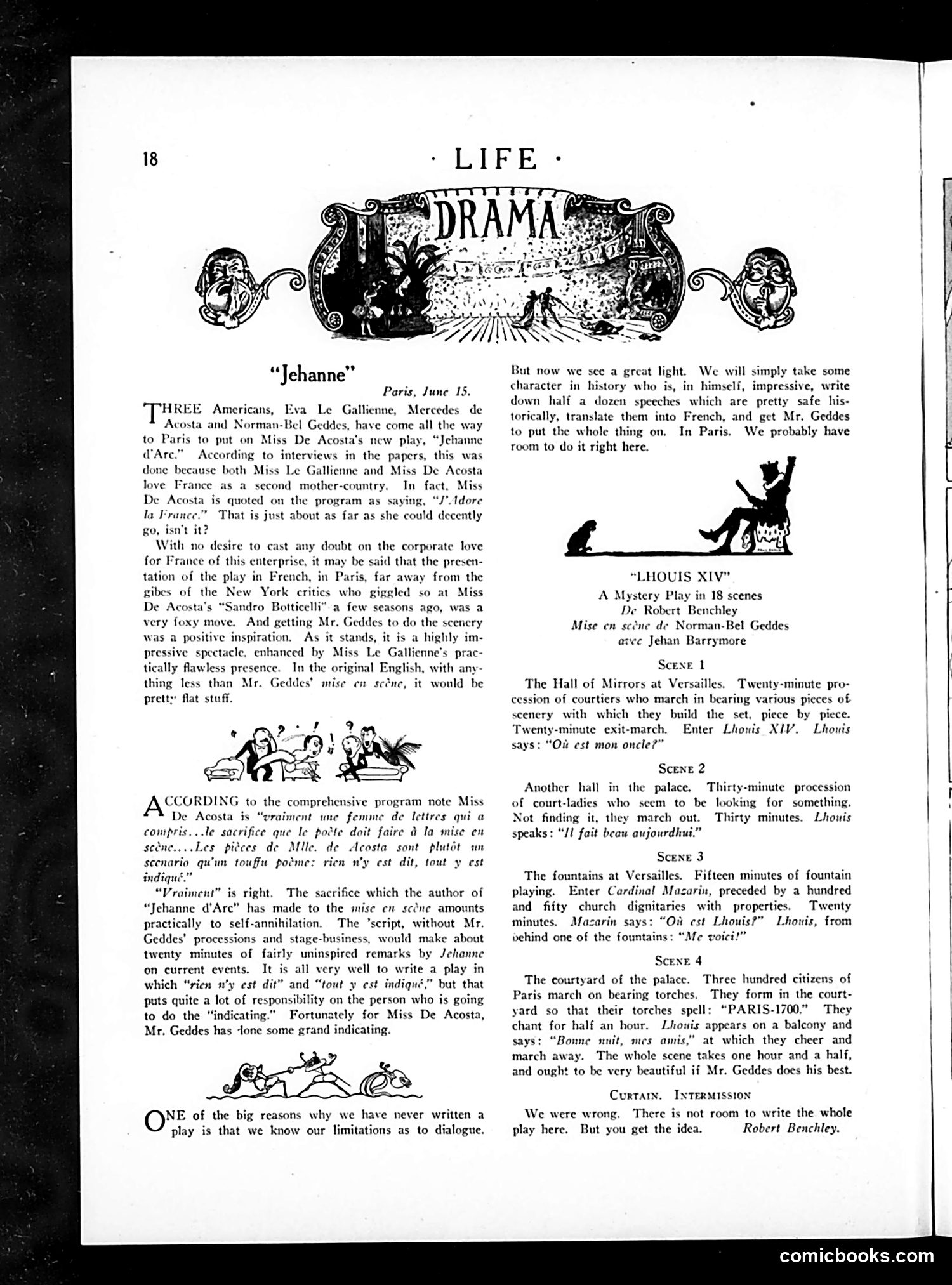
This page satirizes a Paris production of "Jehanne d'Arc" by Mercedes de Acosta, starring Eva Le Gallienne, with sets designed by Norman-Bel Geddes. Life's critic mocks the production as style-over-substance: the play itself consists of minimal dialogue and relies entirely on Geddes' elaborate stagecraft to appear impressive. The reviewer suggests De Acosta chose Paris specifically to escape New York critics who'd previously ridiculed her work. The accompanying mock play-outline "Lhouis XIV" by Robert Benchley extends the joke: Benchley proposes writing plays featuring historically impressive figures who require minimal actual script—just a few safe historical speeches translated to French, then surrounded by Geddes' elaborate processions and spectacle to distract audiences. The humor targets theatrical pretension and the elevation of visual production values over genuine dramatic writing.
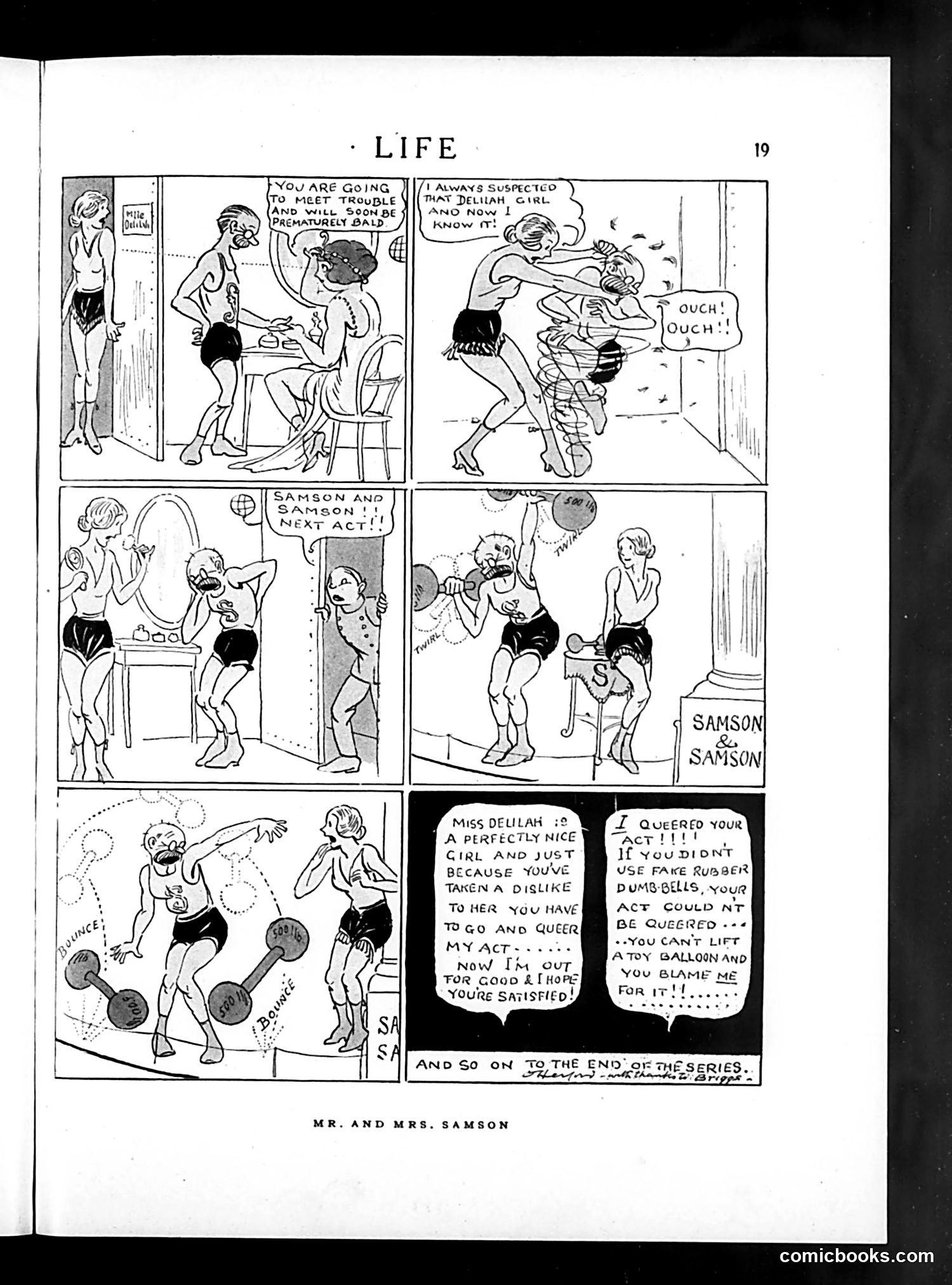
This is a humorous domestic comedy strip playing on the biblical Samson and Delilah story. The setup: a strongman performer (Samson) brings home his girlfriend Delilah, whom his wife immediately dislikes. The wife, seeking revenge, sabotages his stage act by replacing his dumbbells with fake rubber ones, causing him to fail publicly and lose his job. In the final panel, the couple argues about blame—he accuses her of ruining his career; she counters that his act was already fraudulent (using fake weights), so he has no right to complain. The satire targets vaudeville performers who used tricks rather than genuine strength, while also mocking marital conflict and a wife's jealous sabotage. The biblical allusion (Delilah betraying Samson) adds an ironic layer—here, the wife plays Delilah's betrayer role.
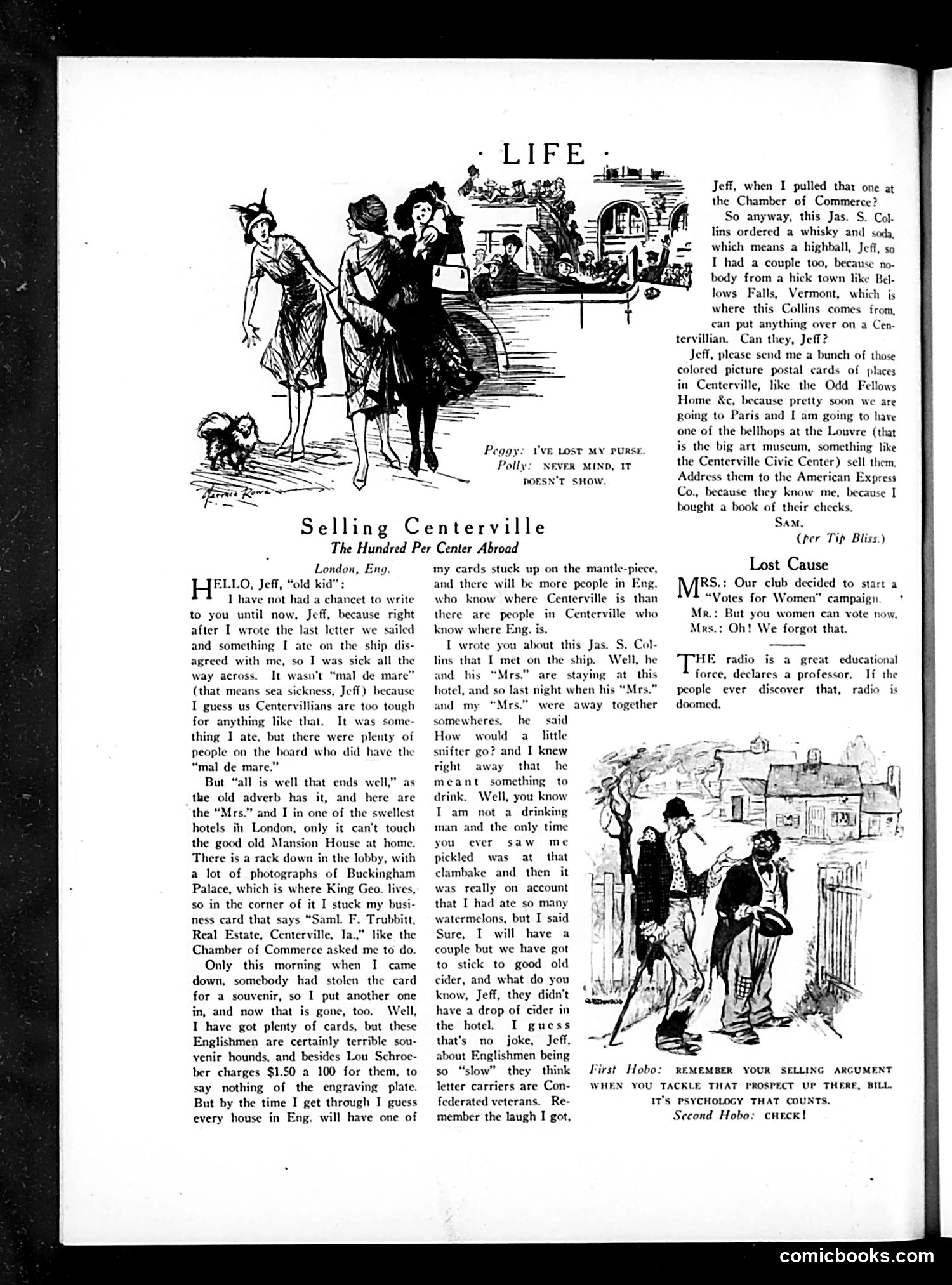
This Life magazine page satirizes American provincialism and small-town boosterism through the character Sam, a Centerville, Iowa businessman abroad in England. **Main Satire:** Sam represents the stereotypical American tourist who absurdly promotes his tiny hometown everywhere—plastering business cards at Buckingham Palace, planning to sell Centerville postcards at the Louvre in Paris. The joke is his oblivious confidence that promoting "Centerville" matters internationally. He's also a comedic "ugly American"—unfamiliar with foreign customs (shocked England lacks cider) and prone to self-aggrandizing anecdotes about his Chamber of Commerce. **The supporting cartoons** mock gender politics ("Lost Cause": women forget they can now vote) and sales tactics relying on psychology over substance. The entire piece gently ridicules American small-town pride and the traveling businessman's misplaced sense of importance—common satirical targets during this era of expanding American tourism and commerce.
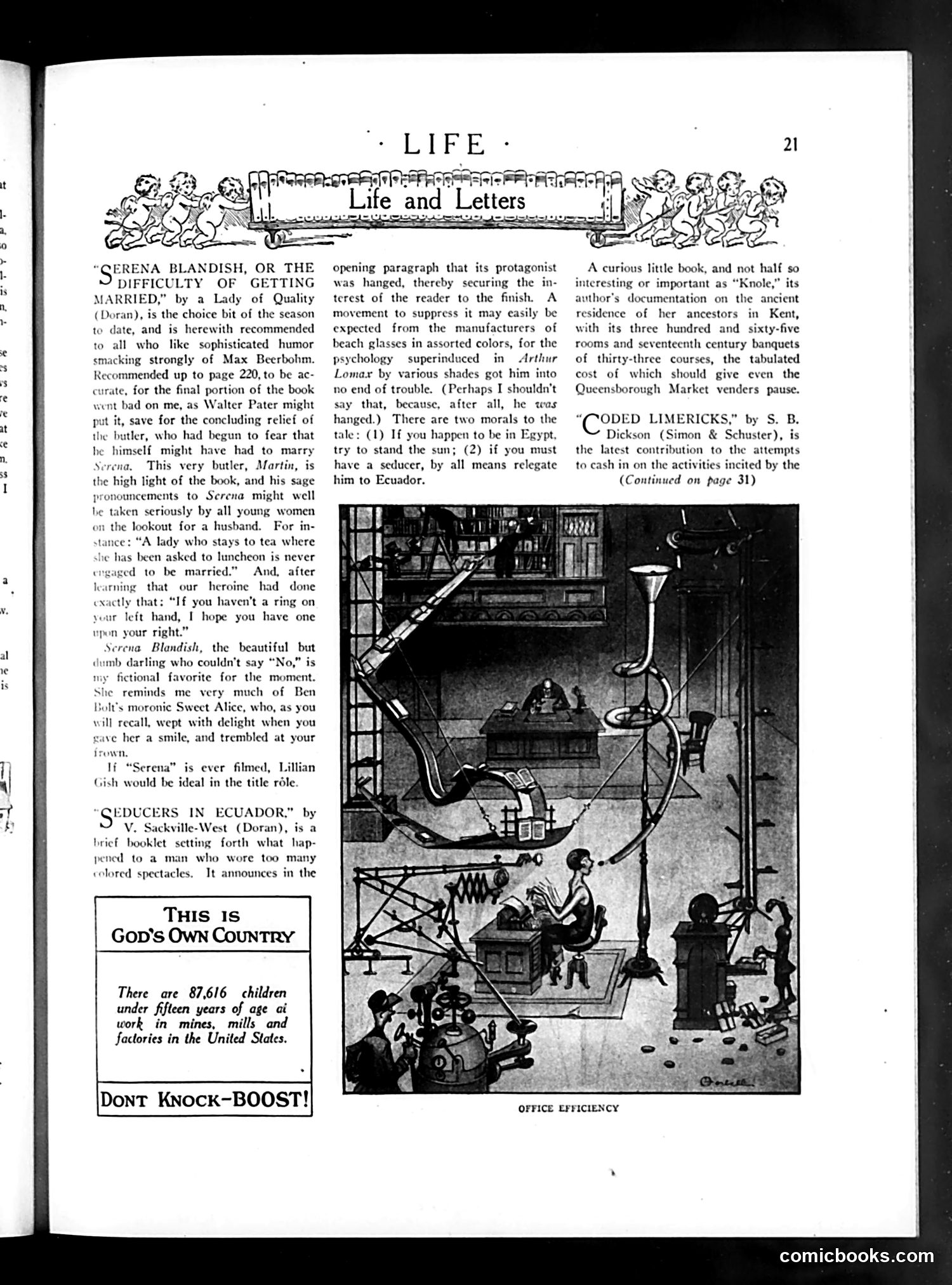
This page features book reviews and a satirical cartoon titled "Office Efficiency." The cartoon depicts an absurdly complex office workspace filled with tangled wires, pulleys, and mechanical contraptions—a visual joke about how modern offices, despite technological "efficiency" improvements, have become chaotic and overcomplicated rather than streamlined. The left sidebar contains a public service message: "This is God's Own Country / Don't Knock-Boost!" highlighting that 87,616 children under fifteen work in American mines, mills, and factories. This appears to be ironic social criticism—calling America "God's Own Country" while exposing child labor exploitation. The book reviews discuss literary works including *Serena Blandish*, a novel about a woman struggling to marry, and *Seducers in Ecuador*, a dark tale involving murder. The reviews are written in the sophisticated, somewhat sarcastic tone characteristic of *Life* magazine's literary criticism.
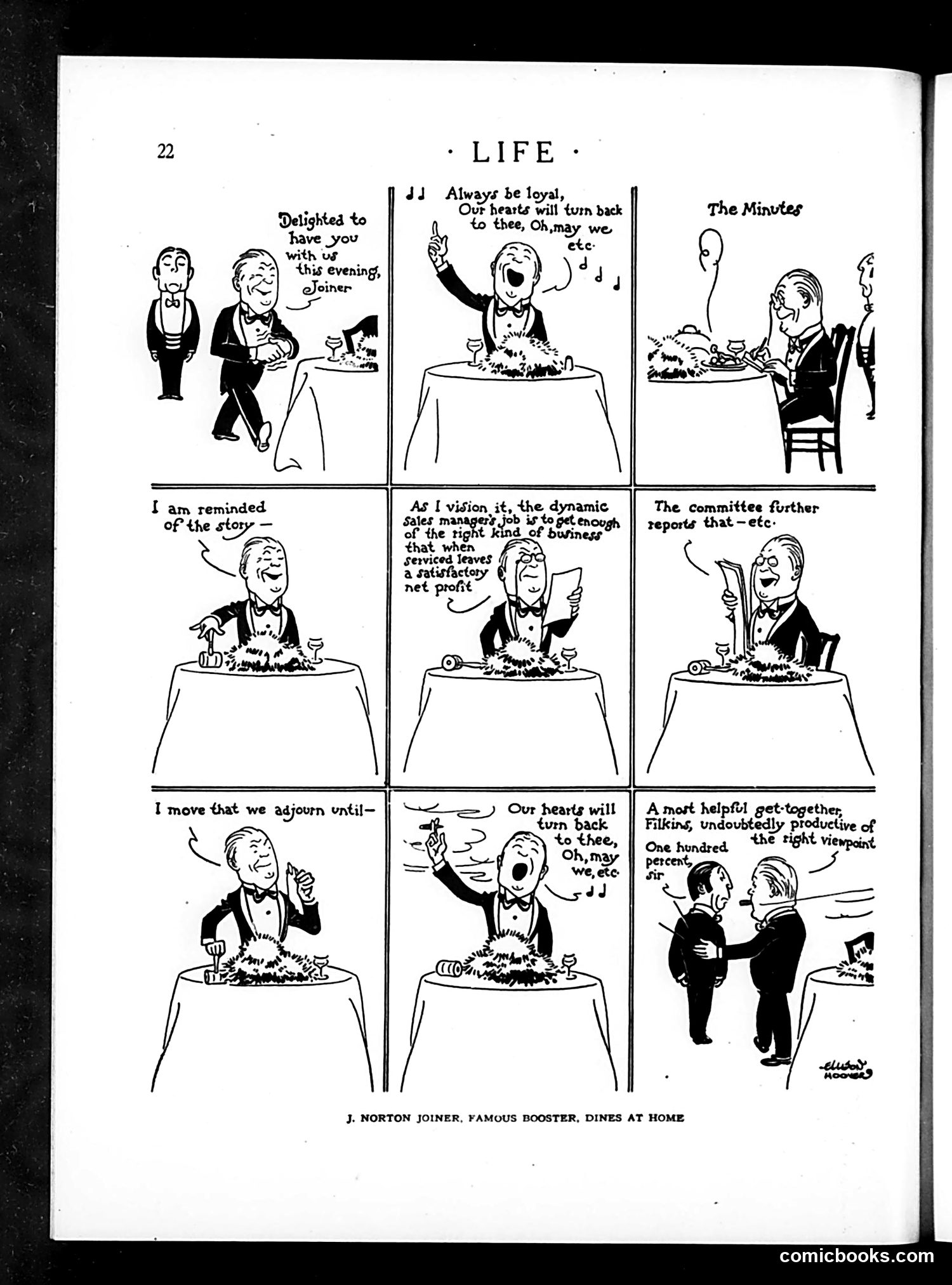
This satirical comic strip mocks corporate "boosters"—men who promote business enthusiasm and loyalty with empty rhetoric. The unnamed protagonist hosts a dinner where he delivers increasingly grandiose speeches about business philosophy, loyalty, and profit margins. His companions respond with exaggerated enthusiasm, singing and gesticulating wildly. The satire targets the gap between flowery corporate speak and actual substance. Each panel shows Joiner expounding on business principles ("dynamic sales manager's job," "satisfactory net profit," "productive of the right viewpoint") while his listeners become more absurdly enthusiastic. The final panel shows them making vague commitments ("One hundred percent") with no concrete results. The joke is that boosters prioritize theatrical loyalty and motivation over meaningful discussion—the "Minutes" are empty ("—etc—"), and the "helpful get-together" produces only hot air and agreement, not actual progress.
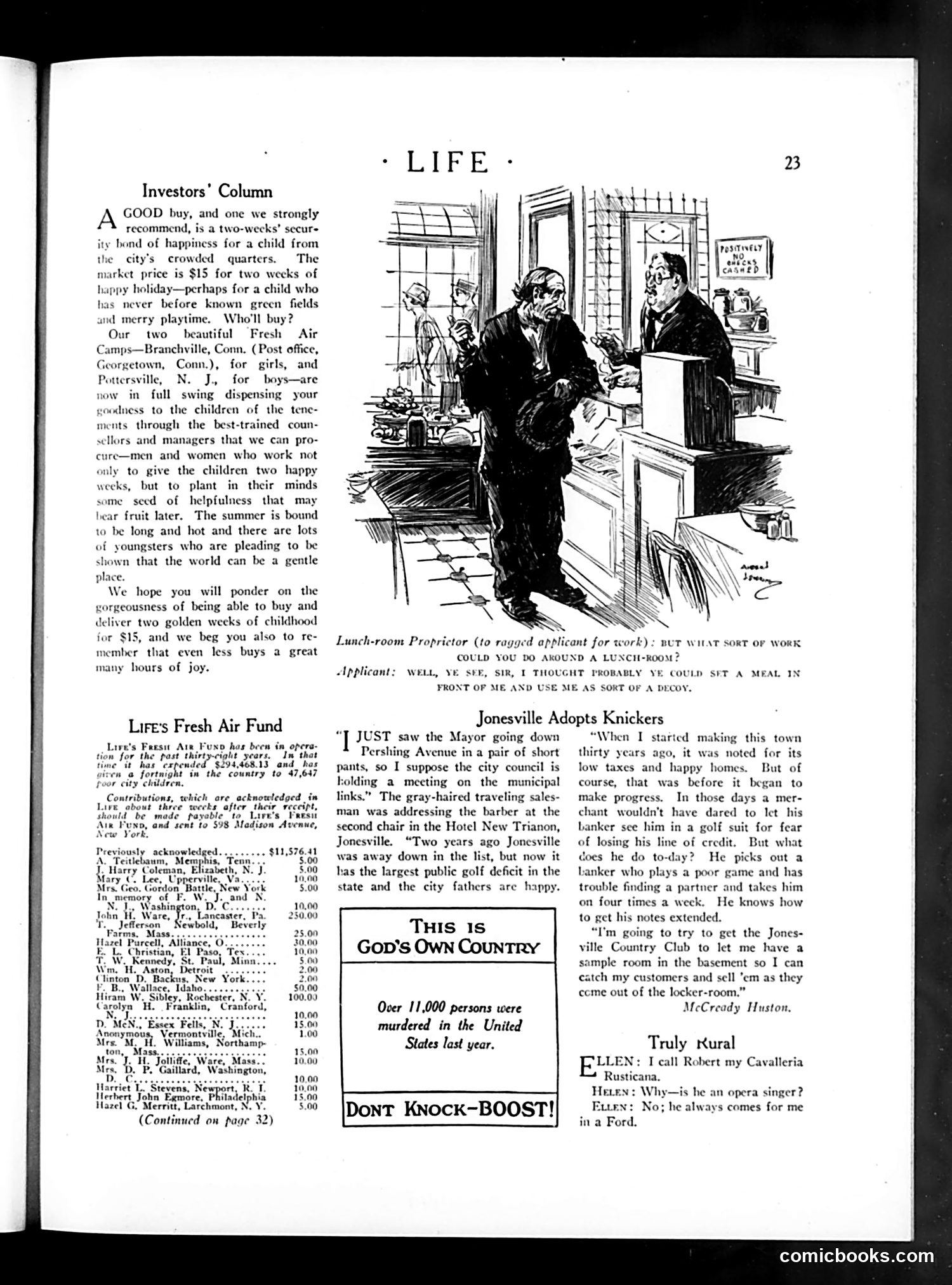
This page contains several satirical pieces targeting early 20th-century American social attitudes. **Main Cartoon**: A lunch-room proprietor interviews a ragged job applicant. The applicant suggests he could "sit a meal in front of me and use me as sort of a decoy"—implying his starving appearance would attract pity customers. The satire mocks both poverty exploitation and the proprietor's callousness. **"Jonesville Adopts Knickers"**: Satirizes small-town status anxiety. A salesman notes the mayor wearing golf knickers (short pants), suggesting the town council now prioritizes golf over fiscal responsibility, accumulating the state's "largest public golf deficit." The piece ridicules how prosperity-chasing communities abandoned thrift for conspicuous leisure and credit-based living. **"Fresh Air Fund"**: A charitable fundraising appeal (not satire) selling two-week rural vacations for poor city children at $15 each. The page's humor targets American materialism, social pretension, and economic irresponsibility during an era of rapid social change.
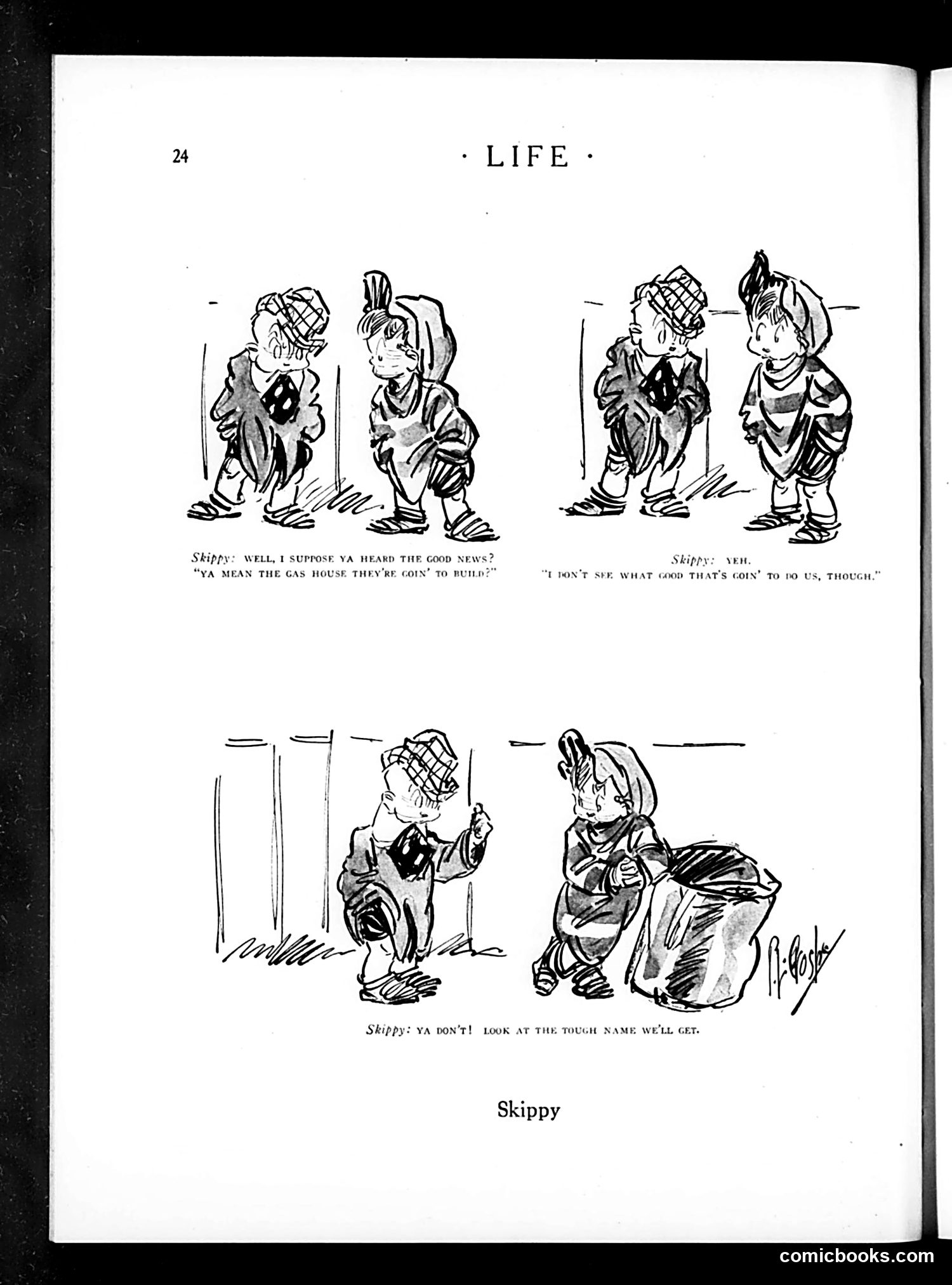
This is a three-panel comic strip featuring "Skippy," a character strip popular in early 20th-century American comics. The humor depicts two young boys discussing a planned gas house in their neighborhood. In the first panel, Skippy excitedly shares "good news" about construction. His friend asks if he means the gas house being built. In the second panel, the friend expresses skepticism about any benefit to them. The punchline (third panel) reveals Skippy's reasoning: having a "Gas House" in their neighborhood will give them a tough, cool-sounding name—they can call themselves "Gas House" kids or gang members. The satire gently mocks childish logic and the era's working-class neighborhood identity, where industrial facilities like gas houses were common fixtures. Boys would adopt neighborhood landmarks as identity markers. This reflects early 20th-century urban childhood culture.
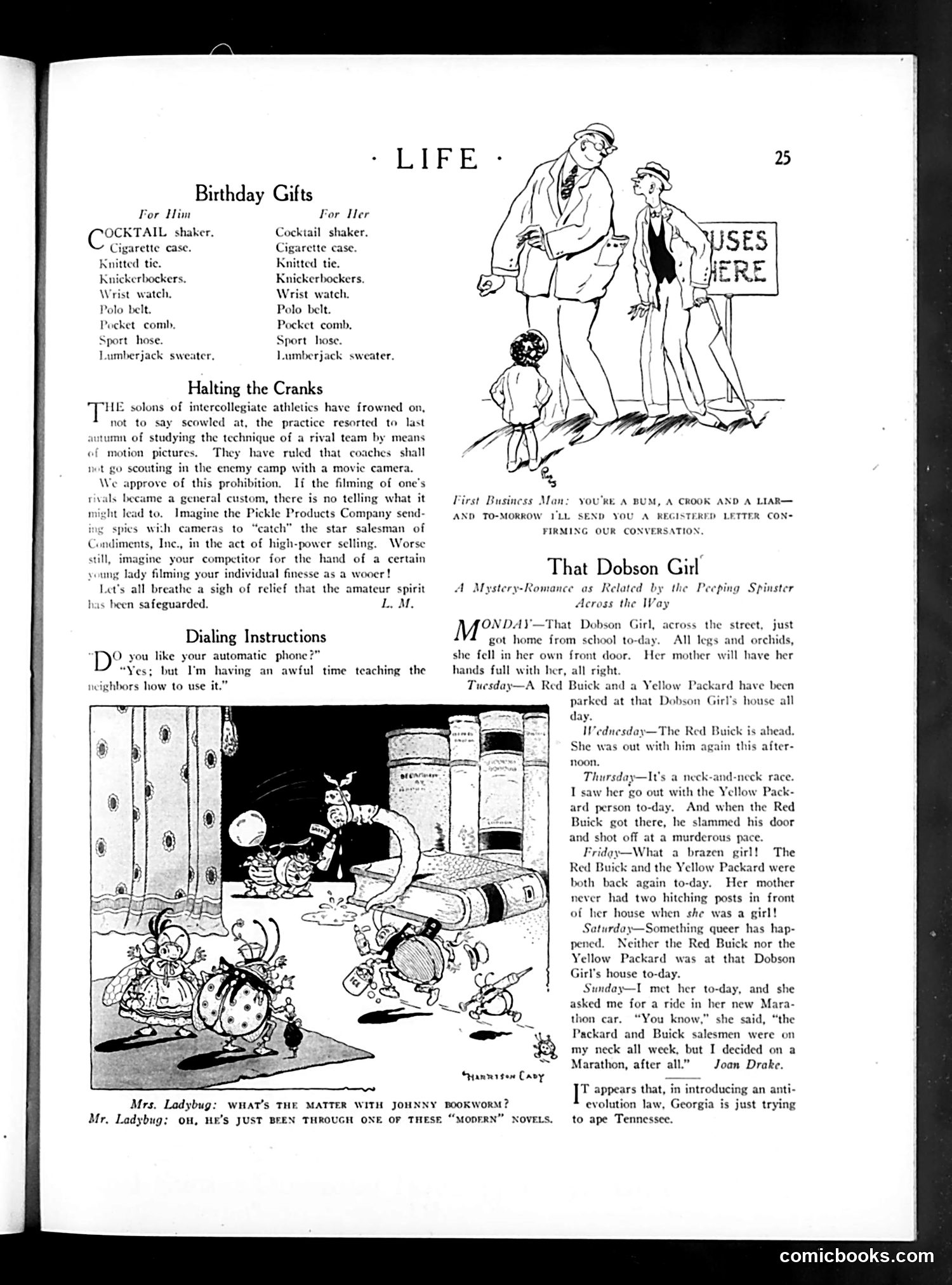
This page contains three distinct satirical pieces: **"Birthday Gifts"** mocks gender equality by listing identical gift suggestions for both men and women—polo belts, cocktail shakers, knickerbockers—suggesting the modern woman now does everything men do, a commentary on 1920s social changes. **"Halting the Cranks"** defends collegiate athletics' ban on filming rival teams. The satire imagines this rule extended to business, warning that allowing spies with cameras in competitors' offices (or worse, filming romantic rivals wooing women) would undermine "amateur spirit." **"That Dobson Girl"** is a serialized gossip column spoofing neighborhood busybodies. It tracks a young woman juggling two suitors—a Red Buick and Yellow Packard driver—before unexpectedly choosing a Marathon car, satirizing both female independence and automobile salesmanship. The **ladybug cartoon** jokes about modern novels corrupting innocence. The **business cartoon** mocks redundant formal communication (confirming conversations via registered letter).
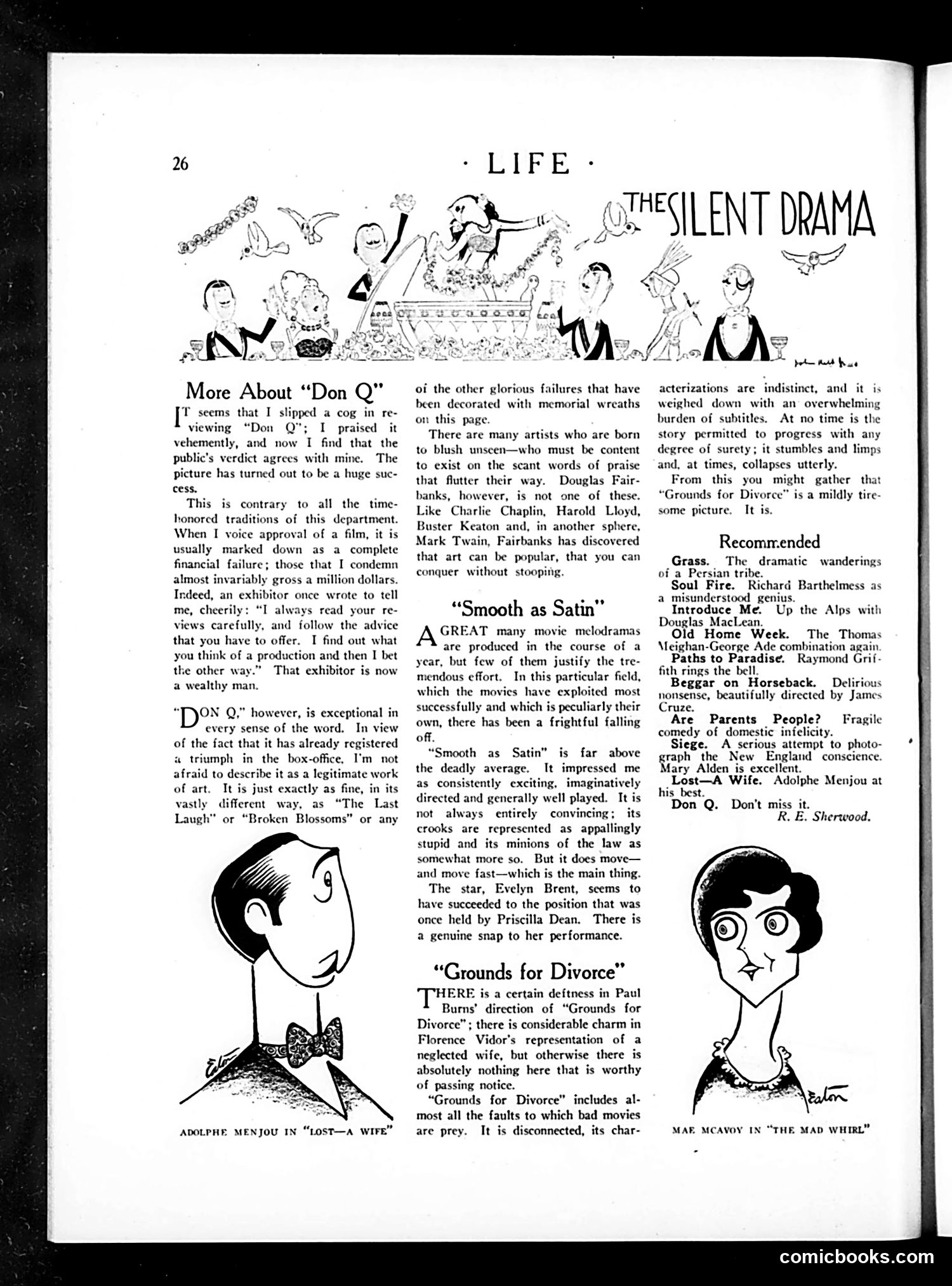
This page reviews silent films from approximately the 1920s. The critic discusses several movies: **"Don Q"** (starring Douglas Fairbanks) receives praise—the critic notes this is unusual because his positive reviews typically harm films financially, yet this one succeeds anyway. He compares Fairbanks favorably to Charlie Chaplin and Harold Lloyd, arguing that Fairbanks proved art can be both popular and quality. **Other reviewed films** include "Smooth as Satin" (starring Evelyn Brent, praised as successor to silent star Priscilla Dean), and "Grounds for Divorce" (criticized for poor pacing, unclear characterization, and excessive subtitles). The **two caricatures** show Adolphe Menjou and Mae McCavoy from respective films. For modern readers: this reflects how silent-film critics evaluated movies—emphasizing direction, acting performance, and visual storytelling without dialogue. The repeated subtitle complaints highlight a key limitation of early cinema.
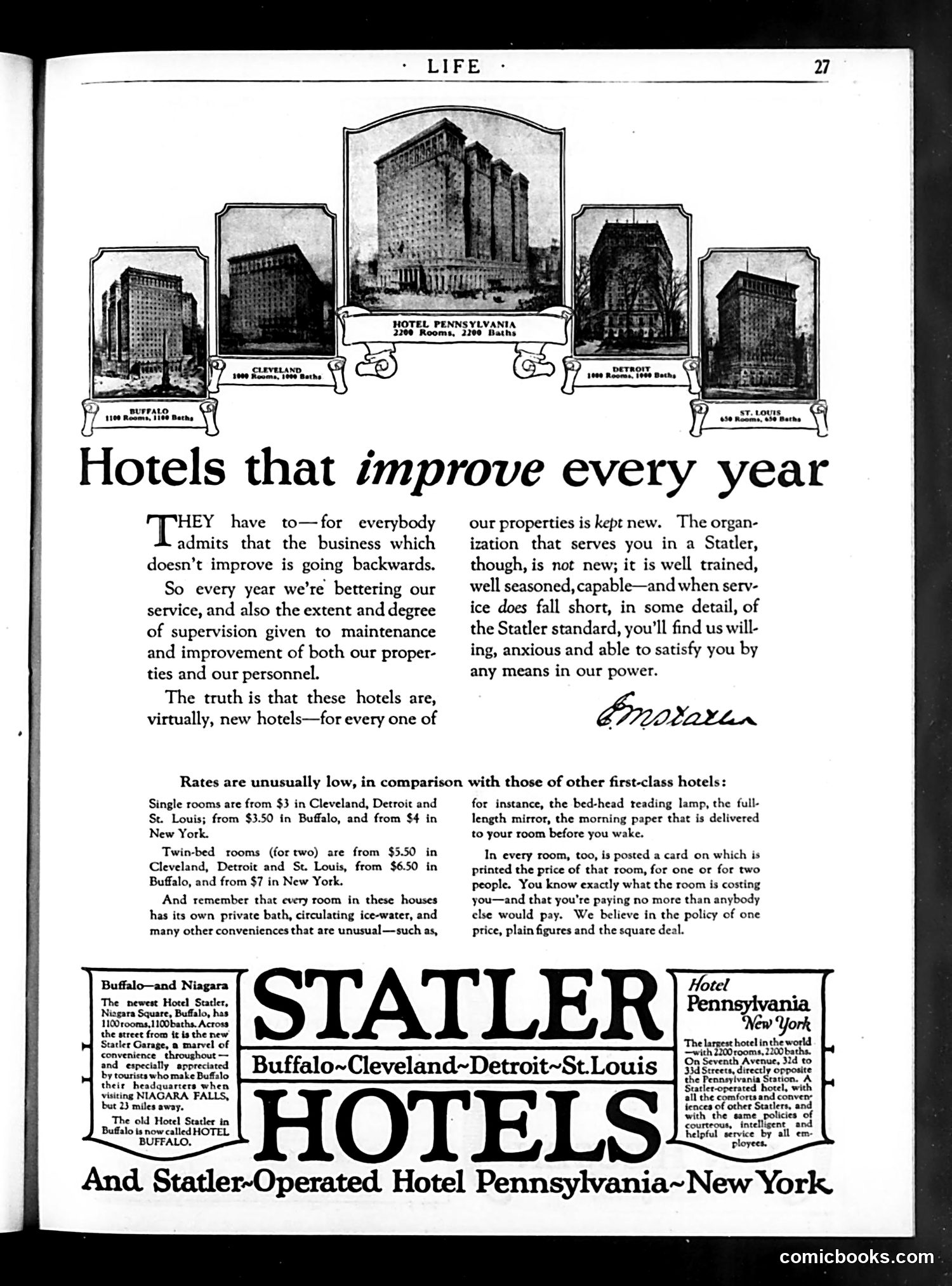
This is primarily a **hotel advertisement**, not a political cartoon. The page promotes the Statler Hotels chain operating in Buffalo, Cleveland, Detroit, and St. Louis, plus the Hotel Pennsylvania in New York. The advertisement emphasizes the hotels' continuous improvement and consistent service standards. The five photographs at top show the properties' substantial architecture, meant to convey quality and permanence. Key selling points highlighted include: - Unusually low rates ($3-$7 per room depending on location) - Modern amenities: private baths, ice-water, reading lamps, morning newspapers delivered to rooms - Transparent pricing ("square deal" — no hidden charges) - Professional, well-trained staff The signature at bottom appears to be the hotel company's owner/operator. There is **no satire or political commentary** on this page—it's straightforward commercial messaging typical of early-to-mid 20th century hotel industry advertising, emphasizing value, cleanliness, and service to appeal to business travelers and tourists.
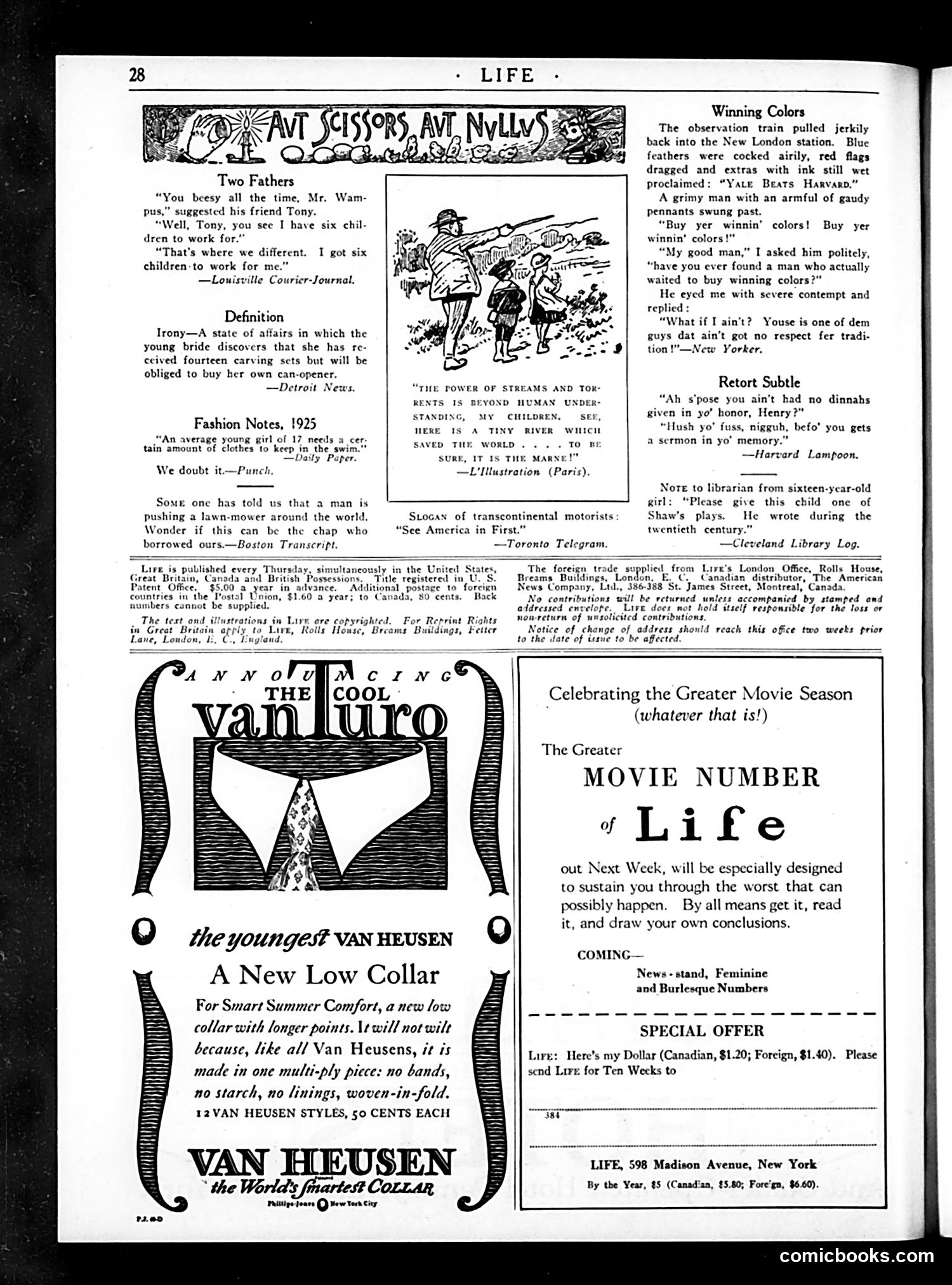
This page contains several brief humorous pieces typical of 1920s satirical magazines: **Main Content:** - **"Two Fathers"** contrasts work ethics: one man works *for* his children; the other makes his children work *for* him - **"Winning Colors"** satirizes American sports tradition—a vendor sells pennants after Yale beats Harvard, yet admits he doesn't actually believe anyone wants them. The joke: people buy them anyway out of blind tradition - **"Retort Subtle"** appears to use period dialect humor (now considered offensive), likely from Harvard Lampoon, depicting working-class banter **Context for Modern Readers:** The page reflects 1920s American college sports culture (Yale-Harvard rivalry was significant), consumer habits, and attitudes toward commercialized tradition. The vendor's complaint about lack of "respect fer tradition" satirizes how Americans mindlessly perpetuate customs. The prominent **Van Heusen collar advertisement** dominates the lower half—typical of Life's revenue model. Overall: lighthearted social observation rather than political commentary.
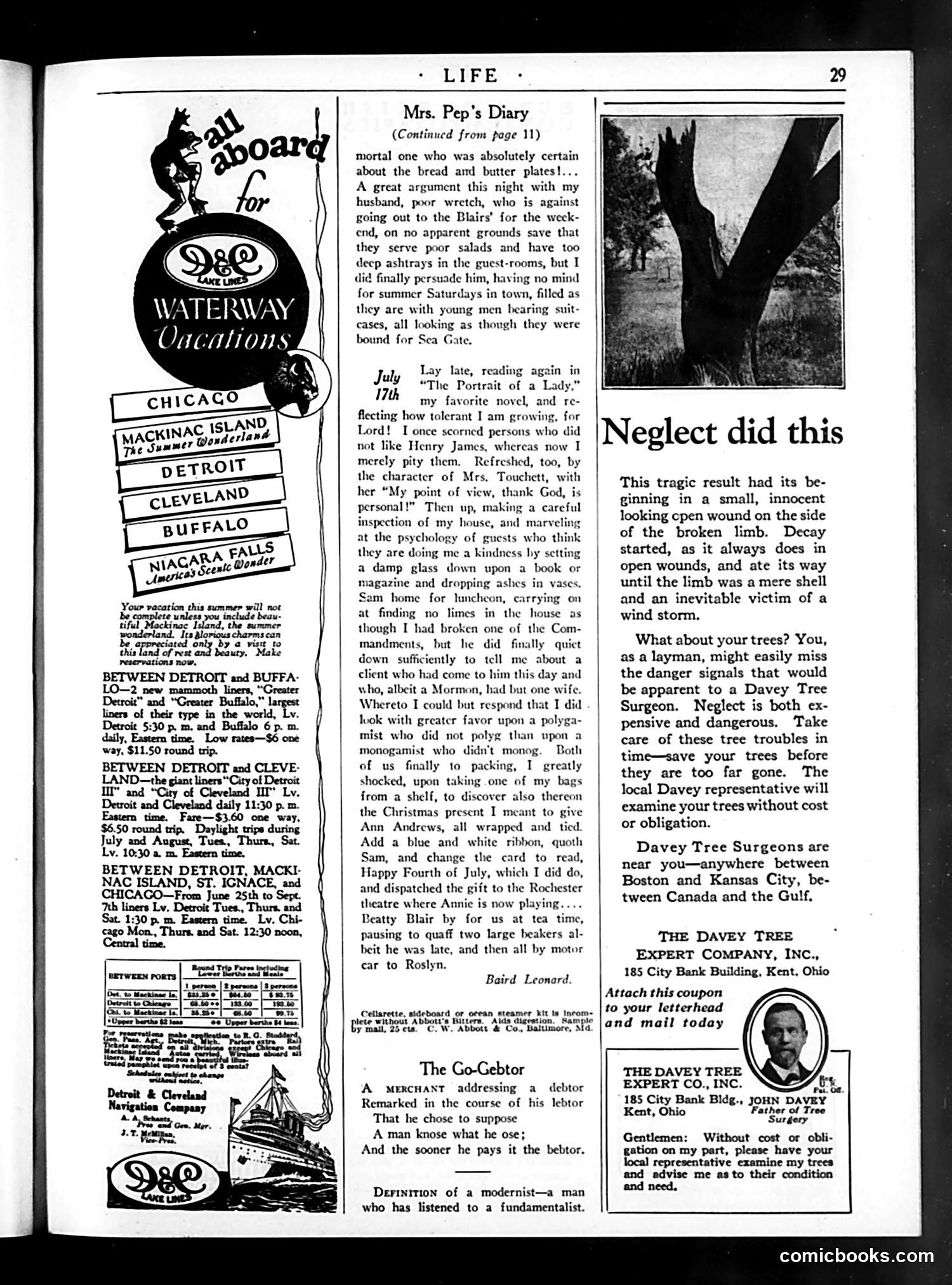
This page mixes advertisements, a society humor column, and public service messaging. **Mrs. Pep's Diary** (upper right): A satirical column mocking upper-class social pretensions. The narrator obsesses over trivial hostess details—correct bread plates, guest psychology, Henry James literary snobbery—while describing mundane domestic life with her husband "Sam." The humor targets the artificial concerns of leisure-class women. **"The Go-Debtor"**: A light verse joke using imperfect rhymes ("ose/suppose") to mock debt collection—likely commenting on post-war financial struggles. **Davey Tree Surgeon advertisement** (right): A legitimate public service notice about tree care, featuring a coupon and company information from Kent, Ohio. **The left side** contains waterway vacation advertisements for Great Lakes steamship lines between Detroit, Chicago, and Buffalo—typical 1920s travel promotion. The page reflects 1920s concerns: leisure travel, consumer debt, and emerging consumer services (professional tree care), balanced against satirical commentary on upper-class social anxiety.
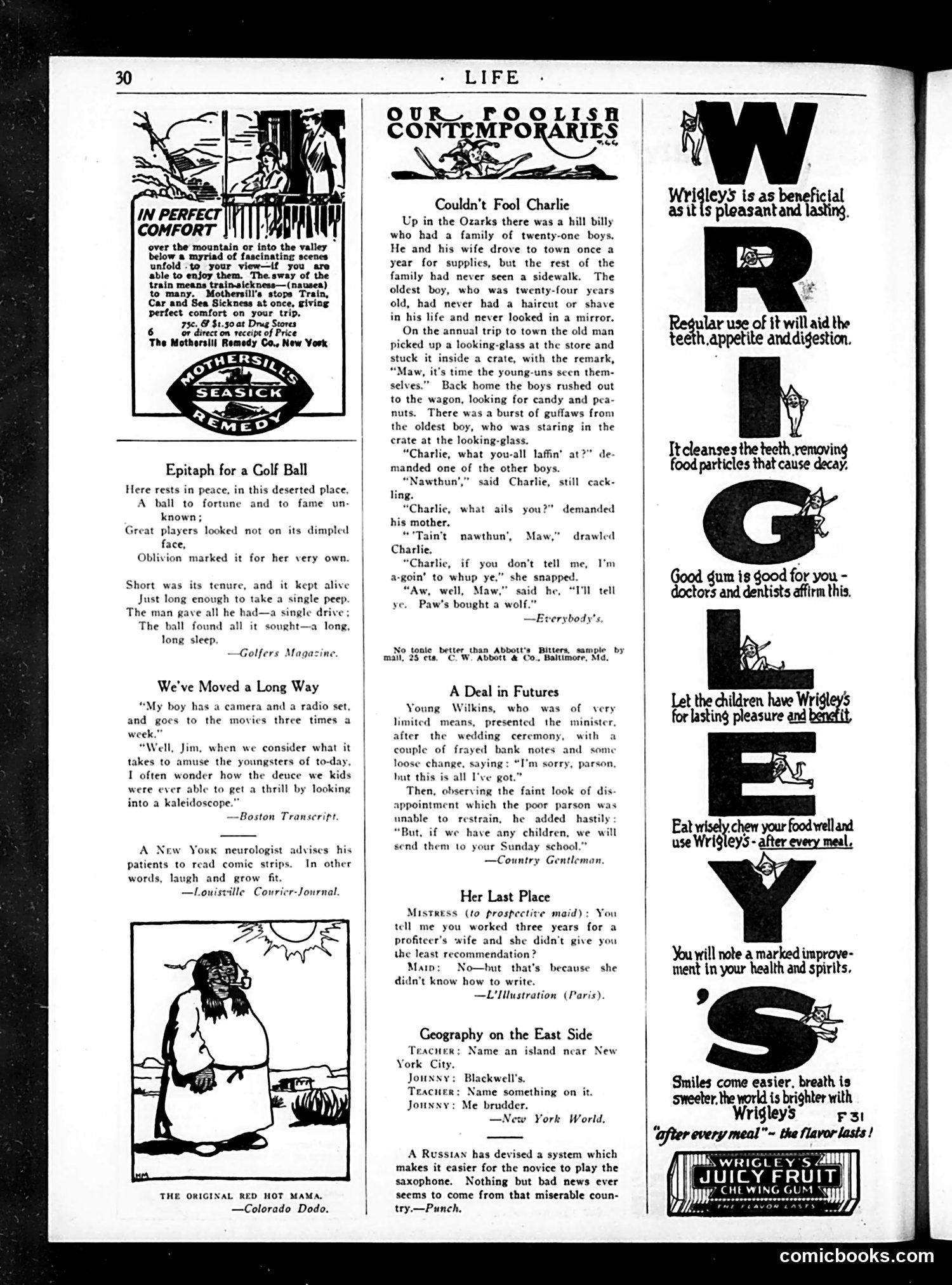
This page from *Life* magazine (a satirical publication, not the modern photo magazine) contains several humor pieces and advertisements typical of early-to-mid 20th century American comedy. **Main Cartoons/Stories:** 1. **"Couldn't Fool Charlie"** — A rural Ozark humor piece about an isolated hillbilly family whose oldest son, having never seen a mirror, mistakes his own reflection for a wolf. The joke satirizes rural ignorance and isolation. 2. **"Epitaph for a Golf Ball"** — Mock-serious poetry about a golf ball hit poorly, never used by great players. Light satire of golf culture. 3. **Other brief jokes** about modernization ("We've Moved a Long Way"), a neurologist recommending comics for health, and workplace/domestic humor. The page is primarily **advertising** (Mothersill's seasickness remedy, Wrigley's gum) mixed with light satirical humor pieces typical of *Life*'s format. The humor relies on period-specific stereotypes: rural simplicity, class differences, and domestic situations recognizable to 1920s-30s readers.
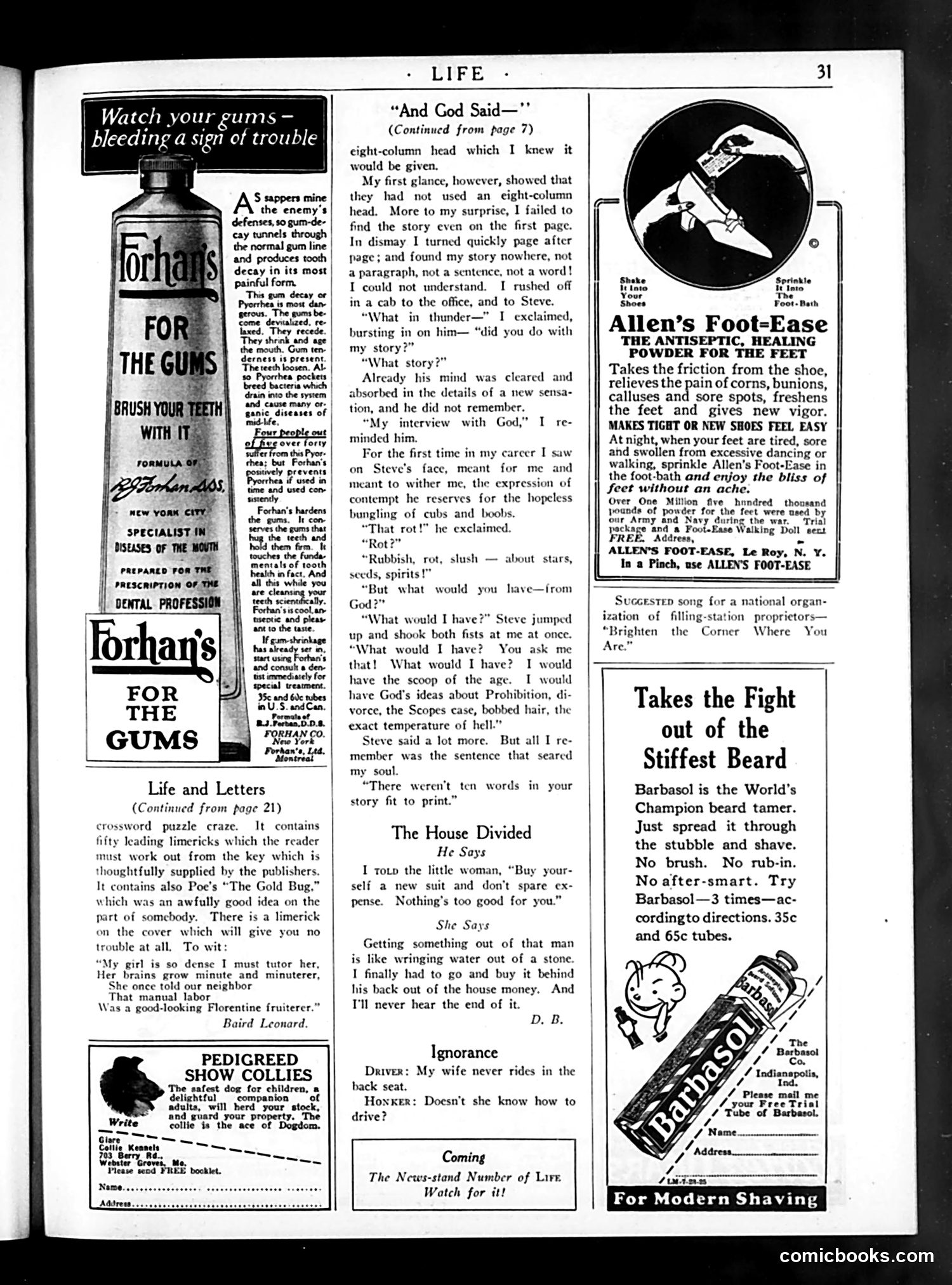
This page is primarily **advertising and miscellaneous content** rather than political satire. The dominant features are: **Advertisements:** Forhan's toothpaste (gum health), Allen's Foot-Ease powder, Barbasol shaving cream, and a pedigreed collie dog breeder. **Satirical Content:** The short pieces under "Life and Letters" include: - A humorous anecdote about a journalist whose interview with God gets rejected by his editor as unprintable "rot," mocking sensationalist journalism and editorial priorities - "The House Divided"—domestic humor about marital disagreements over spending - "Ignorance"—a brief joke implying a woman doesn't know how to drive The page reflects 1920s consumer culture and light social commentary typical of Life magazine's satirical-but-mainstream humor. References to Prohibition, the Scopes trial, and "bobbed hair" ground it in that era's debates.
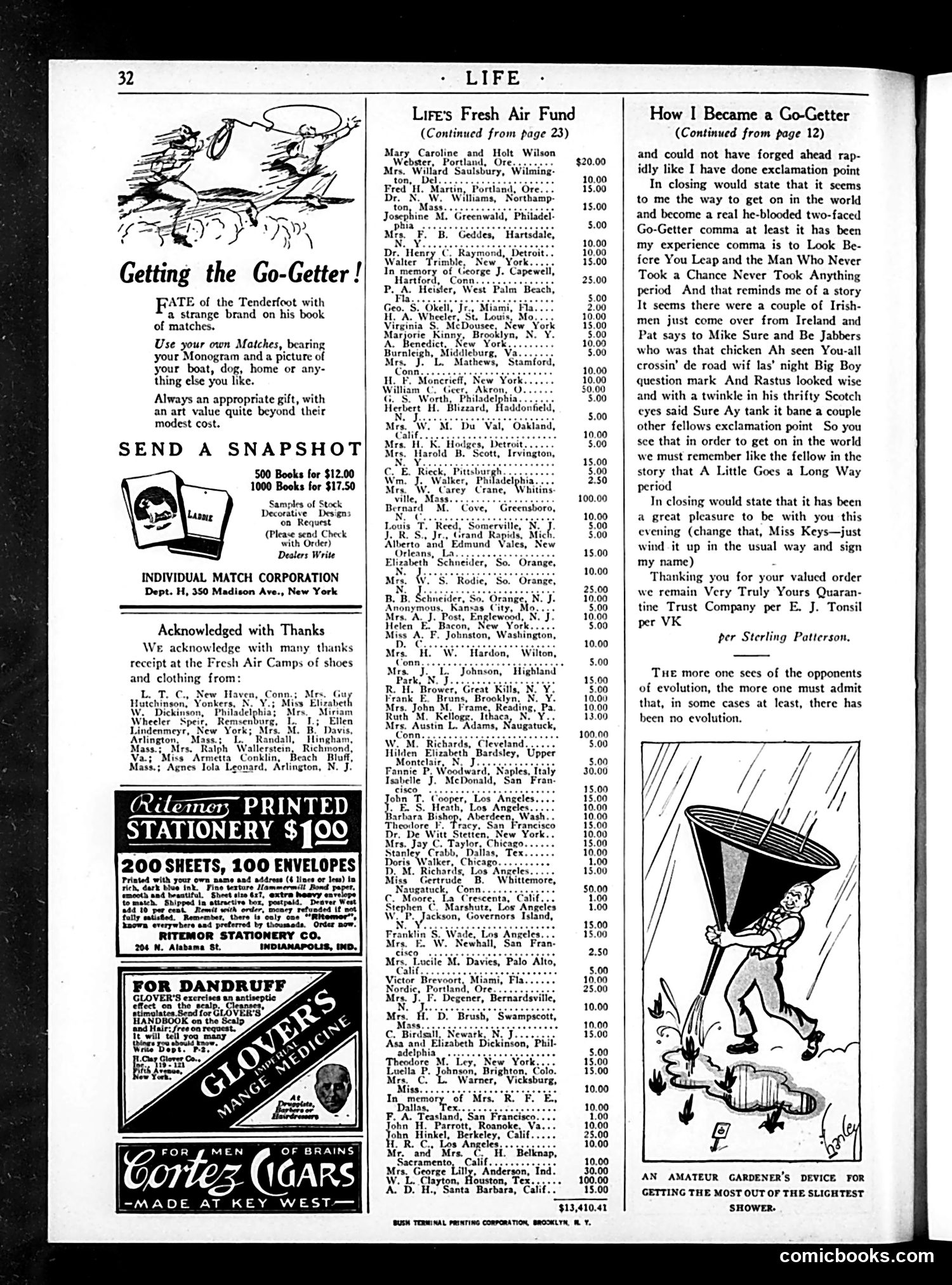
This page contains three distinct elements: **Main Cartoon ("Getting the Go-Getter!")**: The illustration shows a tenderfoot (inexperienced person) being blown away or knocked down. The joke satirizes the "go-getter" business culture of the era—a contemporary obsession with aggressive, ambitious self-promotion. The cartoon mocks how these self-made businessmen figures were portrayed in popular culture. **Text Content**: The bulk of the page consists of two items: (1) a continuation of an article titled "How I Became a Go-Getter," which parodies motivational business writing with clichéd phrases like "Look Before You Leap" and overwrought punctuation; and (2) a lengthy donor acknowledgment list for "Life's Fresh Air Fund," a charitable campaign providing outdoor experiences for underprivileged children. **Advertising**: Multiple period advertisements for matches, stationery, cigars, and dandruff remedies occupy the margins. The page satirizes 1920s business culture's hollow platitudes while simultaneously promoting genuine charitable work—contrasting empty ambition rhetoric with real social benefit.
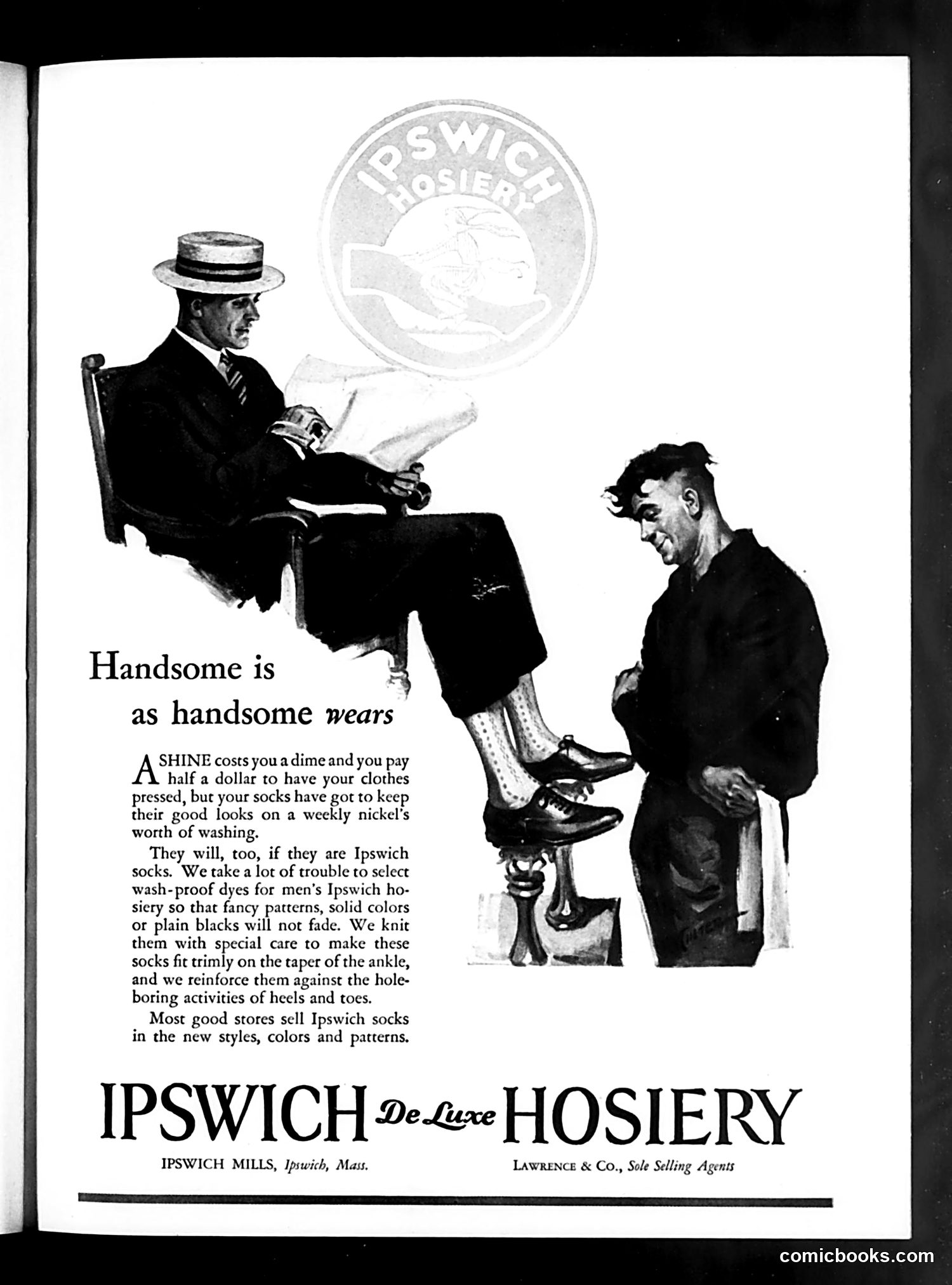
This is a **product advertisement**, not political satire. It promotes Ipswich De Luxe socks to men. The illustration shows two figures: a well-dressed businessman seated in a chair, and a shoe-shiner or valet attending to his shoes. The image demonstrates the product's value proposition: while men spend money on expensive clothes and professional pressing/shining services, quality socks are affordable maintenance (a "weekly nickel's worth of washing") that preserve a gentleman's appearance. The tagline "Handsome is as handsome wears" suggests that looking respectable depends on attention to detail—including often-overlooked hosiery. The ad emphasizes Ipswich socks' durability (fade-resistant, reinforced heels and toes) as practical value for the cost-conscious man. This reflects early-20th-century class consciousness and grooming standards for professional men.
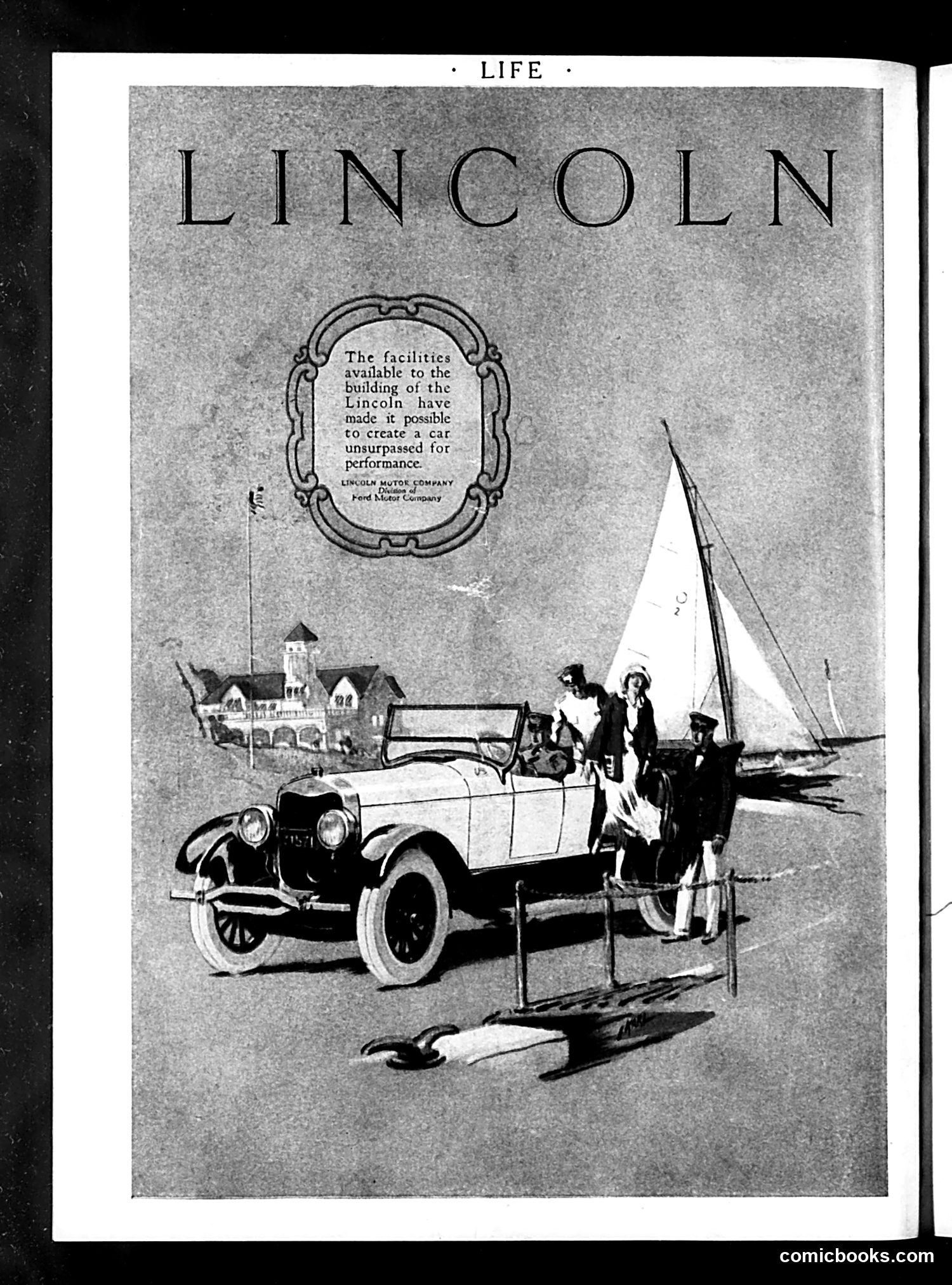
This is a **Lincoln automobile advertisement**, not political satire. The page promotes Lincoln cars (made by Ford Motor Company) by depicting an idealized leisure scene: well-dressed figures enjoy recreational activities—sailing, relaxation—alongside a Lincoln automobile. The ad's message claims that Lincoln's manufacturing facilities enabled creation of a superior-performing vehicle. The tagline emphasizes performance as the car's key selling point. The lifestyle imagery—yacht, leisure clothes, affluent setting—targets wealthy consumers, positioning Lincoln as a luxury brand for the privileged class. The juxtaposition of car and sailboat suggests both are status symbols for the elite. This represents typical 1920s advertising strategy: associating products with aspirational lifestyles rather than listing practical features.