
Life, 1925-07-23 · page 20 of 36
Life — July 23, 1925 — page 20: what you’re looking at
What you’re looking at
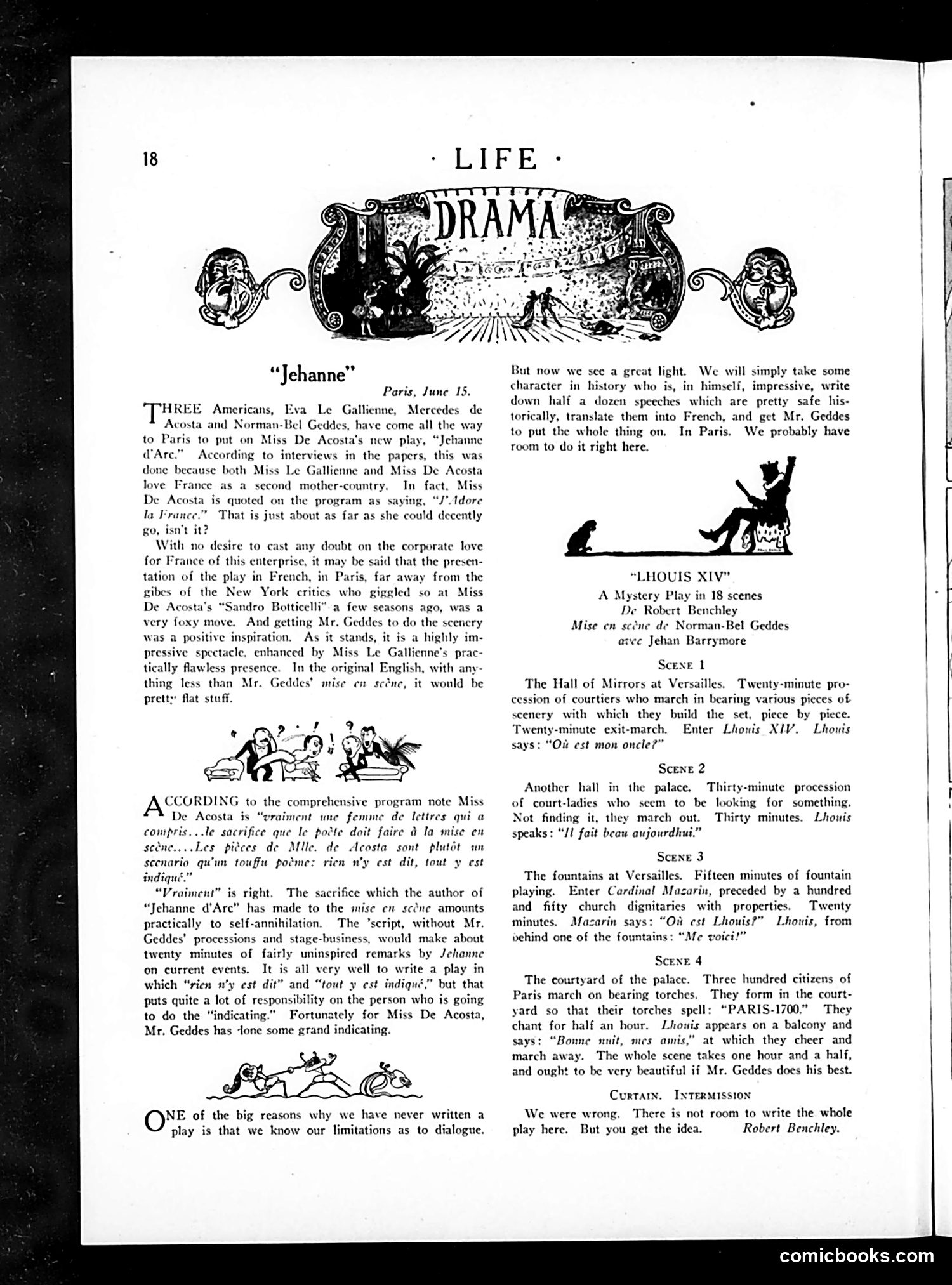
This page satirizes a Paris production of "Jehanne d'Arc" by Mercedes de Acosta, starring Eva Le Gallienne, with sets designed by Norman-Bel Geddes. Life's critic mocks the production as style-over-substance: the play itself consists of minimal dialogue and relies entirely on Geddes' elaborate stagecraft to appear impressive. The reviewer suggests De Acosta chose Paris specifically to escape New York critics who'd previously ridiculed her work. The accompanying mock play-outline "Lhouis XIV" by Robert Benchley extends the joke: Benchley proposes writing plays featuring historically impressive figures who require minimal actual script—just a few safe historical speeches translated to French, then surrounded by Geddes' elaborate processions and spectacle to distract audiences. The humor targets theatrical pretension and the elevation of visual production values over genuine dramatic writing.
📄 Transcribed text from this page (OCR, searchable)
Machine-transcribed from the original scan — historical spelling and the odd misread are preserved.
Paris, June 15. HREE Americans, Eva Le Gallienne, Mercedes de Acosta and Norman-Bel Geddes, have come all the way to Paris to put on Miss De Acosta’s new play, “Jehanne Are." According to interviews in the papers, this was done because both Miss Le Gallienne and Miss De Ac love France as a second mother-country. In fact, Miss De Acosta is quoted on the program as saying, “J’.tdore la Franc That is just about as far as she could decently go, isn’t it? With no desire to cast any doubt on the corporate love for France of this enterprise, it may be said that the presen- tation of the play in French, in Paris, far away from the gibes of the New York critics who giggled so at Miss De Acosta’s “Sandro Botticelli” a few seasons ago, was a very foxy move. And getting Mr. Geddes to do the scenery was a positive inspiration. As it stands, it is a highly im- pressive spectacle, enhanced by Miss Le Gallienne’s prac- tically flawless presence. In the original English, with any- thing less than Mr. Geddes’ mise ens would be pretty flat stuff. CORDING to the comprehensive program note Miss De Acosta is “vraiment une femme de lettres qui a compris...le sacrifice que le poéte doit faire & la mise en scene....Les pieces de Mlle. de Acosta sont plutét w scenario qu'un touffu podme: rien n’y est dit, tout y est indiqué, “Vraiment” is right. The sacrifice which the author of “Jehanne d’Arc” has le to the mise en scéne amounts practically to self-annihilation, The ’script, without Mr. Geddes’ processions and stage-business, would make about twenty minutes of fairly uninspired remarks by Jehanne on current events. It is all very well to write a play in which “rien n'y est dit” and “tout y est indiqué,” but that puts quite a lot of responsibility on the person who is going to do the “indicating.” Fortunately for Miss De Acosta, Mr. Geddes has ‘lone some grand indicating. O = of the big reasons why we have never written a play is that we know our limitations as to dialogue. But now we see a great li We will simply take some character in history who is, in himself, impressive, write down half a dozen speeches which are pretty safe his- torically, translate them into French, and get Mr. Geddes to put the whole thing on. In Paris. We probably have room to do it right here. “LHOUIS XIV" A Mystery Play in 18 scenes De Robert Benchley Mise en scene de Norman-Bel Geddes avec Jehan Barrymore Scene 1 The Hall of Mirrors at Versailles. Twenty-minute pro- cession of courtiers who march in bearing various pieces of scenery with which they build the set, piece by piece. Twenty-minute exit-march, Enter Lhouwis XIV. Lhouis says: “Oui est mon oncle?” Scene 2 Another hall in the palace. of court-ladies who scem to be looking for something. Not finding they march out. Thirty minutes. Lhowis speaks: “JI fait beau aujourdhui.” Thirty-minute procession Scene 3 The fountains at Versailles. Fifteen minutes of fountain playing. Enter Cardinal Mazarin, preceded by a hundred and fifty church dignitaries with properties. Twenty minutes. Mazarin says: “Oi est Lhouis?” Lhouis, from behind one of the fountains: “Me voici!” Scene 4 The courtyard of the palace. Paris march on bearing torches. They form in the court- yard so that their torches spell: “PARIS-1700." They chant for half an hour. Lhouis appears on a balcony and says: “Bonne nuit, mes amis,” at which they cheer and march away. The whole scene takes one hour and a half, and ought to be very beautiful if Mr. Geddes does his best. Three hundred citizens of Curtain. INTERMISSION We were wrong. There is not room to write the whole play here. But you get the idea. Robert Benchley. comicbooks.com