
Life, 1925-07-23 · page 16 of 36
Life — July 23, 1925 — page 16: what you’re looking at
What you’re looking at
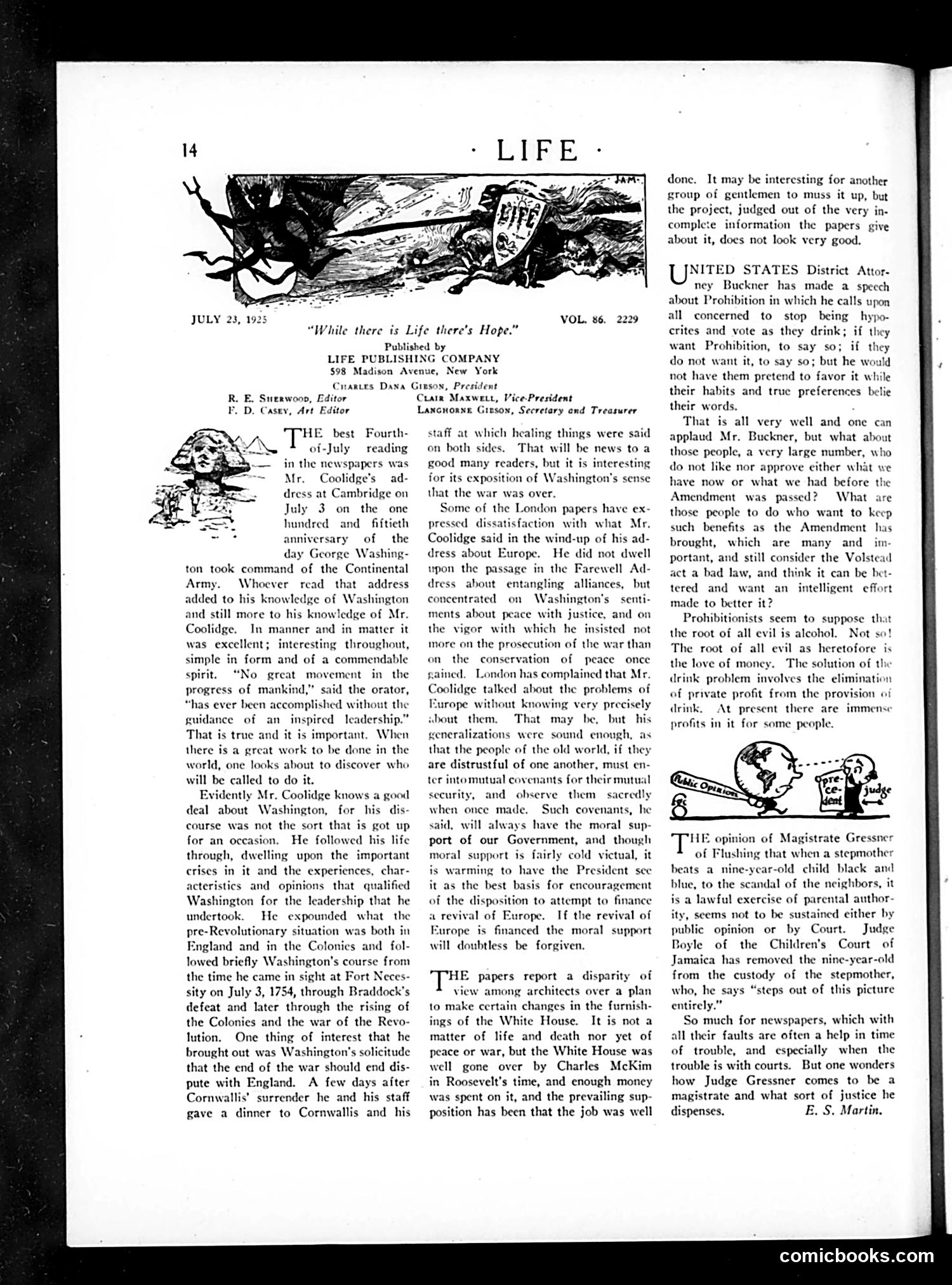
This page contains editorial commentary on Prohibition rather than a traditional political cartoon. The main illustration shows **a coffin labeled "RIP" with devil-like figures**, satirizing the consequences of Prohibition enforcement. The text criticizes **District Attorney Buckner's speech** demanding stricter Prohibition enforcement while acknowledging citizens won't voluntarily comply. The satire targets the contradiction: Buckner wants people to stop drinking while remaining hypocrites about their actual preferences. The commentary suggests Prohibition's "root of all evil" isn't alcohol itself but rather **the law's attempt to enforce private morality**. The piece argues this approach generates corruption and fails because it ignores what people actually want—a familiar anti-Prohibition argument from the 1920s.
📄 Transcribed text from this page (OCR, searchable)
Machine-transcribed from the original scan — historical spelling and the odd misread are preserved.
JULY 23,1 “While there is L VOL. 86. 2229 c there's Hope.” Published by LIFE PUBL $98 Madison Ave; Craates Dana . E. Suerwoop, Editor . Cast, Art Editor best Fourth- reading pers was Mr. Coolidge’s ad- dress at Cambridge on July 3 on the one hundred and _ fiftieth anniversary of — the day George Washing- ton took command of the Continental Army. Whoever read that address added to his knowledge of Washington and still more to his knowledge of Mr. Coolidge. In manner and in matter it was excellent; interesting throughout, simple in form and of a commendable spirit. “No great movement in the progress of mankind,” said the orator, “has ever been accomplished without the guidance of an inspired leadership.” That is true and it is important. When there is a great work to be done in the world, one looks about to discover who will be called to do it. Evidently Mr. Coolidge knows a good deal about Washington, for his dis- course was not the sort that is got up for an occasion. He followed his life through, dwelling upon the important crises in it and the experiences, char- acteristics and opinions that qualified Washington for the leadership that he undertook. He expounded what the pre-Revolutionary situation was both in England and in the Colonies and fol- lowed briefly Washington's course from the time he came in sight at Fort Neces- sity on July 3, 1754, through Braddock’s defeat and later through the rising of the Colonies and the war of the Revo- lution. One thing of interest that he brought out was Washington's solicitude that the end of the war should end dis- pute with England. A few days after Cornwallis’ surrender he and his staff gave a dinner to Cornwallis and his COMPANY » New York Son, President Ciaim Maxwent, Vice-President Laxcnorng Gitson, Secretary and Treasurer staff at which healing things were said on both sides. That will be news to a good many readers, but it is interesting for its exposition of Washington's sense that the war was over. Some of the London papers have ex- pressed dissatisfaction with what Mr. Coolidge said in the wind-up of his ad- dress about Europe. He did not dwell upon the passage in the Farewell Ad- dress about entangling alliances, but concentrated on Washington's — senti- ments about peace with justice, and on the vigor with which he insisted not more on the prosecution of the war than on the conservation of peace once ned, London has complained that Mr. Coolidge talked about the problems of rope without knowing very precisely about them. That may be, but his generalizations were sound enough, as that the people of the old world, if they are distrustful of one another, must en- ter intomutual covenants for their mutual security, and them when once made. Such covenants, he said, will alway ve the moral sup- port of our Government, and though support is fairly cold victual, it is warming to have the President see it as the best basis for encouragement of the disposition to attempt to finance of Europe. If the revival of Europe is financed the moral support will doubtless be forgiven. observe sacredly a revi THE papers report a disparity of view among architects over a plan to make certain changes in the furnish- ings of the White House. It is not a matter of life and death nor yet of peace or war, but the White House was well gone over by Charles McKim in Roosevelt's time, and enough moncy was spent on it, and the prevailing sup- position has been that the job was well done. It may be interesting for another group of gentlemen to muss it up, but the project, judged out of the very in- complete information the papers give about it, does not look very good. NITED STATES District Attor- ney Buckner has made a speech about Prohibition in which he calls upon all concerned to stop being hypo- crites and vote as they drink; if the want Prohibition, to say so; if. th do not want it, to say so; but he would not have them pretend to favor it while their habits and true preferences b their words. That is all very well and one can applaud Mr. Buckner, but what about those people, a very large number, who do not like nor approve either what we have now or what we had before the Amendment was passed? What are those people to do who want to keep such benefits as the Amendment has brought, which are many and im- portant, and still consider the Volstead act a bad law, and think it can be bet- tered and want an_ intelligent effort made to better it? Prohibitionists seem to suppose that the root of all evil is alcohol. Not so! The root of all evil as heretofore is the love of money. The solution of the drink problem involves the elimination of private profit from the provision of drink. At present there are immense profits in it for some people. HE opinion of Magistrate Gressner of Flushing that when a stepmother beats a nine-year-old child black and blue, to the scandal of the neighbors, it is a lawful exercise of parental author- ity, seems not to be sustained either by public opinion or by Court. Judge Boyle of the Children’s Court of Jamaica has removed the nine-year-old from the custody of the stepmother, who, he says “steps out of this picture entirely.” So much for newspapers, which with all their faults are often a help in time of trouble, and especially when the trouble is with courts. But one wonders how Judge Gressner comes to be a magistrate and what sort of justice he dispenses. E. S. Martin. comicbooks.com