
Life, 1925-07-23 · page 28 of 36
Life — July 23, 1925 — page 28: what you’re looking at
What you’re looking at
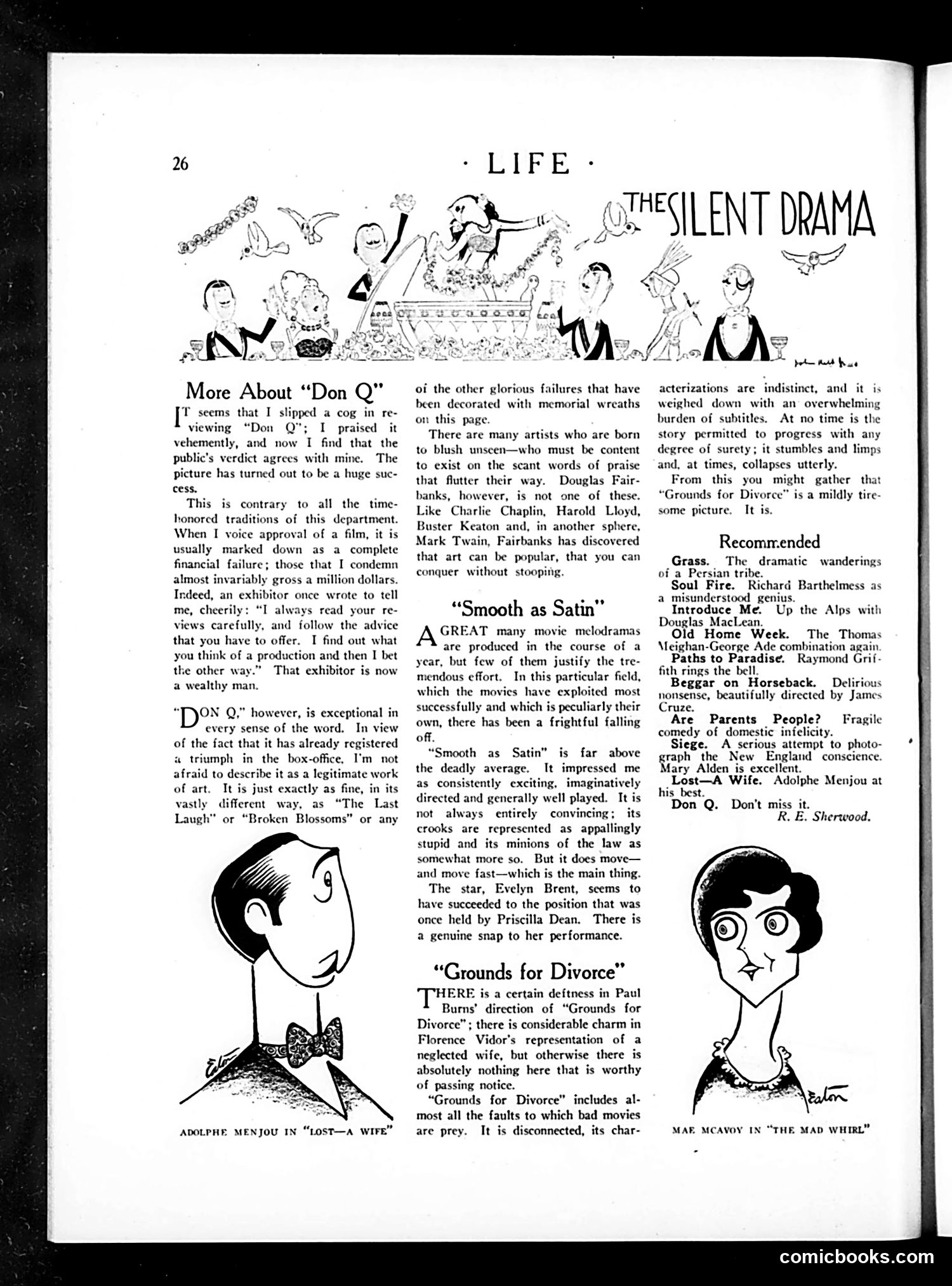
This page reviews silent films from approximately the 1920s. The critic discusses several movies: **"Don Q"** (starring Douglas Fairbanks) receives praise—the critic notes this is unusual because his positive reviews typically harm films financially, yet this one succeeds anyway. He compares Fairbanks favorably to Charlie Chaplin and Harold Lloyd, arguing that Fairbanks proved art can be both popular and quality. **Other reviewed films** include "Smooth as Satin" (starring Evelyn Brent, praised as successor to silent star Priscilla Dean), and "Grounds for Divorce" (criticized for poor pacing, unclear characterization, and excessive subtitles). The **two caricatures** show Adolphe Menjou and Mae McCavoy from respective films. For modern readers: this reflects how silent-film critics evaluated movies—emphasizing direction, acting performance, and visual storytelling without dialogue. The repeated subtitle complaints highlight a key limitation of early cinema.
📄 Transcribed text from this page (OCR, searchable)
Machine-transcribed from the original scan — historical spelling and the odd misread are preserved.
More About “Don Q” eems that I slipped a cog in re ing “Don Q"; I praised it vehemently, and now I find that the public's verdict agrees with mine. The picture has turned out to be a huge suc- cess. This is contrary to all the time- honored traditions of this department. When I voice approval of a film, it is usually marked down as a complete financial failure; those that I condemn almost invariably gross a million dollars. Indeed, an exhibitor once wrote to tell me, cheerily: “I always read your re- views carefully, and follow the advice that you have to offer. I find out what you think of a production and then I bet the other wa That exhibitor is now a wealthy man. ‘Do’ Q,” however, is exceptional in every sense of the word. In view of the fact that it has already registered a triumph in the box-office, I'm not afraid to describe it as a legitimate work of art. It is just exactly as fine, in its vastly different: way, as “The Last Laugh” or “Broken Blossoms” or any S IN ADOLPHE MENJOU IN “LOST—A WIFE” S*ESILENT DRAMA oi the other glorious failures that have been decorated with memorial wreaths on this page. There are many artists who are born to blush unscen—who must be content to exist on the scant words of praise that flutter their way. Douglas Fair- banks, however, is not one of these. Like Charlie Chaplin, Harold Lloyd, Buster Keaton and, in another sphere, Mark Twain, Fairbanks has discovered that art can be popular, that you can conquer without stooping. “Smooth as Satin” GREAT many movie melodramas are produced in the course of a year, but few of them justify the tre- mendous effort. In this particular field, which the movies have exploited most successfully and which is peculiarly their own, there has been a frightful falling off, “Smooth as Satin” is far above the deadly average. It impressed me as consistently exciting, imaginatively directed and generally well played. It is not always entirely convincing; its crooks are represented as appallingly stupid and its minions of the law as somewhat more so. But it does move— and move fast—which is the main thing. The star, Evelyn Brent, scems to have succeeded to the position that was once held by Priscilla Dean. There is a genuine snap to her performance. “Grounds for Divorce” ERE is a certain deftness in Paul Burns’ direction of “Grounds for Divorce” ; there is considerable charm in Florence Vidor’s representation of a neglected wife, but otherwise there is absolutely nothing here that is worthy of passing notice. “Grounds for Divorce” includes al- most all the faults to which bad movies are prey. It is disconnected, its char- SS acterizations are indistinct, and it is weighed down with an overwhelming burden of subtitles. At no time is the story permitted to progress with any degree of surety; it stumbles and limps and, at times, collapses utterly. From this you might gather that Grounds for Divorce” is a mildly tire- some picture. It is. Recommended Grass. The dramatic of a Persian tribe. Soul Fire. Richard Barthelmess as a misunderstood genius. Introduce Me. Up the Alps with Douglas MacLean. Old Home Week. The Thomas Meighan-George Ade combination again. Paths to Paradise. Raymond Grif- fith rings the bell. Beggar on Horseback. Delirious nonsense, beautifully directed by James Cruze. Are Parents People? comedy of domestic infelicity. Siege. A serious attempt to photo- graph the New England conscience. Mary Alden is excellent. Lost—A Wife. Adolphe Menjou at his_best. Don Q. Don't miss it. . E. Sherwood. wanderings Fragile MAR MCAVOY IN “THE MAD WHIRL” comicbooks.com