
A complete issue · 36 pages · 1924
Life — August 28, 1924
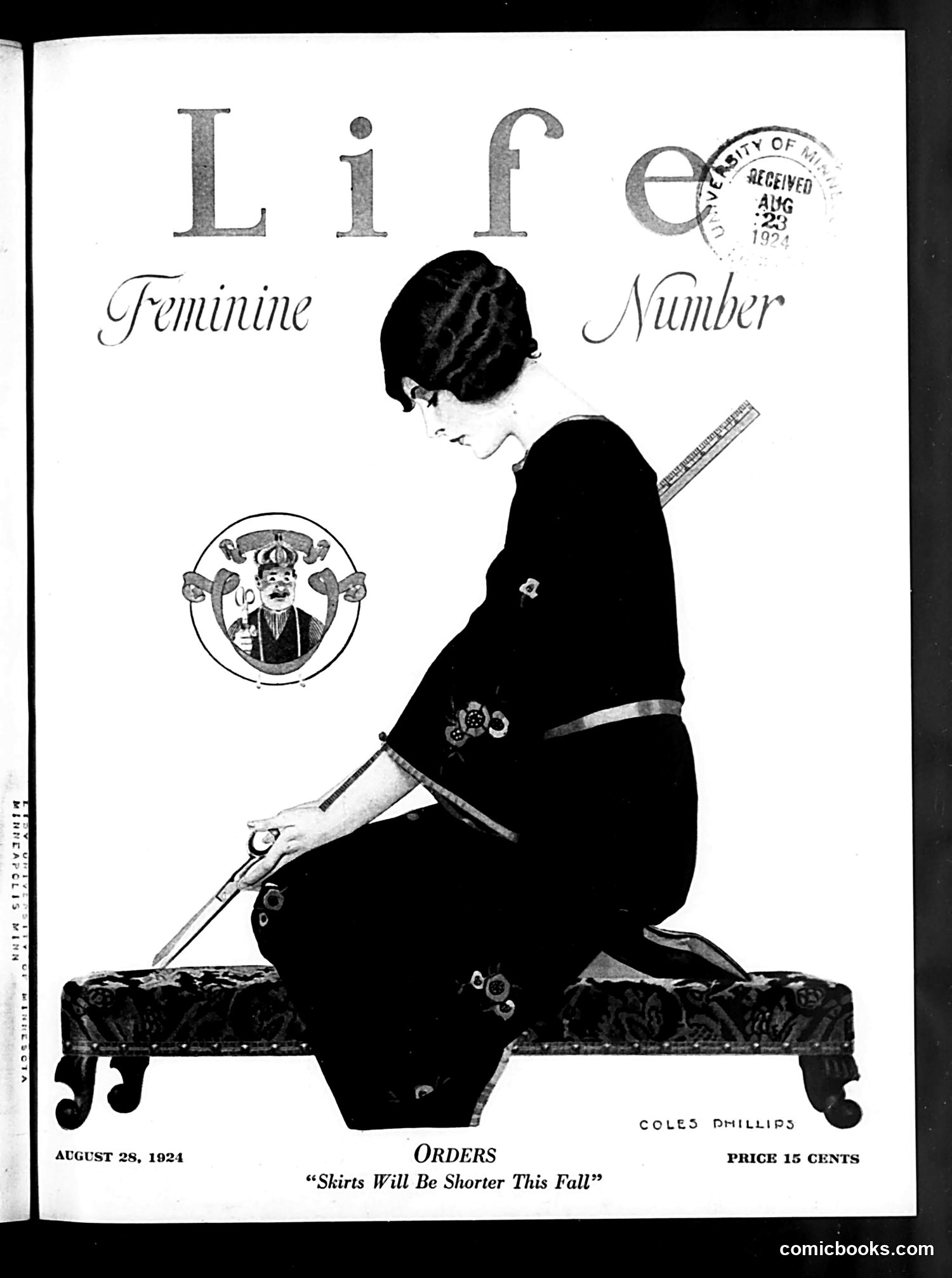
This is the cover of *Life* magazine's "Feminine Number" issue. The illustration by Coles Phillips depicts a woman in silhouette seated on an ornate bench, holding a rifle or gun and a ruler. The satire appears to target changing women's fashions and social roles in the 1920s. The headline "Skirts Will Be Shorter This Fall" references the ongoing controversy over hemlines—a major social debate of the era, with shorter skirts symbolizing women's liberation and modernity. The rifle and measuring tool suggest women are "taking aim" at fashion standards or "measuring" new social boundaries. The small medallion image shows a crowned figure, likely referencing traditional authority or propriety being challenged. Overall, the cover satirizes the tension between traditional femininity and modern, more independent women reshaping 1920s society.
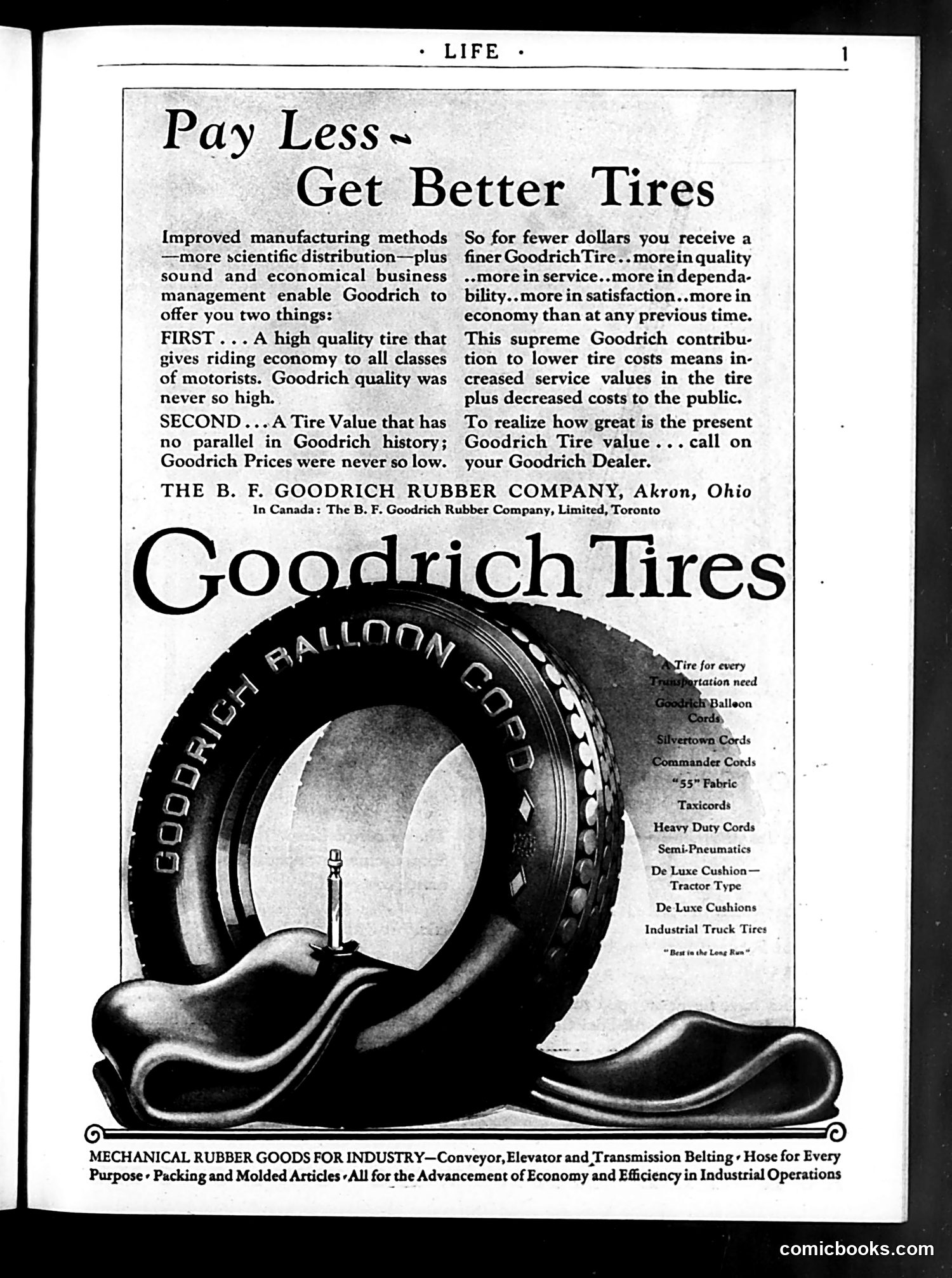
This page is **primarily an advertisement**, not satire or political commentary. It's a Goodrich Tire Company ad from the LIFE magazine archives. The ad emphasizes two selling points: high quality tires at lower prices than ever before, made possible by "improved manufacturing methods" and "scientific distribution." The imagery shows a tire cradled in hands—a visual metaphor suggesting care, value, and support. The list on the right catalogs various tire types (Balloon, Silvertown, Commander cords, etc.), indicating Goodrich's broad product range for different transportation needs. The bottom line promotes Goodrich's industrial rubber goods beyond tires. This is straightforward corporate messaging about affordability and quality, typical of early-to-mid 20th century advertising, with no apparent political satire.
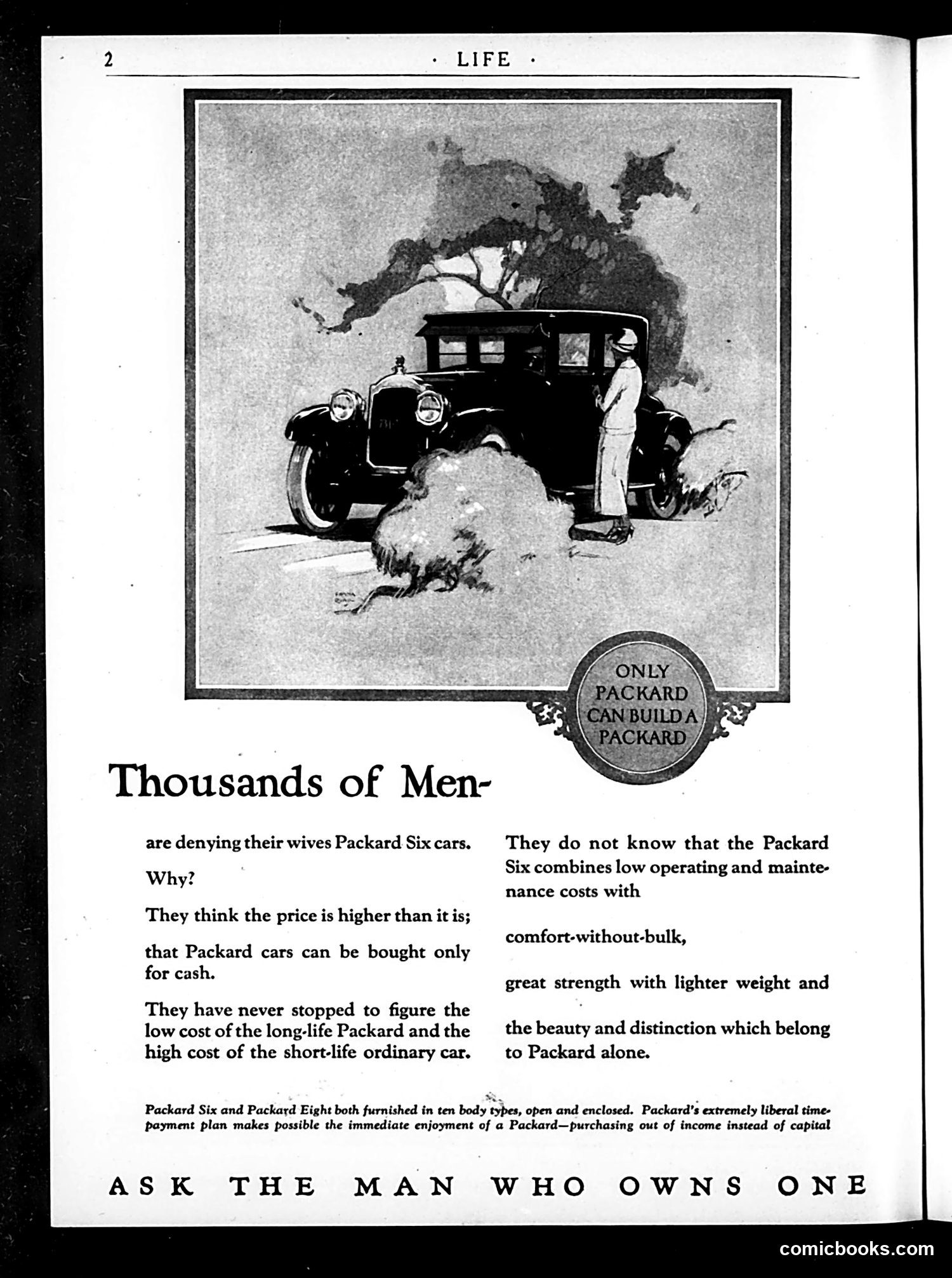
This is a **Packard automobile advertisement**, not political satire. The ad addresses husbands ("Thousands of Men") who allegedly refuse to buy their wives Packard Six cars, claiming the price is too high and that Packard requires cash payment. The advertisement counters these objections by arguing that men haven't calculated the Packard's true value: low operating and maintenance costs, comfort, durability ("great strength with lighter weight"), and prestige. The tagline "Only Packard can build a Packard" emphasizes exclusivity. The illustration shows a well-dressed couple beside a Packard in a scenic setting, depicting the aspirational lifestyle the car supposedly offers. A note mentions Packard's "extremely liberal time-payment plan," directly addressing the cash-only objection. This is commercial persuasion, not political commentary.
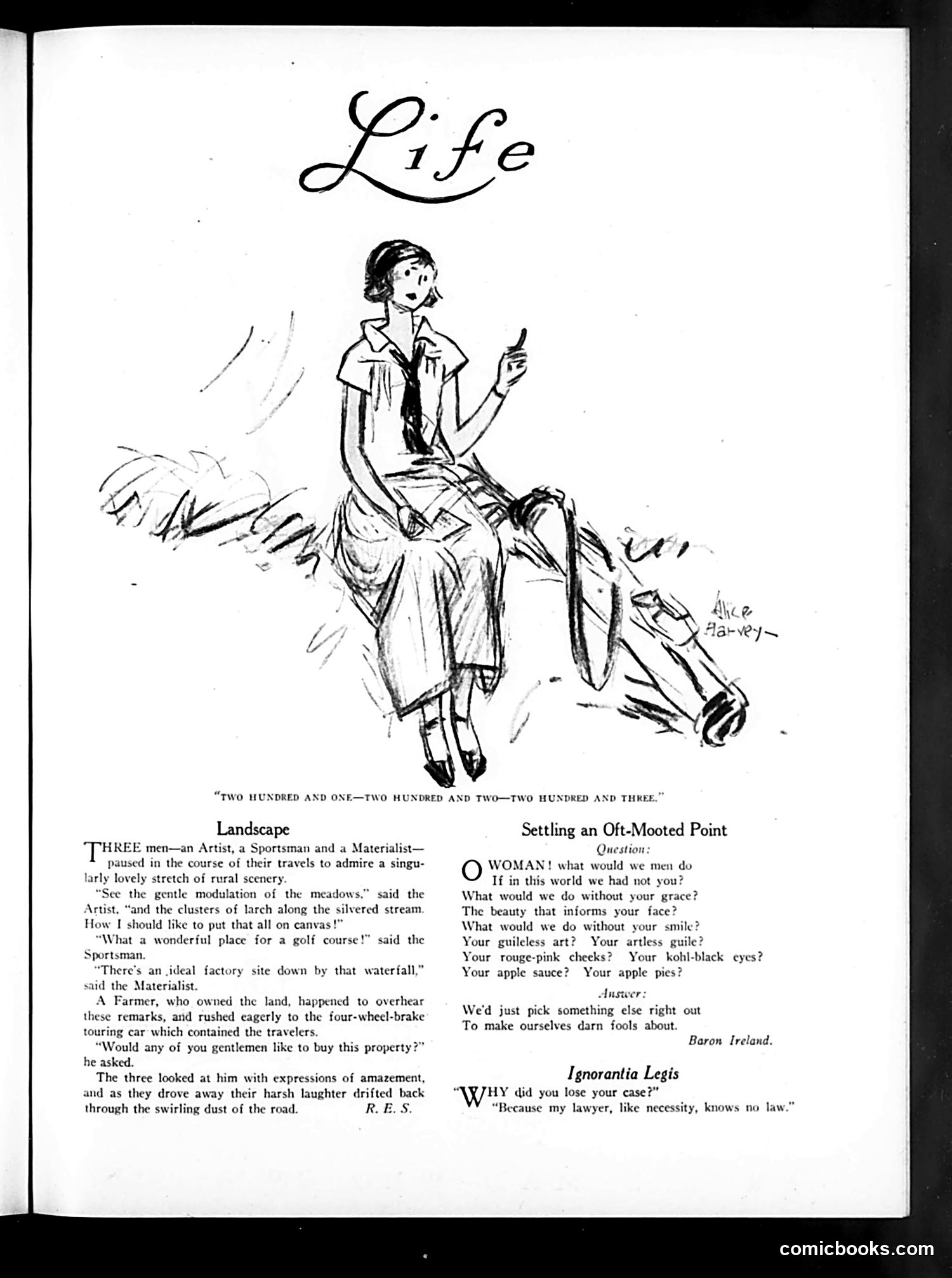
This page features a sketch by Alice Harvey titled "Life" showing a woman on horseback, numbered "Two hundred and one—two hundred and two—two hundred and three," suggesting she's counting something as she rides. Below are three brief pieces: a landscape anecdote about three men (Artist, Sportsman, Materialist) discussing rural scenery and property value, and two short satirical items. "Settling an Oft-Mooted Point" humorously asks what men would do without women, answering they'd "pick something else right out to make ourselves darn fools about." "Ignorantia Legis" is a legal joke about losing a case due to lawyer ignorance. The overall page emphasizes romantic/social humor typical of early 20th-century Life magazine satire.
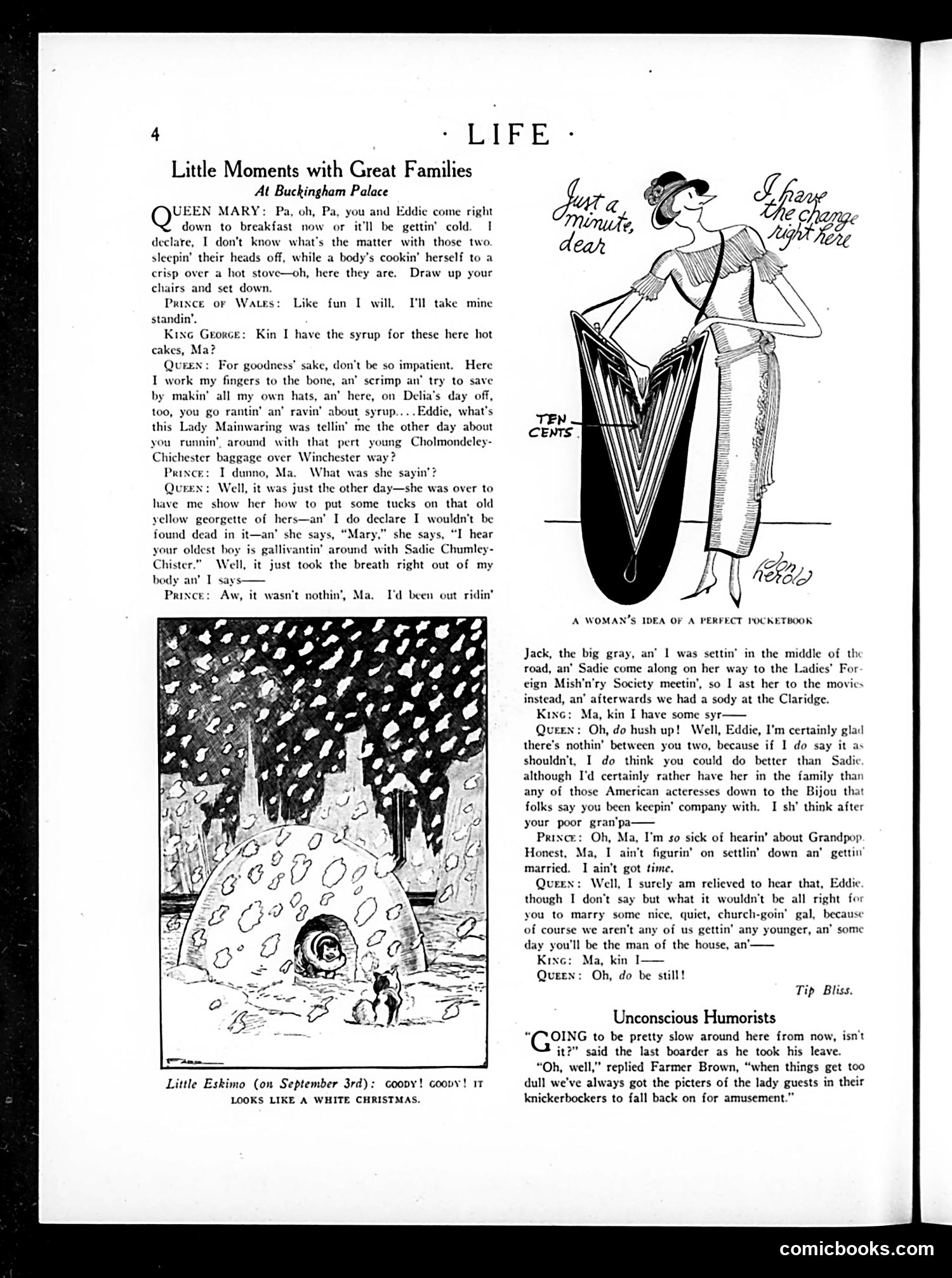
**"Little Moments with Great Families"** features dialogue between Queen Mary, Prince of Wales, King George, and others discussing breakfast and social matters. The satire gently mocks royal protocol and formality—the Queen fusses over punctuality and proper etiquette while family members make casual remarks about daily life. **"A Woman's Idea of a Perfect Pocketbook"** is a fashion illustration showing an impossibly large dress pocket, satirizing women's recurring complaint that clothing lacks functional pockets. The humor relies on the visual absurdity. **"Little Eskimo (on September 3rd)"** depicts an igloo in heavy snow, with the caption joking that it "looks like a white Christmas"—likely referencing unexpected September snowfall somewhere. The page emphasizes gentle, domestic humor rather than political satire.
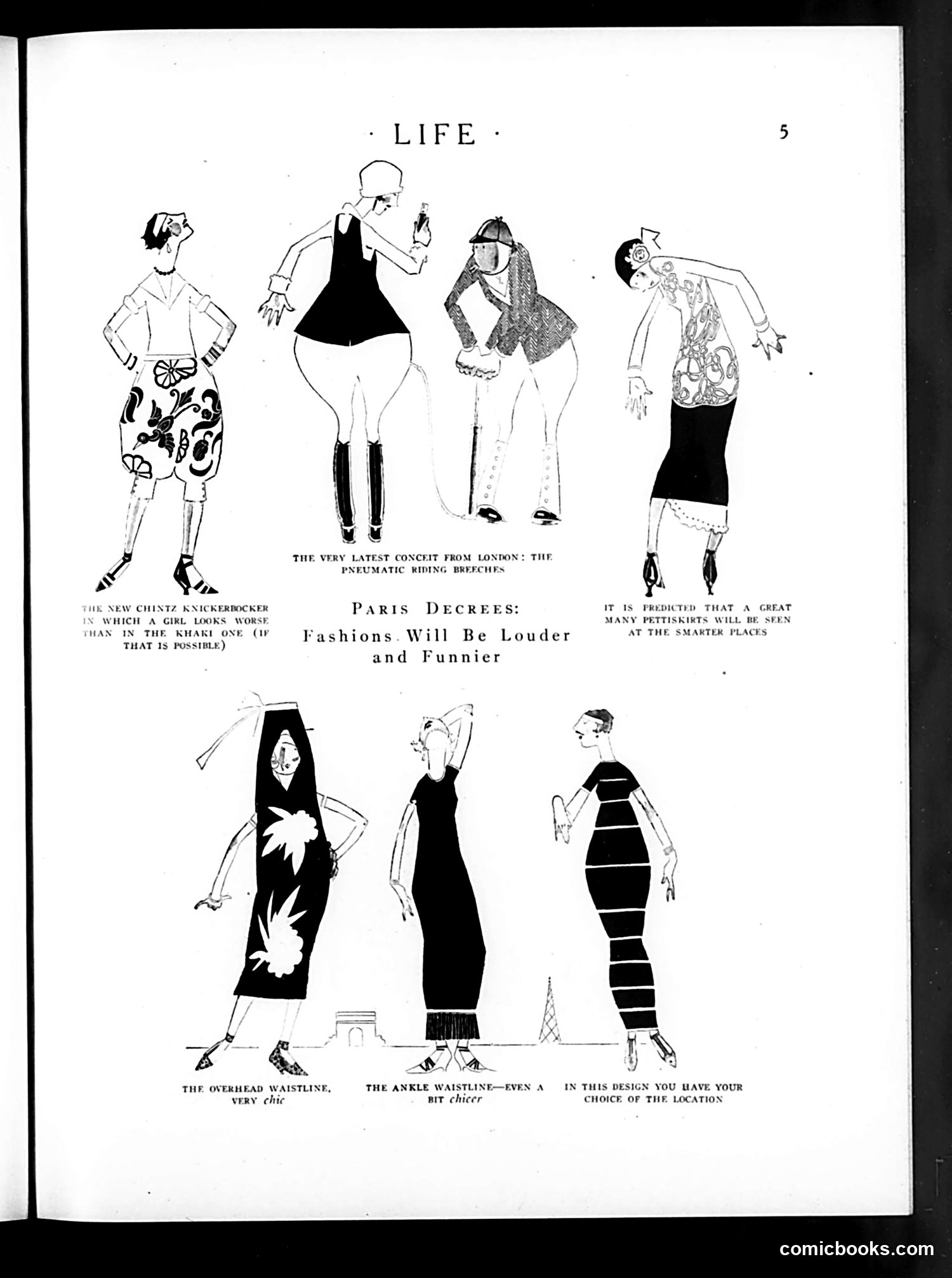
This page satirizes 1920s women's fashion trends. The top section mocks the "Chintz Knickerbocker" style, showing how unflattering the outfit appears on women. The central heading announces "Paris Decrees: Fashions Will Be Louder and Funnier," introducing fashion predictions. The bottom section displays exaggerated examples of these predicted trends: increasingly daring waistlines, bold patterned dresses, and geometrically striped designs. Each illustration includes tongue-in-cheek captions emphasizing how extreme or impractical these styles are ("very chic," "a bit chicer," "your choice of location"). The satire targets the fashion industry's constant drive toward more outlandish designs and women's pressure to follow these dictates—treating haute couture as absurd rather than aspirational. The humor relies on visual exaggeration and deadpan commentary.
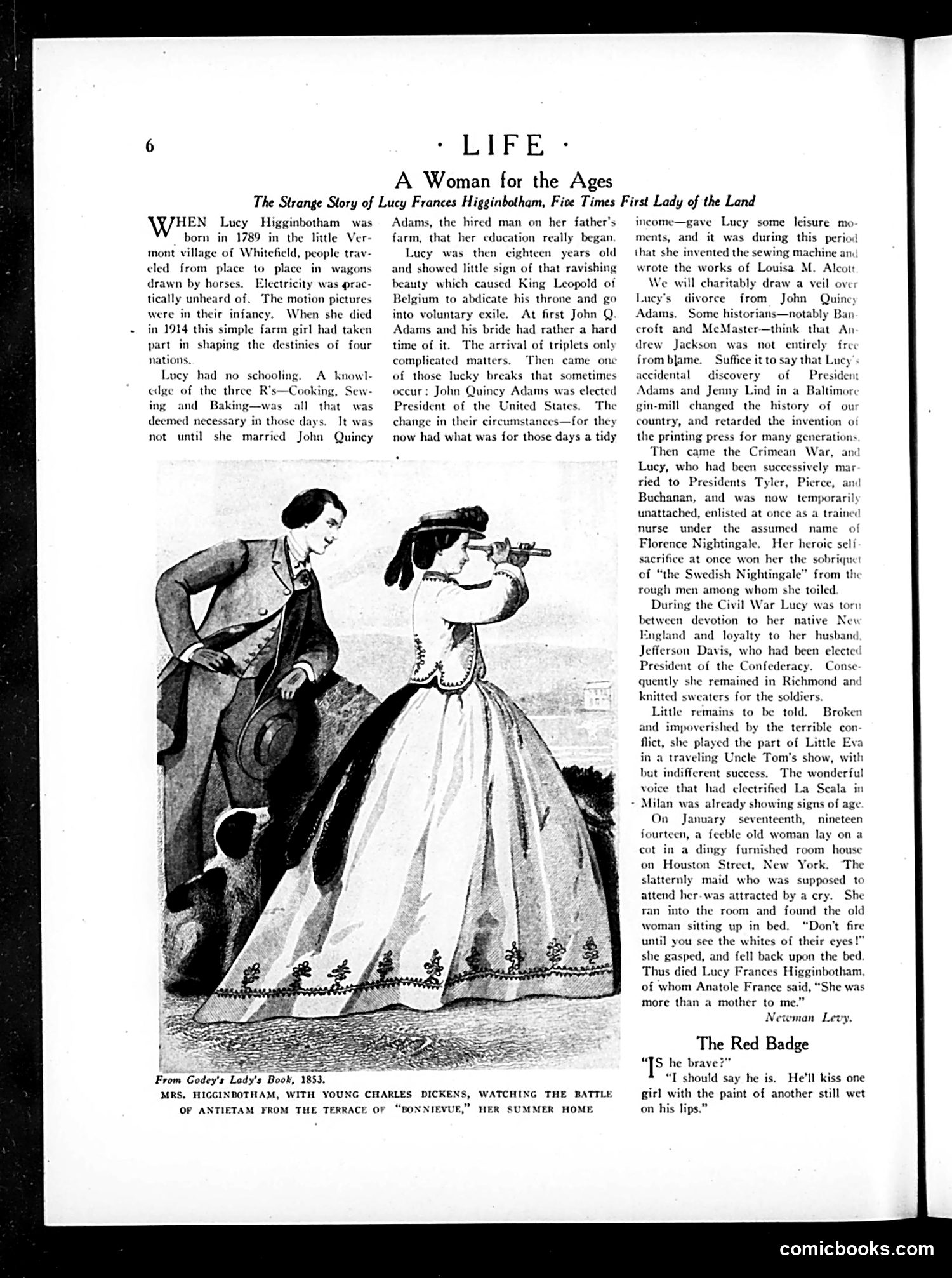
This page presents a biographical profile of Lucy Frances Higginbotham, described as "Five Times First Lady of the Land"—a historical figure who was married successively to U.S. Presidents Tyler, Pierce, Buchanan, and Jefferson Davis (Confederate President). The illustration shows a woman in an elaborate dress observing a Civil War battle scene, referencing her dramatic life spanning multiple presidencies and the nation's greatest conflict. The accompanying narrative traces her from an uneducated girl in rural Vermont through her wartime service as a nurse (compared to Florence Nightingale), her Civil War-era divided loyalties, and her eventual death in 1874 New York. "The Red Badge" section appears to be a separate short story or anecdote on the same page.
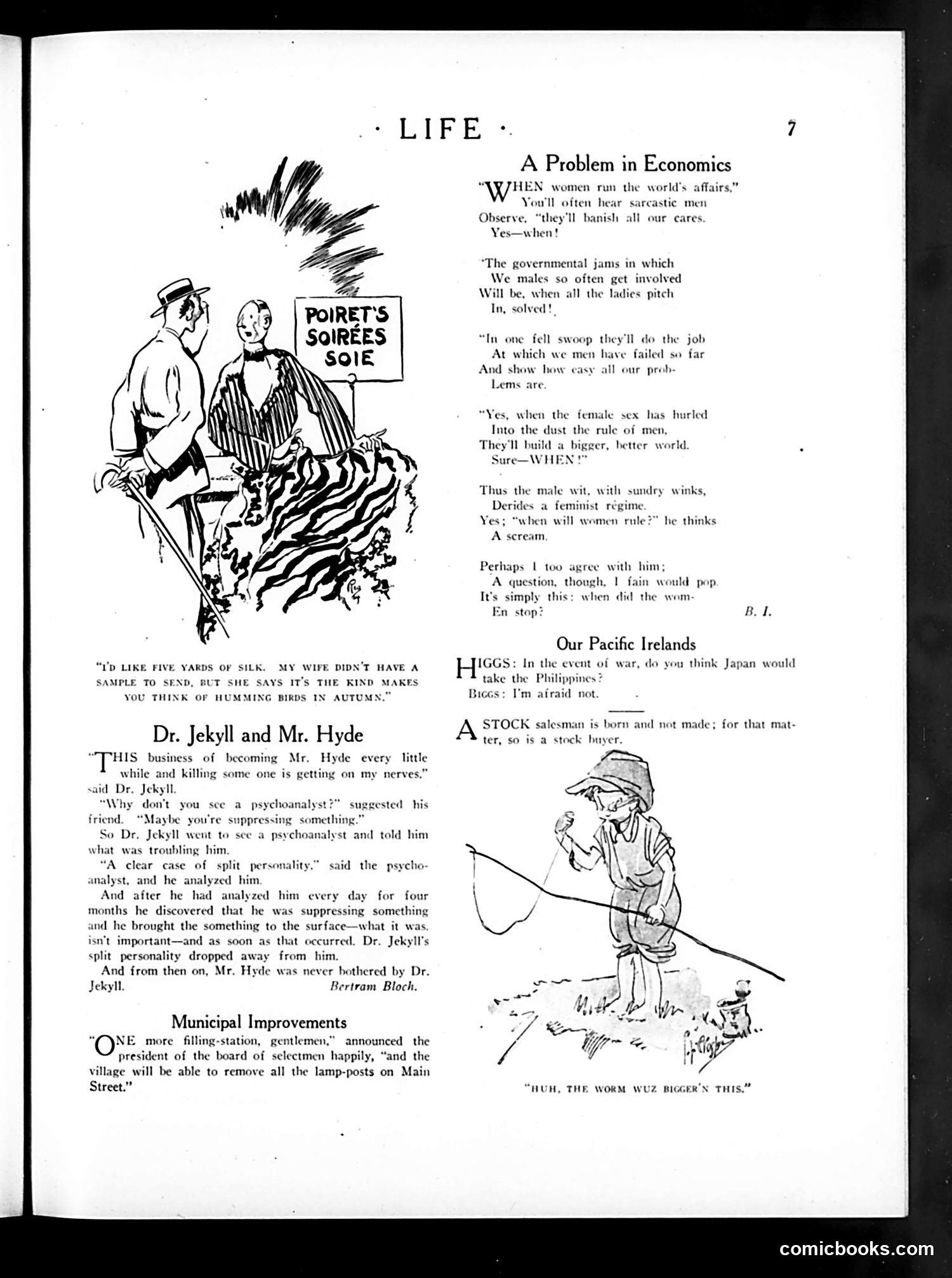
This page contains three satirical pieces: 1. **"A Problem in Economics"** — A poem mocking men who dismiss women's potential in politics and business, sarcastically suggesting women will "solve" governmental problems when they gain power. The satire targets male skepticism about female leadership. 2. **"Dr. Jekyll and Mr. Hyde"** — A short story about a man with split personality disorder whose psychoanalyst discovers the root cause and cures him. The satire appears to mock psychoanalysis as a fashionable but superficial treatment. 3. **"Our Pacific Irelands"** and **"Municipal Improvements"** — Brief comedic snippets about war speculation and small-town civic planning, respectively. The cartoons illustrate these pieces with period-appropriate illustrations emphasizing the satirical tone of early 20th-century American humor.
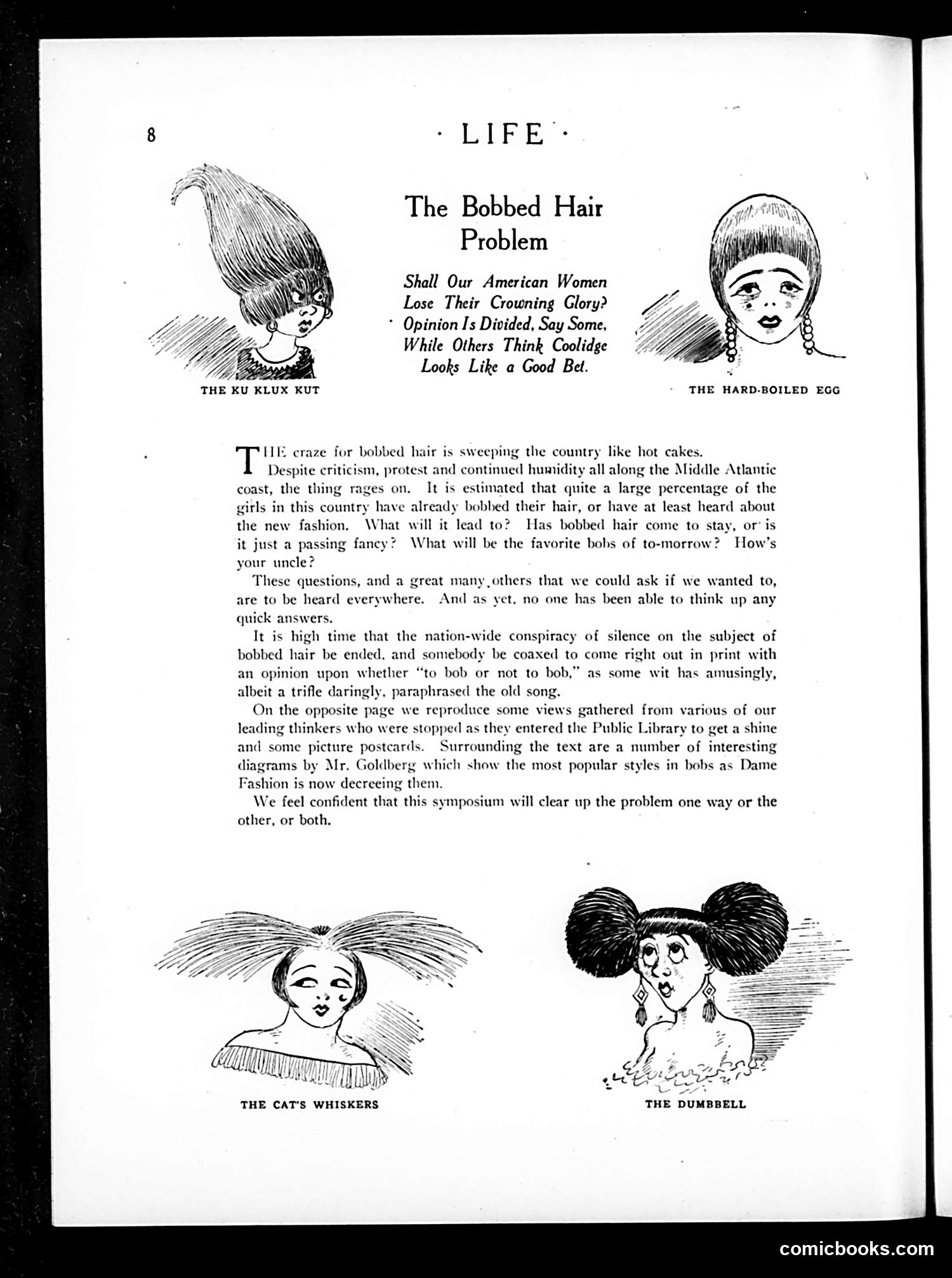
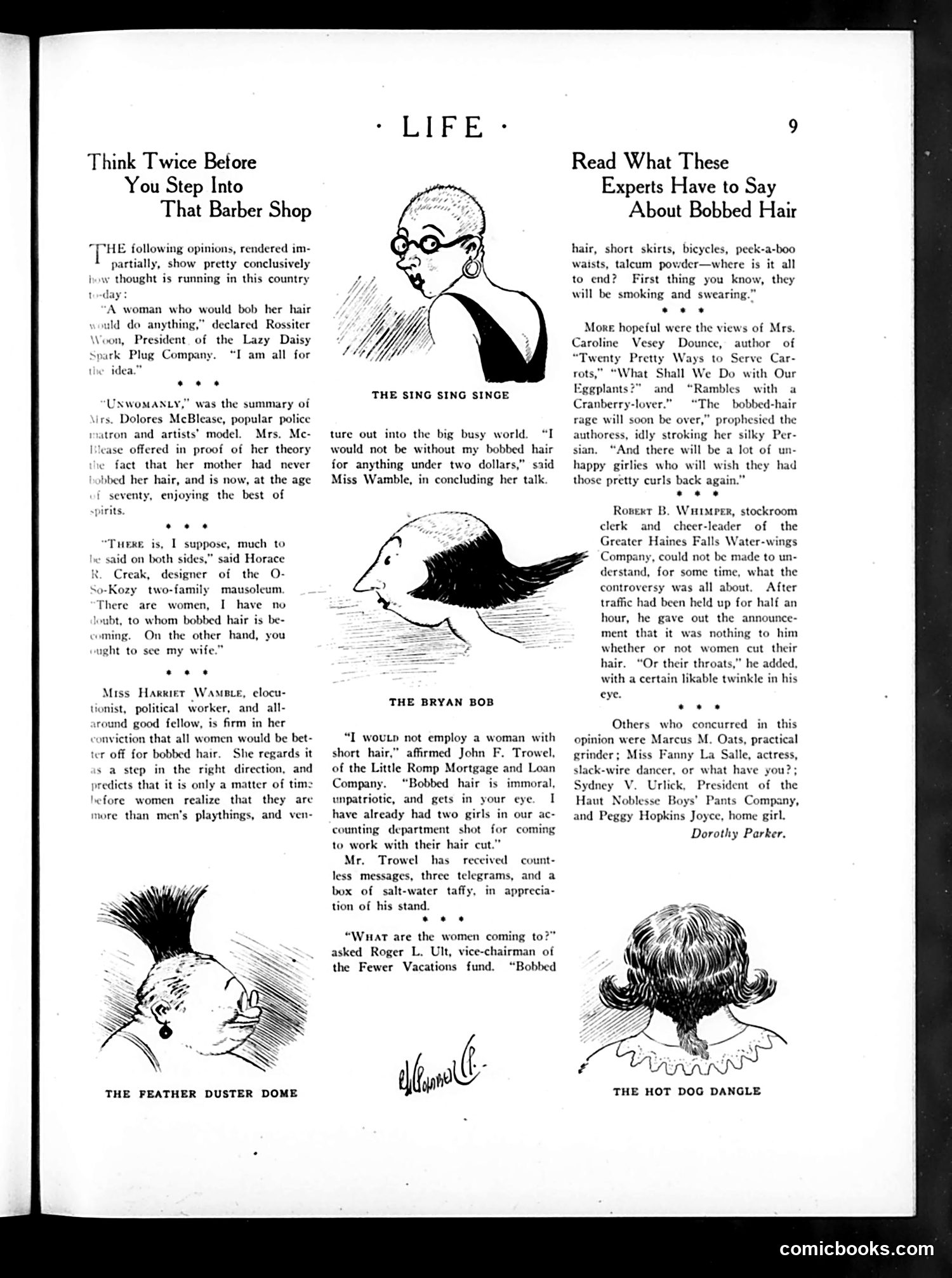
This satirical article addresses the 1920s controversy over women bobbing (cutting short) their hair—a radical departure from long hair conventions. The page presents humorous illustrated "styles" with absurdist names: "The Ku Klux Kut," "The Hard-Boiled Egg," "The Cat's Whiskers," and "The Dumbbell." The text describes bobbed hair as a sweeping national craze causing divided opinion, with the magazine promising to settle the "to bob or not to bob" debate. The illustrations mock both the fashion trend itself and the intense social debate surrounding it, treating women's hairstyle choice as worthy of serious public discussion and symposium. This reflects genuine 1920s anxiety about changing women's roles and appearance during the flapper era.
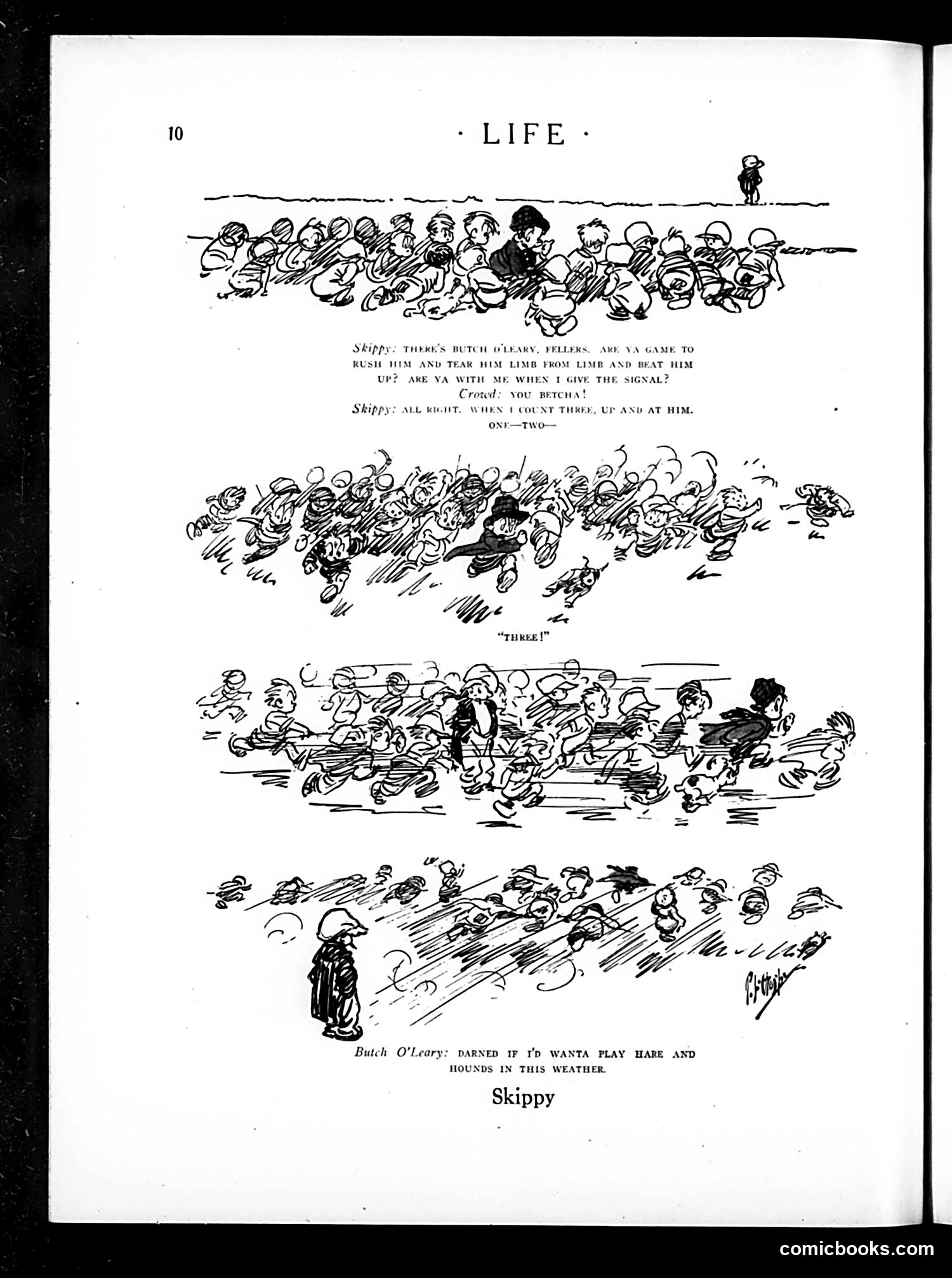
This is a comic strip titled "Skippy" depicting a children's street game. In the first panel, Skippy organizes other children to rush and tackle "Butch O'Leary," apparently a local tough kid, and "beat him up" when signaled. The children eagerly count down ("ONE—TWO—THREE!") before charging at Butch in a chaotic mob. In the final panel, Butch O'Leary stands alone in the snow, refusing to participate in such rough play in bad weather. The humor derives from the ironic contrast: Butch, portrayed as a bully, is the only one with enough sense to avoid the violent "game" Skippy has organized. The satire gently mocks childhood mob mentality and the casual acceptance of bullying disguised as play.
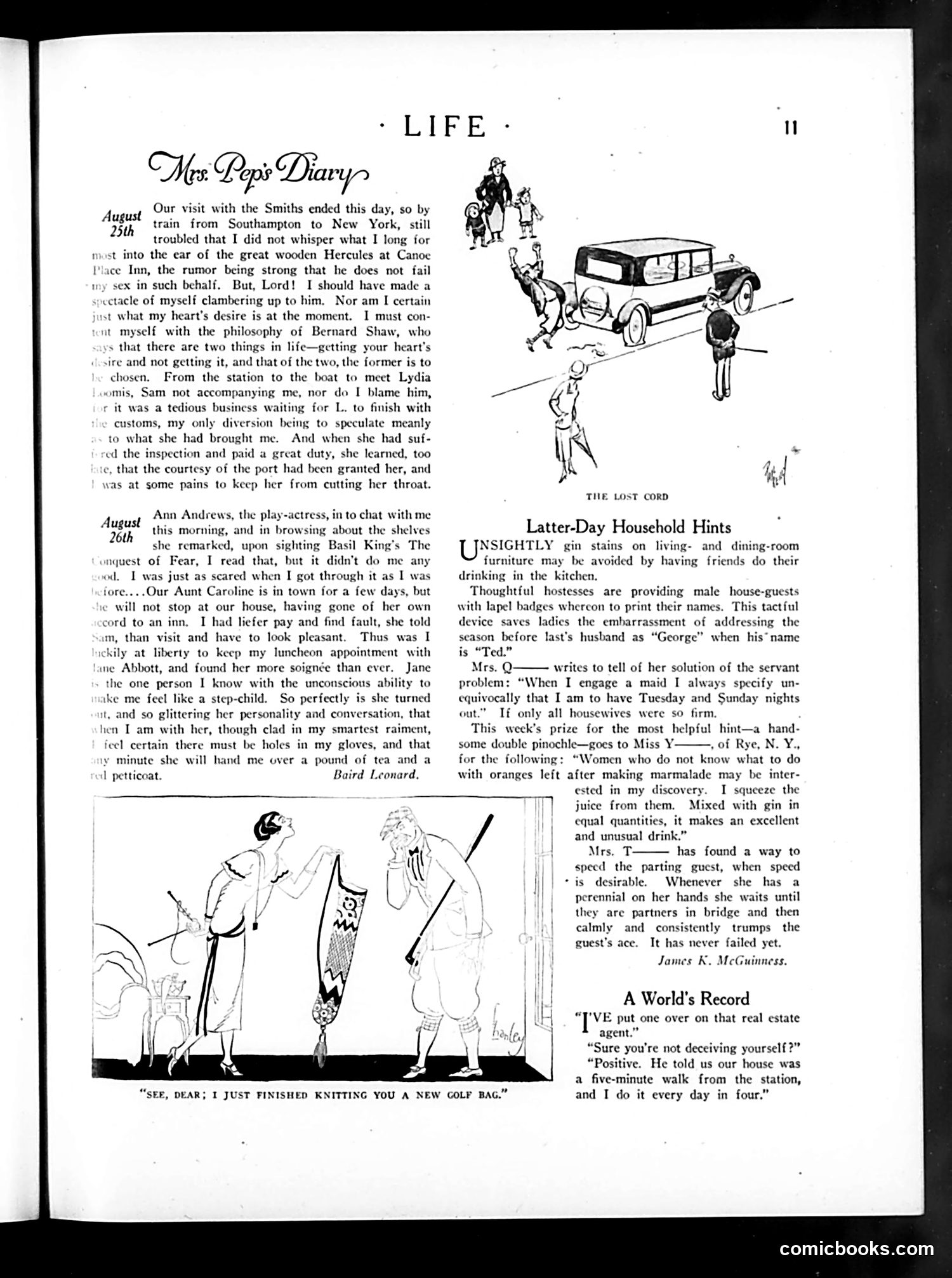
This page contains diary entries and household advice rather than political cartoons. "Mrs. Pep's Diary" describes social encounters from August 25-26, including visits with the Smiths and playwright Ann Andrews. The only illustration is a domestic cartoon captioned "SEE, DEAR; I JUST FINISHED KNITTING YOU A NEW GOLF BAG," showing a woman presenting an absurdly oversized knitted item to a man. The humor relies on the wife's obliviousness—she's created an impractical, comically enormous object when a golf bag is a practical item one purchases. "Latter-Day Household Hints" offers practical advice about servant management and entertaining, reflecting 1920s upper-class domestic concerns. The "World's Record" section jokes about a real estate agent's exaggeration—claiming a five-minute walk is done "in four," poking fun at salesmanship dishonesty.
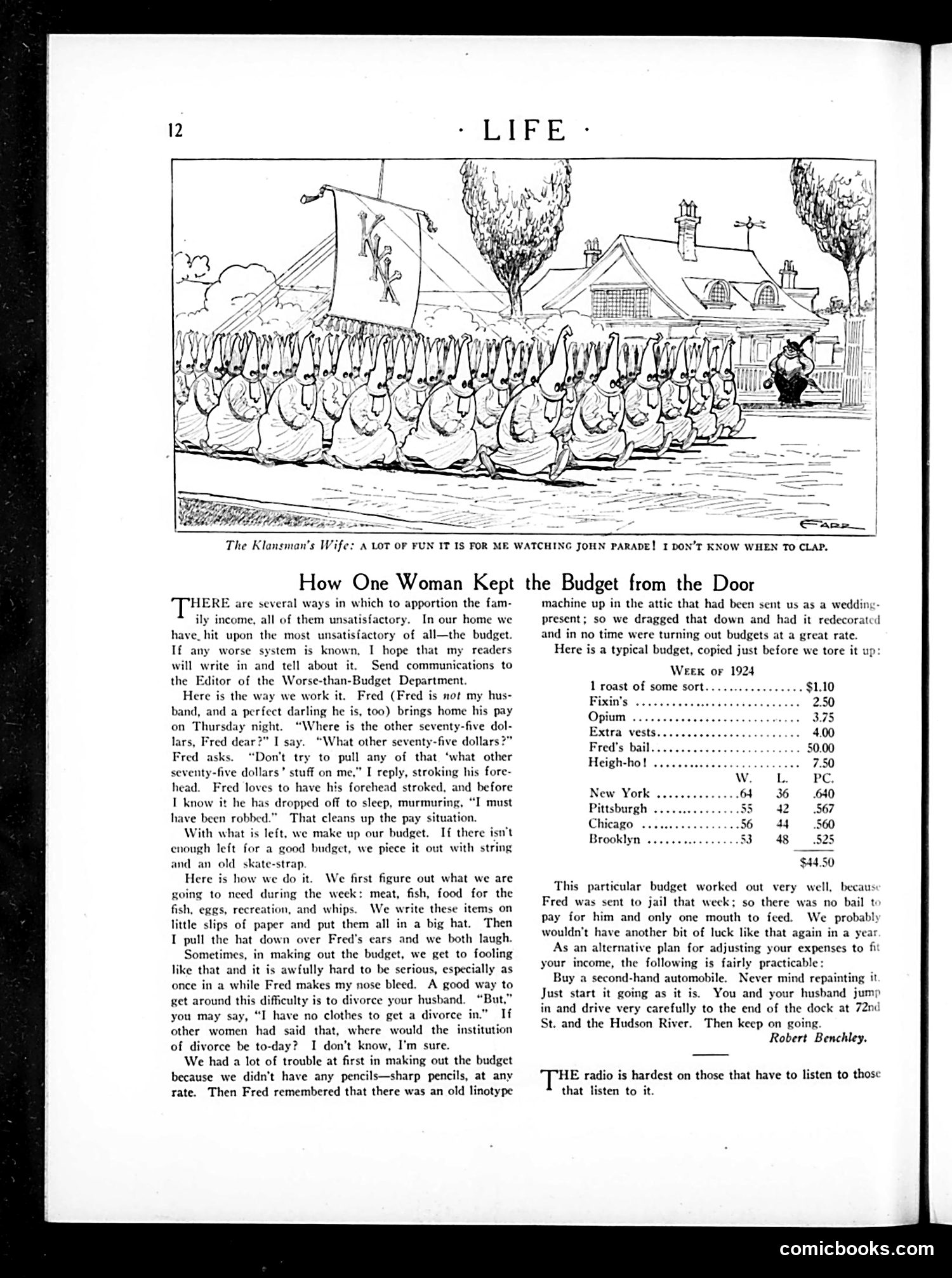
The cartoon depicts a long line of identically-dressed geese or ducks in formation, labeled "The Kluntsman's Wife," with the caption mocking a parade-watching wife who complains about not knowing when to clap—satirizing mindless conformity and spousal obedience. The main article, "How One Woman Kept the Budget from the Door," addresses household financial management during the 1920s. It describes a working-class family struggling with tight finances, where the husband (Fred) brings home pay on Thursdays. The text humorously illustrates budgeting challenges: lack of pencils for accounting, and an anecdote about the husband being jailed (with no bail expenses that week, providing dark comic relief). The article reflects Depression-era anxieties about domestic economics and marital financial strain.
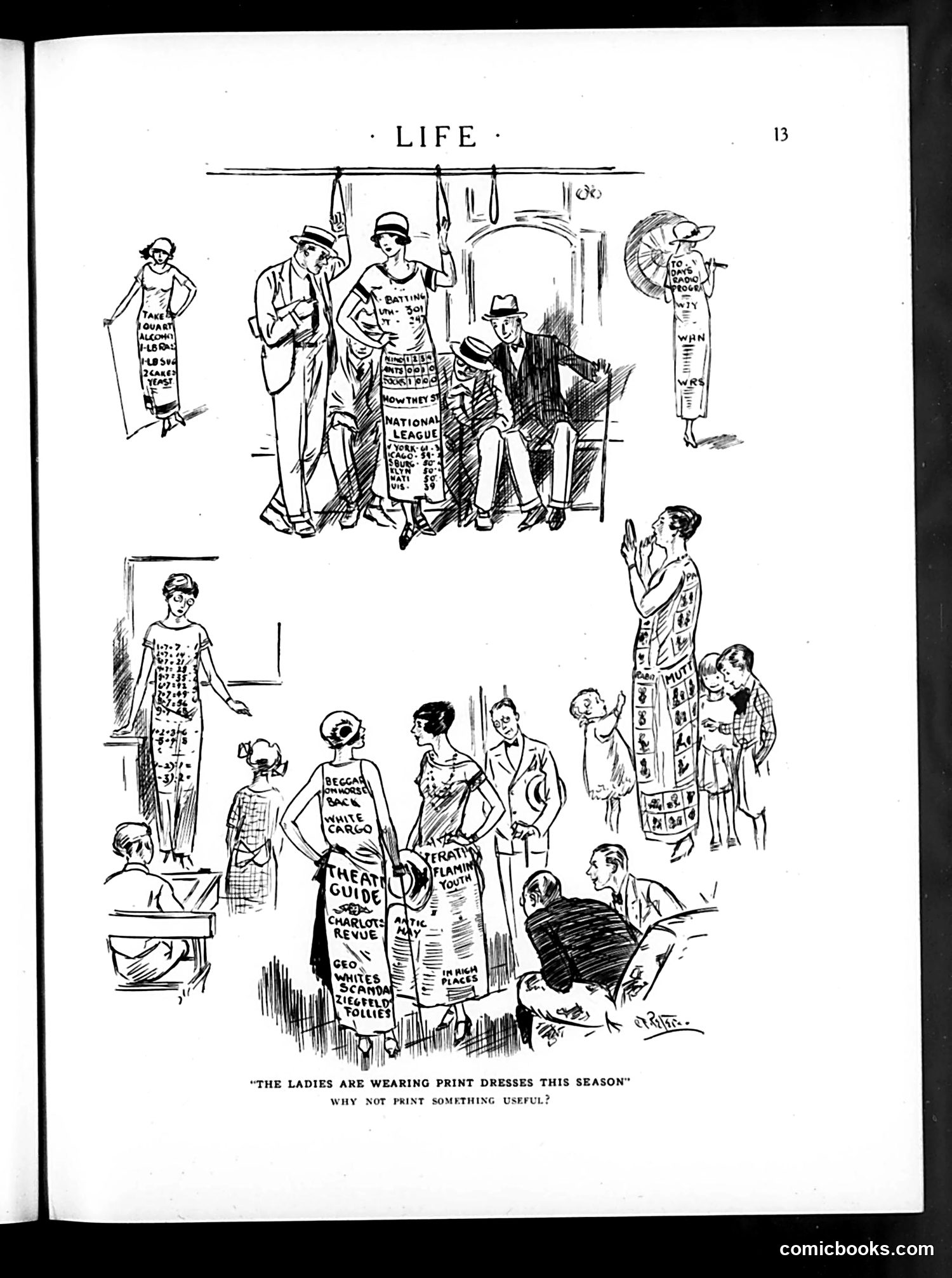
This Life magazine cartoon satirizes women's fashion trends and their practical uselessness. The caption reads: "The ladies are wearing print dresses this season—Why not print something useful?" The illustration shows women and men wearing garments covered entirely with printed text and information—baseball statistics, theater guides, stock market data, legal codes, and other reference materials. The satire suggests that if women must wear impractical decorative print dresses anyway, they might as well wear dresses printed with genuinely useful information (like schedules, prices, or facts) that could serve some functional purpose. The joke mocks both the frivolity of fashion trends and the impracticality of women's clothing, while sardonically proposing that utility should replace pure aesthetics in dress design.
This page discusses Mr. Davis's political speech and candidacy. The text critiques Davis for not fully exposing Republican corruption—particularly regarding President Coolidge's administration—despite claiming to oppose it. The article argues Davis should have mentioned more specifics about Coolidge's record and cited examples like the Daugherty scandal (involving Attorney General Walsh and Wheeler's investigations) and alleged misuse of ambassadorships. The small cartoons appear to illustrate Davis as a political performer or candidate, though their specific meaning is unclear without fuller context. The piece essentially accuses Davis of pulling punches in his campaign rhetoric, suggesting his criticism lacks sufficient detail and force needed to effectively challenge the incumbent Republican administration.
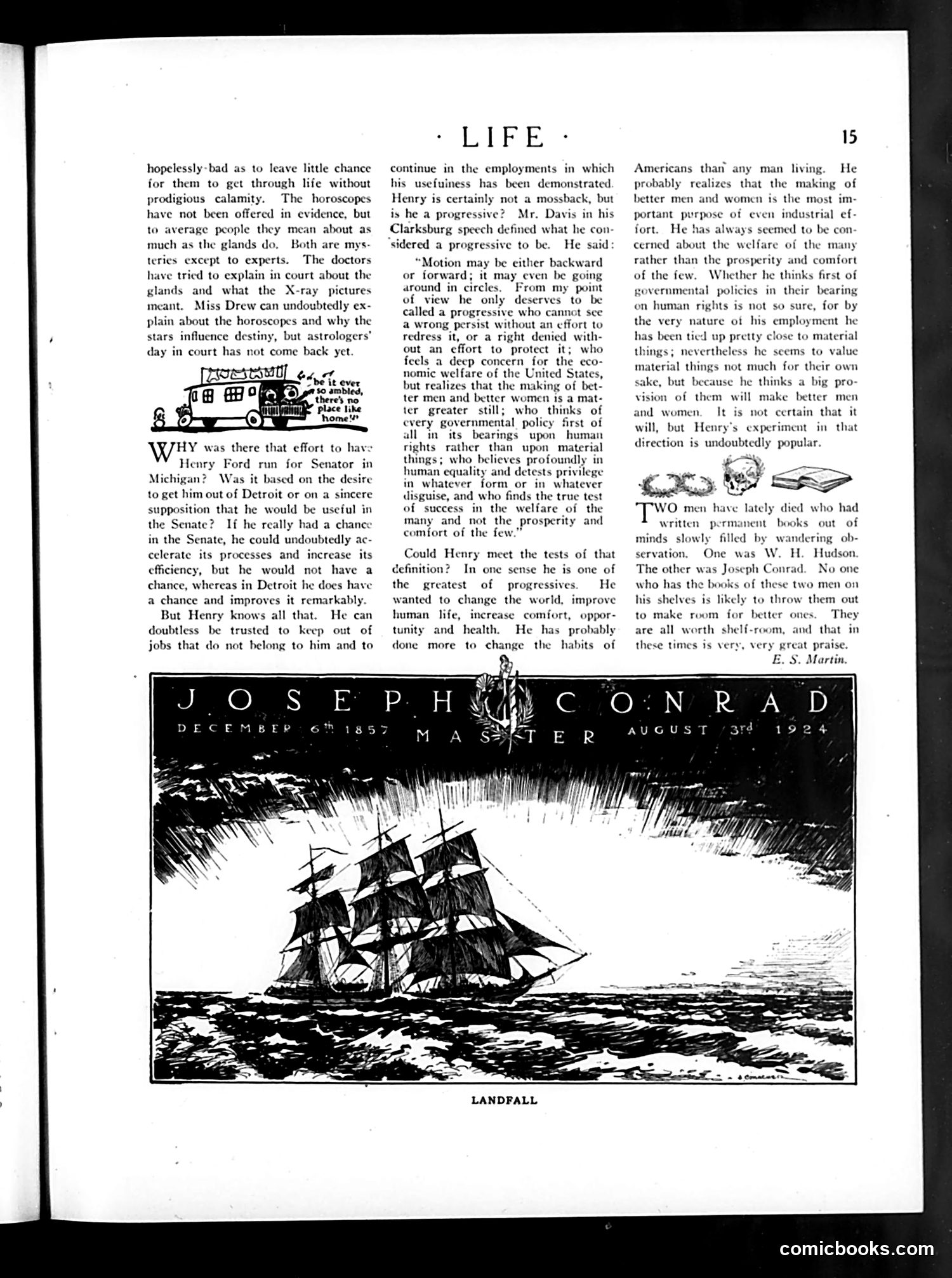
This page contains a memorial illustration for Joseph Conrad, the Polish-British novelist who died August 3, 1924. The image shows a sailing ship (appearing to be from Conrad's era of seafaring adventure) with the text "LANDFALL" below it—referencing Conrad's maritime themes. The upper text discusses progressive politics and Henry Ford, arguing about what constitutes genuine progress in improving human welfare. It debates whether true progressivism means changing the world for better living conditions or simply advancing individual prosperity. The page is primarily a tribute to Conrad's literary legacy, using nautical imagery appropriate to his novels like *Lord Jim* and *Heart of Darkness*, which heavily featured ships and ocean voyages as central elements.
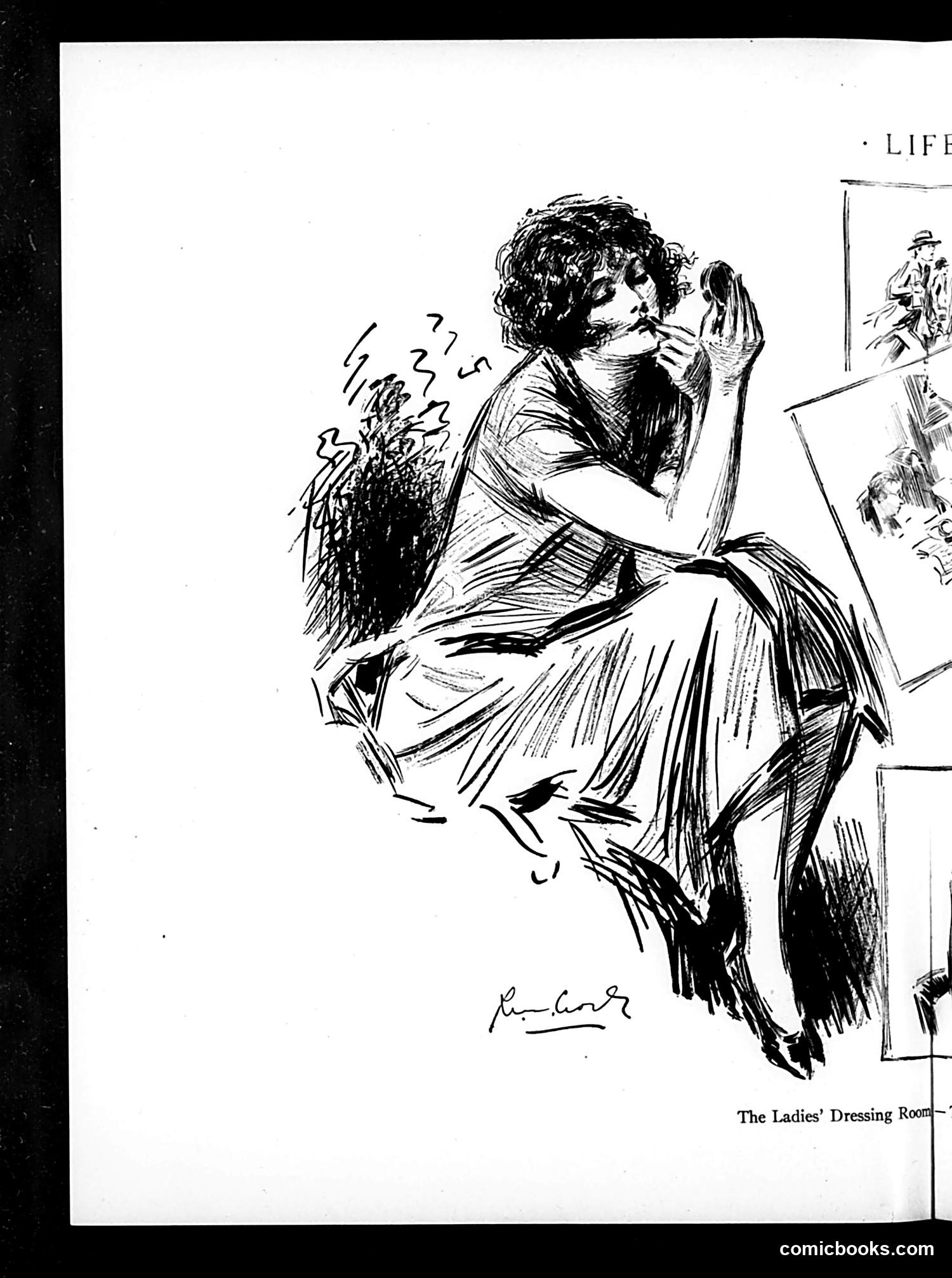
This is a satirical sketch titled "The Ladies' Dressing Room" from *Life* magazine, showing a woman seated at what appears to be a vanity or dressing table, adjusting her appearance (possibly her hair or makeup). The sketch uses exaggerated, energetic line work characteristic of early 20th-century editorial cartooning. The humor likely satirizes women's vanity and the time/effort devoted to personal grooming—a common comedic target in period satirical magazines. The woman's focused, absorbed expression and the dynamic sketching style emphasize this preoccupation. Without additional context about the specific issue date, the exact social commentary remains unclear, but the piece appears to mock conventional attitudes about feminine beauty rituals and self-consciousness about appearance.
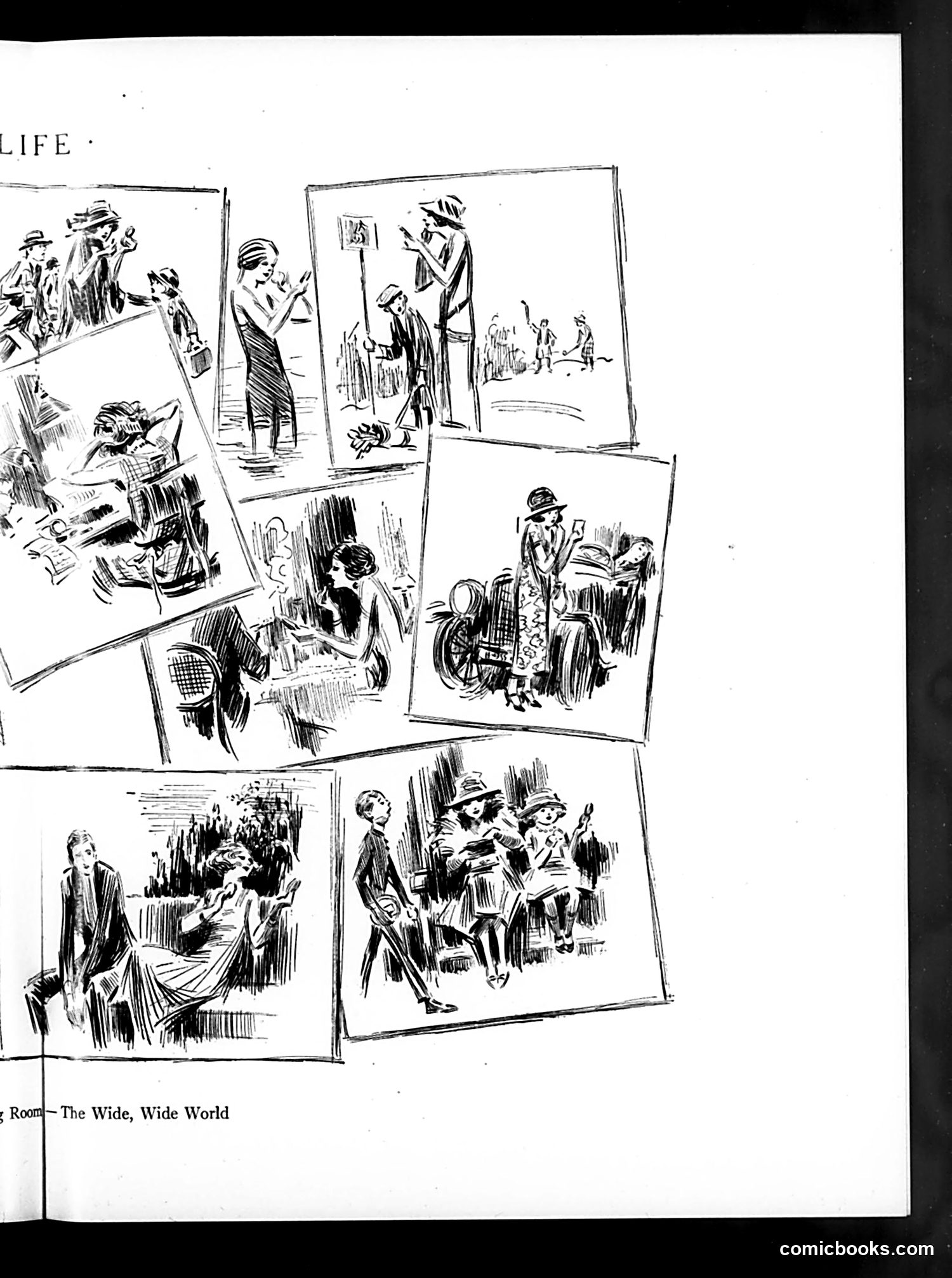
This appears to be a multi-panel sketch series depicting various social scenarios from early-to-mid 20th century life. The panels show people in different situations: what appears to be street encounters, indoor gatherings, leisure activities (possibly at a tennis court or recreational venue), and domestic scenes. The title "The Wide, Wide World" likely satirizes the contrast between people's aspirations for worldly experience and their actual mundane, repetitive daily lives. The sketchy style and varied vignettes suggest commentary on ordinary middle-class existence—work, courtship, socializing, and domestic routines. Without clearer identifying details or captions for individual panels, the specific satirical targets remain unclear, though the overall theme appears to be gentle social observation about contemporary American life.
This is a theater review of the Broadway play *Dancing Mothers*, critiquing both the production and its depiction of the "Younger Generation" scandal theme popular in 1920s drama. The reviewer mocks the play's premise: a mother takes up drinking and smoking to teach her wayward daughter a lesson—a plot device already done 211 times in recent seasons. The satire targets the play's predictability and moral hypocrisy. The small cartoons (dancing figures) illustrate the reviewer's pointed criticism of the offstage dance sequences, which he compares unfavorably to the "Helter Skelter" ride at Coney Island—suggesting chaotic, amateurish choreography. The reviewer also lampoons the ending's supposed "surprise": the mother actually leaves her family, which the author sardonically notes is shocking only because financial backers might demand an alternate ending where she returns, making it all a joke. The piece is signed by Robert Benchley, Life's prominent humorist.
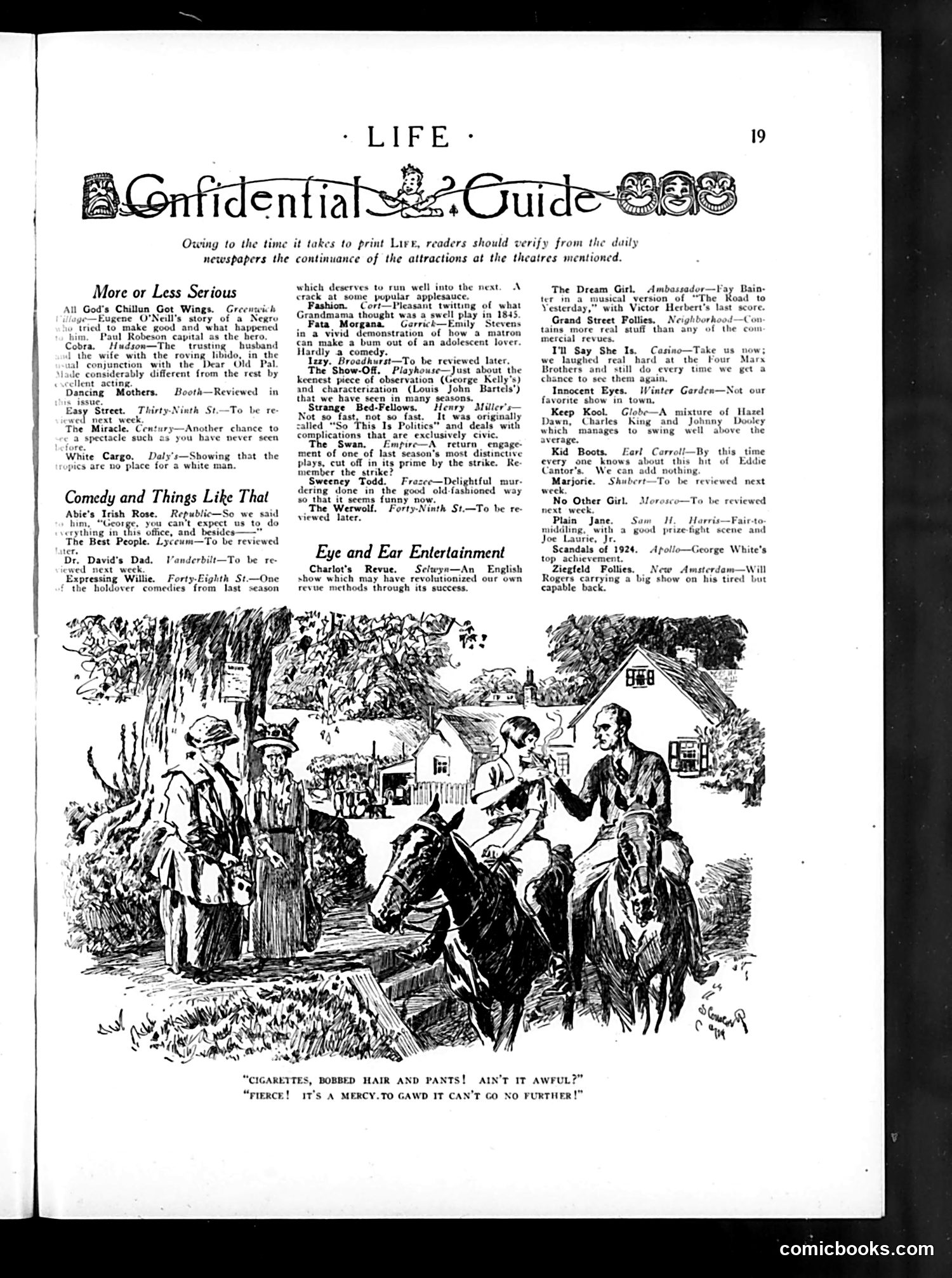
This is primarily a theater listings and review page with a satirical cartoon at the bottom. The cartoon depicts two figures on horseback encountering a woman and man near a cottage. The dialogue critiques modern social changes: the horsemen mock "cigarettes, bobbed hair and pants" as going too far, with one declaring "it's a mercy to God it can't go no further!" The satire targets conservative anxiety about 1920s social transformation—specifically women's liberation. Bobbed hair and women wearing pants were genuinely controversial markers of the "New Woman" and sexual liberation of the Jazz Age. The cartoon mocks older generations' shock at these visible symbols of changing gender roles and behavior. The page itself is a standard Life theater guide reviewing Broadway productions including Eugene O'Neill's "All God's Chillun Got Wings" (featuring Paul Robeson) and various comedies and musicals popular in the era.
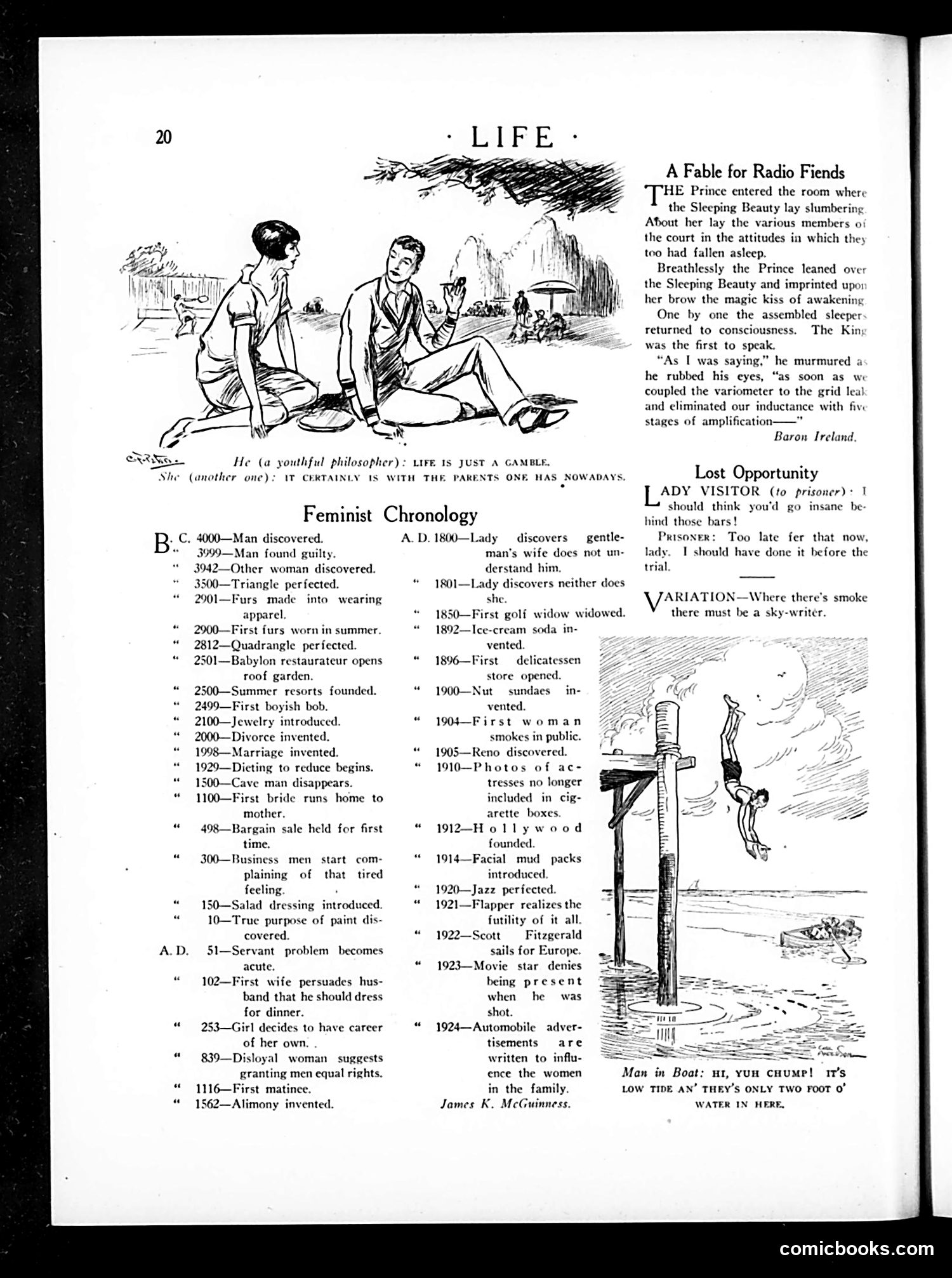
This page from Life satirizes early 20th-century gender relations through humor. The top cartoon jokes about philosophy and parental authority—two young men debate whether "life is just a gamble," with one noting parents make it so by their unpredictability. The "Feminist Chronology" is the page's main satire: a mock timeline tracing human "progress" backward from 4000 B.C. to 1924 A.D., presenting women's increasing independence and changing social roles as absurd historical "inventions"—divorce (2000 A.D.), women smoking in public (1904), the "flapper" (1921), even alimony (1562). The humor is misogynistic, mocking women's liberation by treating their freedoms as ridiculous milestones. The remaining pieces—"A Fable for Radio Fiends" and "Lost Opportunity"—are unrelated joke features typical of Life's format. The page reflects 1920s attitudes toward feminism: conservative resistance presented as lighthearted comedy.
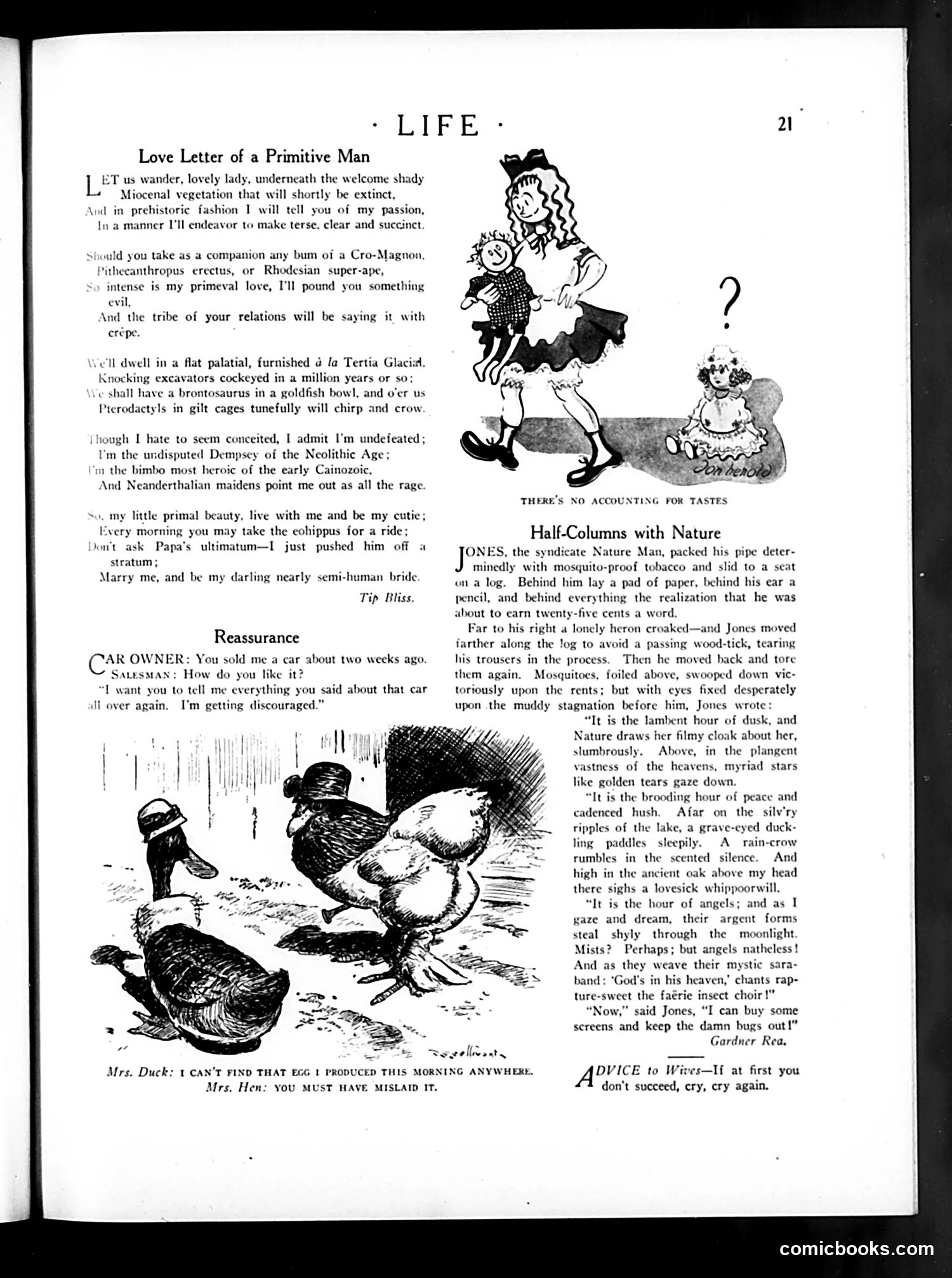
This page from *Life* magazine contains several satirical pieces mocking early 20th-century literary and social pretensions. **"Love Letter of a Primitive Man"** parodies romantic poetry by imagining a suitor from prehistoric times (referencing Cro-Magnon, Neanderthal, and other early human species). The joke is the absurd juxtaposition: flowery, sentimental language paired with primitive violence ("I'll pound you something evil"). It mocks both overwrought romantic literature and pseudo-scientific fascination with human evolution that was popular in the era. **"Half-Columns with Nature"** satirizes nature writers who sell sentimental descriptions of pastoral scenes. "Jones," a hack writer earning "twenty-five cents a word," composes florid prose about dusk, angels, and moonlight while actually being annoyed by mosquitoes, wood-ticks, and herons. The humor comes from the gap between his published romanticization and his true miserable experience—critiquing dishonest, commercially-motivated nature writing. The smaller cartoons provide additional social humor about cars and domestic life.
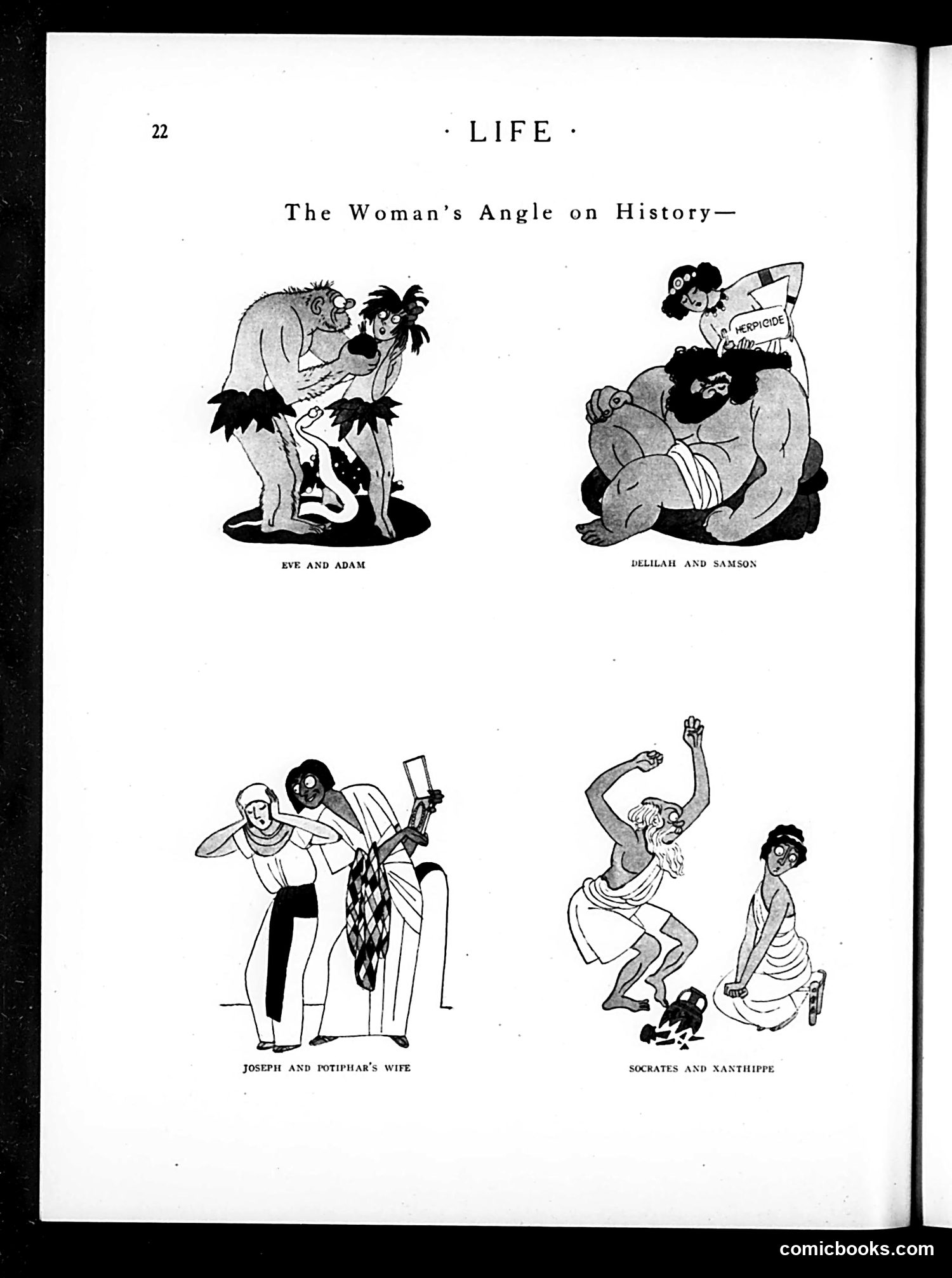
This page satirizes famous historical and biblical pairs through "The Woman's Angle on History"—presenting four scenarios where women allegedly caused or influenced major events: 1. **Eve and Adam**: Eve tempts Adam with the apple, blaming women for humanity's fall from grace. 2. **Delilah and Samson**: Delilah seduces the strong man, leading to his betrayal and downfall. 3. **Joseph and Potiphar's Wife**: The wife's false accusation destroys Joseph's life. 4. **Socrates and Xanthippe**: His wife (depicted as aggressive) represents the nagging spouse undermining the great philosopher. The satire's point: women are portrayed as manipulative, seductive, or destructive forces behind historical male failures. This reflects early 20th-century misogynistic humor common in *Life* magazine, treating female influence as inherently corrupting or emasculating. The cartoons blame women for men's downfalls across history.
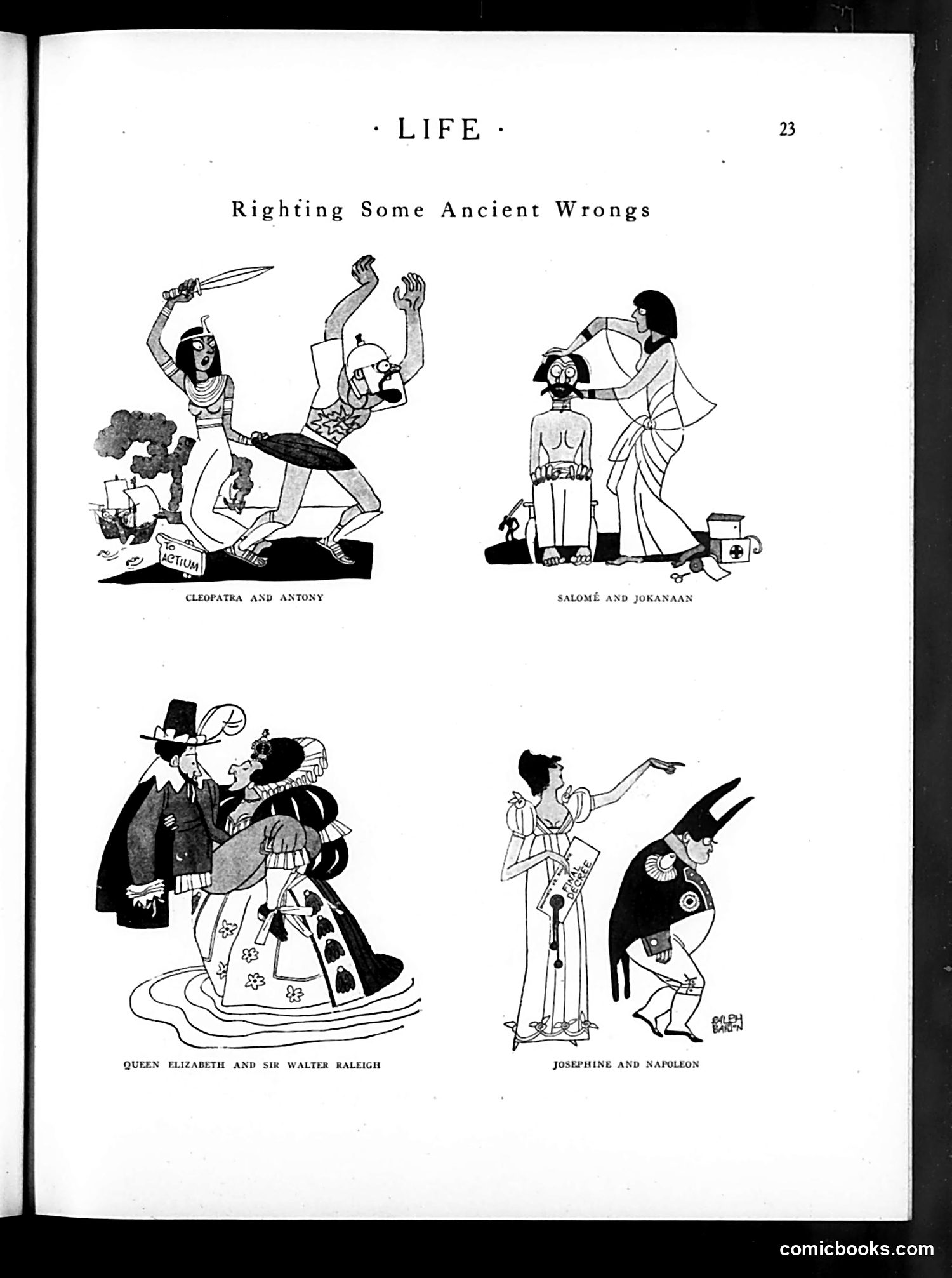
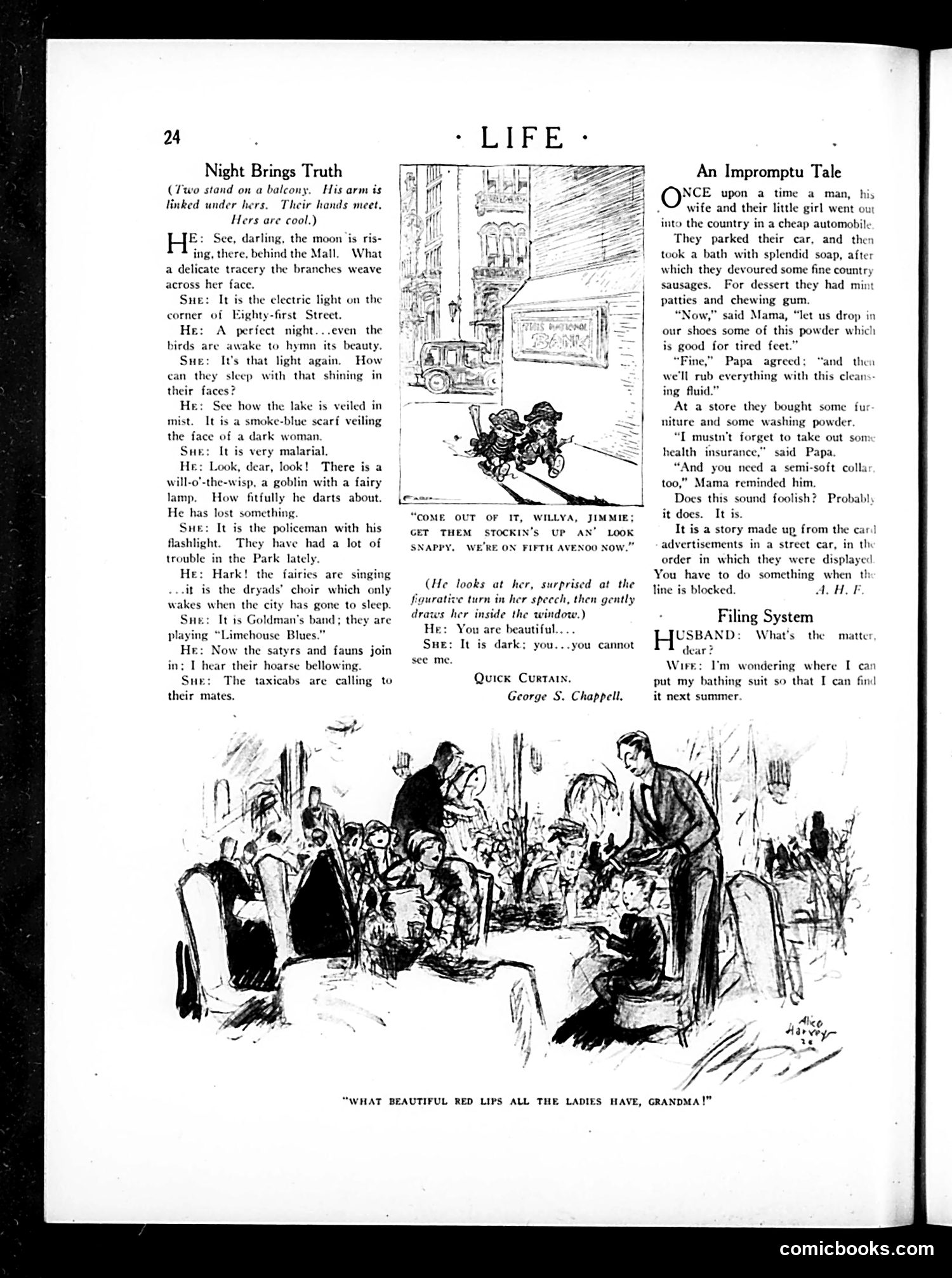
This page contains three separate satirical pieces from *Life* magazine: **"Night Brings Truth"** mocks romantic pretension. A man poetically interprets urban sights (moonlight, a lake, fairies) while his companion pragmatically debunks each fantasy (it's electric lights, malarial mist, a policeman's flashlight, Goldman's band). The satire targets flowery sentimentality versus practical reality—his romantic illusions collapse when she speaks plainly. **"An Impromptu Tale"** ridicules advertising saturation. The narrator reveals he composed a domestic story entirely from streetcar advertisements, arranged in order. It's commentary on how pervasive commercial messaging has become—even casual narratives are now advertising copy. **"Filing System"** is a domestic humor cartoon. A wife has lost her bathing suit so thoroughly she can't find it until next summer, suggesting chaotic household organization (or perhaps marital exasperation with domestic disorder). All three pieces reflect early 20th-century anxieties: urbanization obscuring nature, commercialism invading daily life, and domestic friction.
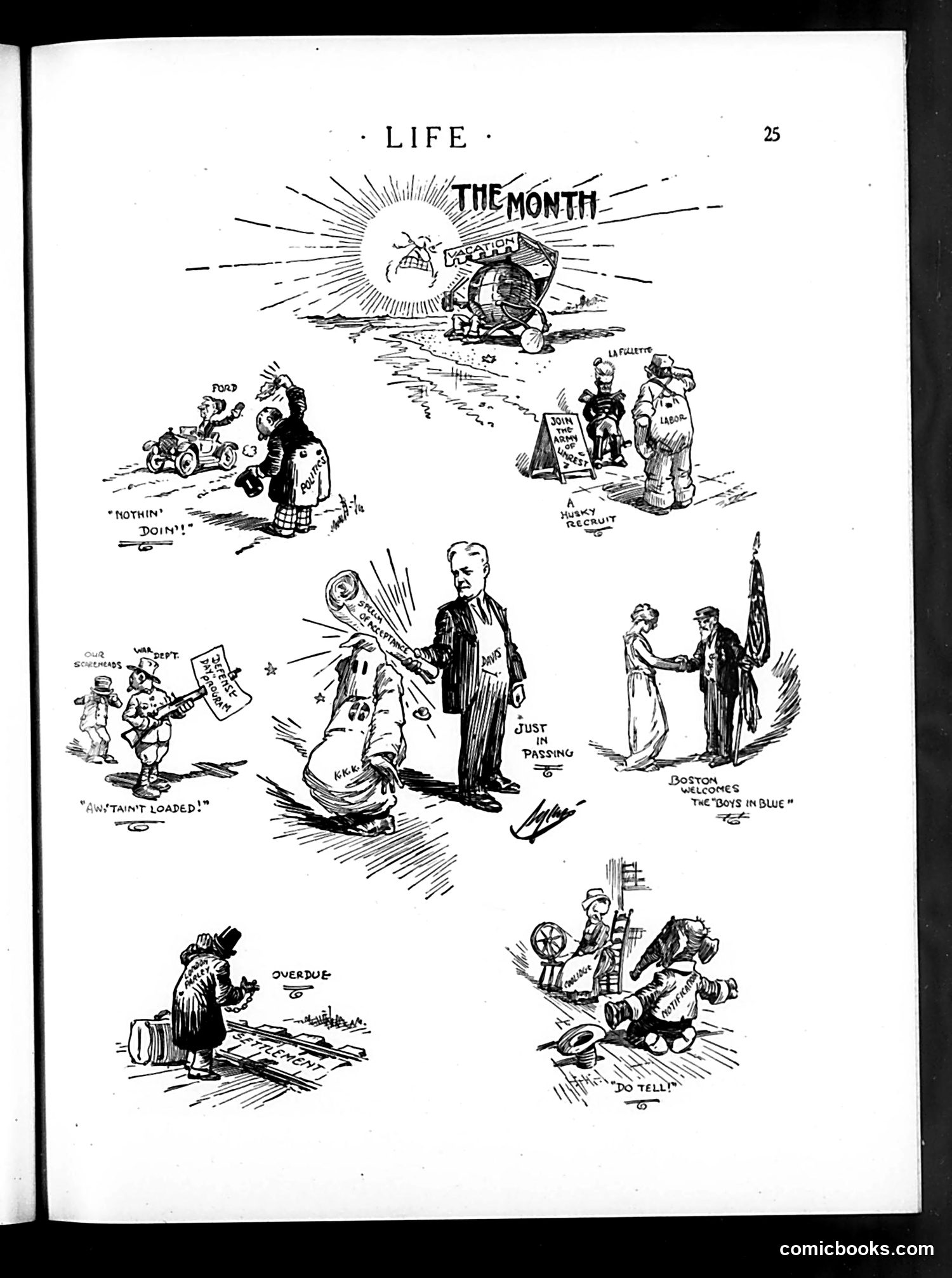
This page presents eight political cartoon vignettes labeled "The Month," satirizing current events. The cartoons mock: - **Ford** (automobile industry) and what appears to be **Prohibition** ("Nothin' Doin'") - **KKK recruitment** efforts ("Husking Recruit") - **Labor disputes** ("Ain't Tainted Loaded!") - **Government corruption** or scandal ("Just in Passing") - **Boston welcoming "Boys in Blue"** (likely police/law enforcement) - **Overdue** (possibly taxes or debts) - **Naval/military matters** ("Hard to Tell") The cartoons employ exaggerated caricature and ironic juxtaposition typical of 1920s-era satirical commentary. Without the specific issue date visible, the exact events referenced are unclear, but they address major contemporary American concerns: Prohibition, organized labor, racial extremism, and government inefficiency.
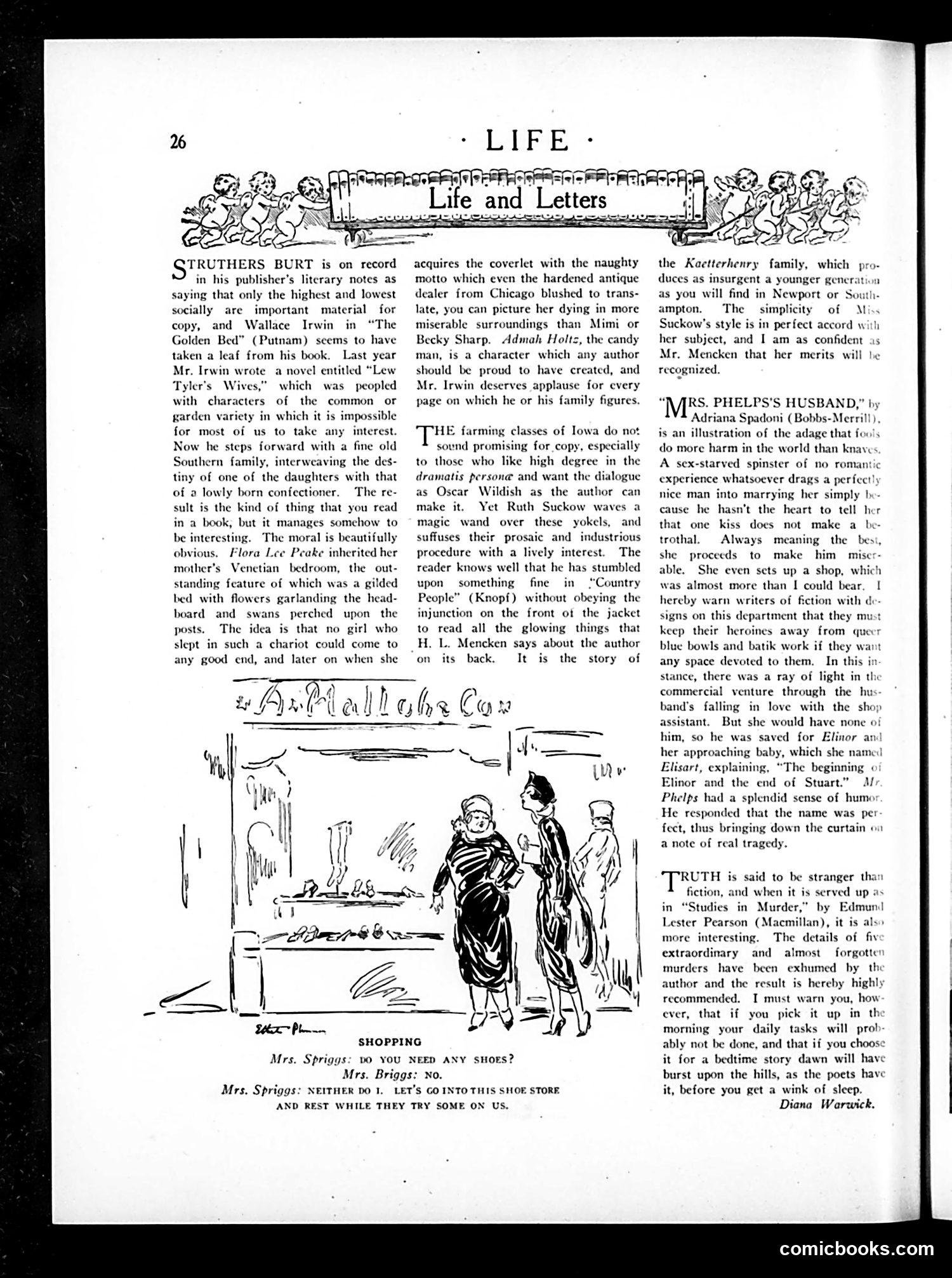
This page features literary reviews of contemporary novels, with one accompanying cartoon. The cartoon depicts two women shopping—Mrs. Spriggs and Mrs. Briggs—who enter a shoe store not to buy shoes but simply to rest while sales clerks try on footwear for them. The humor is gentle satire on leisure-class women's shopping habits: using retail establishments as social spaces and rest stops rather than genuinely intending to purchase. The reviews discuss novels by Wallace Irwin, Ruth Suckow, and Adriana Spadoni, evaluating their character development and literary merit. The overall tone suggests *Life* positioned itself as a sophisticated arbiter of contemporary American literature, addressing educated readers interested in serious fiction alongside lighter social commentary. The shopping cartoon illustrates the magazine's dual purpose: satirizing modern manners while reviewing serious literary works.
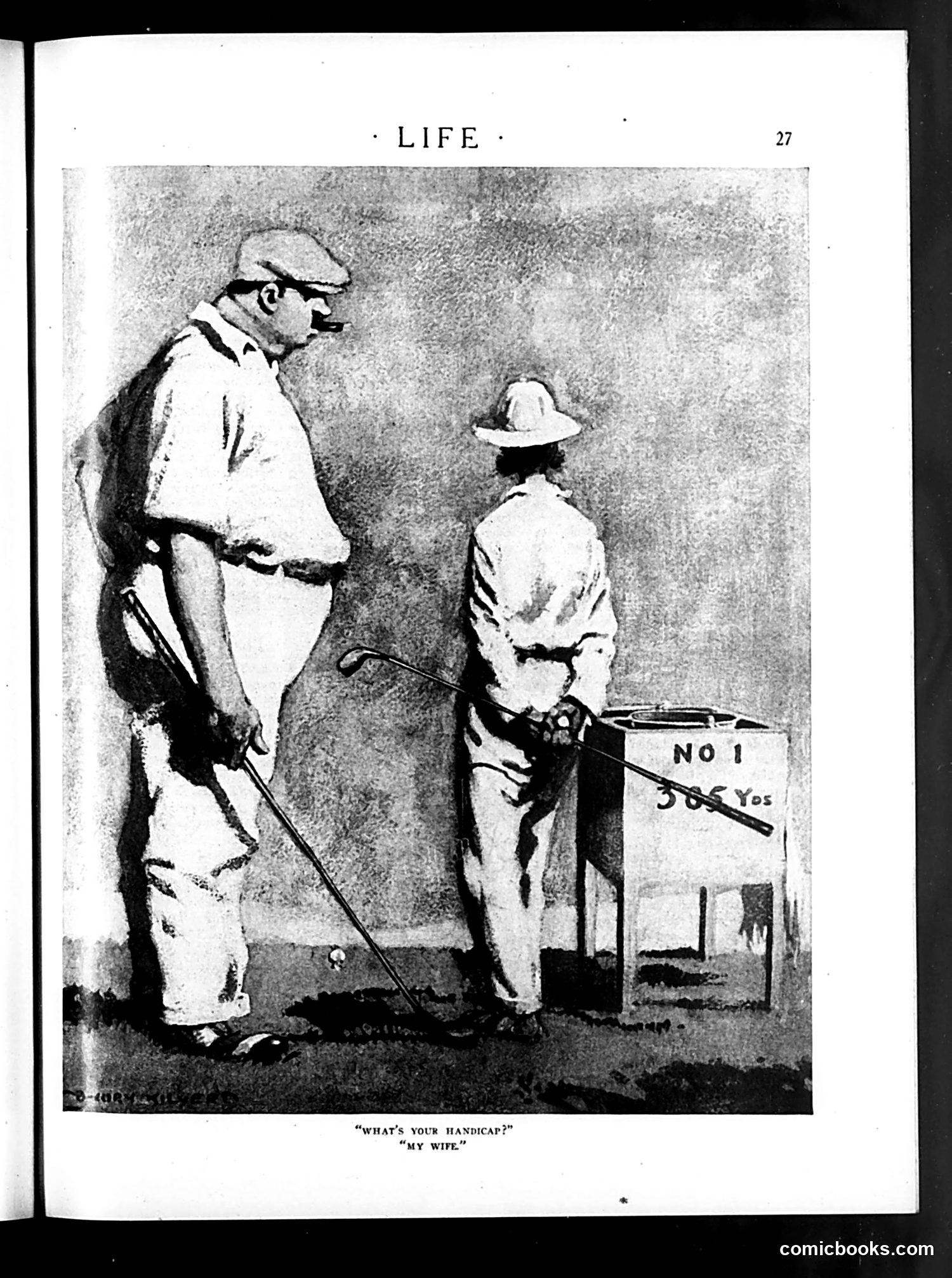
This is a golf-themed joke cartoon from *Life* magazine. Two golfers are shown on a golf course, one asking the other about his handicap—a standard golf term referring to a player's skill level adjustment. The humor relies on a double meaning: instead of answering with a golf handicap number, the man replies "My wife," implying that marriage itself is his handicap—a burden that impedes his ability to play golf well, likely due to domestic obligations or lack of free time. The joke reflects early-to-mid 20th century satirical attitudes toward marriage as restrictive, particularly for men's leisure activities. The cartoon assumes a male audience who would find the complaint relatable.
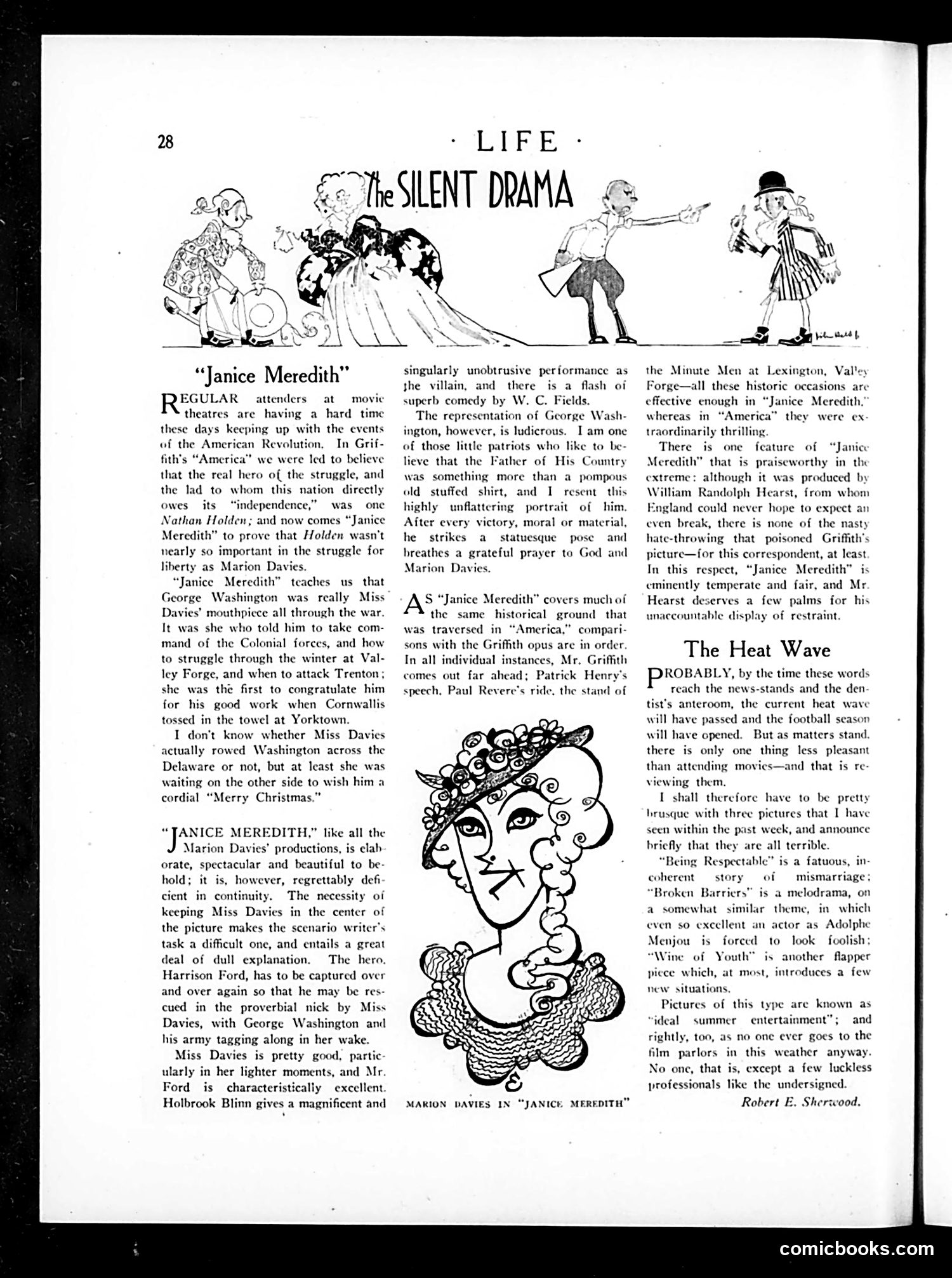
This is a film review from *Life* magazine critiquing Marion Davies' silent film "Janice Meredith," a Revolutionary War drama. The satire targets **Davies' dominance in the narrative**: the reviewer sarcastically notes that the film rewrites history to position Davies' character as the true architect of American independence, with George Washington reduced to taking her orders. The joke relies on **nepotism criticism**—Davies was a protégée (and romantic interest) of newspaper magnate William Randolph Hearst, who produced the film. The reviewer ridicules how the script contorts itself keeping Davies center-stage, requiring repetitive rescue scenarios. The caricature of Marion Davies shown alongside mocks her outsized prominence. The reviewer compares the film unfavorably to D.W. Griffith's earlier "America," praising Griffith's dramatic execution while acknowledging Hearst's film avoids the "hate-throwing" present in Griffith's work—a backhanded compliment about restraint in propaganda.
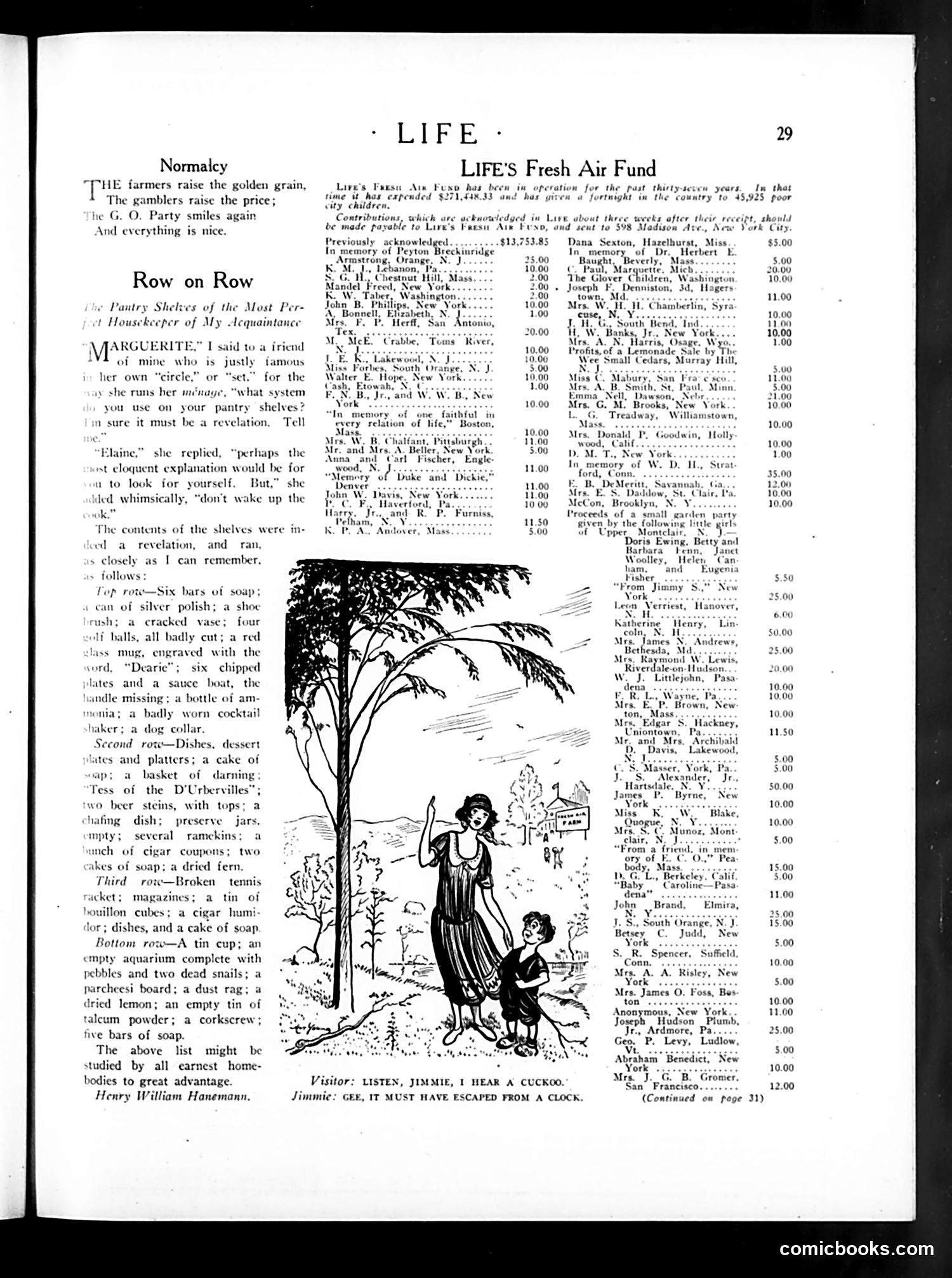
This page contains two distinct pieces of satirical content: ## "Normalcy" and "Row on Row" A poem and humorous essay about household pantry shelves. The satire mocks domestic life and waste—the poem opens with farmers producing grain while "gamblers raise the price," then jokes that "the G.O. Party smiles again" (likely referencing Republican "Return to Normalcy" politics of the 1920s). The essay humorously catalogs the absurd, broken, and useless items cluttering a typical homemaker's shelves: broken tennis rackets, dead snails in an aquarium, dried ferns, and inexplicably, five bars of soap scattered throughout. The satire targets both wasteful consumerism and the chaos of domestic life. ## The Cuckoo Clock Cartoon A simple visual gag below shows a woman visitor telling a child (Jimmie) she hears a cuckoo bird. Jimmie replies it must have escaped from a clock—a straightforward children's joke playing on the mechanical cuckoo birds found in novelty clocks of that era. The page also lists "Life's Fresh Air Fund" contributions—a genuine charitable program providing country vacations for poor city children.
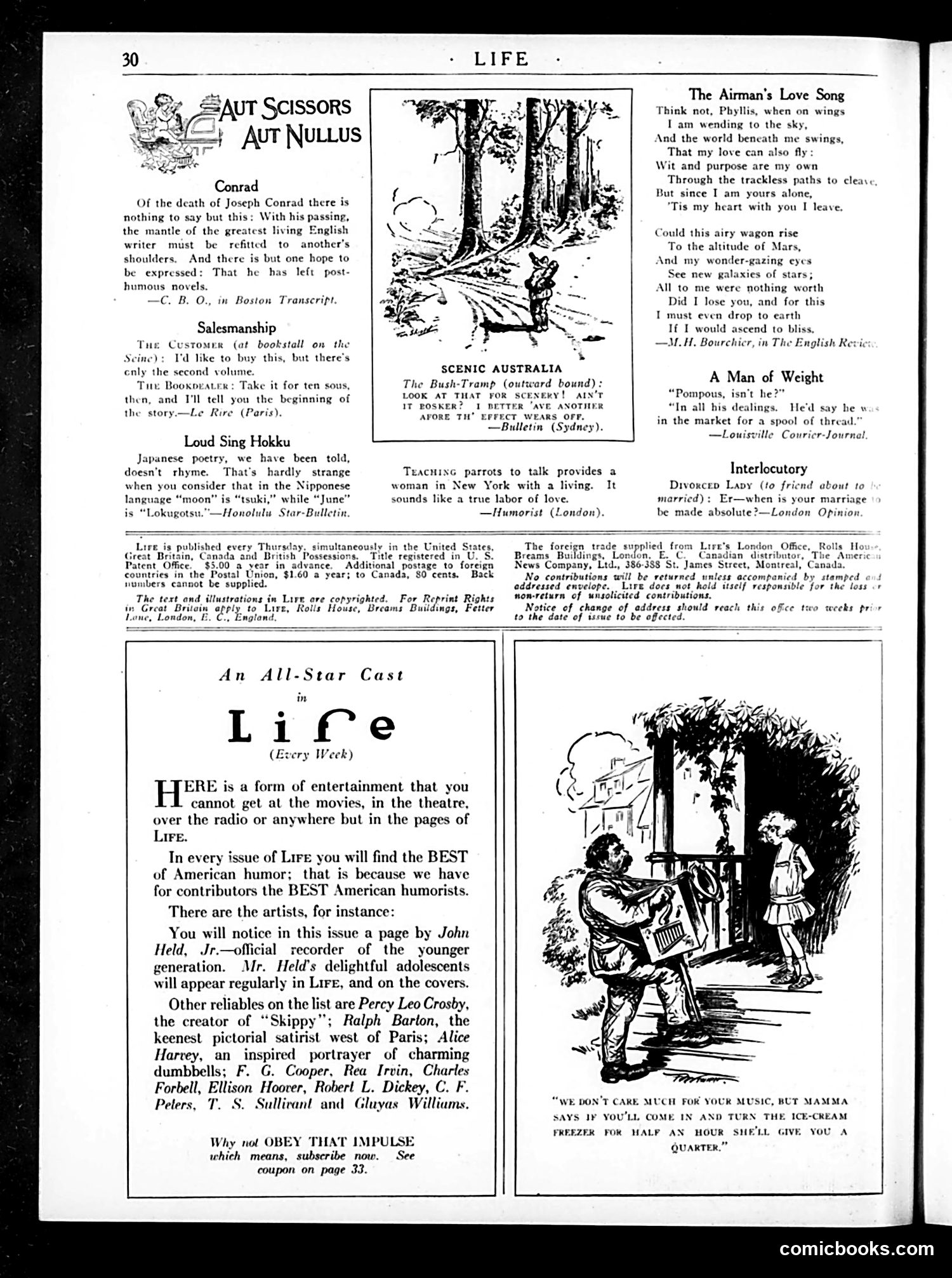
This page from *Life* magazine contains several brief humorous pieces and advertisements typical of the publication's format. The substantive content includes: **Literary tributes**: A note mourning author Joseph Conrad's death, praising him as the greatest living English writer. **International humor**: Short jokes reprinted from foreign publications—a Paris anecdote about a bookseller selling only volume two, a Hawaiian piece on Japanese poetry's lack of rhyme, and an Australian bush-tramp joke about scenery. **Romantic/sentimental pieces**: "The Airman's Love Song" (poetic verse about a pilot's devotion) and brief witticisms about pomposity and divorce. **Advertisement**: The lower half promotes *Life* itself, boasting of its "all-star cast" of American humorists and illustrators—naming John Held Jr., Ralph Barton, and others as regular contributors, positioning the magazine as superior entertainment unavailable elsewhere. The page reflects early 20th-century magazine culture: international sophistication, light verse, and self-promotion of American satirical talent.
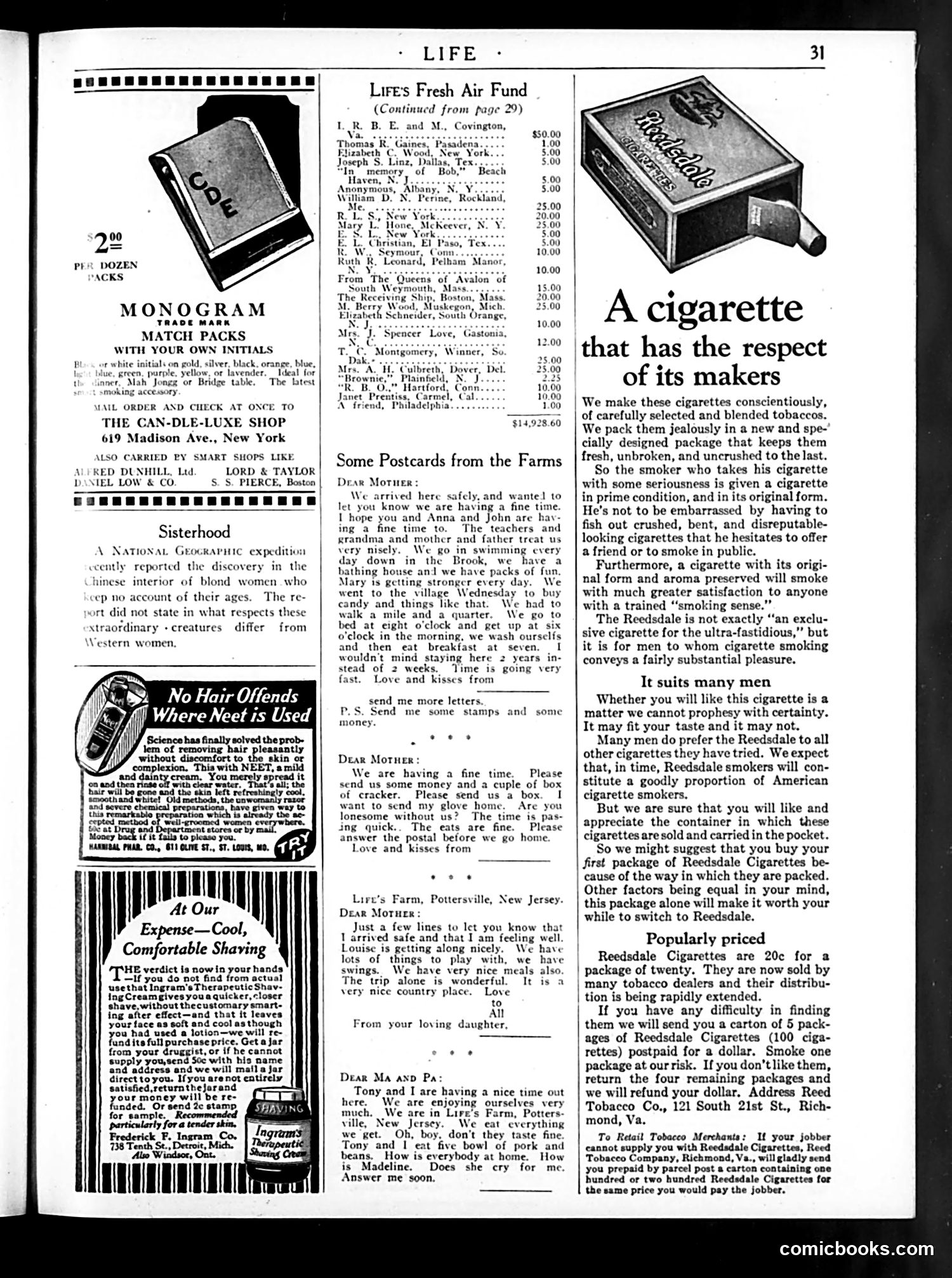
This page is primarily **advertising and reader correspondence**, not political satire. The main content includes: **Advertisements:** Match packs with monograms, hair removal cream (Neet), and shaving cream (Ingram's) — typical 1920s personal grooming products marketed to women and men. **"Sisterhood" humor:** A brief joke about a National Geographic expedition reporting "blonde women" in China who "keep no account of their ages" — a mild jab at Western women's vanity about aging, suggesting they're obsessed with hiding their years. **Life's Fresh Air Fund:** The bulk of the page comprises reader donations and postcards from children at a farm camp, likely a charitable program providing rural respite for urban children. The postcards show children's simple pleasures—swimming, walks, good food—and homesickness, reflecting Progressive Era charitable efforts to benefit underprivileged youth. The page reflects early 20th-century American attitudes toward personal appearance, charitable causes, and innocent childhood experiences.
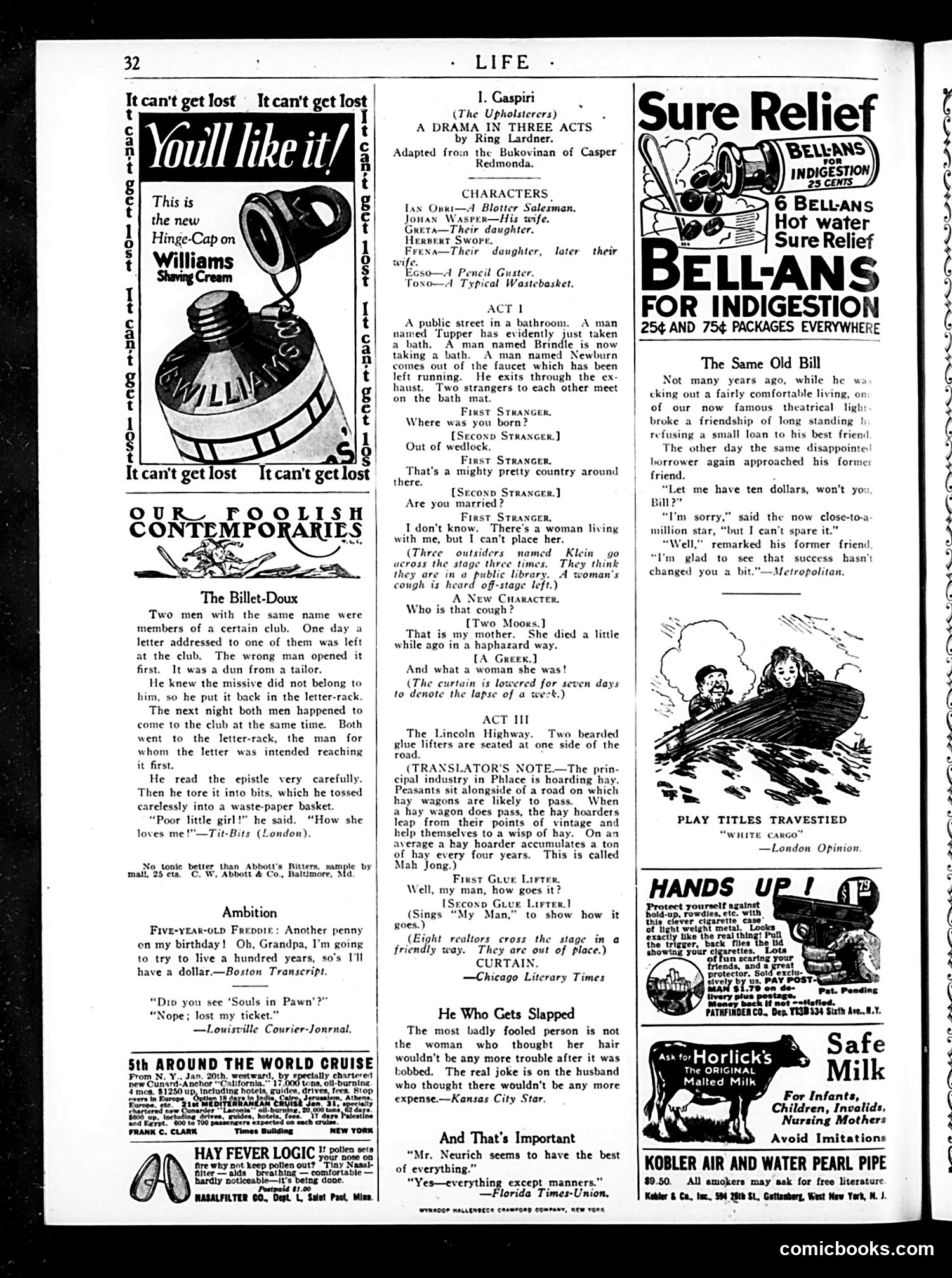
This page contains multiple short humorous pieces typical of Life's satirical style: **"The Billet-Doux"** mocks mistaken identity—two club members with identical names, where one man tears up a love letter meant for the other, hilariously misinterpreting a tailor's dun (debt notice) as a romantic confession. **"Our Foolish Contemporaries"** section includes absurdist humor like a five-year-old planning to live a hundred years to accumulate a dollar, and hay-fever logic suggesting nasal filters. **"Gaspiri (The Upholsterers)"** parodies avant-garde modernist theater—particularly Dadaist and experimental drama—through intentionally nonsensical characters (a "Typical Wastebasket" as cast member) and illogical plot descriptions ("hay hoarders"). The Chicago Literary Times attribution suggests satire of experimental literary magazines. **Brief quips** mock domestic life: marriage expense jokes, bobbed hair's upkeep costs, and marital misunderstandings. The overall tone ridicules contemporary absurdist artistic movements and everyday social pretensions.
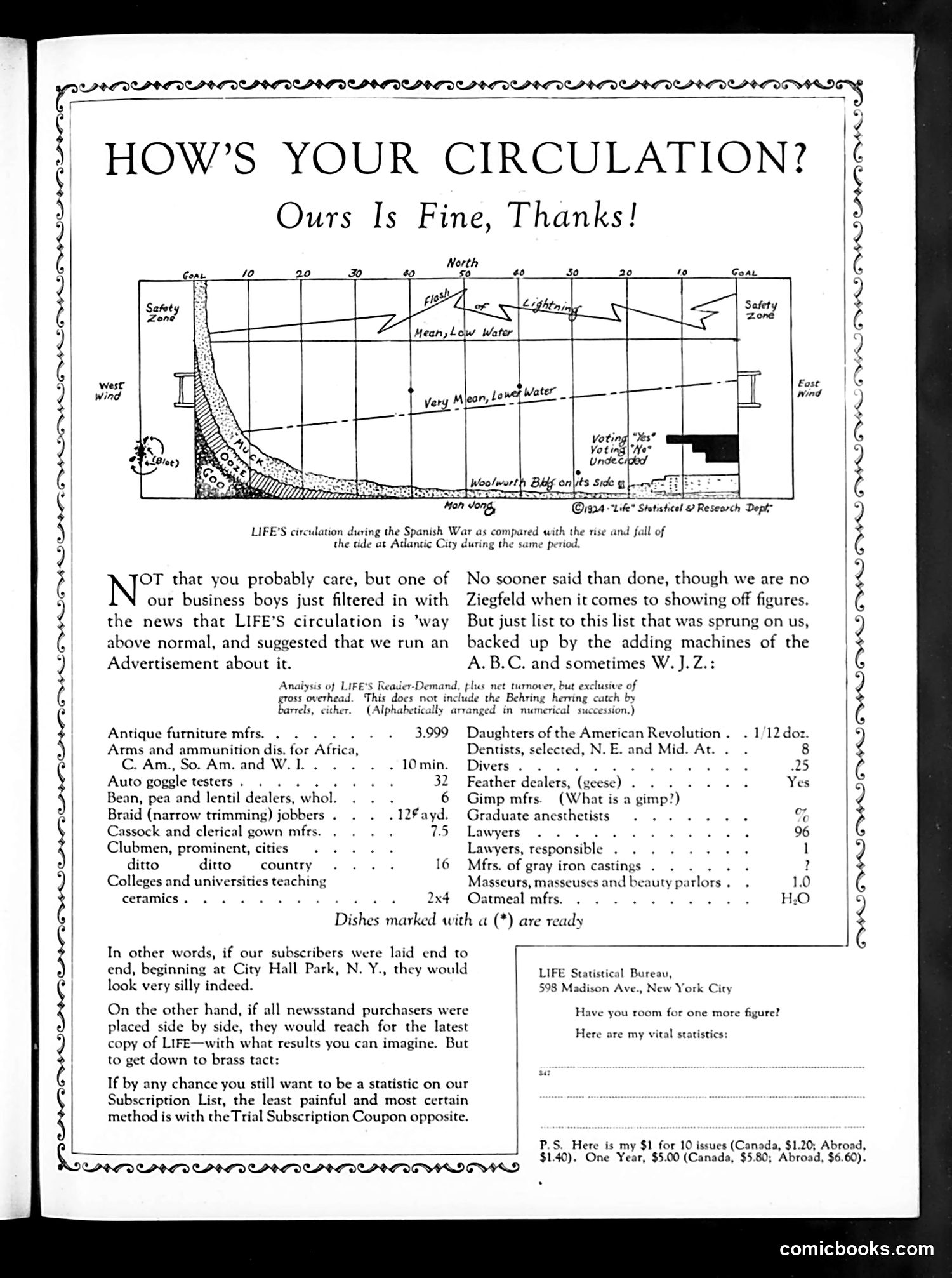
This page is a satirical self-promotional piece by *Life* magazine (circa 1924, based on the copyright mark) boasting about increased readership. The humor operates on multiple levels: **The Main Joke:** The top chart absurdly compares *Life's* circulation surge during the Spanish-American War to Atlantic City's tidal patterns—a nonsensical comparison meant to mock how magazines tout statistics. **The List Satire:** The bizarre "Reader-Demand Analysis" that follows ridicules audience segmentation by listing absurd subscriber categories: "Gimp mfrs. (What is a gimp?)", "Graduate anesthetists," "Feather dealers (geese)"—mixing legitimate professions with nonsensical ones to expose how arbitrarily publications slice demographic data. **The Physical Joke:** The closing quip—if subscribers were "laid end to end...they would look very silly indeed"—is slapstick humor about the magazine's growth. The overall satire targets how magazines use inflated or meaningless statistics to attract advertisers, while simultaneously *Life* itself engages in the same ridiculous practice for self-promotion.
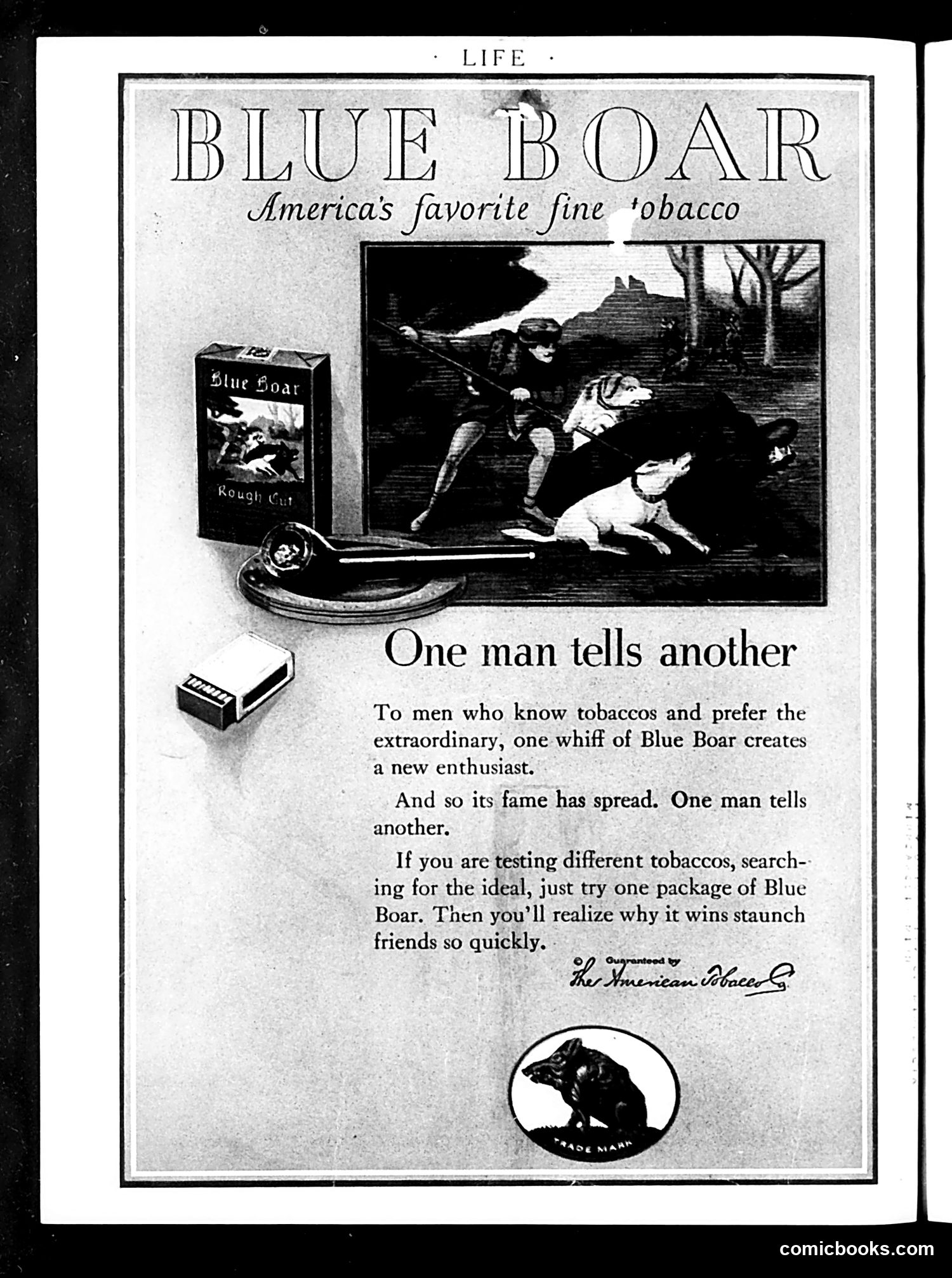
This is a **tobacco advertisement**, not political satire. The page promotes Blue Boar brand tobacco as "America's favorite fine tobacco." The imagery shows men outdoors hunting with dogs—a leisure activity associated with affluence and masculinity in early 20th-century advertising. The accompanying text uses word-of-mouth endorsement as its sales pitch: the product is so superior that "one man tells another," creating organic enthusiasm. The ad targets educated, discriminating male consumers ("men who know tobaccos") by positioning Blue Boar as the choice of connoisseurs. A boar logo appears at bottom. This reflects the era when tobacco advertising was commonplace in mainstream publications like *Life* magazine, before health concerns were widely publicized.