
Life, 1924-08-28 · page 20 of 36
Life — August 28, 1924 — page 20: what you’re looking at
What you’re looking at
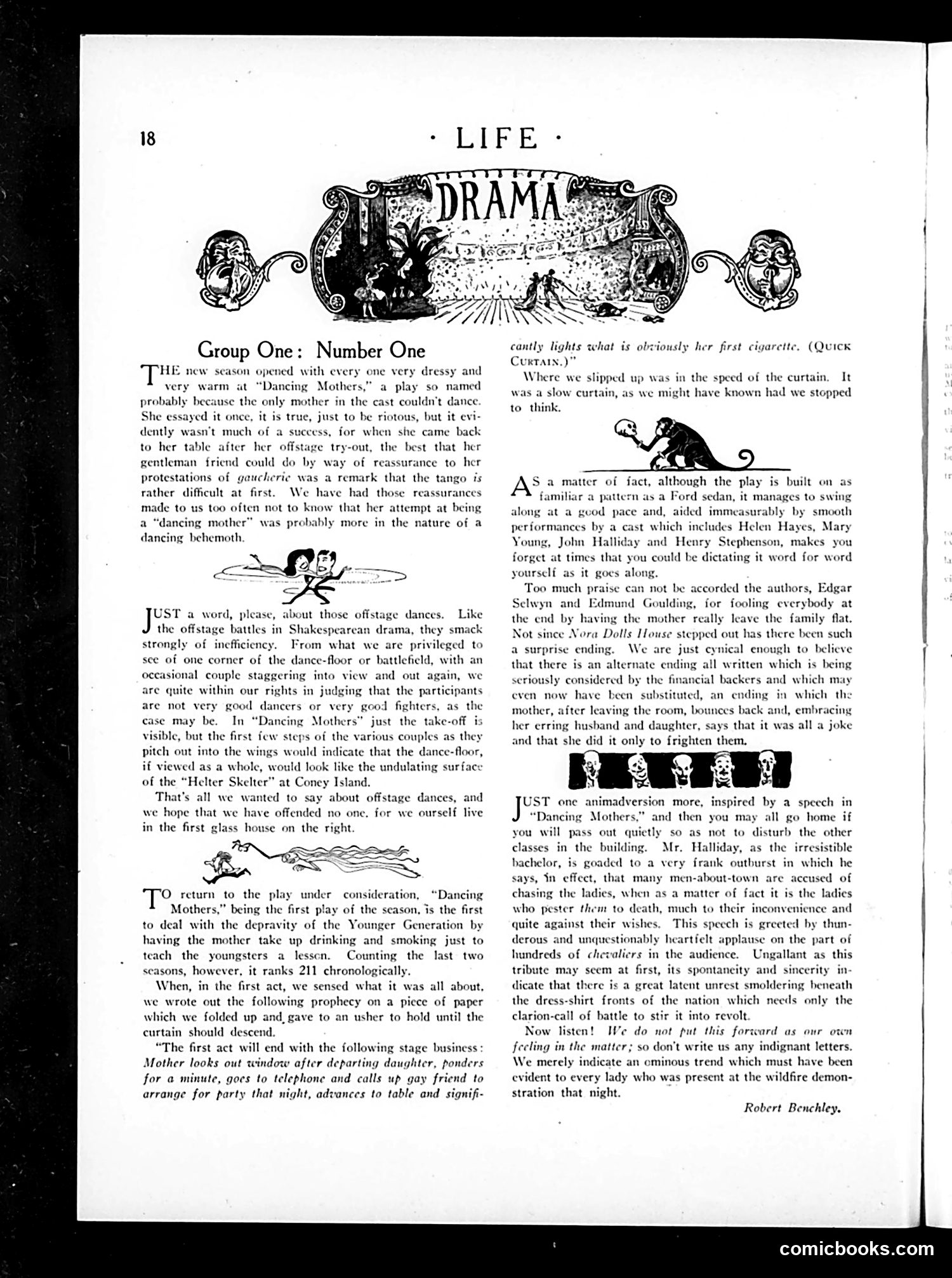
This is a theater review of the Broadway play *Dancing Mothers*, critiquing both the production and its depiction of the "Younger Generation" scandal theme popular in 1920s drama. The reviewer mocks the play's premise: a mother takes up drinking and smoking to teach her wayward daughter a lesson—a plot device already done 211 times in recent seasons. The satire targets the play's predictability and moral hypocrisy. The small cartoons (dancing figures) illustrate the reviewer's pointed criticism of the offstage dance sequences, which he compares unfavorably to the "Helter Skelter" ride at Coney Island—suggesting chaotic, amateurish choreography. The reviewer also lampoons the ending's supposed "surprise": the mother actually leaves her family, which the author sardonically notes is shocking only because financial backers might demand an alternate ending where she returns, making it all a joke. The piece is signed by Robert Benchley, Life's prominent humorist.
📄 Transcribed text from this page (OCR, searchable)
Machine-transcribed from the original scan — historical spelling and the odd misread are preserved.
Group One: Number One THe new season opened with every one very dressy and very warm at “Dancing Mothers,” a play so named probably because the only mother in the cast couldn't dance. She essayed it once, it is true, just to be riotous, but it evi- dently wasn’t much of a to her table after her « gentleman friend could do by w of reassurance to her protestations of gaucherie was a remark that the tango is rather difficult at first. We have had those made to us too often not to know that her attempt at being a “dancing mother” was probably more in the nature of a dancing behemoth x » ST a word, please, about those offstage dances. Like the offstage battles in Shakespearean drama, they smack strongly of ineffici From what we are privileged to see of one corner of the dance-floor or battlefield, with an occasional couple staggering into view and out are quite within our rights in judging that the participants success, for when she came back we try-out, the best that her ain, we are not very good dancers or very good fighters, as the ise may be. In “Dancing Mothers” just the take-off is visible, but the first few steps of the various couples as they pitch out into the wings would indicate that the dance-floor, if viewed as a whole, would look like the undulating surfat of the “Helter Skelter” at Coney Island. That's all we wanted to say about o! we hope that we have offended no one. in the first glass house on the right. stage dances, and or we ourself live om, T° return to the play under consideration, “Dancing being the first play of the se is the first to deal with the depravity of the Younger Generation by having the mother take up drinking and smoking just to teach the youngsters a lesson. Counting the last two seasons, however, it ranks 211 chronologically. When, in the first act, we sensed what it was all about, we wrote out the following prophecy on a picce of paper which we folded up and, gave to an usher to hold until the curtain should descend. “The first act will end with the following stage business : Mother looks out window after departing daughter, ponders for a minute, goes to telephone and calls up gay friend to arrange for party that night, advances to table and signifi- cantly lights what is obviously her first cigarette. (Quick Curtain,)” Where we slipped up was in the speed of the curtain. It was a slow curtain, as we might have known had we stopped to think. AS a matter of fact, although the play is built on as familiar a pattern as a Ford sedan, it manages to swing ace and, aided immeasurably by smooth performances by a cast which includes Helen Hayes, Mary Young, John Halliday and Henry Stephenson, makes you forget at times that you could be dictating it word for word along at a geod yourself as it goes along. Too much praise can not be accorded the authors, Edgar Selwyn and Edmund Goulding, for fooling everybody at the end by having the mother really leave the family flat. Not since Vora Dolls House stepped out has there been such a surprise ending. We are just cynical enough to believe that there is an alternate ending all written which is being seriously considered by the financial backers and which may even now have been substituted, an ending in which the mother, after leaving the room, bounces ‘k and, embracing her erring husband and daughter, says that it was all a joke and that she did it only to frighten them, UST one animadversion more, inspired by a speech in “Dancing Mothers,” a then you may all go home if you will pass out quictly so as not to disturb the other classes in the building. Mr, Halliday bachelor, is goaded to a very frank outburst in which he , as the irresistible says, in effect, that many men-about-town are accused of chasing the who pester them to death, much to their inconvenience and quite against their wishes. This speech is greeted by thun- derous and unquestionably heartfelt applause on the part of hundreds of chevaliers in the audi Ungallant as this tribute may ‘m at first, its spontaneity and sincerity in- dicate that there is a great latent unrest smoldering beneath the dress-shirt fronts of the nation which needs only the clarion-call of battle to stir it into revolt Now listen! We do not put this forward as our own ladies, when as a matter of fact it is the ladies feeling in the matter; so don't write us any indignant letters. We merely indicate an ominous trend which must have been evident to every lady who was present at the wildfire demon- stration that night. Robert Benchley. comicbooks.com