
Life, 1924-08-28 · page 30 of 36
Life — August 28, 1924 — page 30: what you’re looking at
What you’re looking at
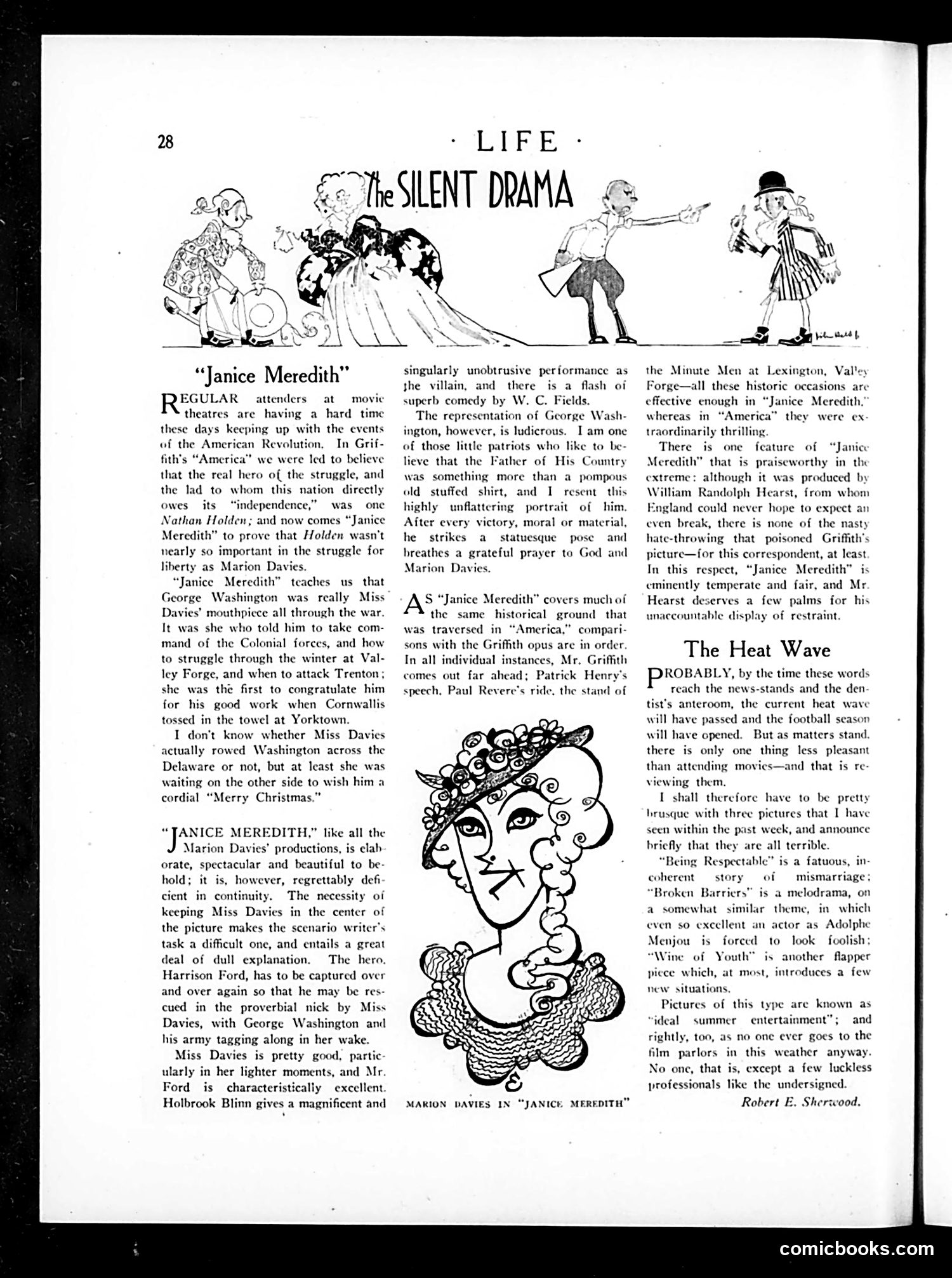
This is a film review from *Life* magazine critiquing Marion Davies' silent film "Janice Meredith," a Revolutionary War drama. The satire targets **Davies' dominance in the narrative**: the reviewer sarcastically notes that the film rewrites history to position Davies' character as the true architect of American independence, with George Washington reduced to taking her orders. The joke relies on **nepotism criticism**—Davies was a protégée (and romantic interest) of newspaper magnate William Randolph Hearst, who produced the film. The reviewer ridicules how the script contorts itself keeping Davies center-stage, requiring repetitive rescue scenarios. The caricature of Marion Davies shown alongside mocks her outsized prominence. The reviewer compares the film unfavorably to D.W. Griffith's earlier "America," praising Griffith's dramatic execution while acknowledging Hearst's film avoids the "hate-throwing" present in Griffith's work—a backhanded compliment about restraint in propaganda.
📄 Transcribed text from this page (OCR, searchable)
Machine-transcribed from the original scan — historical spelling and the odd misread are preserved.
~TheSILENT DRAMA “Janice Meredith” EGULAR attenders at movie theatres are having a hard time these days keeping up with the events of the American Revolution, In Gri fith's “America” we were led to believe that the real hero of the struggle, and the lad to whom this nation directly owes its “independence,” was Nathan Holden; and now comes “Janice Meredith” to prove that Holden wasn't nearly so important in the struggle for liberty as Marion Davies. “Janice Meredith” teaches us that George Washington was really Miss Davies’ mouthpiece all through the war. It was she who told him to take com- mand of the Colonial forces, and how to struggle through the winter at Val- ley Forge, and when to attack Trenton; she was the first to congratulate him for his good work when Cornwallis tossed in the towel at Yorktown. I don't know whether Miss Davies actually rowed Washington across the Delaware or not, but at least she was waiting on the other side to wish him a cordial “Merry Christmas.” one “JANICE MEREDITH,” like all the Marion Davies’ productions, is clab orate, spectacular and beautiful to be- hold; it is, however, regrettably defi cient in continuity. The necessity of keeping Miss Davies in the center of the picture makes the scenario writer's task a difficult one, and entails a great deal of dull explanation. The hero. Harrison Ford, has to be captured over and over again so that he may be res- cued in the proverbial nick by Miss Davies, with George Washington and his army tagging along in her wake. Miss Davies is pretty good, partic ularly in her lighter moments, and Mr. Ford is characteristically excellent. Holbrook Blinn gives a magnificent and LEE - a “ q fo singularly unobtrusive performance as the villain, and there is a flash of superb comedy by W. C. Fields. The representation of George Wash- ington, however, is ludicrous. I am one of those little patriots who like to be- lieve that the Father of His Country was something more than a pompous old stuffed shirt, and 1 resent this highly unflattering portrait: of him. After every victory, moral or material, he strik a statuesque and breathes a grateful prayer to God and Marion Davies. AS “Janice Meredith” covers much of the same historical ground that was traversed in “America,” compari- sons with the Griffith opus are in order. In all individual instances, Mr. Griffith comes out far ahead; Patrick Henry's speech, Paul Revere’s ride, the stand of pose MARION DAVIES IN “JANICE MEREDITH” the Minute Men at Lexington, Val'ey Forge—all these historic occasions are effective enough in “Janice Meredith, whereas in “America” they were ex traordinarily thrilling. There is feature of “Janice Meredith” that is praiseworthy in- the one extreme: although it was produced by W m Randolph Hearst, from whom England could never hope to expect an even break, there is none of the nasty hate-throwing that poisoned Griffith's picture—for this correspondent, at least. In this respect, “Janice Meredith” is eminently temperate and fair, and Mr Hearst deserves a few palms for his unaccountable display of restraint. The Heat Wave ROBABLY, by the time these words reach the news-stands and the den tist’s anteroom, the current heat wave will have passed and the football s will have opened. But as matters stand. there is only one thing less pleasant than attending movies—and that is re viewing them. ason I shall therefore have to be pretty brusque with three pictures that 1 have seen within the past week, and announce briefly that they are all terrible: “Being Respectable” is a fatuous, in- coherent story of “Broken Barrier: a somewhat mismarriage ; a melodrama, on similar theme, in which even so excellent an actor as Adolphe Menjou. is look foolish: “Wine of Youth" is another flapper piece which, at most, introduces a few forced to new situations, Pictures of this type are known as summer entertainment”; and rightly, too, as no one ever goes to the “ideal film parlors in this weather anyway. No one, that is, except a few luckless professionals like the undersigned. Robert E, Sherwood. comicbooks.com