
Life, 1924-08-28 · page 17 of 36
Life — August 28, 1924 — page 17: what you’re looking at
What you’re looking at
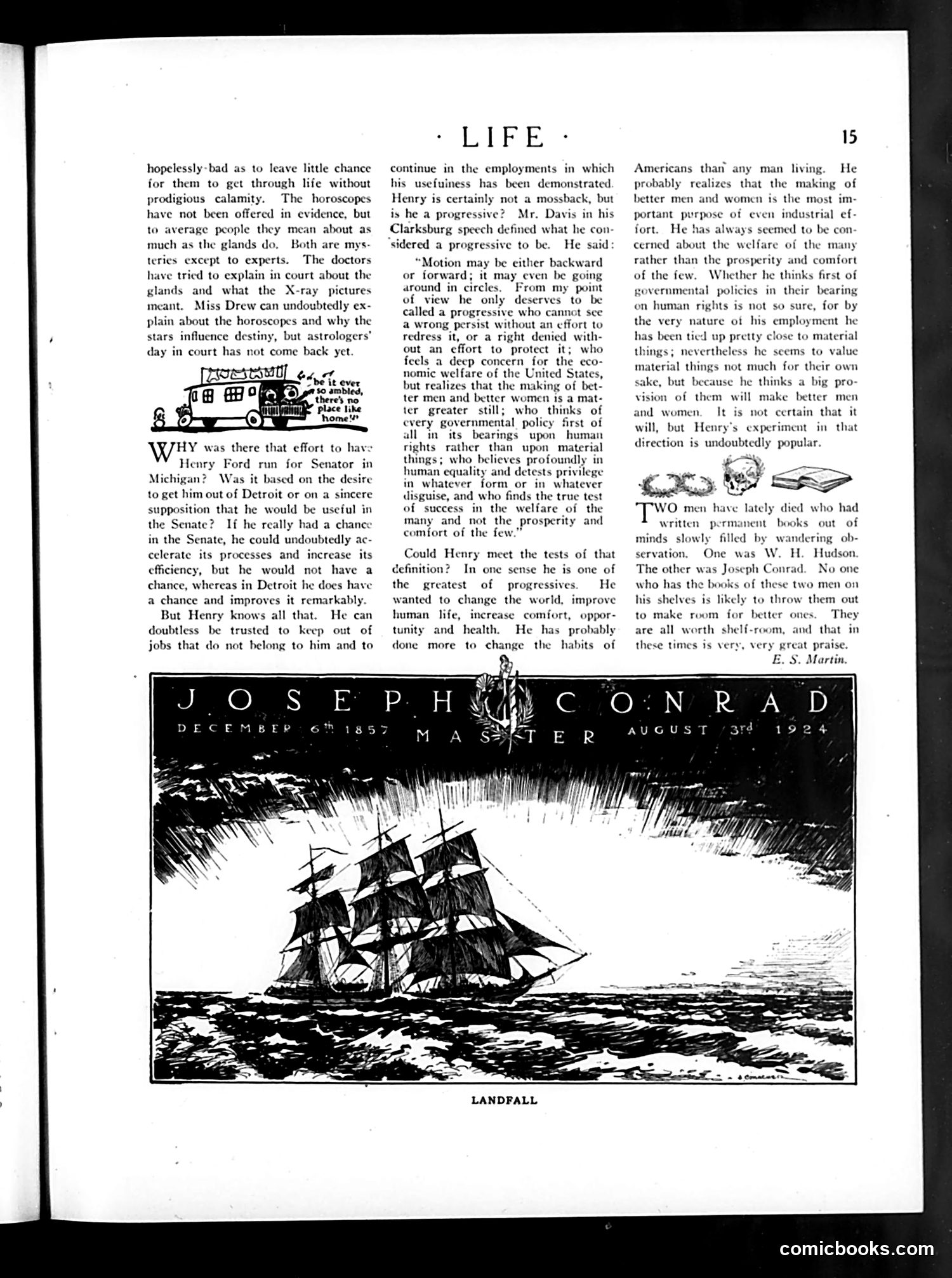
This page contains a memorial illustration for Joseph Conrad, the Polish-British novelist who died August 3, 1924. The image shows a sailing ship (appearing to be from Conrad's era of seafaring adventure) with the text "LANDFALL" below it—referencing Conrad's maritime themes. The upper text discusses progressive politics and Henry Ford, arguing about what constitutes genuine progress in improving human welfare. It debates whether true progressivism means changing the world for better living conditions or simply advancing individual prosperity. The page is primarily a tribute to Conrad's literary legacy, using nautical imagery appropriate to his novels like *Lord Jim* and *Heart of Darkness*, which heavily featured ships and ocean voyages as central elements.
📄 Transcribed text from this page (OCR, searchable)
Machine-transcribed from the original scan — historical spelling and the odd misread are preserved.
hopelessly-bad as to leave little chance for them to get through life without prodigious calamity. The horoscopes have not been offered in evidence, but to average people they mean about as much as the glands do, Both are mys. teries except to experts. The doctors have tried to explain in court about the glands and what the X-ray pictures meant. Miss Drew can undoubtedly ex- plain about the horoscopes and why the stars influence destiny, but astrologers’ day in court not come back yet HY was there that effort to h: Henry Ford run for Senator in Michigan? Was it based on the desire to get him out of Detroit or on a sincere supposition that he would be useful in the Senate? If he really had a chance in the Senate, he could undoubtedly ac- celerate its processes and increase its efficiency, but he would not have a chance, whereas in Detroit he does have a chance and improves it remarkably. But Henry knows all that. He can doubtless be trusted to keep out of jobs that do not belong to him and to J.O,,8 EF EMBER “sidered a progressive to be. LIFE continue in the employments in which his usefuiness has been demonstrated. Henry is certainly not a mossback, but is he a progressive? Mr. Davis in his Clarksburg speech defined what he con- He sai “Motion may be either backward or forward; it may even be going around in circles. rom my point of view he only deserves to be called a progressive who cannot sce a wrong persist without an cffort to redress it, or a right denied with- out an effort to protect it; who feels a deep concern for the eco- nomic welfare of the United States, but realizes that the making of bet- ter men and better women is a mat- ter greater still; who thinks of every governmental policy first of all in its bearings upon human rights rather than upon material things; who believes profoundly in human equality and detests privilege in whatever form or in whatever disguise, and who finds the true test of success in the welfare of the many and not the prosperity and comfort of the few.” Could Henry meet the tests of that cefinition? In one sense he is one of the greatest of progressives. He wanted to change the world, human life, increase comfort, oppor- tunity and health, He has probably done more to change the habits of improve LANDFALL 15 man living. He realizes that the making of better men and women is the most im- Americans than any probably even industrial ef- fort. He med to be con- cerned about the welfare of the rather than the prosperity and comfort of the few. Whether he thinks first of governmental policies in their bearing on human rights is not so sure, for by the very nature of his employment he has been tied up pretty close to material things; nevertheless he seems to value material things not much for their own sake, but because he thinks a big pro- vision of them will make better men and women. It is not certain that it will, but Henry's experiment in that direction is undoubtedly popular. portant purpose of as alway’s si many To m men have lately died who had written permanent books out of minds slowly filled by wandering ob- servation, One was W. H. Hudson The other was Joseph Conrad. No one who has the books of these tw: his shelves is likely to throw them out to make for better ones. They are all worth shelf-room, and that in praise. Martin, men on room these times is very, very gre comicbooks.com