
A complete issue · 36 pages · 1924
Life — February 21, 1924
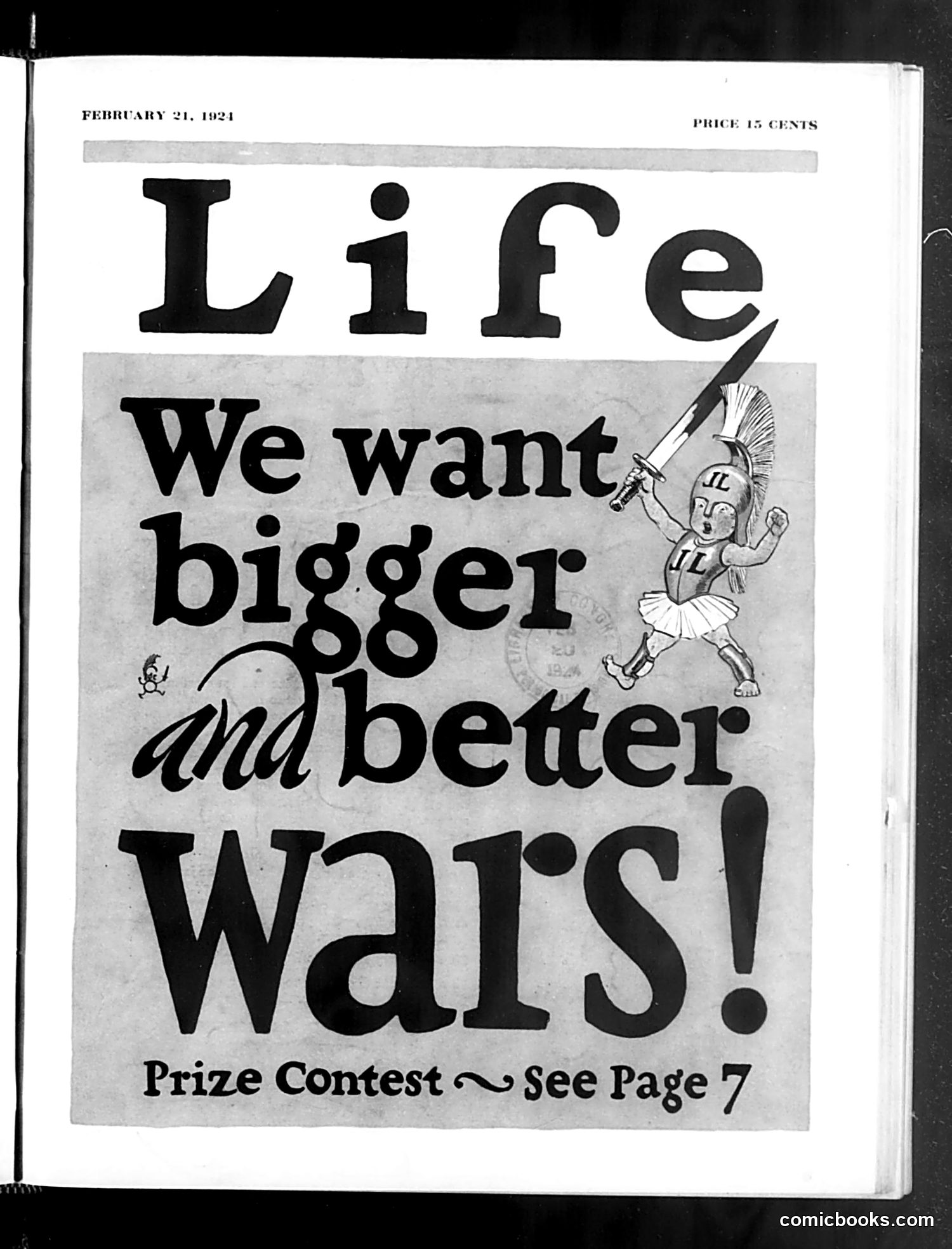
This appears to be a **magazine cover or advertisement** promoting a prize contest about walls. The headline "We want bigger and better WARS!" features a caricatured figure (possibly representing a political or military leader) wielding a large paintbrush or weapon, wearing what appears to be a military or ceremonial hat marked "II." The satire likely comments on **post-World War I militarism or international tensions** of the early 1920s—a period when nations were debating military spending and preparedness. The ironic phrasing "bigger and better" mocks the rhetoric of those advocating for increased military buildups. Readers are directed to **Page 7 for contest details**. Without seeing that page, the specific satirical target remains unclear, though it's clearly critiquing contemporary militaristic attitudes.
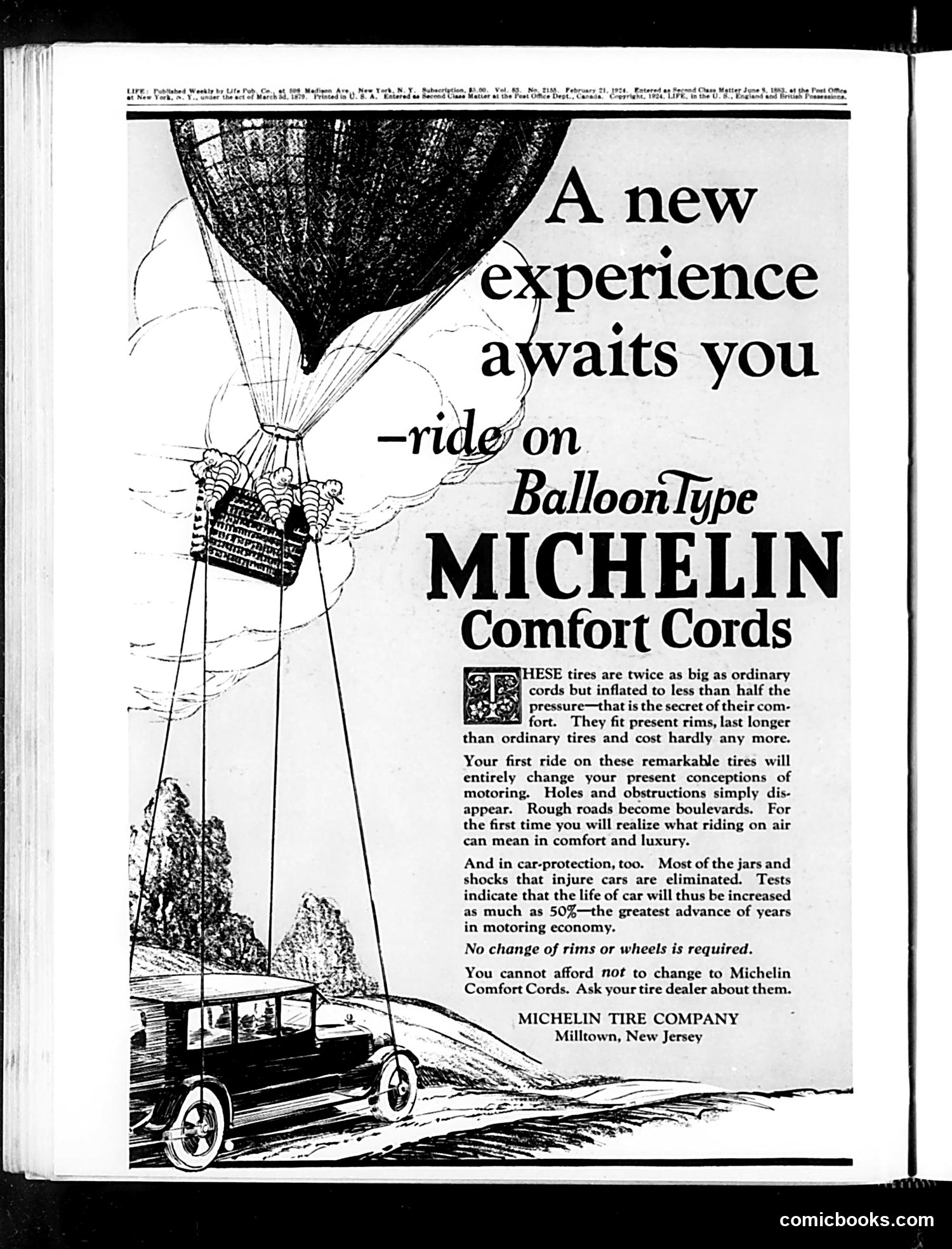
This is not a political cartoon or satire, but rather a **straightforward advertisement** for Michelin Comfort Cords tires from the Michelin Tire Company (Milltown, New Jersey). The image depicts a hot air balloon carrying an automobile basket, with a car below on the ground—a whimsical illustration meant to convey the extraordinary comfort and smoothness of the tires. The ad claims these balloon-type tires are "twice as big as ordinary cords" yet cost barely more, offering superior comfort, longer life, and protection against road damage. The key selling point: "No change of rims or wheels is required." This was significant for early automotive buyers concerned about compatibility and installation costs. The ad concludes with an emphatic "You cannot afford *not* to change to Michelin Comfort Cords."
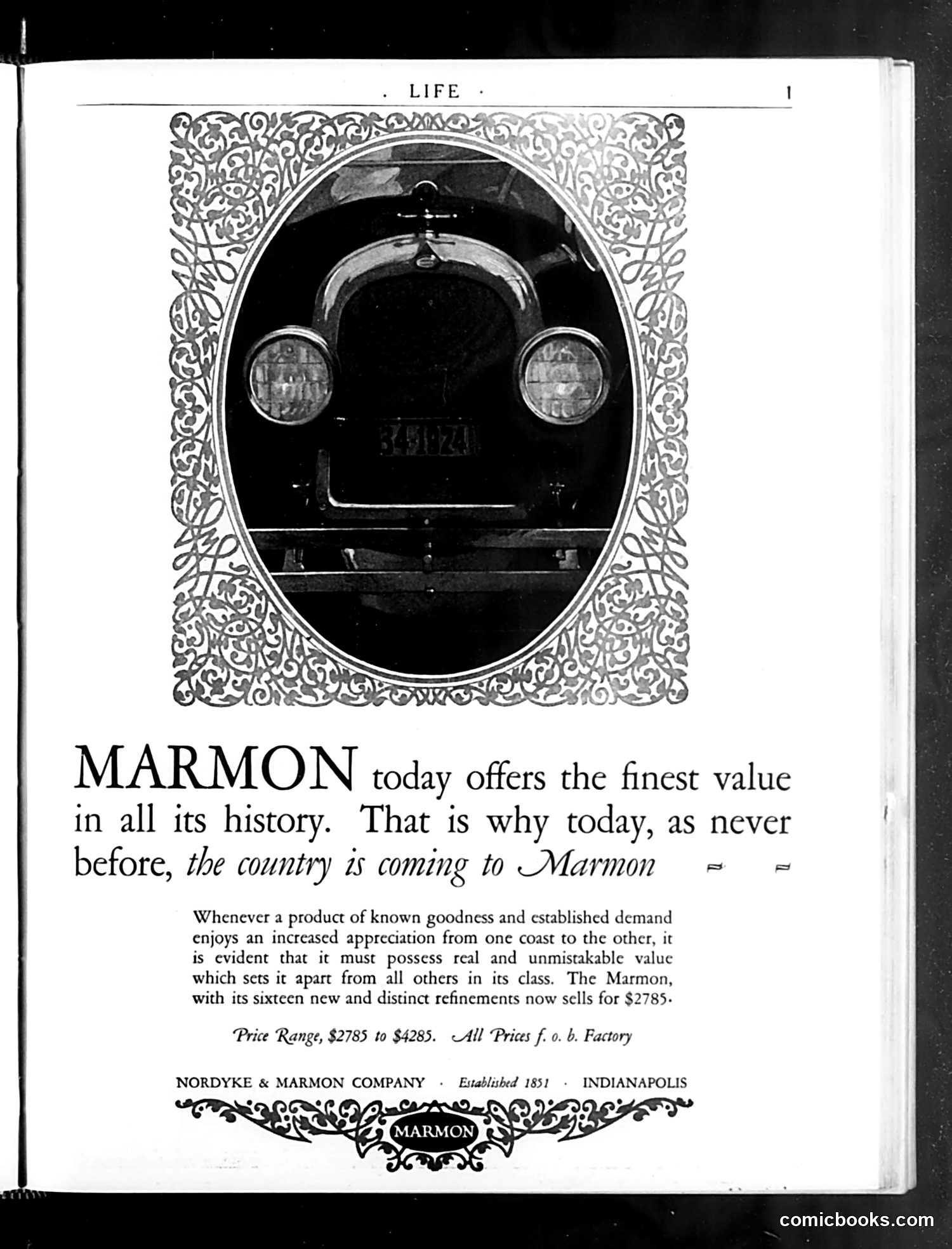
This page is **primarily an advertisement**, not satire or political commentary. It's a full-page ad for the Marmon automobile, published by Nordyke & Marmon Company (established 1851, Indianapolis). The ad features a front-facing photograph of a Marmon car framed in ornate decorative borders. The marketing copy claims the Marmon "today offers the finest value in all its history" and boasts that "the country is coming to Marmon." It emphasizes the car's "real and unmistakable value" and lists a price range of $2,785 to $4,285 (factory prices). There is no political cartoon or satire present on this page—it is straightforward automotive advertising from the Life magazine archives.
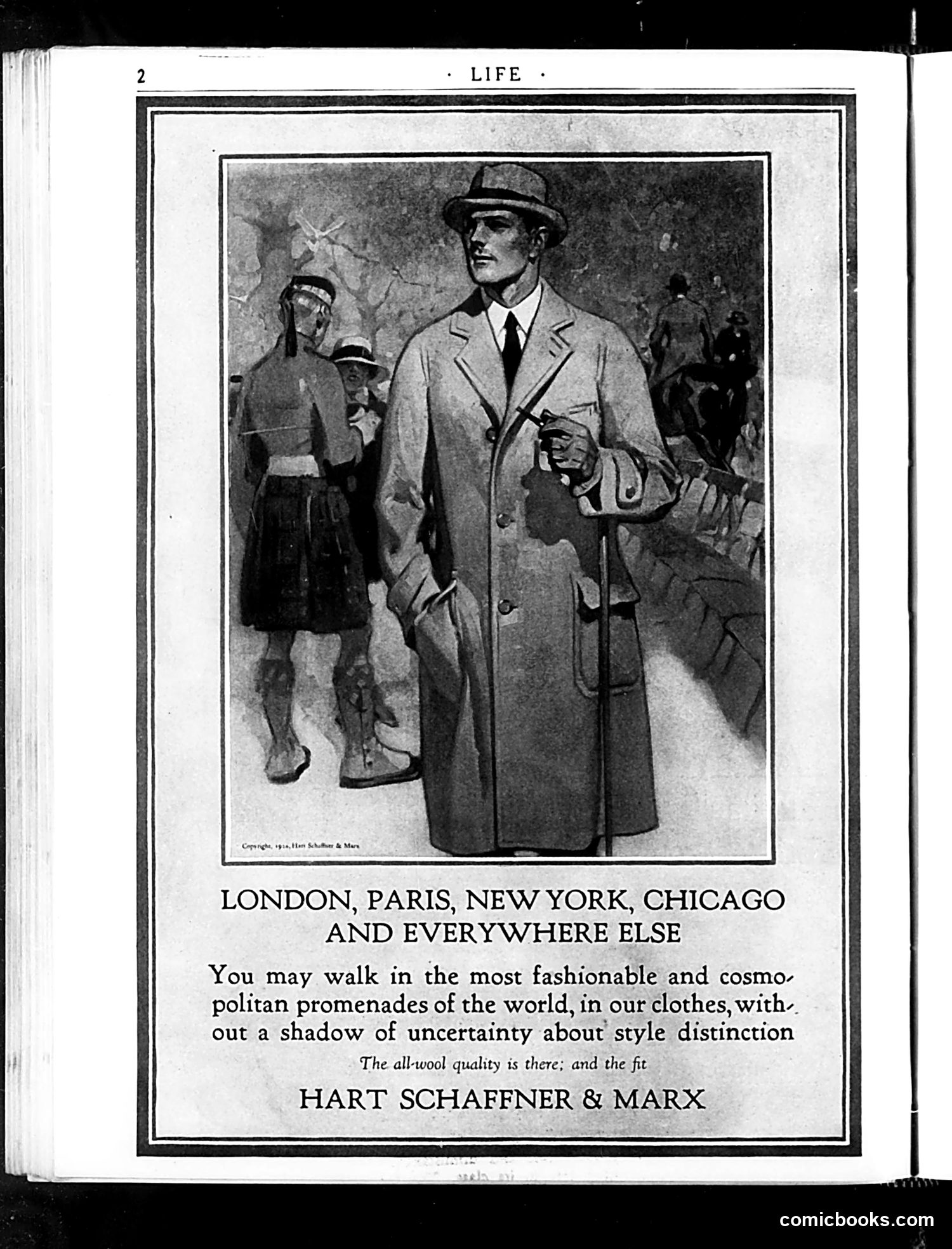
This is a **clothing advertisement**, not political satire. Hart Schaffner & Marx, a men's clothier, uses aspirational messaging to market their suits. The image shows a well-dressed man in an overcoat and fedora, positioned prominently while other figures appear in the background—a visual strategy emphasizing his superior style and confidence. The advertisement's text promises that wearing their all-wool clothes allows customers to walk "in the most fashionable and cosmopolitan promenades of the world" (London, Paris, New York, Chicago) "without a shadow of uncertainty about style distinction." This appeals to early 20th-century male consumers' desire for social respectability and cosmopolitan sophistication through proper clothing. The ad suggests their garments confer both quality and status.
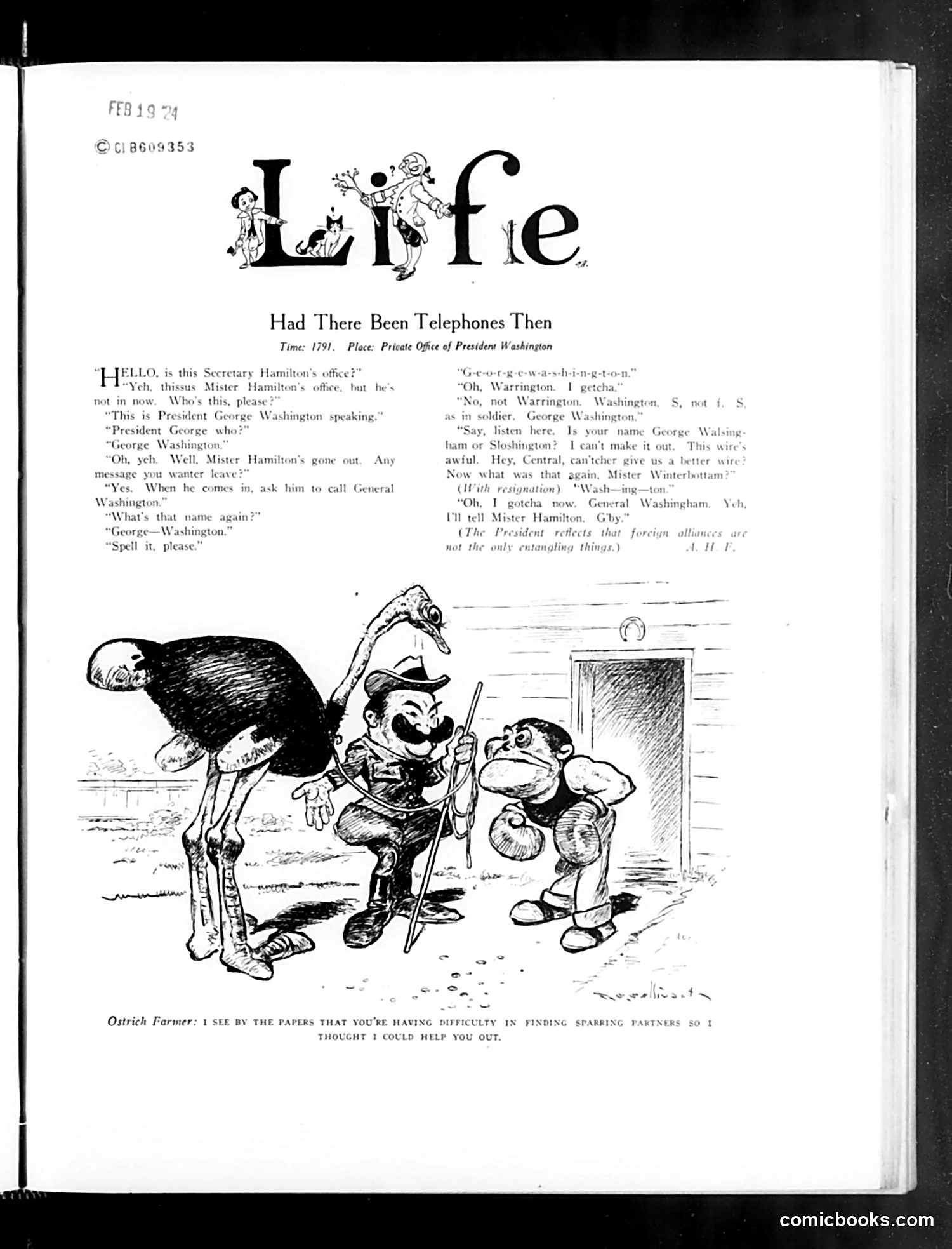
This is a humorous hypothetical scenario imagining President George Washington in 1791 trying to use a telephone to reach General Washington (confusing the two identities). The joke satirizes: 1. **Communication confusion**: A secretary mishears "George Washington" repeatedly, unable to distinguish between the President and a General with the same name. 2. **Modern technology anachronism**: The humor comes from applying 1890s telephone technology to the 18th century, showing how even a simple phone call creates bureaucratic confusion. 3. **Period satire**: The cartoon mocks both contemporary phone system inefficiencies and the absurdity of imagining historical figures dealing with modern inconveniences. The illustration depicts cartoon characters in a period office setting, emphasizing the comedic clash between eras.
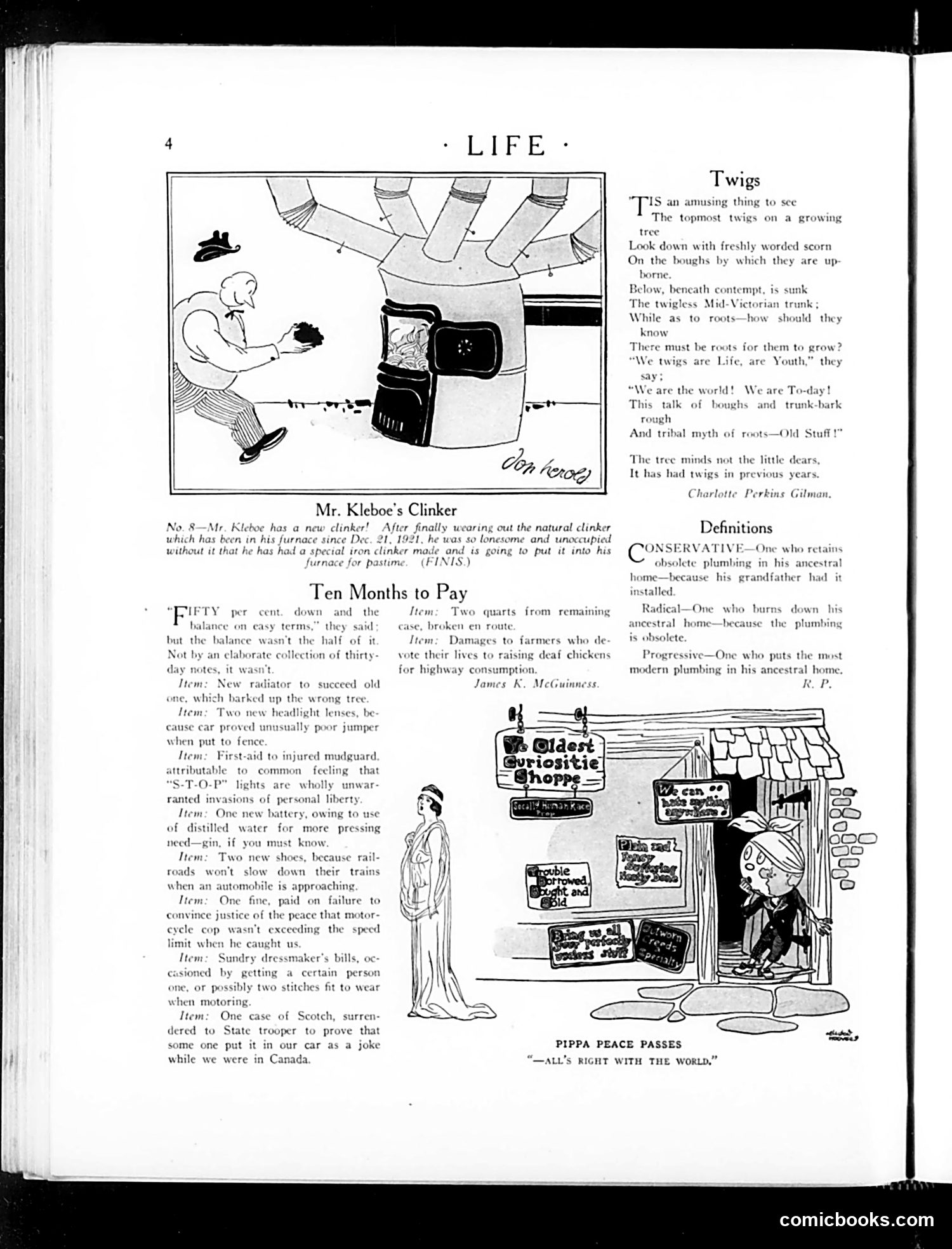
**"Mr. Kleboe's Clinker"** (top cartoon): Shows a man discarding what appears to be a defective furnace part from his home. The caption notes he's owned this problematic clinker since December 21, 1921, and finally decided to remove it—likely a contemporary reference to an actual malfunctioning furnace that became a running joke among readers. **"Ten Months to Pay"** (middle section): A humorous list of absurd damages and repairs, mostly satirizing poor car maintenance and automotive mishaps. The humor relies on mundane domestic frustrations. **"Pippa Peace Passes"** (bottom cartoon): Shows a woman visiting an "Oldest Curiositie Shoppe," satirizing consumerism and nostalgic acquisition of antiques or oddities. The page represents typical 1920s-era satirical humor about consumer goods and domestic life.
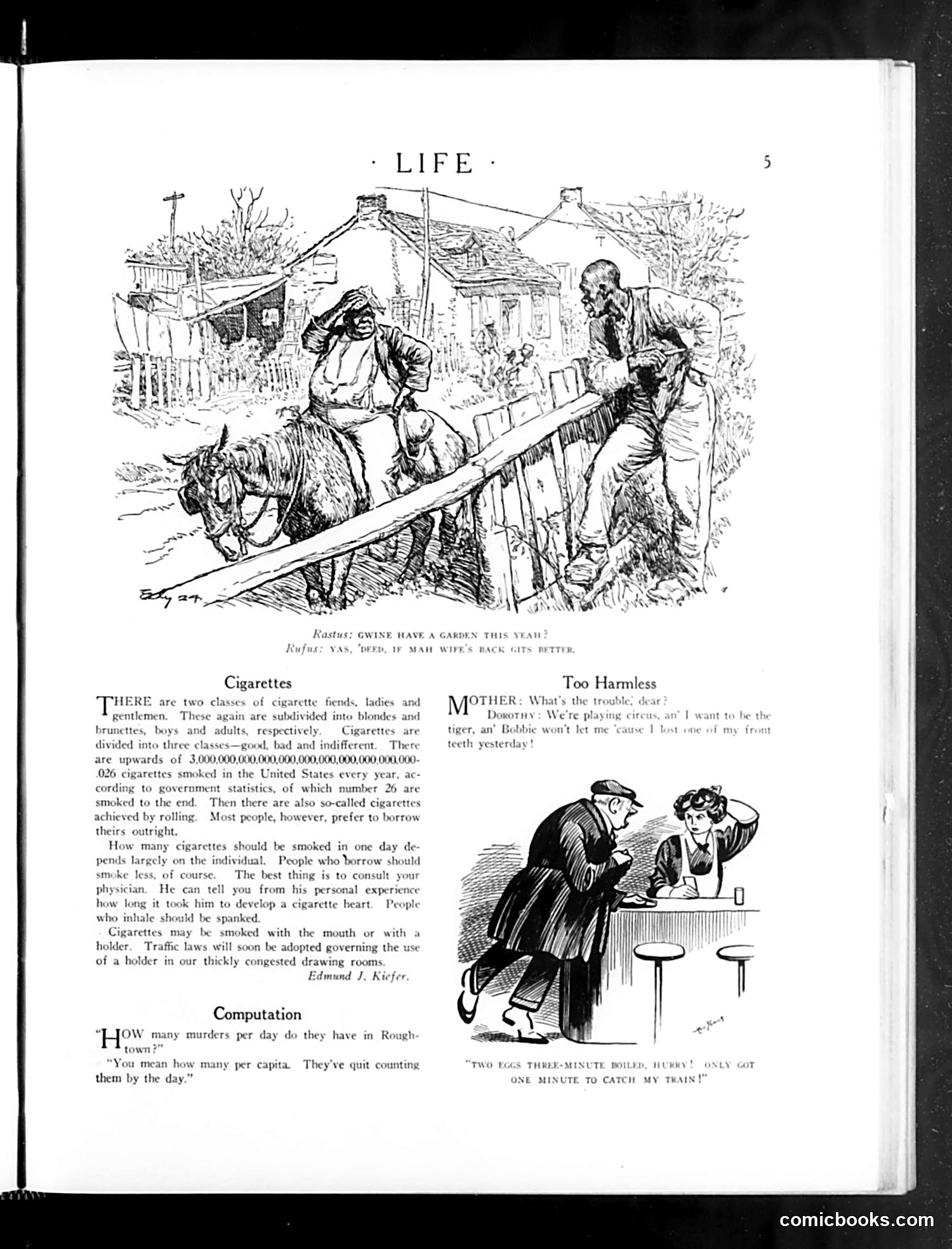
This page contains three satirical pieces: 1. **Top cartoon**: A rural scene where one man on horseback asks another about growing a garden. The response jokes that gardens will thrive "if man wife's back gits better"—humor based on the assumption of hard domestic labor. 2. **"Cigarettes" article**: A mock-serious discussion of cigarette consumption in America, noting billions smoked yearly. It satirizes debates about smoking habits and health concerns through deadpan statistics and advice to consult physicians. 3. **"Too Harmless" cartoon**: A mother and child discuss missing front teeth. The child blames "Bobbie" and a lost tooth yesterday, creating gentle domestic humor about childhood accidents. 4. **"Computation" section**: A brief joke about murder statistics in a rough town, playing on dark humor about crime rates. The page exemplifies Life's satirical approach to American social customs and contemporary concerns.
This appears to be a satirical illustration titled "Lies" from Life magazine. The image depicts a large, rotund figure (possibly representing a politician or public figure) surrounded by smaller cherub-like creatures blowing trumpets and emerging from clouds of smoke or distortion. The composition suggests the central figure is generating or spreading falsehoods, with the cherubs functioning as amplifiers of misinformation. The swirling, chaotic linework emphasizes confusion and chaos emanating from this source. Without additional context or visible text explaining the specific political reference, I cannot identify the exact figure being caricatured or name the particular scandal or public lie being satirized. The general message critiques how one prominent person's dishonesty spreads widely through public channels.
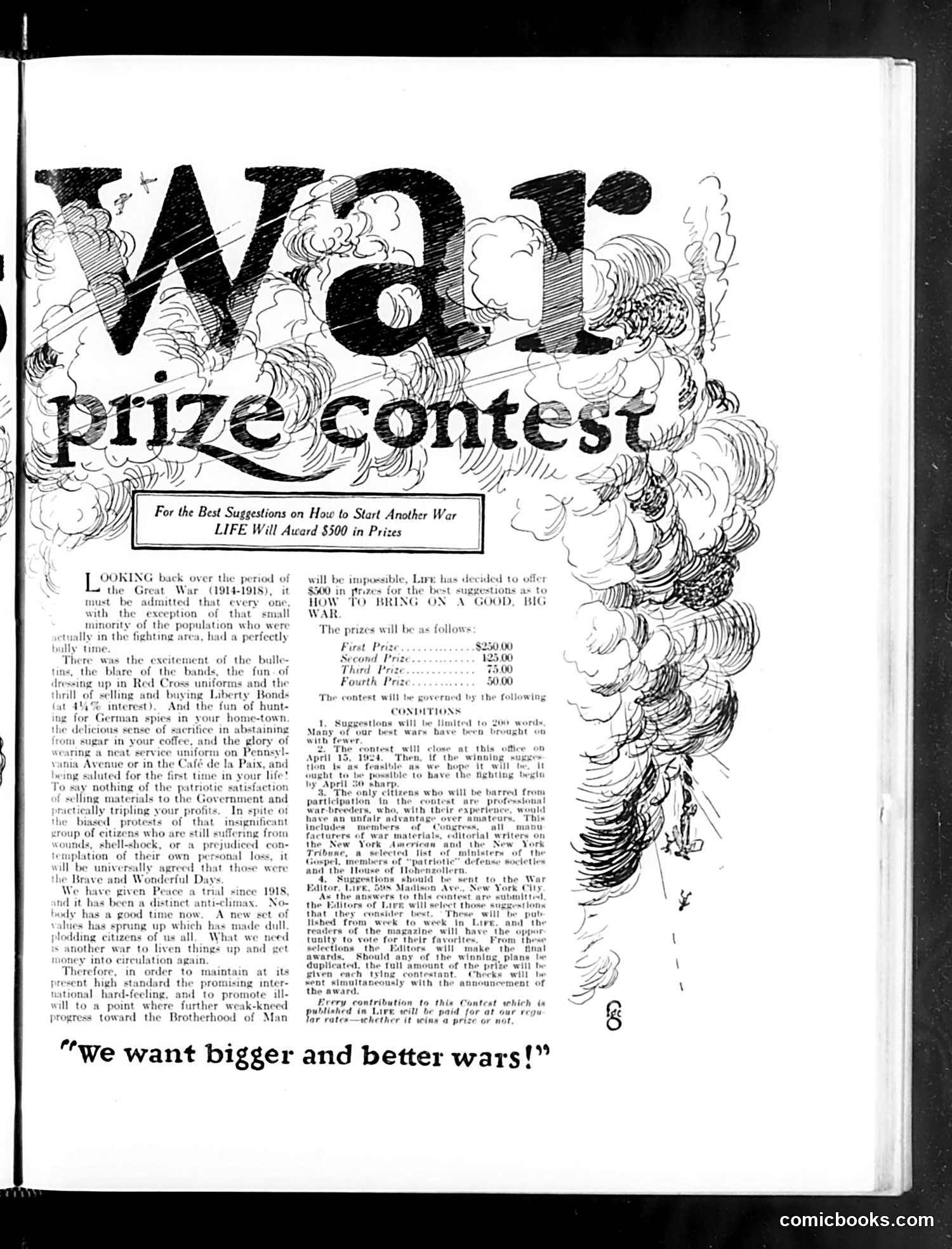
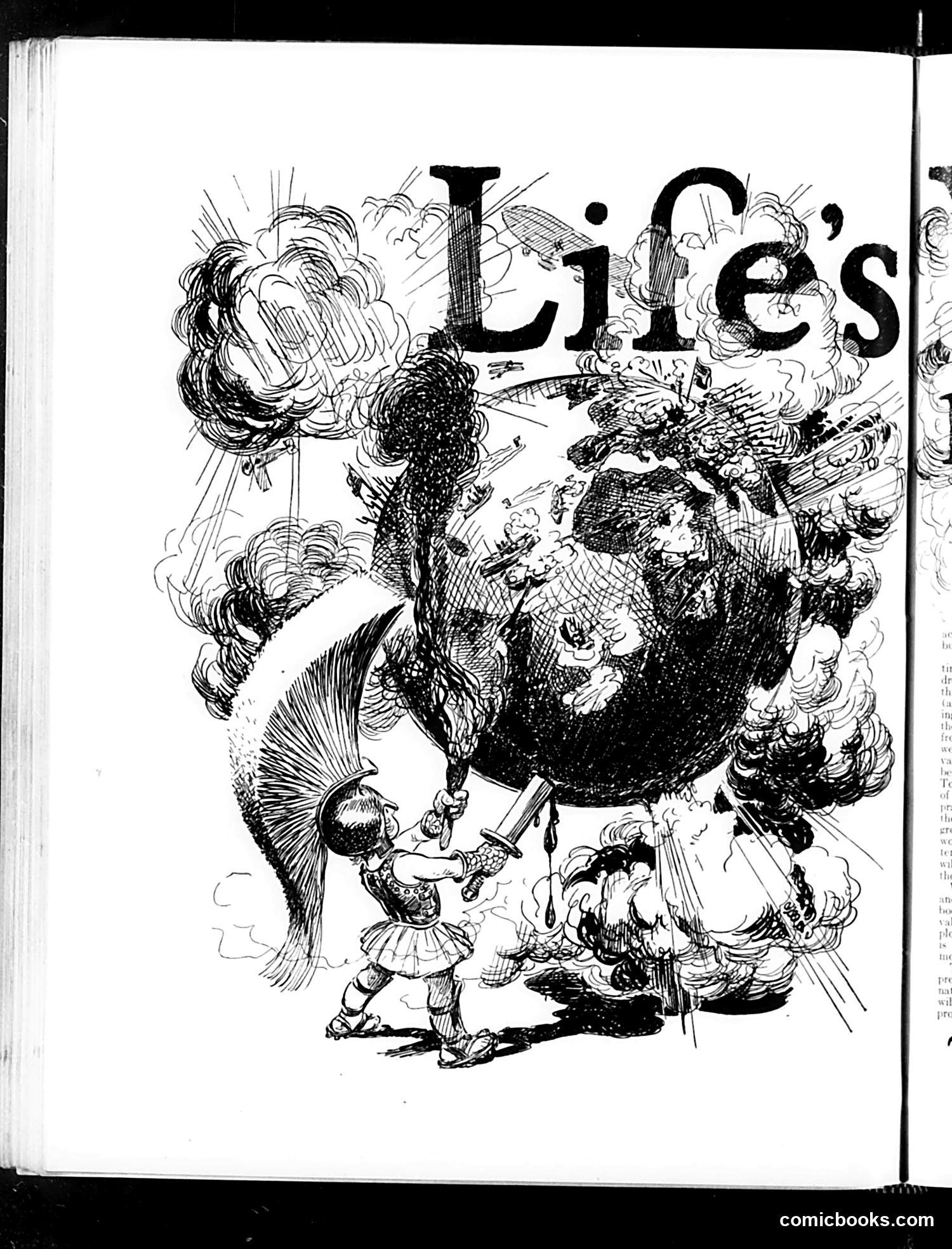
This page is primarily a contest advertisement rather than a political cartoon. Life magazine is soliciting submissions for a "Prize Contest" offering $500 total in prizes for "the Best Suggestions on How to Start Another War." The large decorative letters "WAR" are surrounded by explosive cloud imagery. The text indicates this is satirical commentary on WWI (1914-1918), which had recently ended. The contest invites readers to propose ways to initiate future conflicts, clearly meant as dark satire mocking the destructive folly of the Great War. The closing line—"We want bigger and better wars!"—underscores the satirical intent: by absurdly celebrating war, Life critiques the attitudes and policies that led to that devastating conflict. This represents post-WWI anti-war sentiment expressed through ironic humor.
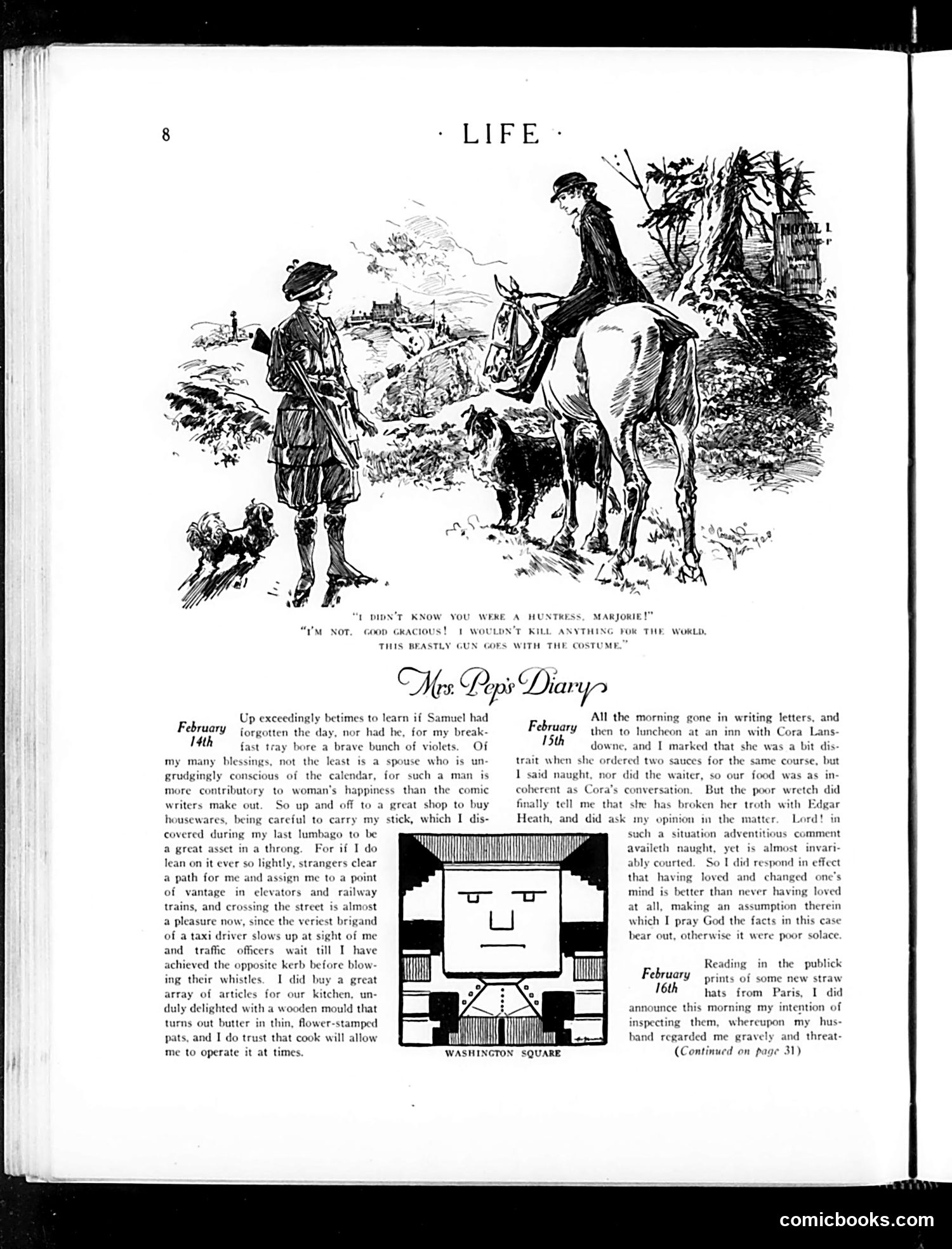
This page presents a satirical diary entry from "Mrs. Pepis" (a play on Samuel Pepys, the famous historical diarist). The illustration shows a woman in hunting attire with a horse and dog, with dialogue: "I didn't know you were a huntress, Marjorie!" / "I'm not. Good gracious! I wouldn't kill anything for the world. This beastly gun goes with the costume." The satire mocks fashionable women who adopt sporting costumes and affectations without genuine interest in hunting or outdoor pursuits—they wear the outfit for appearance only. The diary entries from February document mundane domestic matters (shopping, lunch, hats from Paris) presented in mock-heroic style, further satirizing the trivial concerns of society women. The joke targets superficial upper-class fashion consciousness.
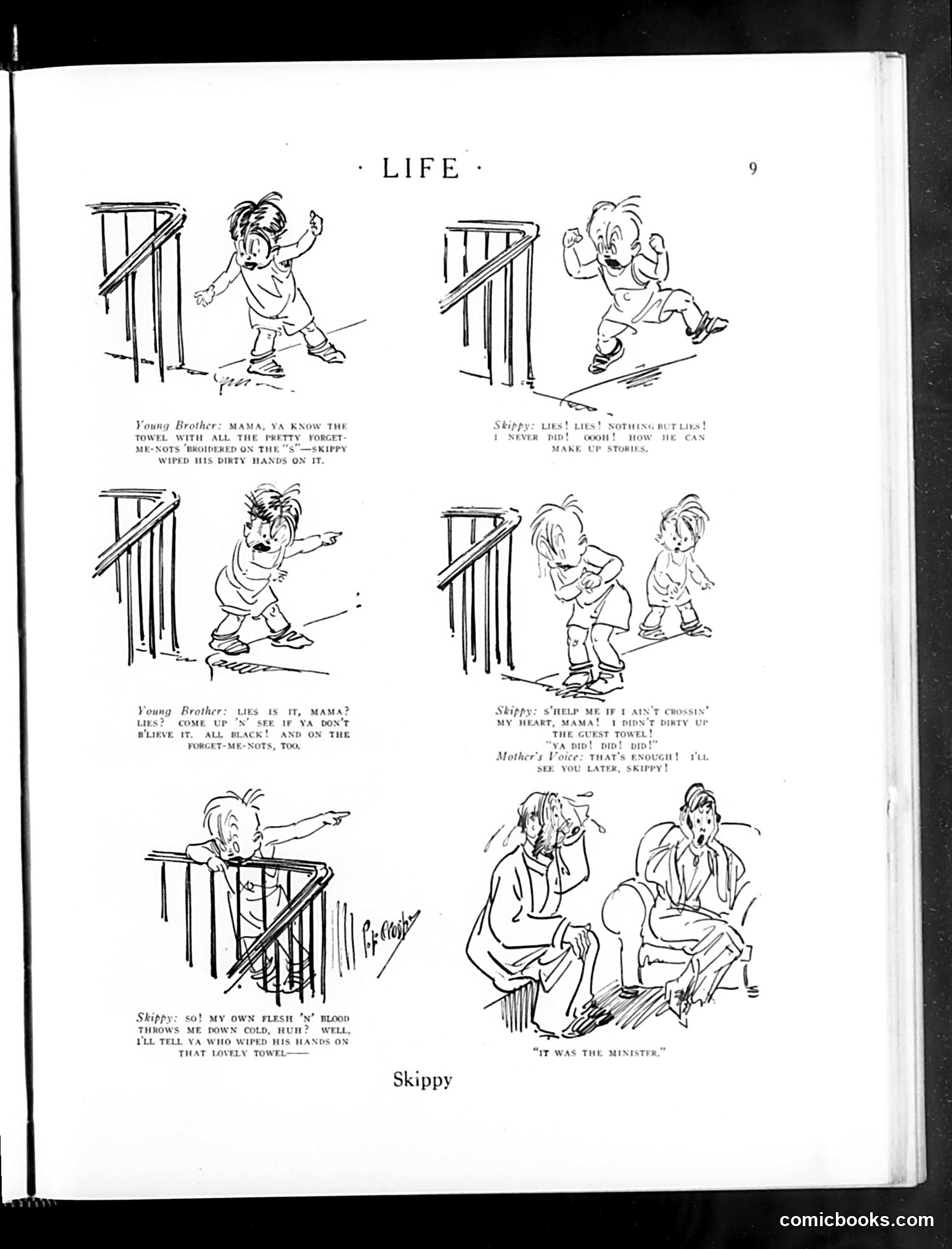
This is a humorous comic strip titled "Skippy" depicting a young boy's mischievous behavior around a towel rack. The narrative follows the child's escalating lies to his mother about dirtying a guest towel—first denying involvement, then blaming his older brother, eventually confessing when cornered by his mother's questioning. The satire targets common childhood behavior: the instinct to lie when caught misbehaving, the tendency to blame siblings, and the gradual unraveling of false stories under parental pressure. The final panel shows what appears to be a minister or authority figure, suggesting the mother will escalate consequences beyond simple scolding. The strip humorously illustrates universal parenting challenges and childhood dishonesty in early 20th-century domestic life.
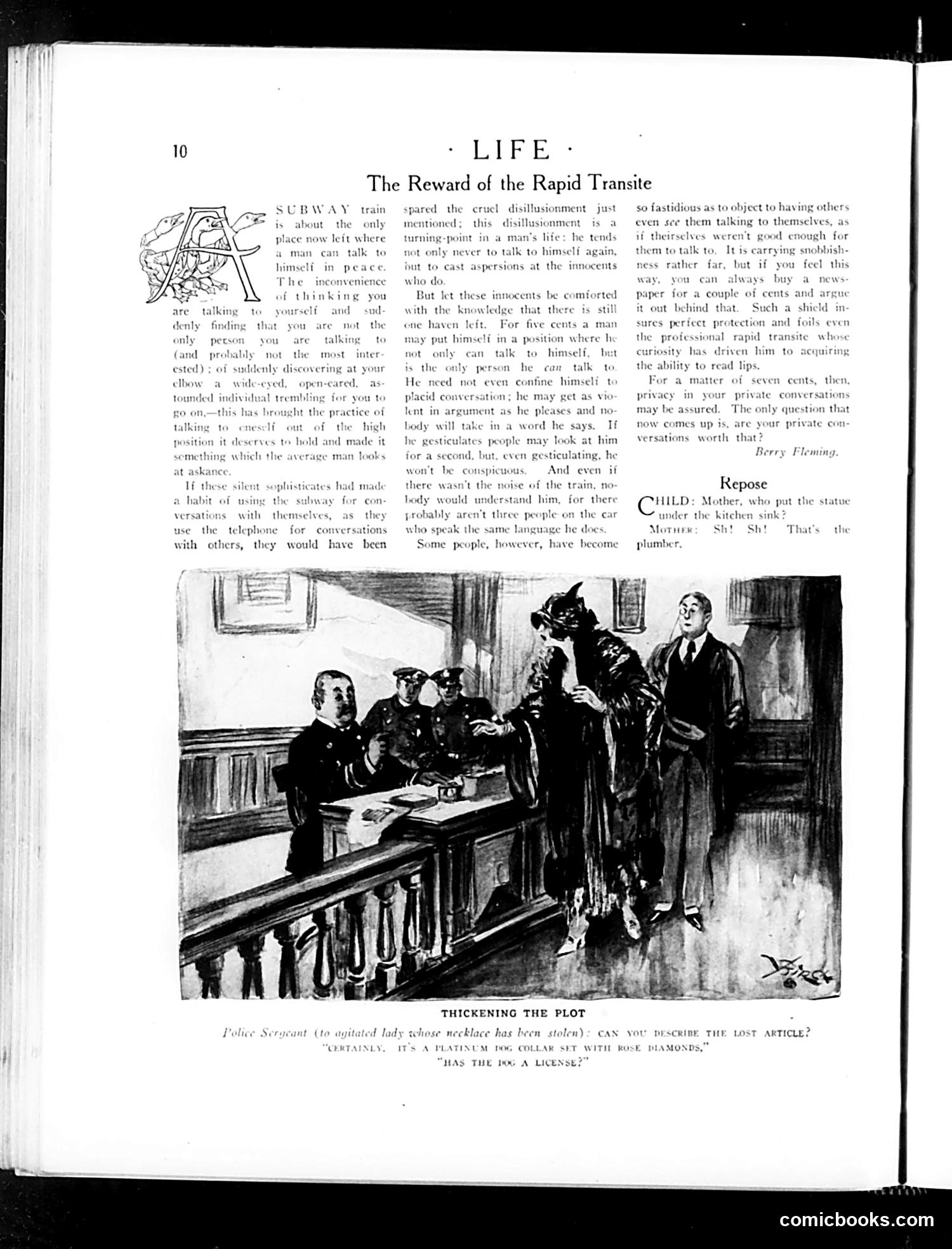
This page contains two satirical pieces about urban social behavior on the subway. **"The Reward of the Rapid Transit"** (left column) critiques how subway travel isolates people. The author argues that while subway inconvenience is frustrating, it paradoxically provides privacy—one can talk to oneself without embarrassment since the noise and crowd make it unnoticeable. The piece jokes that this "reward" of privacy justifies tolerating the transportation's discomforts. **"Repose"** (right side) is a brief comic dialogue between a mother and child discovering something unusual under the kitchen sink, which the child identifies as "the plumber." **"Thickening the Plot"** (illustration below) shows a police sergeant interrogating an elegantly dressed woman about a lost article—apparently a platinum dog collar set with diamonds—humorously suggesting jewelry theft or missing valuables among the wealthy.
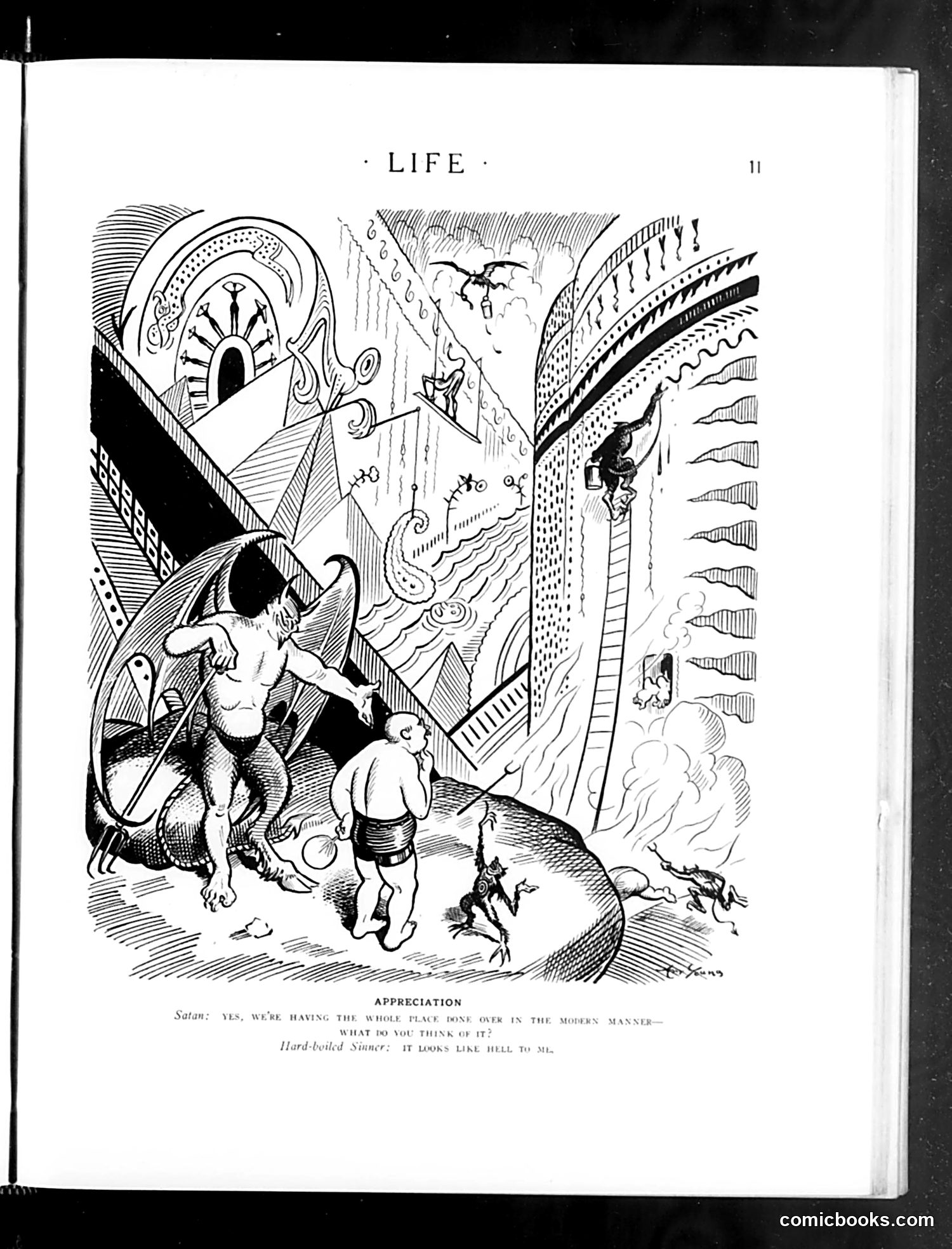
This cartoon satirizes modern interior design and architecture. Satan (identified by horns and tail) shows a Hard-boiled Sinner around an elaborately decorated, maze-like interior space with ornate arches and decorative elements. Satan boasts they've "done over" the place "in the modern manner," while the Hard-boiled Sinner responds that "it looks like hell to me." The joke plays on a double meaning: the sinner, despite being in actual Hell with Satan, finds the trendy "modern" architectural style so ugly and chaotic that it's hellish. This mocks the contemporary modernist or art deco design movement, suggesting that avant-garde aesthetics—however fashionable—produce visually chaotic, unpleasant spaces. The cartoon criticizes pretentious modern design as worse than actual damnation.
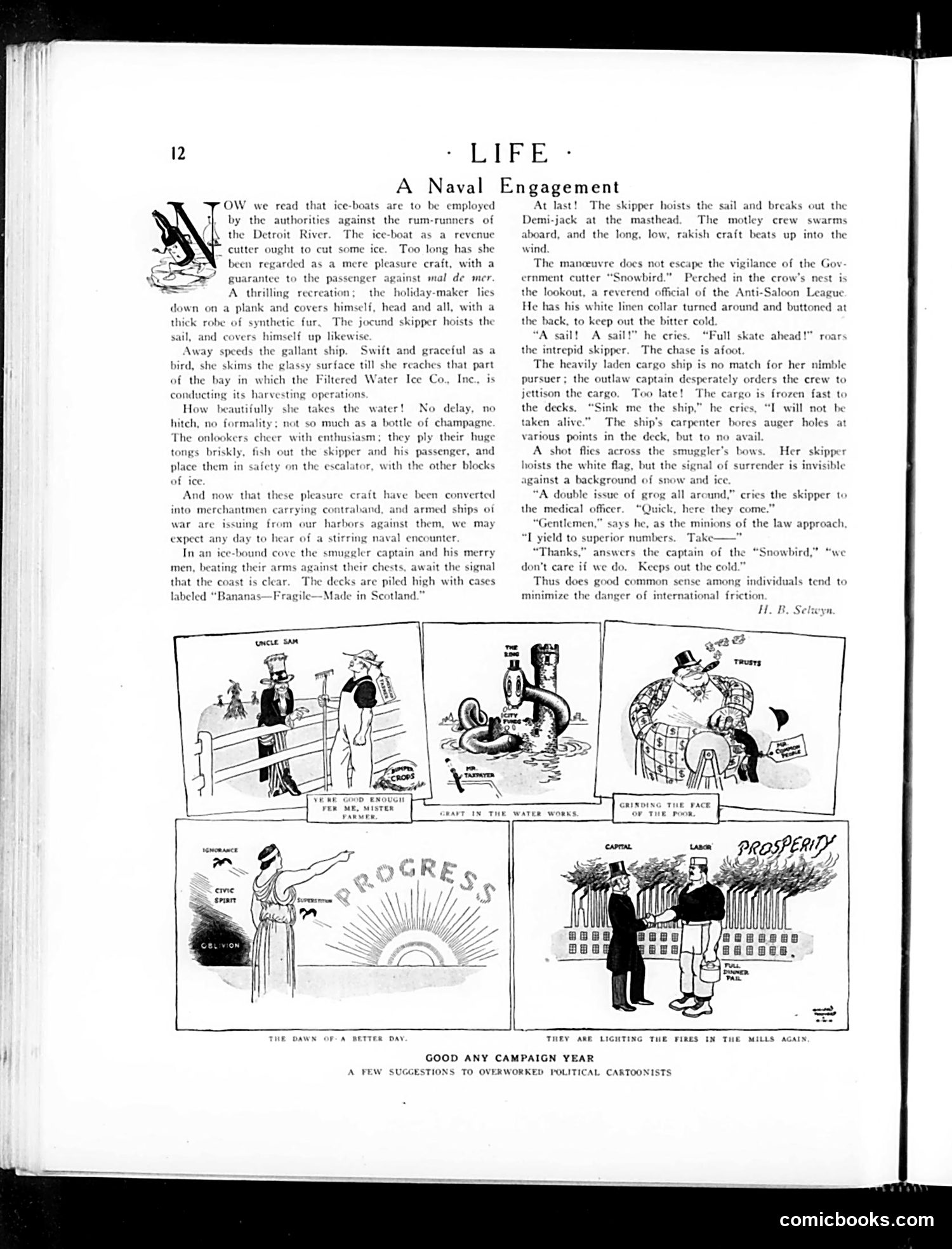
This page combines a narrative story about ice-boats on the Detroit River with political cartoons below. The story portrays a comedic naval "battle" between pleasure craft and revenue cutters enforcing regulations against ice harvesting. The bottom cartoons appear to be titled "Good Any Campaign Year: A Few Suggestions to Overworked Political Cartoonists." These mock the repetitive nature of political cartooning through recurring allegorical figures: "Uncle Sam," "Progress" (depicted as a rising sun), "Capital" and "Labor" (shown as businessmen), and "Prosperity" (as a woman). The cartoons satirize how cartoonists reuse the same symbolic characters and imagery across different campaign years, suggesting political commentary has become formulaic and exhausted.
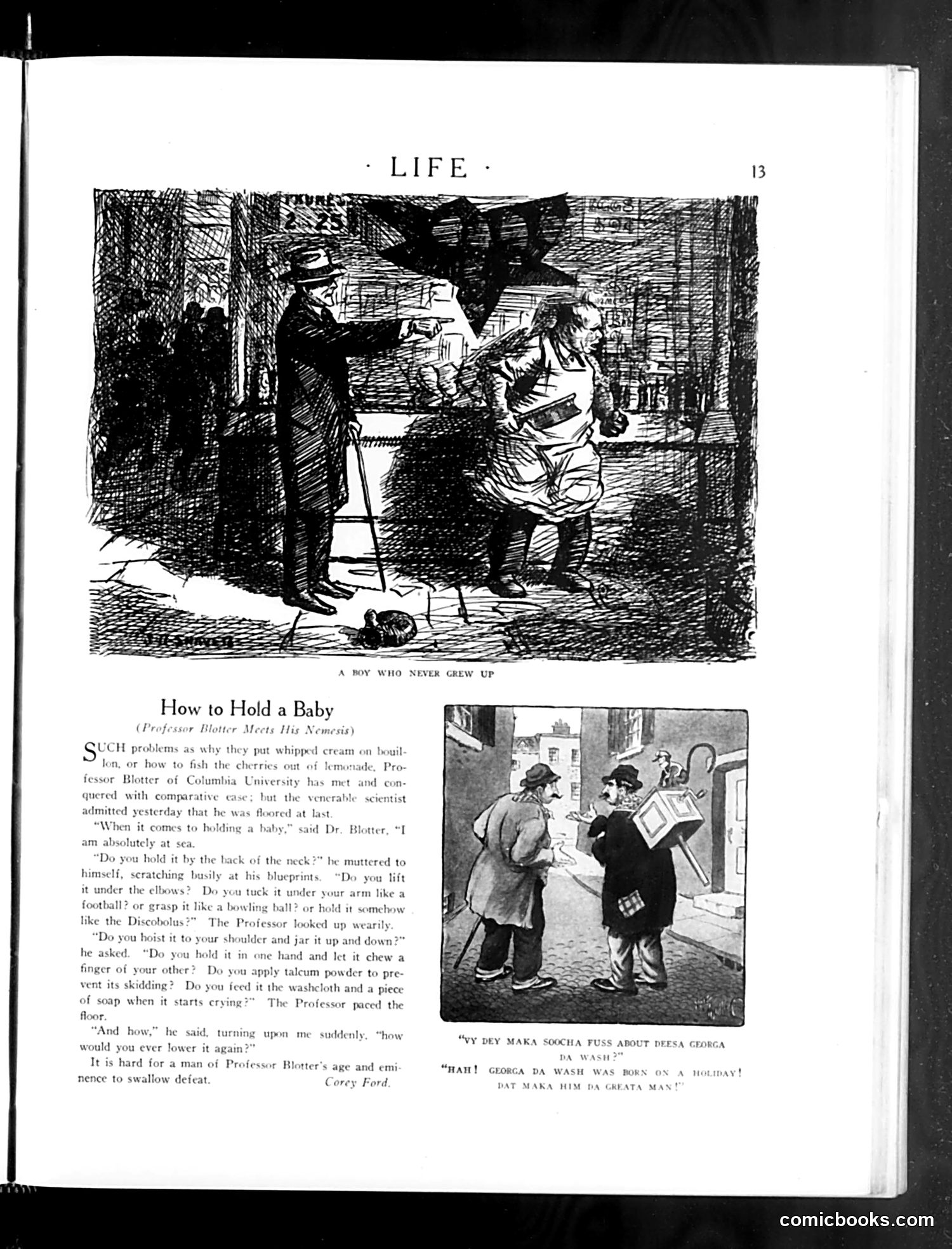
This page contains two distinct pieces of satire: **Top cartoon** ("A Boy Who Never Grew Up"): A sketch-style illustration depicting what appears to be a child's chaotic behavior in an indoor setting, likely satirizing arrested development or immaturity. **Main article** ("How to Hold a Baby"): A humorous piece attributed to "Professor Blotter" from Columbia University, mocking the era's emerging "scientific" parenting advice. The text sarcastically catalogs absurd baby-handling techniques (holding by neck, treating like a football, applying talcum powder to prevent crying). This satirizes the pretentiousness of academic experts dispensing impractical parenting guidance. **Bottom cartoon**: Shows figures discussing "Georga da wash" and "Dessa Georga"—appearing to reference a holiday-born child, likely satirizing either immigrant dialects or class-based naming practices common in early 20th-century American humor. The page mocks both childhood development and contemporary parenting culture.
This page contains an article titled "While there is Life there's Hope" commemorating Woodrow Wilson's death. The accompanying cartoon depicts a skeletal figure labeled "Life" lying prone, illustrating the magazine's title's dark irony. The article praises Wilson as "the first world citizen" and "the greatest President since Lincoln," while acknowledging contemporary criticism of his political failures. It reflects on his role in World War I peace efforts and notes his death occurred when his influence over world affairs had diminished. The piece also mentions two other notable figures—Calhoun and Roosevelt—comparing Wilson's political power and legacy to theirs, positioning Wilson as historically significant despite disputed contemporary assessments of his presidency and policies.
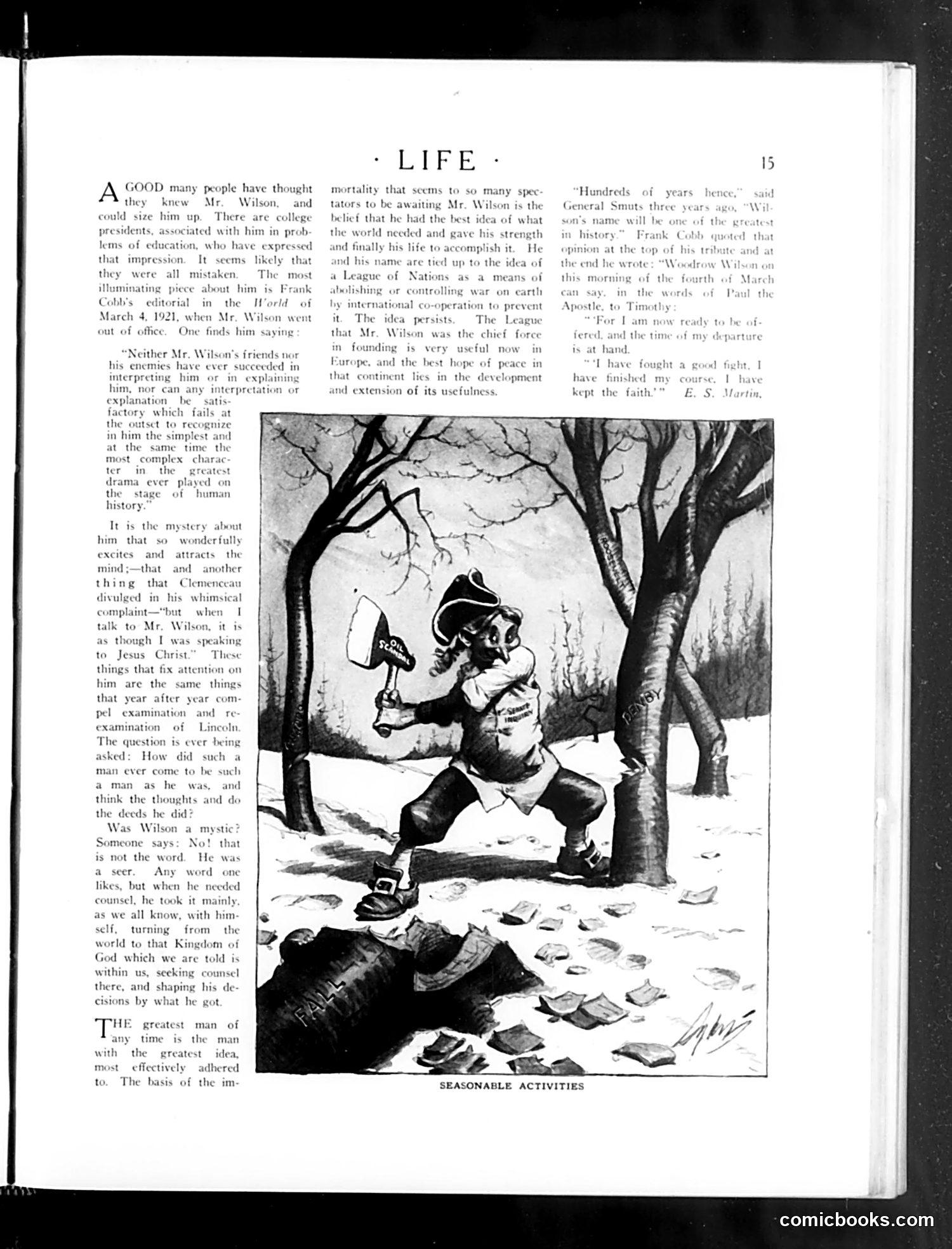
This cartoon depicts a caricatured figure chopping wood in winter, with money scattered on the ground below. The caption "SEASONABLE ACTIVITIES" suggests commentary on winter work or economic behavior. The surrounding text discusses Woodrow Wilson and the League of Nations, praising Wilson's legacy and ideas. The figure appears to be a caricature engaged in manual labor—possibly representing either common people or, less clearly, a political figure—though the specific identity isn't definitive from the image alone. The satire likely contrasts Wilson's idealistic international diplomacy with practical, mundane economic activity, or comments on how seasonal work affects different social classes. Without clearer identifying features or publication date context, the precise political target remains somewhat ambiguous.
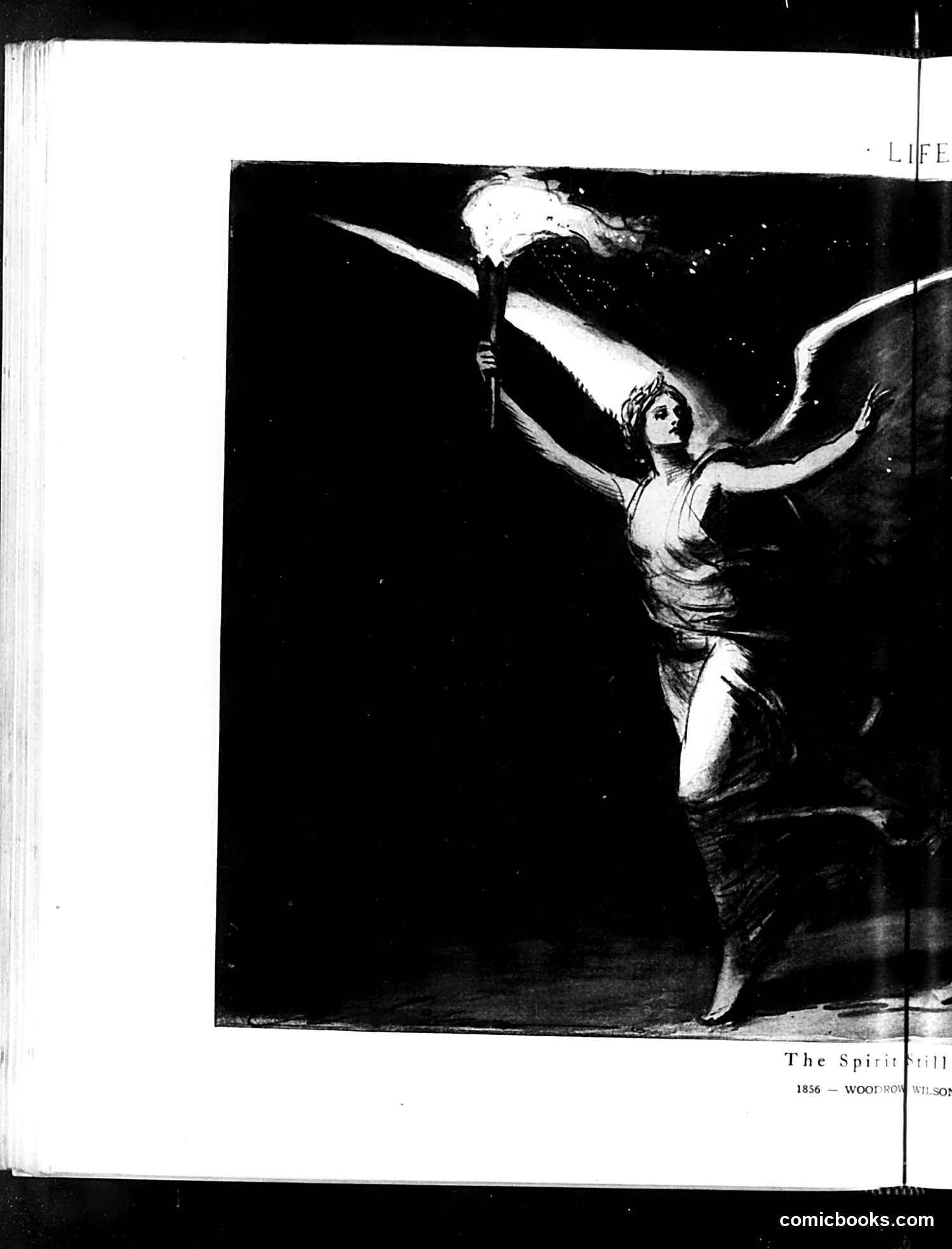
This appears to be a wood engraving titled "The Spirit" from 1856, likely referencing Woodrow Wilson (based on partial OCR text). The image shows a classical female allegorical figure—representing "Spirit" or a national ideal—holding aloft a torch or flame while wearing draped clothing and striking a triumphant pose against a dark background. Given the 1856 date and classical allegorical style, this likely satirizes or comments on American political ideals of that era, possibly relating to slavery debates, westward expansion, or national purpose. The figure's uplifted torch suggests enlightenment or progress. However, without clearer text or additional context, the specific satirical target remains unclear.
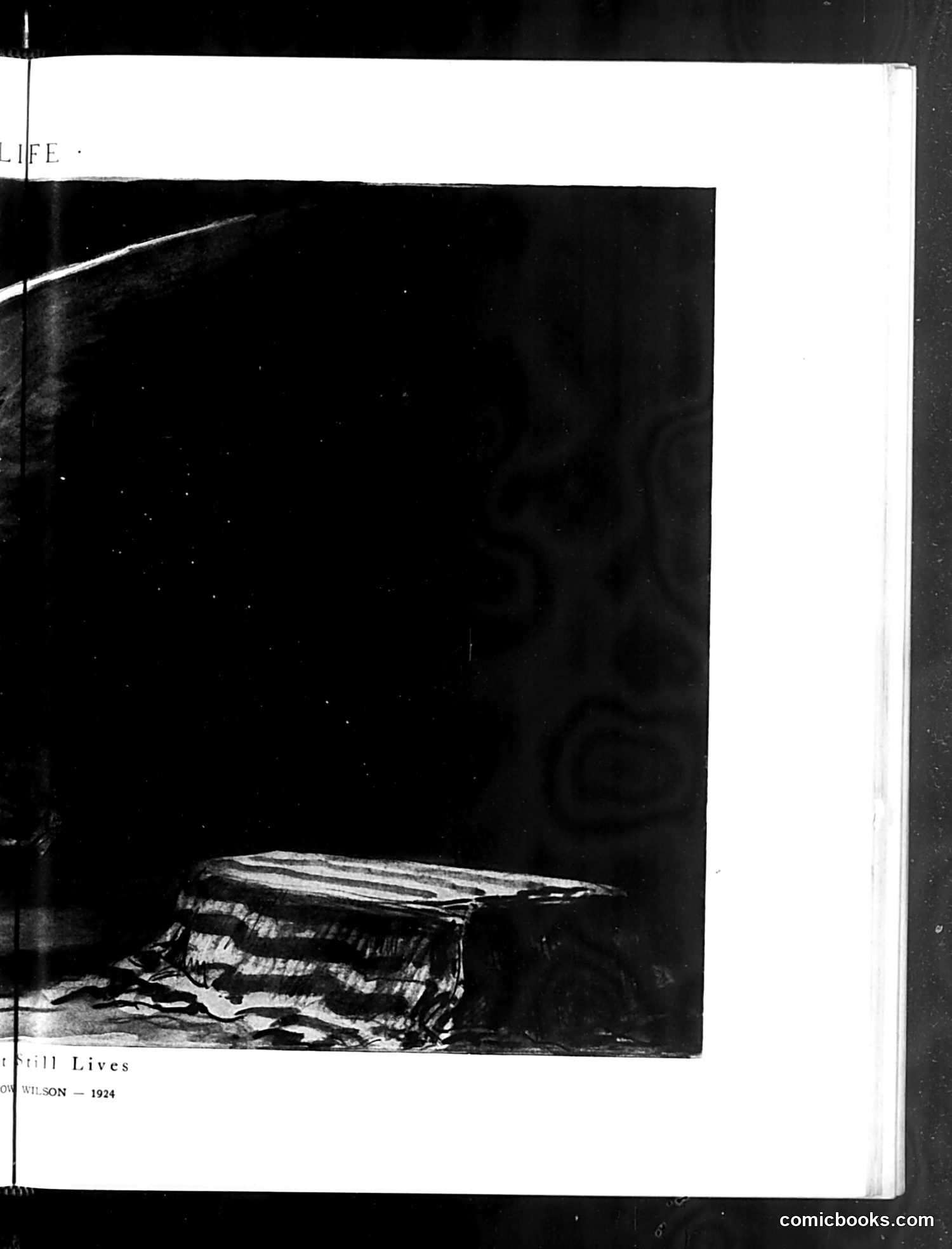
I can see this is a page from Life magazine dated 1924, titled "Still Lives" at the bottom. The page shows a black and white photograph or artwork depicting what appears to be a still life arrangement in dramatic lighting against a dark background. There's a striped object (possibly fabric or a container) at the bottom of the composition. However, the image quality and the primarily visual nature of this content make it difficult to identify specific satirical targets or political references with certainty. Without clearer text or more context about the artist's intent, I cannot definitively explain what social or political commentary this still life composition was meant to convey to 1924 readers. The artistic style suggests modernist influence typical of Life's era.
This page reviews contemporary Broadway comedies. The main focus is "The Show-Off," a play by George Kelly starring Louis John Bartels as Aubrey Piper—a type of boastful, working-class character the critic finds compelling. Bartels embodies a specific American archetype: the blustering, self-aggrandizing man who uses dated slang ("all washed up," "dotted-line") and empty talk to seem important. The review also covers "Fashion," a 1845 American comedy revived at the Provincetown Theatre, praising its authentic period staging. The critic notes audiences laugh at things they "ought" to laugh at—suggesting period comedy about city corruption and rural virtue still resonates with 1920s sophistication. The cartoons (decorative drama headers) are purely ornamental. The "Mostly Good" title signals qualified praise for contemporary theater—entertaining but somewhat repetitive in subject matter.
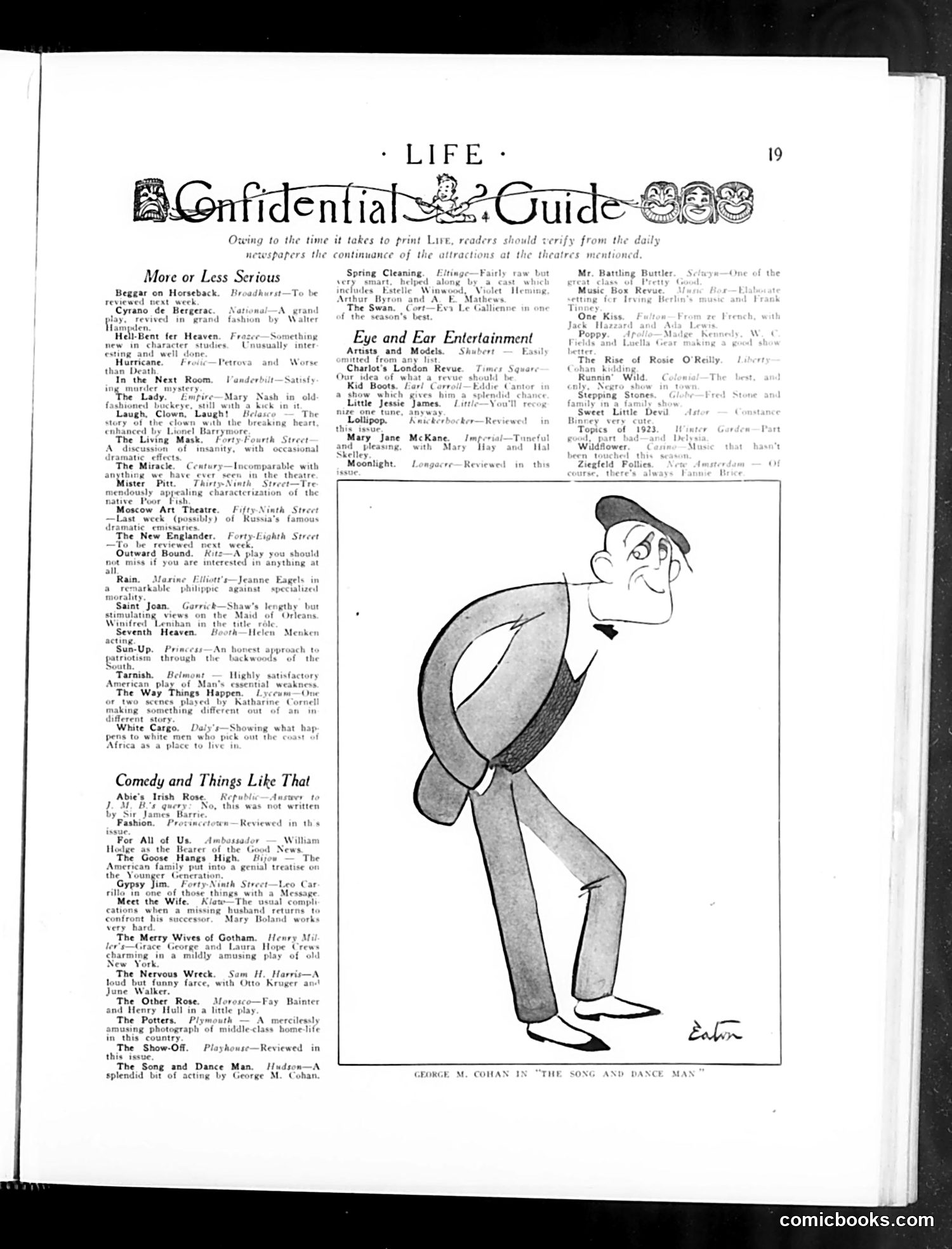
This page is primarily a **theater guide and review column** titled "Confidential Guide," listing Broadway shows currently running with brief critical assessments. The substantial illustrated cartoon shows a caricatured man in oversized clothing bent over awkwardly, carrying an enormous sack or burden on his back. The cartoon caption identifies the figure as **George M. Cohan in "The Song and Dance Man."** This is a promotional illustration tied to the theater listings below. Cohan was a famous American theatrical performer and composer of the era. The exaggerated posture and burden likely illustrate a comedic moment from the play—the visual gag being the physical comedy of carrying an unwieldy load, which would resonate with audiences familiar with vaudeville and silent-film physical humor. The page itself is not primarily satirical but rather a practical entertainment guide for Life magazine readers seeking theater recommendations and current production information.
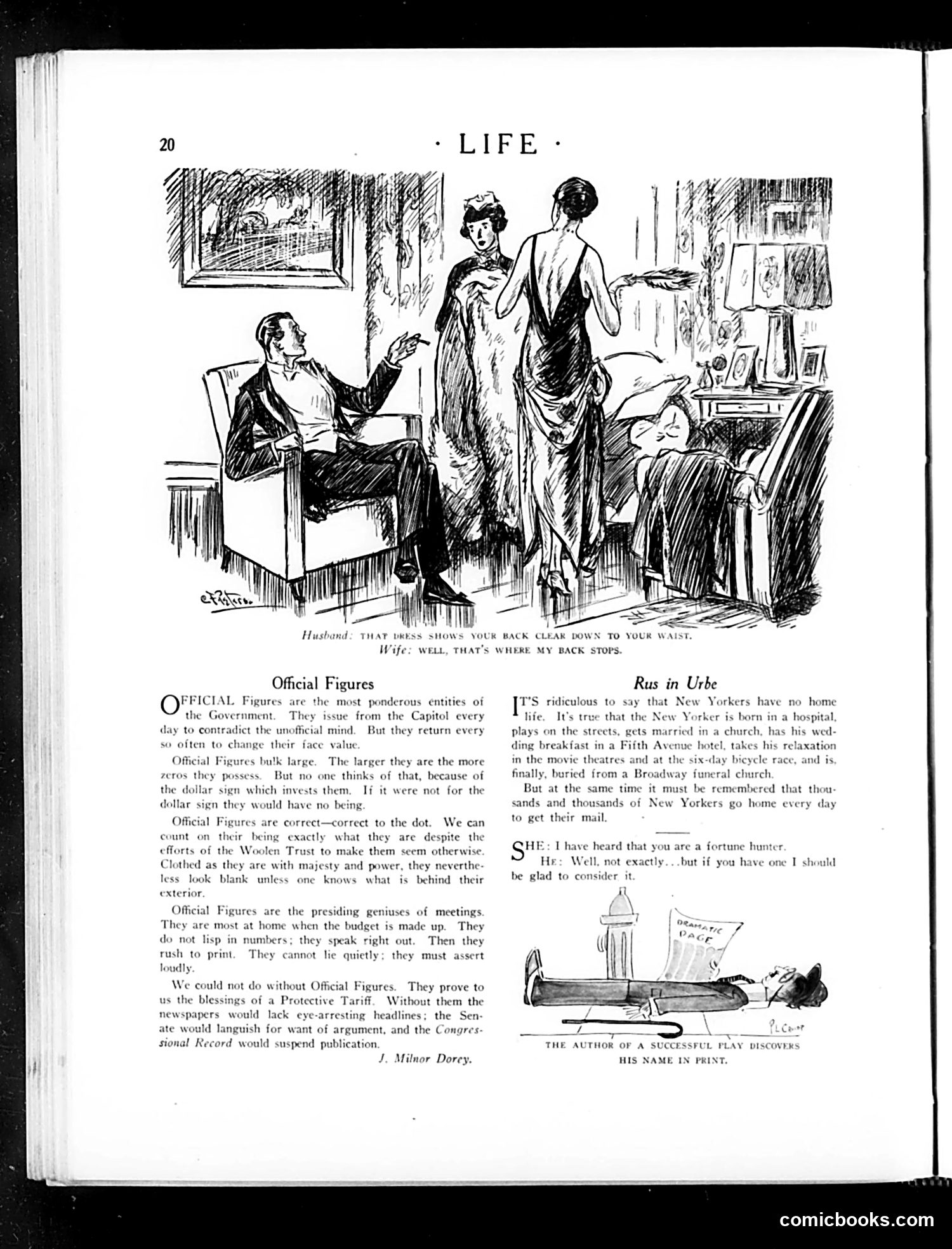
This page contains two distinct pieces of satire: **Top Cartoon**: A domestic humor joke about fashion. A husband criticizes his wife's revealing dress, noting it exposes her back "clear down to your waist." Her witty response—"that's where my back stops"—deflates his complaint through logical literalism, a common comedic structure of the era. **"Official Figures" Essay**: Sharp political satire by J. Milnor Dorey attacking government statistics and bureaucratic pronouncements. The piece mocks how official data from Congress, issued to "contradict the unofficial mind," carry false authority through dollar signs and zeros despite being unreliable. It satirizes how newspapers and government bodies depend on these figures for credibility, even when the underlying reality is unclear. **"Rus in Urbe"**: A humorous essay observing that New Yorkers' "home life" consists entirely of institutional moments—hospitals, churches, hotels, theaters—except for one daily act: returning home to collect mail. The fortune-hunter dialogue adds conventional romantic comedy. All three pieces target contemporary American social pretension and bureaucratic absurdity.
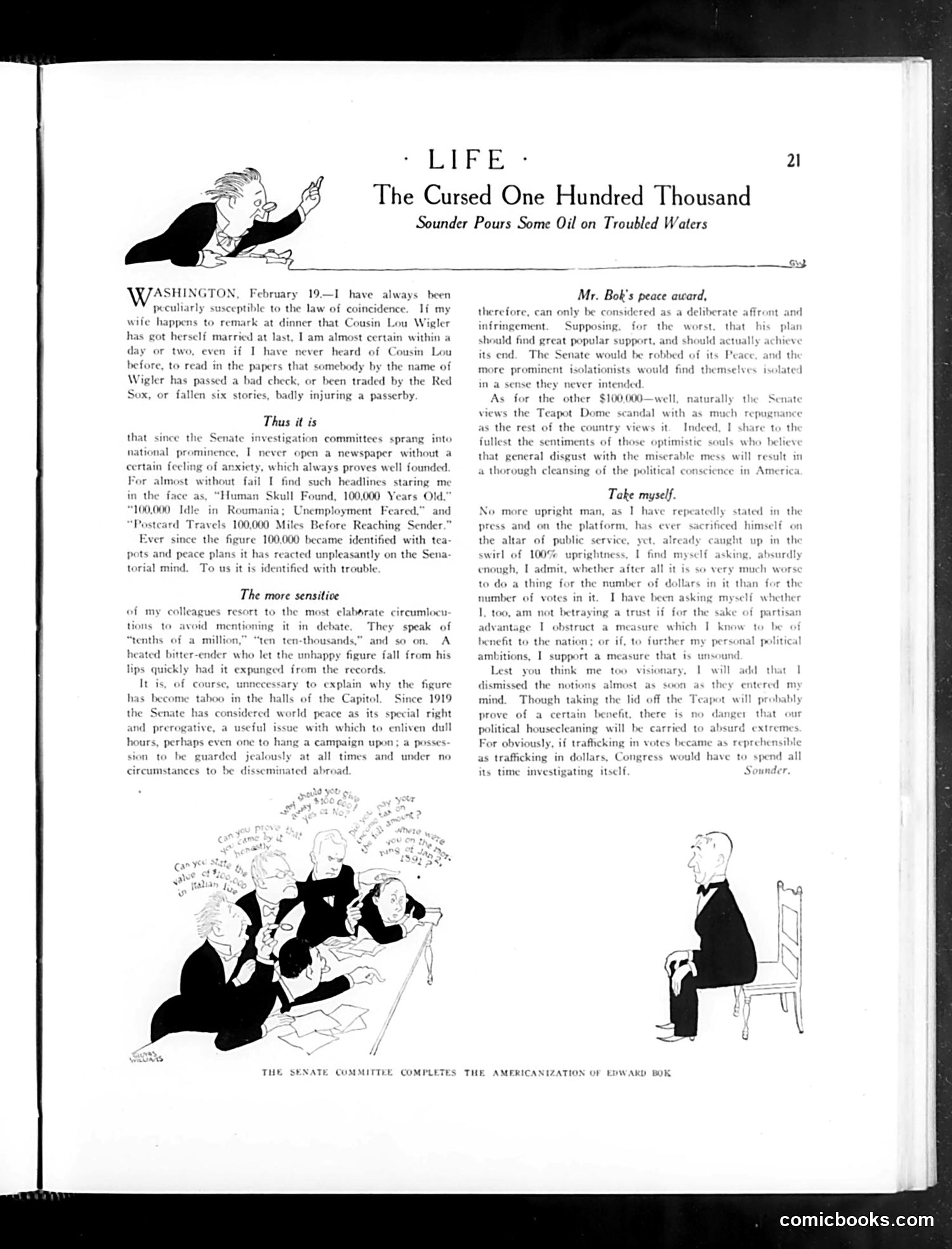
This satirical piece by "Sounder" critiques the Senate's investigation committees of the early 1920s, which became obsessed with the number "100,000." The author notes that since investigations gained prominence, newspapers constantly feature headlines with "100,000"—idle workers, old artifacts, travel distances—creating an almost comedic coincidence. The main target appears to be the **Teapot Dome scandal** (referenced explicitly), a major corruption case involving oil reserves. The cartoon at bottom depicts **Senate committee members** intensely interrogating someone, illustrating their theatrical investigation style. The author satirizes senators' political grandstanding: they use investigations as campaign issues while remaining hypocritically silent about their own potential vote-trafficking and corruption. The piece suggests congressional "housecleaning" is performative rather than genuine—if vote-trafficking faced consequences equivalent to dollar-trafficking, Congress would spend all its time investigating itself. The satire targets both the obsessive focus on a single number and the selective moral outrage of Senate investigators.
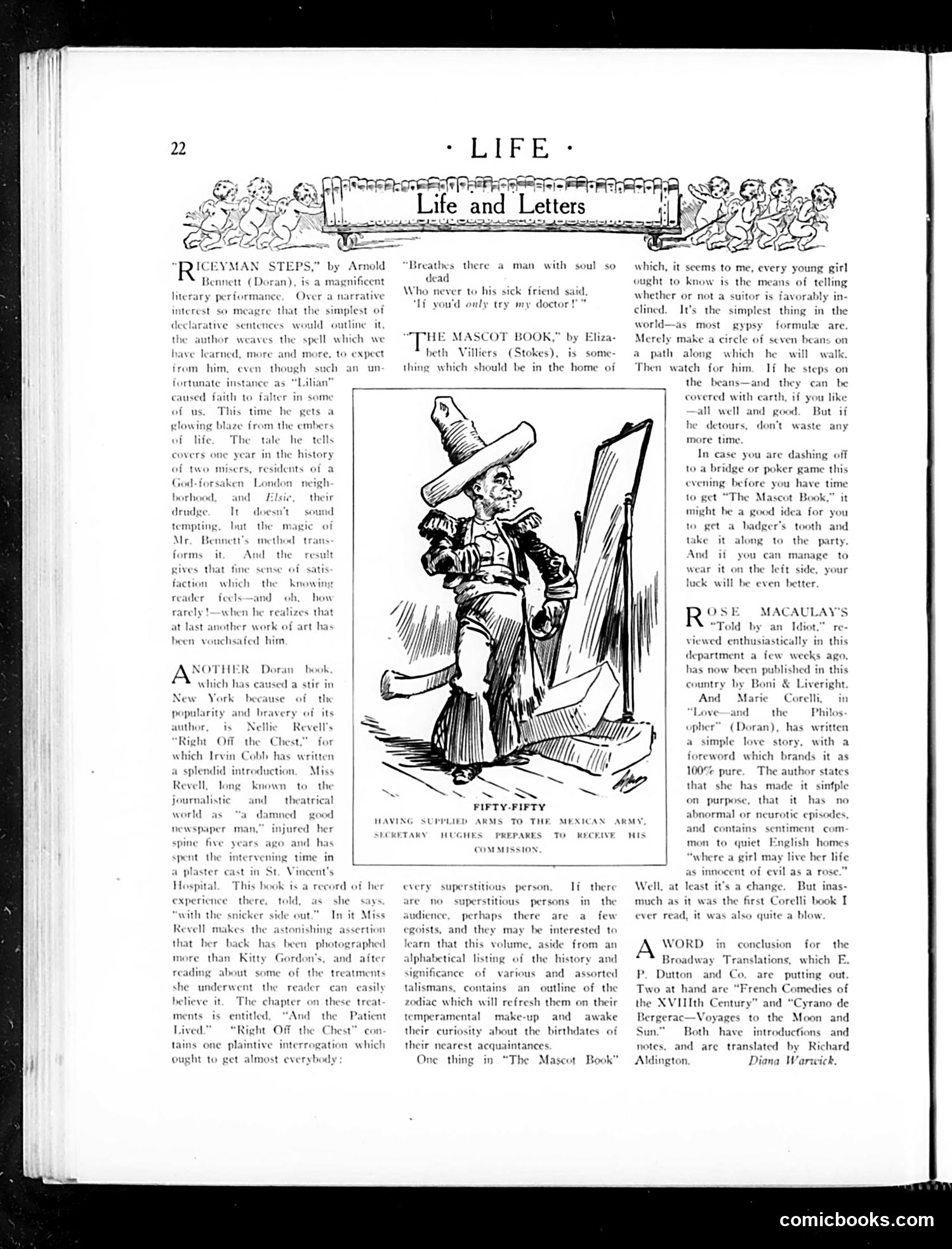
This page from *Life* magazine features book reviews and literary commentary rather than political cartoons. The central illustration shows a caricatured Mexican military figure in an exaggerated sombrero and ornate uniform, labeled "FIFTY-FIFTY: Having Supplied Arms to the Mexican Army, Secretary Hughes Prepares to Receive His Commission." This references Secretary of State Charles Evans Hughes and U.S. involvement in Mexican affairs—likely relating to American arms sales during Mexico's political instability in the 1920s. The satire suggests Hughes profited personally ("receives his commission") from supplying weapons, implying corruption or improper financial benefit from foreign policy decisions. The cartoon criticizes the intersection of American diplomacy and commercial arms dealing with Mexico, presenting it as a self-serving financial transaction rather than principled statecraft. The grotesque caricature of the Mexican officer underscores the satirical tone.
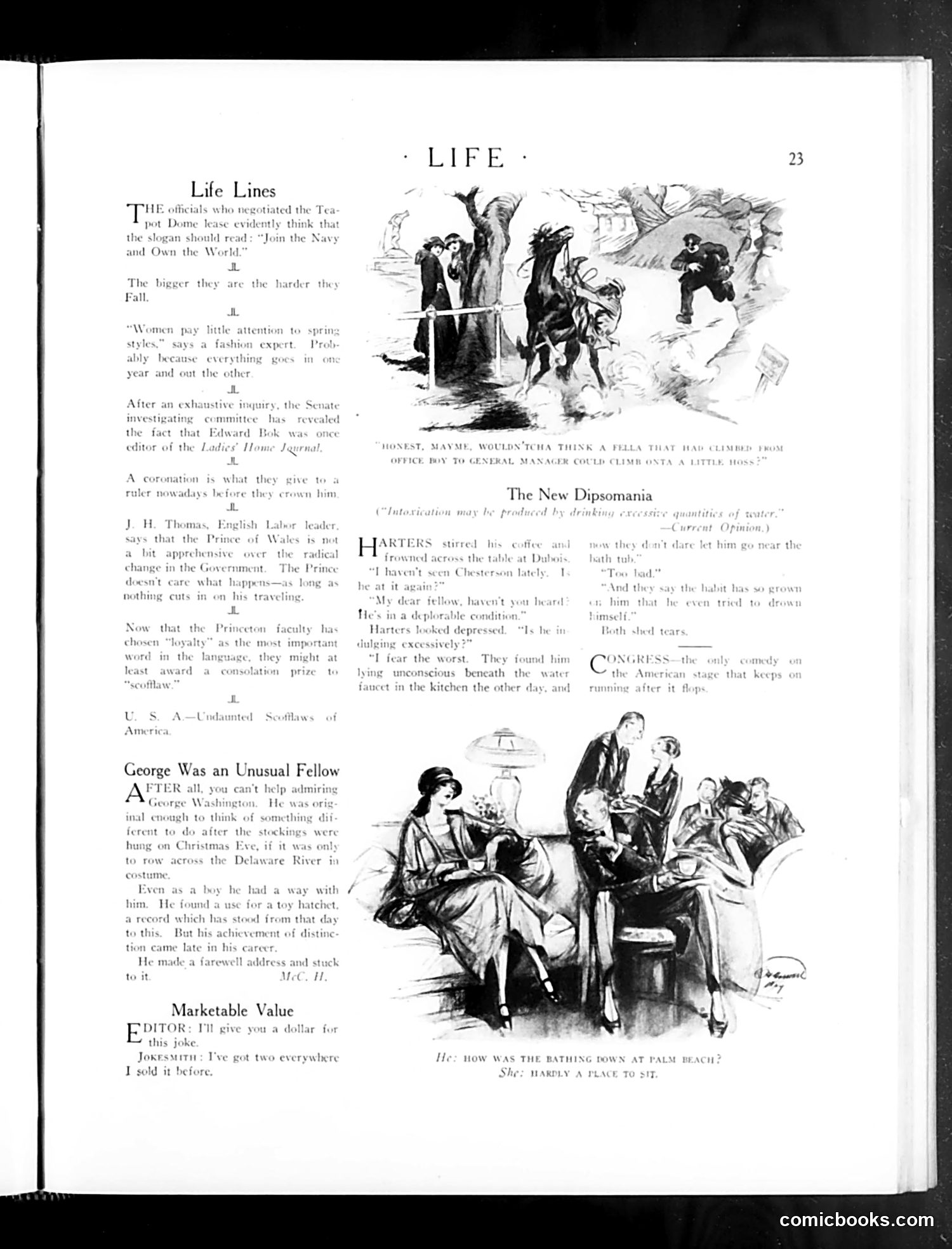
This page from *Life* magazine contains several satirical items: **"Life Lines"** presents brief social commentary, including a joke about Edward Bok, former editor of *Ladies' Home Journal*, being discovered unconscious in a kitchen—likely mocking his prominence or some recent incident. **"The New Dipsomania"** satirizes excessive water-drinking as a health fad, with a couple discussing the husband's compulsive water consumption and resulting bathroom visits—a humorous jab at contemporary wellness trends. **"Congress"** identifies Congress as "the only comedy on the American stage that keeps on running after it flops"—political satire on Congressional ineffectiveness. **"George Was an Unusual Fellow"** humorously describes someone's odd Christmas behavior (crossing the Delaware River in costume), likely referencing historical reenactments or eccentric behavior. **"Marketable Value"** is a brief joke exchange about selling jokes, playing on commercial transaction humor. The cartoons accompanying these pieces use period illustration style typical of early 20th-century satirical magazines.
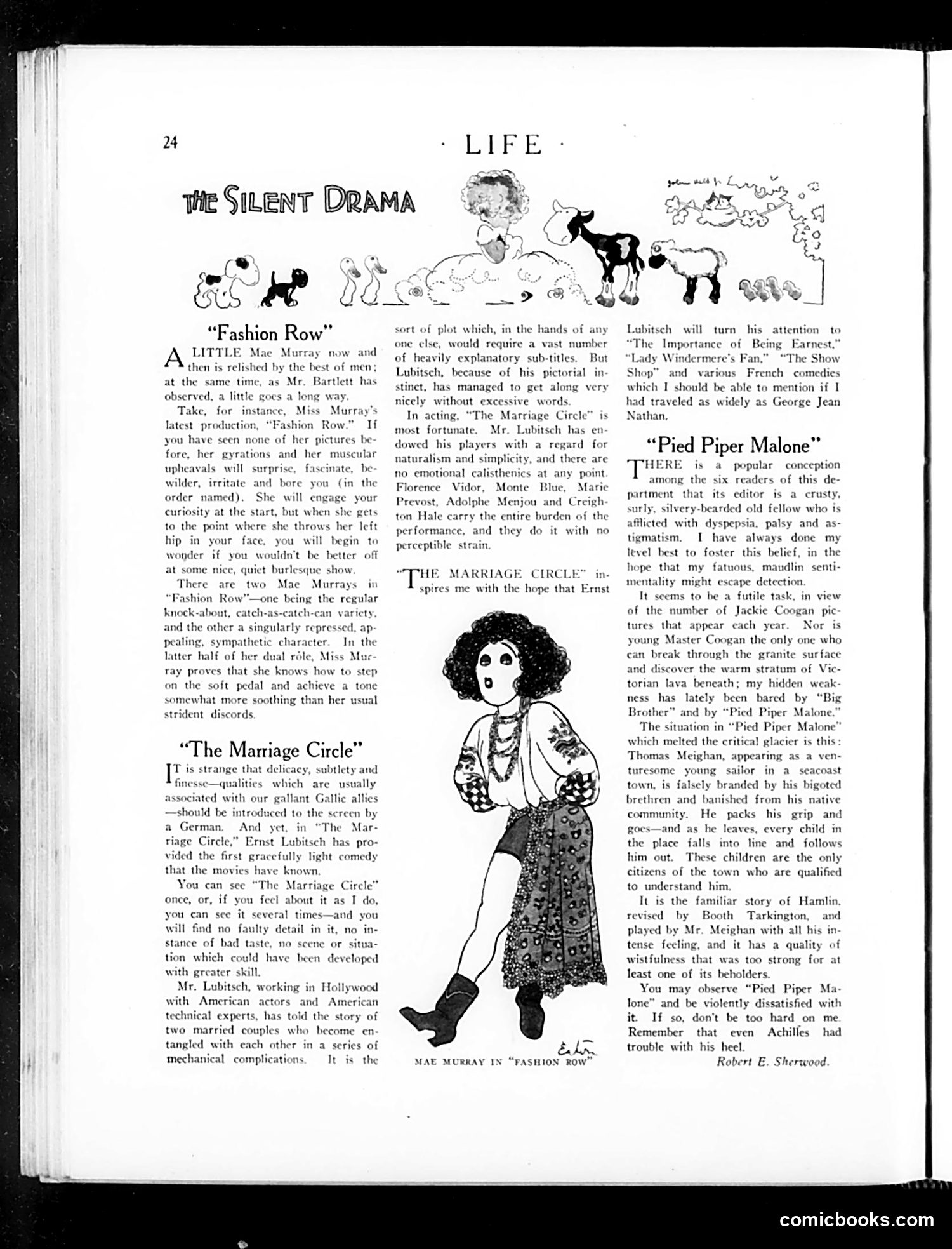
This page contains three film reviews from Life's movie criticism section. The reviews discuss: **"Fashion Row"** starring Mae Murray, criticized for her exaggerated physical movements and gyrations that the reviewer finds alternately fascinating and tedious, though praising her more restrained dramatic moments. **"The Marriage Circle"** directed by Ernst Lubitsch, enthusiastically reviewed as the first gracefully light comedy in cinema. The reviewer praises Lubitsch's German directorial skill in bringing French sophistication to Hollywood, and commends the naturalistic acting of the ensemble cast (Florence Vidor, Monte Blue, Marie Prevost, Adolphe Menjou, Creighton Hale). **"Pied Piper Malone"** starring child actor Jackie Coogan and Thomas Meighan. The reviewer humorously admits to hiding sentimental weakness for Coogan's films, describing a plot where Meighan's character is falsely accused and banished from his community. The page uses typical 1920s film criticism conventions, balancing entertainment industry gossip with aesthetic judgment.
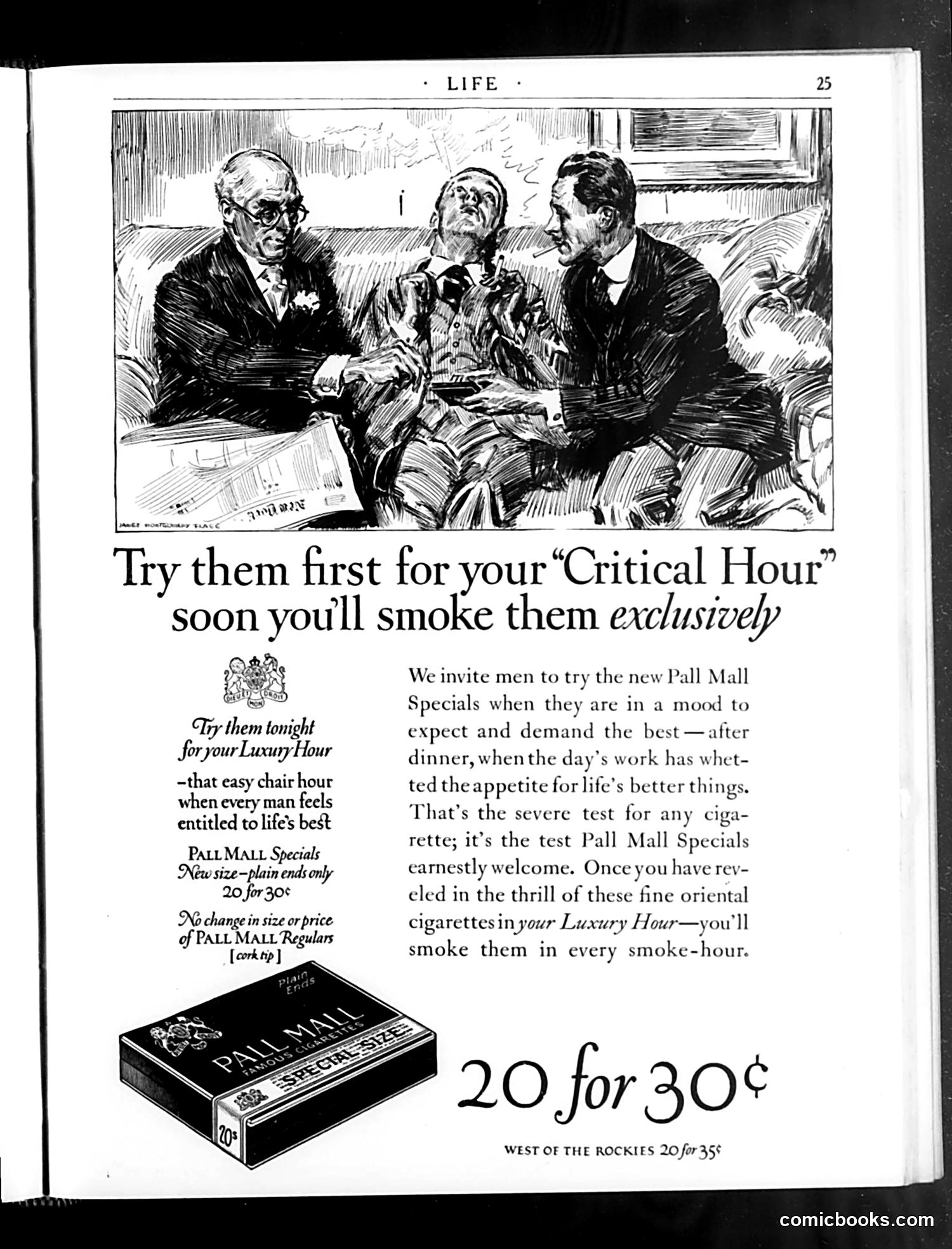
This is primarily a **cigarette advertisement**, not political satire. The page advertises Pall Mall Specials cigarettes to the Life magazine audience. The illustration depicts three well-dressed men in conversation—likely representing affluent businessmen or professionals of the era. The ad copy appeals to masculine leisure and sophistication, promoting the "Luxury Hour" (the relaxed evening time after work when a man supposedly "feels entitled to life's best"). The marketing strategy targets aspirational middle/upper-class males by associating the product with refinement and exclusivity. The phrase "fine oriental cigarettes" references the cigarettes' supposed quality and exotic appeal—common selling language of the 1920s-30s era. The pricing ("20 for 30¢") and note about regional variation ("West of the Rockies 20 for 35¢") ground this in Depression-era economics. There is **no political commentary**—this is straightforward consumer advertising exploiting period notions of masculine status and leisure.
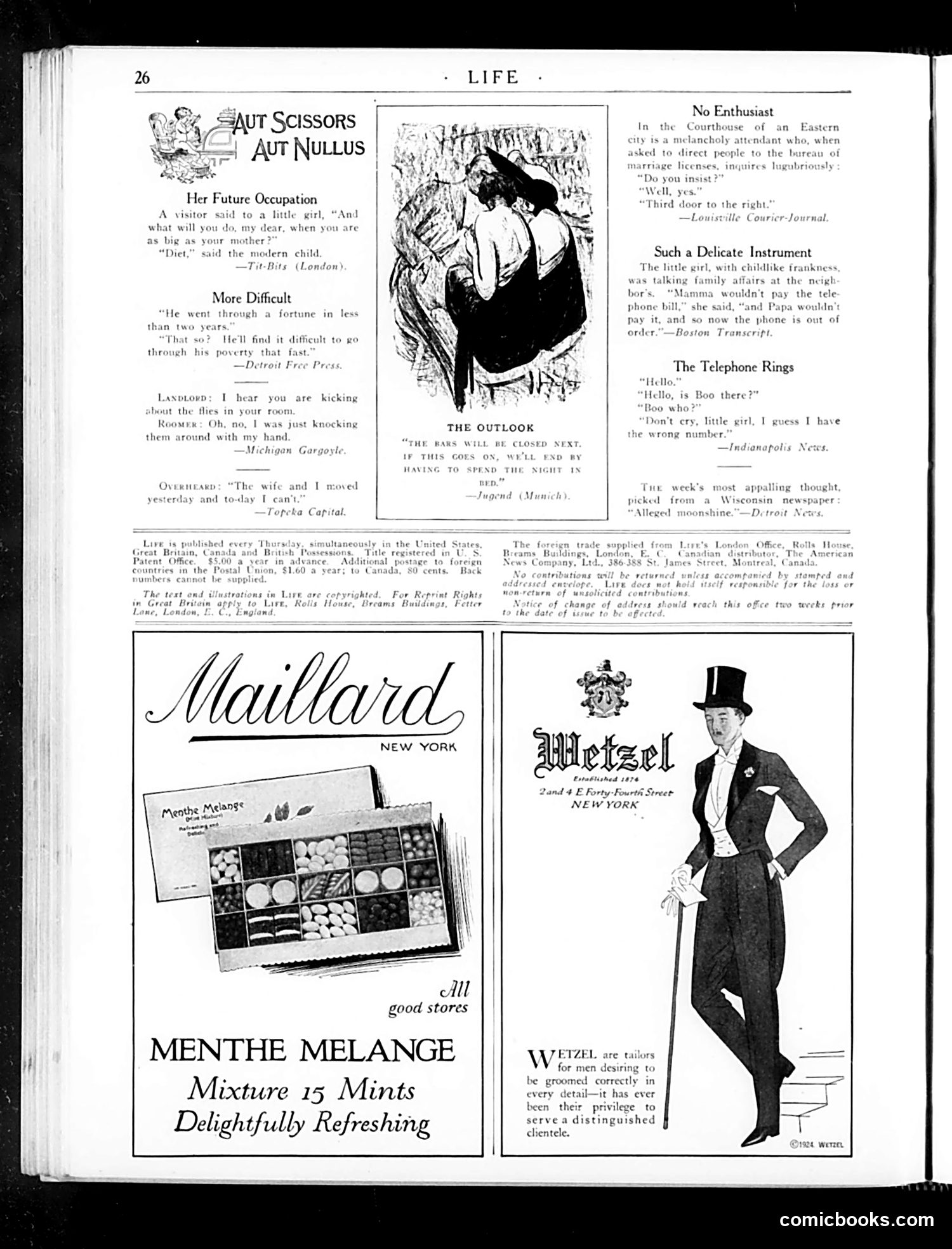
This page combines humor columns with period advertisements. The top section features brief satirical anecdotes—short jokes mocking contemporary social situations. One notes a child's practical career ambition ("Diet"), while others joke about financial ruin, domestic squabbles over telephone bills, and marital disagreements. The most pointed humor appears in "The Outlook" cartoon: a couple arguing while their apartment burns, captioned with concern they'll "end by having to spend the night in a bed." This satirizes middle-class anxieties and marital discord as more pressing than actual disaster. The advertisements—Maillard chocolates, Wetzel tailoring, and Menthe Melange mints—represent typical luxury goods marketed to affluent readers. The Wetzel ad emphasizes proper male grooming for "distinguished clientele," reflecting early-20th-century concerns with social polish and appearance. Overall, the page targets educated, urban readers with gentle mockery of contemporary domestic life and consumer culture.
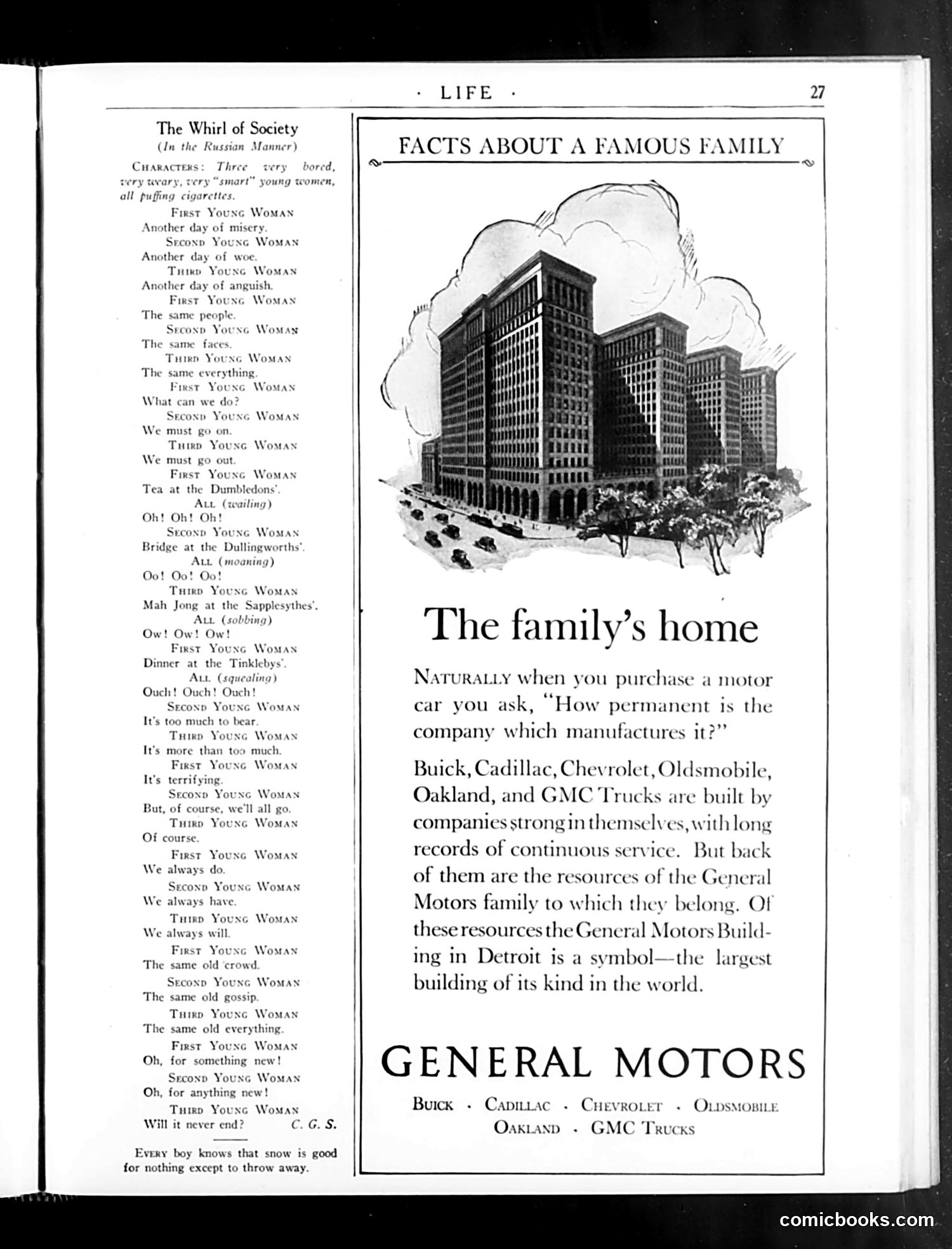
The left page satirizes wealthy young women trapped in monotonous high-society life. Three bored socialites endlessly attend the same tedious events—teas, bridge games, Mah Jong, dinners—at homes of the same people, seeing the same faces, discussing the same gossip. Despite finding it exhausting ("terrifying," "too much to bear"), they dutifully attend anyway because "we always do." The satire's point: upper-class social obligations create a suffocating, repetitive cycle with no escape. The women's anguished exclamations ("Oh! Oh! Oh!" / "Oo! Oo!" / "Ow! Ow! Ow!") mock their performative distress. Their desperate plea "Oh, for something new!" reveals how their constrained world offers no novelty or genuine freedom—only ritualized, joyless conformity. The right side contains a General Motors advertisement about automotive permanence, unrelated to the cartoon's social critique.
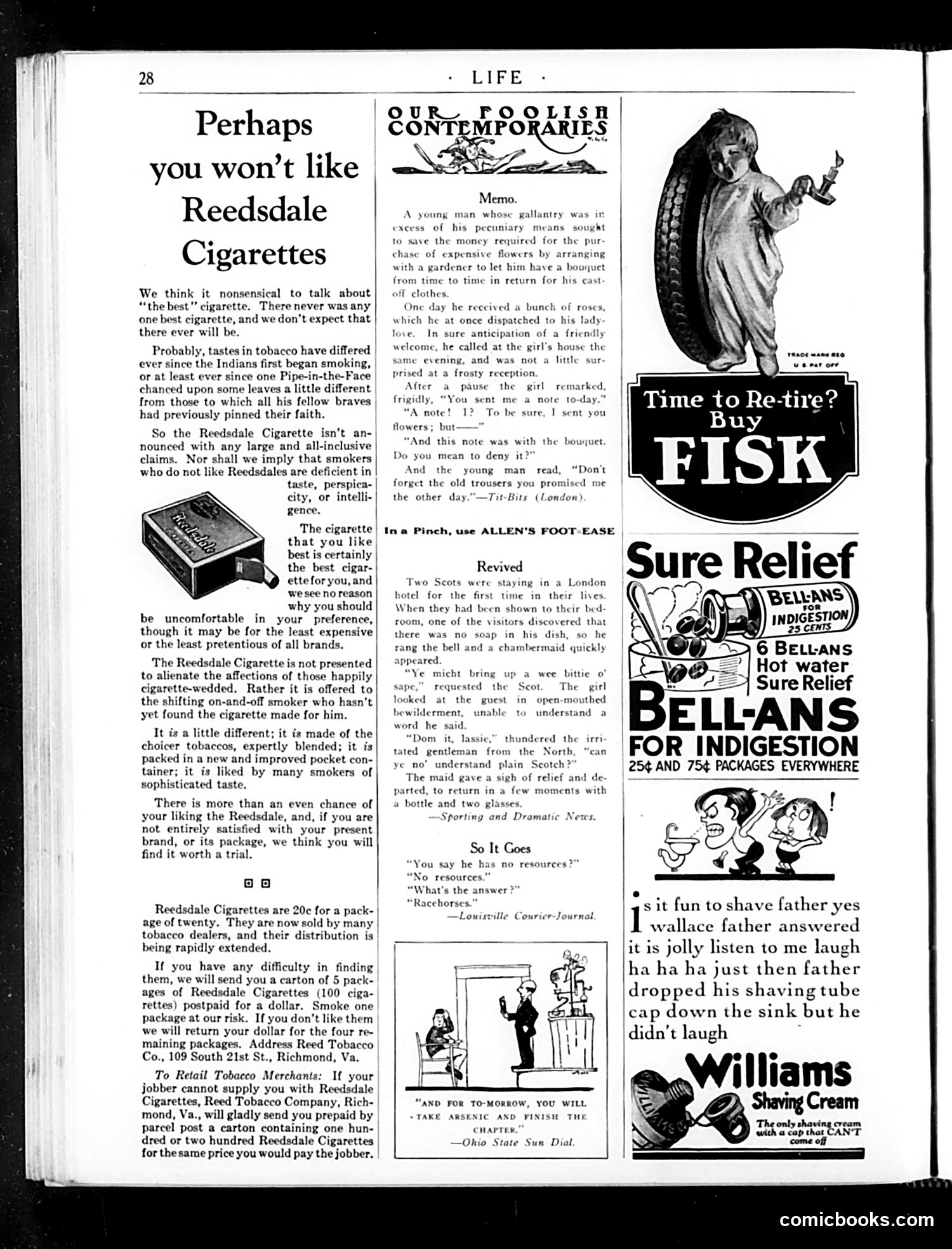
This page is primarily **advertising**, not political satire. The dominant content is a Reedsdale Cigarettes advertisement that takes an unusually honest approach: rather than claiming superiority, it argues that taste in cigarettes is subjective and that smokers should buy what they prefer. Supporting the cigarette ad are several smaller advertisements and humorous anecdotes, including: - A British joke ("Our Foolish Contemporaries") about a young man who arranges with a gardener to send used flowers and old trousers to impress a girl, only to be caught - A Scottish dialect humor piece about confusion over "soap" - Ads for Fisk tires, Bellans indigestion remedy, and Williams Shaving Cream The page reflects early-20th-century advertising conventions and genteel humor conventions of the era. There is no significant political or social satire present.
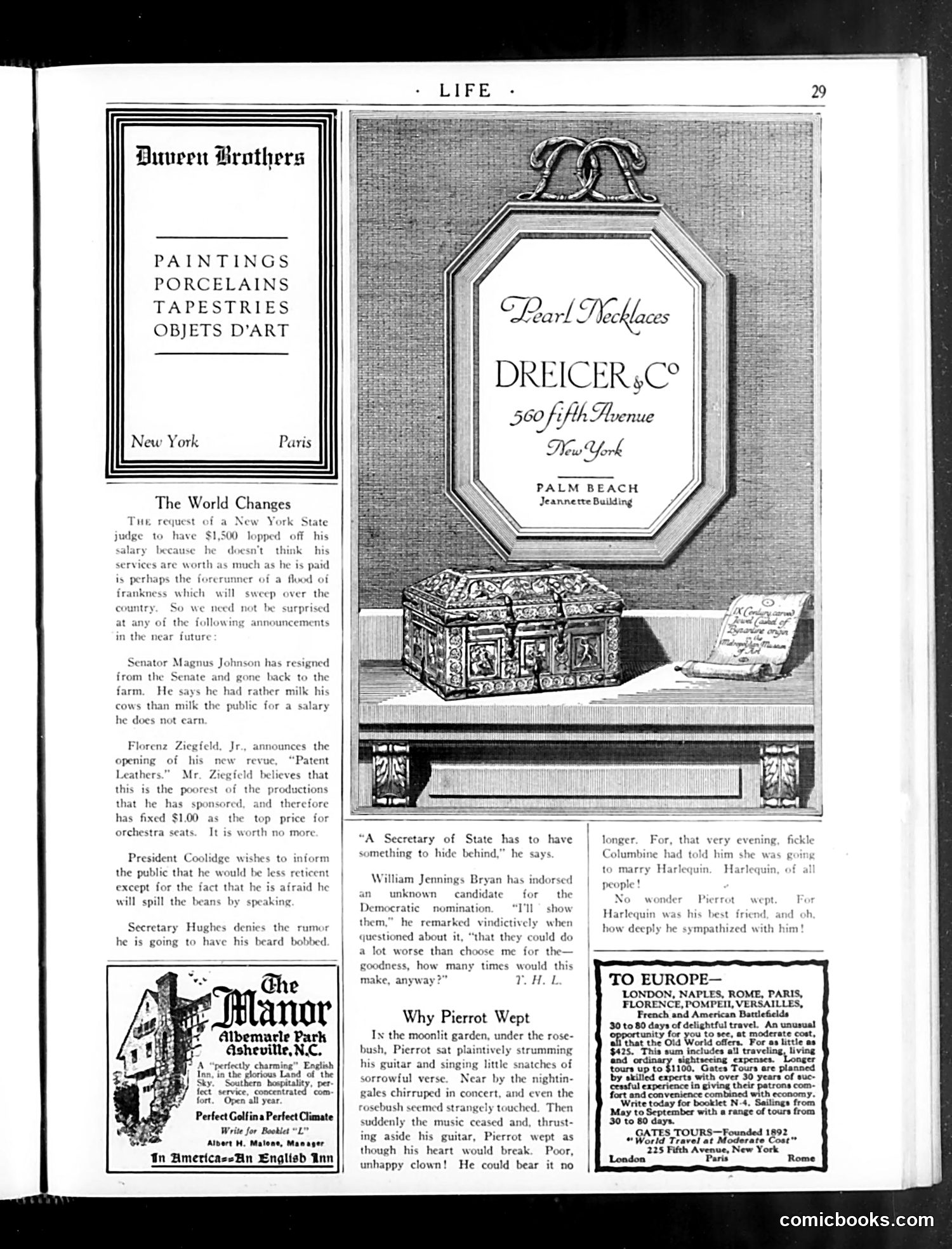
This page mixes satirical political commentary with period advertising. The "World Changes" section uses ironic mockery of contemporary figures: **Political satire targets:** - A New York State judge requesting a $1,500 salary cut (suggesting absurd honesty) - Senator Magnus Johnson leaving politics to farm (implying politics is less honest work) - Florenz Ziegfeld pricing his "Patent Leathers" revue at $1.00, calling it his "poorest" production (mocking self-aware mediocrity) - President Coolidge claiming he'd "spill the beans" if less reticent (satirizing his notorious taciturnity) - Secretary of State Hughes denying beard-bobbing rumors (unclear contemporary reference) - William Jennings Bryan endorsing an "unknown" Democratic candidate after multiple previous endorsements (mocking his inconsistency) The "Why Pierrot Wept" story appears to be sentimental fiction, unrelated to satire. The page is otherwise dominated by luxury advertisements (Duveen Brothers art dealers, Dreicer pearls, travel tours), typical of *Life*'s affluent readership.
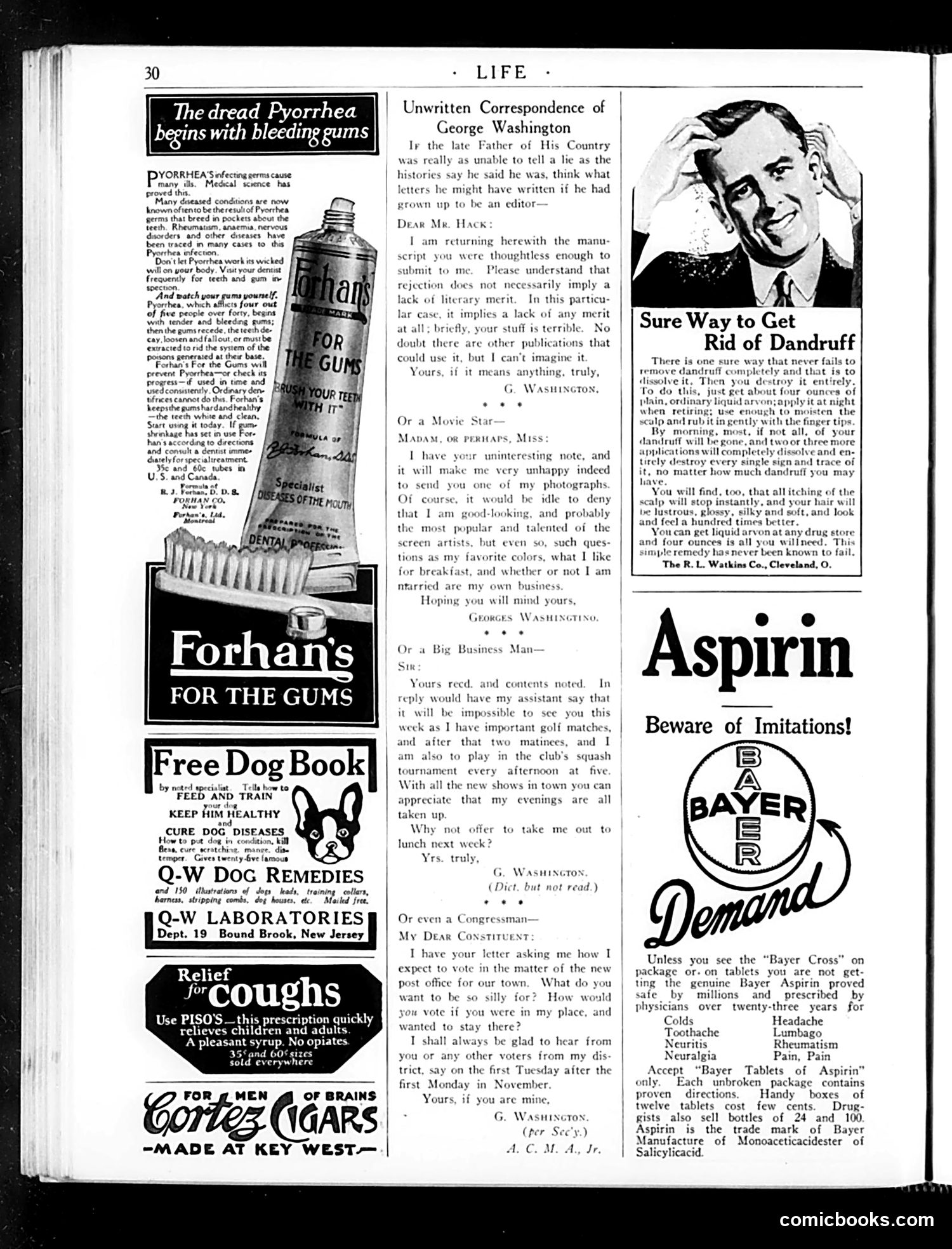
This page is primarily **advertisements and satirical letters**, not political cartoons. The main satire is a mock "Unwritten Correspondence of George Washington"—humorous fake letters imagining what the famously honest first president might write if he'd become a newspaper editor. Each letter parodies a different social type: - **To a rejected manuscript writer**: Washington coldly rejects terrible writing - **To a movie actress**: He dismissively declines to answer personal fan questions - **To a businessman**: He claims he's too busy with golf to meet - **To a congressman**: He cynically advises a constituent to vote however keeps him in office The satire targets **editorial indifference, celebrity aloofness, business culture, and political corruption**—showing how modern figures contradict Washington's legendary honesty. The humor relies on incongruity: the "Father of His Country," known for integrity, behaving like a dismissive, self-serving modern figure. The remainder of the page contains period advertisements for Forhan's toothpaste, dog remedies, cough medicine, and other products.
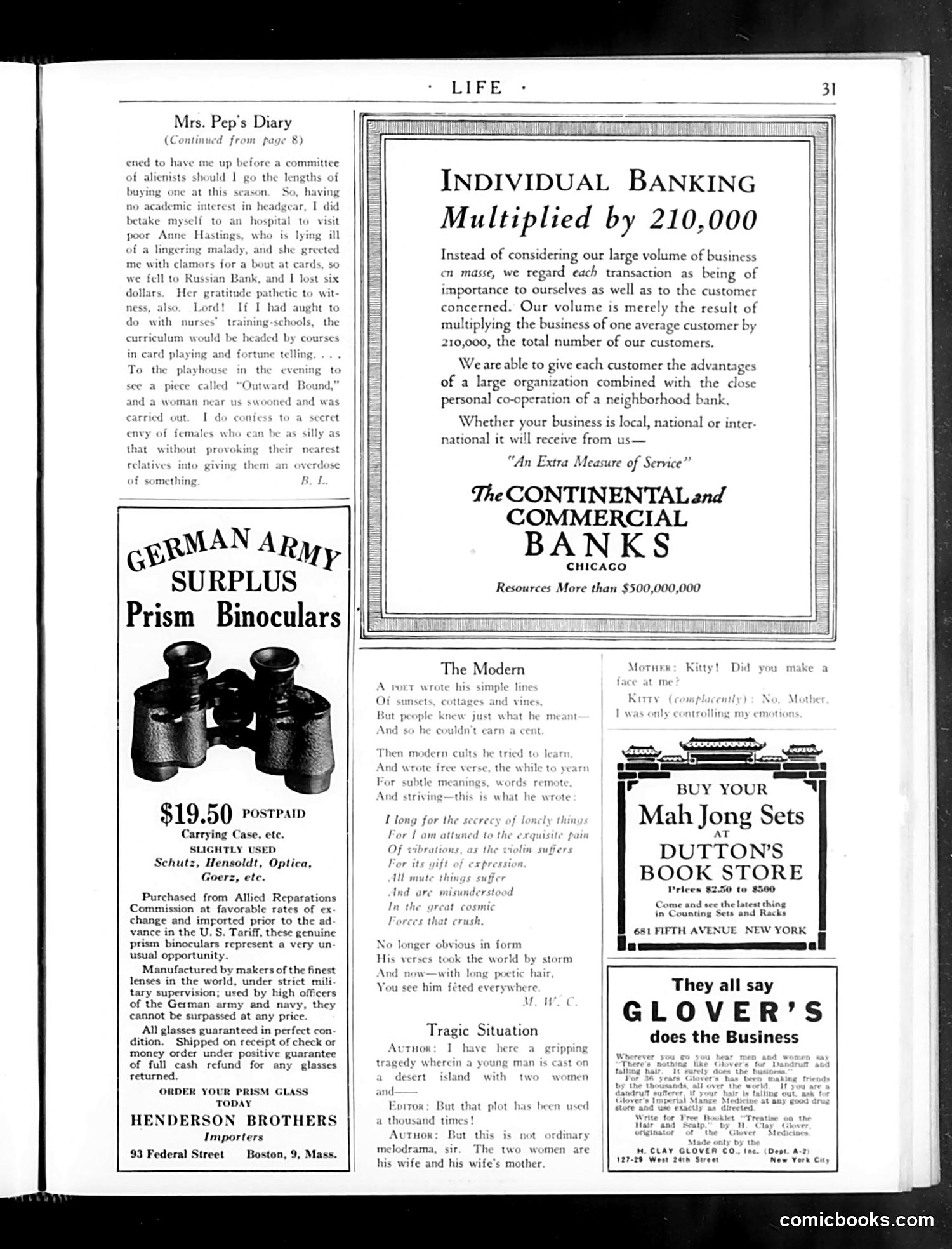
This page is primarily **advertising and filler content** rather than satirical editorial material. The notable elements include: **Mrs. Pep's Diary** (continued from earlier): A society gossip column describing upper-class activities—playing Russian Bank card games, visiting ill acquaintances, attending evening entertainments. This reflects early 20th-century leisure pursuits of wealthy women. **German Army Surplus Binoculars ad**: Selling military optics imported post-WWI via Allied Reparations Commission. This capitalizes on post-war availability of German military equipment at favorable tariff rates—a commercial opportunity exploiting the war's aftermath. **Other ads**: Continental and Commercial Banks (emphasizing personal service despite scale), Dutton's Book Store (Mah Jong sets), and Glover's hair products. **A brief literary exchange**: Discusses modern poetry versus traditional verse—appears to be contemporary literary commentary. No clear political satire or caricature is present. The page reflects 1920s consumer culture, post-WWI commerce, and society-page conventions.
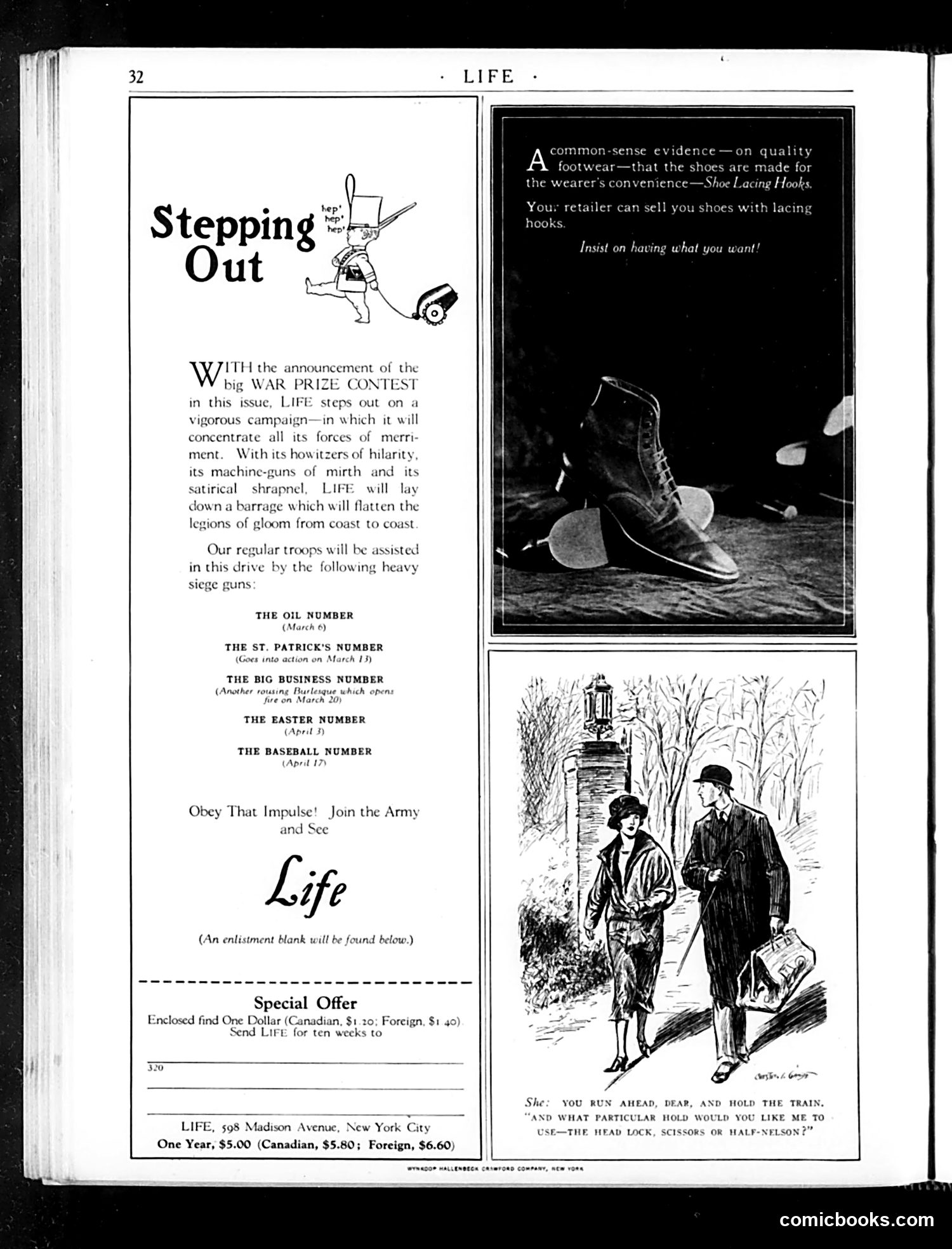
This page announces Life's "War Prize Contest" using extended military metaphor—the magazine will deploy "howitzers of hilarity" and "machine-guns of mirth" against "legions of gloom." This satirical framing reflects the WWI-era context (references to "war prize," specific upcoming issues like "The Oil Number" and "The Baseball Number"). The cartoon below depicts a couple at a train station. The woman tells her male companion to "run ahead and hold the train," then asks what "particular hold" he'd like her to use—"the head lock, scissors or half-nelson?" The joke mocks contemporary gender role expectations: she's sarcastically suggesting wrestling holds in response to his presumption that she'll passively follow his lead. It's gentle satire on male-female relationship dynamics and masculine authority. The shoe advertisement above advocates for "lacing hooks"—a consumer product emphasis typical of Life's advertising content.
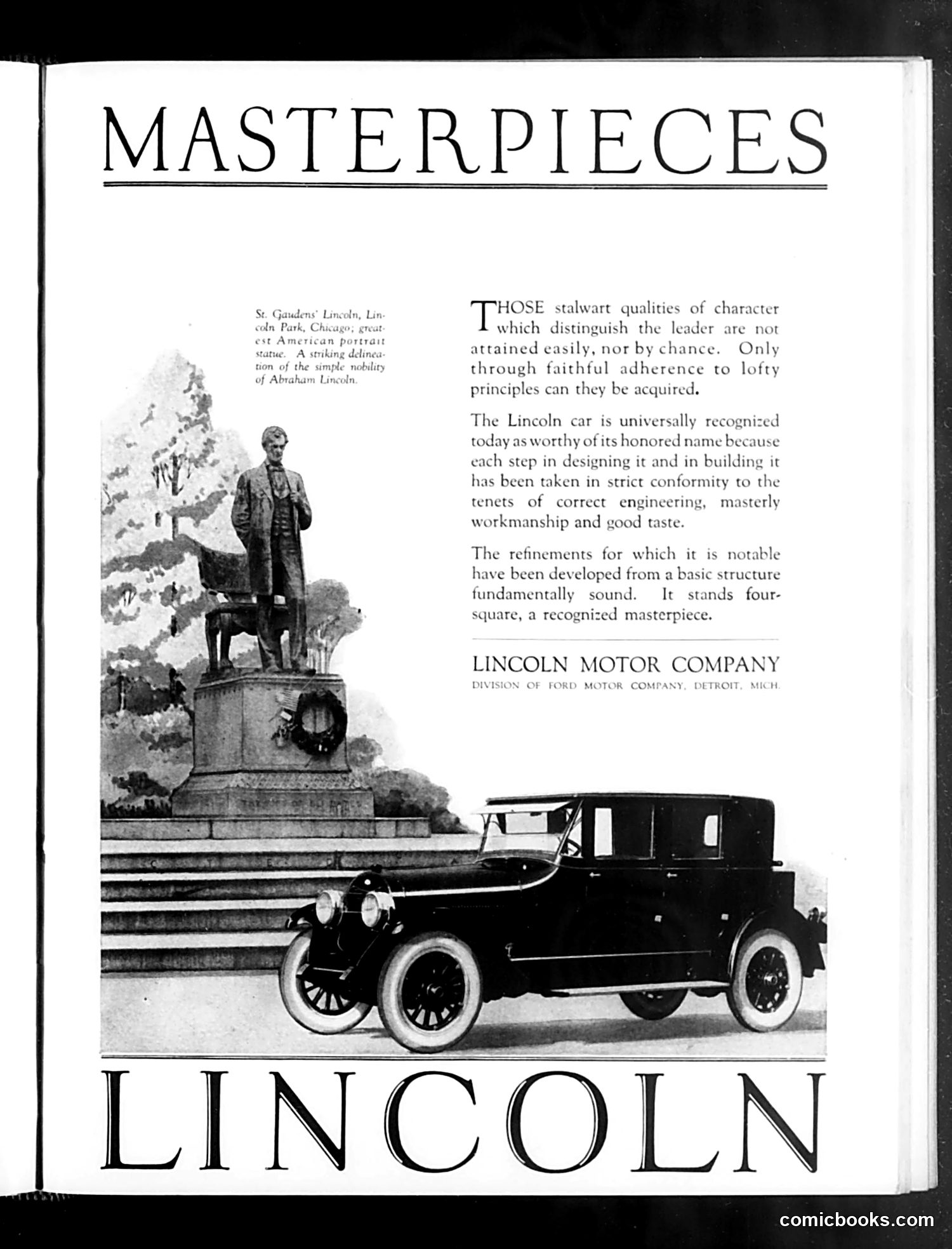
This is **not satire or political commentary**—it's a straightforward automobile advertisement. The page uses the Lincoln automobile statue in Chicago's Lincoln Park as visual branding, juxtaposing Abraham Lincoln's monument with a Lincoln Motor Company vehicle below. The ad's rhetoric draws a parallel between Lincoln the president's "stalwart qualities of character" and the car's engineering excellence. By naming the vehicle after Lincoln and positioning it beneath his statue, the company associates its product with American values: integrity, sound principles, and masterful craftsmanship. The "masterpiece" framing suggests the car achieves artistic perfection through engineering discipline—it's built on fundamentally sound design, not frivolous styling. This was typical early automotive advertising that emphasized mechanical virtue rather than luxury or style.
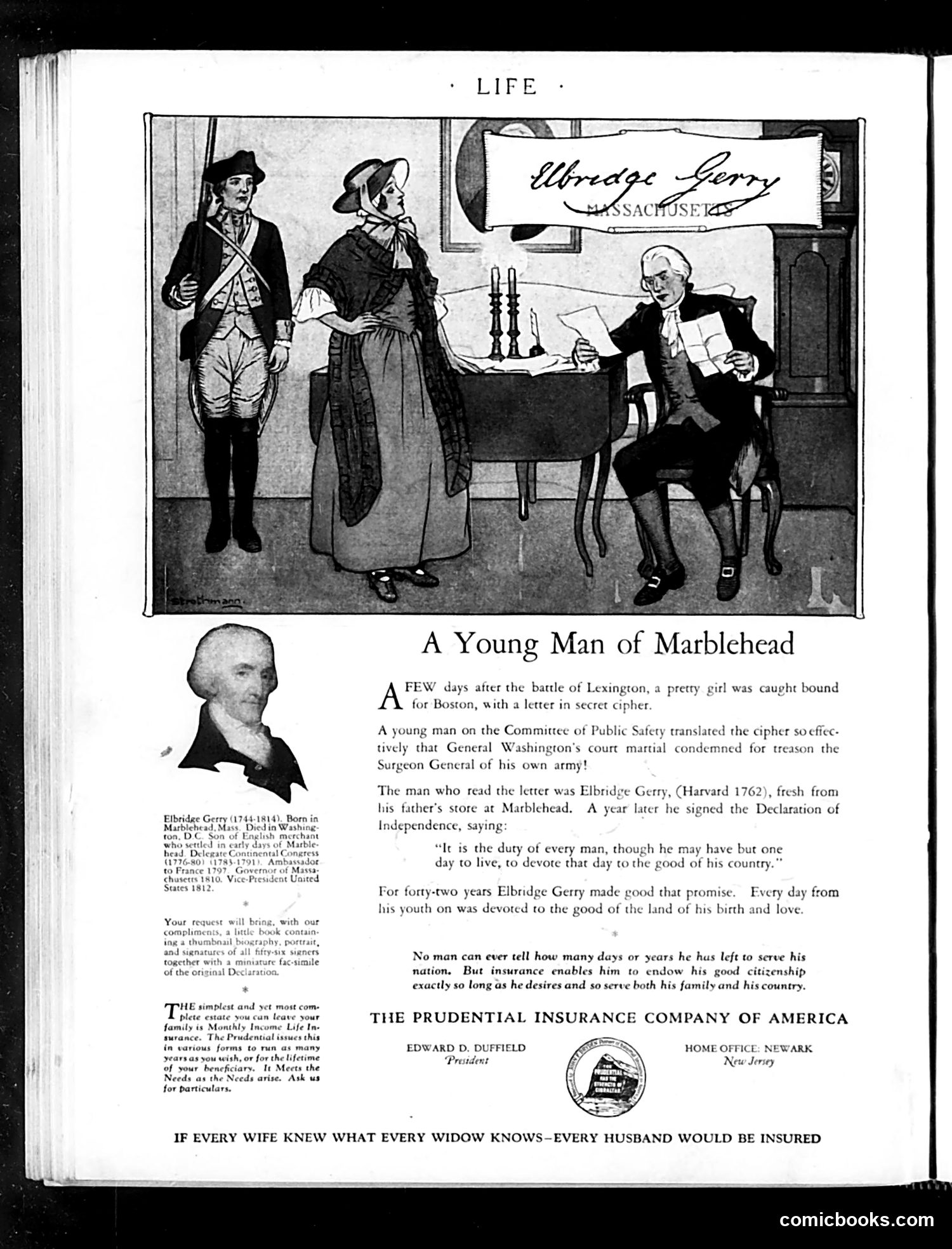
This is primarily **advertising content disguised as historical biography**, not satire. The top illustration depicts a Revolutionary War-era scene where Elbridge Gerry (1744-1814), a young Massachusetts patriot, deciphers a secret letter that exposes a traitor in General Washington's army. The narrative frames Gerry's lifelong public service—culminating in signing the Declaration of Independence—as exemplary citizenship. His famous quote about devoting even "one day to live" to his country's good serves as the moral anchor. **The sales pitch**: The Prudential Insurance Company uses Gerry's patriotic legacy to argue that life insurance enables citizens to extend their service to both nation and family after death, through financial provision. The final slogan—"IF EVERY WIFE KNEW WHAT EVERY WIDOW KNOWS—EVERY HUSBAND WOULD BE INSURED"—directly appeals to anxiety about family security. This represents early 20th-century **institutional advertising** borrowing American historical authority to sell insurance products.