
Life, 1924-02-21 · page 16 of 36
Life — February 21, 1924 — page 16: what you’re looking at
What you’re looking at
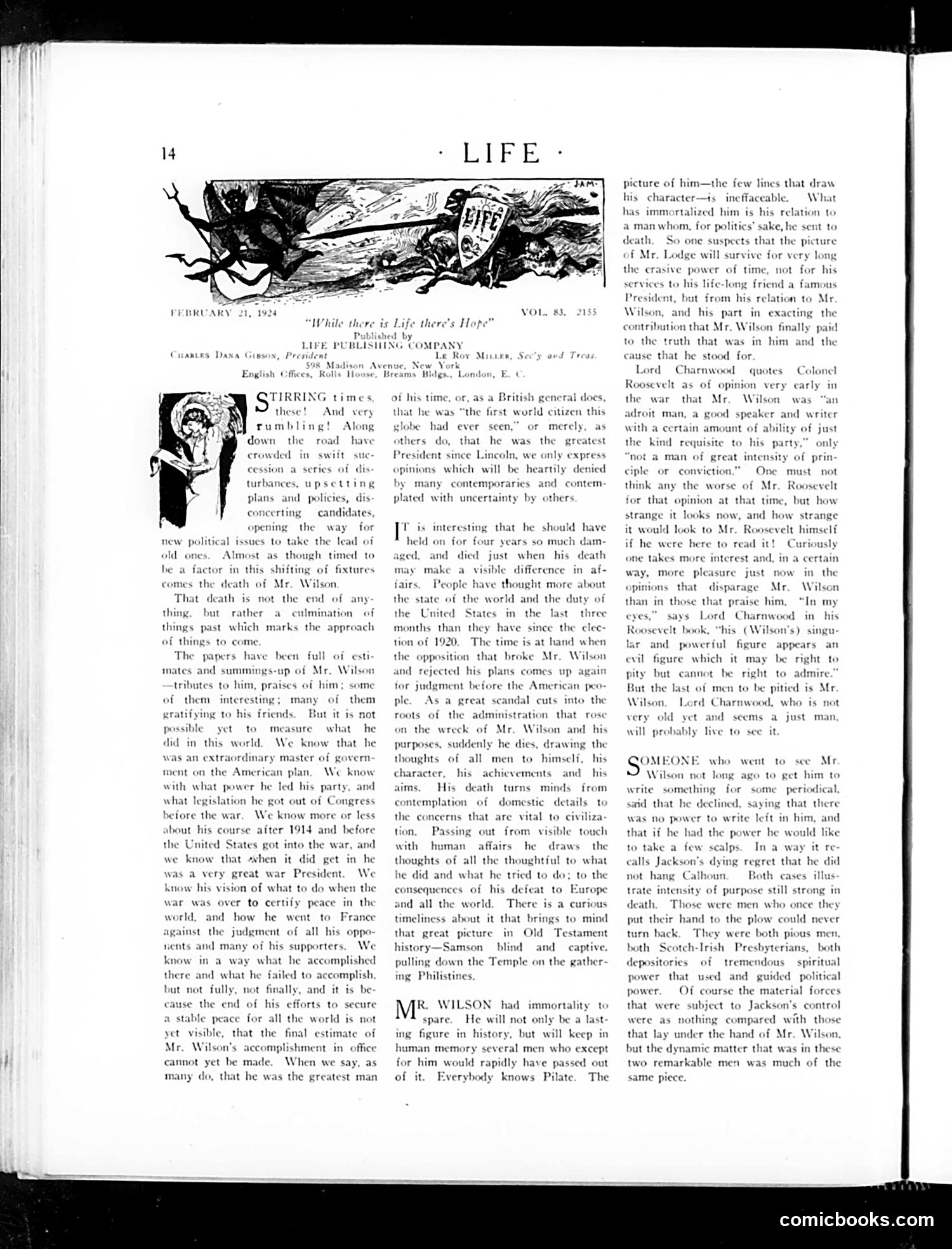
This page contains an article titled "While there is Life there's Hope" commemorating Woodrow Wilson's death. The accompanying cartoon depicts a skeletal figure labeled "Life" lying prone, illustrating the magazine's title's dark irony. The article praises Wilson as "the first world citizen" and "the greatest President since Lincoln," while acknowledging contemporary criticism of his political failures. It reflects on his role in World War I peace efforts and notes his death occurred when his influence over world affairs had diminished. The piece also mentions two other notable figures—Calhoun and Roosevelt—comparing Wilson's political power and legacy to theirs, positioning Wilson as historically significant despite disputed contemporary assessments of his presidency and policies.
📄 Transcribed text from this page (OCR, searchable)
Machine-transcribed from the original scan — historical spelling and the odd misread are preserved.
FERRUA VOL. 83. 21 “While there is Life th Published by LIFE PUBLISHING COMPANY Cuamtes Dana Ginson, President Le Rov Miter, Sec'y end Tr 398 Madison New York English Cffices, Rolls It ams Bhlgs., London, E. ¢ TIRRING times these! And very rumbling! Along down the road have crowded in. swift ste turbances, upsetting y plans and policies, dis- concerting candidates opening the way for new political issues to take the lead of old ones. Almost as though timed to be a factor in this shifting of fixtures comes the death of Mr. W That death is not the er lof any thing, but rather a culmination of things past which marks the approach of things to come. The papers have been full of esti mates and summings-up of Mr. Wilson tributes to him, praises of him; some of them interes! ng; many of them ig to his friends. But it is not possible yet gratify measure what he did in this world. We know that he was an extraordinary master of govern ment on the American plan. We know with wh t power he led his party, and what legislation he got out of Congress before the war. We know more or less se after 1914 and befe the United States got into the war, anc sbout his ¢ we know that swhen it did get in he was a very great war President. We know his vision of what to do when the war was over to certify peace in the world, and how he went France inst the judgment of all his oppo nents and many of his supporters. We know in a way what he accomplished there and what he failed to accomplish but not fully, not finally, and it is be cause end of his efforts to secure a stable peace for all the world is not yet visible, that the final estimate of Mr. Wilson's accomplishment office je. When we say, as cannot yet be ma many do, that he was the greatest man of his time, or, as a British general docs, that he was “the first world citizen this x had ever seen,” or merely, as others do, that he was the greatest President since Lincoln, we only express opinions which will be heartily denied by many contemporaries and contem: plated with uncertainty by others [' is interesting that he should have held on for ur years so much dam ed, and died just when his death may make a visible difference in af- iairs. People have thought more about the state of the world and the duty of the Un months than they have since the elec- d States in the last. three tion of 1920. The time is at hand when the opposition that broke Mr. Wilson and rejected his plans comes up for judgme before the American poo- ple. As a great scandal cuts into the wots of the administration that rose 1 the wreck of Mr. Wilson and his purposes, suddenly he dies, thoughts of all men c drawing the himseli, his racter, his achievements and his aims. His death turns minds from ntemplation of ¢ mestic details te the concerns that are vital to civiliza hy with human affairs he draws the tion. Passing out from visible te thoughts of all the thoughtful to what t he tried to do; to the f his defeat to Europe and all the world. There is a curious timeliness about it that brings to mind that great picture in Old history—Samson ne and wh consequences ‘estament 1 and captive, le on the gathe pulling down the Te ing Philistines. MR WILSON had immortality to spare. He will not only be a last ing figure in history, but will keep in human memory several men who except for him would rapidly have passed out of it. Everybody knows Pilate. The picture of him—the few lines that draw his character—is_ ineffaceable What has immortalized him is his re a man whom, fc jon to politics’ sake, he sent to death. So one suspects that the picture of Mr. Lodge will survive for very | the crasive power of time, not for his services to his life-long friend a famous President, but from his relation to Mr Wilson, and his part in exacting the contribution that Mr, Wilson. fin ly paid to the truth that was in him and the cause that he stood for ord Charnwood quotes Colonel Roosevelt as of opinion very early in the war that Mr. Wils adroit man, a good speaker and writer with a certain amount of ability noWwas “an f just the kind requisite to his party,” only not a man of great intensity of prin ciple or conviction.” must not think any the worse of Mr. Roosevelt for that opinion at that time, but how strange it looks now, and how strange it would 1 to Mr. Roosevelt himself if he were here to read it! Curiously one takes more interest and, in a certain way, more pleasure just now in the opinions that disparage Mr. Wilson than in those that praise him. “In my eyes,” says Lord Charnwood in his Roosevelt book, “his (Wilse and powerful figure appears an ight to pity but cannot be right to admire But the last of men to be pitied is Mr Wilson, Lord Charnw N's) singu evil figure which it may be r 1, who is not very old yet and seems a just- man will probably live to see it GOMEONE who went to see Mr Wilson not long ago to get him to write something for some periodical, said that he declined, saying that there was n power to write left in him, and that if he had the power he would to take a few scalps. In a way it re calls Jacksc not ha v's dying regret that he did Both cases illu trate intensity of purpose still strong in death. Those were men who once they put their hand to the plow could never turn back. They were both pious men both Scotch-Irish Presbyterians, both depositories of tremendous spiritual power that uscd and guided political power. Of course the material forces that were subject to Jackson's control compared with those that lay under the hand of Mr. Wilson, but the dynamic matter that was in these two remarkable men was much of the were as nothin, same pi comicbooks.com