
Life, 1924-02-21 · page 20 of 36
Life — February 21, 1924 — page 20: what you’re looking at
What you’re looking at
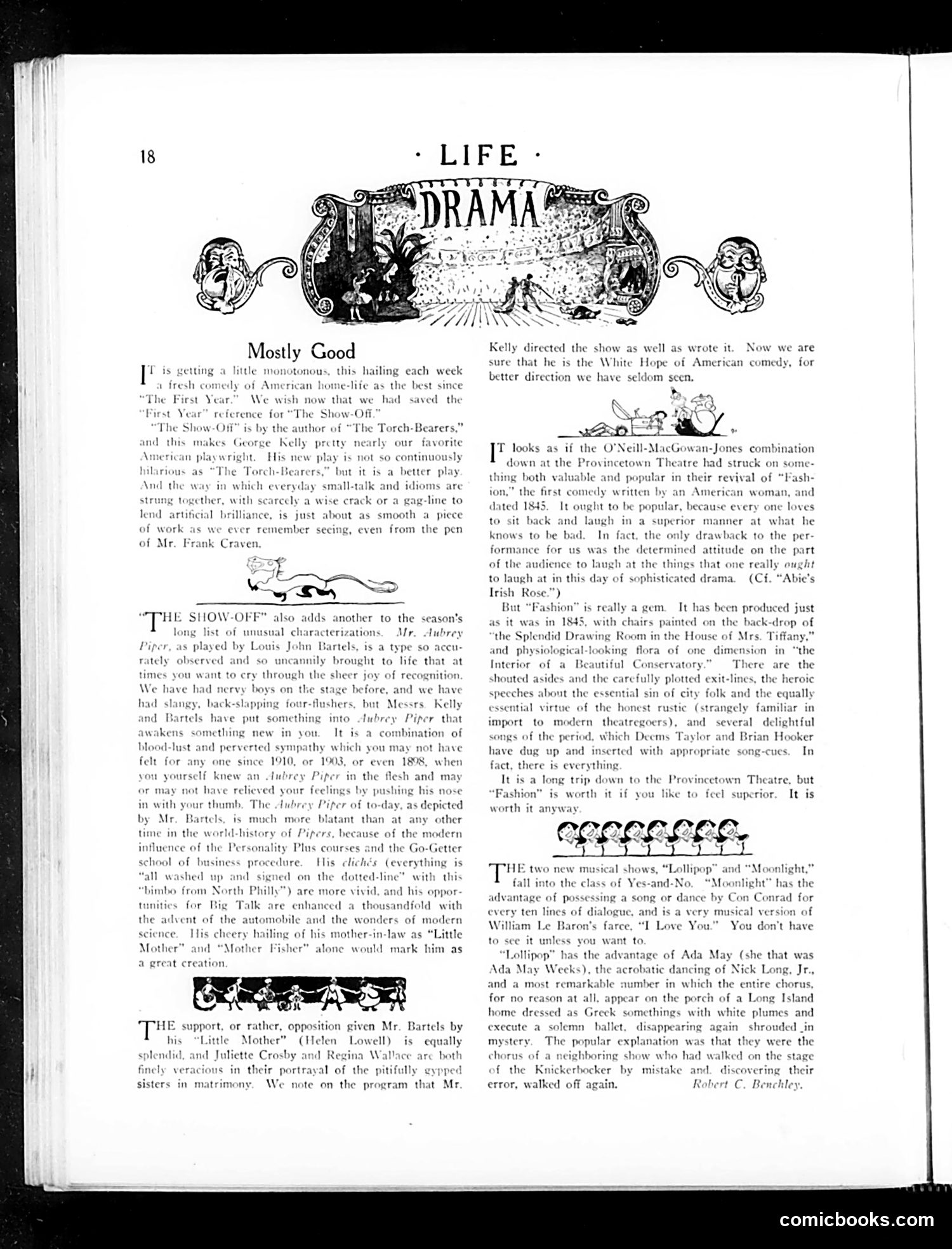
This page reviews contemporary Broadway comedies. The main focus is "The Show-Off," a play by George Kelly starring Louis John Bartels as Aubrey Piper—a type of boastful, working-class character the critic finds compelling. Bartels embodies a specific American archetype: the blustering, self-aggrandizing man who uses dated slang ("all washed up," "dotted-line") and empty talk to seem important. The review also covers "Fashion," a 1845 American comedy revived at the Provincetown Theatre, praising its authentic period staging. The critic notes audiences laugh at things they "ought" to laugh at—suggesting period comedy about city corruption and rural virtue still resonates with 1920s sophistication. The cartoons (decorative drama headers) are purely ornamental. The "Mostly Good" title signals qualified praise for contemporary theater—entertaining but somewhat repetitive in subject matter.
📄 Transcribed text from this page (OCR, searchable)
Machine-transcribed from the original scan — historical spelling and the odd misread are preserved.
Mostly Good [! is ge 1 little monotonous, this hailing each week 1 fresh comedy of Ar an home-life as the bes The First Year.” We w First Year” reicrence for “The Show-Off The Show-Ofi” is by the author of “The Torch-Bearers,” Kelly pretty nearly our favorite now that we saved the wright. His new play i “The Toreh-Bearers,” but it ty in which everyday small-talk and idio line to gf together, with scarcely a wise crack or a lend artificial brilliance, is just about as smooth a pice of work of Mr ever remember seeing, even from the pen nk Craven. i a Wo cj, “> SHOW-OFF" also ist of unusual ed by L rately observed and Ids another to the season's uracterizations. Mr. Aubrey i li cr, as pl hn Bartels, is a type so accu- ancannily brought to life that at times you want to ery through the sheer joy of recognition. We have had had slangy, back-slapping four ers, but Messrs. Kelly nervy boys on th before, and we have nd Bartels have put something into Aubrey Piper that wakens something new in you. It is a combination of blood-lust and perverted sympathy which you may not have felt for any one since 1910, or 1903, or even 1898, when you yourself knew an Aubrey Pipe the flesh and may not have relieved your feelings by tubrey Piper of to-day or may in with your thumb, The by Mr. Bartels time in the world-hi depicted blatant than at other ry of Pipers is much m hecause of the n ern io-Getter influence of the Pe Plus courses and th school of s procedure. His clichés (everything is “all washed up an the dotted-line” with this “bimbo f North Philly”) are more vivid, and his oppor nities for Big Talk are enhanced r ld with Ivent of the automobile and the wond: of his mother-in-law a ace. His cheery haili her” and “Mother er” alone would mar great creation. Coa S| HE support, or rather, opposition given Mr. Bartels by his “Li Mother” (Helen Lowell) is equally nd Juliette Crosby and Regina Wallace are bot their portrayal of ny. We note on the program that Mr Kelly directed the show as well as wrote it. Now we are sure that he is the White Hope of American comedy, for better direction we have seldom seen. iN XS — ZPD. i looks as if the O'Neill-MacGowan-Jones combination down at the Provincetown 1 heatre had struck on s¢ g both valuable and popular in their revival of “Fash- * the first comedy written by an American woman, and dated 1845. It ou to sit back and | in a superior manner at what he t to be popular, because every one loves knows to be bad. In fact, the only drawback to the per- formance for us was the determined attitude on the part of the audience to laugh at the things that one really ought to laugh at in this day of sophisticated drama. (Ci. “Abie's Irish Rose.”) But “Fashion” is really a gem. It has been produced just as it was in 1843, with chairs painted on the back-drop of the Splendid Drawing Room in the House of Mrs. Tiffany,” ind physiological-looking flora Interior of a Beautiful Coi shouted asides and the carefully plotted exit-lines, the heroic imension in “the rvatory.” There are the speeches about the essential sin of city folk and the equally tial vir of the honest rustic (strangely familiar in import to modern theatregoers), and several delightful h Deems Taylor and B: have dug up and inserted with appropriate song-cues. In of the period, ian Hooker fact, there is everything. It is a long trip down to the Provincetown Theatre, but “Fashion” is worth it if you like to feel supe It is worth it anyway fall of Yes-and-No. “M idvantage of possessing a song or dance by Con Conrad for every ten lines of dialogue, and is a very musical version of farce, “I Love You.” u don’t have Ivantage of Ada May (she that was Ada May Weeks), the acrobatic dancing of Nick Long, Jr., and a most remarkable aumber in which the entire chorus, for no reason at all, appear on the porch of a Long Island Greck somethings with white p home dressed 4 mes and execute a solemn ballet, disappearing again shrouded _in The popular explanation was that they were the chorus of a neighbe walked on the stage f the Knickerbocker by mistake wering their error, walked off in. mystery ing show who ha comicbooks.com