
Life, 1924-02-21 · page 26 of 36
Life — February 21, 1924 — page 26: what you’re looking at
What you’re looking at
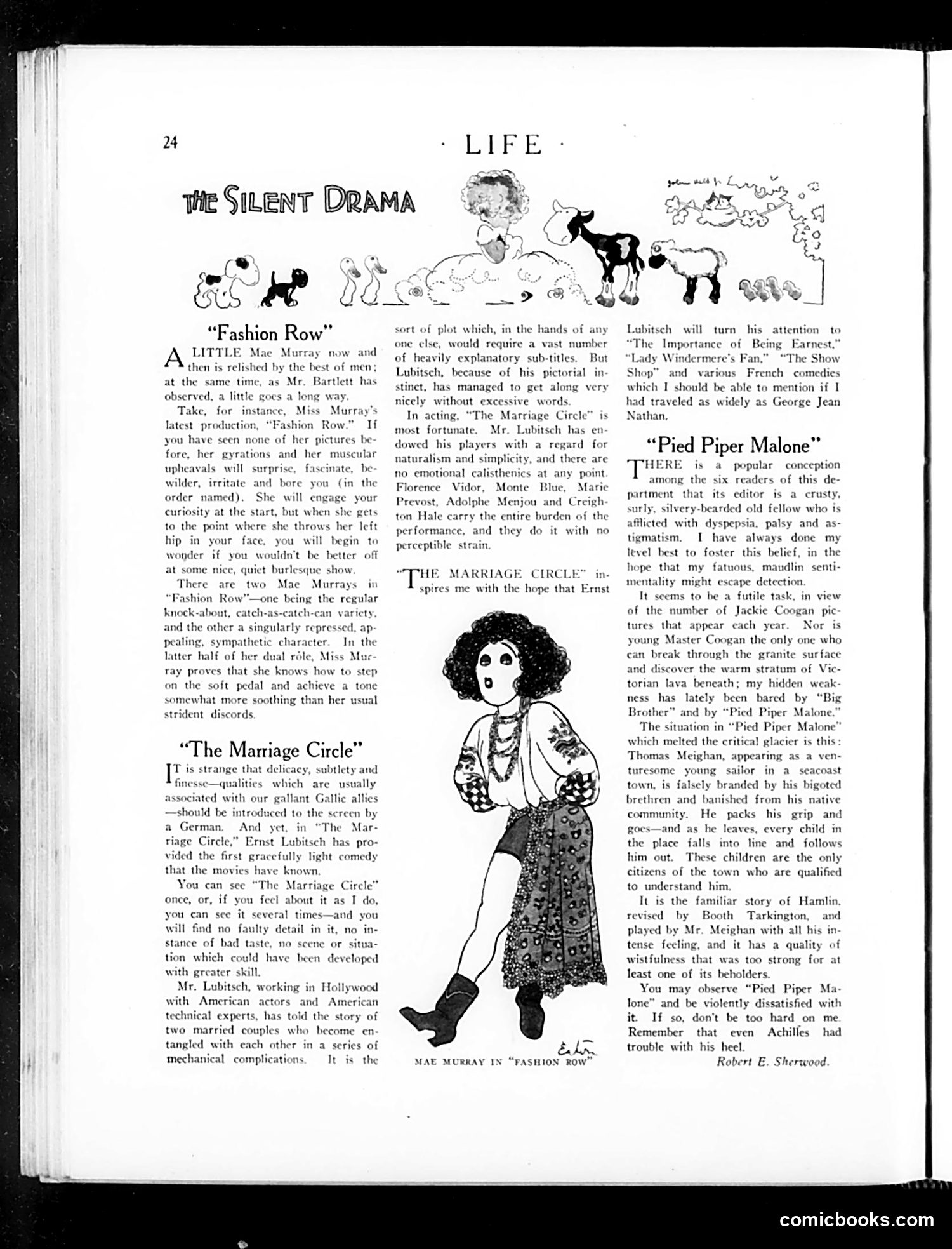
This page contains three film reviews from Life's movie criticism section. The reviews discuss: **"Fashion Row"** starring Mae Murray, criticized for her exaggerated physical movements and gyrations that the reviewer finds alternately fascinating and tedious, though praising her more restrained dramatic moments. **"The Marriage Circle"** directed by Ernst Lubitsch, enthusiastically reviewed as the first gracefully light comedy in cinema. The reviewer praises Lubitsch's German directorial skill in bringing French sophistication to Hollywood, and commends the naturalistic acting of the ensemble cast (Florence Vidor, Monte Blue, Marie Prevost, Adolphe Menjou, Creighton Hale). **"Pied Piper Malone"** starring child actor Jackie Coogan and Thomas Meighan. The reviewer humorously admits to hiding sentimental weakness for Coogan's films, describing a plot where Meighan's character is falsely accused and banished from his community. The page uses typical 1920s film criticism conventions, balancing entertainment industry gossip with aesthetic judgment.
📄 Transcribed text from this page (OCR, searchable)
Machine-transcribed from the original scan — historical spelling and the odd misread are preserved.
24 te Sitenr DRAMA “Fashion Row” LITTLE Mae Murray now a then is relished by the best of men; as Mr. Bartlett has oes a le at the same time observed, a little Take, for instance, Mi latest production, way Murray's Row.” If you have seen none of her pictures be shion fore, her gyrations and her muscular upheavals will surprise, fascinate, be wilder, irritate and bore you (in the will engag curiosity at the start, but when she gets to the pe order named). She your nt where she throws her left hip in your face, you will begin te wouldn't be better quiet burlesque show Mae one being the regular knock-about, catch-as-catch-can_ variety wonder if you at some nice Murrays inv There are two “Fashion Row nd the other a singularly repressed, ap pealing, sympathetic character. In the latter half of her dual role, Miss Mur ray proves that she knows how to step on the soft pedal and achieve a tone somewhat more soothing than her ustal strident discords. “The Marriage Circle” [1 is strange that deticacy, subtlety and finesse—qualities which are usually associated with our gallant Gallic allies —should be introduced to the screen by a rman. And yet, in “The Mar- riage Circle,” Ernst Lubitsch has pro- vided the first gracefully light comedy that the movies have known. You can see “The Marriage Circle” once, or, if you feel about it as I do, you can see it several times—and you will find no faulty detail in it, no in- stance of bad taste, no scene or situa- tion which could have been developed with greater skill Mr. Lubitsch, working in Hollywood with American American technical experts, has told the story of two married couples who become en- actors id tangled with each other in a series of mechanical complications sort of plot which, in the hands of any one else, would require a vast number of heavily explanatory sub-titles. But Lubitsch, because of his pictorial in stinet, has managed to get along very nicely without excessive words In acting, “The Marriage Circle” is most fortunate. Mr. Lubitsch has en- dowed his players with a regard for naturalism and simplicity, and there are no emotional calisthenics at any point Florence Vid Monte Blue, Maric Prevost, Adolphe Menjou and Creigh ton Hale ¢ performance, perceptible. strai ry the entire burden of the and they do it with no . HE MARRIAGE CIRCLE” in- spires me with the hope that Ernst MAE MURRAY IN “FASHION ROW” Lubitsch will turn his attention t “The Importance of Being E- “Lady Windermere’s Fan,” Shop” and various French comedies which I should be able to mention if I had traveled as widely as George Jean Nathan. “Pied Piper Malone” THERE is a popular ame the six readers of this de- partment that its surly, silvery-bearded old fellow who is The Show conception editor is a crusty, afflicted with dyspepsia, palsy and as- tigmatism, I have always done my level best to foster this belief, hope that my in the fatuous, maudlin senti- mentality might escape detection. It seems to be a futile task, in view of the number of Jackie Coogan pic tures that appear year or is young Master Coogan the only one who can break thr and discover the warm stratum of V: each h the granite surface torian lava beneath; my hidden weak- ness has lately been bared by “Big Brother” and by “Pied Piper Malone.” The situation in “Pied Piper Malone’ which melted the critical glacier is this Thomas Meighan, appearing as a ven- turesome young town, is falsely br brethren and banished from his native community. He packs his grip and goes—and as he leaves, every child in the place falls into line and follows him out. These children are the only citizens of the town who are qualified to understand him. It is the familiar story of Hamlin, revised by Booth Tarkington, and played by Mr. Meighan with all his in tense feeling, and it has a quality of sailor in nded by his bigoted wistfulness that was too strong for at least one of its beholders. You may observe “Pied Piper M Tone” and be violently dissatisfied with it. If so, don't be too hard on me. Remember that even Achilles had trouble with his heel. Robert E. Sherwoo comicbooks.com