
A complete issue · 36 pages · 1924
Life — January 31, 1924
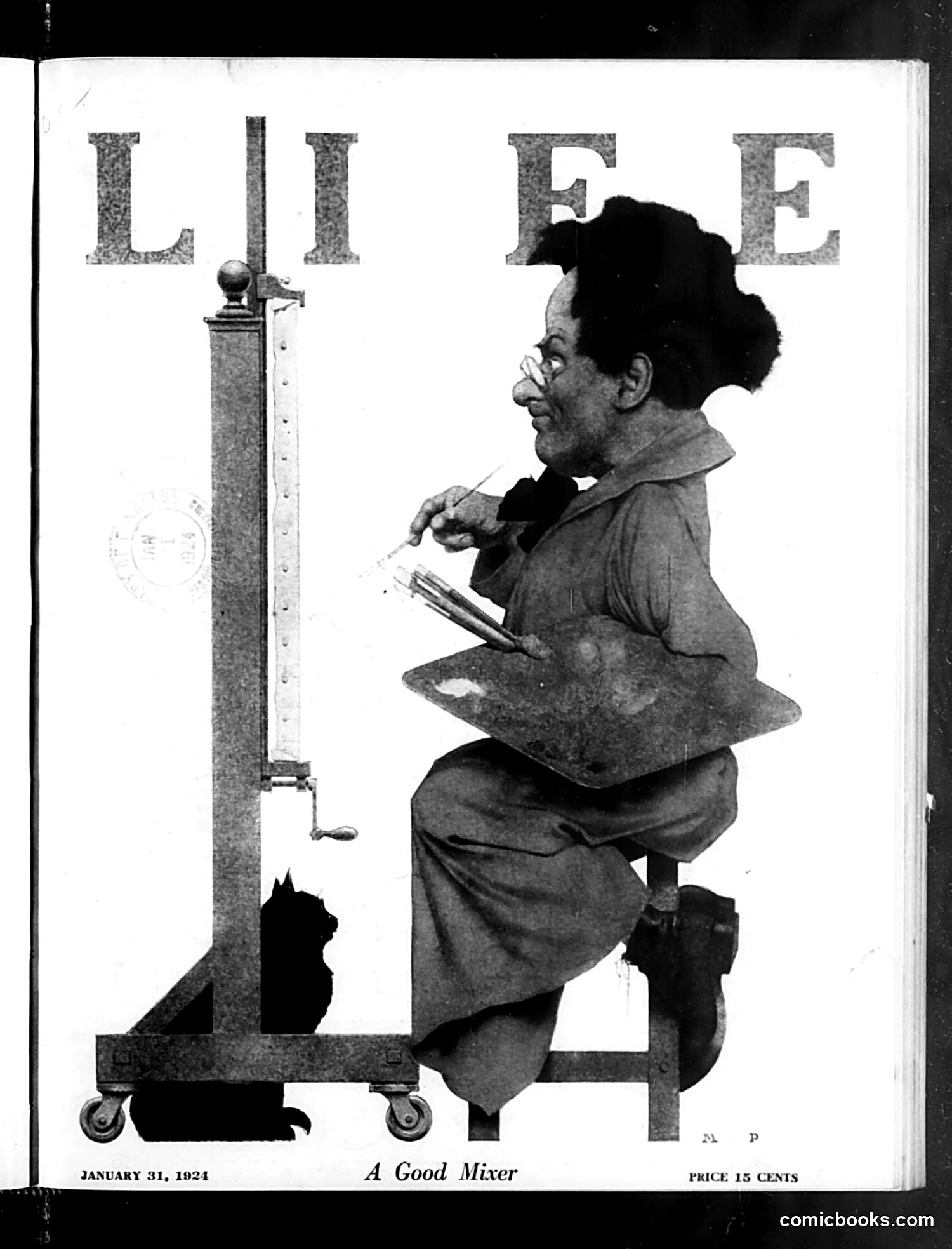
This political cartoon depicts a caricatured figure operating a large mechanical mixer. The exaggerated facial features and body proportions suggest this is a satirical commentary on a specific political or public figure of the era, though the identity isn't explicitly stated in the visible text. The "mixer" device—complete with gears and mechanical components—appears to metaphorically reference the subject's role in combining or blending different political elements or constituencies. The title "A Good Mixer" likely mocks someone's political flexibility or their ability to appeal to diverse groups, a common criticism of politicians. Without additional context identifying the specific figure, the exact political target remains unclear, though the January 1921 date suggests relevance to immediate post-WWI American politics.
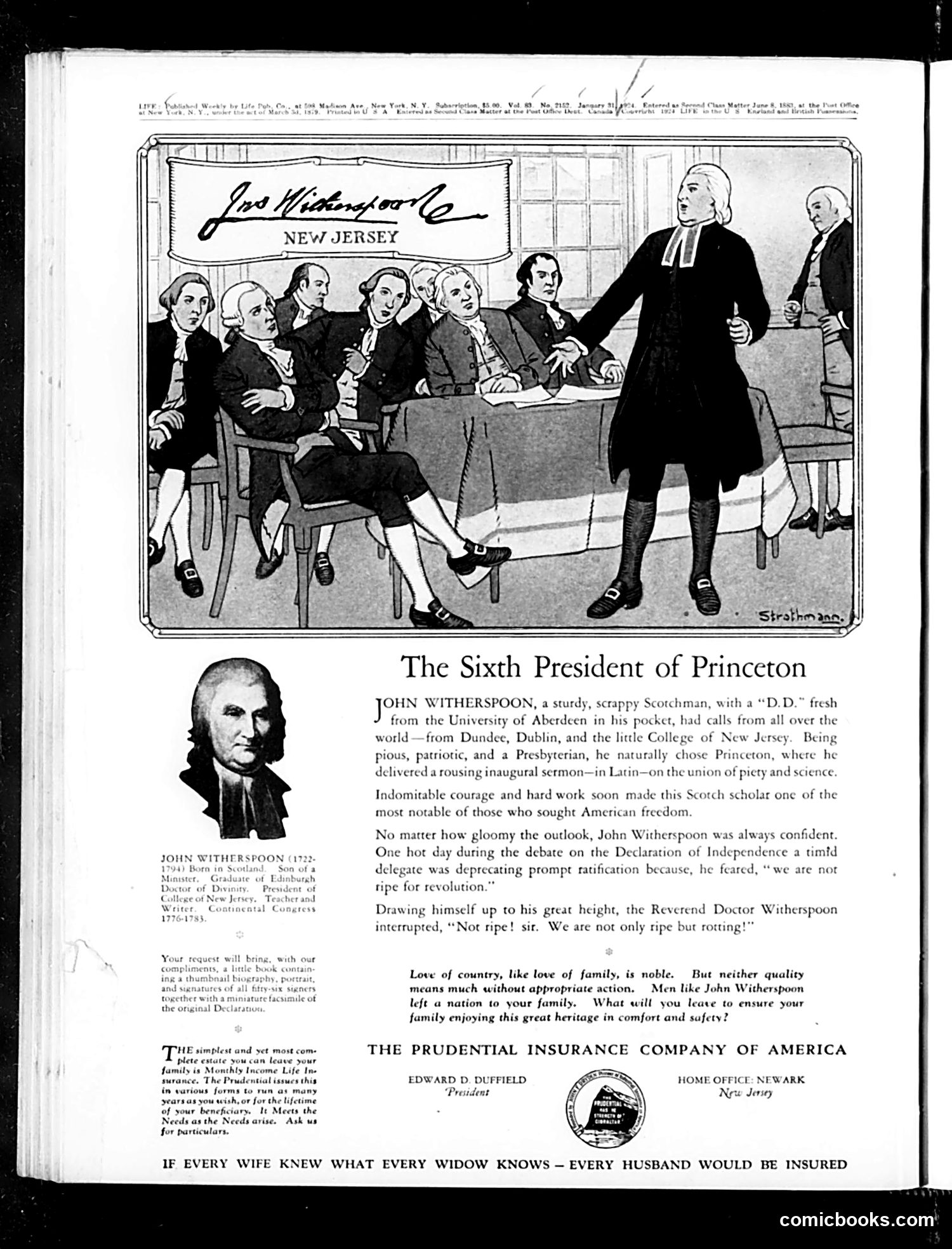
The main cartoon depicts **John Witherspoon**, identified as the sixth president of Princeton University. The illustration shows him in formal 18th-century dress, gesturing emphatically before seated figures in what appears to be a formal debate or meeting. The accompanying text emphasizes Witherspoon as a Scottish Presbyterian clergyman and signer of the Declaration of Independence. It recounts an anecdote where, during debates over ratifying the Declaration, when a delegate expressed fear "we are not ripe for revolution," Witherspoon famously replied: "Not ripe sir. We are not only ripe but rotting!" The page frames this as patriotic inspiration—celebrating Witherspoon's bold confidence during America's founding. However, the bottom half shifts to **insurance advertising** (The Prudential Insurance Company), using this founding father as branding to suggest security and wisdom.
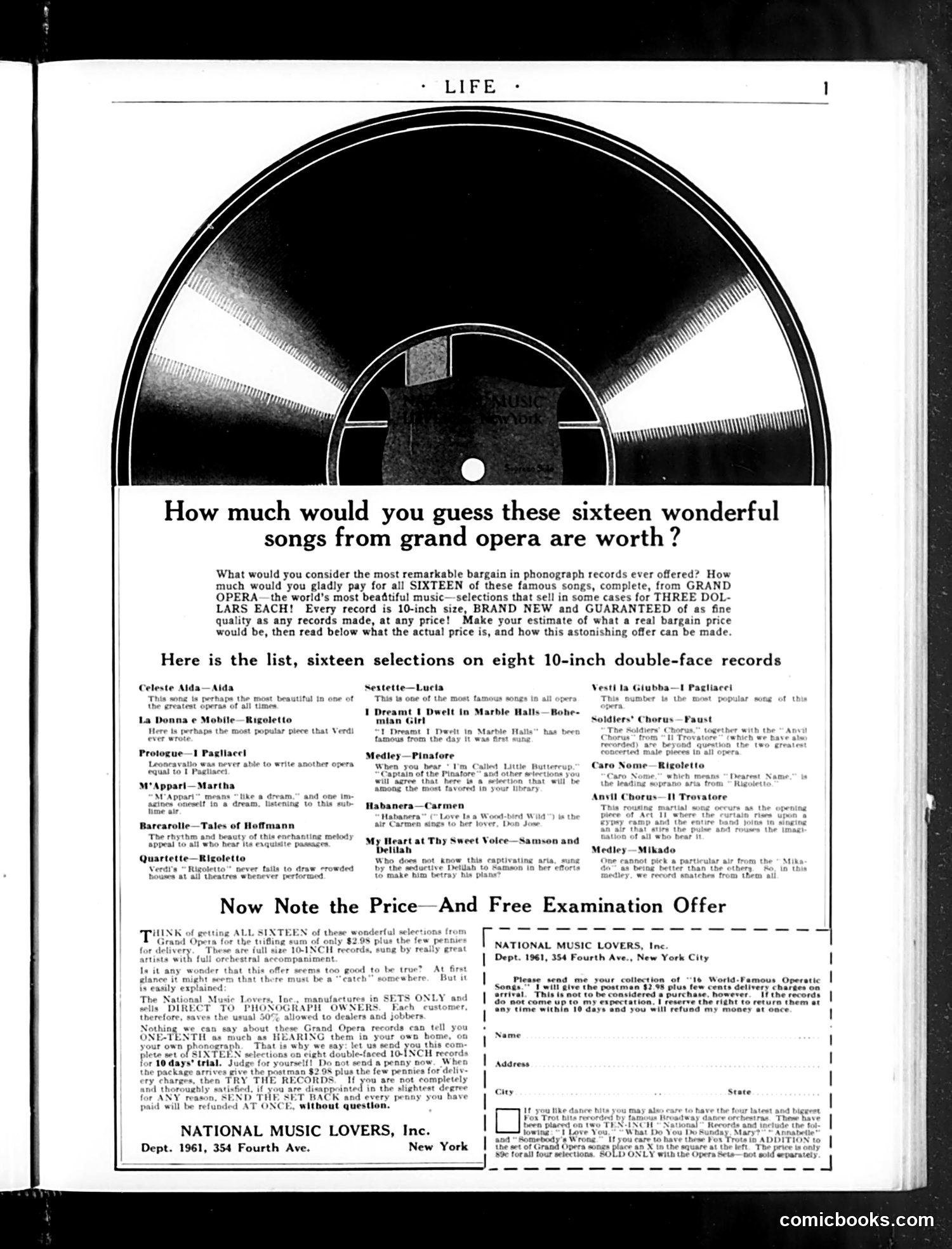
This page is **primarily an advertisement**, not satirical content. It's a direct-mail offer from National Music Lovers, Inc. for sixteen grand opera selections on eight 10-inch records. The advertisement uses a marketing hook—asking readers to guess the value of these recordings before revealing an "astonishing" price. The copy emphasizes that these are brand-new, guaranteed quality records normally selling for three dollars each, now offered at a bargain rate. The decorative element at top shows a phonograph record, establishing the product visually. The extensive text below lists opera selections (Aida, Lucia, Faust, etc.) and includes a mail-in coupon with a free examination offer—standard direct-marketing tactics of the era. This reflects mid-20th-century record-selling practices targeting opera enthusiasts.
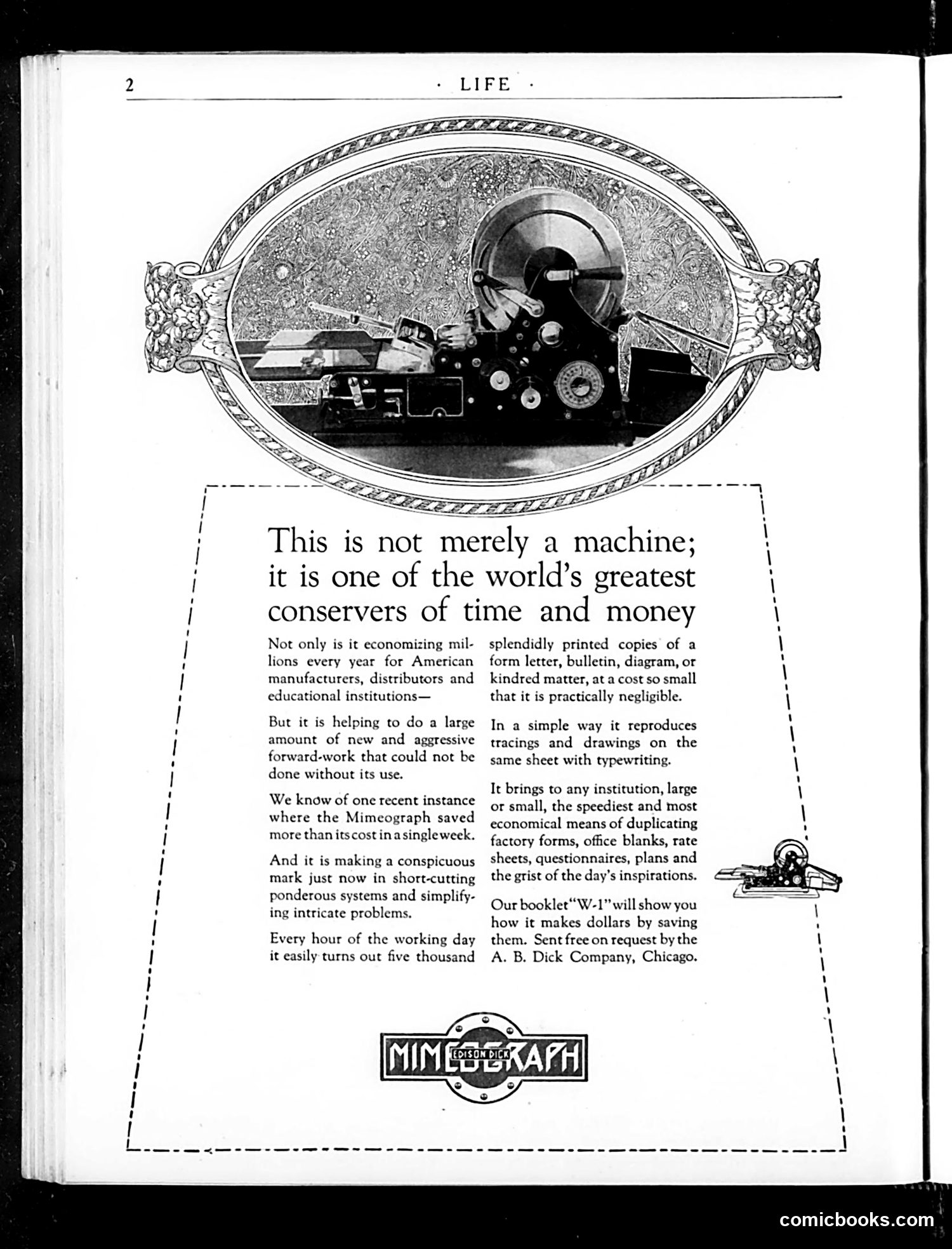
This is a **Mimeograph machine advertisement**, not political satire. The page promotes the "Mimeograph" (a duplicating device) to *Life* magazine readers as a time and money-saving tool for businesses and institutions. The ornate oval frame contains an image of the machine itself. The ad claims the device economically produces copies of letters, bulletins, diagrams, and forms at negligible cost. It highlights a specific recent case where the machine "saved more than its cost in a single week." The advertisement promises a free booklet ("W-1") explaining the machine's money-saving benefits, distributed by the A.B. Dick Company of Chicago. This represents early 20th-century office technology marketing—promoting industrial efficiency solutions to institutional buyers.
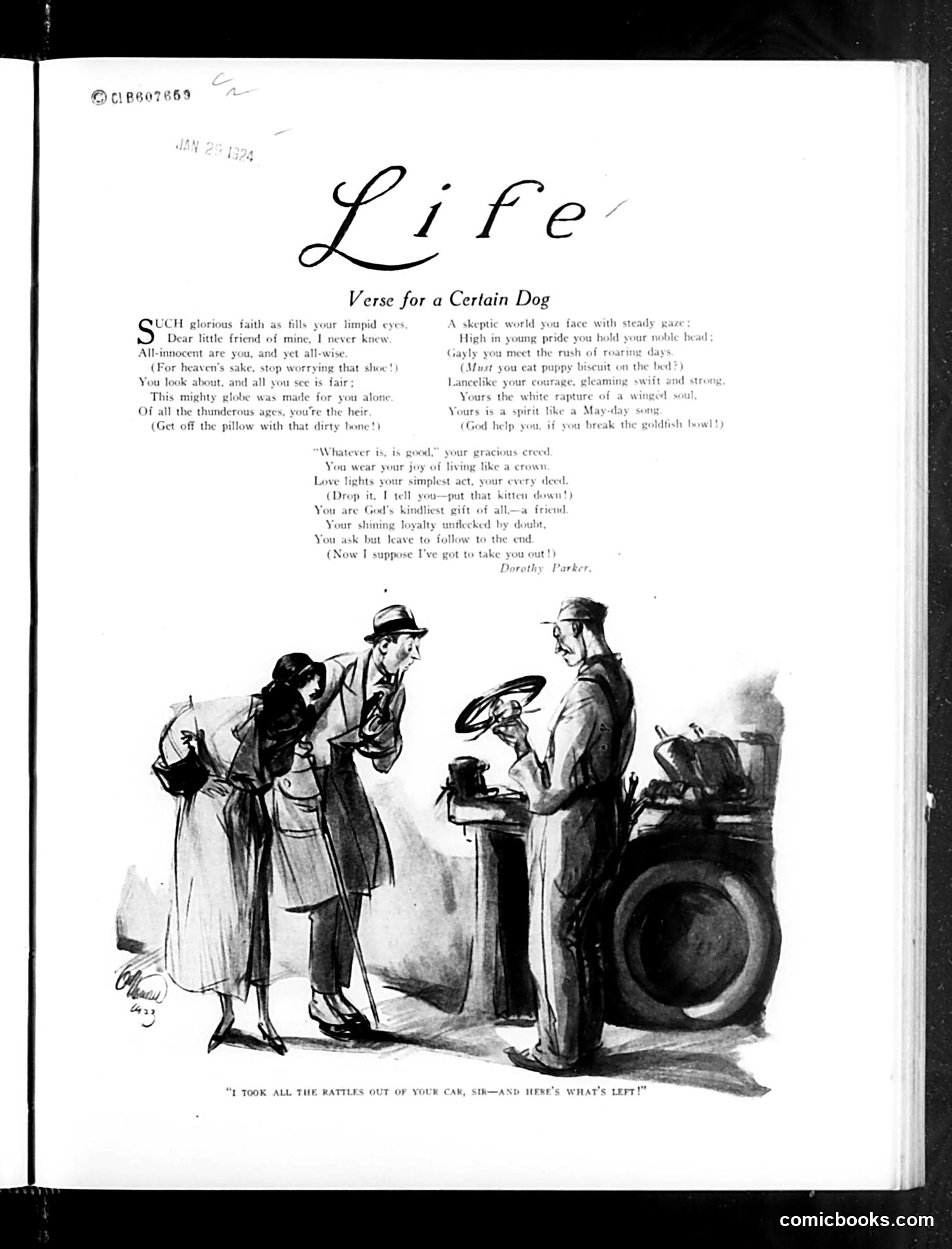
This page features "Life: Verse for a Certain Dog," a humorous poem by Dorothy Parker celebrating a dog's virtues and loyalty. The accompanying illustration shows a domestic scene where a woman and man stand beside a car, with another man at the steering wheel. The caption reads: "I TOOK ALL THE RATTLE OUT OF YOUR CAR, SIR—AND HERE'S WHAT'S LEFT!" The cartoon jokes about early automobile unreliability—specifically, the mechanical rattling sounds common in 1920s cars. The mechanic has removed all the rattling parts, leaving virtually nothing, suggesting the car was mostly noise and barely functional. This satirizes the poor quality and fragility of early automobiles, poking fun at both vehicle engineering and the frustrations of car ownership during this period.
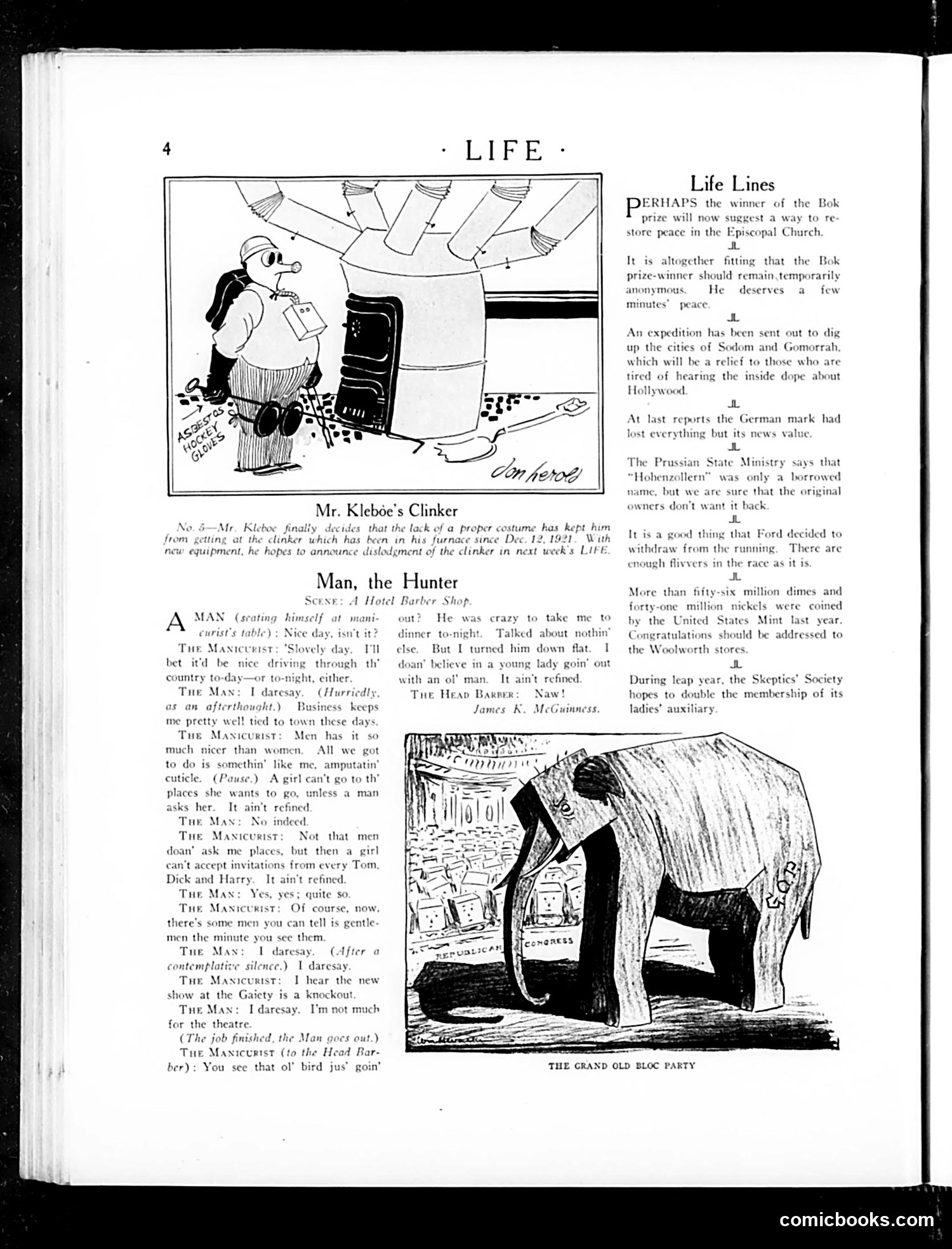
**Top Cartoon - "Mr. Kleboe's Clinker":** A man in work clothes stands before a large industrial furnace, holding papers labeled "PRESSURE TEST" and "CLINKER." The caption notes Mr. Kleboe has "kept him from getting at the clinker which has been in his furnace since Dec. 12, 1921." This satirizes industrial inefficiency or labor disputes—a worker unable to perform basic maintenance due to bureaucratic obstacles or equipment failure. **Bottom Section - "Man, the Hunter":** A dialogue-driven piece mocking masculine pretension. A manicurist and customer discuss the customer's claims about hunting and dining out. The humor derives from the man's apparent exaggeration of his sophistication and adventurousness, contrasted with his refined manners and actual timidity around women. **"The Grand Old Bloc Party":** An illustration of an elephant (Republican symbol) at what appears to be a political gathering, likely referencing 1920s political coalitions.
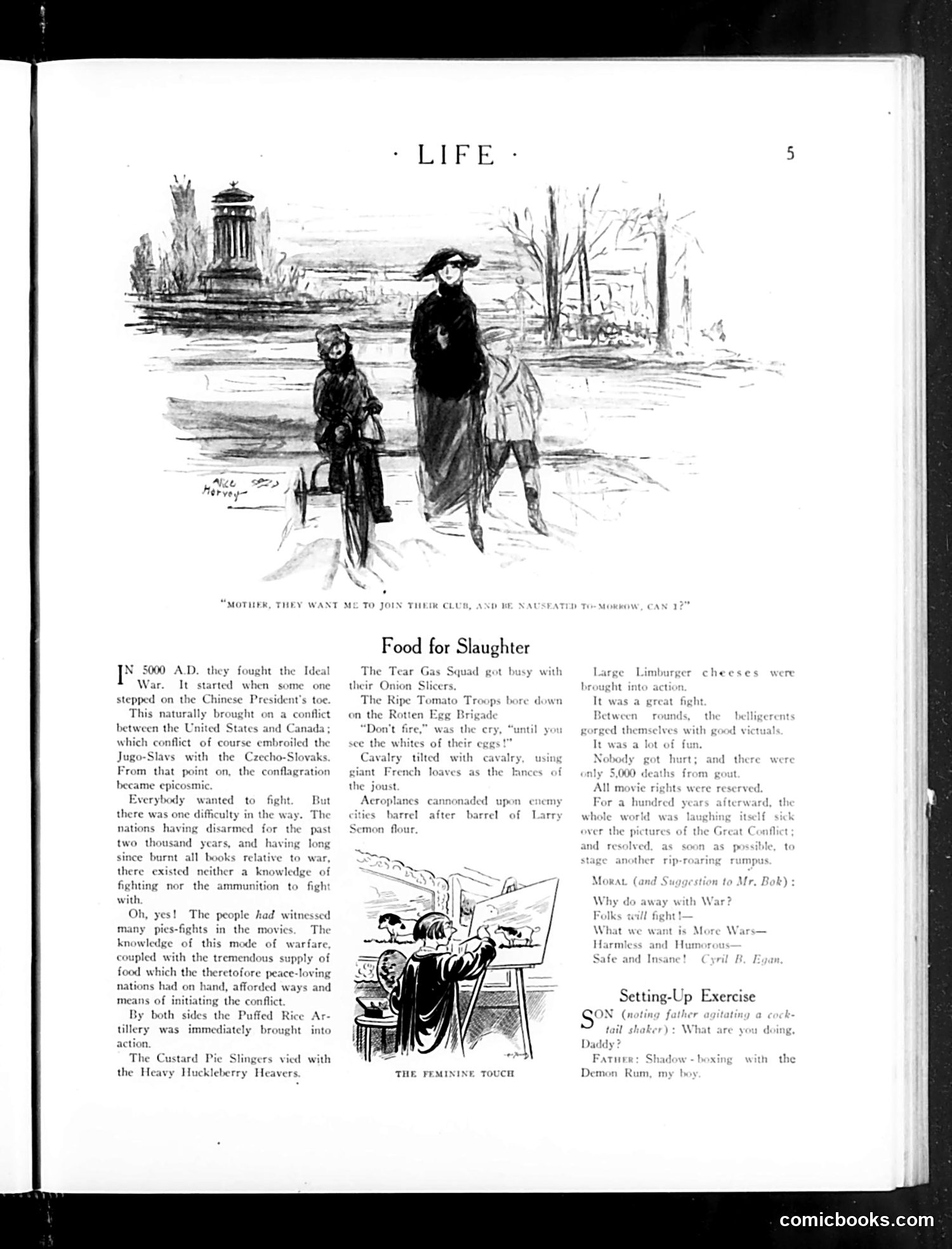
This page contains satirical commentary on World War I. The main article, "Food for Slaughter," uses dark humor to critique the war's casualty rates. It references historical conflicts (noting that in 5000 A.D., future historians will observe this era's massive loss of life) and mocks the military's tactics—comparing armies' supply of food to their supply of soldiers meant for consumption. The illustration labeled "The Feminine Touch" shows a woman working in what appears to be munitions manufacturing, sardonically titled given the article's grim subject matter. A separate humor piece, "Setting-Up Exercise," presents a father-son dialogue about boxing training, likely offering light relief from the war-focused content above. The overall page uses satire to critique the mechanized slaughter of modern warfare.
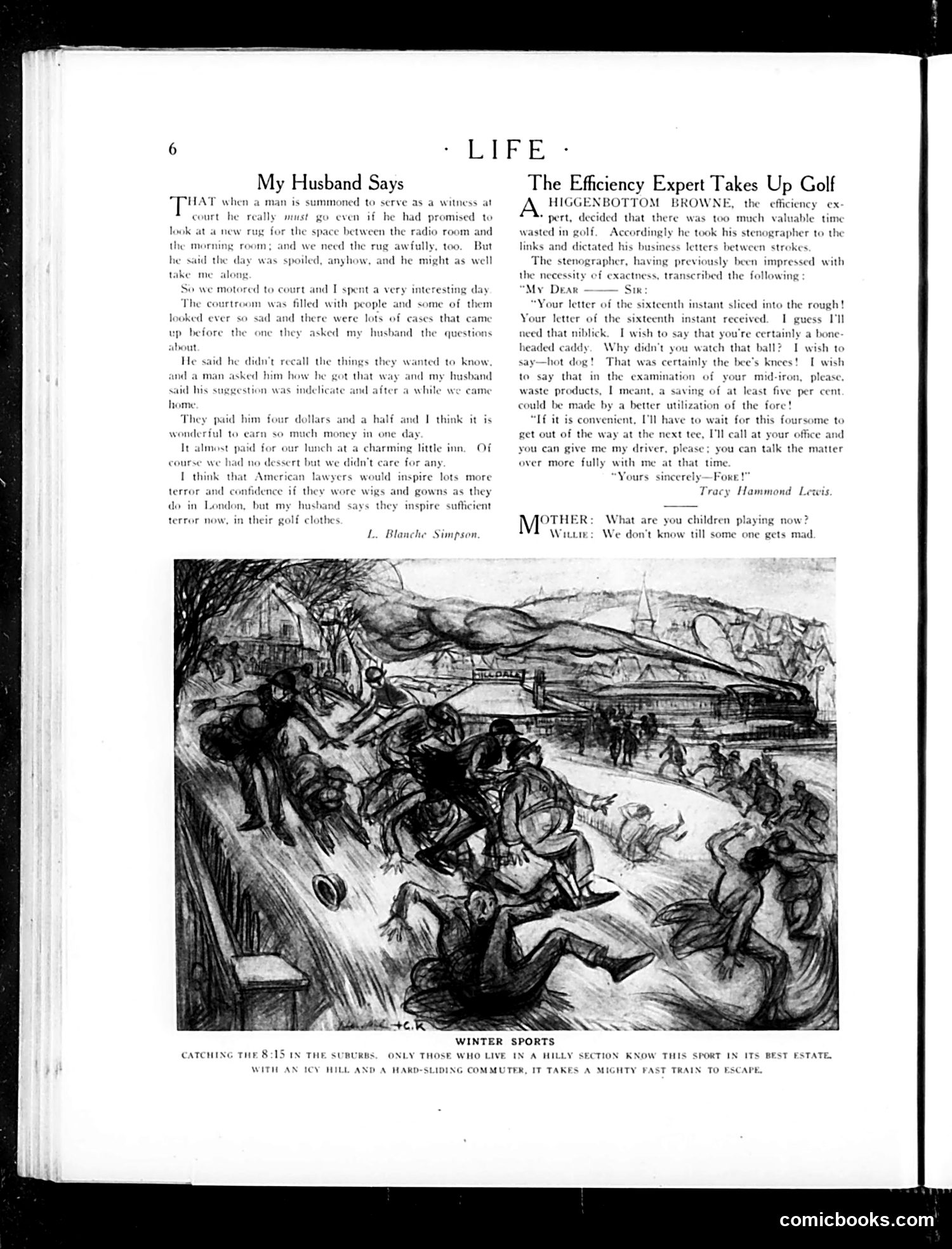
This page contains two satirical pieces. The upper left presents "My Husband Says," a humorous anecdote by L. Blanche Simpson about a man summoned for court testimony who was asked about a rug—a trivial matter that the author suggests wouldn't inspire American lawyers with the terror that English lawyers in their formal wigs apparently instill. The main illustration depicts "Winter Sports: Catching the 8:15 in the Suburbs," showing commuters desperately scrambling and sliding on an icy hill to catch a departing train. The satire mocks suburban commuting life—specifically the dangerous chaos of winter travel when "an icy hill and a hard-sliding commuter" make catching morning trains perilous. It's social commentary on the absurdity and physical hazard of suburban railway commuting.
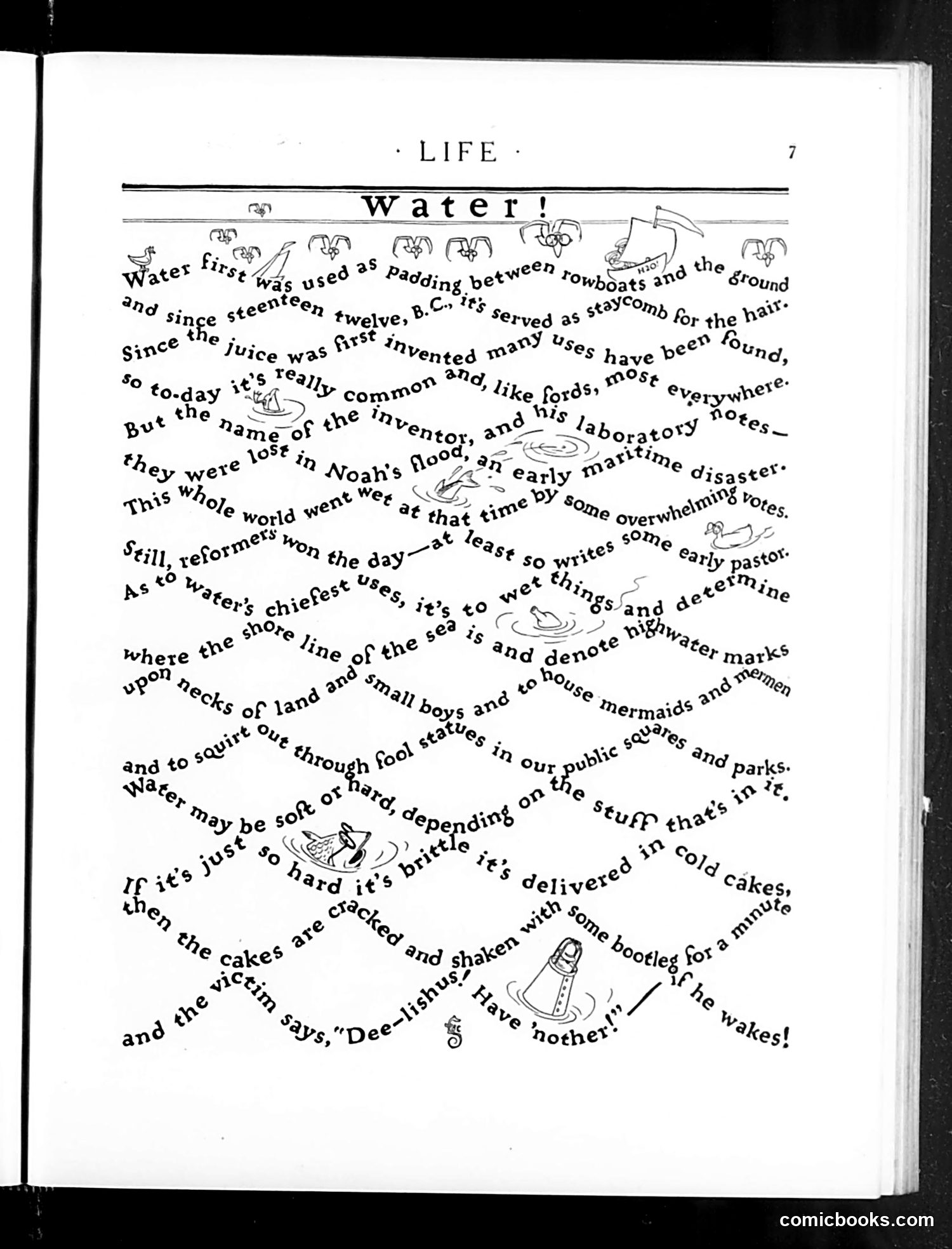
This page satirizes water's uses and history through whimsical, flowing text arranged around water-themed illustrations. The piece humorously traces water from ancient times (padding between rowboats, hair staycoomb by 1200 B.C.) through various practical applications. The satire mocks both the mundane uses of water and humanity's tendency to forget its originators: "the name of the inventor...lost in Noah's flood." It references water's role in maritime disasters and everyday life—cooling things, watering statues, quenching children's thirst. The joke culminates in a comic scenario where cold cakes delivered in water break, and a victim exclaims "Dee-licious! Have another!" The playful typography and whimsical drawings emphasize the article's lighthearted, irreverent tone toward a basic substance we take for granted.
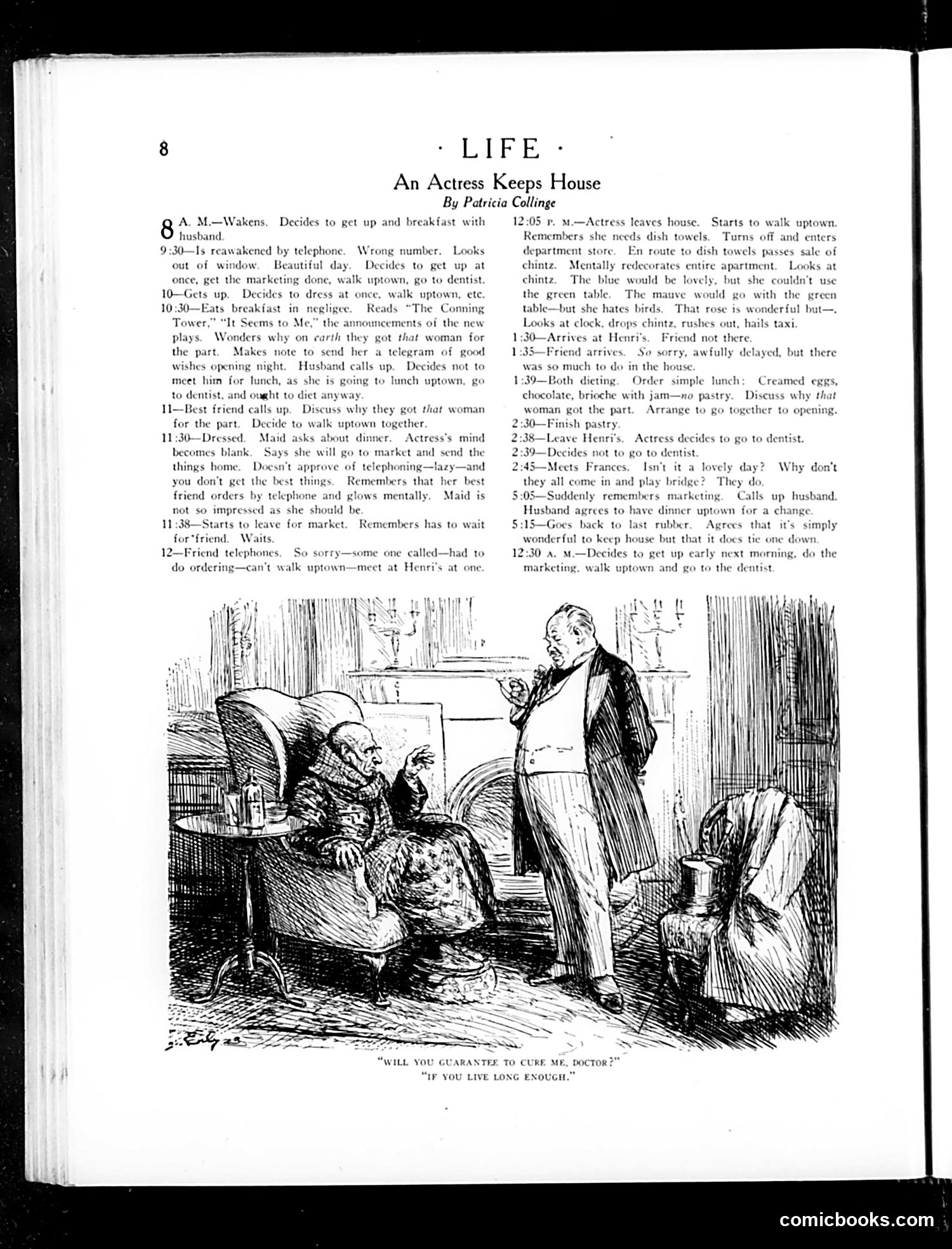
This is a humorous domestic narrative about an actress attempting to manage household responsibilities. The story follows her day from morning (8 a.m.) through afternoon, chronicling comic mishaps: a wrong telephone number, neglected breakfast, a maid's poor work, and an ultimately failed attempt at housekeeping. The accompanying sketch depicts a domestic scene with what appears to be a doctor visiting. The caption reads: "Will you guarantee to cure me, doctor?" "If you live long enough." The satire targets the common stereotype of actresses as impractical and incompetent at domestic tasks—unable to manage the "real world" of housekeeping despite their professional capabilities. The piece presents household management as more challenging than theatrical work.
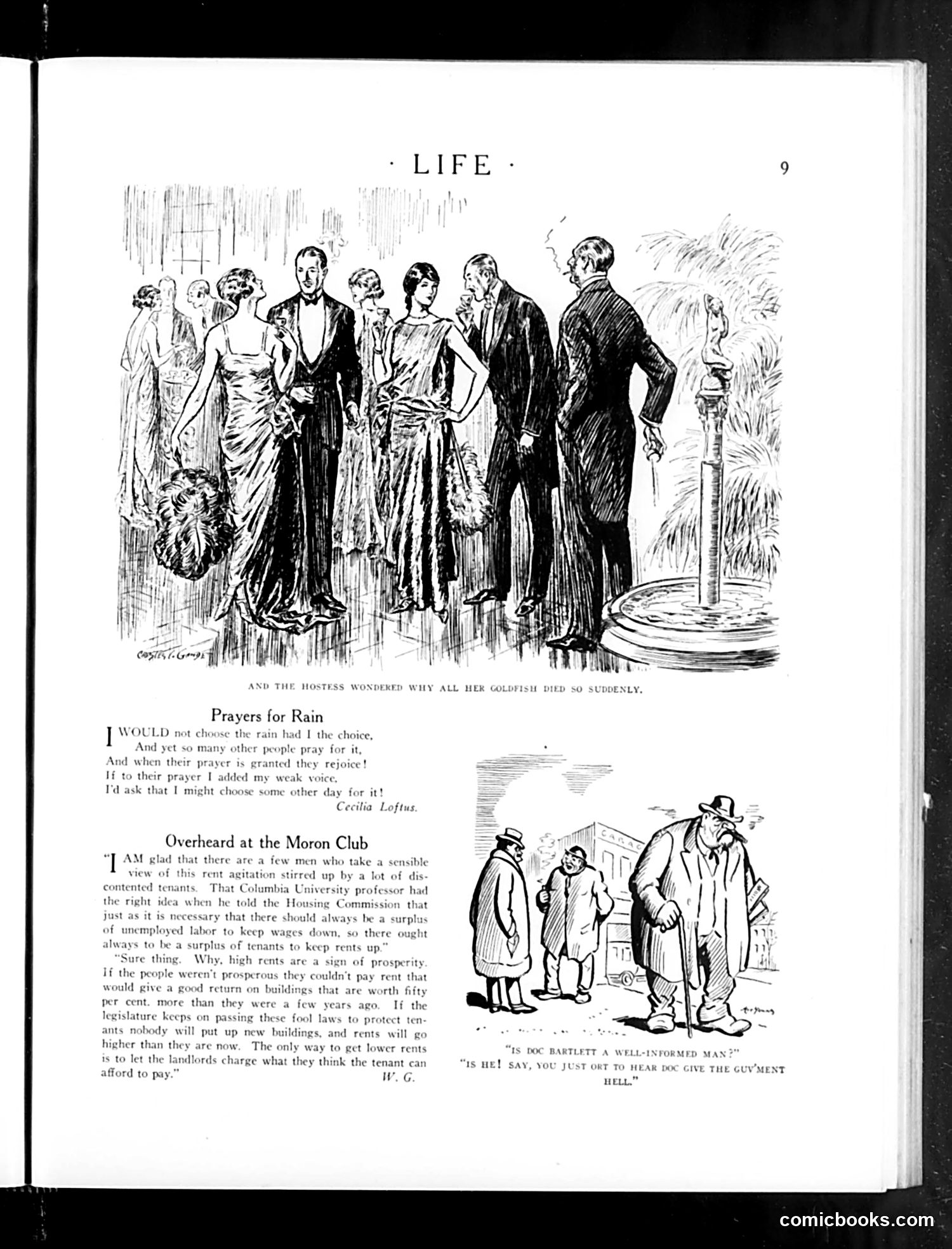
**Top Cartoon:** Shows a formal social gathering where a hostess looks distressed. The caption reads "AND THE HOSTESS WONDERED WHY ALL HER GOLDFISH DIED SO SUDDENLY." The joke relies on the reader understanding that guests at such formal events were expected to behave properly—the implication is that someone (likely a guest) did something to the goldfish, though the exact offense isn't stated. **"Overheard at the Moron Club":** A satirical section critiquing real-estate practices and housing policy. The text discusses rent control debates, landlord complaints, and unemployment, suggesting that high rents indicate prosperity. The satire attacks this economic reasoning as foolish. **Bottom Cartoon:** Two men discussing "Doc Bartlett." One says you'd "just get to hear doc give the guy next hell"—likely a satirical jab at someone's notoriety or reputation, though the specific reference is unclear.
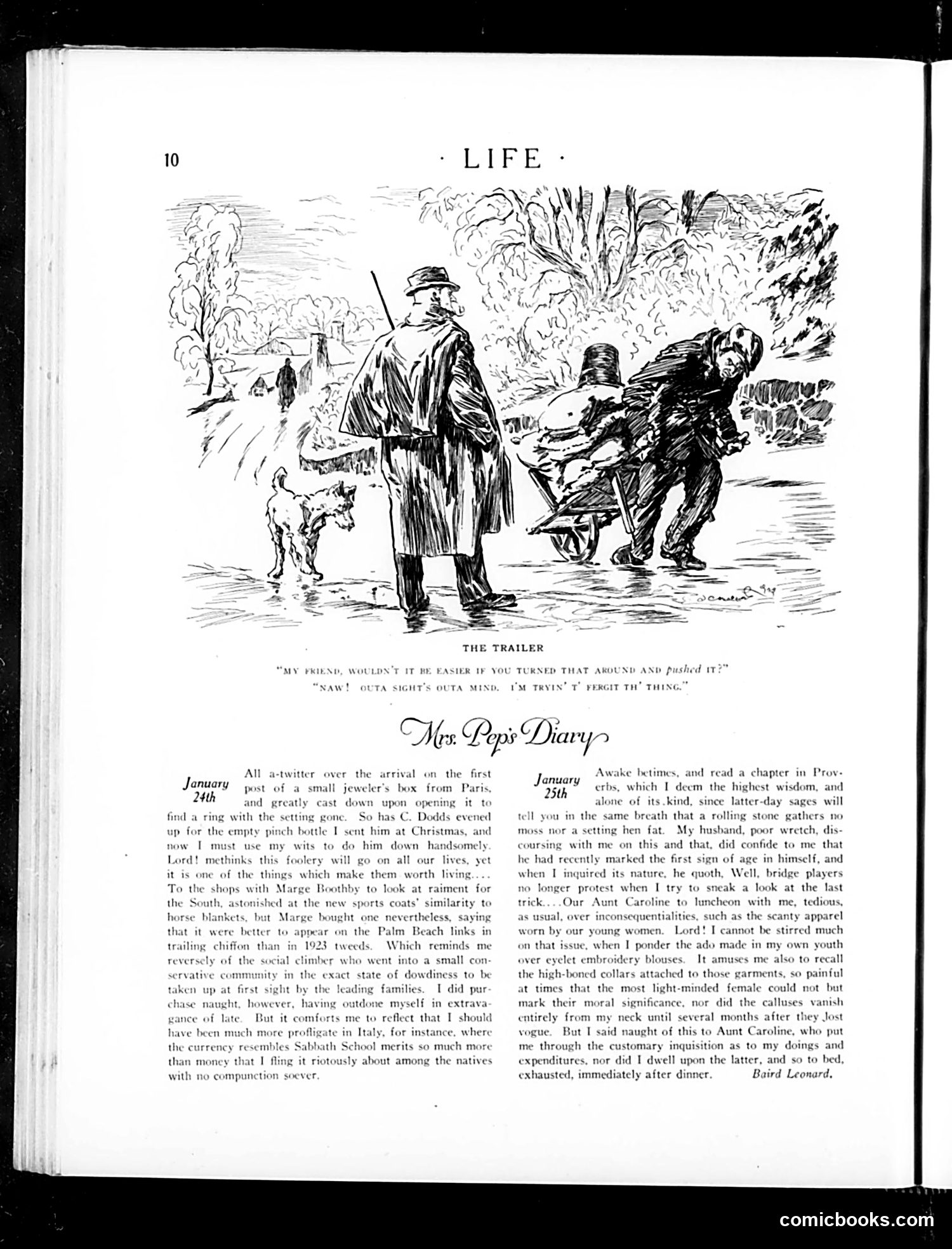
This sketch satirizes early 1920s fashion and gender politics. It depicts a man in a coat and hat encountering a woman pulling a small cart/trailer, with a dog nearby. The caption reads: "My friend, wouldn't it be easier if you turned that around and pushed it?" / "Naw! Gus' sight's outa mind. I'm tryin' t'forget th' thing." The joke targets the era's "trailer" fashion trend—likely women's trailing skirts or garments that dragged behind them. The cartoon mocks both the impracticality of the style and gender dynamics: the man suggests the woman reconfigure her burden, but she ironically prefers to ignore it rather than acknowledge her own cumbersome fashion choice. The humor reflects contemporary anxiety about women's evolving roles and fashion independence.
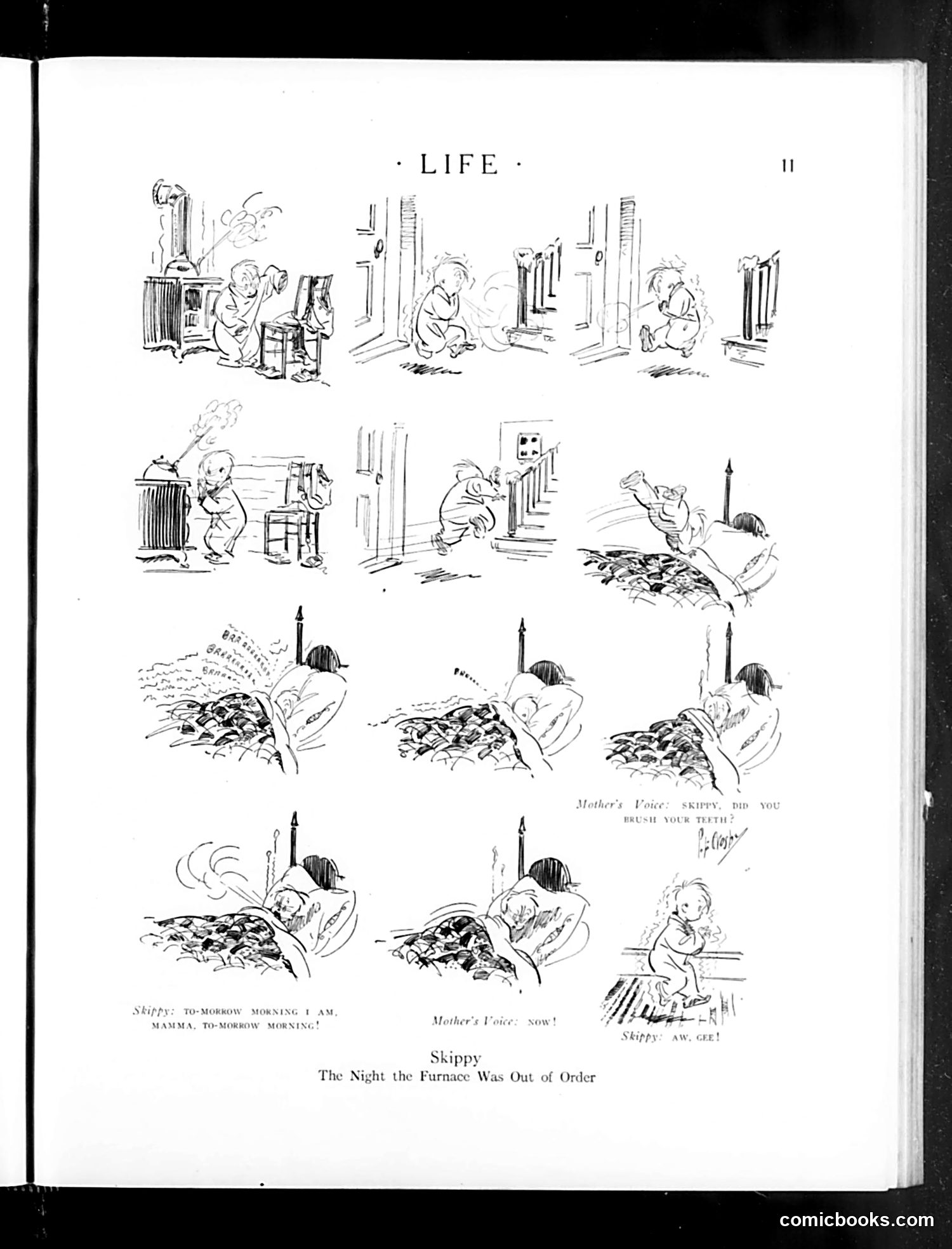
This is a humorous domestic comic strip about a mischievous child named Skiffy. The narrative follows him one night when the home's furnace malfunctions. The sequence shows Skiffy in bed, then apparently building an enormous pile of materials (possibly blankets, wood, or other combustibles) as an improvised heat source. His mother repeatedly calls out reminders—"brush your teeth," "tomorrow morning I am, mamma," "now," and "aw, gee!"—suggesting she's trying to maintain bedtime routine despite the heating crisis. The joke appears to be about Skiffy's chaotic and excessive solution to staying warm, contrasted with his mother's persistent attempts at parental discipline and hygiene, even during household emergencies. It's gentle, domestic humor typical of early Life magazine content.
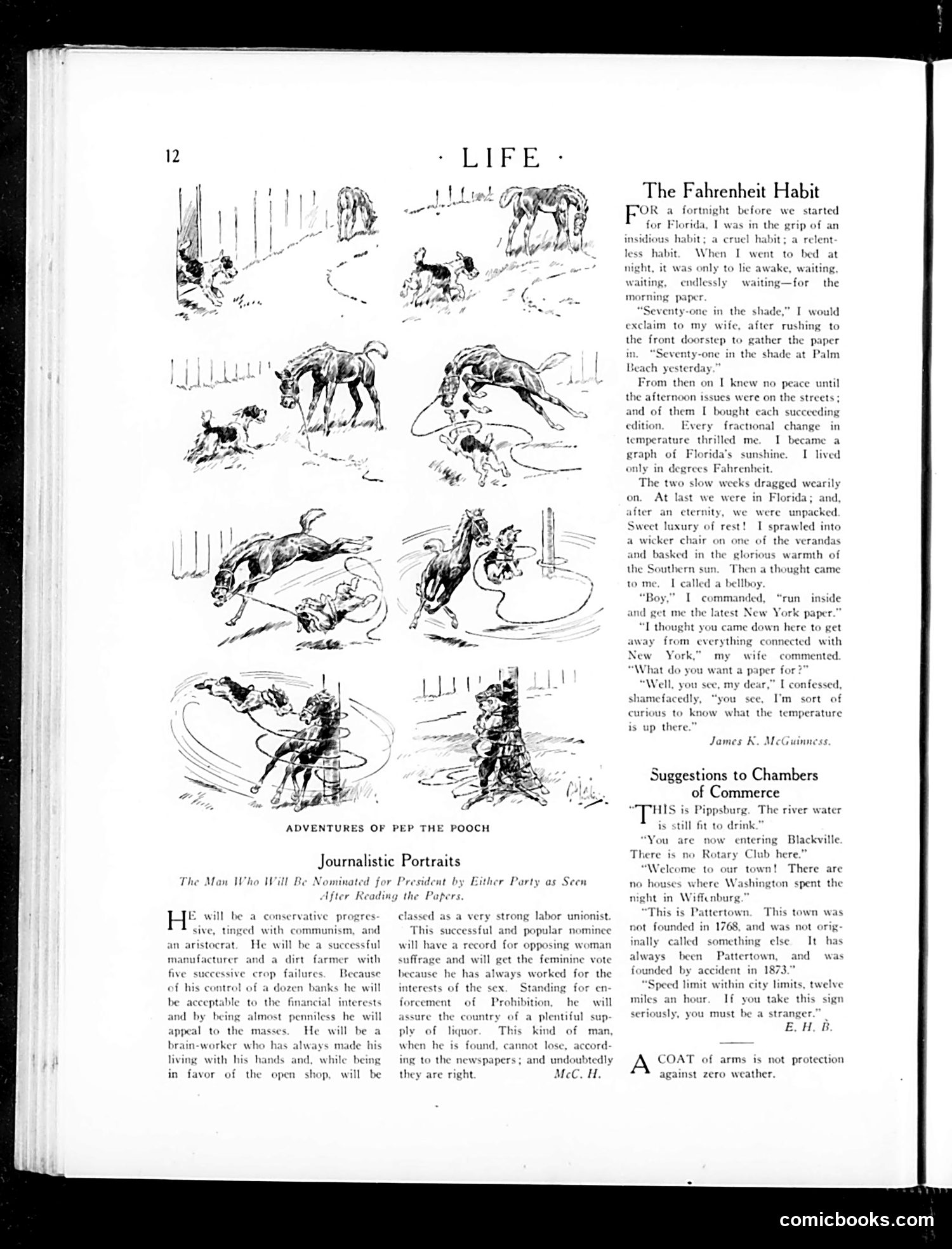
The left side of this page features a comic strip titled "Adventures of Pep the Pooch" showing a dog causing chaos—jumping on people, knocking things over, and generally misbehaving. The humor is slapstick physical comedy typical of early 20th-century comics, requiring no historical context to understand. Below this are two brief "Journalistic Portraits" offering satirical commentary on political figures. These appear to be character sketches of potential presidential candidates from different parties, written in the cynical, pointed style Life magazine was known for. The text criticizes their positions and motivations without naming them directly—a common editorial tactic of the era.
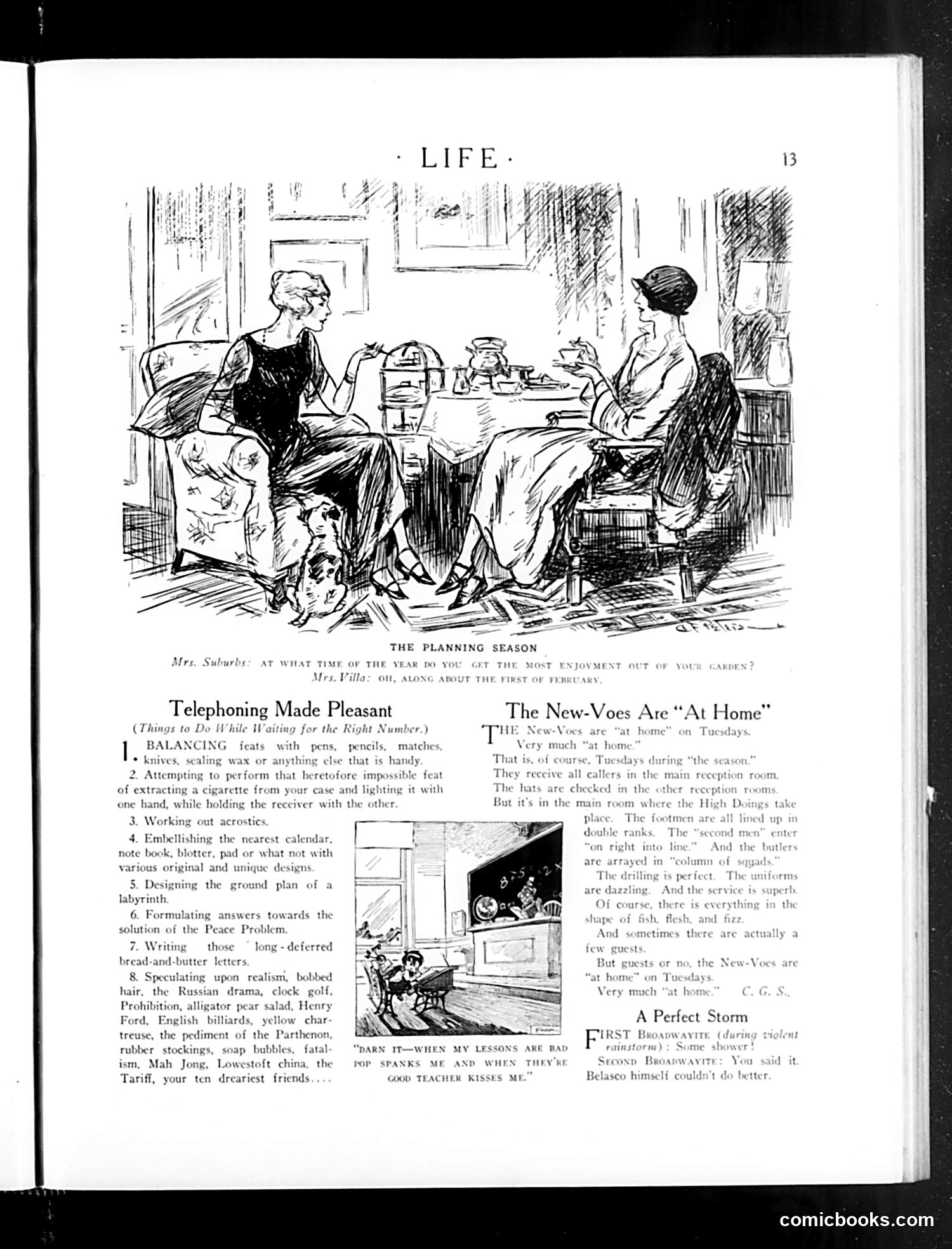
The main cartoon depicts two women having tea and discussing garden planning, with the caption "THE PLANNING SEASON." One woman asks when to get the most enjoyment from her garden; the other replies "along about the first of February." This is gentle social satire about leisure-class women's seasonal activities. In winter, wealthy households apparently engaged in detailed planning and design work for their gardens—treating it as an intellectual pursuit rather than active gardening. The joke suggests that the *planning* phase, done indoors over tea in February, provided more enjoyment than actual outdoor gardening work. The accompanying text articles appear to cover miscellaneous humorous observations about daily life, including domestic topics and social customs typical of Life magazine's satirical approach to American manners.
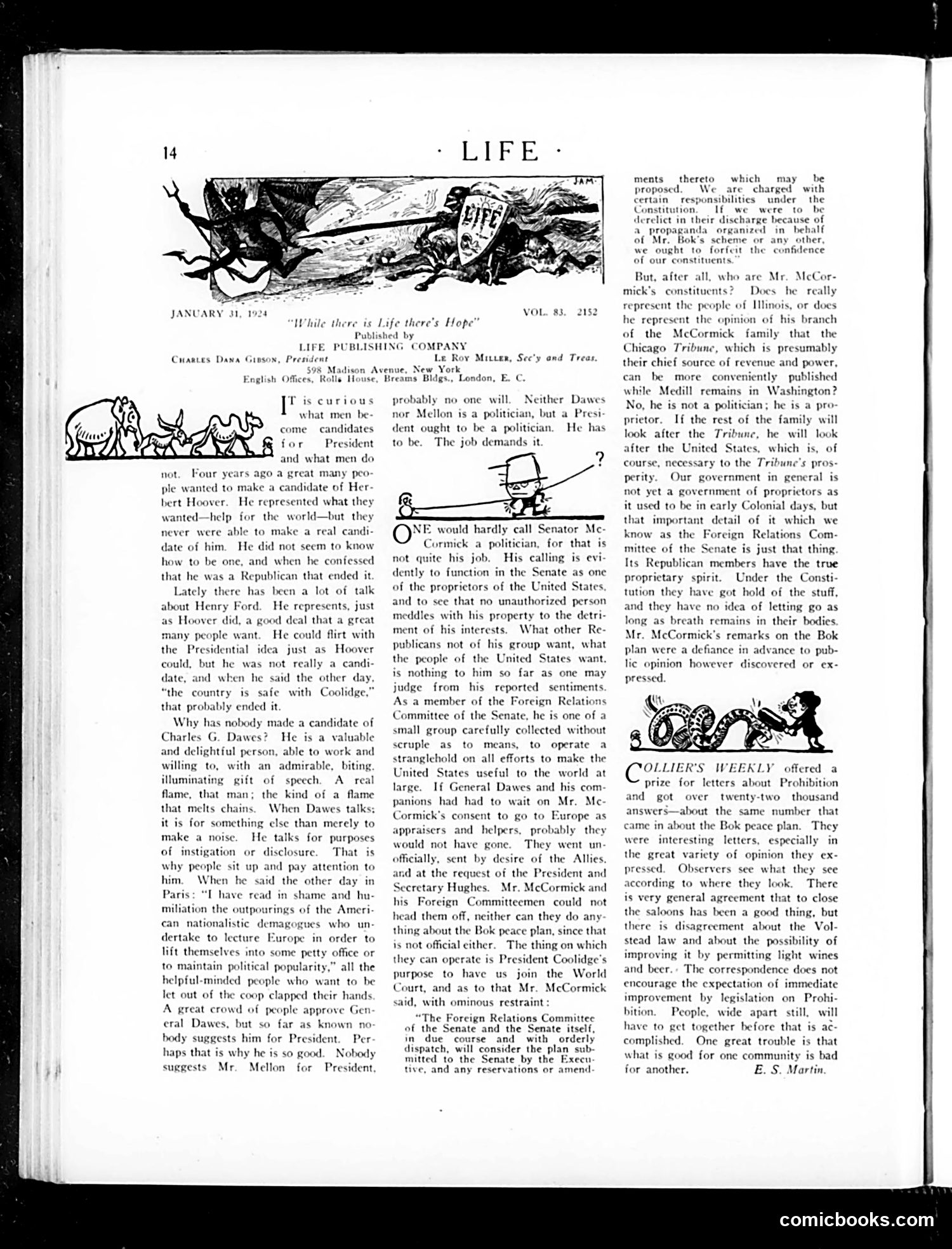
This page contains political commentary on presidential candidates rather than traditional cartoons. The text discusses whether Herbert Hoover or Charles G. Dawes would make a suitable presidential candidate, contrasting them unfavorably with Henry Ford (presented as representing what voters wanted). The article critiques Dawes as unsuitable for the presidency, arguing he's better suited to his current role. It also discusses Senator McCormick's Foreign Relations Committee work, questioning whether McCormick truly represents Illinois constituents or merely his family's (the Chicago Tribune-owning McCormick family's) interests. A small cartoon shows a figure in profile, though specific identity is unclear from the image alone. The page emphasizes political establishment figures versus populist alternatives in 1924 electoral discussions.
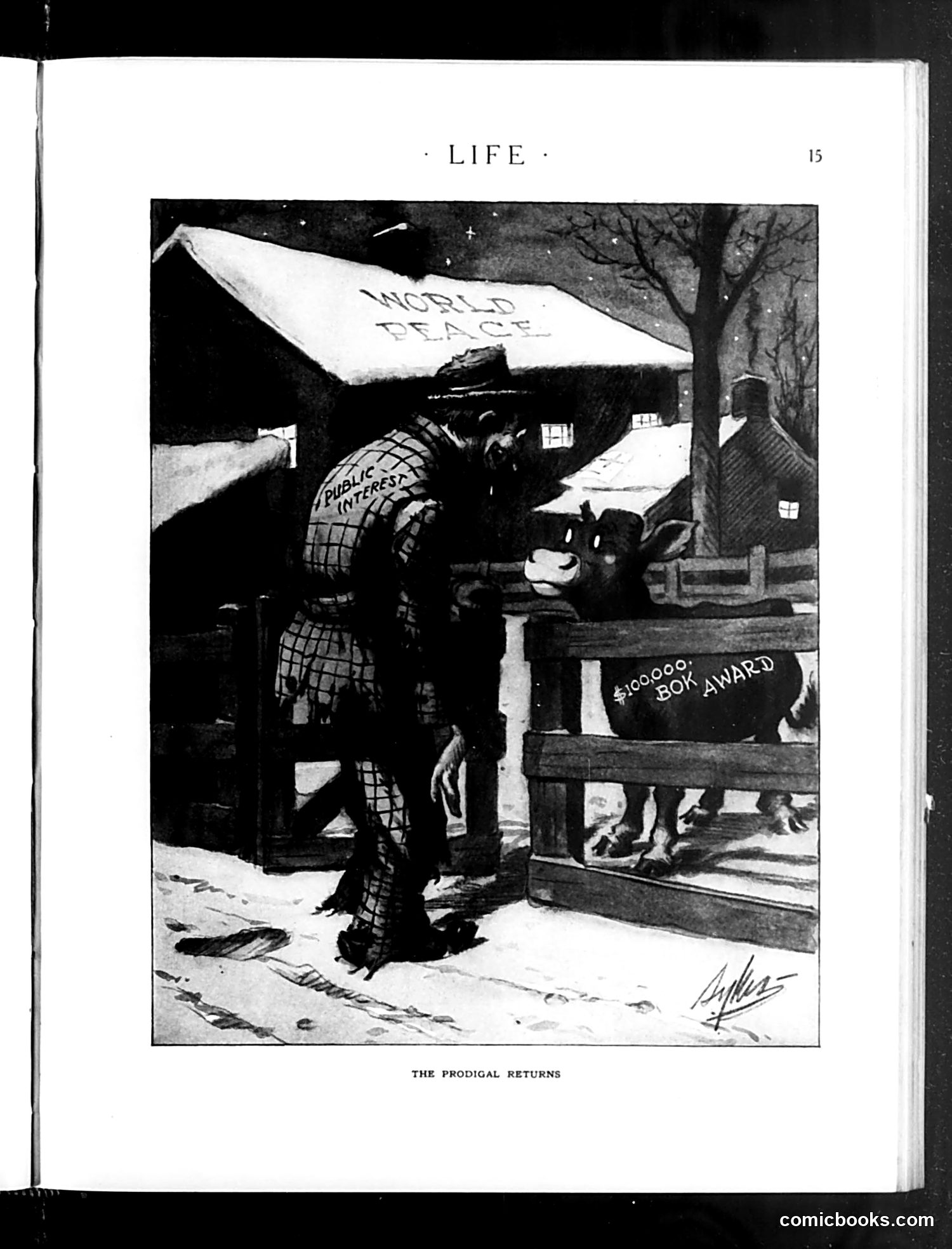
This cartoon depicts a figure in plaid clothing returning to a rural homestead after apparent absence. The scene references the biblical parable of the prodigal son—a wasteful child who returns home seeking forgiveness. Visible text includes "PUBLIC INTEREST" on the figure's clothing and "$100,000 BOOK AWARD" on a sign. A tent overhead reads "WELCOME HOME." The satire likely mocks someone who abandoned public service or attention for profit (the book award), then attempts a triumphant homecoming. The "public interest" label suggests the target had previously positioned themselves as serving the public good before pursuing commercial success—now returning, seeking rehabilitation of their image. The specific identity remains unclear without additional context from this Life magazine issue.
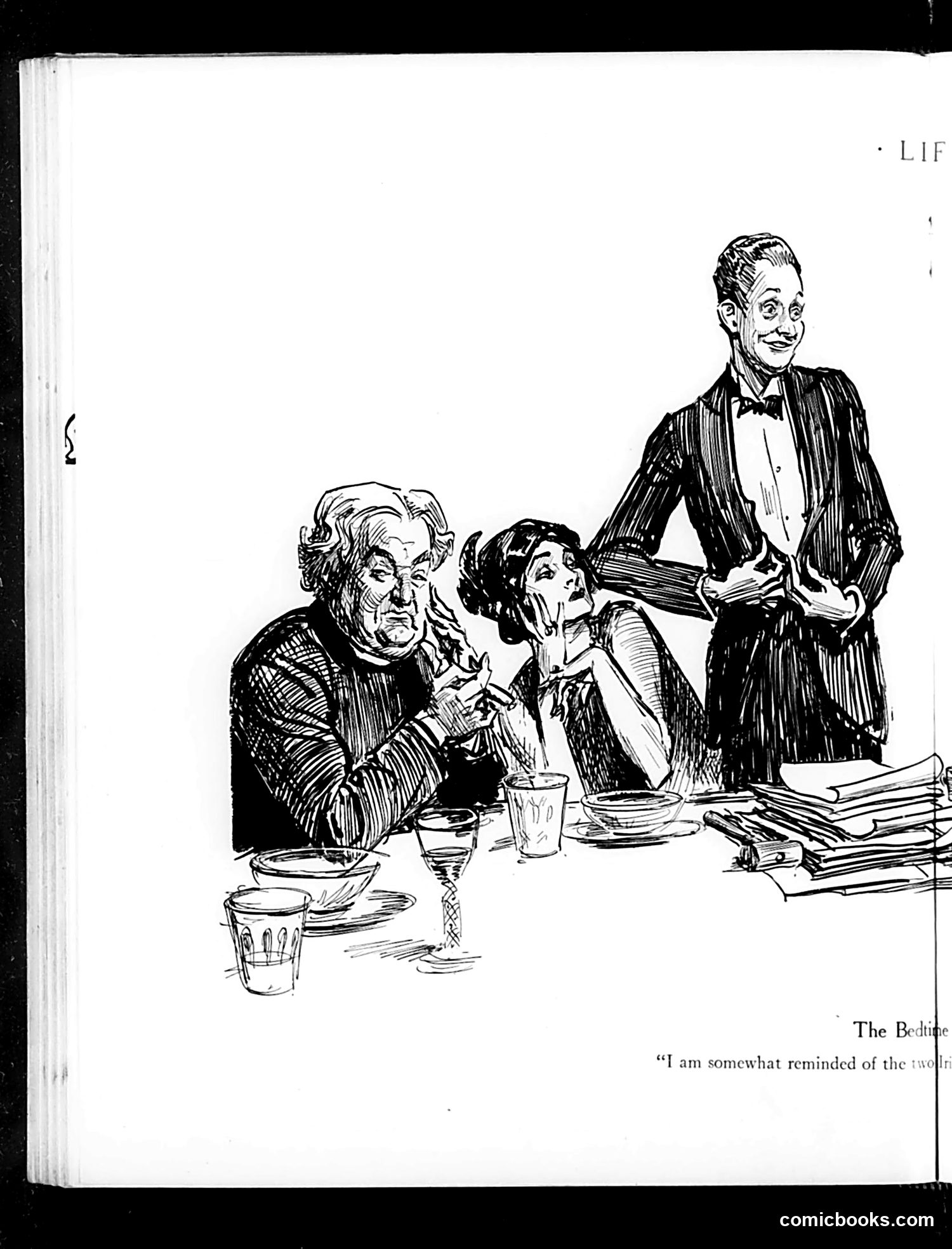
This is a dinner scene featuring three figures in formal attire. A standing man in a tuxedo appears to be speaking or performing for two seated diners—an older man and a woman. The seated figures display exaggerated, somewhat strained expressions suggesting discomfort or forced attention. The partial caption reads: "I am somewhat reminded of the two-" (text cuts off), making the full joke unclear. The sketch style and composition suggest this is satirizing social dinner etiquette or performance—possibly mocking either tedious dinner conversation or someone's attempt at entertainment or storytelling that bores the audience. Without the complete caption and without certain knowledge of the specific historical context, the exact target of satire remains unclear, though it appears to critique some aspect of formal social interaction.
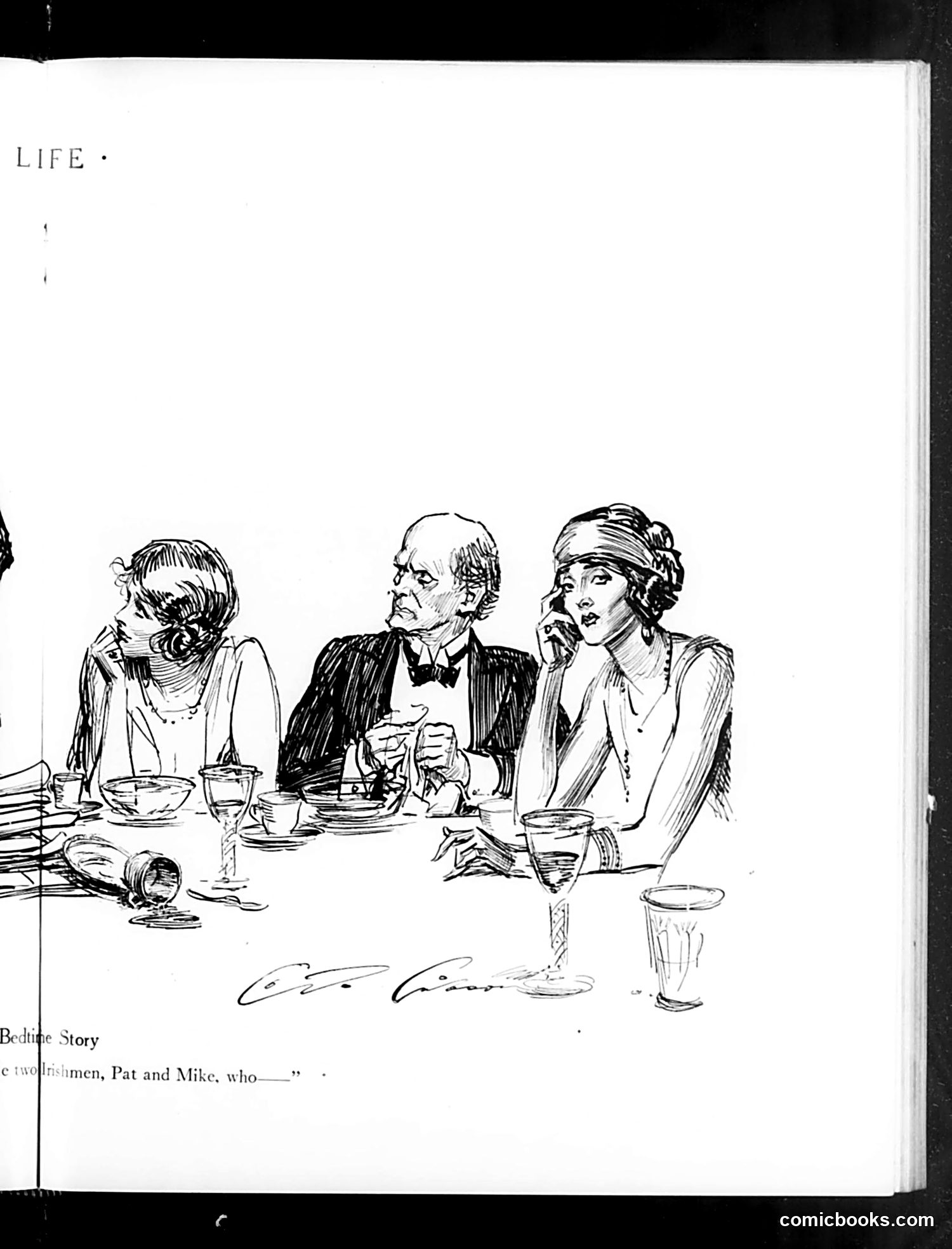
This page from *Life* magazine appears to feature an illustration titled "Bedtime Story" about two Irishmen, Pat and Mike (a reference to common Irish-American stereotypes in early 20th-century humor). The sketch shows three figures at a dining table in formal dress—a woman on each end and a man in the center wearing a tuxedo. The incomplete OCR text suggests this is the setup for a joke or satirical narrative involving the two Irish characters, though the punchline is cut off. The formal dinner setting and the character types suggest this is satirizing either Irish-American social aspirations or ethnic humor typical of the era. Without the complete text, the specific satirical point remains unclear, but it likely plays on period stereotypes about Irish immigrants and social climbing.
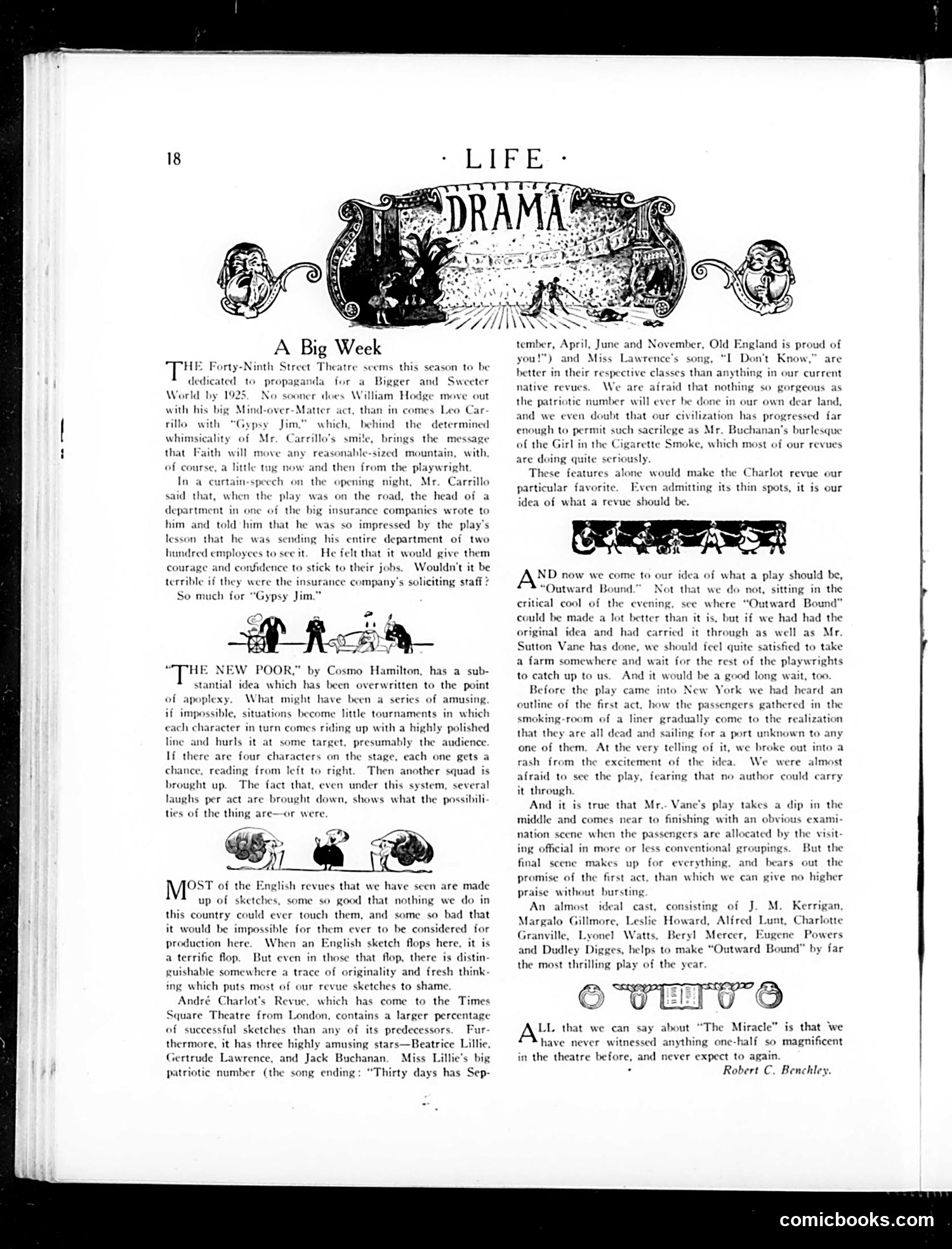
This page reviews several Broadway productions. The main content discusses four theatrical works: **"Gypsy Jim"** — A William Hodge vehicle praised for its message about faith overcoming obstacles. The text notes an insurance company was so inspired they sent 200 employees to see it, hoping to boost morale. **"The New Poor"** by Cosmo Hamilton — Criticized as overwritten, using a comedic structure where characters take turns delivering punchlines at the audience like "riding up with a highly polished line and hurls it at some target." **"Outward Bound"** — Praised as an exemplary play, despite minor flaws. The plot involves ship passengers gradually realizing they're dead, sailing to an unknown port. The reviewer admits the premise initially seemed risky but was impressed by Sutton Vane's execution. **"André Chariot's Revue"** — Described as superior to American revues, praised for avoiding sacrilegious humor that American audiences supposedly couldn't yet handle. The small decorative illustrations appear to be typical period vignettes of theatrical scenes.
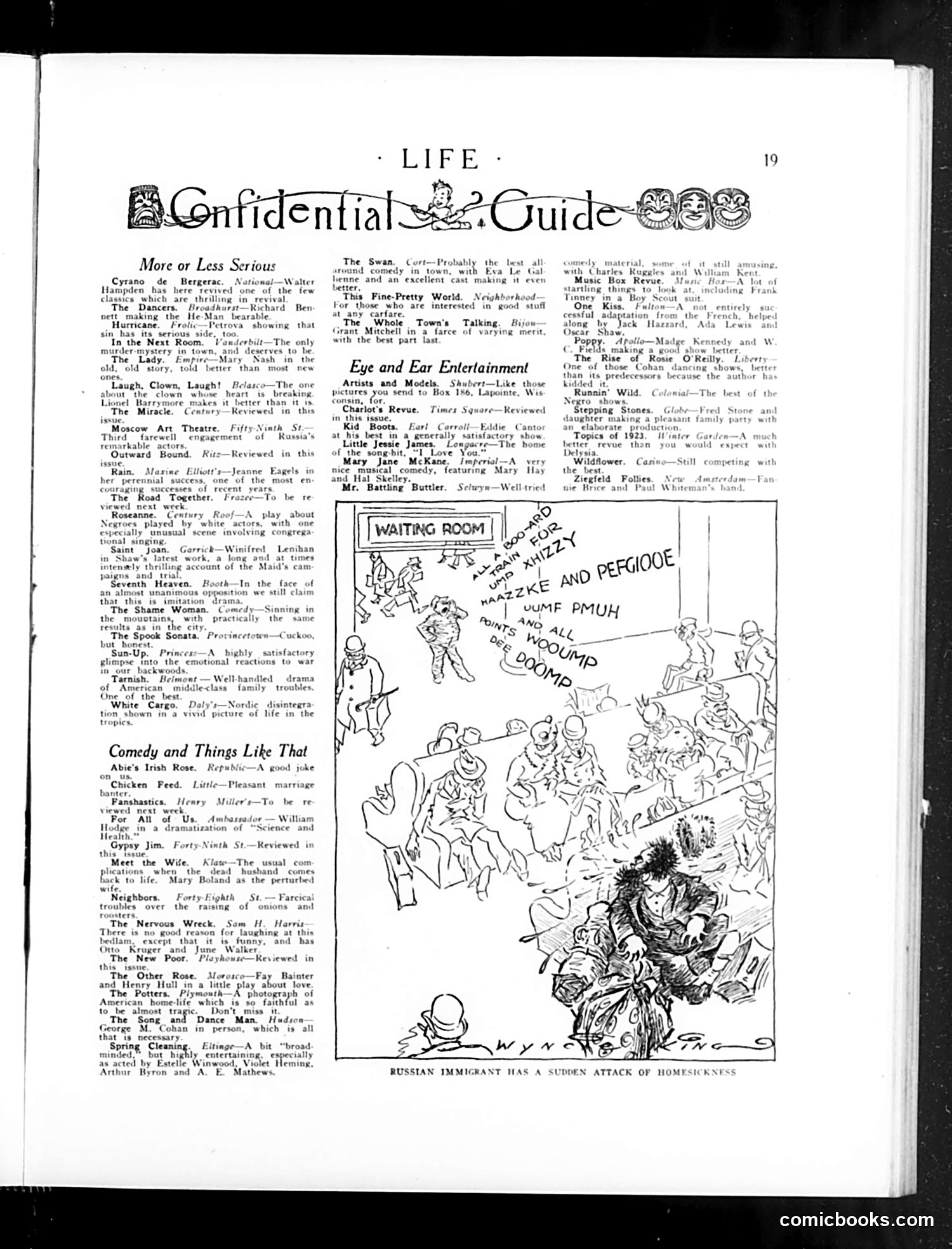
This cartoon satirizes the experience of Russian immigrants in 1920s America. The drawing shows a crowded, chaotic waiting room (likely an immigration or government office) where a Russian immigrant is suddenly overcome with nostalgia for home, crying out in Russian phrases visible in the cartoon's speech bubbles. The satire operates on multiple levels: it mocks both the immigrant's emotional volatility and the bureaucratic confusion of American institutions processing newcomers. The "homesickness" is depicted as comically abrupt and theatrical—the figure appears to be dramatically overcome amid the mundane waiting-room setting. This reflects 1920s American attitudes toward Eastern European immigrants: viewing them as emotionally excitable, culturally foreign, and struggling to assimilate. The cartoon captures contemporary anxiety about immigration while treating the immigrant's distress as humorous material for entertainment in Life magazine's "More or Less Serious" section.
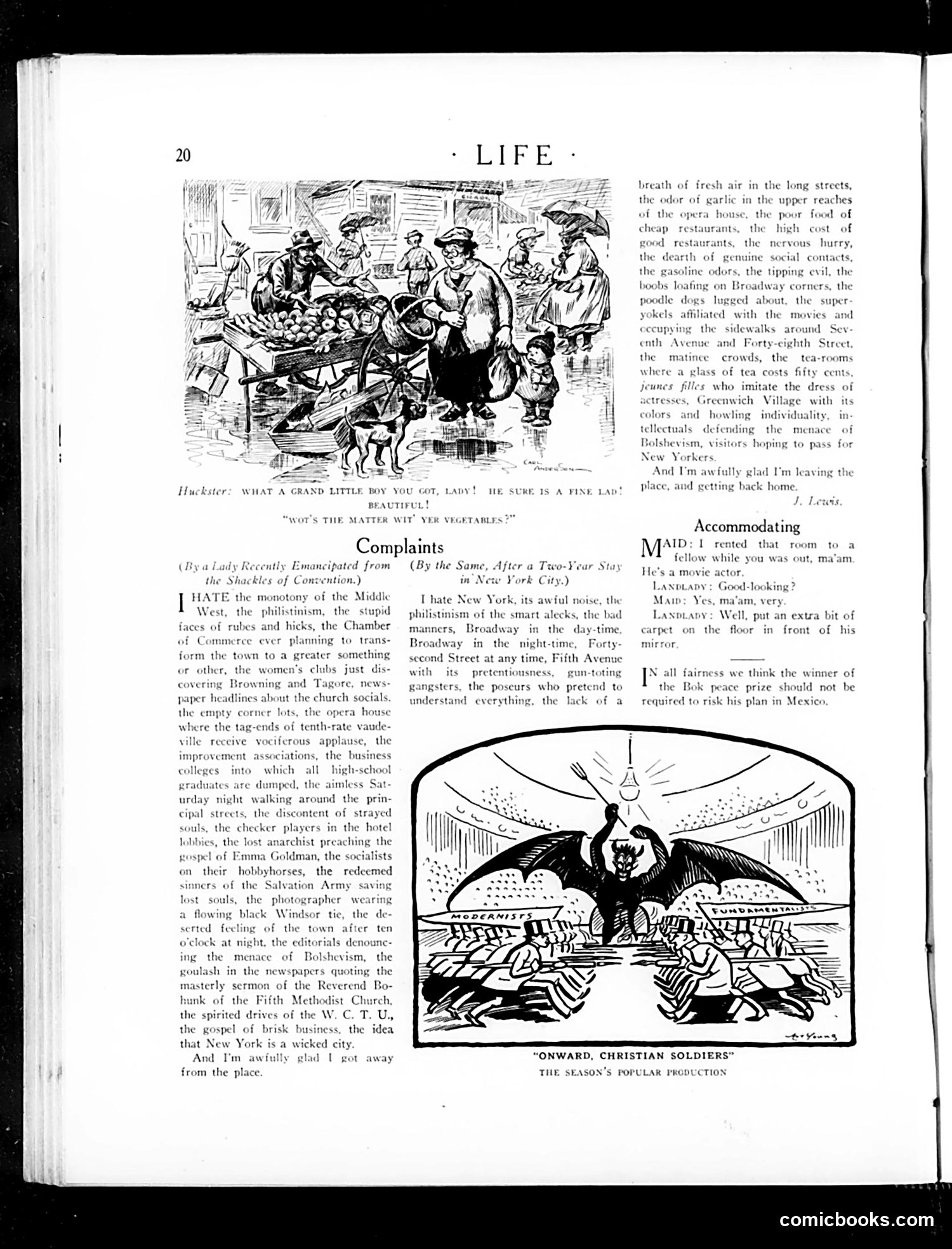
This Life magazine page contains two distinct satirical pieces: **"Complaints"** presents contrasting monologues from two women—one recently escaped from small-town convention, another after a two-year stay in New York City. The first woman catalogs her hatred of New York's noise, pretension, and social disorder (anarchists, Bolsheviks, suffragettes). The second, initially enchanted, now despises the city's monotony and philistinism. The satire mocks both provincial narrow-mindedness and cosmopolitan disillusionment. **The cartoon** titled "Onward, Christian Soldiers" depicts what appears to be a theatrical production scene with performers in costume. The caption's ironic juxtaposition of the hymn title with the theatrical context likely satirizes either wartime propaganda masquerading as morality, or the disconnect between Christian preaching and actual American behavior—a common Life magazine theme of the 1910s-20s era. Both pieces reflect post-WWI anxieties about American identity, urban decay, and the gap between ideals and reality.
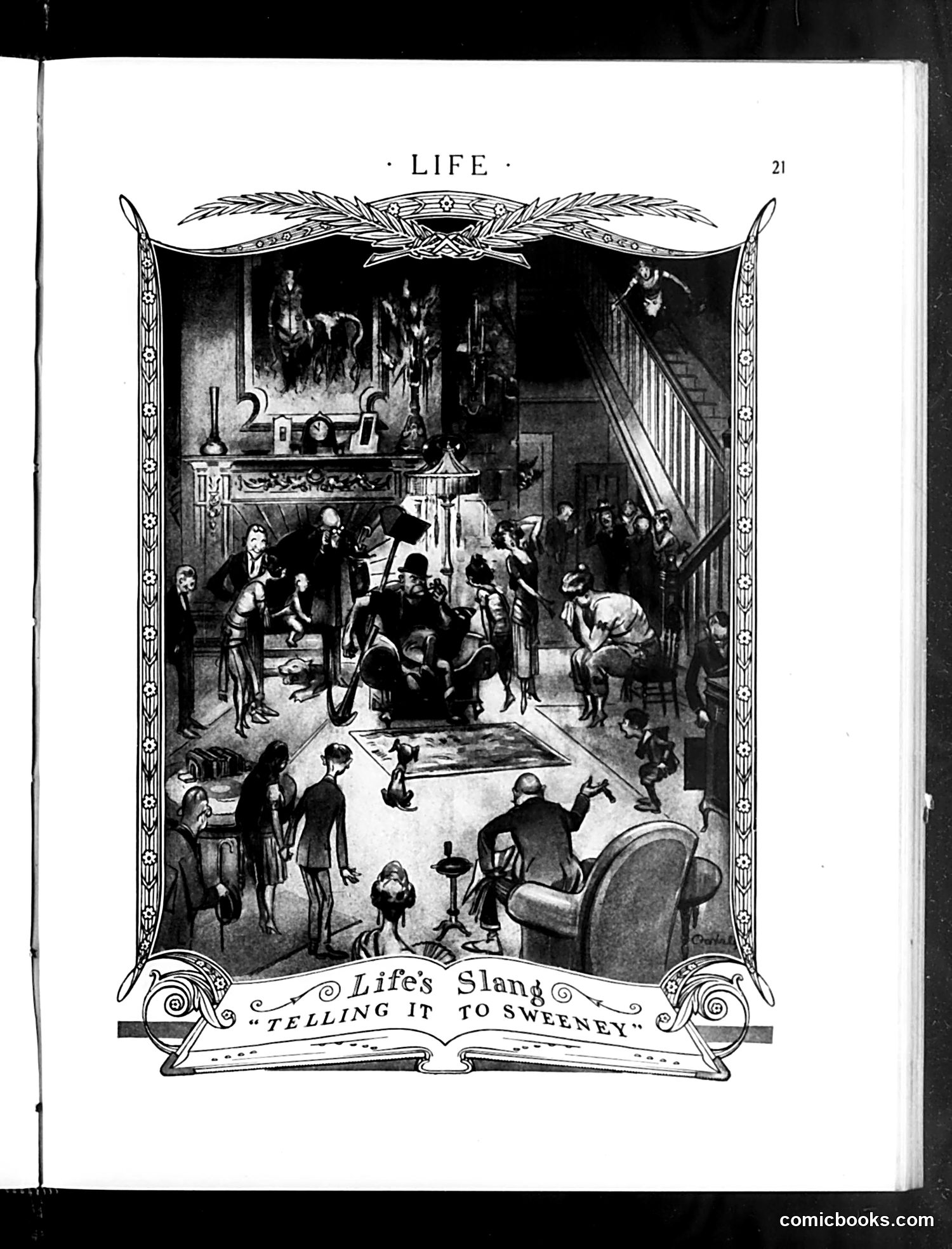
This satirical illustration depicts a crowded Victorian-era parlor scene with numerous figures engaged in various activities and conversations. The caption references "Sweeney," likely alluding to the common period phrase "tell it to Sweeney"—slang meaning to tell someone an implausible or false story, as if they'd believe anything. The cartoon satirizes contemporary slang and colloquial speech by showing a chaotic social gathering where different characters presumably use period slang expressions. The elaborate interior setting with its staircase, fireplace, and well-dressed attendees suggests upper-class society, making the use of casual slang ironic. Without clearer OCR text, the specific slang terms being mocked aren't entirely visible, but the overall point appears to be ridiculing how even refined social settings were infiltrated by informal, trendy language.
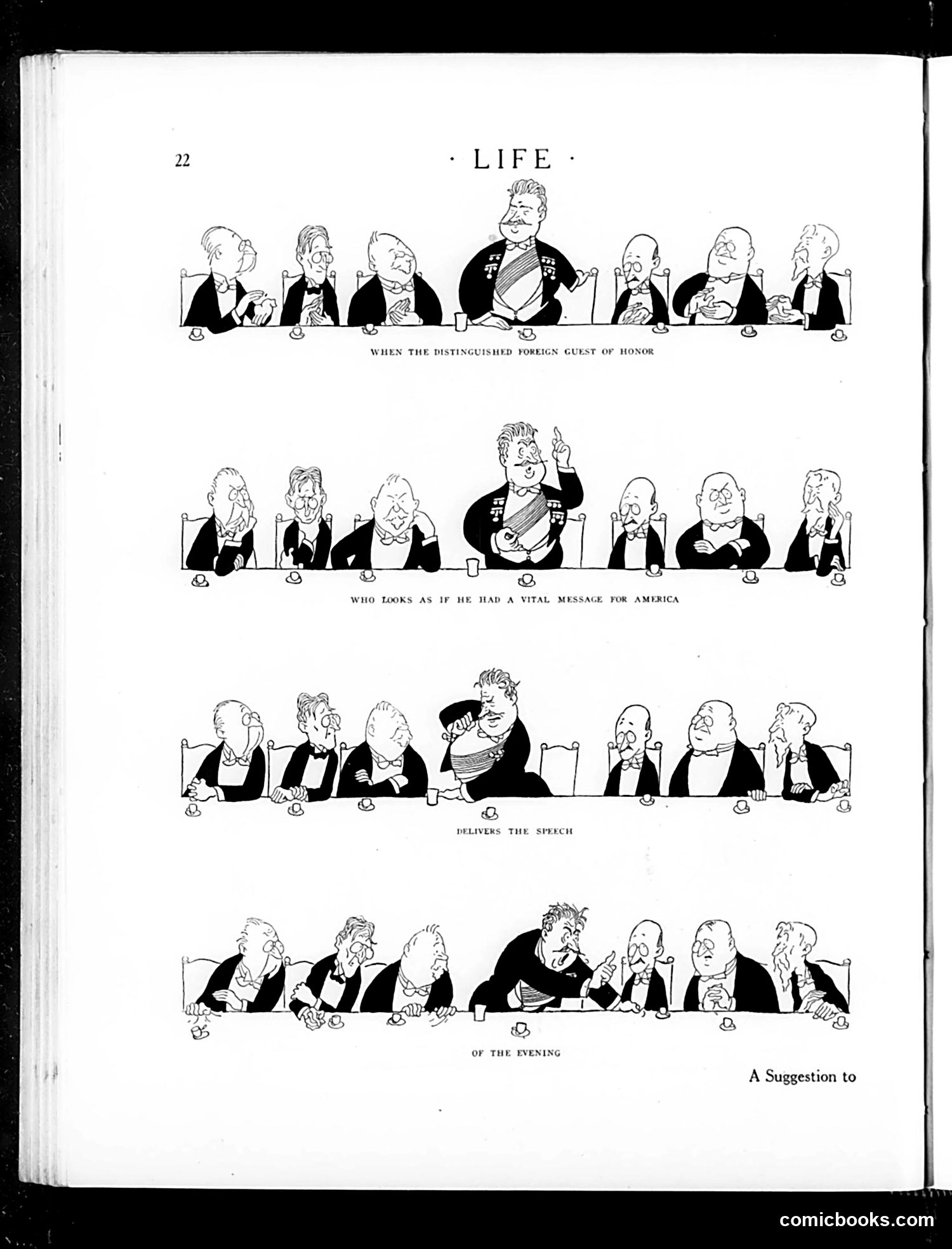
This page presents a four-panel satirical sequence showing a formal dinner with distinguished gentlemen (depicted in exaggerated caricature style). The central figure—marked by military decorations and prominent positioning—appears to be a foreign dignitary or "distinguished foreign guest of honor." The humor tracks the guest's evolving expressions across the evening: initially commanding attention, then appearing to deliver an important message, followed by delivering a speech, and finally appearing exhausted or depleted by evening's end. The satire likely mocks diplomatic dinners and the tedious nature of formal state occasions, or possibly satirizes a specific foreign official's visit to America. The "Suggestion to" text at bottom remains incomplete, leaving the exact target unclear without additional context from the original publication date.
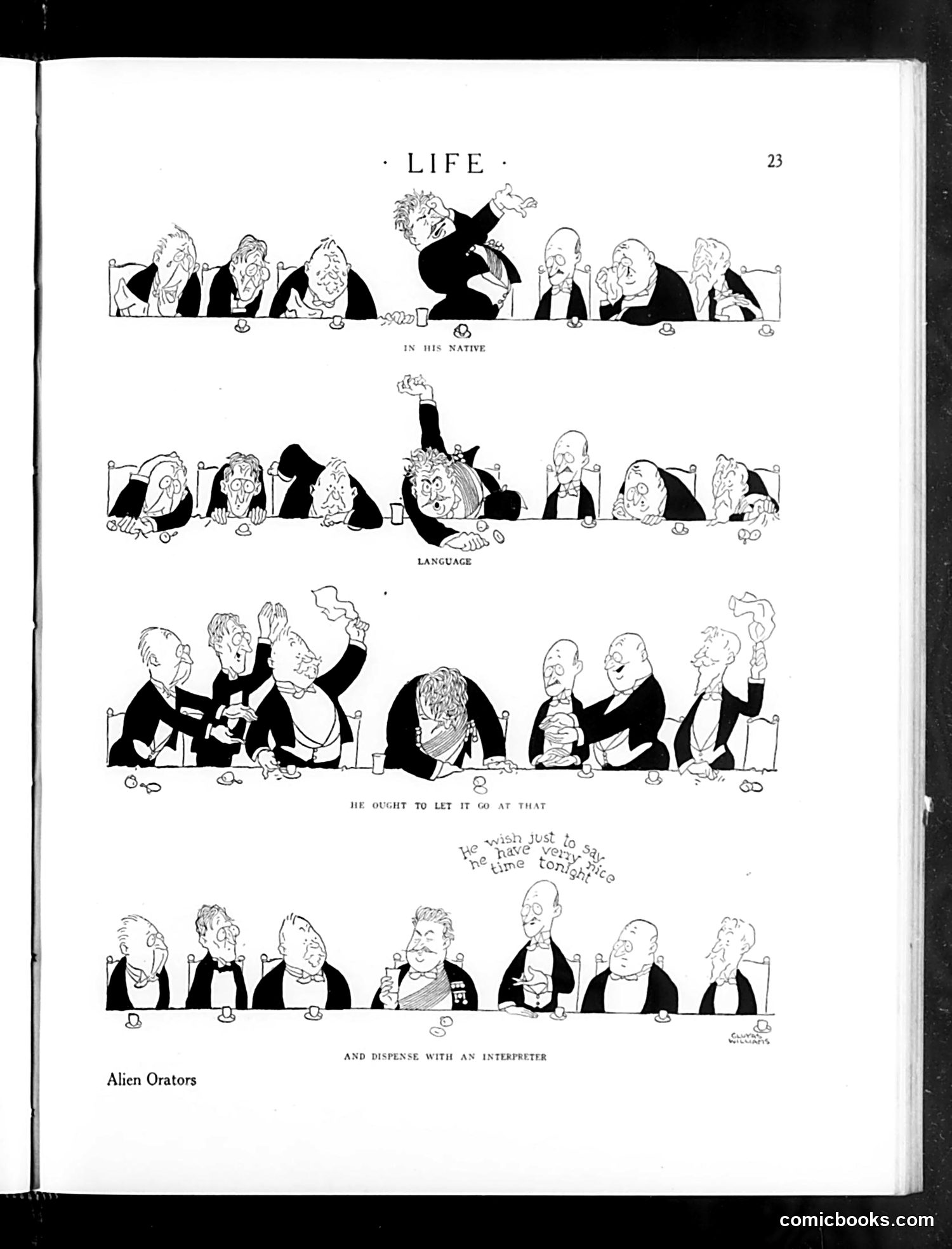
This page from *Life* magazine features four sequential cartoon panels satirizing foreign diplomats or politicians struggling with English language communication at what appears to be a formal dinner table. The titled sections—"IN HIS NATIVE LANGUAGE," "LANGUAGE," "HE OUGHT TO LET IT GO AT THAT," and "AND DISPENSE WITH AN INTERPRETER"—show the same figure becoming increasingly animated and incomprehensible as he attempts to speak English, with other diners' reactions ranging from polite to bewildered. The humor targets "Alien Orators" (as captioned), likely mocking early 20th-century immigrant or foreign dignitaries whose thick accents and language barriers made diplomatic communication comical to American audiences. The satire reflects period attitudes about linguistic assimilation and the perceived absurdity of non-native English speakers in formal settings.
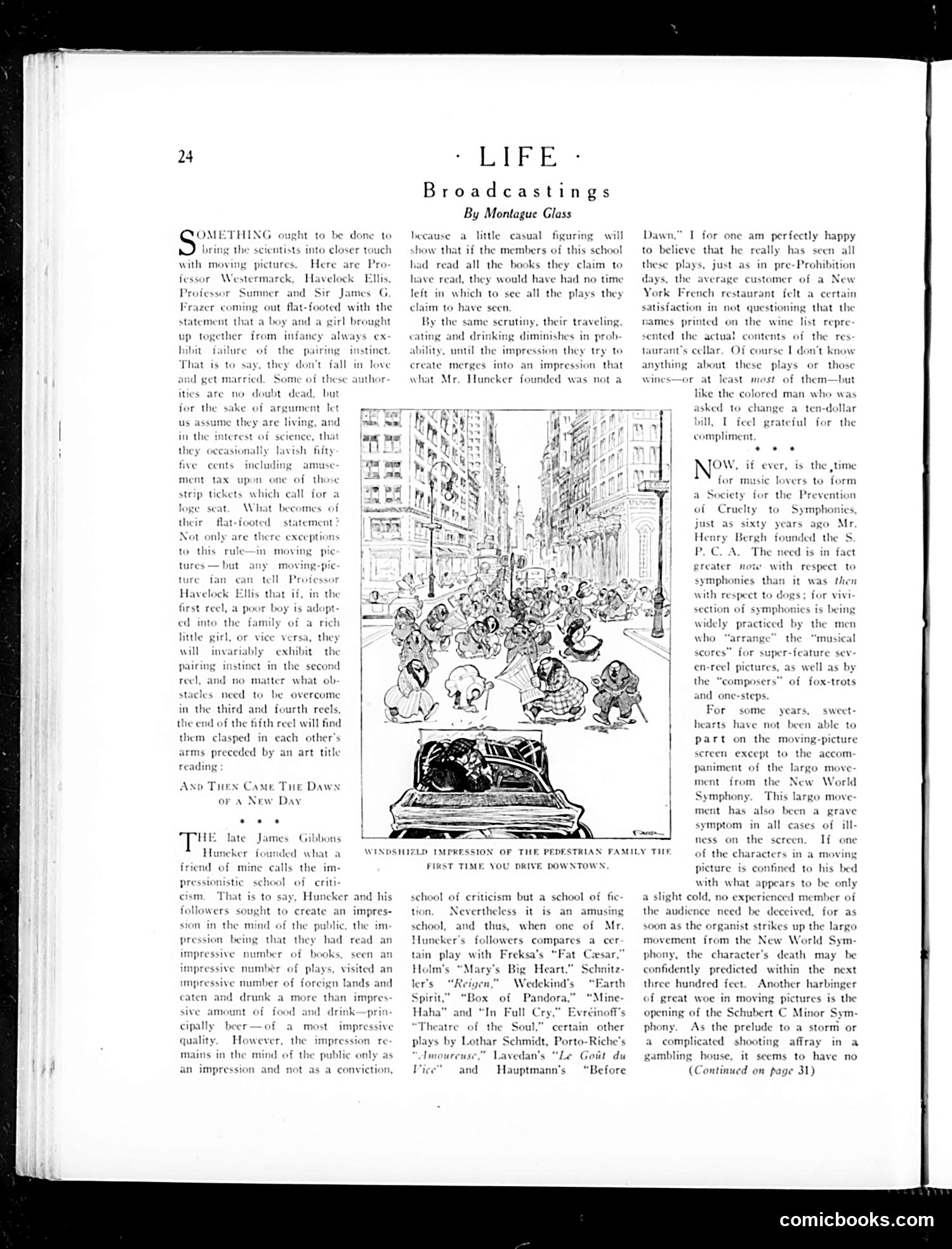
This satirical column attacks the pretensions of literary and music critics of the era. The main cartoon illustrates the absurdity of "impressionistic criticism"—exemplified by the late critic James Gibbons Huneker—where critics claim to have read countless books, seen numerous plays, and traveled extensively, yet their "impressions" remain unverified boasts rather than genuine conviction. The cartoon shows a pedestrian family's windshield view during their first downtown drive, sardonically captioned to suggest critics similarly distort reality through selective, exaggerated perception. The text also ridicules movie plots' predictable "pairing instinct" formula: poor boy meets rich girl, obstacles arise in reels three-four, they embrace by reel five—a formulaic sentimentality the author finds both obvious and intellectually lazy. Finally, Glass proposes a "Society for the Prevention of Cruelty to Symphonies," mocking how composers and arrangers mutilate classical music for silent film accompaniment and fox-trots—treating symphonies as brutally as turn-of-century society treated animals.
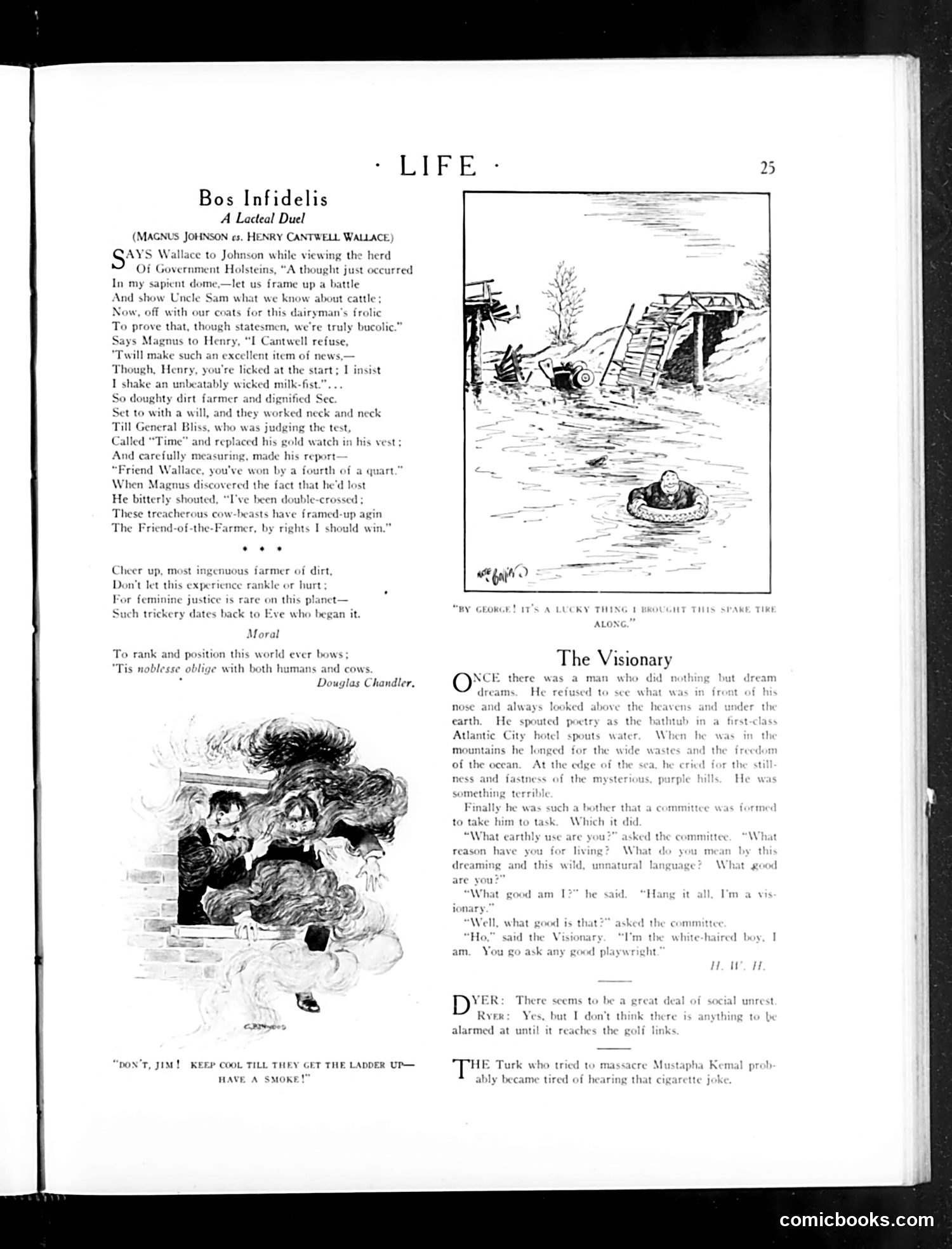
This page contains political satire from the early 20th century featuring two pieces: **"Bos Infidelis: A Lacteal Duel"** depicts a humorous competition between **Magnus Johnson** (a farmer) and **Henry Cantwell Wallace** (Secretary of Agriculture), who engage in a milk-production contest with government dairy cattle. The satire mocks both men as politicians pretending to be farmers ("statesmen" playing "bucolic"). When Johnson loses, he complains of being "double-crossed," a jab at political dishonesty. The moral critiques how even cattle respond to "noblesse oblige." **"The Visionary"** sketches a dreamer who does nothing but fantasize—spouting poetry in absurd places—until a committee confronts his uselessness. He responds that he's "the white-haired boy" and tells them to ask "any good playright." This mocks impractical idealists disconnected from reality. The cartoons reflect 1920s skepticism toward both agricultural politics and artistic/visionary pretensions, using exaggeration and irony to critique social pretense.
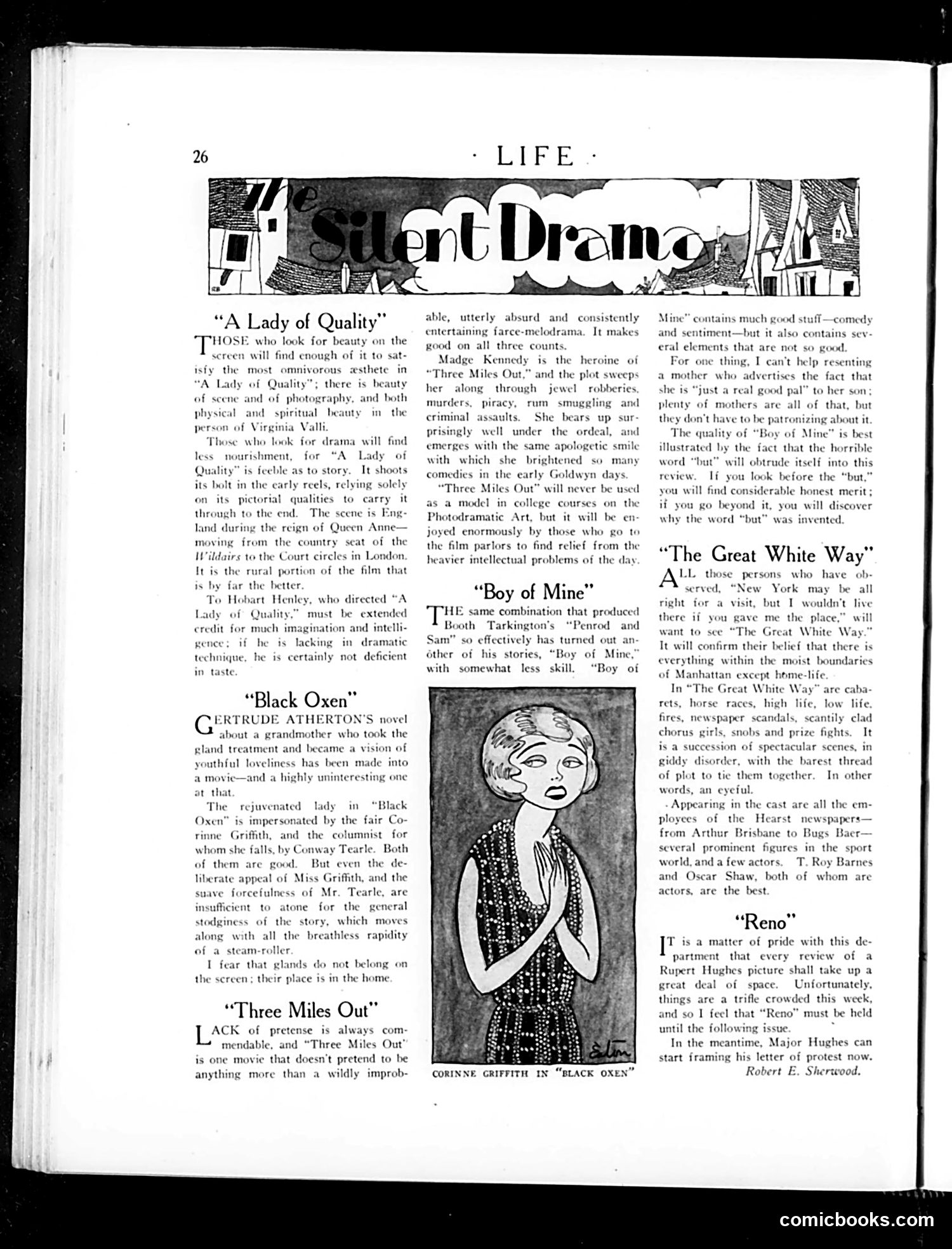
This page reviews five silent films, offering modern readers insight into 1920s cinema criticism and social attitudes. **Key Reviews:** - **"A Lady of Quality"**: Praised for visual beauty but criticized for weak plot, starring Virginia Valli - **"Black Oxen"**: Adapts Gertrude Atherton's novel about a woman rejuvenated through medical treatment, starring Corinne Griffith. The reviewer satirizes the gland-treatment premise as absurd, sarcastically suggesting such medical matters belong "in the home," not onscreen - **"Three Miles Out"**: Celebrated as entertainingly ridiculous farce-melodrama - **"Boy of Mine"**: Mixed review criticizing sentimental elements - **"The Great White Way"**: Cynically depicts Manhattan nightlife The reviews reveal period attitudes: skepticism toward science/medicine, moralism about appropriate subjects for film, and New York portrayed as superficial and morally hollow—lacking "home-life."
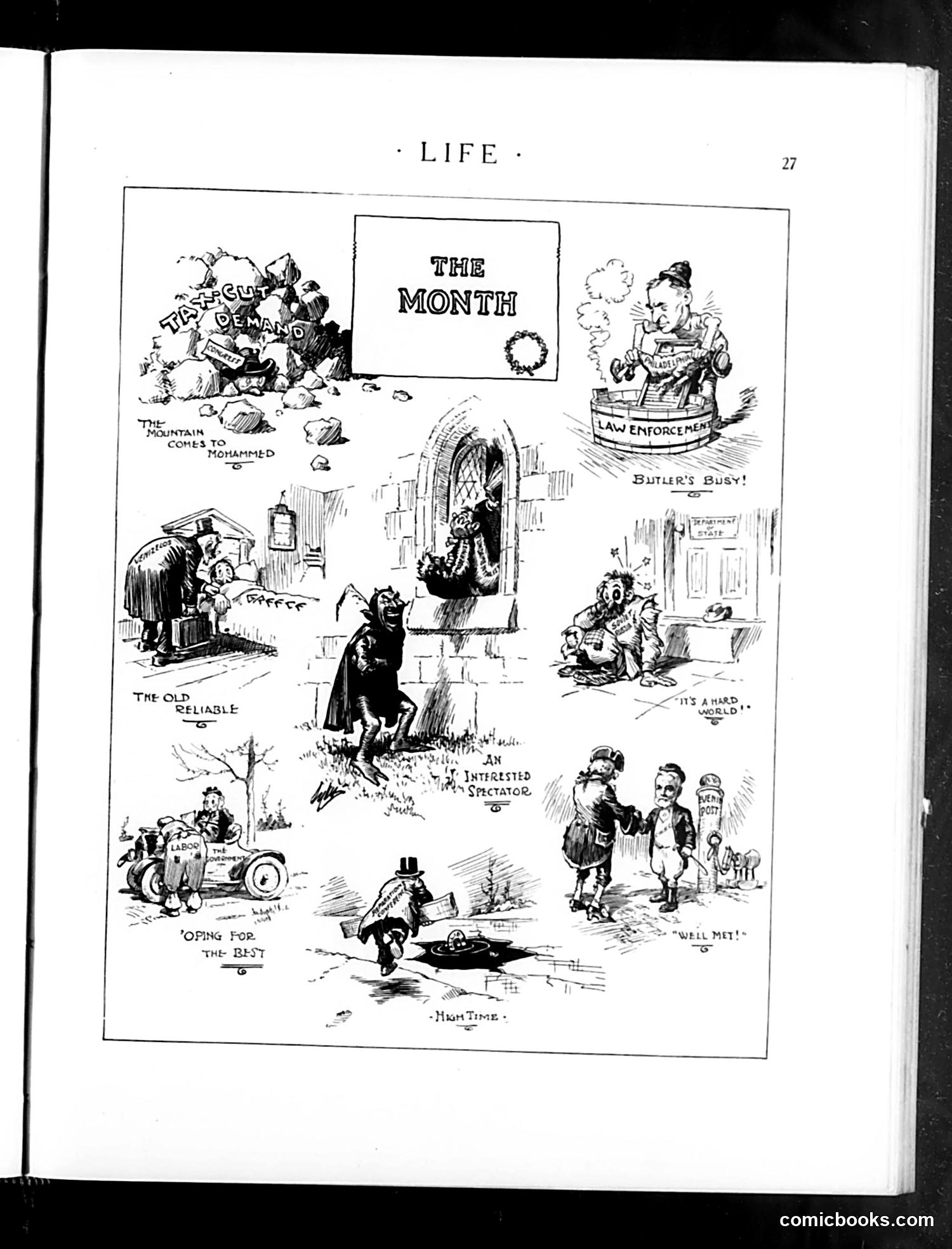
This is a composite satirical illustration titled "The Month," featuring seven vignettes commenting on contemporary issues. The cartoons depict: 1. "The Mountain Comes to Mohammed" - appears to reference a political or social reversal 2. "The Only Reliable" - shows someone at a stove/cooking 3. "Law Enforcement's Busy!" - depicts officials dealing with crime 4. "An Interested Spectator" - shows someone observing events 5. "It's a Hard World!" - illustrates economic or social hardship 6. "Hoping for the Best" - depicts Labor concerns or strikes 7. "Halftime" and "Will Meet!" - likely references to current events The cartoons use exaggerated caricature and visual metaphor typical of early-to-mid 20th century American political satire. Without specific dating or author attribution visible, the exact historical references remain somewhat unclear, though they appear to critique labor issues, law enforcement, and social conditions of their era.
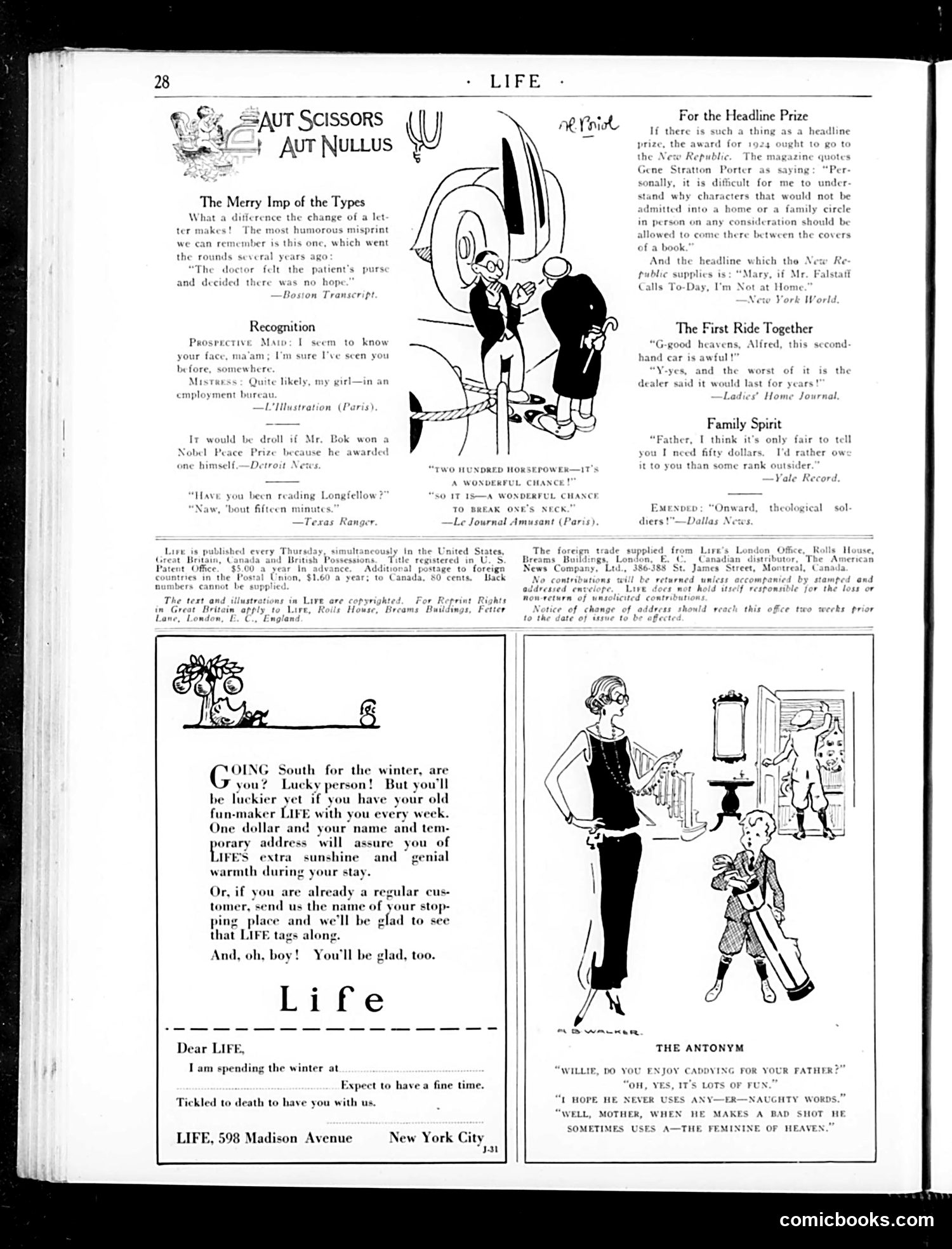
This page from *Life* magazine contains several satirical cartoons and humorous pieces typical of 1920s American humor: **"The Merry Imp of the Types"** mocks printing errors and their absurd consequences—a recurring theme in pre-digital publishing. **"Recognition"** jokes about a maid who seems familiar, playing on class-based awkwardness about remembering service workers. **"The First Ride Together"** and **"Family Spirit"** are domestic comedy pieces about secondhand cars and children asking parents for money—reflecting 1920s consumer culture concerns. **"The Antonym"** cartoon shows a boy caddying for his father, with humor centered on the child hoping his father doesn't curse while golfing. The "antonym" joke suggests the father uses "feminine" language when frustrated—likely a euphemistic reference to mild swearing or exclamations considered unmanly. The page also includes subscription advertising and miscellaneous fillers typical of the magazine's format. No specific political figures or events are caricatured here; the humor is social and domestic.
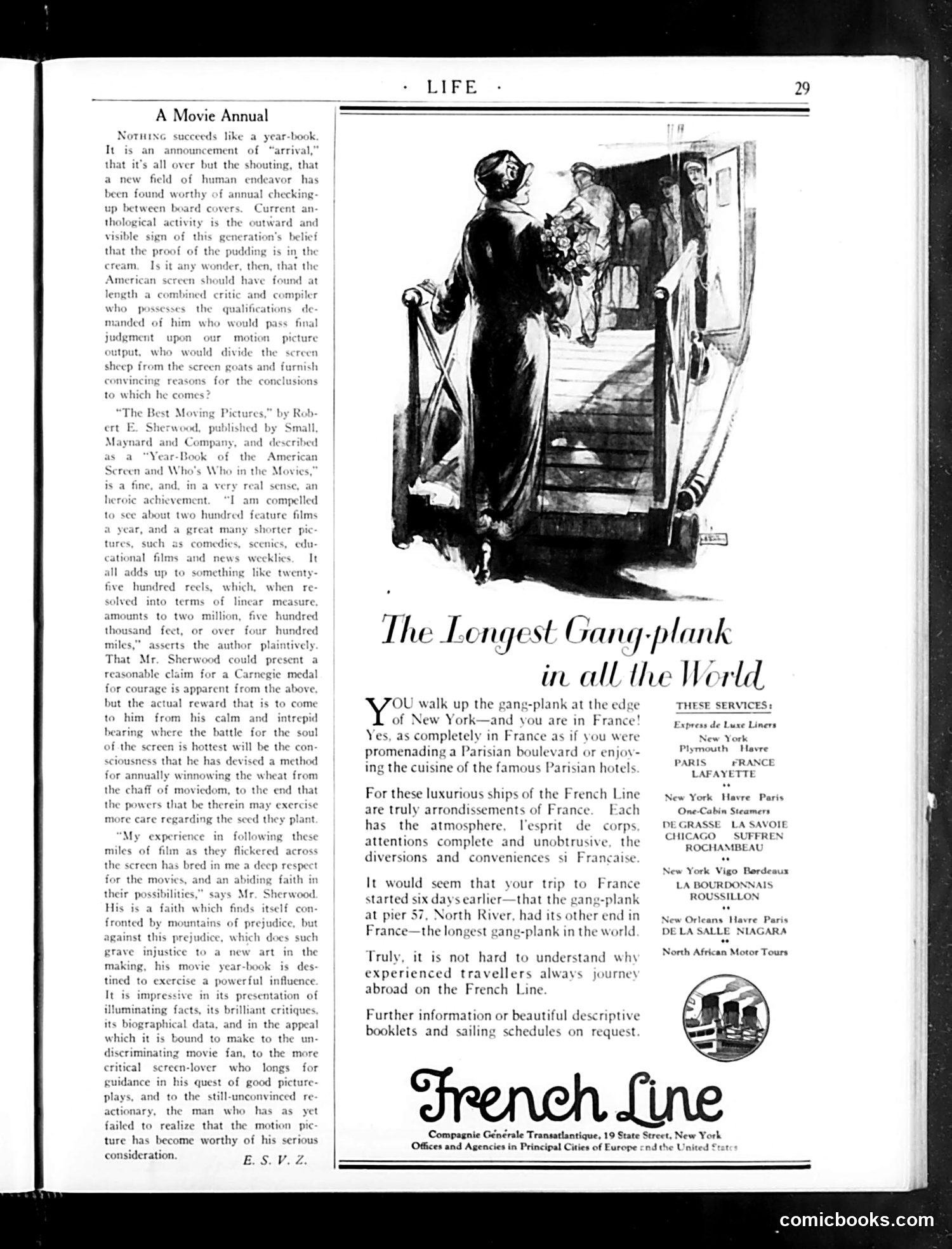
This page contains two distinct items: an article reviewing "The Best Moving Pictures," a new annual film guide by Robert E. Sherwood, and a French Line steamship advertisement. **The Movie Annual Section**: The article celebrates Sherwood's achievement in evaluating approximately 2,500 reels of film annually—over four hundred miles of footage—to separate quality films from inferior ones. The writer argues this represents a "heroic achievement" and claims the guide will influence Hollywood's output by providing critical guidance to discriminating viewers. It reflects 1920s-era debate about cinema's legitimacy as an art form worthy of serious critical evaluation. **The Advertisement**: The French Line ad uses the clever metaphor of a "gang-plank" connecting New York to France, suggesting that boarding their ships means entering French territory and culture. It emphasizes luxury, French atmosphere, and authentic French hospitality aboard their vessels—positioning transatlantic travel as an extension of France itself.
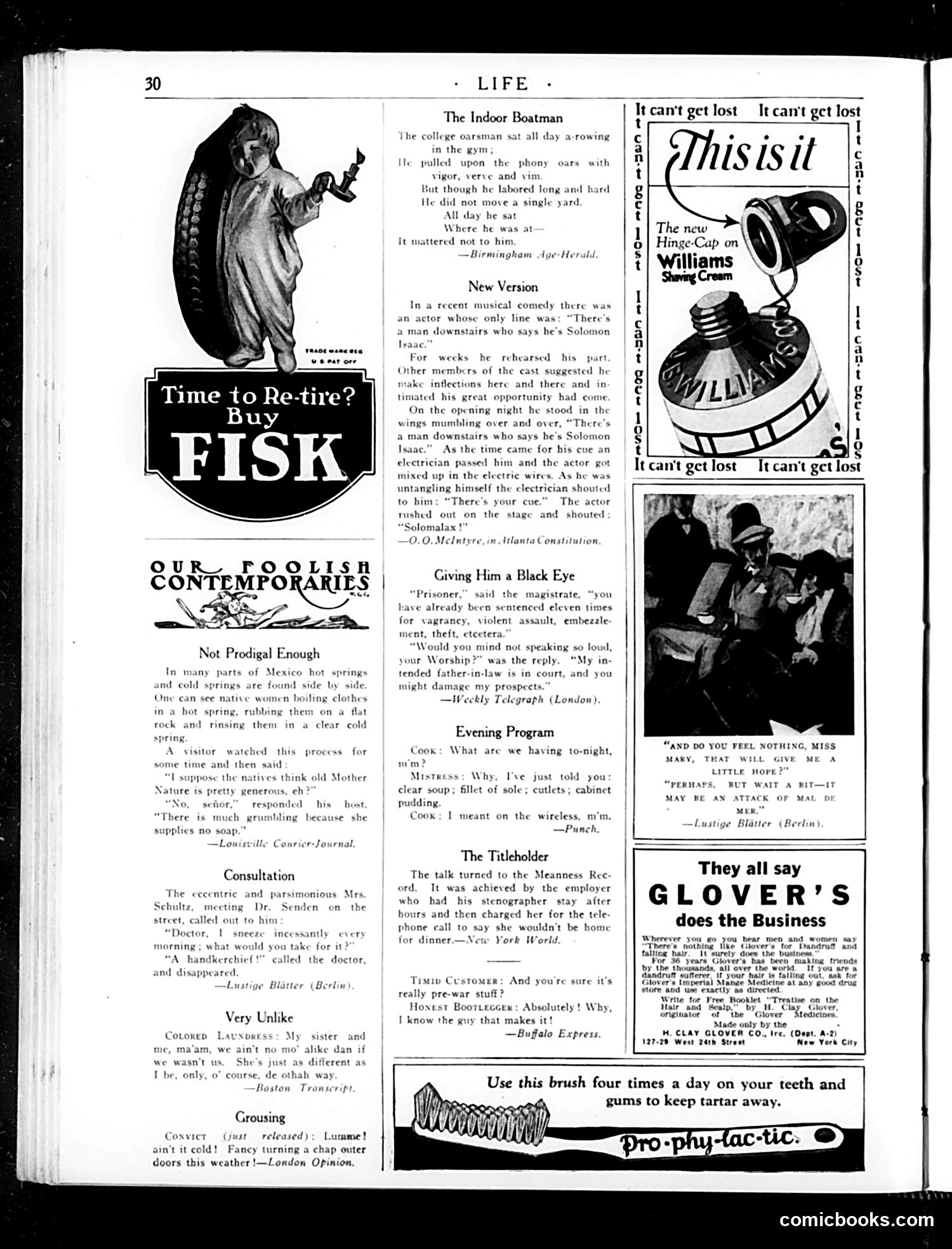
This page from *Life* magazine contains primarily **humorous anecdotes and jokes** rather than political cartoons. The content reflects early 20th-century American humor: **Key Content:** - Short comedic stories about everyday situations (Mexican hot springs, a doctor's wit, a stammering actor, workplace meanness) - A poem about a rower using a stationary gym machine—making the obvious joke that despite vigorous effort, he goes nowhere - Several British-sourced jokes (credited to *Punch*, *London Opinion*, *Weekly Telegraph*) **The Satire:** The humor targets petty human behaviors: cheap employers, prisoners' false hopes, servants' obliviousness, and class pretensions. One anecdote mocks an employer who charges his secretary for a phone call to say she won't return for dinner—satirizing extreme stinginess. **Advertisements:** The page includes ads for Fisk tires, Williams shaving cream, Pro-phy-lac-tic toothbrushes, and Glover's hair medicine—typical period product placement. This appears to be a **humor/miscellany page** rather than a political commentary section.
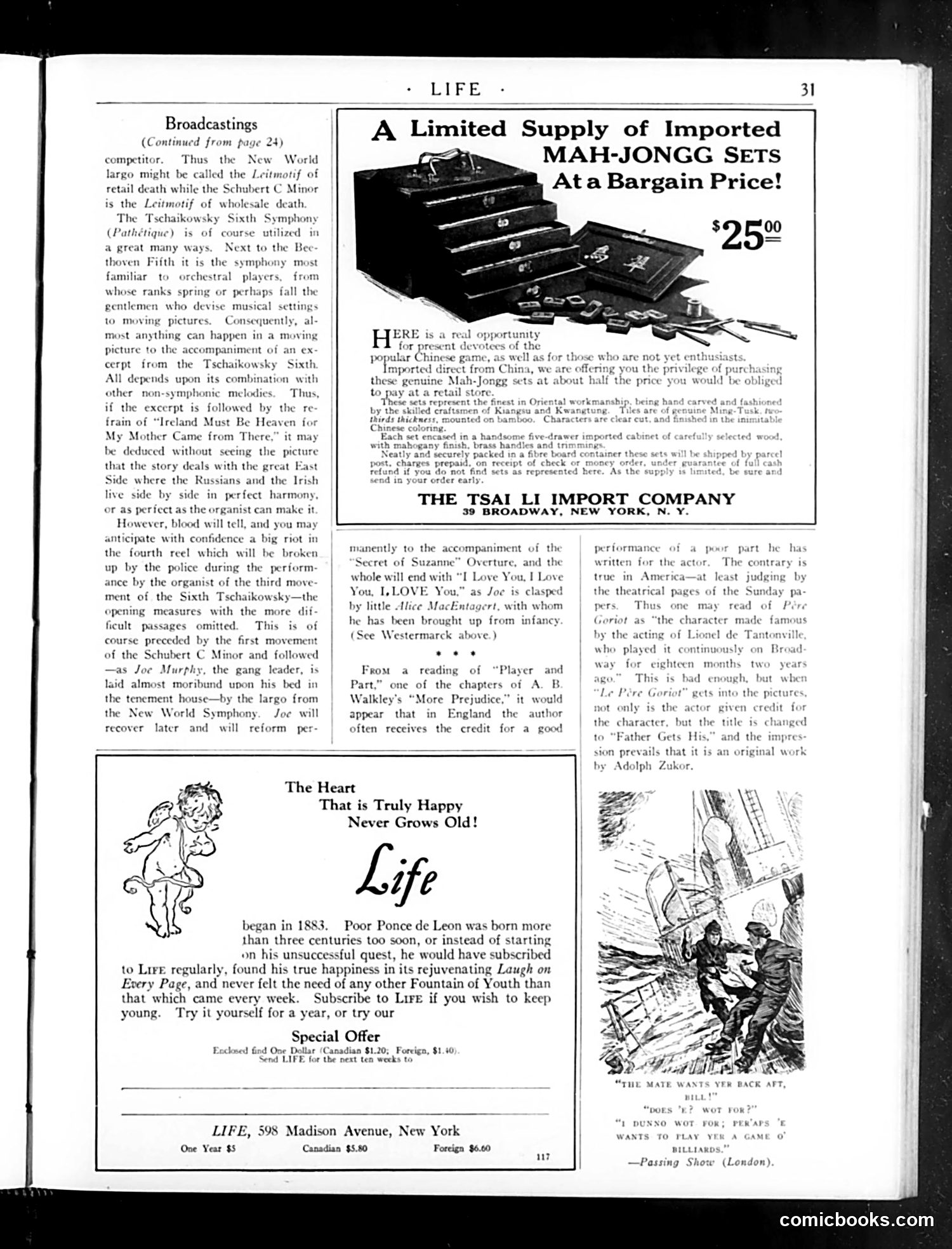
This page is primarily **advertising and subscription promotion** rather than satirical content. The main advertisement promotes **Mah-Jongg sets** ($25) imported from China—a game that was experiencing a craze in 1920s America. The text emphasizes authenticity and craftsmanship from "Kiangsu and Kwangtung." The upper section discusses **film music and orchestral accompaniment**, noting how composers use Tchaikovsky's symphonies to signal narrative elements (e.g., Irish-Russian immigrant stories, romantic conclusions). This reflects early cinema's reliance on live musical accompaniment to convey emotional context. The **"Life" magazine self-promotion** at bottom uses a Ponce de Leon reference to pitch subscriptions as a "Fountain of Youth"—humor based on the magazine providing rejuvenating laughter. A small cartoon sketch appears but is largely illegible in reproduction. The page reflects 1920s popular culture: Mah-Jongg's fashionable status, silent film conventions, and Life's satirical positioning as essential reading for staying culturally current.
This piece satirizes the absurdity of a proposed tourist attraction: converting an Indian cave in Manhattan into a "historical" dwelling where Native American actors would perform daily life in "full Indian costume" for paying visitors. The humor lies in the clash between authentic historical presentation and modern commercial compromise. The Custer family agrees to live primitively—but then demands steam heat, electricity, running water, parquet floors, French windows, and fine furnishings. The speakers recognize the contradiction: they want to educate visitors about "how the primitive redskin lived and warred with the elements," while providing every modern comfort. The satire targets both the commercialization of Native American culture and the patronizing attitude of wealthy whites who want to "understand" indigenous life while maintaining their own luxuries. The joke is that authentic historical education becomes impossible once comfort requirements are introduced—the whole enterprise becomes merely theatrical spectacle.
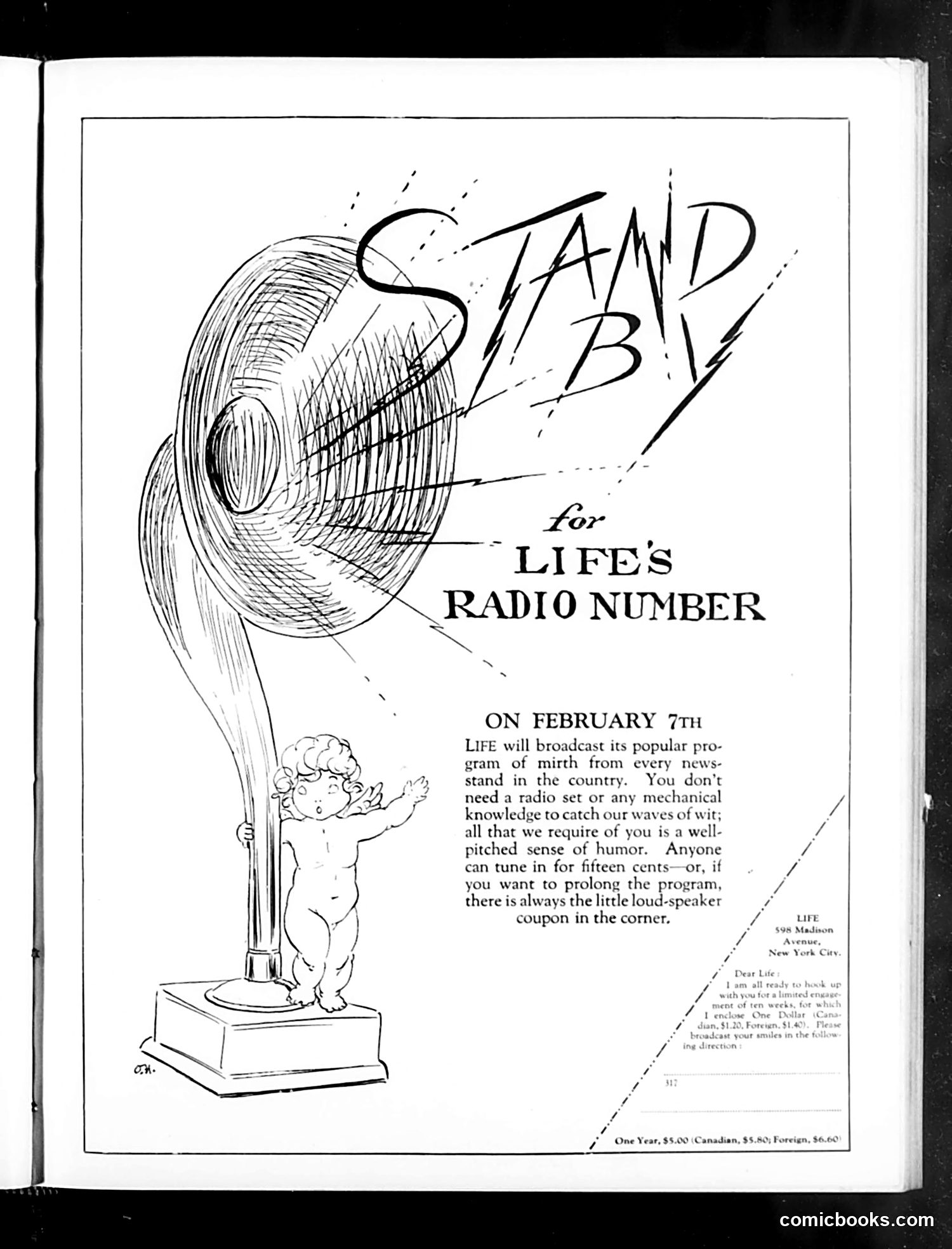
This is a promotional advertisement for *Life* magazine's February 7th broadcast, playfully framed as a "radio number." The illustration shows a cherub or cupid figure operating an old-fashioned radio speaker, which serves as a visual metaphor for the magazine itself as a "broadcasting" source of humor. The joke hinges on wordplay: *Life* magazine will "broadcast" its comedy "from every newsstand" across America—but you don't need an actual radio set to receive it. Instead, you simply purchase the magazine for fifteen cents. The text humorously suggests that humor is the only "mechanical knowledge" required, and readers can "tune in" by buying a subscription or using the coupon advertised. This represents early-20th-century advertising that cleverly exploited contemporary fascination with the newly popular radio medium to promote traditional print media.
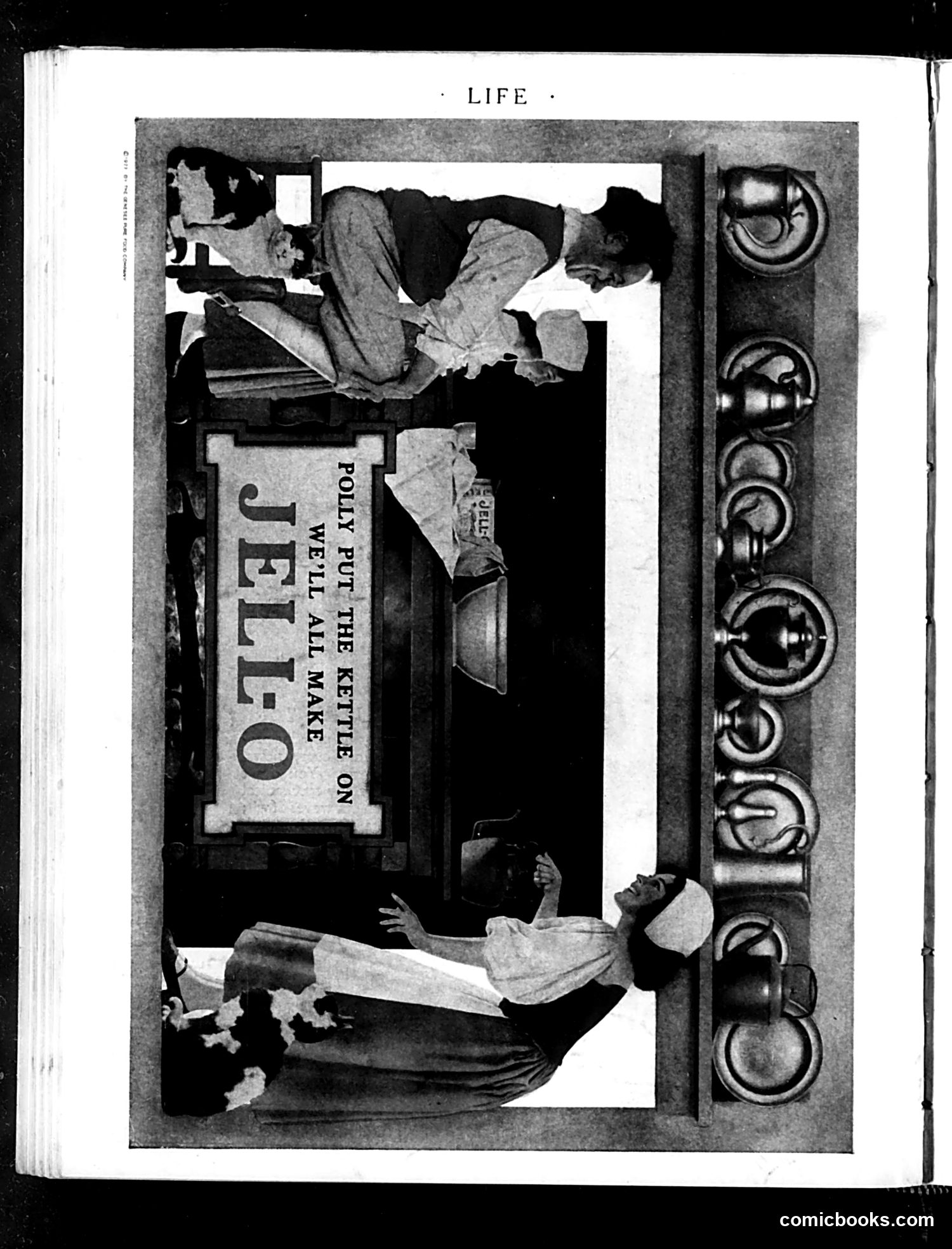
This appears to be a satirical illustration about a political or market situation, though the OCR text is too corrupted to read the caption clearly. The image shows two figures in what appears to be an interior setting with a sign reading "JELLO" and text mentioning "POLITICS PUT THE KETTLE ON" (or similar). The cartoon likely satirizes contemporary politics or business dealings—possibly referencing market speculation, political maneuvering, or public deception during the early-to-mid 20th century when Life magazine was active. One figure appears to be in a position of control or authority over the other. However, without legible caption text or date information visible in the image, I cannot definitively identify the specific political figures, events, or satirical targets being referenced. The exact meaning requires clearer source material.