
Life, 1924-01-31 · page 26 of 36
Life — January 31, 1924 — page 26: what you’re looking at
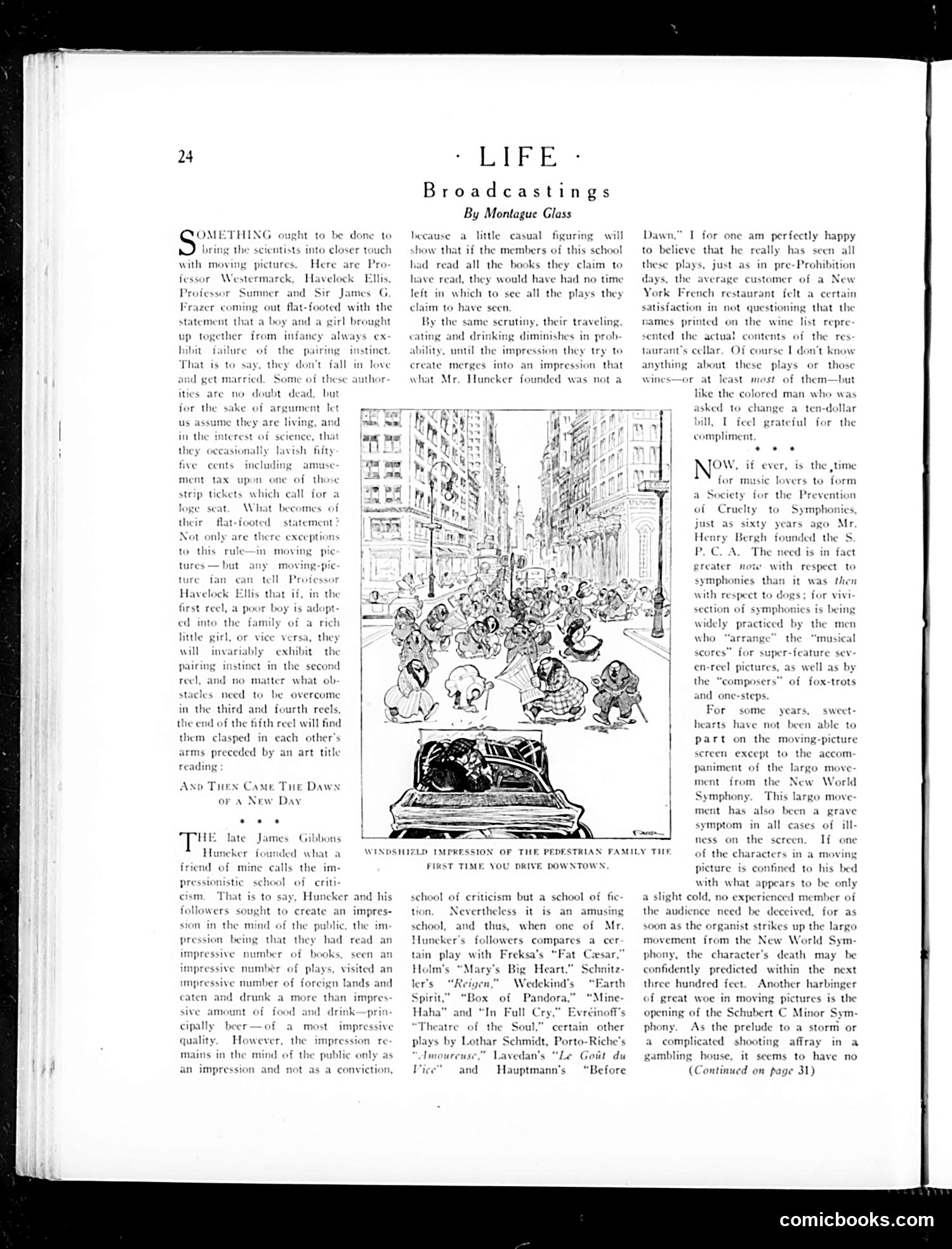
What you’re looking at
This satirical column attacks the pretensions of literary and music critics of the era. The main cartoon illustrates the absurdity of "impressionistic criticism"—exemplified by the late critic James Gibbons Huneker—where critics claim to have read countless books, seen numerous plays, and traveled extensively, yet their "impressions" remain unverified boasts rather than genuine conviction. The cartoon shows a pedestrian family's windshield view during their first downtown drive, sardonically captioned to suggest critics similarly distort reality through selective, exaggerated perception. The text also ridicules movie plots' predictable "pairing instinct" formula: poor boy meets rich girl, obstacles arise in reels three-four, they embrace by reel five—a formulaic sentimentality the author finds both obvious and intellectually lazy. Finally, Glass proposes a "Society for the Prevention of Cruelty to Symphonies," mocking how composers and arrangers mutilate classical music for silent film accompaniment and fox-trots—treating symphonies as brutally as turn-of-century society treated animals.
📄 Transcribed text from this page (OCR, searchable)
Machine-transcribed from the original scan — historical spelling and the odd misread are preserved.
OMETHING ought to be done to S bring the scientists into closer touch Here ar Havelock I Sumner and Sir James G sted with the boy and a girl brought with moving. pictures. fessor Westermarck, Frazer con statement that ether irom infancy always ex € h i] amstinet That is to say. they don’ in love and get married. Some of these author ities are no doul but for the sake of argument let us assume they 3 in the interest o they occasionally | © cents incluc ment tax upon one of strip tickets which call their flat-footed Not only are t this rule—in exceptions moving pic tures any moving-pic ture fan can tell Havelock Ellis first reel, a poor boy is adopt- ed into the little will invariably family of exhibit tl pairing instinct in the second girl, or vice reel, and no matter what ob need to be overcome third and fourth reels. the end of the fifth reel will find stacles in the them clasped in each other's arms preceded by an art tit ng Tne Dawn Day Axp Tues Came or \ New eee HE. late Huneker friend James Gibbons nded what a mine calls the im- pressionistic school of crit cism, That is to say, Huncker his wers sought to create an impres- sion in the mind of the public, the im that number of pression being they had read an impressive books, seen an impressive num visited mpressive number of foreign lands and caten and drunk a more than impres sive amount of and. drink—pri cipally beer f a most impressive quality. However, the impression re mains in the mind of the public only as an impression and not as a conviction, LIFE Broadcastings By Montague Glass Iecause a little casual figuring will how that if the members of this school dread all the books they claim to have read, they would have had no time all the left in which to sec plays they claim to have seen. By the same scrutiny, their traveling cating and drinking diminishes in pi ability, until the impression they try create merges into an impression that what Mr. Huncker founded was not a WINDSHIZLD IMPRESSION OF THE PEDESTRIAN FAMILY TIF FIRST TIME YOU DRIVE DOWNTOWN school of criticism but a school of fic m. Nevertheless it is an amusing thus, when one of Mr followers compares a cer school, and Huneker’s tain play with Freksa’s “Fat Cyesar,” Holm's “Mary's Big Heart.” Sct ler’s “Reigen,” —Wedekind’s Spirit,” “Box of Pandora, Haha” and “In Full Cry,” Evréinoff’s “Theatre of the Soul certain other plays by Lothar Schmidt, Porto-Riche’s Gout du Before Lavedan’s “Le and Hauptmann’s Dawn,” I to believe one am perfectly happy that he plays, just as in pre-Prohibition really has seen all these days, the average customer of a New York French restaurant felt a certain satisfaction in not questioning that the names pr ented the taurant’s cellar don the wine list repre contents of the res I don’t know plays or those actu: OF course anything about these or at st most of them—but like the colored man who was asked to change a ten-dollar “ll, I feel compliment see grateful for the JOW, if ever, is the ,time for m vers to form for the Prever of Cruelty to a Society Symphonies, just as sixty years ago Mr Henry Bergh founded the S PLC. A. The greater now w eed is in fact respect to symphonies th was th with respect to dogs; for vivi section of symphonies is being widely practiced by the men who “arrange” the “musical scores” for super-feature sev en-reel pictures, as well as by the “composers” of fox-trots and one-steps. For some hearts have not part on the screen years, sweet: been moving-picture except to the accom paniment of the largo move ment New World This largo move from the Symphony ment has also been a grave symptom in all cases of ill- ness on the screen. If one of the characters in a mov picture is confined to his bed with what appears to be only a slight cold, no experienced member of the audience need be deceived, for as soon as the organist strikes up the larg movement from the New World Sym- phony, the death may be confidently predicted within the next three hundred feet. Another har! character's nger g pictures is the opening of the Schubert C Minor Sym- phony. As the prelude to a storm or a complicated of great woe in mov shooting affray in a seems to have no (Continued on page 31) gambling house, it comicbooks.com