
Life, 1924-01-31 · page 20 of 36
Life — January 31, 1924 — page 20: what you’re looking at
What you’re looking at
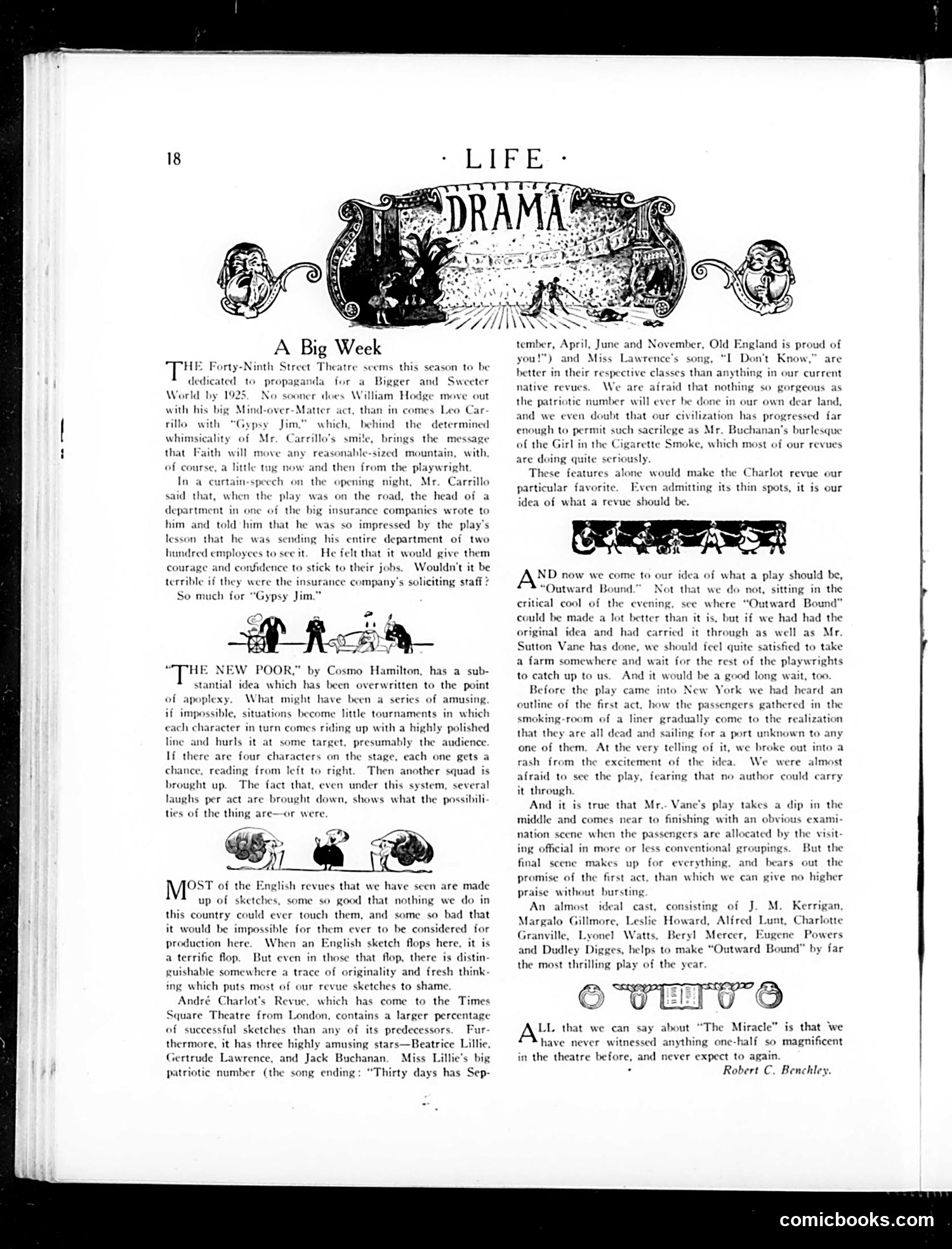
This page reviews several Broadway productions. The main content discusses four theatrical works: **"Gypsy Jim"** — A William Hodge vehicle praised for its message about faith overcoming obstacles. The text notes an insurance company was so inspired they sent 200 employees to see it, hoping to boost morale. **"The New Poor"** by Cosmo Hamilton — Criticized as overwritten, using a comedic structure where characters take turns delivering punchlines at the audience like "riding up with a highly polished line and hurls it at some target." **"Outward Bound"** — Praised as an exemplary play, despite minor flaws. The plot involves ship passengers gradually realizing they're dead, sailing to an unknown port. The reviewer admits the premise initially seemed risky but was impressed by Sutton Vane's execution. **"André Chariot's Revue"** — Described as superior to American revues, praised for avoiding sacrilegious humor that American audiences supposedly couldn't yet handle. The small decorative illustrations appear to be typical period vignettes of theatrical scenes.
📄 Transcribed text from this page (OCR, searchable)
Machine-transcribed from the original scan — historical spelling and the odd misread are preserved.
nk RES A Big Week tember, April, June and November, Old England is proud of you!") and Miss Lawrence’s song, “I Don't Know,” are better in their respective classes than anything HE Forty-Ninth Street Theatre seems this season to be dedicated to propaganda for a Bigger and Sweeter World by 1925. No sooner does William Hodge move out with his big Mind-over-Matter act, than in comes Leo Car rillo n our current native revues. We are afraid that nothing so gorgeous as the patriotic number will ever be done in our own dear land, nd we even doubt that our civilization has progressed far enough to permit such sacrilege as Mr. Buchanan's burlesque of the Girl in the Cigarette Smoke, which most of our revues determined ith “Gypsy Jim.” which, behind th whimsicality of Mr. Carrillo’s smite, brings the message that Faith will move any reasonable-sized mountain, with are doing quite seriously of course, a little tug ° s sds patel These features alone would make the Charlot revue our wand then from the playwright rtain-speech on the opening night, Mr. Carrillo In ac particular favorite. Even admitting its thin spots, it is our goad the thead idea of what a revue should be. said that, when the play was on th fia department in one of the big insurance companies wrote to him and told him that he was so impressed by the play's lesson that he was sending his entire department of two hundred employces to see it. He felt that it would give them at courage and confidence to stick to their jobs. Wouldn't it be terrible if they were the insurance company’s soliciting staff ? much for “ ND now we come to our idea of what a play should be, “Outward Bound.” Not that we do not, sitting in the Sypsy Jim.” crit cool of the evening, see where “Outward Bound” Q, could be made a lot better than it is, but if we had had the Be original idea and had carried it through as well as Mr — Sutton Vane has done, we should feel quite satisfied to take Bore bree : a farm somewhere and wait for the rest of the playwrights THE NEW POOR,” by Cosmo Hamilton, has a sub- stantial idea which has been overwritten to the point of apoplexy. What might have been a series of amusing if impossible, situations become little tournaments in which to catch up to us. And it would be a good long wait, too. Before the play came into New York we had heard an outline of the first act, how the passengers gathered in the come to the realization a port unknown to any He isa a nah smoking-room of a liner gradua each character in turn comes riding up with a highly polished that they are all dead ‘and sailing { line and hurls it at some target, presumably the audience. If there are four characters on the sta one of them. At the very telling of it, we broke out into 1 1 ‘ 1 f Th ‘i M rash from the excitement of the idea. We were alm chances Teaaing | trogt eit te tight pt en anther; squads afraid to see the play, fearing that no author could carry brought up. The t that, even under this system, several it through. laughs per act are brought down, shows what the possibili And it . each one gets a st is true that Mr. Vane’s play takes a dip in the ties of the thing are—or were. : 8 middle and comes near to finishing with an obvious exami- nation scene when the passengers are allocated by the visit- > SD GS* eo ) ing official in more or less conventional groupings. But the aw) final scene makes up for everything, and bears out the promise of the first act, than which we can give no higher OST of the English revues that we have seen are made praise without bursting eae of sketches, some 20 goo tat nothing ¥s = y ‘Ancalmest desl “ease, consisting vot cue Kennaan his ‘country could ever..touct Clem aid) some ,s0. bac. ta Margalo Gillmore, Leslie Howard, Alfred Lunt, Chark ould be yssible for th ever to b considered fo - 3 it would be impossible for them ever to be considered for Granville, Lyonel Watts, Beryl Mercer, Eugene Powers a terrific flop. But even in those that flop, there is distin a : ; : the most thrilling play of the year guishable somewhere a trace of originality and fresh think ndré Charlot’s Revue, which has come to the Times hd Square Theatre from London, contains a larger percentage thermore, it has three highly amusing stars—Beatrice Lillie have never witnessed anything one-half so magnificent Gertrude Lawrence, and Jack Buchanan. Miss Lillie’s big in the theatre before, and never expect to again. production here. When an English sketch flops here. it is 4 Dudley Digges, helps to make “Outward Bound” by far ing which puts most of our revue sketches to shame. of successful sketches than any of its predecessors. Fur LL that we can say about “The Miracle” is that we “Thirty days has Sep- bert C. Benchley. patriotic number (the song ending: comicbooks.com