
Life, 1924-01-31 · page 28 of 36
Life — January 31, 1924 — page 28: what you’re looking at
What you’re looking at
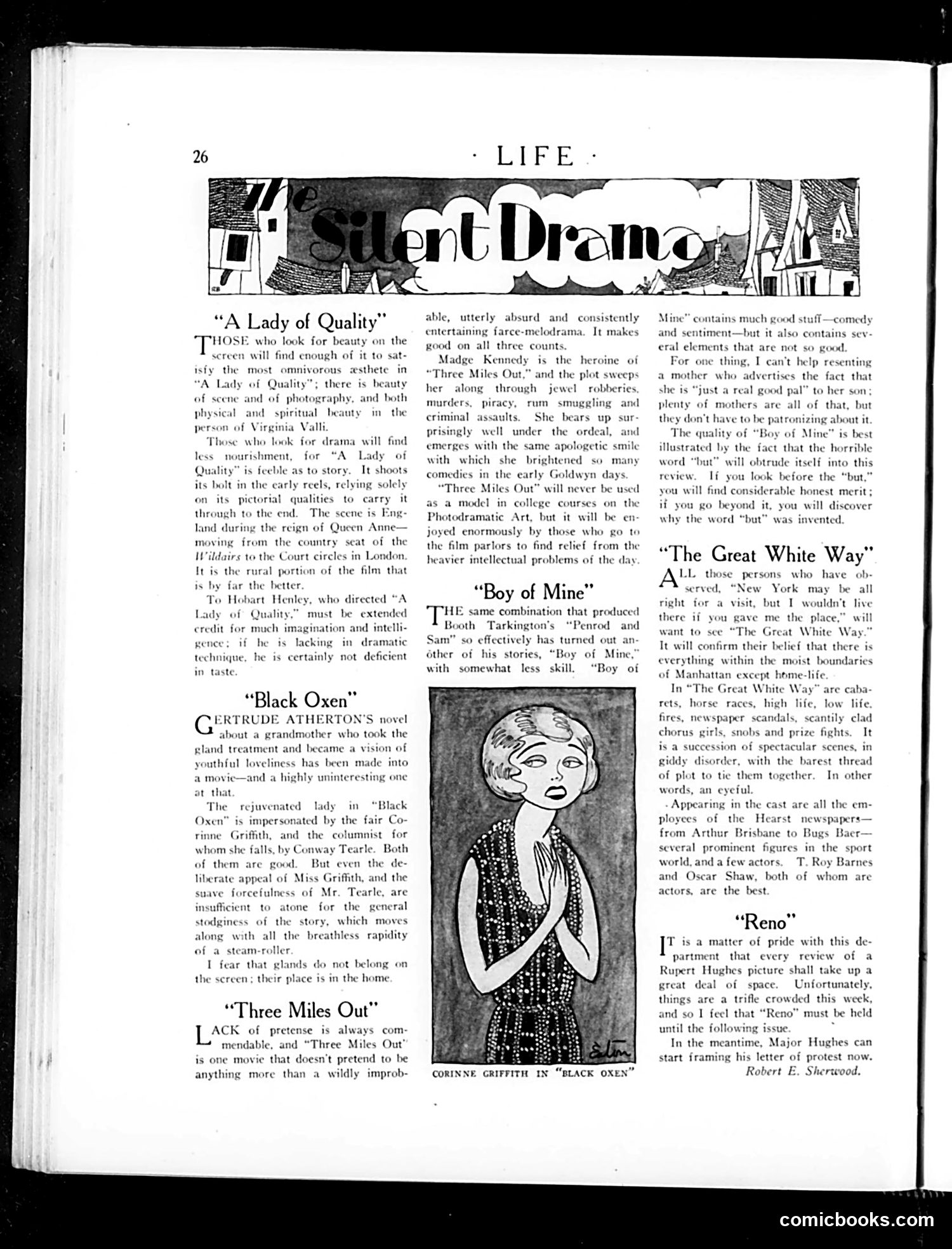
This page reviews five silent films, offering modern readers insight into 1920s cinema criticism and social attitudes. **Key Reviews:** - **"A Lady of Quality"**: Praised for visual beauty but criticized for weak plot, starring Virginia Valli - **"Black Oxen"**: Adapts Gertrude Atherton's novel about a woman rejuvenated through medical treatment, starring Corinne Griffith. The reviewer satirizes the gland-treatment premise as absurd, sarcastically suggesting such medical matters belong "in the home," not onscreen - **"Three Miles Out"**: Celebrated as entertainingly ridiculous farce-melodrama - **"Boy of Mine"**: Mixed review criticizing sentimental elements - **"The Great White Way"**: Cynically depicts Manhattan nightlife The reviews reveal period attitudes: skepticism toward science/medicine, moralism about appropriate subjects for film, and New York portrayed as superficial and morally hollow—lacking "home-life."
📄 Transcribed text from this page (OCR, searchable)
Machine-transcribed from the original scan — historical spelling and the odd misread are preserved.
“A Lady of Quality HOSE who look for bea screen will find enough of it to sat- isfy the ‘most ‘omnivorous: aathete in “A Lady of Quality”; there is beauty of scene and of photography, and both heauty in the ty on the physical and spiritual person of Virginia Valli Those who look for drama will find Lady of It shoots less nourishment, for “A Quality” is feeble as to story its bolt in the early reels, relying solely on its pictorial qualities to carry it through to the end. The scene is Eng- land during the reign of Queen Anne— moving from the country seat of the Wildairs to the Court circles in London It is the rural portion of the film that is by far the better: To Hobart Henley, who directed “A Lady of Quality, extended credit for much im nd intelli- gence; if he is lacking in’ dramatic he is certainly not deficient must be ination technique in taste “Black Oxen” GERTRUDE ATHERTOS about a grandmother who took the novel gland treatment and became a vision of youthful loveliness has been made into a movie—and a highly uninteresting one at that The “Black Oxen” is impersonated by the fair Co- umnist for whom she falls, by Conway Tearle. Both of them are good. But even the de- liberate appeal of Miss Griffith, and the rejuvenated lady in rinne Griffith, and the c forcefulness of Mr. Tearle, are atone for the general which moves suave insufficient to stodginess of the story, ng with all the breathless rapidity of a steam-roller I fear that glands d the screen; their place is in the home “Three Miles Out” Lack of pretense is always com- mendable, and “Three Miles Out" is one movie that doesn’t pretend to be not belong on anything more than a wildly improb- able, utterly absurd and consistently entertaining farce-melodrama. It makes good on all three counts Madge Kennedy is the “Three Miles Out, through rum heroine of nd the plot sweeps jewel her along robberies, murders, smuggling and She bears up sur under the ordeal, and emerges with the same apologetic smile with which she brightened so comedies in the early “Three Miles Out as a model in college courses on th Photodramatic Art, but it will be er joyed enormously by the the film parlors to find relief from the heavier intellectual problems of the day “Boy of Mine” = same combination that produced ath Tarkington's “Penrod and so effectively has turned out an of his stories, “Boy of Mine,” somewhat less. skill. i piracy, assaults. well erimi prisingly many dwyn days will never be used who go to other with CORINNE GRIFFITH IN “BLACK OXEN Mine” contains much good comedy nd sentiment—but it also contains sev- eral elements that are not so good For one thing, I can't help resenting ct that she is “just a real good pal” to her son; a mother who advertises the plenty of mothers are all of that, but they don’t have to be pat bout it is best nizing The quality of “Boy of Mine illustrated by the fact that the horrible word “but” will obtrude itself into this li you look before the “but,” you will find considerable honest merit ; review if you go beyond it, you will discover why the word “but” was invented. “The Great White Way” All those served, persons who have ob- New York may be all a visit, but I there if you gave me the place,” will he Great White Way.” It will confirm their belief that there is everything within the moist boundaries of Manhattan except home-life In “The Great White Way" rets, right for wouldn't live want to sce are caba- horse races, high life, low life. fires, newspaper scandals, scantily clad chorus girls, snobs and prize fights. It is a succession of spectacular scenes, in giddy disorder, with the barest thread of plot to tie them together. In other words, an eyeful Appearing in the cast are all the em- ployees of the Hearst newspapers— from Arthur Brisbane to Bugs Baer— several prominent figures in the sport world, and a few actors. T. Roy Barnes and Oscar Shaw, both of whom are e the best “Reno” [7 is & matter of pride with this de- partment that every review of a Rupert Hughes picture shall take up a great deal of space. Unfortunately, things are a trifle crowded this week, and so I feel that until the following issue. In the meantime, Major Hughes can start framing his letter of protest now. Robert E. Sherwood. eno” must be held comicbooks.com