
Life, 1924-01-31 · page 16 of 36
Life — January 31, 1924 — page 16: what you’re looking at
What you’re looking at
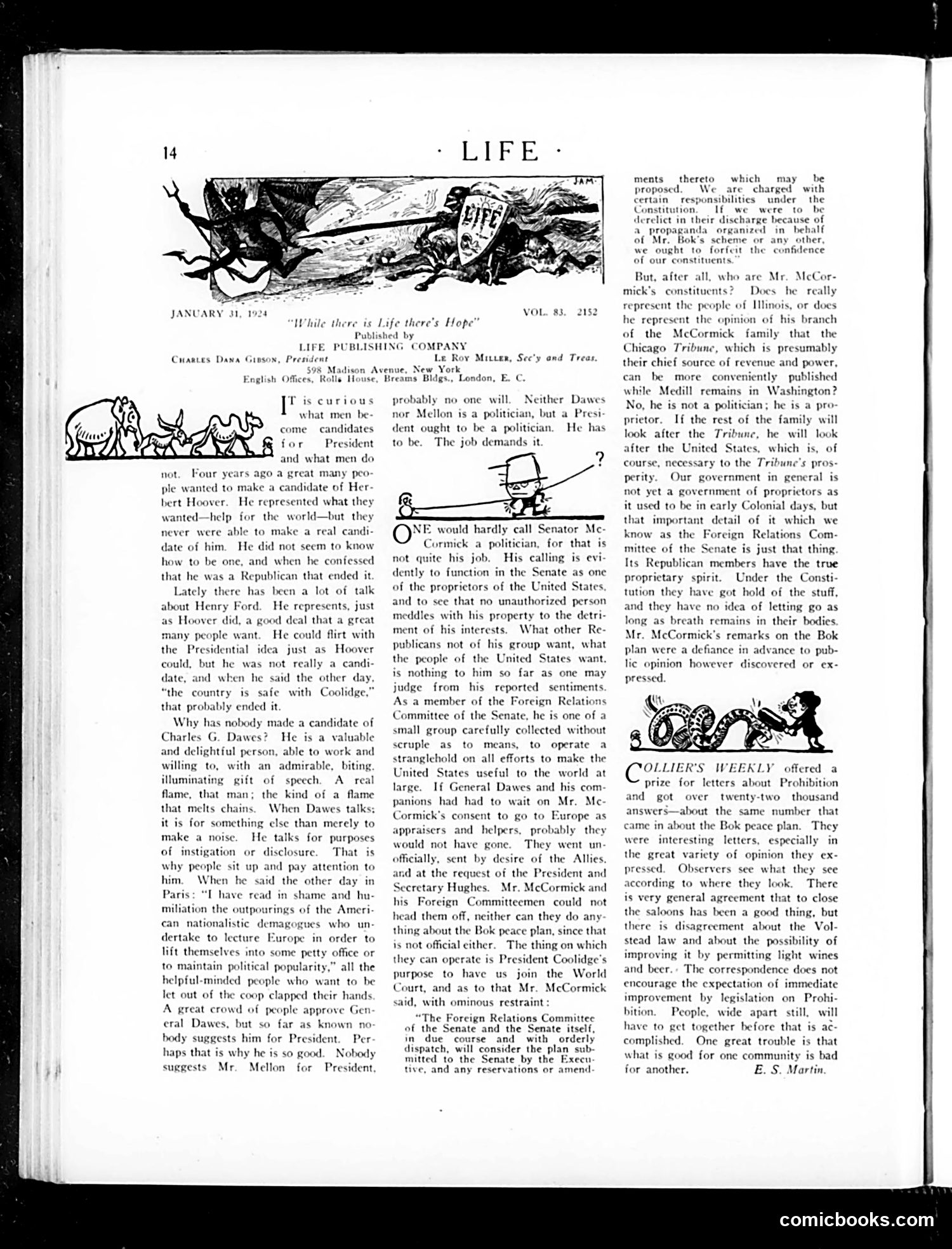
This page contains political commentary on presidential candidates rather than traditional cartoons. The text discusses whether Herbert Hoover or Charles G. Dawes would make a suitable presidential candidate, contrasting them unfavorably with Henry Ford (presented as representing what voters wanted). The article critiques Dawes as unsuitable for the presidency, arguing he's better suited to his current role. It also discusses Senator McCormick's Foreign Relations Committee work, questioning whether McCormick truly represents Illinois constituents or merely his family's (the Chicago Tribune-owning McCormick family's) interests. A small cartoon shows a figure in profile, though specific identity is unclear from the image alone. The page emphasizes political establishment figures versus populist alternatives in 1924 electoral discussions.
📄 Transcribed text from this page (OCR, searchable)
Machine-transcribed from the original scan — historical spelling and the odd misread are preserved.
JANUARY 31 While there is Life there's Ho, Published by LIFE Cuaates Dana Ginson, President 598 Madison Avenue, reams Bldgs., h Offices, Rolls House [' is curious what men be- candidates President and what men do come for not. Four years ago a great many pe ple wanted to make a candidate of Her He represented what they help for the never were able to make a real candi- date of him. He did not seem to know how to be one, and when he confessed bert Hoover wanted world—but they that he was a Republican that ended it Lately there has been a lot of talk about Henry Ford. as Hoover did, a good deal that a great nany people want. He could flirt with the Presidential idea just as Hoover could, but he Mt really a candi- date, and when he said the other day “the country is sa that probably ended it He represents, just was 1 with Coolidge Why has nobody made a candidate of Charles G. Dawes? He is a valuable and delightful person, able to work and willing to, with an admirable, biting illuminating gift of speech. A real flame, that man; the kind of a flame that melts chains. When Dawes talks: it is for something else than merely to make a noise. He of instigation or alks for purposes disclosure. That is why people sit up and pay attention to him. When he said the other day in Paris d hu- miliation the outpourings of the Ameri can nationalistic demagogues who un- dertake to lecture Europe in order to lift themselves into some petty office or to maintain political popularity,” all the helpful-minded people who want to be “T have read in shame a let out of the coop clapped their hands A great crowd of people approve Gen eral Dawes, but so far as known no: body suggests him for President. Per Nobody President haps that is why he is so good suggests Mr. Mellon for PUBLISHING COMPANY Le Roy Mitten, Sec'y ond ew York London, E. C. Treas probably no one will, Neither Dawes nor Mellon is a politician, but a Presi dent ought to be a politician, He has to be. The job demands it 2 NE would hardly call Senator Mc- Cormick a politician, for that is not quite his job. His calling is evi dently to function in the Senate as one of the proprictors of the United § and to see that no unauthorized person meddles with his property to the detri- ment of his interests. What other Re- publicans not of his group want, what the people of the United States want is nothing to him so far as one may ates. judge from his reported sentiments. As a member of the Foreign Relations Committee of the Senate, he is one of a small group carefully collected without scruple as to means, to operate a stranglehold on all efforts to make the United States useful to the world at large. If General Dawes and his com- panions had had to wait on Mr. Mc Cormick’s consent to go to Europe as appraisers and helpers, probably. they would not have gone. They went un officially, sent by desire of the Allies. and at the request of the President and Secretary Hughes. Mr. McCormick and his Foreign Committeemen could not head them off, neither can they do any thing about the Bok peace plan, since that is not official either. The thing on which they can operate is President Coolidge’s purpose to have us join the World Court, and as to that Mr. McCormick said, with ominous restraint: “The Foreign Relations Committee of the Senate and the Senate itself, in due course and with orderly dispatch, will consider the plan sub- mitted to the Senate by the Execu: tive, and any reservations or amend ments thereto which may be proposed. We are charged with certain responsibilities under th Constitution. If we were to b derelict in their discharge because \ propaganda organized in’ behalf of Mr. Bok’s schen r any other, we ought to forfeit the confidence of our constituents. But, after all McCor- mick’s really represent the people of Ilinois, or does who are Mr constituents? Does he he represent the opinion of his branch of the McCormick family that the Chicago Tribune, which is presumably their chief source of revenue and power, can be more conveniently published while Medill remains in Washington? No, he is not a politician; he is a pr prietor. If the rest of the family will look after the Tribune, he will look after the United States, which is, of course, necessary to the Tribune's pros- perity not yet a government of proprietors as it used to be in early Colonial days, but that important detail of it which we know as the Foreign Relations Com- mittee of the Senate is just that thing Its Republican members have the true proprietary spirit. Under the Consti- tution they have got hold of the stuff, and they have no idea of letting go as long as breath remains in their bodies. Mr. McCormick's remarks on the Bok plan were a defiance in advance to pub- lic opinion however discovered or ex- pressed. Our government in general is WEEKLY ffered a Ce LIER'S prize for letters about Prohibition over thousand about the same number that came in about the Bok peace plan. They were interesting letters, especially in and got twenty-two answers: the great variety of opinion they ex- pressed. Observers see what they see according to where they look. There is very general agreement that to close the saloons has been a good thing, but there is disagreement about the Vol- stead law and about the possibility of improving it by permitting light wines and beer.» The correspondence does not encourage the expectation of immediate improvement by legislation on Prohi- bition. People, wide apart still, will have to get ether before that is ac- complished. One great trouble is that what is good for one community is bad for another. E. S. Martin. comicbooks.com