
A complete issue · 36 pages · 1923
Life — December 20, 1923
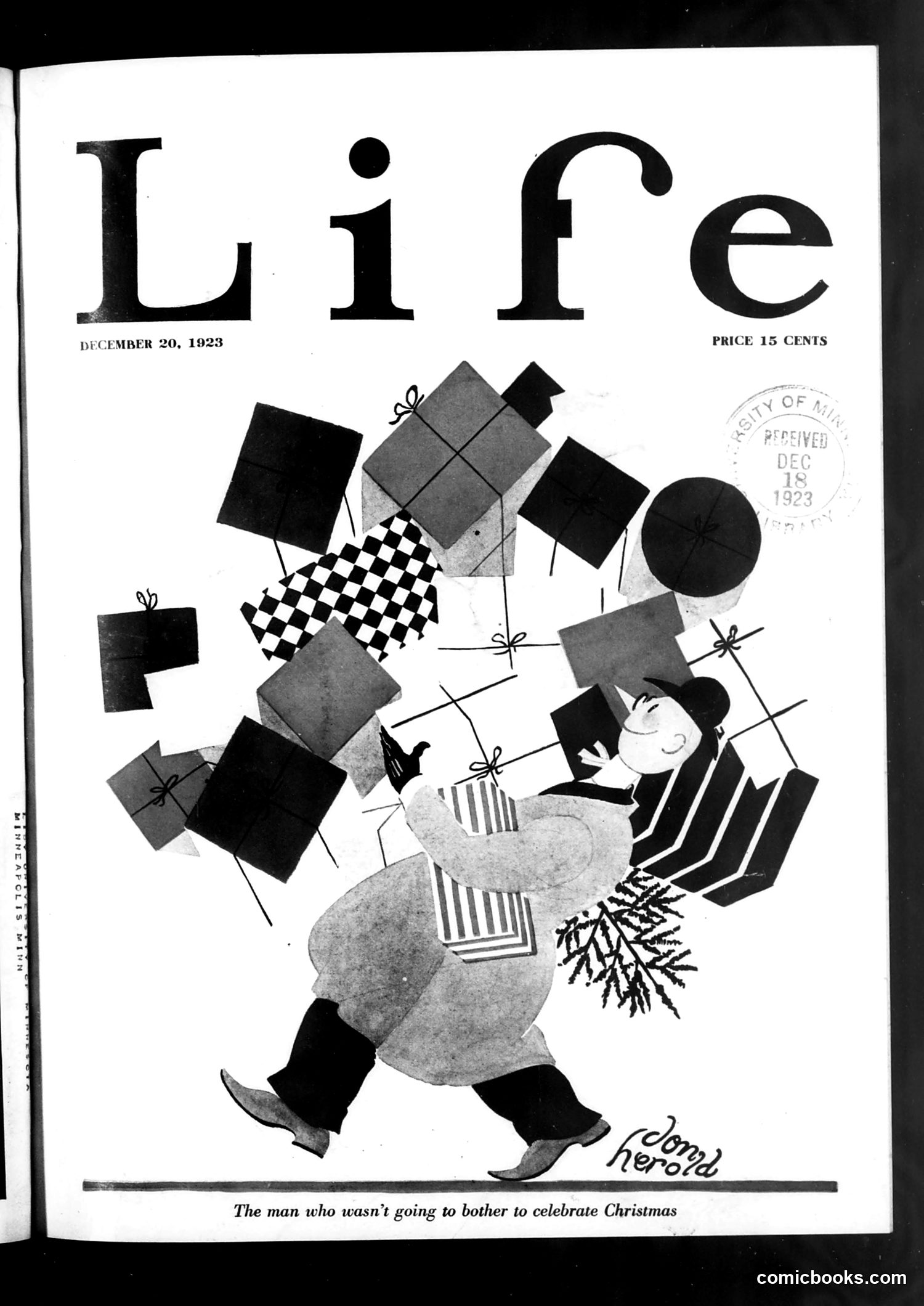
This cover satirizes a man overwhelmed by Christmas preparations and obligations. The central figure, drawn in a cartoonish style by artist John Held Jr., is literally juggling wrapped presents, decorations, and holiday items while appearing stressed and burdened. The caption reads: "The man who wasn't going to bother to celebrate Christmas." This is ironic commentary—despite his apparent intention to avoid holiday fuss, he's been swept into the commercial and social demands of Christmas shopping, wrapping, and decorating. The satire targets the commercialization of Christmas and the inevitable social pressure to participate in holiday consumption, even for reluctant individuals. The chaotic visual composition emphasizes how Christmas obligations spiral beyond anyone's control. This reflects 1920s consumer culture anxieties about holiday materialism.
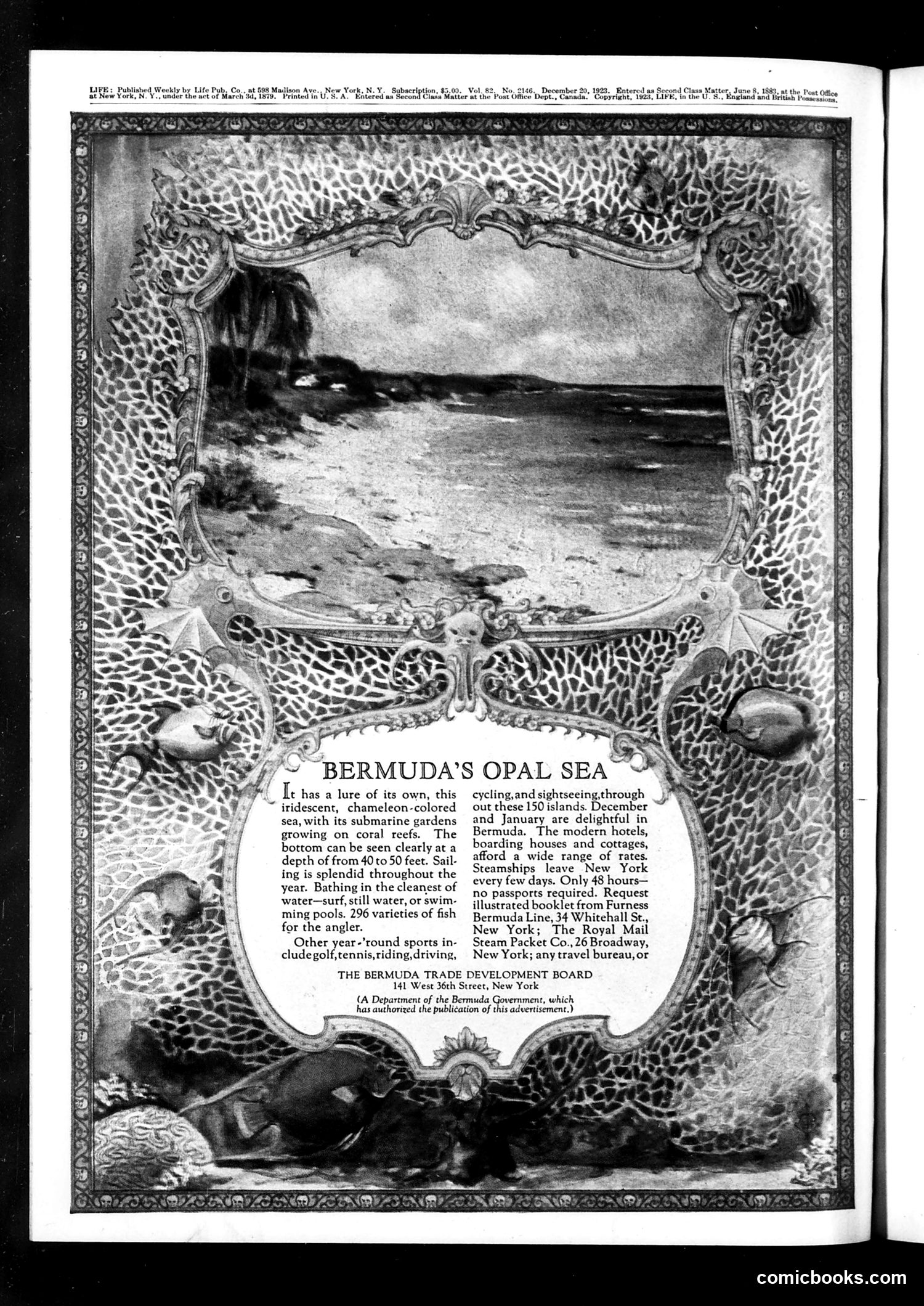
This page is **primarily an advertisement**, not political satire. It promotes Bermuda as a tourist destination, highlighting the "Opal Sea" with its clear waters, coral reefs, and submarine gardens visible at 40-50 feet depth. The ornate decorative border frames a seascape photograph. The text emphasizes year-round attractions: bathing, cycling, sightseeing December-January, plus golf, tennis, riding, and driving. It mentions steamship service from New York and provides contact information for Bermuda's tourism board and travel agents. The elaborate frame and romantic language reflect early 20th-century travel marketing style, presenting Bermuda as an accessible luxury destination for affluent Americans seeking warm-weather recreation.
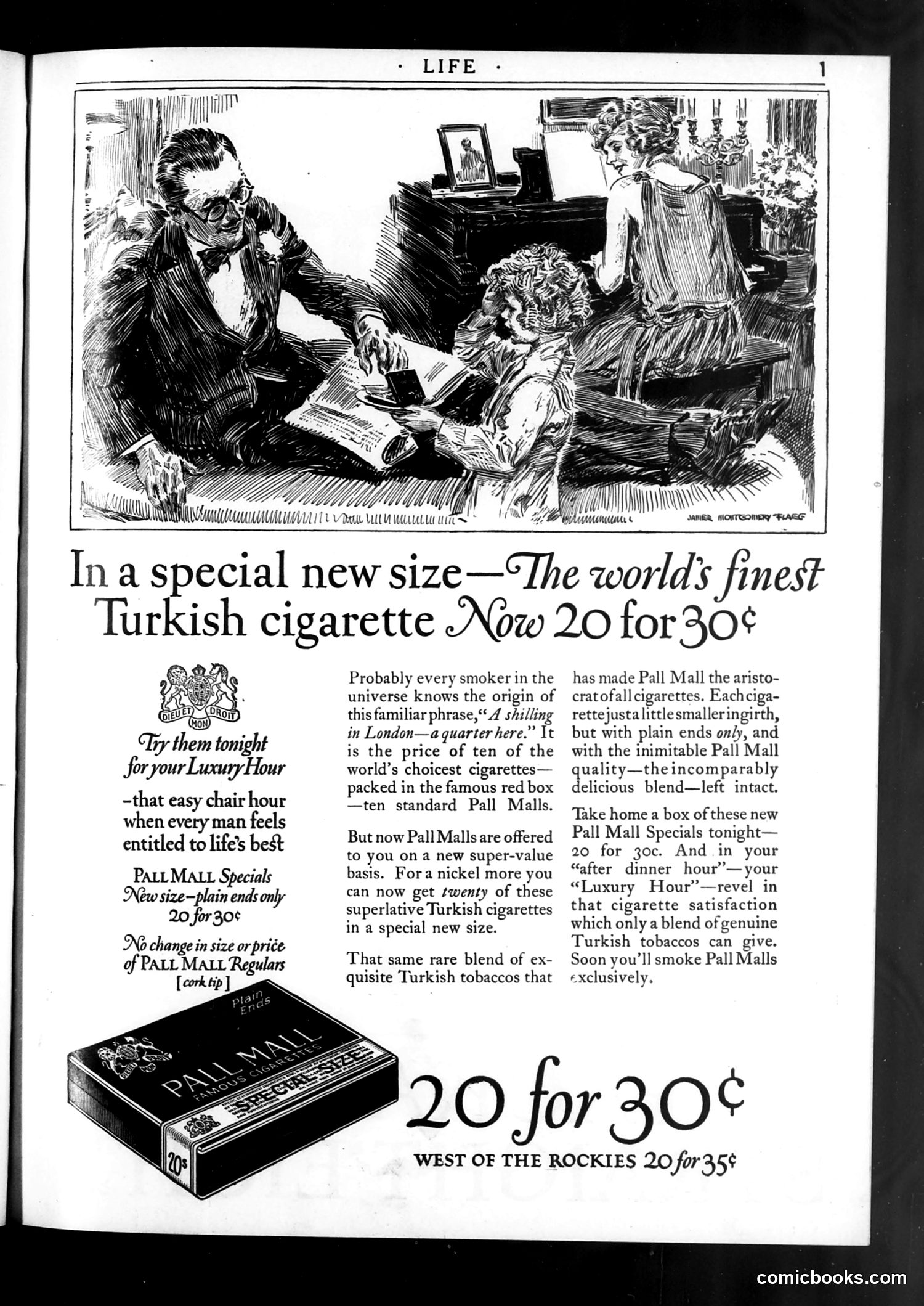
This page is primarily a **cigarette advertisement** for Pall Mall cigarettes, not political satire. The illustration at top shows a domestic scene: an older man with glasses examining what appears to be a document with a young child, while a woman stands nearby. The ad emphasizes Pall Mall's new "special size" offering 20 cigarettes for 30 cents. The marketing copy frames smoking as a "luxury hour" and "life's best," reflecting early 20th-century advertising that normalized cigarettes without health warnings. The phrase "a shilling in London—a quarter here" references international pricing. Modern readers should note: this represents an era when cigarette advertising in mainstream publications was routine and unregulated, targeting general audiences including families, before tobacco's health dangers were widely acknowledged.
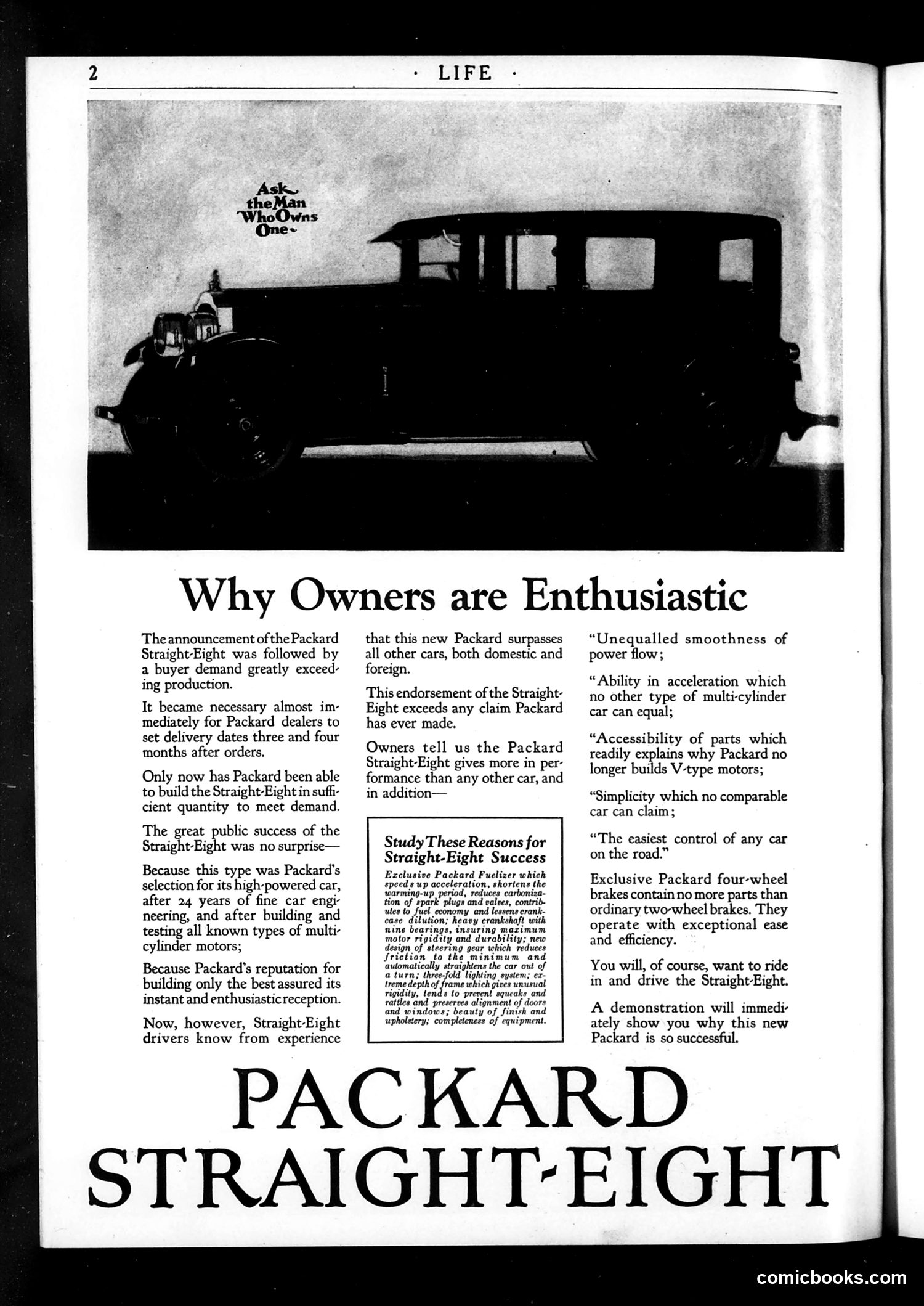
This page is **not a political cartoon but an automobile advertisement** for the Packard Straight-Eight, appearing in Life magazine. The content explains why car owners were enthusiastic about this new model. The advertisement highlights technical features: smooth power flow, acceleration capabilities, accessible parts, simple design, and effective braking systems. The silhouetted image at top shows the car's side profile. The text emphasizes that Packard dealers faced such high demand they couldn't meet delivery schedules—a selling point indicating the vehicle's desirability. There is no satire or political commentary here. This is straightforward commercial advertising leveraging the car's market success and owner testimonials to encourage purchases. The page demonstrates how Life magazine combined editorial content with advertisements.
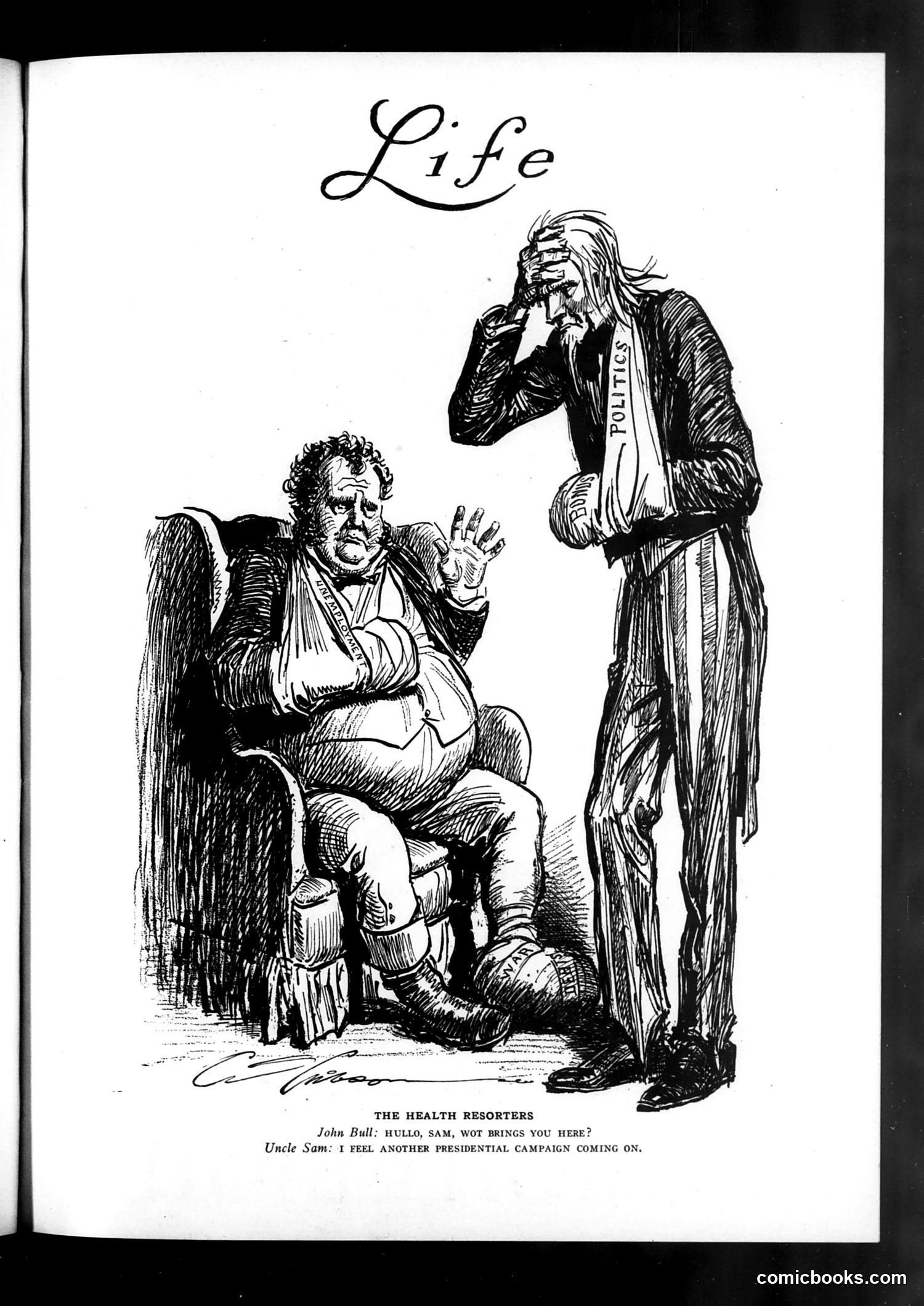
This cartoon depicts two figures labeled as **John Bull** (seated, representing Britain) and **Uncle Sam** (standing, representing the United States). The satire concerns a "presidential campaign" coming to American politics. **Context**: John Bull appears unwell or fatigued, seated with evident discomfort. Uncle Sam, labeled as bringing "Profits," stands over him in a proprietary manner. The joke suggests that American political campaigning practices—portrayed as exploitative or exhausting—are being imported to Britain, where such aggressive electioneering is unfamiliar. The "health resorters" title implies both figures need recovery, satirizing how American-style politics depletes the health and dignity of democratic systems. The cartoon critiques the commercialization and intensity of American electoral politics as a corruptive influence.
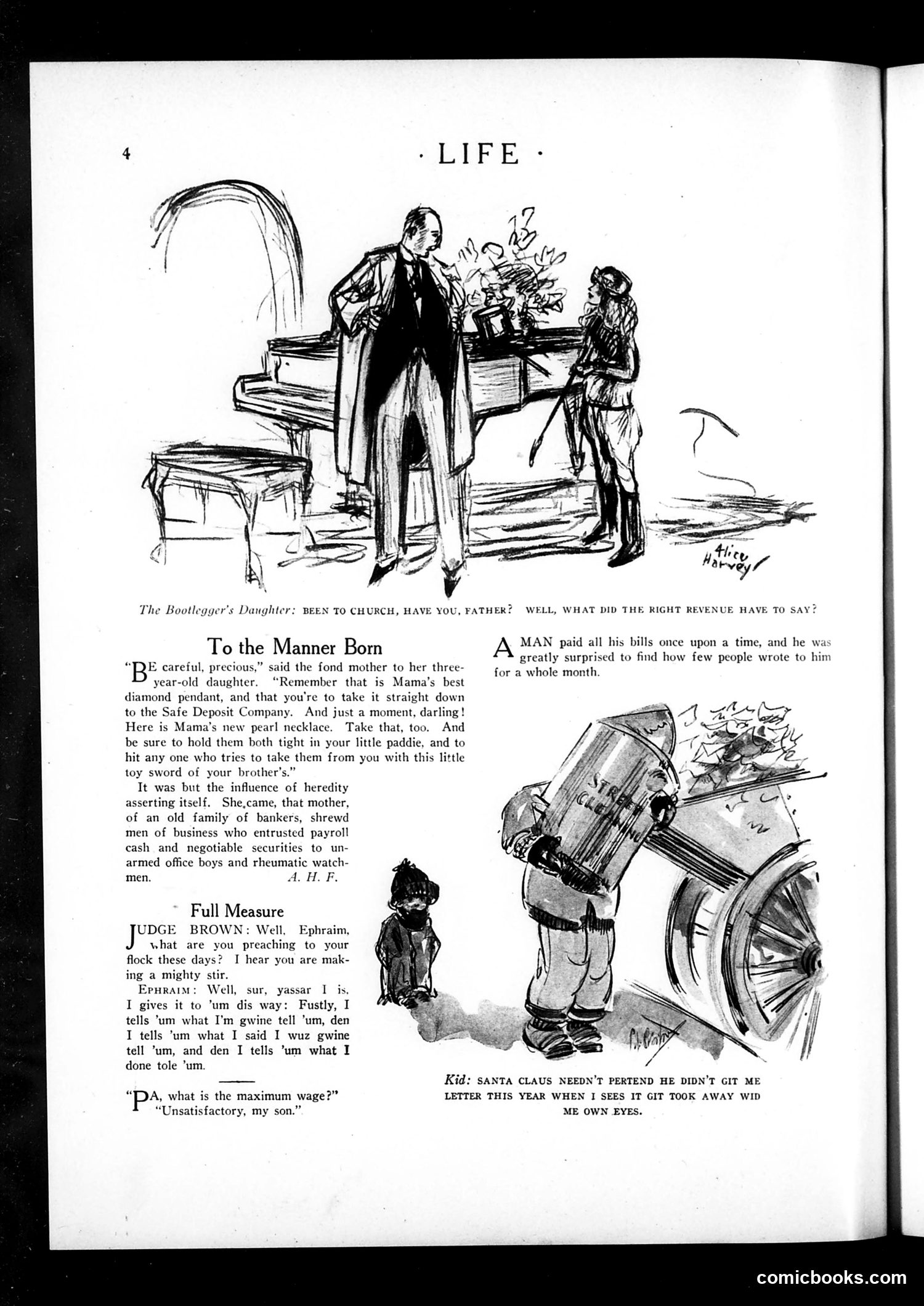
This page contains three separate humorous pieces satirizing middle-class social conventions and family dynamics: **"The Bootlegger's Daughter"** (top): A father instructs his young daughter on protecting valuable jewelry, using language about "taking it straight down to the Safe Deposit Company"—satirizing how bootleggers (illegal alcohol dealers during Prohibition) had become wealthy enough to have families concerned with banking and valuables. **"To the Manner Born"**: Mocks inherited pretension—a banker's mother instructs her daughter to guard possessions with "a little toy sword," suggesting old-money families teach children to value and protect their inherited status and goods. **"Full Measure"** and the remaining pieces joke about workplace dynamics and parental expectations regarding wages and Christmas gifts—universal domestic humor requiring no specific historical context.
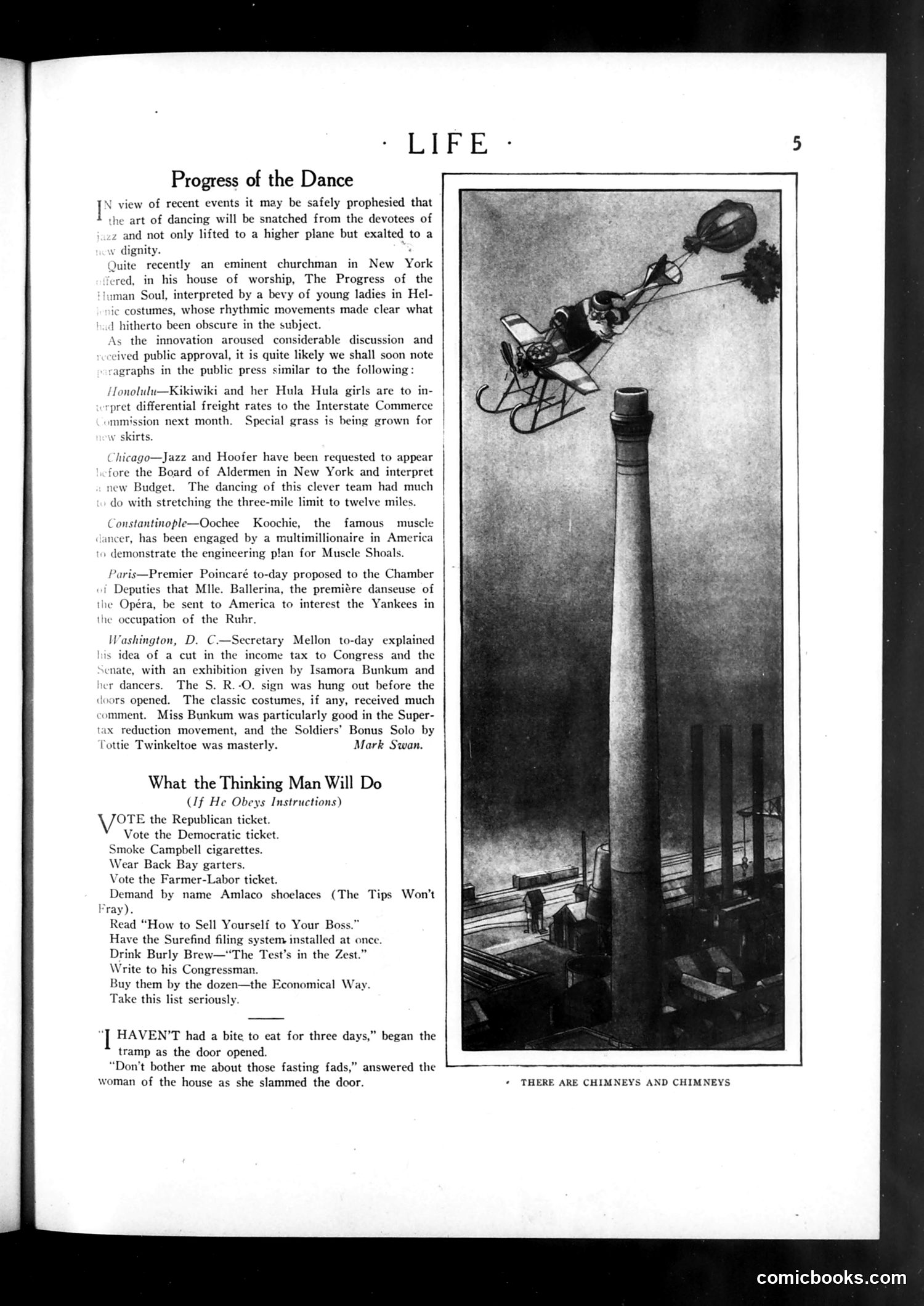
This page satirizes the growing acceptance of jazz and modern dance in 1920s America. The text mocks predictions that jazz will be "lifted to a higher plane," citing absurd hypothetical newspaper headlines from various cities where jazz dancers supposedly appear before formal institutions (the Board of Aldermen, Congress, the Chamber of Deputies). The satire targets both the pretentiousness of those claiming to legitimize popular entertainment and the faddish enthusiasm for jazz among the wealthy and influential. References to "Isamora Bunkum" and dancers exhibiting before Congress mock the idea that crude entertainment could ever achieve cultural respectability. The accompanying photograph of industrial smokestacks provides ironic visual contrast to the frivolous dance discussion, suggesting Jazz Age frivolity amid serious social concerns.
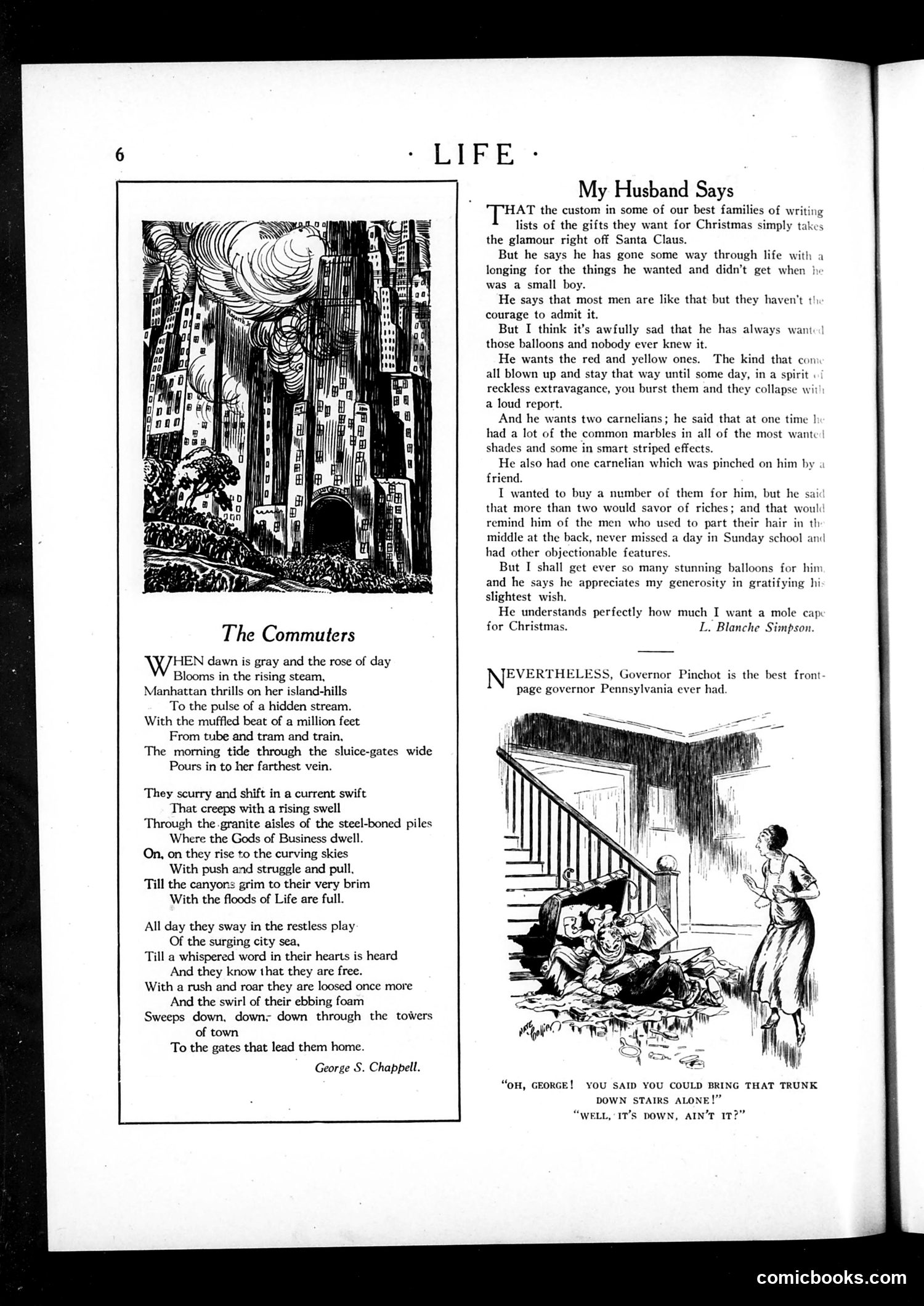
This page contains two distinct pieces: **Left side:** "The Commuters," a poem by George S. Chappell accompanying a woodcut illustration of Manhattan's skyline and commuter traffic. The poem celebrates the daily rush of workers flowing into the city from outlying areas via "tube and tram and train," describing them as vital to urban commerce. **Right side:** "My Husband Says," a humorous domestic essay by L. Blanche Simpson about Christmas gift-giving. Her husband longs for childhood toys (balloons, marbles, carnations) he never received as a boy, though he's too proud to admit such longing. The author humorously plans to indulge his unstated wishes. **Bottom illustration:** A domestic scene showing a woman confronting a man about moving a trunk downstairs alone—likely satirizing gender expectations or marital dynamics around household tasks. The page reflects early 20th-century middle-class concerns: urban commuting, nostalgia, consumer desires, and domestic life.
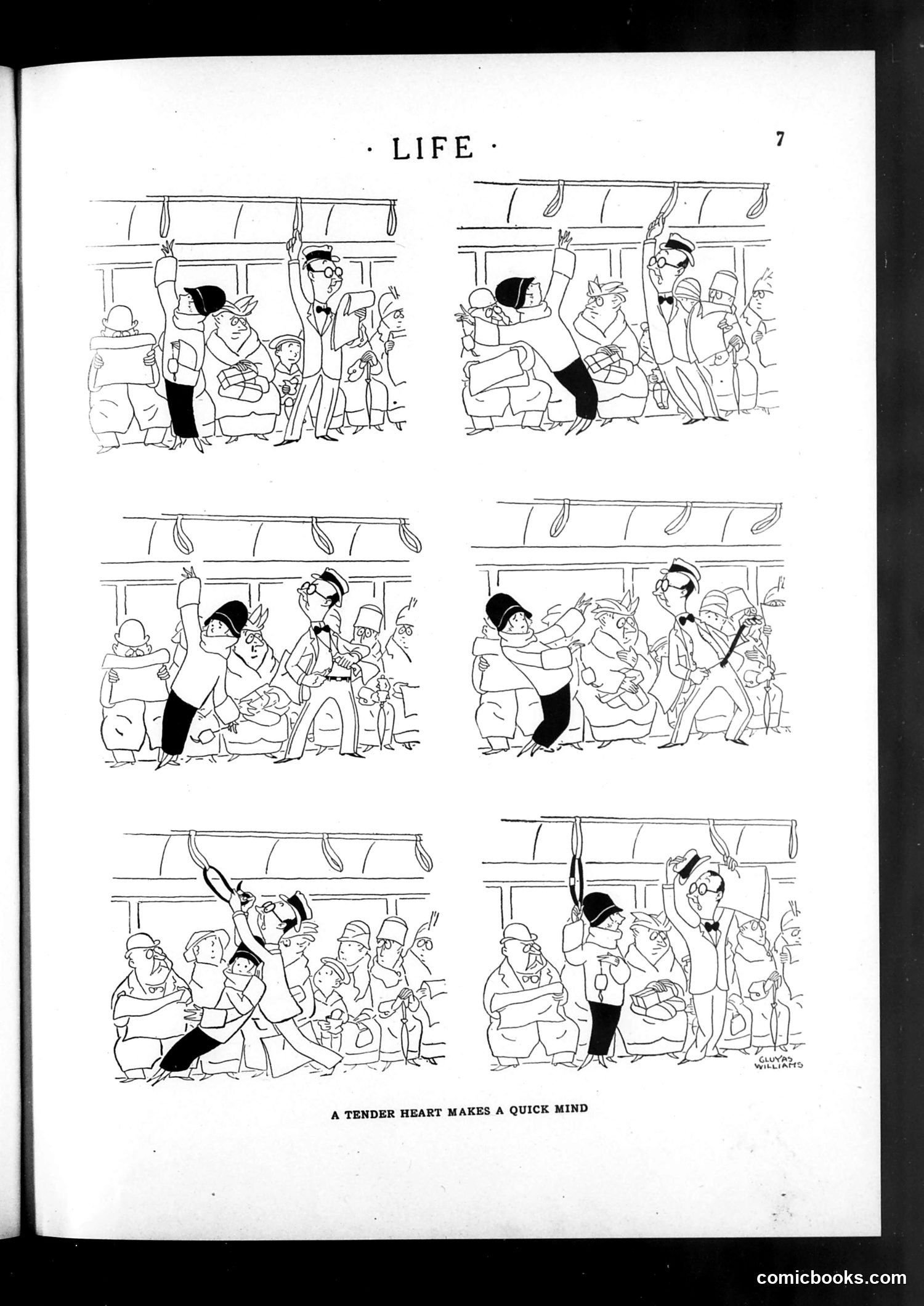
This six-panel comic depicts a crowded public transit scene (likely a streetcar or subway), showing a sequence of increasingly chaotic interactions between passengers. The title appears to reference how emotional sensitivity or compassion relates to quick thinking. The narrative progresses from relatively orderly crowding to escalating physical comedy and disruption. A figure in dark clothing appears central to the action across panels, seemingly either causing or reacting to the mayhem. The satire likely targets either urban overcrowding, public transportation etiquette, or human nature under crowded conditions. Without clearer historical context or visible dates, the specific social commentary remains somewhat unclear, though the humor derives from depicting civilized people losing composure in confined spaces.
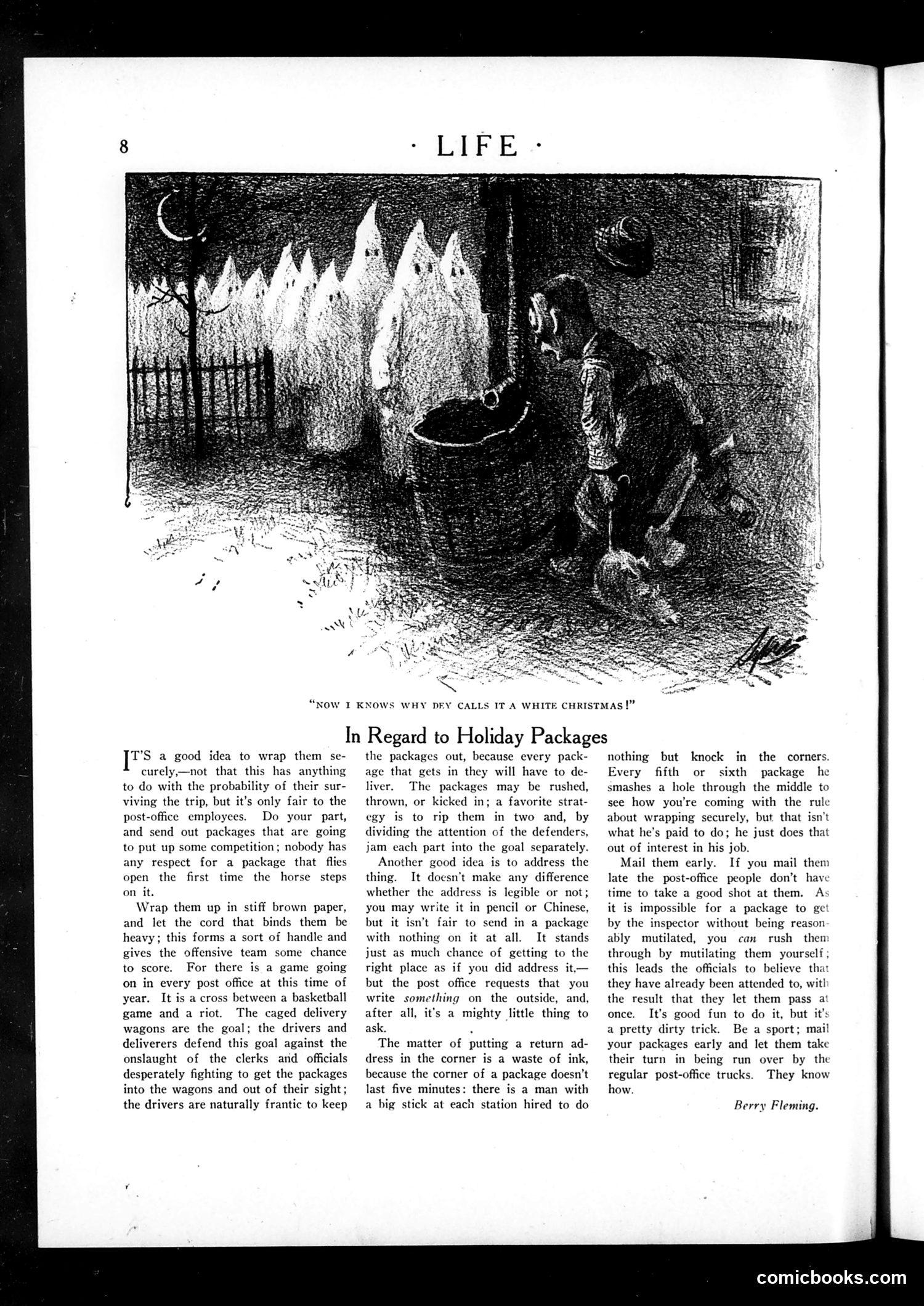
This page contains a cartoon and advice article about holiday mail packages. The cartoon depicts ghostly figures delivering packages at night, with the caption "NOW I KNOWS WHY DEY CALLS IT A WHITE CHRISTMAS!" The joke plays on racial dialect and the visual pun of white-sheeted figures—likely referencing the KKK, whose members wore such robes. The "white Christmas" reference creates dark humor by conflating holiday delivery with the intimidating presence of these figures. The accompanying article by Berry Fleming offers practical advice for wrapping and mailing holiday packages, suggesting use of sturdy brown paper, proper addressing, and early mailing to avoid damage. It addresses the competitive chaos of holiday mail delivery season, recommending tips to ensure packages arrive safely.
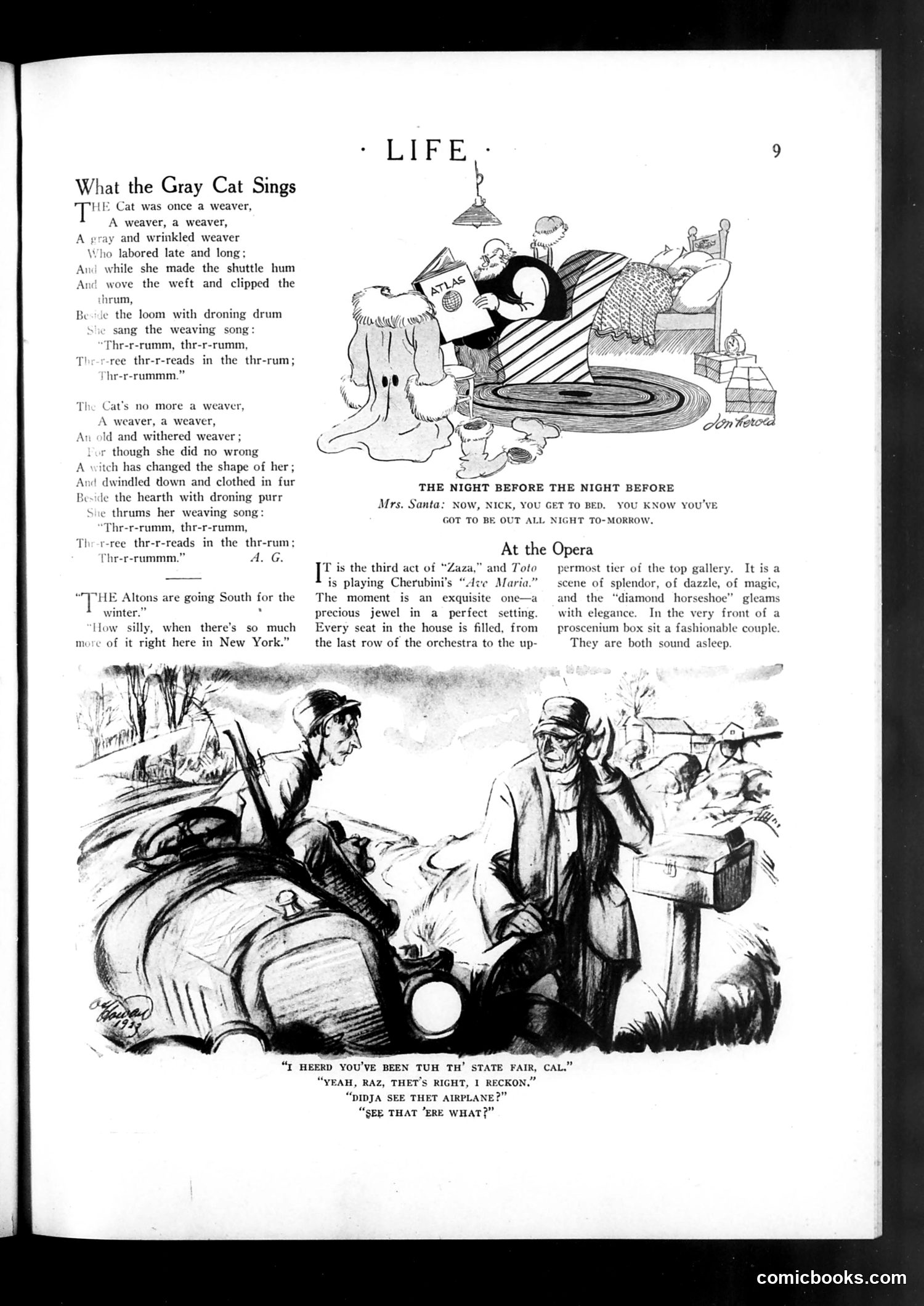
This page contains three distinct pieces of humor content: 1. **"What the Gray Cat Sings"** — A poem about a former weaver who became a cat, with repetitive "thr-r-rumm" refrains mimicking a loom's sound. The accompanying illustration shows a cat amid weaving equipment. 2. **"The Night Before the Night Before"** — A cartoon captioned about Mrs. Santa instructing Nick (Santa) to get to bed, as they have a busy night ahead. It's holiday-themed domestic humor. 3. **"At the Opera"** and **"The Altons are going South"** — A sketch depicting two men with a barrel near a boat, with dialogue about attending a state fair and spotting an airplane. The humor appears to reference rural characters encountering modern technology, typical of early 20th-century satire contrasting country and urban sophistication.
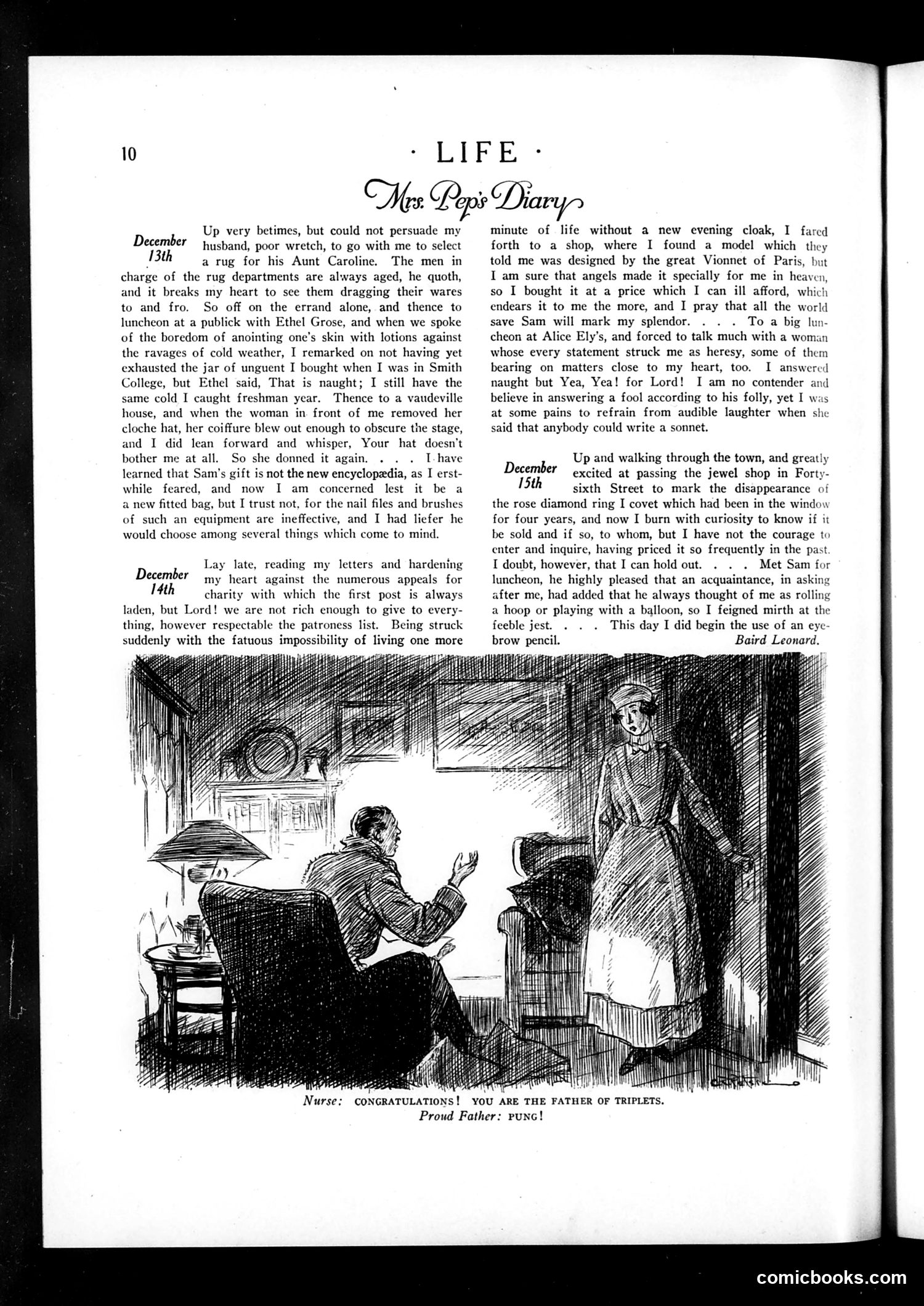
This page from *Mrs. Peps Diary* presents a satirical illustration of a domestic scene. The cartoon shows a man seated while a nurse delivers news of triplets, to which he responds "PUNG!" (apparently an exclamation of dismay or resignation). The humor targets middle-class anxieties about large families and financial burden. The man's reaction—seemingly shocked or displeased at fathering triplets—satirizes contemporary attitudes toward childbearing and domestic responsibility. The diary entries above reference shopping for jewelry and holiday social obligations, suggesting the author's broader satirical commentary on women's consumer habits and social performance. The cartoon uses the father's comical distress to mock both masculine pride in paternity and the economic pressures of supporting multiple children, reflecting early 20th-century social concerns about family size and class status.
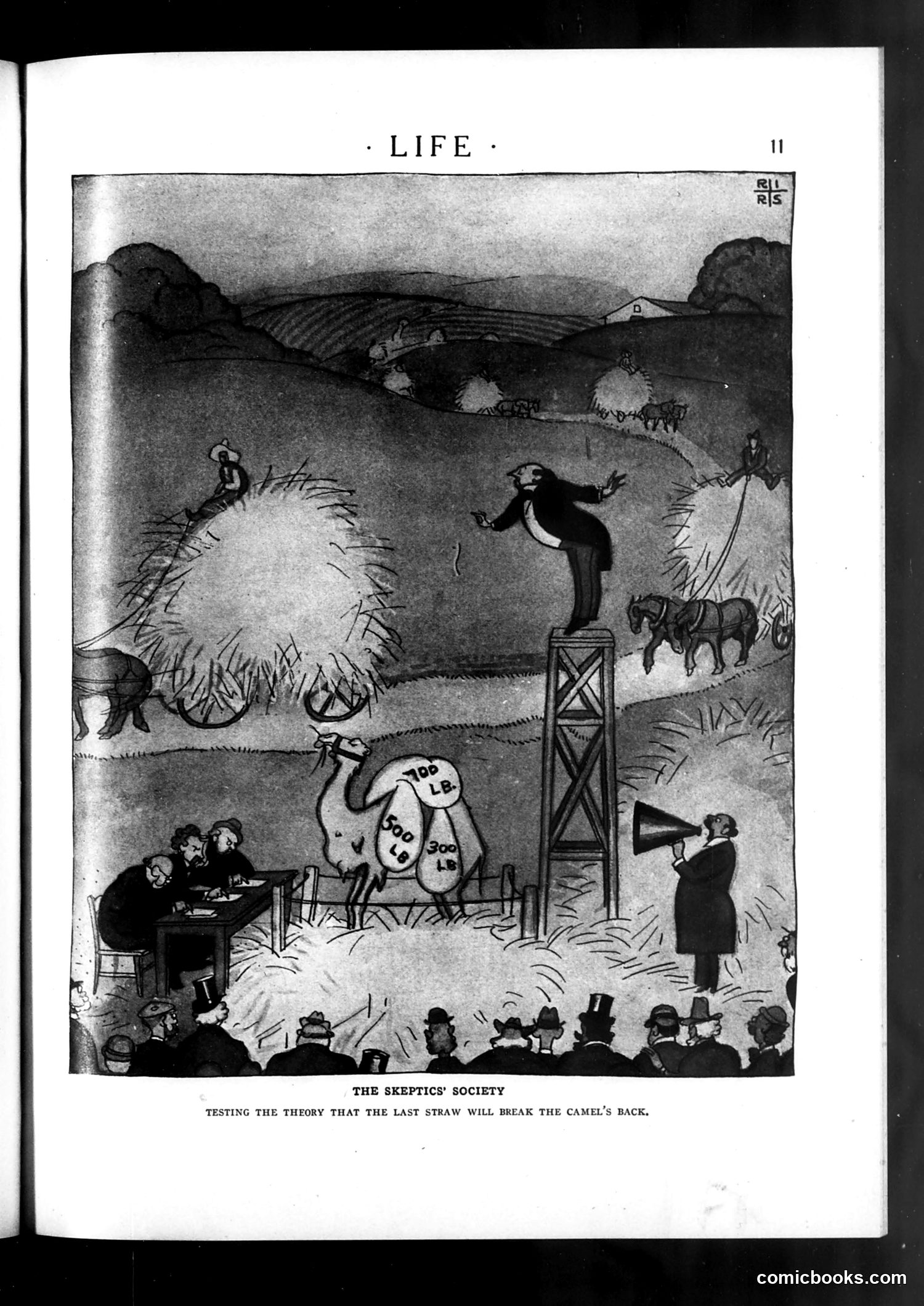
This cartoon satirizes skepticism about the proverb "the last straw will break the camel's back." The illustration shows a public demonstration or scientific test where observers (wearing top hats, suggesting gentlemen or scientists) watch as increasingly heavy weights are loaded onto a camel labeled with measurements (100 LB, 500 LB, 300 LB, etc.). A man operates weighing equipment while another directs proceedings with a megaphone. The satire targets those who doubt the validity of this common saying—the "skeptics" are literally testing whether the proverb holds true through empirical means. The cartoon mocks both excessive skepticism of folk wisdom and the era's faith in scientific demonstration to prove (or disprove) even obvious truths. The elaborate setup to test something commonly accepted as true is the joke's centerpiece.
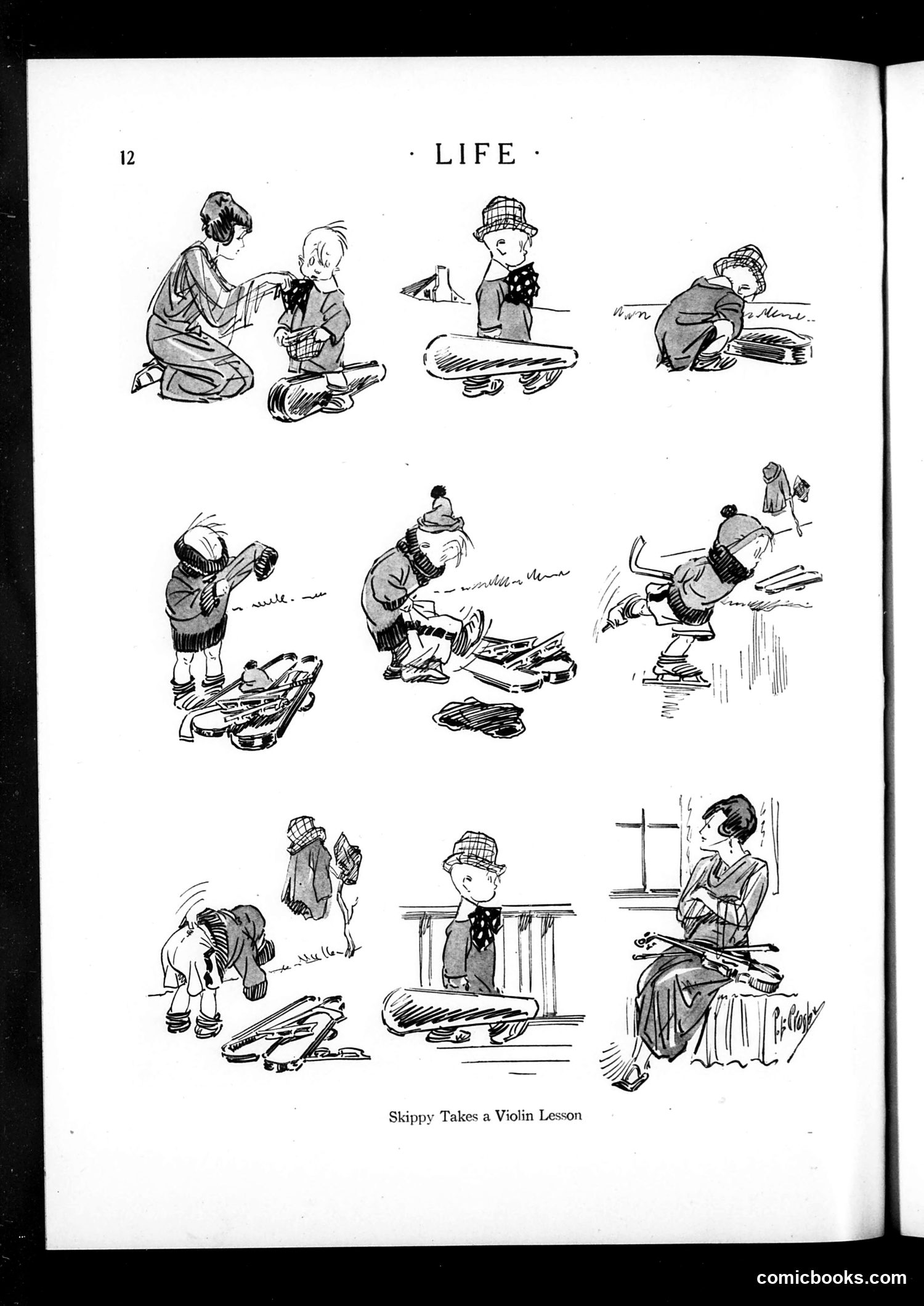
This is a humorous comic strip sequence titled "Skippy Takes a Violin Lesson," featuring a young boy named Skippy and his experiences with musical instruction. The series of nine panels depicts the child's reluctant progression through a violin lesson—showing typical childhood resistance to practicing an instrument he evidently dislikes. The humor comes from relatable domestic scenes: Skippy's evasion tactics, his distraction with toys and outdoor activities, and what appears to be his teacher's (or parent's) exasperation. The comic satirizes the common struggle between children's natural inclinations toward play and adults' insistence on "improving" activities like music lessons—a middle-class concern of early 20th-century America.
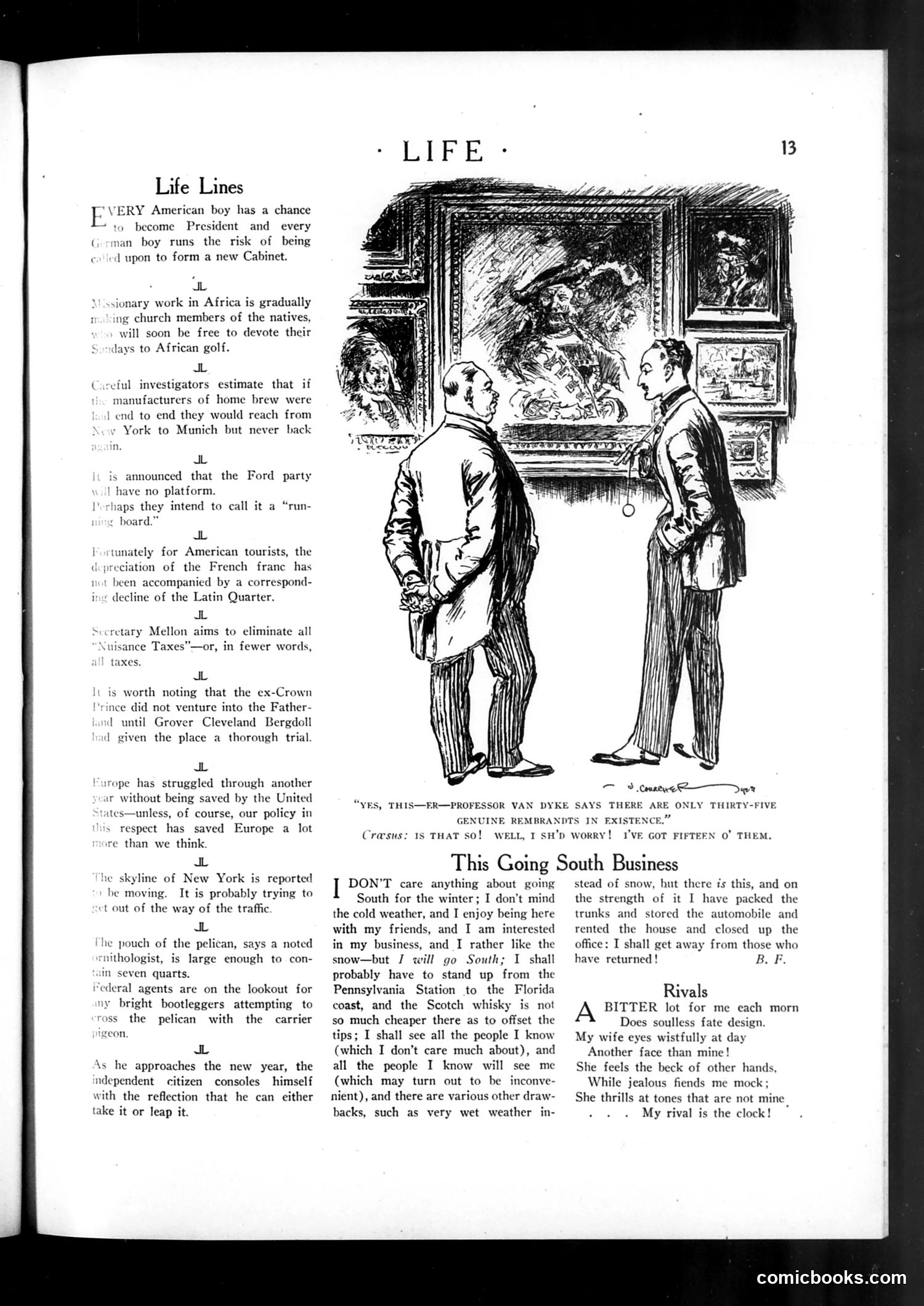
The main cartoon depicts two men viewing what appears to be a large painting or artwork in a gallery. The caption attributes a quote to "Professor Van Dyke" claiming there are "only thirty-five genuine Rembrandts in existence," with the humorous response that "That's so! Well, I sh'd worry! We got fifteen of them." This satirizes American wealthy collectors' acquisitions of European art, particularly Old Masters. The joke suggests that American millionaires were buying so many paintings claimed to be genuine Rembrandts that their collection alone exceeded the supposed total number in existence—implying either the paintings were forgeries or "Professor Van Dyke's" expertise was questionable. It mocks both American nouveau-riche art collecting and European art authentication during the Gilded Age.
This page contains editorial commentary on President Coolidge's post-war foreign policy message. The cartoons are satirical illustrations accompanying the text rather than standalone political commentary. The main content discusses Coolidge's position on European debts, the League of Nations, and establishing an international court. The author critiques Coolidge for being cautious about foreign entanglement while also suggesting he should be bolder. The bottom section mentions Henry Ford and Andrew Mellon as potential presidential candidates, discussing their wealth and public service credentials. The cartoons appear to be generic decorative illustrations (a zebra, a cherub) rather than caricatures of specific political figures. The satire focuses on policy debate rather than personal mockery of politicians.
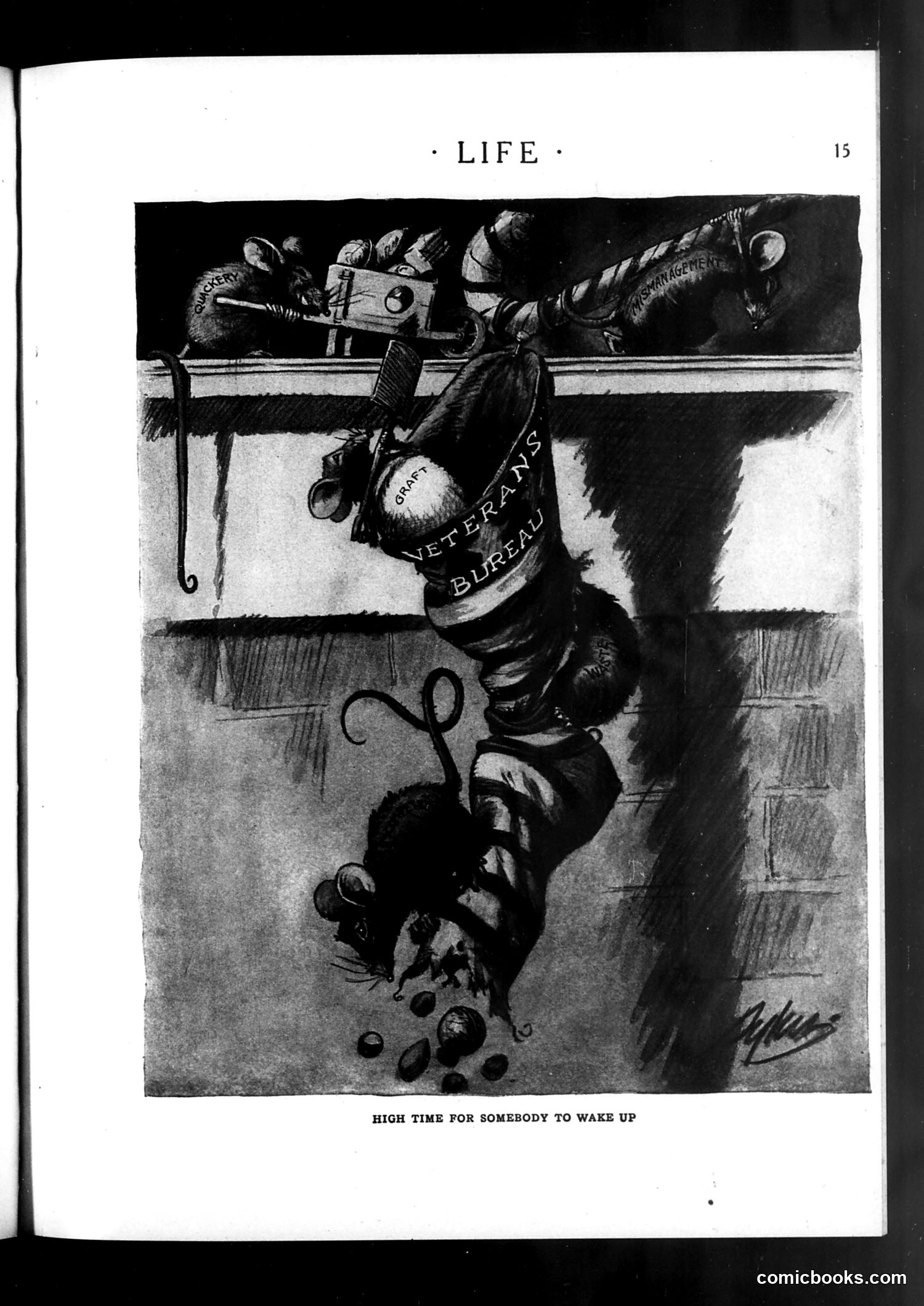
This cartoon depicts a rat labeled "VETERANS BUREAU" falling from a high shelf or ledge, with mice scattering below. The caption reads "HIGH TIME FOR SOMEBODY TO WAKE UP." The image satirizes corruption or mismanagement within the Veterans Bureau—a federal agency. The rat metaphor suggests the bureau has become infested with corruption or is itself parasitic. Mice fleeing below likely represent victims or concerned citizens. This appears to reference the Teapot Dome scandal era (early 1920s) when multiple government agencies, including the Veterans Bureau, faced serious corruption investigations. The cartoon calls for public awareness and action against institutional wrongdoing, using the dramatic falling rat to suggest accountability is overdue.
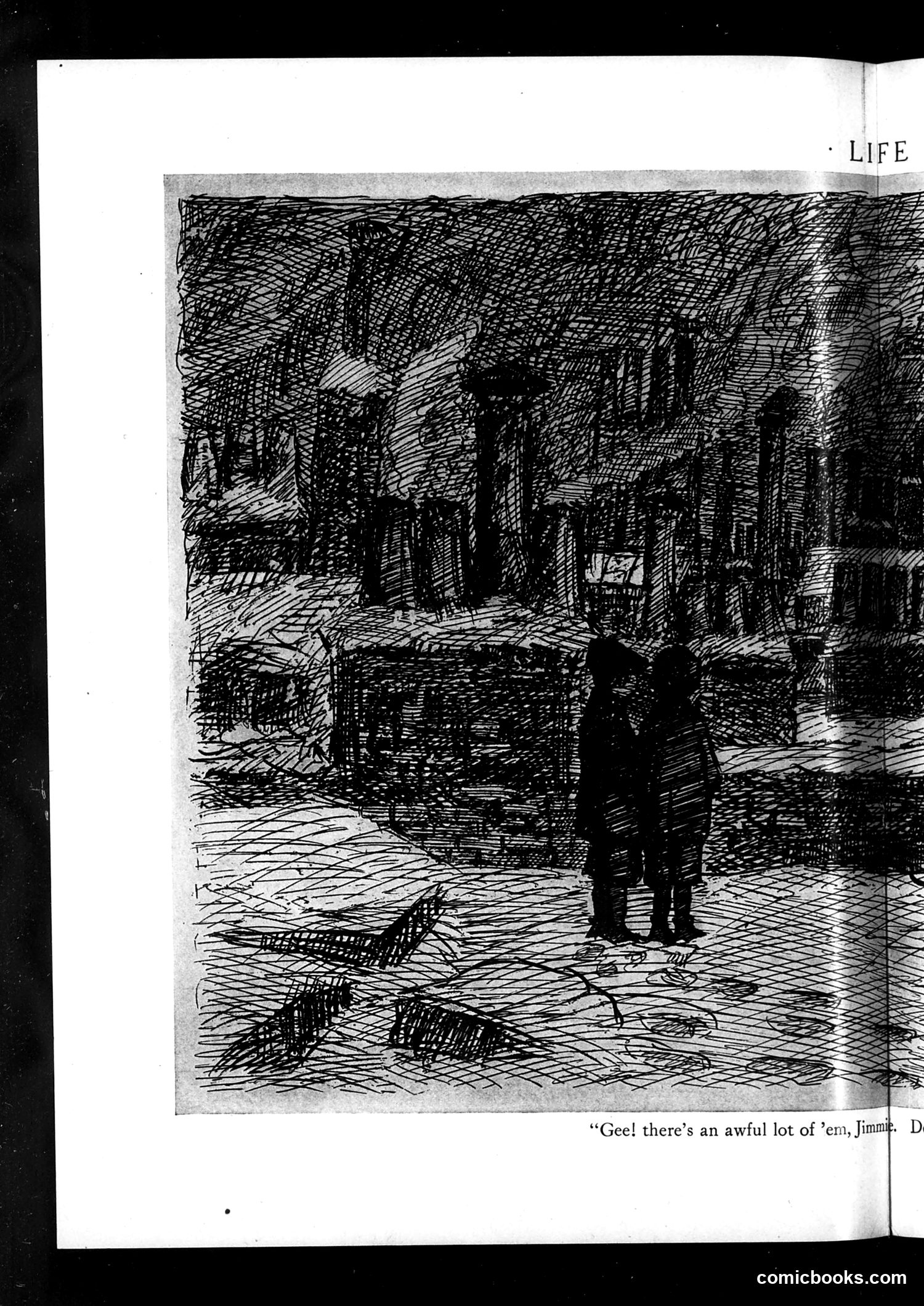
This appears to be an illustration from *Life* magazine showing two figures standing in what looks like an urban or industrial setting with buildings and structures rendered in heavy crosshatching. The figures are silhouetted against detailed architectural backgrounds. The partial caption reads: "Gee! there's an awful lot of 'em, Jimm—D[incomplete]" However, without the complete caption and without being able to identify the specific figures or clearly discern their characteristics from this reproduction quality, I cannot reliably determine what political or social commentary this cartoon intends. The OCR text is largely garbled, providing no helpful context. To accurately explain the satire or joke to a modern reader, I would need either clearer image resolution or the complete, legible caption text.
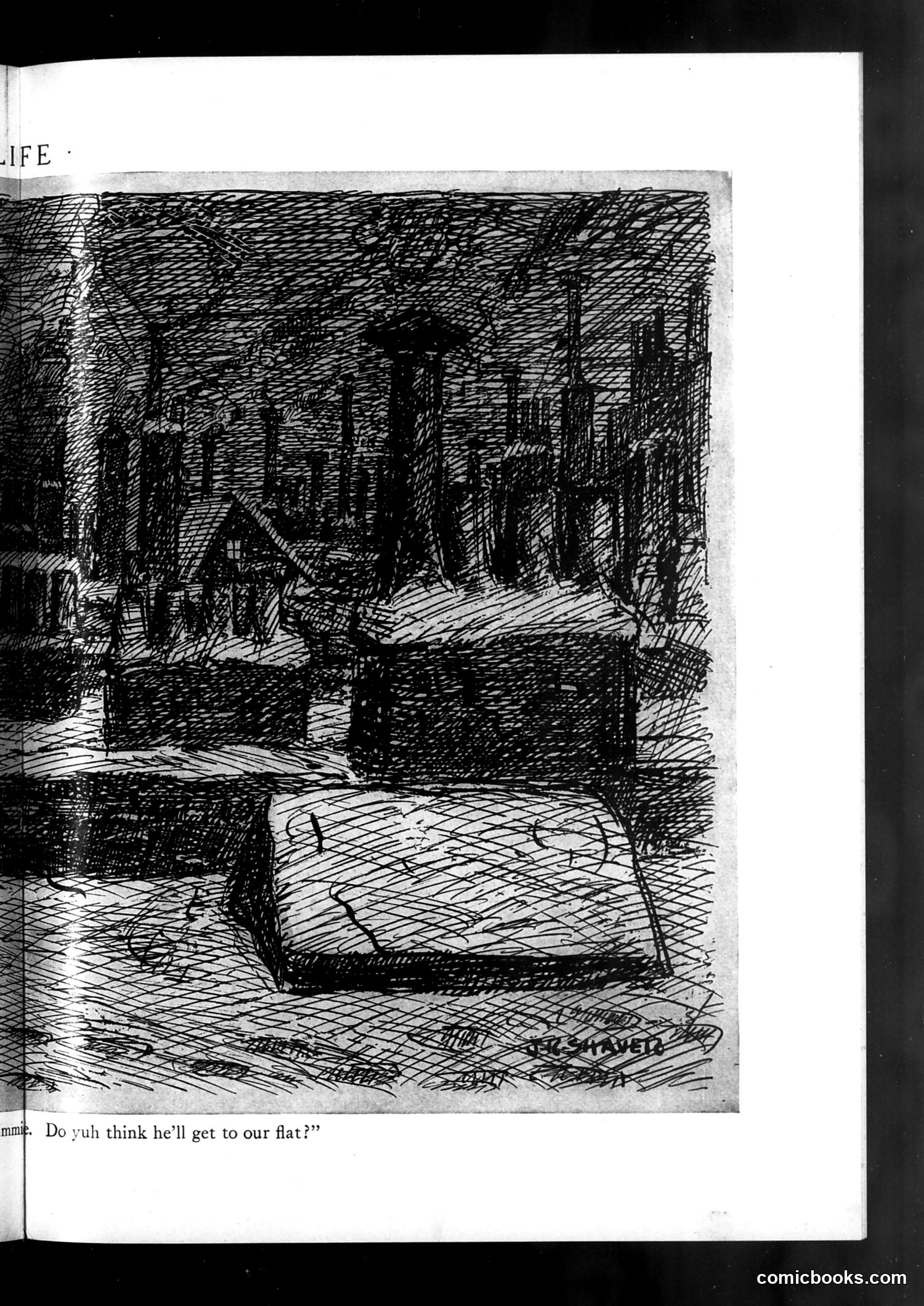
This appears to be a single cartoon from *Life* magazine showing an interior domestic scene—a tenement or working-class apartment with multiple rooms visible through doorways. The sketch style uses heavy cross-hatching to convey a cramped, dark living space. The caption reads: "Do yuh think he'll get to our flat?" The joke appears to concern someone (likely a visitor or intruder) navigating through a maze-like or confusing apartment layout. The satire targets the notorious overcrowding and poor conditions of urban working-class housing, particularly tenement buildings common in early-20th-century American cities. The humor derives from the absurd complexity of the space—suggesting the flat is so labyrinthine that a visitor might never actually reach it, satirizing how cramped and disorienting such living quarters were.
This page contains theater reviews from Life magazine's drama section. The critic reviews three plays: "Laugh, Clown, Laugh!" (starring Lionel Barrymore), "In the Next Room," and "The Lady." The satire targets theatrical conventions and David Belasco's pretentious adapting practices. The critic mocks Belasco—a famous producer known for elaborate stagecraft—for requiring two men to adapt an Italian play, sarcastically suggesting his "brain-power" equals three ordinary men. The review ridicules melodramatic plot devices (clowns with broken hearts, suicide via flaming hoops) while praising Barrymore's genuine acting ability. The second section humorously observes audience behavior at melodramas: spectators eagerly warn each other about "suspicious" window activity, essentially solving the plot for themselves through collective whispering. The tone is witty and irreverent toward overwrought theatrical conventions and star power, typical of Life's satirical approach to entertainment.
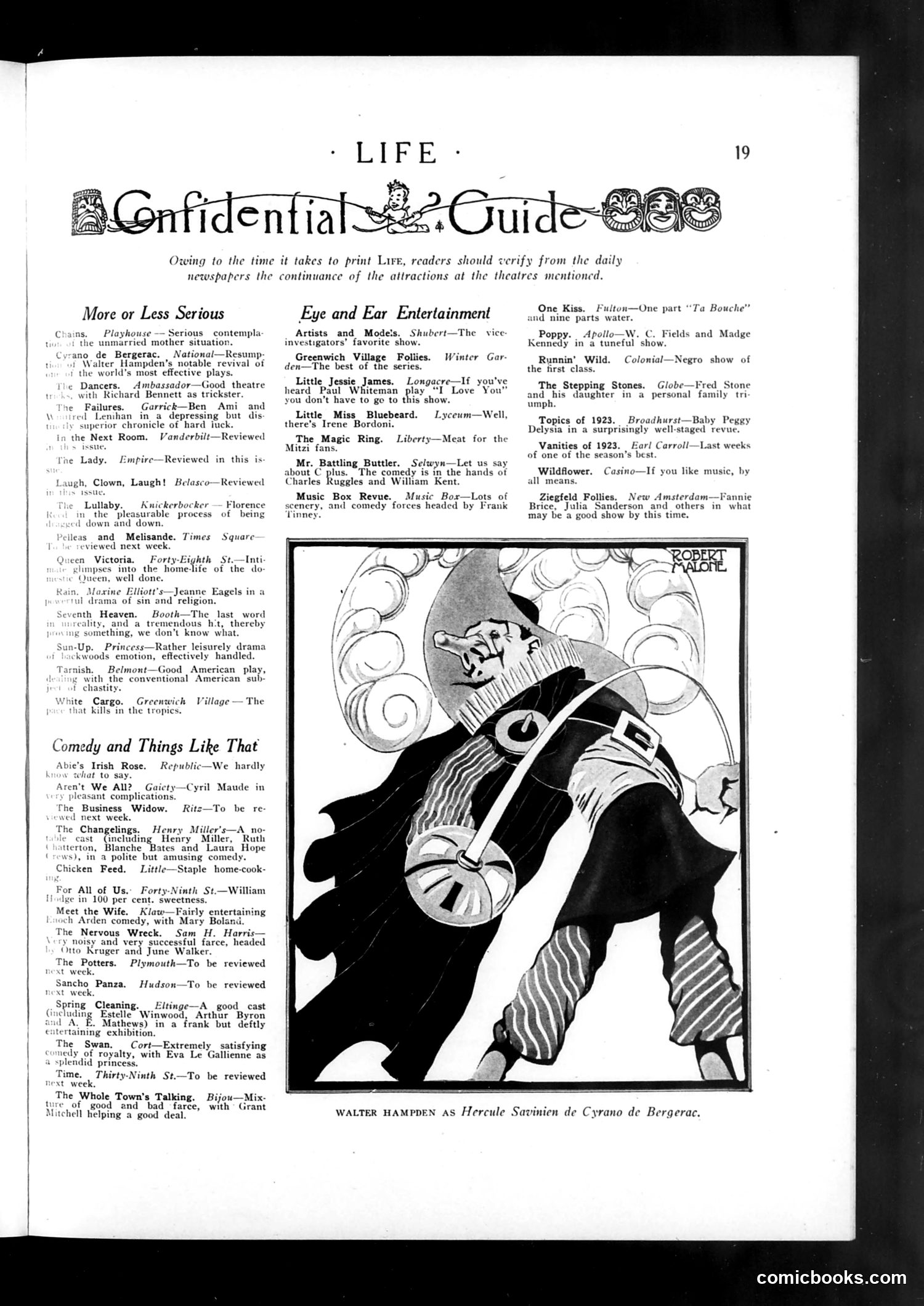
This page is a **theater guide and review section**, not primarily a political cartoon. The main image shows **Walter Hampden as Hercule Savinien de Cyrano de Bergerac**—an illustration accompanying a review of this classic play's revival at the National Theatre. The page lists current Broadway productions with brief critical commentary. Notable context for modern readers: - **"Abie's Irish Rose"** (Republic): A famous interethnic romance comedy that was hugely popular in the 1920s - **Paul Whiteman** reference: "King of Jazz," a major cultural figure of the era - **W.C. Fields and Madge Kennedy** in "Poppy": Silent-film and vaudeville stars - **Baby Peggy Delysia**: Child star performer - **"Runnin' Wild"**: Explicitly labeled a "Negro show," reflecting segregated entertainment of this period The reviews are punchy and often dismissive (one show is "one part 'Ta Bouche' and nine parts water"). This reflects Life's satirical voice—irreverent commentary on popular entertainment for educated, theater-going readers.
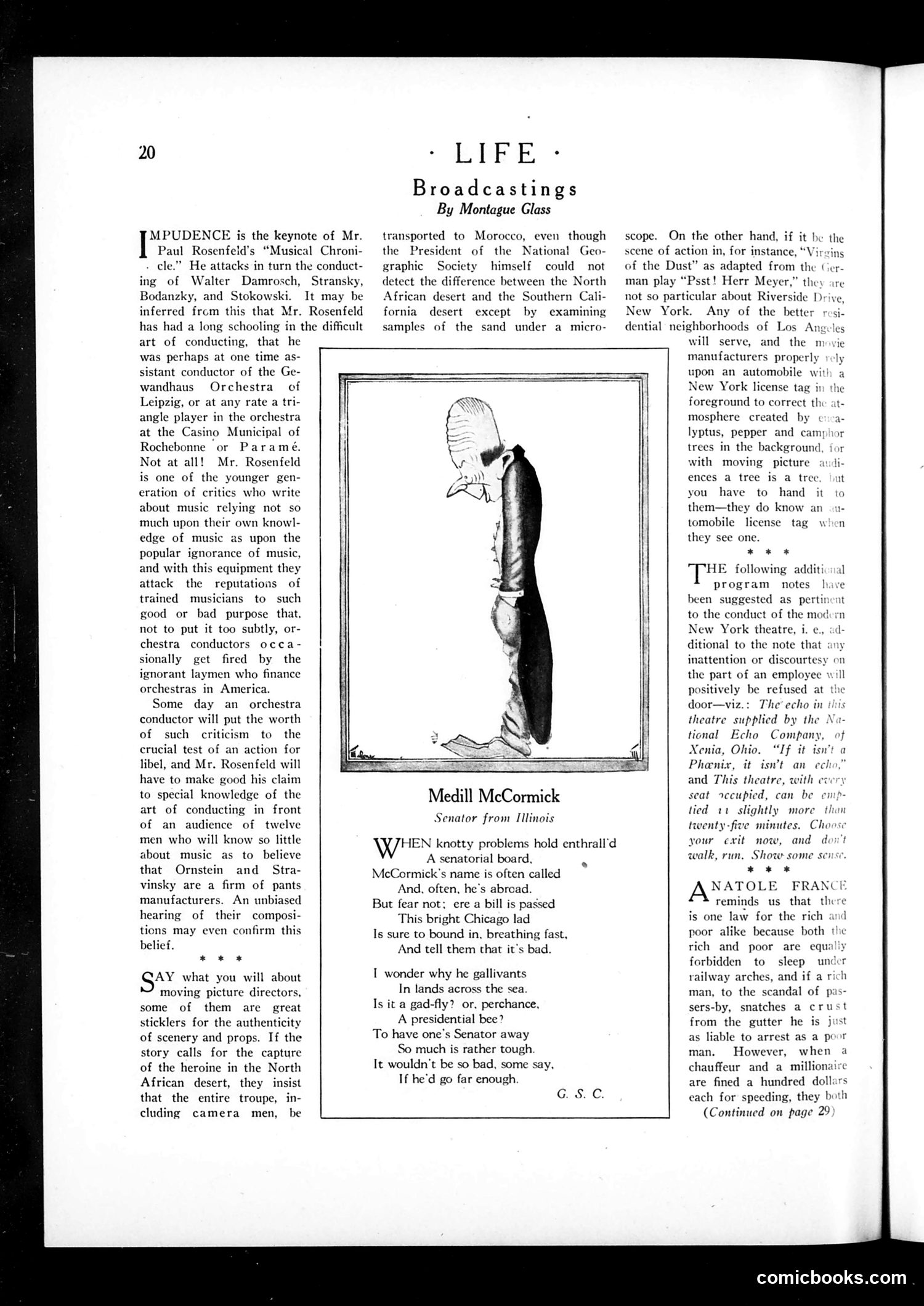
This page contains satirical commentary on American cultural life circa the 1920s. **The Cartoon:** A caricature of **Medill McCormick**, an actual U.S. Senator from Illinois, depicted in an exaggerated pose. The accompanying poem mocks him for frequently traveling abroad while serving in the Senate, suggesting he's an absentee legislator more interested in foreign adventures than legislative duties. The satire questions whether his travels serve a "presidential bee" (ambition for higher office) or are mere gadfly restlessness. **The Articles:** The page also critiques music critics (particularly Paul Rosenfeld) for attacking renowned conductors without proper training, and pokes fun at movie directors' obsessive authenticity regarding desert scenery—yet their willingness to use California locations if they include a New York automobile license plate for "authenticity." The overall tone reflects Life magazine's satirical approach to exposing hypocrisy and incompetence among public figures and cultural elites.
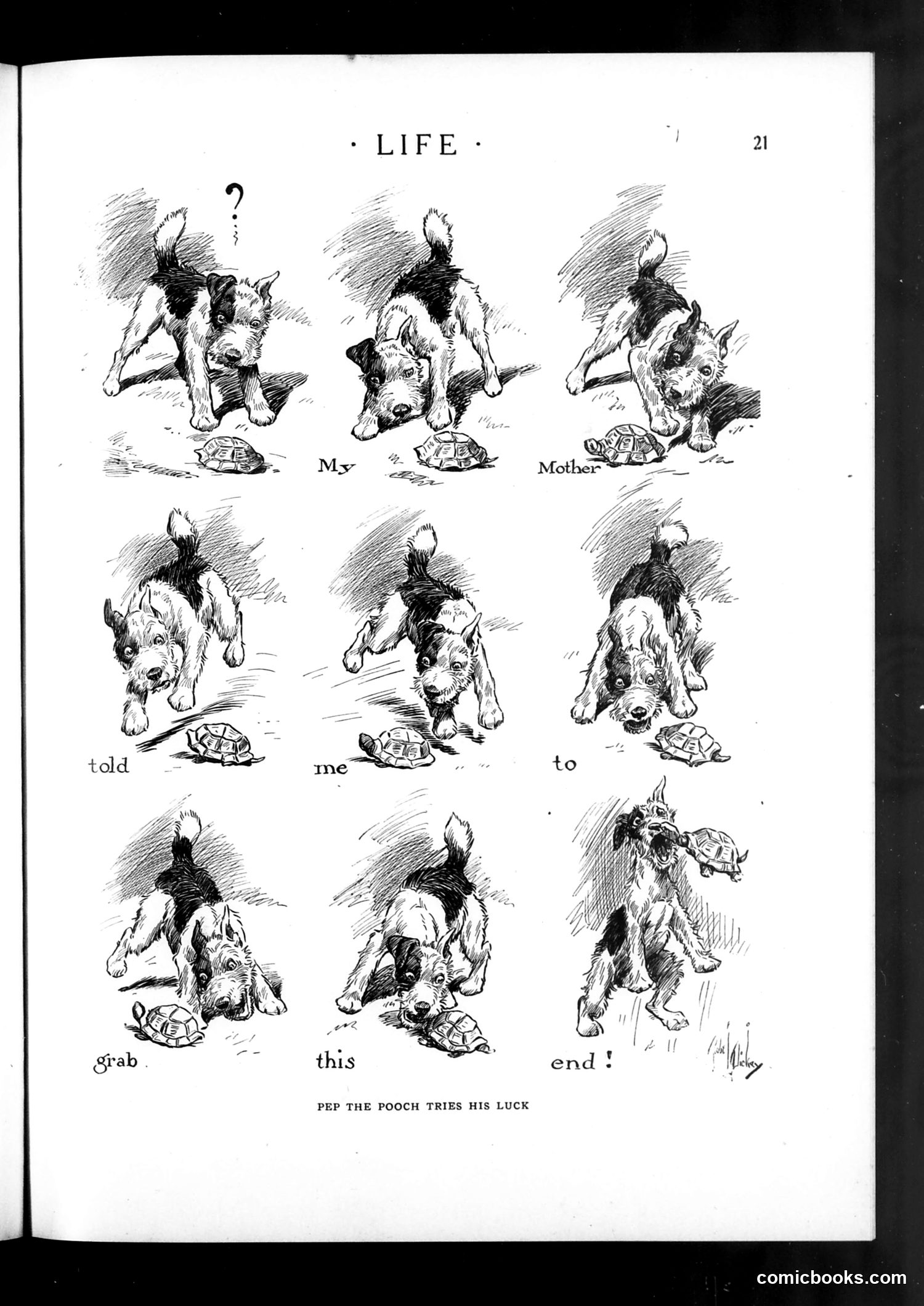
This is a humorous comic strip showing a small dog named Pep repeatedly attempting to catch a turtle. The nine-panel sequence depicts the same failed interaction from different angles: the dog approaches the turtle with curiosity (marked "?"), while the mother dog watches ("My Mother"), then Pep chases the turtle ("told me to"), only for the turtle to disappear into its shell each time. The final panels show escalating desperation as Pep tries increasingly frantic tactics ("grab this end!") before ultimately giving up. The joke is simple slapstick humor: the dog's persistent failure to catch or understand the turtle, treated as a humorous life lesson. It's gentle animal humor typical of early 20th-century magazine comics—no political satire, simply entertainment through a relatable scenario of animal foolishness.
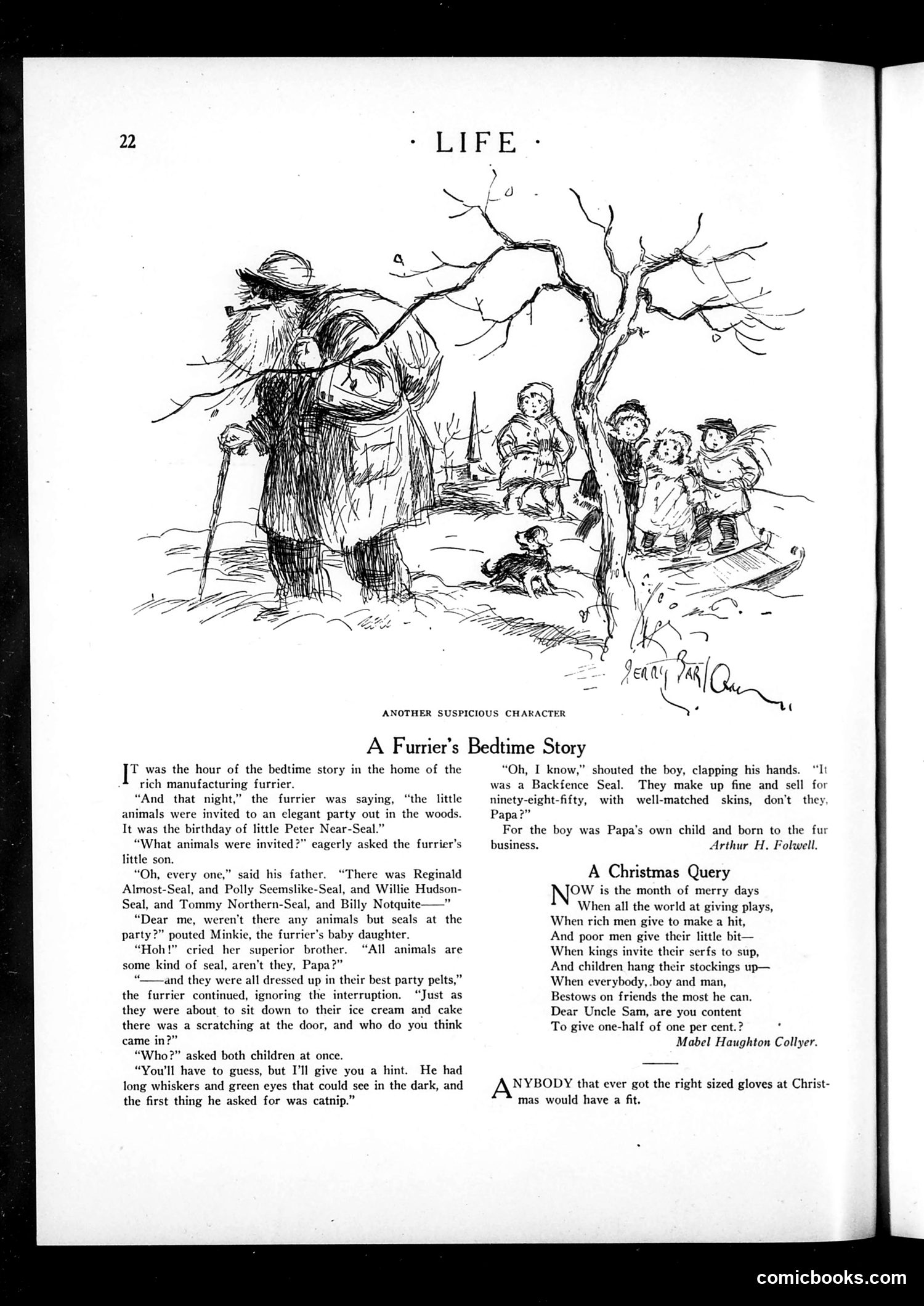
This page contains satirical commentary on American wealth and consumption circa early 1900s. **"A Furrier's Bedtime Story"** (illustrated): A wealthy furrier tells his children a bedtime story featuring animals all named as types of seals—exploiting a dark joke. When a mysterious visitor arrives, the boy immediately identifies it as a "Backfence Seal" worth $98.50 with "well-matched skins," revealing the child has been raised entirely within the fur trade's logic. The satire targets how commercial interests corrupt even childhood innocence, and how the wealthy rationalize animal exploitation through playful language. **"A Christmas Query"** (poem): Mabel Haughton Collyer sarcastically questions whether "Uncle Sam" (the U.S. government/wealthy Americans) is satisfied giving only one-half of one percent to charity during Christmas—when giving is supposedly universal. The satire highlights the stinginess of the rich despite their abundance. **"Christmas Gloves" quip**: A throwaway joke about the impracticality of gift-giving—even simple items like gloves never fit properly. All three items mock wealth, consumerism, and moral hypocrisy among the privileged classes.
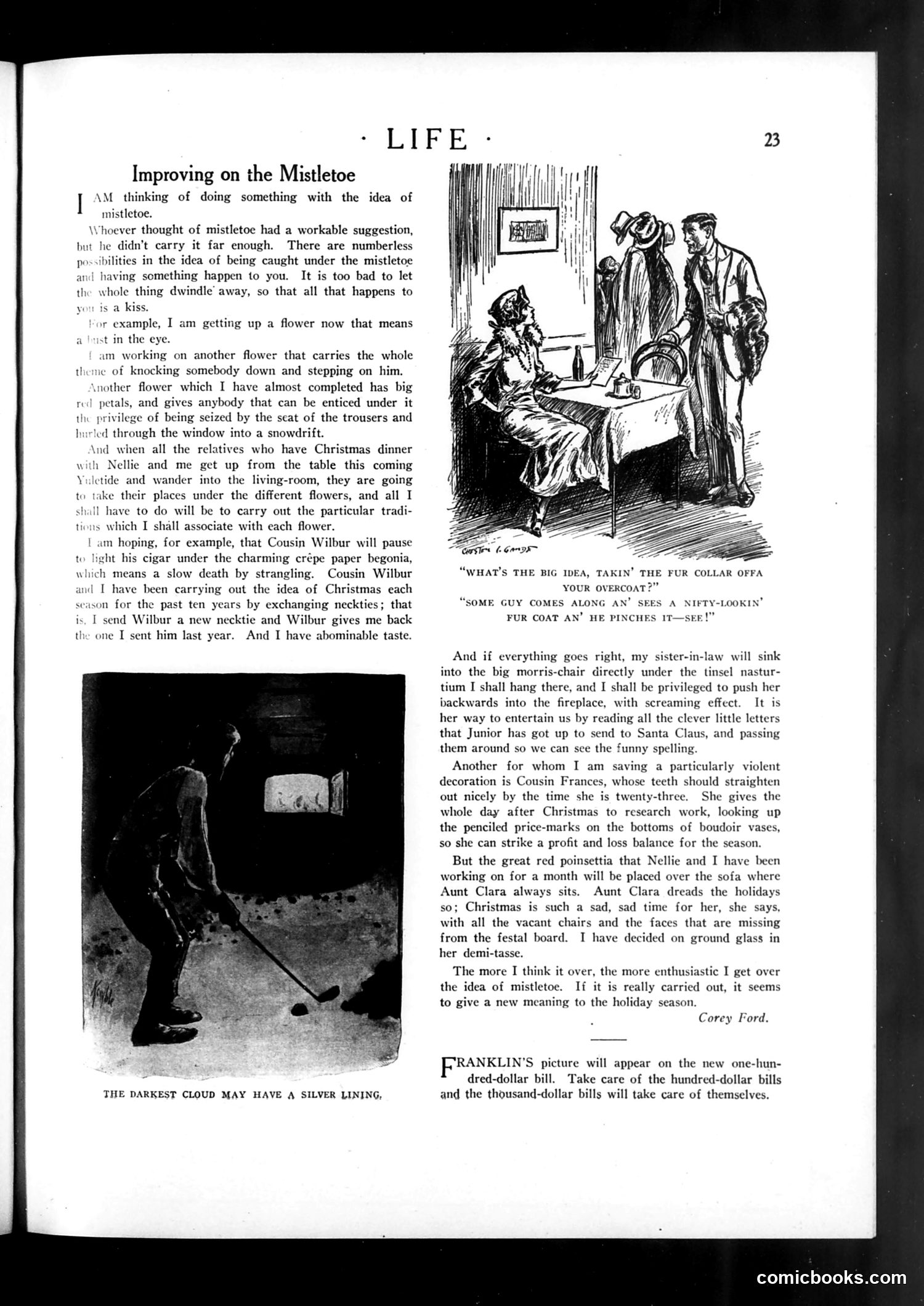
This satirical piece by Corey Ford mocks overly elaborate Christmas traditions and annoying relatives. The author humorously proposes replacing simple mistletoe kisses with decorated flowers that trigger increasingly violent "traditions"—punching relatives in the eye, knocking them down, throwing them through windows into snowdrifts, and even strangling Cousin Wilbur with crepe paper. The cartoon shows a street mugging: a thief steals a fur collar from someone's overcoat, joking that it's "nifty-lookin'." This illustrates the era's common street crime and class anxiety—thieves targeting luxury items from the urban working/middle class. The piece satirizes both holiday excess and family dysfunction, while the cartoon reflects period concerns about urban theft and poverty. Both mock contemporary American society's materialism and social tensions.
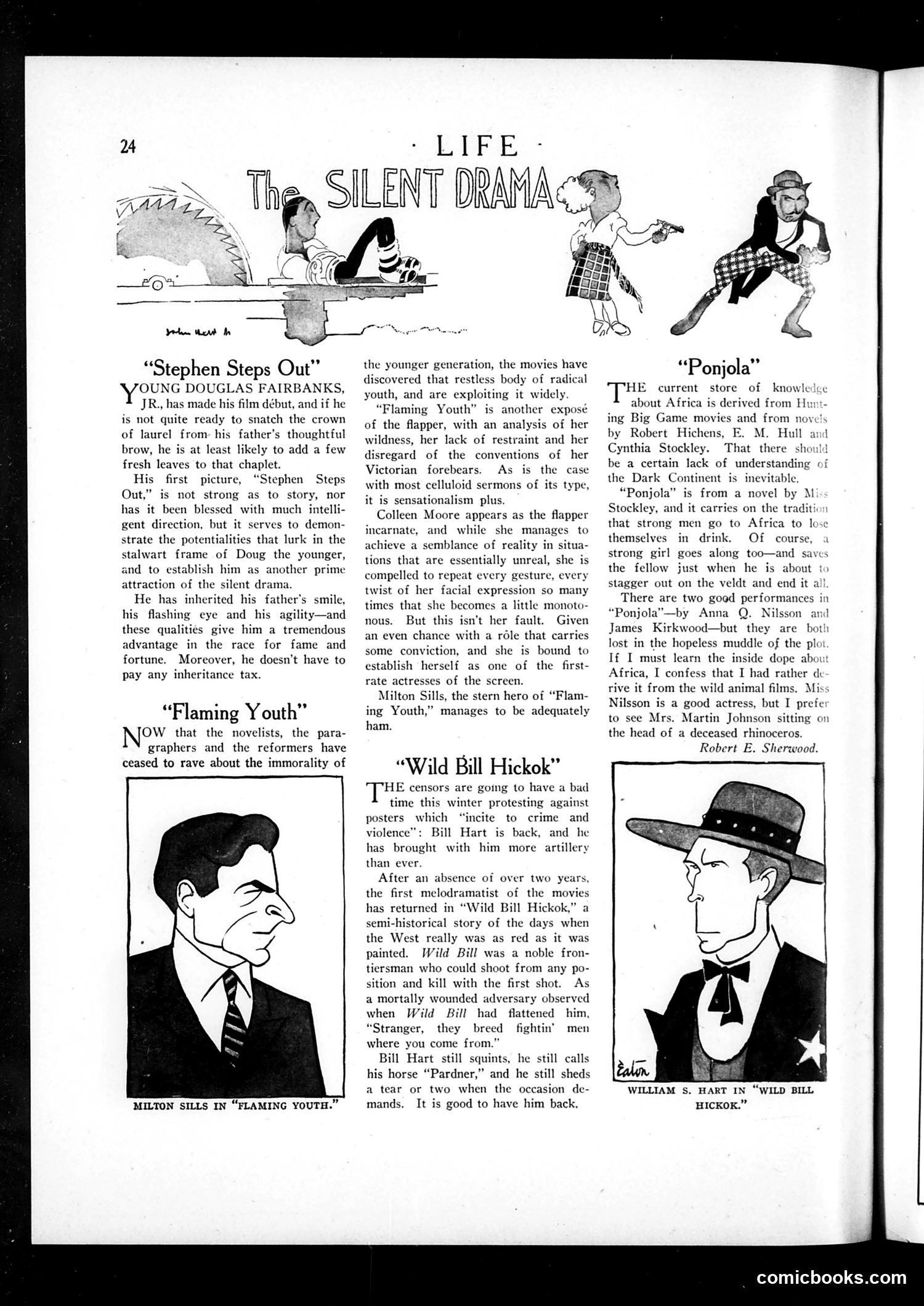
This page reviews four silent films from the early 1920s. The key figures are: **"Stephen Steps Out"**: Douglas Fairbanks Jr. makes his film debut. The reviewer notes he inherits his father's (the famous Douglas Fairbanks Sr.'s) athletic talents and charm, making him a promising screen attraction. **"Flaming Youth"**: Features Colleen Moore as a "flapper"—a young woman defying Victorian conventions with wildness and lack of restraint. The reviewer critiques both the sensationalism of the plot and Moore's repetitive acting, though he blames the script rather than her talent. **"Wild Bill Hickok"**: William S. Hart returns after two years in a Western about the historical frontier figure. Hart's character remains predictably gruff, still calling his horse "Pardner" and crying sentimentally. **"Ponjola"**: An African adventure film starring Anna Q. Nilsson and James Kirkwood, criticized as muddled melodrama perpetuating stereotypes about Africa derived from hunting films and novels. The cartoons at top satirize silent-film physical comedy conventions.
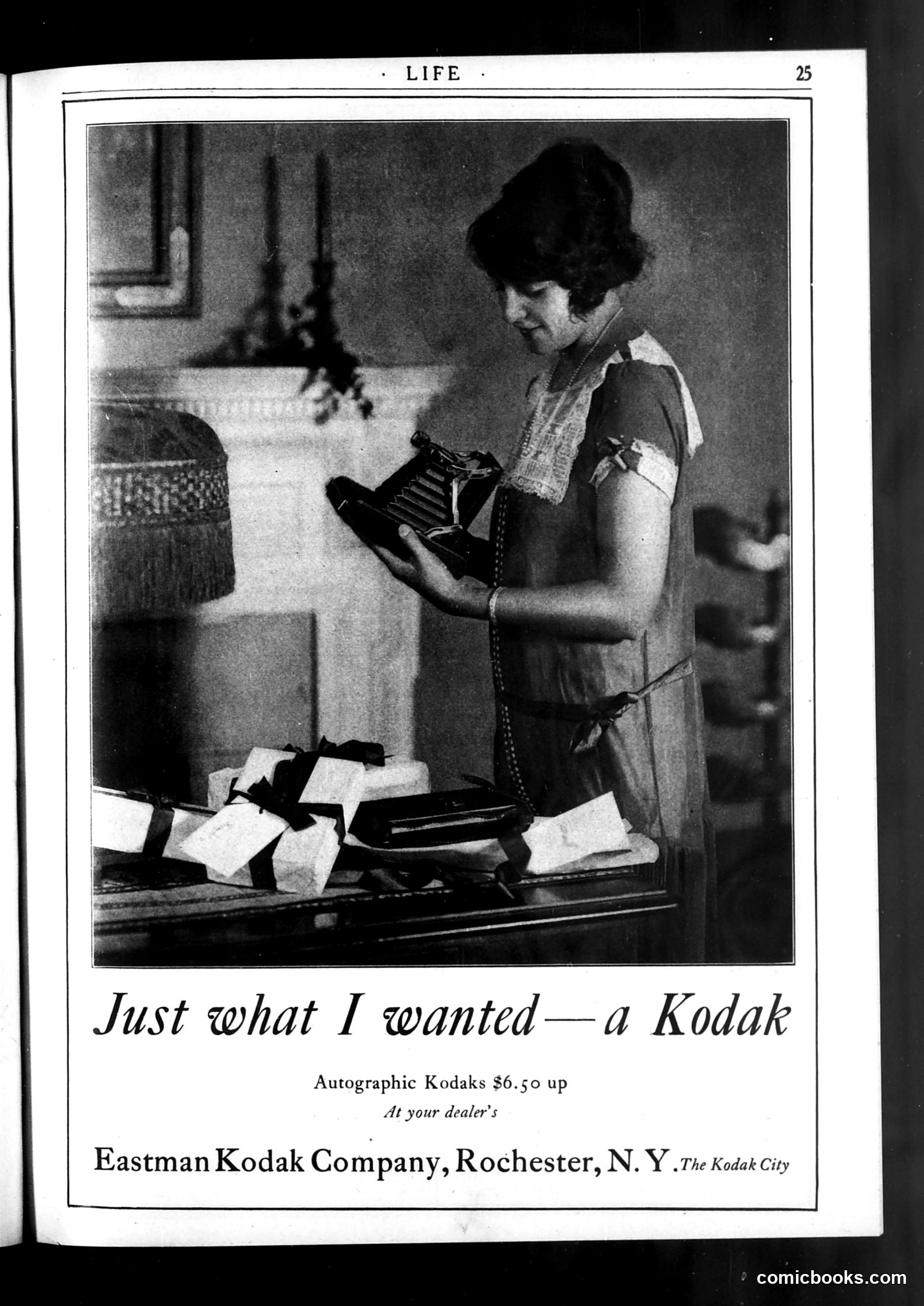
This is a straightforward **advertisement, not satire or political commentary**. It appears in Life magazine page 25 and promotes Eastman Kodak's "Autographic Kodaks" cameras starting at $6.50. The image shows a woman examining a camera, with gift boxes displayed below—suggesting cameras as desirable gifts. The tagline "Just what I wanted" emphasizes consumer desire and gift-giving culture of the era. The "Autographic" feature (visible on the camera) was a Kodak innovation allowing users to write notes directly on film. This ad targets middle-class consumers, particularly women, positioning photography as an accessible, desirable hobby. The Rochester, New York company headquarters is noted as "The Kodak City," indicating the brand's dominance in camera manufacturing.
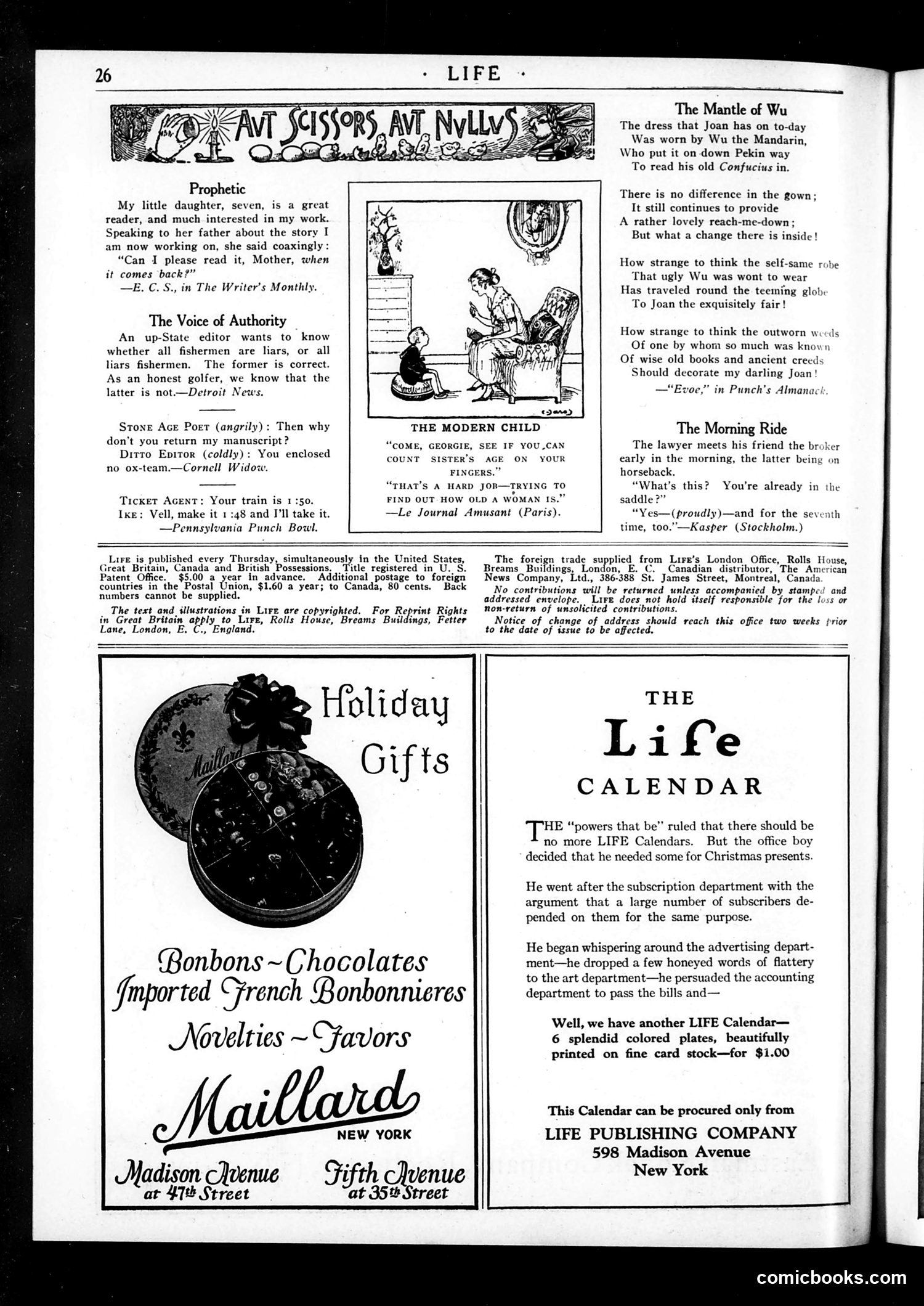
This page contains multiple brief satirical pieces typical of early 20th-century humor magazines: **"The Mantle of Wu"** is a poem about a dress previously owned by a Chinese Mandarin, now worn by someone named Joan. The satire lies in the ironic contrast: the same garment that once symbolized wisdom and learning (associated with reading Confucius) now merely provides fashionable "reach-me-down" clothing, suggesting Western society values appearance over substance. **"The Modern Child"** and **"The Morning Ride"** are short joke pieces about children's precocity and marital longevity, respectively—common themes in period humor. **"The Voice of Authority"** collects brief editorial quips distinguishing fishermen-liars from golfer-liars. The page is primarily **advertising** (Maillard chocolates, Life Calendar) interspersed with these traditional joke columns. The satire is gentle and domestic rather than political, reflecting Life's focus on social observation and wordplay rather than hard commentary.
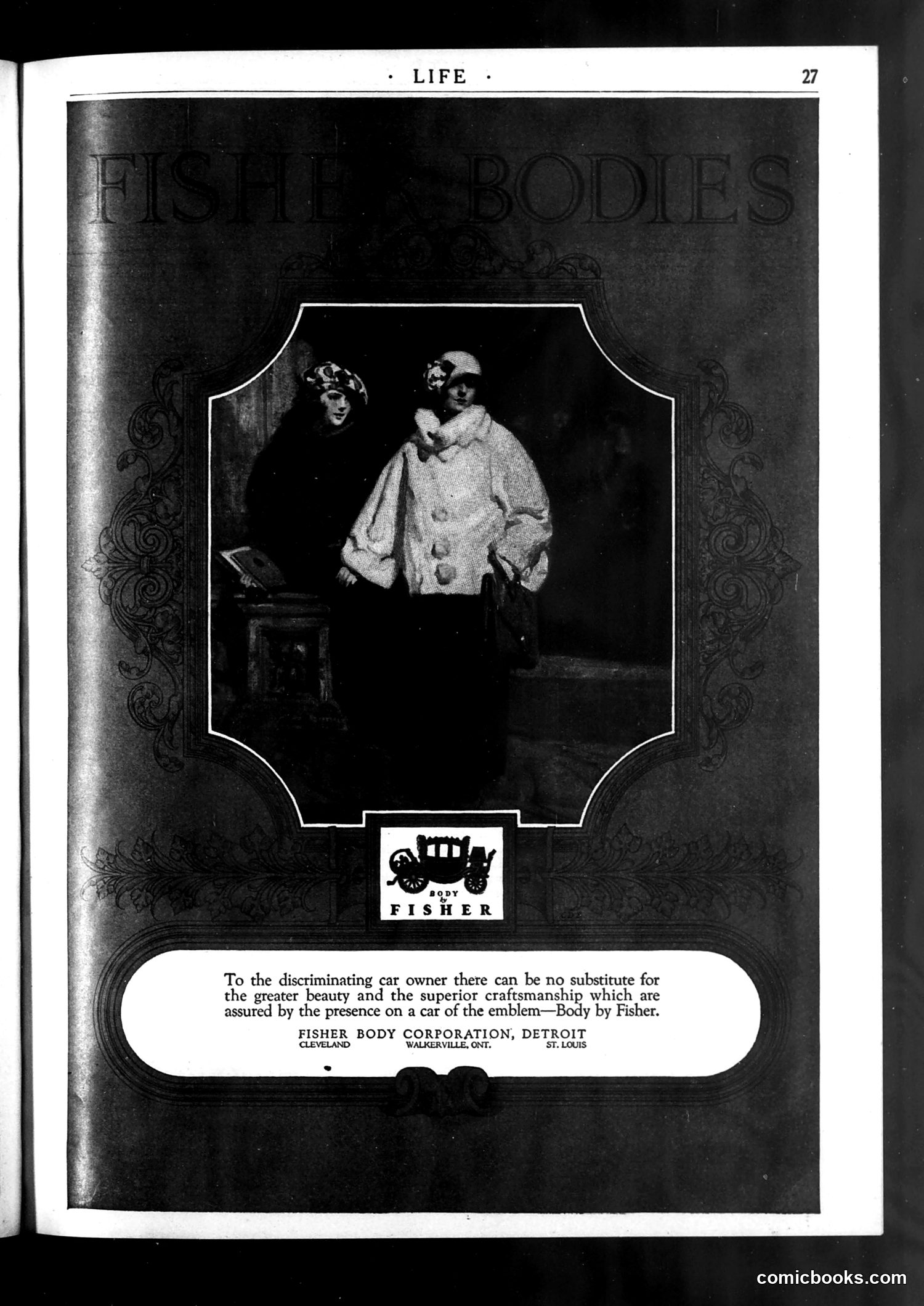
This is a **Fisher Body Corporation advertisement**, not a political cartoon. The page's title "Fish Bodies" is a visual pun—the ad features two elegantly dressed women examining a car, playing on the double meaning of "body" (automobile body vs. human body). The joke targets luxury car buyers: Fisher Body was marketing their automobile bodies as comparable to fine fashion and craftsmanship. The ad suggests that owning a Fisher-bodied car signals sophistication and taste to "discriminating" owners—essentially selling status and beauty alongside engineering. The ornate decorative border and fine photography underscore the luxury positioning. This represents early 1900s automotive marketing that equated cars with high fashion and social distinction.
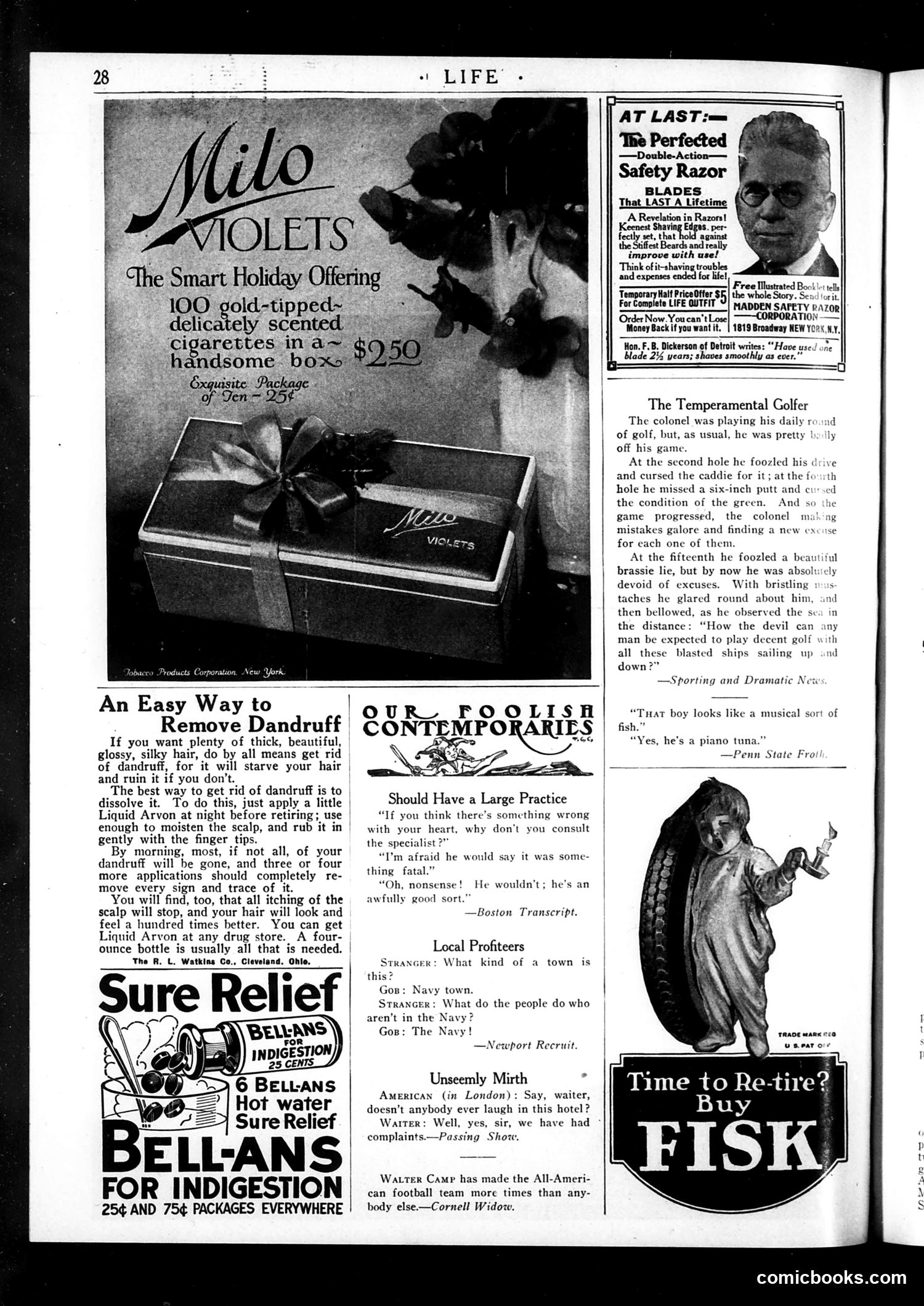
This page is primarily **advertisements and humor shorts**, not political cartoons. The main content includes: **Advertisements:** Milo Violets cigarettes ($2.50), Liquid Arvon dandruff treatment, Bell-Ans indigestion remedy, and Fisk tires dominate the layout. **Humor shorts** under "Our Foolish Contemporaries" and other sections offer light satirical jokes: - A doctor joke (consultant dismisses heart concerns) - Navy town humor (civilians asking what non-Navy people do in a Navy town) - Hotel service complaint - A temperamental golf colonel cursing ships at sea instead of admitting poor play - Puns ("piano tuna" fish joke) **The satire** is gentle and genteel—typical 1920s magazine humor mocking minor social pretensions, hypochondria, and sporting frustration. No specific political figures or events appear. The page reflects era-appropriate consumer culture and upper-middle-class leisure concerns rather than substantive social commentary.
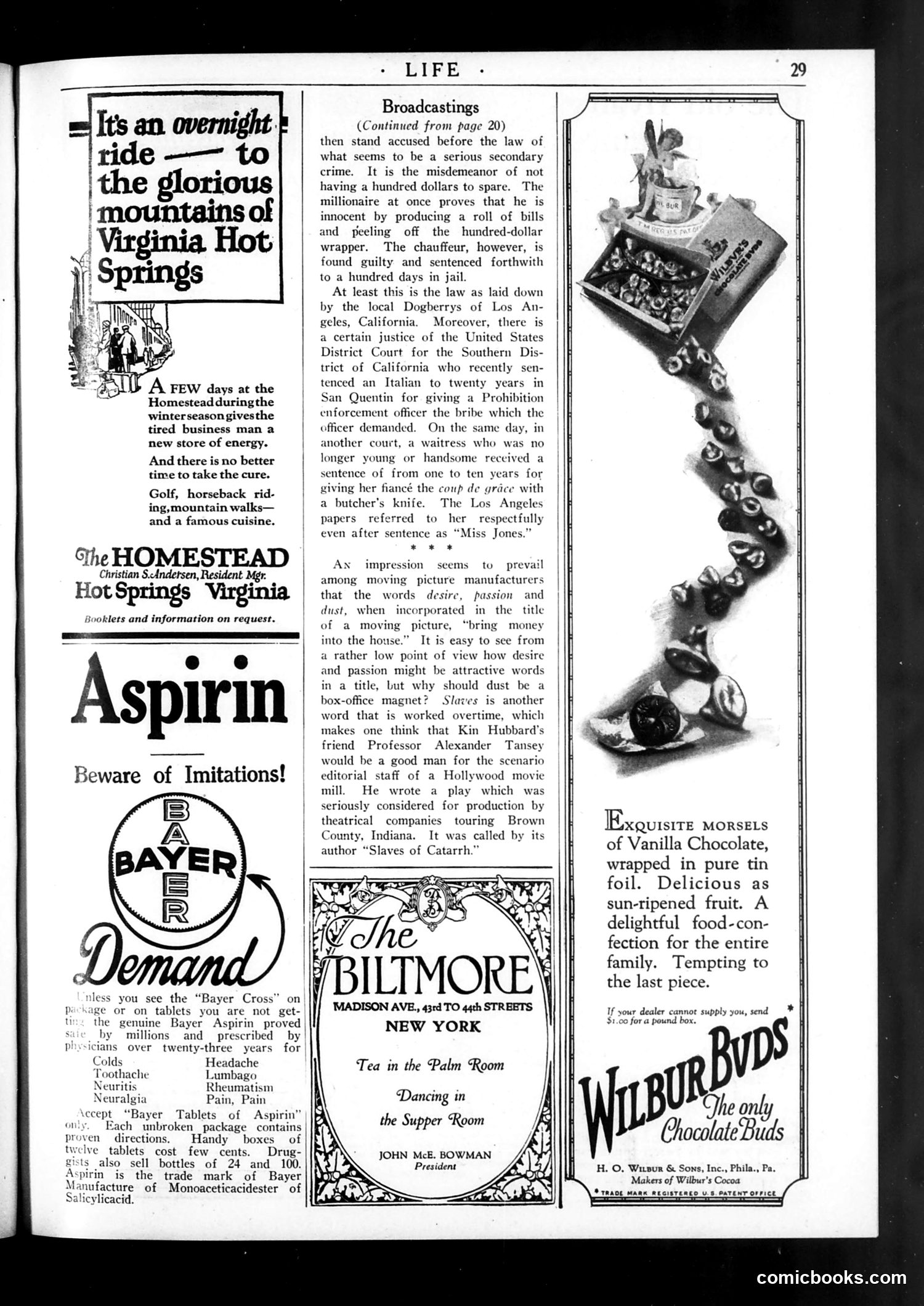
This page is primarily **advertising**, with one substantive editorial piece titled "Broadcastings." The **editorial commentary** critiques class-based justice in 1920s California. It contrasts how a wealthy millionaire caught violating Prohibition can simply produce cash to prove innocence, while a poor chauffeur receives 100 days in jail for the same offense. The piece further notes a judge sentenced an Italian man to 20 years for accepting a bribe a Prohibition officer *demanded*, while a waitress received 1-10 years for murder—yet the papers treated her with respectful language ("Miss Jones"). The satire exposes double standards: wealth purchases legal mercy, while poverty and desperation bring harsh punishment. A secondary complaint targets Hollywood's arbitrary use of words like "desire," "passion," and inexplicably "dust" in movie titles as supposed box-office draws, suggesting the industry lacks coherent creative judgment. The page otherwise consists of typical period advertisements for Aspirin (warning of counterfeits), a Virginia resort, and chocolate products.
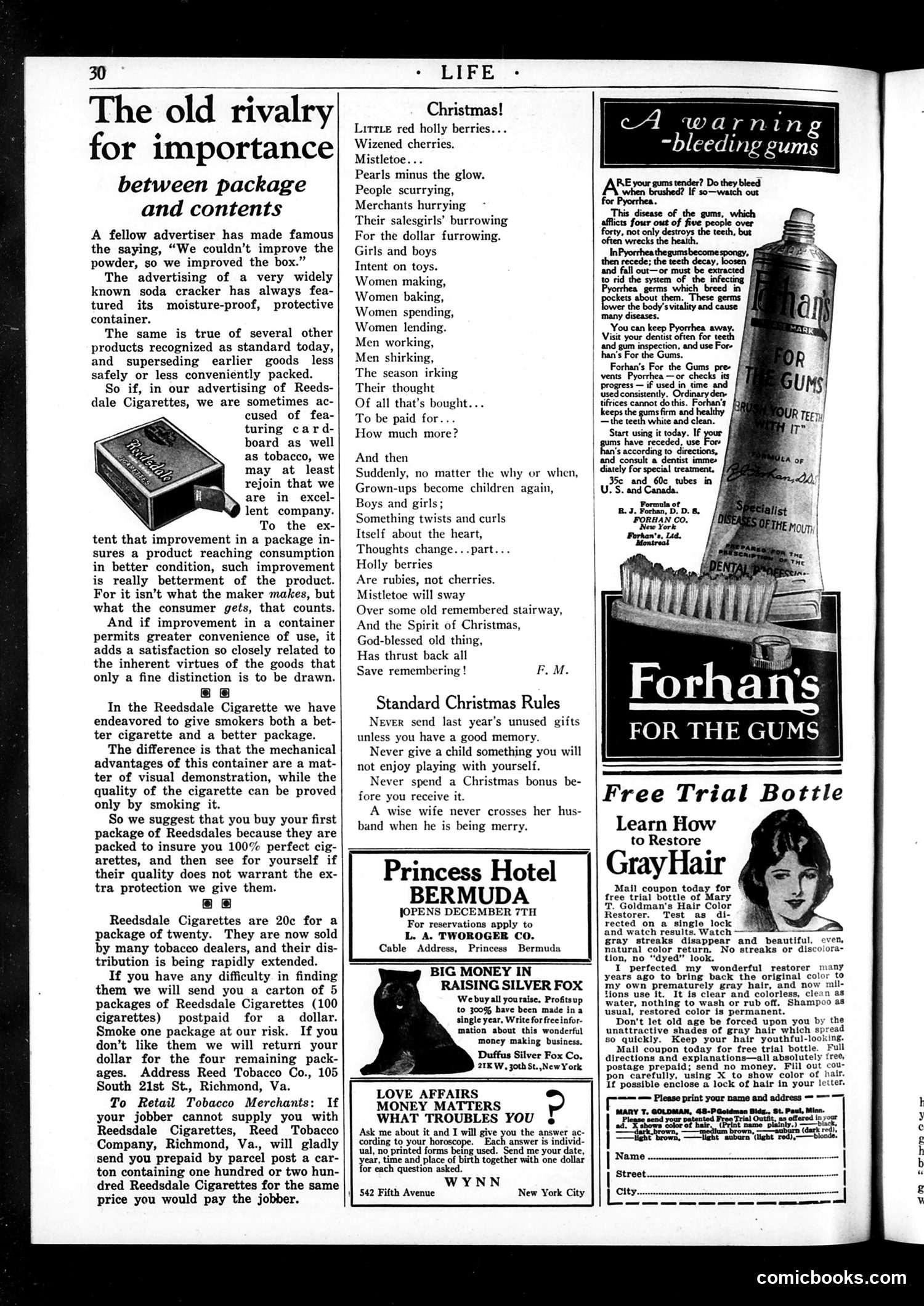
This page is primarily **advertising content** with some editorial material. The main elements are: **"The Old Rivalry for Importance"** is a long-form advertisement for Reedsdale Cigarettes arguing that improved packaging—not just product quality—matters to consumers. The advertiser defends emphasizing the cardboard container by noting other successful brands (soda crackers, powder) do likewise. This reflects early 20th-century marketing philosophy: presentation affects consumer satisfaction. **"Christmas!"** is a sentimental poem (by F.M.) capturing holiday commercialism—merchants, shopping, debt ("To be paid for...How much more?")—before pivoting to nostalgia and spiritual meaning. It's gentle satire of crass materialism softened by genuine sentiment. **Other advertisements** include Princess Hotel (Bermuda), Forhan's For The Gums (dental product), GayHair restoration, and miscellaneous notices. The page reflects Life's dual role as satirical magazine and advertising vehicle, with consumer culture and holiday consumerism as implicit targets of gentle mockery.
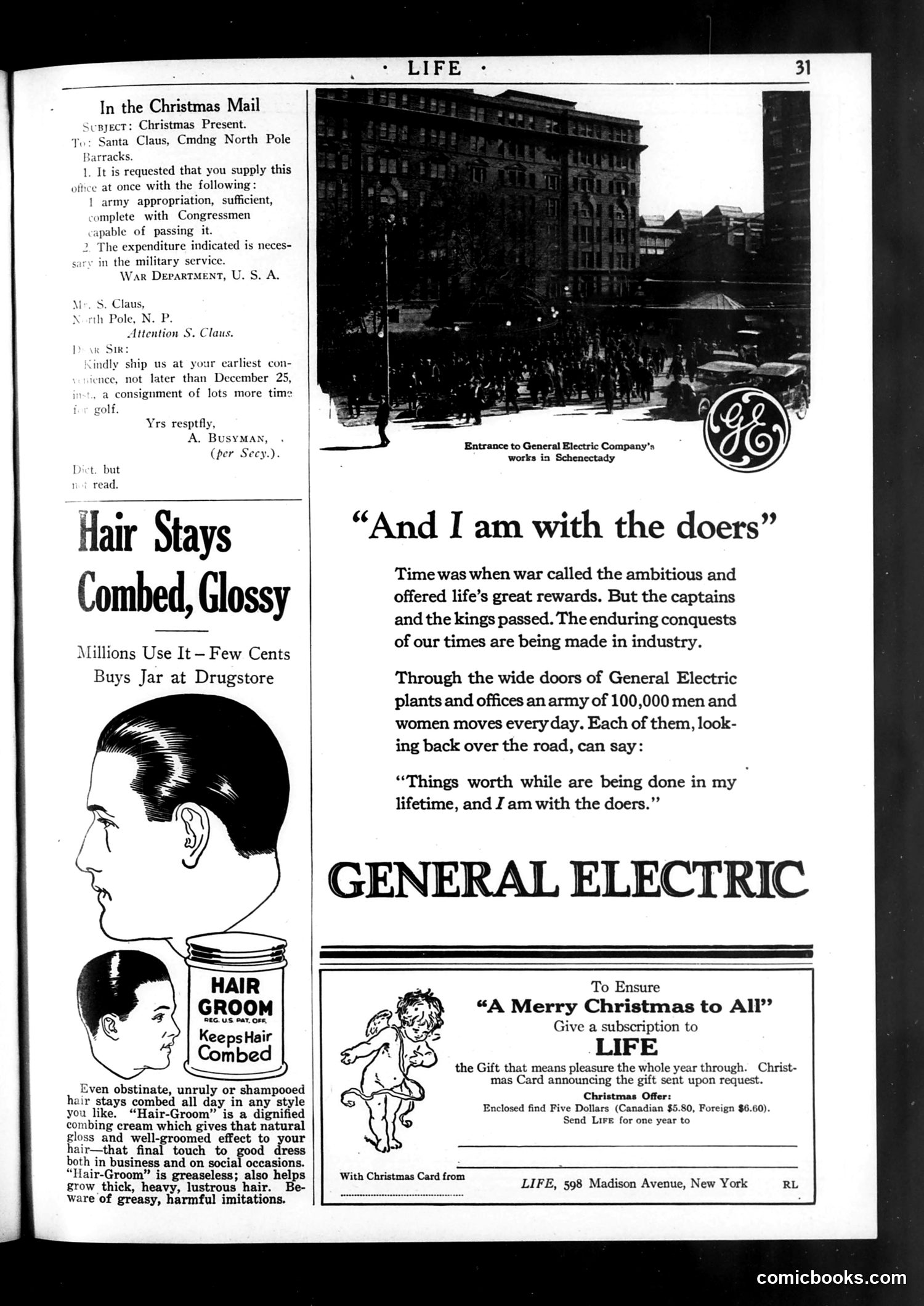
This page mixes satire with advertising, typical of Life's format. **The Satire**: The "Christmas Mail" section mocks military bureaucracy. A letter to Santa Claus requests an "army appropriation" with "Congressmen capable of passing it"—satirizing how the War Department frames budget requests as Christmas gifts. A follow-up from "A. Busy Man" asks Santa for "lots more time" for golf, poking fun at officials prioritizing leisure over serious work. **The Advertisement**: The General Electric ad romanticizes industrial work as modern heroism, claiming 100,000 workers find meaning in manufacturing rather than warfare. The headline "And I am with the doers" reframes factory labor as noble conquest, replacing military ambition with industrial ambition. **The Context**: This appears post-WWI, when Life contrasts outdated military glory with industrial progress as America's new frontier. The page also includes a hair product advertisement unrelated to the satire.
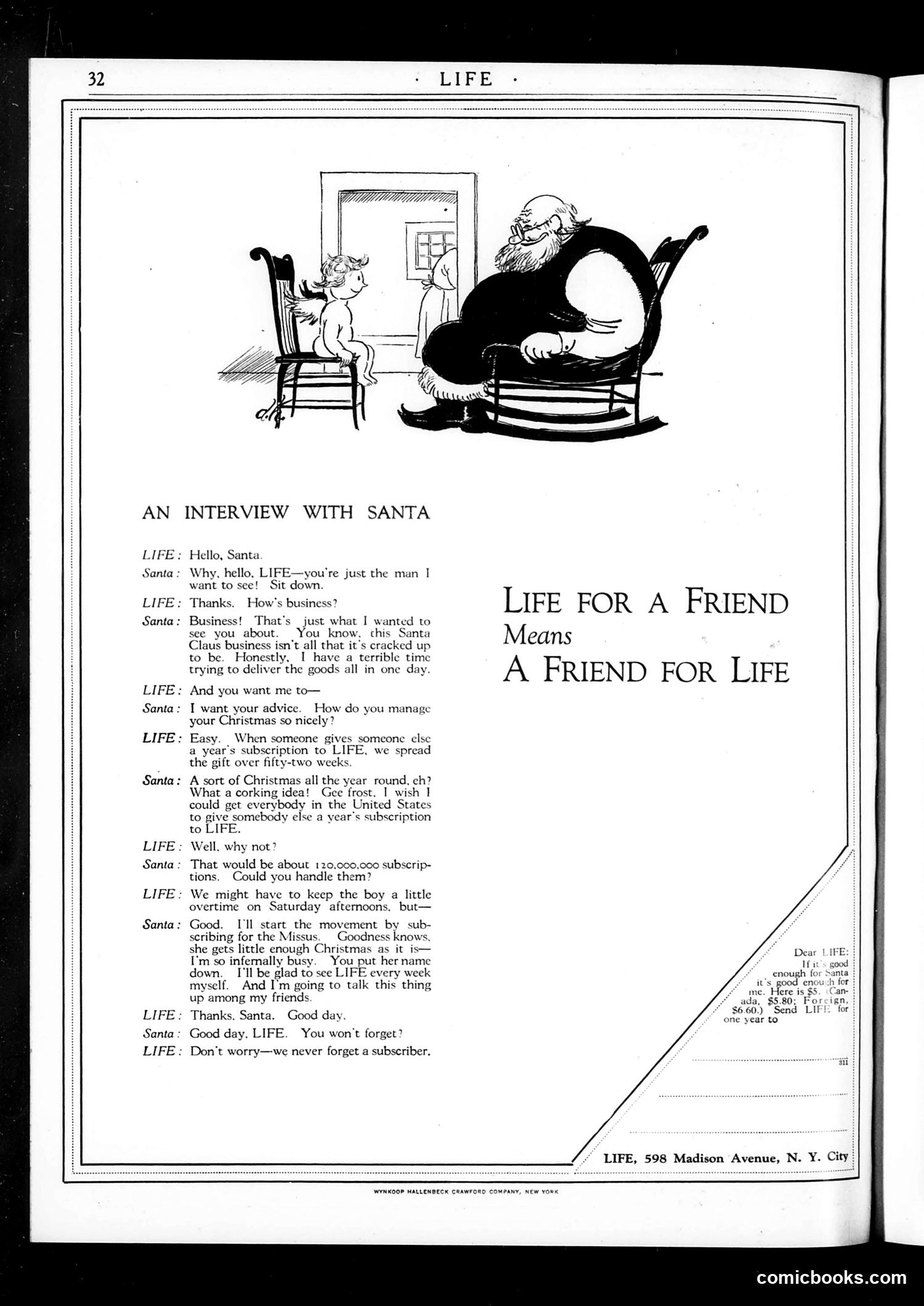
This is a satirical advertisement disguised as a comic dialogue. Santa Claus seeks business advice from *Life* magazine about his struggling holiday delivery schedule. *Life* proposes their solution: gift subscriptions spread the "Christmas spirit" across fifty-two weeks rather than concentrated on one day. Santa is enchanted and agrees to start a mass subscription movement, beginning with his wife. The satire works on multiple levels: it gently mocks the supposed crisis of Santa's logistics while positioning *Life* magazine as the solution to holiday stress—transforming an annual tradition into year-round consumption. The punchline, "we never forget a subscriber," suggests *Life* treats subscribers with Santa-like reliability. The accompanying tagline—"Life for a Friend Means a Friend for Life"—reframes magazine subscriptions as intimate, lasting relationships rather than commercial transactions. This reflects early 20th-century marketing strategies that anthropomorphized products and publications to build consumer loyalty.
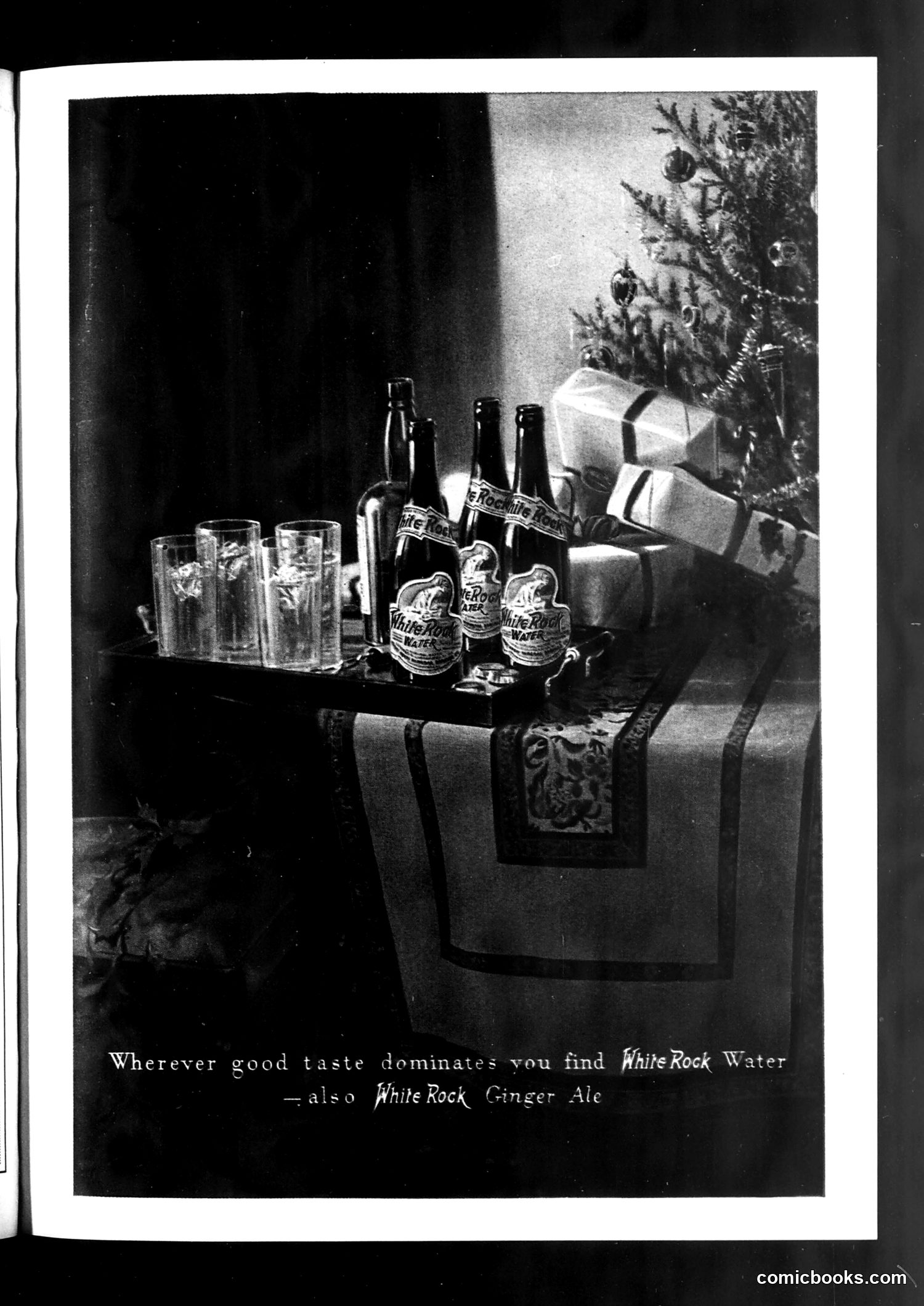
This is an advertisement, not political satire or a cartoon. It promotes White Rock Water and White Rock Ginger Ale beverages. The image shows an elegantly styled holiday or festive table setting with wrapped gifts, a decorated Christmas tree, beer bottles, and drinking glasses arranged to suggest refined entertaining. The ad's message links the brand to "good taste" and sophistication—a common advertising strategy positioning consumer products as markers of social status and refinement. The sophisticated presentation implies that serving White Rock beverages at upscale gatherings signals the host's discernment and class. This represents typical early-to-mid 20th century marketing that equated product consumption with cultural sophistication and proper taste.
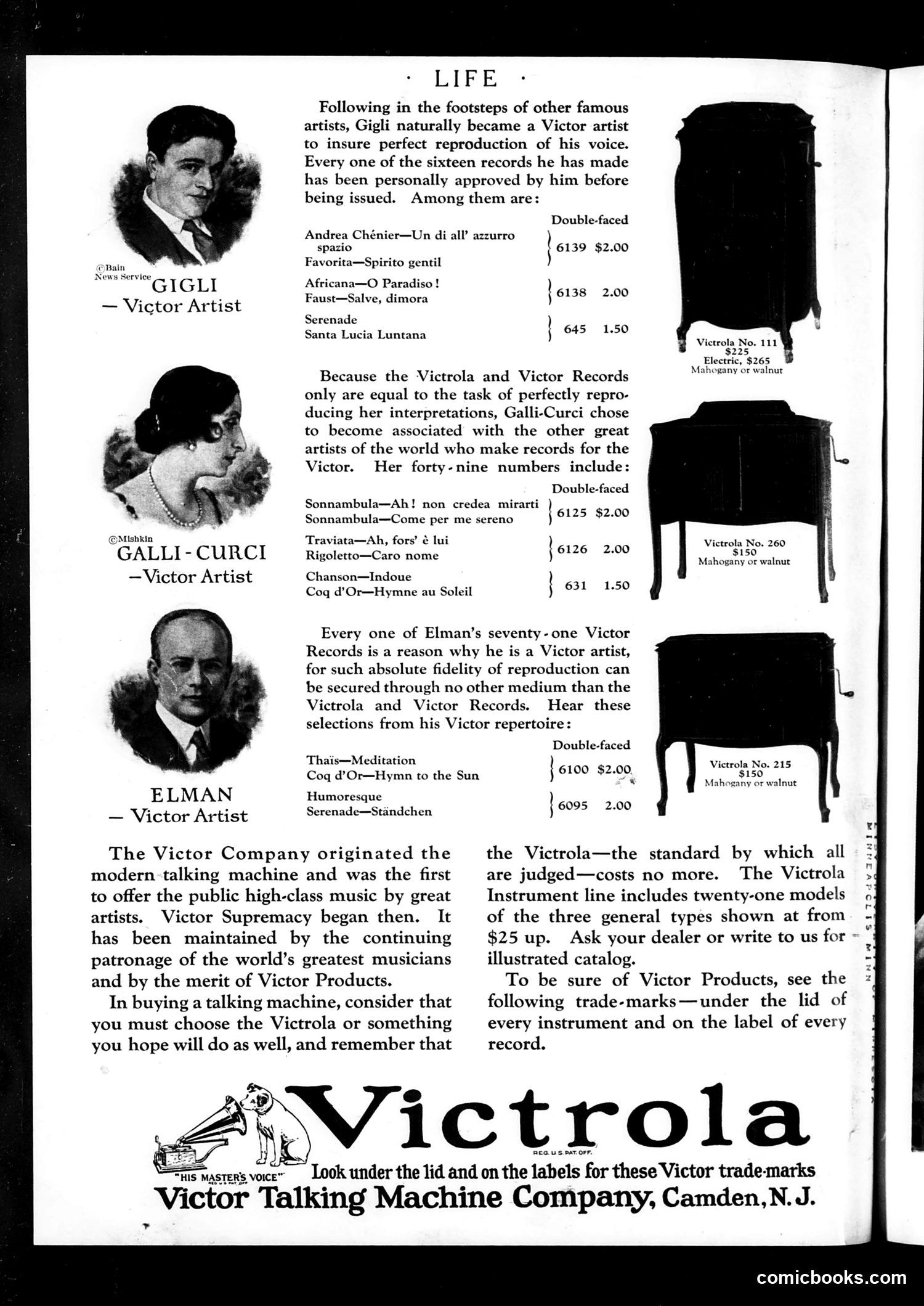
This is primarily **advertising, not satire or political commentary**. It's a Victor Talking Machine Company advertisement from Life magazine promoting Victrolas (phonographs) by featuring endorsements from famous opera singers: Beniamino Gigli, Amelita Galli-Curci, and Mischa Elman. The page uses celebrity association as a marketing strategy—claiming these world-renowned artists chose Victor exclusively because only Victrolas could faithfully reproduce their voices. Each artist's record catalog is listed with prices ($1.50–$2.00 per double-sided record). The three portrait photographs function as celebrity testimonials rather than caricatures. The accompanying Victrola furniture models (shown as black silhouettes) emphasize the product as both a musical instrument and home furnishing. The closing copy positions Victrola as the industry standard and market leader, suggesting competitors are inferior imitations. This reflects early 20th-century phonograph market competition.