
Life, 1923-12-20 · page 20 of 36
Life — December 20, 1923 — page 20: what you’re looking at
What you’re looking at
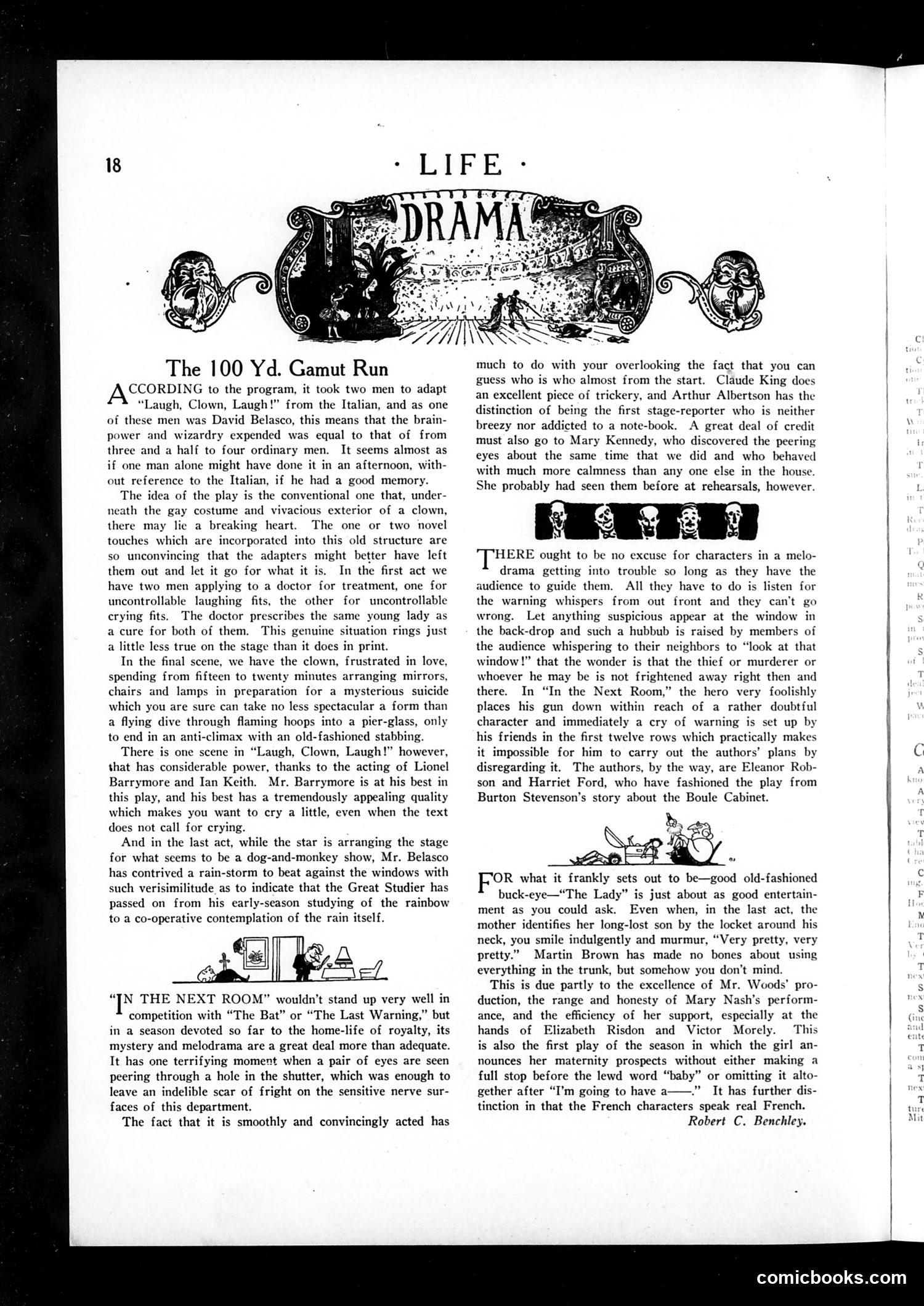
This page contains theater reviews from Life magazine's drama section. The critic reviews three plays: "Laugh, Clown, Laugh!" (starring Lionel Barrymore), "In the Next Room," and "The Lady." The satire targets theatrical conventions and David Belasco's pretentious adapting practices. The critic mocks Belasco—a famous producer known for elaborate stagecraft—for requiring two men to adapt an Italian play, sarcastically suggesting his "brain-power" equals three ordinary men. The review ridicules melodramatic plot devices (clowns with broken hearts, suicide via flaming hoops) while praising Barrymore's genuine acting ability. The second section humorously observes audience behavior at melodramas: spectators eagerly warn each other about "suspicious" window activity, essentially solving the plot for themselves through collective whispering. The tone is witty and irreverent toward overwrought theatrical conventions and star power, typical of Life's satirical approach to entertainment.
📄 Transcribed text from this page (OCR, searchable)
Machine-transcribed from the original scan — historical spelling and the odd misread are preserved.
CCORDING to the program, it took two men to adapt “Laugh, Clown, Laugh!” from the Italian, and as one of these men was David Belasco, this means that the brain- power and wizardry expended was equal to that of from three and a half to four ordinary men. It seems almost as if one man alone might have done it in an afternoon, with- out reference to the Italian, if he had a good memory. The idea of the play is the conventional one that, under- neath the gay costume and vivacious exterior of a clown, there may lie a breaking heart. The one or two novel touches which are incorporated into this old structure are so unconvincing that the adapters might better have left them out and let it go for what it is. In the first act we have two men applying to a doctor for treatment, one for uncontrollable laughing fits, the other for uncontrollable crying fits. The doctor prescribes the same young lady as a cure for both of them. This genuine situation rings just a little less true on the stage than it does in print. In the final scene, we have the clown, frustrated in love, spending from fifteen to twenty minutes arranging mirrors, chairs and lamps in preparation for a mysterious suicide which you are sure can take no less spectacular a form than a flying dive through flaming hoops into a pier-glass, only to end in an anti-climax with an old-fashioned stabbing. There is one scene in “Laugh, Clown, Laugh!” however, that has considerable power, thanks to the acting of Lionel Barrymore and Ian Keith. Mr. Barrymore is at his best in this play, and his best has a tremendously appealing quality which makes you want to cry a little, even when the text does not call for crying. And in the last act, while the star is arranging the stage for what seems to be a dog-and-monkey show, Mr. Belasco has contrived a rain-storm to beat against the windows with such verisimilitude as to indicate that the Great Studier has passed on from his early-season studying of the rainbow to a co-operative contemplation of the rain itself. “IN THE NEXT ROOM” wouldn't stand up very well in competition with “The Bat” or “The Last Warning,” but in a season devoted so far to the home-life of royalty, its mystery and melodrama are a great deal more than adequate. It has one terrifying moment when a pair of eyes are seen peering through a hole in the shutter, which was enough to leave an indelible scar of fright on the sensitive nerve sur- faces of this department. The fact that it is smoothly and convincingly acted has much to do with your overlooking the fact that you can guess who is who almost from the start. Claude King does an excellent piece of trickery, and Arthur Albertson has the distinction of being the first stage-reporter who is neither breezy nor addicted to a note-book. A great deal of credit must also go to Mary Kennedy, who discovered the peering eyes about the same time that we did and who behaved with much more calmness than any one else in the house. She probably had seen them before at rehearsals, however. "THERE ought to be no excuse for characters in a melo- drama getting into trouble so long as they have the audience to guide them. All they have to do is listen for the warning whispers from out front and they can't go wrong. Let anything suspicious appear at the window in the back-drop and such a hubbub is raised by members of the audience whispering to their neighbors to “look at that window!” that the wonder is that the thief or murderer or whoever he may be is not frightened away right then and there. In “In the Next Room,” the hero very foolishly places his gun down within reach of a rather doubtful character and immediately a cry of warning is set up by his friends in the first twelve rows which practically makes it impossible for him to carry out the authors’ plans by disregarding it. The authors, by the way, are Eleanor Rob- son and Harriet Ford, who have fashioned the play from Burton Stevenson’s story about the Boule Cabinet. ‘OR what it frankly sets out to be—good old-fashioned buck-eye—“The Lady” is just about as good entertain- ment as you could ask. Even when, in the last act, the mother identifies her long-lost son by the locket around his neck, you smile indulgently and murmur, “Very pretty, very pretty.” Martin Brown has made no bones about using everything in the trunk, but somehow you don’t mind. This is due partly to the excellence of Mr. Woods’ pro- duction, the range and honesty of Mary Nash’s perform- ance, and the efficiency of her support, especially at the hands of Elizabeth Risdon and Victor Morely. This is also the first play of the season in which the girl an- nounces her maternity prospects without either making a full stop before the lewd word “baby” or omitting it alto- gether after “I’m going to have a—.” It has further dis- tinction in that the French characters speak real French. Robert C. Benchley. comicbooks.com