
Life, 1923-12-20 · page 26 of 36
Life — December 20, 1923 — page 26: what you’re looking at
What you’re looking at
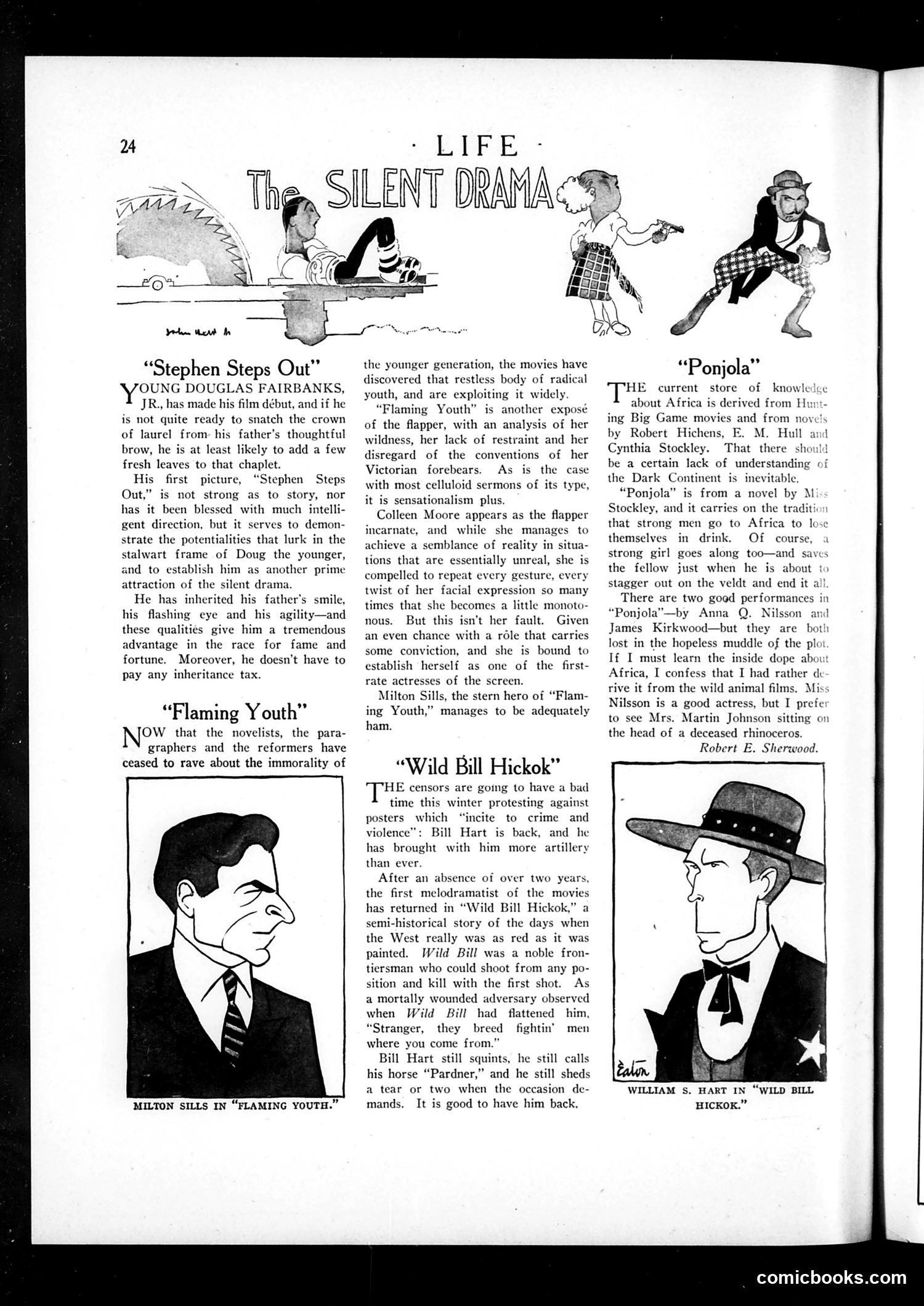
This page reviews four silent films from the early 1920s. The key figures are: **"Stephen Steps Out"**: Douglas Fairbanks Jr. makes his film debut. The reviewer notes he inherits his father's (the famous Douglas Fairbanks Sr.'s) athletic talents and charm, making him a promising screen attraction. **"Flaming Youth"**: Features Colleen Moore as a "flapper"—a young woman defying Victorian conventions with wildness and lack of restraint. The reviewer critiques both the sensationalism of the plot and Moore's repetitive acting, though he blames the script rather than her talent. **"Wild Bill Hickok"**: William S. Hart returns after two years in a Western about the historical frontier figure. Hart's character remains predictably gruff, still calling his horse "Pardner" and crying sentimentally. **"Ponjola"**: An African adventure film starring Anna Q. Nilsson and James Kirkwood, criticized as muddled melodrama perpetuating stereotypes about Africa derived from hunting films and novels. The cartoons at top satirize silent-film physical comedy conventions.
📄 Transcribed text from this page (OCR, searchable)
Machine-transcribed from the original scan — historical spelling and the odd misread are preserved.
SILENT DRAHACS “Stephen Steps Out” OUNG DOUGLAS FAIRBANKS, JR., has made his film début, and if he is not quite ready to snatch the crown of laurel from: his father’s thoughtful brow, he is at least likely to add a few fresh leaves to that chaplet. His first picture, “Stephen Steps Out,” is not strong as to story, nor has it been blessed with much intelli- gent direction, but it serves to demon- strate the potentialities that lurk in the stalwart frame of Doug the younger, and to establish him as another prime attraction of the silent drama. He has inherited his father his flashing eye and his agility—and these qualitiés give him a tremendous advantage in the race for fame and fortune. Moreover, he doesn’t have to pay any inheritance tax. “Flaming Youth” OW that the novelists, the para- graphers and the reformers have ceased to rave about the immorality of MILTON SILLS IN “FLAMING YOUTH.” LDPE ounger generation, the movies have discovered that restless body of radical youth, and are exploiting it widely. “Flaming Youth” is another exposé of the flapper, with an anal. of her wildness, her lack of restraint and her disregard of the conventions of her Victorian forebears. As is with most celluloid sermons of its type, it is sensationalism plus. Colleen Moore appears as the flapper incarnate, and while she manages to achieve a semblance of reality in situa- tions that are essentially unreal, she is compelled to repeat every gesture, every twist of her facial expression so many times that she becomes a little monoto- nous. But this isn’t her fault. Given an even chance with a réle that carries some conviction, and she is bound to establish herself as one of the first- rate actresses of the screen. Milton Sills, the stern hero of “Flam- ing Youth,” manages to be adequately ham. the case “Wild Bill Hickok” 'HE censors are going to have a bad time this winter protesting against posters which “incite to crime and violence Bill Hart is back, and he has brought with him more artillery than ever. After an absence of over two years, the first melodramatist of the movie has returned in “Wild Bill Hickok,” a semi-historical story of the days when the West really was as red as it was painted. Wild Bill was a noble fron- tiersman who could shoot from any po- sition and kill with the first shot. As a mortally wounded adversary observed when Wild Bill had flattened him, “Stranger, they breed fightin’ where you come from.” Bill Hart still squints, he still calls his horse “Pardner,” and he still sheds a tear or two when the occasion de- mands. It is good to have him back. men = oe “Ponjola HE store of knowledge about Africa is derived from Hunt- ing Big Game movies and from novels by Robert Hichens, M. Hull Cynthia Stockley. That there sho be a certain lack of understanding of the Dark Continent is inevitable. “Ponjola” is from a novel by M Stockley, and it carries on the tradition that strong men go to Africa to lose themselves in drink. Of course, a strong girl goes along too—and saves the fellow just when he is about to stagger out on the veldt and end it al! There are two good performances in “Ponjola”"—by Anna Q. Nilsson and James Kirkwood—but they are bot lost in the hopeless muddle of the plot If I must learn the inside dope about Africa, I confess that I had rather c rive it from the wild animal films. Mis Nilsson is a good actress, but I prefe: to see Mrs. Martin Johnson sitting on the head of a deceased rhinoceros. Robert E. Sherwood. current WILLIAM S. HART IN HICKOK.” comicbooks.com