
A complete issue · 36 pages · 1923
Life — August 30, 1923
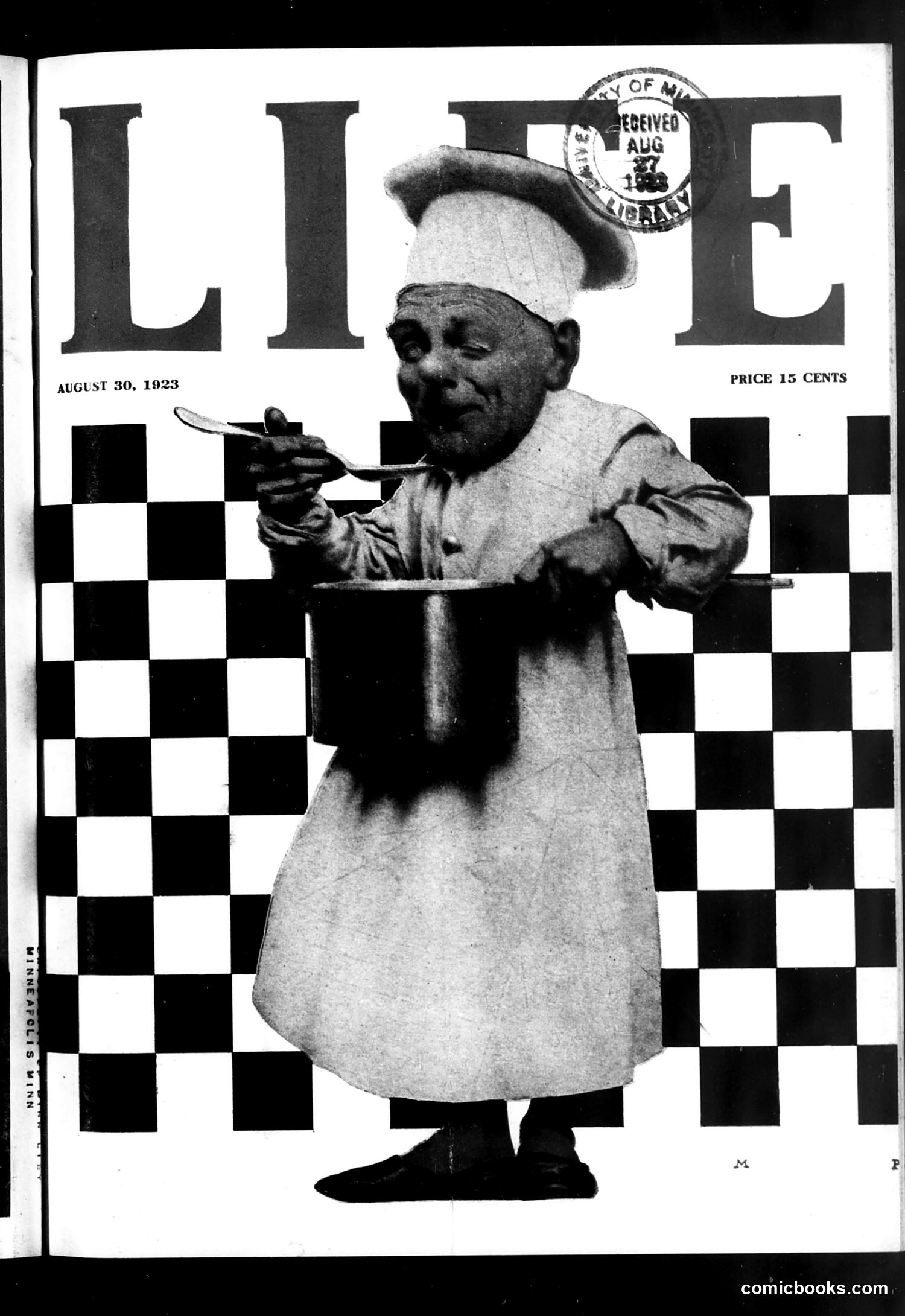
This cover depicts a chef or cook in traditional white chef's attire and headwrap, tasting soup from a large pot with a spoon. The checkered background suggests a kitchen setting. The satire likely references food, cooking, or culinary matters popular in 1923 American culture. Without additional text visible on the page, the specific political or social commentary remains unclear—it could be commentary on prohibition-era cooking, restaurant culture, immigrant labor, or a contemporary public figure known for culinary interests. The jovial expression and exaggerated style are typical of Life magazine's satirical approach, but the precise target or joke requires more context than the image alone provides.
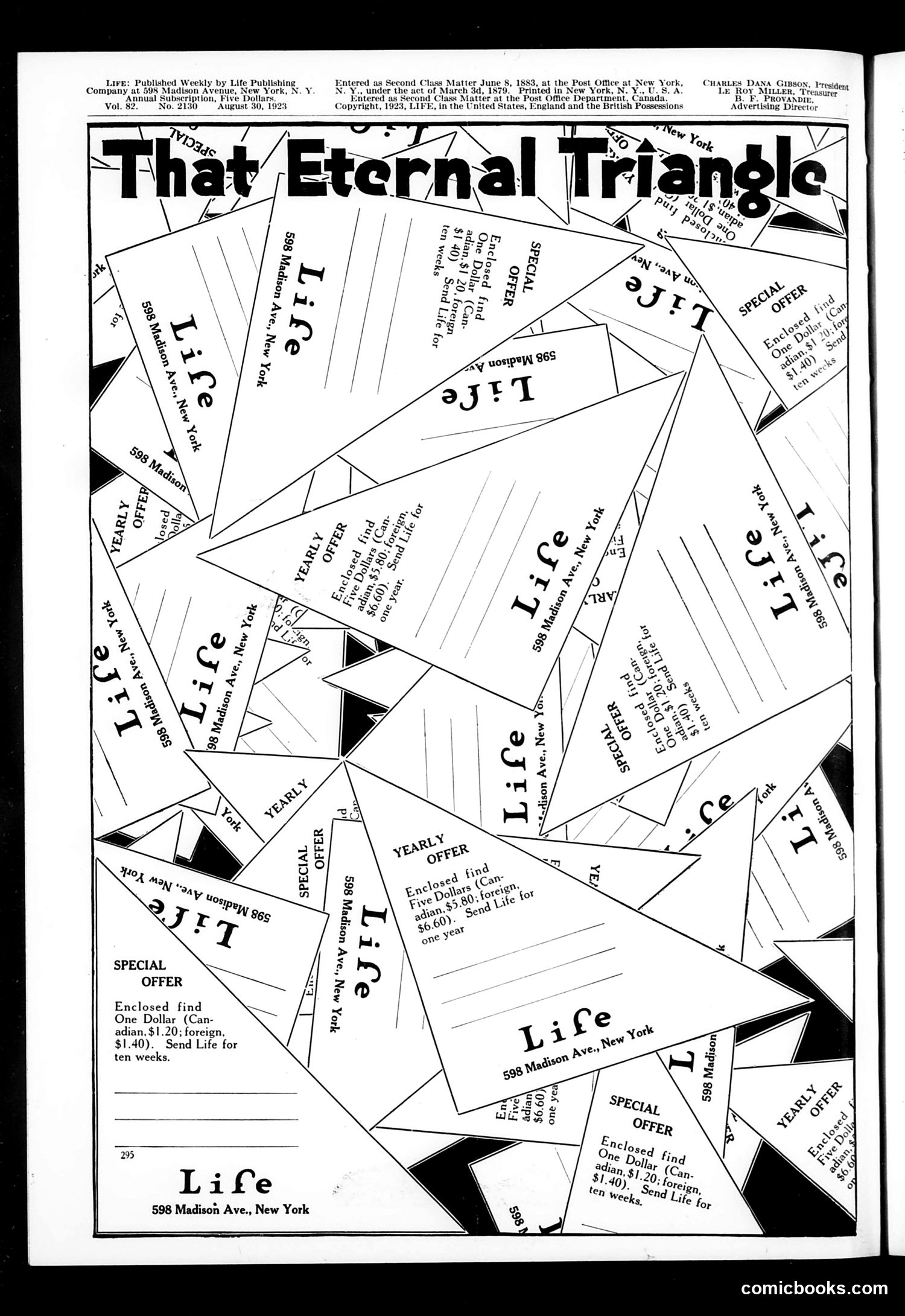
This page is primarily **advertising for Life magazine**, not political satire. The design uses a geometric "triangle" motif—literally composed of overlapping triangular shapes—to promote subscription offers. The repeated text fragments reading "Life," "Special Offer," and subscription details are arranged within the triangular composition itself. The "eternal triangle" reference appears to be a visual pun: a geometric design shaped like triangles, rather than a commentary on the famous romantic narrative trope. The advertisements offer subscription deals (one dollar for ten weeks of Life magazine), with the publication's address at 598 Madison Avenue prominently displayed. This is essentially a graphically creative house ad designed to encourage magazine subscriptions among readers.
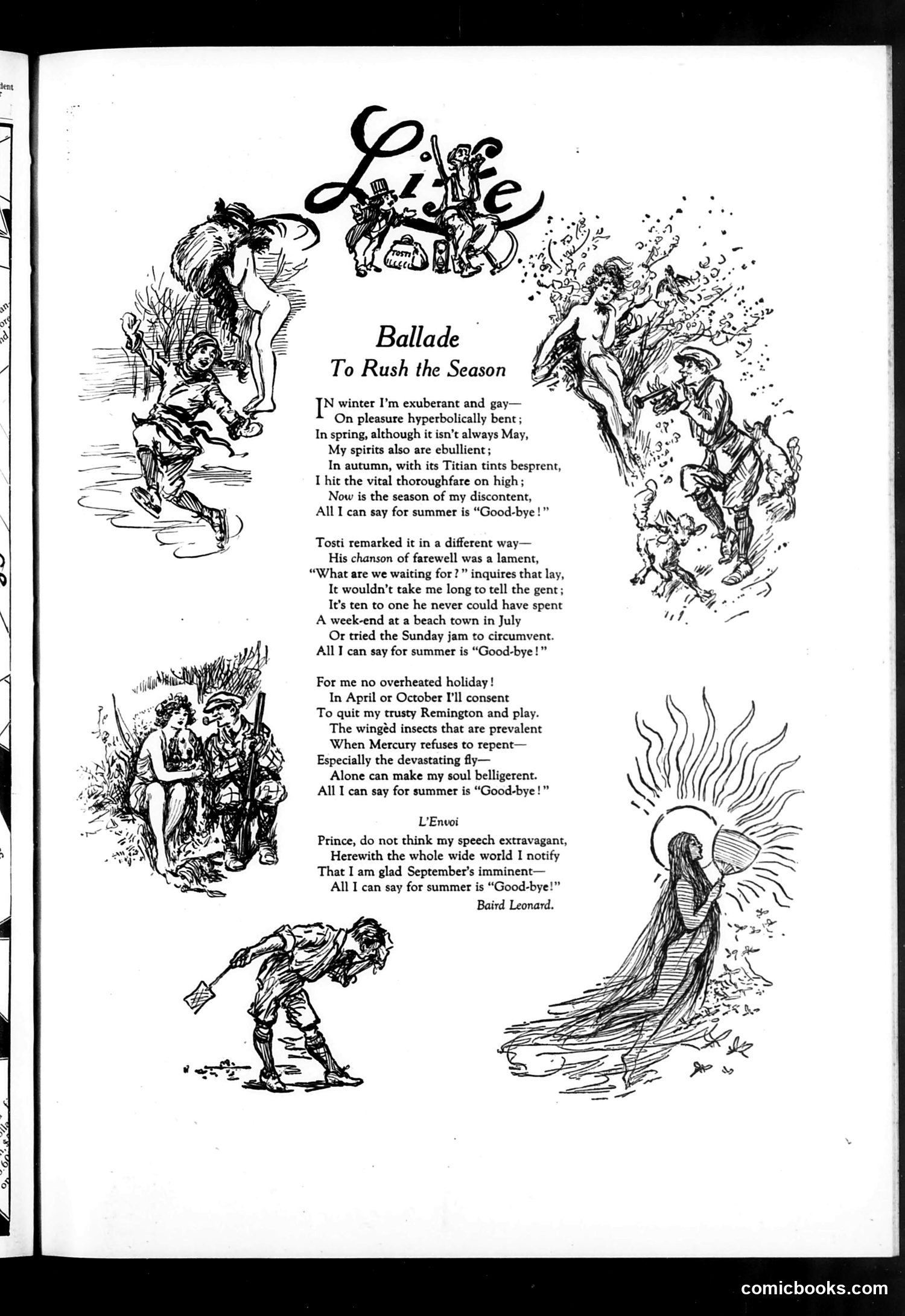
This satirical poem by Baird Leonard mocks the American tendency to artificially accelerate seasonal activities and holidays. The speaker expresses disdain for people who can't wait for each season properly—those who rush summer plans in spring, exhaust themselves with overbooked holidays, and generally refuse to let seasons unfold naturally. The refrain "All I can say for summer is 'Good-bye!'" emphasizes exhaustion from premature season-rushing. References to "Mercury" and "the devastating fly" suggest summer's actual discomforts. The accompanying whimsical illustrations depict various figures in seasonal chaos. The satire targets American impatience and commercialism—the cultural pressure to consume holidays and leisure time frantically rather than savor them appropriately.
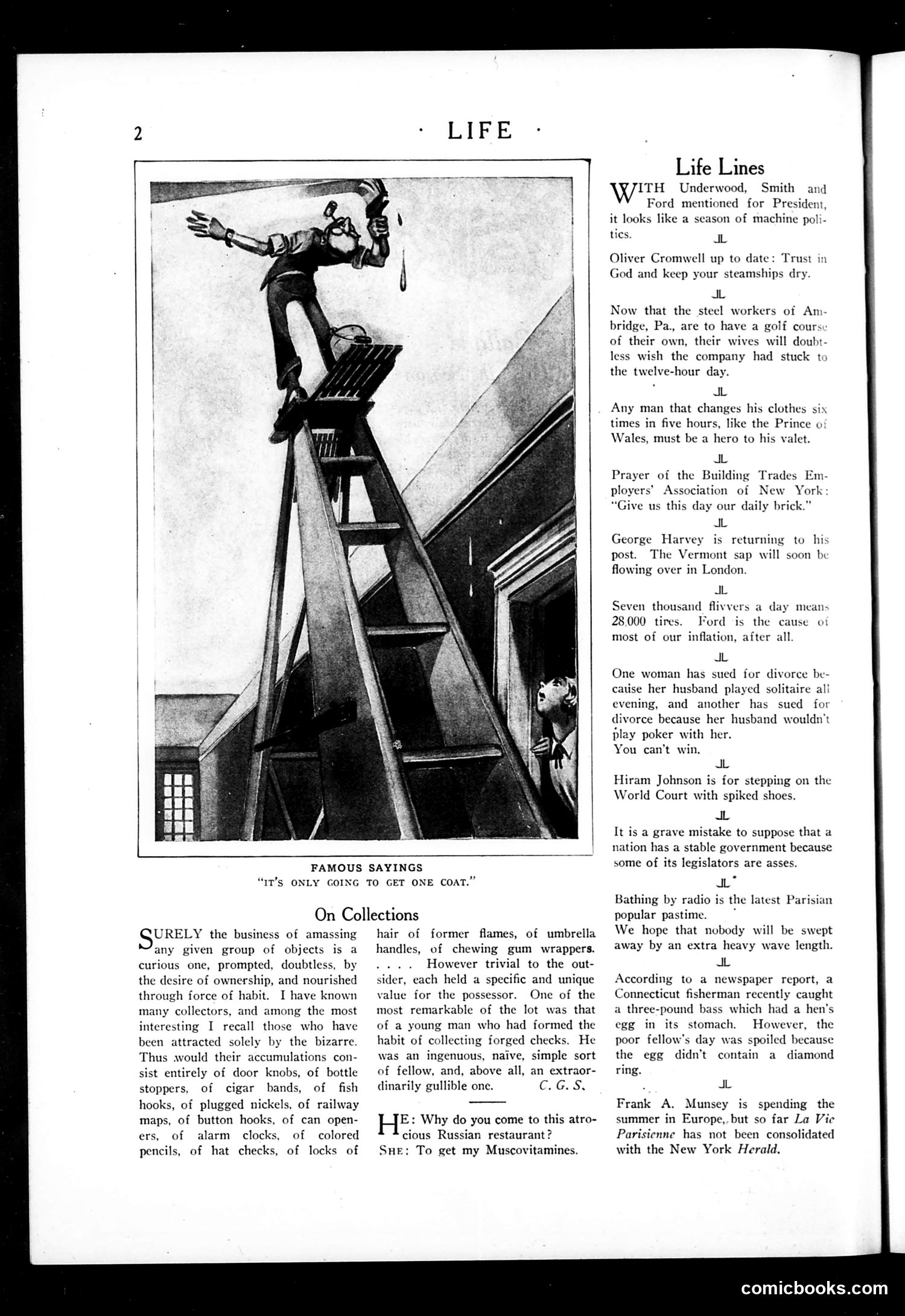
The main cartoon, captioned "It's only going to get one coat," depicts a man precariously balanced atop a tall ladder, arms flailing as he appears to lose his footing. The image satirizes inadequate or cheap workmanship—the single coat of paint presumably representing shoddy, economical work that won't last. The "Life Lines" column contains brief satirical commentary on contemporary topics: mentions of Underwood, Smith, and Ford as presidential candidates; complaints about industrial working conditions (Ambridge steel workers); and critiques of frivolous wealth (the Prince of Wales changing clothes frequently). The "On Collections" section humorously catalogs obsessive collecting habits, poking fun at those who hoard trivial objects. The overall tone reflects early 20th-century American satirical magazine conventions—punchy social criticism and light mockery of politics and modern life.
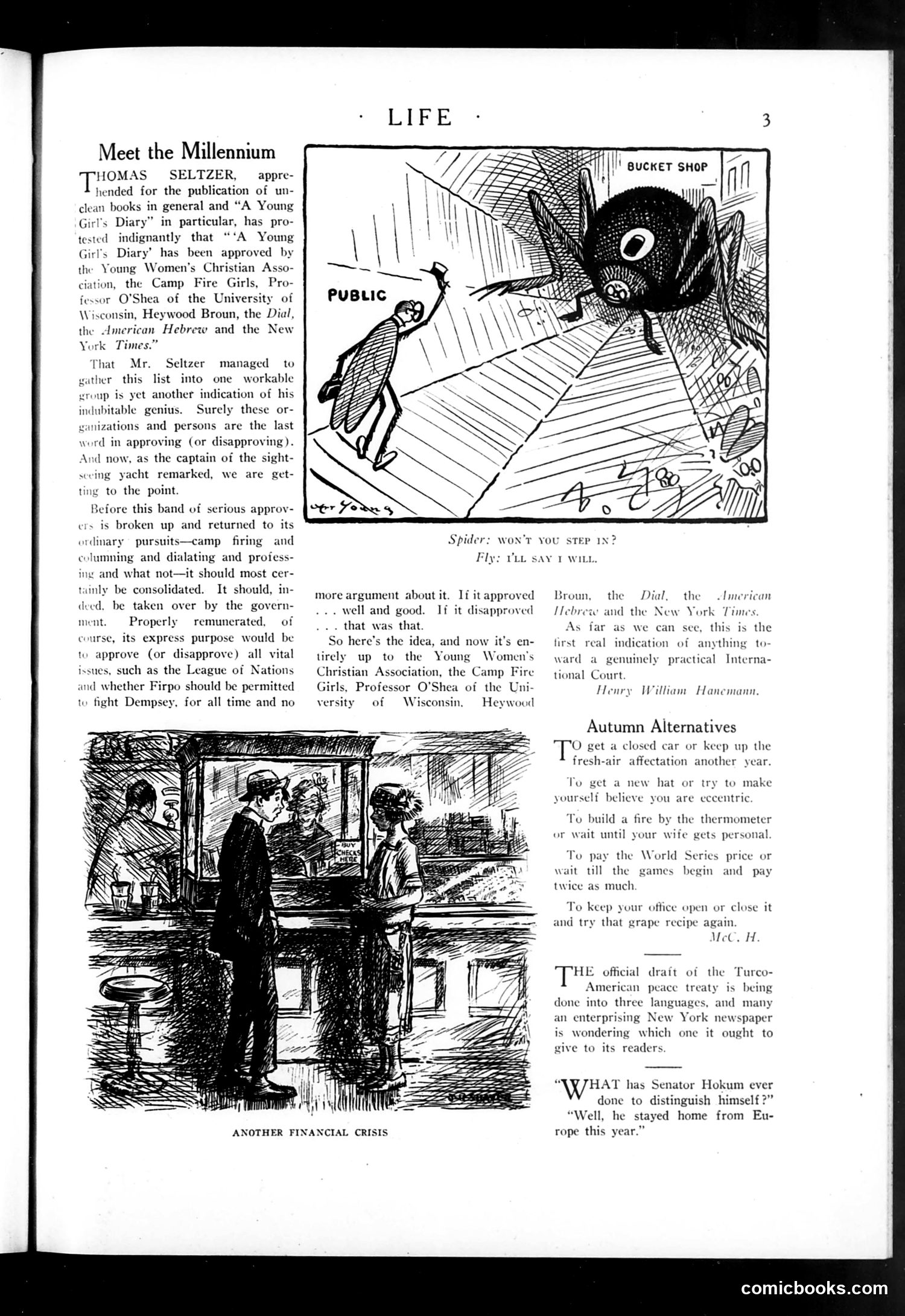
**Top Cartoon ("Spider; Won't You Step In?"):** A large spider in a "Bucket Shop" web traps a tiny human figure. This satirizes **bucket shops**—fraudulent brokerage operations that took customer money without actually executing trades. The spider represents the predatory operators; the human, the naive investor. This was a genuine financial scam of the early 20th century. **Bottom Cartoon ("Another Financial Crisis"):** Shows men at what appears to be a store counter during economic hardship, likely referencing Depression-era financial strain or domestic budget pressures. **Text ("Meet the Millennium"):** Discusses Thomas Seltzer's approval of "A Young Girl's Diary"—a controversial book. The piece playfully suggests such approvals indicate cultural gatekeepers' declining influence over what society accepts.
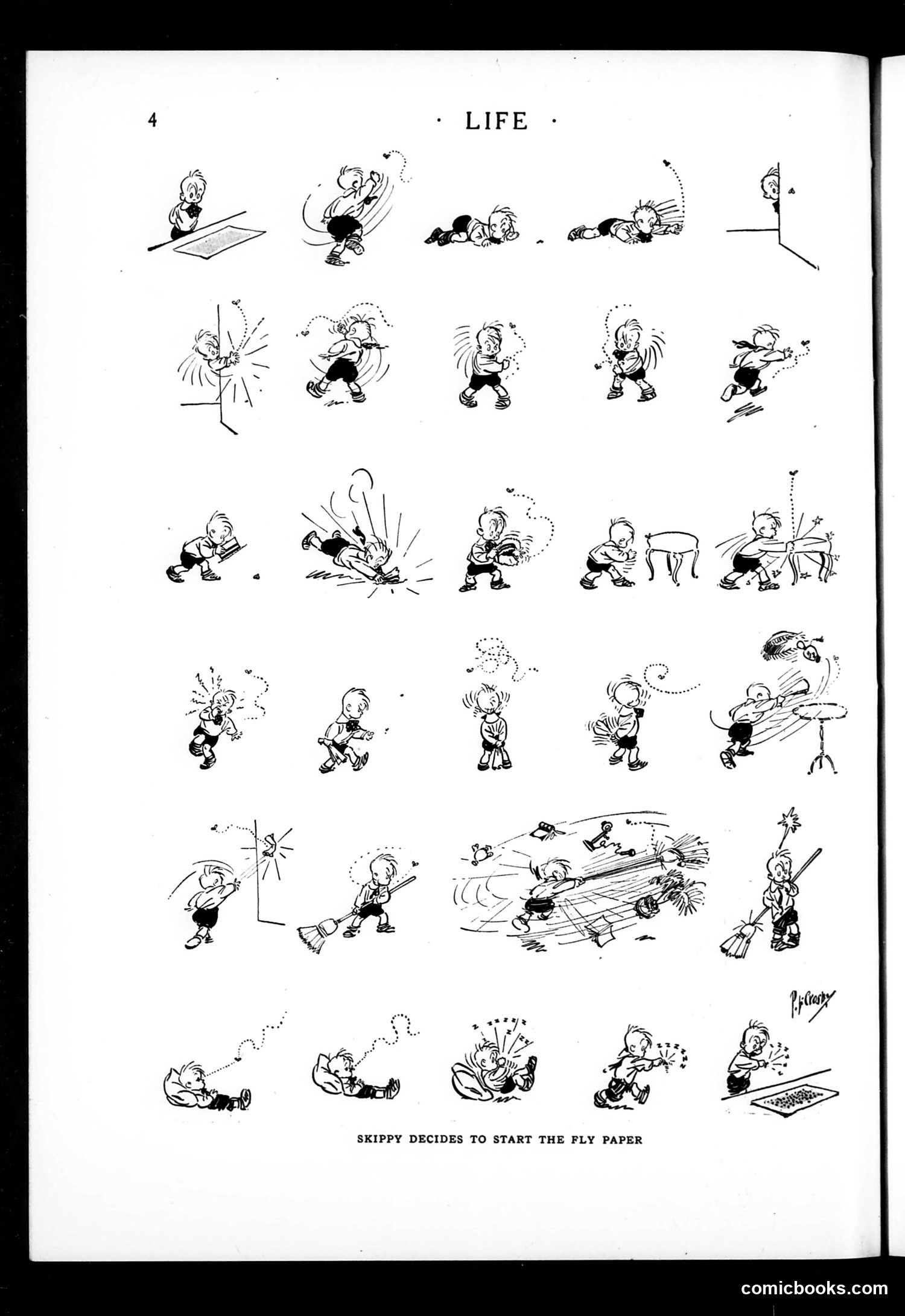
This page depicts **Skippy**, a popular comic strip character from the early 20th century, in a series of sequential panels showing a child's mischievous activities culminating in starting to make or deploy flypaper. The humor is entirely **non-political**—it's domestic comedy about childhood pranks and misadventure. Each panel captures exaggerated physical comedy: Skippy running, jumping, colliding with furniture, and generally creating chaos around a house. The final caption indicates he's begun the "fly paper" project, suggesting messy, destructive play typical of a rambunctious kid. This represents **Life magazine's** use of established comic characters for light entertainment rather than social satire. The appeal is visual slapstick humor targeting family audiences.
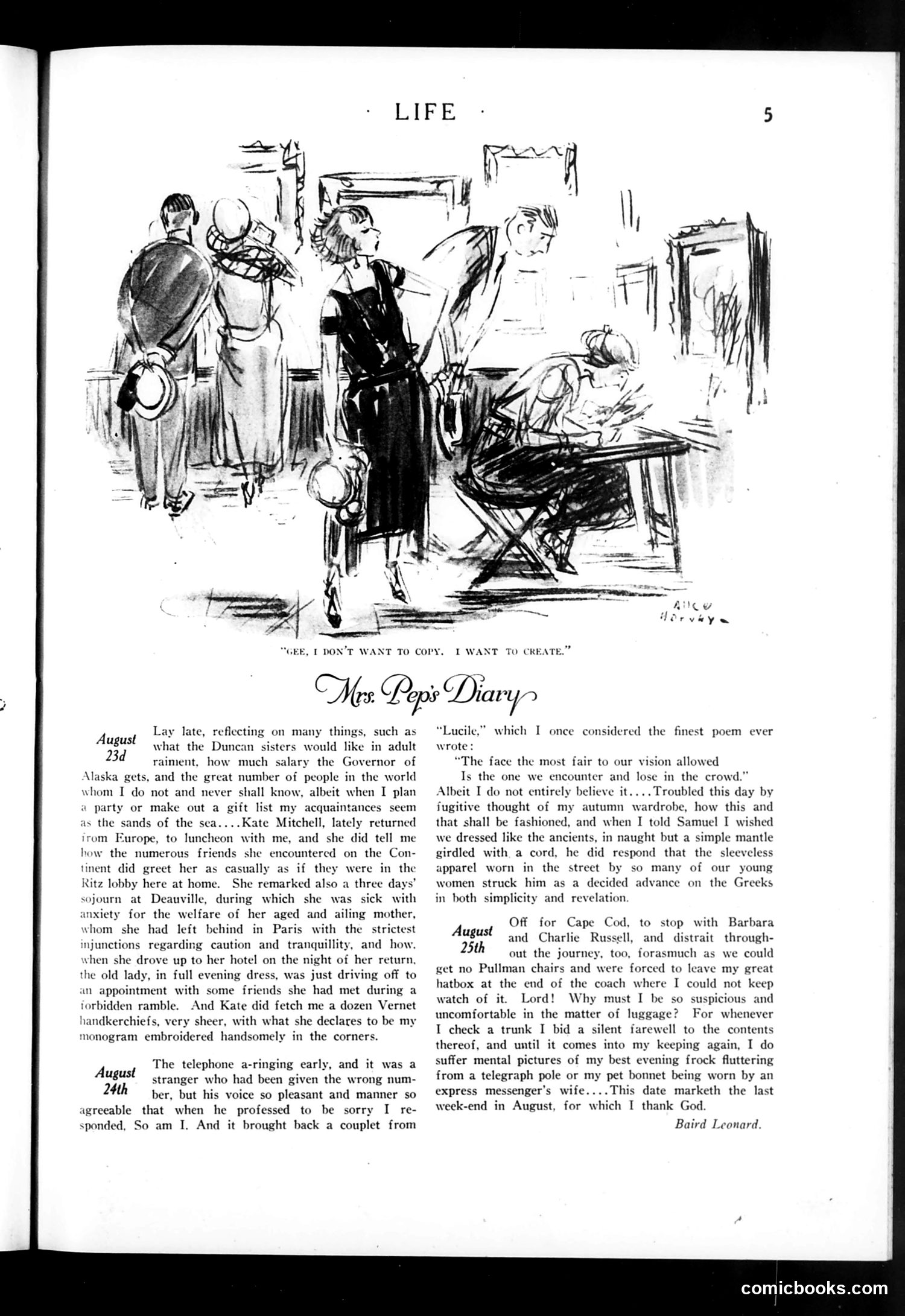
This page contains a satirical diary entry and accompanying sketch rather than a political cartoon. The illustration shows a woman in a black dress declaring "GEE, I DON'T WANT TO COPY, I WANT TO CREATE" to onlookers in what appears to be a domestic setting. The diary entries (August 23rd-25th) mock a woman's pretensions to artistic and intellectual aspirations while she remains absorbed in domestic concerns—reflecting on her social circle, dealing with travel logistics, and worrying about luggage. The satire lies in the gap between her stated desire for creative originality and her actual preoccupation with mundane, conventional domestic matters. This represents typical early-20th-century humor mocking upper-class women's cultural pretensions.
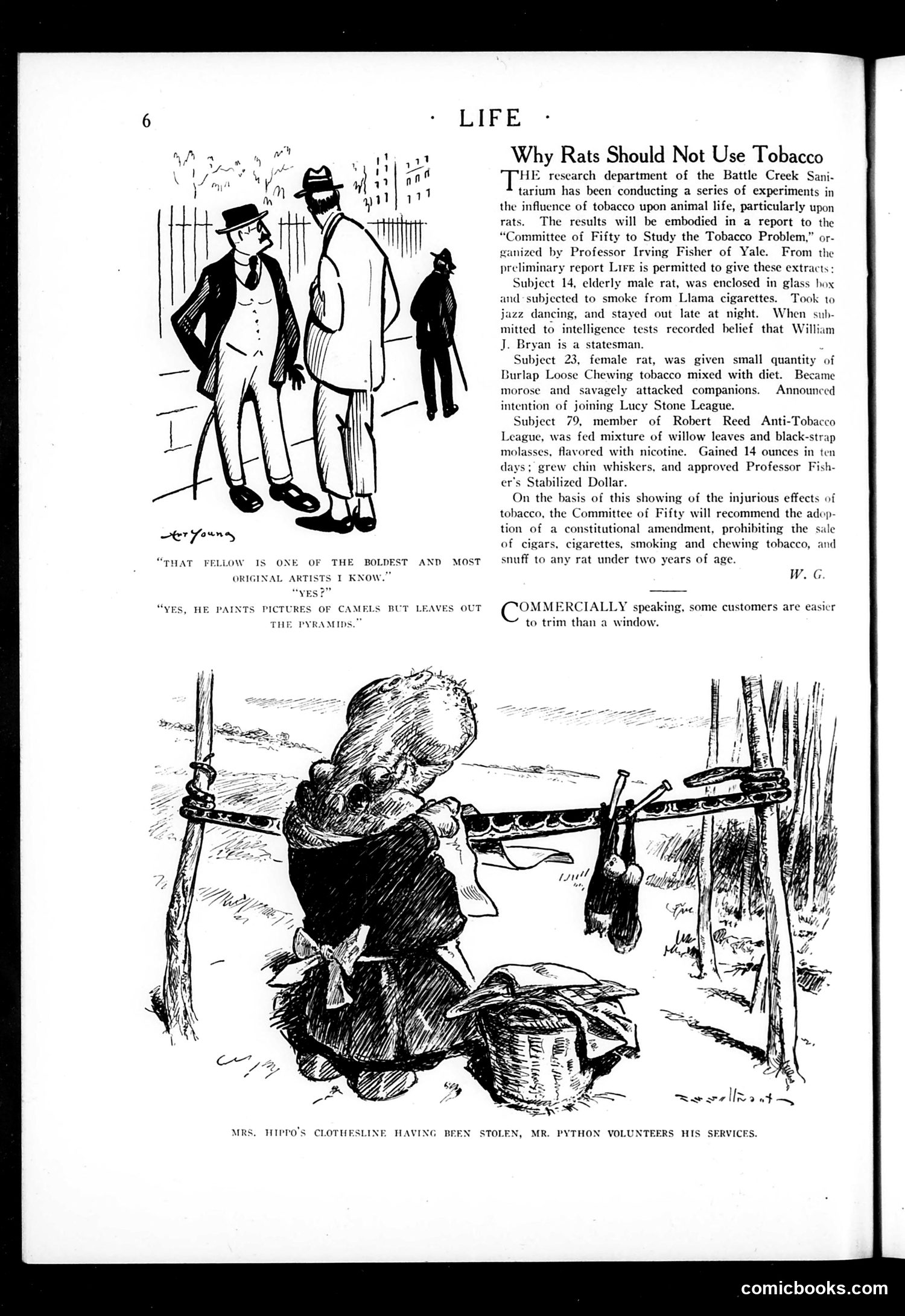
This page contains two distinct items: **Top Section:** A satirical article titled "Why Rats Should Not Use Tobacco" describes a scientific study at Battle Creek Sanitarium testing tobacco's effects on rats. The text humorously reports results—one rat became "morose," another gained weight after nicotine treatment—presenting the findings as if they were serious research. This appears to satirize both pseudo-scientific justifications for anti-tobacco campaigns and the era's various health fads. **Bottom Cartoon:** Shows a woman doing laundry while a snake ("Mr. Python") retrieves clothes from a clothesline. The caption reads: "Mrs. Hippo's Clothesline Having Been Stolen, Mr. Python Volunteers His Services." This is a visual pun playing on the absurdity of unlikely animal substitutions for everyday problems. Both items exemplify Life's satirical humor style.
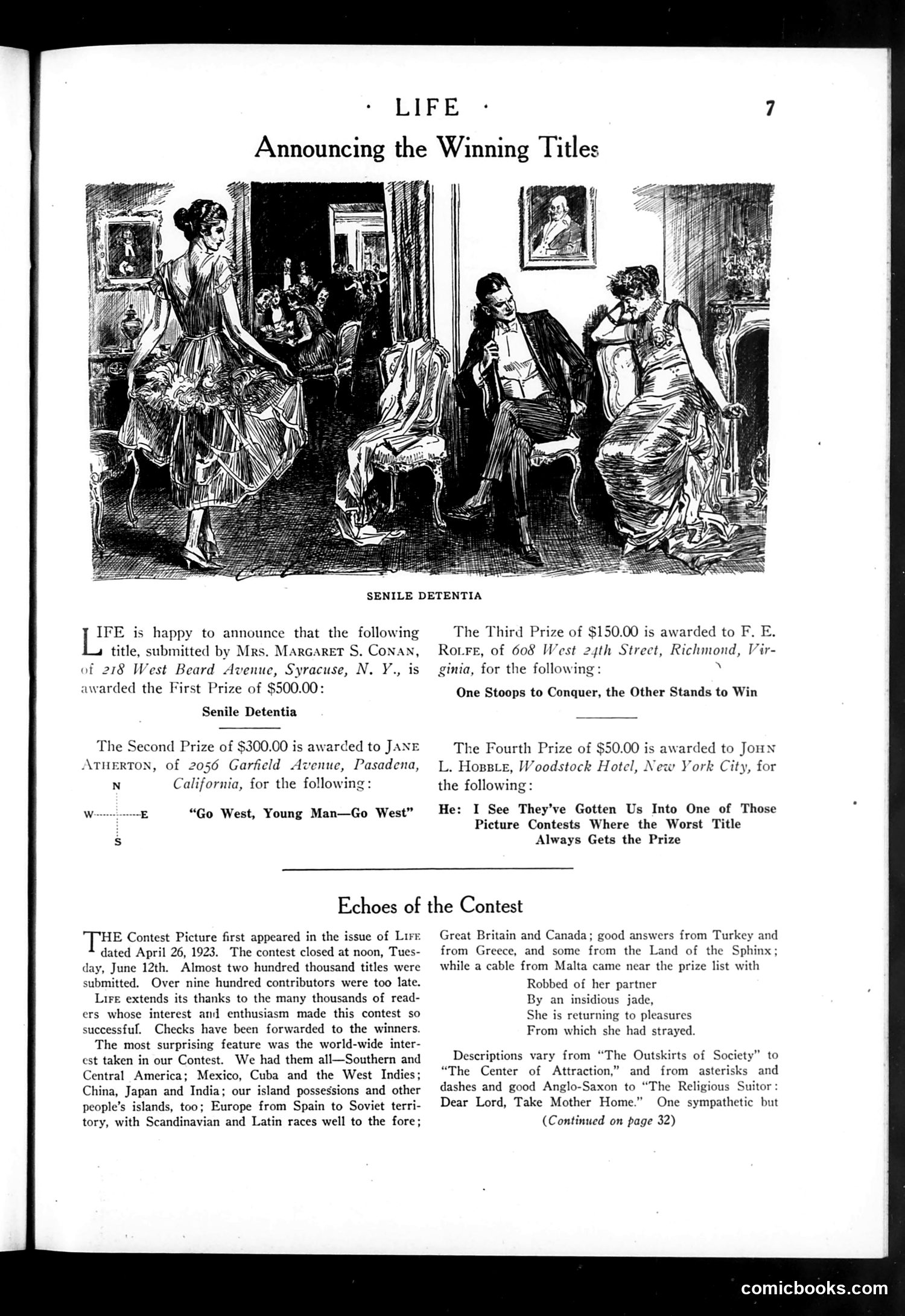
This page announces winners of a Life magazine picture-titling contest. The illustration at top depicts a formal social gathering—men in tuxedos and women in elegant dresses at what appears to be a party or reception. The winning titles are: - **First Prize** ($500): "Senile Detentia" by Margaret S. Conan - **Second Prize** ($300): "Go West, Young Man—Go West" by Jane Atherton - **Third Prize** ($150): "One Stoops to Conquer, the Other Stands to Win" by F.E. Rolfe - **Fourth Prize** ($50): A title about picture contests and worst titles always winning The "Echoes of the Contest" section notes the contest drew nearly 900 submissions from worldwide readers, including responses from remote locations. The satire lies in readers creating humorous or cynical captions for the dignified scene—the winning titles suggest social commentary about aging, westward migration, and the arbitrariness of contests themselves.
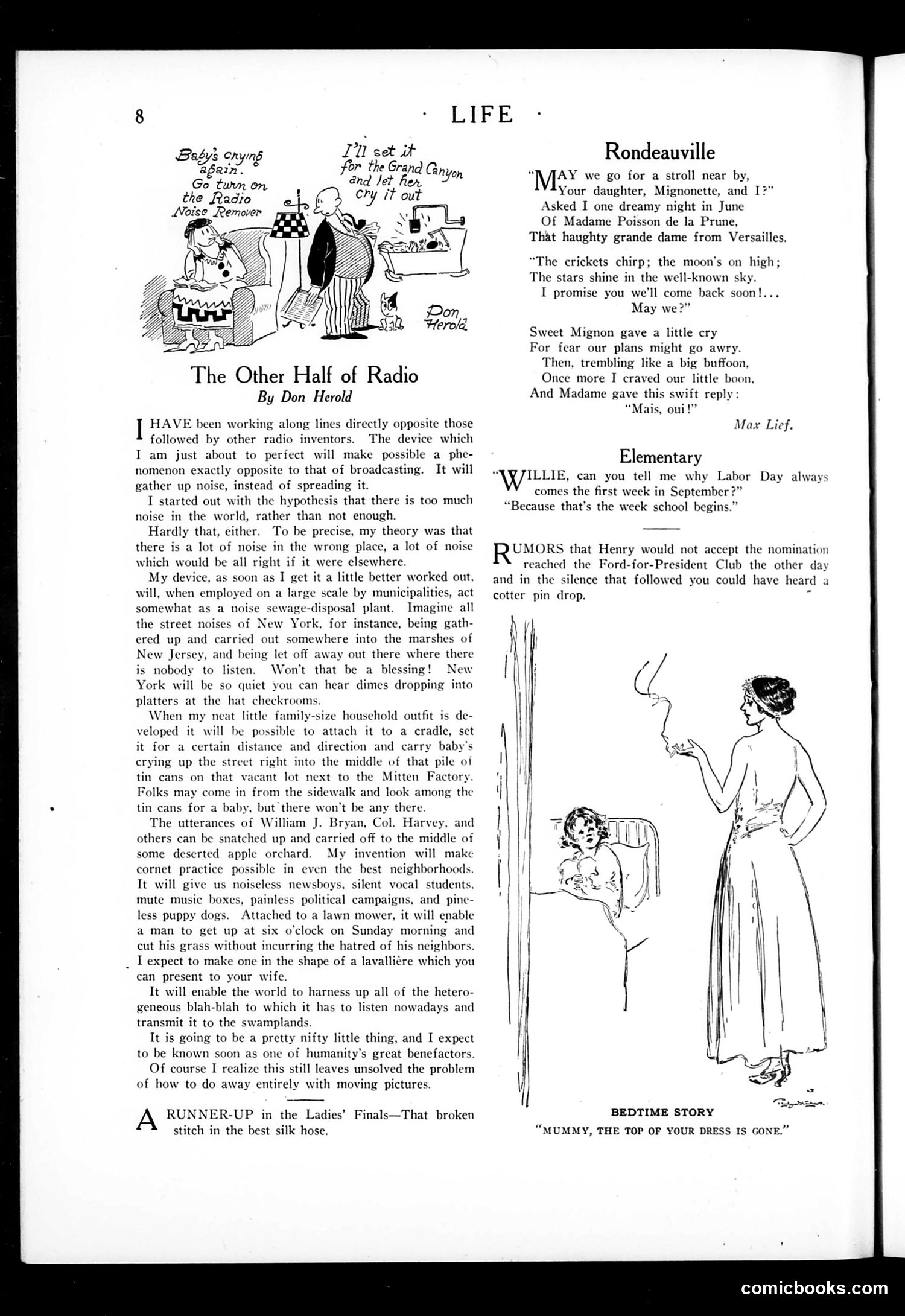
**"The Other Half of Radio"** by Don Herald is a humorous essay proposing an anti-noise device—essentially reversing radio's function to *collect* rather than *spread* noise. Herald satirizes urban cacophony by suggesting gathering New York street sounds and dumping them in New Jersey marshes, capturing neighborhood noises for "silent vocal students" and "painless political campaigns." The illustration shows a family scene with radio technology, likely depicting the contrast between radio's promised benefits and household reality. **"Bedtime Story"** cartoon depicts a mother and child, with the caption "Mummy, the top of your dress is gone"—a gentle joke about parental dishevelment or wardrobe malfunction during bedtime routines. Both pieces represent typical Life magazine satire: social commentary wrapped in domestic humor.
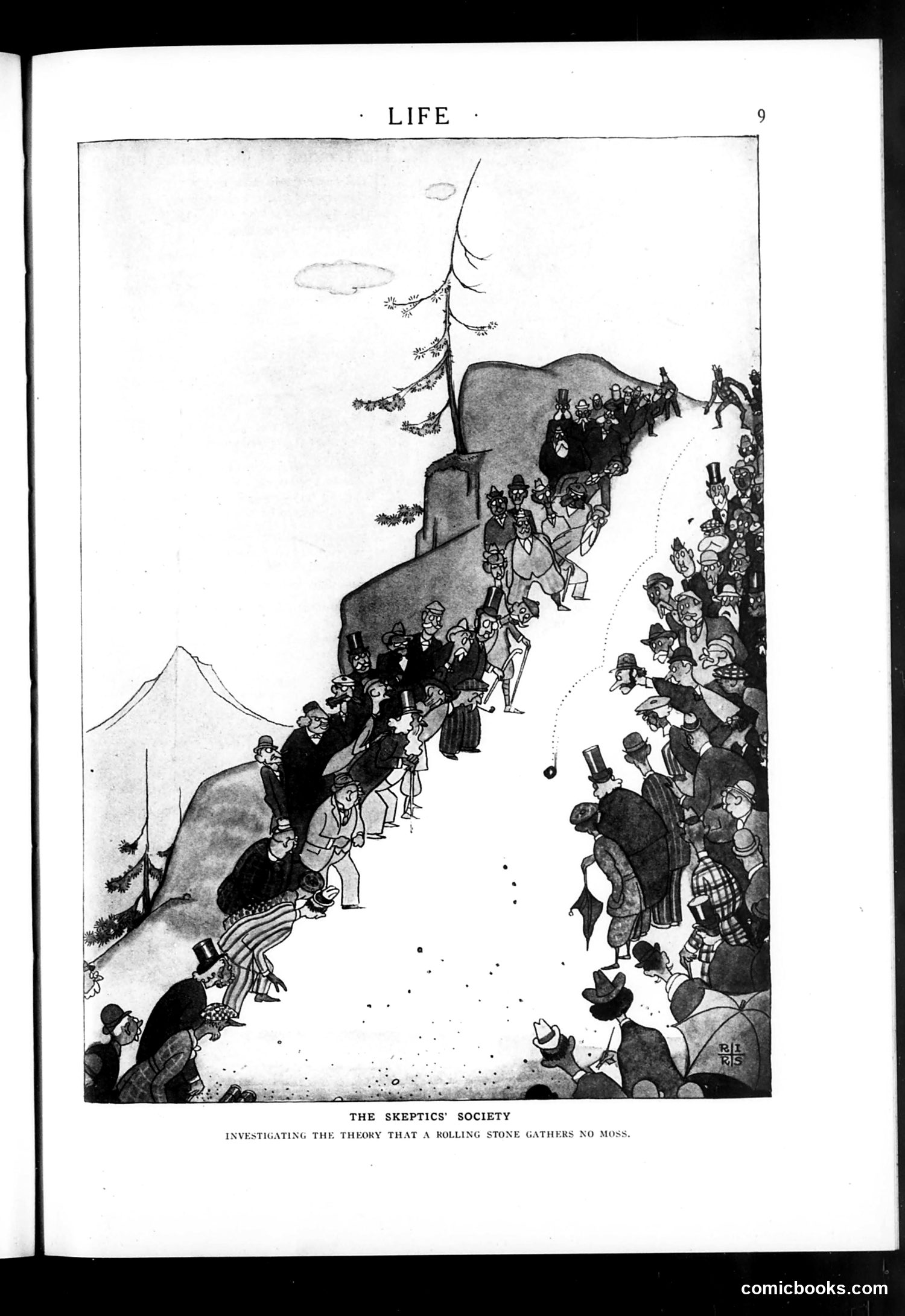
This satirical cartoon depicts a large group of formally-dressed people climbing a steep, rocky mountain path. The caption reads: "INVESTIGATING THE THEORY THAT A ROLLING STONE GATHERS NO MOSS." The joke is a visual pun on the proverb "a rolling stone gathers no moss" (meaning constant movement prevents accumulation or stagnation). The cartoon literalizes this by showing skeptics physically investigating whether an actual rolling stone collects moss—climbing a mountain to conduct what appears to be an absurdly literal, pedantic scientific examination of a common saying. This mocks overly literal-minded people, pedantic analysis, or perhaps scientific societies that pursue trivial investigations rather than meaningful inquiry. The formal dress and large organized group suggest institutional pretension facing ridicule.
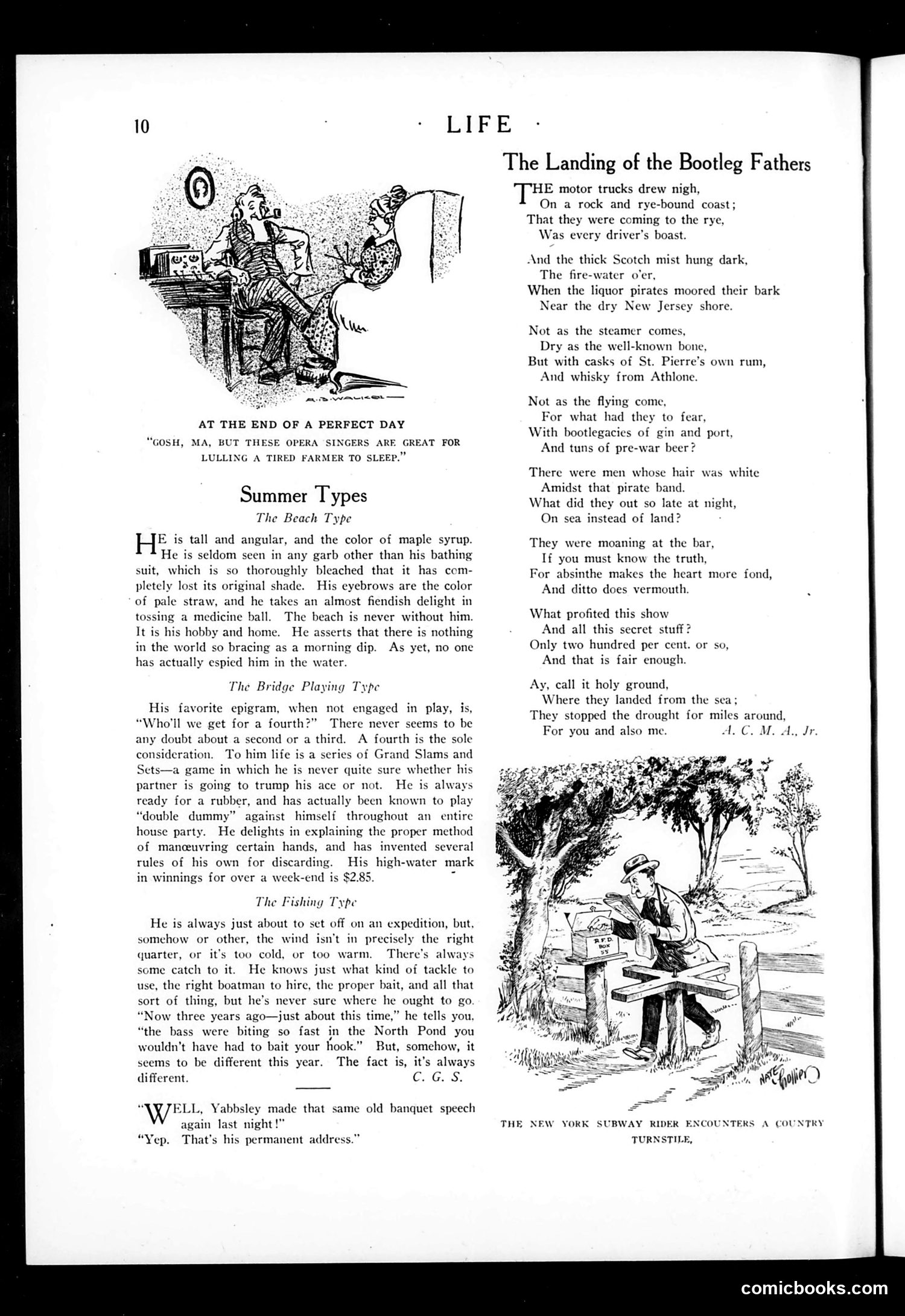
This page contains humorous social commentary rather than political cartoons. The top illustration shows fashionably dressed figures at what appears to be a speakeasy or illicit drinking establishment—referencing Prohibition-era bootlegging. "Summer Types" offers satirical character sketches of three social archetypes: the Beach Type (a tall, angular man obsessed with bathing), the Bridge Playing Type (competitive card player), and the Fishing Type (an optimistic angler perpetually planning expeditions). The bottom illustration depicts a subway rider encountering a country person fishing, captioned "THE NEW YORK SUBWAY RIDER ENCOUNTERS A COUNTRY TURNSTILE." The poem "The Landing of the Bootleg Fathers" satirizes smugglers bringing illegal alcohol to New Jersey shores—a direct jab at Prohibition enforcement failures. The content mocks both social pretensions and the widespread lawlessness of the Prohibition era.
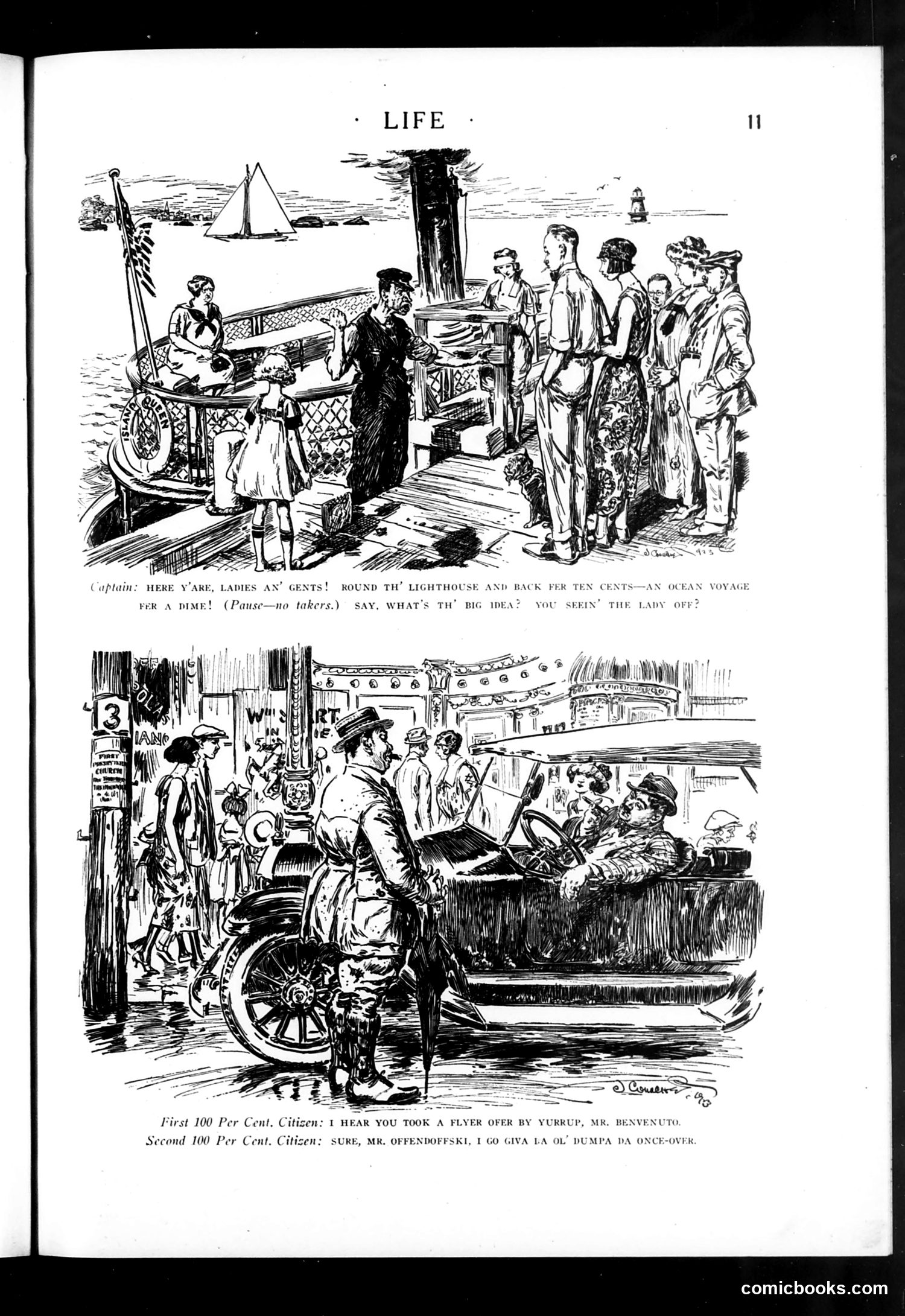
**Top cartoon:** A ship captain addresses wealthy passengers about an ocean voyage excursion to a lighthouse for ten cents, sarcastically asking "what's th' big idea?" The joke appears to mock either tourist exploitation or absurdly cheap entertainment offers to the wealthy. **Bottom cartoon:** Two street hustlers approach a well-dressed gentleman with investment schemes. One mentions "a flyer" from someone named Yurkuf about a lighthouse investment; the second pitches what appears to be a dubious financial scheme ("pumpa da once-over"). **The satire:** Both cartoons likely mock financial scams and get-rich-quick schemes targeting city dwellers, connecting questionable business proposals with shady street operators. The lighthouse reference links both images thematically around suspicious commercial ventures.
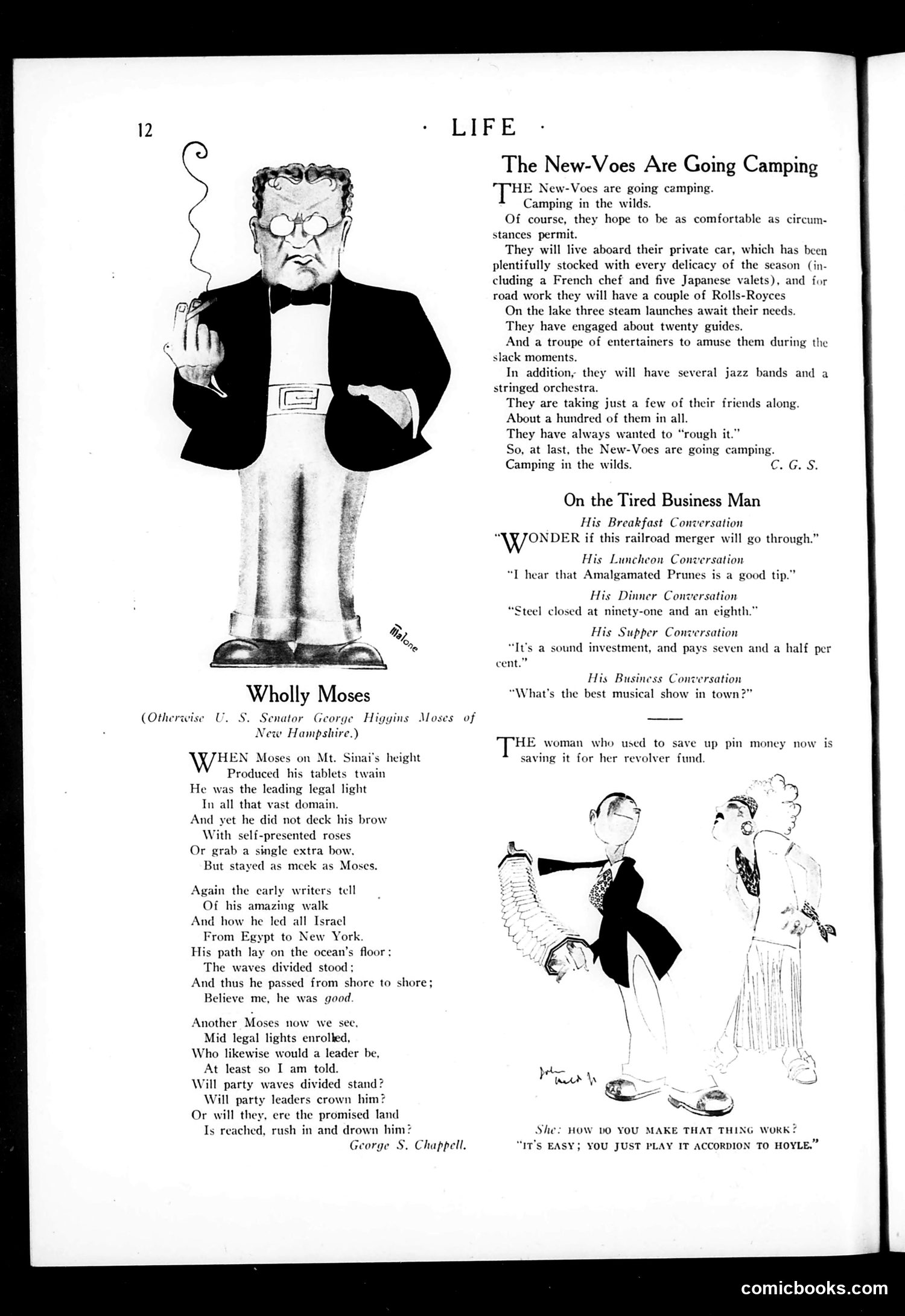
This page contains three distinct satirical pieces: 1. **"Wholly Moses"** - A poem by George S. Chappell mocking Senator George Higgins Moses of New Hampshire. The caricature shows him as self-important despite his meek demeanor. The verse sarcastically compares him to the Biblical Moses, suggesting his actual influence doesn't match his pretensions—he's "meek as Moses" rather than a transformative leader. 2. **"The New-Voes Are Going Camping"** - Satire on wealthy New Yorkers ("New-Voes") attempting "roughing it" while bringing excessive luxuries: French chefs, valets, steam launches, jazz bands, and orchestras. The joke mocks the contradiction of seeking wilderness adventure while maintaining aristocratic comfort. 3. **"On the Tired Business Man"** - Four brief vignettes showing a businessman's repetitive, mundane conversations about stocks and shows—satirizing corporate monotony. The bottom cartoon shows a man demonstrating an accordion, with caption about playing "according to Hoyle."
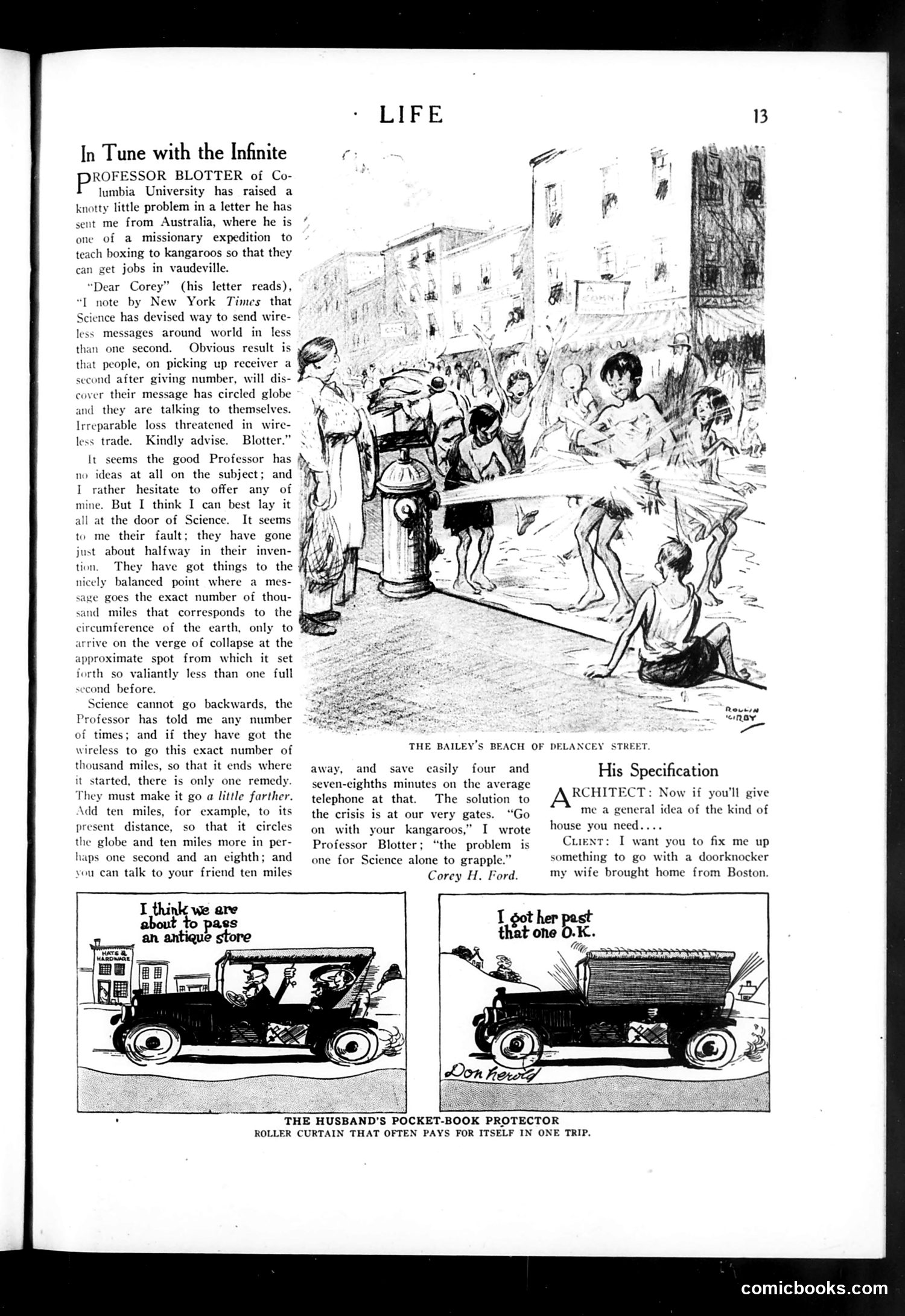
This page contains two distinct satirical pieces from *Life* magazine: **"In Tune with the Infinite"** (top): A humorous letter mocking Professor Blotter's impractical scientific proposal to send wireless messages via kangaroos in Australia. The satire targets overly theoretical scientists disconnected from practical reality—the joke being that the professor's elaborate scheme is ridiculous, yet he presents it with academic seriousness. **"His Specification"** (middle): A brief comic dialogue between an architect and client about building a house, with the client wanting to incorporate a "doodlebender" to transport his wife home from Boston—an absurdist non-solution to a domestic problem. **"The Husband's Pocket-Book Protector"** (bottom): Two-panel comic showing a "roller curtain" device protecting a husband's wallet during a car trip past an antique store, suggesting wives' uncontrollable shopping impulses. All three pieces use exaggeration and domestic/technological absurdity as humor vehicles.
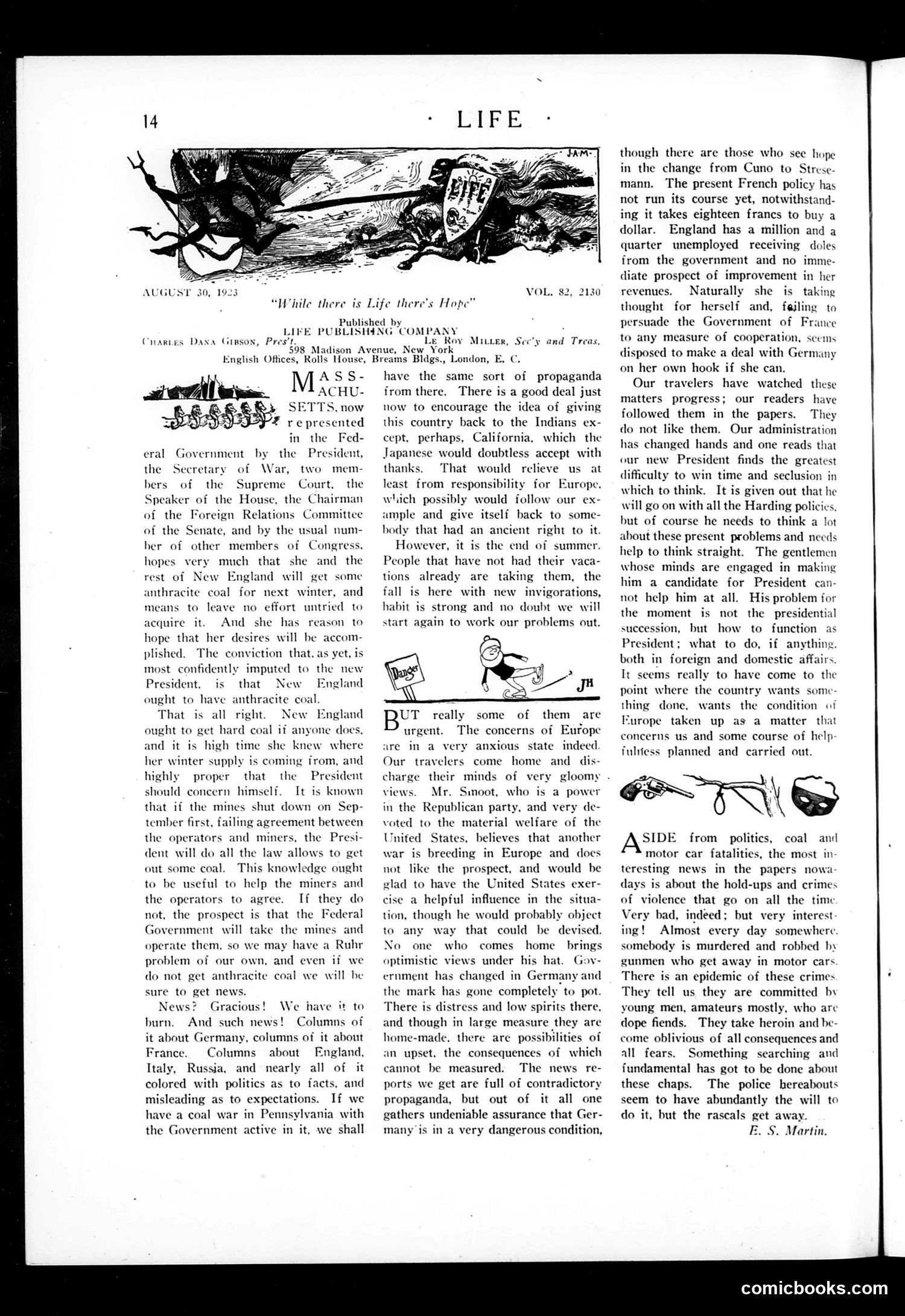
This page contains editorial commentary on post-WWI European conditions and domestic American politics. The main cartoon depicts a figure lying dead or collapsed, labeled "While there is Life there's Hope"—satirizing optimistic rhetoric about European recovery despite grim realities. The text discusses coal shortages, German economic collapse, and concerns about American intervention in European affairs. It references President Harding's administration and debates over potential U.S. involvement abroad. The author critiques sensationalized newspaper coverage of European crisis while advocating for practical problem-solving. A secondary cartoon shows a figure on a bicycle, appearing to illustrate domestic concerns about crime and violence mentioned in the final section, attributed to E.S. Martin. The overall tone expresses skepticism about both European stability and sensationalist American media coverage of international affairs.
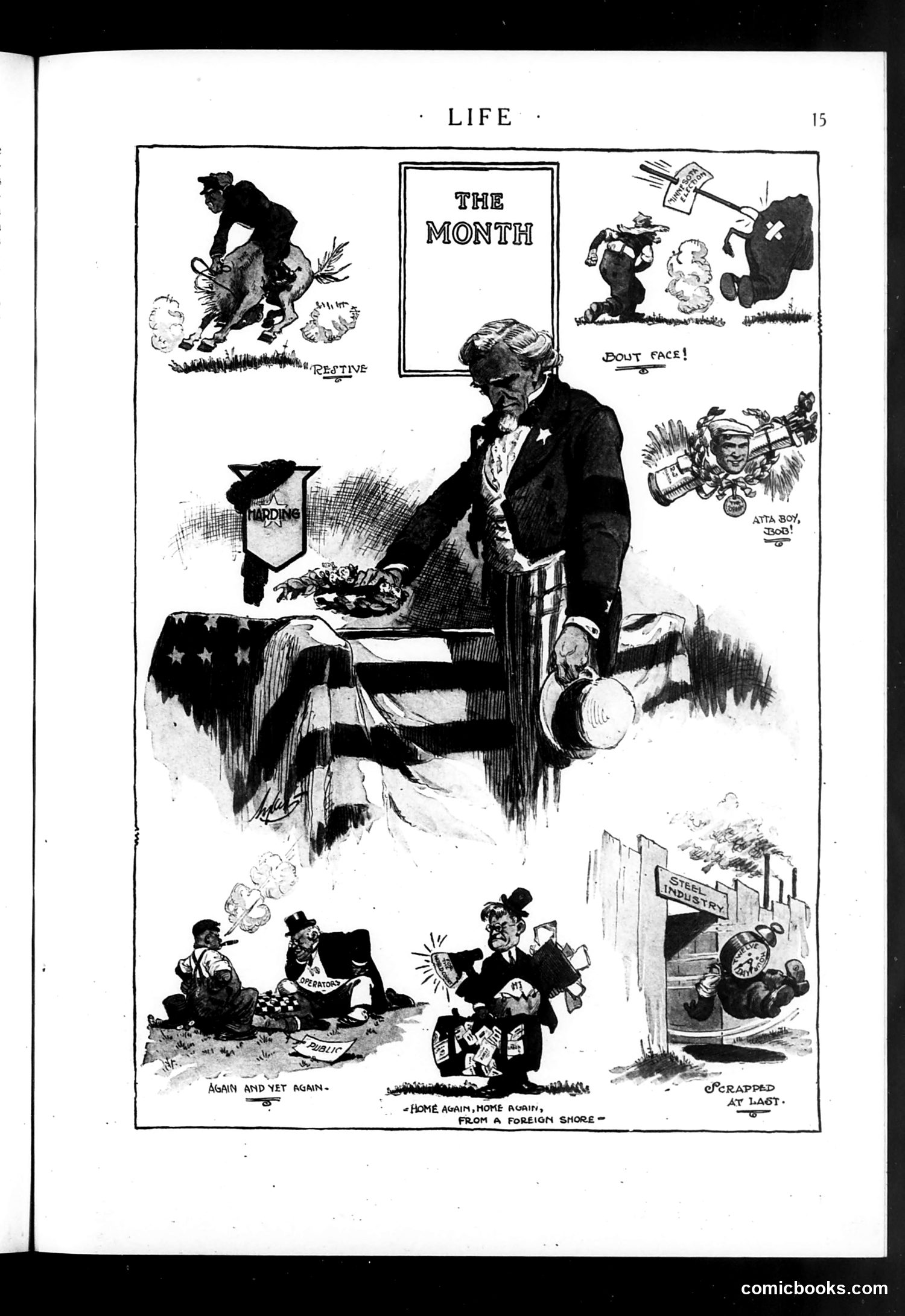
This Life magazine page satirizes President Warren G. Harding's administration through multiple vignettes. The central figure shows Uncle Sam at a table labeled "Harding," seemingly cooking or managing various crises. The surrounding panels mock recurring scandals: - "Protective" (upper left): likely references Harding's tariff policies - "Bout Face!" (upper right): suggests inconsistent foreign policy - "Again and Yet Again" (lower left): depicts persistent domestic problems - "Home Again, Home Aright, From a Foreign Shore": appears to mock Harding's return from diplomatic travels while domestic issues fester - "Scrapped at Last" (lower right): references administrative failures The cartoon's theme emphasizes that despite Harding's efforts abroad, fundamental problems at home remain unresolved—a common criticism of his presidency (1921-1923), which was later marred by the Teapot Dome scandal and other controversies.
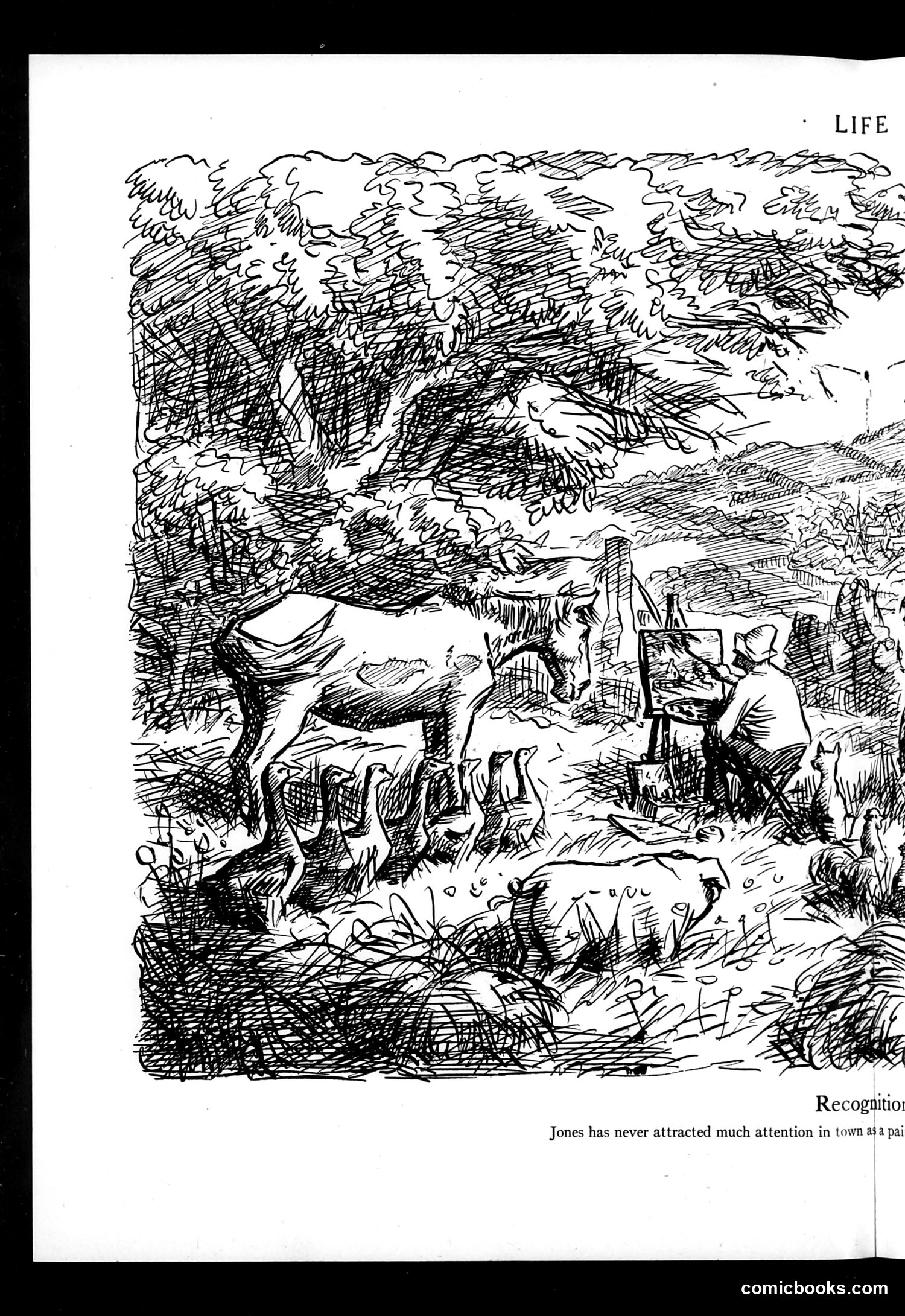
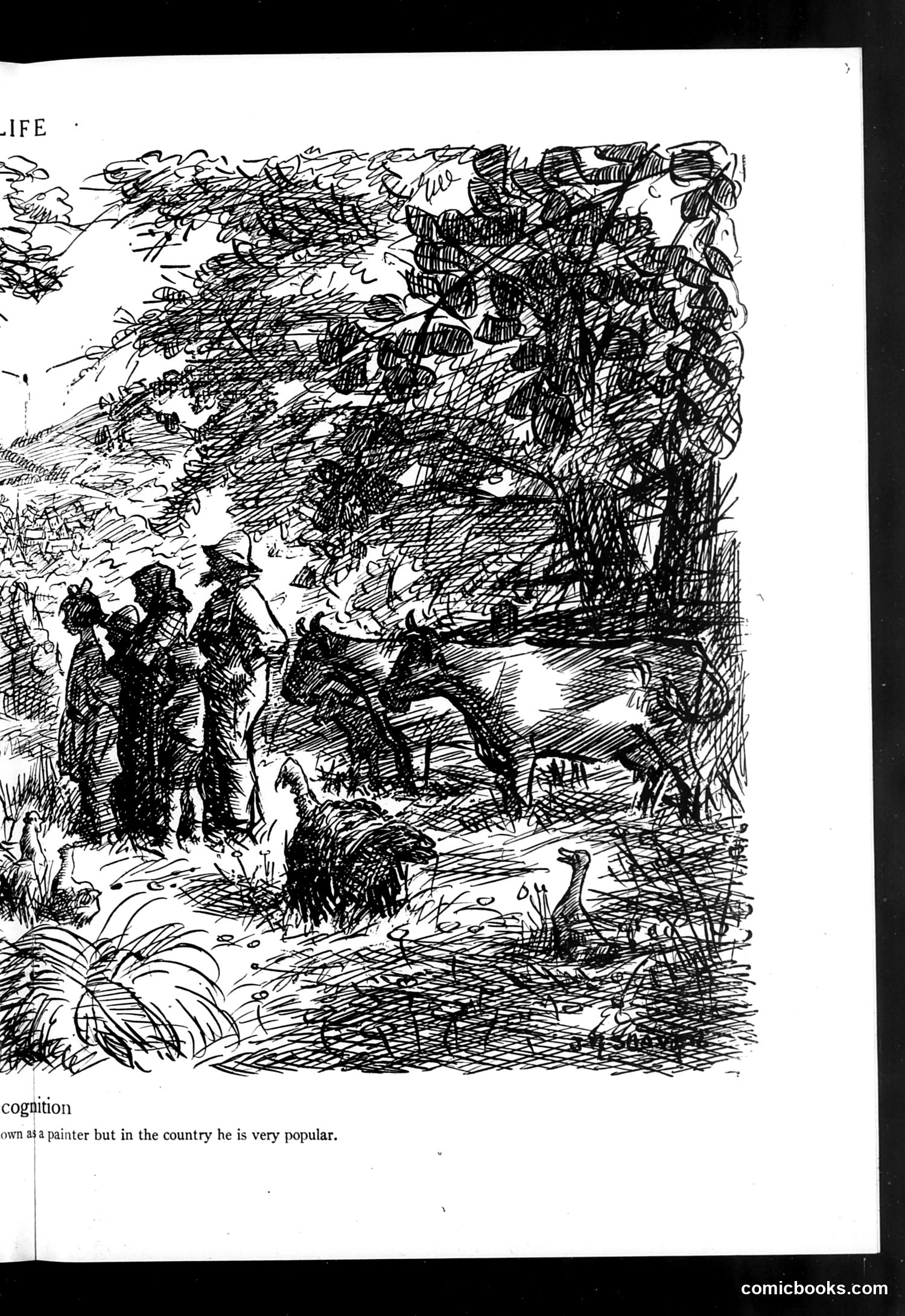
This page shows a sketch-style illustration of what appears to be a scene with several figures in period dress (possibly 19th century, based on the clothing and hats) standing near water, with vegetation in the background. A dog or similar animal is visible in the foreground. The OCR text is heavily corrupted and largely illegible, making it difficult to determine the cartoon's specific subject or satire. The visible fragments—"cognition," "painter," and "very popular"—suggest the humor may involve an artist or intellectual figure, but the incomplete text prevents confident interpretation of the joke or political reference. Without clearer text or additional context, I cannot reliably identify the specific figures, events, or satirical point this cartoon makes. The illustration style is consistent with Life magazine's satirical approach, but the meaning remains unclear.
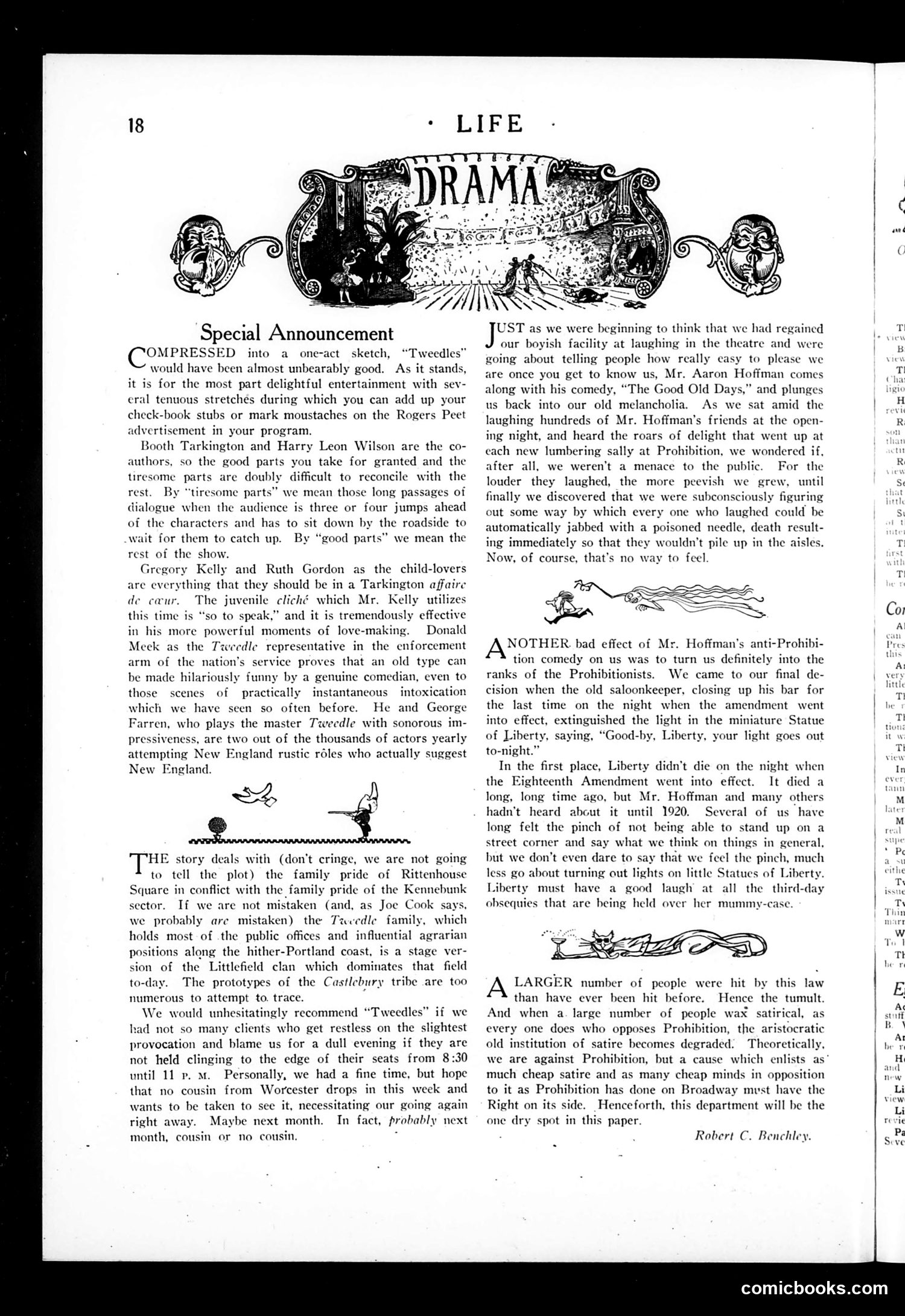
This is a theater review page from Life magazine critiquing two Broadway plays: "Tweedles" (co-written by Booth Tarkington and Harry Leon Wilson) and Aaron Hoffman's "The Good Old Days." The reviewer praises "Tweedles" selectively—the young leads Gregory Kelly and Ruth Gordon perform well, but lengthy dialogue passages drag. The plot involves a status conflict between Philadelphia's wealthy Rittenhouse Square society and a Maine coastal family (the "Tweedles"), apparently based on real regional clans. The second review targets Hoffman's anti-Prohibition comedy. The critic is irritated by audience laughter at jokes mocking Prohibition laws (recently enacted via the 18th Amendment in 1920). The reviewer's sarcastic response—imagining poisoning laughing audience members—illustrates the cultural tension over Prohibition: some viewed it as moral reform while others, like this critic, saw supporters as humorless zealots. The small decorative illustrations are typical period embellishments, not political cartoons.
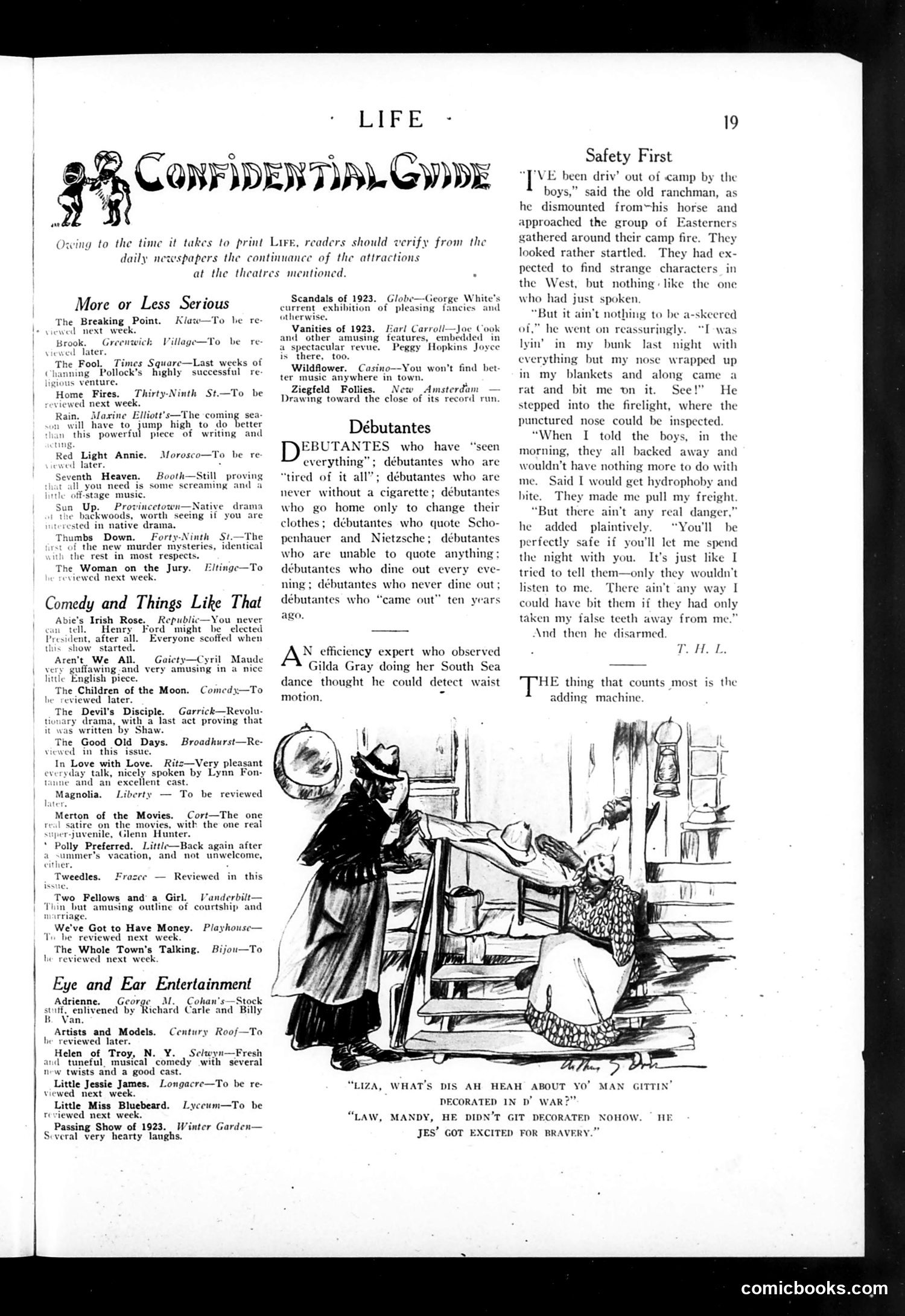
This page from Life magazine contains theater reviews and a cartoon satirizing Eastern city tourists visiting the American West. **The Main Cartoon:** depicts a cowboy speaking to a young Eastern woman at a ranch. The caption reads: "LIZA, WHAT'S DIS AH HEAH ABOUT YO' MAN GITTIN' DECORATED IN D' WAR?" / "LAW, MANDY, HE DIDN'T GIT DECORATED SHOW. JES' GOT EXCITED FOR BRAVERY." **The Satire:** The humor relies on stereotypical dialect and cultural clash—the rural cowboy using exaggerated African American vernacular ("dis," "gittin'") and the comic misunderstanding of "decorated" (military honor) as related to a war experience. This reflects 1920s attitudes portraying rural/Western characters as unsophisticated compared to urbane readers. **Context:** The accompanying text about "Safety First" describes Eastern tourists at a Western ranch, with the cowboy reassuring nervous city folk that dangers are exaggerated. The cartoon exemplifies Life's satirical approach to regional and class differences popular with its educated, urban readership.
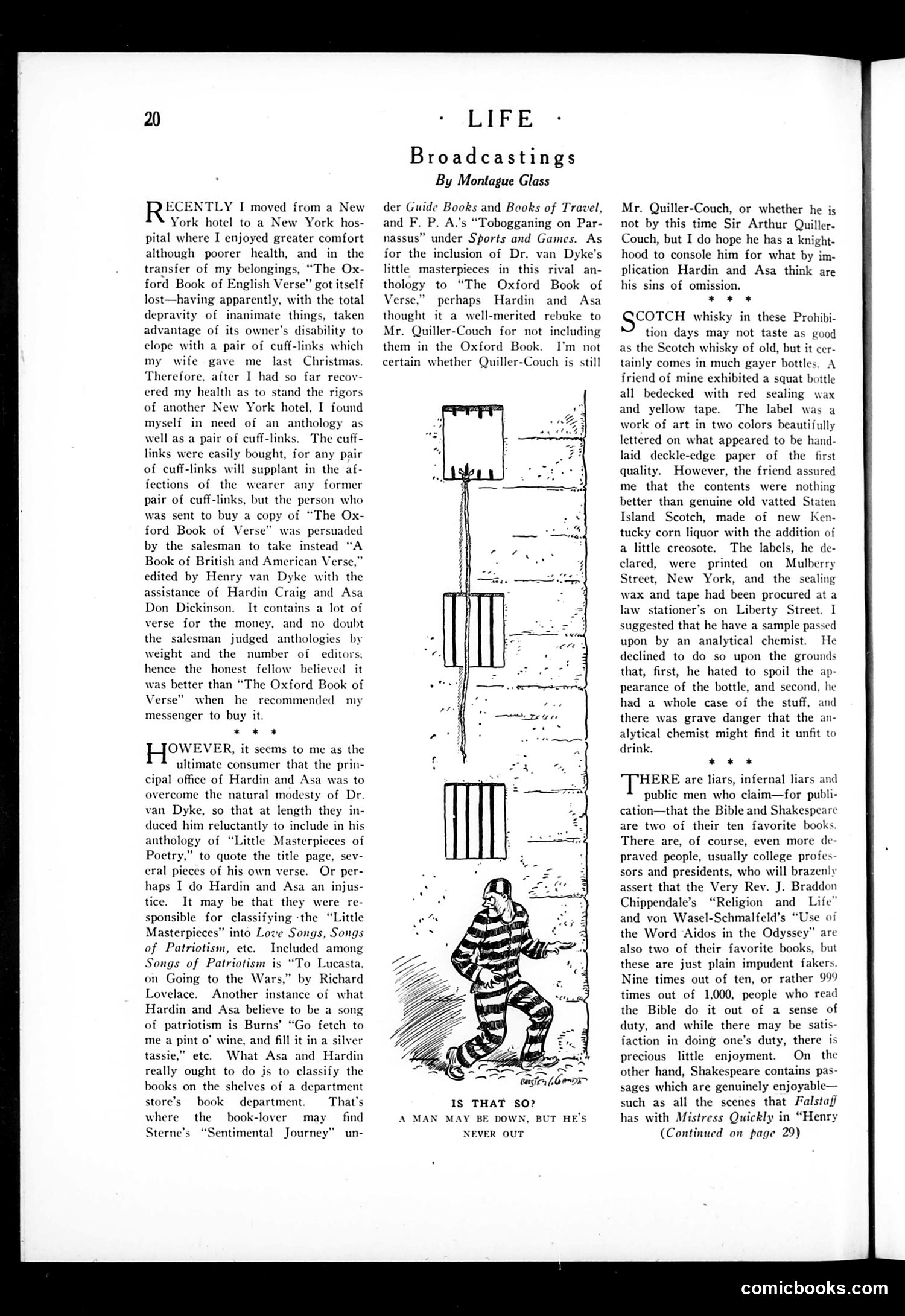
This essay satirizes the pretentiousness of literary gatekeeping and editorial hubris during Prohibition-era America. Glass mocks editors Hardin Craig and Asa Don Dickinson for persuading the modest Dr. Henry van Dyke to include his own verse in their anthology "Little Masterpieces of Poetry," positioning it as a rival to the prestigious "Oxford Book of Verse" edited by Sir Arthur Quiller-Couch. The author lampoons their misclassification choices (suggesting they'd shelve books absurdly—like placing travel guides under "Sports"). The cartoon shows a boxer, illustrating the essay's concluding anecdote about Prohibition-era "Scotch whisky"—cheap Kentucky corn liquor with creosote, deceptively packaged with fancy labels from Mulberry Street to appear authentic. The phrase "A Man May Be Down, But He's Never Out" comments on American resilience despite prohibition's failures and cultural compromises.
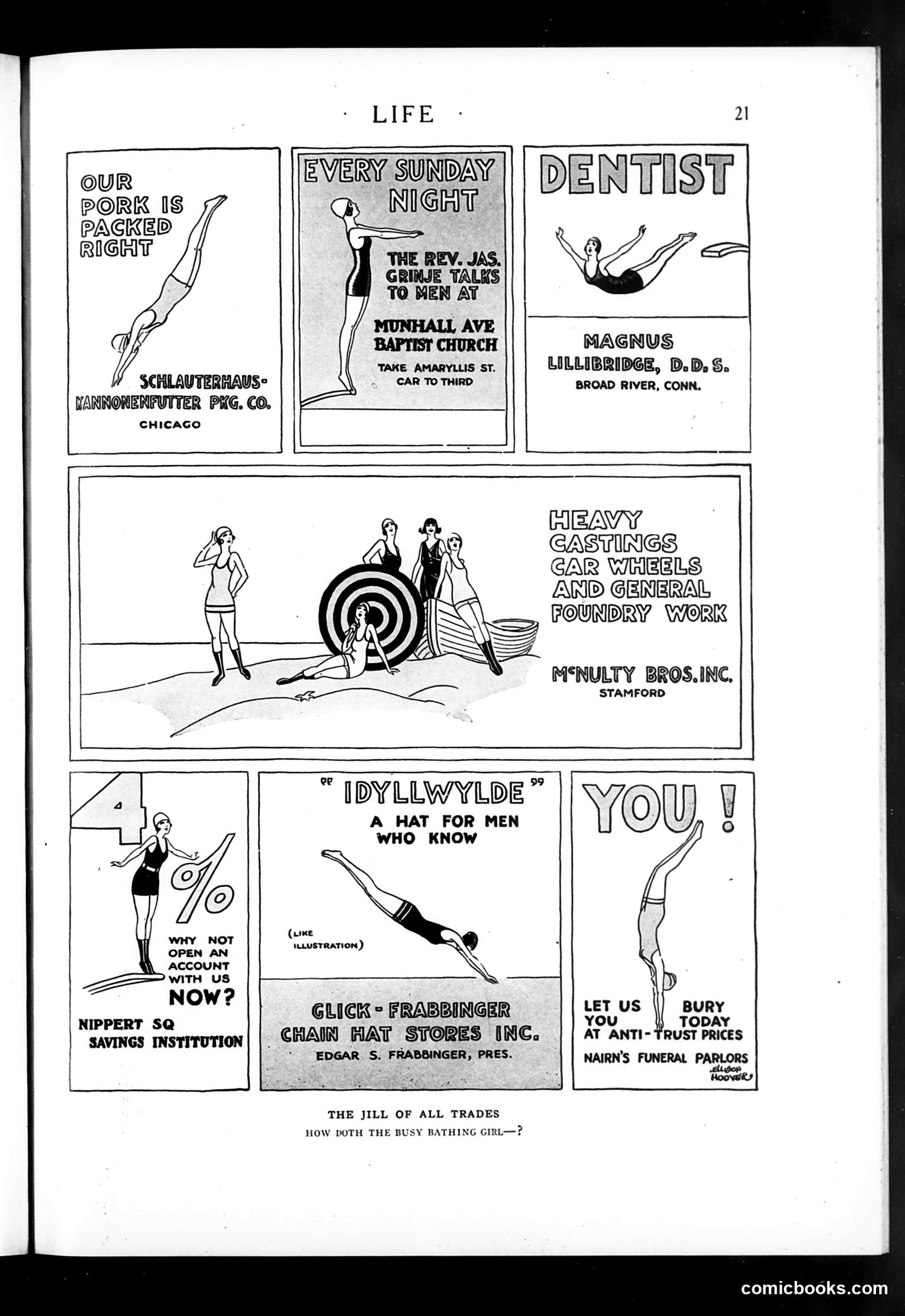
This page is primarily **advertising**, not political satire. It displays various small ads from early 20th-century businesses—a pork packer, Baptist church event, dentist, foundry, savings institution, hat store, and funeral parlor. The only apparent editorial content is the caption at bottom: "The Jill of All Trades—How Doth the Busy Bathing Girl—?" which frames multiple illustrations of women in swimwear diving, exercising, and posing. This appears to be light social commentary on the "modern woman" staying active and athletic—a topic of interest during the era when women's participation in sports and bathing was still relatively novel and subject to public discussion. The overall tone is lighthearted rather than biting satire. The page reflects 1920s consumer culture and attitudes toward women's changing social roles.
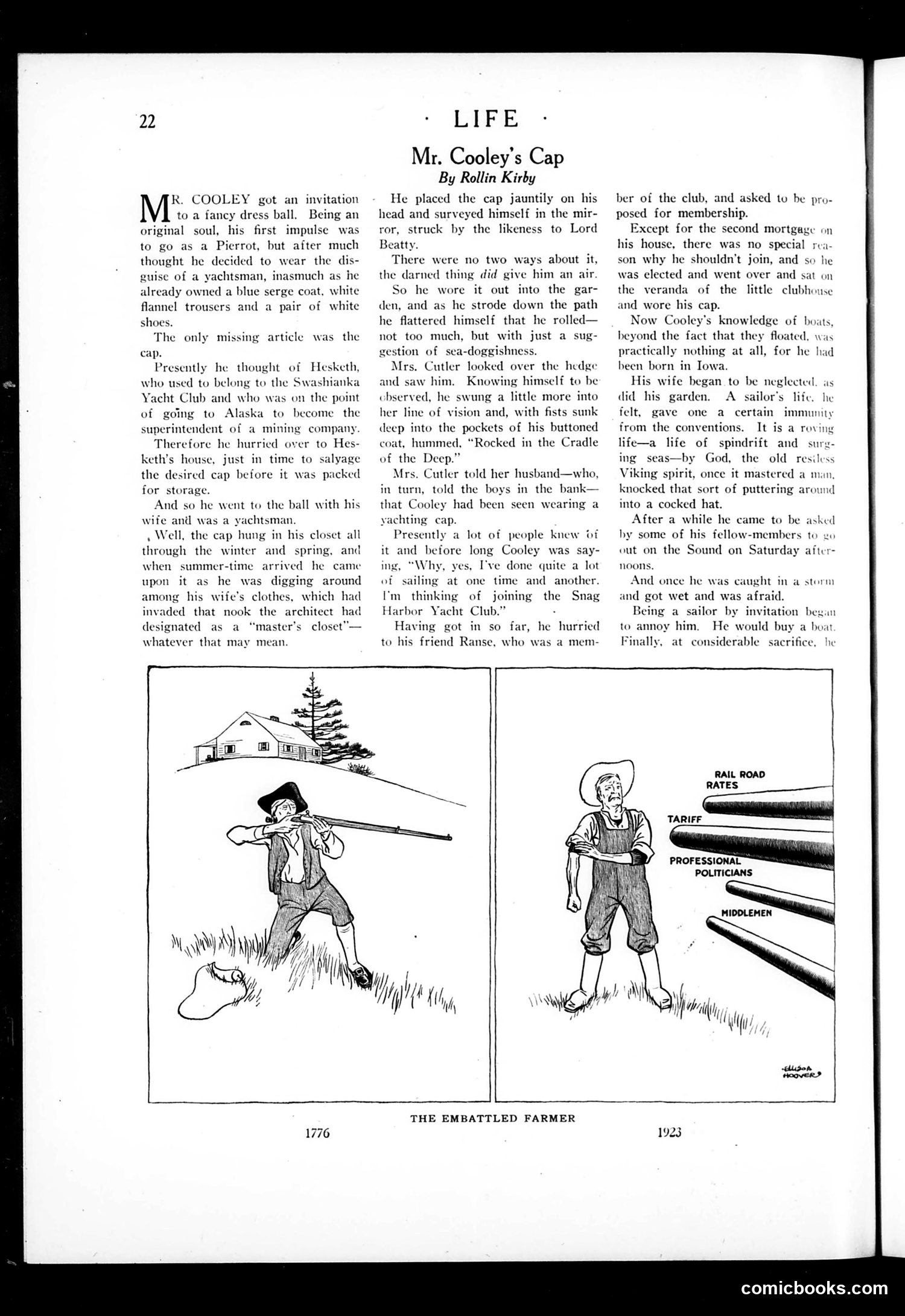
This story satirizes how a borrowed accessory transforms an ordinary man into someone he's not. Mr. Cooley borrows a yacht club cap to complete a costume, but the cap's mere presence convinces neighbors he's a seasoned sailor. Cooley, lacking any actual sailing knowledge (he was "born in Iowa"), plays along with the fabricated identity—eventually joining the yacht club and neglecting his wife and garden for this invented persona. The satire targets social climbing and self-deception: a simple prop becomes permission to reinvent oneself. Cooley adopts mannerisms ("sea-doggishness") and lies about his sailing experience. The irony peaks when he's finally invited sailing, gets caught in a storm, and becomes afraid—exposing the fraud beneath the cap. The accompanying cartoon comparing "The Embattled Farmer" (1776 vs. 1923) appears unrelated, satirizing how farmers have been burdened by new problems (railroad rates, tariffs, politicians, middlemen) replacing historical threats.
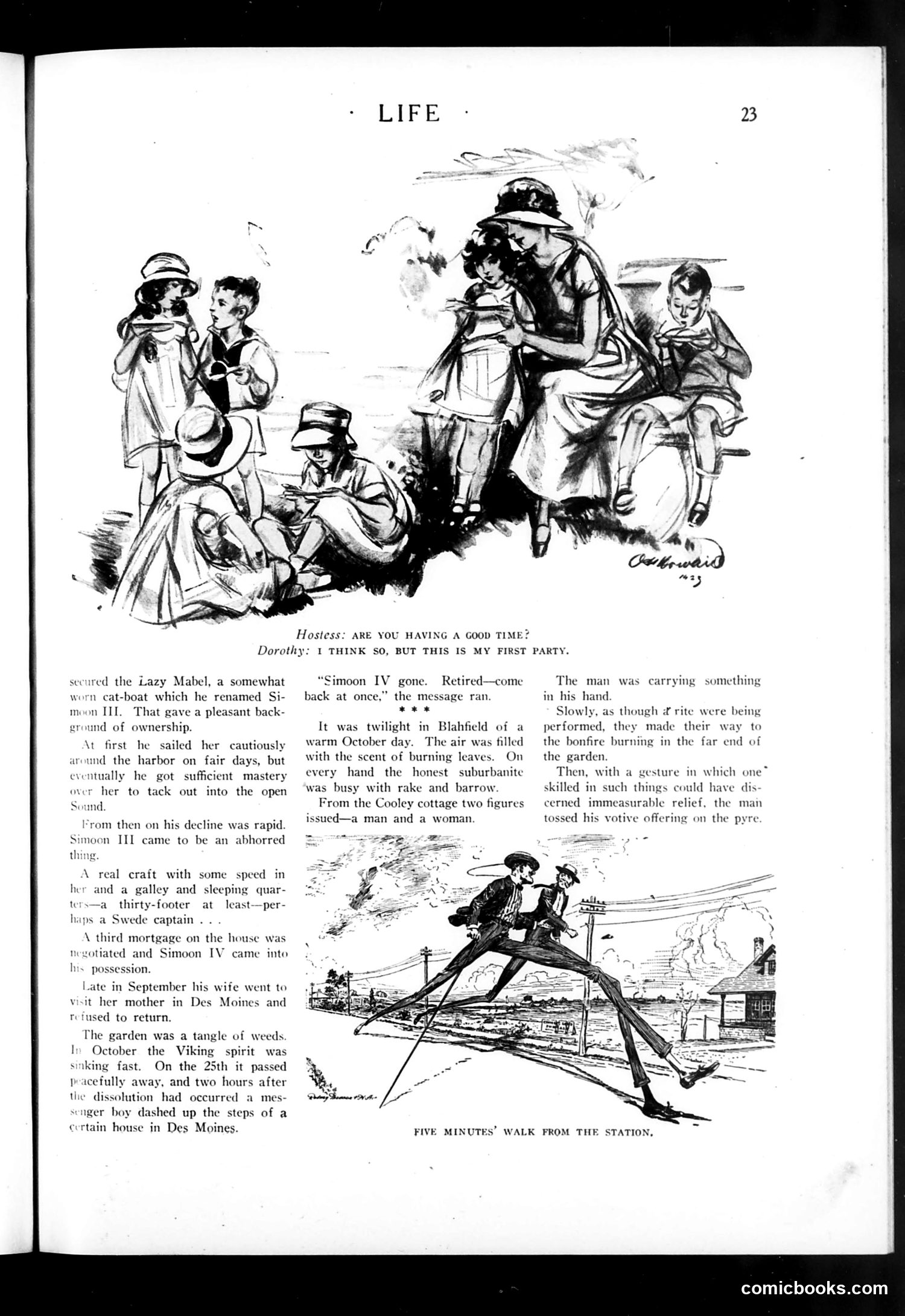
This page satirizes the "boating obsession" of an affluent suburban man. The narrative follows a wealthy enthusiast who buys increasingly expensive sailboats (Simoon III, then IV), mortgaging his house in the process. His obsession escalates until his wife abandons him, leaving a note demanding he return from Des Moines. The humor culminates in the lower illustration labeled "Five Minutes' Walk from the Station"—the man ceremonially tosses his final boat onto a bonfire in his garden, suggesting financial ruin and the symbolic destruction of his frivolous passion. The top cartoon shows a hostess asking a young woman (Dorothy) if she's enjoying her first party—a lighter social joke about party etiquette. The satire critiques nouveau-riche materialism and status-seeking through expensive hobbies, common themes in early 20th-century American humor about suburban middle-class pretension and financial excess.
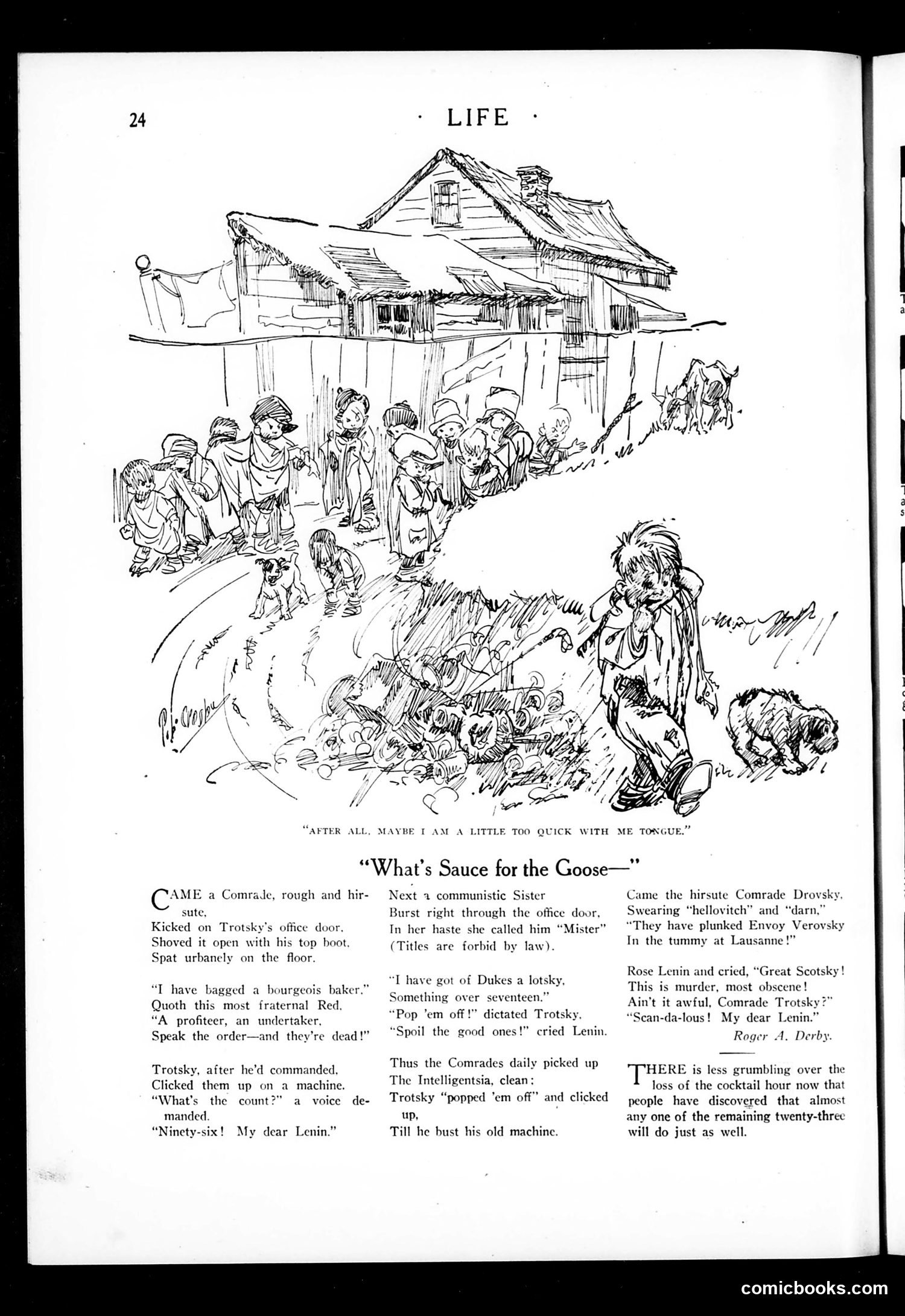
This 1920s *Life* magazine piece satirizes the Russian Revolution's violence through dark comedy. The narrative mocks Lenin and Trotsky as they mechanically execute perceived class enemies—bourgeois bakers, profiteers, undertakers, and aristocrats ("Dukes")—using a dehumanizing machine that counts victims like factory output. The satire's core joke: the revolutionaries claim to oppose class distinctions, yet a communist Sister accidentally calls someone "Mister" and is corrected for violating ideology. When an *envoy* (diplomat) is murdered, Lenin hypocritically cries "murder" and "obscene"—exposing the Bolsheviks' selective morality. They justify killing common people but condemn killing dignitaries. The closing quip about cocktail hours suggests American indifference to Soviet atrocities, implying that losing luxuries matters more than mass executions abroad. The crude caricatures and broken English ("hellovitch," "darr") reflect era-typical anti-Soviet, anti-communist American prejudice.
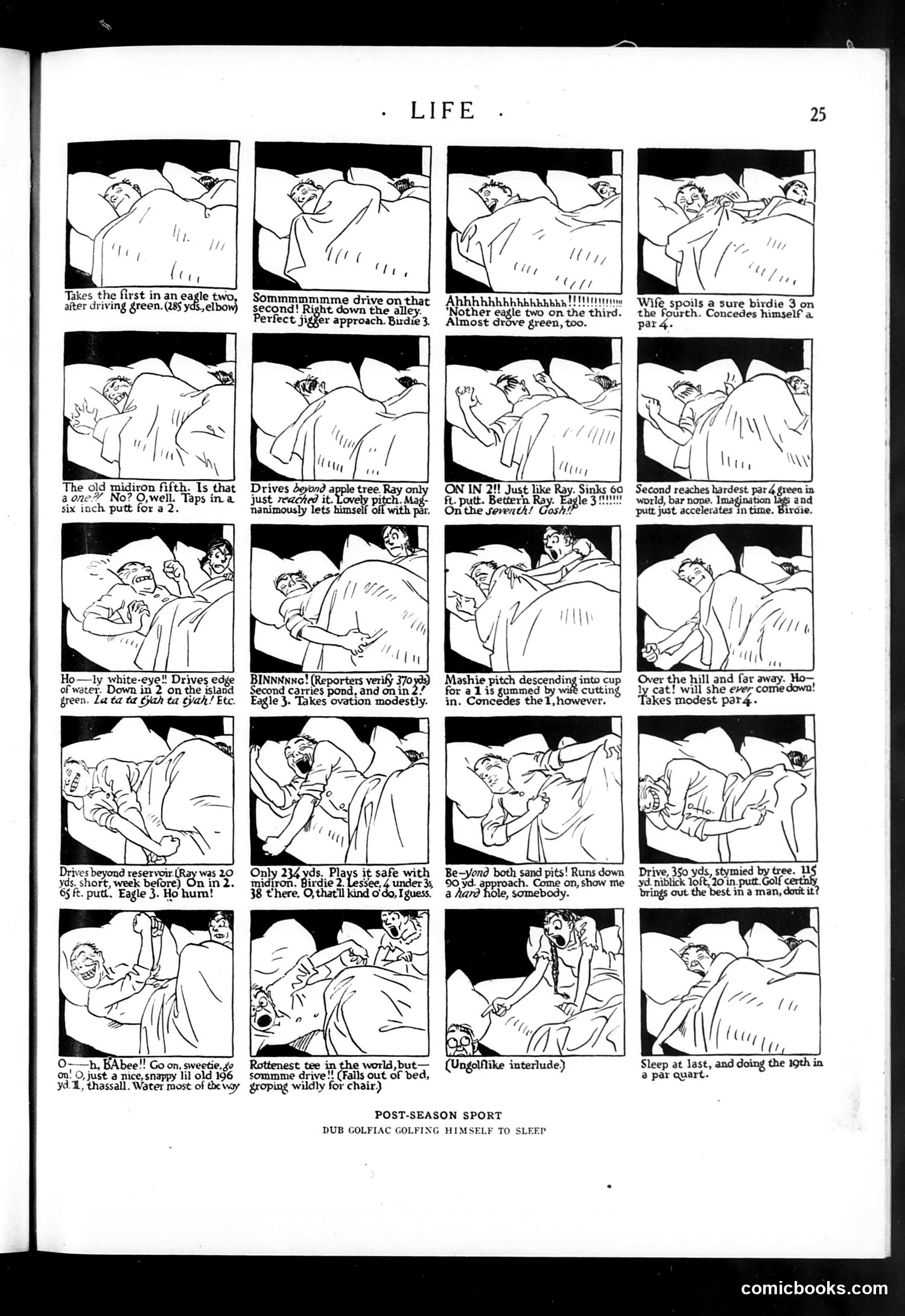
This multi-panel comic depicts a golfer's vivid dream sequences while sleeping, showing exaggerated golf performances. The humor contrasts his imaginary prowess—eagle twos, impossible long putts, spectacular shots—with reality's likely mediocrity. The title "Post-Season Sport" suggests this is satirizing golfers' obsessive mental replaying of games during off-season. The repeated exclamations ("Ho—ly white-eye!!," "BINNNNNc!") mock both the golfer's excited self-commentary and sports reporters' breathless coverage. The final panel shows him achieving "the 2th in a par quart"—likely nonsensical dream-logic humor. The overall satire targets amateur golfers' tendency to fantasize about perfect play while sleeping, contrasting their delusional nighttime golf with waking reality. It's gentle mockery of golf obsession among the leisure class.
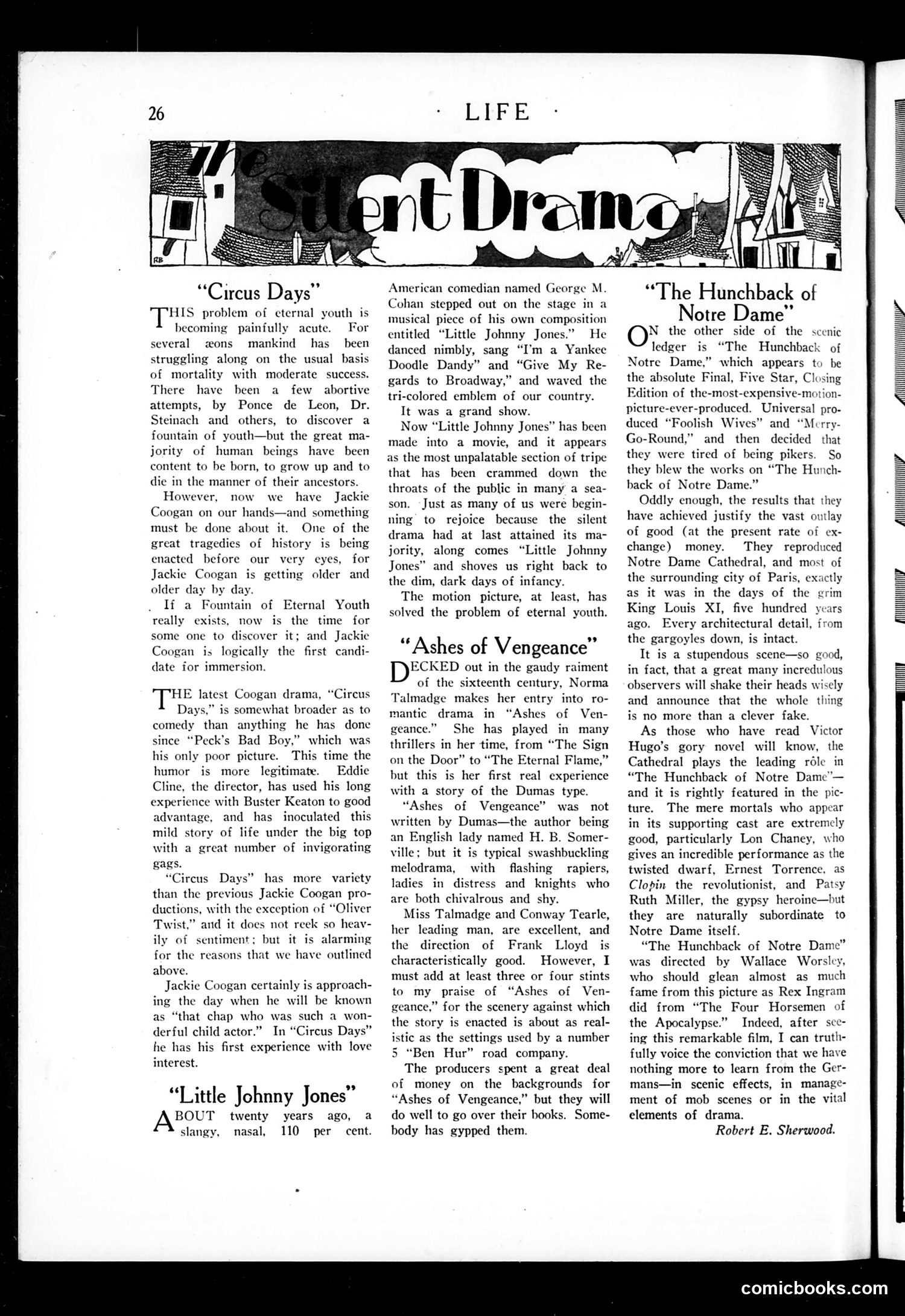
This page reviews three silent films and satirizes child star Jackie Coogan's aging. The opening "Circus Days" review expresses anxiety about Coogan growing older—he was a famous child actor (likely known from Charlie Chaplin's *The Kid*), and the magazine jokes that society needs to find a "Fountain of Eternal Youth" to preserve his career as he matures. The review of "Little Johnny Jones" (a George M. Cohan musical adapted for film) criticizes it as crude and sentimental, lamenting that silent cinema had "attained its majority" before this regressive picture arrived—a metaphor suggesting film art had matured beyond such melodrama. "Ashes of Vengeance" praises Norma Talmadge's performance and direction but mocks the cheap, unconvincing set design despite the producers' claimed expenses—implying financial mismanagement or fraud ("somebody has gypped them"). The tone throughout is witty complaint about cinema quality and the inevitable decline of child actors.
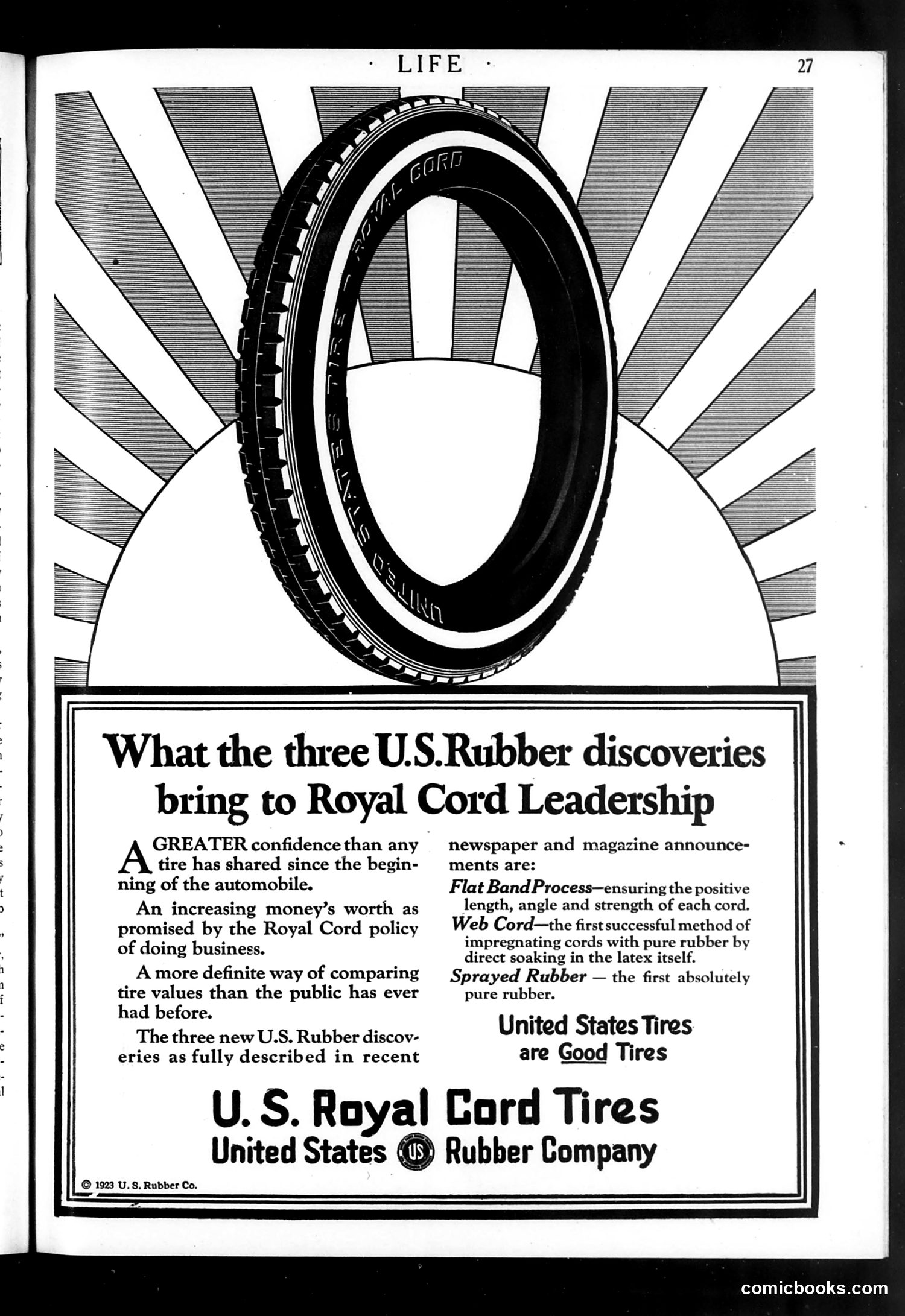
This is **not a political cartoon or satire**—it's a straightforward **advertisement for U.S. Rubber Company's Royal Cord Tires**, published in *Life* magazine around 1923. The page features a large tire illustration with radiating lines (suggesting importance/innovation) and promotional text claiming three manufacturing breakthroughs: the Flat Band Process, Web Cord technology, and Sprayed Rubber. These innovations allegedly ensure superior cord strength and pure rubber composition. The ad emphasizes consumer confidence, value, and objective tire comparison—standard advertising rhetoric of the 1920s automotive era. The tagline "United States Tires are Good Tires" is straightforward brand messaging. *Life* magazine regularly ran advertisements alongside satirical content; this page appears to be pure advertising rather than editorial commentary or satire. Modern readers should understand this reflects early automotive marketing's focus on technical innovation as a selling point.
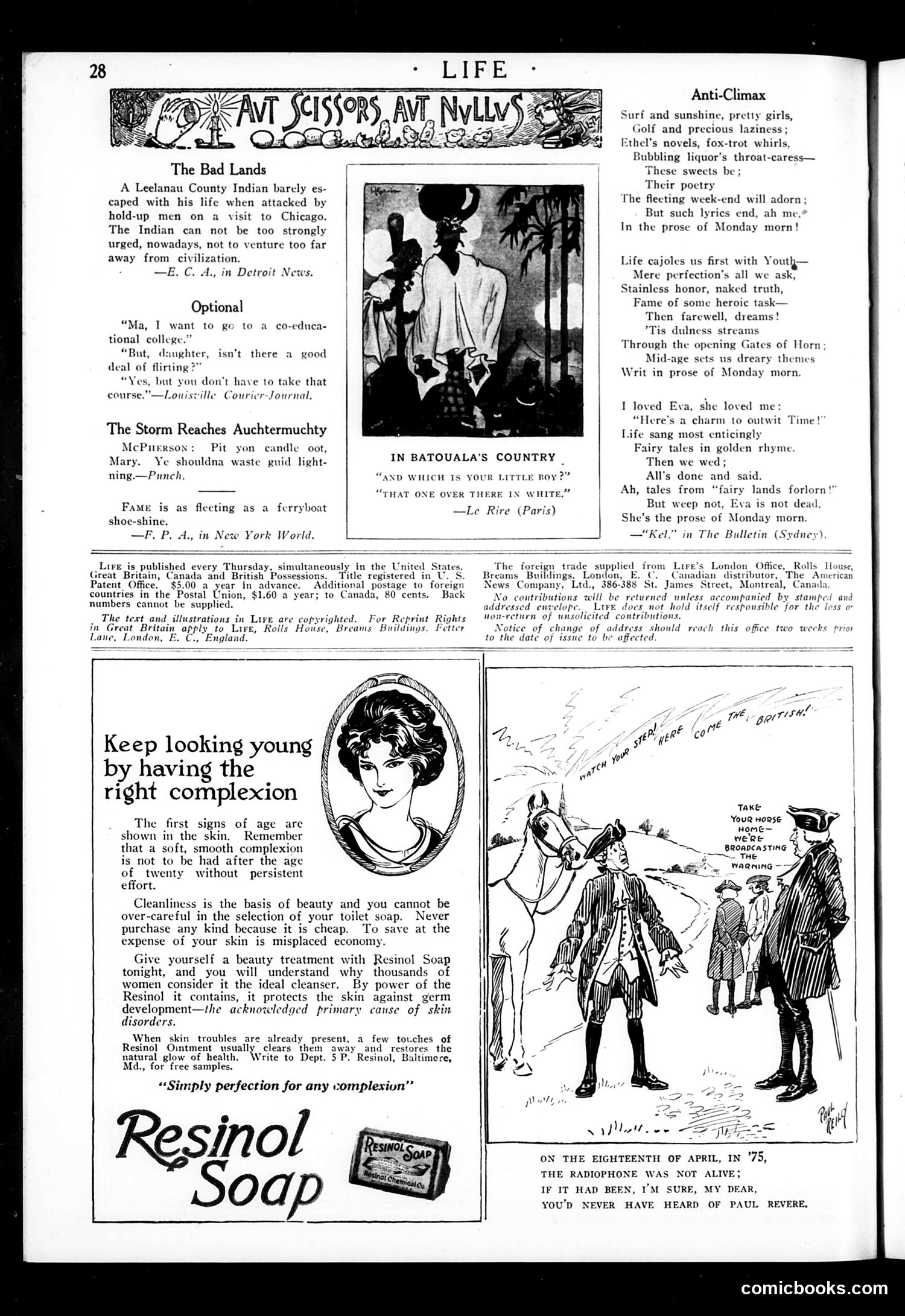
This Life magazine page (circa 1920s) contains several satirical items: **"The Bad Lands"**: A brief editorial joke warning Native Americans against visiting Chicago—implying the city itself is more dangerous than the wilderness. **"The Storm Reaches Auchtermuchty"**: A Scottish dialect joke about thrift during hard times. **"In Batoula's Country"**: A colonial-era joke referencing a French novel about Africa, relying on racial stereotypes common to period humor. **"Anti-Climax" poem**: Satirizes the disappointment of adult life—youthful romance and ambition give way to mundane Monday mornings. It's melancholic social commentary on aging. **The cartoon**: Shows what appears to be a historical scene (captioned about 1775 and "radiophone"), likely satirizing anachronisms or technological imagination. The page is primarily **advertising** (Resinol Soap dominates the lower half), typical of Life's business model. The editorial content reflects 1920s sensibilities—casual racism, Scottish humor, and reflective verse about life's disillusionment.
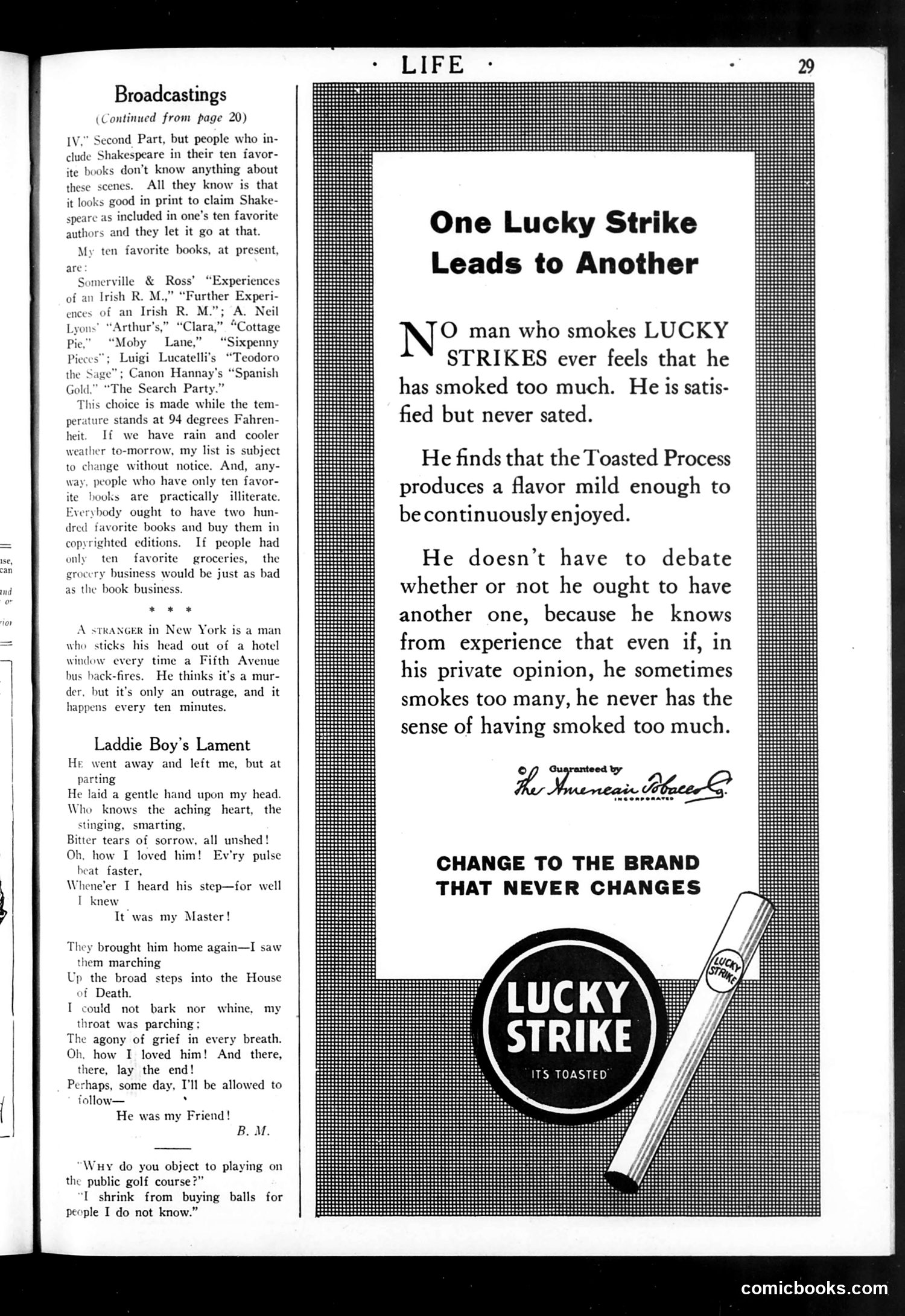
This page is primarily a **cigarette advertisement** for Lucky Strike, disguised as editorial content in *Life* magazine. The ad uses humor and lifestyle appeal rather than direct sales pitch. The central claim—that Lucky Strike smokers never feel they've smoked "too much" because the "Toasted Process" produces a mild, continuously enjoyable flavor—is classic early 20th-century tobacco marketing. It addresses a genuine consumer concern (overindulgence guilt) by reframing the product as uniquely satisfying yet never excessive. The phrase "Change to the brand that never changes" emphasizes consistency and reliability as selling points. The surrounding editorial content (book recommendations, anecdotes about New York life, a sentimental poem about a dog) provides *Life*'s characteristic mix of satire and light humor, but serves mainly to contextualize the ad within the magazine's format. This represents pre-regulation tobacco advertising, when health concerns were minimal and emotional/lifestyle appeals dominated marketing.
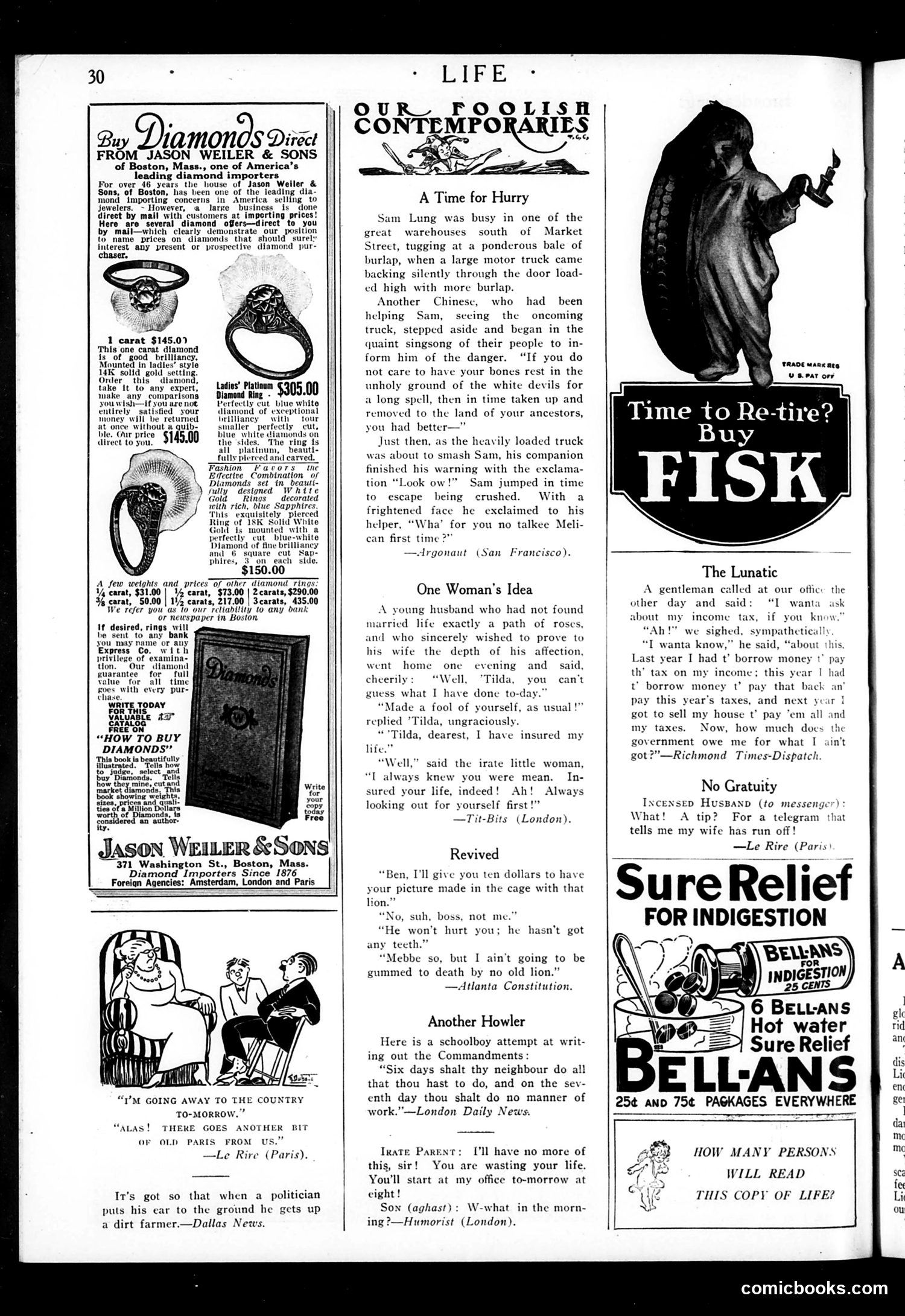
This page contains humorous anecdotes mocking contemporary attitudes and behaviors. The main cartoons and jokes include: **"A Time for Hurry"**: A stereotypical portrayal of Chinese warehouse workers, where one warns Sam Lung of danger in elaborate Chinese-accented English about ancestral burial grounds, then simply yells "Look out!" when the truck actually approaches. The joke mocks both overly flowery speech and the contrast with direct urgency. **"One Woman's Idea"**: A domestic humor piece where a husband attempts romantic gesture by insuring his life, but his wife dismissively responds he's "made a fool of yourself, as usual"—satirizing marital discord and feminine cynicism. The page also includes brief political jokes about politicians and farmers, typical of Life's satirical format. The advertisements (diamonds, Fisk tires, Bellans indigestion remedy) are period-appropriate commercial content interspersed with editorial humor—common for early 20th-century magazines.
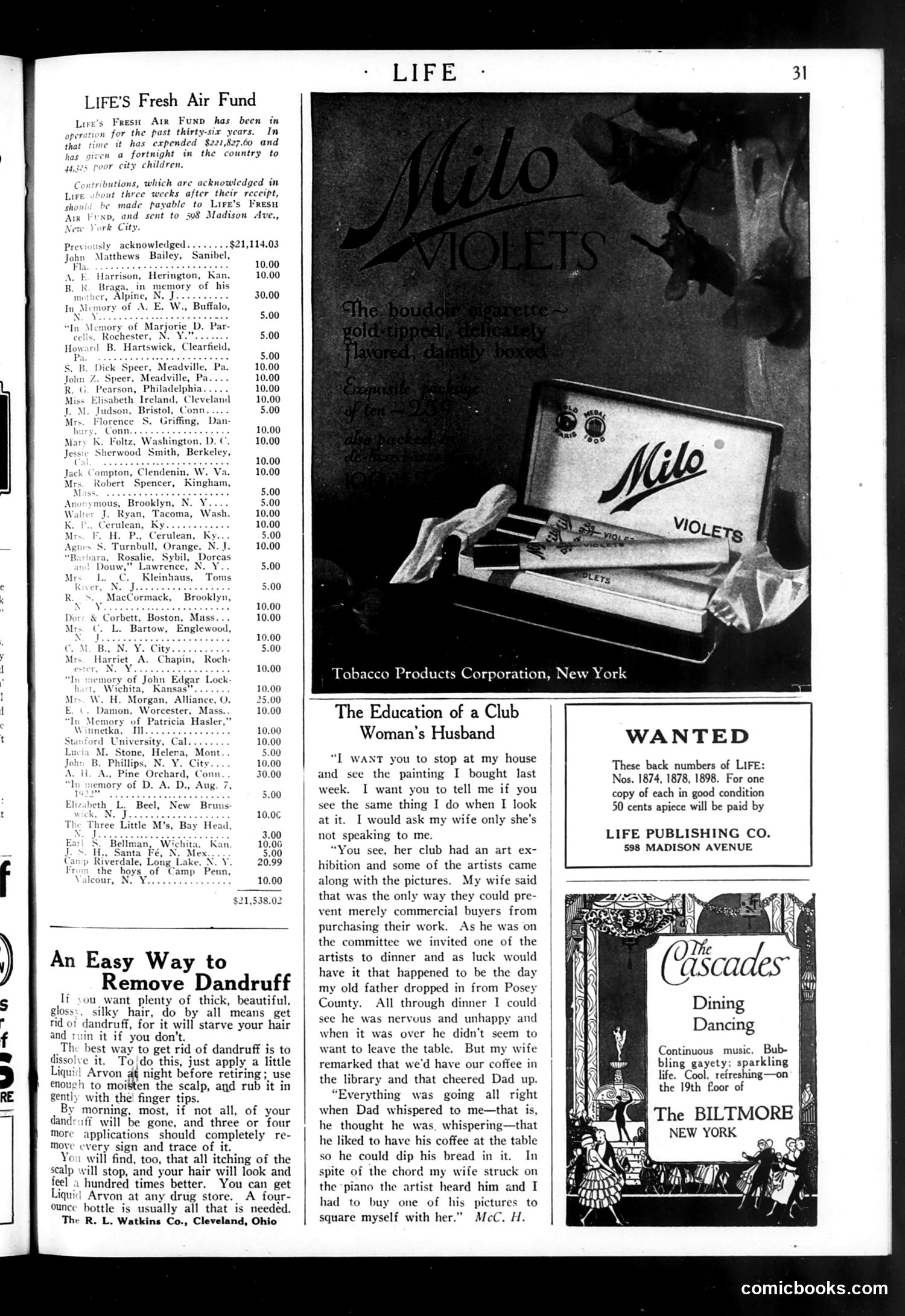
This page contains primarily **advertisements and miscellaneous content** rather than political cartoons. The main elements are: 1. **Life's Fresh Air Fund** - A charity fundraising list showing donations for sending poor city children to the countryside for health and recreation. 2. **"The Education of a Club Woman's Husband"** - A humorous anecdote about a socially awkward moment. A husband invites a friend to view his wife's art purchase, then describes how his visiting father embarrassed them at a dinner with an artist by loudly expressing that he preferred dipping bread in his coffee at the table. The husband had to buy one of the artist's paintings to smooth things over—satirizing how modern art collecting is driven by social obligation rather than genuine appreciation, and poking fun at the clash between rural informality and urban artistic pretension. 3. **Product advertisements** for dandruff remedy and the Biltmore Hotel's nightclub. The satire gently mocks both pretentious art culture and provincial manners.
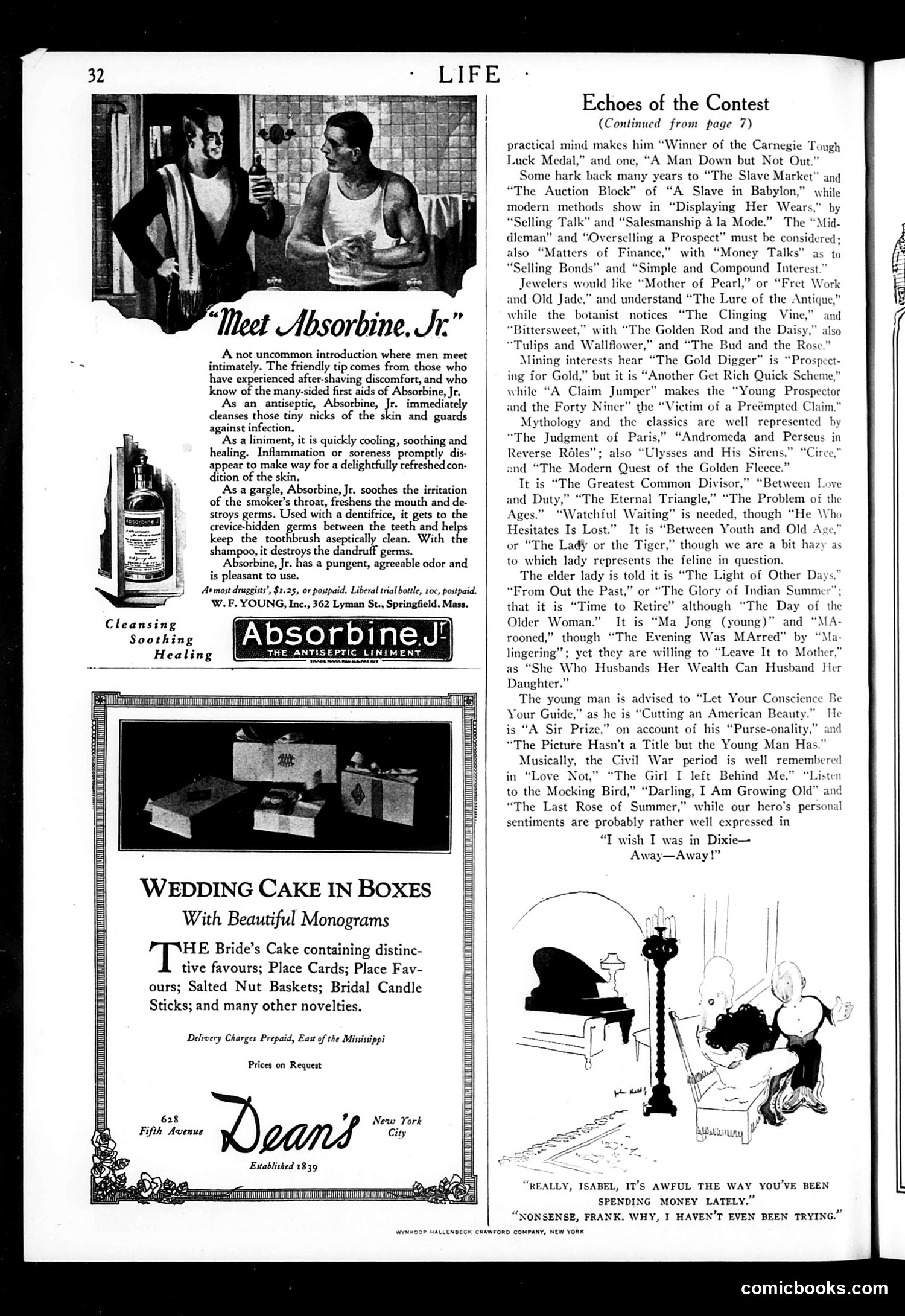
This page contains primarily **advertisements** rather than political cartoons. The main visual content includes: 1. **Absorbine Jr. ad**: Shows two men in conversation, illustrating the product as a post-shaving remedy. The copy humorously frames it as a common recommendation between men who've experienced shaving discomfort—a relatable domestic scenario rather than political satire. 2. **Dean's Wedding Cake ad**: Displays decorated cake boxes, promoting mail-order wedding cakes with monograms and favors. 3. **Cartoon illustration** (bottom right): Shows a couple at a piano with the caption about financial arguments—a domestic humor scene about marital money disputes, not political commentary. The text "Echoes of the Contest" appears to reference a writing contest, listing various submitted titles organized by theme (financial, botanical, classical mythology, etc.). **Overall**: This is a commercial magazine page from the early 20th century focused on consumer advertising and light domestic humor, not political satire requiring historical context.
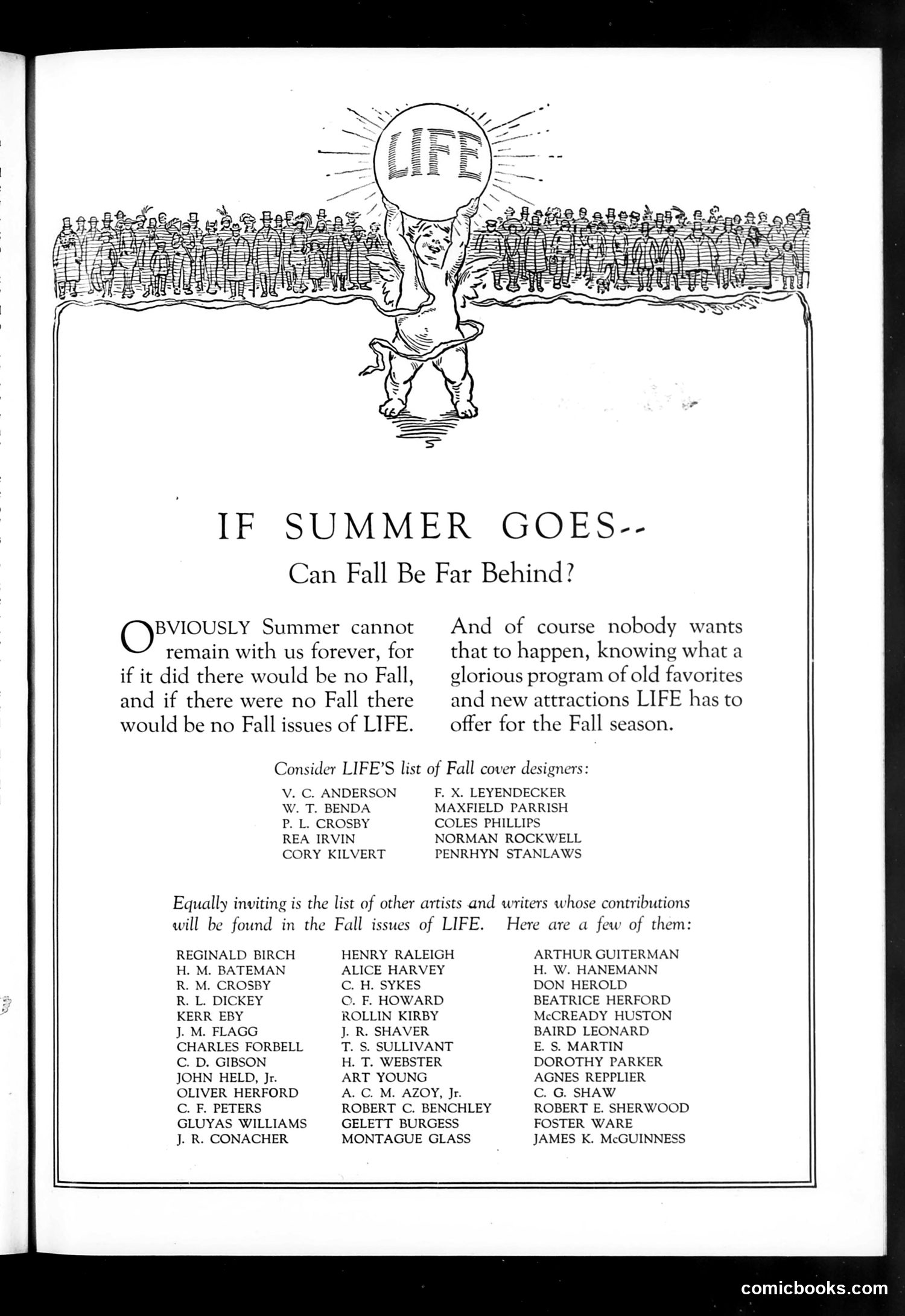
This is a **promotional page**, not satirical commentary. Life magazine uses seasonal transition as a hook to advertise its upcoming Fall issues. The cartoon shows a figure holding aloft a glowing "LIFE" sphere while standing before crowds—a visual metaphor for Life magazine's cultural importance and broad appeal. The text employs light humor: the rhetorical setup (if no Fall, no Fall issues of LIFE) is deliberately circular logic, inviting readers to anticipate the magazine's autumn content. The real message is promotional: Life lists prominent illustrators (Maxfield Parrish, Norman Rockwell, John Held Jr.) and writers (Dorothy Parker, Robert Benchley) who will contribute to Fall issues. This represents Life's golden era when it was genuinely influential, featuring America's most recognizable cartoonists and humorists. The page essentially says: "Summer's ending, but Life magazine's best season approaches—featuring your favorite artists."
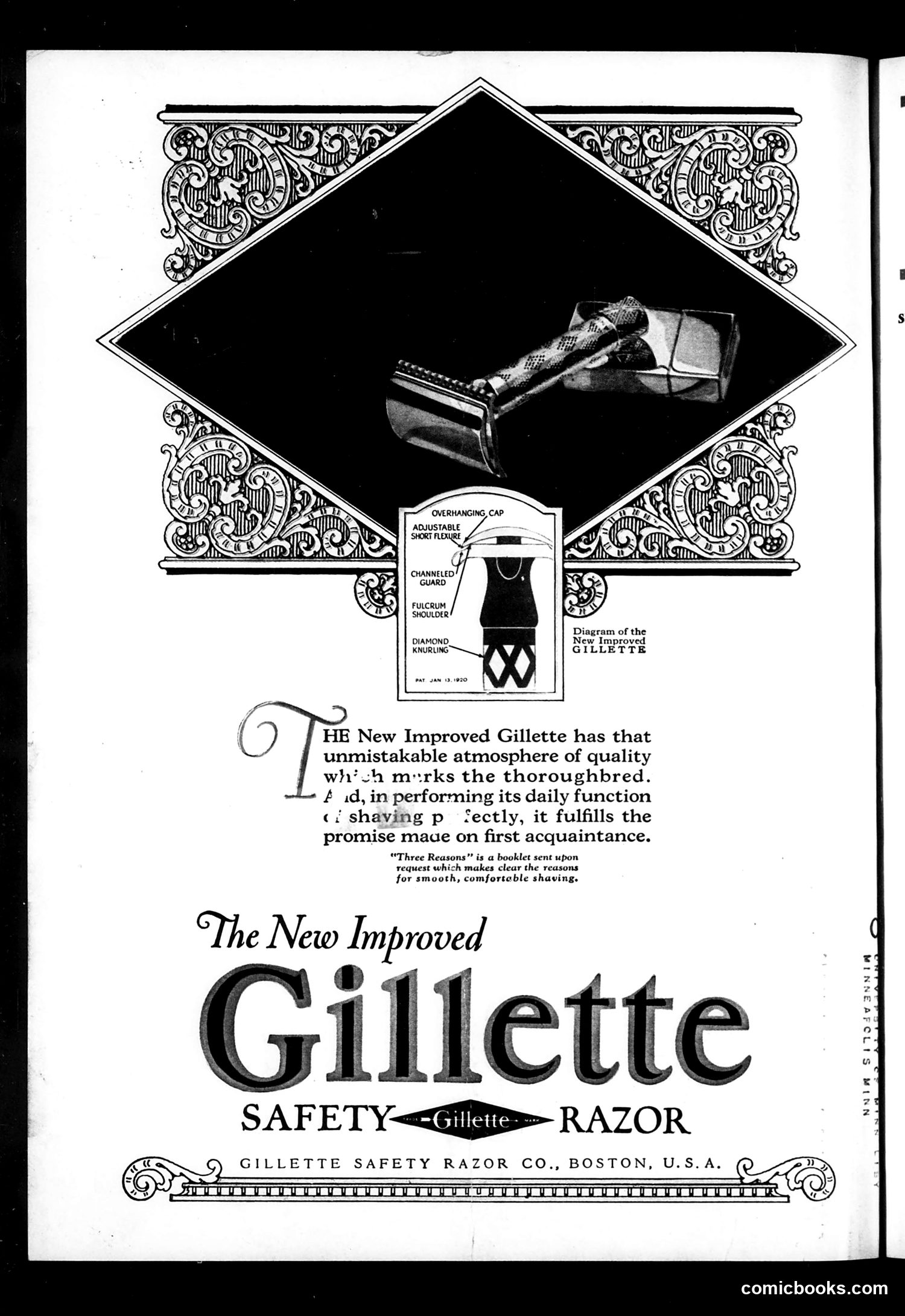
This is **not a cartoon or satire** — it's a straightforward advertisement for the Gillette Safety Razor, placed in Life magazine. The page promotes "The New Improved Gillette" with: - A photograph showing the razor's handle and blade assembly - A technical diagram labeling its parts (overhanging cap, channeled guard, fulcrum shoulder, diamond knurling) - Marketing copy emphasizing the razor's quality and shaving performance - A mention of a free booklet ("Three Reasons") explaining the product's benefits The ornate decorative border and elegant typography reflect early-20th-century advertising design conventions. The text appeals to ideas of thoroughbred quality and precision engineering — common selling points for luxury goods of the era. This represents Life magazine's business model: mixing editorial content with paid advertisements from major manufacturers like Gillette.