
Life, 1923-08-30 · page 28 of 36
Life — August 30, 1923 — page 28: what you’re looking at
What you’re looking at
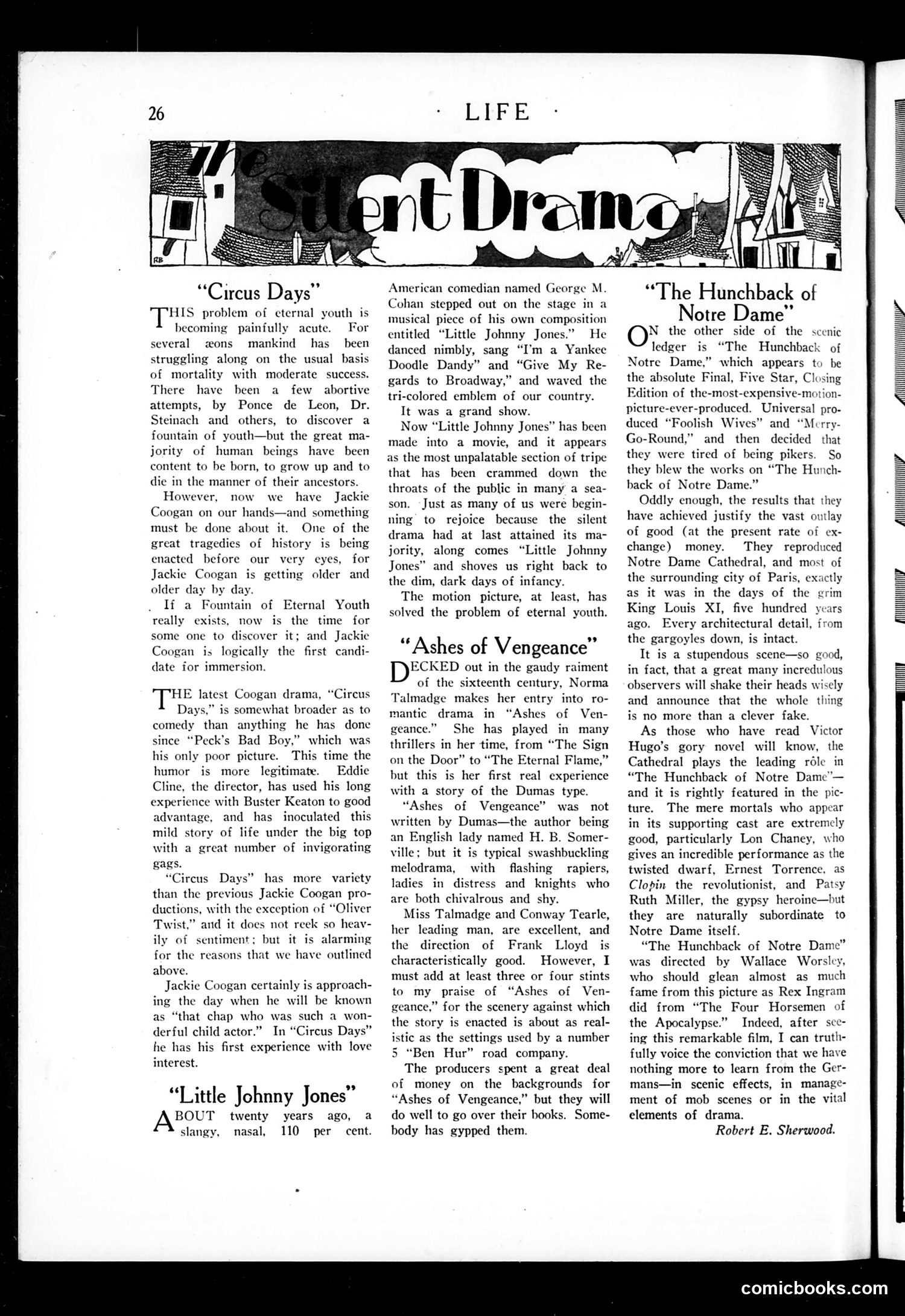
This page reviews three silent films and satirizes child star Jackie Coogan's aging. The opening "Circus Days" review expresses anxiety about Coogan growing older—he was a famous child actor (likely known from Charlie Chaplin's *The Kid*), and the magazine jokes that society needs to find a "Fountain of Eternal Youth" to preserve his career as he matures. The review of "Little Johnny Jones" (a George M. Cohan musical adapted for film) criticizes it as crude and sentimental, lamenting that silent cinema had "attained its majority" before this regressive picture arrived—a metaphor suggesting film art had matured beyond such melodrama. "Ashes of Vengeance" praises Norma Talmadge's performance and direction but mocks the cheap, unconvincing set design despite the producers' claimed expenses—implying financial mismanagement or fraud ("somebody has gypped them"). The tone throughout is witty complaint about cinema quality and the inevitable decline of child actors.
📄 Transcribed text from this page (OCR, searchable)
Machine-transcribed from the original scan — historical spelling and the odd misread are preserved.
“Circus Days” qs problem of eternal youth is becoming painfully acute. For several ons mankind has been struggling along on the usual basis of mortality with moderate success. There have been a few abortive attempts, by Ponce de Leon, Dr. Steinach and others, to discover a fountain of youth—but the great ma- jority of human beings have been content to be born, to grow up and to die in the manner of their ancestors. However, now we have Jackie Coogan on our hands—and something must be done about it. One of the great tragedies of history is being enacted before our very eyes, for Jackie Coogan is getting older and older day by day. If a Fountain of Eternal Youth really exists, now is the time for some one to discover it; and Jackie Coogan is logically the first candi- date for immersion. ays, somewhat broader as to comedy than anything he has done since “Peck’s Bad Boy,” which was his only poor picture. This time the humor is more legitimate. Eddie Cline, the director, has used his long experience with Buster Keaton to good advantage, and has inoculated this mild story of life under the big top with a great number of invigorating gags. “Circus Days” has more variety than the previous Jackie Coogan pro- ductions, with the exception of “Oliver Twist.” and it does not reek so heav- ily of sentiment; but it is alarming for the reasons that we have outlined above. Jackie Coogan certainly is approach- ing the day when he will be known as “that chap who was such a won- derful child actor.” In “Circus Days” he has his first experience with love interest. THE latest Coogan drama, rcus D: “Little Johnny Jones” BOUT twenty years ago, a slangy, nasal, 110 per cent. American comedian named George M. Cohan stepped out on the stage in a musical piece of his own composition entitled “Little Johnny Jones.” He danced nimbly, sang “I’m a Yankee Doodle Dandy” and “Give My Re- gards to Broadway,” and waved the tri-colored emblem of our country. It was a grand show. Now “Little Johnny Jones” has been made into a movie, and it appears as the most unpalatable section of tripe that has been crammed down the throats of the public in many a sea- son. ‘Just as many of us were begin- ning to rejoice because the silent drama had at last attained its ma- jority, along comes “Little Johnny Jones” and shoves us right back to the dim, dark days of infancy. The motion picture, at least, has solved the problem of eternal youth. “Ashes of Vengeance” D ECKED out in the gaudy raiment of the sixteenth century, Norma Talmadge makes her entry into ro- mantic drama in “Ashes of Ven- geance.” She has played in many thrillers in her time, from “The Sign on the Door” to “The Eternal Flame,” but this is her first real experience with a story of the Dumas type. “Ashes of Vengeance” was not written by Dumas—the author being an English lady named H. B. Somer- ville; but it is typical swashbuckling melodrama, with flashing rapiers, ladies in distress and knights who are both chivalrous and shy. Miss Talmadge and Conway Tearle, her leading man, are excellent, and the direction of Frank Lloyd is characteristically good. However, I must add at least three or four stints to my praise of “Ashes of Ven- geance,” for the scenery against which the story is enacted is about as real- istic as the settings used by a number 5 “Ben Hur” road company. The producers spent a great deal of money on the backgrounds for “Ashes of Vengeance,” but they will do well to go over their books. Some- body has gypped them. “The Hunchback of Notre Dame” N the other side of the scenic ledger is “The Hunchback of Notre Dame,” which appears to be the absolute Final, Five Star, Closing Edition of the-most-expensive-motion- picture-ever-produced. Universal pro- duced “Foolish Wives” and “Merry- Go-Round,” and then decided that they were tired of being pikers. So they blew the works on “The Hunch- back of Notre Dame.” Oddly enough, the results that they have achieved justify the vast outlay of good (at the present rate of ex- change) money. They reproduced Notre Dame Cathedral, and most of the surrounding city of Paris, exactly as it was in the days of the grim King Louis XI, five hundred years ago. Every architectural detail, from the gargoyles down, is intact. It is a stupendous scene—so good, in fact, that a great many incredulous observers will shake their heads wisely and announce that the whole thing is no more than a clever fake. As those who have read Victor Hugo’s gory novel will know, the Cathedral plays the leading réle in “The Hunchback of Notre Dame”— and it is rightly featured in the pic- ture. The mere mortals who appear in its supporting cast are extremely good, particularly Lon Chaney, who gives an incredible performance as the twisted dwarf, Ernest Torrence, as Clopin the revolutionist, and Patsy Ruth Miller, the gypsy heroine—but they are naturally subordinate to Notre Dame itself. “The Hunchback of Notre Dame” was directed by Wallace Worsley, who should glean almost as much fame from this picture as Rex Ingram did from “The Four Horsemen of the Apocalypse.” Indeed, after scc- ing this remarkable film, I can truth- fully voice the conviction that we have nothing more to learn from the Ger- mans—in scenic effects, in manage- ment of mob scenes or in the vital elements of drama. Robert E. Sherwood. comicbooks.com Wi