
Life, 1923-08-30 · page 22 of 36
Life — August 30, 1923 — page 22: what you’re looking at
What you’re looking at
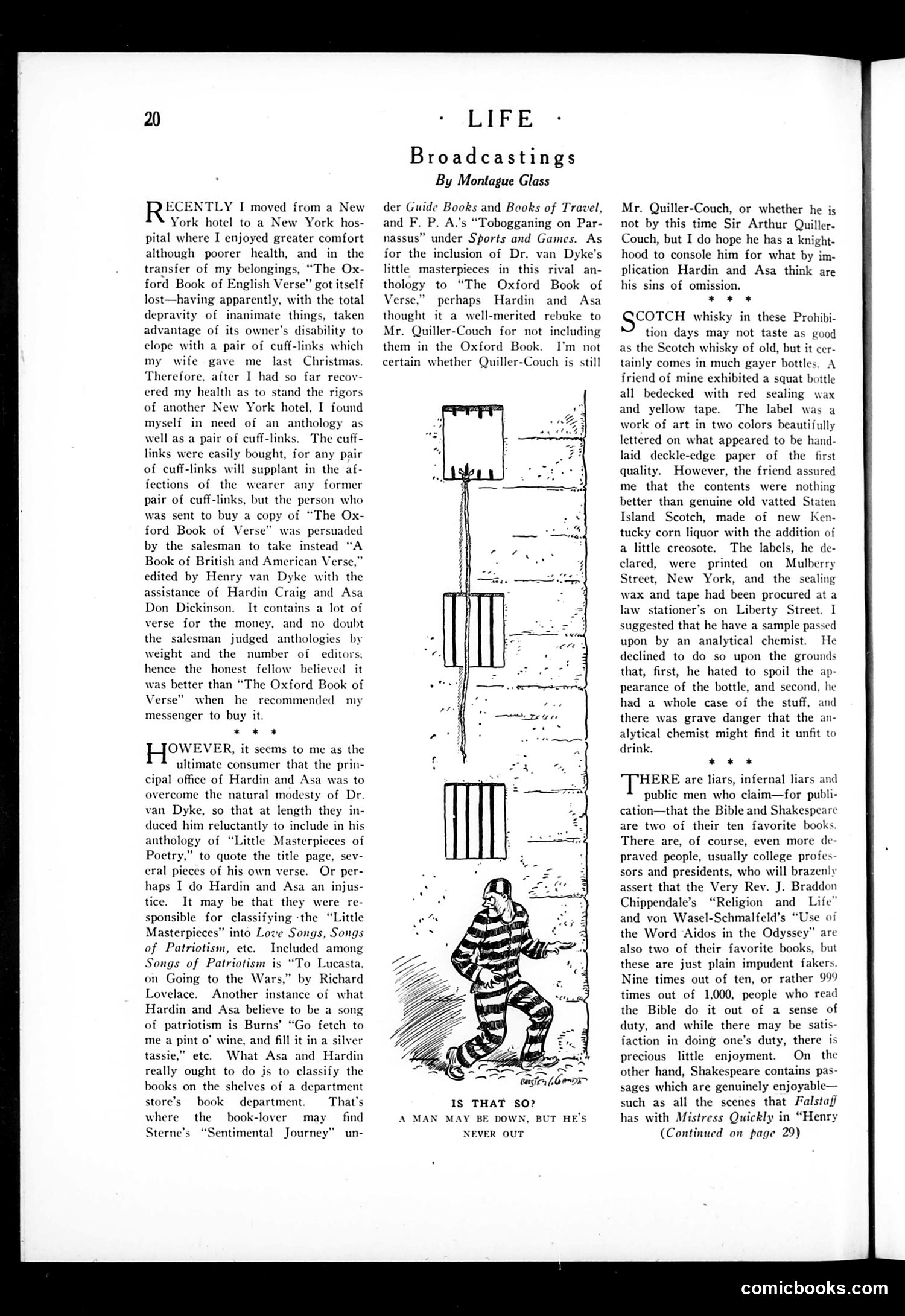
This essay satirizes the pretentiousness of literary gatekeeping and editorial hubris during Prohibition-era America. Glass mocks editors Hardin Craig and Asa Don Dickinson for persuading the modest Dr. Henry van Dyke to include his own verse in their anthology "Little Masterpieces of Poetry," positioning it as a rival to the prestigious "Oxford Book of Verse" edited by Sir Arthur Quiller-Couch. The author lampoons their misclassification choices (suggesting they'd shelve books absurdly—like placing travel guides under "Sports"). The cartoon shows a boxer, illustrating the essay's concluding anecdote about Prohibition-era "Scotch whisky"—cheap Kentucky corn liquor with creosote, deceptively packaged with fancy labels from Mulberry Street to appear authentic. The phrase "A Man May Be Down, But He's Never Out" comments on American resilience despite prohibition's failures and cultural compromises.
📄 Transcribed text from this page (OCR, searchable)
Machine-transcribed from the original scan — historical spelling and the odd misread are preserved.
CENTLY I moved from a New York hotel to a New York hos- pital where I enjoyed greater comfort although poorer health, and in the transfer of my belongings, “The Ox- ford Book of English Verse” got itself lost—having apparently, with the total depravity of inanimate things, taken advantage of its owner's disability to elope with a pair of cuff-links which my wife gave me last Christmas. Therefore, after I had so far recov- ered my health as to stand the rigors of another New York hotel, I found myself in need of an anthology as well as a pair of cuff-links. The cuff- links were easily bought, for any pair of cuff-links will supplant in the af- fections of the wearer any former pair of cuff-links, but the person who was sent to buy a copy of “The Ox- ford Book of Verse” was persuaded by the salesman to take instead “A Book of British and American Verse,” edited by Henry van Dyke with the assistance of Hardin Craig and Asa Don Dickinson. It contains a lot of verse for the money, and no doubt the salesman judged anthologies by weight and the number of editors, hence the honest fellow believed it was better than “The Oxford Book of Verse” when he recommended my messenger to buy it. +k * OWEVER, it seems to me as the ultimate consumer that the prin- cipal office of Hardin and Asa was to overcome the natural modesty of Dr. van Dyke, so that at length they in- duced him reluctantly to include in his. anthology of “Little Masterpieces of Poetry,” to quote the title page, sev- Or per- haps I do Hardin and Asa an injus- tice. It may be that they were re- sponsible for classifying ‘the “Little Masterpieces” into Love Songs, Songs of Patriotism, etc. Included among Songs of Patriotism is “To Lucasta, on Going to the Wars,” by Richard Lovelace. Another instance of what Hardin and Asa believe to be a song of patriotism is Burns’ “Go fetch to me a pint o’ wine, and fill it in a silver tassie,” etc. What Asa and Hardin really ought to do js to classify the books on the shelves of a department store’s book department. That's where the book-lover may find Sterne’s “Sentimental Journey” un- eral pieces of his own verse. LIFE Broadcastings By Montague Glass der Guide Books and Books of Travel, and F. P. A.’s “Tobogganing on Par- nassus” under Sports and Games. As for the inclusion of Dr. van Dyke's little masterpieces in this rival an- thology to “The Oxford Book of Verse,” perhaps Hardin and Asa thought it a well-merited rebuke to Mr. Quiller-Couch for not including them in the Oxford Book. I'm not certain whether Quiller-Couch is still Is THAT SO? A MAN MAY BE DOWN, BUT HE'S NEVER OUT Mr. Quiller-Couch, or whether he is not by this time Sir Arthur Quiller- Couch, but I do hope he has a knight- hood to console him for what by im- plication Hardin and Asa think are his sins of omission. * * * ScotcH whisky in these Prohibi- tion days may not taste as good as the Scotch whisky of old, but it cer- tainly comes in much gayer bottles. A friend of mine exhibited a squat bottle all bedecked with red sealing wax and yellow tape. The label was a work of art in two colors beautifully lettered on what appeared to be hand- laid deckle-edge paper of the first quality. However, the friend assured me that the contents were nothing better than genuine old vatted Staten Island Scotch, made of new Ken- tucky corn liquor with the addition of a little creosote. The labels, he de- clared, were printed on Mulberry Street, New York, and the sealing wax and tape had been procured at a law stationer’s on Liberty Street. I suggested that he have a sample passed upon by an analytical chemist. He declined to do so upon the grounds that, first, he hated to spoil the ap- pearance of the bottle, and second, he had a whole case of the stuff, and there was grave danger that the an- alytical chemist might find it unfit to drink. * * * HERE are liars, infernal liars and public men who claim—for publi- cation—that the Bible and Shakespeare are two of their ten favorite books. There are, of course, even more de- praved people, usually college profes- sors and presidents, who will brazenly assert that the Very Rev. J. Braddon Chippendale’s “Religion and Life” and von Wasel-Schmalfeld’s “ of the Word Aidos in the Odyssey” are also two of their favorite books, but these are just plain impudent fakers. Nine times out of ten, or rather 999 times out of 1,000, people who read the Bible do it out of a sense of duty, and while there may be satis- faction in doing one’s duty, there is precious little enjoyment. On the other hand, Shakespeare contains pas- sages which are genuinely enjoyable— such as all the scenes that Falstaff has with Mistress Quickly in “Henry (Continued on page 29) comicbooks.com