
Life, 1923-08-30 · page 20 of 36
Life — August 30, 1923 — page 20: what you’re looking at
What you’re looking at
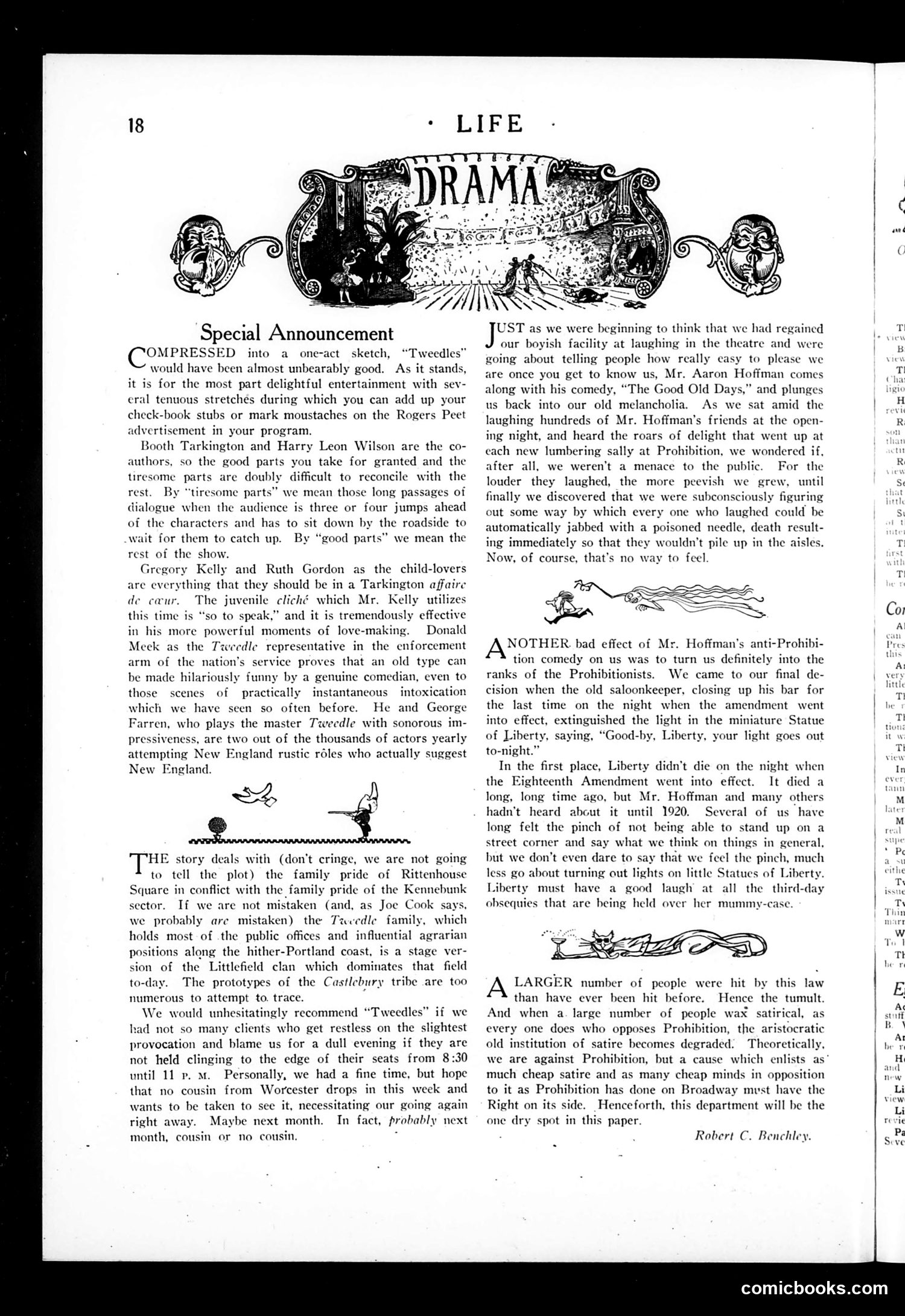
This is a theater review page from Life magazine critiquing two Broadway plays: "Tweedles" (co-written by Booth Tarkington and Harry Leon Wilson) and Aaron Hoffman's "The Good Old Days." The reviewer praises "Tweedles" selectively—the young leads Gregory Kelly and Ruth Gordon perform well, but lengthy dialogue passages drag. The plot involves a status conflict between Philadelphia's wealthy Rittenhouse Square society and a Maine coastal family (the "Tweedles"), apparently based on real regional clans. The second review targets Hoffman's anti-Prohibition comedy. The critic is irritated by audience laughter at jokes mocking Prohibition laws (recently enacted via the 18th Amendment in 1920). The reviewer's sarcastic response—imagining poisoning laughing audience members—illustrates the cultural tension over Prohibition: some viewed it as moral reform while others, like this critic, saw supporters as humorless zealots. The small decorative illustrations are typical period embellishments, not political cartoons.
📄 Transcribed text from this page (OCR, searchable)
Machine-transcribed from the original scan — historical spelling and the odd misread are preserved.
Special Announcement (COMPRESSED into a one-act sketch, “Tweedles” would have been almost unbearably good. As it stands, it is for the most part delightful entertainment with sev- eral tenuous stretchés during which you can add up your check-book stubs or mark moustaches on the Rogers Peet advertisement in your program. Booth Tarkington and Harry Leon Wilson are the co- authors, so the good parts you take for granted and the tiresome parts are doubly difficult to reconcile with the rest. By “tiresome parts’ we mean those long passages of dialogue when the audience is three or four jumps ahead of the characters and has to sit down by the roadside to wait for them to catch up. By “good parts” we mean the rest of the show. Gregory Kelly and Ruth Gordon as the child-lovers are ¢ thing that they should be in a Tarkington affaire de cour. The juvenile cliché which Mr. Kelly utilizes this time is “so to speak,” and it is tremendously effective in his more powerful moments of love-making. Donald Meek as the Tweedle representative in the enforcement arm of the nation’s service proves that an old type can be made hilariously funny by a genuine comedian, even to those scenes of practically instantaneous intoxication which we have seen so often before. He and George Farren, who plays the master Tweedle with sonorous im- pressiveness, are two out of the thousands of actors yearly attempting New England rustic rdles who actually suggest New England. C1 HE story deals with (don’t cringe, we are not going to tell the plot) the family pride of Rittenhouse Square in conflict with the family pride of the Kennebunk sector. If we are not mistaken (and, as Joe Cook says, we probably are mistaken) the Tzecedle family, which holds most of .the public offices and influential agrarian positions along the hither-Portland coast, is a stage ver- sion of the Littlefield clan which dominates that field to-day. The prototypes of the Castlebury tribe are too numerous to attempt to. trace. We would unhesitatingly recommend “Tweedles” if we had not so many clients who get restless on the slightest provocation and blame us for a dull evening if they are not held clinging to the edge of their seats from 8:30 until 11 p. om. Personally, we had a fine time, but hope that no cousin from Worcester drops in this week and wants to be taken to see it, necessitating our going again right away. Maybe next month. In fact, probably next month, cousin or no cousin. . UST as we were beginning to think that we had regained our boyish facility at laughing in the theatre and were going about telling people how really easy to please we are once you get to know us, Mr. Aaron Hoffman comes along with his comedy, “The Good Old Days,” and plunges us back into our old melancholia. As we sat amid the laughing hundreds of Mr. Hoffman's friends at the open- ing night, and heard the roars of delight that went up at each new lumbering sally at Prohibition, we wondered if, after all, we weren't a menace to the public. For the louder they laughed, the more peevish we grew, until finally we discovered that we were subconsciously figuring out some way by which every one who laughed could be automatically jabbed with a poisoned needle, death result- ing immediately so that they wouldn't pile up in the aisles. Now, of course, that’s no way to feel fn SS =>. NOTHER bad effect of Mr. Hoffman's anti-Prohibi- tion comedy on us was to turn us definitely into the ranks of the Prohibitionists. We came to our final de- cision when the old saloonkeeper, closing up his bar for the last time on the night when the amendment went into effect, extinguished the light in the miniature Statue of Liberty, saying, “Good-by, Liberty, your light goes out to-night.” In the first place, Liberty didn’t die on the night when the Eighteenth Amendment went into effect. It died a long, long time ago, but Mr. Hoffman and many others hadn't heard about it until 1920. Several of us have long felt the pinch of not being able to stand up on a street corner and say what we think on things in general, but we don’t even dare to say that we feel the pinch, much less go about turning out lights on little Statues of Liberty. .iberty must have a good laugh at all the third-day obsequies that are being held over her mummy-case. LARGER number of people were hit by this law than have ever been hit before. Hence the tumult. And when a. large number of people wax satirical, a every one does who opposes Prohibition, the aristocratic old institution of satire becomes degraded. Theoretically, we are against Prohibition, but a cause which enlis s much cheap satire and as many cheap minds in opposition to it as Prohibition has done on Broadway mvst have the Right on its side. Henceforth, this department will be the one dry spot in this paper. Robert C. Benchley. comicbooks.com